Archive for the The Universe and Stuff Category

Weekly Update from the Open Journal of Astrophysics – 12/04/2025

Posted in OJAp Papers, Open Access, The Universe and Stuff with tags , , , , , , , , , , , , , , , , on April 12, 2025 by telescoper

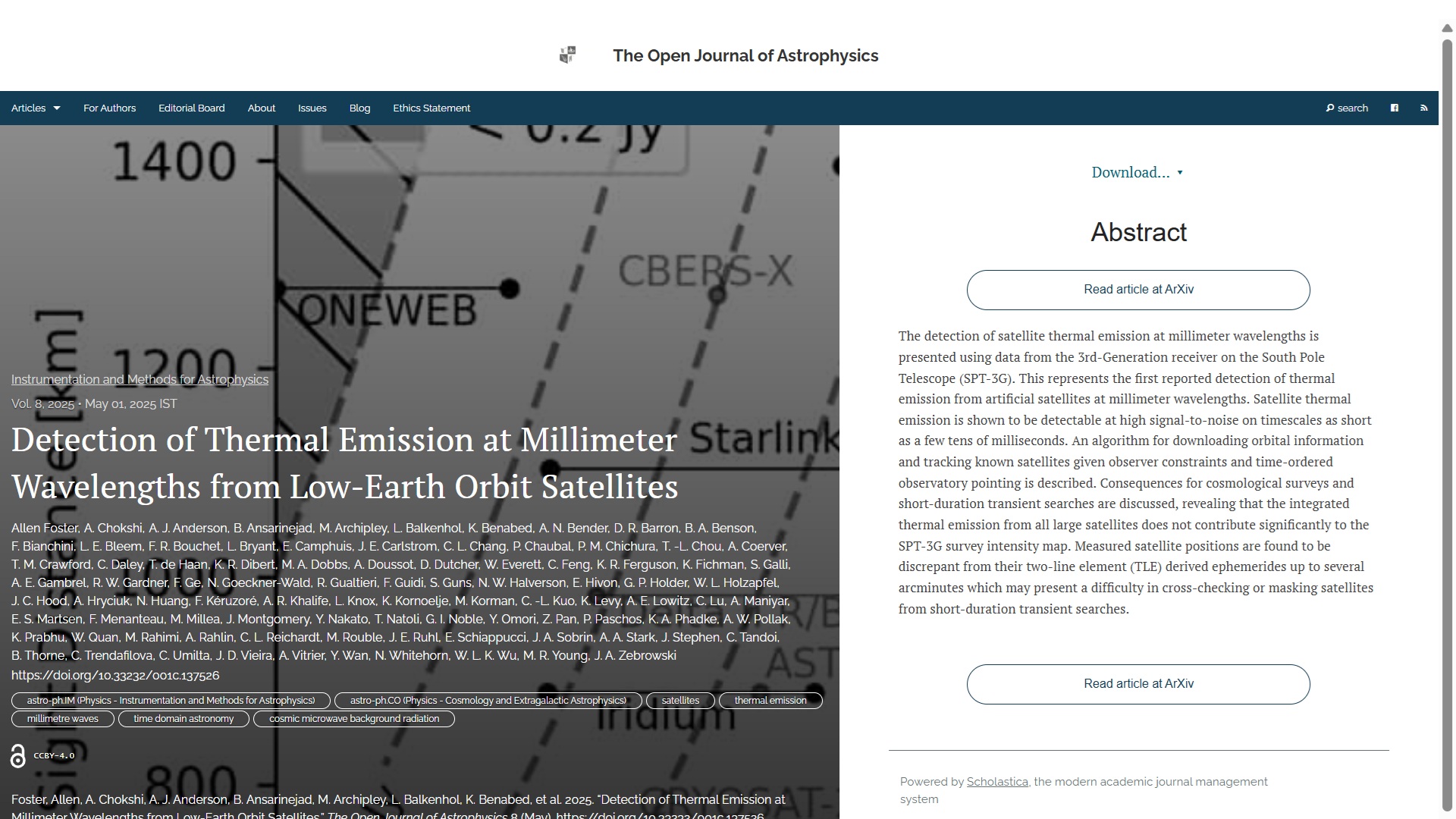
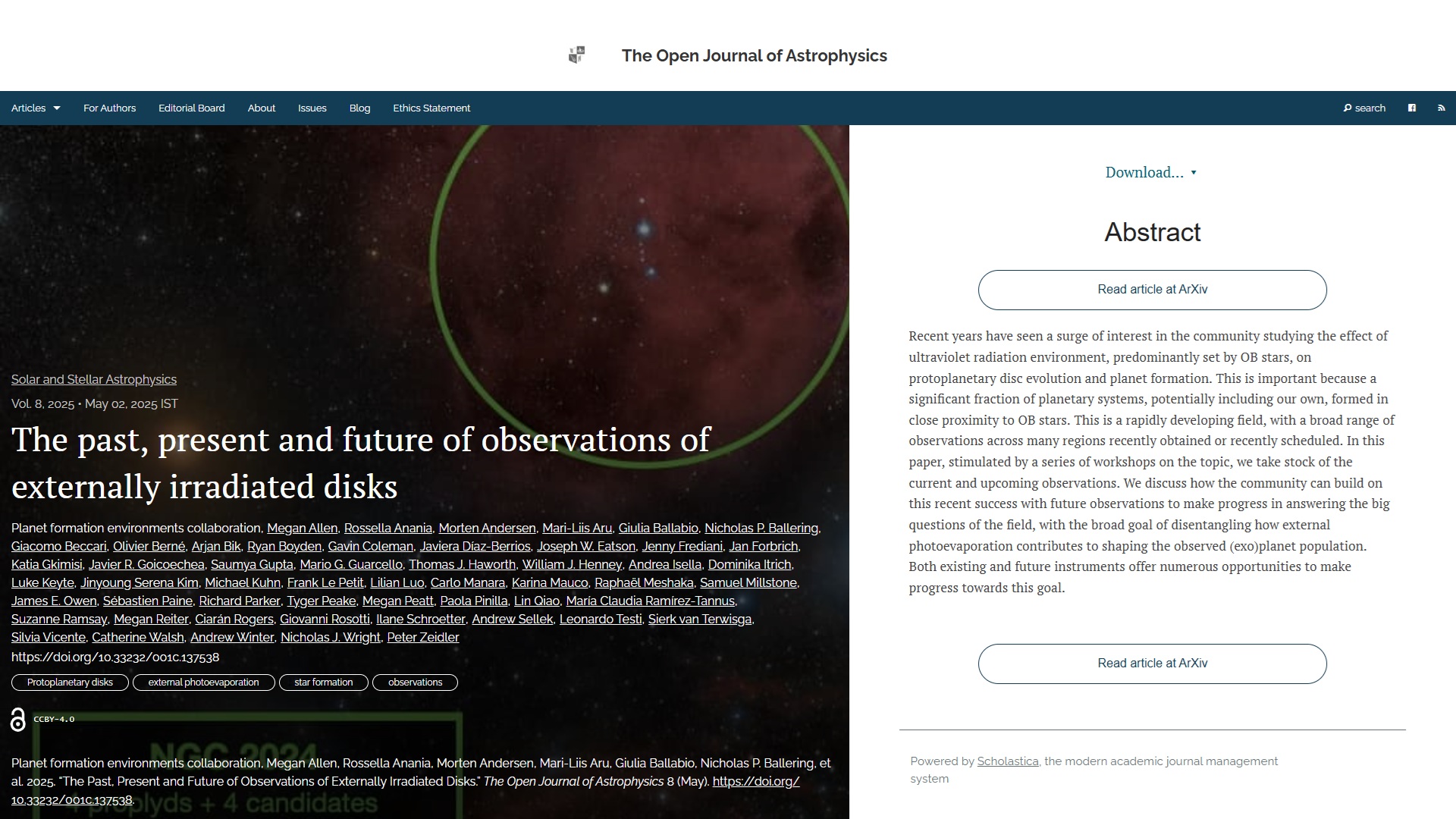
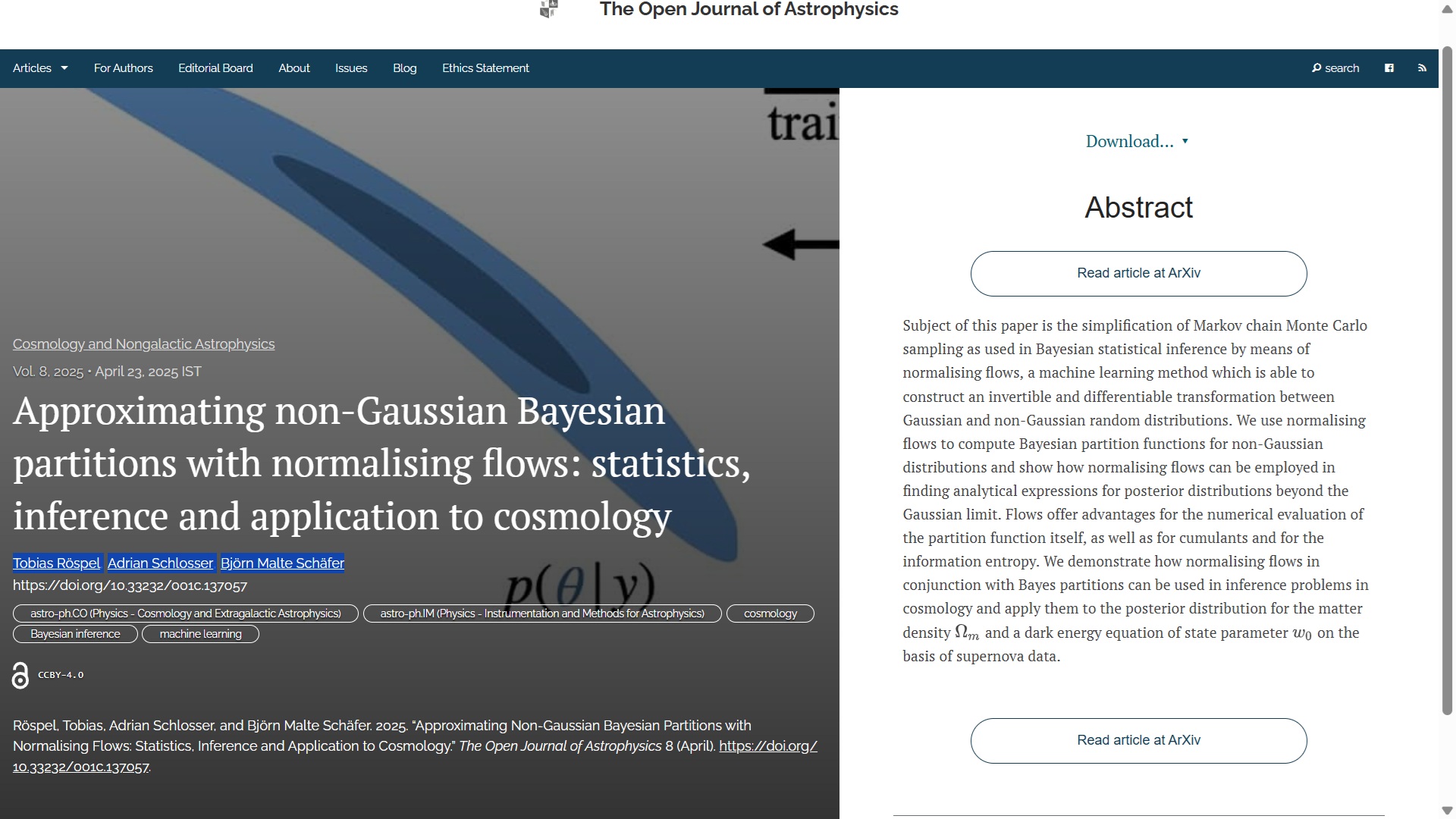
Time for the weekly Saturday morning update of papers published at the Open Journal of Astrophysics. Since the last update we have published four new papers, which brings the number in Volume 8 (2025) up to 37 and the total so far published by OJAp up to 272.

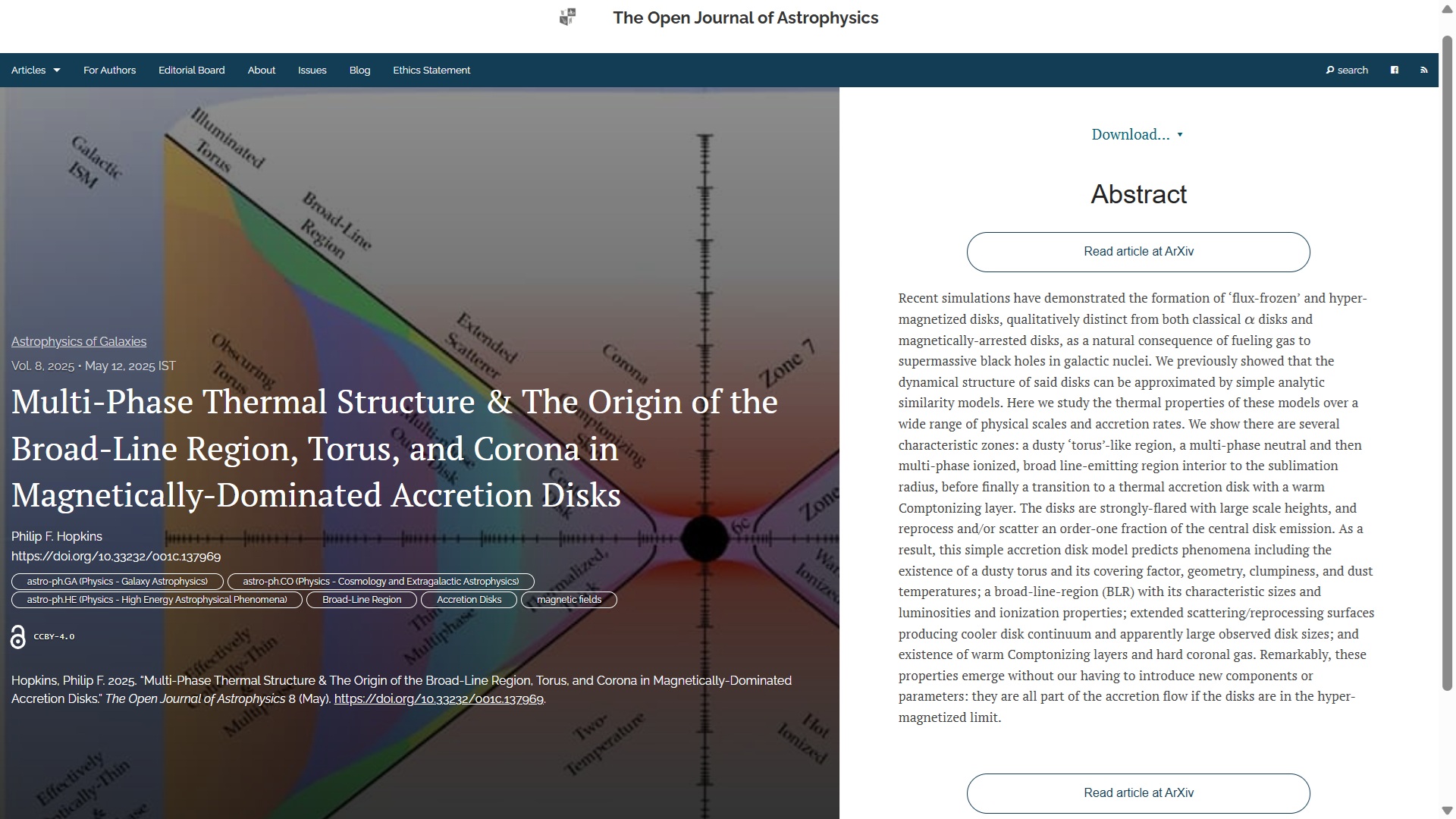
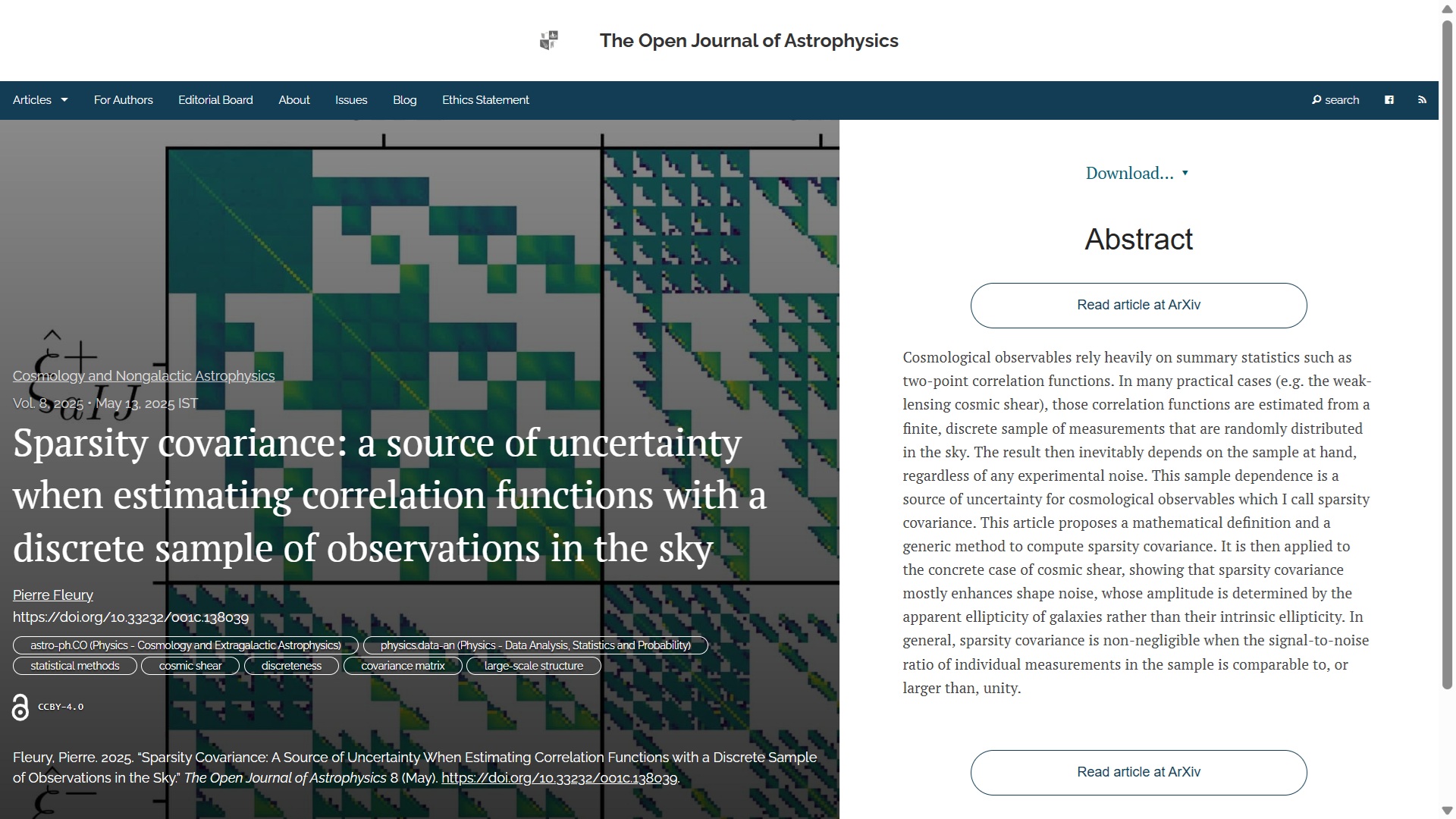
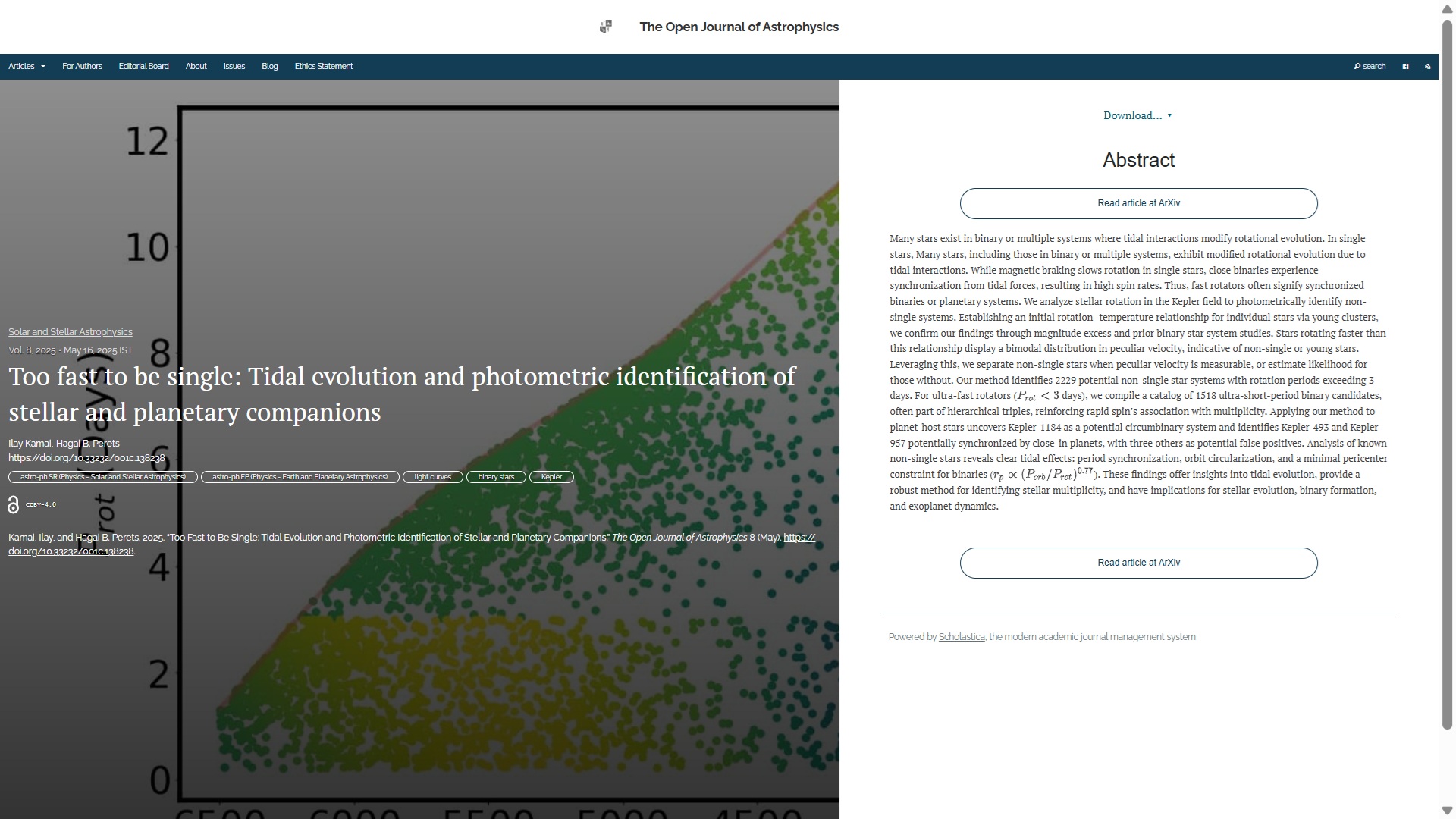
In chronological order of publication, the four papers published this week, with their overlays, are as follows. You can click on the images of the overlays to make them larger should you wish to do so.

The first paper to report is “Searching for new physics using high precision absorption spectroscopy; continuum placement uncertainties and the fine structure constant in strong gravity” by Chung-Chi Lee (Big Questions Institute (BQI), Sydney, Australia), John K. Webb (Cambridge, UK), Darren Dougan (BQI), Vladimir A. Dzuba & Victor V. Flambaum (UNSW, Australia) and Dinko Milaković (Trieste, Italy).

This presents a discussion of the problem of continuum placement in high-resolution spectroscopy, which impacts significantly on fine structure constant measurements, and a method for mitigating its effects. The paper is in the folder Solar and Stellar Astrophysics and was published on Tuesday 8th April 2025. The overlay is here:

You can find the officially-accepted version of the paper on arXiv here.

The second paper to announce, also published on 8th April 2025,  is “Deciphering Spatially Resolved Lyman-Alpha Profiles in Reionization Analogs: The Sunburst Arc at Cosmic Noon” by Erik Solhaug (Chicago, USA), Hsiao-Wen Chen (Chicago), Mandy C. Chen (Chicago),  Fakhri Zahedy (University of North Texas),  Max Gronke (MPA Garching, Germany),  Magdalena J. Hamel-Bravo (Swinburne, Australia), Matthew B. Bayliss (U. Cincinatti), Michael D. Gladders  (Chicago), Sebastián López (Universidad de Chile), Nicolás Tejos (Universidad Católica de Valparaíso, Chile).

This paper, which presents a study of the Lyman-alpha emission properties of a gravitationally-lensed galaxy at redshift z=2.37, appears in the folder Astrophysics of Galaxies. It was published


You can read the officially accepted version of this paper on arXiv here.

The third paper of the week  is “On the progenitor of the type Ia supernova remnant 0509-67.5” by Noam Soker (Technion, Haifa, Israel). This one was published on Wednesday 9th April 2025 in the folder High-Energy Astrophysical Phenomena. The author discusses possible ideas for the origin of a supernova that exploded inside a planetary nebula.

Here is the overlay:


You can find the officially accepted version of this paper on arXiv here.

Last (but certainly) not least for this week, published on April 11th 2025, we have “Are Models of Strong Gravitational Lensing by Clusters Converging or Diverging?” by Derek Perera (U. Minnesota), John H Miller Jr & Liliya L. R. Williams (U. Minnesota, USA), Jori Liesenborgs (Hasselt U., Belgium), Allison Keen (U. Minnesota), Sung Kei Li (Hong Kong University), Marceau Limousin (Aix Marseille Univ., France).  This papers study various models of a strong gravitational lensing system, the results suggesting that lens models are neither converging to nor diverging from a common solution for this system, regardless of method.

Here is the overlay:


The official published version can be found on the arXiv here.


That’s all the papers for this week. By way of a postscript I’ll just mention that the gremlins that have affected submissions to Crossref (which we rely on for registering the article metadata) have now been resolved and normal services have been restored.

R.I.P. Jerry Ostriker (1937-2025)

Posted in R.I.P., The Universe and Stuff with tags , , , , , , on April 9, 2025 by telescoper

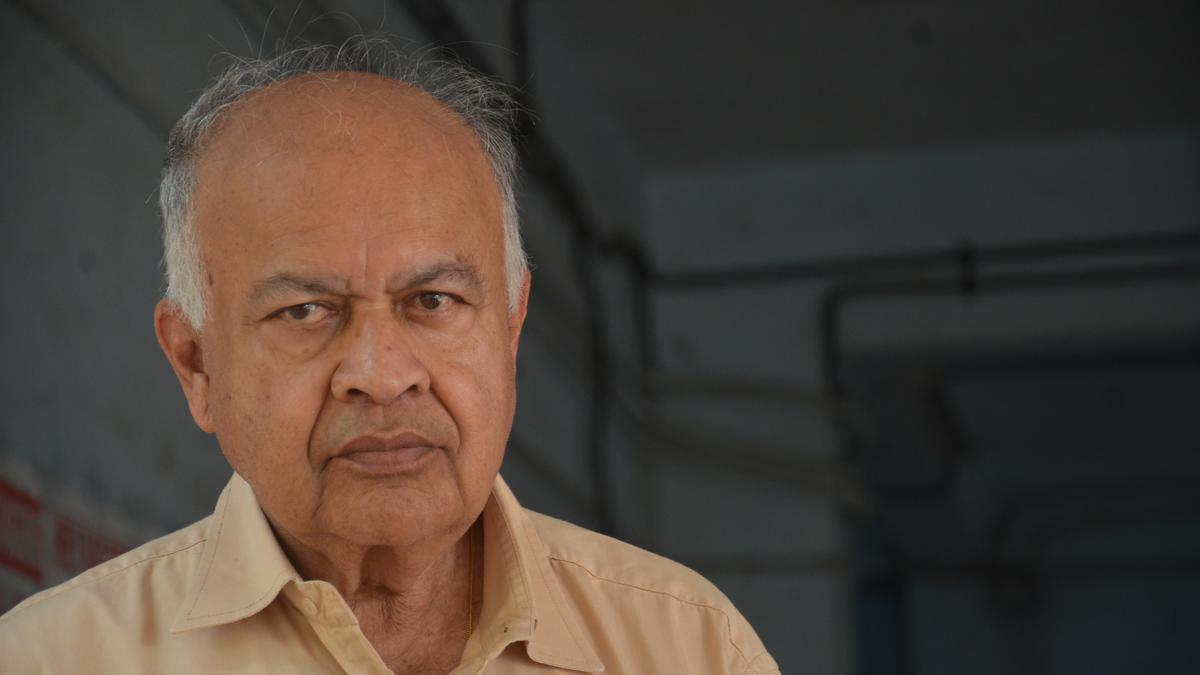
Once again I find myself using this blog to pass on sad news. This time it is of the death of renowned astrophysicist Jerry Ostriker (pictured left in 2012), who passed away on Monday 6th April 2025 just a week before his 88th birthday.

Jeremiah Paul Ostriker (to give his full name) was an extremely energetic, versatile and influential theorist who worked on a wide range of problems in diverse areas of astrophysics and produced a number of classic papers. Close to my own specialism I would quote two in particular: one written with Jim Peebles in 1973 about the stability of galactic disks; and the other with Martin Rees in 1977 about the role of gas cooling and fragmentation in determining the size of galaxies and clusters. He also did much to establish the use of hydrodynamic simulations in cosmology and was an early adopter of the current standard cosmological model, including a cosmological constant. He worked on many other things too, including pulsars and galactic nuclei.

I only met Jerry Ostriker a few times, mainly at conferences – where he was never shy to contribute to discussions after talks – but also once back in the 1990s when I was a visitor Princeton (where he was Professor). I didn’t have much time to talk to him then as he always seemed to be on the go, so I never really got to know him personally. After spending most of his career in Princeton, including a spell as Provost, in 2001 Ostriker moved to Cambridge for a short stint as Plumian Professor, before returning to Princeton.

There is a very nice obituary of Jerry Ostriker by Dennis Overbye in the New York Times.

Rest in peace, Jerry Ostriker

Weekly Update from the Open Journal of Astrophysics – 05/04/2025

Posted in OJAp Papers, Open Access, The Universe and Stuff with tags , , , , , on April 5, 2025 by telescoper

It’s time once more for the regular Saturday morning update of papers published at the Open Journal of Astrophysics. Since the last update we have published one new paper. The number of articles in Volume 8 (2025) is now up to 33 and the total so far published by OJAp up to 268.

The paper concerned, published on 2nd April 2025, is “The molecular gas content throughout the low-z merger sequence” by Mark T. Sargent (ISSI, Bern), S. L. Ellison (U. Victoria, Canada), J. T. Mendel (ANU), A. Saintonge (UCL), D. Cs. Molnár & T. Schwandt (U. Sussex), J. M. Scudder (Oberlin College, USA) and G. Violino (U. Hertfordshire). It is published in the folder Astrophysics of Galaxies and it discusses the observed properties of molecular gas in post-merger galaxies and interacting pairs and the physical origin of these properties.

Here is the overlay:

You can read the officially accepted version of this paper on arXiv here.

That’s all for this week. I’ll do another update next Saturday.

The Universe from Beginning to End

Posted in Maynooth, The Universe and Stuff with tags , , , on April 2, 2025 by telescoper

It’s not every day that you get the chance to attend a lecture by a Nobel Laureate, but 14th April 2025 will be such a day in Maynooth because the annual Dean’s Lecture for the Faculty of Science and Engineering at Maynooth University will be given by Professor Brian Schmidt who was one of the three winners of the 2011 Nobel Prize for Physics.

The description of his lecture is as follows:

Astronomers have pieced together the story of our Universe that begins more than 13 Billion years ago in a Big Bang. In the 2025 Dean’s Lecture, Nobel Prize Winner Prof Brian Schmidt will describe the journey that science has thus far taken to understand our Universe, describing what we know about the Cosmos and how we know it, as well as reflecting on some of the mysteries that remain. A chance to learn a bit about everything from Dark Energy to Black Holes, and an opportunity for the audience to ask questions at the end of the lecture.

The lecture is intended to be accessible to a wide audience and will be in person. It is free to attend but you need to register because space in the lecture venue is limited. To register and also find out more about the event please visit Eventbrite below:

I am delighted that Brian is taking time out of his busy schedule to visit us in Maynooth and am looking forward not only to his lecture but also for the chance for him to meet and talk to our students.

Last Chance to apply for the Professorial Position in Observational Astrophysics or Cosmology at Maynooth University!

Posted in Maynooth, The Universe and Stuff with tags , , , , on March 31, 2025 by telescoper

A couple of months ago I announced here a vacancy for a Professor of Observational Astrophysics or Cosmology at Maynooth. The position is on the AAS Jobs Register here. The deadline is 31st March 2025 which is today so if you were thinking of applying then this is your last chance! Applications close at 23.30 Irish Time; the clocks went forward yesterday so it’s actually 00.30 tomorrow CEST so you still have time. The application portal is here.

The strategic case for this Chair revolves around broader developments in the area of astrophysics and cosmology at Maynooth. Currently there are two groups active in research in these areas, one in the former Department of Experimental Physics (which is largely focussed on astronomical instrumentation) and the other, in the former Department of Theoretical Physics, which is theoretical and computational. We want to promote closer collaboration between these research strands. The idea with the new position is that the holder will nucleate and lead a research programme in the area between these existing groups as well as getting involved in outreach and public engagement.

It is intended that the position to appeal not only to people undertaking observational programmes using ground-based facilities (e.g. those provided by ESO, which Ireland recently joined), or those exploiting data from space-based experiments, such as Euclid, as well as people working on multi-messenger astrophysics, gravitational waves, and so on.

P. S. For those of you reading this from outside Ireland the job is tenured and includes a defined benefit pension way better than the equivalent UK system.

The KiDS Legacy

Posted in The Universe and Stuff with tags , , , , , , , , on March 30, 2025 by telescoper

What with all the cosmological goings-on of the past couple of weeks – see here, here and here – I quite forgot to mention another important set of results. These are from the final data release Kilo-Degree Survey known as KiDS for short and represent a final analysis of the complete dataset. For those of you not in the know, KiDs is a weak lensing shear tomography survey and its core science drivers are to map the large scale matter distribution in the Universe and constrain the equation of state of Dark Energy. The results can be found in three papers on arXiv, which you can add to your reading list:

As far as I’m concerned, the main result to leap out from the cosmological analysis, which primarily constrains the clumpiness of matter in the universe, expressed by the density parameter Ωm and a fluctuation amplitude σ8 in the combined parameter “S8“, which is constrained almost independently from Ωm. The value obtained for this parameter by KiDS has previously been “in tension” with values from other experiments (notably Planck) ; see here for a discussion. The new results, however, seem consistent with the standard cosmological model. Here is a figure from the last paper in the above list that illustrates the point:

As is often the case, there’s also one of those nice Cosmology Talks videos that discusses this and other aspects of the KiDS Legacy results to which I refer you for more details!

Weekly update from the Open Journal of Astrophysics – 29/03/25

Posted in OJAp Papers, Open Access, The Universe and Stuff with tags , , , , , , , , , , , on March 29, 2025 by telescoper

It’s time once more for the regular Saturday morning update of papers published at the Open Journal of Astrophysics. Since the last update we have published three new papers which brings the number in Volume 8 (2025) up to 32 and the total so far published by OJAp up to 267.

We’re almost at the end of March so I checked the records. In the first three months of last year we published 22 papers, compared to the 32 so far this year.

We were affected by a few gremlins in the works at Crossref this week which delayed some submissions. Since our DOIs are generated and registered with Crossref at the time of publication this delayed some papers a little.  I think these problems are ongoing but I know that the team at Crossref are working on them so expect will be fixed soon.

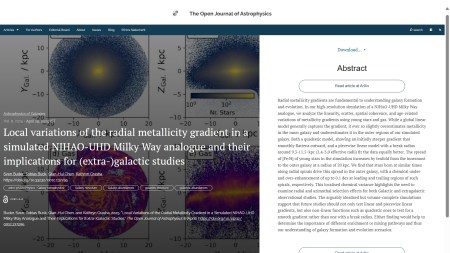
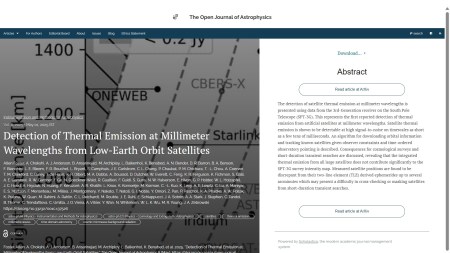
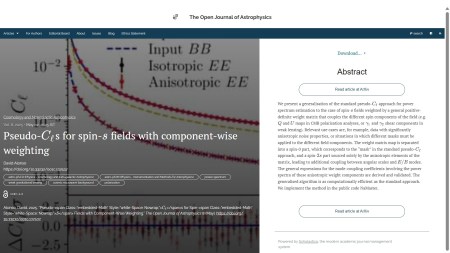
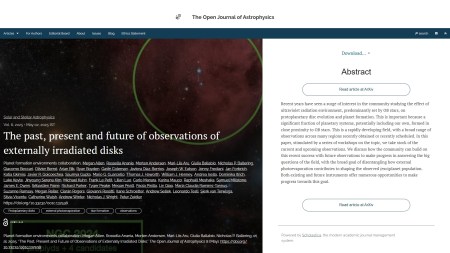
Anyway, in chronological order of publication, the three papers published this week, with their overlays, are as follows. You can click on the images of the overlays to make them larger should you wish to do so.

The first paper to report is “Gravitational Lensing of Galaxy Clustering” by Brandon Buncher & Gilbert Holder (University of Illinois Urbana Champaign) and Selim Hotinli (Perimeter Institute, Canada). This paper is in the folder marked Cosmology and NonGalactic Astrophysics and it was published on Thursday 27th March 2025. it presents a study of the cross-correlations between lensing reconstruction using galaxies as sources with cosmic shear measurements.

Here is the overlay:


You can read the officially accepted version of this paper on arXiv here.

The second paper of the week is “Reformulating polarized radiative transfer for astrophysical applications. (I) A formalism allowing non-local Magnus solutions” by Edgar S. Carlin (Instituto de Astrofísica de Canarias), Sergio Blanes (Universitat Politcècnica de Valencia) & Fernando Casas (Universitat Jaume I), all in Spain.

It appears in the folder Solar and Stellar Astrophysics. It presents a new family of numerical radiative transfer methods and their potential applications such as accelerating calculations involving Non-Local Thermodynamic Equilibrium. This paper was published on Friday 28th March 2025.

Here is the overlay:


You can find the officially accepted version of this paper on arXiv here.

The final paper, also published on Friday 28th March, is in the folder
Cosmology and NonGalactic Astrophysics. The title is “CosmICweb: Cosmological Initial Conditions for Zoom-in Simulations in the Cloud” and the authors are Michael Buehlmann (Argonne National Laboratory), Lukas Winkler (U. Wien), Oliver Hahn (U. Wien), John C. Helly (ICC Durham) and Adrian Jenkins (ICC Durham).

This paper describes a new database and web interface to store, analyze, and disseminate initial conditions for zoom simulations of objects forming in cosmological simulations. The database can be accessed directly here.

Here is the overlay:


The official published version can be found on the arXiv here.

That’s all for this week. I’ll do another update next Saturday.
MSc in Theoretical Physics & Mathematics at Maynooth

Posted in Education, Maynooth, The Universe and Stuff with tags , , on March 27, 2025 by telescoper

It is time once again to use the medium of this blog to advertise the fact that the MSc in Theoretical Physics & Mathematics at Maynooth University is open to applications for entry in September.

This postgraduate course is run jointly between the Departments of Physics and Mathematics & Statistics, with each contributing about half the material. The duration is one calendar year (full-time) or two years (part-time) and consists of 90 credits in the European Credit Transfer System (ECTS). This is split into 60 credits of taught material (split roughly 50-50 between Theoretical Physics and Mathematics) and a research project of 30 credits, supervised by a member of staff in a relevant area from either Department.

This course is a kind of follow-up to the existing undergraduate BSc Theoretical Physics & Mathematics at Maynooth, also run jointly. We think the postgraduate course will appeal to many of the students on that programme who wish to continue their education to postgraduate level, though applications are very welcome from suitably qualified candidates who did their first degree elsewhere.

Here is the “official” poster:

You can register your interest by scanning the QR code or, if you prefer, following the link here.

The Particle Physics Opera

Posted in Opera, The Universe and Stuff on March 26, 2025 by telescoper

I thought I’d use the excuse that I’m teaching particle physics again to revive an old idea linking that subject to Mozart’s Opera The Magic Flute (Die Zauberflöte, K. 620).

I can’t remember how many times I have seen this opera performed nor in how many different productions. It’s a wonderful creation because it manages to combine being utterly daft with being somehow immensely profound. The plot makes no sense at all, the settings are ridiculous (e.g. “rocks with water and a cavern of fire”), and the whole thing appears to be little more than a pantomime. Since it’s Mozart, though, there is one ingredient you can’t quibble with: a seemingly unending sequence of gorgeous music.

When I first saw The Magic Flute I thought it was just a silly but sublime piece of entertainment not worth digging into too deeply. I wondered why so many pompous people seemed to take it so terribly seriously. Real life doesn’t really make much sense, so why would anyone demand that an opera be any less ridiculous? Nevertheless, there is a vast industry devoted to unravelling the supposed “mystery” of this opera, with all its references to magic and freemasonry.

But now I can unveil the true solution of problem contained within the riddle encoded in the conundrum that surrounds the enigma that has puzzled so many Opera fans for so long. I have definitive proof that The Magic Flute is not about freemasons or magic or revolutionary politics. It is actually about particle physics.

To see how I arrived at this conclusion note the following figure which shows the principal elementary particles contained within the standard model of particle physics:

To the left of this picture are the fermions, divided into two sets of particles labelled “quarks” and “leptons”. Each of these consists of three pairs (“doublets”), each pair defining a “generation”. This structure of twos and threes is perfectly represented in the cast The Magic Flute.

Let’s consider the leptons first. These can be clearly identified with the three ladies who lust after the hero Tamino in Act 1. This emotional charge is clearly analogous to the electromagnetic charge carried by the massive leptons (the electron, muon and tauon, lying along the bottom of the diagram). The other components in the leptonic sector must be the three boys who pop up every now and again to help Papageno with useful advice about when to jangle his magic bells. These must therefore be the neutrinos, which are less massive than the ladies, and are also neutral (although I hesitate to suggest that this means they should be castrati). They don’t play a very big part in the show because they participate only in weak interactions.

Next we have the quarks, also arrayed in three generations of pairs. These interact more strongly than the leptons and are also more colourful. The first generation is easy to identify, from the phenomenology of the Opera, as consisting of the hero Tamino (d for down) and his beloved Pamina (u for up); her voice is higher than his, hence the identification. The second generation must comprise the crazy birdcatcher Papageno (s for strange) and his alluring madchen who is called Papagena (c for charmed). That just leaves the final pairing which clearly is the basso profundo and fount of all wisdom Sarastro (b for bass bottom) and my favourite character and role model the Queen of the Night (t for top).

To provide corroboration of the identification of the Queen of the Night with the “top” quark, here is a clip from Youtube of a bevy of famous operatic sopranos having a go at the immensely different coloratura passage from the Act 1 aria “O Zittre Nicht, mein leiber Sohn” culminating in a spectacular top F that lies beyond the range of most particle accelerators, never mind singers.

There’s some splendid frocks in there too.

The Queen of the Night isn’t actually in the Opera very much. After this aria in Act 1 she disappears until the middle of Act 2, probably because she needs to have a lie down. When she comes back on she sings another glass-shattering aria (Der Hölle Rache kocht in meinem Herzen), which I like to listen to when I’m writing referee reports. The first line translates as “The rage of hell is boiling in my heart”.

The remaining members of the cast – The Speaker and Monostatos, as well as sundry priests, slaves, enchanted animals and the chorus – must make up the so-called Force carriers at the left of the table, which are bosons, but I haven’t had time to go through the identifications in detail. They’re just the supporting cast anyway. And there is one particle missing from the picture, the Higgs boson. This accounts for the masses of other particles by exerting a kind of drag on them so it clearly must be the Dragon from Act 1.

Not in Leiden…

Posted in Biographical, The Universe and Stuff with tags , , on March 24, 2025 by telescoper

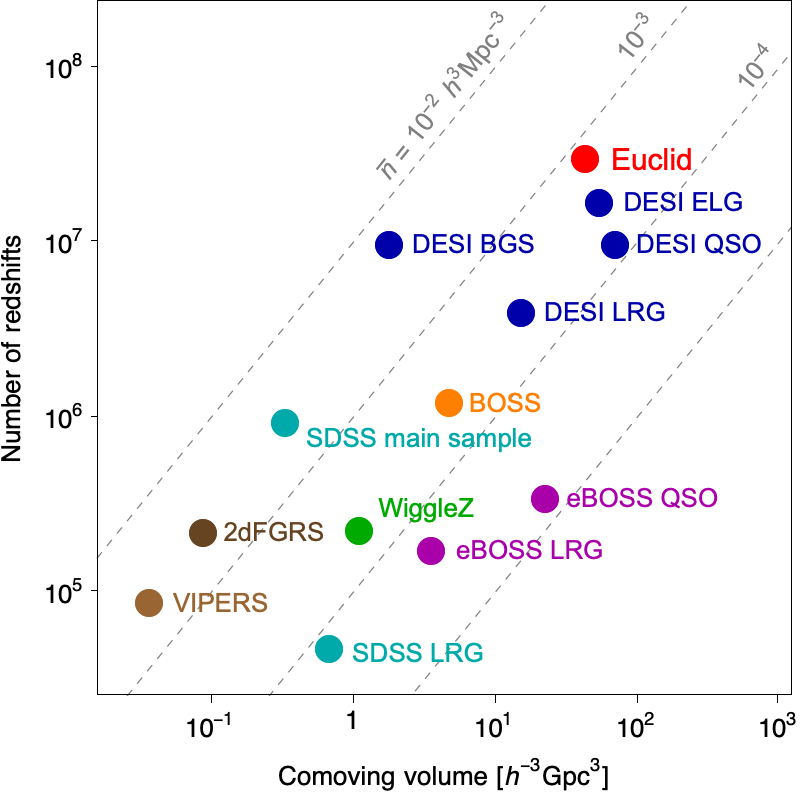
It’s been a very busy day back to teaching after last week’s study break. This week there’s a big meeting in Leiden (Netherlands) which I would like to have attended as it combines the annual Euclid Consortium meeting with the 56th ESLAB Symposium. No doubt there’ll be a lot of discussion of the Euclid Q1 results announced last week. I can’t go, however, because of teaching commitments. The Euclid meetings are quite often scheduled in the summer, so I have a chance to attend, but not this time.

Anyway, I thought I would post a relevant memory from a previous trip to Leiden, about 30 years ago. which was taken at a conference in Leiden (Netherlands) in 1995. Was that really 30 years ago? Various shady characters masquerading as “experts” were asked by the audience of graduate students at a summer school to give their favoured values for the cosmological parameters (from top to bottom: the Hubble constant, density parameter, cosmological constant, curvature parameter and age of the Universe):

From left to right we have Alain Blanchard (AB), Bernard Jones (BJ, standing), John Peacock (JP), me (yes, with a beard and a pony tail – the shame of it), Vincent Icke (VI), Rien van de Weygaert (RW) and Peter Katgert (PK, standing). You can see on the blackboard that the only one to get anywhere close to correctly predicting the parameters of what would become the standard cosmological model was, in fact, Rien van de Weygaert…