Archive for the The Universe and Stuff Category

Weekly Update from the Open Journal of Astrophysics – 06/09/2025

Posted in OJAp Papers, Open Access, The Universe and Stuff with tags , , , , , , , , , , , on September 6, 2025 by telescoper

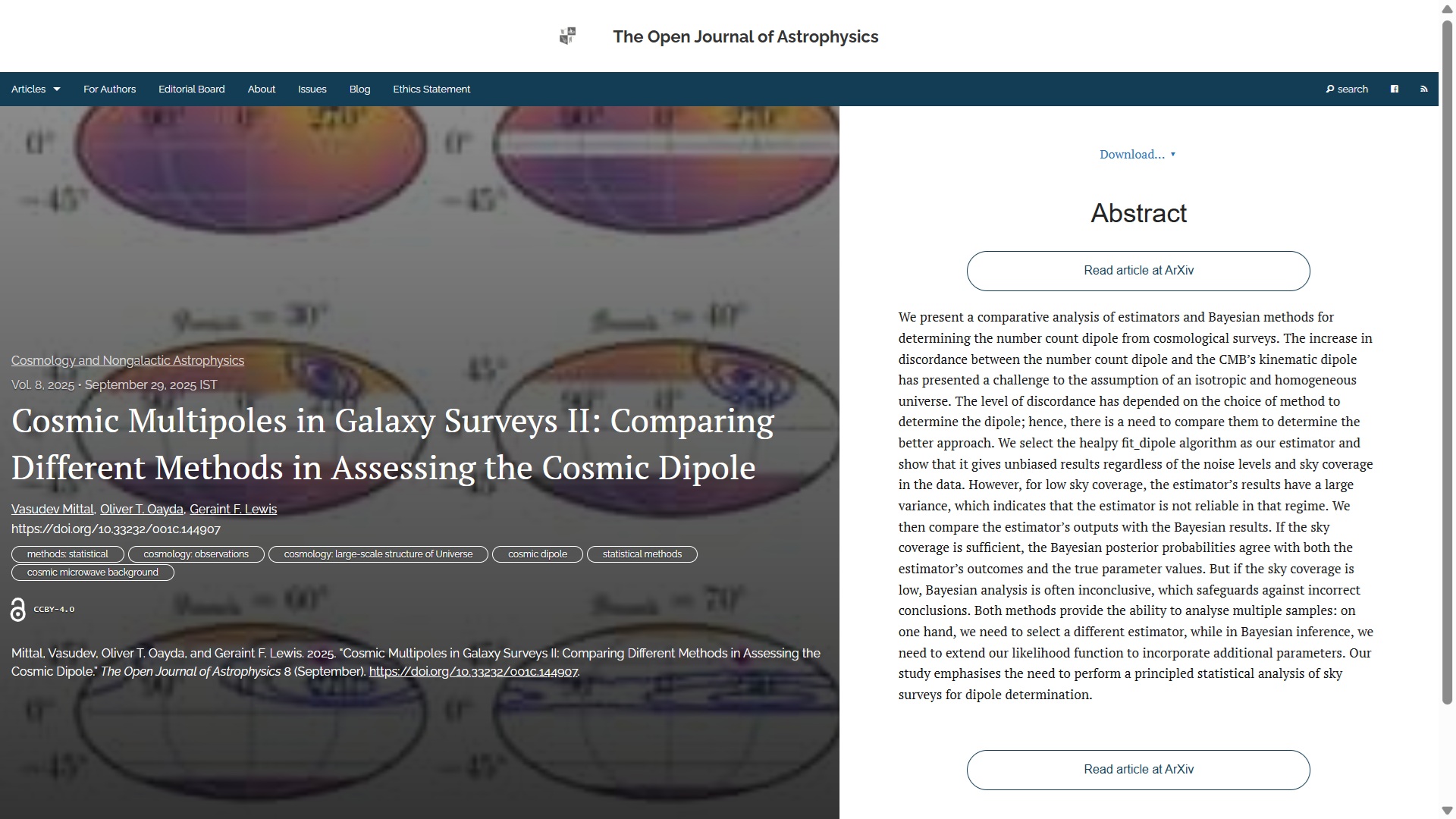
It’s Saturday again, so it’s time for a summary of the week’s new papers at the Open Journal of Astrophysics. Since the last update we have published two new papers, which brings the number in Volume 8 (2025) up to 127, and the total so far published by OJAp up to 362. It’s been another relatively slow week, not least because of the Labor (sic) Day holiday in the USA on Monday which, among other things, meant there was no arXiv update on Tuesday.

Anyway, the first paper to report this week is “An analytical model for the dispersion measure of Fast Radio Burst host galaxies” by Robert Reischke, Michael Kovač & Andrina Nicola (U. Bonn, Germany), Steffen Hagstotz (Ludwig-Maximilians Universität München) and Aurel Schneider (U. Zurich, Switzlerland). This is a theoretical study of the dispersion measures (DMs) intrinsic to host galaxies of Fast Radio Burst (FRB) sources to enable separation of that from the line-of-sight DM. This one was published on Monday 1st September 2025 in the folder Cosmology and NonGalactic Astrophysics.

The overlay is here:


You can make this larger by clicking on it.  The officially accepted version of this paper can be found on the arXiv here.

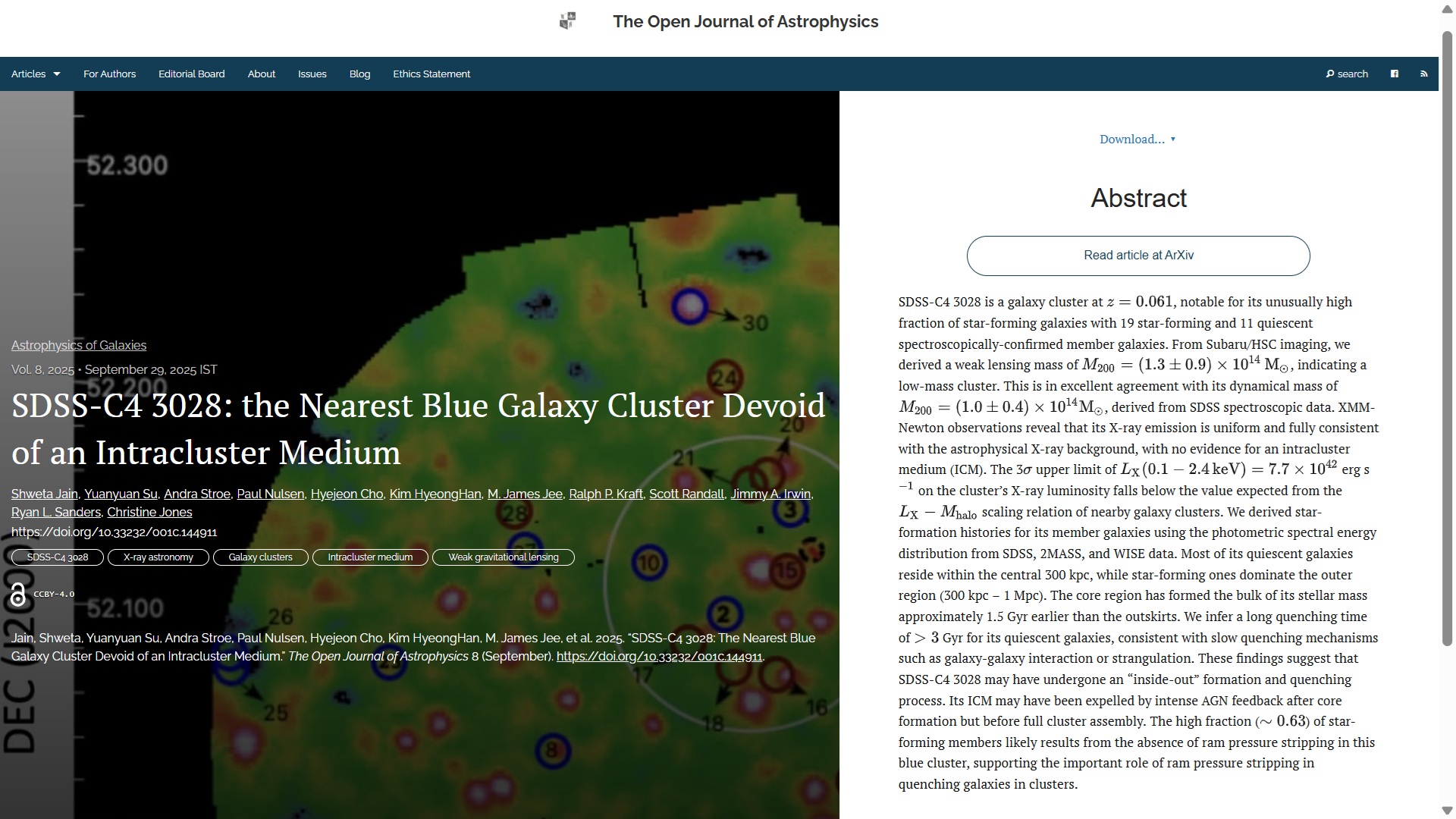
The second paper this week, published on Wednesday 3rd Sepember in the folder Solar and Stellar Astrophysics, is “Complex spectral variability and hints of a luminous companion in the Be star + black hole binary candidate ALS 8814” by Kareem El-Badry (Caltech, USA), Matthias Fabry (Villanova U., USA), Hugues Sana (KU Leuven, Belgium), Tomer Shenar (Tel Aviv U., Israel) and Rhys Seeburger (MPA Heidelberg, Germany).

The overlay for this one is here:


You can find the officially accepted version on arXiv here.

And that’s all the papers for this week. It’s still a bit slow as we emerge from the summer vacations, we have a lot of papers in the pipeline that I expect to emerge pretty soon.

A Hitchhiker’s Guide to the Swampland

Posted in Maynooth, The Universe and Stuff with tags , , , , , on September 5, 2025 by telescoper

A very comprehensive review article has appeared on arXiv with the title Hitchhiker’s Guide to the Swampland: The Cosmologist’s Handbook to the string-theoretical Swampland Programme by Kay Lehnert (who just happens to be my PhD student). The paper is 170 pages long and contains over 1,800 references, which gives some idea of what a large field this is and how much work Kay has put into writing it!

This is Figure 3 from Kays paper. If you would like to know more of what it is about, turn to page 50…

The abstract reads

String theory has strong implications for cosmology: it tells us that we cannot have a cosmological constant, that single-field slow-roll inflation is ruled out, and that black holes decay. We elucidate the origin of these statements within the string-theoretical swampland programme. The swampland programme is generating a growing body of insights that have yet to be incorporated into cosmological models. Taking a cosmologist’s perspective, we highlight the relevance of swampland conjectures to black holes, dark matter, dark energy, and inflation, including their implications for scalar fields such as quintessence and axions. Our goal is to inspire cosmological model builders to examine the compatibility of effective field theories with quantum gravitational UV completions and to address outstanding cosmological tensions such as the Hubble tension. This comprehensive literature review presents clear definitions, cosmological implications, and the current status – including evidence and counterexamples – of the following swampland conjectures: the anti-de Sitter distance conjecture (AdSDC), the completeness conjecture (CC), the cobordism conjecture, the de Sitter conjecture (dSC), the swampland distance conjecture (SDC), the emergence proposal (EP), the Festina Lente Bound (FLB), the finite number of massless fields conjecture (or finite flux vacua conjecture (FFV)), the no global symmetries conjecture, the no non-supersymmetric theories conjecture, the non-negative null energy condition conjecture, the positive Gauss-Bonnet term conjecture, the species scale conjecture, the gravitino swampland conjecture (GSC), the tadpole conjecture, the tameness conjecture, the trans-Planckian censorship conjecture (tPCC/TCC), the unique geodesic conjecture, and the weak gravity conjecture (WGC), including the repulsive force conjecture (RFC).

This is essentially the literature review part of Kay’s thesis; the aim of his research is to study the implications of the string-theoretical swampland programme for cosmology. He’s particularly interested in the predictions string theory makes regarding inflation, dark energy, and dark matter, and the impact this has on the Hubble tension. The point of writing this review was to suggest projects that might be undertaken to bring string theory into the realm of testability, thus suppling material for the rest of Kay’s thesis, but I think it is also a very good guide for cosmologists of all types to what the swampland conjectures are and what they do and do not say about the Universe we actually live in.

A Primordial Black Hole?

Posted in The Universe and Stuff with tags , , , , , on September 3, 2025 by telescoper

There’s a recent paper on arXiv with the title A direct black hole mass measurement in a Little Red Dot at the Epoch of Reionizationon by Juodžbalis et al. that is causing a lot of interest. The paper is here and the abstract is:

There is a discussion of this in the Grauniad here and in several other places on the interwebs. It comes hard on the heels of the theoretical paper announced here.

I only saw this paper yesterday and, now that I’ve read it, it isn’t really all that clear to me what this object is. No doubt there’ll be considerable follow-up. One possibility – and it is just a possibility – is that we are seeing evidence of a primordial black hole, called a PBH for short. These are black holes formed by direct collapse in the early Universe rather than by merging of stellar black holes. Note the use of the word “naked” is rather misleading. It does not mean a naked singularity, in the sense of a singularity without an event horizon around it. In this case it just means that it appears not to be surrounded by accreting material or even a host galaxy.

A PBH of mass M would form at a particular cosmic time t if a region of radiius ~ct (the cosmological horizon scale) collapses into a black hole. Obviously this would require a large fluctuation in density on that scale but if a PBH does form then its mass will be roughly the mass contained within the horizon, i.e. M ~ ρ(t) (ct)3 (ignoring dimensionless factors). The sort of mass required (~106 M) corresponds to a time when the Universe was radiation-dominated and before matter and radiation decoupled. What would be inside such a black hole is therefore predominantly trapped radiation, which is Quite Interesting, but as far as the outside universe is considered it’s just a massive black hole.

Graphic by European Space Agency showing how structure formation might be affected by PBH formation

Anyway, during radiation domination, the mass-energy density of the Universe ρ(t) ∝ t-2, so the horizon mass increases linearly with t. According to the standard cosmology, the epoch of radiation domination lasts for approximately 50,000 years after the Big Bang, i.e. of order 1012 seconds, and at the end of it the horizon mass is of order 1014 M. Assuming that the universe is completely radiation-dominated before that the time at which a PBH of mass 106 M would form is about 104 seconds, i.e. getting on for 3 hours after the Big Bang. This is after the end of cosmological nucleosynthesis, but not by much. Primordial black holes of lower mass than this would form earlier, with a stellar mass PBH having to collapse around the time of the quark-hadron transition. Lighter PBHs would form even earlier.

The numbers I’ve quoted are very approximate, back-of-the-envelope, ballpark guesstimates. For one thing not all of the horizon mass will end up in a PBH: energy may well be released during the collapse. Moreover, some PBHs on one scale will subsequently be subsumed within objects of larger mass. Also I’ve ignored quite a lot of numerical factors. All this will have to be worked out properly, but there are potential constraints on any physical processes that might give rise to PBHs on the relevant scale if they involve a release of significant amount of energy as there may not be time for this excess to be thermalized by scattering or they may intefere with the element abundances predicted by nucleosynthesis.

That is all assuming it is a primordial black hole in the first place…

Galaxies and Black Holes in the First Billion Years

Posted in Biographical, The Universe and Stuff with tags , , , , , on September 1, 2025 by telescoper

Trying to catch up on recent developments in galaxy formation? I can heartily recommend an excellent review article on the subject by Richard Ellis which you can find on the arXiv here. The abstract reads:

 I present written notes from three lectures given at the 54th Saas-Fee Advanced Course of the Swiss Society of Astrophysics and Astronomy in January 2025 entitled “Galaxies and Black Holes in the First Billion Years as seen by the JWST”. I focused my lectures on progress in studies of cosmic reionisation, the properties of galaxies in the reionisation era, topics related to the redshift frontier and the search for Population III stars. The lectures were given to graduate students in astrophysics and cover both pedagogical material as well as observational results from the first two and half years of JWST science operations. The pace of discovery with JWST is, of course, rapid and so my lectures discuss long-term goals, analysis methods and their assumptions and limitations in the hope that the underlying material will retain value in the near future. In this written version, the visual material is that presented at Saas-Fee in January 2025 but I have provided updates on progress from the literature up to August 2025. The material is aimed at early career researchers and should not be considered as a scholarly review of the entire JWST literature on high redshift galaxies.

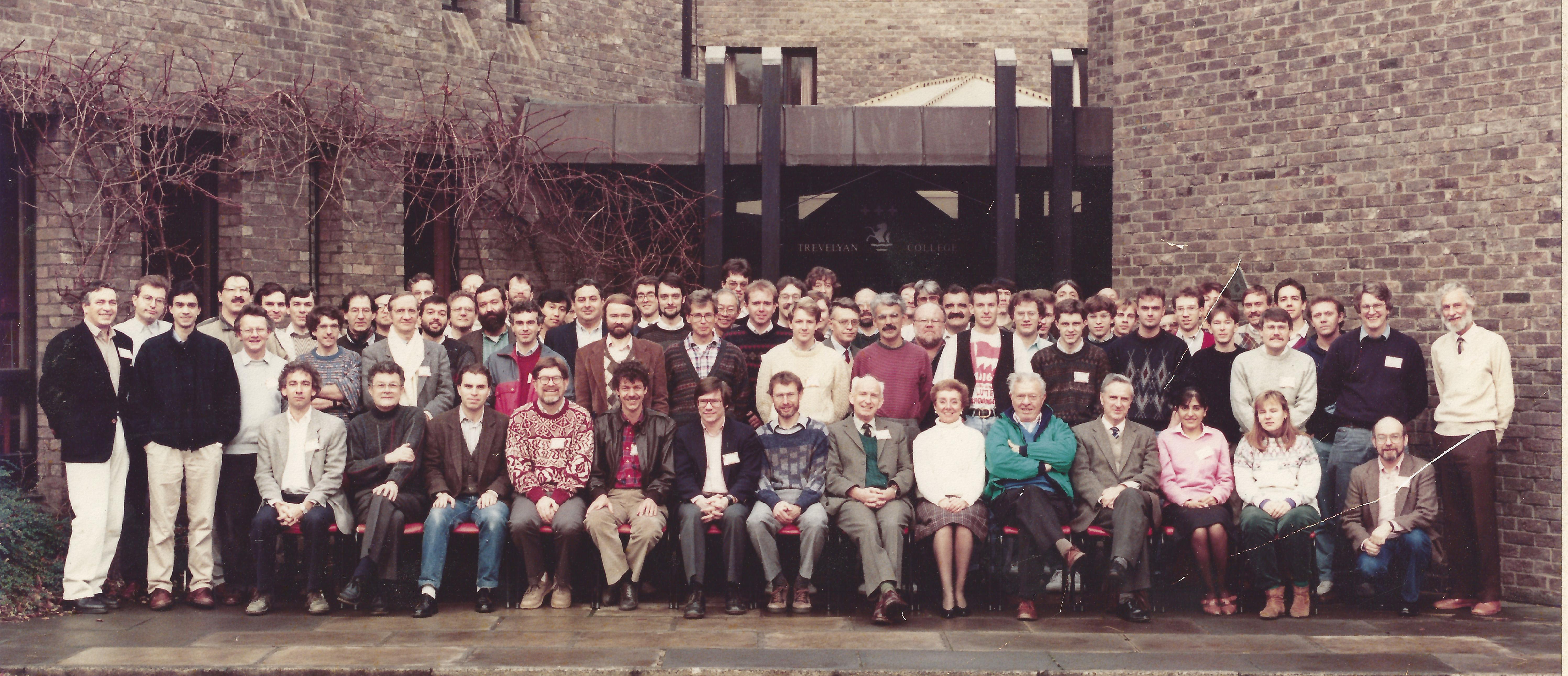
It’s quite a long article (65 pages) but nicely written and well worth reading, as it is full of information about recent advances as well as historical insights. Talking of which, there’s a picture on page 41 taken at a meeting in Durham in 1988 called The Epoch of Galaxy Formation that I attended while I was still a graduate student:

Richard Ellis himself is in the front row, left of centre with light-coloured trousers, checked shirt and hands in pockets. I’m in the picture too, but I’ll leave it up to you to find me!

A poll was held among the delegates at that meeting about various questions to do with galaxy formation. The majority opinions revealed by these votes nearly all turned out to be utterly wrong! That’s progress, I guess…

Weekly Update from the Open Journal of Astrophysics – 30/08/2025

Posted in OJAp Papers, Open Access, The Universe and Stuff with tags , , , , , , , , , , , , , , , on August 30, 2025 by telescoper

Once again it’s time for a summary of the week’s new papers at the Open Journal of Astrophysics. Since the last update we have published three new papers, which brings the number in Volume 8 (2025) up to 125, and the total so far published by OJAp up to 360.

The first paper to report this week is “Large-scale surveys of the quasar proximity effect” by Rupert Croft, Patrick Shaw & Ann-Marsha Alexis (Carnegie Mellon University; CMU), Nianyi Chen (Princeton), Yihao Zhou & Tiziana Di Matteo (CMU), Simeon Bird (UC Riverside), Patrick Lachance (CMU), and Yueying Ni (Harvard). This paper was published on Monday 25th August in the folder Cosmology and NonGalactic Astrophysics. It presents a CDM-based halo model of the quasar proximity effect, tested on quasar Lyman-alpha spectra from the ASTRID cosmological simulation, including self-consistent formation of quasar black holes and the intergalactic medium.

The overlay is here:


You can make this larger by clicking on it, as you can with all the overlays below. The officially accepted version of this paper can be found on the arXiv here.

The second paper this week, also published on Monday 25th August, but in the folder Astrophysics of Galaxies, is “Redshift evolution of Lyman continuum escape fraction after JWST” by Andrea Ferrara (Pisa), M. Giavalisco (UMass Amherst), L. Pentericci (Rome), E. Vanzella (Bologna), A. Calabrò (Rome) and M. Llerena (Rome). This paper is about the Attenuation-Free Model (AFM) for galaxies, in which radiation-driven outflows develop once the galaxy specific star formation rate exceeds a certain level, which is tested on data with positive results. The overlay is here:

You can find the officially accepted version on arXiv here.

The third and final paper this week is “Primordial black holes in cosmological simulations: growth prospects for supermassive black holes” by Lewis R Prole, John A Regan, Daxal Mehta & Peter Coles (National University of Ireland, Maynooth) and Pratika Dayal (Groningen, NL). This one was published in Astrophysics of Galaxies folder on Thursday 28th August 2025. You can read more about this paper here: basically it studies the growth of primordial black holes in the early Universe using numerical simulations, with implications for the subsequent formation of massive black holes.

The overlay is here:

You can find the officially accepted version of this one on arXiv here.

And that’s all the papers for this week. It’s still a bit slow as we emerge from the summer vacations, but I expect things will start to pick up from now on.

Primordial Black Holes in Cosmological Simulations – Update

Posted in Maynooth, The Universe and Stuff with tags , , on August 28, 2025 by telescoper

Just time for a quick update about a paper that I posted about at the start of the summer, when it appeared on arXiv. At that time it had already gained a bit of traction in the media, e.g. here. Well, the paper is now published in the Open Journal of Astrophysics. Obviously, as an author I was conflicted so not involved in the editorial process.

Here is the overlay:

For those of you not in the field, there is currently a big mystery about how galaxies we have found at high redshift with JWST managed to acquire massive black holes so early in the Universe’s evolution. Black holes can grow quickly in a dense environment by accreting mass onto an initial seed, but what are the seeds? In this paper we investigate the possibility that they were primordial black holes. These form directly from fluctuations in the early Universe, as opposed to astrophysical black holes which form from stellar collapse. We don’t know exactly what mass primordial black holes would have nor how numerous they would be, but this paper uses high-resolution numerical experiments to investigate their effects if they do exist.

Here’s a pretty picture which is a zoom into 200 pc of the full simulation. I think 10pc counts as high resolution for a cosmological simulation! The blue circle shows the most massive PBH in the simulation, the green circle shows its nearest neighbour. The colour scale represents the number-density of dark matter particles.

For more details, read the paper!

Weekly Update from the Open Journal of Astrophysics – 23/08/2025

Posted in OJAp Papers, Open Access, The Universe and Stuff with tags , , , , , , , , , , , , , , , , , , , , , , , , , on August 23, 2025 by telescoper

So it’s Saturday again, so it’s time for the usual update of papers published at the Open Journal of Astrophysics which I do every Saturday. Since the last update we have published six new papers, which brings the number in Volume 8 (2025) up to 122, and the total so far published by OJAp up to 357. As I mentioned here we have overtaken the total of 120 published in Volume 7 (2024) and are on track for in excess of 180 publications in 2025.

The first paper to report this week is “Mass-feeding of jet-launching white dwarfs in grazing and common envelope evolution” by Noam Soker (Technion, Haifa, Israel). This was published on Tuesday 19th August in the folder Solar and Stellar Astrophysics. It proposes a theoretical suggestion about the production of jets in common-envelope evolution with massive stars.

The overlay is here:

You can make this larger by clicking on it, as you can with all the overlays below. The officially accepted version of this paper can be found on the arXiv here.

The second paper this week, published on Wednesday 20th August in the folder Earth and Planetary Astrophysics, is “Transition metal abundance as a key parameter for the search of Life in the Universe” by Giovanni Covone and Donato Giovannelli (University of Naples, Italy). This paper presents an argument that the availability of transition elements is an essential feature of habitability, and should be considered as such in selecting exoplanetary targets in the search for life.

The overlay is here:

You can find the officially accepted version of the paper on arXiv here.

The third paper this week, also published on 20th August 2025 in the folder Earth and Planetary Astrophysics, is “Discrete element simulations of self-gravitating rubble pile collisions: the effects of non-uniform particle size and rotation” by Job Guidos, Lucas Kolanz and Davide Lazzati (Oregon State University, USA).  This presents a new computer code for simulating the growth of granular masses through collisions of smaller particles and discusses results generated by it.

The overlay for this one is here:

You can find the officially accepted version on arXiv here.

The next paper, the fourth this week, is “Seeing the Outer Edge of the Infant Type Ia Supernova 2024epr in the Optical and Near Infrared” by W.B. Hoogendam (University of Hawaii, USA) and 32 others – too numerous to list by name – based in various institutes in the USA, Australia, UK, Denmark, Taiwan and China. This paper was also published on Wednesday 20th August 2025, but in the folder High-Energy Astrophysical Phenomena.  The article reports on the results of optical-to-near-infrared photometry and spectroscopy of the Type Ia supernova (SN Ia) 2024epr and a discusses how these challenge models for this sort of supernova.

The overlay is here:

You can find the officially accepted version on arXiv here.

The fifth paper this week is “Computing Nonlinear Power Spectra Across Dynamical Dark Energy Model Space with Neural ODEs” by Peter L. Taylor of Ohio State University (USA).  This one shows how to compute the evolution of cosmological power spectra into the non-linear regime via neural differential equations. It was published on Friday 22nd August 2025 in the folder Cosmology and NonGalactic Astrophysics. The overlay is here:

You can find the officially accepted version on arXiv here.

And finally for this week we have “Symbiotic star candidates in Gaia Data Release 3” by Samantha E. Ball & Benjamin C Bromley (University of Utah, USA) and Scott J. Kenyon (Smithsonian Observatory, USA). This paper was published on Friday 22nd August in the folder Solar and Stellar Astrophysics. It describes a new search for symbiotic star candidates in Gaia Data Release 3 (GDR3), based on astrometric, photometric, and spectroscopic information. The overlay is here:

You can find the officially accepted version of this one on arXiv here.

And that’s all the papers for this week. I suppose there will come a time when we publish a paper on every day of the week and each week’s summary will contain a paper in each of the astro-ph categories on arXiv, but we haven’t done that yet. This week we published on every day but Monday 18th August, and have papers in four of the six categories.

Weekly Update from the Open Journal of Astrophysics – 16/08/2025

Posted in OJAp Papers, Open Access, The Universe and Stuff with tags , , , , , , , , , , , , on August 16, 2025 by telescoper

It’s time once again for the usual update of papers published at the Open Journal of Astrophysics which I do every Saturday. Since the last update we have published two new papers, which brings the number in Volume 8 (2025) up to 116, and the total so far published by OJAp up to 351. The summer lull we always expected is now upon us, so this will be a shorter post than we have had of late.

The first paper to report this week is “The reflex instability: exponential growth of a large-scale mode in astrophysical discs” by Aurélien Crida (Université Côte d’Azur, France), Clément Baruteau (Université de Toulouse, France), Jean-François Gonzalez (Universite Claude Bernard Lyon 1, France), Frédéric Masset (Universidad Nacional Autonoma de México) and Paul Segretain, Philippine Griveaud, Héloïse Méheut & Elena Lega (Université Côte d’Azur).  This paper was published on Tuesday August 12th 2025 in the folder marked “Earth and Planetary Astrophysics“. It discusses a exponentially-growing instability in gas discs around stars caused by the motion of the central star in response to the disc.

The overlay – which you can make larger by clicking on it – is here:

You can find the officially accepted version on arXiv here.

The other paper this week, published in the folder Cosmology and Nongalactic Astrophysics, is “The galaxy-IGM connection in THESAN: the physics connecting the IGM Lyman-alpha opacity and galaxy density in the reionization epoch” by Enrico Garaldi (University of Tokyo, Japan), Verena Bellscheidt (Technical University of Munich, Germany), Aaron Smith (York University, Canada) and Rahul Kannan (University of Texas at Dallas, USA).  It presents a study of the relation between the Lyman-alpha effective optical depth of quasar sightlines and the distribution of galaxiesas as a probe of ionized regions around sources of photons. It was published on Wednesday August 13th 2025.

The overlay is here:


You can find the officially accepted version of the paper on arXiv here.

That concludes the papers for this week. I’ll do another update next weekend, though I expect things will remain relatively quiet until September.

Weekly Update from the Open Journal of Astrophysics – 09/08/2025

Posted in OJAp Papers, Open Access, The Universe and Stuff with tags , , , , , , , , , , , , , , , , , , , , , on August 9, 2025 by telescoper

It’s Saturday morning so, once again, it’s time for an update of papers published at the Open Journal of Astrophysics. Since the last update we have published four new papers, which brings the number in Volume 8 (2025) up to 114, and the total so far published by OJAp up to 349.

The papers published this week, with their overlays, are as follows. You can click on the images of the overlays to make them larger should you wish to do so.

The first paper to report is “Caught in the Act of Quenching? – A Population of Post-Starburst Ultra-Diffuse Galaxies” by Loraine Sandoval Ascencio & M. C. Cooper (UC Irvine), Dennis Zaritsky, Richard Donnerstein & Donghyeon J. Khim (U. Arizona) and Devontae C. Baxter (UC San Diego). This paper was puvblished on Monday 4th August and is in the folder marked Astrophysics of Galaxies. It discusses a sample of Ultra-Diffuse Galaxies (UDGs) found to be post-starburst galaxies through spectroscopic analysis analysis of candidates selected from the Systematically Measuring Ultra-Diffuse Galaxies (SMUDGes) program.

The overlay is here:


The officially-accepted version can be found on arXiv here.

Next one up, published on Tuesday 5th August, in the folder Cosmology and Nongalactic Astrophysics, is “Damping Wing-Like Features in the Spectra of High Redshift Quasars: a Challenge for Fully-Coupled Simulations” by Nick Gnedin & Hanjue Zhu (University of Chicago, USA).  This paper presents a discussion of the difficulties that cosmological radiation transfer codes have in accounting for the existence of “neutral islands” in the universe at relatively low redshifts.

The overlay is here:


You can find the officially accepted version of the paper on arXiv here.

The third paper of the week is “Spectroscopic Analysis of Pictor II: a very low metallicity ultra-faint dwarf galaxy bound to the Large Magellanic Cloud” by Andrew Pace (U. Virginia, USA) and 32 others based in the USA, UK, Canada, Chile and Spain. This one was also published on Tuesday 5th August but in the folder Astrophysics of Galaxies. It describes Magellan/IMACS and Magellan/MIKE spectroscopy of the ultra-faint dwarf (UFD) galaxy Pictor II, which is located only 12 kpc from the Large Magellanic Cloud (LMC).

The overlay is here:


The final version is on arXiv here.

The fourth, and final, paper of the week, also published on Thursday 7th August, is “ASASSN-24fw: An 8-month long, 4.1 mag, optically achromatic and polarized dimming event” by Raquel Forés-Toribio (Ohio State University) and 22 others based in the USA, Austria, Chile and Australia. It is published in the folder Solar and Stellar Astrophysics, and it presents an observational study of an unusual dimming event likely to have been caused by eclipsing of a binary system by a dusty disk.

Here is the overlay:

You can find the officially-accepted version on arXiv here.

And that’s all the papers for this week. I’ll do another update next Saturday.

P.S. For those of you who missed the post I did earlier in the week, I have been looking at the accounts for the Open Journal of Astrophysics and can confirm that the cost to us per paper is less than $30 and will reduce with scale. We expect to publish around 180 papers in 2025 for which the total cost incurred by OJAp will be around $5000. Obviously if we increase by a factor, say, ten then that amount would become significant so we are taking steps to secure additional funding in the event that happens.

Weekly Update from the Open Journal of Astrophysics – 02/08/2025

Posted in OJAp Papers, Open Access, The Universe and Stuff with tags , , , , , , , , , , , , , , , , , , , , , , , , , , , , on August 2, 2025 by telescoper

It’s Saturday morning again, and it’s the start of a new month, so it’s time for an update of papers published at the Open Journal of Astrophysics. Since the last update we have published five new papers, which brings the number in Volume 8 (2025) up to 110, and the total so far published by OJAp up to 345. I expect we’ll the total number we published last year (120) sometime this month. I predict that by the end of this year we will have published around 180 papers in Volume 8 and around 400 altogether.

The papers published this week, with their overlays, are as follows. You can click on the images of the overlays to make them larger should you wish to do so.

The first paper to report is “The matter with(in) CPL” by Leonardo Giani (U. Queensland, Australia), Rodrigo Von Marttens (Universidade Federal da Bahia, Brazil) and Oliver Fabio Piattella (Universita degli Studi dell’Insubria, Italy). This was published on Monday 29th July 2025 in the folder Cosmology and Nongalactic Astrophysics. This article presents a new parameterization of the standard model and its implications for the interpretation of cosmological observations.

The overlay is here:


The officially-accepted version can be found on arXiv here.

The second paper of the week, published on Tuesday 30th July in the folder Instrumentation and Methods for Astrophysics, is “An automated method for finding the most distant quasars” by Lena Lenz, Daniel Mortlock, Boris Leistedt & Rhys Barnett (Imperial College London, UK) and Paul C. Hewett (U. Cambridge, UK)”.  This paper presents an automated, reproduceable and objective high-redshift quasar selection pipeline, tested on simulations and real data from the Sloan Digital Sky Survey (SDSS) and UKIRT Infrared Deep Sky Survey (UKIDSS). The overlay is here:


You can find the officially accepted version of the paper on arXiv here.

The third paper of the week is “Early Post Asymptotic Giant Branch Instability: Does it Affect White Dwarf Hydrogen Envelope Mass?” by James MacDonald (University of Delaware, USA). This one was published on Friday 1st Auguest (i.e. yesterday) in the folder Solar and Stellar Astrophysics. It is an investigation into whether Early Post AGB Instability (EPAGBI) can affect determinations of the total abundance of hydrogen in white dwarf stars.

The overlay is here:

The final version is on arXiv here.


The fourth paper of the week, also published on Friday 1st August, is “Light Echoes of Time-resolved Flares and Application to Kepler Data” by Austin King and Benjamin C. Bromley (University of Utah, USA).  This describes a new model for circumstellar disks that incorporates echoes produced by extended, time-resolved flares. It is published in the folder Solar and Stellar Astrophysics. Here is the overlay:

You can find the officially-accepted version on arXiv here.


The fifth and final article published this week, also published on Friday 1st August,  is “Wide Binaries from Gaia DR3 : testing GR vs MOND with realistic triple modelling” by Charalambos Pittordis, Will Sutherland and Paul Shepherd (Queen Mary, University of London, UK). This presents a test for modified gravity from a sample of wide-binary stars from Gaia DR3, finding that (unmodified) Newtonian gravity provides a better fit to the data. It is in the folder Astrophysics of Galaxies.

The overlay is here:


You can find the officially-accepted version on arXiv here.

And that’s all the papers for this week. I’ll do another update next Saturday.