The other day I mentioned the forthcoming graduation of a Maynooth PhD student. His name is Aonghus Hunter-McCabe and his main supervisor was Maynooth colleague Brian Dolan, and I just took over when Brian retired to see Aognhus through the latter stages. Anyway, asof yesterday, his thesis is available on arXiv (on hep-th) as well as on the Maynooth University Research Archive Library (MURA) here, so as it is all in the public domain I thought I would advertise it here, as I think it is very good indeed (though I would say that!) and also in case anyone out there is looking to employ a PDRA in a related area…
The abstract is:
This thesis explores the application of differential geometric and general relativistic techniques to deepen our understanding of quantum mechanical systems. We focus on three systems, employing these mathematical frameworks to uncover subtle features within each. First, we examine Unruh radiation in the context of an accelerated two-state atom, determining transition frequencies for a variety of accelerated trajectories via first-order perturbation theory. For harmonic motion of the atom in a vacuum, we derive transition rates with potential experimental realizations. Next, we investigate the quantum Hall effect in a spherical geometry using the Dirac operator for non-interacting fermions in a background magnetic field generated by a Wu-Yang monopole. The Atiyah-Singer index theorem constrains the degeneracy of the ground state, and the fractional quantum Hall effect is studied using the composite fermion model, where Dirac strings associated with the monopole field supply the statistical gauge field vortices. A unique, gapped ground state emerges, yielding fractions of the form ν=1/(2k+1) for large particle numbers. Finally, we examine the AdS/CMT correspondence through a bulk fermionic field in an RN-AdS4 background (with a U(1) gauge field), dual to a boundary fermionic operator. Spherical and planar event horizon geometries are discussed, with the temperature of the RN black hole identified with that of the dual system on the boundary. By numerically solving for the spectral functions of the dual theory, for a spherical event horizon at zero temperature, we identify a shift in the Fermi surface from that which arises in the planar case. Preliminary evidence of a phase transition emerges upon examining these spectral functions, again for the spherical horizon, at non-zero temperature.
It’s been a very busy day for various reasons so I’ll just mention that this morning I published the 250th paper at the Open Journal of Astrophysics. The lucky publication to garner this distinction is “Untangling Magellanic Streams” by Dennis Zaritsky (Steward Observatory), Vedant Chandra (Harvard), Charlie Conroy (Harvard), Ana Bonaca (Carnegie Observatories), Phillip A. Cargile (Harvard), and Rohan P. Naidu (MIT), all based in the USA. Here is the overlay
This will feature in the update on Saturday along with the other papers to be published this week, of which I expect several.
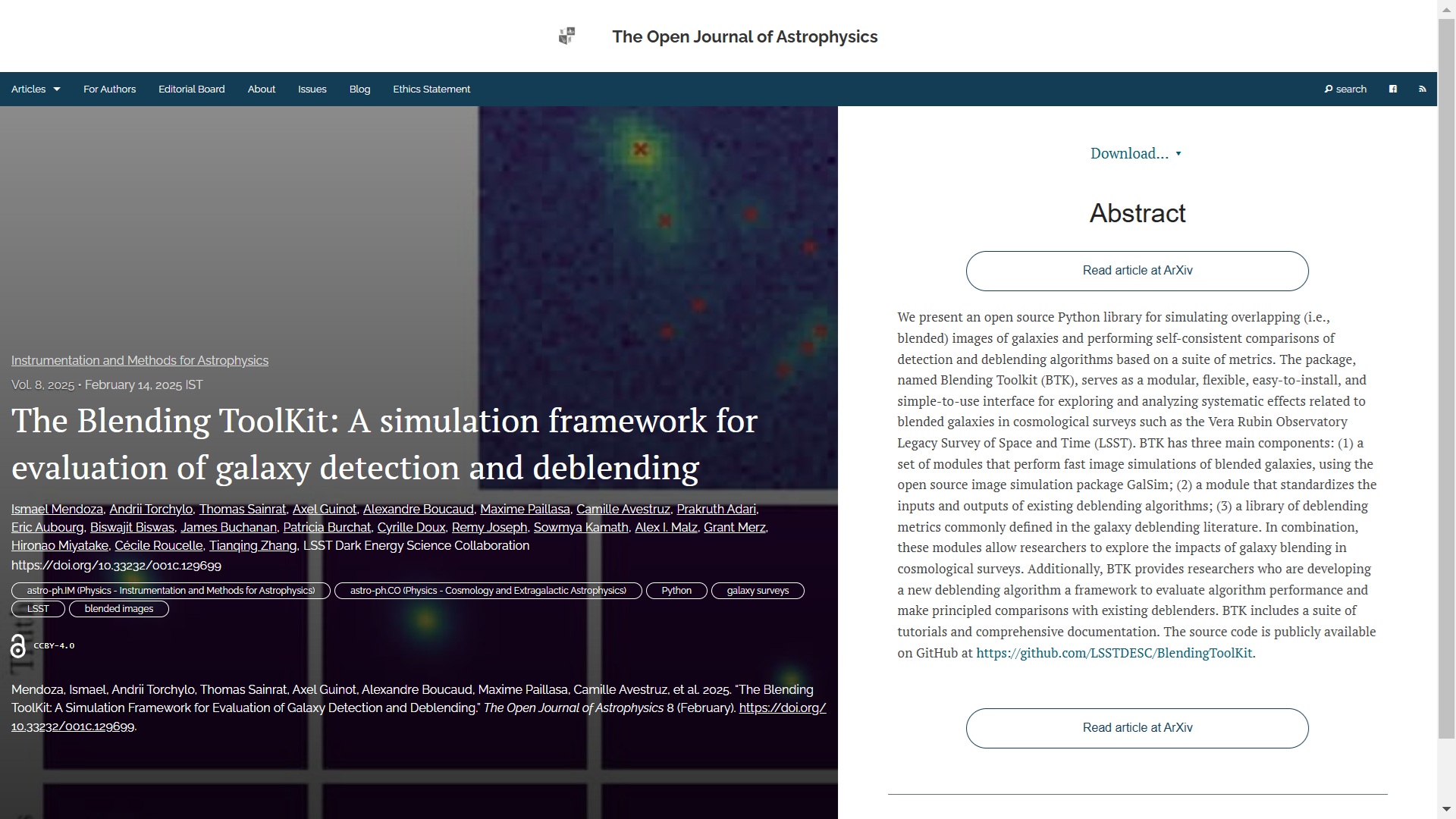
Time for another quick update of papers published at the Open Journal of Astrophysics. Since the last update we have published two new papers, which brings the number in Volume 8 (2025) up to 14 and the total so far published by OJAp up to 249.
Here are quick descriptions of the two papers concerned; you can click on the images of the overlays to make them larger should you wish to do so.
First one up is “AI-assisted super-resolution cosmological simulations IV: An emulator for deterministic realizations” by Xiaowen Zhang & Patrick Lachance (Carnegie Mellon), Ankita Dasgupta (Penn State), Rupert A. C. Croft & Tiziana Di Matteo (Carnegie Mellon), Yueying Ni (Harvard), Simeon Bird (UC Riverside) and Yin Li (Shenzhen University, China). It presents a method of achieving super-resolution to rapidly enhance low-resolution runs with statistically correct fine details to generate accurate simulations and mock observations for large galaxy surveys and was published on Monday 10th February 2025 in the folder marked Cosmology and NonGalactic Astrophysics.
You can find the officially accepted version of this paper on arXiv here.
The strategic case for this Chair revolves around broader developments in the area of astrophysics and cosmology at Maynooth. Currently there are two groups active in research in these areas, one in the former Department of Experimental Physics (which is largely focussed on astronomical instrumentation) and the other, in the former Department of Theoretical Physics, which is theoretical and computational. We want to promote closer collaboration between these research strands. The idea with the new position is that the holder will nucleate and lead a research programme in the area between these existing groups as well as getting involved in outreach and public engagement.
It is intended that the position to appeal not only to people undertaking observational programmes using ground-based facilities (e.g. those provided by ESO, which Ireland recently joined), or those exploiting data from space-based experiments, such as Euclid, as well as people working on multi-messenger astrophysics, gravitational waves, and so on.
P. S. For those of you reading this from outside Ireland the job includes a proper public service pension, a defined benefit scheme way better than the UK’s USS.
What better way to start a cold February morning than with a lovely image from Euclid? The picture above on the left shows an image of the galaxy NGC 6505 and on the right a closer view of the central portion that reveals a near perfect Einstein Ring. This phenomenon is caused by gravitational lensing and is quite a rare occurrence because it requires a perfect alignment between a background source, a concentration of mass that acts as a lens, and the observer (in this case the Euclid telescope):
This find is all the more extraordinary because it was made using observations made during Euclid’s commissioning phase when the telescope was not yet fully focussed. The first release of (a small sample) of full-quality data from Euclid – the so-called Q1 release – will actually be announced next month.
The published paper by O’Riordan et al is available here, from which I have taken this image showing the two relationship between the two images above:
There has already been quite a lot of media coverage of this discovery (even in Ireland). Here is the Press Release from the European Space Agency explaining the background and some comments from people involved in the work:
–0–
Euclid blasted off on its six-year mission to explore the dark Universe on 1 July 2023. Before the spacecraft could begin its survey, the team of scientists and engineers on Earth had to make sure everything was working properly. During this early testing phase, in September 2023, Euclid sent some images back to Earth. They were deliberately out of focus, but in one fuzzy image Euclid Archive Scientist Bruno Altieri saw a hint of a very special phenomenon and decided to take a closer look.
“I look at the data from Euclid as it comes in,” explains Bruno. “Even from that first observation, I could see it, but after Euclid made more observations of the area, we could see a perfect Einstein ring. For me, with a lifelong interest in gravitational lensing, that was amazing.”
The Einstein Ring, an extremely rare phenomenon, turned out to be hiding in plain sight in a galaxy not far away. The galaxy, called NGC 6505, is around 590 million light-years from Earth, a stone’s throw away in cosmic terms. But this is the first time that the ring of light surrounding its centre is detected, thanks to Euclid’s high-resolution instruments.
The ring around the foreground galaxy is made up of light from a farther out bright galaxy. This background galaxy is 4.42 billion light-years away, and its light has been distorted by gravity on its way to us. The far-away galaxy hasn’t been observed before and doesn’t yet have a name.
“An Einstein ring is an example of strong gravitational lensing,” explains Conor O’Riordan, of the Max Planck Institute for Astrophysics, Germany, and lead author of the first scientific paper analysing the ring. “All strong lenses are special, because they’re so rare, and they’re incredibly useful scientifically. This one is particularly special, because it’s so close to Earth and the alignment makes it very beautiful.”
Albert Einstein’s general theory of relativity predicts that light will bend around objects in space, so that they focus the light like a giant lens. This gravitational lensing effect is bigger for more massive objects – galaxies and clusters of galaxies. It means we can sometimes see the light from distant galaxies that would otherwise be hidden.
If the alignment is just right, the light from the distant source galaxy bends to form a spectacular ring around the foreground object. These Einstein rings are a rich laboratory for scientists. Studying their gravitational effects can help us learn about the expansion of the Universe, detect the effects of invisible dark matter and dark energy, and investigate the background source whose light is bent by dark matter in between us and the source.
“I find it very intriguing that this ring was observed within a well-known galaxy, which was first discovered in 1884,” says Valeria Pettorino, ESA Euclid Project Scientist. “The galaxy has been known to astronomers for a very long time. And yet this ring was never observed before. This demonstrates how powerful Euclid is, finding new things even in places we thought we knew well. This discovery is very encouraging for the future of the Euclid mission and demonstrates its fantastic capabilities.
By exploring how the Universe has expanded and formed over its cosmic history, Euclid will reveal more about the role of gravity and the nature of dark energy and dark matter. The space telescope will map more than a third of the sky, observing billions of galaxies out to 10 billion light-years. It is expected to find around 100 000 strong lenses, but to find one that’s so spectacular – and so close to home – is astonishing. Until now, less than 1000 strong lenses were known, and even fewer were imaged at high resolution.
“Euclid is going to revolutionise the field, with all this data we’ve never had before,” adds Conor.
Although this Einstein ring is stunning, Euclid’s main job is searching for the more subtle effects of weak gravitational lensing, where background galaxies appear only mildly stretched or displaced. To detect this effect, scientists will need to analyse billions of galaxies. Euclid began its detailed survey of the sky on 14 February 2024 and is gradually creating the most extensive 3D map of the Universe yet. Such an amazing find, so early in its mission, means Euclid is on course to uncover many more hidden secrets.
It’s Saturday morning, so once again it’s time for an update from the Open Journal of Astrophysics. Since the last update we have published one new paper, which brings the number in Volume 8 (2025) up to 12 and the total so far published by OJAp up to 247.
“Galaxy evolution in the post-merger regime. III – The triggering of active galactic nuclei peaks immediately after coalescence” was written by Sara Ellison, Leonardo Ferreira, Robert Bickley & Tess Grindlay (U. Victoria, Canada), Samir Salim (Indiana U., USA), Shoshannah Byrne-Mamahit (Victoria), Shobita Satyapal (George Mason U., USA), David R. Patton (Trent U., Canada) and Jillian M. Scudder (Oberlin College, USA). It was published on 4th February 2025 and is in the folder marked Astrophysics of Galaxies. The paper describes an investigation into the timescale of triggering of AGN activity after galaxy mergers and concluding that most occurs immediately after coalescence.
You can find the officially accepted version of this paper on arXiv here.
That’s all for this week. I’ll have more updates next Saturday.
About a year ago I wrote a couple of articles (here and here) in response to the discovery of a very large structure (“The Big Ring“) and claims that this structure and others – such as a Giant Arc – were inconsistent with the standard model of cosmology; the work concerned was later submitted as a preprint to arXiv. In my first post on the Big Ring I wrote
To assess the significance of the Big Ring or other structures in a proper scientific fashion, one has to calculate how probable that structure is given a model. We have a standard model that can be used for this purpose, but to simulate very structures is not straightforward because it requires a lot of computing power even to simulate just the mass distribution. In this case one also has to understand how to embed Magnesium absorption too, something which may turn out to trace the mass in a very biased way. Moreover, one has to simulate the observational selection process too, so one is doing a fair comparison between observations and predictions.
Well on today’s arXiv there is a preprint by Sawala et al. with the title aims to assess the significance of structures comparable to the Giant Arc. The title of the paper is The Emperor’s New Arc: gigaparsec patterns abound in a ΛCDM universe from which you can guess the conclusions. The abstract is
Recent discoveries of apparent large-scale features in the structure of the universe, extending over many hundreds of megaparsecs, have been claimed to contradict the large-scale isotropy and homogeneity foundational to the standard (ΛCDM) cosmological model. We explicitly test and refute this conjecture using FLAMINGO-10K, a new and very large cosmological simulation of the growth of structure in a ΛCDM context. Applying the same methods used in the observations, we show that patterns like the “Giant Arc”, supposedly in tension with the standard model, are, in fact, common and expected in a ΛCDM universe. We also show that their reported significant overdensities are an algorithmic artefact and unlikely to reflect any underlying structure.
arXiv:2502.03515
Here’s a picture of a large structure (a “Giant Arc”) taken from a gallery of such objects found in the simulations
I quote from the conclusions:
We hope that our results will dispel the misconception that no inhomogeneity can be found in the standard model Universe beyond some finite size. Instead, any given realisation of the isotropic universe comprises a time- and scale-dependent population of structures from which patterns can be identified on any scale.
Many times on this blog (e.g. here) I have mentioned the SAO/NASA Astrophysics Data System which (for the uninitiated) is a Digital Library portal for researchers in astronomy and physics, operated by the Smithsonian Astrophysical Observatory (SAO) under a NASA grant. The ADS maintains three bibliographic databases containing more than 14.0 million records covering publications in Astronomy and Astrophysics, Physics, and (of course) the arXiv e-prints. In addition to maintaining its bibliographic corpus, the ADS tracks citations and other information, which means, that among many other things, it is an important tool for evaluating publication impact. I use it very frequently.
I’m not the only person to be worried about this, see e.g. here.
After the Trump administration’s sudden and devasting cuts to Federal science agencies such as the National Science Foundation, it seems very likely that NASA programmes will also be severely cut which calls the future of the ADS system into doubt. This facility is used by astronomers around the world and its loss would have serious consequences for the global research community. I sincerely hope that astronomical organizations around the world will get together and ensure that data is not lost and a replacement website is set up. If your’e an astronomer please put pressure on your national funders to look at this as a matter of agency. We NASA/ADS is a wonderful resource, and is not by any standards expensive to run. We will all regret it if it is lost.
Until about 5 years ago, when ADS underwent a major overhaul, there were mirror sites all around the world. These are all still listed by ADS but do not seem to be functional. At the very least these should be reactivated.
P.S. I have been asked if arXiv is under a similar threat. I don’t believe it is – yet – as it is not run by a Federal organization. We do have secure backups of all OJAp published articles, though, in case you were wondering.
After yesterday’s holiday it was back to teaching full-time this morning with the first lecture of my module on Particle Physics. I just about managed to get everything ready in time for the teaching session at 1pm which, because it was an introductory lecture with lots of pictures, I decided to do via powerpoint rather than my usual chalk-and-talk. That didn’t get off to a very good start because the podium PC in my room had decided to do a Windows update just before I started and I had to wait for that to finish before I could show my slides. I suppose that happened because this was the first day of teaching after a lengthy break so nobody had used the room recently.
Most of the lecture was devoted to introducing natural units, which I intend to use throughout the module, like I have on previous occasions I have taught this sort of material for reasons I explained here. The last time I taught particle physics was some 15 years ago, so I had to update some things, especially the picture of the components of the standard model to include the Higgs. After extensive research (by which I mean looking at wikipedia) I found the above; the Higgs is on the right. Unfortunately the particle masses – which reveal themselves if you click on the image above – are not given in natural units, but have pesky factors of c-squared in them. You can’t have everything.
The bit I’m looking forward to most is doing the Dirac Equation which, years ago when I was at Sussex, was once the subject of a cake:
That particular cake was a lemon drizzle cake which unfortunately is not one of the flavours represented in the standard model.
The views presented here are personal and not necessarily those of my employer (or anyone else for that matter).
Feel free to comment on any of the posts on this blog but comments may be moderated; anonymous comments and any considered by me to be vexatious and/or abusive and/or defamatory will not be accepted. I do not necessarily endorse, support, sanction, encourage, verify or agree with the opinions or statements of any information or other content in the comments on this site and do not in any way guarantee their accuracy or reliability.




 In the Dark