Archive for the The Universe and Stuff Category

Teaching Transforms

Posted in Education, History, Maynooth, The Universe and Stuff with tags , , , , , on November 21, 2024 by telescoper

We’re about two-thirds of the way into the Autumn Semester here at Maynooth and, by a miracle, I’m just about on schedule with both the modules I’m teaching. It’s always difficult to work out how long things are going to need for explanation when you’re teaching them for the first time.

One of the modules I’m doing is Differential Equations and Transform Methods for Engineering Students. I’ve been on the bit following the “and” for a couple of weeks already. The first transform method covered was the Laplace transform, which I remember doing as a physics undergraduate but have used only rarely. Now I’m doing Fourier Series, as a prelude to Fourier transforms.

As I have observed periodically, the differential equations and transform methods are not at all disconnected, but are linked via the heat equation, the solution of which led Joseph Fourier to devise his series in Mémoire sur la propagation de la chaleur dans les corps solides (1807), a truly remarkable work for its time that inspired so many subsequent developments.

In the module I’m teaching, the applications are rather different from when I taught Fourier series to Physics students. Engineering students at Maynooth primarily study electronic engineering and robotics, so there’s a much greater emphasis on using integral transforms for signal processing. The mathematics is the same, of course, but some of the terminology is different from that used by physicists.

Anyway I was looking for nice demonstrations of Fourier series to help my class get to grips with them when I remembered this little video recommended to me some time ago by esteemed Professor George Ellis. It’s a nice illustration of the principles of Fourier series, by which any periodic function can be decomposed into a series of sine and cosine functions.

This reminds me of a point I’ve made a few times in popular talks about astronomy. It’s a common view that Kepler’s laws of planetary motion according to which which the planets move in elliptical motion around the Sun, is a completely different formulation from the previous Ptolemaic system which involved epicycles and deferents and which is generally held to have been much more complicated.

The video demonstrates however that epicycles and deferents can be viewed as the elements used in the construction of a Fourier series. Since elliptical orbits are periodic, it is perfectly valid to present them in the form of a Fourier series. Therefore, in a sense, there’s nothing so very wrong with epicycles. I admit, however, that a closed-form expression for such an orbit is considerably more compact and elegant than a Fourier representation, and also encapsulates a deeper level of physical understanding. What makes for a good physical theory is, in my view, largely a matter of economy: if two theories have equal predictive power, the one that takes less chalk to write it on a blackboard is the better one!

Anyway, soon I’ll be moving onto the complex Fourier series and thence to Fourier transforms which is familiar territory, but I have to end the module with the Z-transform, which I have never studied and never used. That should be fun!

New Results from DESI

Posted in Barcelona, The Universe and Stuff with tags , , , , , , , on November 20, 2024 by telescoper
The Mayall Telescope at Kitt Peak, in which DESI is housed. This PR image was taken during a meteor shower, which is not ideal observing conditions. Picture Credit: KPNO/NOIRLab/NSF/AURA/R. Sparks

I’ve just got time between meetings to mention that a clutch of brand new papers has emerged from the DESI (Dark Energy Spectroscopic Instrument) Collaboration. There is a press release discussing the results from the Lawrence Berkeley Laboratory here and one from the ICCUB in Barcelona here; several members of the group I visited there during sabbatical are working on DESI. Congratulations to them.

I haven’t had time to read them yet, but a quick skim suggests that the results are consistent with the standard cosmological model.

The latest batch contains three Key Publications:

together with the companion supporting papers:

The links lead to the arXiv version of these papers. These articles can also be found, along with previously released publications by the DESI Collaboration, here.

Anyone who has read the latest papers is welcome to comment through the box below!

Two New Publications at the Open Journal of Astrophysics

Posted in OJAp Papers, Open Access, The Universe and Stuff with tags , , , , , , , , on November 16, 2024 by telescoper

Once again it’s time for a Saturday morning update on activity at the  Open Journal of Astrophysics.  Since the last update we have published two more papers, taking  the count in Volume 7 (2024) up to 104 and the total published by OJAp up to 219.

The first paper of the most recent pair, published on November 13 2024,  in the folder Cosmology and NonGalactic Astrophysics, is “Stochastic Super-resolution of Cosmological Simulations with Denoising Diffusion Models” by Andreas Schanz, Florian List and Oliver Hahn (all based in the University of Vienna, Austria). It presents a  discussion of denoising diffusion in generative models for achieving super-resolution in simulations of cosmic large-scale structure.

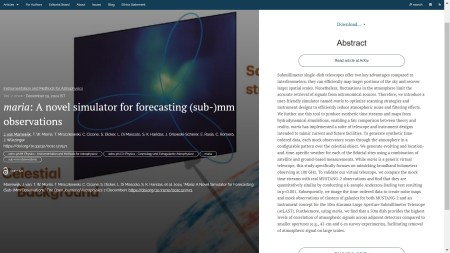
Here is a screen grab of the overlay which includes the abstract:


You can click on the image of the overlay to make it larger should you wish to do so.  You can find the officially accepted version of this paper on the arXiv here.

The second paper to be published this week is also in the folder marked Cosmology and NonGalactic Astrophysics. It was published on November 14 and has the title “Halo mass functions at high redshift” by Hannah O’Brennan, John A. Regan, Chris Power (*), Saoirse Ward, John Brennan, and Joe McCaffrey. Five of the six authors are colleagues of mine from the National University of Ireland, Maynooth; Chris Power (marked with a *) is from the University of Western Australia.

Here is a screen grab of the overlay which includes the abstract:


You can click on the image of the overlay to make it larger should you wish to do so. You can find the officially accepted version of the paper on the arXiv here.

That concludes this week’s update. More  next week!

Four New Publications at the Open Journal of Astrophysics

Posted in OJAp Papers, Open Access, The Universe and Stuff with tags , , , , , , , , , , , , , , , , on November 9, 2024 by telescoper

Once again it’s time for a quick update of activity at the Open Journal of Astrophysics. Since the last update a week ago we have published  four papers, which takes the count in Volume 7 (2024) up to 102 and the total published altogether by OJAp up to 217.   This means not only that we have reached a century for the year but also that so far in 2024 we have published more than double the number of papers that we published in all of 2023. I blogged about the significance of the figure 217 here.

In chronological order, the four papers published this week, with their overlays, are as follows. You can click on the images of the overlays to make them larger should you wish to do so.

First one up is “A generative model for Gaia astrometric orbit catalogs: selection functions for binary stars, giant planets, and compact object companions” by Kareem El-Badry (Caltech, USA), Casey Lam (Carnegie Observatories), Berry Holl & Jean-Louis Halbwachs (U. Geneva), Hans-Walter Rix (MPA Heidelberg, Germany), Tsevi Mazeh (Tel Aviv, Israel) and Sahar Shahaf (Weizmann Institute of Science, Israel). This one is in the folder Solar and Stellar Astrophysics. The paper presents a forward method for estimating the selection function (i.e. the probability of a system with a given set of parameters being included in a catalog). It was published on November 4th 2024.

Here is a screen grab of the overlay, which includes the abstract:


You can find the officially accepted version of the paper on the arXiv here.

The second paper to announce, published on 5th November 2024. is “Primordial magnetogenesis in a bouncing model with dark energy” by Marcus V. Bomfim (Rio de Janeiro, Brazil), Emmanuel Frion (Western U. Canada), Nelson Pinto-Neto (Espírito Santo, Brazil), and Sandro D. P. Vitenti (Paraná, Brazil). This paper, in the section on Cosmology and NonGalactic Astrophysics, presents a discussion of the possible generation of magnetic fields on cosmological scales by in a model involving a scalar field coupled to electromagnetism

You can see the overlay here:


The accepted version of this paper can be found on the arXiv here.

The third paper, published on 6th November 2024 in the folder marked Astrophysics of Galaxies, is called  “Evidence for large scale compressible turbulence in the ISM of CSWA13, a star-Forming Lensed Galaxy at z = 1.87 with outflowing wind” by Itzhak Goldman (Tel Aviv, Israel). It presents a statistical analysis of the spatial distribution and kinematics of nebular gas with discussion of the nature of the turbulence present.

Here is the overlay


The final version accepted on arXiv is here.

Last in this batch is “Star formation in the high-extinction Planck cold clump PGCC G120.69+2.66” by Anlaug Amanda Djupvik (Aarhus, Denmark), João L. Yun (Lisbon, Portugal), and Fernando Comerón (ESO, Garching, Germany). It was published on 7th November 2024 in the folder marked Astrophysics of Galaxies. The paper uses imaging and spectroscopy  information to identify sites of star formation in a molecular cloud. This is the overlay:

You can find the official accepted version on the arXiv here.

That’s all for now. I will post another update in a week.

Another Edgeworth Connection

Posted in History, The Universe and Stuff with tags , , , , , , , , , on November 3, 2024 by telescoper

A week or so ago I posted an item about the Edgeworth family that included a reference to Kenneth Edgeworth, an amateur astronomer of some note who first posited the existence of what is now known as the Kuiper belt. Here’s another interesting connection. Kenneth Edgeworth was born in 1880 in Daramona House in Street in County Westmeath. The owner of this house was Edgeworth’s uncle, another astronomer called William Edward Wilson who built an observatory next to Daramona House.

Here are pictures of (left) house and (right) the observatory, neither of look in particularly good condition!

After independence, many of the large houses owned by the rich Anglo-Irish families who had run Ireland until then fell into disrepair or were destroyed.

Anyway, on top of the two-storey observatory building there used to be a dome that housed a 24″ Grubb reflecting telescope. Here’s an old picture showing what it looked like in better times, around 1900:

The dome is no longer there, and neither is the telescope. The latter was donated to the University of London in 1925 eventually housed in the Observatory at Mill Hill, now run by University College London. Here is an excerpt from the history of the University of London Observatory:

W.E. Wilson established an observatory at Daramona, Street, County Westmeath, in 1871 and equipped it with a 12-inch equatorial reflector by Grubb. Wilson (born in 1851, elected FRS in 1896, an original member of the BAA, awarded an honorary DSc by the University of Dublin in 1901, High Sheriff of Co. Westmeath in 1894), observed the transit of Venus in 1882 and solar eclipses at Oran in 1870 and Spain in 1900, published many papers in Proc. R. Soc, Proc. R. Dublin Soc., Proc. R. Irish Acad., etc., and died in 1908) enlarged his observatory in 1881 and installed a 24-inch reflector by Grubb on the mounting previously used for the 12-inch reflector. Ten years later a new mounting was constructed. It is this mounting which was moved to Mill Hill in 1928. Dr. Wilson used his telescope to make some of the best photographs of his time of star clusters and nebulae, and he worked extensively on problems of solar physics and the solar constant. The telescope may be used in Newtonian and Cassegrain forms; the focal length of the mirror is 10 feet and the equivalent focal length at the Cassegrain focus is approximately 42 feet. The telescope was moved in 1928 from Ireland to University College, where minor modifications were made to the focussing arrangements and plate-holder, and an electric motor was added to rewind the driving clock automatically.

The Wilson telescope was retired from active service in 1974 and moved to the World Museum in Liverpool where, as far as I know, it remains on display to this day.

Three New Publications at the Open Journal of Astrophysics

Posted in OJAp Papers, Open Access, The Universe and Stuff with tags , , , , , , , , , , , on November 2, 2024 by telescoper

It’s Saturday, so it’s time once again for another summary of business at the  Open Journal of Astrophysics. This week I have three papers to announce, which brings the total we have published so far this year (Vol. 7) to 98 and the total published by OJAp to 213.

First one up, published on Tuesday 29th October 2024, is “Cosmology with shear ratios: a joint study of weak lensing and spectroscopic redshift datasets” by Ni Emas & Chris Blake (Swinburne U., Australia), Rossana Ruggeri (Queensland U, Australia) and Anna Porredon (Ruhr University, Bochum, Germany). This paper is in the folder marked Cosmology and NonGalactic Astrophysics. The paper investigates the use of shear ratios as a cosmological diagnostic, with applications to lensing surveys

Here is a screen grab of the overlay, which includes the abstract:

You can read the paper directly on arXiv here.

The second paper to present, also published on Tuesday 29th October 2024, is “Echo Location: Distances to Galactic Supernovae From ASAS-SN Light Echoes and 3D Dust Maps” by Kyle D. Neumann (Penn State), Michael A. Tucker & Christopher S. Kochanek (Ohio State), Benjamin J. Shappee (U. Hawaii), and K. Z. Stanek (Ohio State), all based in the USA. This paper is in the folder marked High-Energy Astrophysical Phenomena and it presents a new approach to estimating the distance to a source by combining light echoes with recent three-dimensional dust maps with application to supernova distances.

The overlay looks like this:


You can read this paper directly on the arXiv here.

Last, but by no means least, comes  “A deconstruction of methods to derive one-point lensing statistics” by Viviane Alfradique (Universidade Federal do Rio De Janeiro, Brazil), Tiago Castro (INAF Trieste, Italy), Valerio Marra (Trieste), Miguel Quartin (Rio de Janeiro), Carlo Giocoli (INAF Bologna, Italy), and Pierluigi Monaco (Trieste).  Published in the folder marked Cosmology and NonGalactic Astrophysics, it describes a comparative study of different methods of approximating the one-point probability density function (PDF) for use in the statistical analysis of gravitational lensing.

Here is a screengrab of the overlay:


To read the accepted version of this on the arXiv please go here.

That’s it for this week. I hope to post another update next weekend, by when we might well have reached a century for this year!

New Image Casts Doubt on Standard Cosmological Theory

Posted in The Universe and Stuff with tags , , on October 28, 2024 by telescoper

Scarcely a day goes by without some news outlet or other claiming that recent observations have ruled out the standard cosmological model. This remarkable new image does however seem to cast doubt on many aspects of the Big Bang Theory:

For one thing, it seems to be much less homogeneous and isotropic than we previously imagined. Although the composition is uncertain, it also seems to have a much higher fraction of baryonic matter than currently assumed. Whether or not this picture overthrows the standard model or not, it seems likely to lead to a revival of interest in cosmological applications of the Burgers equation.

Two New Publications at the Open Journal of Astrophysics

Posted in OJAp Papers, Open Access, The Universe and Stuff with tags , , , , , , , , , , on October 26, 2024 by telescoper

It’s Saturday morning again so here’s another report on activity at the  Open Journal of Astrophysics.  Since the last update we have published two more papers, taking  the count in Volume 7 (2024) up to 95 and the total published by OJAp up to 210.  We’ve still got a few in the pipeline waiting for the final versions to appear on arXiv so I expect we’ll reach the 100 mark for 2024 in the next couple of weeks.

The first paper of the most recent pair, published on October 22 2024,  and in the folder marked Astrophysics of Galaxies, is “Cloud Collision Signatures in the Central Molecular Zone”  by Rees A. Barnes and Felix D. Priestley (Cardiff University, UK) .  This paper presents an analysis of combined hydrodynamical, chemical and radiative transfer simulations of cloud collisions in the Galactic disk and Central Molecular Zone (CMZ).

Here is a screen grab of the overlay which includes the abstract:


You can click on the image of the overlay to make it larger should you wish to do so.  You can find the officially accepted version of this paper on the arXiv here.

The second paper has the title “Partition function approach to non-Gaussian likelihoods: macrocanonical partitions and replicating Markov-chains” and was published October 25th 2024. The authors are Maximilian Philipp Herzog, Heinrich von Campe, Rebecca Maria Kuntz, Lennart Röver and Björn Malte Schäfe (all of Heidelberg University, Germany). This paper, which is in  the folder marked Cosmology and NonGalactic Astrophysics, describes a method of macrocanonical sampling for Bayesian statistical inference, based on the macrocanonical partition function, with applications to cosmology.

Here is a screen grab of the overlay which includes the abstract:


You can click on the image of the overlay to make it larger should you wish to do so. You can find the officially accepted version of the paper on the arXiv here.

That concludes this week’s update. More  next week!

Edgeworth Connections

Posted in History, The Universe and Stuff with tags , , , , , on October 25, 2024 by telescoper

It’s a small world.

This year I am supervising an undergraduate project student who is looking at approximations to probability distribution functions. This project was inspired by a nice paper on the arXiv by Elena Sellentin, Andrew Jaffe and Alan Heavens about the use of the Edgeworth series which I blogged about here.

It turns out that the student who picked this project hails from a place very close to Edgeworthstown in County Longford. I’ve been through there on the train going to and from Sligo, but I never thought much about the possible connection, assuming the name was a coincidence. When I met my project student yesterday for our weekly discussion, however, he told me he had looked into it and the results are very interesting.

The Edgeworth series was invented by Francis Ysidro Edgeworth (1845-1926) who was a political economist and philosopher was born in Edgeworthstown. He was the grandson of the Richard Lovell Edgeworth (1744-1817) who had no fewer than 22 children (including the novelist Maria Edgeworth) and was a founder member of the Royal Irish Academy. In a manner not untypical of the Anglo-Irish landed gentry, the Edgeworths renamed the local town from Meathas Troim (anglicized form Mostrim), c.f. Parsonstown.

There is a directly astronomical connection with the Edgeworth family too. Kenneth Edgeworth (1880-1972) was another member of the Edgeworth dynasty, `one of ‘the archetypal gentleman literary and scientific families’ who had sufficient private income to be able to pursue a diverse range of interests. Kenneth Edgeworth was an independent theoretical astronomer, best known for proposing the existence of a disc of bodies beyond the orbit of Neptune in the 1930s. Observations later confirmed the existence of this structure, often called the Kuiper belt or, especially in Irish circles, the Edgeworth-Kuiper belt.

Here’s the front page of one of his astronomical publications:

Anyway, what’s the probability that a student would randomly pick a project involving a method invented a person born just a few miles away from his family home?

Pastamarkers: astronomy meets gastronomy

Posted in The Universe and Stuff with tags , , , , on October 24, 2024 by telescoper

It’s time to share a paper on arXiv at the interface between astronomy and gastronomy. Here is the abstract:

We aim at facilitating the visualization of astrophysical data for several tasks, such as uncovering patterns, presenting results to the community, and facilitating the understanding of complex physical relationships to the public. We present pastamarkers, a customized Python package fully compatible with matplotlib, that contains unique pasta-shaped markers meant to enhance the visualization of astrophysical data. We prove that using different pasta types as markers can improve the clarity of astrophysical plots by reproducing some of the most famous plots in the literature.

arXiv:2403.20314

Here’s an example of a colour-magnitude diagram plotted with pasta markers, with the main sequence as Lasagne, etc.

You can download the pastamarkers package here.