Archive for the The Universe and Stuff Category

Results from the Atacama Cosmology Telescope

Posted in Cardiff, The Universe and Stuff with tags , , , , , , , on March 19, 2025 by telescoper

Today is going to be a very busy day on the cosmology front – with the Euclid Q1 Data Release coming out at 11am GMT – but I’ll start off by sharing news of final data release (DR6) by the Atacama Cosmology Telescope. This was announced yesterday and includes former colleagues at Cardiff University, so congratulations to them and all concerned. Here is a pretty picture showing one of the beautiful cosmic microwave background polarization and intensity maps:

Intensity and Polarization maps from ACT: arXiv:2503.14451

There are three related preprints on the arXiv today:

There’s a lot to digest in these papers but a quick skim of the abstracts gives two pertinent points. First, from the second paper:

We find that the ACT angular power spectra estimated over 10,000 deg2, and measured to arcminute scales in TT, TE and EE, are well fit by the sum of CMB and foregrounds, where the CMB spectra are described by the ΛCDM model. Combining ACT with larger-scale Planck data, the joint P-ACT dataset provides tight limits on the ingredients, expansion rate, and initial conditions of the universe.

They also find that, when combined with CMB lensing from ACT and Planck, and baryon acoustic oscillation data from the Dark Energy Spectroscopic Instrument (DESI Y1), the ACT data give a “low” value for the Hubble constant: H0=68.22 ± 0.36 km s-1 Mpc-1.

The third paper also says

In general, models introduced to increase the Hubble constant or to decrease the amplitude of density fluctuations inferred from the primary CMB are not favored by our data.

The “Hubble tension” remains!

R.I.P. Sergei Shandarin (1947-2025)

Posted in Biographical, R.I.P., The Universe and Stuff with tags , , , , on March 18, 2025 by telescoper

It is my sad duty to pass on the sad news of the death of Sergei Shandarin, who passed away yesterday at the age of 77. He had been suffering from cancer for some time and had been undergoing chemotherapy, alas to no avail. Last week he was moved onto palliative care and we knew he would soon be leaving us. I was going to post something last night when I heard that he had died, but I just couldn’t find the words. I send my deepest condolences to his family, friends and colleagues who are grieving.

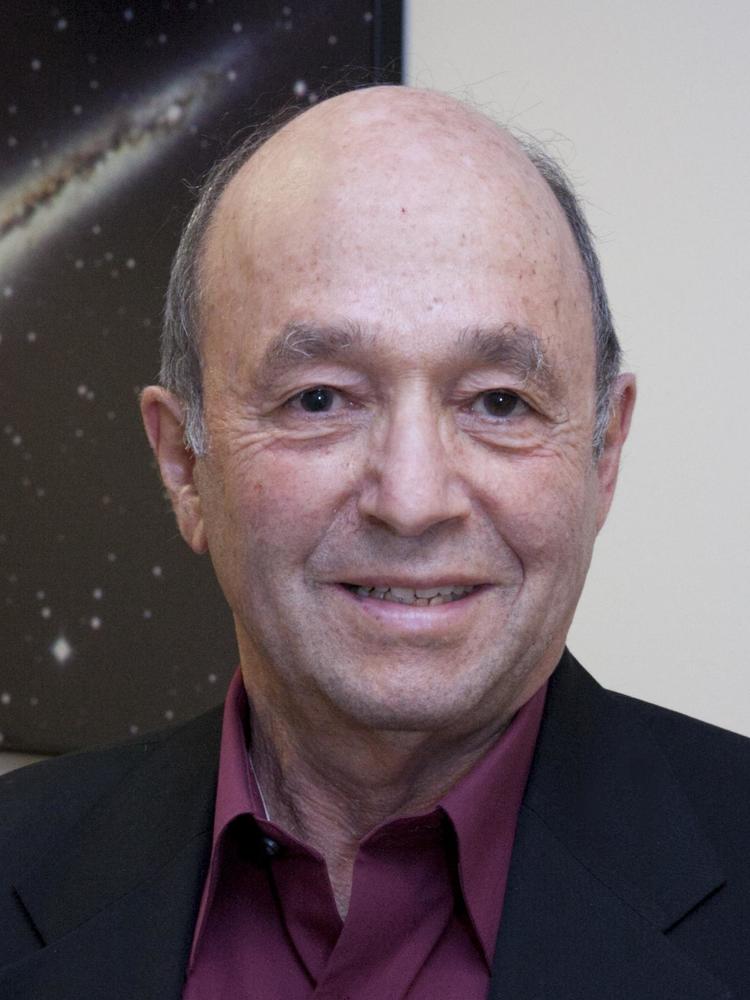
(The picture on the left shows Sergei in 2006; I’m grateful to John Peacock for letting me use it here.)

Sergei Fyodor Shandarin was born in 1947 and gained his PhD at the Moscow Institute of Physics and Technology in 1974. He was a student of the great physicist Yakov Borisovich Zeldovich (whom I blogged about here). Sergei moved to the USA in 1991 to take up a Professorship at the University of Kansas, in Lawrence, where he remained until his retirement. More recently he and his wife Vika moved to Toronto to be closer to his daughter Anya and their grandchildren.

Sergei’s main research interests were the dynamics and statistics of the “Cosmic Web” – the supercluster- void network in spacial distribution of galaxies. In particular, he was interested in nonlinear dynamics of gravitational instability, which is the major mechanism for the formation of a large variety of objects in the universe, and in geometrical and topological statistical descriptors of the distribution of mass and galaxies in space.

These topics overlap considerably with my own and I was delighted to have the opportunity to work with Sergei in 1992 when I was invited by Adrian Melott as a visitor to Lawrence fro about a month. My first impression of Sergei was that he was a bit scary – in that typical Russian physicist sort of way – but I soon discovered that, beneath his initially rather fierce demeanour, he was actually a kind and friendly person with a fine sense of humour. I remember that research visit very well, in fact, not only because of Adrian’s and Sergei’s hospitality, but also because the project we did together went so well that we not only completed the research, but I returned to London with a completed manuscript; the paper that resulted was published in early 1993.

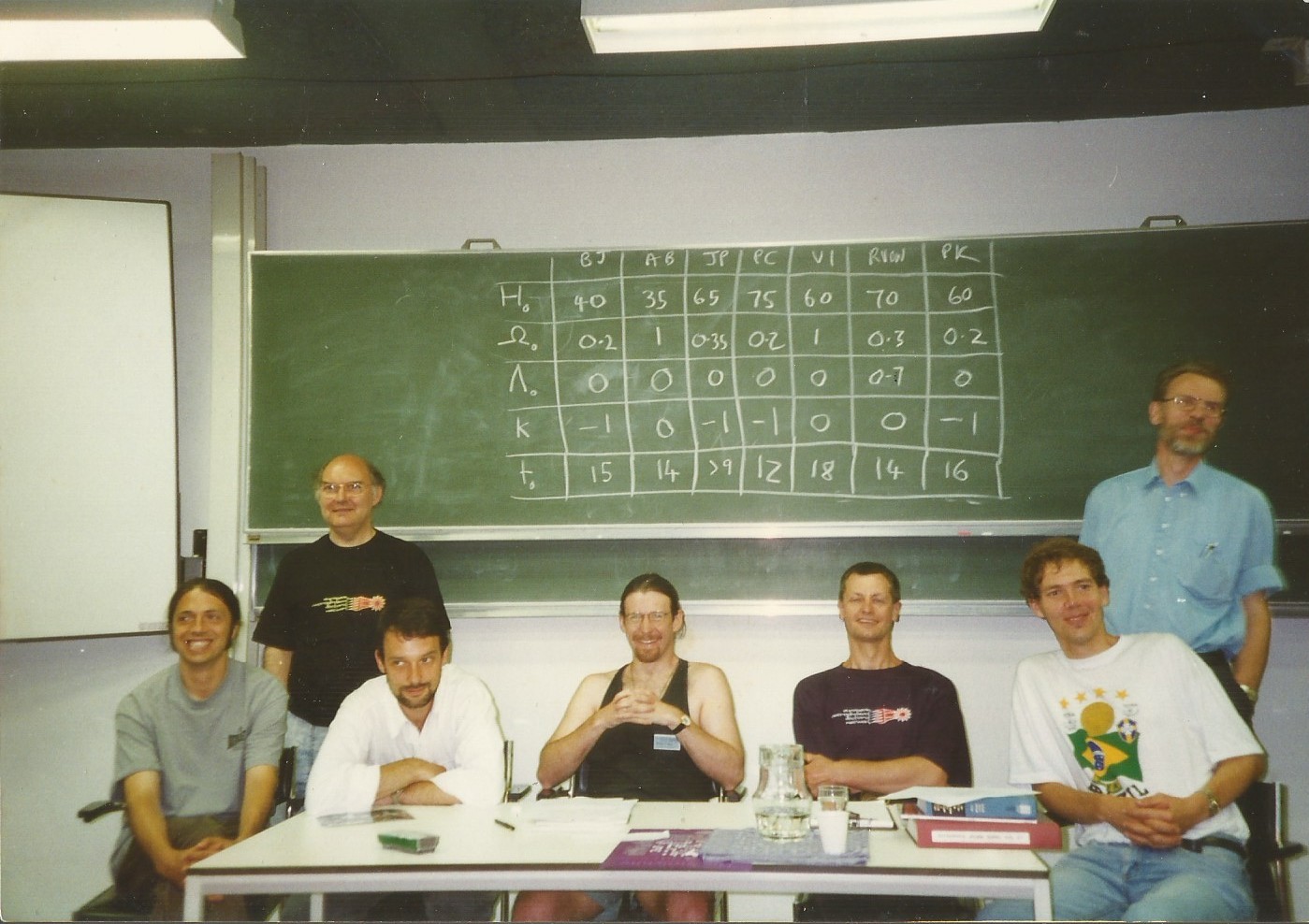
After that I kept in touch with Sergei mainly at conferences. Last night after I heard the news that he has passed away I brought a box of old photographs down from the loft and rummaged around for some pictures. Here are two from a meeting in India in 1994, in which you can see Sergei very much in the centre of things:

The picture on the left shows: (standing, L to R) Francis Bernardeau, Paolo Catelan, Sergei, ?*, Paul R. Shapiro; (crouching) Enzo Branchini and Bernard Jones. The picture on the right has the addition of, among others, Varun Sahni (between Paul Shapiro and Bernard Jones), Dick Bond (with his arm on Sergei’s shoulder) and Sabino Matarrese (front left); I’m on the right of the front row. I remember these pictures were taken on an excursion from Pune to see the historic caves and temples at Ajanta and Ellora.

(*I think the unidentified person might be Lars Hernquist, but I’m not sure: I’d be grateful for any information.)

I also particular remember meeting up with Sergei at meetings in Los Angeles, Nice, Valencia (the meeting at which the first picture was taken). and most recently in Estonia (for a meeting to celebrate the centenary of the birth of Zel’dovich). He was always up for scientific discussions, but also liked to relax with a drink or several; he also liked to watch football.

Sergei was a wonderful scientist as well as a warm and generous human being who was held in a very high regard by the cosmological community worldwide. We will all miss him terribly.

Rest in peace, Sergei Fyodor Shandarin (1947-2025)

Weekly Update at the Open Journal of Astrophysics – 15/03/2025

Posted in OJAp Papers, Open Access, The Universe and Stuff with tags , , , , , , , , , , , , , on March 15, 2025 by telescoper

The Ideas of March are come, so it’s time for another update of papers published at the Open Journal of Astrophysics. Since the last update we have published two papers, which brings the number in Volume 8 (2025) up to 27 and the total so far published by OJAp up to 262.

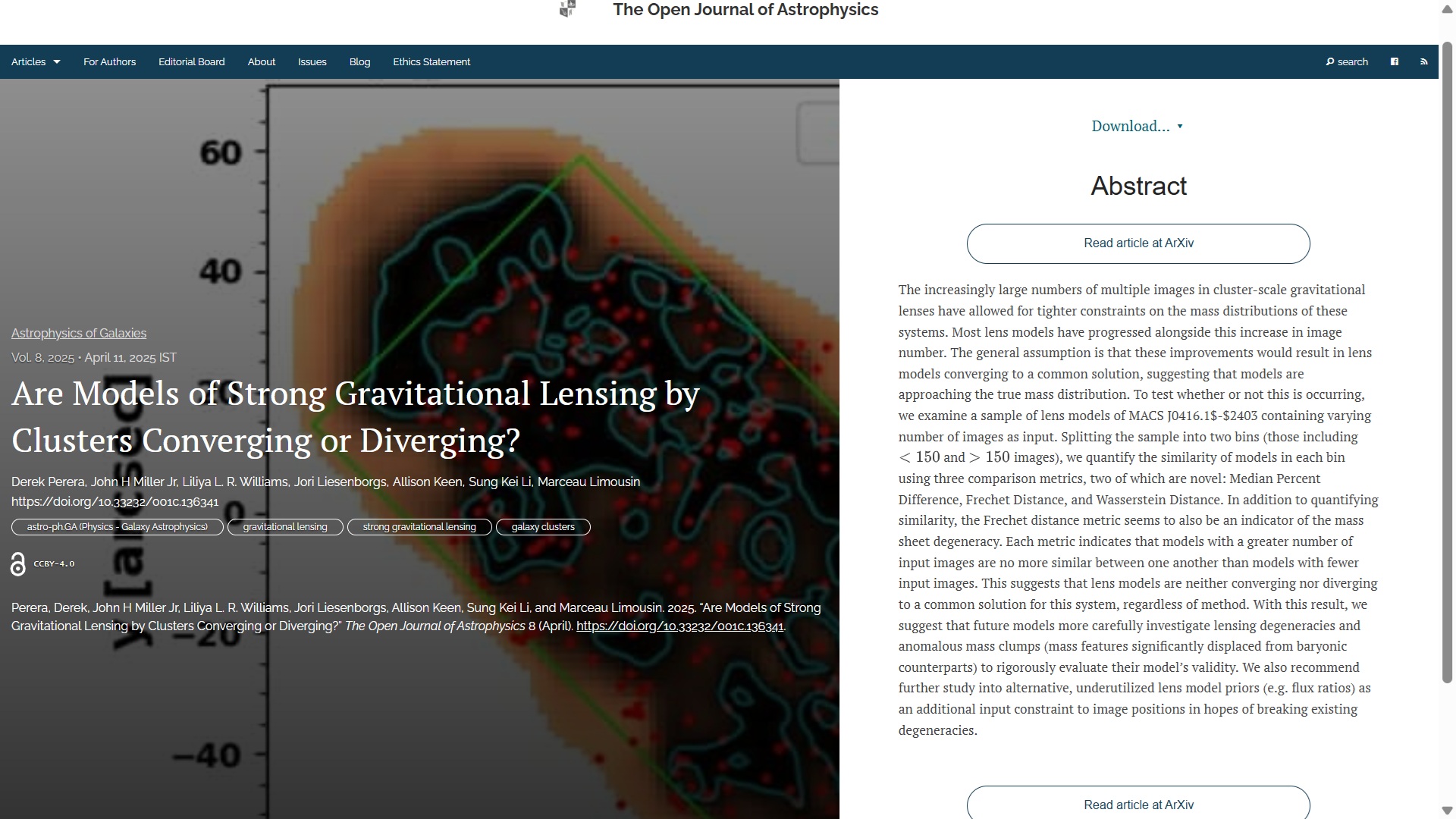
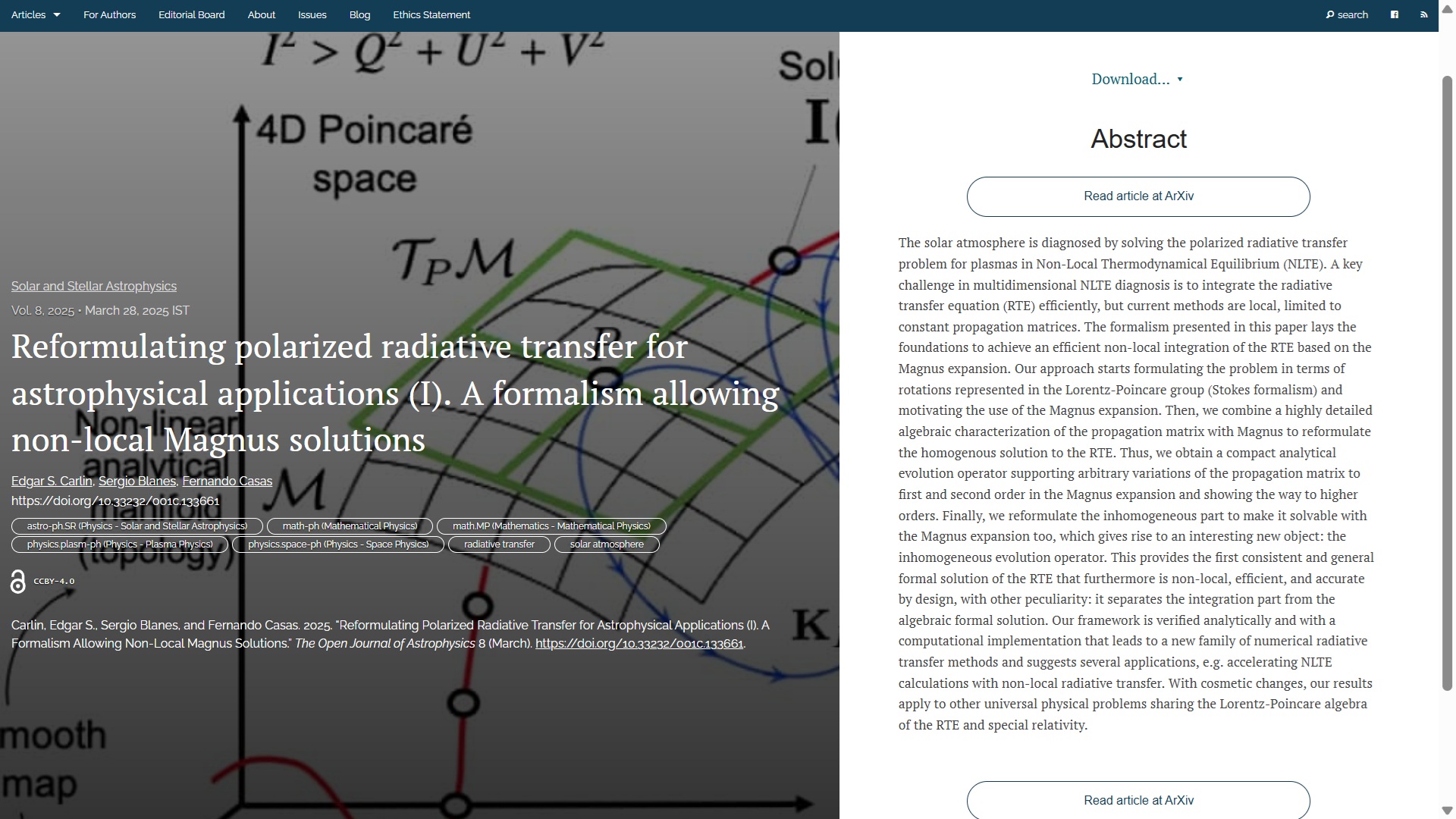
The first paper to report is “Dark Energy Survey Year 6 Results: Point-Spread Function Modeling” by Theo Schutt and 59 others distributed around the world, on behalf of the DES Collaboration. It was published on Wednesday March 12th 2025 in the folder Cosmology and NonGalactic Astrophysics. It discusses the improvements made in modelling the Point Spread Function (PSF) for weak lensing measurements in the latest Dark Energy Survey (6-year) data and prospects for the future.

Here is the overlay, which you can click on to make larger if you wish:


You can read the officially accepted version of this paper on arXiv here.

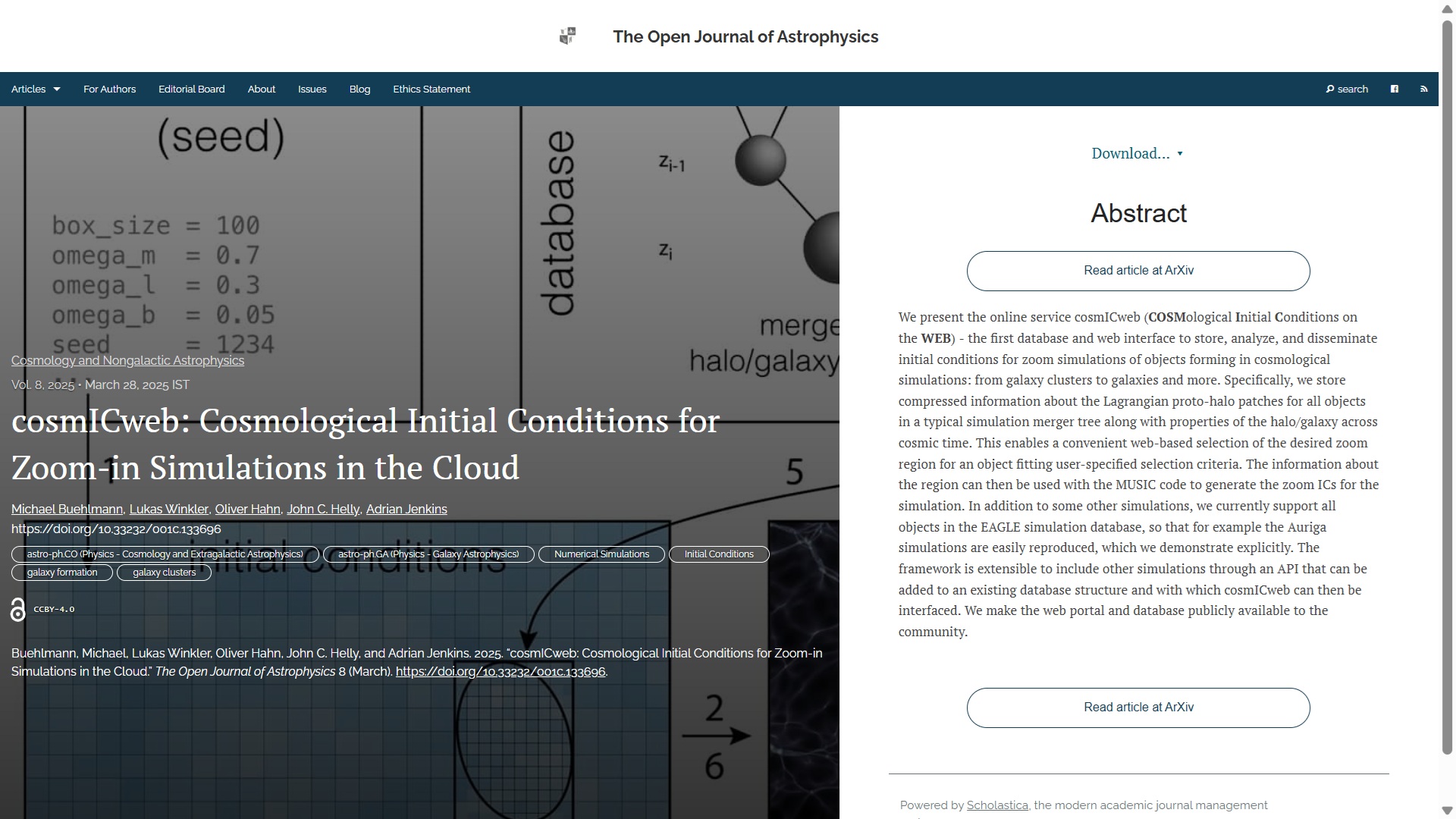
The other paper published this week is “Exploring Symbolic Regression and Genetic Algorithms for Astronomical Object Classification” by Fabio Ricardo Llorella (Universidad Internacional de la Rioja, Spain) & José Antonio Cebrian (Universidad Laboral de Córdoba, Spain), which came out on Thursday 13th March. This one is in the folder marked Astrophysics of Galaxies and it discusses the classification of astronomical objects in the Sloan Digital Sky Survey SDSS-17 dataset using a combination of Symbolic Regressiion and Genetic Algorithms.

The overlay can be seen here:

You can find the “final” version on arXiv here.

That’s it for this week. I’ll have more papers to report next Saturday.

Weekly Update at the Open Journal of Astrophysics – 08/03/2025

Posted in OJAp Papers, Open Access, The Universe and Stuff with tags , , , , , , , , , , , , , , , , , , , , on March 8, 2025 by telescoper

Time for the weekly Saturday morning update of papers published at the Open Journal of Astrophysics. Since the last update we have published four new papers, which brings the number in Volume 8 (2025) up to 25 and the total so far published by OJAp up to 260.

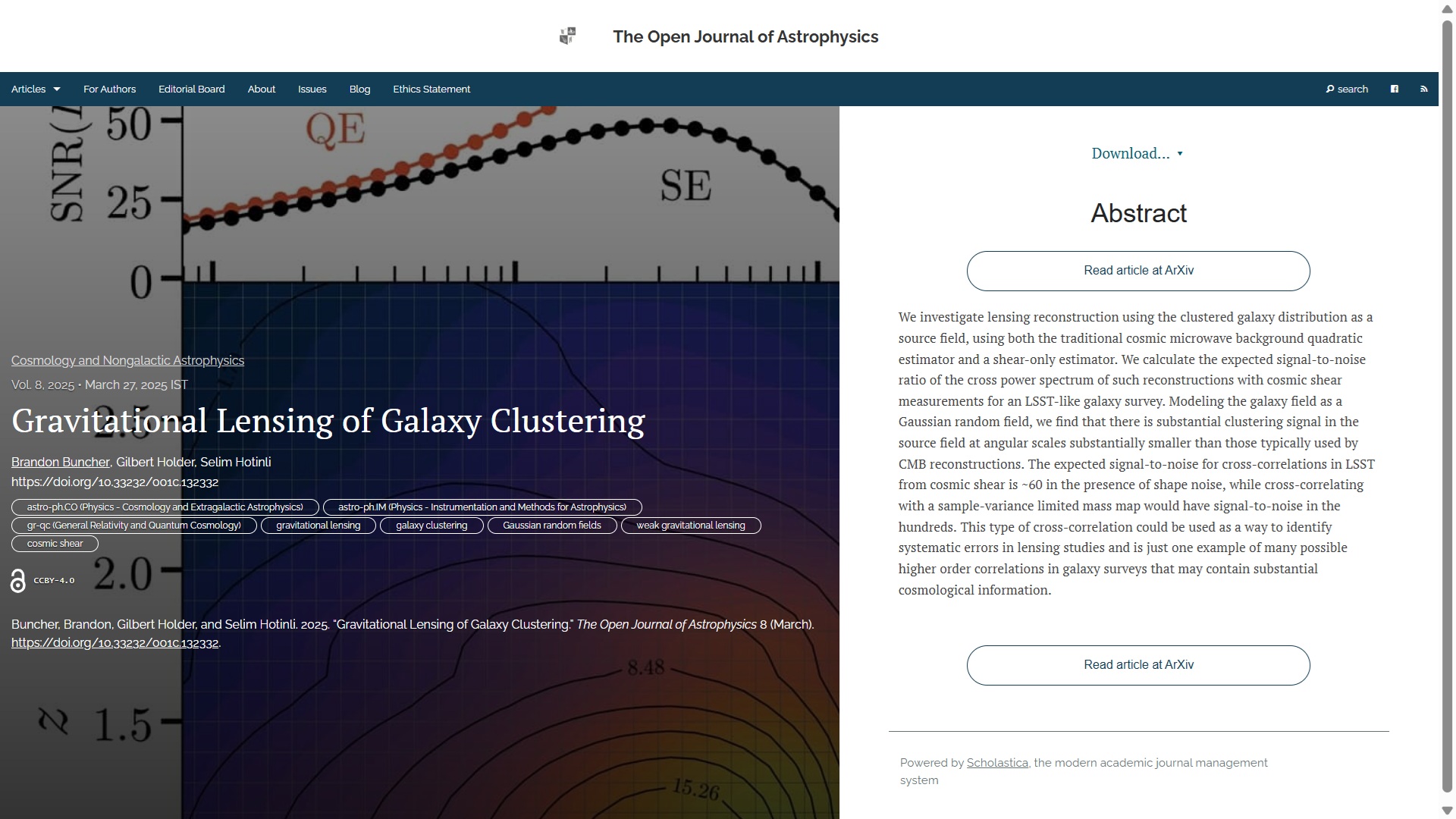
In chronological order of publication, the four papers published this week, with their overlays, are as follows. You can click on the images of the overlays to make them larger should you wish to do so.

The first paper to report is “Partition function approach to non-Gaussian likelihoods: information theory and state variables for Bayesian inference” by Rebecca Maria Kuntz, Heinrich von Campe, Tobias Röspel, Maximilian Philipp Herzog, and Björn Malte Schäfer, all from the University of Heidelberg (Germany). It was published on Wednesday March 5th 2025 in the folder Cosmology and NonGalactic Astrophysics and it discusses the relationship between information theory and thermodynamics with applications to Bayesian inference in the context of cosmological data sets.


You can read the officially accepted version of this paper on arXiv here.

The second paper of the week  is “The Cosmological Population of Gamma-Ray Bursts from the Disks of Active Galactic Nuclei” by Hoyoung D. Kang & Rosalba Perna (Stony Brook), Davide Lazzati (Oregon State), and Yi-Han Wang (U. Nevada), all based in the USA. It was published on Thursday 6th March 2025 in the folder High-Energy Astrophysical Phenomena. The authors use models for GRB electromagnetic emission to simulate the cosmological occurrence and observational detectability of both long and short GRBs within AGN disks

You can find the officially accepted version of this paper on arXiv here.

The next two papers were published on Friday 7th March 2025.

The distribution of misalignment angles in multipolar planetary nebulae” by Ido Avitan and Noam Soker (Technion, Haifa, Israel) analyzes the statistics of measured misalignment angles in multipolar planetary nebulae implies a random three-dimensional angle distribution limited to <60 degrees. It is in the folder Solar and Stellar Astrophysics.

Here is the overlay:


The official published version can be found on the arXiv here.

The last paper to report this week is “The DESI-Lensing Mock Challenge: large-scale cosmological analysis of 3×2-pt statistics” by Chris Blake (Swinburne, Australia) and 43 others; this is a large international collaboration and I apologize for not being able to list all the authors here!

This one is in the folder marked Cosmology and NonGalactic Astrophysics; it presents an end-to-end simulation study designed to test the analysis pipeline for the Dark Energy Spectroscopic Instrument (DESI) Year 1 galaxy redshift dataset combined with weak gravitational lensing from other surveys.

The overlay is here:


You can find the “final” version on arXiv here.

That’s all for this week. It’s good to see such an interesting variety of topics. I’ll do another update next Saturday

Through a wine glass, darkly…

Posted in Euclid, The Universe and Stuff with tags , , , on March 7, 2025 by telescoper

Usually I disapprove of using a wine glass for any purpose other than drinking wine, but here’s a very neat short video by Phil Marshall explaining how you can use a one to simulate a strong gravitational lens such as the system that produced the wonderful Einstein ring recently discovered by Euclid. More specifically it shows how perfect alignment leads to a ring whereas other configurations can produce multiple images or arcs.

If you’re planning to try this at home, please remember to empty your glass beforehand.

The Universe Keeper

Posted in Maynooth, The Universe and Stuff with tags , , , , , , on February 28, 2025 by telescoper

Interested in learning a little bit about the ideas behind string theory? Here’s a short video that tries to explain the basics in a thought-provoking way. It features three main characters: The Universe Keeper Renata, inspired by Russian-American physicist Renata Kallosh, the quizzical Wolfie, inspired by the Austrian Nobel laureate Wolfgang Pauli, and the inquisitive Albie, inspired by Albert Einstein.

See what you make of it…

(One of the creators of this video is my PhD student Kay Lehnert, who has just given a departmental seminar in which he mentioned the video.)

Roger Penrose: Discoverer of Black Holes?

Posted in History, The Universe and Stuff with tags , , , , , , , , , on February 27, 2025 by telescoper

I got home from a busy day on campus to find the 21st February issue of the Times Literary Supplement had landed on my doormat having arrived today, 27th February. It used to take a couple of weeks for my subscription copy to reach Ireland but recently the service has improved. Intriguingly, the envelope it comes in is postmarked Bratislava…

But I digress. This is the cover:

The text below the title “Light on darkness” under the graphic reads “Roger Penrose, discoverer of black holes, by Jennan Ismael”. Nice though it is to see science featured in the Times Literary Supplement for a change and much as I admire Roger Penrose, it is unreasonable to describe him as “the discoverer of black holes”.

A black hole represents a region of space-time where the action of gravity is sufficiently strong that light cannot escape. The idea that such a phenomenon might exist dates back to John Michell, an English clergyman, in 1783, and later by Pierre-Simon Laplace but black holes are most commonly associated with Einstein’s theory of general relativity.  Indeed, one of the first exact solutions of Einstein’s equations to be found describes such an object. The famous Schwarzschild solution was obtained in 1915 by Karl Schwarzschild, who died soon after on the Eastern front in the First World War. The solution corresponds to a spherically-symmetric distribution of matter, and it was originally intended that it could form the basis of a mathematical model for a star. It was soon realised, however that for an object of any mass M there is a critical radius (Rs, the Schwarzschild radius) such that if all the mass is squashed inside Rs then no light can escape.  In terms of the mass M, velocity of light c, and Newton’s constant G, the critical radius is given by Rs = 2GM/c2 . For the mass of the Earth, the critical radius is only 1cm, whereas for the Sun it is about 3km.

Since the pioneering work of Schwarzschild, research on black holes has been intense and other kinds of mathematical solutions have been obtained. For example, the Kerr solution describes a rotating black hole and  the Reissner -Nordstrom solution corresponds to  a black hole with an electric charge.  Various theorems have also been demonstrated relating to the so-called `no-hair’ conjecture: that black holes give very little outward sign of what is inside.

Some people felt that the Schwarzschild solution was physically unrealistic as it required a completely spherical object, but Roger Penrose showed mathematically that the existence of a trapped surface was a generic consequence of gravitational collapse, the result that won him the Nobel Prize in 2020. His work did much to convince scientists of the physical reality of black holes, and he deserved his Nobel Prize, but I don’t think it is fair to say he “discovered” them.

I would say that, as is the case for discoveries in many branches of science, there isn’t just one “discoverer” of black holes: there were important contributions by many people along the way.

P.S. If you want to limit the application of the word “discovery” to observations then I think that the discovery of black holes is down to Paul Murdin and Louise Webster who identified the first really plausible candidate for a black hole in Cygnus X-1, way back in 1971…

P.P.S. The term “Black Hole” was, as far as I know, coined by John Wheeler in 1967.

Roger Penrose is 93.

Beautiful Equations

Posted in Biographical, mathematics, The Universe and Stuff with tags , , , , on February 25, 2025 by telescoper

I did a lecture today about the Dirac Equation (which is almost 100 years old, having been first presented in 1928). You might think this is a difficult topic to lecture on, but it’s really a piece of cake:

This reminds me that a a while ago I posted about an interesting article on the BBC website that discussed the way mathematicians’ brains appear to perceive “beauty”. A (slightly) more technical version of the story can be found here. According to functional magnetic resonance imaging studies, it seems that beautiful equations excite the same sort of brain activity as beautiful music or art.

The question of why we think equations are beautiful is one that has come up a number of times on this blog. I suspect the answer is a slightly different one for theoretical physicists compared with pure mathematicians. Anyway, I thought it might be fun to invite people offer suggestions through the comments box as to the most beautiful equation along with a brief description of why.

I should set the ball rolling myself, and I will do so with the Dirac Equation:

dirac_equation

This equation is certainly the most beautiful thing I’ve ever come across in theoretical physics, though I don’t find it easy to articulate precisely why. I think it’s partly because it is such a wonderfully compact fusion of two historic achievements in physics – special relativity and quantum mechanics – but also partly because of the great leaps of the imagination that were needed along the journey to derive it and my consequent admiration for the intellectual struggle involved. I feel it is therefore as much an emotional response to the achievement of another human being – such as one feels when hearing great music or looking at great art – as it is a rational response to the mathematical structure involved. But it’s not just that, of course. The Dirac Equation paved the way to many further developments in particle physics. It seems to encapsulate so much about the behaviour of elementary particles in so few symbols. Some of its beauty derives from its compactness- it uses up less chalk in a mathematical physics lecture.

Anyway, feel free to suggest formulae or equations, preferably with a brief explanation of why you think they’re so beautiful.

P.S. Paul Dirac was my (academic) great-grandfather.

Particle Physics Masterclass at Maynooth

Posted in Education, Maynooth, The Universe and Stuff with tags , , on February 23, 2025 by telescoper

Last week’s announcement about Ireland joining CERN reminded me that I should have advertised the annual Particle Physics Masterclass at Maynooth University long before now, not least because I’m actually teaching particle physics this year. My only excuse is that I’m old and forgetful. Anyway, better late than never; there’s still almost a week until the registration closes.

Since 2012 the Department of Theoretical Physics hosted the International Particle Physics Masterclasses for secondary school students each spring (except for 2020 when it was cancelled due to Covid-19 restrictions).  Now the Department of Theoretical Physics is no more, having been incorporated last year into the Department of Physics, but the Particle Physics Masterclasses continue; the next event will be on Tuesday 18 March 2025.

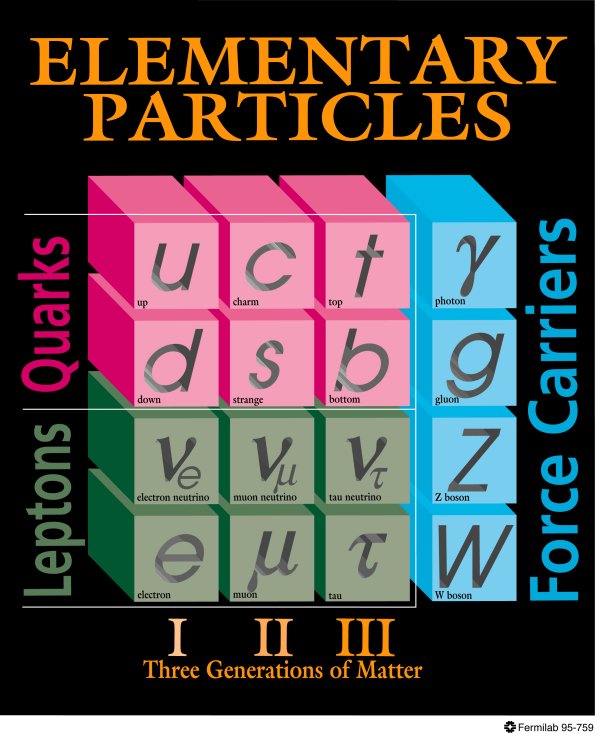
These Masterclasses give secondary school students the opportunity to discover the world of quarks and leptons for themselves, by performing measurements on real data from CERN, meeting active particle physics researchers and linking up with like-minded students from other countries.  We will join thousands of other secondary school students at more than 100 universities and laboratories around Europe and worldwide in a programme stretching over four weeks.

Physics at the most fundamental level – the smallest and most basic building blocks of matter – is an exotic world.  But a few introductory talks and working with data from CERN will give the students insight into the fundamental particles of matter and the forces between them, as well as what went on during the Big Bang.

In the morning the students are introduced to particle physics, experiments and detectors in lectures given by active particle physics researchers.  After an early lunch, they work on their own with data from the ALICE detector at CERN. Afterwards they participate in a video conference with students from other countries and moderators at CERN, where they discuss and compare their results.  For more information on the masterclasses, see the International Masterclasses web site.

You can find more information about the event here and you can register here. Hurry up though as the deadline for registration is the end of this month, i.e. this Friday, February 28th!