Archive for the The Universe and Stuff Category

Euclid, the Perseus Cluster, and Beyond!

Posted in Euclid, The Universe and Stuff with tags , , , on November 8, 2023 by telescoper

I see that the Euclid Early Release Observation of the Perseus Cluster is today’s Astronomy Picture of the Day:

The Perseus Cluster seen by Euclid

The Perseus Cluster (Abell 426) – a dense concentration of over a thousand galaxies with a total mass of about 1.2 × 10¹⁵ M – is impressive in its own right, especially because the picture was taken in a single exposure, but the staggering thing about this image is that it contains hundreds of thousands of galaxies. In other words there are as many galaxies in this picture as there are words in a book. Most of these galaxies are in the background, not associated with the cluster, and many of them extremely distant. With so many objects in one field, you can perhaps see how much data we will get from the entire survey, which will last more than 6 years. It is these distant sources – billions of them – that Euclid will survey to glean information about the expansion history of the Universe.

P.S. Yesterday’s press conference resulted in a lot of media attention worldwide, even some in Ireland. There is a piece on the RTÉ website, for example, and another on Silicon Republic (which includes a quote from yours truly).

Euclid Early Release Observations

Posted in Euclid, The Universe and Stuff with tags , , , , , , , , on November 7, 2023 by telescoper

So today’s the day. The first science-quality observations from Euclid have now been released to the public. The official press release is here, and the press conference showcasing the new observations can be viewed here:

The images themselves can be found in this repository. In summary they are (in no particular order):

  1. Galaxies in the Perseus Cluster
  2. Spiral galaxy IC 342
  3. Irregular galaxy NGC 6822
  4. Globular cluster NGC 6397
  5. The Horsehead Nebula

And here they are – you can click on them to make them bigger:

A few points of my own.

First, it is important to realise that these observations are not part of the full Euclid survey, which will start in early 2024, but were produced during the process of verification the capabilities of the telescope and detectors. They are all very short exposures, taking up less than a day to make all the images, but they demonstrate that Euclid is performing very well indeed!

Euclid is designed to achieve very sharp optical quality across a very wide field of view, so its strength is that it will produce beautiful images like these not only of a handful of objects but for billions. We need to map very large numbers of galaxies to perform the careful analysis needed to extract information about dark matter and dark energy, which is the main goal of the mission.

While these images are, in a sense, by-products of the Euclid mission, not specifically related to the main aims of the mission, they are interesting in their own right and there are proper scientific papers related to each of the five sets of observations released today. We expect many more non-cosmological spinoffs like these as the mission goes on.

There were some problems during the commissioning of the instruments carried by Euclid, the most serious of which was an issue with the Fine Guidance Sensor used to control the pointing of the telescope. This has been fixed by a software update and everything is now functioning well, as today’s new results confirm!

Preparing for Euclid’s First Images

Posted in Euclid, The Universe and Stuff with tags , , , on November 3, 2023 by telescoper

Another quick update about the release of the Early Release Observations (EROs) from Euclid, due to take place next Tuesday 7th November. For one thing, here is a little taster video.

Five images will be released on Tuesday. I know what the Early Release Observations are but you will have to wait until Tuesday to find out. If I told you now I’d have to kill you…

New Publication at the Open Journal of Astrophysics

Posted in OJAp Papers, Open Access, The Universe and Stuff with tags , , , , , on October 22, 2023 by telescoper

It’s Sunday but I’ll be a bit busy next week so I’m taking the opportunity today to announce yet another new paper at the Open Journal of Astrophysics. This one was published on Friday 20th October.

The latest paper is the 41st  so far in Volume 6 (2023) and the 106th in all. It is a product of the Dark Energy Survey team and the Kilo-Degree Survey Collaboration, which amounts to about 160 authors altogether. The corresponding author for this article was the Astronomer Royal for Scotland Professor Catherine Heymans, no less.

The primary classification for this paper is Cosmology and NonGalactic Astrophysics and its title is “DES Y3 + KiDS-1000: Consistent cosmology combining cosmic shear surveys”. The article presents a joint analysis of the Dark Energy Survey Year 3 data and the Kilo-Degree Survey data, with a discussion of the implications for cosmological parameters. The key figure – a very important one – is this:

If you want to know more about the result and why it is so important you could read the paper. It is, however, rather long: 40 pages including 21 figures and 15 tables. Do not despair, though, because here is a video explaining the work in the series of Cosmology Talks presented by Shaun Hotchkiss:

Anyway, here is the overlay of the paper containing the abstract:

You can click on the image of the overlay to make it larger should you wish to do so. You can find the officially accepted version of the paper on the arXiv here.

Two New Publications at the Open Journal of Astrophysics

Posted in OJAp Papers, Open Access, The Universe and Stuff with tags , , , , , , , , on October 20, 2023 by telescoper

It’s Friday so it’s a good time to catch up with the week’s action at the Open Journal of Astrophysics, where there have been two new publications so far this week. These papers take us up to a total of 40  in Volume 6 (2023) and 105 in total since we started publishing.

The title of the first paper is “Halo Properties from Observable Measures of Environment: I. Halo and Subhalo Masses” and its primary classification is Astrophysics of Galaxies. it is an exploration using neural networks of how the peak masses of dark matter halos and subhaloes correlate with observationally-accessible measures of their dependence on environment.

The authors based in the United States of America: Haley Bowden and Peter Behroozi of the University of Arizona, and Andrew Hearin of the Argonne National Laboratory

Here is a screen grab of the overlay which includes the abstract:


You can click on the image of the overlay to make it larger should you wish to do so. You can find the officially accepted version of the paper on the arXiv here.

The second paper was published on 18th October 2023.  The primary classification for this one is Cosmology and Nongalactic Astrophysics and is “Mitigating the noise of DESI mocks using analytic control variates”. For those of you not up with the lingo, DESI stands for the Dark Energy Spectroscopic Instrument and you can read more about it here.

The lead author for this one is Boryana Hadzhiyska of the Lawrence Berkeley Laboratory and the University of California, Berkeley (USA) and there are 32 other authors. This paper presents a method for reducing the effects of sample variance on cosmological simulations using analytical approximations and tests it using DESI data.

Here is a screen grab of the overlay which includes the abstract:


You can click on the image of the overlay to make it larger should you wish to do so. You can find the officially accepted version of the paper on the arXiv here.

Radial Reconstruction Test

Posted in The Universe and Stuff on October 16, 2023 by telescoper

Don’t worry about what this is, I’m just testing to see what the video rendering looks like. If you want to know, it’s an attempt to run the collapse of a spherical over-density backwards in time!

LiteBIRD Update

Posted in Cardiff, The Universe and Stuff with tags , , , , , on October 12, 2023 by telescoper


It was more than four years ago that I passed on the news that the space mission LiteBIRD had been selected as the next major mission by the Japanese Space Agency JAXA and Institute for Space and Astronautical Science (ISAS).
LiteBIRD (which stands for `Lite (Light) satellite for the studies of B-mode polarization and Inflation from cosmic background Radiation Detection’) is a planned space observatory that aims to detect the footprint of the primordial gravitational waves on the cosmic microwave background (CMB) in a form of a B-mode polarization pattern. This is the signal that BICEP2 claimed to have detected nine years ago to muc excitement, but was later shown to be a caused by galactic dust.
At the time, I said that this was great news for a lot of CMB people all round the world that this mission had been selected – include some old friends from Cardiff University. Well, I’ve just seen a news item announcing a grant to Cardiff astrophysicists who will lead the UK involvement and develop the optical design.
The launch date has slipped into the 2030s (no doubt partly because of the pandemic) so I’ll be long retired before it happens, but the mission will last three years and will, like Euclid, be at Earth-Sun Lagrange point known as L2. It will be a very difficult task to extract the B-mode signal from foregrounds and instrumental artifacts but I wish LiteBIRD every success!

Grubb in Spain

Posted in Barcelona, History, The Universe and Stuff with tags on October 10, 2023 by telescoper

Just after I arrived in Barcelona, I posted a piece about the telescope in the foyer of the Physics Department:

I’m indebted to Vicent Martínez for the following information and the picture:

Howard Grubb et al.

Ignacio Tarzaona bought the telescope in 1906 for the University of Barcelona from the Grubb factory in Dublin. Sir Howard Grubb (son of Thomas Grubb, founder of the Grubb Telescope Company) and Ignacio Tarazona actually knew each other well. In this photograph taken in Berrocalillo (Spain) on May 28, 1900, we can see both of them. The man farthest to the right of all, standing and wearing a “Catalan barretina” is Ignacio Tarazona and Sir Howard Grubb is sitting in the front row, fifth from left with his Panama hat on his knee.

Gaia Focused Product Release

Posted in The Universe and Stuff with tags , on October 10, 2023 by telescoper

I almost forgot about this but some new data from the ESA Gaia mission will be announced this afternoon at 3pm CEST*, though it seems to be a bit late. This announcement concerns the latest batch of Gaia Focused Product (Gaia FPR) data. The release consists in the publication of 5 papers on specific aspects of the mission and the associated data.  You can watch here. Due to technical problems it has been delayed by 30 minutes and there is a new link:

While waiting to view the announcement, you may wish to familiarize yourself with the mission by reading this list of Top Ten Gaia Facts.

*Coles Extended Sabbatical Time

New Publication at the Open Journal of Astrophysics

Posted in OJAp Papers, Open Access, The Universe and Stuff with tags , , , , on October 9, 2023 by telescoper

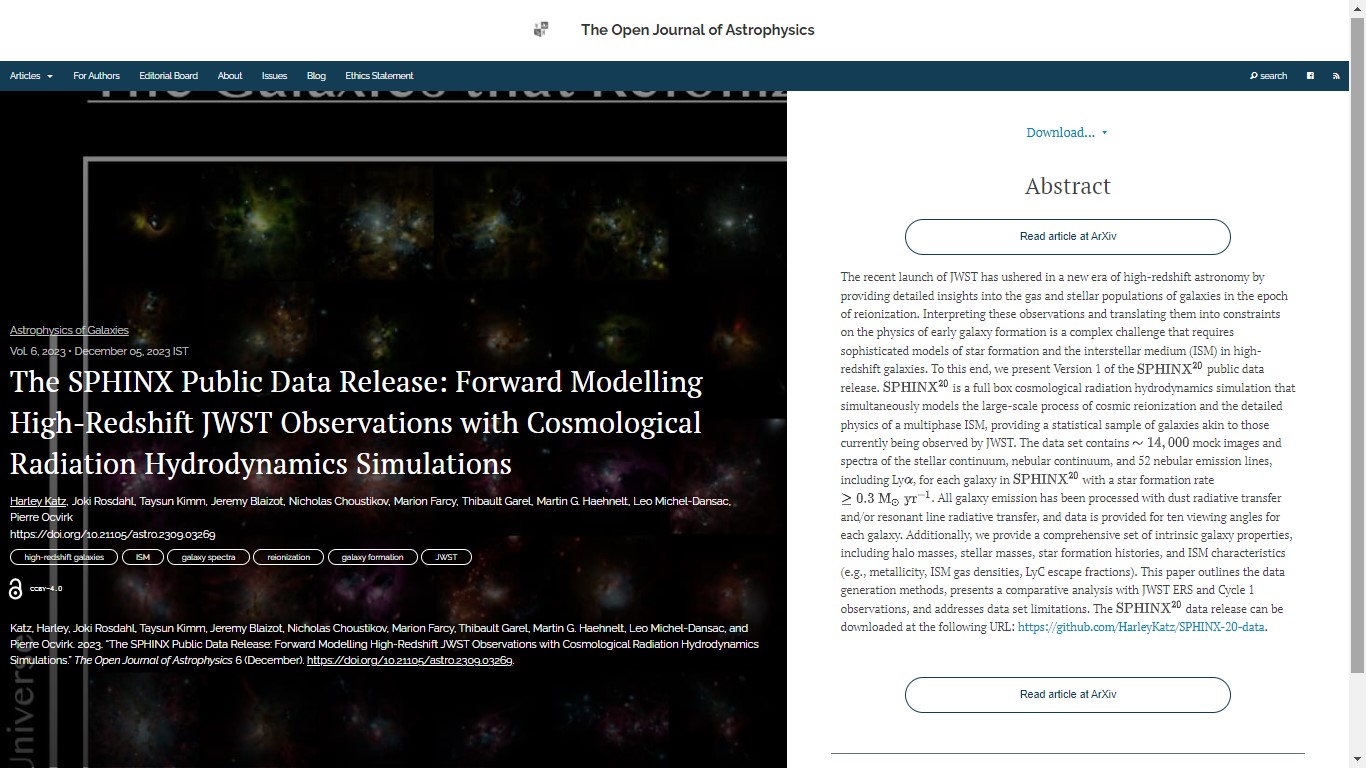
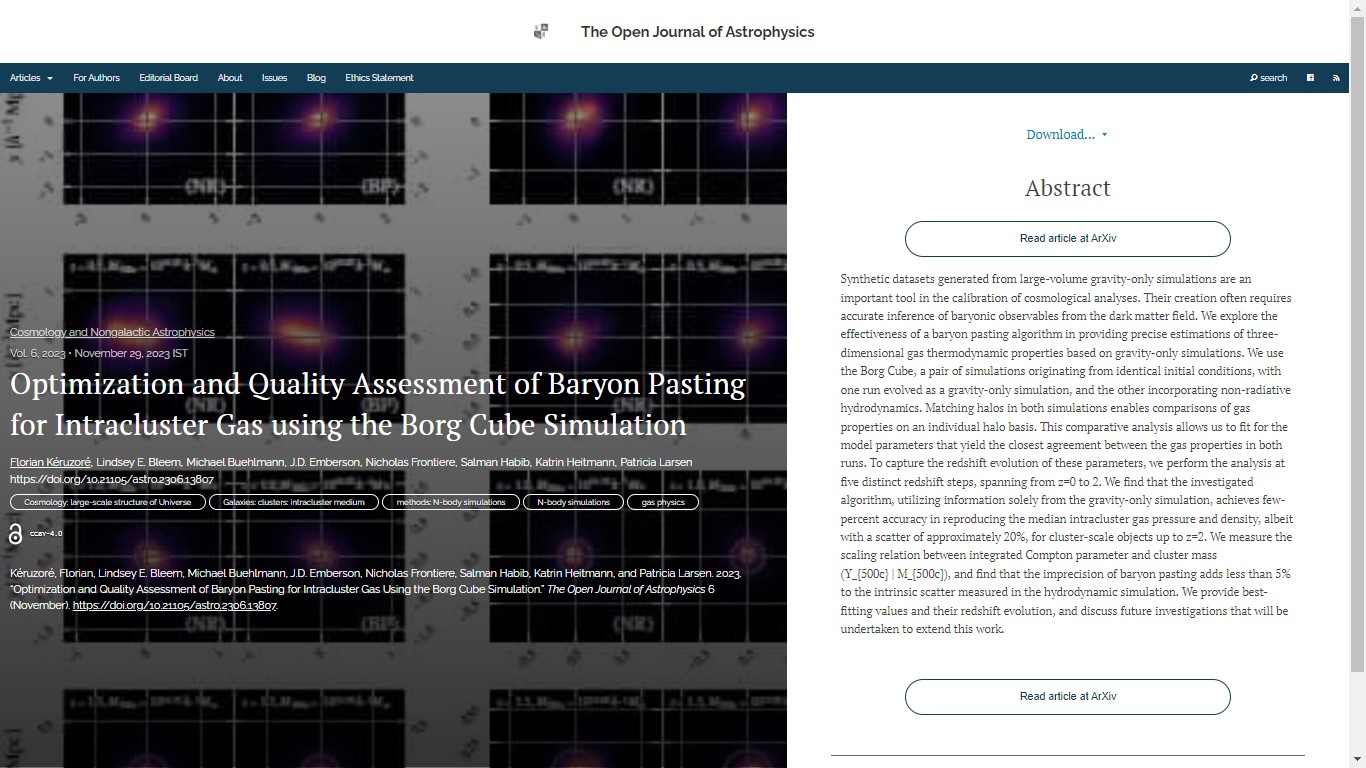
Time to announce yet another new paper at the Open Journal of Astrophysics. This one was actually published on Friday (6th October 2023), but for one reason and another I’ve only just got around to announcing it here.

The latest paper is the 38th  so far in Volume 6 (2023) and the 103rd in all. The authors are: Matthew Price, Matthijs Mars, Matthew Docherty, Alessio Spurio Mancini, Augustin Marignier and Jason McEwen – all affiliated with University College London, UK.

The primary classification for this paper is Cosmology and Nongalactic Astrophysics and its title is “Fast emulation of anisotropies induced in the cosmic microwave background by cosmic strings”. It describes a  generative technique for producing generating cosmic microwave background temperature maps using wavelet phase harmonics. For an explanation of what a cosmic string is, see here. If you don’t know the difference between “emulation” and “simulation”, I refer you to the text!

Here is a screen grab of the overlay of the published version which includes the  abstract:

You can click on the image of the overlay to make it larger should you wish to do so. You can find the officially accepted version of the paper on the arXiv here.