Archive for the The Universe and Stuff Category

R.I.P. George F. Smoot (1945-2025)

Posted in Biographical, R.I.P., The Universe and Stuff with tags , , , , , , on September 26, 2025 by telescoper
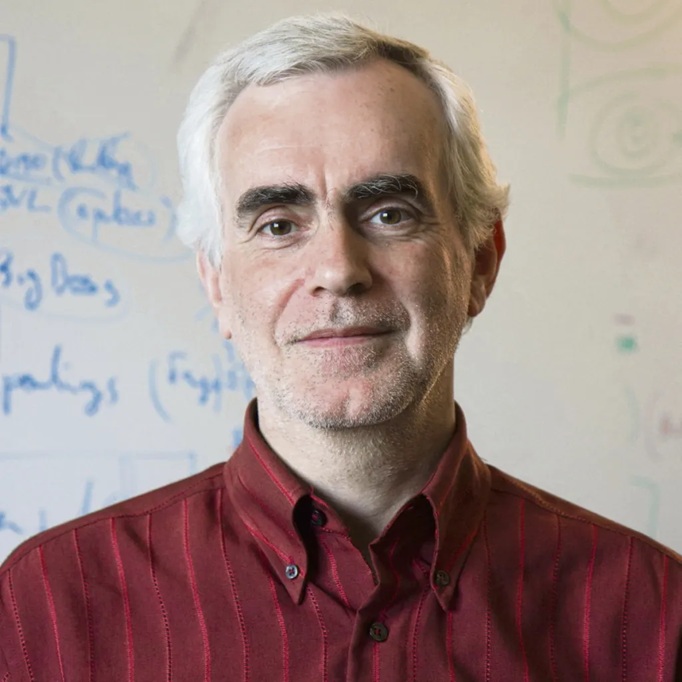
George F. Smoot (1945-2025)

I’m very sad to have to report the death, at the age of 80, of eminent cosmologist George Smoot, who passed away at his home in Paris on 18th September. The news has been reported in France, where George had been living in recent years, but doesn’t seem to have been covered in the international media yet. I thought I would just record some personal relfections and reminiscences here, rather than try to pre-empt the official biographies.

George Smoot was an experimental astrophysicist who is best known for his research in observational cosmology, particularly on the cosmic microwave background. In 2006, jointly with John Mather, he was awarded the Nobel Prize for Physics for measurements made by the COBE satellite that, without exaggeration, ushered in a new era of cosmology. George led the paper Structure in the COBE Differential Microwave Radiometer First-Year Maps that reported the first detection of variations in temperature of the cosmic microwave background across the sky predicted by theories of cosmological structure formation.

I was fortunate enough to meet George many times over the years and to get to know him quite well. The first time was at a meeting in Durham for which this was the conference photo:

George is just to the left of centre in the front row with the red-and-white sweater.

What I remember about that meeting is that I gave a contributed talk there (a short one, because I was a mere postdoc at the time). Some time after that, George Smoot gave an invited talk during the course of which he mentioned (positively) the work I had spoken about. I was gobsmacked to have my little contribution recognized by someone so eminent, and it did wonders for my scientific self-confidence. I got the chance to have a conversation with George in person some time later at that meeting and found him very good value: he was both interesting and amusing to talk to. He was someone who took mentorship seriously, and didn’t confine it to those people he was working with directly.

Over the years I met George regularly at scientific meetings, including numerous times at the (then) Daniel Chalonge schools in Sicily and in Paris where we often chatted about science and other things over coffee breaks and dinner. I always found him hugely knowledgeable about many things, but he also had an almost child-like curiosity about things he didn’t previously know. He didn’t quite jump up and down with excitement when he learnt something interesting, but almost. He could also be very direct when disagreeing, which meant that some people found him a bit abrasive. He fell out with other members of the COBE time when he threw away the agreed protocol for the announcement of results in 1992. That caused a lot of bad feeling at the time, but it seems that by the time the Nobel Prize was awarded, some degree of reconciliation had been achieved. I was lucky enough to attend the Prize Ceremonies and at the ball afterwards chatted with both George and John Mather who seemed on very amiable terms then.

Anyway, in the early noughties George invited me to spend some time at the Lawrence Berkeley Laboratory, a visit that I enjoyed enormously. He was a very generous and thougtful host and I was looked after very well. One day at LBL he asked me if the hotel was OK. I replied that it was, but one thing I didn’t like about staying in a hotel was that I liked to cook and that was impossible in a hotel room. I thought nothing more of that conversation until the end of the day when George appeared and asked me if I wanted to “do dinner” at his house that evening. I answered in the affirmative so he drove me to his house, which was very fancy, set into the hillside overlooking Berkeley – like the sort of place I imagine a film star would live – and had a very large and well-provisioned kitchen.

It soon became clear that I’d misunderstood the invitation, in that “do dinner” didn’t mean “eat dinner” but “make dinner”. Although I was slightly taken aback I set about finding what he had in the refrigerator and on the shelves. There being a plentiful supply of spices, I decided to make a tandoori-style dish of chicken baked with yoghurt, with a couple of side dishes, none of which took long to cook. When everything was getting ready I wanted to add some lemon juice but couldn’t find any lemons in the fridge. I asked George if he had any lemons, at which point he showed me into the garden where he had several lemon trees in full fruit. I’ve never lived anywhere that this would be possible! I think he enjoyed the dinner because he paid me back a few days later with a dinner at Chez Panisse. He was quite the bon viveur.

(After that short visit, I was planning to spend a sabbatical year in Berkeley in 2005, but the United States Embassy in London put paid to that idea and I went to CITA in Toronto instead.)

The last encounters I had with George were online; he was in the audience when I gave talks in the Chalonge-de Vega series organized by Norma Sanchez in 2021 (here and here). I think he had already moved to Paris by that time. The first of these talks was about open access publishing in astrophysics; George subsequently co-authored a paper in the Open Journal of Astrophysics.

My favourite quote from George came during a discussion we had at Berkeley when I suggested that some methods used for studying the cosmic microwave background could be applied to the distribution of galaxies. His response was “Galaxies are shit”. To avoid offending my friends who work on galaxies, what he meant by that was that he thought galaxies were too messy for any statistical measurements to sufficiently reliable to compete with the CMB. I think he would have preferred a universe in which all galaxies were identical, like electrons.

I’m sure many others will have their own personal reflections on their interactions with George Smoot, but he also had a huge influence on many people who never met him personally, through his enormous contributions to astrophysics and cosmology. We will no doubt read many professionally-written official obituaries in days to come, but all I can say in a personal blog post is that he was a character, a very original thinker, a fine scientist, and a very nice man. Along with many others, I will miss him enormously.

Rest in Peace, George Fitzgerald Smoot III (1945-2025) .

Update: Here is an `In Memoriam’ piece from from the Berkeley Lab.

Euclid Flagship 2 Update

Posted in Euclid, The Universe and Stuff with tags , , , on September 22, 2025 by telescoper

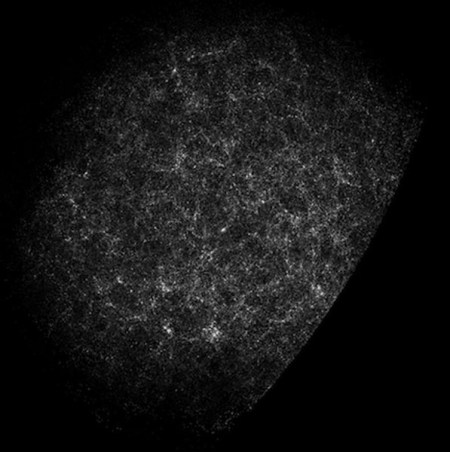
I was thinking earlier today that it’s been a while since I last posted anything about the European Space Agency’s Euclid Mission but I’ve got an excuse to remedy that today because there is a brand new a press release about the Euclid Consortium’s Flagship 2 simulations, a (low-resolution) visual representation of one of which is shown above.

The news is that the largest ever synthetic galaxy catalogue is now public; a team of 8 institutions within the Euclid Consortium, led by the Institute of Space Sciences (ICE-CSIC) and the Port d’Informació Científica (PIC) in Barcelona have developed this `mock’ catalogue, which includes 3.4 billion galaxies, each with 400 modelled properties available for the scientific community. It was constructed to help analyse data from the Euclid mission, but has many other potential uses so is being shared otuside the Consortium.

You can read more about this catalogue, and also find out how the access the simulated catalogues, here. You could also read the scientific paper describing the flagship simulations here.

P.S. The first main data release from Euclid (known to its friends as DR1) will take please on October 21, 2026. That’s just 13 months away…

Autumnal Equinox 2025

Posted in Biographical, Education, Maynooth, The Universe and Stuff with tags , on September 22, 2025 by telescoper

Just a note to say that the Autumnal Equinox (in the Northern hemisphere) takes place this evening (Monday 22nd September 2025)  at 19.20 Irish Summer Time (18.20 UTC).

Although  the term `equinox’  refers to a situation in which day and night are of equal length, which implies that it’s a day rather than a specific time, the astronomical equinox is more accurately defined by a specific event, i.e. when the plane defined by Earth’s equator passes through the centre of the Sun’s disk (or, if you prefer, when the centre of the Sun passes through the plane defined by Earth’s equator). Day and night are not necessarily exactly equal on the equinox, but they’re the closest they get. From now on days in the Northern hemisphere will be shorter than nights and they’ll get shorter still until the Winter Solstice on Sunday 21st December 2024 at 3.03 pm Irish Time.

Many people take the autumnal equinox to be the end of summer. There is a saying around these parts, however, that `Summer is Summer to Michaelmas Day’ (September 29th), which is not until next week. I must say, though, though it doesn’t feel particularly summery this morning as there is a chilly wind blowing from the North.

Anyway, make the most of the Equinox because there is a rumour circulating that The Rapture will occur tomorrow (Tuesday 23rd September).

Weekly Update from the Open Journal of Astrophysics – 20/09/2025

Posted in OJAp Papers, Open Access, The Universe and Stuff with tags , , , , , , , , , , on September 20, 2025 by telescoper

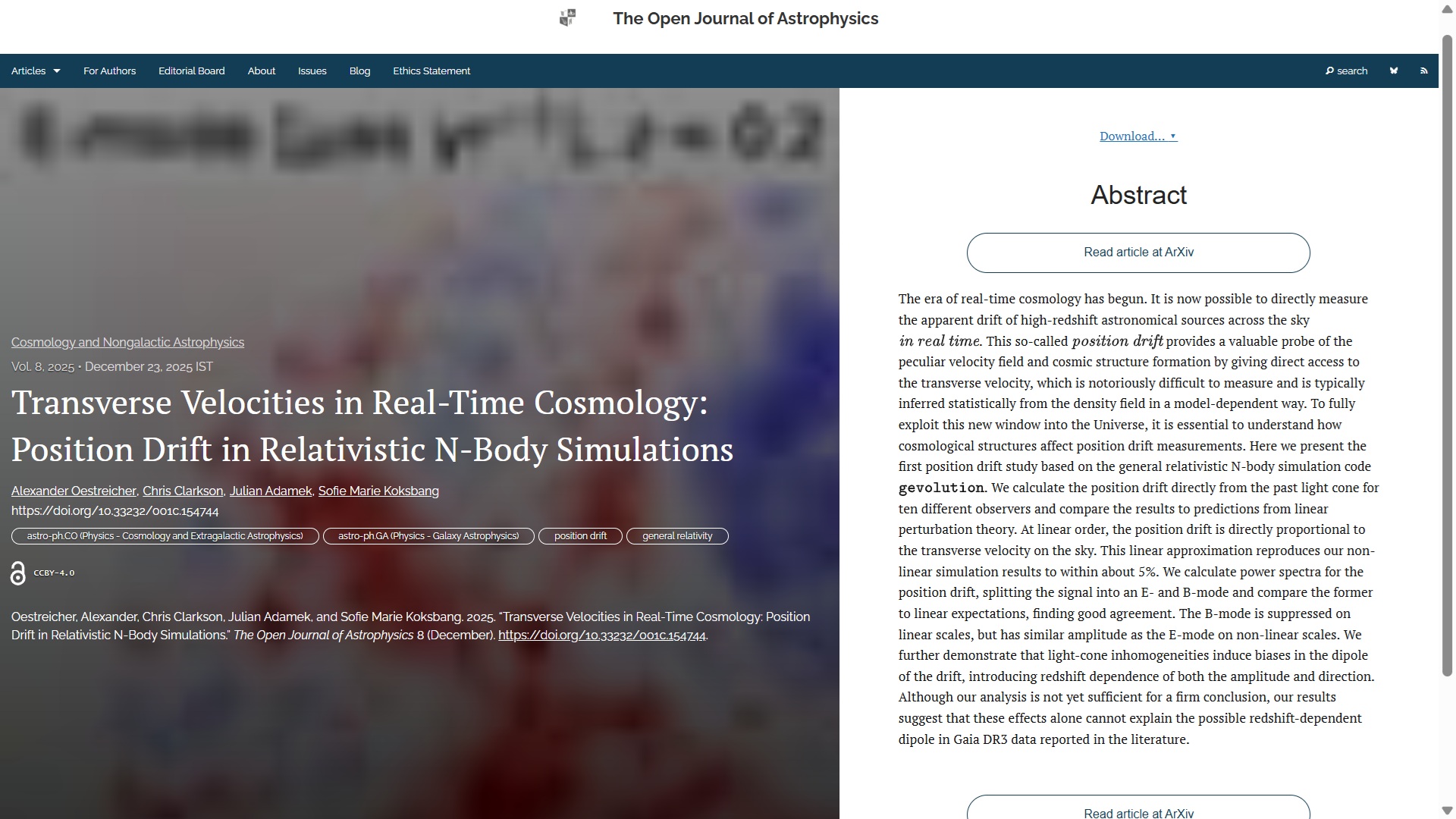
It’s Saturday again, so it’s time for a summary of the week’s new papers at the Open Journal of Astrophysics. Since the last update we have published two new papers, which brings the number in Volume 8 (2025) up to 136, and the total so far published by OJAp up to 371.

The first paper to report this week is “The Moon as a possible source for Earth’s co-orbital bodies” by Rafael Sfair, L. C. Gomes, O. C. Winter & R. A. Moraes (São Paulo State University, Brazil), G. Borderes-Motta (Astronomical Institute of the Czech Academy of Sciences, Czech Republic) and C. M. Schäfer (Universität Tübingen, Germany). This paper was published on Monday 15th September, in the folder Earth and Planetary Astrophysics, and it presents a numerical exploration of the ejection velocities and launch locations necessary for lunar ejecta to evolve into Earth’s co-orbital bodies.

The overlay is here:


You can make this larger by clicking on it.  The officially accepted version of this paper can be found on the arXiv here.

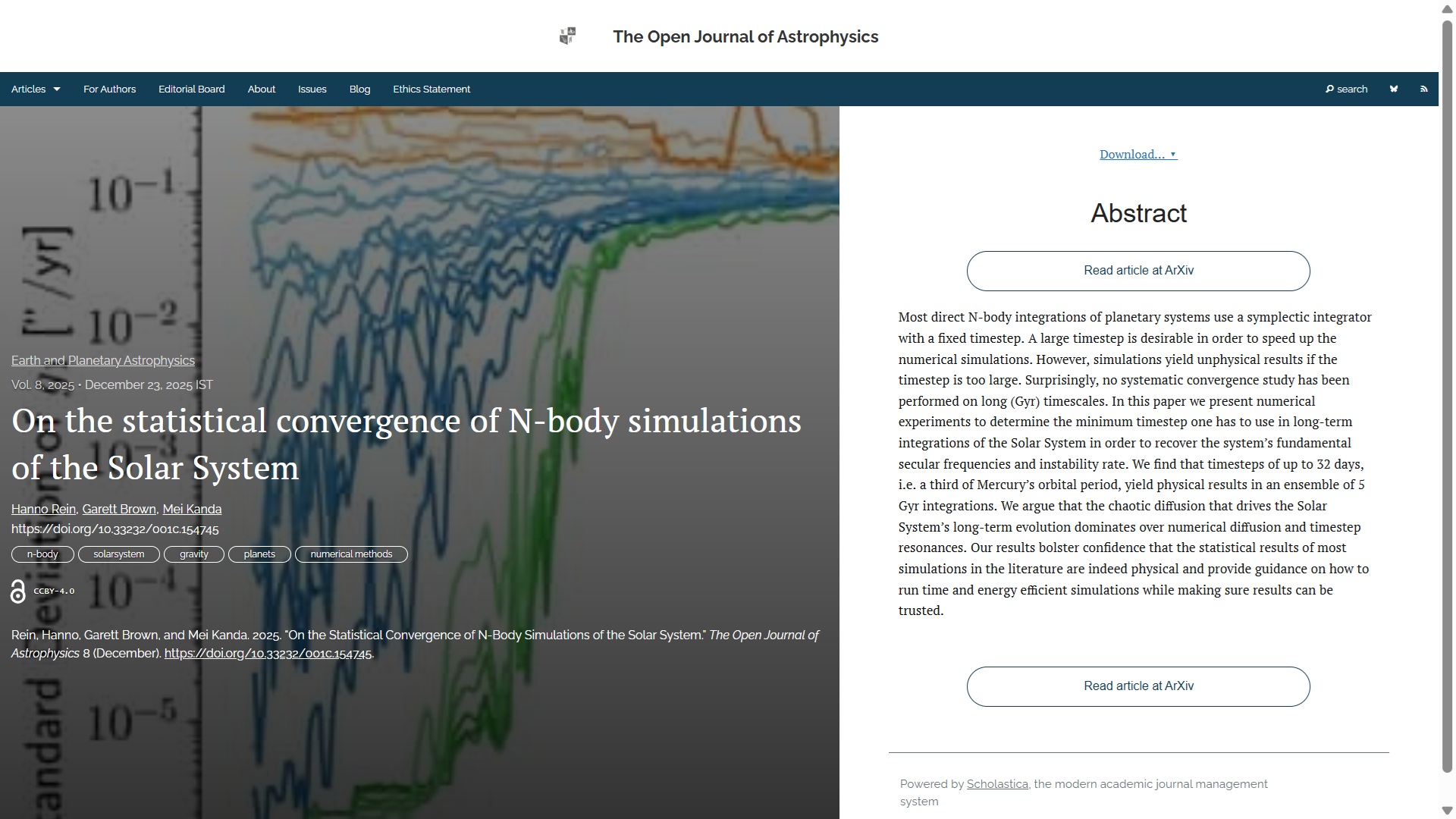
The second paper this week, published on Friday 19th September in the folder Solar and Stellar Astrophysics, is  “Jet-Driven Formation of Bipolar Rings in Planetary Nebulae: Numerical Simulations Inspired by NGC 1514” by Muhammad Akashi, Ealeal Bear, and Noam Soker (Technion, Haifa, Israel). This paper presents evidence from numerical simulations notion that jets play a substantial role in shaping planetary nebulae (PNe).

The corresponding overlay is here:


You can find the officially accepted version on arXiv here.

The Nebra Sky Disc

Posted in Art, History, The Universe and Stuff with tags , , , , on September 19, 2025 by telescoper
By Frank Vincentz – Public Domain, https://commons.wikimedia.org/w/index.php?curid=117229202

This remarkable object is made of bronze, is around 30 cm diameter and weighs about 2.2 kg. It has a blue-green patina and is inlaid with gold symbols, usually interpreted as the full moon, a lunar crescent, and stars, including a cluster of seven stars, thought to represent the Pleiades. The gold arc on the right probably represents the Sun’s path between the solstices; the angle subtended by the arc (82°) is the correct angle sunrise at the summer and winter solstices and at the latitude of the discovery site (Mittelberg, near Nebra, in Germany); there was probably another such arc on the other side of the disk (now lost). Remarkably, the tin used in making the bronze from which it is formed has been traced by metallurgical analysis to Cornwall.

The Nebra disc has been dated to c. 1800–1600 BCE (Bronze Age) which makes it the oldest (certain) depiction of celestial phenomena known from anywhere in the world. In November 2021, a replica of the Nebra Sky Disc was taken by German astronaut Matthias Maurer to the International Space Station.

A Zoom in to the Butterfly Nebula

Posted in Maynooth, The Universe and Stuff, YouTube with tags , , , , , , on September 17, 2025 by telescoper

I haven’t used my Youtube channel very much recently so to avoid disappointing my subscribers, of whom there are several, I have today uploaded a video showcasing the work of colleagues in the Physics Department at Maynooth.

This zoom in from an optical Hubble Space Telescope (HST) image shows how infrared observations by the James Web Space Telescope reveal the surprising details of the structure at the heart of the Butterfly Nebula, NGC 6302

For background to this video, see here.

On Cosm(et)ology

Posted in Biographical, The Universe and Stuff with tags , , , , , on September 16, 2025 by telescoper

Every now and then I clean out my spam folder, usually finding a number of junk conference invitations. Most of them are tedious but sometimes I get a funny one that I post on here. The latest batch included this one.

I suppose the confusion between cosmology and cosmetology was to be expected at some point. I am of course something of an expert on ageing (sic), having managed to age quite considerably over the last 60-odd years. I also have a strong interest in the make-up of the Universe, especially through the foundations of physics. I’d even be tempted to attend the meeting were I not teaching on the dates concerned. I might reply suggesting they invite a colleague of mine here in Ireland, Dermot O’Logical.

Anyway, this gives me an excuse to post the following rehash of one of my old posts, this I one that dates from 2008..

–o–

When asked what I do for a living, I’ve always avoided describing myself as an astronomer, because most people seem to think that involves star signs and horoscopes. Anyone can tell I’m not an astrologer anyway, because I’m not rich. Astrophysicist sounds more impressive, but perhaps a little scary. That’s why I usually settle on “Cosmologist”. Grandiose, but at the same time somehow cuddly.

I had an inkling that this choice was going to be a mistake at the start of my first ever visit to the United States, which was to attend a conference in memory of the great physicist Yacov Borisovich Zel’dovich, who died in 1989. The meeting was held in Lawrence, Kansas, home of the University of Kansas, in May 1990. This event was notable for many reasons, including the fact that the effective ban on Russian physicists visiting the USA had been lifted after the arrival of glasnost to the Soviet Union. Many prominent scientists from there were going to be attending. I had also been invited to give a talk, the only connection with Zel’dovich that I could figure out was that the very first paper I wrote was cited in the very last paper to be written by the great man.

I think I flew in to Detroit from London and had to clear customs there in order to transfer to an internal flight to Kansas. On arriving at the customs area in the airport, the guy at the desk peered at my passport and asked me what was the purpose of my visit. I said “I’m attending a Conference”. He eyed me suspiciously and asked me my line of work. “Cosmologist,” I proudly announced. He frowned and asked me to open my bags. He looked in my suitcase, and his frown deepened. He looked at me accusingly and said “Where are your samples?”

I thought about pointing out that there was indeed a sample of the Universe in my bag but that it was way too small to be regarded as representative. Fortunately, I thought better of it. Eventually I realised he thought cosmologist was something to do with cosmetics, and was expecting me to be carrying little bottles of shampoo or make-up to a sales conference or something like that. I explained that I was a scientist, and showed him the poster for the conference I was going to attend. He seemed satisfied. As I gathered up my possessions thinking the formalities were over, he carried on looking through my passport. As I moved off he suddenly spoke again. “Is this your first visit to the States, son?”. My passport had no other entry stamps to the USA in it. “Yes,” I said. He was incredulous. “And you’re going to Kansas?”

This little confrontation turned out to be a forerunner of a more dramatic incident involving the same lexicographical confusion. One evening during the Zel’dovich meeting there was a reception held by the University of Kansas, to which the conference participants, local celebrities (including the famous writer William Burroughs, who lived nearby) and various (small) TV companies were invited. Clearly this meeting was big news for Lawrence. It was all organized by the University of Kansas and there was a charming lady called Eunice who was largely running the show. I got talking to her near the end of the party. As we chatted, the proceedings were clearly winding down and she suggested we go into Kansas City to go dancing. I’ve always been up for a boogie, Lawrence didn’t seem to be offering much in the way of nightlife, and my attempts to talk to William Burroughs were repelled by the bevy of handsome young men who formed his entourage, so off we went in her car.

Before I go on I’ll just point out that Eunice – full name Eunice H. Stallworth – passed away suddenly in 2009. I spent quite a lot of time with her during this and other trips to Lawrence, including a memorable day out at a pow wow at Haskell Indian Nations University where there was some amazing dancing.

Anyway, back to the story. It takes over an hour to drive into Kansas City from Lawrence but we got there safely enough. We went to several fun places and had a good time until well after midnight. We were about to drive back when Eunice suddenly remembered there was another nightclub she had heard of that had just opened. However, she didn’t really know where it was and we spent quite a while looking for it. We ended up on the State Line, a freeway that separates Kansas City Kansas from Kansas City Missouri, the main downtown area of Kansas City actually being for some reason in the state of Missouri. After only a few moments on the freeway a police car appeared behind us with its lights blazing and siren screeching, and ushered us off the road into a kind of parking lot.

Eunice stopped the car and we waited while a young cop got out of his car and approached us. I was surprised to see he was on his own. I always thought the police always went around in pairs, like low comedians. He asked for Eunice’s driver’s license, which she gave him. He then asked for mine. I don’t drive and don’t have a driver’s license, and explained this to the policeman. He found it difficult to comprehend. I then realised I hadn’t brought my passport along, so I had no ID at all.

I forgot to mention that Eunice was black and that her car had Alabama license plates.

I don’t know what particular thing caused this young cop to panic, but he dashed back to his car and got onto his radio to call for backup. Soon, another squad car arrived, drove part way into the entrance of the parking lot and stopped there, presumably so as to block any attempted escape. The doors of the second car opened and two policemen got out, kneeled down and and aimed pump-action shotguns at us as they hid behind the car doors which partly shielded them from view and presumably from gunfire. The rookie who had stopped us did the same thing from his car, but he only had a handgun.

“Put your hands on your heads. Get out of the car. Slowly. No sudden movements.” This was just like the movies.

We did as we were told. Eventually we both ended up with our hands on the roof of Eunice’s car being frisked by a large cop sporting an impressive walrus moustache. He reminded me of one of the Village People, although his uniform was not made of leather. I thought it unwise to point out the resemblance to him. Declaring us “clean”, he signalled to the other policemen to put their guns away. They had been covering him as he searched us.

I suddenly realised how terrified I was. It’s not nice having guns pointed at you.

Mr Walrus had found a packet of French cigarettes (Gauloises) in my coat pocket. I clearly looked scared so he handed them to me and suggested I have a smoke. I lit up, and offered him one (which he declined). Meanwhile the first cop was running the details of Eunice’s car through the vehicle check system, clearly thinking it must have been stolen. As he did this, the moustachioed policeman, who was by now very relaxed about the situation, started a conversation which I’ll never forget.

Policeman: “You’re not from around these parts, are you?” (Honestly, that’s exactly what he said.)

Me: “No, I’m from England.”

Policeman: “I see. What are you doing in Kansas?”

Me: “I’m attending a conference, in Lawrence..”

Policeman: “Oh yes? What kind of Conference?”

Me: “It’s about cosmology”

At this point, Mr Walrus nodded and walked slowly to the first car where the much younger cop was still fiddling with the computer.

“Son,” he said, “there’s no need to call for backup when all you got to deal with is a Limey hairdresser…”.

17 Years In The Dark

Posted in Biographical, The Universe and Stuff with tags , , , on September 15, 2025 by telescoper

I just received the following message from WordPress.com reminding me that today is the 17th anniversary of my registration with them, which is when I took my first step into the blogosphere. That was way back on 15th September 2008…

I actually wrote my first post on the day I registered but, unfortunately, I didn’t really know what I was doing on my first day at blogging – no change there, then – and I didn’t actually manage to figure out how to publish this earth-shattering piece. It was only after I’d written my second post that I realized that the first one wasn’t actually visible to the general public because I hadn’t pressed the right buttons, so the two appear in the wrong order in my archive. Such was the inauspicious beginning of this “shitty WordPress blog”!

Since then I have published 7,418 blog posts posts (including this one), which have altogether received over 5.8M page views from 2.4M unique visitors. That doesn’t include the 2000+ subscribers who receive posts by email nor those who view the federated version via the fediverse. The largest number of hits I have received in a single day is still 8,864 (in 2014, at the peak of the BICEP2 controversy).

This time next year this blog will be an adult! Having gone this far with it, I might as well continue until I retire…

P.S. I noticed recently that this blog is getting some traffic from China, where it was previously banned. along with all other WordPress.com sites. It’s interesting that this ban appears to have been lifted.

More on the 10th Anniversary of Gravitational Waves

Posted in The Universe and Stuff with tags , , , , , on September 14, 2025 by telescoper

Further to my earlier post, I refer you to this much more detailed article by someone actually involved in the LIGO experiment, former Cardiff colleague Bernard Schutz..

A Decade of Gravitational Waves

Posted in Biographical, The Universe and Stuff with tags , , , , , , on September 14, 2025 by telescoper

This is just a quick post to mark the fact that it is now ten years to the day since the first detection of gravitational waves by Advanced LIGO. The acronym LIGO stands for Laser Interferometer Gravitational-wave Observatory, by the way. It wasn’t until February 11th 2016 that the result was announced at a press conference (which I blogged about here), but the signal itself arrived on 14th September 2015, exactly a decade ago; the name given to the event was GW150914.

Here are the plots for that first one:

LIGO

That first signal corresponded to the coalescence of two black holes, of masses 29 and 36 times the mass of the Sun and produced a large response in the detectors very soon after Advanced LIGO was switched on. There’s synchronicity for you! The LIGO collaboration have done wondrous things getting their sensitivity down to such a level that they can measure such a tiny effect, but there still has to be an event producing a signal to measure. Collisions of two such massive black holes are probably extremely rare so it’s a bit of good fortune that one happened just at the right time. Actually it was during an engineering test.

There have been many subsequent detections and even more candidates waiting to be confirmed- here’s a full list. The official LIGO site states there are 90 confirmed detections, the 4th observational run (O4) (which is due to end in November 2025) has already found 200 candidates. The latest compilation of gravitational-wave transient sources can be found here.

Most of the detections have been binary black hole mergers, but I particularly remember the excitement in 2017 surrounding the first merger of a neutron star with a black hole. It was fun that rumours started to spread via this blog as people outside the LIGO/transient source community used a comments thread here to share information of what various telescopes were looking at. That was in August 2017, just over 8 years ago.

Anyway, here’s to the next decade. Assuming NSF does not follow Trump’s plan to slash the LIGO budget.