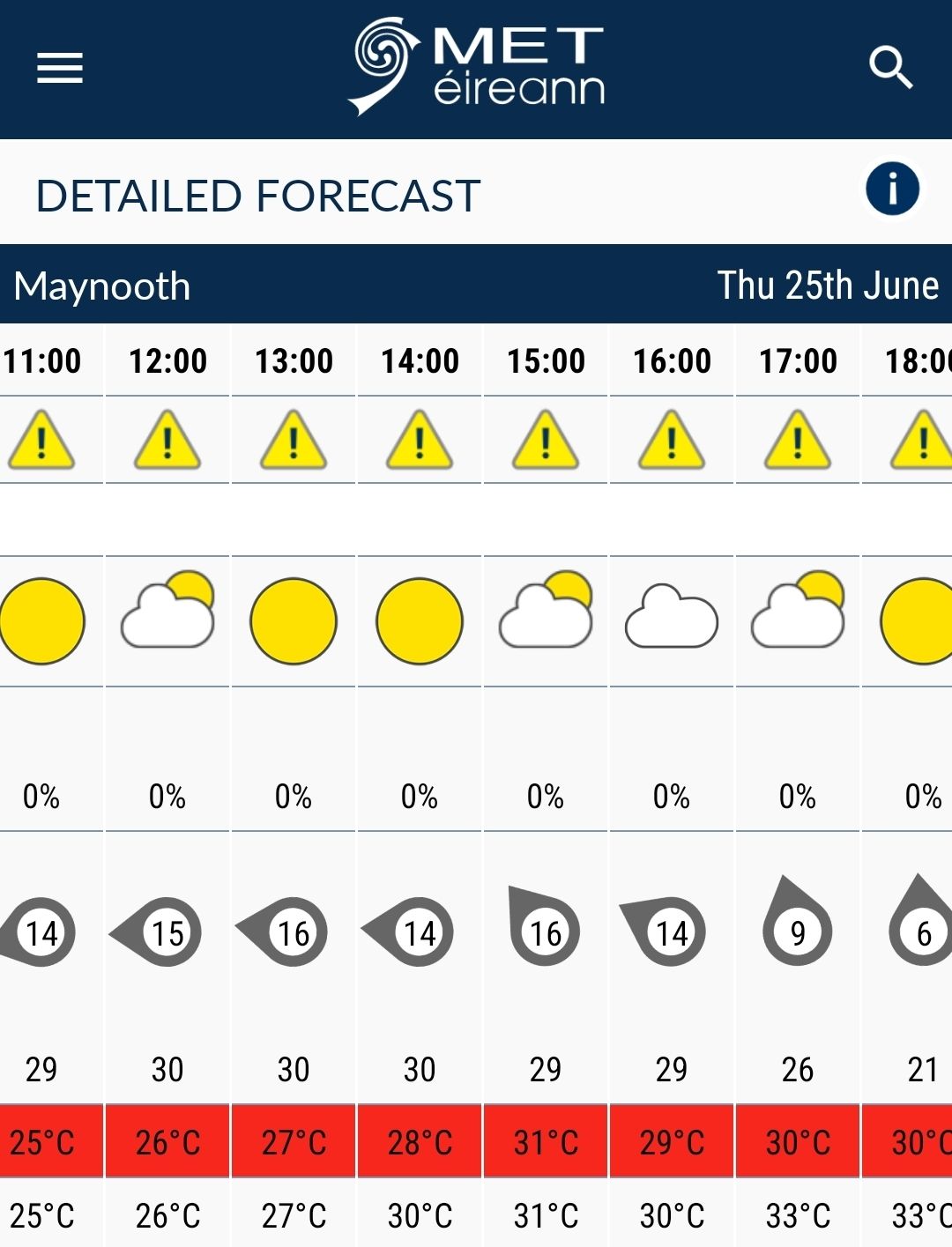
So the heatwave continues. The forecast for Maynooth today has temperatures exceeding 30°C, and higher in the South.
This kind of heat is very unusual for Ireland; the highest temperature ever recorded on the island is 33.3°C, in Kilkenny, way back in 1887. That record may well be broken today…
Actually the temperature readings in 1887 were given to the nearest degree Fahrenheit; the reading on 26th June 1887 was 92°F, which means somewhere between 91.5°F and 92.5°F (which is 33.1–33.6°C), so the central value of 33.3°C is not unreasonable, though the number could have been as low as 33.1°C or as high as 33.6°C. For a discussion see here.
It’s worth also repeating the fact I mentioned a few days ago on the Solstice, that this evening we will have the latest sunset of 2026, at 9:59:38 pm.
Yesterday afternoon we had a Staff Barbecue, which was held in nice – but not quite so hot – weather. It was very well attended and a pleasant occasion all round with plentiful burgers, hotdogs and booze. I must say it was very generous of the President to pay for all that out of her own pocket. (Is This Right? Ed.)
The largest and most detailed photo ever made of the Galactic Centre in visible light was taken by the Euclid mission. For just one day (23rd March 2025), Euclid turned its gaze towards the extremely bright inner region of our Milky Way galaxy, known as the galactic bulge. The extraordinary picture that resulted is not part of Euclid’s main cosmological survey, which is designed to look at objects far outside our own Galaxy, but was made in response to a special request from astronomers who were after what Euclid does best: capturing large areas of the sky in crisp detail. Packed with more than 60 million stars, this image opens the door for scientists to confirm the existence of any exoplanet found in this region and measure its mass using tiny changes in starlight over time. The observational data obtained in this project were released today as Euclid’s Q2 data release; for details of Q1 please see here.
Designed to observe billions of faraway galaxies, the space telescope’s visible light camera is sensitive enough to tell apart individual stars in our super-crowded galactic bulge, without being blinded. This ability is crucial for what scientists want to use this image for: studying planets around other stars using a special technique called gravitational microlensing.
For comparison, Euclid’s sharpness and sensitivity in visible light is similar to the NASA/ESA Hubble Space Telescope’s wide field camera. But each pointing that Euclid captures in a few hours spans an area 270 times larger than Hubble’s field of view. To observe the same Euclid mosaic, the Keck Observatory would need around 2000 hours. Euclid is faster, and able to capture details from fainter stars that would be otherwise missed when observing from the ground. This single mosaic also encompasses the entire region that the upcoming Roman space telescope will monitor for planet hunting.
Ireland is on the periphery of the “Heat Dome” which is bringing extremely high temperatures (over 40°C) to mainland Europe and parts of Britain. Temperatures on the Emerald Isle are somewhat lower, warm by Irish standards, but bearable (though it is quite humid).
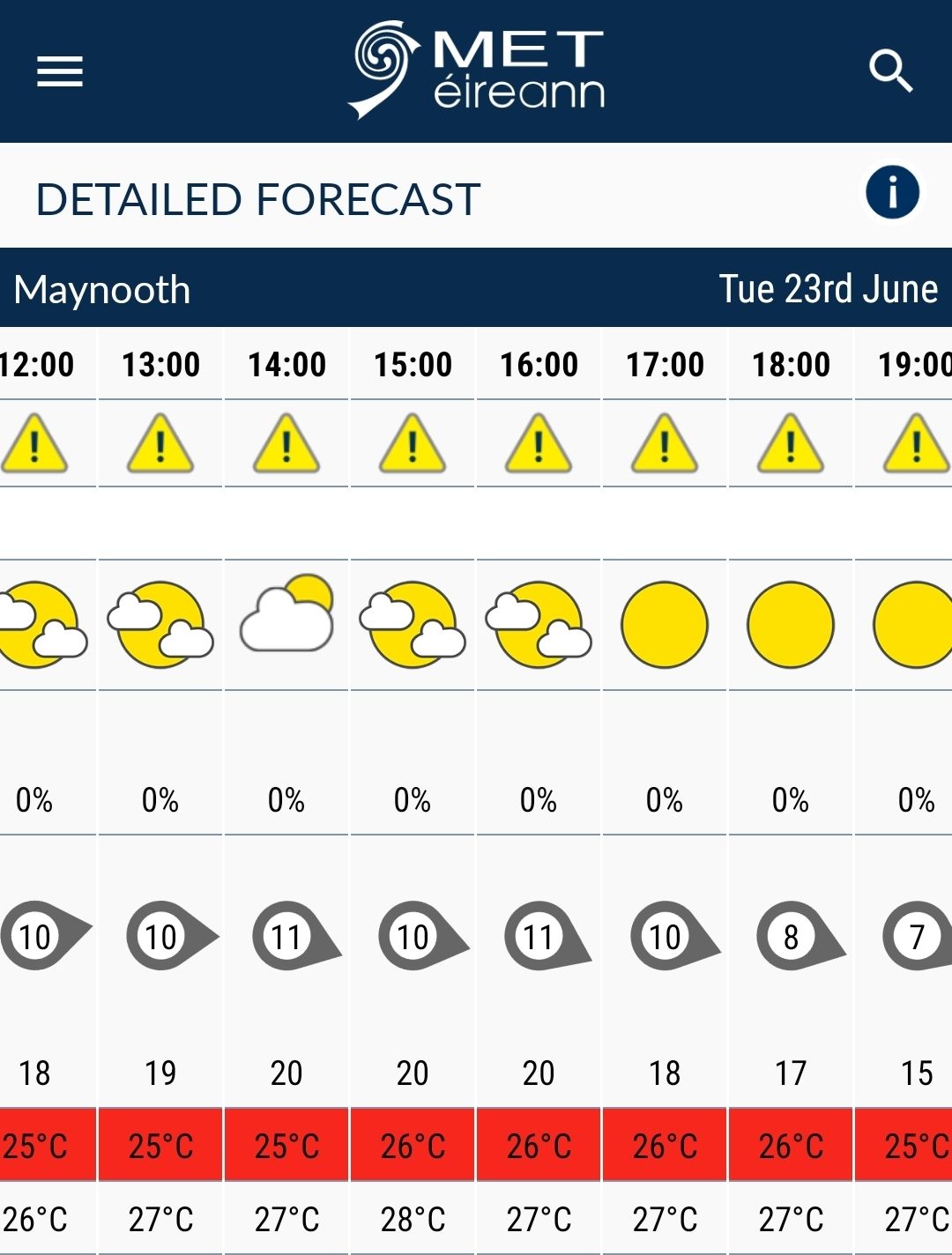
To amuse my friends and colleagues sweltering under the Heat Dome, I thought I’d share this graphic from the Met Éireann weather app:
No doubt it will cause some amusement to see red for danger for temperatures of 25°C!
This type of weather reminds me of the hot summer of 1976, which I remember very well, not least because of the England versus West Indies Test Series that summer. I hadn’t realized until recently that the Windies played a match against Ireland that summer too, in Rathmines. Collis King was out for 24 in the WI first innings, off 6 balls (4 4 6 4 6 out)…
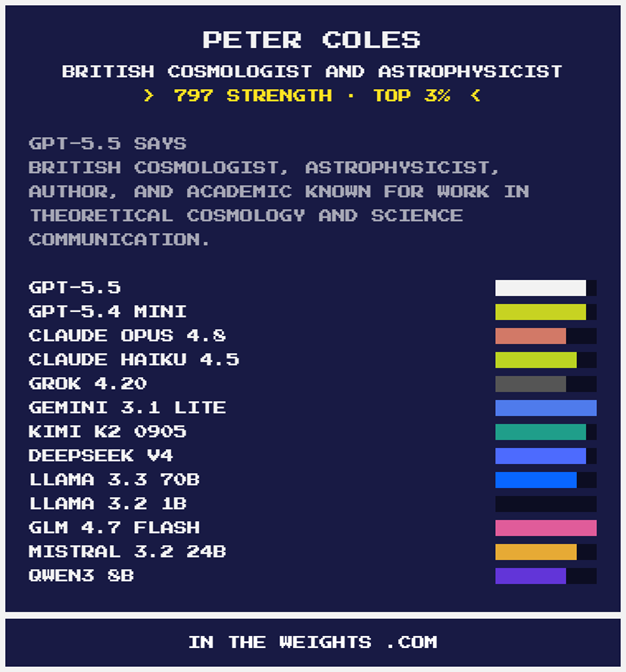
Yesterday I found out about a site calledintheweights.com, which reveals which people are “stored” in the weights of large language models. Those “weights” are billions of numerical values by which these AI models encode their knowledge. If you show up in them, the model considered you relevant enough during training to recall without tools such as web search.
The site queries several models to figure out who a specific person is, combines the results, and assigns a strength score. According to the leaderboard, the current maximum strength score is 998, awarded too a person called Charlize Theron (of whom I have never heard); number Two is Rudyard Kipling, apparently. I’m surprised the top isn’t Taylor Swift. I guess these weights change with time too.
Being a vain person I typed in my name and found this:
The only reason I can think of that I score so highly is all that scraping of this blog site over the last year or so. The weights are obviously influenced by how much material there is available online by or about the person.
The Summer Solstice in the Northern hemisphere takes took place this morning, Sunday21st June 2026, at 9.24am local Irish Time (08.24 UTC). Among other things, this means that tomorrow is the longest day of the year around these parts. According to this website, the interval between sunrise and sunset in Dublin today will be 17 hours 4 minutes and 52 seconds. which is 2 seconds longer than yesterday, while tomorrow will be two whole seconds shorter.
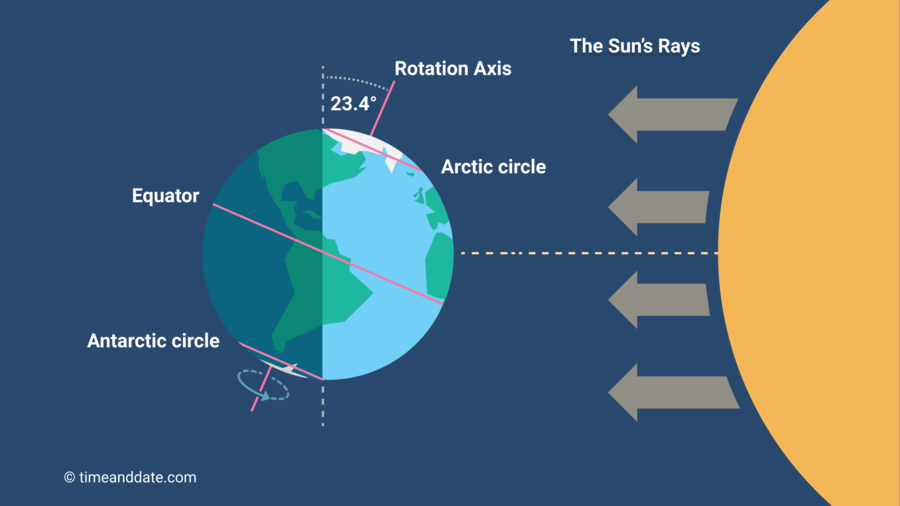
The Earth orbits the Sun once a year in a nearly circular orbit. The Earth’s axis of rotation (the straight line through the center of the Earth between the north and south poles) is not perpendicular to the plane of the Earth’s orbit. The Earth’s axis is tilted by about 23.4° from the the direction perpendiular to the orbital plane:
The orientation of the Earth’s axis in space remains nearly constant even as the Earth revolves around the Sun. It always points in the general direction of the star Polaris. The result is that when the Earth is on one side of its orbit, the South Pole is tilted toward the Sun (by as much as 23.4°) and the Southern Hemisphere experiences summer. Six months later, when the Earth is on the opposite side of its orbit, the North pole is tilted toward the Sun (by as much as 23.4°) and the Northern Hemisphere experiences summer.
On the Summer Solstice, Earth’s maximum axial tilt toward the Sun is 23.4°. Likewise, the Sun’s declination from the celestial equator is 23.4°. In areas outside the tropics, the Sun reaches its highest elevation angle at solar noon on the summer solstice. At the North Pole the Sun doesn’t set at all on the Summer Solstice.
So in a sense it’s all downhill from today until the Winter Solstice in December, but the nights won’t start drawing in just yet. Days will indeed get shorter from tomorrow, although this does not mean that sunset will happen earlier tomorrow than it does today. In fact it is a little later; the latest sunset will be on 25th June. Nor does it mean that today sees the earliest sunrise. Sunrise this morning was a little later than yesterday; the earliest sunrise was actually on 17th June.
This arises because there is a difference between mean solar time (measured by clocks) and apparent solar time (defined by the position of the Sun in the sky), so that a solar day does not always last exactly 24 hours. A description of apparent and mean time was given by Nevil Maskelyne in the Nautical Almanac for 1767:
Apparent Time is that deduced immediately from the Sun, whether from the Observation of his passing the Meridian, or from his observed Rising or Setting. This Time is different from that shewn by Clocks and Watches well regulated at Land, which is called equated or mean Time.
The discrepancy between mean time and apparent time arises because of the Earth’s axial tilt and the fact that it travels around the Sun in an elliptical orbit in which its orbital speed varies with time of year (being faster at perihelion than at aphelion).
You can read a piece about the cultural importance of the solstice over the years here.
It’s Saturday again so it’s time for another update of activity at the Open Journal of Astrophysics. Since the last update we have published a further three papers, bringing the number in Volume 9 (2026) to 126 and the total so far published by OJAp up to 574.
I will continue to include the posts made on our Mastodon account (on Fediscience); these announcements also show the DOI for each paper.
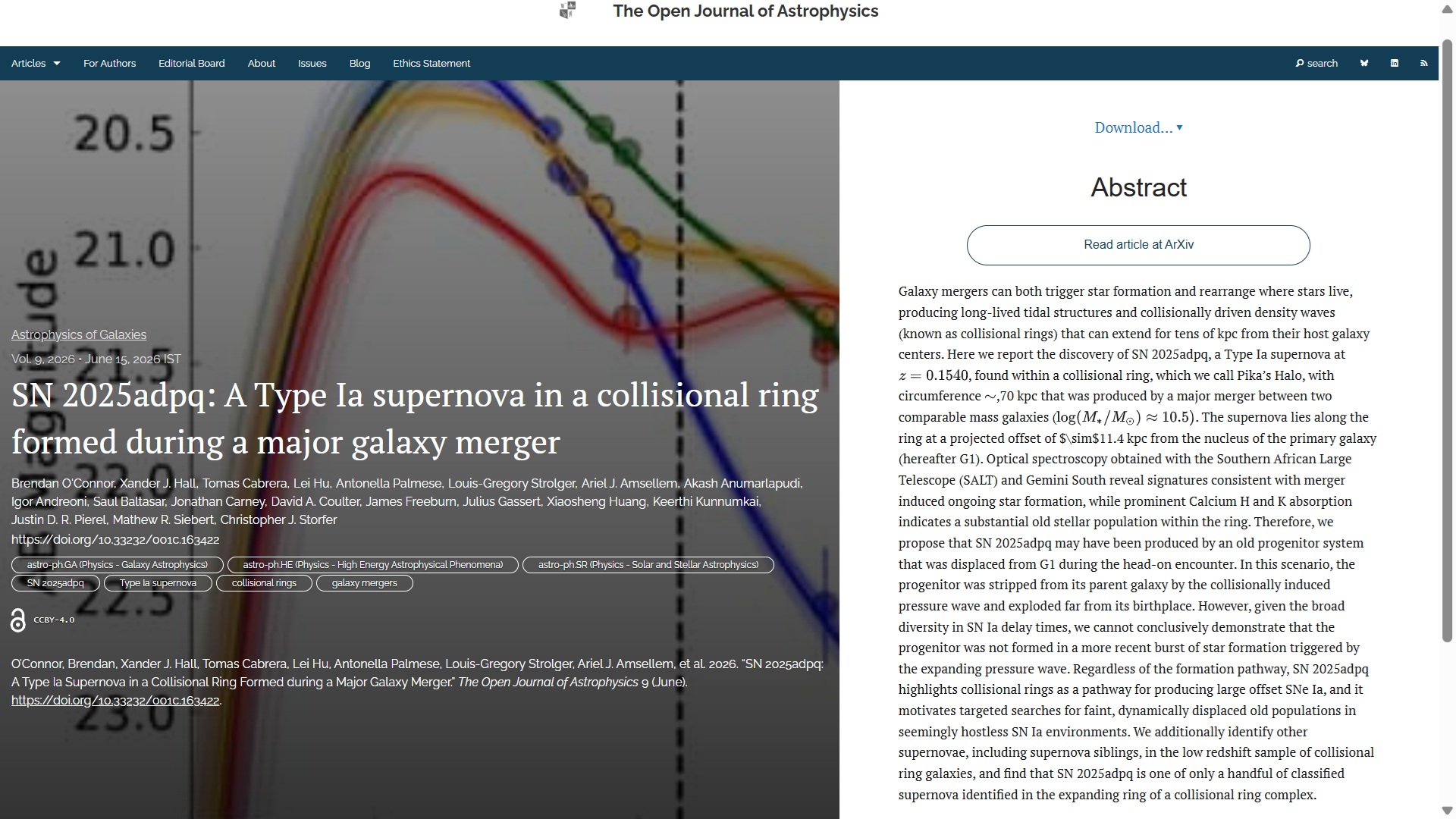
The first paper to report this week, published on Monday 15th June, is “SN 2025adpq: A Type Ia supernova in a collisional ring formed during a major galaxy merger” by Brendan O’Connor (Carnegie Mellon University, USA) and 18 others based in the USA, Germany and Australia. The study reports the discovery of a Type Ia supernova, SN 2025adpq, within a collisional ring formed by a major galaxy merger., offset from the nucleus of the primary galaxy. It is published in the folder Astrophysics of Galaxies.
The overlay for this paper is here
You can find the officially accepted version on arXiv here and the announcement on Fediverse here:
New Publication at the Open Journal of Astrophysics: "SN 2025adpq: A Type Ia supernova in a collisional ring formed during a major galaxy merger" by Brendan O'Connor (Carnegie Mellon University, USA) and 18 others based in the USA, Germany and Australia
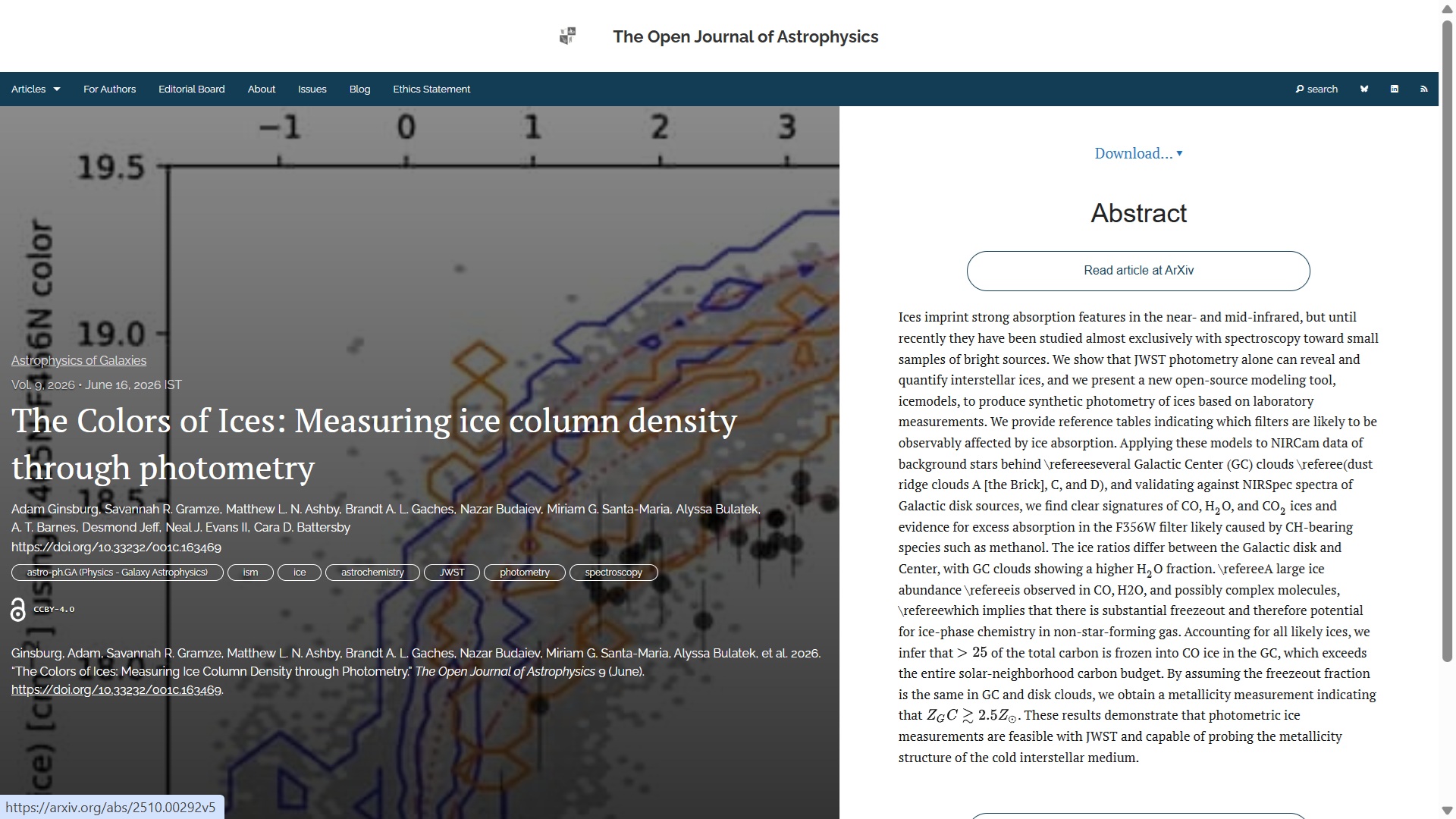
The second paper for this week, published on Tuesday June 16th in the folder Astrophysics of Galaxies is “The Colors of Ices: Measuring ice column density through photometry” by Adam Ginsburg (U. Florida, USA) and ten others based in the USA, Germany and Spain. This study demonstrates that JWST photometry can identify and quantify interstellar ices, using new open-source models, interstellar ices, finding significant abundance in non-star-forming gas, suggesting many avenues for further research.
The overlay looks like this:
The official version of the paper can be found on arXiv here and the Fediverse announcement here:
New Publication at the Open Journal of Astrophysics: "The Colors of Ices: Measuring ice column density through photometry" by Adam Ginsburg (U. Florida, USA) and ten others based in the USA, Germany and Spain
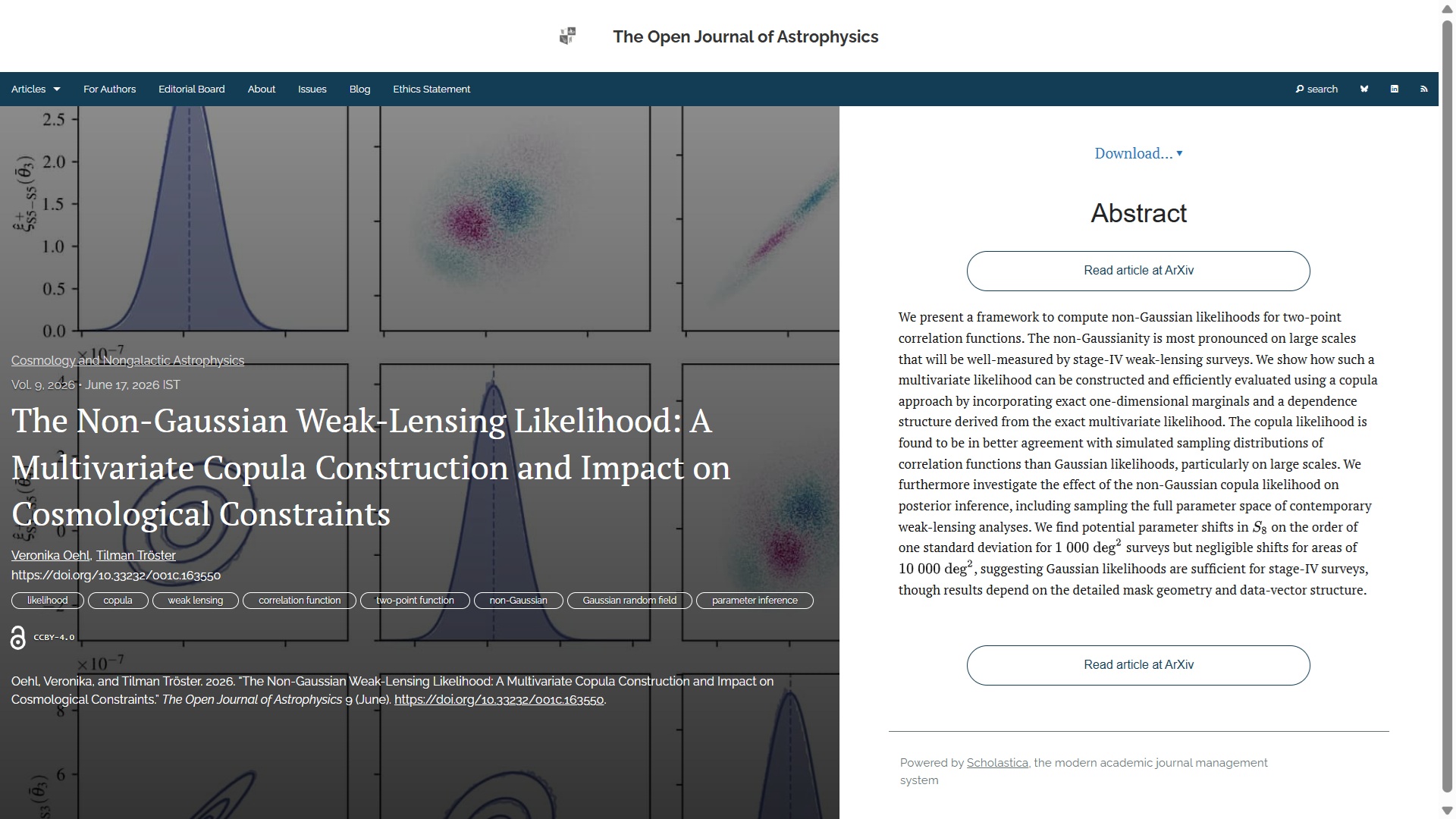
New Publication at the Open Journal of Astrophysics: "The Non-Gaussian Weak-Lensing Likelihood: A Multivariate Copula Construction and Impact on Cosmological Constraints" by Veronika Oehl and Tilman Tröster (ETH Zurich, Switzerland)
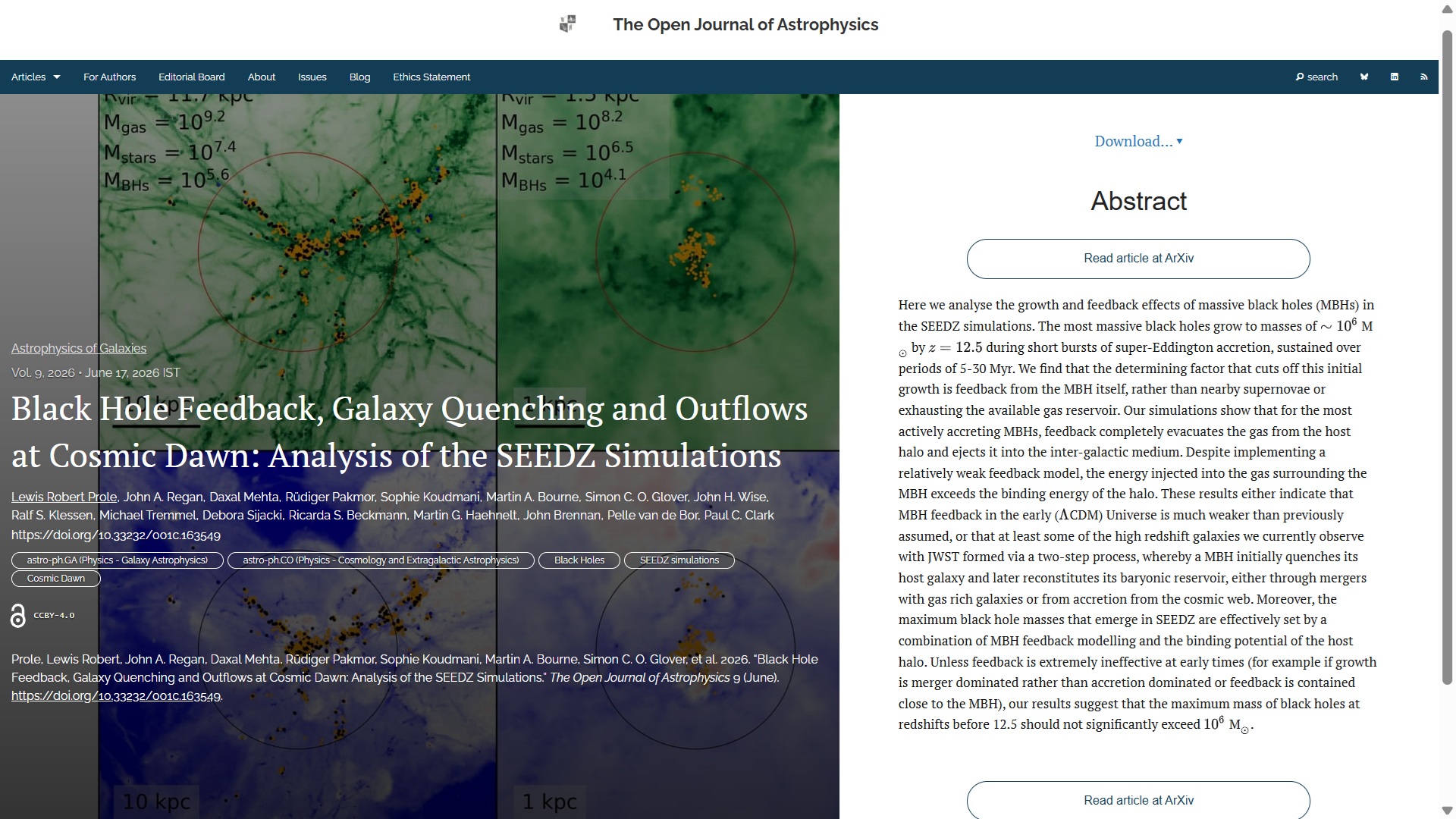
The fourth and final paper of the week, also ublished on Wednesday 17th June but in the folder Astrophysics of Galaxies, is “Black Hole Feedback, Galaxy Quenching and Outflows at Cosmic Dawn: Analysis of the SEEDZ Simulations” by Lewis R. Prole (Maynooth University, Ireland) and 15 others based in Ireland, Germany, USA and UK. The study analyzes the growth and feedback effects of massive black holes in SEEDZ simulations, suggesting that black hole feedback, not nearby supernovae or gas exhaustion, limits initial growth.
The overlay is here:
The final, accepted version can be found on arXiv here and the Mastodon announcement is here:
New Publication at the Open Journal of Astrophysics: "Black Hole Feedback, Galaxy Quenching and Outflows at Cosmic Dawn: Analysis of the SEEDZ Simulations" by Lewis R. Prole (Maynooth University, Ireland) and 15 others based in Ireland, Germany, USA and UK.
And that concludes this week’s update. It has been a slow week on the publishing front, but the main reason is that we have a big backlog of papers accepted but waiting for the authors to put their final versions on arXiv and we can’t do anything about that! I’ll do another update next Saturday.
While I remember I thought I’d follow up my post about the 2026 Leaving Certificate Mathematics papers, by uploading this year’s Physics papers. Here is the Higher level paper:
Many moons ago I wrote a paper with a person called Anthony J.M. Garrett with the title Bayesian Inductive Inference and the Anthropic Cosmological Principle; the full reference is A.J.M. Garrett and P. Coles, Comments on Astrophysics 17(1) 23-47 (1993). It got a few citations here and there, and has been discussed in a few books and other texts. In 1999, the journal Comments on Astrophysics was merged with some other journals to form Comments on Modern Physics which was then acquired by publishers Taylor and Francis in 2001, when it took over Gordon and Breach. The new publisher never put the old papers online in digital format. Most of the back catalogue of Comments on Astrophysics is indexed in NASA/ADS (bibstem: ComAp), but No. 1 of Volume 17 is not there. That classic paper is not, as far as I know, available anywhere on the internet. Or at least it wasn’t until now.
I was recently asked for a PDF of the paper so I made a scan and sent it. Now that I have a scan, however, and WordPress now has a PDF upload gadget, I thought I’d put it up here. I did a Google search for it earlier this evening and the AI Summary described the paper as “seminal”, which just goes to show that AI isn’t always wrong!
Apologies that it’s a bit grubby and wonky, but the scan is made from an old photocopy. I did have a proper offprint somewhere, but I can’t find it.
The real reason for doing this post, however, is to use it as a counter-example to something people often bring up when I criticize academic publishers: “..but they curate the literature!”. They don’t, actually. Libraries do that. The Garrett-Coles paper is available as a hard copy in libraries, but the publisher has nothing to do with that!
P.S. I did a blog post a while ago based on part of the paper.
P.P.S. If I get time I’ll contact ADS to see if they want to put this up in the official biblipgraphic collection…
The views presented here are personal and not necessarily those of my employer (or anyone else for that matter).
Feel free to comment on any of the posts on this blog but comments may be moderated; anonymous comments and any considered by me to be vexatious and/or abusive and/or defamatory will not be accepted. I do not necessarily endorse, support, sanction, encourage, verify or agree with the opinions or statements of any information or other content in the comments on this site and do not in any way guarantee their accuracy or reliability.




 In the Dark
Bayesian Inductive Inference and the Anthropic Cosmological Principle
Posted in The Universe and Stuff with tags Anthropic Cosmological Principle, Antony J.M. Garrett, Bayesian Inductive Inference, Comments on Astrophysics 17(1) 23-47, Gordon and Breach, NASA/ADS, Taylor and Francis on June 17, 2026 by telescoperMany moons ago I wrote a paper with a person called Anthony J.M. Garrett with the title Bayesian Inductive Inference and the Anthropic Cosmological Principle; the full reference is A.J.M. Garrett and P. Coles, Comments on Astrophysics 17(1) 23-47 (1993). It got a few citations here and there, and has been discussed in a few books and other texts. In 1999, the journal Comments on Astrophysics was merged with some other journals to form Comments on Modern Physics which was then acquired by publishers Taylor and Francis in 2001, when it took over Gordon and Breach. The new publisher never put the old papers online in digital format. Most of the back catalogue of Comments on Astrophysics is indexed in NASA/ADS (bibstem: ComAp), but No. 1 of Volume 17 is not there. That classic paper is not, as far as I know, available anywhere on the internet. Or at least it wasn’t until now.
I was recently asked for a PDF of the paper so I made a scan and sent it. Now that I have a scan, however, and WordPress now has a PDF upload gadget, I thought I’d put it up here. I did a Google search for it earlier this evening and the AI Summary described the paper as “seminal”, which just goes to show that AI isn’t always wrong!
Anyway, here is a scanned PDF of the paper:
Apologies that it’s a bit grubby and wonky, but the scan is made from an old photocopy. I did have a proper offprint somewhere, but I can’t find it.
The real reason for doing this post, however, is to use it as a counter-example to something people often bring up when I criticize academic publishers: “..but they curate the literature!”. They don’t, actually. Libraries do that. The Garrett-Coles paper is available as a hard copy in libraries, but the publisher has nothing to do with that!
P.S. I did a blog post a while ago based on part of the paper.
P.P.S. If I get time I’ll contact ADS to see if they want to put this up in the official biblipgraphic collection…
2 Comments »