Cyrille Regis and Racism in Football

Posted in Football with tags , on January 16, 2018 by telescoper

Cyrille Regis, shown here playing for Coventry City in the 1987 FA Cup against Tottenham Hotspur


On my way to the airport yesterday I heard the sad news of the death, at the age of just 59, of the footballer Cyrille Regis.  I’ll leave it to those more qualified to post full obituaries of the man – I couldn’t possibly do justice to him as a player and a person – and will confine myself to one memory that remains strong in my mind.

While I was a student at Cambridge there was a University branch of the Newcastle United Supporters Club. This was mainly for social gatherings but, during term time, and when the game was within reach of a day trip we hired a coach or minibus and went to Newcastle United’s away games. Our team had just been promoted to the old First Division at the end of the 1983/4 season and we all wanted to see as much as possible of them in the top flight.

And so it came to pass that on 13th October 1984 we went by coach to Highfield Road to see Coventry City versus Newcastle United. It wasn’t a great game. In fact, it had been picked as the featured match on Match of the Day that Saturday night. When we got back to Cambridge and settled in the JCR to watch it we heard Jimmy Hill (who presented the show in those days) that they were joining the action mid-way through the second half. The first half had not been deemed worthy of transmission.

Despite the generally low quality of the game, there was one star who was easily the best player on the field and  that was Cyrille Regis, who even eclipsed the little magician Peter Beardsley, whom the away fans had come to watch. Powerfully built, with a good turn of speed and excellent in the air despite not being particularly tall, Cyrille Regis proved a constant handful for Newcastle’s central defenders, winning just about every contested header and beating them for pace seemingly at will. In the second half Glen Roeder stopped even bothering to challenge for the ball in the air as he knew Regis had the beating of him.  Newcastle, however, played five at the back for away games in those days and they managed to stop him scoring.

The game ended 1-1 with  Peter Beardsley scoring for Newcastle from the penalty spot in front of the away supporters for Newcastle and Kenny Hibbitt scoring for Coventry. Here are some of the highlights of the game:

An away draw in the First Division was an acceptable result but, unhappily, the memories I have of the match are blighted by what I recall of the actions of some of the Newcastle United supporters who shouted racist abuse and threw bananas onto the pitch whenever Regis came within range. Their behaviour was disgraceful. In mitigation there were only a few – probably a couple of dozen among 4000-odd travelling suporters  doing this – and many of the rest of us shouted at them to shut the f**k up. But the fact that there were any at all is bad enough. It ruined the day for me, and left me feeling deeply ashamed, but as far as I could tell Cyrille Regis just ignored it; this sort of thing probably happened every time he played. How he managed to keep his composure I’ll never know.

Those of us who have never experienced racist abuse can’t really imagine what it must be like to be on the receiving end. The dignity of men like Cyrille Regis in the face of this sort of thing speaks volumes about his strength of character. Above all, he tried to silence the racists by concentrating on his game and being an outstanding player.

All this was over thirty years ago and we like to think that racism is nowadays far less of an issue in football.  I rarely go to live games now, so I can’t really comment on how crowd behaviour has or hasn’t changed. However, judging by the comments of black players racism is still endemic, it’s just that most of the racists refrain from some of the more overt displays of obnoxious behaviour – such as throwing bananas – because they would (rightly) get the perpetrators ejected from the ground. Dealing with the symptoms, however, doesn’t cure the disease.

It seems that even Peter Beardsley (who played in the match I mentioned above and is now, at 54, Newcastle United’s Under-23 coach) has been accused by young players of bullying and racist comments. He denies the allegations, and is on leave while the charges are investigated. I’m not going to prejudge what the outcome of those investigations will be, but his case is a reminder – as if we needed it – that racism hasn’t gone away.


The WNO Orchestra at St David’s Hall

Posted in Music with tags , , , , , on January 15, 2018 by telescoper

It has been a very busy weekend but yesterday afternoon I took time out to visit St David’s Hall in Cardiff to hear the Orchestra of Welsh National Opera conducted by Tomáš Hanus in a programme of music by Beethoven, Mendelssohn and Dvořák. I’ve noticed that many of the international concerts that are a regular part of Cardiff life have been moved from weekday evenings to weekend afternoons. No doubt that it is for commercial reasons. I have to admit that I’m not a big fan of matinee concerts, but as it happens I’m not going to be available for many of the weekday evening concerts for the foreseeable future so I thought I’d give this one a go. The programme was a middle-of-the-road bums-on-seats affair, but if it brings people into the concert hall that is a good thing and it was nice to see a big crowd, including a sizeable contingent of schoolchildren, there to enjoy the show.

First up we had a favourite piece of mine, Beethoven’s  Egmont overture, inspired by the story of Lamoral, Count of Egmont whose execution in 1568 sparked an uprising Spanish occupation that eventually led to the independence of the Netherlands. It’s a stirring, dramatic work, ideal for opening a concert programme. I thought the tempo was a bit slow at the start, which made increase in speed towards the end a little jarring, but otherwise it was well played the full orchestra, arranged with six double-basses right at the back of the stage facing the conductor with the brass either side. That was very effective at generating a rich dark sonority both in this piece and in the Dvořák later on.

The next item was a very familiar work indeed, the Violin Concerto in E minor by Felix Mendelssohn. This is perhaps best known for its lvoely second movement (in which they key changes to C major) but the other two movements are really innovative and virtuosic. In the wrong hands the slow movement can be horribly schmaltzy but Norwegian soloist Henning Kraggerud managed to bring out is beauty without wallowing in its romanticism. It was a very fine performance, warmly appreciated by the audience. Henning Kraggerud treated us to an encore in the form of an intruguing piece by a musician previously unknown to me, Olof Bull, a fellow Norwegian and a contemporary of Mendelssohn.

After the wine break the main event of was another familiar piece, the Symphony No. 9 (“From the New World”) by Antonín Dvořák, a piece full of nostalgia for his Czech homeland written while the composer was living in America. It’s a piece I’ve heard very many times but it still manages to stay fresh, and yesterday’s performance was full of colour of verve. Tomáš Hanus (himself Czech) chose this piece as a tribute to an old friend who passed away last year, and it was was played with great passion.

I’d heard all the pieces in this programme many times, both in concert and on record, but they all stand up to repeated listening, simply because they’re so very good. I do like to hear new works – and do wish the programming at St David’s Hall were a little more adventurous – but they do have to make ends meet and there’s in any case much to enjoy in the standard repertoire, especially when it’s played by a fine orchestra. Such pieces can fall flat when you get the feeling that the musicians themselves are a bit bored with them, but that emphatically wasn’t the case yesterday.

It will soon be time to Welsh National Opera’s new season, with a new production of Verdi’s La Forza del Destino alongside revivals of Tosca and Don Giovanni. It’s going to be tricky to see them all, but I’ll give it a go!

The Crossword Puzzle Sketch

Posted in Crosswords with tags , , on January 13, 2018 by telescoper

Fifty years old, and starring the wonderful Beryl Reid, here’s a classic sketch about (of all things) … crosswords!

Yellow Tango

Posted in Jazz with tags , , , on January 12, 2018 by telescoper

Before Christmas I posted one of my favourite pieces of music, The Fable of Mabel, performed by a band led by Serge Chaloff and featuring pianist Dick Twardzik (who also composed the piece). I thought I’d follow this up with another piece by Twardzik, this time in a trio with Carson Smith on bass and the excellent Peter Littman on drums.

This piece was recorded in late 1954, at which time the two great influences on jazz piano were Bud Powell and Thelonious Monk. Here’s a good example of how Twardzik manages to nod in the very different directions of these two great musicians – the Monk influence in particular stands out a mile when the rhythm switches from Latin-American to 4/4 at about 1:43 – while also managing to find a very original voicea which was all his own. It’s such a terrible shame that within a few months of this session Twardzik was dead (of a heroin overdose, at the age of 24) and jazz had lost one of its most promising young artists.

Who’s worried about the Hubble Constant?

Posted in The Universe and Stuff with tags , , , , on January 11, 2018 by telescoper

One of the topics that is bubbling away on the back burner of cosmology is the possible tension between cosmological parameters, especially relating to the determination of the Hubble constant (H0) by Planck and by “traditional” methods based on the cosmological distance ladder; see here for an overview of the latter.

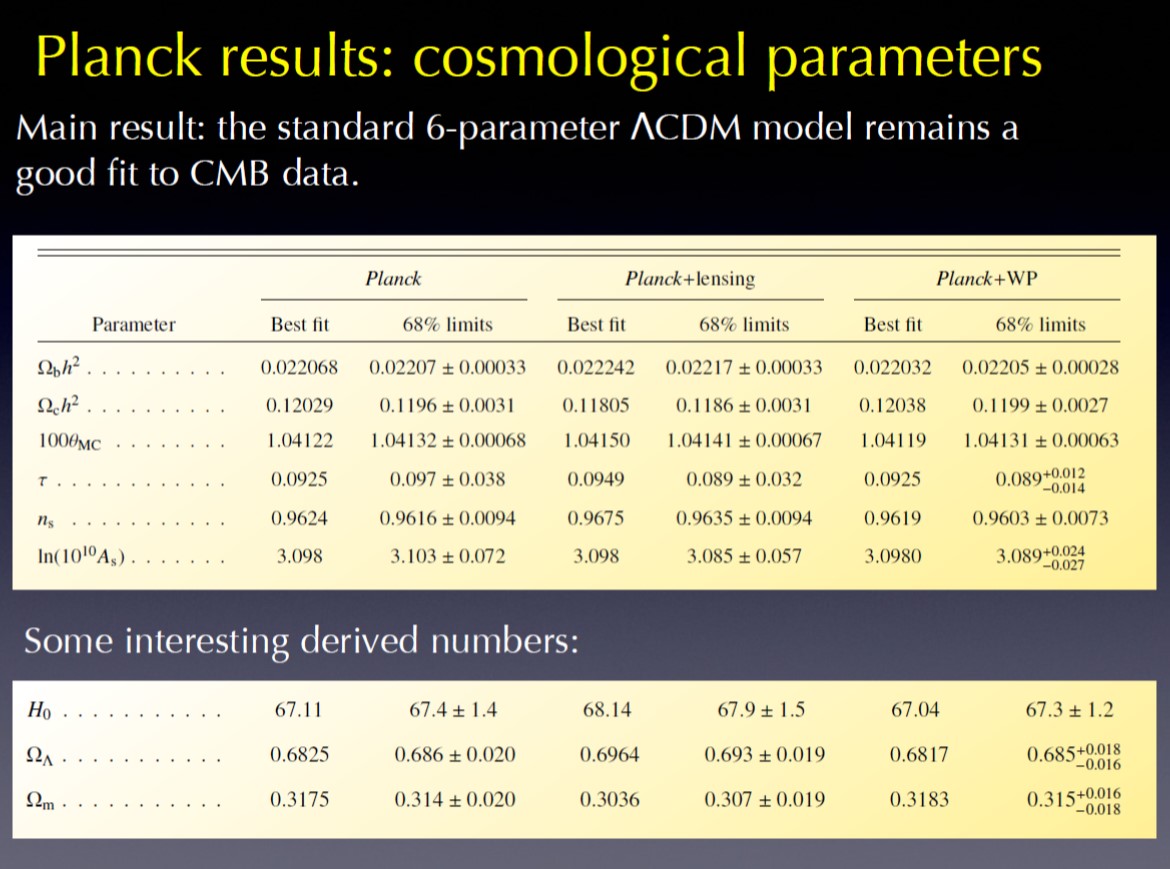
Before getting to the point I should explain that Planck does not determine H0 directly, as it is not one of the six numbers used to specify the minimal model used to fit the data. These parameters do include information about H0, however, so it is possible to extract a value from the data indirectly. In other words it is a derived parameter:

Planck_parameters

The above summary shows that values of the Hubble constant obtained in this way lie around the 67 to 68  km/s/Mpc mark, with small changes if other measures are included. According to the very latest Planck paper on cosmological parameter estimates the headline determination is H0 = (67.8 +/- 0.9) km/s/Mpc.

About 18 months I blogged about a “direct” determination of the Hubble constant by Riess et al.  using Hubble Space Telescope data quotes a headline value of (73.24+/-1.74) km/sec/Mpc, hinting at a discrepancy somewhere around the 3 sigma level depending on precisely which determination you use. A news item on the BBC hot off the press reports that a more recent analysis by the same group is stubbornly sitting around the same value of the Hubble constant, with a slight smaller error so that the discrepancy is now about 3.4σ. On the other hand, the history of this type of study provides grounds for caution because the systematic errors have often turned out to be much larger and more uncertain than the statistical errors…

Nevertheless, I think it’s fair to say that there isn’t a consensus as to how seriously to take this apparent “tension”. I certainly can’t see anything wrong with the Riess et al. result, and the lead author is a Nobel prize-winner, but I’m also impressed by the stunning success of the minimal LCDM model at accounting for such a huge data set with a small set of free parameters.

If one does take this tension seriously it can be resolved by adding an extra parameter to the model or by allowing one of the fixed properties of the LCDM model to vary to fit the data. Bayesian model selection analysis however tends to reject such models on the grounds of Ockham’s Razor. In other words the price you pay for introducing an extra free parameter exceeds the benefit in improved goodness of fit. GAIA may shortly reveal whether or not there are problems with the local stellar distance scale, which may reveal the source of any discrepancy. For the time being, however, I think it’s interesting but nothing to get too excited about. I’m not saying that I hope this tension will just go away. I think it will be very interesting if it turns out to be real. I just think the evidence at the moment isn’t convincing me that there’s something beyond the standard cosmological model. I may well turn out to be wrong.

Anyway, since polls seem to be quite popular these days, so let me resurrect this old one and see if opinions have changed!


Two hundred years of Ozymandias

Posted in Poetry with tags , , , on January 11, 2018 by telescoper

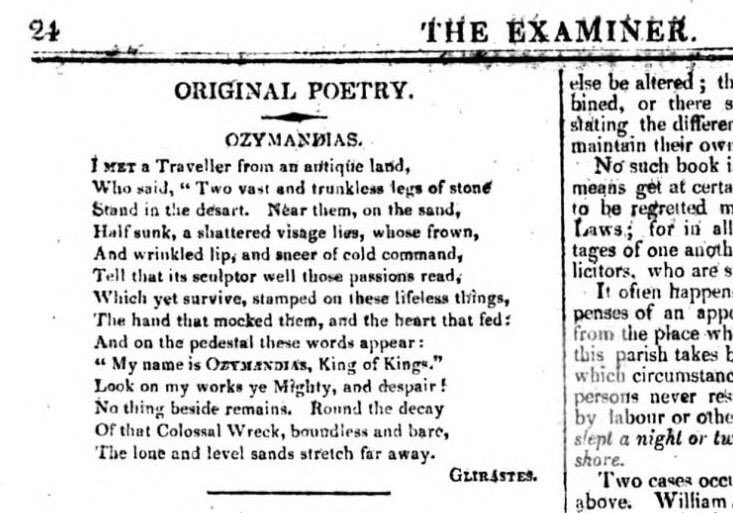
The sonnet Ozymandias by Percy Bysshe Shelley is so famous that it really needs no introduction, especially because I’ve posted it before, but I couldn’t help marking the fact that it was first published in the to the literary magazine The Examiner exactly two hundred years ago today, on January 11th  1818:


Here’s the poem in more legible form:

I met a traveller from an antique land
Who said: “Two vast and trunkless legs of stone
Stand in the desert. Near them on the sand,
Half sunk, a shattered visage lies, whose frown
And wrinkled lip and sneer of cold command
Tell that its sculptor well those passions read
Which yet survive, stamped on these lifeless things,
The hand that mocked them and the heart that fed.
And on the pedestal these words appear:
`My name is Ozymandias, King of Kings:
Look on my works, ye mighty, and despair!’
Nothing beside remains. Round the decay
Of that colossal wreck, boundless and bare,
The lone and level sands stretch far away”.

What you may not know, however, is that Shelley’s poem was one of a pair with the same title on the same theme; the  other, composed by Shelley’s friend Horace Smith, appeared about three weeks later on February 1st 2018. The two friends had written their poems as a sort of competition. Here’s the other Ozymandias:

In Egypt’s sandy silence, all alone,
Stands a gigantic Leg, which far off throws
The only shadow that the Desert knows.
“I am great Ozymandias,” saith the stone,
“The King of kings: this mighty city shows
The wonders of my hand.” The city’s gone!
Naught but the leg remaining to disclose
The sight of that forgotten Babylon.
We wonder, and some hunter may express
Wonder like ours, when through the wilderness
Where London stood, holding the wolf in chase,
He meets some fragment huge, and stops to guess
What wonderful, but unrecorded, race
Once dwelt in that annihilated place.


Maynooth joins the Euclid Community

Posted in Euclid, Maynooth, The Universe and Stuff with tags , , , on January 10, 2018 by telescoper

There’s a nice webpage showing all the institutions around the world who belong to the consortium behind the European Space Agency’s Euclid Mission. Here’s a screen grab that shows all the logos of all the institutions involved in this very large Consortium:

There are so many that it’s hard to see them all, but if you look very closely about half way down, among the Ms, you will see Maynooth University among them. This is the first institution in Ireland to have joined the Euclid Consortium and it has just been officially added thanks to yours truly moving there later this year. Ireland is a member state of the European Space Agency, by the way.

Crunch time for Dark Matter?

Posted in The Universe and Stuff with tags , , on January 9, 2018 by telescoper

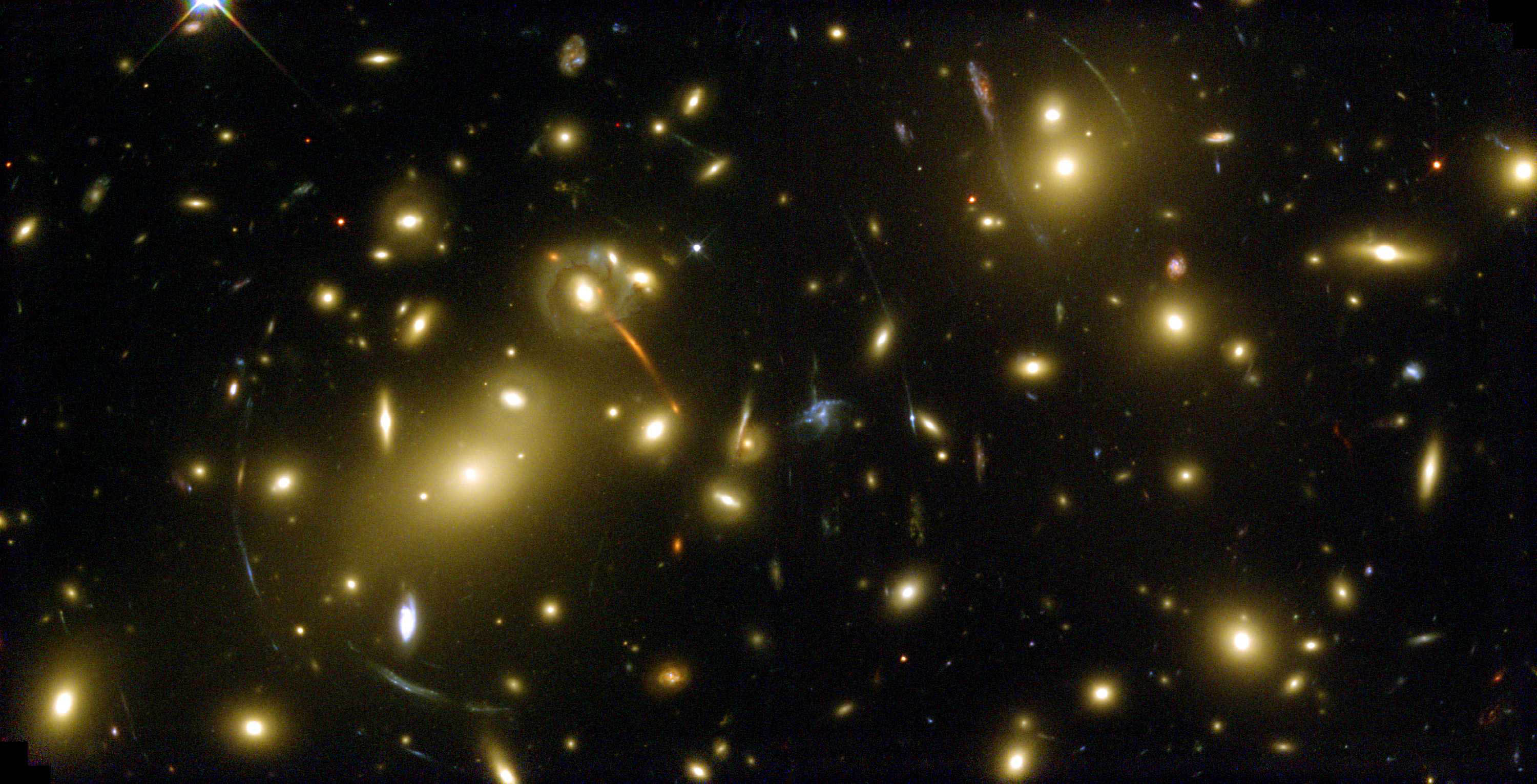
Gratuitous picture of the cluster Abel 2218, showing numerous gravitational lensing arcs

I was reading through an article by Philip Ball in the Grauniad this morning about likely breakthroughs in science for the forthcoming year. One of the topics discussed therein was dark matter. Here’s an excerpt:

It’s been agreed for decades that the universe must contain large amounts of so-called dark matter – about five times as much as all the matter visible as stars, galaxies and dust. This dark matter appears to exert a gravitational tug while not interacting significantly with ordinary matter or light in other ways. But no one has any idea what it consists of. Experiments have been trying to detect it for years, but all have drawn a blank. The situation is becoming grave enough for some researchers to start taking more seriously suggestions that what looks like dark matter is in fact a consequence of something else – such as a new force that modifies the apparent effects of gravity. This year could prove to be crunch time for dark matter: how long do we persist in believing in something when there’s no direct evidence for it?

It’s a good question, though I have to say that there’s very little direct evidence for anything in cosmology: it’s mostly circumstantial, i.e. evidence that relies on an inference to connect it to a conclusion of fact…

Anyway, I thought it would be fun to do a totally unscientific poll of the sort that scientists find  fun to do, so here’s one. It’s actually quite hard to make this the topic of a simple question, because we know that there is ordinary (baryonic) matter that we can’t see, and there is known to be some non-baryonic dark matter in the form of a cosmic neutrino background. What the question below should be interpreted to mean, therefore, is  `is there a dominant component of non-baryonic dark matter in the Universe in the form of some as-yet undiscovered particle?’ or something like that.

For the record, I do think there is dark matter but less convinced that it is simple cold dark matter. On the other hand, I regard its existence as a working hypothesis rather than an article of faith and do not lose any sleep about the possibility of that hypothesis turning out to be wrong!


Hamiltonian Poetry

Posted in Poetry, The Universe and Stuff with tags , , , , , , on January 8, 2018 by telescoper

I posted a couple of items last week inspired by thoughts of the mathematician William Rowan Hamilton. Another thing I thought I might mention about Hamilton is that he also wrote poetry, and since both science and poetry feature quite regularly on this blog I thought I’d share an example.

In fact during the `Romantic Era‘ (in which Hamilton lived) many scientists wrote poetry related either to their work or to nature generally. One of the most accomplished of these scientist-poets was chemist and inventor Humphry Davy who, inspired by his friendship with the poets Wordsworth and Coleridge, wrote poems throughout his life. Others to do likewise were: physician Erasmus Darwin; and astronomer William Herschel (who was also a noted musician and composer),

William Rowan Hamilton interests me because seems to have been a very colourful character as well as a superb mathematician, and because his work relates directly to physics and is still widely used today. Interestingly, he was a very close friend of William Wordsworth, to whom he often sent poems with requests for comments and feedback. In the subsequent correspondence, Wordsworth was usually not very complimentary, even to the extent of telling Hamilton to stick to his day job (or words to that effect). What I didn’t know was that Hamilton regarded himself as a poet first and a mathematician second. That just goes to show you shouldn’t necessarily trust a man’s judgement when he applies it to himself.

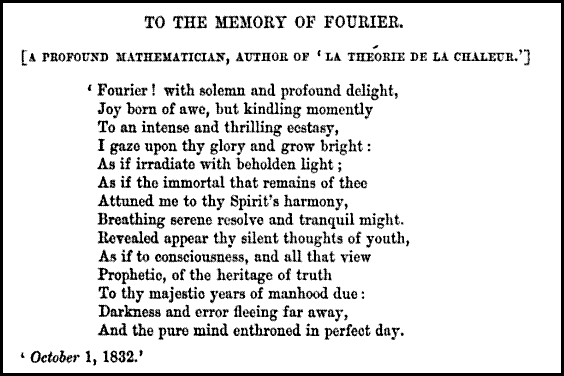
Here’s an example of Hamilton’s verse – a poem written to honour Joseph Fourier, another scientist whose work is still widely used today:

Hamilton-for Fourier

If that’s one of his better poems, then I think Wordsworth may have had a point!

The serious thing that strikes me is not the quality of the verse, but how many scientists of the 19th Century, Hamilton included, saw their scientific interrogation of Nature as a manifestation of the human condition just as the romantic poets saw their artistic contemplation. It is often argued that romanticism is responsible for the rise of antiscience. I’m not really qualified to comment on that but I don’t see any conflict at all between science and romanticism. I certainly don’t see Wordsworth’s poetry as anti-scientific. I just find it inspirational:

I HAVE seen
A curious child, who dwelt upon a tract
Of inland ground, applying to his ear
The convolutions of a smooth-lipped shell;
To which, in silence hushed, his very soul
Listened intensely; and his countenance soon
Brightened with joy; for from within were heard
Murmurings, whereby the monitor expressed
Mysterious union with its native sea.
Even such a shell the universe itself
Is to the ear of Faith; and there are times,
I doubt not, when to you it doth impart
Authentic tidings of invisible things;
Of ebb and flow, and ever-during power;
And central peace, subsisting at the heart
Of endless agitation.

Hold ’em Joe – Sonny Rollins

Posted in Jazz with tags , , , on January 6, 2018 by telescoper

So I’m in Dublin airport waiting to board a (delayed) flight. Since it’s cold and dark outside I thought I’d take the opportunity to use the free airport Wi-fi to share something that put a bit of a spring in my step when I heard it on the radio a couple of days ago. It’s a truly phenomenal performance on tenor saxophone by the great Sonny Rollins over an infectious calypso rhythm generated by Mickey Roker on drums. Enjoy!