Fifty years old, and starring the wonderful Beryl Reid, here’s a classic sketch about (of all things) … crosswords!
Follow @telescoperThe Crossword Puzzle Sketch
Posted in Crosswords with tags Beryl Reid, crosswords, The Crossword Puzzle Sketch on January 13, 2018 by telescoperYellow Tango
Posted in Jazz with tags Bud Powell, Dick Twardzik, Thelonious Monk, Yellow Tango on January 12, 2018 by telescoperBefore Christmas I posted one of my favourite pieces of music, The Fable of Mabel, performed by a band led by Serge Chaloff and featuring pianist Dick Twardzik (who also composed the piece). I thought I’d follow this up with another piece by Twardzik, this time in a trio with Carson Smith on bass and the excellent Peter Littman on drums.
This piece was recorded in late 1954, at which time the two great influences on jazz piano were Bud Powell and Thelonious Monk. Here’s a good example of how Twardzik manages to nod in the very different directions of these two great musicians – the Monk influence in particular stands out a mile when the rhythm switches from Latin-American to 4/4 at about 1:43 – while also managing to find a very original voicea which was all his own. It’s such a terrible shame that within a few months of this session Twardzik was dead (of a heroin overdose, at the age of 24) and jazz had lost one of its most promising young artists.
Follow @telescoperWho’s worried about the Hubble Constant?
Posted in The Universe and Stuff with tags cosmological parameters, Hubble constant, Planck, Riess et al., Tension on January 11, 2018 by telescoperOne of the topics that is bubbling away on the back burner of cosmology is the possible tension between cosmological parameters, especially relating to the determination of the Hubble constant (H0) by Planck and by “traditional” methods based on the cosmological distance ladder; see here for an overview of the latter.
Before getting to the point I should explain that Planck does not determine H0 directly, as it is not one of the six numbers used to specify the minimal model used to fit the data. These parameters do include information about H0, however, so it is possible to extract a value from the data indirectly. In other words it is a derived parameter:
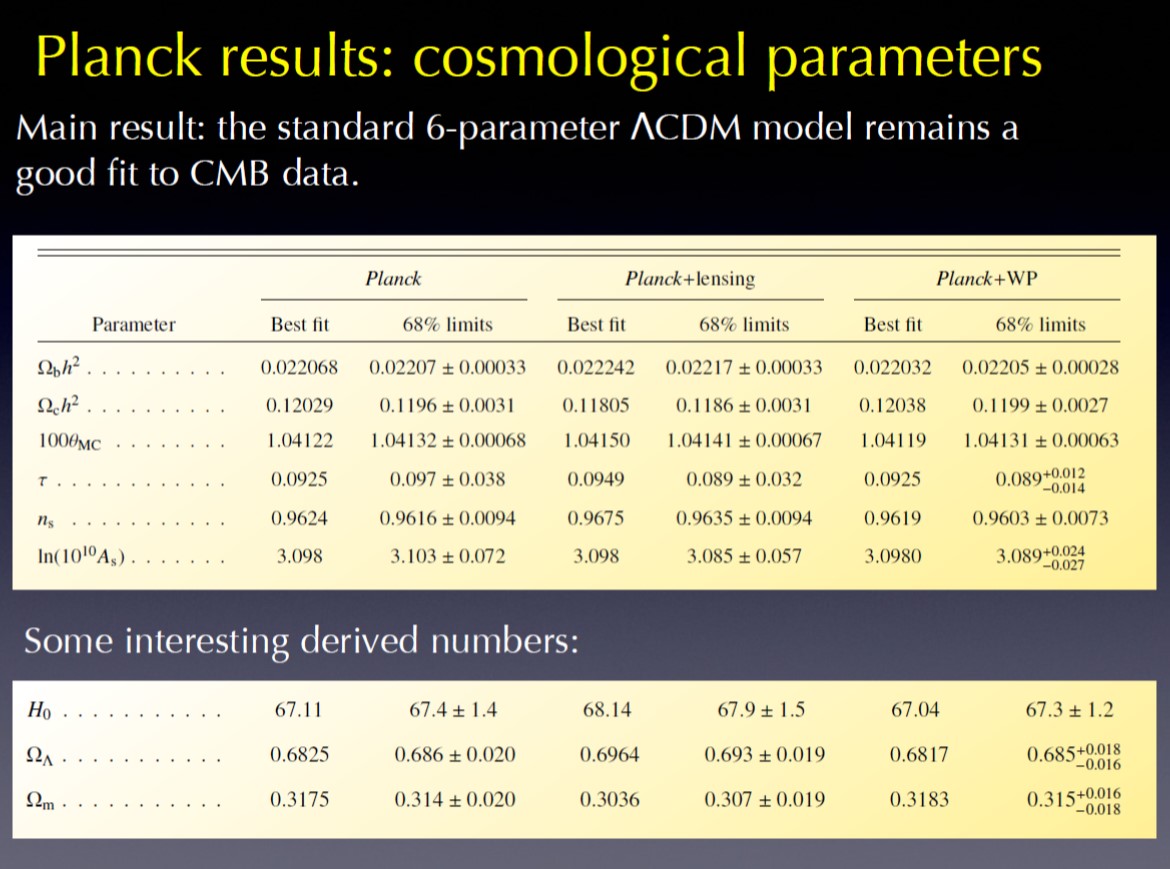
The above summary shows that values of the Hubble constant obtained in this way lie around the 67 to 68 km/s/Mpc mark, with small changes if other measures are included. According to the very latest Planck paper on cosmological parameter estimates the headline determination is H0 = (67.8 +/- 0.9) km/s/Mpc.
About 18 months I blogged about a “direct” determination of the Hubble constant by Riess et al. using Hubble Space Telescope data quotes a headline value of (73.24+/-1.74) km/sec/Mpc, hinting at a discrepancy somewhere around the 3 sigma level depending on precisely which determination you use. A news item on the BBC hot off the press reports that a more recent analysis by the same group is stubbornly sitting around the same value of the Hubble constant, with a slight smaller error so that the discrepancy is now about 3.4σ. On the other hand, the history of this type of study provides grounds for caution because the systematic errors have often turned out to be much larger and more uncertain than the statistical errors…
Nevertheless, I think it’s fair to say that there isn’t a consensus as to how seriously to take this apparent “tension”. I certainly can’t see anything wrong with the Riess et al. result, and the lead author is a Nobel prize-winner, but I’m also impressed by the stunning success of the minimal LCDM model at accounting for such a huge data set with a small set of free parameters.
If one does take this tension seriously it can be resolved by adding an extra parameter to the model or by allowing one of the fixed properties of the LCDM model to vary to fit the data. Bayesian model selection analysis however tends to reject such models on the grounds of Ockham’s Razor. In other words the price you pay for introducing an extra free parameter exceeds the benefit in improved goodness of fit. GAIA may shortly reveal whether or not there are problems with the local stellar distance scale, which may reveal the source of any discrepancy. For the time being, however, I think it’s interesting but nothing to get too excited about. I’m not saying that I hope this tension will just go away. I think it will be very interesting if it turns out to be real. I just think the evidence at the moment isn’t convincing me that there’s something beyond the standard cosmological model. I may well turn out to be wrong.
Anyway, since polls seem to be quite popular these days, so let me resurrect this old one and see if opinions have changed!
Follow @telescoper
Two hundred years of Ozymandias
Posted in Poetry with tags Horace Smith, Ozymandias, Percy Bysshe Shelley, The Examiner on January 11, 2018 by telescoperThe sonnet Ozymandias by Percy Bysshe Shelley is so famous that it really needs no introduction, especially because I’ve posted it before, but I couldn’t help marking the fact that it was first published in the to the literary magazine The Examiner exactly two hundred years ago today, on January 11th 1818:
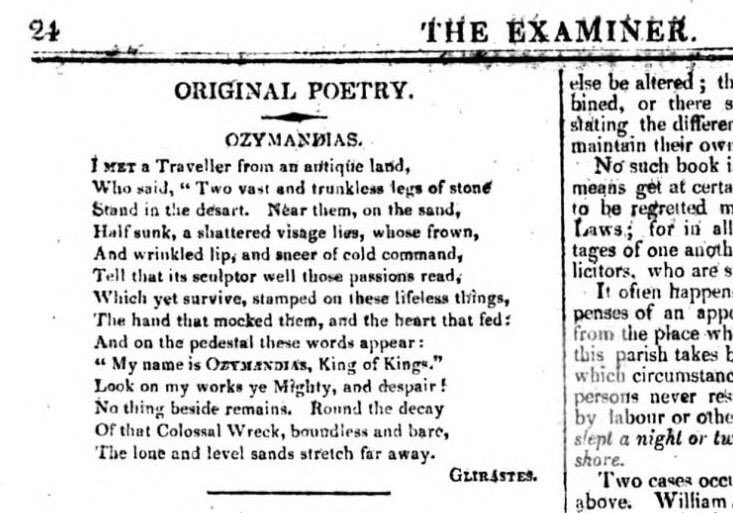
Here’s the poem in more legible form:
I met a traveller from an antique land
Who said: “Two vast and trunkless legs of stone
Stand in the desert. Near them on the sand,
Half sunk, a shattered visage lies, whose frown
And wrinkled lip and sneer of cold command
Tell that its sculptor well those passions read
Which yet survive, stamped on these lifeless things,
The hand that mocked them and the heart that fed.
And on the pedestal these words appear:
`My name is Ozymandias, King of Kings:
Look on my works, ye mighty, and despair!’
Nothing beside remains. Round the decay
Of that colossal wreck, boundless and bare,
The lone and level sands stretch far away”.
What you may not know, however, is that Shelley’s poem was one of a pair with the same title on the same theme; the other, composed by Shelley’s friend Horace Smith, appeared about three weeks later on February 1st 2018. The two friends had written their poems as a sort of competition. Here’s the other Ozymandias:
In Egypt’s sandy silence, all alone,
Stands a gigantic Leg, which far off throws
The only shadow that the Desert knows.
“I am great Ozymandias,” saith the stone,
“The King of kings: this mighty city shows
The wonders of my hand.” The city’s gone!
Naught but the leg remaining to disclose
The sight of that forgotten Babylon.
We wonder, and some hunter may express
Wonder like ours, when through the wilderness
Where London stood, holding the wolf in chase,
He meets some fragment huge, and stops to guess
What wonderful, but unrecorded, race
Once dwelt in that annihilated place.
Maynooth joins the Euclid Community
Posted in Euclid, Maynooth, The Universe and Stuff with tags Euclid mission, European Space Agency, ireland, Maynooth University on January 10, 2018 by telescoperThere’s a nice webpage showing all the institutions around the world who belong to the consortium behind the European Space Agency’s Euclid Mission. Here’s a screen grab that shows all the logos of all the institutions involved in this very large Consortium:

There are so many that it’s hard to see them all, but if you look very closely about half way down, among the Ms, you will see Maynooth University among them. This is the first institution in Ireland to have joined the Euclid Consortium and it has just been officially added thanks to yours truly moving there later this year. Ireland is a member state of the European Space Agency, by the way.
Follow @telescoperCrunch time for Dark Matter?
Posted in The Universe and Stuff with tags Cosmology, dark matter, Guardian on January 9, 2018 by telescoper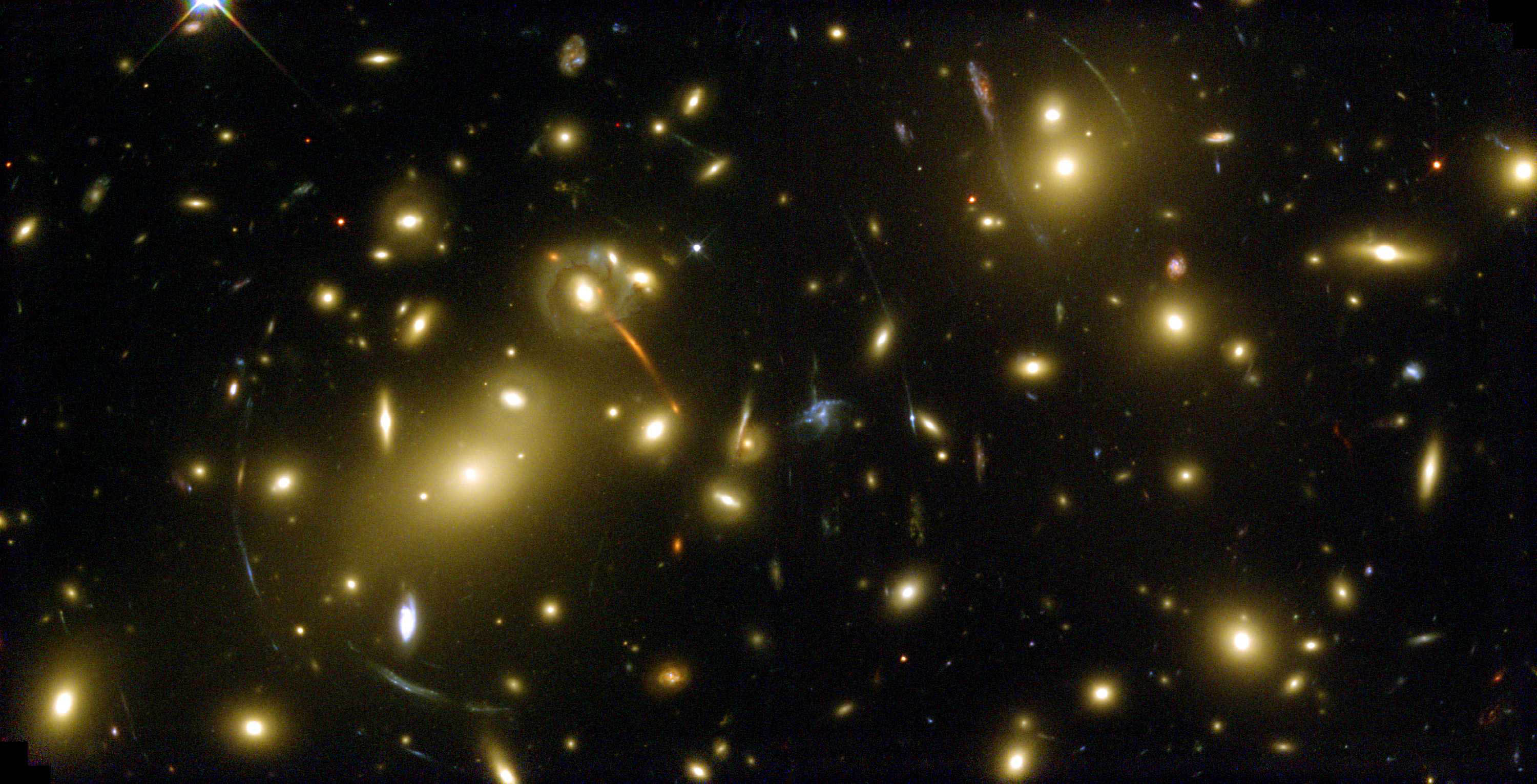
Gratuitous picture of the cluster Abel 2218, showing numerous gravitational lensing arcs
I was reading through an article by Philip Ball in the Grauniad this morning about likely breakthroughs in science for the forthcoming year. One of the topics discussed therein was dark matter. Here’s an excerpt:
It’s been agreed for decades that the universe must contain large amounts of so-called dark matter – about five times as much as all the matter visible as stars, galaxies and dust. This dark matter appears to exert a gravitational tug while not interacting significantly with ordinary matter or light in other ways. But no one has any idea what it consists of. Experiments have been trying to detect it for years, but all have drawn a blank. The situation is becoming grave enough for some researchers to start taking more seriously suggestions that what looks like dark matter is in fact a consequence of something else – such as a new force that modifies the apparent effects of gravity. This year could prove to be crunch time for dark matter: how long do we persist in believing in something when there’s no direct evidence for it?
It’s a good question, though I have to say that there’s very little direct evidence for anything in cosmology: it’s mostly circumstantial, i.e. evidence that relies on an inference to connect it to a conclusion of fact…
Anyway, I thought it would be fun to do a totally unscientific poll of the sort that scientists find fun to do, so here’s one. It’s actually quite hard to make this the topic of a simple question, because we know that there is ordinary (baryonic) matter that we can’t see, and there is known to be some non-baryonic dark matter in the form of a cosmic neutrino background. What the question below should be interpreted to mean, therefore, is `is there a dominant component of non-baryonic dark matter in the Universe in the form of some as-yet undiscovered particle?’ or something like that.
For the record, I do think there is dark matter but less convinced that it is simple cold dark matter. On the other hand, I regard its existence as a working hypothesis rather than an article of faith and do not lose any sleep about the possibility of that hypothesis turning out to be wrong!
Follow @telescoper
Hamiltonian Poetry
Posted in Poetry, The Universe and Stuff with tags Humphry Davy, Joseph Fourier, Physics, Poetry, Science, William Rown Hamilton, William Wordsworth on January 8, 2018 by telescoperI posted a couple of items last week inspired by thoughts of the mathematician William Rowan Hamilton. Another thing I thought I might mention about Hamilton is that he also wrote poetry, and since both science and poetry feature quite regularly on this blog I thought I’d share an example.
In fact during the `Romantic Era‘ (in which Hamilton lived) many scientists wrote poetry related either to their work or to nature generally. One of the most accomplished of these scientist-poets was chemist and inventor Humphry Davy who, inspired by his friendship with the poets Wordsworth and Coleridge, wrote poems throughout his life. Others to do likewise were: physician Erasmus Darwin; and astronomer William Herschel (who was also a noted musician and composer),
William Rowan Hamilton interests me because seems to have been a very colourful character as well as a superb mathematician, and because his work relates directly to physics and is still widely used today. Interestingly, he was a very close friend of William Wordsworth, to whom he often sent poems with requests for comments and feedback. In the subsequent correspondence, Wordsworth was usually not very complimentary, even to the extent of telling Hamilton to stick to his day job (or words to that effect). What I didn’t know was that Hamilton regarded himself as a poet first and a mathematician second. That just goes to show you shouldn’t necessarily trust a man’s judgement when he applies it to himself.
Here’s an example of Hamilton’s verse – a poem written to honour Joseph Fourier, another scientist whose work is still widely used today:
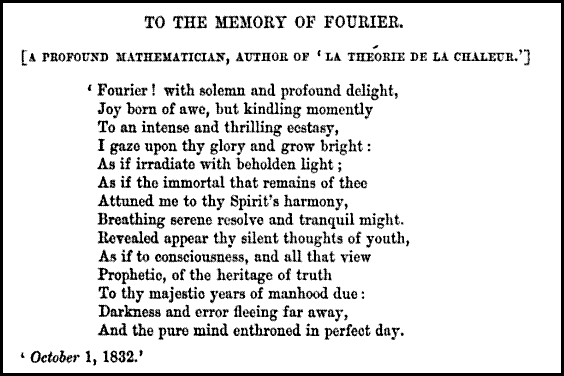
If that’s one of his better poems, then I think Wordsworth may have had a point!
The serious thing that strikes me is not the quality of the verse, but how many scientists of the 19th Century, Hamilton included, saw their scientific interrogation of Nature as a manifestation of the human condition just as the romantic poets saw their artistic contemplation. It is often argued that romanticism is responsible for the rise of antiscience. I’m not really qualified to comment on that but I don’t see any conflict at all between science and romanticism. I certainly don’t see Wordsworth’s poetry as anti-scientific. I just find it inspirational:
I HAVE seen
A curious child, who dwelt upon a tract
Of inland ground, applying to his ear
The convolutions of a smooth-lipped shell;
To which, in silence hushed, his very soul
Listened intensely; and his countenance soon
Brightened with joy; for from within were heard
Murmurings, whereby the monitor expressed
Mysterious union with its native sea.
Even such a shell the universe itself
Is to the ear of Faith; and there are times,
I doubt not, when to you it doth impart
Authentic tidings of invisible things;
Of ebb and flow, and ever-during power;
And central peace, subsisting at the heart
Of endless agitation.
Hold ’em Joe – Sonny Rollins
Posted in Jazz with tags calypso, Hold 'em Joe, Jazz, Sonny Rollins on January 6, 2018 by telescoperSo I’m in Dublin airport waiting to board a (delayed) flight. Since it’s cold and dark outside I thought I’d take the opportunity to use the free airport Wi-fi to share something that put a bit of a spring in my step when I heard it on the radio a couple of days ago. It’s a truly phenomenal performance on tenor saxophone by the great Sonny Rollins over an infectious calypso rhythm generated by Mickey Roker on drums. Enjoy!
Follow @telescoper
Hamilton and the “Light-Bulb” Moment
Posted in Biographical, The Universe and Stuff with tags Clariton, Claritons, dreams, Light-bulb moments, Physics research, Physics World., William Rowan Hamilton on January 5, 2018 by telescoperIn yesterday’s post I mentioned in passing the bridge (Broom Bridge) beside which William Rowan Hamilton first wrote down the fundamental result of quaternions after having a flash of genius while walking from Dunsink Observatory into Dublin.
That reminded me last night that a while ago I read a piece in Physics World (which you can read here, but only if you have a subscription) about whether breakthroughs in physics occur very often in the way of Hamilton’s – through sudden flashes of inspiration or, as they are called in the article, “light-bulb moments” – or are more often the result of solid hard graft, sweat and spadework? In other words, how much is inspiration and how much perspiration?
The piece includes some interesting comments from distinguished scientists about their own “Eureka” moments, which I’m sure will resonate with many researchers, not only physicists. Incidentally, the article refers to such moments as “claritons”, a word I’d never heard before, presumably intended to evoke solitons. It is interestin, though just how strongly the light-bulb has become so strongly associated with this sort of brainwave. You can find a short discussion of this here.

Anyway, I’m pretty sure that most scientists – even the eminent individuals interviewed for the Physics World piece – have spent a large part of their time “stuck”. I know I have, but then I’m not really eminent anyway. In the long run it’s probably good to go through such periods as I think they’re essential for intellectual development, but they’re undoubtedly extremely frustrating at the time. How you get “unstuck” is a very mysterious process. I’m not a neuroscientist, but it seems to me that when you get really immersed in, say, a research problem, your subconscious brain gets drawn into what you think is a fully conscious process, to the extent that even when you’re apparently not thinking about something you really are. I’ve had ideas come to me in all kinds of weird situations: watching ducks paddling on a pond, listening to music, walking in a park, and even pushing a trolley around a supermarket. Often it seems that it’s precisely when you’re not thinking that you have your best ideas. It’s not always clear what acted as the trigger, but and when it is it is often something quite abstract. In the case I mentioned of the ducks on the pond it was just a question of thinking about reference frames. It was a nudge in the right direction, but I still had to do quite a lot of work to finish the calculation. Come to think of it, it’s usually at that conceptual level that such things happen rather than in the detailed working, at least in my case.
The Physics World piece also talks about ideas coming through dreams. That has happened to me too, but I think it’s basically the same phenomenon that I’ve just discussed. It seems to me that dreams are a product of your brain sorting through recent events or experiences and trying to make sense of them in terms of others it has filed away. This can help with a research problem by flagging up a connection with something else hidden away. I can remember at least two occasions when I’ve woken up from a dream with an exact understanding of what I’d been doing wrong and how I could fix it. It’s great to wake up in the morning with that kind of feeling!
I know it’s wrong to draw inferences about other people from one’s own particular experiences, but I do feel that there are some general lessons. One is that if you are going to be successful at research you have to have a sense of determination that borders on obsession. You have to immerse yourself in it and be prepared to put long hours in. When things are going well you will be so excited that you will find it as hard to stop as it is when you’re struggling. I’m writing as a physicist, but I imagine it is the just same for other disciplines.
The other, equally important, lesson to be learned is that it is essential to do other things as well as doing science. Being “stuck” on a problem is an essential part of mathematics or physics research, but sometimes battering your head against the same thing for days on end just makes it less and less likely you will crack it. The human brain is a wonderful thing, but it can get stuck in a rut. One way to avoid this happening is to have more than one thing to think about.
I’ve lost count of the number of times I’ve been stuck on the last clue in a crossword, which usually means that my facility for thinking laterally, which is so essential for solving cryptic puzzles, is not operating well. What I always do in that situation is put it down and do something else for a bit. It could even be something as trivial as making a cup of tea, just as long as I don’t think about the clue at all while I’m doing it. Nearly always when I come back to it and look at it afresh I can solve it. I have a large stack of prize dictionaries to prove that this works!
It can be difficult to force yourself to pause in this way. I’m sure that I’m not the only physicist who has been unable to sleep for thinking about their research. I do think however that it is essential to learn how to effect your own mental reboot. In the context of my research this involved simply turning to a different research problem, but I think the same purpose can be served in many other ways: taking a break, going for a walk, playing sport, listening to or playing music, reading poetry, doing a crossword, or even just taking time out to socialize with your friends. Time spent sitting at your desk isn’t guaranteed to be productive, and you should never feel guilty about taking a thinking break.
I’d be interested to receive examples of other “light-bulb” moments through the comments box. I’d also welcome comments from neuroscientists on my extremely naïve comments about how the brain works in such situations.
Follow @telescoper
The Expanding Universe: An Introduction
Posted in The Universe and Stuff with tags Cosmology, general relativity, Markus Pössel on January 5, 2018 by telescoperFor those of you reading this blog who feel they need an up-to-date primer for the basics of modern cosmology without too much technical detail, I found a paper on the arXiv that might give you what you want. It’s over a hundred pages long but does not use much complicated mathematics but has some nice illustrations. The author is Markus Pössel; the abstract reads
An introduction to the physics and mathematics of the expanding universe, using no more than high-school level / undergraduate mathematics. Covered are the basics of scale factor expansion, the dynamics of the expanding universe, various distance concepts and the generalized redshift-luminosity relation, among other topics.
This paper focusses on the basics of the standard framework founded on general relativity, especially how cosmological distances are defined and measured, rather than on trendy modern topics like dark energy and the cosmic microwave background. I’d say any first-year physics student should be able to cope with it, but it’s not for someone who hasn’t learned calculus. On the other hand, it’s free to download so you don’t have much to lose by having a look!
You can download a PDF here.
Follow @telescoper
 In the Dark