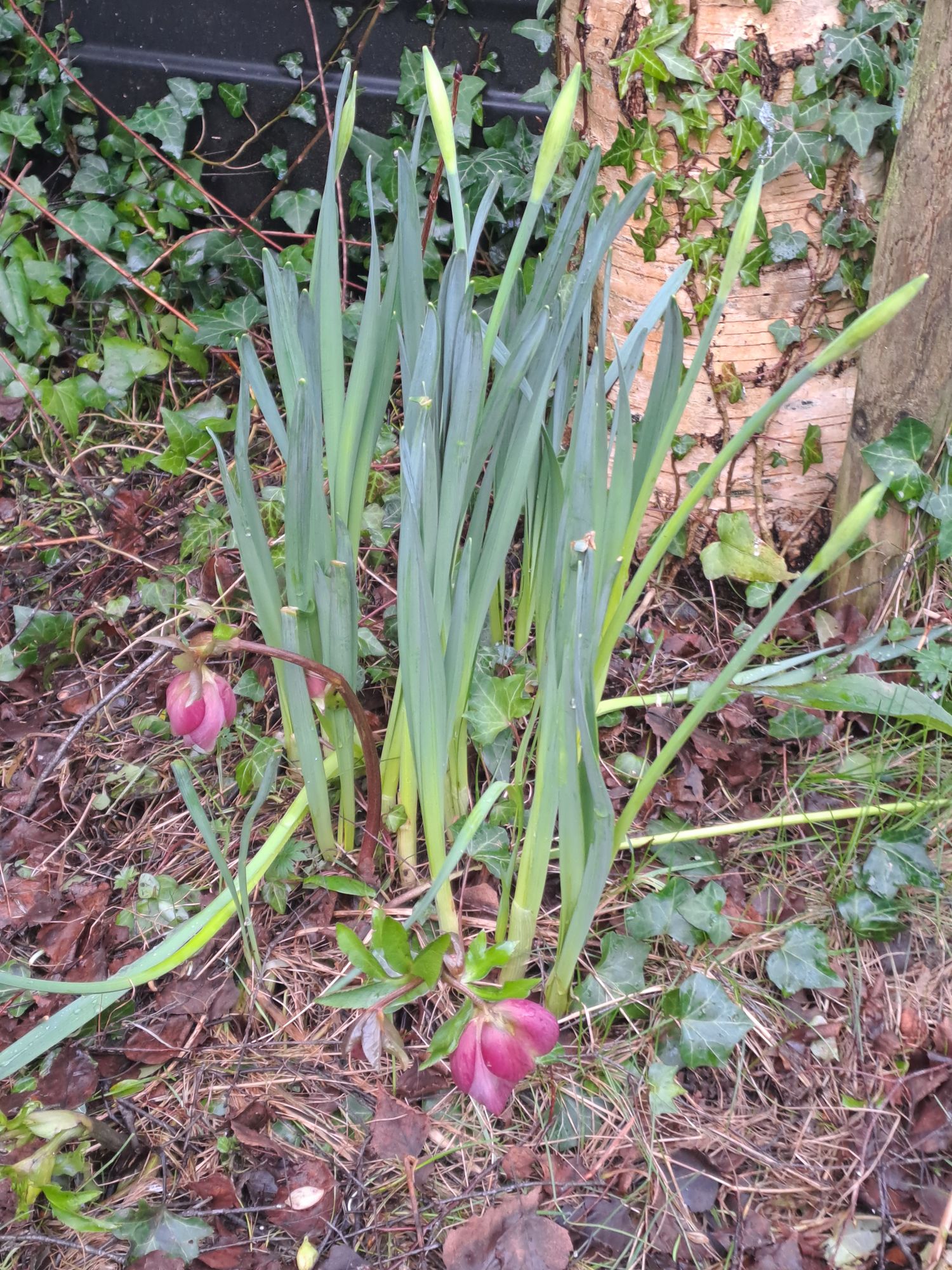

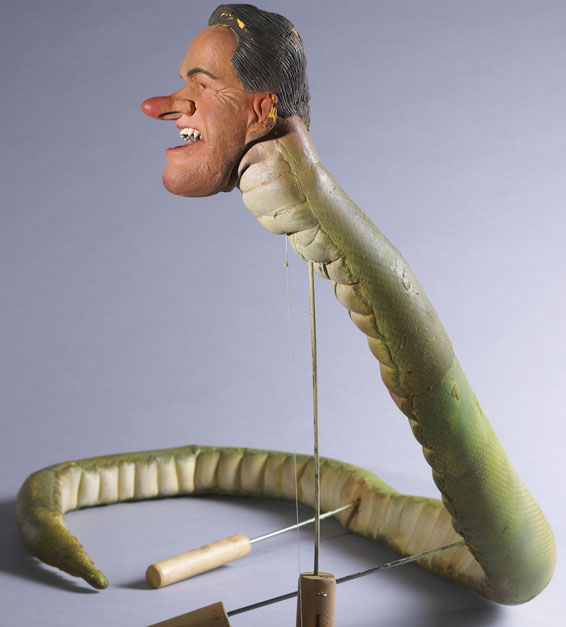

P.S. The pink flowers in the first picture in front of the daffodils are examples of Lenten Rose (Helleborus Orientalis), all parts of which are toxic (cf. Mandelson)
P.S. The pink flowers in the first picture in front of the daffodils are examples of Lenten Rose (Helleborus Orientalis), all parts of which are toxic (cf. Mandelson)
It’s Saturday once more so time for another update of activity at the Open Journal of Astrophysics. Since the last update we have published a further six papers, bringing the number in Volume 9 (2026) to 24 and the total so far published by OJAp up to 472.
I will continue to include the posts made on our Mastodon account (on Fediscience) to encourage you to visit it. Mastodon is a really excellent service, and a more than adequate replacement for X/Twitter which nobody should be using; these announcement also show the DOI for each paper.
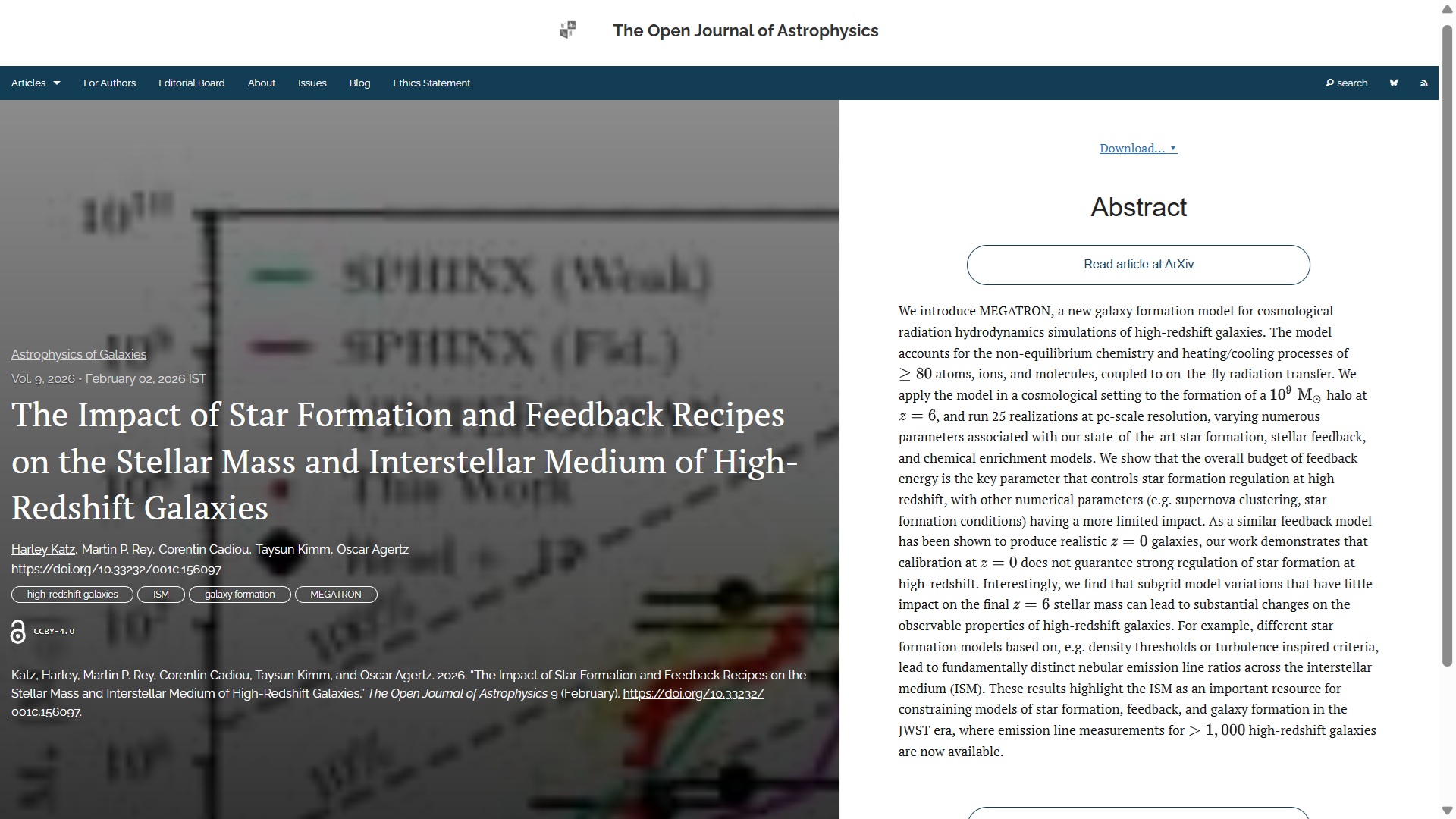
The first paper to report this week is “The Impact of Star Formation and Feedback Recipes on the Stellar Mass and Interstellar Medium of High-Redshift Galaxies” by Harley Katz (U. Chicago, USA), Martin P. Rey (U. Oxford, UK), Corentin Cadiou (Lund U., Sweden) Taysun Kimm (Yonsei U., Korea) and Oscar Agertz (Lund). This paper was published on Monday 2nd February 2026 in the folder Astrophysics of Galaxies. It introduces MEGATRON, a new model for galaxy formation simulations, highlighting that feedback energy controls star formation at high redshift and highlighting the importance of the interstellar medium.
The overlay is here:
You can find the officially accepted version on arXiv here and the announcement on Fediverse here:
The second paper is “Photometric Redshifts in JWST Deep Fields: A Pixel-Based Alternative with DeepDISC” by Grant Merz (U. Illinois at Urbana-Champaign) and 6 others, all based in the USA. This paper was published on Monday February 2nd 2026 in the folder Instrumentation and Methods for Astrophysics. This paper explores the effectiveness of the DeepDISC machine learning algorithm in estimating photometric redshifts from near-infrared data, demonstrating its potential for larger image volumes and spectroscopic samples
The overlay for this one is here:
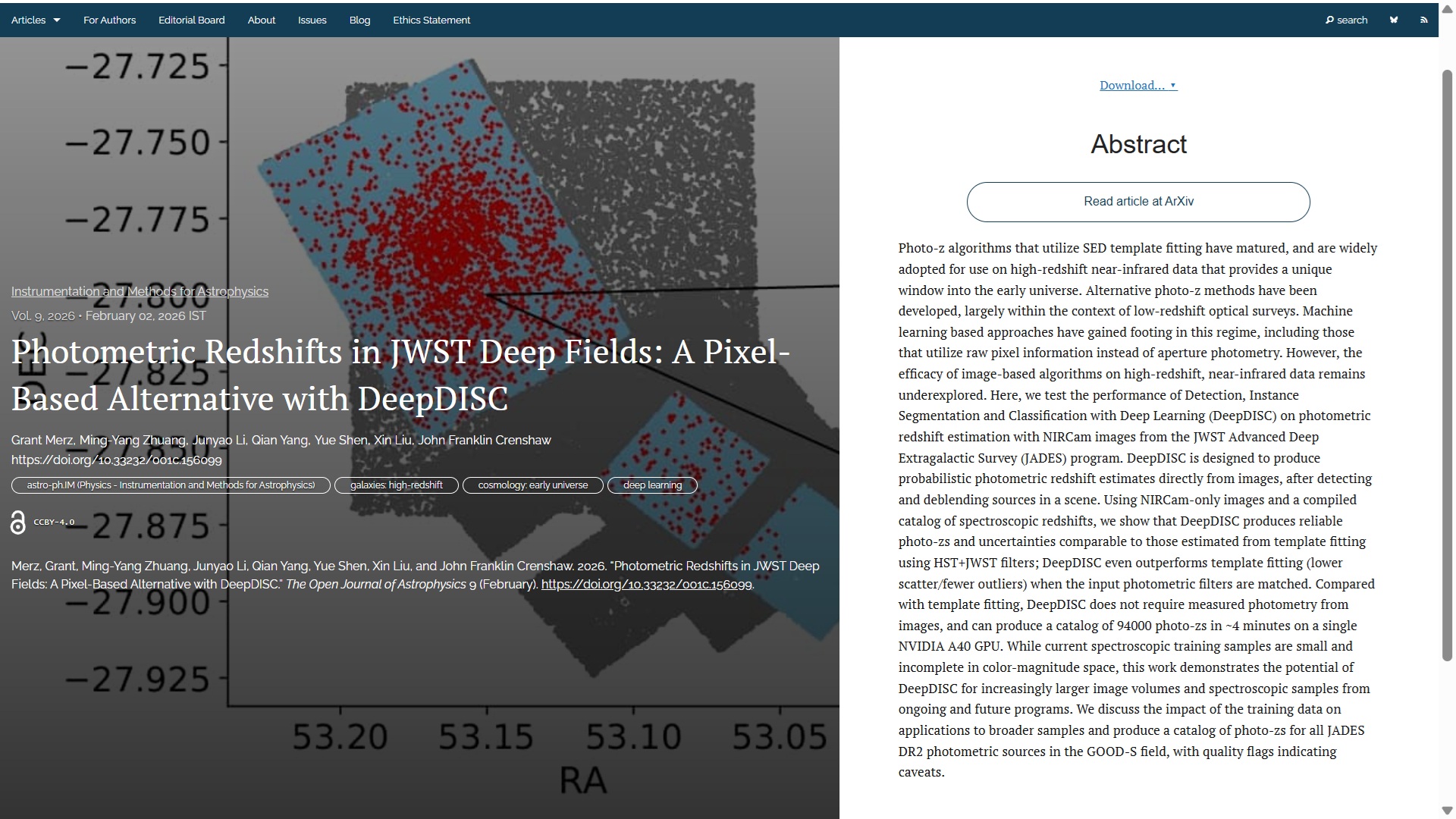
The official version of the paper can be found on arXiv here and the Fediverse announcement here:
Next, published on Wednesday 4th February in the folder Astrophysics of Galaxies, is “Inferring Interstellar Medium Density, Temperature, and Metallicity from Turbulent H II Regions” by Larrance Xing (U. Chicago, USA), Nicholas Choustikov (U. Oxford, UK), Harley Katz (U. Chicago) and Alex J. Cameron (DAWN, Denmark). This paper argues that supersonic turbulenc affects the interpretation of H II region properties, potentially impacting inferred metallicity, ionization, and excitation from in nebular emission lines, motivating more extensive modelling.
The overlay is here:
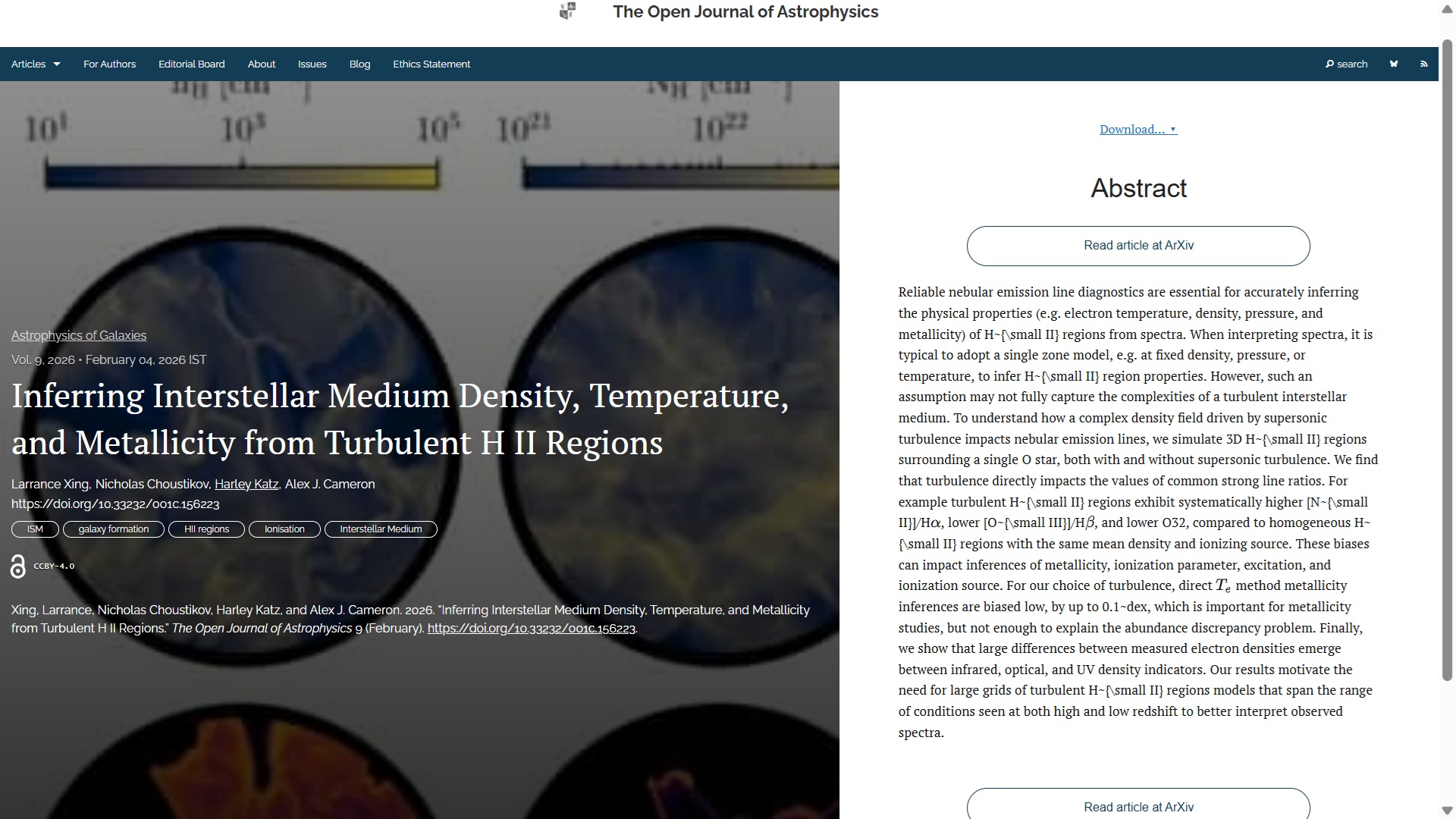
The official version can be found on arXiv here and the Fediverse announcement is here:
The fourth paper this week, also published on Wednesday 4th February, but in the folder Solar and Stellar Astrophysics, is “A Systematic Search for Big Dippers in ASAS-SN” by B. JoHantgen, D. M. Rowan, R. Forés-Toribio, C. S. Kochanek, & K. Z. Stanek (Ohio State University, USA), B. J. Shappee (U. Hawaii, USA), Subo Dong (Peking University), J. L. Prieto Universidad Diego Portales, Chile) and Todd A. Thompson (Ohio State). This study identifies 4 new dipper stars and 15 long-period eclipsing binary candidates using ASAS-SN light curves and multi-wavelength data, categorizing them based on their characteristics.
Here is the overlay:
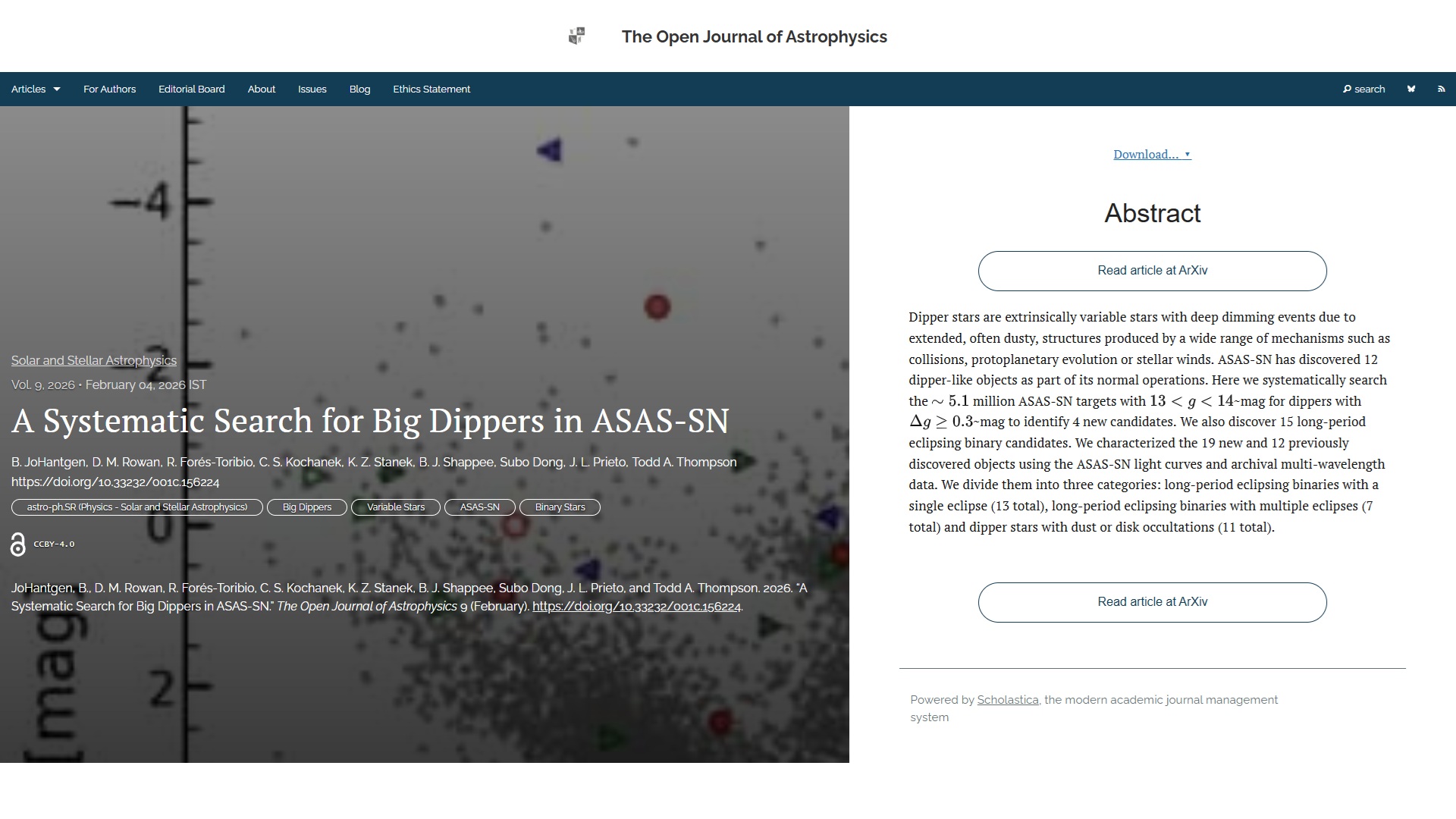
The official version can be found on arXiv here and the Fediverse announcement is here:
Fifth, and next to last this week we have “Unveiling the drivers of the Baryon Cycles with Interpretable Multi-step Machine Learning and Simulations” by Mst Shamima Khanom, Benjamin W. Keller and Javier Ignacio Saavedra Moreno (U. Memphis, USA). This paper was published on Thursday 5th February 2026 in the folder Astrophysics of Galaxies. This study uses machine learning methods to understand how galaxies lose or retain baryons, highlighting the relationship between baryon fraction and various galactic measurements.
The overlay is here:
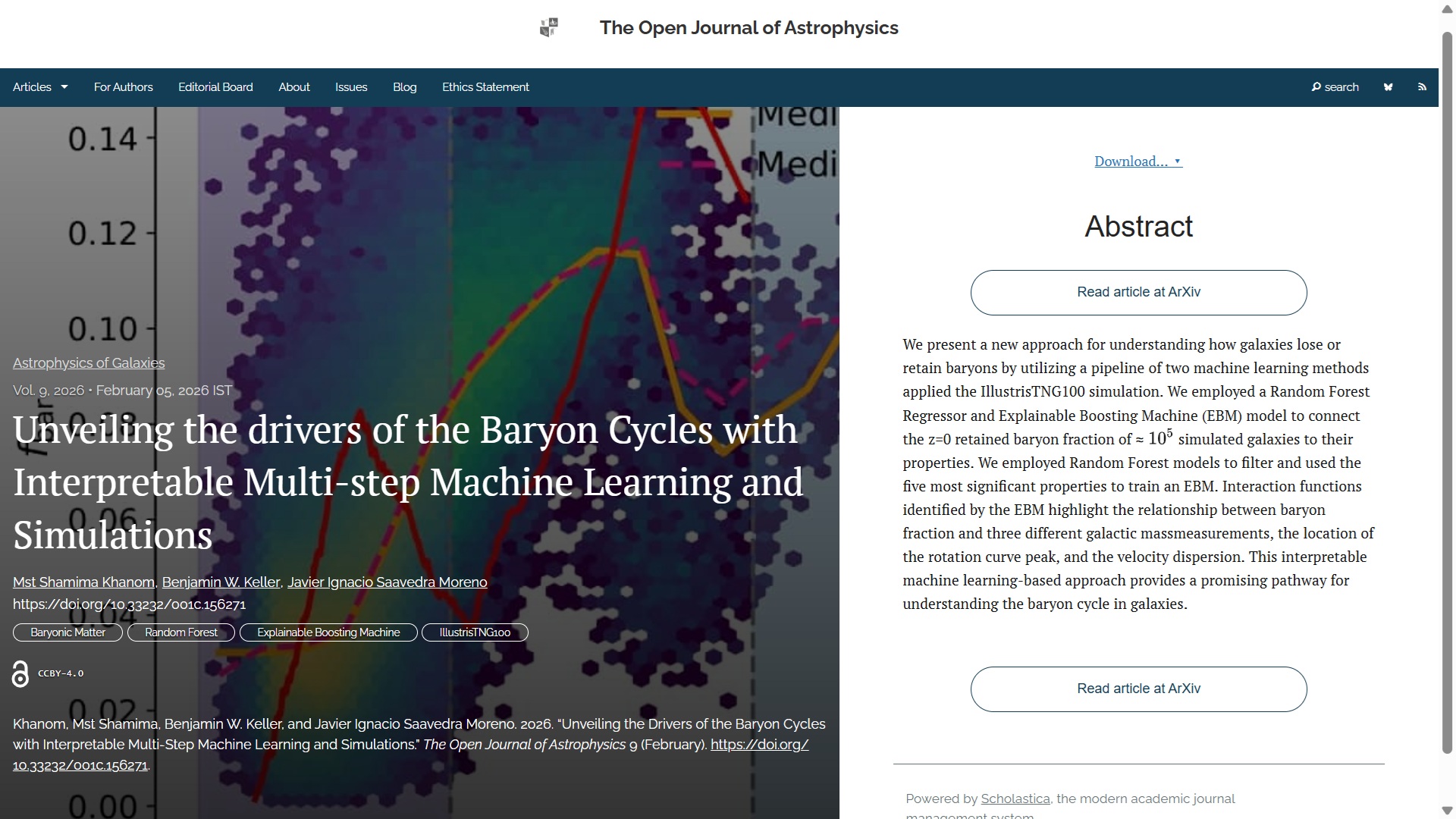
The accepted version can be found on arXiv here, and the fediverse announcement is here:
Finally for this week we have “The Bispectrum of Intrinsic Alignments: II. Precision Comparison Against Dark Matter Simulations” by Thomas Bakx (Utrecht U., Netherlands), Toshiki Kurita (MPA Garching, Germany), Alexander Eggemeier (U. Bonn, Germany), Nora Elisa Chisari (Utrecht) and Zvonimir Vlah (Ruđer Bošković Institute, Croatia). This paper was accepted in December, but publication got delayed by the Christmas effect so was published on February 6th 2026, in the folder Cosmology and Nongalactic Astrophysics. This study uses N-body simulations to accurately measure three-dimensional bispectra of halo intrinsic alignments and dark matter overdensities, providing a method to determine higher order shape bias parameters.
The overlay is here:
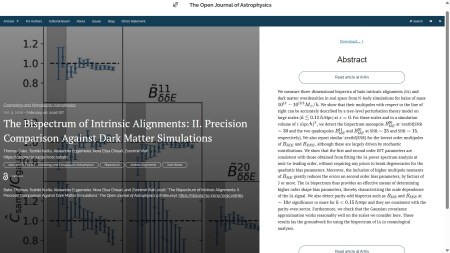
You can find the published version of the article here, and the Mastodon announcement is here:
And that concludes this week’s update. I will do another next Saturday.
The following guest post by George Efstathiou is a response to the current STFC funding crisis I blogged about here, and specifically to a letter by the Executive Chair of STFC, Professor Michele Dougherty. I include the letter here for completeness:
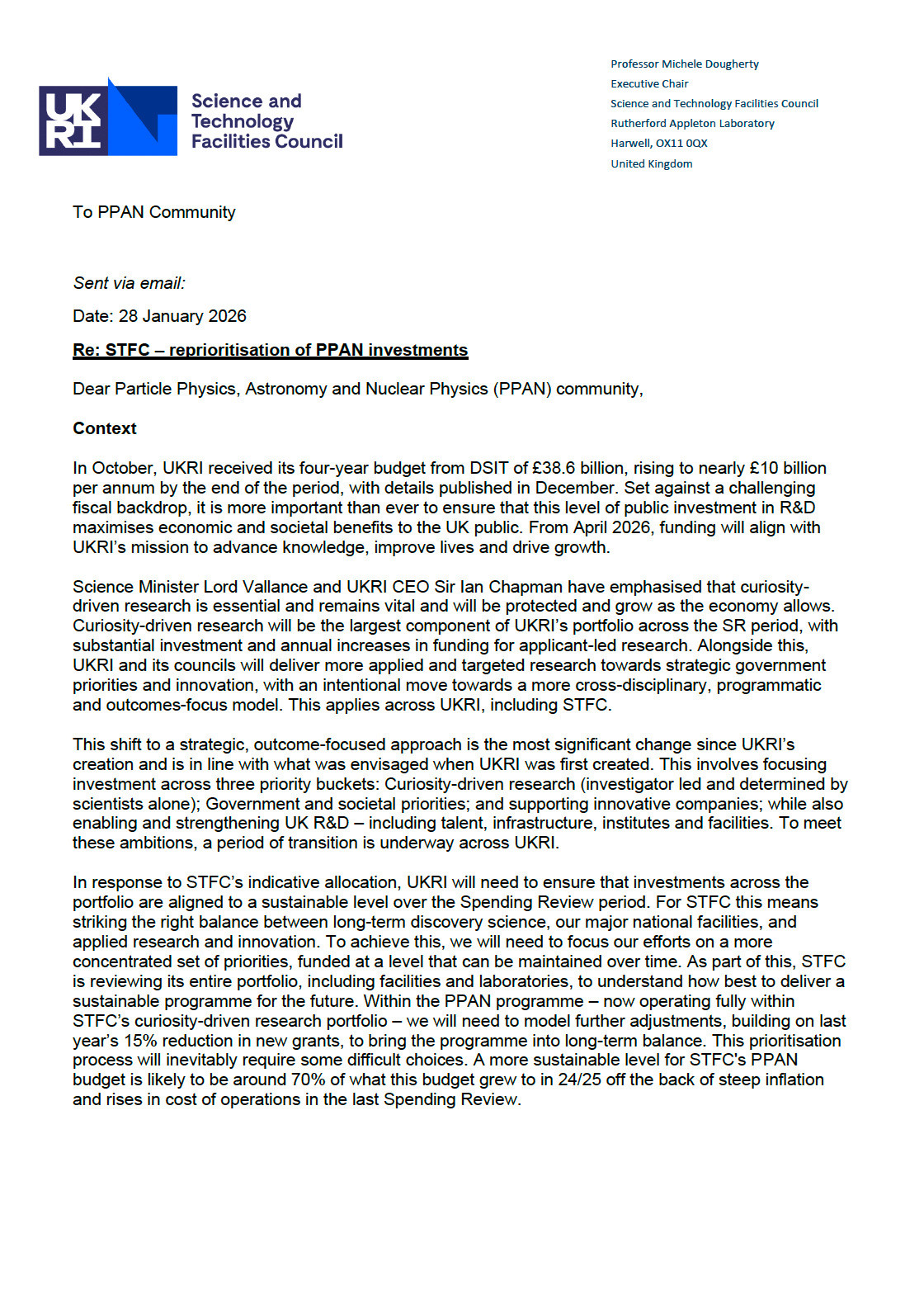
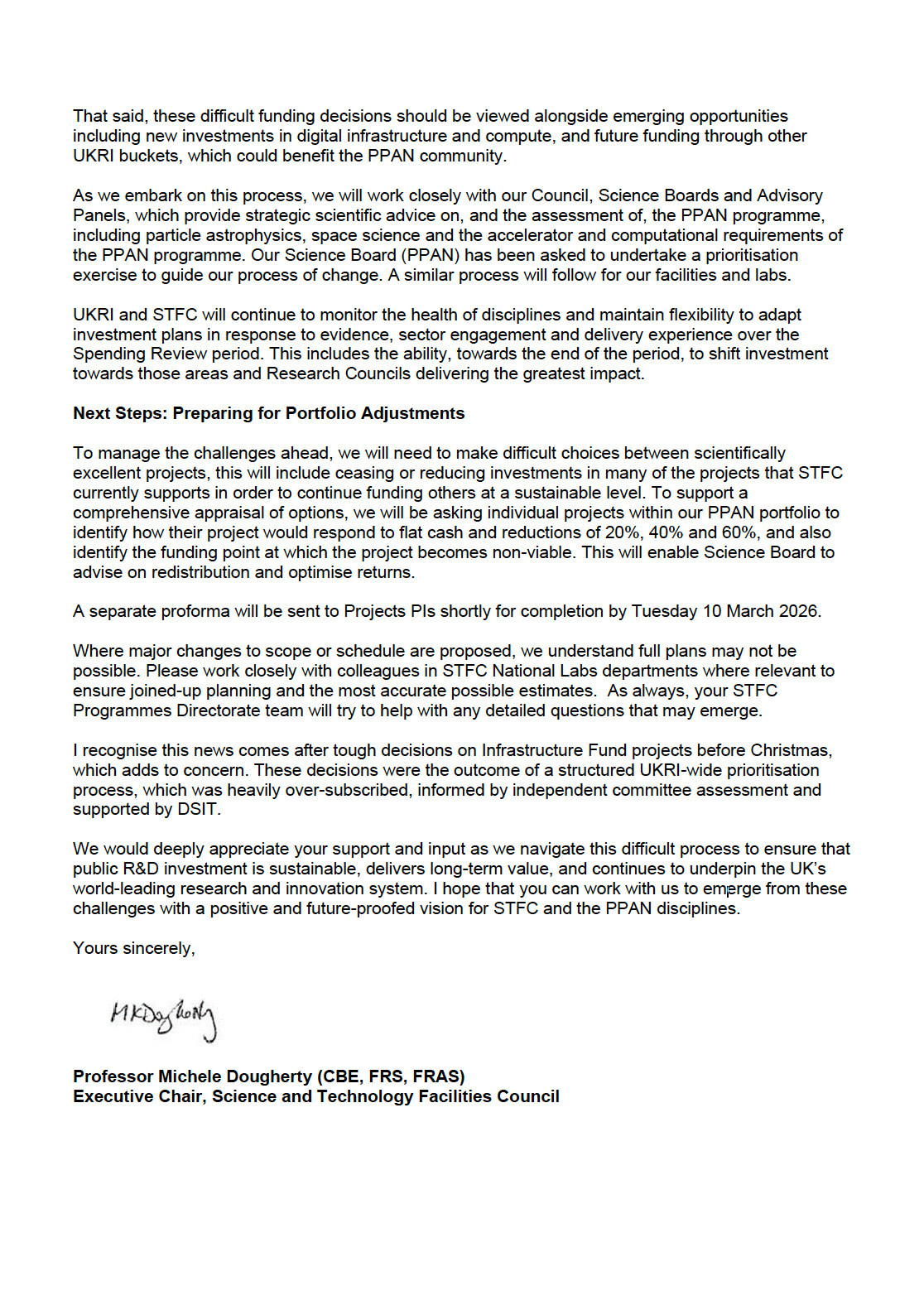
George’s post follows:
–o–
I am glad that Michele Dougherty has finally communicated the position of STFC to the community. There is a glaring inconsistency between paragraphs 2 and 4 of her letter.
I have just finished a 5 year term on the STFC Science Board and now that the problems are in the public domain I am able to speak freely. In brief, the financial problems at STFC have arisen because of high inflation and high costs of energy against the backdrop of long term flat cash settlements. The national labs/facilities are particularly vulnerable to both. In addition, the labs invested heavily in ambitious upgrades that are now acknowldeged to be unsustainable. However, it is difficult to downsize programmes at the facilities quickly because it takes time to cut staff levels. In fact, money needs to be spent up front to achieve long term reductions in staff levels. From my time on Science Board, I can see no solution given the SR settlement other than for PPAN to take a big cut. Asking for more money from UKRI will likely fall on deaf ears, since the STFC problems are (to a large extent) of their own making.
The problem, as I see it, is whether it is possible for STFC to construct a recovery programme for PPAN science. The impression given in the Dougherty letter is that the ‘bucket’ allocation formula constrains STFC and so they are forced to reduce PPAN expenditure (Bucket 1) at the expense of ‘outcome driven’ growth related expenditure (Bucket 2) which goes mostly to the government labs/facilities. Science board was told that the new allocation formula was to blame for the huge cuts in the PPAN programme. Furthermore, the STFC plan to shift towards ‘growth related’ priorities is envisaged by STFC to lead to a long term cut in PPAN science. This situation was described to Science Board as the ‘new normal’. This is clearly inconsistent with paragraph 2 in Dougherty’s letter, which states that ‘curiosity-driven research will be the largest component of UKRI’s portfolio across the SR period, with substantial investment and annual increases in funding for applicant-led research’.
I discussed this contradiction with Paul Nurse, who told me that Patric Vallance had assured him that funding for basic research would not be cut under the new funding model. This prompted me to write to Michele Dougherty and Grahame Blair asking for clarification on the interpretation of the new funding model by STFC. I did not receive a reply.
This is what I think is going on. I believe that it is the STFC Executive Board that has decided to prioritise the facilities ahead of the PPAN programme. This is their decision and is not forced on them by the new allocation formula. I also believe that the their priorities are a reflection of conflicts of interest in the governance structure of STFC. Decisions at STFC are made by the Executive Board (EB) which is composed mostly of lab/facility directors and senior programme managers. The Council and Science Boards are advisory. The EB is therefore heavily biased in favour of the facilities component of the STFC portfolio. This bias has afflicted STFC since it was first created. I wrote to Michele Dougherty last July concerning the governance structure at STFC. I did not get a reply.
The situation for PPAN science is very serious and I objected to Science Board being used to conduct a ‘prioritisation’ exercise. At these high levels of cuts, decisions depend on many programmatic factors that Science Board cannot judge. Large cuts to key PPAN projects will surely raise questions of whether the UK should continue to pay international subscriptions. In addition, the UK Space Agency is being absorbed into DSIT and there is uncertainty concerning the relationship between UKSA and STFC. We also have the absurd spectacle of deep cuts to PPAN projects running alongside a call for white papers on future space missions.
I would urge the community to ask questions of STFC. It is important, in particular, to extract an answer from Michele Dougherty to the question of ‘how much freedom does STFC have to distribute funds between the three buckets?’. This is pertinent to the issue of whether STFC can construct a recovery plan for PPAN science. I also think that it is worth pursuing questions on the governance of STFC, which are at the heart of the problems.
George Efstathiou FRS
Emeritus Professor of Astrophysics (1909)
Kavli Institute for Cosmology
Madingley Road
Cambridge
The release of the latest batch of information relating to disgraced financier and sex offender Jeffrey Epstein got me thinking about the number of physicists on friendly terms with that individual and that in turn got me thinking about the Erdős Number, which I blogged about here, and about constructing some sort of metric relating to a person’s connecttion to Epstein.
The Erdős Number? It’s actually quite simple to define. First, Erdős himself is assigned an Erdős number of zero. Anyone who co-authored a paper with Erdős then has an Erdős number of 1. Then anyone who wrote a paper with someone who wrote a paper with Erdős has an Erdős number of 2, and so on. The Erdős number is thus a measure of “collaborative distance”, with lower numbers representing closer connections. A list of individuals with very low Erdős numbers (1, 2 or 3) can be found here. As it happens, mine is three.
The main difference between an Erdős Number and a putative Epstein Number is that most people think’s a nice thing to have a low Erdős Number whereas the opposite is probably the case for evidence of close collaboration with Jeffrey Epstein…
It is also difficult to define an equivalent to the Erdős Number for Epstein as the form of “colloboration” is less easily catergorised than publishing a paper. I think it is probably fairer to base a number simply on the number of people you know who met Epstein personally (assuming you didn’t know him yourself). Anyone who did know Epstein personally therefore gets an automatic red card. It would also be very difficult for a typical person to work out how many people they have met who have met someone who has met Epstein, etc.
I was intrigued by this because it is known that Epstein liked hanging out with scientists and, being a scientist myself, I wondered if anyone I knew had been drawn into the Epstein circle. It’s unreasonable to count anyone who appears in the Epstein files as having “known” Epstein because many of the names simply appear on emails sent by Epstein to which no reply was apparently ever received or which were not indicative of a working relationship or personal friendship, sometimes quite the opposite.
Anyway, based on a not very thorough bit of research I came across the following people who I have met in person who met and knew Jeffrey Epstein to a greater or lesser extent.
First, there’s Lawrence Krauss who left his position at Arizona State University as a consequence of a sexual misconduct case. He features prominently in the Epstein correspondence, including many messages about the disciplinary case brought against him at ASU. I met Lawrence Krauss in the 1990s at an Aspen Summer School for Physics, where I shared an office with him for about two weeks. I wouldn’t say that we got on well.
Second, there’s Harvard theoretical physicist Lisa Randall, whom I met at a meeting in South Africa about 25 years ago. The disturbing thing about her case is that she carried on interacting with Epstein even after his conviction for sex offences, visiting Epstein’s island home and travelling on his private jet.
Another name that comes up frequently in the Epstein files is John Brockman, a well-known literary agent. I met him at the Experiment Marathon in Reykjavik in 2008. In fact we were placed next to each other alphabetically speaking in the list of contributors:

Our conversations at that meeting were limited to small talk. As a matter of fact I didn’t really know who he was! He certainly didn’t offer me a lucrative book deal like he did with certain other physicists. The topic never arose.
The files also contain references to Stephen Hawking (who died in 2018), including allegations about him made by Virginia Giuffre. Hawking was never charged with any crime but it is the case that he met Epstein at least once, at a meeting organized by Lawrence Krauss on St Thomas, close to Epstein Island. I met Stephen Hawking on a number of occasions.
Now you can add Lee Smolin, whom I met in Canada when I was on sabbatical in 2005. He has stepped back from his position at the Perimeter Institute after revelations that he maintained contact with Epstein after Epstein’s conviction for child sex offences.
So according to this my Epstein Number is four five. I have had no contact with any people who knew Epstein since 2008 and very little before that. Although it is perhaps indicative of a lack of eminence, I can’t say I’m sorry this number is low. I may have missed some, of course.
P.S. It is worth reading Peter Woit’s blog post on this topic and Scott Aaronson’s here.

I hadn’t seen Maynooth University Library Cat for a while, so it was nice to see him today, on post, as large as life. Approaching him I saw him receive a number of back scratches. It seems he enjoyed them and continued to present his back to passers-by in the hope of getting more.
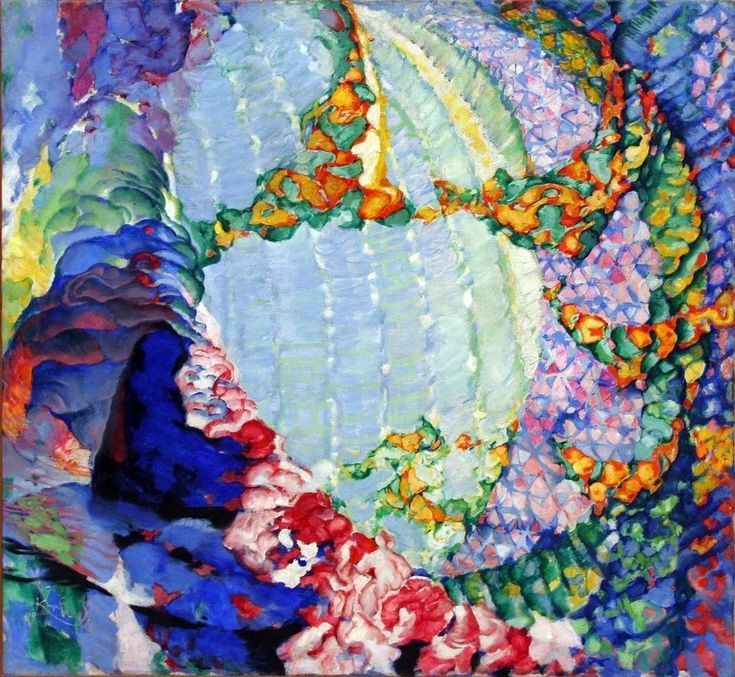
Cosmis Spring I (Cosmic Spring I) by František Kupka (1913/4, oil on canvas, 115 x 125 cm, National Gallery of Prague).
Adapted from the Gallery catalogue:
František Kupka (1871-1957) wrote in his book Tvoření v umění výtvarném (Creation in Visual Art), that he did not seek to copy nature but sought inspiration in varied shapes of nature such as ice crystals, flower buds, freezing vapour, clouds, airflow, and falling stars. Kupka was fascinated by shape analogies which he found in various levels of microstructures and macrostructures – from microphotographs of cells to astronomical photographs of planets.
(Posted because, of course, 1st February was the first day of Spring…)
I only have time for a quick post today but I think it’s important to comment on the very feeble open letter circulated (yesterday) to “the research and innovation community” by the Chief Executioner Executive of UKRI. I think it’s feeble because it seems to have been intended to clarify what is going on, but does nothing of the sort. In fact, to me, it reads like it was written by someone who doesn’t know what he is doing and is playing for time by waffling.
The letter basically tells researchers working in areas outside the STFC remit (i.e. in anything except particle physics, astronomy and nuclear physics) not to worry because it’s only STFC that will suffer. This is the “explanation”:
In order to remain sustainable, STFC must make significant cumulative savings: a decrease of £162 million relative to our forecasts for their operational costs. The £162 million is the total net reduction in STFC’s annual costs that they must achieve by the end of the 2029 and 2030 financial year. It is not a £162 million saving in each year of the current SR period. Instead, STFC needs to reshape its cost base over the whole SR period so that their budget is balanced by 2029 and 2030 and key facilities are funded properly and sustainably.
That is not the situation at other councils and we do not anticipate equivalent measures will be necessary outside of STFC.
One of the problems with this logic is that a huge slice of STFC’s budget is spent on facilities that support science outside STFC’s scientific remit. The Diamond Light Source, for example, which has annual running costs of almost £70 million caters largely to the EPSRC and BBSRC communities. It makes no sense to me to require particle physics, astronomy and nuclear physics reseachers to bear the entire consequences of cost overruns at this facility when other communities benefit from it.
I’m sure the UKRI Chief Executive knows this, so it must have been a deliberate decision to wield the axe in this way. In other words it’s a conscious downgrade of particle physics, astronomy and nuclear physics. In the new regime, these are less important than any other branch of scientific research.
I’m out of it now, but I always felt that STFC should never have been set up as a research council. It should have been a service organisation, as its title – the Science and Technology Facilities Council – suggests. When STFC was created, back in 2007, funding for particle physics, astronomy and nuclear physics research as opposed to facilities should have been administered by EPSRC. Whether intentionally or not, the current arrangements make these areas of fundamental physics exceptionally vulnerable. We saw the consequences of that back in 2007/8 and it is happening again.
It is 1st February 2026, which means that today is Imbolc (or Imbolg in modern Irish), an ancient Gaelic festival marking the point halfway between the winter solstice and vernal equinox. In the old pagan calendar, this day is regarded as the first day of spring, as it is roughly the time when the first spring lambs are born, daffodils etc start to appear, and the days get noticeably longer. The name Imbolg may be derived from “i mbolg” meaning “in the belly”, referring to the pregnancy of ewes. This time corresponds to the Welsh Gŵyl Fair y Canhwyllau and is also sometimes called, rather beautifully, The Quickening of the Year. It’s a time for rebirth and renewal after the darkness of winter.
Incidentally, in spoken Irish it is common to place an unstressed vowel sound – often schwa – between certain pairs of consonants, e.g. the name “Colm” is pronounced “Collum”. This extends to Hiberno-English: e.g. many Irish people say “fillum” for “film”. Imbolg is therefore pronounced something like “Imbollig”. In phonology this is called anaptyxis.

In Ireland Imbolc is usually often referred to a Lá Fhéile Bríde, St Brigid’s Day, after St Brigid of Kildare, whose feast day is today 1st February. There are events going on in Maynooth, which is in Couny Kildare, but I am not in Maynooth today so I don’t know what is going on. Incidentally, the Celts counted each day starting from sunset, so the Imbolc/St Brigid’s Day celebrations in County Kildare started last night, 31st January, but I didn’t see any of them either.
In the Northern hemisphere, in astronomical terms, the solar year is defined by the two solstices (summer, around June 21st, and winter, around December 21st) and the equinoxes (spring, around March 21st, and Autumn, around September 21st). These four events divide the year into four roughly equal parts of about 13 weeks each.
If you divide each of these intervals in two you divide the year into eight pieces of six and a bit weeks each. The dates midway between the astronomical events mentioned above are the cross-quarter days, of which Imbolc is one. They are:
The names I’ve added in italics are taken from the Celtic/neo-Pagan and, in parenthesis the Christian terms, for the cross-quarter days. These timings are rough because the dates of the equinoxes and solstices vary from year to year. Imbolc is often taken to be the 2nd of February (Groundhog Day) and Samhain is sometimes taken to be October 31st, Halloween but hopefully you get the point that although the Pagan festivals have been appropriated by the Christian church, they have much older origins. The status of St Brigid herself is particular obscure; it is not known for sure whether she was a real person or Christian appropriation of a Celtic deity, or some amalgamation of those.
Until recently there was an anomaly in that the first of these was the only one not associated with a Bank Holiday. That was changed in 2022 and tomorrow, Monday 2nd February, will be the St Brigid’s Day holiday. It would have been the first of teaching in Semester 2 had it not been a holiday; we return to teaching on Tuesday. As you may have surmised, I’ve taken the opportunity of the long weekend for a bit of a break and a trip elsewhere.
P.S. As it also happens, today is also the 8th anniversary of the very first lecture I gave in Maynooth, on Computational Physics, on 1st February 2018. I”ll be giving pretty much the same lecture again on Thursday 5th February.
It’s Saturday once more so time for another update of activity at the Open Journal of Astrophysics. Since the last update we have published a further four papers, bringing the number in Volume 9 (2026) to 18 and the total so far published by OJAp up to 466.
I will continue to include the posts made on our Mastodon account (on Fediscience) to encourage you to visit it. Mastodon is a really excellent service, and a more than adequate replacement for X/Twitter which nobody should be using; these announcement also show the DOI for each paper.
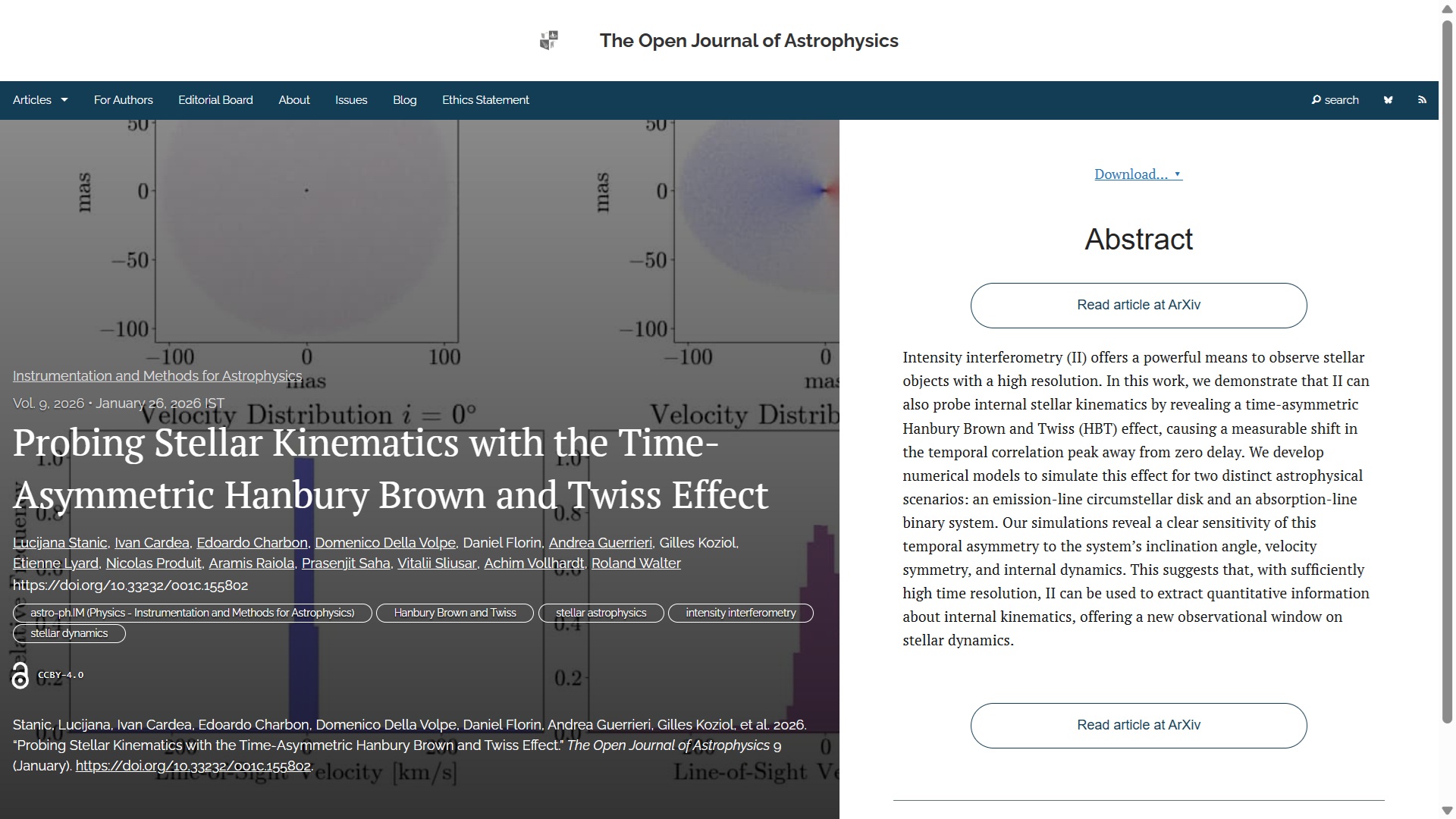
The first paper to report this week is “Probing Stellar Kinematics with the Time-Asymmetric Hanbury Brown and Twiss Effect” by Lucijana Stanic (University of Zurich, Switzerland) and 13 others based in Zurich, Lausanne and Geneva (all in Switzerland). This was published on Monday 26th January 2026 in the folder Instrumentation and Methods for Astrophysics. This research demonstrates that intensity interferometry can reveal internal stellar kinematics, providing a new way to observe stellar dynamics with high time resolution.
The overlay is here:
You can find the officially accepted version on arXiv here and the announcement on Fediverse here:
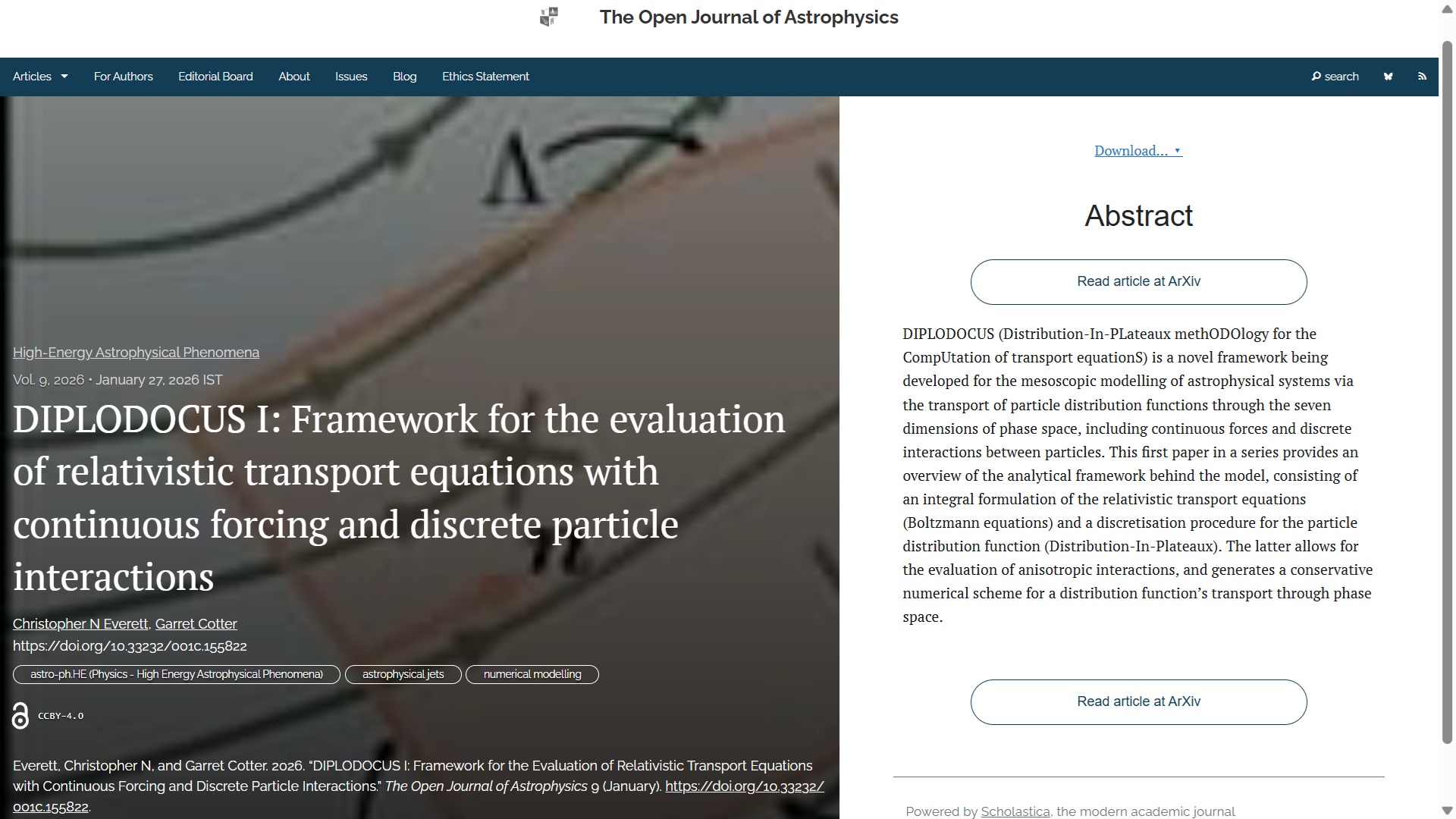
The second paper is “DIPLODOCUS I: Framework for the evaluation of relativistic transport equations with continuous forcing and discrete particle interactions” by Christopher N Everett & Garret Cotter (University of Oxford, UK). This was published on Tuesday January 27th 2026 in the folder High-Energy Astrophysical Phenomena. DIPLODOCUS is a new framework for mesoscopic modelling of astrophysical systems, using an integral formulation of relativistic transport equations and a discretisation procedure for particle distributions.
The overlay for this one is here:
The official version of the paper can be found on arXiv here and the Fediverse announcement here:
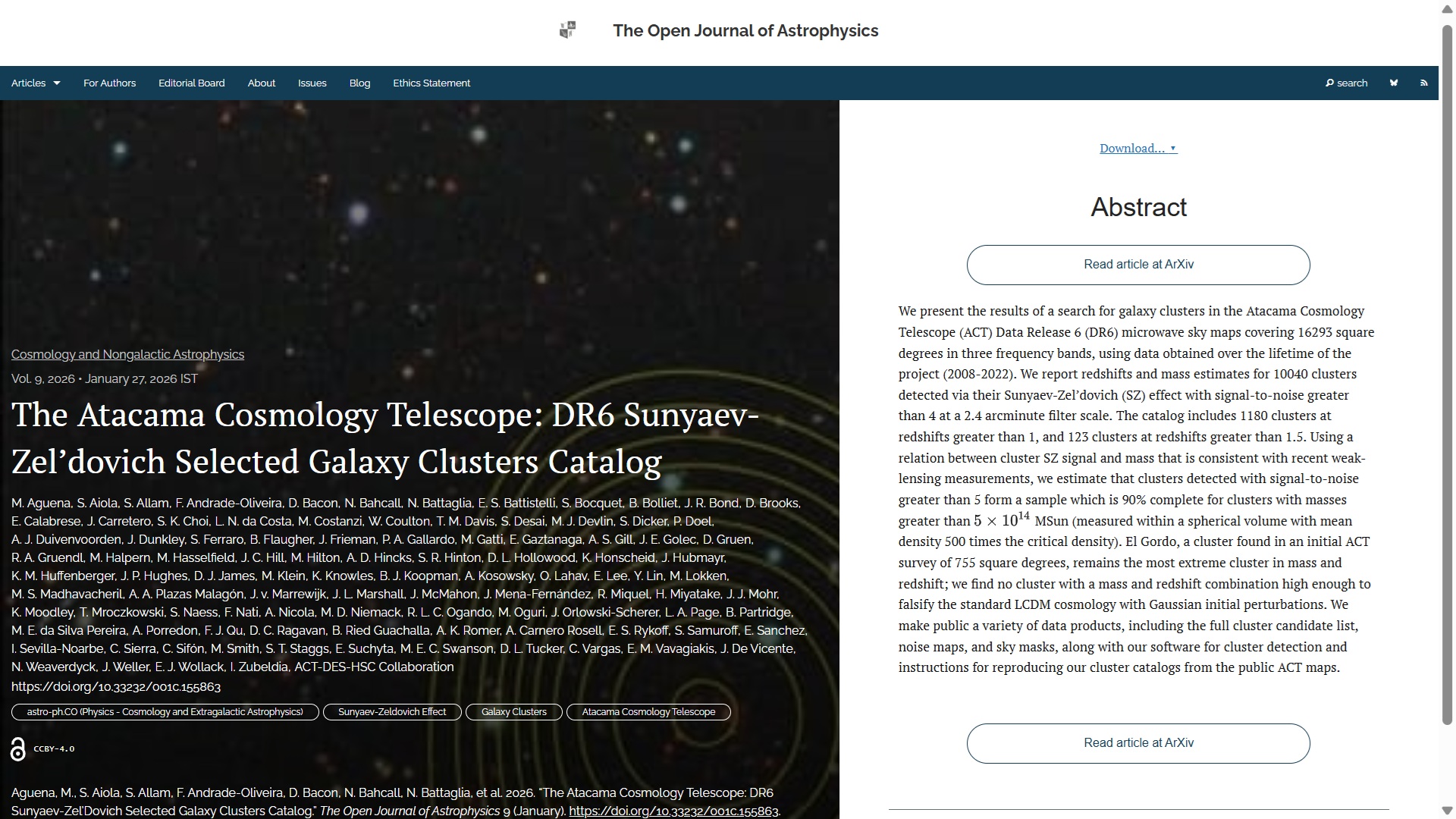
Next, also published on Tuesday January 27th but in the folder Cosmology and Nongalactic Astrophysics we have “The Atacama Cosmology Telescope: DR6 Sunyaev-Zel’dovich Selected Galaxy Clusters Catalog” by M. Aguena et al. (101 authors altogether), on behalf of the ACT-DES-HSC Collaboration. This article reports on the discovery of 10,040 galaxy clusters in the Atacama Cosmology Telescope data, including 1,180 clusters at high redshifts, using the Sunyaev-Zel’dovich effect.
The overlay is here:
The official version can be found on arXiv here and the Fediverse announcement is here:
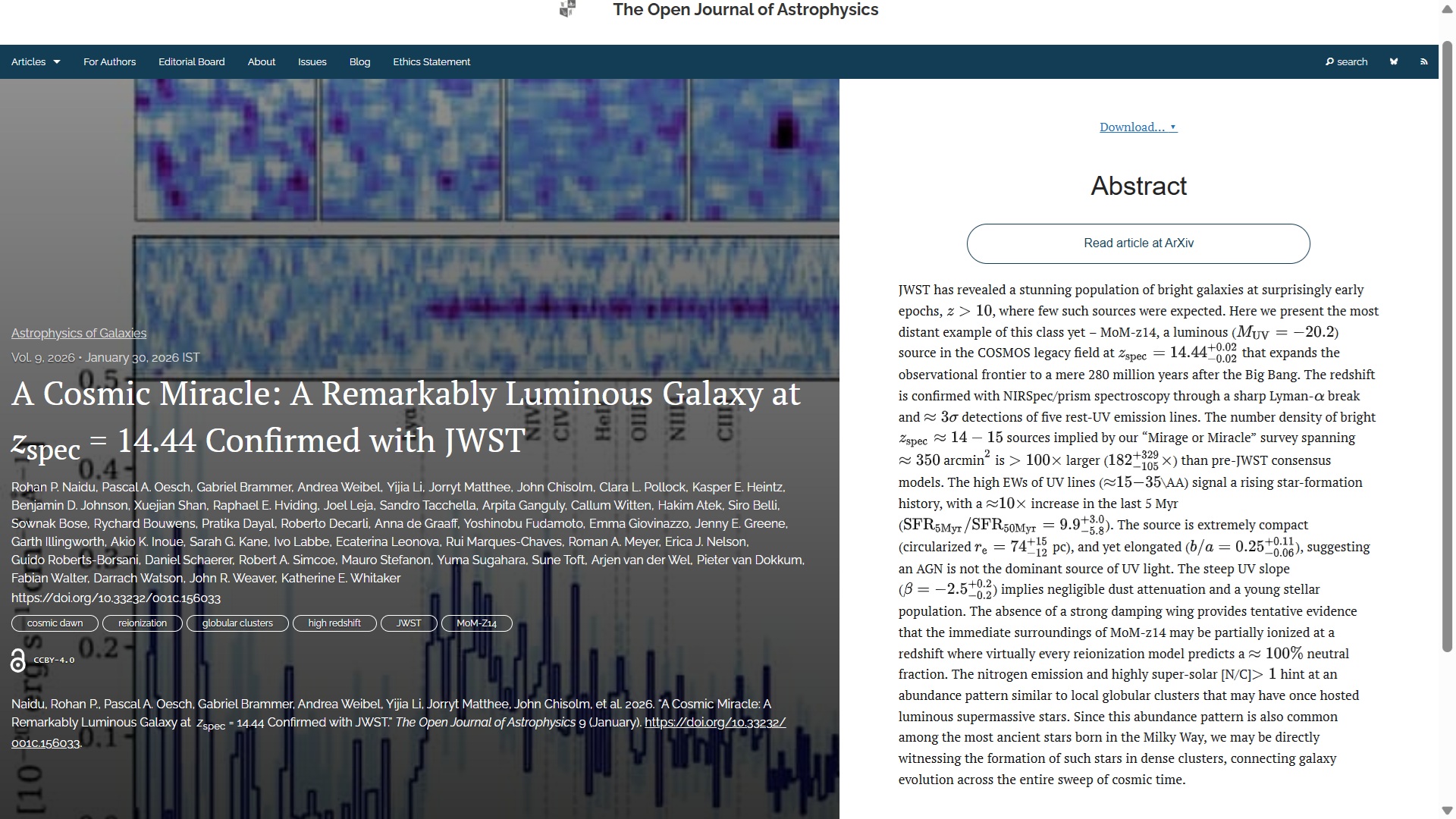
And finally for this week we have a paper published yesterday, Friday 30th January 2026, in the folder Astrophysics of Galaxies. This is the paper I blogged about yesterday: “A Cosmic Miracle: A Remarkably Luminous Galaxy at zspec = 14.44 Confirmed with JWST” by Rohan Naidu (MIT Kavli Institute) and an international cast of 45 others. This article reports on the discovery by the James Webb Space Telescope (JWST) of a bright galaxy, MoM-z14, located 280 million years post-Big Bang, that challenges models of galaxy formation and the star-formation history of early galaxies.
The overlay is here:
The accepted version can be found on arXiv here, and the fediverse announcement is here:
And that concludes the update for this week. I will do another next Saturday.
A while ago (last May, in fact) I posted an article about a galaxy with an apparent spectroscopic redshift of 14.44. The paper to which that post related had been submitted to the Open Journal of Astrophysics and I haven’t mentioned that paper again until now as the paper was then, so to speak, sub judice. Well, as of today, the paper is now published and will feature in tomorrow’s traditional Saturday roundup of publications at the journal.
This paper was in fact accepted for publication before Christmas, but it took until this morning for the final accepted article to reach the arXiv. Rather awkwardly, the Space Telescope Science Institute issued a press release about this paper on 28th January 2026 stating that the paper was published in the Open Journal of Astrophysics, when that statement was not accurate. As Editor-in Chief of the Open Journal of Astrophysics, I was subsequently contacted by a number of journalists asking where they could find the paper on the OJAp platform. Since it hadn’t been published then I had to say they couldn’t, so a number of pieces (including, for example, this one in Scientific American) have appeared based on the STSCi press release without links to the final version of the paper. It would have been far better, in my opinion, to have delayed the press release until the paper was actually published. It’s better to wait until the ball is in the back of the net before you start celebrating!
Anyway, thanks to me getting up at 6am today, it’s now published so there’s no real harm done.
The fediscience announcement is here:
For reference, here is the key plot showing the spectrum from which the galaxy’s redshift is determined. It is rather noisy, but the Lyman break seems convincing and there are some emission lines that offer corroborative evidence:


 In the Dark