Enjoy the Eclipse, but watch out for the cosmologists and druids!

Posted in Biographical, The Universe and Stuff with tags , , , , , on April 7, 2024 by telescoper

Ahead of tomorrow’s total eclipse of the Sun visible from a large part of the USA, I can’t resist sharing this excerpt from The Times warning about the consequences of a mass influx of people to Cornwall for the total eclipse of the Sun that was visible on August 11th 1999, almost 25 years ago. No doubt there are similar things going around about tomorrow’s eclipse:
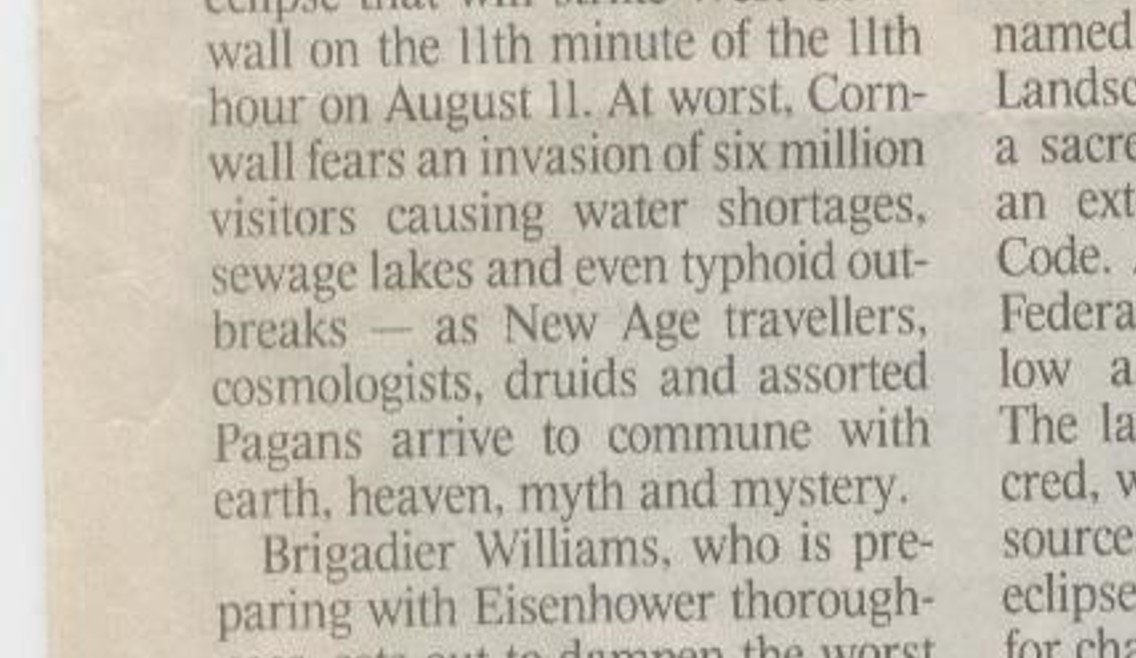
I did write a letter to the Times complaining that, as a cosmologist, I felt this was very insulting… to druids. They didn’t publish it.

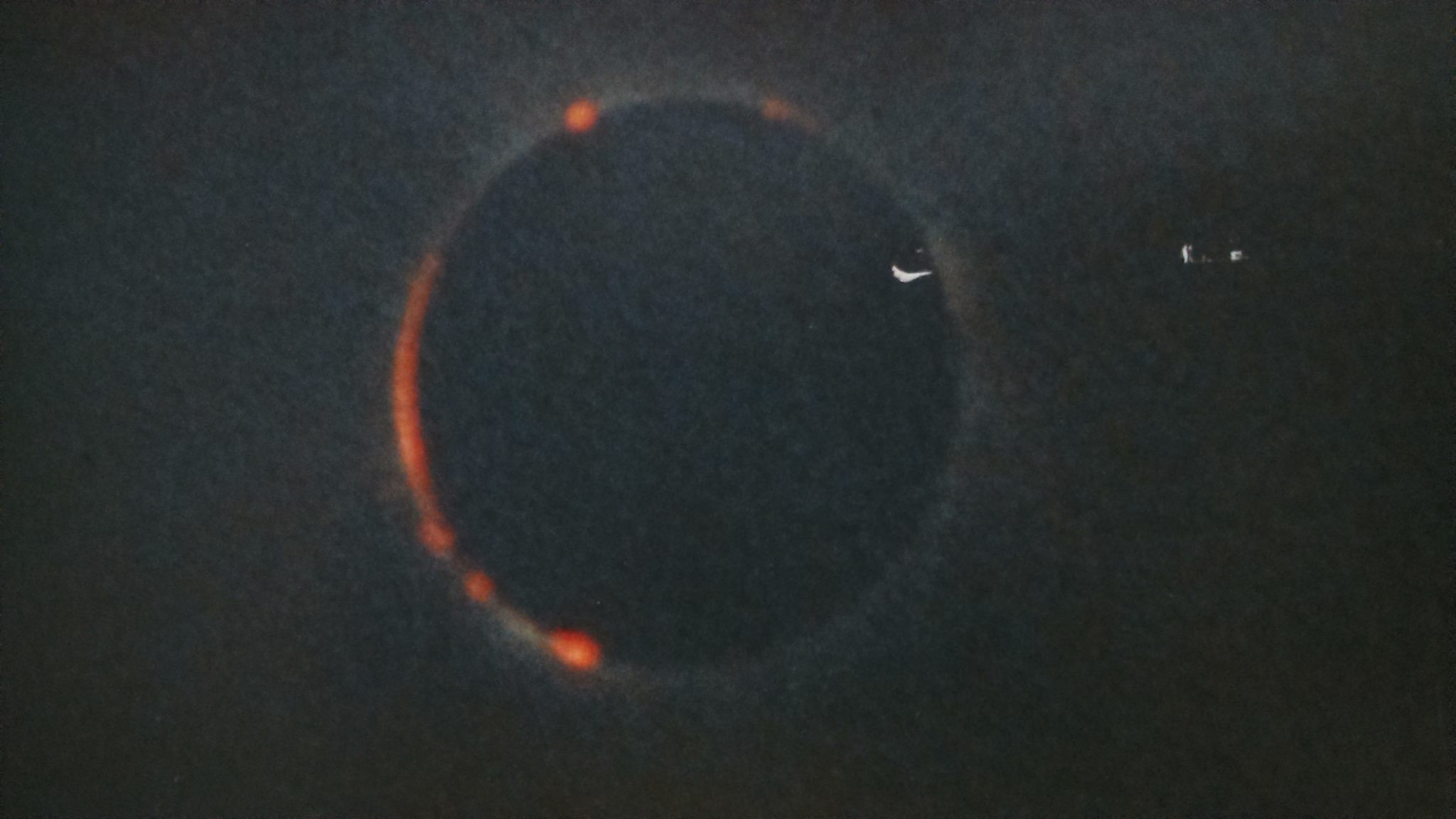
Anyway, I did get to see the total solar eclipse of 1999, not from Cornwall (where it was overcast and rainy) but from the island of Alderney (one of the Channel Islands). There was quite a lot of cloud cover in the morning of the big event so I was expecting to be disappointed. Indeed, the very start of the eclipse was hidden by cloud and there were groans from the large crowd assembled to watch it. A few seconds later, however, the clouds parted and we got a wonderful view. I remember very well that it seemed to get much colder during totality and an eery wind started to blow. Another thing is that all the birds thought it was night already and started to roost, although it was only around 11am.

You might think astronomers would be a bit indifferent to eclipses because they are well understood and totally predictable. But to experience an eclipse in person has a very powerful effect (or did on me anyway). We may be scientists but we don’t respond entirely rationally to everything. Nor should we.

Here’s a (not very good) scan of a (slightly damaged) picture from that eclipse:
Anyway, tomorrow (i.e. 8th April 2024) the total solar eclipse crosses North America with parts of 15 states able to view it: the eclipse will first appear along Mexico’s Pacific Coast at around 11:07 a.m. PDT, then travel across a swath of the U.S., from Texas to Maine, and into Canada. About 31.6 million people live in the path of totality. The path will range between 108 and 122 miles wide. An additional 150 million people live within 200 miles of the path of totality.

Do make the effort to see it if you can. It’s a remarkable experience that will live long in your memory. But watch out for the cosmologists and druids!

Five New Publications at the Open Journal of Astrophysics

Posted in OJAp Papers, Open Access, The Universe and Stuff with tags , , , , , , , , , on April 6, 2024 by telescoper

As promised a couple of days ago, I am taking the opportunity today to announce the batch of papers at the Open Journal of Astrophysics that were paused slightly while we updated our system. This batch includes five papers, which I now present to you here. These five take the count in Volume 7 (2024) up to 25 and the total published by OJAp up to 140. We’re publishing roughly two papers a week these days so we expect publish about 100 this year.

In chronological order, the five papers, with their overlays, are as follows. You can click on the images of the overlays to make them larger should you wish to do so.

This paper, by Yingtian Chen and Oleg Gnedin of the University of Michigan, is the 21st paper to be published in Volume 7 and the 136th altogether. It is a study of kinematic, chemical and age data of globular clusters from Gaia yielding clues to how the Milky Way Galaxy assembled. Here’s a screenshot of the overlay which includes the abstract. Note the new-style DOI at the bottom left.

You can read the article on arXiv directly here. This paper has a publication date of 20th March 2024, and is in the folder marked Astrophysics of Galaxies.

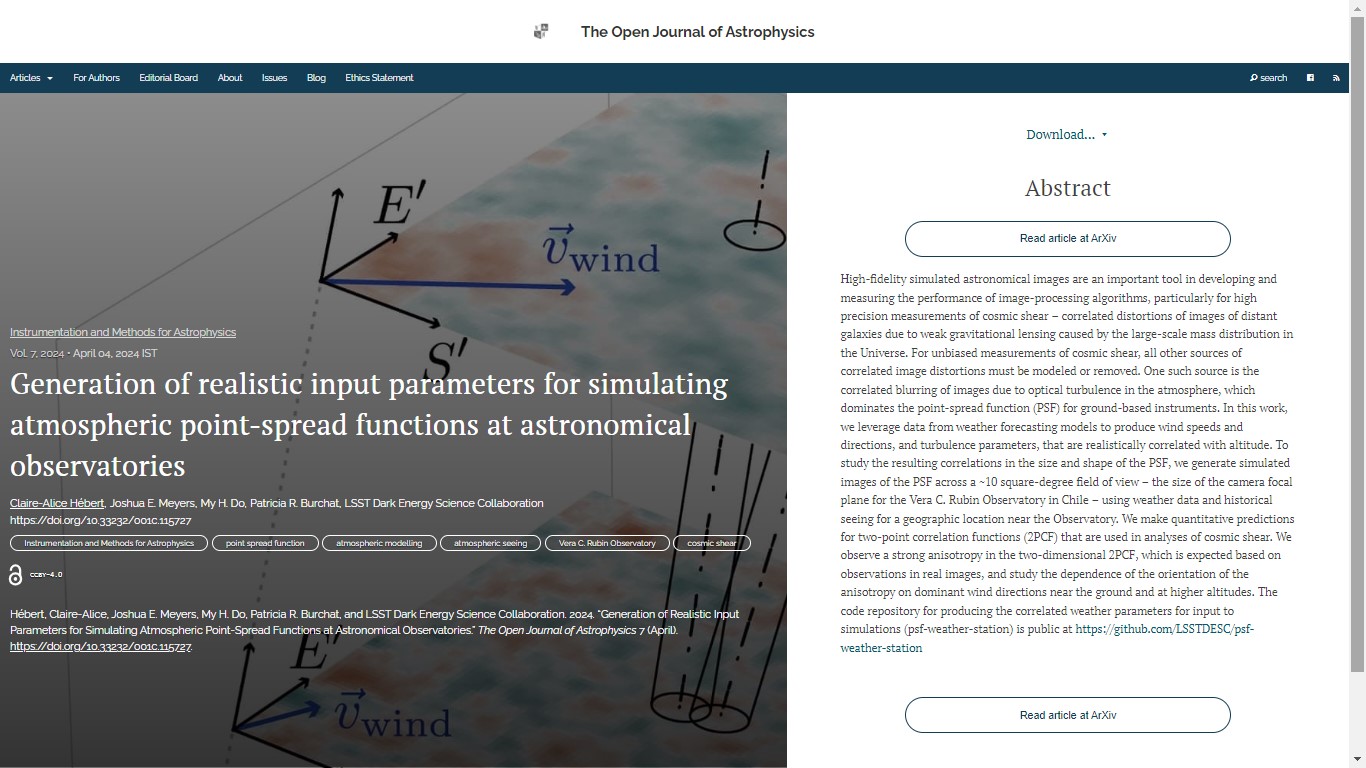
The second paper is “Generation of realistic input parameters for simulating atmospheric point-spread functions at astronomical observatories” by Claire-Alice Hébert (Stanford), Joshua E. Meyers (Stanford), My H. Do (Cal. State U, Pomona), Patricia R. Burchat (Stanford) and the LSST Dark Energy Science Collaboration. It explores the use of atmospheric modelling to generate realistic estimates of the point-spread function for observational work, especially for the Vera C. Rubin Observatory. This one is in the folder marked Instrumentation and Methods for Astrophysics and was published on 4th April 2024. Here is a screen grab of the overlay which includes the abstract:


You can find the officially accepted version of the paper on the arXiv here.

The third paper to announce is “Cosmic Dragons: A Two-Component Mixture Model of COSMOS Galaxies” by William K. Black and August E. Evrard of the University of Michigan (Ann Arbor, USA). This paper was also published on 4th April 2024,  is in the folder Astrophysics of Galaxies and you can see the overlay here:


The accepted version of this paper can be found on the arXiv here.

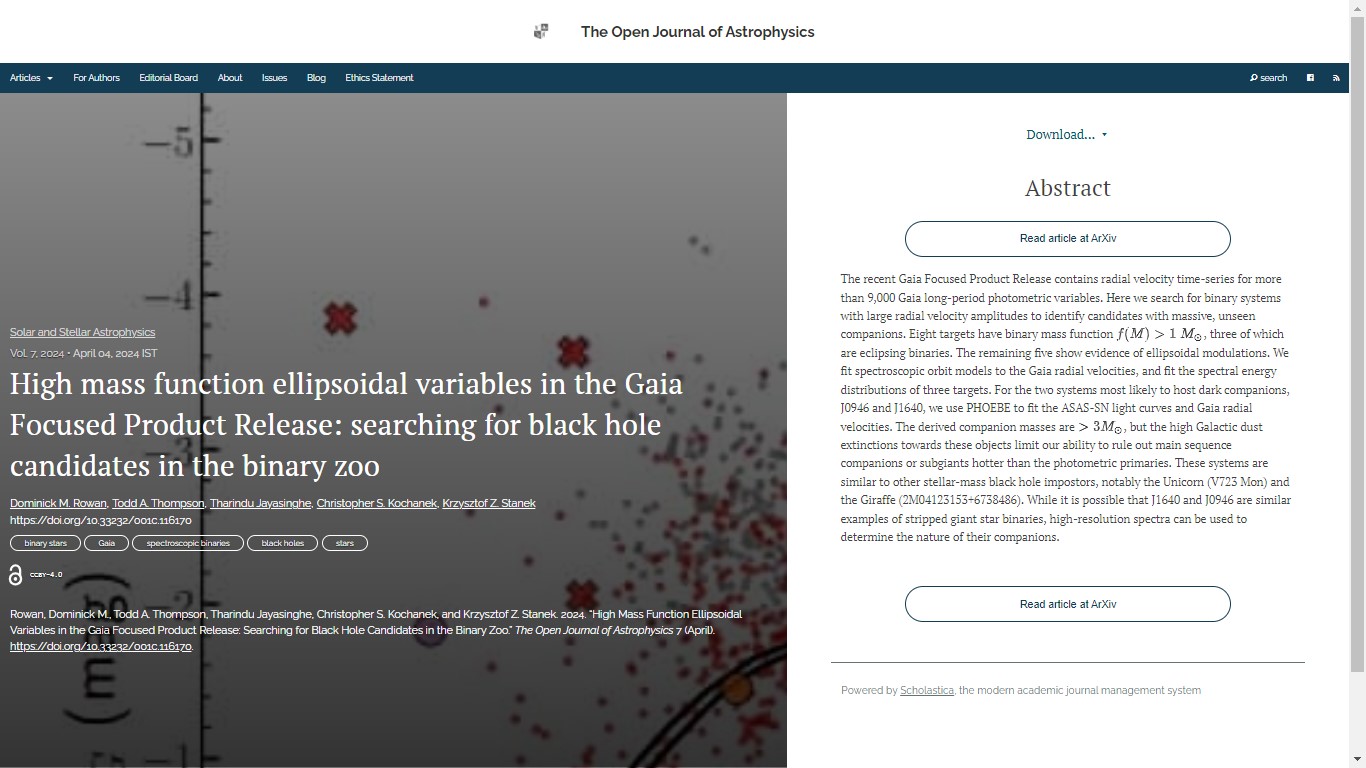
The next paper is “High mass function ellipsoidal variables in the Gaia Focused Product Release: searching for black hole candidates in the binary zoo” by Dominick M. Rowan, Todd A. Thompson,
Tharindu Jayasinghe, Christopher S. Kochanek and Krzysztof Z. Stanek of Ohio State University (USA). This paper, in the Solar and Stellar Astrophysics collection, describes a search for massive unseen stellar companions variable star systems found in Gaia data. This one was also published on 4th April 2024.

Here is the overlay:


You can find the full text for this one on the arXiv here.

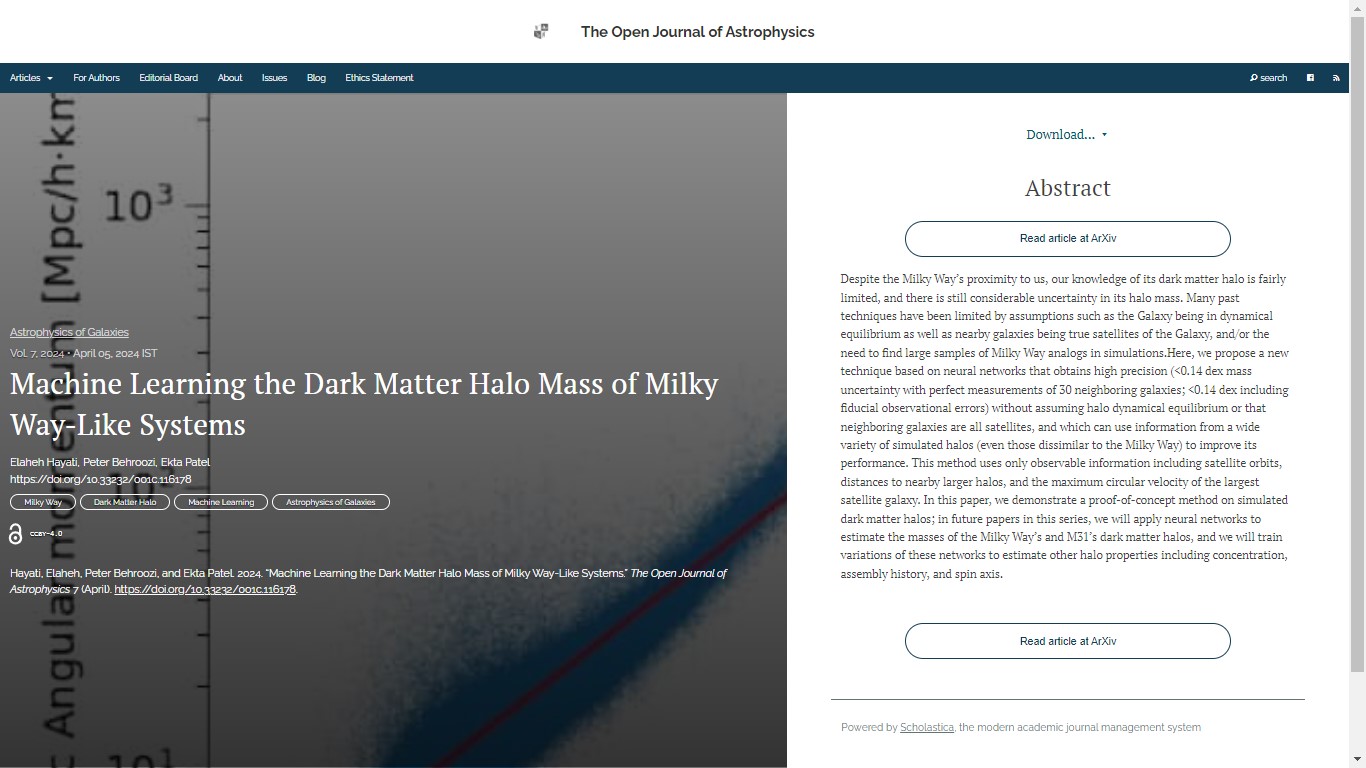
Last in this batch, but by no means least, published yesterday (5th April 2024), we have a paper “Machine Learning the Dark Matter Halo Mass of Milky Way-Like Systems” by Elaheh Hayati & Peter Behroozi (University of Arizona, USA) and Ekta Patel (University of Utah, USA).  The primary classification for this one is once again Astrophysics of Galaxies and it presents a method for estimating the mass of a galaxy halo using neural networks that does not assume, for example,  dynamical equilibrium:


You can click on the image of the overlay to make it larger should you wish to do so. You can find the officially accepted version of the paper on the arXiv here.

As you can see this is quite a diverse collection of papers. Given the increase in submissions in the area of galactic astrophysics we are very happy to welcome another expert in that area to our Editorial Board, in the form of Professor Walter Dehnen of the University of Heidelberg.

Cosmology Talks: Cosmological Constraints from BAO

Posted in The Universe and Stuff, YouTube with tags , , , , , , , , , on April 5, 2024 by telescoper

Here’s another video in the Cosmology Talks series curated by Shaun Hotchkiss. This one very timely after yesterday’s announcement. Here is the description on the YouTube page:

The Dark Energy Spectroscopic Instrument (DESI) has produced cosmological constraints! And it is living up to its name. Two researchers from DESI, Seshadri Nadathur and Andreu Font-Ribera, tell us about DESI’s measurements of the Baryon Acoustic Oscillations (BAO) released today. These results use one full year of DESI data and are the first cosmological constraints from the telescope that have been released. Mostly, it is what you might expect: tighter constraints. However, in the realm of the equation of state of dark energy, they find, even with BAO alone, that there is a hint of evidence for evolving dark energy. When they combine their data with CMB and Supernovae, who both also find small hints of evolving dark energy on their own, the evidence for dark energy not being a cosmological constant jumps as high as 3.9σ with one combination of the datasets. It seems there still is “concordance cosmology”, it’s just not ΛCDM for these datasets. The fact that all three probes are tentatively favouring this is intriguing, as it makes it unlikely to be due to systematic errors in one measurement pipeline.

My own take is that the results are very interesting but I think we need to know a lot more about possible systematics before jumping to conclusions about time-varying dark energy. Am I getting conservative in my old age? These results from DESI do of course further underline the motivation for Euclid (another Stage IV survey), which may have an even better capability to identify departures from the standard model.

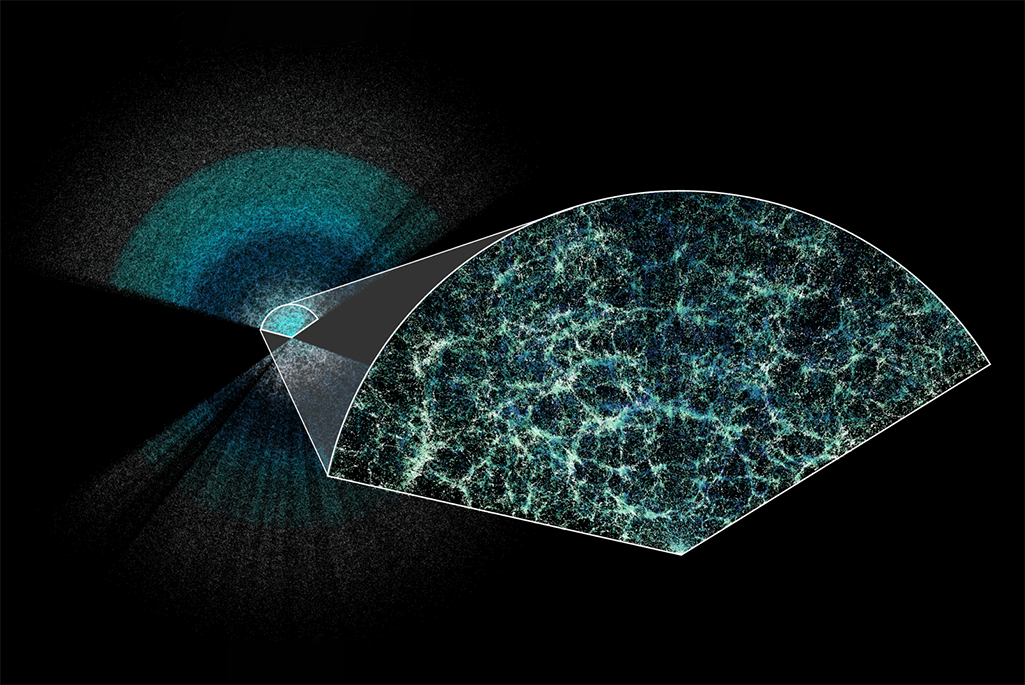
P.S. Here’s a nice graphic showing the cosmic web showing revealed by the DESI survey:

DESI Year 1 Results: Baryon Acoustic Oscillations

Posted in Barcelona, Euclid, The Universe and Stuff with tags , , , , on April 4, 2024 by telescoper

There has been a lot of excitement around the ICCUB today – the press have been here and everything – ahead of the release of the Year 1 results from the Dark Energy Spectroscopic Instrument (DESI). The press release from the Lawrence Berkeley Laboratory in California can be found here.

The papers were just released at 5pm CEST and can be found here. The key results pertain to Baryon Acoustic Oscillations (BAOs) which can be used to track the expansion rate and geometry of the Universe. This is one of the techniques that will be used by Euclid.

There’s a lot of technical information to go through and I have to leave fairly soon. Fortunately we have seminar tomorrow that will explain everything at a level I can understand:

I will update this post with a bit more after the talk, but for the time being I direct you to the high-level cosmological implications are discussed in this paper (which is Paper VI from DESI).

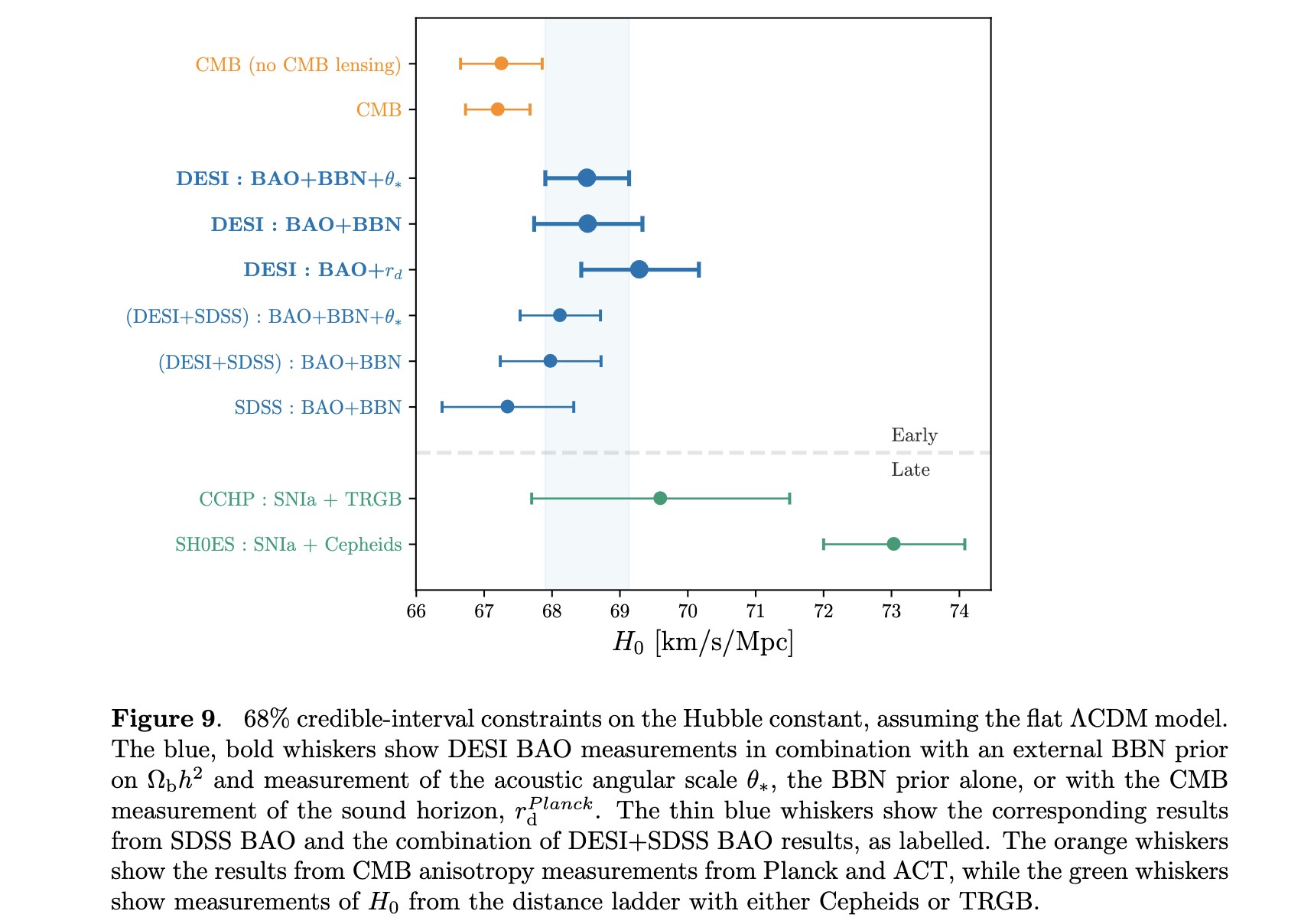
If your main interest is in the Hubble Tension then I direct you to this Figure:

Depending on the other data sets included, the value obtained is around 68.5 ± 0.7 in the usual units, closer to the (lower) Planck CMB value than the (higher) Supernovae values but not exactly in agreement; the error bars are quite small too.

You might want to read my thoughts about distances estimated from angular diameters compared with distances measured using luminosity distances here.

If you’re wondering whether there is any evidence for departures from the standard cosmology, another pertinent comment is:

In summary, DESI data, both alone and in combination with other cosmological probes, do not show any evidence for a constant equation of state parameter different from −1 when a flat wCDM model is assumed.

DESI 2024 VI: Cosmological Constraints from the Measurements of Baryon Acoustic Oscillations

More complicated models of time-varying dark energy might work, but there’s no strong evidence from the current data.

That’s all from me for now, but feel free to comment through the box below with any hot takes!

UPDATE: As expected there has been quite a lot of press coverage about this – see the examples below – mostly concentrating on the alleged evidence for “new physics”. Personally I think the old physics is fine!

Open Journal of Astrophysics Update

Posted in OJAp Papers, Open Access with tags , , , , , on April 4, 2024 by telescoper

I’ve just noticed that my post earlier in the week about changes to the publication system at the Open Journal of Astrophysics is dated April 1st. I can assure you it wasn’t meant as a joke! Anyway, the integration with Crossref is now complete and I’ve started clearing the backlog of papers waiting to be published. I would say normal service has been resumed, but the idea is to make the process faster and more reliable than before so it’s hopefully a return but to better-than-normal service.

I want first of all to thank the people at Maynooth University Library, Crossref, and Scholastica for helping us figure out the issue and solve it. We would no doubt have got there faster were it not for the intervention of the Easter break, but in any case it has only required a pause of publication for a couple of weeks.

I’ll resume the regular weekly updates at the weekend. However, one paper got snarled up when we ran into a problem. Although published on 20th March, it was never properly registered with Crossref. The only way I could think of to sort out the issue with this one was to start it again, which I did this morning, and it is now published though I kept the publication date as 20th March.

This paper, by Yingtian Chen and Oleg Gnedin of the University of Michigan, is the 21st paper to be published in Volume 7 and the 136th altogether. It is a study of kinematic, chemical and age data of globular clusters from Gaia yielding clues to how the Milky Way Galaxy assembled. You can read the article on arXiv directly here.

You will note the new format of DOI on the overlay. Nothing else has changed that’s visible to the reader.

Two Poems by Sir Thomas Wyatt

Posted in History, Poetry with tags , , , , , , , on April 3, 2024 by telescoper

Another character who appears in Hilary Mantel’s novel Wolf Hall is Sir Thomas Wyatt (1503-1542) who was a diplomat and member of the Court of Henry VIII, as well as being a fine poet. I thought I would post two of his famous poems.

The first is a sonnet, written some time in the 1530s, is ostensibly a (loose) translation of Petrarch’s Una Candida Cerva and thus one of the first examples of a Petrarchan Sonnet written in English. That makes it interesting in its own right, but many people think that it is actually about Anne Boleyn. The use of hunting as a metaphor for courtly love was widespread and, despite being married, Wyatt seems to have had his eye on Anne Boleyn. As far as is known, however, they didn’t have a sexual relationship. Wyatt wisely backed off when he realized he was competing with Henry VIII (thinly disguised as “Caesar”) in the penultimate line; Noli me tangere means “do not touch me” in Latin.

Whoso list to hunt, I know where is an hind,
But as for me, hélas, I may no more.
The vain travail hath wearied me so sore,
I am of them that farthest cometh behind.
Yet may I by no means my wearied mind
Draw from the deer, but as she fleeth afore
Fainting I follow. I leave off therefore,
Sithens in a net I seek to hold the wind.
Who list her hunt, I put him out of doubt,
As well as I may spend his time in vain.
And graven with diamonds in letters plain
There is written, her fair neck round about:
Noli me tangere, for Caesar’s I am,
And wild for to hold, though I seem tame.

Wyatt was in fact confined to the Tower of London in 1536 on suspicion of having committed adultery with Anne Boleyn; adultery with the King’s wife was considered treason, a capital offence. While in the Tower, where he witnessed executions, possibly including that of Anne Boleyn herself and others accused of treason with her, he wrote this other famous poem

Who list his wealth and ease retain,
Himself let him unknown contain.
Press not too fast in at that gate
Where the return stands by disdain,
For sure, circa Regna tonat.

The high mountains are blasted oft
When the low valley is mild and soft.
Fortune with Health stands at debate.
The fall is grievous from aloft.
And sure, circa Regna tonat.

These bloody days have broken my heart.
My lust, my youth did them depart,
And blind desire of estate.
Who hastes to climb seeks to revert.
Of truth, circa Regna tonat.

The bell tower showed me such sight
That in my head sticks day and night.
There did I learn out of a grate,
For all favour, glory, or might,
That yet circa Regna tonat.

By proof, I say, there did I learn:
Wit helpeth not defence too yerne,
Of innocency to plead or prate.
Bear low, therefore, give God the stern,
For sure, circa Regna tonat.

The repeated Latin phrase circa Regna tonat is usually translated “Thunder rolls around the Throne”, a reference to the dangerous temperament of the King.

Wyatt was not executed in 1536, but released after the intervention of none other than Thomas Cromwell. It seems he had a habit of sailing rather close to the wind, and was in and out of trouble with the King, being charged again with treason in 1541 and again released. He died, apparently of natural causes, in 1541, at the age of 39.

John Henry – Big Bill Broonzy

Posted in Music with tags , , , , , on April 2, 2024 by telescoper

I’ve been meaning to post this track for some time but for some reason haven’t got around to it until now. It was recorded in Germany in 1951 and is a solo performance by legendary guitarist, blues singer and guitarist Big Bill Broonzy. The song, often called the Ballad of John Henry, tells the story of the folk hero John Henry, a man whose job was to use a 12lb hammer drive a steel drill into a rock to make holes for explosives to blast the rock in constructing a railroad tunnel. In the legend, John Henry is pitted against a steam-powered drill. He beats the machine, but is exhausted by his efforts and dies with his hammer in his hand.

By the way, you will hear reference in the song to a “shaker”. This was a man whose job it was to hold the drill – an object like a chisel – against the rock while it was struck by the hammer, and move it about to loosen the rock around it. I dread to think what happened if the hammerman missed the drill.

The historical facts around the location of the story of John Henry and indeed the identity of the hero are open to debate, but it’s a wonderful song and this is a brilliant and very characteristic performance of the song by Big Bill Broonzy whose singing, playing, and announcement to the song, will bring it all back to anyone lucky enough to hear him in the flesh. Bill Broonzy was on a European tour at the time this record was made, and I have back at home a very old LP of him singing and playing at the Dancing Slipper in West Bridgford, in Nottingham. I also have a copy of the album from which this performance is taken, the other side of which is by Graham Bell and his Australian Jazz Band. The full introduction to John Henry begins with Bill Broonzy saying rather sardonically “Thank you. Thank you. Thank you. I’m glad to be here too, don’t think I ain’t” before the rest of it that you hear.

Changes at the Open Journal of Astrophysics

Posted in Maynooth, Open Access with tags , , , , , , , on April 1, 2024 by telescoper

Regular readers of this blog – both of them – will have noticed that I haven’t posted any new publications from the Open Journal of Astrophysics for a couple of weeks. The reason for this is that we are switching to a new system of publishing that automatically integrates the Scholastica platform with Crossref, the system that (among many other things) keeps track of citations to published articles.

Up to now, I have had to prepare manually an XML file containing the metadata for each paper for upload, then send it to a colleague to register with Crossref. There are two problems with this. One is that transcribing the information from each overlay is prone to errors (made by me), especially if there is a long author list. The other problem is that it is rather slow and inefficient, which wasn’t such a problem when we were only publishing a few papers, but now that we are handling much more it is taking up too much time.

The obvious solution is to cut out the middle man (i.e. me) and register everything with Crossref directly from our platform. That will ensure that what goes to Crossref will be exactly the same as on our website and it will go there much faster. Another advantage is that if there is an error on the platform, such as a spelling mistake in an author name, correcting it there will automatically update the metadata on Crossref. You have no idea how much time and frustration this will save. Up to now we have to raise a ticket with Crossref for their staff to make the change, which can take a while to complete.

Scholastica offers a way to do this integration, but it doesn’t work with our existing Digital Object Identifiers (DOIs), which have the format 10.21105/astro.1234.56789, because it doesn’t allow us to include the “astro” which we need it to do because we share the prefix (10.21105) with another journal, the Journal of Open Source Software and we need to keep the two separate; they use 10.21105/joss at the start of their DOIs. After much to-ing and fro-ing we were unable to persuade Scholastica to change their policy, so to use their integration we have been forced to change prefix. Fortunately, Maynooth University (which runs Maynooth Academic Publishing, the official publisher of OJAp) is registered to mint its own DOIs so we can switch to a new prefix (10.33232) and avoid potential problems with the old one.

This change seems straightforward but it requires Crossref to switch the “ownership” of the journal and give us permission to add new papers with the same journal title “The Open Journal of Astrophysics” from what is effect a new publisher. This is a straightforward process, but has been a bit slower than expected because of the Easter break. I expect it to be completed in a week or so, at the latest.

It is important to stress that this change only affects the DOIs and registration of new papers. Existing papers are not affected at all: they continue with the old DOIs. The DOI is meant to be a persistent identifier so this is as it should be. The name of our website domain (astro.theoj.org) remains unchanged too. In other words, nothing visible to authors will change except for the format of the DOIs and the fact we go from acceptance to publication even faster.

If al this seems rather boring, that’s because it is. But please bear with us while we complete this change. It’s definitely going to be worth it in the long run, for me if nobody else!

Thomas Cromwell and his Prayer-Book

Posted in Art, History with tags , , , , , , on April 1, 2024 by telescoper
(1532-1533, Oil on Panel, 78.1 cm × 64.1 cm) by Hans Holbein the Younger – The Frick Collection, Public Domain, https://commons.wikimedia.org/w/index.php?curid=207764

The famous portrait of Thomas Cromwell by Hans Holbein the Younger shown above is in fact a copy; the original is lost. There is another copy in the National Portrait Gallery in London, but it’s not as good. The original was painted around 1533, during the period covered by the novel Wolf Hall (which I reviewed yesterday) and is mentioned in the book. Holbein is known for having sometimes painted excessively flattering portraits – most notably of Anne of Cleves – but he doesn’t seem to have done that here. Cromwell is portrayed as dour, stern-faced and more than a little scary. He probably wanted people to fear him, so wouldn’t have minded this.

As well as the nature of the likeness, the composition is interesting. The subject seems to be squashed into the frame, and hemmed in by the table that juts out towards the viewer. He is also looking out towards the viewer’s left, though not simply staring into space; his eyes are definitely focussed on something. I’m not sure what all this is intended to convey, except that the table carries an ornate prayer-book (the Book of Hours) as if to say “look, here’s a symbol of how devout this man is”.

Interesting, just last year scholars published research that argues that the copy of the Hardouyn Hours which can be found in the Library at Trinity College, Cambridge, is precisely the book depicted on the table. If so, it’s a rare and perhaps unique example of an artefact seen in a Tudor painting that survives to this day.

Wolf Hall by Hilary Mantel

Posted in History, Literature, Uncategorized with tags , , , , , , , on March 31, 2024 by telescoper

Still trying to use the spare time during my sabbatical to catch up on long-neglected reading, this Easter weekend – helped by the rainy weather – I finished Wolf Hall by Hilary Mantel, the first of her novels that I’ve read. This “historical novel” won the Booker Prize in 2009 and I understand was made into a play and a TV series, neither of which I have seen.

The novel is set in Tudor England in the reign of Henry VIII and revolves around Thomas Cromwell, who rose from lowly beginnings in Putney to be one of the powerful men in the country. Cromwell gets a surprisingly sympathetic treatment, at odds with most of the historical record which treats him largely as a cruel and unscrupulous character, undoubtedly clever but given to threats and torture if appeals to reason failed. From a 21st century perspective, it’s hard to find redeeming features in Cromwell. Or anyone else in this story, to be honest.

The historical events of the period covered by the book are dominated by Henry’s attempts to have his marriage of 24 years to Catherine of Aragon annulled so he could marry Anne Boleyn, along the way having himself declared the Supreme Governor of the Church in England, causing a split with Rome. Henry does marry Anne, and she bears him a daughter, destined to become Elizabeth I, though her second pregnancy ends in a miscarriage. The book ends in 1535 just after the execution of Thomas More, beheaded for refusing to swear the Oath of Supremacy.

(More was portrayed sympathetically in the play and film A Man For All Seasons though he was much disposed to persecution of alleged heretics, many of whom he caused to be burned at the stake for such terrible crimes as distributing copies of the Bible printed in English. Significant chunks of the penultimate chapter are lifted from the script of A Man For All Seasons but given a very different spin.)

Henry VIII is also portrayed in a somewhat flattering light; Anne Boleyn rather less so. Mary Tudor, Henry’s eldest daughter by Catherine of Aragon, cuts an unsurprisingly forlorn and intransigent. There are also significant appearances from other figures familiar from schoolboy history: Hugh Latimer, Cardinal Wolsey, and Thomas Cranmer; as well as those whose story is not often told, such as Mary Boleyn (Anne’s older sister). I have a feeling that Hilary Mantel was being deliberately courting controversy with her heterodox approach to characterization. She probably succeeded, as many professional historians are on record as hating Wolf Hall as much of it is of questionable accuracy and some is outright fiction.

Incidentally, one of the most negative reactions to this book that I’ve seen is from Eamon Duffy who is on record as detesting the historical figure of Thomas Cromwell and was “mystified by his makeover in Hilary Mantel’s Wolf Hall from a thuggish ruthless commoner to a thoughtful sensitive figure”. I mention this particularly because Eamon Duffy, an ecclesiastical historian, was my tutor when I was an undergraduate at Magdalene College, Cambridge.

On the other hand, Wolf Hall not meant to be a work of scholarly history: it is a novel and I think you have to judge it by the standards of whether it succeeds as a work of fiction. I would say that it does. Although rather long-winded in places – it’s about 640 pages long – it is vividly written and does bring this period to life with colour and energy, and a great deal of humour, while not shying away from the brutality of the time; the execution scenes are unflinchingly gruesome. The book may not be accurate in terms of actual history, but it certainly creates a credible alternative vision of the time.

It’s interesting that the title of this book is Wolf Hall when that particular place – the seat of the Seymour family – hardly figures in the book. However, one character does make a few appearances, Jane Seymour, who just a year after the ending of this book would become the third wife of Henry VIII. It also happened that Thomas Cromwell’s son, Gregory, married Jane’s sister, Elizabeth. I suppose I will have to read the next book in the trilogy, Bring Up The Bodies, to hear Mantel’s version of those events…