Yesterday evening (10pm Irish Time) saw the release of new results from the Dark Energy Spectroscopic Instrument (DESI), completing a trio of major announcements of cosmological results in the space of two days (the Atacama Cosmology Telescope and the Euclid Q1 release being the others). I didn’t see the DESI press conference but you can read the press release here.
There were no fewer than eight DESI papers on the astro-ph section of the arXiv this morning. Here are the titles with links:
You can see from the titles that the first seven of these relate to the second data release (DR2; three years of data) from DESI; the last one listed here is a description of the first data release (DR1), which is now publicly available.
Obviously there is a lot of information to digest in these papers so here are two members of the DESI collaboration talking with Shaun Hotchkiss on Cosmology Talks about the key messages from the analysis of Baryon Acoustic Oscillations (the BAO in the titles of the new papers):
A lot has been made in the press coverage of these results about the evidence that the standard cosmological model is incomplete; see, e.g., here. Here are a few comments.
As I see it, taken on their own, the DESI BAO results are broadly consistent with the ΛCDM model as specified by the parameters determined by the Cosmic Microwave Background (CMB) inferred from Planck. Issues do emerge, however, when these results are combined with other data sets. The most intriguing of these arises with the dark energy contribution. The simplest interpretation of dark energy is that it is a cosmological constant (usually called Λ) which – as explained here – corresponds to a perfect fluid with an equation-of-state p=wρc2 with w=-1. In this case the effective mass density of the dark energy ρ remains constant as the universe expands. To parametrise departures from this constant behaviour, cosmologists have replaced this form with the form w(a)=w0+wa(1-a) where a(t) is the cosmic scale factor. A cosmological constant Λ would correspond to a point (w0=-1, wa=0) in the plane defined by these parameters, but the only requirement for dark energy to result in cosmic acceleration is that w<-1/3, not that w=-1.
The DESI team allow (w0, wa) to act as free parameters and let the DESI data constrain them, either alone or in combinations with other data sets, finding evidence for departures from the “standard values”. Here’s an example plot:
The DESI data don’t include the standard point (at the intersection of the two dashed lines) but the discrepancy gets worse when other data (such as supernovae and CMB) are folded in, as in this picture. The weight of evidence suggests a dark energy contribution which is decreasing with time.
These results are certainly intriguing, and a lot of credit is due to the DESI collaboration for working so hard to identify and remove possible systematics in the analysis (see the papers above) but what do they tell us about ΛCDM?
My view is that we’ve never known what the dark energy actually is or why it is so large that it represents 70% of the overall energy density of the Universe. The Λ in ΛCDM is really just a place-holder, not there for any compelling physical reason but because it is the simplest way of accounting for the observations. In other words, it’s what it is because of Occam’s Razor and nothing more. As with any working hypothesis, the standard cosmological model will get updated whenever new information comes to light (as it is doing now) and/or if we get new physical insights into the origin of dark energy.
Do the latest observations cast doubt on the standard model? I’d say no. We’re seeing an evolutionary change from “We have no idea what the dark energy is but we think it might be a cosmological constant” to “We still have no idea what the dark energy is but we think it might not be a cosmological constant”.
Today is Q1 Day! This means the first public release of data from the full Euclid Survey. It’s only a very small portion (0.4%) of the survey – just 63 square degrees on the sky, while the full survey will be over 14,000 square degrees – but in contrast to earlier data releases, this has been passed through the full Euclid Ground Segment so it represents the true quality of the data we can expect for the rest of the mission. There are no actual cosmology results yet – there isn’t enough data to address the key science goals of Euclid – but there are some great illustrations of the many byproducts of a survey of this type.
Update: here’s one of the Cosmology Talks video by Shaun Hotchkiss with two members of the Euclid Consortium commenting on today’s data release:
As well as the splash of press coverage likely to follow the lifting of today’s embargo, there will be a deluge of Q1-related papers hit the arXiv on 20th March. You can find details here.
Here’s a gallery of pretty pictures released today. These are low resolution versions; try opening the image in a new tab to see it without the caption. You can find and explore higher resolution images on ESASky (see below). Picture credits are: ESA/Euclid/Euclid Consortium/NASA, image processing by J.-C. Cuillandre, E. Bertin, G. Anselmi for the first six images, then ESA/Euclid/Euclid Consortium/NASA, image processing by M. Walmsley, M. Huertas-Company, J.-C. Cuillandre for the next two (bottom row); and ESA/Euclid/Euclid Consortium/NASA; ESA/Gaia/DPAC; ESA/Planck Collaboration for the last one.
This is Euclid’s Deep Field Fornax. After only one observation, the space telescope already spotted 4.5 million galaxies in this field. In the coming years, Euclid will make 52 observations of this field to reach its full depth. This is a zoom-in of Euclid’s Deep Field North, showing the Cat’s Eye Nebula in the centre of the image, around 3000 light-years away. Also known as NGC 6543, this nebula is a visual ‘fossil record’ of the dynamics and late evolution of a dying star. This dying star is shedding its outer colourful shells. This is Euclid’s Deep Field North. After only one observation, the space telescope has already spotted more than ten million galaxies in this field. It is also very rich in Milky Way stars, as it is close to the Galactic plane. In the coming years, Euclid will make 32 observations of this field to reach its full depth. This is Euclid’s Deep Field South. After only one observation, the space telescope already spotted more than 11 million galaxies in this field. In the coming years, Euclid will make more observations of this field to reach its full depth. This image shows an area of Euclid’s Deep Field South. The area is zoomed in 16 times compared to the large mosaic.This image shows an area of Euclid’s Deep Field South. The area is zoomed in 70 times compared to the large mosaic.This image shows examples of galaxies in different shapes, all captured by Euclid during its first observations of the Deep Field areas. This image shows examples of gravitational lenses that Euclid captured in its first observations of the Deep Field areas. This graphic shows the location of the Euclid Deep Fields (yellow). This all-sky view is an overlay of ESA Gaia’s star map from its second data release in 2018 and ESA Planck’s dust map from 2014.
I’m taking the liberty to append the official ESA Press Release, which follows:
–o–
On 19 March 2025, the European Space Agency’s Euclid mission released its first batch of survey data, including a preview of its deep fields. Here, hundreds of thousands of galaxies in different shapes and sizes take centre stage and show a glimpse of their large-scale organisation in the cosmic web.
Covering a huge area of the sky in three mosaics, the data release also includes numerous galaxy clusters, active galactic nuclei and transient phenomena, as well as the first classification survey of more than 380,000 galaxies and 500 gravitational lens candidates compiled through combined artificial intelligence and citizen science efforts. All of this sets the scene for the broad range of topics that the dark Universe detective Euclid is set to address with its rich dataset.
“Euclid shows itself once again to be the ultimate discovery machine. It is surveying galaxies on the grandest scale, enabling us to explore our cosmic history and the invisible forces shaping our Universe,” says ESA’s Director of Science, Prof. Carole Mundell.
“With the release of the first data from Euclid’s survey, we are unlocking a treasure trove of information for scientists to dive into and tackle some of the most intriguing questions in modern science. With this, ESA is delivering on its commitment to enable scientific progress for generations to come.”
Tracing out the cosmic web in Euclid’s deep fields
Euclid has scouted out the three areas in the sky where it will eventually provide the deepest observations of its mission. In just one week of observations, with one scan of each region so far, Euclid already spotted 26 million galaxies. The farthest of those are up to 10.5 billion light-years away. The fields also contain a small population of bright quasars that can be seen much farther away. In the coming years, Euclid will pass over these three regions tens of times, capturing many more faraway galaxies, making these fields truly ‘deep’ by the end of the nominal mission in 2030.
But the first glimpse of 63 square degrees of the sky, the equivalent area of more than 300 times the full Moon, already gives an impressive preview of the scale of Euclid’s grand cosmic atlas when the mission is complete. This atlas will cover one-third of the entire sky – 14 000 square degrees – in this high-quality detail.
“It’s impressive how one observation of the deep field areas has already given us a wealth of data that can be used for a variety of purposes in astronomy: from galaxy shapes, to strong lenses, clusters, and star formation, among others,” says Valeria Pettorino, ESA’s Euclid project scientist. “We will observe each deep field between 30 and 52 times over Euclid’s six year mission, each time improving the resolution of how we see those areas, and the number of objects we manage to observe. Just think of the discoveries that await us.”
“The full potential of Euclid to learn more about dark matter and dark energy from the large-scale structure of the cosmic web will be reached only when it has completed its entire survey. Yet the volume of this first data release already offers us a unique first glance at the large-scale organisation of galaxies, which we can use to learn more about galaxy formation over time,” says Clotilde Laigle, Euclid Consortium scientist and data processing expert based at the Institut d’Astrophysique de Paris, France.
Humans and AI classify more than 380 000 galaxies
Euclid is expected to capture images of more than 1.5 billion galaxies over six years, sending back around 100 GB of data every day. Such an impressively large dataset creates incredible discovery opportunities, but huge challenges when it comes to searching for, analysing and cataloguing galaxies. The advancement of artificial intelligence (AI) algorithms, in combination with thousands of human citizen science volunteers and experts, is playing a critical role.
“We’re at a pivotal moment in terms of how we tackle large-scale surveys in astronomy. AI is a fundamental and necessary part of our process in order to fully exploit Euclid’s vast dataset,” says Mike Walmsley, Euclid Consortium scientist based at the University of Toronto, Canada, who has been heavily involved in astronomical deep learning algorithms for the last decade.
“We’re building the tools as well as providing the measurements. In this way we can deliver cutting-edge science in a matter of weeks, compared with the years-long process of analysing big surveys like these in the past,” he adds.
A major milestone in this effort is the first detailed catalogue of more than 380 000 galaxies, which have been classified according to features such as spiral arms, central bars, and tidal tails that infer merging galaxies. The catalogue is created by the ‘Zoobot’ AI algorithm. During an intensive one-month campaign on Galaxy Zoo last year, 9976 human volunteers worked together to teach Zoobot to recognise galaxy features by classifying Euclid images.
This first catalogue released today represents just 0.4% of the total number of galaxies of similar resolution expected to be imaged over Euclid’s lifetime. The final catalogue will present the detailed morphology of at least an order of magnitude more galaxies than ever measured before, helping scientists answer questions like how spiral arms form and how supermassive black holes grow.
“We’re looking at galaxies from inside to out, from how their internal structures govern their evolution to how the external environment shapes their transformation over time,” adds Clotilde.
“Euclid is a goldmine of data and its impact will be far-reaching, from galaxy evolution to the bigger-picture cosmology goals of the mission.”
Gravitational lensing discovery engine Light travelling towards us from distant galaxies is bent and distorted by normal and dark matter in the foreground. This effect is called gravitational lensing and it is one of the tools that Euclid uses to reveal how dark matter is distributed through the Universe.
When the distortions are very apparent, it is known as ‘strong lensing’, which can result in features such as Einstein rings, arcs, and multiple imaged lenses.
With the help of these models, Euclid will capture some 7000 candidates in the major cosmology data release planned for the end of 2026, and in the order of 100 000 galaxy-galaxy strong lenses by the end of the mission, around 100 times more than currently known.
Euclid will also be able to measure ‘weak’ lensing, when the distortions of background sources are much smaller. Such subtle distortions can only be detected by analysing large numbers of galaxies in a statistical way. In the coming years, Euclid will measure the distorted shapes of billions of galaxies over 10 billion years of cosmic history, thus providing a 3D view of the distribution of dark matter in our Universe.
“Euclid is very quickly covering larger and larger areas of the sky thanks to its unprecedented surveying capabilities,” says Pierre Ferruit, ESA’s Euclid mission manager, who is based at ESA’s European Space Astronomy Centre (ESAC) in Spain, home of the Astronomy Science Archive where Euclid’s data will be made available.
“This data release highlights the incredible potential we have by combining the strengths of Euclid, AI, citizen science and experts into a single discovery engine that will be essential in tackling the vast volume of data returned by Euclid.”
Notes to editors
As of 19 March 2025, Euclid has observed about 2000 square degrees, approximately 14% of the total survey area (14 000 square degrees). The three deep fields together comprise 63.1 square degrees.
Euclid ‘quick’ releases, such as the one of 19 March, are of selected areas, intended to demonstrate the data products to be expected in the major data releases that follow, and to allow scientists to sharpen their data analysis tools in preparation. The mission’s first cosmology data will be released to the community in October 2026. Data accumulated over additional, multiple passes of the deep field locations will be included in the 2026 release.
The three deep field previews can now be explored in ESASky from 19 March 12:00 CET onwards:
Euclid was launched in July 2023 and started its routine science observations on 14 February 2024. In November 2023 and May 2024, the world got its first glimpses of the quality of Euclid’s images, and in October 2024 the first piece of its great map of the Universe was released.
Euclid is a European mission, built and operated by ESA, with contributions from its Member States and NASA. The Euclid Consortium – consisting of more than 2000 scientists from 300 institutes in 15 European countries, the USA, Canada and Japan – is responsible for providing the scientific instruments and scientific data analysis. ESA selected Thales Alenia Space as prime contractor for the construction of the satellite and its service module, with Airbus Defence and Space chosen to develop the payload module, including the telescope. NASA provided the detectors of the Near-Infrared Spectrometer and Photometer, NISP. Euclid is a medium-class mission in ESA’s Cosmic Vision Programme.
Today is going to be a very busy day on the cosmology front – with the Euclid Q1 Data Release coming out at 11am GMT – but I’ll start off by sharing news of final data release (DR6) by the Atacama Cosmology Telescope. This was announced yesterday and includes former colleagues at Cardiff University, so congratulations to them and all concerned. Here is a pretty picture showing one of the beautiful cosmic microwave background polarization and intensity maps:
Intensity and Polarization maps from ACT: arXiv:2503.14451
There are three related preprints on the arXiv today:
There’s a lot to digest in these papers but a quick skim of the abstracts gives two pertinent points. First, from the second paper:
We find that the ACT angular power spectra estimated over 10,000 deg2, and measured to arcminute scales in TT, TE and EE, are well fit by the sum of CMB and foregrounds, where the CMB spectra are described by the ΛCDM model. Combining ACT with larger-scale Planck data, the joint P-ACT dataset provides tight limits on the ingredients, expansion rate, and initial conditions of the universe.
They also find that, when combined with CMB lensing from ACT and Planck, and baryon acoustic oscillation data from the Dark Energy Spectroscopic Instrument (DESI Y1), the ACT data give a “low” value for the Hubble constant: H0=68.22 ± 0.36 km s-1 Mpc-1.
The third paper also says
In general, models introduced to increase the Hubble constant or to decrease the amplitude of density fluctuations inferred from the primary CMB are not favored by our data.
It is my sad duty to pass on the sad news of the death of Sergei Shandarin, who passed away yesterday at the age of 77. He had been suffering from cancer for some time and had been undergoing chemotherapy, alas to no avail. Last week he was moved onto palliative care and we knew he would soon be leaving us. I was going to post something last night when I heard that he had died, but I just couldn’t find the words. I send my deepest condolences to his family, friends and colleagues who are grieving.
(The picture on the left shows Sergei in 2006; I’m grateful to John Peacock for letting me use it here.)
Sergei Fyodor Shandarin was born in 1947 and gained his PhD at the Moscow Institute of Physics and Technology in 1974. He was a student of the great physicist Yakov Borisovich Zeldovich (whom I blogged about here). Sergei moved to the USA in 1991 to take up a Professorship at the University of Kansas, in Lawrence, where he remained until his retirement. More recently he and his wife Vika moved to Toronto to be closer to his daughter Anya and their grandchildren.
Sergei’s main research interests were the dynamics and statistics of the “Cosmic Web” – the supercluster- void network in spacial distribution of galaxies. In particular, he was interested in nonlinear dynamics of gravitational instability, which is the major mechanism for the formation of a large variety of objects in the universe, and in geometrical and topological statistical descriptors of the distribution of mass and galaxies in space.
These topics overlap considerably with my own and I was delighted to have the opportunity to work with Sergei in 1992 when I was invited by Adrian Melott as a visitor to Lawrence fro about a month. My first impression of Sergei was that he was a bit scary – in that typical Russian physicist sort of way – but I soon discovered that, beneath his initially rather fierce demeanour, he was actually a kind and friendly person with a fine sense of humour. I remember that research visit very well, in fact, not only because of Adrian’s and Sergei’s hospitality, but also because the project we did together went so well that we not only completed the research, but I returned to London with a completed manuscript; the paper that resulted was published in early 1993.
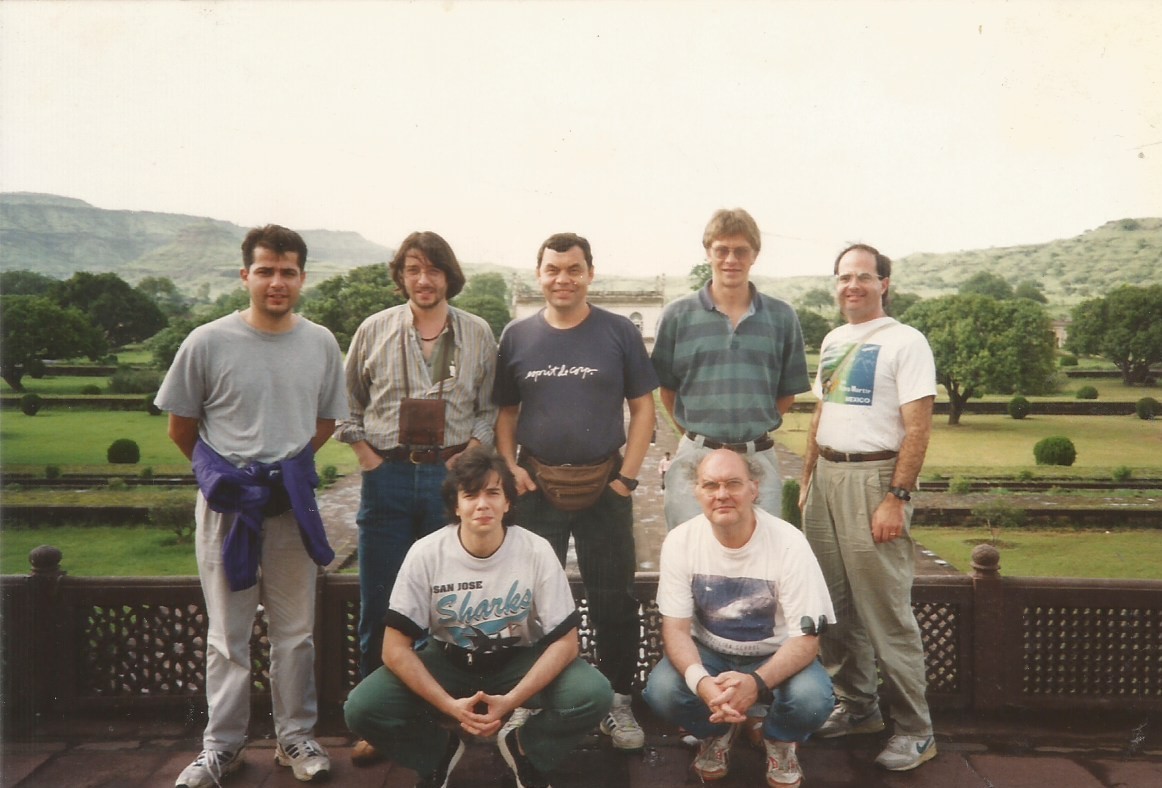
After that I kept in touch with Sergei mainly at conferences. Last night after I heard the news that he has passed away I brought a box of old photographs down from the loft and rummaged around for some pictures. Here are two from a meeting in India in 1994, in which you can see Sergei very much in the centre of things:
The picture on the left shows: (standing, L to R) Francis Bernardeau, Paolo Catelan, Sergei, ?*, Paul R. Shapiro; (crouching) Enzo Branchini and Bernard Jones. The picture on the right has the addition of, among others, Varun Sahni (between Paul Shapiro and Bernard Jones), Dick Bond (with his arm on Sergei’s shoulder) and Sabino Matarrese (front left); I’m on the right of the front row. I remember these pictures were taken on an excursion from Pune to see the historic caves and temples at Ajanta and Ellora.
(*I think the unidentified person might be Lars Hernquist, but I’m not sure: I’d be grateful for any information.)
I also particular remember meeting up with Sergei at meetings in Los Angeles, Nice, Valencia (the meeting at which the first picture was taken). and most recently in Estonia (for a meeting to celebrate the centenary of the birth of Zel’dovich). He was always up for scientific discussions, but also liked to relax with a drink or several; he also liked to watch football.
Sergei was a wonderful scientist as well as a warm and generous human being who was held in a very high regard by the cosmological community worldwide. We will all miss him terribly.
Time for the weekly Saturday morning update of papers published at the Open Journal of Astrophysics. Since the last update we have published four new papers, which brings the number in Volume 8 (2025) up to 25 and the total so far published by OJAp up to 260.
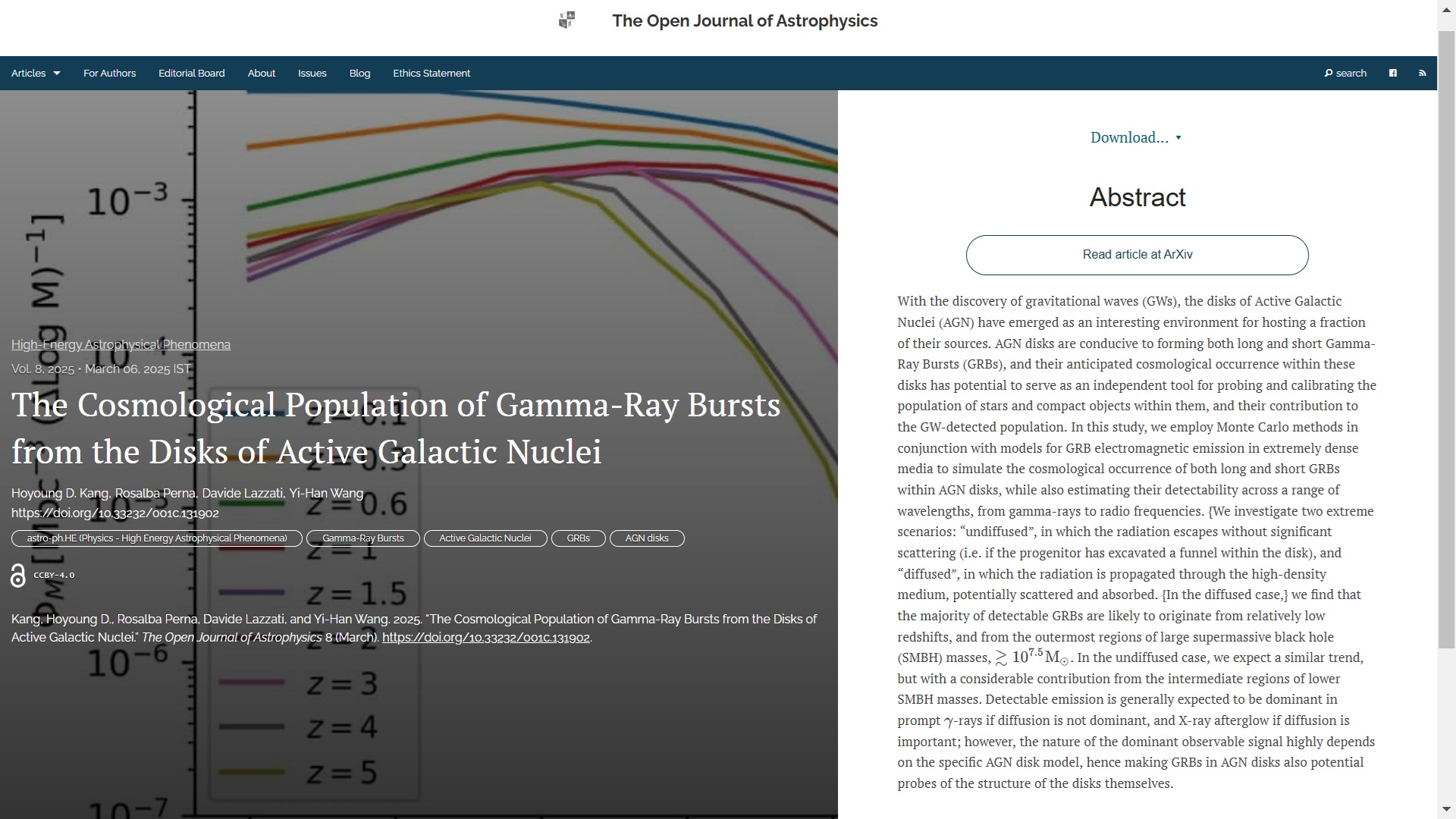
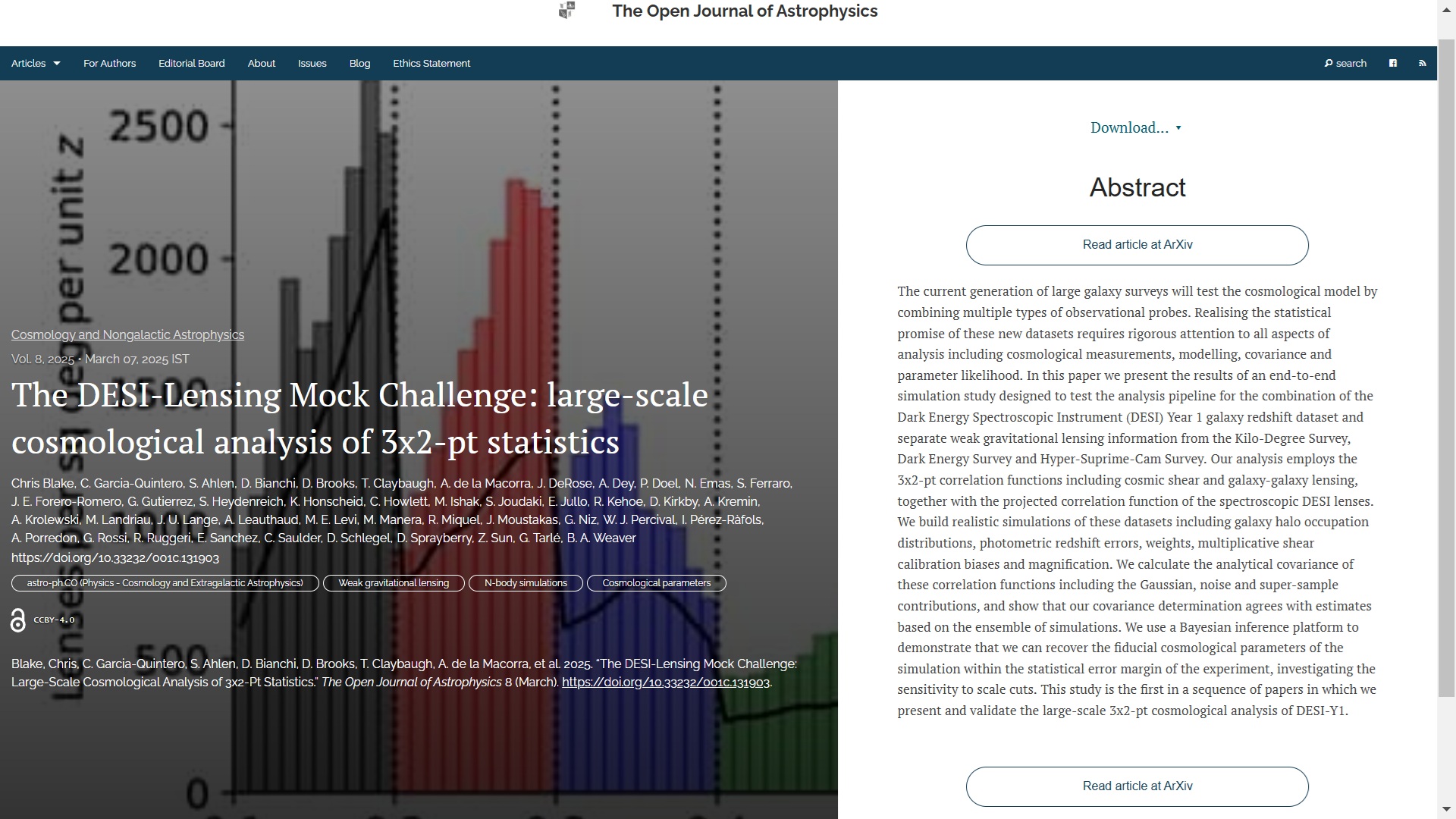
In chronological order of publication, the four papers published this week, with their overlays, are as follows. You can click on the images of the overlays to make them larger should you wish to do so.
The first paper to report is “Partition function approach to non-Gaussian likelihoods: information theory and state variables for Bayesian inference” by Rebecca Maria Kuntz, Heinrich von Campe, Tobias Röspel, Maximilian Philipp Herzog, and Björn Malte Schäfer, all from the University of Heidelberg (Germany). It was published on Wednesday March 5th 2025 in the folder Cosmology and NonGalactic Astrophysics and it discusses the relationship between information theory and thermodynamics with applications to Bayesian inference in the context of cosmological data sets.
You can read the officially accepted version of this paper on arXiv here.
The second paper of the week is “The Cosmological Population of Gamma-Ray Bursts from the Disks of Active Galactic Nuclei” by Hoyoung D. Kang & Rosalba Perna (Stony Brook), Davide Lazzati (Oregon State), and Yi-Han Wang (U. Nevada), all based in the USA. It was published on Thursday 6th March 2025 in the folder High-Energy Astrophysical Phenomena. The authors use models for GRB electromagnetic emission to simulate the cosmological occurrence and observational detectability of both long and short GRBs within AGN disks
You can find the officially accepted version of this paper on arXiv here.
The next two papers were published on Friday 7th March 2025.
The official published version can be found on the arXiv here.
The last paper to report this week is “The DESI-Lensing Mock Challenge: large-scale cosmological analysis of 3×2-pt statistics” by Chris Blake (Swinburne, Australia) and 43 others; this is a large international collaboration and I apologize for not being able to list all the authors here!
This one is in the folder marked Cosmology and NonGalactic Astrophysics; it presents an end-to-end simulation study designed to test the analysis pipeline for the Dark Energy Spectroscopic Instrument (DESI) Year 1 galaxy redshift dataset combined with weak gravitational lensing from other surveys.
It’s time once more for the regular Saturday morning update of papers published at the Open Journal of Astrophysics. Things have picked up a bit after a quiet couple of weeks. Since the last update we have published three new papers which brings the number in Volume 8 (2025) up to 21 and the total so far published by OJAp up to 256. We’re now officially a byte-sized journal!
In chronological order of publication, the three papers published this week, with their overlays, are as follows. You can click on the images of the overlays to make them larger should you wish to do so.
The first paper to report is “Baryon-free S_8 tension with stage IV cosmic shear surveys” by Ottavia Truttero, Joe Zuntz, Alkistis Pourtsidou and Naomi Robertson (all based at the University of Edinburgh, UK). This paper is in the folder marked Cosmology and NonGalactic Astrophysics and it was published on Monday 24th February 2025. It presents a study of the effect of baryonic feedback in the determination of cosmological parameters and the possibility of using large-scale clustering information to mitigate its effects
Here is the overlay:
You can read the officially accepted version of this paper on arXiv here.
It appears in the folder Astrophysics of Galaxies and it describes a method for Looking for a ‘kink’ in the power spectrum of galaxy images that might indicate at some transition from two-dimensional to three-dimensional turbulence on the scale of the disk thickness. This paper was published on Wednesday 26th February 2025.
Here is the overlay:
You can find the officially accepted version of this paper on arXiv here.
The final paper, also published on Wednesday 26th February in the folder Astrophysics of Galaxies is “The evolution of galaxy morphology from redshift z=6 to 3: Mock JWST observations of galaxies in the ASTRID simulation” by Patrick LaChance (Carnegie Mellon University, Pittsburgh; hereafter CMU), Rupert Croft (CMU), Yueying Ni (CfA Harvard), Nianyi Chen (CMU), Tiziana Di Matteo (CMU), and Simeon Bird (UC Riverside); all based in the USA. This paper describes an An analysis of a large sample of mock observations of JWST galaxies obtained from the ASTRID simulation revealing how galaxy properties are expected to evolve with redshift.
Here is the overlay:
The official published version can be found on the arXiv here.
That brings us up to the end of February 2025. I had a delve through the archives and found that by the same stage last year we published 17 papers compared to this year’s 21. It’s small numbers, of course, but we’re up about 23% so far this year.
That’s all for this week. I’ll do another update next Saturday.
The strategic case for this Chair revolves around broader developments in the area of astrophysics and cosmology at Maynooth. Currently there are two groups active in research in these areas, one in the former Department of Experimental Physics (which is largely focussed on astronomical instrumentation) and the other, in the former Department of Theoretical Physics, which is theoretical and computational. We want to promote closer collaboration between these research strands. The idea with the new position is that the holder will nucleate and lead a research programme in the area between these existing groups as well as getting involved in outreach and public engagement.
It is intended that the position to appeal not only to people undertaking observational programmes using ground-based facilities (e.g. those provided by ESO, which Ireland recently joined), or those exploiting data from space-based experiments, such as Euclid, as well as people working on multi-messenger astrophysics, gravitational waves, and so on.
P. S. For those of you reading this from outside Ireland the job includes a proper public service pension, a defined benefit scheme way better than the UK’s USS.
What better way to start a cold February morning than with a lovely image from Euclid? The picture above on the left shows an image of the galaxy NGC 6505 and on the right a closer view of the central portion that reveals a near perfect Einstein Ring. This phenomenon is caused by gravitational lensing and is quite a rare occurrence because it requires a perfect alignment between a background source, a concentration of mass that acts as a lens, and the observer (in this case the Euclid telescope):
This find is all the more extraordinary because it was made using observations made during Euclid’s commissioning phase when the telescope was not yet fully focussed. The first release of (a small sample) of full-quality data from Euclid – the so-called Q1 release – will actually be announced next month.
The published paper by O’Riordan et al is available here, from which I have taken this image showing the two relationship between the two images above:
There has already been quite a lot of media coverage of this discovery (even in Ireland). Here is the Press Release from the European Space Agency explaining the background and some comments from people involved in the work:
–0–
Euclid blasted off on its six-year mission to explore the dark Universe on 1 July 2023. Before the spacecraft could begin its survey, the team of scientists and engineers on Earth had to make sure everything was working properly. During this early testing phase, in September 2023, Euclid sent some images back to Earth. They were deliberately out of focus, but in one fuzzy image Euclid Archive Scientist Bruno Altieri saw a hint of a very special phenomenon and decided to take a closer look.
“I look at the data from Euclid as it comes in,” explains Bruno. “Even from that first observation, I could see it, but after Euclid made more observations of the area, we could see a perfect Einstein ring. For me, with a lifelong interest in gravitational lensing, that was amazing.”
The Einstein Ring, an extremely rare phenomenon, turned out to be hiding in plain sight in a galaxy not far away. The galaxy, called NGC 6505, is around 590 million light-years from Earth, a stone’s throw away in cosmic terms. But this is the first time that the ring of light surrounding its centre is detected, thanks to Euclid’s high-resolution instruments.
The ring around the foreground galaxy is made up of light from a farther out bright galaxy. This background galaxy is 4.42 billion light-years away, and its light has been distorted by gravity on its way to us. The far-away galaxy hasn’t been observed before and doesn’t yet have a name.
“An Einstein ring is an example of strong gravitational lensing,” explains Conor O’Riordan, of the Max Planck Institute for Astrophysics, Germany, and lead author of the first scientific paper analysing the ring. “All strong lenses are special, because they’re so rare, and they’re incredibly useful scientifically. This one is particularly special, because it’s so close to Earth and the alignment makes it very beautiful.”
Albert Einstein’s general theory of relativity predicts that light will bend around objects in space, so that they focus the light like a giant lens. This gravitational lensing effect is bigger for more massive objects – galaxies and clusters of galaxies. It means we can sometimes see the light from distant galaxies that would otherwise be hidden.
If the alignment is just right, the light from the distant source galaxy bends to form a spectacular ring around the foreground object. These Einstein rings are a rich laboratory for scientists. Studying their gravitational effects can help us learn about the expansion of the Universe, detect the effects of invisible dark matter and dark energy, and investigate the background source whose light is bent by dark matter in between us and the source.
“I find it very intriguing that this ring was observed within a well-known galaxy, which was first discovered in 1884,” says Valeria Pettorino, ESA Euclid Project Scientist. “The galaxy has been known to astronomers for a very long time. And yet this ring was never observed before. This demonstrates how powerful Euclid is, finding new things even in places we thought we knew well. This discovery is very encouraging for the future of the Euclid mission and demonstrates its fantastic capabilities.
By exploring how the Universe has expanded and formed over its cosmic history, Euclid will reveal more about the role of gravity and the nature of dark energy and dark matter. The space telescope will map more than a third of the sky, observing billions of galaxies out to 10 billion light-years. It is expected to find around 100 000 strong lenses, but to find one that’s so spectacular – and so close to home – is astonishing. Until now, less than 1000 strong lenses were known, and even fewer were imaged at high resolution.
“Euclid is going to revolutionise the field, with all this data we’ve never had before,” adds Conor.
Although this Einstein ring is stunning, Euclid’s main job is searching for the more subtle effects of weak gravitational lensing, where background galaxies appear only mildly stretched or displaced. To detect this effect, scientists will need to analyse billions of galaxies. Euclid began its detailed survey of the sky on 14 February 2024 and is gradually creating the most extensive 3D map of the Universe yet. Such an amazing find, so early in its mission, means Euclid is on course to uncover many more hidden secrets.
About a year ago I wrote a couple of articles (here and here) in response to the discovery of a very large structure (“The Big Ring“) and claims that this structure and others – such as a Giant Arc – were inconsistent with the standard model of cosmology; the work concerned was later submitted as a preprint to arXiv. In my first post on the Big Ring I wrote
To assess the significance of the Big Ring or other structures in a proper scientific fashion, one has to calculate how probable that structure is given a model. We have a standard model that can be used for this purpose, but to simulate very structures is not straightforward because it requires a lot of computing power even to simulate just the mass distribution. In this case one also has to understand how to embed Magnesium absorption too, something which may turn out to trace the mass in a very biased way. Moreover, one has to simulate the observational selection process too, so one is doing a fair comparison between observations and predictions.
Well on today’s arXiv there is a preprint by Sawala et al. with the title aims to assess the significance of structures comparable to the Giant Arc. The title of the paper is The Emperor’s New Arc: gigaparsec patterns abound in a ΛCDM universe from which you can guess the conclusions. The abstract is
Recent discoveries of apparent large-scale features in the structure of the universe, extending over many hundreds of megaparsecs, have been claimed to contradict the large-scale isotropy and homogeneity foundational to the standard (ΛCDM) cosmological model. We explicitly test and refute this conjecture using FLAMINGO-10K, a new and very large cosmological simulation of the growth of structure in a ΛCDM context. Applying the same methods used in the observations, we show that patterns like the “Giant Arc”, supposedly in tension with the standard model, are, in fact, common and expected in a ΛCDM universe. We also show that their reported significant overdensities are an algorithmic artefact and unlikely to reflect any underlying structure.
arXiv:2502.03515
Here’s a picture of a large structure (a “Giant Arc”) taken from a gallery of such objects found in the simulations
I quote from the conclusions:
We hope that our results will dispel the misconception that no inhomogeneity can be found in the standard model Universe beyond some finite size. Instead, any given realisation of the isotropic universe comprises a time- and scale-dependent population of structures from which patterns can be identified on any scale.
We haven’t been able to make an appointment so far, despite trying! One of the reasons was undoubtedly that the two previous Departments of Theoretical Physics and Experimental Physics were in the throes of a merger and it was by no means certain at that time what the outcome of that process would look like in terms of the structure of the new Department. However, we now have a single Department of Physics so that at least is much clearer. So we’re trying again now.
The job announcement can be found here. It will appear on other sites shortly. Update: it is now on the Times Higher Jobs page here. The deadline is 31st March. I hope readers of this blog will help spread the news of this opportunity through their own networks.
The key rationale for these SALI positions is clear from the statement from Simon Harris, the (then) Minister responsible for Third Level education in Ireland:
“Championing equality and diversity is one of the key goals of my department. The Senior Academic Leadership Initiative (SALI) is an important initiative aimed at advancing gender equality and the representation of women at the highest levels in our higher education institutions.
We have a particular problem with gender balance among the staff in Physics in Maynooth, especially on the theoretical side, where all the permanent staff are male, and the lack of role models has a clear effect on our ability to encourage more female students to study with us.
The wider strategic case for this Chair revolves around broader developments in the area of astrophysics and cosmology at Maynooth. Currently there are two groups active in research in these areas, one in the former Department of Experimental Physics (which is largely focussed on astronomical instrumentation) and the other, in the former Department of Theoretical Physics, which is theoretical and computational. We want to promote closer collaboration between these research strands. The idea with the new position is that the holder will nucleate and lead a research programme in the area between these existing groups as well as getting involved in outreach and public engagement.
It is intended that the position to appeal not only to people undertaking observational programmes using ground-based facilities (e.g. those provided by ESO, which Ireland recently joined), or those exploiting data from space-based experiments, such as Euclid, as well as people working on multi-messenger astrophysics, gravitational waves, and so on.
Exciting as this position is in itself, it is part of wider developments and we are expecting to advertise further job opportunities in physics and astronomy very soon! I’d be happy to be contacted by any eligible person wishing to discuss this position (or indeed the general situation in Maynooth) on an informal basis:
P. S. For those of you reading this from outside Ireland the job includes a proper public service pension, a defined benefit scheme way better than the UK’s USS.
The views presented here are personal and not necessarily those of my employer (or anyone else for that matter).
Feel free to comment on any of the posts on this blog but comments may be moderated; anonymous comments and any considered by me to be vexatious and/or abusive and/or defamatory will not be accepted. I do not necessarily endorse, support, sanction, encourage, verify or agree with the opinions or statements of any information or other content in the comments on this site and do not in any way guarantee their accuracy or reliability.