Further to my earlier post, I refer you to this much more detailed article by someone actually involved in the LIGO experiment, former Cardiff colleague Bernard Schutz..
Archive for gravitational waves
More on the 10th Anniversary of Gravitational Waves
Posted in The Universe and Stuff with tags Advanced LIGO, Bernard Schutz, Black hole merger, gravitational waves, GW Astronomy, GW150914 on September 14, 2025 by telescoperA Decade of Gravitational Waves
Posted in Biographical, The Universe and Stuff with tags Advanced LIGO, arXiv:2508.18082, Black hole merger, black holes, gravitational waves, GW150914, inspiral on September 14, 2025 by telescoperThis is just a quick post to mark the fact that it is now ten years to the day since the first detection of gravitational waves by Advanced LIGO. The acronym LIGO stands for Laser Interferometer Gravitational-wave Observatory, by the way. It wasn’t until February 11th 2016 that the result was announced at a press conference (which I blogged about here), but the signal itself arrived on 14th September 2015, exactly a decade ago; the name given to the event was GW150914.
Here are the plots for that first one:

That first signal corresponded to the coalescence of two black holes, of masses 29 and 36 times the mass of the Sun and produced a large response in the detectors very soon after Advanced LIGO was switched on. There’s synchronicity for you! The LIGO collaboration have done wondrous things getting their sensitivity down to such a level that they can measure such a tiny effect, but there still has to be an event producing a signal to measure. Collisions of two such massive black holes are probably extremely rare so it’s a bit of good fortune that one happened just at the right time. Actually it was during an engineering test.
There have been many subsequent detections and even more candidates waiting to be confirmed- here’s a full list. The official LIGO site states there are 90 confirmed detections, the 4th observational run (O4) (which is due to end in November 2025) has already found 200 candidates. The latest compilation of gravitational-wave transient sources can be found here.
Most of the detections have been binary black hole mergers, but I particularly remember the excitement in 2017 surrounding the first merger of a neutron star with a black hole. It was fun that rumours started to spread via this blog as people outside the LIGO/transient source community used a comments thread here to share information of what various telescopes were looking at. That was in August 2017, just over 8 years ago.
Anyway, here’s to the next decade. Assuming NSF does not follow Trump’s plan to slash the LIGO budget.
Two New Publications at the Open Journal of Astrophysics
Posted in OJAp Papers, Open Access, The Universe and Stuff with tags accretion disks, arXiv:2404.08046v2, arXiv:2404.11480v2, Astrophysics of Galaxies, Cosmology and NonGalactic Astrophysics, Gravitational Lensing, gravitational waves, Initial Mass Function, Neutron Stars, Open Journal of Astrophysics, quasars, STARFORGE, The Open Journal of Astrophysics on August 31, 2024 by telescoperI am back in circulation after my little break and, since it’s Saturday, I will resume blogging with another report on activity at the Open Journal of Astrophysics. Since the last update we have published two more papers, taking the count in Volume 7 (2024) up to 71 and the total published by OJAp up to 186. We’ve still got a few in the pipeline waiting for the final versions to appear on arXiv so I expect we’ll reach the 200 mark fairly soon.
The first paper of the most recent pair, published on August 26th 2024, is “Impact of lensing of gravitational waves on the observed distribution of neutron star masses” by Sofia Canevarolo, Loek van Vonderen and Nora Elisa Chisari, all of Utrecht University in the Netherlands. This article presents a discussion of the bias in neutron star mass determinations caused by gravitational lensing of the gravitational waves they produceThe paper is in the folder marked Cosmology and NonGalactic Astrophysics.
Here is a screen grab of the overlay which includes the abstract:

You can click on the image of the overlay to make it larger should you wish to do so. You can find the officially accepted version of the paper on the arXiv here.
The second paper has the title “FORGE’d in FIRE III: The IMF in Quasar Accretion Disks from STARFORGE” and was published (in the early hours of the morning) on 29th August 2024. The authors, all based in the USA, are Philip F. Hopkins (Caltech), Michael Y. Grudic (Carnegie Observatories), Kyle Kremer (Caltech), Stella S. R. Offner (UT Austin), David Guszejnov (UT Austin) and Anna L. Rosen (UCSD). This paper, which is in the folder marked Astrophysics of Galaxies, presents a numerical study of star formation and the initial mass function in quasar accretion disks. The previous two papers in this series have also been published in the OJAp: you can find them here and here; images and movies related to this project can be found here.
Here is a screen grab of the overlay which includes the abstract:

You can click on the image of the overlay to make it larger should you wish to do so. You can find the officially accepted version of the paper on the arXiv here.
That concludes this week’s update. We still have quite a few papers in the pipeline after the summer lull so I expect I’ll have a larger update for you next week!
Four New Publications at the Open Journal of Astrophysics
Posted in OJAp Papers, Open Access, The Universe and Stuff with tags arXiv:2406.02466v2, arXiv:2407.00504v3, BL Lac, Diamond Open Access, Earth and Planetary Astrophysics, gamma rays, gravitational waves, High-Energy Astrophysical Phenomena, Instrumentation and Methods for Astrophysics, Machine Learning, OJ 287, Open Access, Open Journal of Astrophysics, planet formation, Science Fiction, Support Vector Machines, The Open Journal of Astrophysics, Transit Detection, Warp Drives on July 27, 2024 by telescoperIt’s Saturday morning, so once again it’s time for an update of activity at the Open Journal of Astrophysics. This week we have published another batch of four papers, the same number as last week, which takes the count in Volume 7 (2024) up to 64 and the total published altogether by OJAp up to 179.
Before announcing the week’s papers I’ll add three other updates you might find interesting:
- When I looked at NASA/ADS this morning to help construct this post I saw that papers published in OJAp have now garnered over 2500 citations between them;
- We had a good response to our recent call for new members of the Editorial Board and have added four new members here;
- Last week we received a significant (unsolicited) cash donation from a higher education institution based in Europe to help with our work in Diamond Open Access. If any other organizations or individuals would like to do similar then please contact me!
Now, in chronological order, the four papers published this week, with their overlays, are as follows. You can click on the images of the overlays to make them larger should you wish to do so.
First one up is: “Widespread disruption of resonant chains during protoplanetary disk dispersal by Bradley M S Hansen (UCLA), Tze-Yeung Yu (UCLA) and Yasuhiro Hasegawa (JPL), all based in California, USA. The paper presents a discussion of the effect of a dispersing protoplanetary disk on the evolution of low-mass planets around a Solar mass star. It was published on 21st July 2024 and is in the folder marked Earth and Planetary Astrophysics.
Here is a screen grab of the overlay, which includes the abstract:

You can find the officially accepted version of the paper on the arXiv here.
The second paper to announce is “Using A One-Class SVM To Optimize Transit Detection” by Jakob Roche of the University of South Florida, also in the USA (but not in California). This articles discusses the advantages of One-Class Support Vector Machines (SVMs) over Convolutional Neural Networks (CNN) in the context of exoplanet detection. Its in the folder called Instrumentation and Methods for Astrophysics and was published on 25th July 2024.
You can see the overlay here:

The accepted version of this paper can be found on the arXiv here.
The next paper, also published on 25th July 2024, is in the folder marked High-Energy Astrophysical Phenomena. Its primary classification on arXiv is General Relativity and Quantum Cosmology (gr-qc), but it is cross-listed on astro-ph so we considered it for publication and had it refereed, with favourable results. It is entitled “What no one has seen before: gravitational waveforms from warp drive collapse” and is by Katy Clough (QMUL, UK), Tim Dietrich (Potsdam, Germany) and Sebastian Khan (Cardiff, UK). Looking at the title of this paper you might be tempted to dismiss it on the grounds that warp drives are the stuff of science fiction (which they are), but this paper is really a rigorous technical study of the dynamical evolution and stability of spacetimes that violate the null energy condition, inspired by the idea of a warp drive.
Here is the overlay:

You can find the full text for this one on the arXiv here.
Last, published on 26th July 2024, we have a paper with the title “A study of gamma-ray emission from OJ 287 using Fermi-LAT from 2015-2023” by Vibhavasu Pasumarti and Shantanu Desai of the Indian Institute of Technology, Hyderabad, India. It is an investigation of the properties of gamma-ray emission from OJ287 (a BL Lac object) using the Fermi Large Area Telescope (LAT). This one is also in the folder marked High-Energy Astrophysical Phenomena; here is the overlay

You can find the officially accepted version of this paper on the arXiv here.
That’s all for this week. Stay tuned for another update next week.
LISA adopted by ESA
Posted in Science Politics, The Universe and Stuff with tags EAS, European Space Agency, gravitational waves, Laser Interferometric Space Agency, LISA on January 25, 2024 by telescoperI have some good news for gravitational-wave physicists to pass on. The European Space Agency (ESA) has formally “adopted” the Laser Interferometric Space Experiment (LISA) – a gravitational wave experiment in space. This follows the detection of gravitational waves using the ground-based experiment Advanced LIGO and the success of a space-based technology demonstrator mission called Lisa Pathfinder. LISA was actually selected as a potential mission in 2017 – see here – but “adoption” means that the mission concept and technology required are now both sufficiently advanced that it can proceed in 2025, once contractors are found to actually build it.
LISA consists of a flotilla of three spacecraft in orbit around the Sun forming the arms of an interferometer with baselines of the order of 2.5 million kilometres, much longer than the ~1km arms of Advanced LIGO. These larger dimensions make LISA much more sensitive to long-period signals. Each of the LISA spacecraft contains two telescopes, two lasers and two test masses, arranged in two optical assemblies pointed at the other two spacecraft. This forms Michelson-like interferometers, each centred on one of the spacecraft, with the platinum-gold test masses defining the ends of the arms.
Here’s an artist’s impression of LISA:
This is excellent news for the gravitational waves community, especially since LISA was threatened with the chop when NASA pulled out in 2011. Space experiments are huge projects – and LISA is more complicated than most – so it will take some time before it actually happens. The first I heard of the LISA concept was back in the mid-1990s and at the moment LISA is pencilled in for launch in 2035, so it will be forty years in the development.
Ireland is a full member of ESA so let’s hope the Irish Government finds a way of funding participation in the LISA mission. Although Ireland joined ESA nearly fifty years ago, and is paying into the mandatory science programme which includes LISA (and, for example, Euclid), there is no funding programme in Ireland dedicated to the scientific exploitation of ESA projects. Let’s hope the Irish scientists involved in LISA – including those at Maynooth – are able to play a full part in this exciting project.
Four New Publications at the Open Journal of Astrophysics
Posted in OJAp Papers, Open Access, The Universe and Stuff with tags arXiv:2302.10472v2, arXiv:2304.02581v2, arXiv:2306.03914v2, arXiv:2307.05683v2, Astrophysics of Galaxies, black holes, Cosmology and NonGalactic Astrophysics, Earth and Planetary Astrophysics, Gravitational Lensing, gravitational waves, M-Sigma Relation, N-body calculations, Open Journal of Astrophysics, runaway stars, Solar and Stellar Astrophysics, Solar System, The Open Journal of Astrophysics on July 29, 2023 by telescoperThe rate of publication at the Open Journal of Astrophysics has now reached the point at which I think I’ll have to limit myself to weekly updates here rather than announcing every paper as it appears. We still announce individual papers on social media of course, meaning Mastodon, Facebook and the platform formerly known as Twitter…
This week we have published four papers which I now present to you here. These four take the count in Volume 6 (2023) up to 31 and the total published by OJAp up to 96. I speculated earlier this year that we might reach 100 before the end of 2023, now it looks certain we will reach the century mark as early as August! It is gratifying to see the range of papers published increasing, with all four of these in different categories.
In chronological order, the four papers published this week, with their overlays, are as follows. You can click on the images of the overlays to make them larger should you wish to do so.
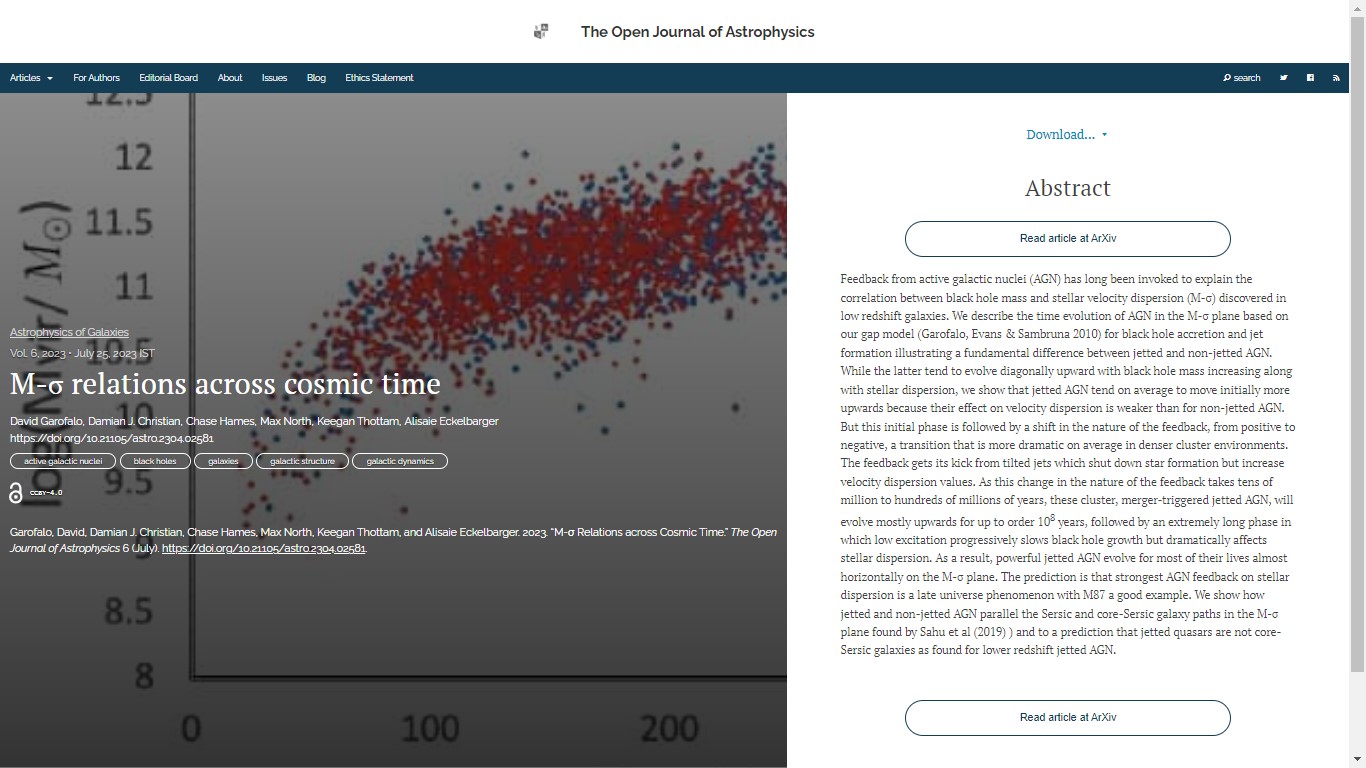
First one up is “M-σ relations across cosmic time” by David Garofalo (1), Damian J. Christian (2), Chase Hames (1), Max North (3), Keegan Thottam (1) & Alisaie Eckelbarger (1). The author affiliations are: (1) Department of Physics, Kennesaw State University, USA; (2) Department of Physics and Astronomy, California State University, Northridge, USA; (3) Department of Information Systems, Kennesaw State University, USA. This is a discussion of the relationship between black hole mass and stellar velocity dispersion discovered in low redshift galaxies and its evolution with cosmic time. The paper was published on 25th July, is in the folder marked Astrophysics of Galaxies and can be found here.
Here is a screen grab of the overlay, which includes the abstract:
You can find the officially accepted version of the paper on the arXiv here.
The second paper to announce is “The fastest stars in the Galaxy” by Kareem El-Badry et al. (21 authors. This one is the fourth item in the folder marked Solar and Stellar Astrophysics and it reports the spectroscopic discovery of 6 new “runaway” stars, probably the surviving members of binary star systems in which one star exploded in a Type 1a supernova. The paper was published on 27th July 2023 and you can see the overlay here:
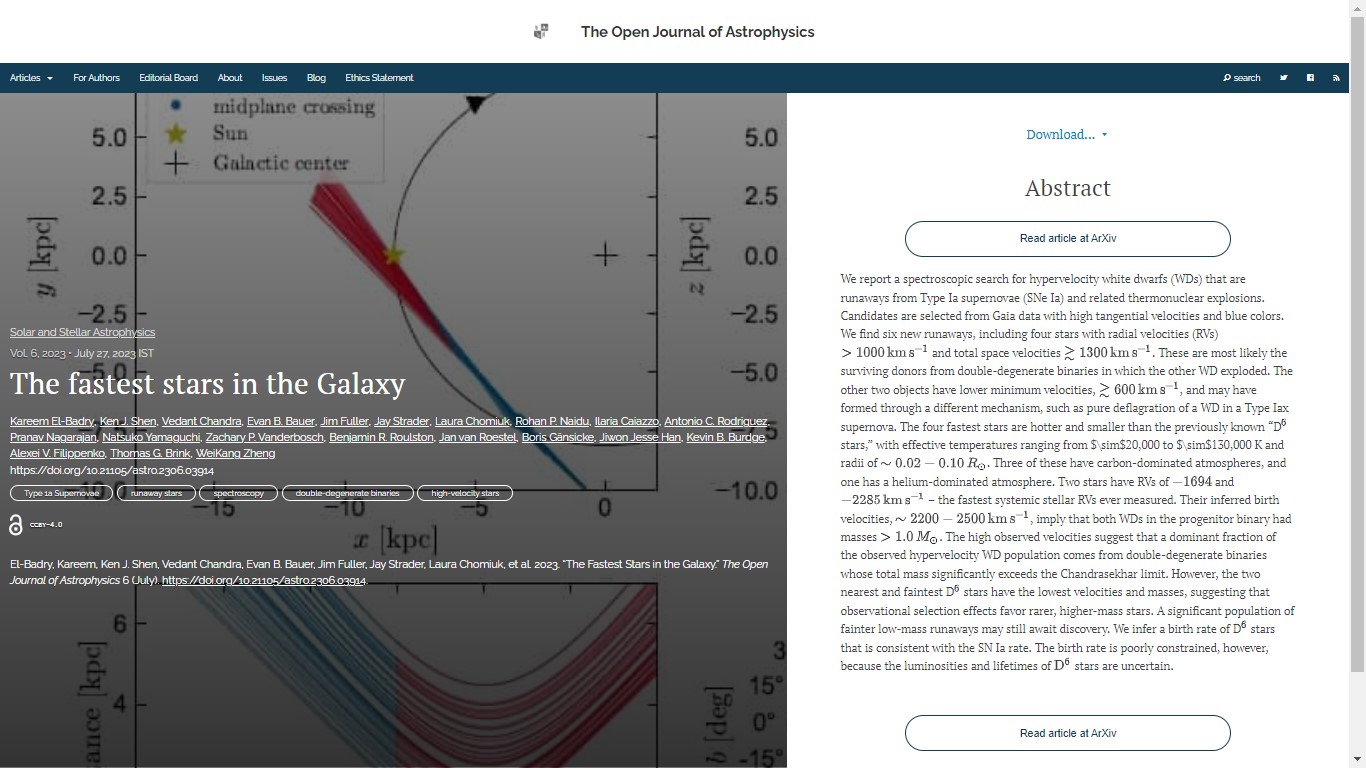
The accepted version of this paper can be found on the arXiv here.
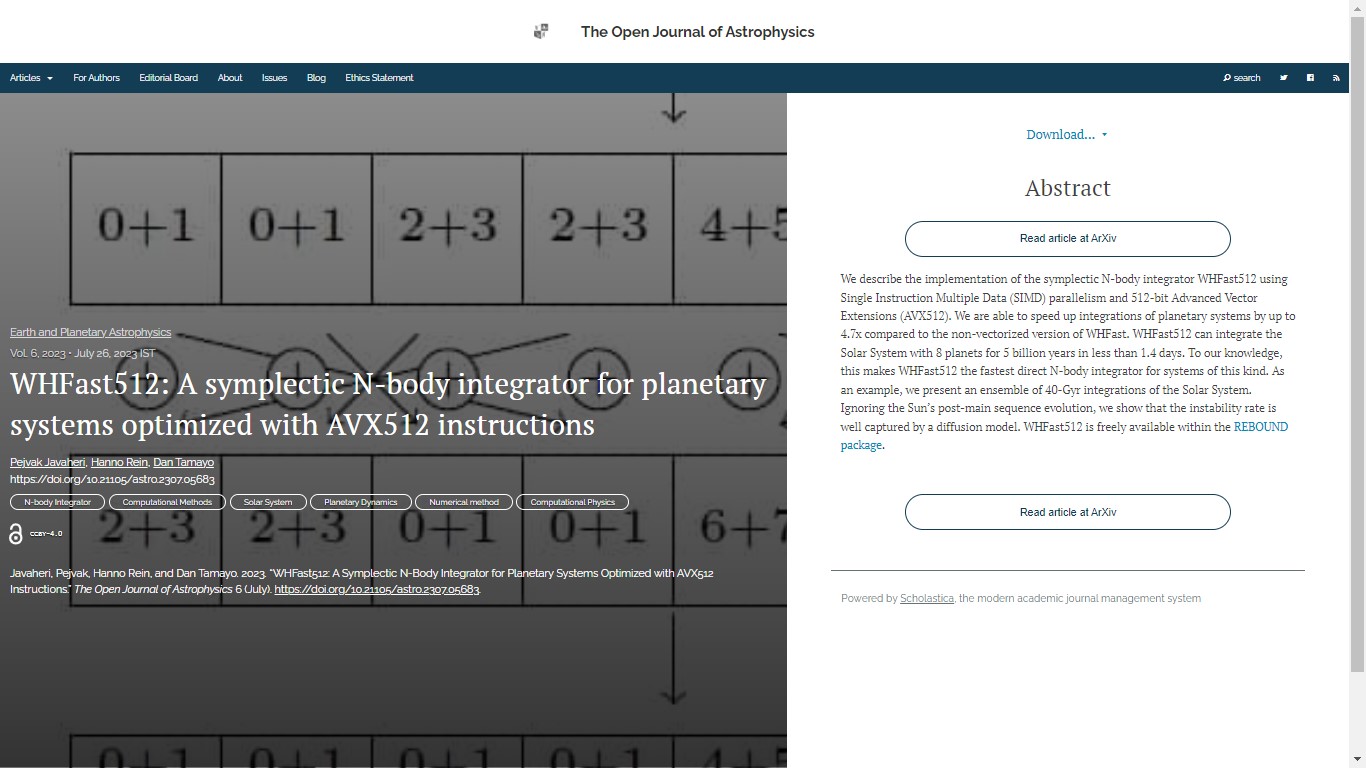
The next paper is in the Earth and Planetary Astrophysics folder. It is in fact only the second paper we have published in that area. It is entitled “WHFast512: A symplectic N-body integrator for planetary systems optimized with AVX512 instructions” by Pejvak Javaheri & Hanno Rein (University of Toronto, Canada) and Daniel Tamayo (Harvey Mudd College, USA). This paper presents a fast direct N-body integrator for gravitational systems, and demonstrates it using a 40 Gyr integration of the Solar System.
Here is the overlay:
You can find the full text for this one on the arXiv here.
Last but by no means least, published yesterday (29th July), we have a paper that asks the question “Can Einstein (rings) surf Gravitational Waves?” by Leonardo Giani, Cullan Howlett and Tamara M. Davis of the University of Queensland, Australia. The primary classification for this one is Cosmology and Nongalactic Astrophysics and it discusses the possible effect(s) of gravitational waves on gravitational lensing observations.
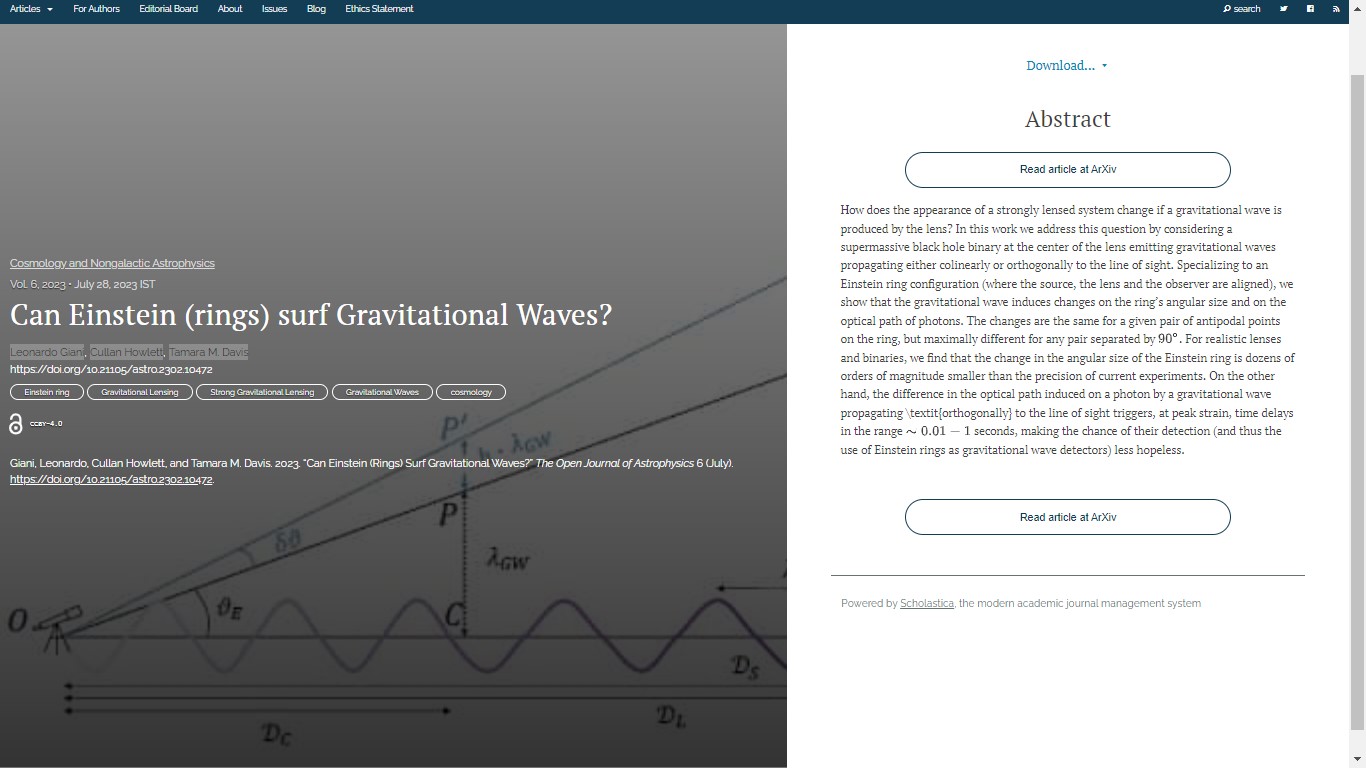
You can click on the image of the overlay to make it larger should you wish to do so. You can find the officially accepted version of the paper on the arXiv here.
NANOGrav Newsflash!
Posted in Astrohype, The Universe and Stuff with tags gravitational waves, Hellings-Downs, NANOGrav, SMBHs, stochastic gravitational wave background, supermassive black holes on June 29, 2023 by telescoperIn a post earlier this week I wrote that
There is a big announcement scheduled for Thursday by the NANOGrav collaboration. I don’t know what is on the agenda, but I suspect it may be the detection of a stochastic gravitational wave background using pulsar timing measurements. I may of course be quite wrong about that, but will blog about it anyway.
The press conference is not until 1pm EDT (6pm Irish Time) but the papers have already arrived and it appears I was correct in my inference. The papers can be found here, along with a summary. The main results paper is entitled The NANOGrav 15 yr Data Set: Evidence for a Gravitational-wave Background. Here is the abstract (click on the image to make it bigger):
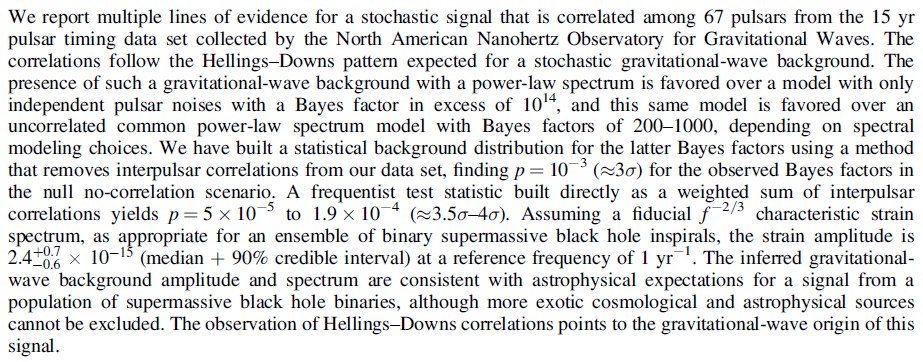
In a nutshell, this evidence differs from the direct detection of gravitational waves by interferometric experiments, such as Advanced LIGO, in that it: (a) does not detect individual sources but an integrated background produced by many sources; (b) it is sensitive to much longer gravitational waves (measured in light-years rather than kilometres).; and (c) the statistical evidence of this detection is far less clear-cut.
While Advanced LIGO can – and does – detect gravitational waves from mergers of stellar mass black holes, the NANOGrav signal would correspond to similar events involving much more massive objects – supermassive black holes (SMBHs) – with masses exceeding a million times the mass of the Sun, such as the one found in the Galactic Centre. If this is the right interpretation, the signal will provide important information about how many such mergers are happening across the Universe and hence about the formation of such objects and their host galaxies.
SMBH mergers are not the only possible source of the NANOGrav signal, however, and you can bet your bottom dollar that there will now be an avalanche of theory papers on the arXiv purporting to explain the results in terms of more exotic models.
Incidentally, for a nice explanation of the Hellings-Downs correlation, see here. The figure from the paper is
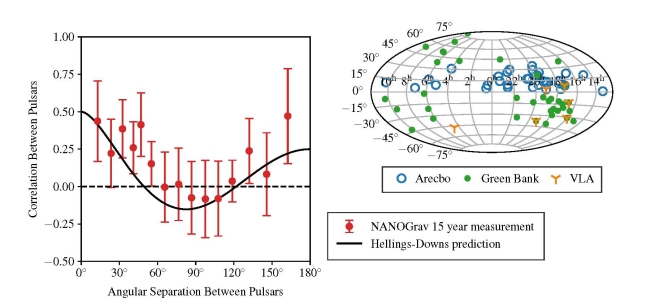
I haven’t had time to go through the papers in detail so won’t comment on the results, at least partly because I find the presentation of the statistical results in the abstract a very confusing jumble of Bayesian and frequentist language which I find hard to penetrate. Hopefully it will make more sense when I have time to read the papers and/or when I watch the announcement later.
Newsflash: another Neutron Star – Black Hole merger?
Posted in The Universe and Stuff with tags Advanced LIGO, black hole, gravitational waves, LIGO, neutron star, S230518h on May 18, 2023 by telescoper
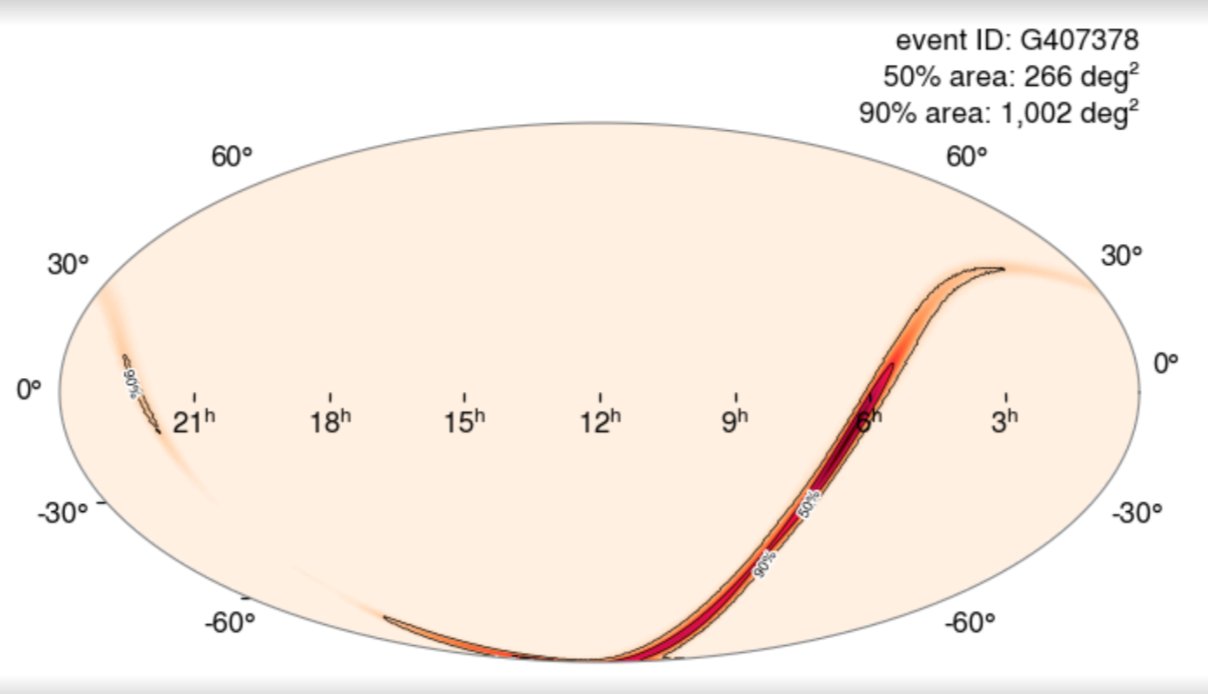
It seems that the engineering data ahead of the imminent observing run from the newly refurbished LIGO gravitational wave observatory has just triggered an alert for astronomers to look for an electromagnetic counterpart. The code number for this candidate event is S230518h. If confirmed this could very well be another Neutron-Star – Black Hole merger event. The search area is rather large, with the 90% probability region being about 1002 square degrees on the sky:
For more details, see here.
I’m reminded about the excitement surrounding the first Neutron Star merger way back in 2017. In fact, rumours started to spread via this blog as people outside the LIGO/transient source community used a comments thread here to share information of where telescopes were looking. Those were the days. Was that really 6 years ago?
Still no Primordial Gravitational Waves…
Posted in Astrohype, Bad Statistics, The Universe and Stuff with tags arXiv:2110.00483, Bicep2, BICEP3, gravitational waves, Polarization, polarized dust, Primordial Gravitational Waves on October 27, 2021 by telescoperDuring March 2014 this blog received the most traffic it has ever had (reaching almost 10,000 hits per day at one point). The reason for that was the announcement of the “discovery” of primordial gravitational waves by the BICEP2 experiment. Despite all the hype at the time I wasn’t convinced. This is what I said in an interview with Physics World:
It seems to me though that there’s a significant possibility of some of the polarization signal in E and B [modes] not being cosmological. This is a very interesting result, but I’d prefer to reserve judgement until it is confirmed by other experiments. If it is genuine, then the spectrum is a bit strange and may indicate something added to the normal inflationary recipe.
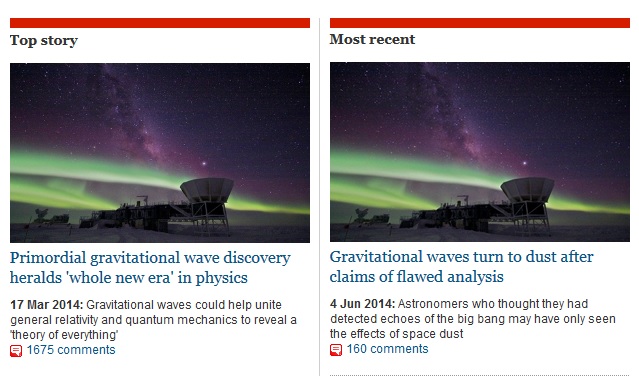
I also blogged about this several times, e.g. here. It turns out I was right to be unconvinced as the signal detected by BICEP2 was dominated by polarized foreground emission. The story is summarized by these two news stories just a few months apart:
Anyway, the search for primordial gravitational waves continues. The latest publication on this topic came out earlier this month in Physical Review Letters and you can also find it on the arXiv here. The last sentence of the abstract is:
These are the strongest constraints to date on primordial gravitational waves.
In other words, seven years on from the claimed “discovery” there is still no evidence for anything but polarized dust emission…

 In the Dark