Archive for High redshift galaxies

Weekly Update from the Open Journal of Astrophysics – 11/10/2025

Posted in OJAp Papers, Open Access, The Universe and Stuff with tags , , , , , , , , , , , , , , , , , , , , , on October 11, 2025 by telescoper

It’s time once again for the usual Saturday update of the week’s new papers at the Open Journal of Astrophysics. Since the last update we have published six  more papers, which brings the number in Volume 8 (2025) up to 152, and the total so far published by OJAp up to 387. Not only have we passed the 150 mark for the year, but this week saw another record for the Journal, in that it was the first week in which we published at least one paper on every day.

Anyway, here are this week’s papers:

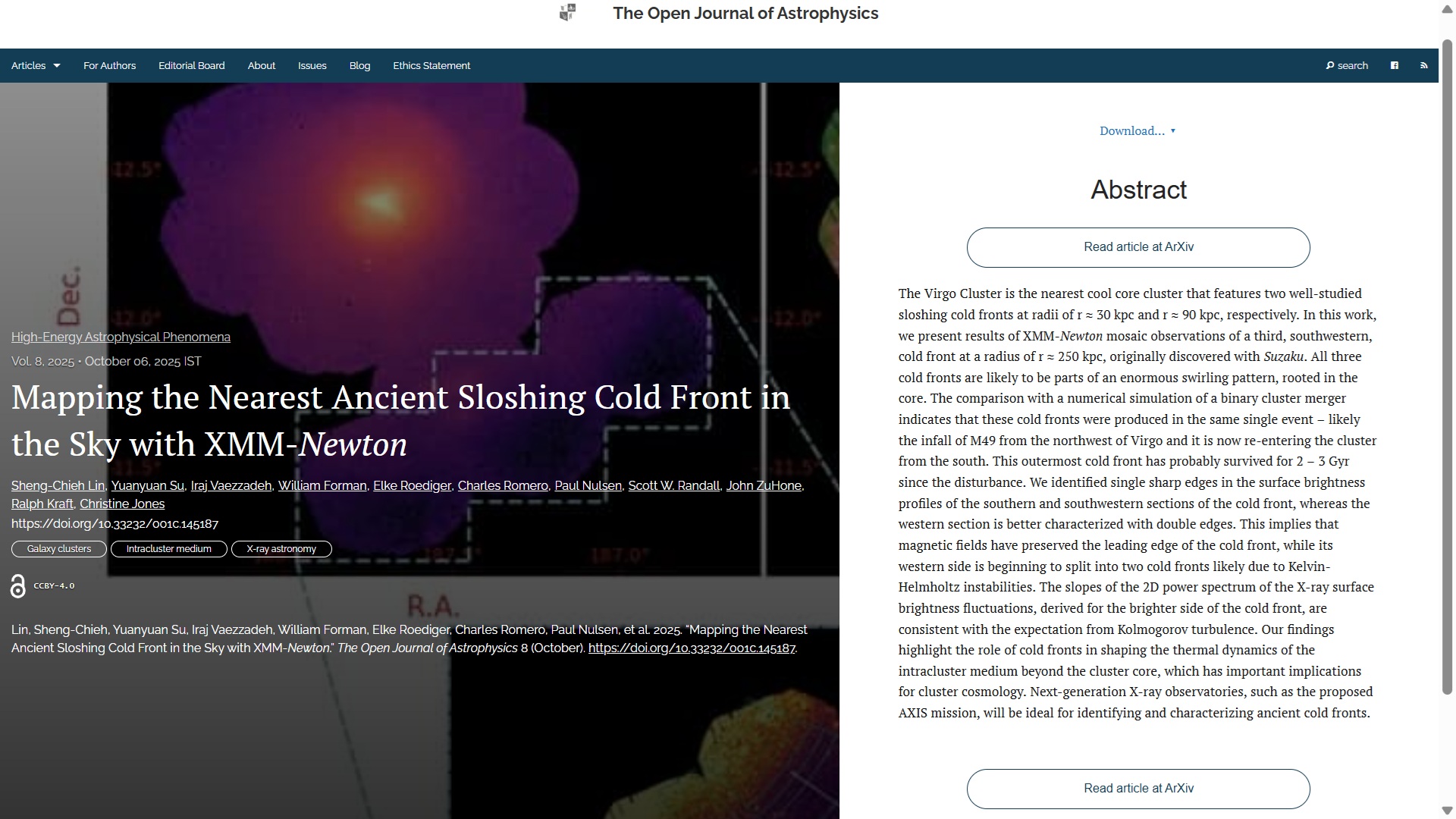
The first paper is “Mapping the Nearest Ancient Sloshing Cold Front in the Sky with XMM-Newton” by Sheng-Chieh Lin (University of Kentucky) and 10 others based in the USA, Spain and Germany. This article, published on Monday 6th October 2025, in the section High-Energy Astrophysical Phenomena discusses cold fronts in the Virgo Cluster, their importance in shaping the thermal dynamics of the intracluster medium beyond the cluster core, and their implications for cluster cosmology.

The overlay is here:


The officially accepted version of this paper can be found on the arXiv here.

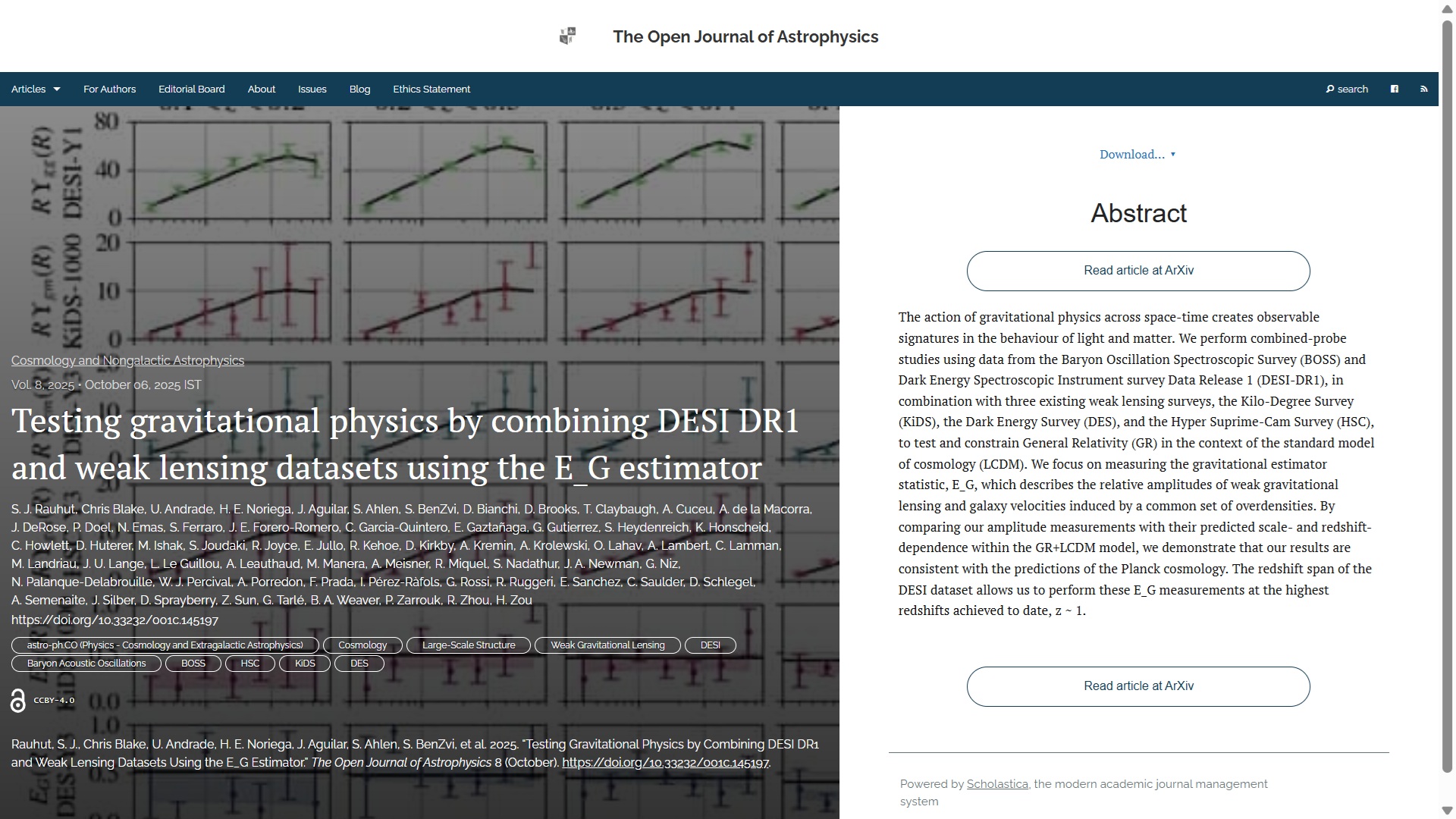
The second paper this week, also published on Monday 6th October, is “Testing gravitational physics by combining DESI DR1 and weak lensing datasets using the E_G estimator” by S.J. Rauhut (Swinburne University of Technology, Australia) and an international cast of 63 others. This one is in the folder Cosmology and NonGalactic Astrophysics, and it presents a comparison of  Baryon Acoustic Oscillation (BAO) measurements from BOSS, DESI with weak lensing from KiDS, DES and HSC showing that the results are altogether consistent with the standard cosmological model.

The overlay is here:

You can find the officially accepted version of this paper on arXiv here.

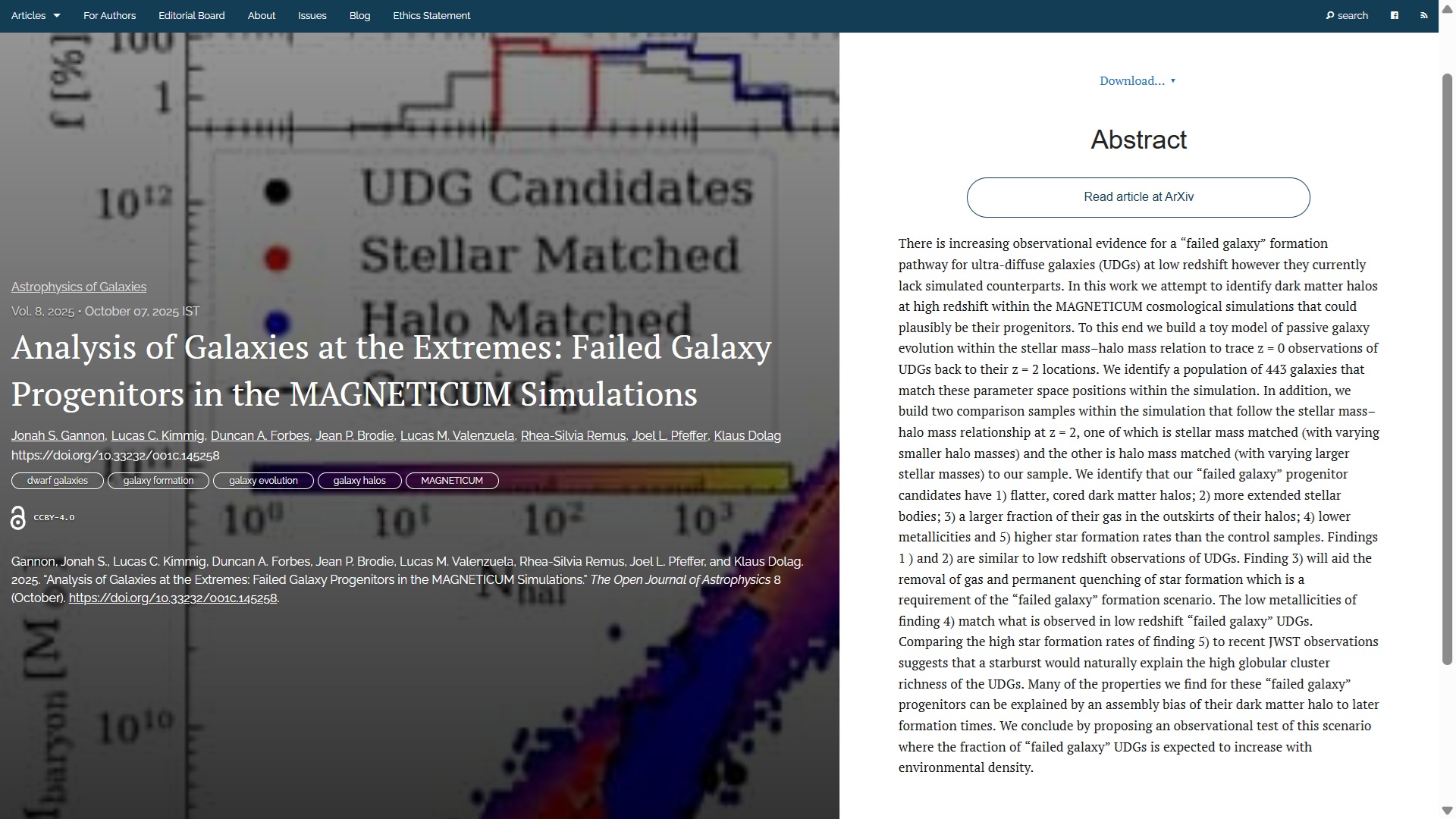
Next one up is “Analysis of Galaxies at the Extremes: Failed Galaxy Progenitors in the MAGNETICUM Simulations” by Jonah S. Gannon (Swinburne University, Australia), Lucas C. Kimmig (Ludwig-Maximilians-Universität, Germany; LMU), Duncan A. Forbes (Swinburne), Jean P. Brodie (Swinburne), Lucas M. Valenzuela (LMU), Rhea-Silvia Remus (LMU), Joel L. Pfeffer (Swinburne) and Klaus Dolag (LMU). This paper, published on Tuesday 7th October 2025, in the folder Astrophysics of Galaxies, discusses the business of identifying the possible high-redshift progenitors of low-redshift ultra-diffuse galaxies in cosmological simulations.

The corresponding overlay is here:

You can find the officially accepted version on arXiv here.

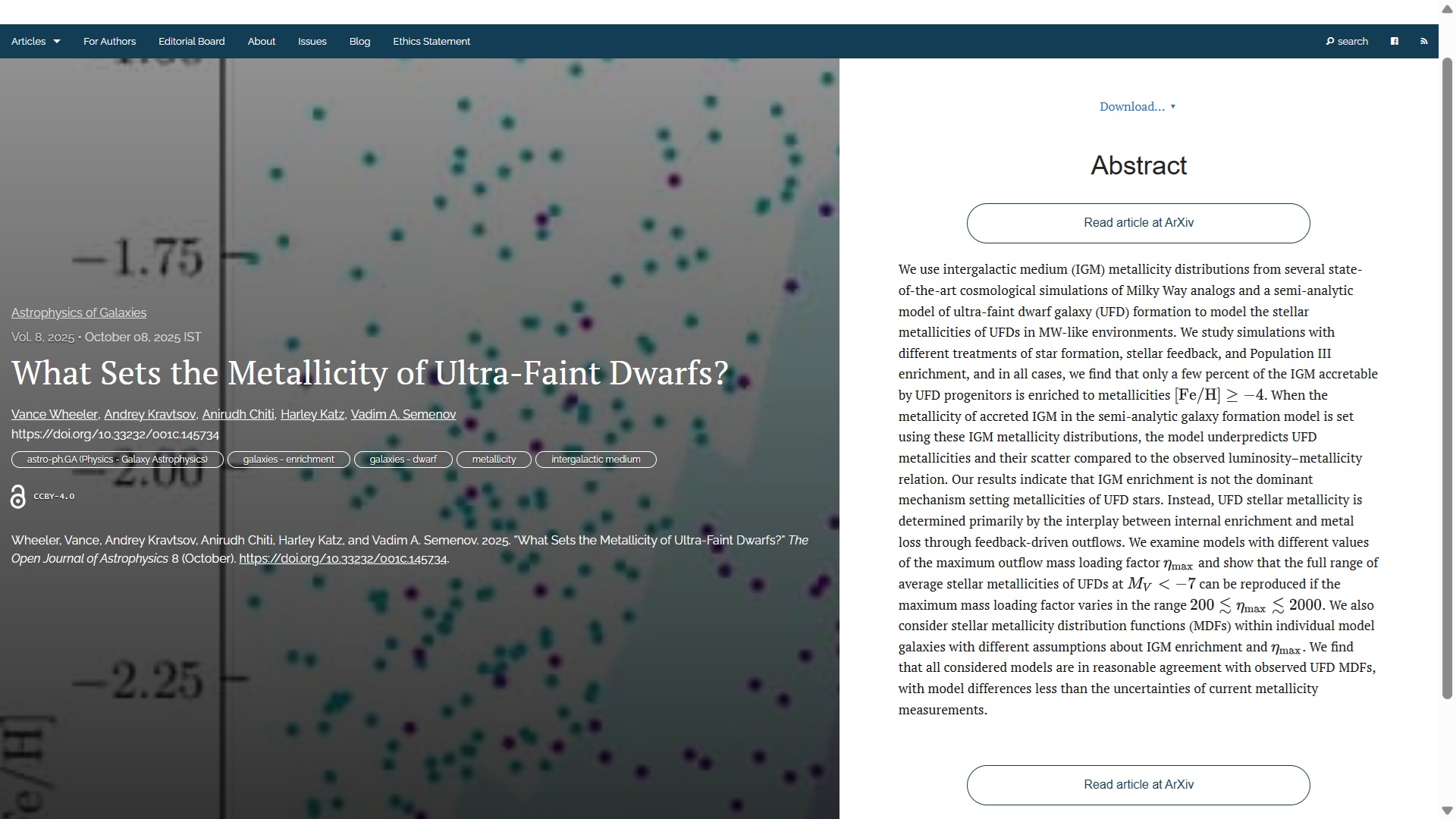
The fourth paper this week, published on Wednesday 8th October 2025 in the folder Astrophysics of Galaxies,  is
What Sets the Metallicity of Ultra-Faint Dwarfs?” by Vance Wheeler, Andrey Kravtsov, Anirudh Chiti & Harley Katz (U. Chicago) and Vadim A. Semenov (CfA Harvard), all based in the USA.

The overlay is here:

You can find the officially-accepted version on arXiv here.

Next, and fifth, we have our 150th publication of 2025, “Synthesizer: a Software Package for Synthetic Astronomical Observables” by Christopher C. Lovell (Cambridge, UK), William J. Roper, Aswin P. Vijayan & Stephen M. Wilkins (Sussex, UK), Sophie Newman (Portsmouth, UK) and Louise Seeyave (Sussex). This paper presents a suite of software tools for creating synthetic astrophysical observables for use in mock galaxy catalogues. It was published on Thursday 9th October 2025 in the folder Instrumentation and Methods for Astrophysics.

The overlay is here:

You can find the officially accepted version on arXiv here.

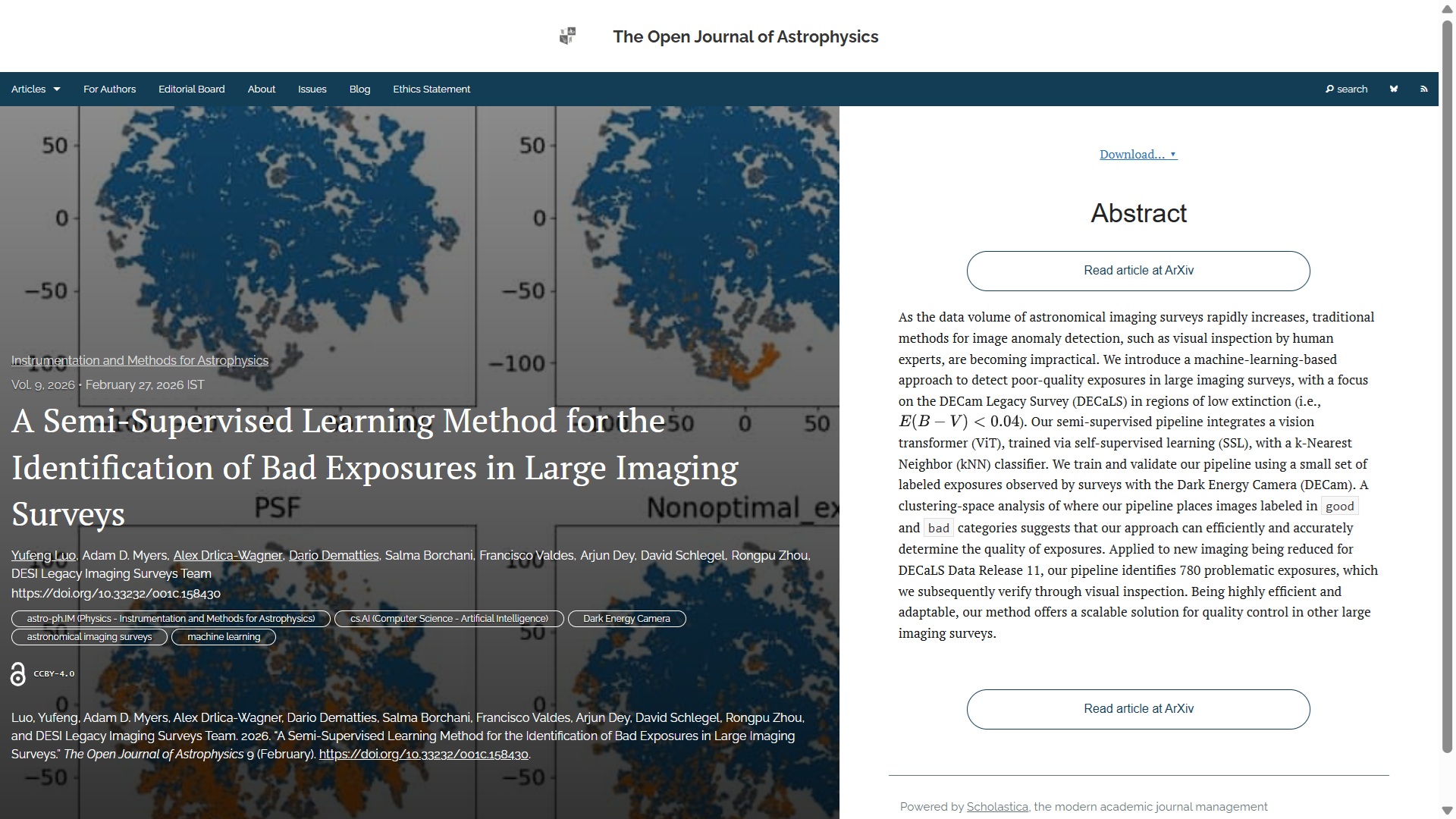
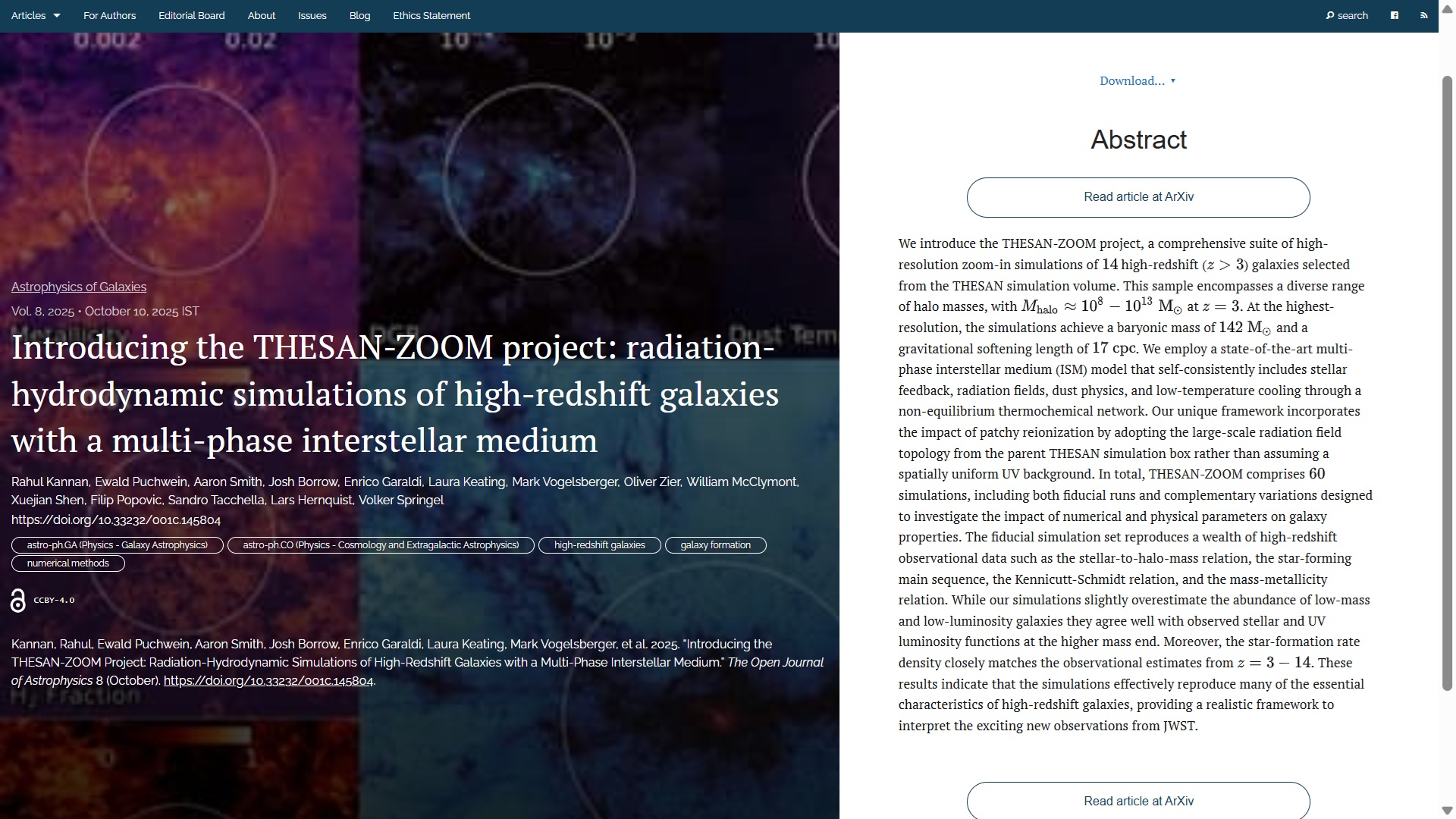
And finally for this week we have “Introducing the THESAN-ZOOM project: radiation-hydrodynamic simulations of high-redshift galaxies with a multi-phase interstellar medium” by Rahul Kannan (York University, Canada) and 13 others based in the USA, Germany, Japan, Italy and the UK. This one was published on Friday 10th October (i.e. yesterday) in the folder Astrophysics of Galaxies. It describes a comprehensive suite of high-resolution zoom-in simulations of high-redshift galaxies, encompassing a diverse range of halo masses, selected from the THESAN simulation volume.

The corresponding overlay is here:

You can find the officially accepted version of this one on arXiv here.

That concludes the papers for this week. I will, however, add a short postscript. This week saw the announcement of this year’s list of MacArthur Fellows. among them Kareem El-Badry who has published quite a few papers with the Open Journal of Astrophysics. His biography on the MacArthur Foundation page includes this:

He has published articles in Monthly Notices of the Royal Astronomical SocietyThe Astrophysical Journal, and The Open Journal of Astrophysics, among other leading scientific journals.

I’m pleased to see us listed with the established names. I mention this just in case there are still people out there who think it might damage their career if they publish with a non-mainstream journal. I guess we are mainstream now…

New Publication at the Open Journal of Astrophysics

Posted in OJAp Papers, Open Access, The Universe and Stuff with tags , , , , , on November 23, 2024 by telescoper

It’s Saturday morning so it’s time for the usual weekly update of publications at the Open Journal of Astrophysics. This week’s report will be short because there is only one paper to report this week, being  the 105th paper in Volume 7 (2024)  and the 220th  altogether. It was published on Wednesday 19th November 2024.

The title of the latest paper is”Early Bright Galaxies from Helium Enhancements in High-Redshift Star Clusters” and the authors are Harley Katz (U. Chicago), Alexander P. Ji (U. Chicago), Grace Telford (Princeton) & Peter Senchyna (Carnegie Observatories), all based in the USA. This paper, which is in the folder marked Astrophysics of Galaxies, discusses chemical abundance – specfically Helium enhancement – as a factor in the luminosity of high-redshift galaxies

Here is the overlay of the paper containing the abstract:


You can click on the image of the overlay to make it larger should you wish to do so. You can also find the officially accepted version of the paper on the arXiv here.

That’s all for this week – tune in next Saturday for next week’s update!

No Tension at Redshift Ten

Posted in Maynooth, The Universe and Stuff with tags , , , , , on April 29, 2023 by telescoper

I know it’s the Bank Holiday weekend but I could resist a quick post about a new paper that hit the arXiv yesterday (where all new astrophysics papers worth reading can be found). It is led by Joe McCaffrey who is a PhD student in the Department of Theoretical Physics at Maynooth University. The paper has been submitted to the Open Journal of Astrophysics, but obviously I am conflicted so have assigned it to another editor.

UPDATE: the paper is now published here.

As many of you will be aware, there’s been a considerable to-do not to mention a hoo-hah about the detections by JWST of some galaxies at high redshift. Some of these have been shown not to be galaxies at high redshift after all, but some around z=10 seem to be genuine.

Anyway, the abstract of Joe’s paper is this:

Recent observations by JWST have uncovered galaxies in the very early universe via the JADES and CEERS surveys. These galaxies have been measured to have very high stellar masses with substantial star formation rates. There are concerns that these observations are in tension with the ΛCDM model of the universe, as the stellar masses of the galaxies are relatively high for their respective redshifts. Recent studies have compared the JWST observations with large-scale cosmological simulations. While they were successful in reproducing the galaxies seen in JADES and CEERS, the mass and spatial resolution of these simulations were insufficient to fully capture the early assembly history of the simulated galaxies. In this study, we use results from the Renaissance simulations, which are a suite of high resolution simulations designed to model galaxy formation in the early universe. We find that the most massive galaxies in Renaissance have stellar masses and star formation rates that are entirely consistent with the observations from the JADES and CEERS surveys. The exquisite resolution afforded by Renaissance allows us to model the build-up of early galaxies from stellar masses as low as 104 M⊙ up to a maximum stellar mass of a few times 107 M⊙. Within this galaxy formation paradigm, we find excellent agreement with JADES and CEERS. We find no tension between the ΛCDM model and current JWST measurements. As JWST continues to explore the high redshift universe, high resolution simulations, such as Renaissance, will continue to be crucial in understanding the formation history of early embryonic galaxies.

arXiv:2304.13755

The key figure is this one:

The solid curves show the number of galaxies of a given mass one would expect to see as a function of redshift in fields comparable to those observed with estimated values from observations (star-shaped symbols). As you can see the observed points are consistent with the predictions. There’s no tension, so you can all relax.

Spectroscopy of High Redshift Galaxies

Posted in The Universe and Stuff with tags , , , , , on March 28, 2023 by telescoper

The tentative identifications of a number of galaxies at high redshift using JWST on the basis of photometric measurements (see, e.g., here and here) have initiated a huge amount of activity in the extragalactic community trying to establish spectroscopic redshifts for these galaxies. Results of this endeavour have started to appear on the arXiv here with this abstract:

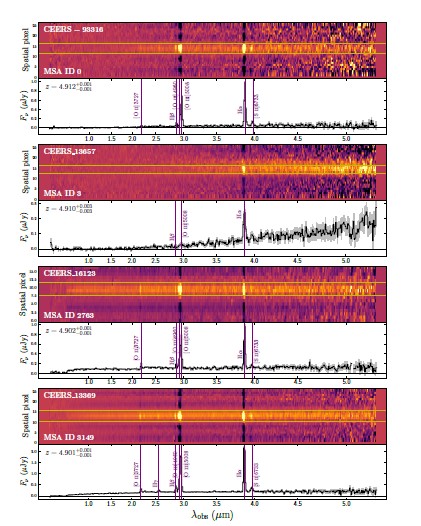
During the first 500 million years of cosmic history, the first stars and galaxies formed and seeded the cosmos with heavy elements. These early galaxies illuminated the transition from the cosmic “dark ages” to the reionization of the intergalactic medium. This transitional period has been largely inaccessible to direct observation until the recent commissioning of JWST, which has extended our observational reach into that epoch. Excitingly, the first JWST science observations uncovered a surprisingly high abundance of early star-forming galaxies. However, the distances (redshifts) of these galaxies were, by necessity, estimated from multi-band photometry. Photometric redshifts, while generally robust, can suffer from uncertainties and/or degeneracies. Spectroscopic measurements of the precise redshifts are required to validate these sources and to reliably quantify their space densities, stellar masses, and star formation rates, which provide powerful constraints on galaxy formation models and cosmology. Here we present the results of JWST follow-up spectroscopy of a small sample of galaxies suspected to be amongst the most distant yet observed. We confirm redshifts z > 10 for two galaxies, including one of the first bright JWST-discovered candidates with z = 11.4, and show that another galaxy with suggested z ~ 16 instead has z = 4.9, with strong emission lines that mimic the expected colors of more distant objects. These results reinforce the evidence for the rapid production of luminous galaxies in the very young Universe, while also highlighting the necessity of spectroscopic verification for remarkable candidates.

arXiv:2303.15431

As the abstract explains, the spectroscopic measurements confirm some – but not all – of the galaxies studied to be at high redshift. One galaxy – the one discussed here (known to its friends as 93316) which appeared to have a redshift of 16.6 ± 0.1 now seems to have a much lower redshift of 4.91. Here’s an image of this object:

The redshift 16.6 object was of some interest to cosmologists because an object of large stellar mass at such a large distance is difficult to reconcile with the standard theory of galaxy formation. That is now apparently out of the way, and the remaining high-z galaxies are not as extreme as this one and pose less of a problem.

While this result may disappoint some, and indeed delight others, it is also interesting to note that there are three similar objects at much the same redshift, which may indicate the presence of some sort of group or cluster:

Fascinating!

P.S. It struck me, after writing this, that waiting for spectroscopic confirmation of photometric redshifts is a lot like waiting for VAR to check whether or not to rule out a goal for offside…

A 13-billion-year-old Galaxy Spectrum

Posted in The Universe and Stuff with tags , , , , , on February 16, 2023 by telescoper

The Galaxy GN-z11 has been known for some time to have a very high redshift z~11 (hence the name) but you can now feast your eyes on the exquisite infrared spectrum of this object recently obtained using JWST:

It’s incredible to see so many clear emission lines for an object at such an enormous distance. The light from this galaxy set out towards us over 13 billion years in the past, when the Universe was less than 400 million years old, so it provides clues about the very early stages of cosmic structure formation. The spectral lines can not only be used to establish the redshift with great precision – it is z = 10.603 – but also to probe the physical properties of this source and its environment. The progress in this field is truly remarkable thanks to superb advances in observational technology.

For more details of this amazing result see the paper by Bunker et al now on the arXiv.

Recalibration of Ultra-High-Redshift Galaxies

Posted in Astrohype, The Universe and Stuff with tags , , , , on August 10, 2022 by telescoper

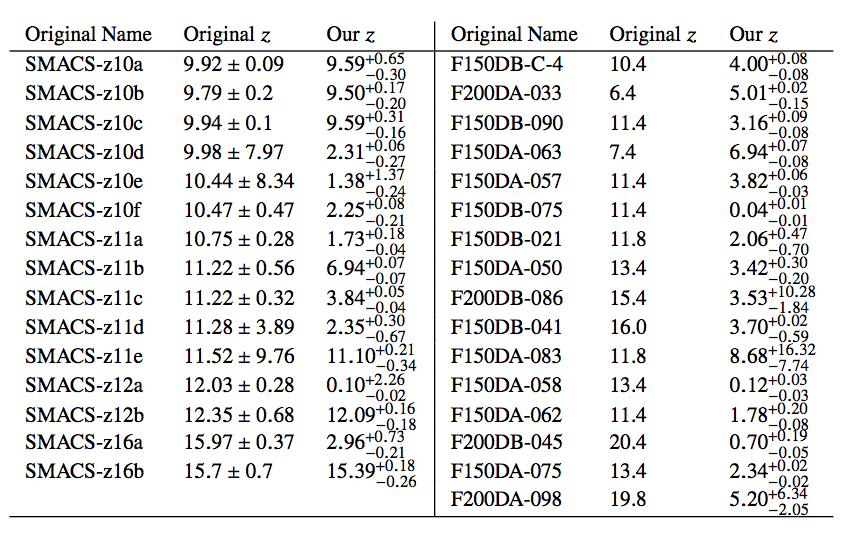
Remember all the recent excitement about the extremely high redshift galaxies (such as this and this; the two examples shown above) “identified” in early-release JWST observations? Well, a new paper on the arXiv by Adams et al using post-launch calibration of the JWST photometry suggests that we should be cautious about the interpretation of these objects. The key message of this study is that the preliminary calibration that has been in widespread use for these studies is wrong by up to 30% and that can have a huge impact on inferred redshifts.

The new study does indeed identify some good candidates for ultra-high-redshift galaxies, but it also casts doubt on many of the previous claims. Here is a table of some previous estimates alongside those using the newly recalibrated data:

You will see that in most – but not all – cases the recalibration results in a substantial lowering of the estimated redshift; one example decreases from z>20 to 0.7! The two candidates mentioned at the start of this post are not included in this table but one should probably reserve judgement on them too.

The conclusive measurements for these objects will however include spectroscopy, and the identification of spectral lines, rather than photometry and model fits to the spectra energy distribution. Only with such data will we really know how many of these sources are actually at very high redshift. As the philosopher Hegel famously remarked

The Owl of Minerva only spreads its wings with the coming of spectroscopy.

Now a Galaxy at z>16?

Posted in The Universe and Stuff with tags , , , , , , on July 26, 2022 by telescoper

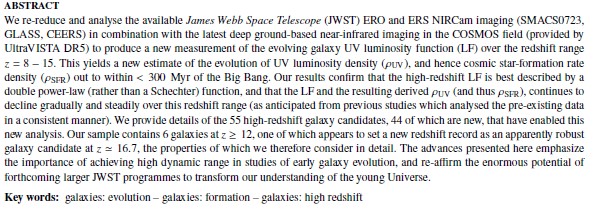
It’s less than a week since I posted an item about an object which is possibly the highest redshift galaxy ever observed (with z ~13) and now along comes a paper describing an object that may be of even higher redshift (with z~16.7). The abstract of the new paper – lead author of which is Callum Donnan of the University of Edinburgh – is here:

As with the previous object the redshift of this one is not obtained via spectroscopy (which usually involves the identification of spectral lines) but via fitting a spectral profile to photometric imaging data seen in different bands. The process for this galaxy is illustrated by this diagram from the paper:

There are 7 images along the top showing the source through various broad band filters. Suitably calibrated these can be converted to the flux measurements shown on the graph. Notice the first three images are significantly fainter than the others, so the first three points on the left of the graph are lower.

If this is a galaxy its spectrum is expected to possess a Lyman Break resulting from the fact that radiation of shorter wavelength than the Lyman Limit (912 Å) is absorbed by neutral gas surrounding the regions where stars are formed in the galaxy. In the rest frame of a galaxy this break is the ultraviolet region of the spectrum but because of the cosmological redshift it is observed in the infrared part of the spectrum for very distant galaxies. In this case the best fit is obtained if the break is positioned as shown, with the first three fainter points to the left of the break and the rest to the right. The break itself is straddled by two observational bands. Employing a number of different estimates the authors conclude that the redshift of this galaxy is z=16.7 or thereabouts.

There is no direct evidence for the sharp edge associated with the Lyman Break – and no spectral lines are observed either – so this all depends on the object being correctly identified as a high-redshift galaxy and not some other object at lower redshift. You have to assume this to get a redshift, but then all inferences are based on assumed models so there’s nothing unusual about this approach. The authors discuss other possibilities and conclude that there is no plausible alternative source. Take away the green template spectrum and you just see a spectrum that rises to a peak and falls again. The authors claim that there is no plausible low-redshift source with such a spectrum.

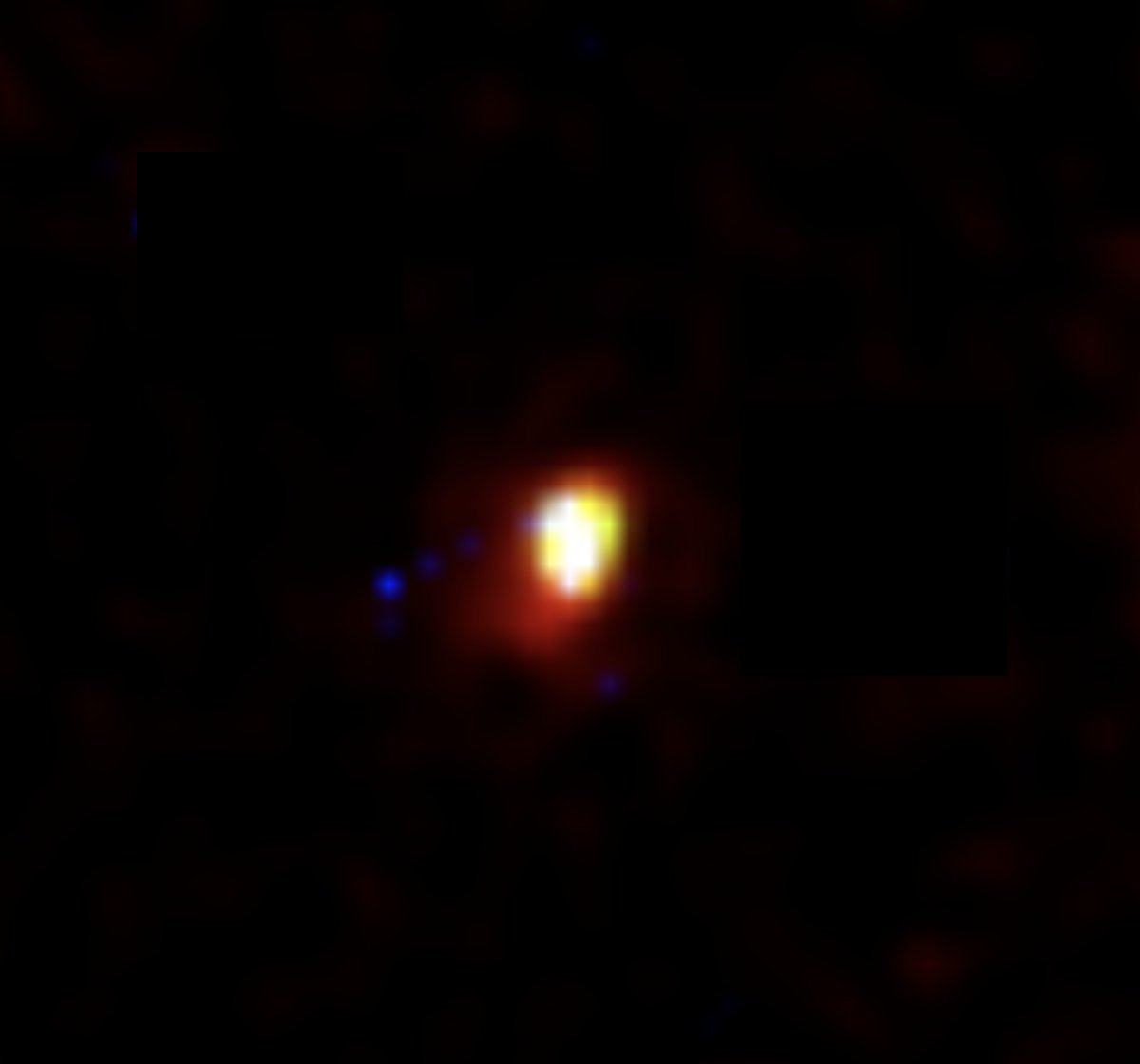
Anyway, here is a composite colour image of the source:

So is this now the earliest galaxy ever observed? And what object will I be asking this question about next week? One thing I can predict is that there are going to be many more such objects in the very near future!