Archive for Instrumentation and Methods for Astrophysics

Five New Publications at the Open Journal of Astrophysics

Posted in OJAp Papers, Open Access, The Universe and Stuff with tags , , , , , , , , , , , , , on December 21, 2024 by telescoper

Time for the usual Saturday summary of papers at the Open Journal of Astrophysics. We have published five more papers since the last update a week ago. The count in Volume 7 (2024) is now up to 119 and the total altogether to 234. As I mentioned in a post last week this means we have published more papers this year (2024) than in all previous years put together.

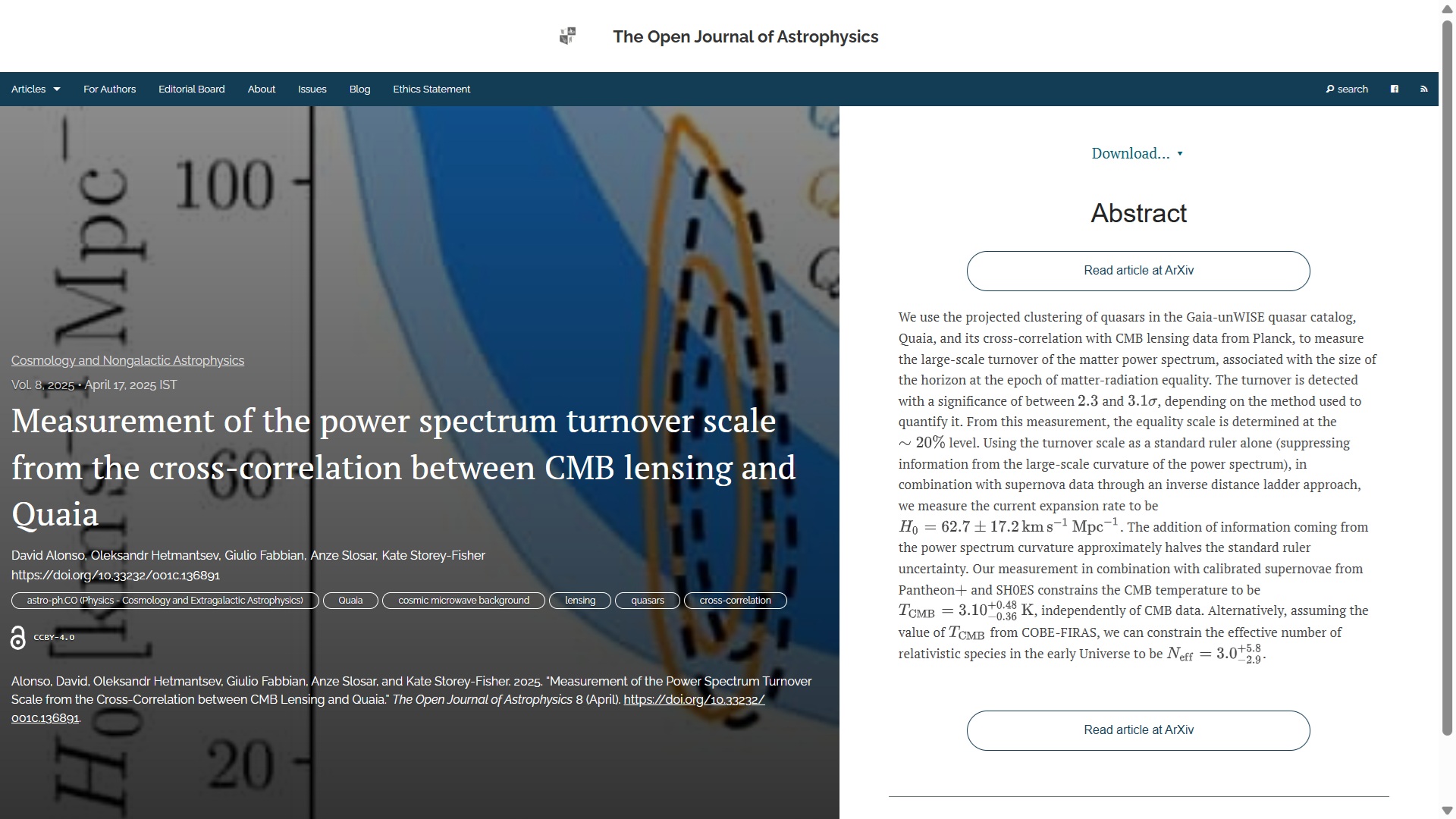
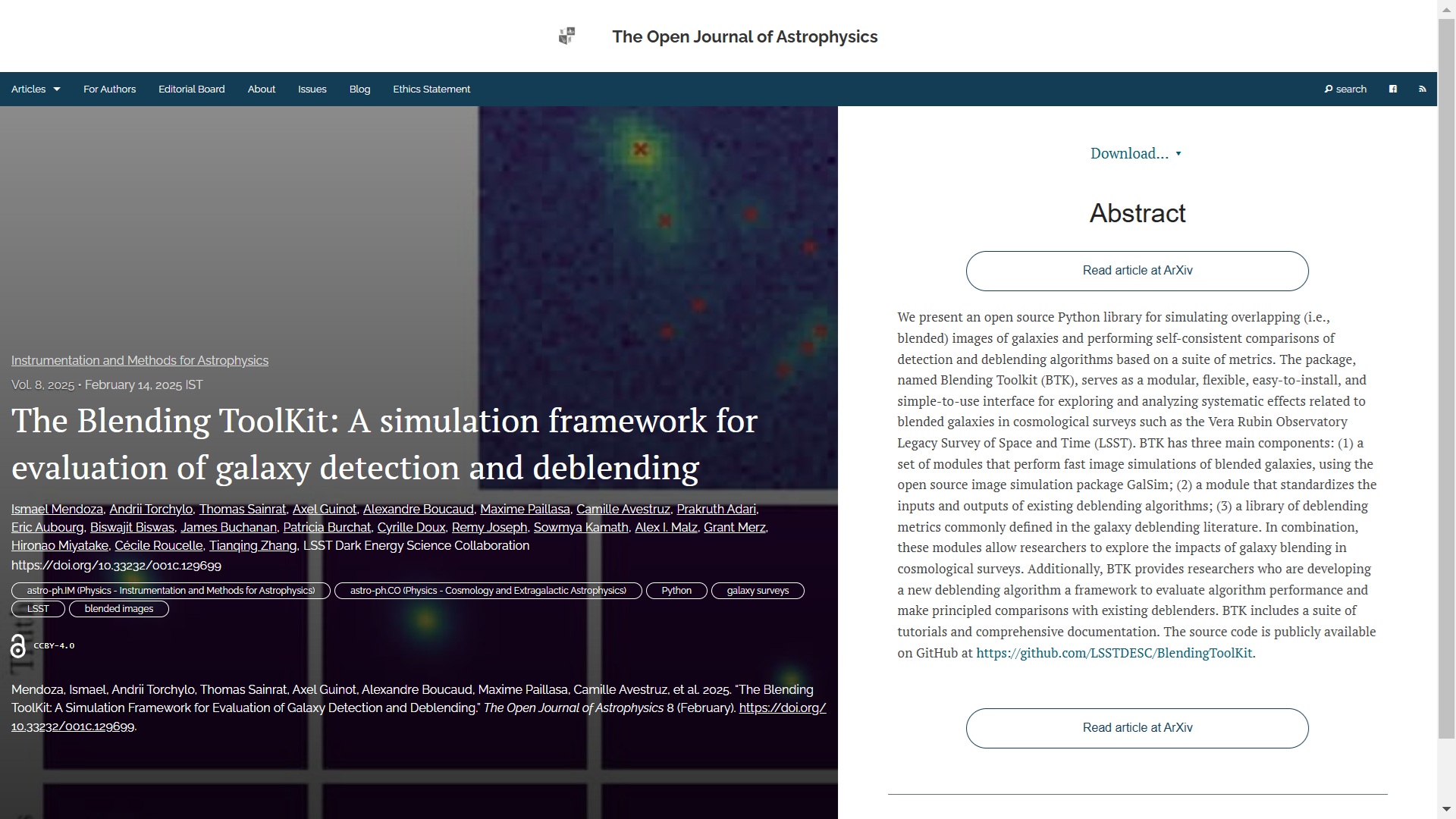
In chronological order, the five papers published this week, with their overlays, are as follows. You can click on the images of the overlays to make them larger should you wish to do so.

First one up, published on Wednesday 18th December 2024 is “The picasso gas model: Painting intracluster gas on gravity-only simulations” byby Florian Kéruzoré, L. E. Bleem, N. Frontiere, N. Krishnan, M. Buehlmann, J. D. Emberson, S. Habib, and P. Larsen all of the Argonne National Laboratory, USA.  The paper, which is in the folder marked Cosmology and NonGalactic Astrophysics describes a method using machine learning based on an analytical gas model to predict properties of the intracluster medium.

Here is a screen grab of the overlay, which includes the abstract:


You can find the officially accepted version of the paper on the arXiv here.

The second paper to announce, and the first of four published on Wednesday 19th December 2024, “maria: A novel simulator for forecasting (sub-)mm observations” by J. van Marrewijk (ESO, Garching, Germany) and 10 others based in Germany, USA, Norway, France and Italy. This paper describes a multi-purpose telescope simulator that optimizes scanning strategies and instrument designs, produces synthetic time-ordered data, time streams, and maps from hydrodynamical simulations, thereby enabling comparison between theory and observations. This one is in the folder marked Instrumentation and Methods for Astrophysics.

You can see the overlay here:

The accepted version of this paper can be found on the arXiv here.

The third paper  is “Detached Circumstellar Matter as an Explanation for Slowly-Rising Interacting Type Ibc Supernovae” by Yuki Takei (Kyoto U., Japan) & Daichi Tsuna (Caltech, USA). This one was also published on 19th December and is in the folder marked High-Energy Astrophysical Phenomena. The overlay is here:


The officially accepted version can be found on arXiv here.

The fourth paper, also published on 19th December 2024, is called “On the dark matter content of ultra-diffuse galaxies” and was written by Andrey Kravtsov (U. Chicago, USA).  The article discusses the implications of measured velocity dispersions of ultra-diffuse galaxies for models of galaxy formation and is in the folder marked Astrophysics of Galaxies.

The overlay is here


You can find the officially accepted version of this paper here.

The fifth paper in this batch is “Estimating Exoplanet Mass using Machine Learning on Incomplete Datasets” by Florian Lalande (Okinawa Institute of Science and Technology), Elizabeth Tasker (Institute of Space and Astronautical Science, Kanagawa) and Kenji Doya (Okinawa); all based in Japan. This one was published on 10th October 2024 in the folder marked Earth and Planetary Astrophysics. It compares different methods for inferring exoplanet masses in catalogues with missing data


You can find the official accepted version on the arXiv here.

Finally for this week we have “A new non-parametric method to infer galaxy cluster masses from weak lensing” by Tobias Mistele (Case Western Reserve University, USA) and Amel Durakovic (Czech Academy of Sciences, Czechia). This one was also published on 19th December and is in the folder Cosmology and NonGalactic Astrophysics.  The overlay is here


You can find the officially-accepted version on arXiv here.

That’s in for this week. I will do another update next Saturday only if we have any new papers on Monday. I will be taking a break over Christmas and also preparing Volume 8 (2025) for the new year, so publishing will be suspended from 24th December until 2nd January (inclusive). If you want your paper to be published in 2024 the final version must be on arXiv by Monday 23rd December at the latest, otherwise it will be held over until 2025.


Six New Publications at the Open Journal of Astrophysics

Posted in OJAp Papers, Open Access, The Universe and Stuff with tags , , , , , , , , , , , , , , , , , , , , , , , , , on October 12, 2024 by telescoper

Regular readers of this blog (both of them) will have noticed that I didn’t post an update of activity at the Open Journal of Astrophysics last weekend. Despite having accepted several papers for publication in the preceding week, no final versions had made it onto the arXiv. We can’t published a paper until the authors post the final version, so that meant a bit of a backlog developed. This week included one day with no arXiv update (owing to a US holiday on Tuesday 8th October) and a major glitch on Crossref on Thursday which delayed a couple, but even so we’ve published six papers which is the most we’ve ever managed in a week. This week saw the publication of our 200th article; the total as of today is 202.  The count in Volume 7 (2024) is now up to 87; we have four papers in the queue for publication so we should pass 90 next week if all goes well.

In chronological order, the six papers published this week, with their overlays, are as follows. You can click on the images of the overlays to make them larger should you wish to do so.

First one up, published on Monday 7th October 2024 is “z~2 dual AGN host galaxies are disky: stellar kinematics in the ASTRID Simulation” by Ekaterina Dadiani (CMU; Carnegie Mellon U.) Tiziana di Matteo (CMU), Nianyi Chen (CMU), Patrick Lachance (CMU), Yue Shen (U. Illinois at Urbana-Champaign), Yu-Ching Chen (Johns Hopkins U.), Rupert Croft (CMU), Yueying Ni (CfA Harvard) and Simeon Bird (U. California Riverside) – all based in the USA. The paper, which is in the folder marked Astrophysics of Galaxies describes a numerical study of the morphology of AGN host galaxies containing close pairs of black holes.

Here is a screen grab of the overlay, which includes the abstract:


You can find the officially accepted version of the paper on the arXiv here.

The second paper to announce, published on 8th October 2024, is “Origin of LAMOST J1010+2358 Revisited” by S.K. Jeena and Projjwal Banerjee of the Indian Institute of Technology Palakkad, Kerala, India. This paper discusses  the possible formation mechanisms for Very Metal Poor (VMP) stars and the implications for the origin of LAMOST J1010+2358 and is in the folder marked Solar and Stellar Astrophysics.

You can see the overlay here:

The accepted version of this paper can be found on the arXiv here.

The third paper is very different in both style and content: “Assessing your Observatory’s Impact: Best Practices in Establishing and Maintaining Observatory Bibliographies” by Raffaele D’Abrusco (Harvard CfA and 14 others; the Observatory Bibliographers Collaboration) and is in the folder marked Instrumentation and Methods for Astrophysics. It presents discussion of the methods used by astronomical observatories to construct and analyze bibliographic databases. The overlay is here:

(This one gave me a rare opportunity to use the library of stock images that comes with the Scholastica platform!) The officially accepted version can be found on arXiv here.

The fourth paper, also published on 8th October 2024, and our 200th publication, is in the folder marked Cosmology and NonGalactic Astrophysics, and is called “CombineHarvesterFlow: Joint Probe Analysis Made Easy with Normalizing Flows“. The authors are Peter L. Taylor, Andrei Cuceu, Chun-Hao To, and Erik A. Zaborowski of Ohio State University, USA. The article presents a new method that speeds up the sampling of joint posterior distributions in the context of inference using combinations of data sets. The overlay is here

You can find the officially accepted version of this paper here.

The fifth paper in this batch is “Estimating Exoplanet Mass using Machine Learning on Incomplete Datasets” by Florian Lalande (Okinawa Institute of Science and Technology), Elizabeth Tasker (Institute of Space and Astronautical Science, Kanagawa) and Kenji Doya (Okinawa); all based in Japan. This one was published on 10th October 2024 in the folder marked Earth and Planetary Astrophysics. It compares different methods for inferring exoplanet masses in catalogues with missing data


You can find the official accepted version on the arXiv here.

Finally for this week we have “Forecasting the accuracy of velocity-field reconstruction” by Chris Blake and Ryan Turner of Swinburne University of Technology, Melbourne, Australia. This was also published on 10th October 2024 and is in the folder marked Cosmology and NonGalactic Astrophysics. The paper describes a numerical study of the reliability and precision of different methods of velocity-density reconstruction. The overlay is here

You can find the officially-accepted version on arXiv here.

That’s it for now. We have published six papers, with a very wide geographical spread of authors, and in five of the six astro-ph categories we cover. I think it’s been a good week!

Four New Publications at the Open Journal of Astrophysics

Posted in OJAp Papers, Open Access, The Universe and Stuff with tags , , , , , , , , , , , , on September 29, 2024 by telescoper

A day later than has been usual for such things, it’s now time for a quick update of activity at the Open Journal of Astrophysics. This week we have published another batch of four papers which takes the count in Volume 7 (2024) up to 81 and the total published altogether by OJAp up to 196. I think there may come a week in we publish papers on every day of that week, but it was not this week…

In chronological order, the four papers published this week, with their overlays, are as follows. You can click on the images of the overlays to make them larger should you wish to do so.

First one up is “Finding the unusual red giant remnants of cataclysmic variable mergers” by Nicholas Z. Rui and Jim Fuller of California Institute of Technology (Caltech), USA. It presents a discussion of the possible photometric, astroseismological, and surface abundance signatures of red giants formed by mergers of cataclysmic variable stars. It was published on 23rd September 2024 and is in the folder marked Solar and Stellar Astrophysics.

Here is a screen grab of the overlay, which includes the abstract:


You can find the officially accepted version of the paper on the arXiv here.

The second paper to announce, also published on 23rd September 2024, is “Notes on the Practical Application of Nested Sampling: MultiNest, (Non)convergence, and Rectification” by Alexander Dittmann (U. Maryland, USA). A critical analysis of the MultiNest algorithm together with suggestions for approving its applicability. It is in the folder Instrumentation and Methods for Astrophysics.

You can see the overlay here:


The accepted version of this paper can be found on the arXiv here.

The third paper, published on 24th September 2024 in the folder marked High-Energy Astrophysical Phenomena, is called  “Merger Precursor: Year-long Transients Preceding Mergers of Low-mass Stripped Stars with Compact Objects” and is by Daichi Tsuna, Samantha Wu & Jim Fuller (Caltech), Yize Dong (UCLA) and Anthony Piro (Carnegie Observatories), all based in the USA.

Here is the overlay


The final version accepted on arXiv is here.

Last in this batch is “Spectroscopic Observations of the GALEX Nearby Young Star Survey Sample. I. Nearby Moving Group Candidates” by Navya Nagananda (Rochester, NY, USA), Laura Vican (UCLA), Ben Zuckerman (UCLA), David Rodriguez (STScI), Alexander Binks (Tübingen, Germany) & Joel Kastner (Rochester). It describes investigations of the spectra of the GALNYSS sample of over 2000 young stars and the assignment of these stars into moving groups. It is is in the folder marked Solar and Stellar Astrophysics, and was published on 25th September 2024 with this overlay:


You can find the official accepted version on the arXiv here.

That’s all for now. I will post another update in a week.

Four New Publications at the Open Journal of Astrophysics

Posted in OJAp Papers, Open Access, The Universe and Stuff with tags , , , , , , , , , , , , , , , , , , on July 27, 2024 by telescoper

It’s Saturday morning, so once again it’s time for an update of activity at the Open Journal of Astrophysics. This week we have published another batch of four papers, the same number as last week, which takes the count in Volume 7 (2024) up to 64 and the total published altogether by OJAp up to 179.

Before announcing the week’s papers I’ll add three other updates you might find interesting:

  1.  When I looked at NASA/ADS this morning to help construct this post I saw that papers published in OJAp have now garnered over 2500 citations between them;
  2. We had a good response to our recent call for new members of the Editorial Board and have added four new members here;
  3. Last week we received a significant (unsolicited) cash donation from a higher education institution based in Europe to help with our work in Diamond Open Access. If any other organizations or individuals would like to do similar then please contact me!

Now, in chronological order, the four papers published this week, with their overlays, are as follows. You can click on the images of the overlays to make them larger should you wish to do so.

First one up is: “Widespread disruption of resonant chains during protoplanetary disk dispersal by Bradley M S Hansen (UCLA), Tze-Yeung Yu (UCLA) and Yasuhiro Hasegawa (JPL), all based in California, USA.  The paper presents a discussion of the effect of a dispersing protoplanetary disk on the evolution of low-mass planets around a Solar mass star.  It was published on 21st July 2024 and is in the folder marked Earth and Planetary Astrophysics.

Here is a screen grab of the overlay, which includes the abstract:


You can find the officially accepted version of the paper on the arXiv here.

The second paper to announce is “Using A One-Class SVM To Optimize Transit Detection” by Jakob Roche of the University of South Florida, also in the USA (but not in California). This articles discusses the advantages of One-Class Support Vector Machines (SVMs) over Convolutional Neural Networks (CNN) in the context of exoplanet detection. Its in the folder called Instrumentation and Methods for Astrophysics and was published on 25th July 2024.

You can see the overlay here:


The accepted version of this paper can be found on the arXiv here.

The next paper, also published on 25th July 2024, is in the folder marked High-Energy Astrophysical Phenomena. Its primary classification on arXiv is General Relativity and Quantum Cosmology (gr-qc), but it is cross-listed on astro-ph so we considered it for publication and had it refereed, with favourable results. It is entitled “What no one has seen before: gravitational waveforms from warp drive collapse” and is by Katy Clough (QMUL, UK), Tim Dietrich (Potsdam, Germany) and Sebastian Khan (Cardiff, UK).  Looking at the title of this paper you might be tempted to dismiss it on the grounds that warp drives are the stuff of science fiction (which they are), but this paper is really a rigorous technical study of the dynamical evolution and stability of spacetimes that violate the null energy condition, inspired by the idea of a warp drive.

Here is the overlay:


You can find the full text for this one on the arXiv here.

Last, published on 26th July 2024, we have a paper with the title “A study of gamma-ray emission from OJ 287 using Fermi-LAT from 2015-2023” by Vibhavasu Pasumarti and Shantanu Desai of the Indian Institute of Technology, Hyderabad, India. It is an investigation of the properties of gamma-ray emission from OJ287 (a BL Lac object) using the Fermi Large Area Telescope (LAT).  This one is also in the folder marked High-Energy Astrophysical Phenomena; here is the overlay

You can find the officially accepted version of this paper on the arXiv here.

That’s all for this week. Stay tuned for another update next week.

Two New Publications at the Open Journal of Astrophysics

Posted in OJAp Papers, Open Access, The Universe and Stuff with tags , , , , , , , , , on July 6, 2024 by telescoper

My own laptop is still with the menders but I’ve managed to borrow one until I get it back so I don’t get too far behind. Anyway, it’s Saturday morning, and once again time to post another update relating to the  Open Journal of Astrophysics.  Since the last update we have published two more papers, taking  the count in Volume 7 (2024) up to 54 and the total published by OJAp up to 169.  There was one less arXiv update than usual last week, owing to the holiday on July 4th, so a couple of papers have been delayed.

The first paper of the most recent pair, published on July 3rd 2024,  is “Recovering 21cm Monopole Signals Without Smoothness” by Rugved Pund & Anže Slosar (Stony Brook, NY, USA) and Aaron Parsons (Berkeley, CA, USA) . This paper presents a new method for identifying the ‘Dark Ages’ trough contribution to the monopole of the 21cm radiation background that does not rely on the assumption that the spectrum is smooth. The paper is in the folder marked Cosmology and NonGalactic Astrophysics.

Here is a screen grab of the overlay which includes the abstract:


You can click on the image of the overlay to make it larger should you wish to do so. You can find the officially accepted version of the paper on the arXiv here.

The second paper, also published on 3rd July, has the title “LtU-ILI: An All-in-One Framework for Implicit Inference in Astrophysics and Cosmology”. There are fifteen authors with primary affiliations as follows: Matthew Ho (IAP, Paris, France), Deaglan J. Bartlett (IAP, Paris, France), Nicolas Chartier (Seoul National University, Korea),  Carolina Cuesta-Lazaro (Cfa, Harvard, USA),  Simon Ding (IAP, Paris, France), Axel Lapel (IAP, Paris, France), Pablo Lemos (Université de Montréal, Canada), Christopher C. Lovell (University of Portsmouth, UK),  T. Lucas Makinen (Imperial College, London, UK), Chirag Modi (Flatiron Institute, NY, USA), Viraj Pandya (Columbia University, NY, USA), Shivam Pandey (Columbia University, NY, USA), Lucia A. Perez (Flatiron Institute, NY, USA), Benjamin Wandelt (IAP, Paris, France),  and Greg L. Bryan (Sorbonne Université, Paris, France).

This paper, which is in the folder marked Instrumentation and Methods for Astrophysics, presents a suite of software for rapid, user-friendly, and cutting-edge inference using machine learning in astrophysics and cosmology. The software can be found on Github here.

Here is a screen grab of the overlay which includes the abstract:


You can click on the image of the overlay to make it larger should you wish to do so. You can find the officially accepted version of the paper on the arXiv here.

That concludes this week’s update. No doubt I’ll have more for you next week!

Four New Publications at the Open Journal of Astrophysics

Posted in OJAp Papers, Open Access, The Universe and Stuff with tags , , , , , , , , , , , , on May 11, 2024 by telescoper

It is time yet again for an update of recent activity at the Open Journal of Astrophysics.
This week we have published four papers, which I now present to you. These four take the count in Volume 7 (2024) up to 36 and the total published by OJAp up to 151. I speculated last week that we would probably pass the 150 mark this week, and so we did. We’re still on target to publish around 100 papers this year.
In chronological order, the four papers published this week, with their overlays, are as follows. You can click on the images of the overlays to make them larger should you wish to do so.
First one up is “Ephemeris Matching Reveals False Positive Validated and Candidate Planets from the K2 Mission” by Drake A. Lehmann (U. Wisconsin-Madison, USA) and Andrew Vanderburg (MIT, USA). It presents a description and application of a technique for identifying false positives among candidate exoplanets. The paper was published on 7th May 2024, is in the folder marked Earth and Planetary Astrophysics, and can be found here.
Here is a screen grab of the overlay, which includes the abstract:

You can find the officially accepted version of the paper on the arXiv here.
The second paper to announce is “Accuracy requirements on intrinsic alignments for Stage-IV cosmic shear” which is by by Anya Paopiamsap, Natalia Porqueres & David Alonso (Oxford, UK) and Joachim Harnois-Deraps & C. Danielle Leonard (Newcastle, UK). This paper sets about quantifying the permissible level of disagreement between the true intrinsic galaxy alignments and the theoretical models thereof that can be allowed for future Stage-IV cosmic shear surveys. This one is in the folder marked Cosmology and Nongalactic Astrophysics. The paper was published on May 9th 2024 and you can see the overlay here:

The accepted version of this paper can be found on the arXiv here.
The next paper, is in the folder Instrumentation and Methods for Astrophysics and is entitled “Optimal Summary Statistics for X-ray Polarization”. The authors are Jeremy Heyl (Uni. British Columbia, Canada), Denis González-Caniulef (Uni. Toulouse, France) and Ilaria Caiazzo (Caltech, USA). This presents new statistical estimators for use in studies of X-ray polarization, with an analytic discussion of their efficiency. It can be found here and the accepted version can be read on arXiv here. Here is the overlay:

The last paper of this batch is called “B-modes from galaxy cluster alignments in future surveys” and is by Christos Georgiou, Thomas Bakx, Juliard van Donkersgoed and Nora Elisa Chisari, all from Utrecht University in The Netherlands. It presents a discussion of the possible detection of cosmic shear B-modes produced by intrinsic alignments in future galaxy surveys.
Here is the overlay:

You can find the full text for this one on the arXiv here. The primary classification for this one is Cosmology and Nongalactic Astrophysics.
And that ends this week’s update. More next week!

Five New Publications at the Open Journal of Astrophysics

Posted in OJAp Papers, Open Access, The Universe and Stuff with tags , , , , , , , , , on April 6, 2024 by telescoper

As promised a couple of days ago, I am taking the opportunity today to announce the batch of papers at the Open Journal of Astrophysics that were paused slightly while we updated our system. This batch includes five papers, which I now present to you here. These five take the count in Volume 7 (2024) up to 25 and the total published by OJAp up to 140. We’re publishing roughly two papers a week these days so we expect publish about 100 this year.

In chronological order, the five papers, with their overlays, are as follows. You can click on the images of the overlays to make them larger should you wish to do so.

This paper, by Yingtian Chen and Oleg Gnedin of the University of Michigan, is the 21st paper to be published in Volume 7 and the 136th altogether. It is a study of kinematic, chemical and age data of globular clusters from Gaia yielding clues to how the Milky Way Galaxy assembled. Here’s a screenshot of the overlay which includes the abstract. Note the new-style DOI at the bottom left.

You can read the article on arXiv directly here. This paper has a publication date of 20th March 2024, and is in the folder marked Astrophysics of Galaxies.

The second paper is “Generation of realistic input parameters for simulating atmospheric point-spread functions at astronomical observatories” by Claire-Alice Hébert (Stanford), Joshua E. Meyers (Stanford), My H. Do (Cal. State U, Pomona), Patricia R. Burchat (Stanford) and the LSST Dark Energy Science Collaboration. It explores the use of atmospheric modelling to generate realistic estimates of the point-spread function for observational work, especially for the Vera C. Rubin Observatory. This one is in the folder marked Instrumentation and Methods for Astrophysics and was published on 4th April 2024. Here is a screen grab of the overlay which includes the abstract:


You can find the officially accepted version of the paper on the arXiv here.

The third paper to announce is “Cosmic Dragons: A Two-Component Mixture Model of COSMOS Galaxies” by William K. Black and August E. Evrard of the University of Michigan (Ann Arbor, USA). This paper was also published on 4th April 2024,  is in the folder Astrophysics of Galaxies and you can see the overlay here:


The accepted version of this paper can be found on the arXiv here.

The next paper is “High mass function ellipsoidal variables in the Gaia Focused Product Release: searching for black hole candidates in the binary zoo” by Dominick M. Rowan, Todd A. Thompson,
Tharindu Jayasinghe, Christopher S. Kochanek and Krzysztof Z. Stanek of Ohio State University (USA). This paper, in the Solar and Stellar Astrophysics collection, describes a search for massive unseen stellar companions variable star systems found in Gaia data. This one was also published on 4th April 2024.

Here is the overlay:


You can find the full text for this one on the arXiv here.

Last in this batch, but by no means least, published yesterday (5th April 2024), we have a paper “Machine Learning the Dark Matter Halo Mass of Milky Way-Like Systems” by Elaheh Hayati & Peter Behroozi (University of Arizona, USA) and Ekta Patel (University of Utah, USA).  The primary classification for this one is once again Astrophysics of Galaxies and it presents a method for estimating the mass of a galaxy halo using neural networks that does not assume, for example,  dynamical equilibrium:


You can click on the image of the overlay to make it larger should you wish to do so. You can find the officially accepted version of the paper on the arXiv here.

As you can see this is quite a diverse collection of papers. Given the increase in submissions in the area of galactic astrophysics we are very happy to welcome another expert in that area to our Editorial Board, in the form of Professor Walter Dehnen of the University of Heidelberg.

New Publication at the Open Journal of Astrophysics

Posted in mathematics, OJAp Papers, Open Access, The Universe and Stuff with tags , , , on November 17, 2023 by telescoper

It’s Friday afternoon but before I collapse, exhausted, into the arms of the weekend I’ll take  the opportunity to announce yet another new paper at the Open Journal of Astrophysics.

The latest paper is the 45th so far in Volume 6 (2023) – just five to go for a half-century – and it’s the 110th altogether. This one was actually published on Tuesday November 14th.

The title is “Marginalised Normal Regression: Unbiased curve fitting in the presence of x-errors” and it’s by Deaglan J. Bartlett (Institut d’Astrophysique de Paris, France) and Harry Desmond (Portsmouth, UK). It sounds like a statistical methods paper, and indeed it is, but remember that there’s a very long historical connection between astronomy and the development of statistical methods for data analysis, and this paper tackles a very longstanding issue: how best to fit curves in the presence of noisy data. This paper presents a new method for doing this, together with applications to cosmological and astrophysical data, and accompanying software. It is in the folder marked Instrumentation and Methods for Astrophysics.

Here is the overlay of the paper containing the abstract:

You can click on the image of the overlay to make it larger should you wish to do so. You can find the officially accepted version of the paper on the arXiv here.

Three New Publications at the Open Journal of Astrophysics

Posted in OJAp Papers, Open Access, The Universe and Stuff with tags , , , , , , , on August 30, 2023 by telescoper

Not unexpectedly because of holidays, August has been rather a quiet month at the Open Journal of Astrophysics, but with people returning to work this week business has picked up again and it’s time to announce the last batch (all published this week).

In fact, this week we have published three papers, which I now present to you here. These take the count in Volume 6 (2023) up to 34 and the total published by OJAp up to 99. Who will be the author(s) of the 100th? We will just have to wait and see! I’ll do a special post for whichever paper wins that honour.

In chronological order, the three papers published this week, with their overlays, are as follows. You can click on the images of the overlays to make them larger should you wish to do so.

First one up is “Bright common envelope evolution requires jets” by Noam Soker of Technion, Haifa in Israel. This is a discussion of the role of jets that a main sequence secondary star launches as it enters a common envelope evolution (CEE) with a primary giant star. The paper was published on 28th August, is just the fifth item in the folder marked Solar and Stellar Astrophysics and can be found here.

Here is a screen grab of the overlay, which includes the abstract:


You can find the officially accepted version of the paper on the arXiv here.

The second paper to announce is “Almanac: MCMC-based signal extraction of power spectra and maps on the sphere” by Elena Sellentin (Leiden), Arthur Loureiro (Stockholm); Lorne Whiteway (UCL); Javier Lafaurie (Leiden); Sreekumar Balan (UCL); Malak Olamaie (York); and Andrew Jaffe & Alan Heavens (Imperial).  This presents a new software tool called Almanac , which uses Hamiltonian Monte Carlo sampling to infer the underlying all-sky noiseless maps of cosmic structures, together with their auto- and cross-power spectra.

This one is  in the folder marked Cosmology and Nongalactic Astrophysics. The paper was also published on 28th August 2023 and you can see the overlay here:


The accepted version of this paper can be found on the arXiv here.

The last paper of this batch paper is in the Instrumentation and Methods for Astrophysics folder. It is entitled “Neural Network Based Point Spread Function Deconvolution For Astronomical Applications” and the authors are: Hong Wang, Sreevarsha Sreejith, Yuewin, Nesar Ramachandra*, Anze Slosar & Shinjae Yoo, all of the Brookhaven National Laboratory (NY) except * who is at the Argonne National Laboratory (IL), all based in the USA. This paper discusses a neural-network based deconvolution algorithm based on Deep Wiener Deconvolution Network (DWDN) and its performance in an astronomical context.

Here is the overlay:


You can find the full text for this one on the arXiv here.

Four New Publications at the Open Journal of Astrophysics

Posted in OJAp Papers, Open Access, The Universe and Stuff with tags , , , , , , , on July 19, 2023 by telescoper

Time for an update at the Open Journal of Astrophysics. Owing to a well-deserved holiday by a member of the OJAp team, we were unable to register DOIs and associated metadata for a couple of weeks so refrained from announcing new papers during this period while other functions of the journal continued. Anyway, this week we have caught up with the backlog of four papers, which I now present to you here, all published on 17th July 2023. These four take the count in Volume 6 (2023) up to 26 and the total published by OJAp up to 91.

In no particular order, the four papers published this week, with their overlays, are as follows. You can click on the images of the overlays to make them larger should you wish to do so.

“Large-scale power loss in ground-based CMB mapmaking” by Sigurd Naess (Oslo, Norway) and Thibaut Louis (Saclay, France). This one is a discussion of the possible biases introduced by using a data model to create sky maps of CMB temperature fluctuations and is in the folder marked Instrumentation and Methods for Astrophysics.

Here is a screen grab of the overlay, which includes the abstract:


You can find the officially accepted version of the paper on the arXiv here.

The primary classification for the next paper paper is Cosmology and Nongalactic Astrophysics and its title is “”The cumulant generating function as a novel observable to cumulate weak lensing information”. The authors are Aoife Boyle (Saclay, France), Alexandre Barthelemy (LMU, Germany), Sandrine Codis (Saclay, France), Cora Uhlemann (Newcastle, UK) & Oliver Friedrich (LMU, Germany). The paper explores the use of the cumulant generating function (CGF), from which the probability density function (PDF) can be obtained, in the context of weak gravitational lensing information.

You can click on the image of the overlay to make it larger should you wish to do so. You can find the officially accepted version of the paper on the arXiv here.

Also in the folder marked Cosmology and Nongalactic Astrophysics is the third paper “Cosmology with 6 parameters in the Stage-IV era: efficient marginalisation over nuisance parameters” by B. Hadzhiyska (Berkeley, USA), K. Wolz (Trieste, Italy), S. Azzoni (Oxford, UK; Tokyo, Japan), D. Alonso (Oxford, UK), C. García-García (Oxford, UK), J. Ruiz-Zapatero (Oxford, UK) and A. Slosar (Tokyo, Japan). This presents an efficient analytical method to speed up marginalization over nuisance parameters introduced to model systematic effects in large-scale structure data.

Here is a screen grab of the overlay which includes the abstract:


You can find the officially accepted version of the paper on the arXiv here.

The final paper in this quartet, also in Cosmology and Nongalactic Astrophysics, is “Modeling the Galaxy Distribution in Clusters using Halo Cores” by D. Korytov, E. Rangel, L. Bleem, N. Frontiere, S. Habib, K. Heitmann, J. Hollowed, and A. Pope (all of the Argonne National Laboratory, USA). This presents a new method to speed up numerical simulations using a method of simplifying the handling of substructure in galaxy clusters using halo ‘core-tracking’.

The overlay of this one is here:


You can find the officially accepted version of the paper on the arXiv here.