Archive for Power spectrum

Weekly Update from the Open Journal of Astrophysics – 14/02/2026

Posted in OJAp Papers, Open Access, The Universe and Stuff with tags , , , , , , , , , , , , , , , , , , , , , , , , , , , , , , on February 14, 2026 by telescoper

It’s Saturday once more so time for another update of activity at the Open Journal of Astrophysics. Since the last update we have published a further six papers, bringing the number in Volume 9 (2026) to 30 and the total so far published by OJAp up to 478.

I will continue to include the posts made on our Mastodon account (on Fediscience) to encourage you to visit it. Mastodon is a really excellent service, and a more than adequate replacement for X/Twitter (which nobody should be using); these announcements also show the DOI for each paper.

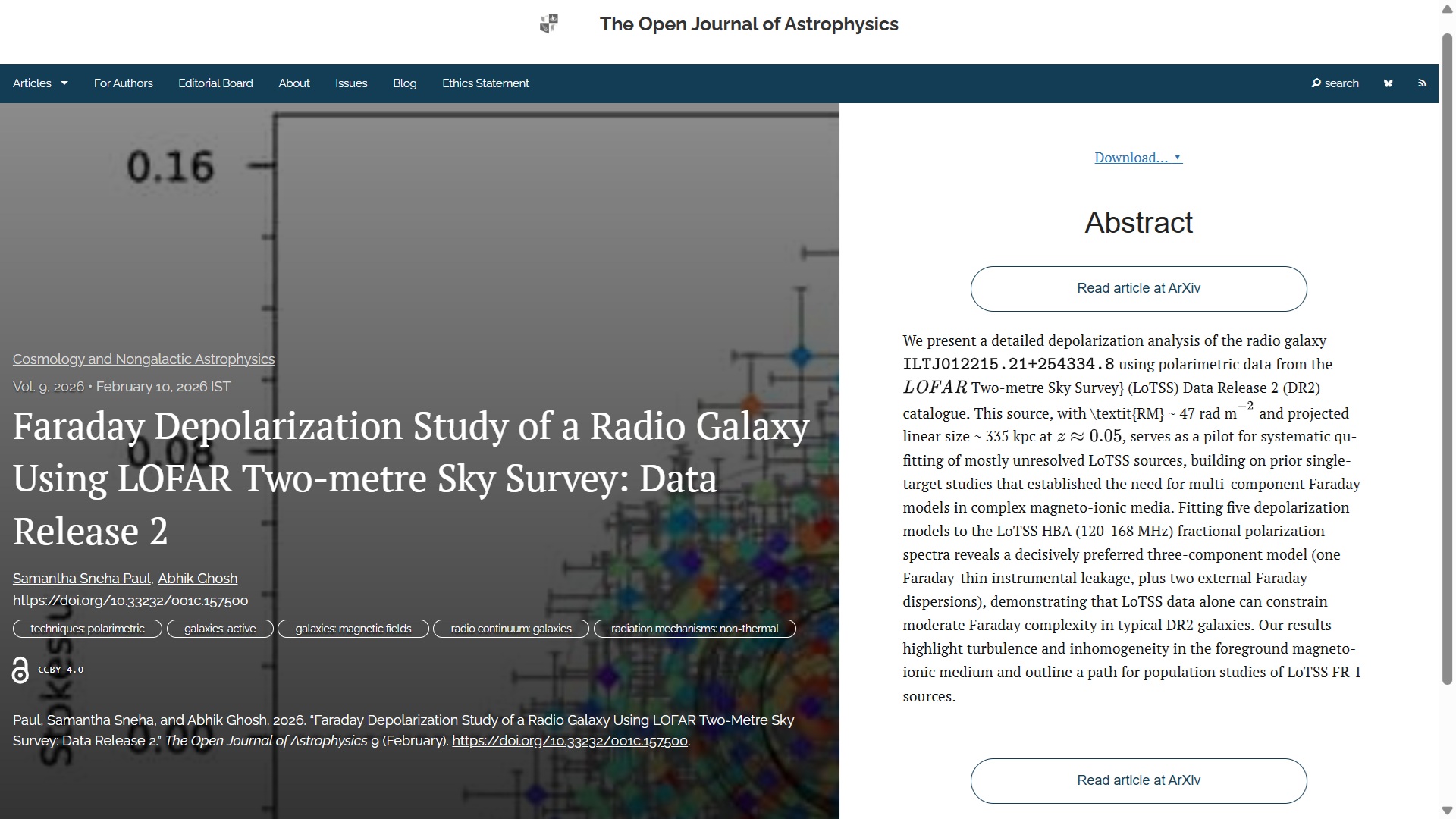
The first paper to report this week is “Faraday Depolarization Study of a Radio Galaxy Using LOFAR Two-metre Sky Survey: Data Release 2” by Samantha Sneha Paul and Abhik Ghosh (Banwarilal Bhalotia College, India). This was published on Tuesday February 10th in the folder Cosmology and Nongalactic Astrophysics. The paper analyzes the depolarization of radio galaxy ILTJ012215.21+254334.8 using LOFAR’s Sky Survey data, revealing a preferred three-component model and highlighting turbulence in the magneto-ionic medium.

The overlay is here:
You can find the officially accepted version on arXiv here and the announcement on Fediverse here:

Open Journal of Astrophysics

New Publication at the Open Journal of Astrophysics: "Faraday Depolarization Study of a Radio Galaxy Using LOFAR Two-metre Sky Survey: Data Release 2" by Samantha Sneha Paul and Abhik Ghosh (Banwarilal Bhalotia College, India)

doi.org/10.33232/001c.157500

February 10, 2026, 6:25 am 0 boosts 1 favorites

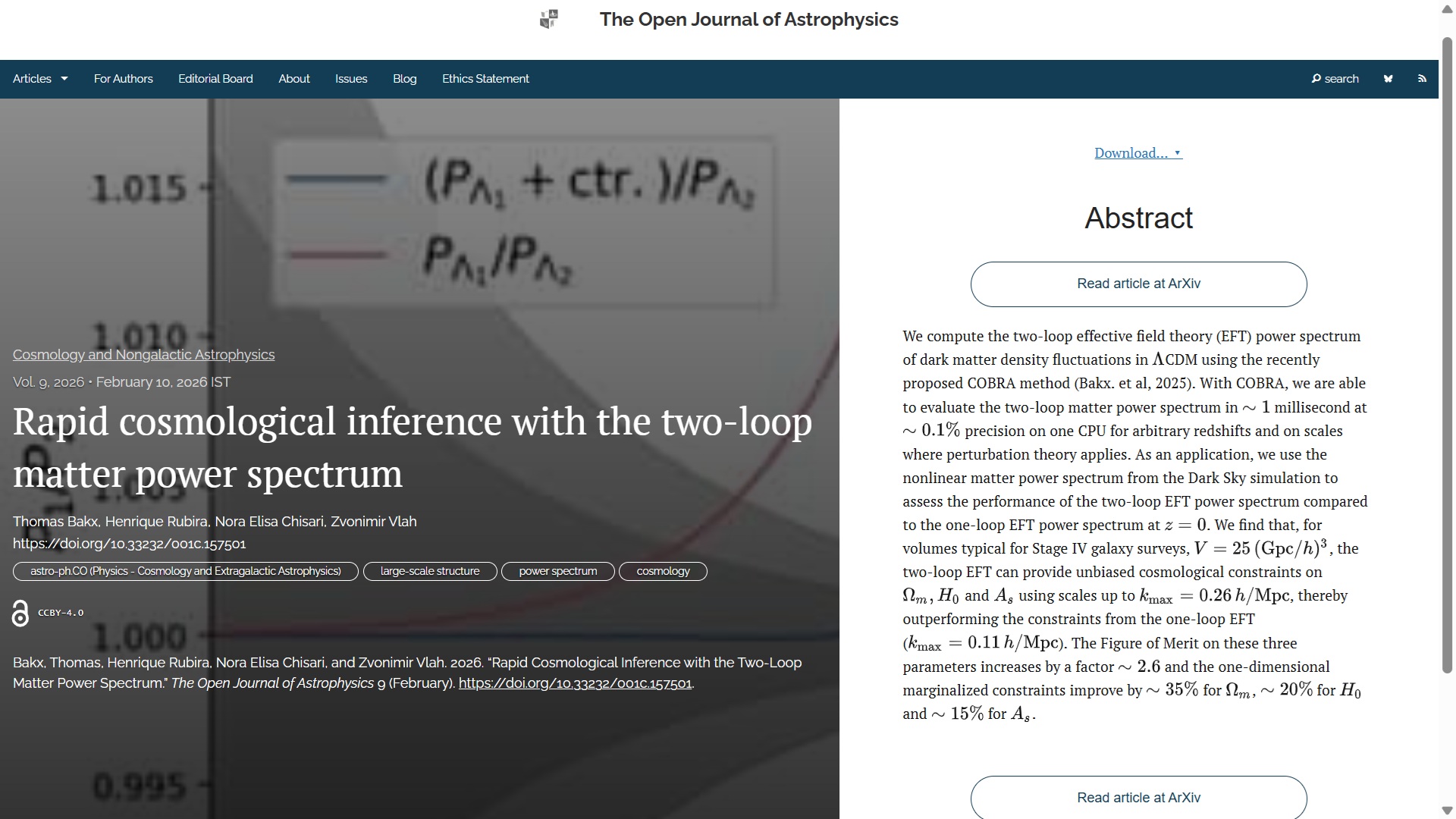
The second paper is “Rapid cosmological inference with the two-loop matter power spectrum” by Thomas Bakx (Utrecht U., NL), Henrique Rubira (Ludwig-Maximilians-Universität, DE), Nora Elisa Chisari (Utrecht) and Zvonimir Vlah (Ruđer Bošković Institute, Croatia). This was also published on Tuesday February 10th in the folder Cosmology and Nongalactic Astrophysics. This paper uses the COBRA method to compute the two-loop effective field theory power spectrum of dark matter density fluctuations, providing more precise cosmological constraints than the one-loop EFT.

The overlay for this one is here:
The official version of the paper can be found on arXiv here and the Fediverse announcement here:

Open Journal of Astrophysics

New Publication at the Open Journal of Astrophysics: "Rapid cosmological inference with the two-loop matter power spectrum" by Thomas Bakx (Utrecht U., NL), Henrique Rubira (Ludwig-Maximilians-Universität, DE), Nora Elisa Chisari (Utrecht) and Zvonimir Vlah (Ruđer Bošković Institute, Croatia)

doi.org/10.33232/001c.157501

February 10, 2026, 6:41 am 0 boosts 0 favorites

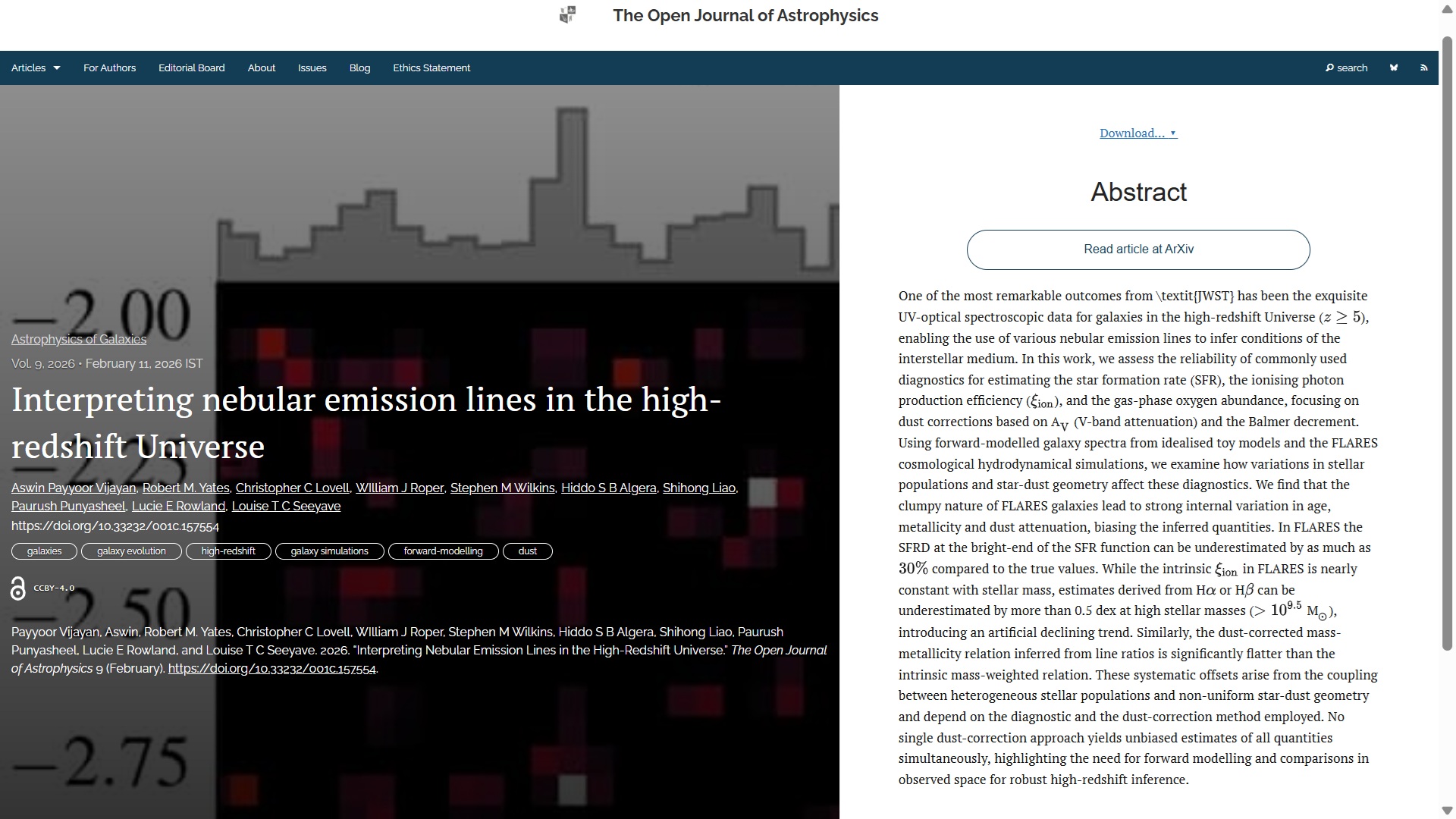
Next, published on Wednesday 11th February in the folder Astrophysics of Galaxies, is “Interpreting nebular emission lines in the high-redshift Universe” by Aswin P. Vijayan (U. Sussex, UK) and 9 others based in the UK, Taiwan, China and The Netherlands. This article examines the reliability of diagnostics used to estimate star formation rate and gas-phase oxygen abundance in high-redshift galaxies. It finds that variations in stellar populations and star-dust geometry. The overlay is here:
The official version can be found on arXiv here and the Fediverse announcement is here:

Open Journal of Astrophysics

New Publication at the Open Journal of Astrophysics: "Interpreting nebular emission lines in the high-redshift Universe" by Aswin P. Vijayan (U. Sussex, UK) and 9 others based in the UK, Taiwan, China and The Netherlands

doi.org/10.33232/001c.157554

February 11, 2026, 8:21 am 0 boosts 0 favorites

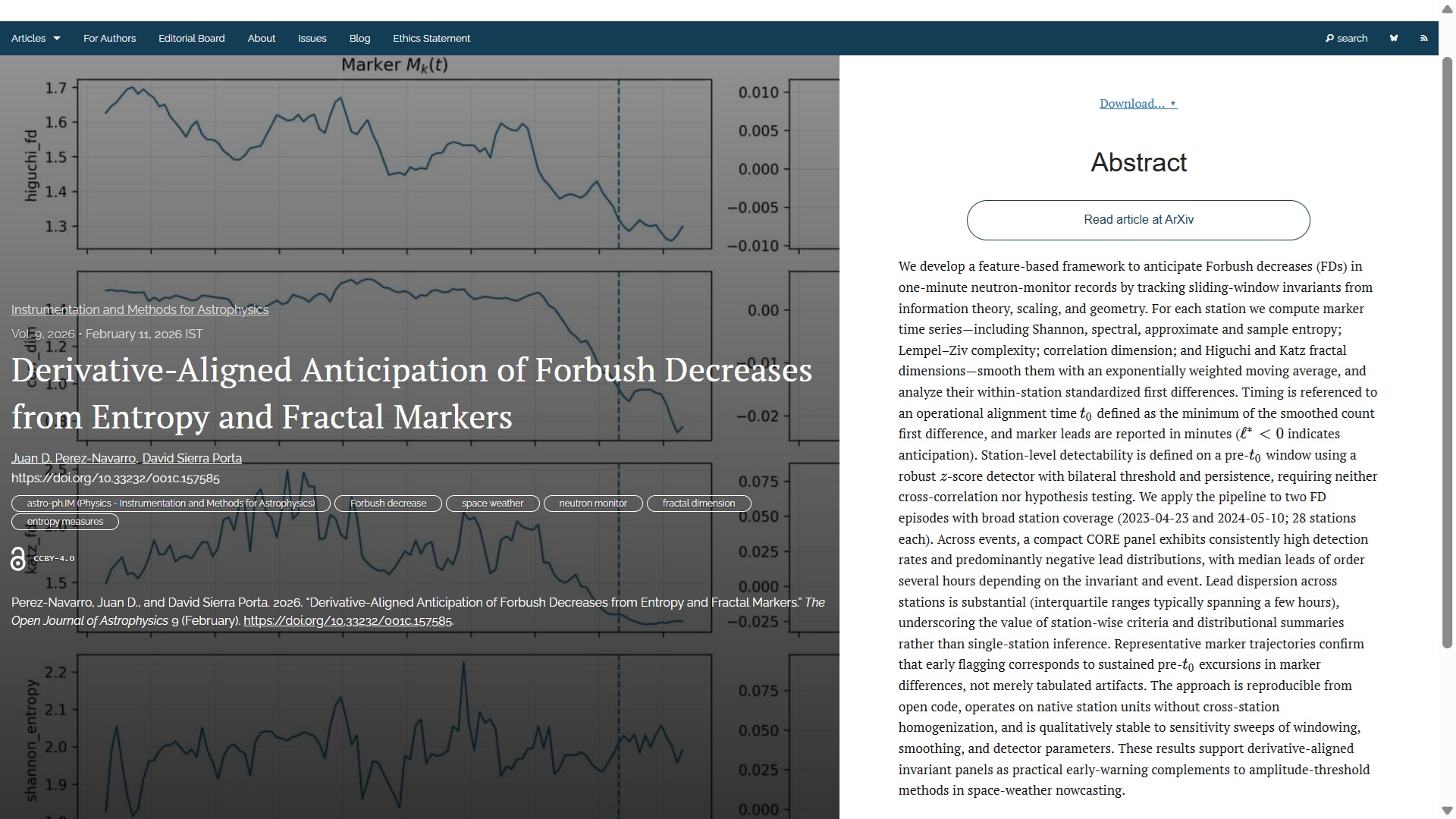
The fourth paper this week, also published on Wednesday 11th February, but in the folder Instrumentation and Methods for Astrophysics is “Derivative-Aligned Anticipation of Forbush Decreases from Entropy and Fractal Markers” by Juan D. Perez-Navarro & David Sierra Porta (Universidad Tecnológica de Bolívar, Colombia). The paper presents a feature-based framework for predicting Forbush decreases, i.e. rapid, temporary drops in galactic cosmic ray (GCR) intensity (up to tens of percent) caused by solar wind disturbances, typically Coronal Mass Ejections (CMEs) or high-speed streams from coronal holes, in neutron-monitor records using various computational methods. The approach is reproducible, operates on native station units, and is stable.

Here is the overlay:
The official version can be found on arXiv here and the Fediverse announcement is here:

Open Journal of Astrophysics

New Publication at the Open Journal of Astrophysics: "Derivative-Aligned Anticipation of Forbush Decreases from Entropy and Fractal Markers" by Juan D. Perez-Navarro & David Sierra Porta (Universidad Tecnológica de Bolívar, Colombia)

doi.org/10.33232/001c.157585

February 11, 2026, 5:19 pm 0 boosts 0 favorites

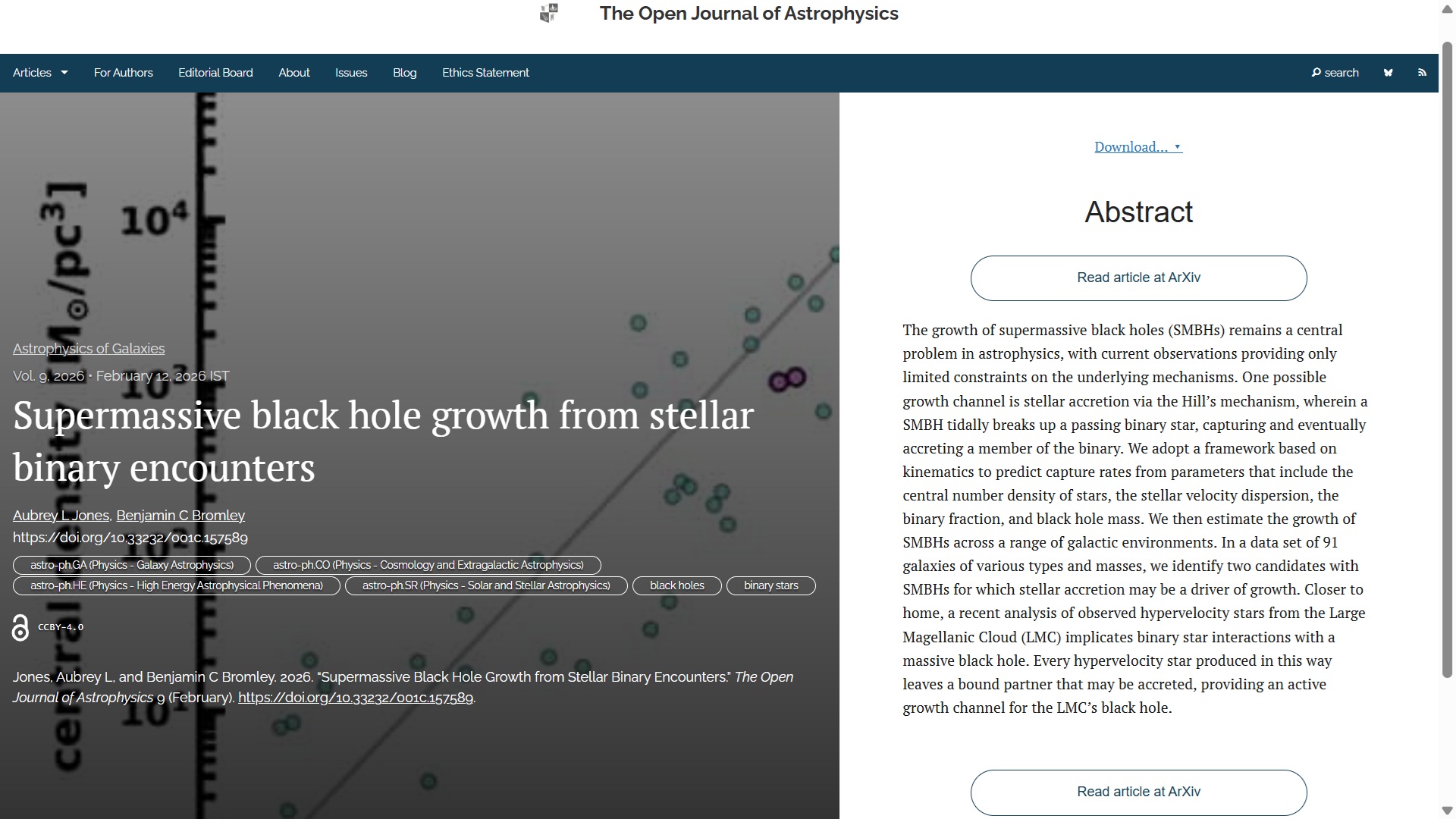
The fifth paper, the penultimate for this week, is “Supermassive black hole growth from stellar binary encounters” by Aubrey L Jones and Benjamin C Bromley (University of Utah, USA). This paper explores the growth of supermassive black holes (SMBHs) through stellar accretion via the Hill’s mechanism, predicting capture rates and identifying potential growth drivers in 91 galaxies. It was published on Thursday 11th February 2026 in the folder Astrophysics of Galaxies.

The overlay is here:
The accepted version can be found on arXiv here, and the fediverse announcement is here:

Open Journal of Astrophysics

New Publication at the Open Journal of Astrophysics: "Supermassive black hole growth from stellar binary encounters" by Aubrey L Jones and Benjamin C Bromley (University of Utah, USA)

doi.org/10.33232/001c.157589

February 12, 2026, 7:31 am 1 boosts 2 favorites

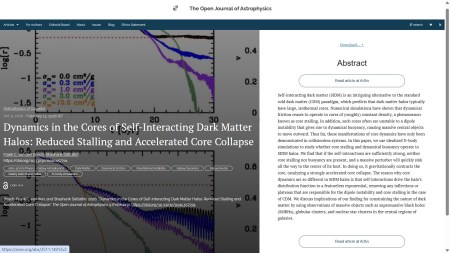
Finally for this week we have “Dynamics in the Cores of Self-Interacting Dark Matter Halos: Reduced Stalling and Accelerated Core Collapse” by Frank C. van den Bosch and Shashank Dattathri (Yale University, USA). This study uses simulations to explore core dynamics in self-interacting dark matter (SIDM) halos. Findings suggest strong self-interactions prevent core stalling and buoyancy, leading to accelerated core collapse. This was published yesterday, on Friday 13th February 2026, in the folder Astrophysics of Galaxies.

The overlay is here:
You can find the published version of the article here, and the Mastodon announcement is here:

Open Journal of Astrophysics

New Publication at the Open Journal of Astrophysics: "Dynamics in the Cores of Self-Interacting Dark Matter Halos: Reduced Stalling and Accelerated Core Collapse" by Frank C. van den Bosch and Shashank Dattathri (Yale University, USA)

doi.org/10.33232/001c.157701

February 13, 2026, 8:27 am 1 boosts 2 favorites

And that concludes this week’s update. I will do another next Saturday.
Weekly Update from the Open Journal of Astrophysics – 10/01/2026

Posted in OJAp Papers, Open Access, The Universe and Stuff with tags , , , , , , , , , , , , , , , , , , , on January 10, 2026 by telescoper

Welcome to the first proper update for 2026 from the Open Journal of Astrophysics. The New Year brings us to Volume 9. In many countries, especially in Europe, Christmas is celebrated on January 6th so this week was also affected by the holiday season. Nevertheless, since the last update we have published four papers, bringing the number in Volume 9 (2026) to 4 and the total so far published by OJAp up to 452.

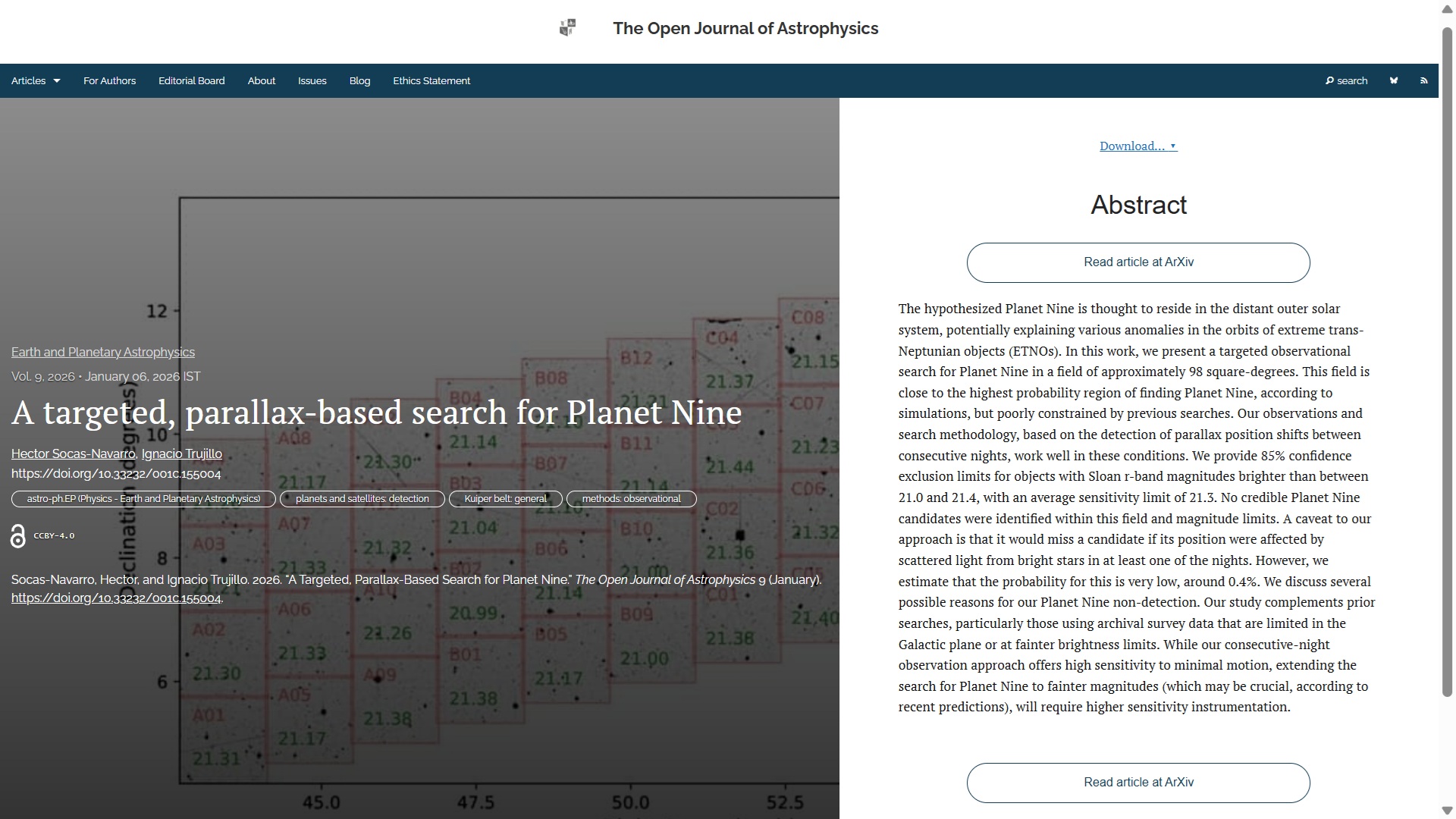
The first paper this week (and of course the first of 2026) is “A targeted, parallax-based search for Planet Nine” by Hector Socas-Navarro and Ignacio Trujillo (both of the Instituto de Astrofísica de Canaria, Spain). This article describes a targeted search for the hypothesized Planet Nine in the outer solar system, using parallax position shifts. No credible candidates were found within the observed field. It was published on Tuesday January 6th in the folder Earth and Planetary Astrophysics. The overlay is here:

You can find the officially accepted version on arXiv here and the announcement on Fediverse here:

Open Journal of Astrophysics

New Publication at the Open Journal of Astrophysics: "A targeted, parallax-based search for Planet Nine" by Hector Socas-Navarro and Ignacio Trujillo (Instituto de Astrofísica de Canaria, Spain)

doi.org/10.33232/001c.155004

January 6, 2026, 7:53 am 1 boosts 2 favorites

The second paper is “Going beyond S8: fast inference of the matter power spectrum from weak-lensing surveys” by Cyrille Doux (Université Grenoble Alpes, France) and Tanvi Karwal (U. Chicago, USA). This was published on Wednesday January 7th in the folder Cosmology and Nongalactic Astrophysics and it presents a new framework to extract the scale-dependent matter power spectrum from cosmic shear and CMB lensing measurements, revealing a consistent suppression in the matter power spectrum in galaxy-lensing. The overlay is here:

The official version of the paper can be found on arXiv here and the Fediverse announcement here:

Open Journal of Astrophysics

New Publication at the Open Journal of Astrophysics: "Going beyond $S_{8}$: fast inference of the matter power spectrum from weak-lensing surveys" by Cyrille Doux (Université Grenoble Alpes, France) and Tanvi Karwal (U. Chicago, USA)

doi.org/10.33232/001c.155045

January 7, 2026, 9:30 am 1 boosts 2 favorites

Next we have “Constraining the Stellar-to-Halo Mass Relation with Galaxy Clustering and Weak Lensing from DES Year 3 Data” which is led by G. Zacharegkas et al. (Argonne National Laboratory, USA) and has 102 other authors too numerous to list by name from many institutions around the world again too numerous to list by name. It presents a framework to analyze the relationship between a galaxy’s stellar mass and its dark matter halo mass, using data from the Dark Energy Survey. The findings align with previous results. This paper was published on Thursday January 8th in the folder Astrophysics of Galaxies. The overlay is here:

The official version can be found on arXiv here and the Fediverse announcement is here:

Open Journal of Astrophysics

New Publication at the Open Journal of Astrophysics: "Constraining the Stellar-to-Halo Mass Relation with Galaxy Clustering and Weak Lensing from DES Year 3 Data" by G. Zacharegkas et al. (Argonne National Laboratory, USA) and 102 others based in numerous countries.

doi.org/10.33232/001c.155046

January 8, 2026, 10:20 am 1 boosts 1 favorites

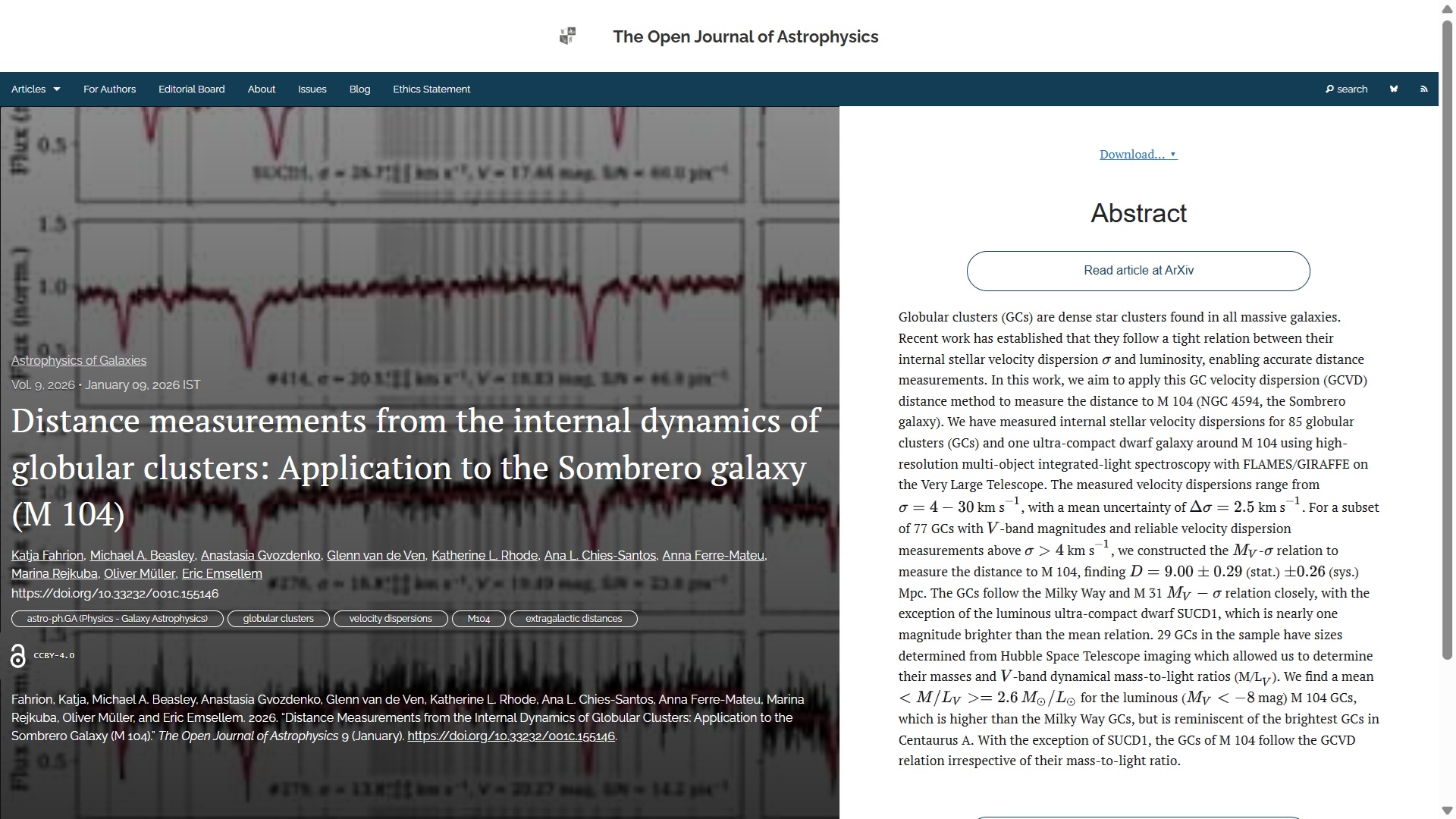
Finally for this week we have “Distance measurements from the internal dynamics of globular clusters: Application to the Sombrero galaxy (M 104)” by Katja Fahrion (University of Vienna, Austria) and 9 others based in Spain, Australia, UK, USA, Brazil, Germany and Switzerland. This was published on Friday 9th January (yesterday) in the folder Astrophysics of Galaxies. This study uses the globular cluster velocity dispersion method to measure the distance to the Sombrero galaxy, finding it to be approximately 9.0 Mpc away. The overlay is here:

The officially accepted version can be found on arXiv here and the Fediverse announcement here:

Open Journal of Astrophysics

New Publication at the Open Journal of Astrophysics: "Distance measurements from the internal dynamics of globular clusters: Application to the Sombrero galaxy (M 104)" by Katja Fahrion (University of Vienna, Austria) and 9 others based in Spain, Australia, UK, USA, Brazil, Germany and Switzerland.

doi.org/10.33232/001c.155146

January 9, 2026, 9:30 am 1 boosts 2 favorites

That concludes the update for this week. I will do another next Saturday.
Two New Publications at the Open Journal of Astrophysics

Posted in OJAp Papers, Open Access, The Universe and Stuff with tags , , , , , , , , , , , on February 1, 2024 by telescoper

As the first month of 2024 is now over, I thought I’d post an update relating to the  Open Journal of Astrophysics.  Since the last update we have published two papers, taking  the count in Volume 7 (2024) up to 9 (the total for January) and the total published by OJAp up to 124. We will have others soon, but I will be travelling for the first few days of February so the next update will be in a week or so.

Using our sophisticated forecasting algorithm, based on the first month of 2024 as input, I predict that we will publish around 9×12=108 papers in 2024, more than double last year’s total of 50.

Both the current papers discussed here are in the folder marked Cosmology and NonGalactic Astrophysics, our most popular category.

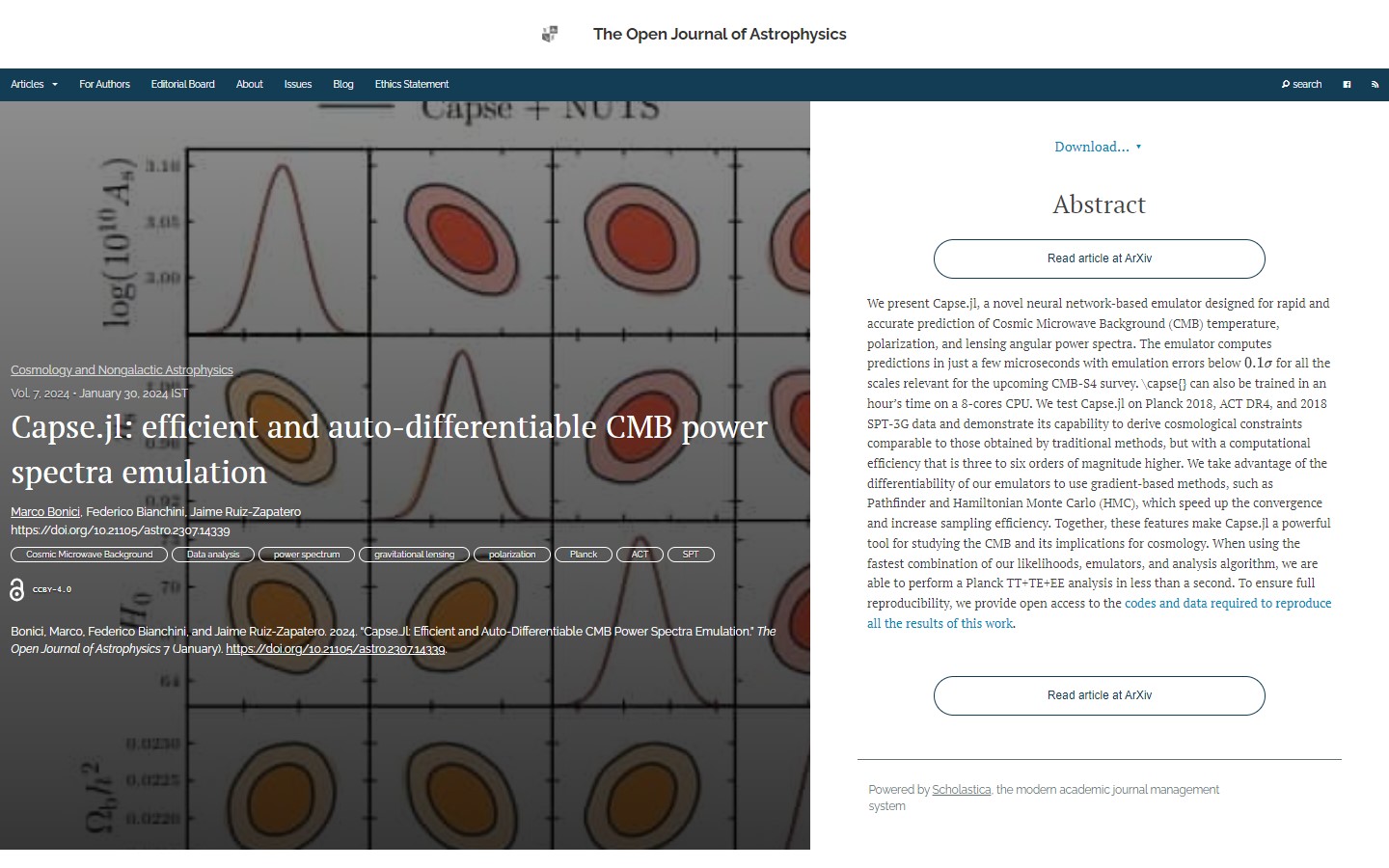
Anyway, the first paper of the most recent pair – published on January 30th – is “Capse.jl: efficient and auto-differentiable CMB power spectra emulation”, by Marco Bonici (INAF Milano, Italy & Waterloo, Canada), Federico Bianchini (Stanford, USA) and Jaime Ruiz-Zapatero (Oxford, UK). This paper presents an emulator for rapid and accurate prediction of Cosmic Microwave Background (CMB) temperature, polarization, and lensing angular power spectra, that works much faster than traditional methods. The code is written in Julia, in which language we are seeing an increasing number of submissions to OJAp.

Here is a screen grab of the overlay which includes the abstract:


You can click on the image of the overlay to make it larger should you wish to do so. You can find the officially accepted version of the paper on the arXiv here.

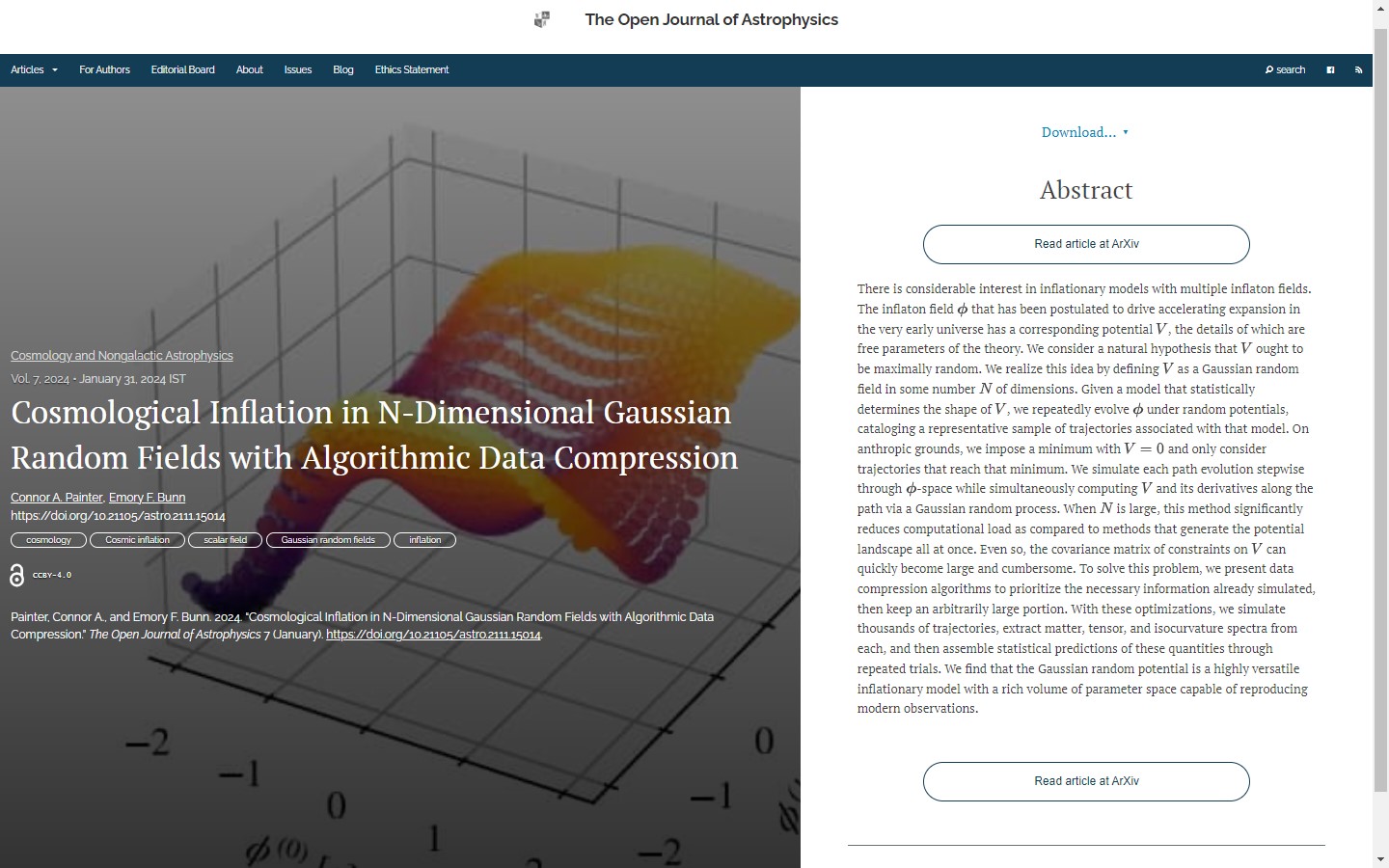
The second paper was published yesterday (31st January 2024) and has the title “Cosmological Inflation in N-Dimensional Gaussian Random Fields with Algorithmic Data Compression” which is a  study of inflationary models with Gaussian random potentials for multiple scalar fields, tracking the evolutionary trajectories numerically. The authors are Connor Painter and Emory Bunn, both the Physics Department at the University of Richmond, Virginia (USA). Ted Bunn (as he is usually known) is a longstanding member of the Editorial Board of the Open Journal of Astrophysics (and was thereby excluded from any involvement in the editorial process for this paper).

Here is a screen grab of the overlay which includes the abstract:


You can click on the image of the overlay to make it larger should you wish to do so. You can find the officially accepted version of the paper on the arXiv here.

Here Endeth the Update.

With the Cosmic Web in Mind..

Posted in Astronomy Lookalikes, The Universe and Stuff with tags , , , , , on November 23, 2019 by telescoper

Some time ago I posted one of my Astronomy Look-alikes about the remarkable similarity between the structure of the human brain and that revealed by computer simulations of the large-scale structure of the Universe:

I wonder whether this means that the Cosmic Web is really just all in the mind?

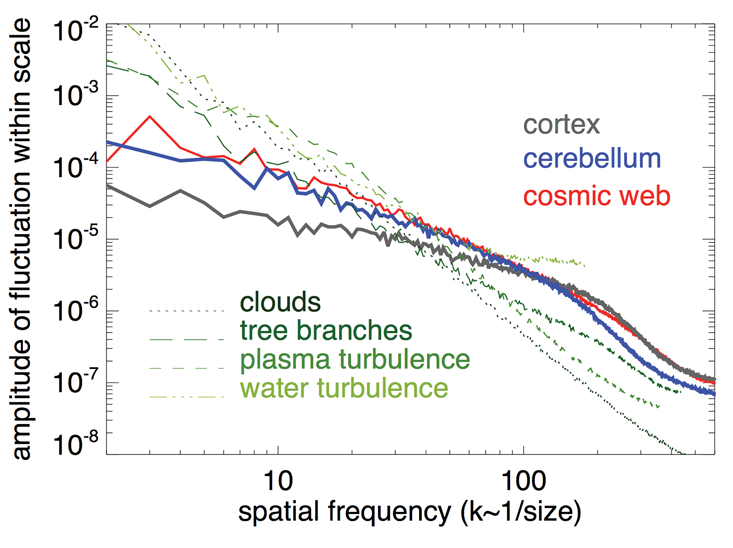
Anyway I just came across an article by Franco Vazza and Alberto Fenetti that takes the comparison between brain cells (among other things) and the Cosmic Web a bit further, including a look at the corresponding power spectra:

The main point to take from this picture is that many naturally occurring patterns have approximately power-law power spectra, at least over a limited range of scales. However, as I have pointed out before on this blog, the power spectrum on its own does not really quantify pattern in any meaningful way. Here for example are two patterns with exactly the same power spectrum:

The point is that the power spectrum does not contain any information about the phase correlations of the Fourier modes, which are important in quantifying localised features. For further discussion of this issue, see here.

The Power Spectrum and the Cosmic Web

Posted in Bad Statistics, The Universe and Stuff with tags , , , , , , on June 24, 2014 by telescoper

One of the things that makes this conference different from most cosmology meetings is that it is focussing on the large-scale structure of the Universe in itself as a topic rather a source of statistical information about, e.g. cosmological parameters. This means that we’ve been hearing about a set of statistical methods that is somewhat different from those usually used in the field (which are primarily based on second-order quantities).

One of the challenges cosmologists face is how to quantify the patterns we see in galaxy redshift surveys. In the relatively recent past the small size of the available data sets meant that only relatively crude descriptors could be used; anything sophisticated would be rendered useless by noise. For that reason, statistical analysis of galaxy clustering tended to be limited to the measurement of autocorrelation functions, usually constructed in Fourier space in the form of power spectra; you can find a nice review here.

Because it is so robust and contains a great deal of important information, the power spectrum has become ubiquitous in cosmology. But I think it’s important to realise its limitations.

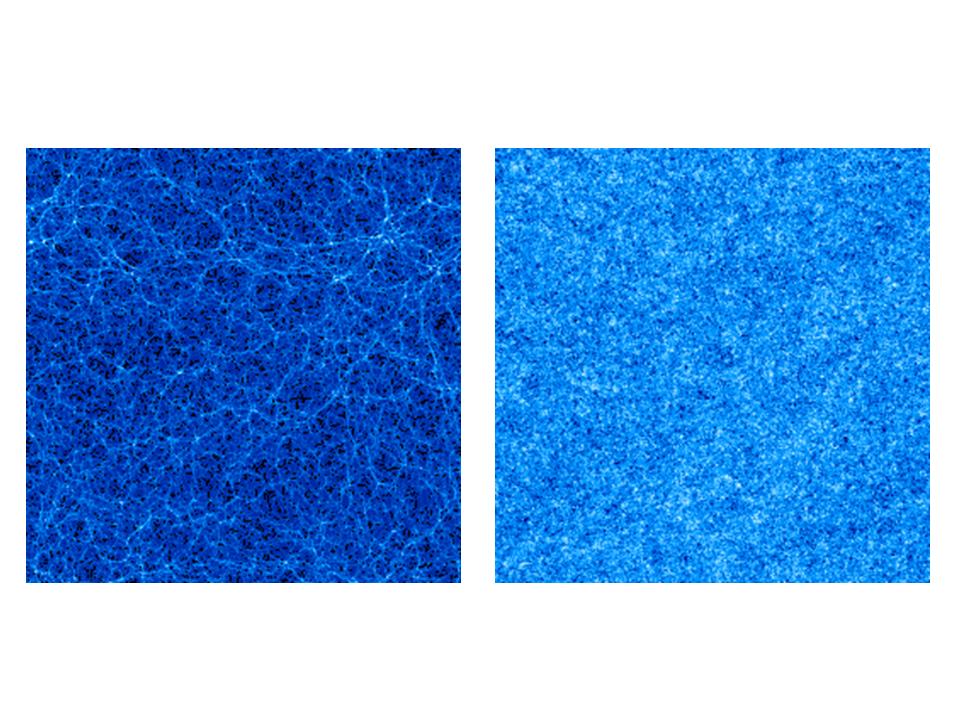
Take a look at these two N-body computer simulations of large-scale structure:

The one on the left is a proper simulation of the “cosmic web” which is at least qualitatively realistic, in that in contains filaments, clusters and voids pretty much like what is observed in galaxy surveys.

To make the picture on the right I first  took the Fourier transform of the original  simulation. This approach follows the best advice I ever got from my thesis supervisor: “if you can’t think of anything else to do, try Fourier-transforming everything.”

Anyway each Fourier mode is complex and can therefore be characterized by an amplitude and a phase (the modulus and argument of the complex quantity). What I did next was to randomly reshuffle all the phases while leaving the amplitudes alone. I then performed the inverse Fourier transform to construct the image shown on the right.

What this procedure does is to produce a new image which has exactly the same power spectrum as the first. You might be surprised by how little the pattern on the right resembles that on the left, given that they share this property; the distribution on the right is much fuzzier. In fact, the sharply delineated features  are produced by mode-mode correlations and are therefore not well described by the power spectrum, which involves only the amplitude of each separate mode. In effect, the power spectrum is insensitive to the part of the Fourier description of the pattern that is responsible for delineating the cosmic web.

If you’re confused by this, consider the Fourier transforms of (a) white noise and (b) a Dirac delta-function. Both produce flat power-spectra, but they look very different in real space because in (b) all the Fourier modes are correlated in such away that they are in phase at the one location where the pattern is not zero; everywhere else they interfere destructively. In (a) the phases are distributed randomly.

The moral of this is that there is much more to the pattern of galaxy clustering than meets the power spectrum…

SPT and the CMB

Posted in The Universe and Stuff with tags , , , , , , , , , on November 30, 2012 by telescoper

I’ve been remiss in not yet passing on news  from the South Pole Telescope, which has recently produced a number of breakthrough scientific results, including:  improved cosmological constraints from the SPT-SZ cluster survey (preprint here); a new catalogue of 224 SZ-selected cluster candidates from the first 720 square-degrees of the survey (preprint here); the first measurement of galaxy bias from the gravitational lensing of the CMB (preprint here); the first CMB-based constraint on the evolution of the ionized fraction during the epoch of reionization (preprint here); the most-significant detection of non-Gaussianity induced from the gravitational lensing of the CMB (preprint here); and the most precise measurement of the CMB damping tail and improved constraints on models of Inflation (preprint here).

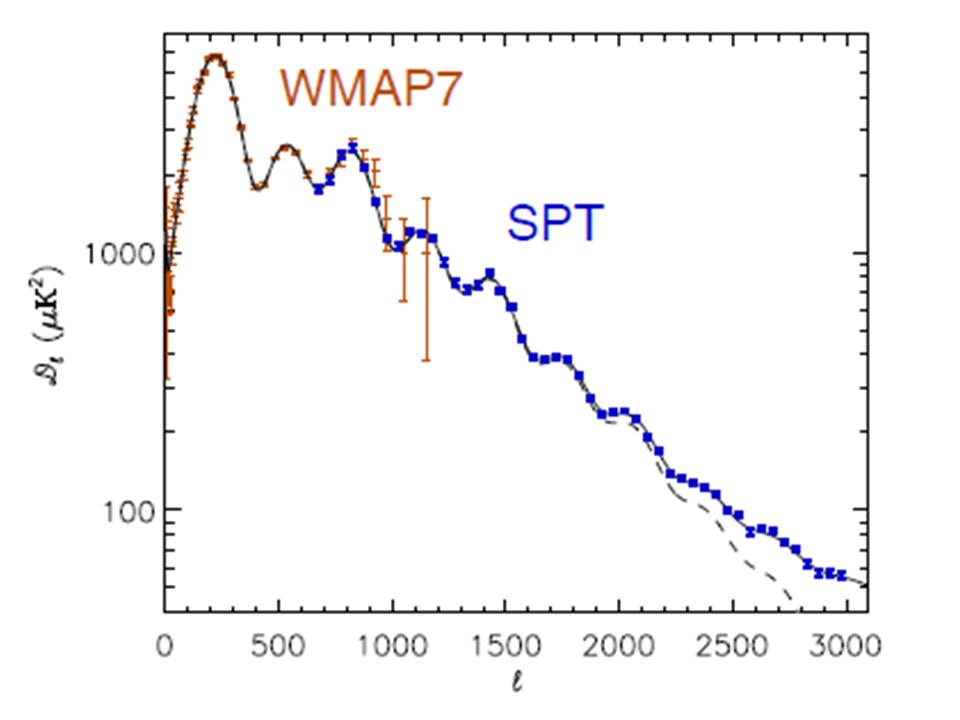
Here’s the graph that drew my eye (from this paper). It shows the (angular) power spectrum of the cosmic microwave for very high (angular) frequency spherical harmonics; the resolution of SPT allows it to probe finer details of the spectrum that WMAP (also shown, at lower l).

Slide1

This is an amazing graph, especially for oldies like me who remember being so impressed by the emergence of the first “acoustic peak” at around l=200 way back in the days of Boomerang and Maxima and gobsmacked by WMAP’s revelation of the second and third. Now there are at least six acoustic peaks, although of progressively lower amplitude. The attenuation of the CMB fluctuations at high frequencies is the result of diffusion damping – similar to the way high-frequency sound waves are attenuated when they pass through a diffusive medium (e.g. a gas).  The phenomenon in this case is usually called Silk Damping, as it was first worked out back in the 1960s by Joe Damping Silk.

Anyway, there’ll be a lot more CMB news early (?) next year from Planck which will demonstrate yet again that cosmic microwave background physics has certainly come a long way from pigeon shit

Power versus Pattern

Posted in Bad Statistics, The Universe and Stuff with tags , , , , , on June 15, 2012 by telescoper

One of the challenges we cosmologists face is how to quantify the patterns we see in galaxy redshift surveys. In the relatively recent past the small size of the available data sets meant that only relatively crude descriptors could be used; anything sophisticated would be rendered useless by noise. For that reason, statistical analysis of galaxy clustering tended to be limited to the measurement of autocorrelation functions, usually constructed in Fourier space in the form of power spectra; you can find a nice review here.

Because it is so robust and contains a great deal of important information, the power spectrum has become ubiquitous in cosmology. But I think it’s important to realise its limitations.

Take a look at these two N-body computer simulations of large-scale structure:

The one on the left is a proper simulation of the “cosmic web” which is at least qualitatively realistic, in that in contains filaments, clusters and voids pretty much like what is observed in galaxy surveys.

To make the picture on the right I first  took the Fourier transform of the original  simulation. This approach follows the best advice I ever got from my thesis supervisor: “if you can’t think of anything else to do, try Fourier-transforming everything.”

Anyway each Fourier mode is complex and can therefore be characterized by an amplitude and a phase (the modulus and argument of the complex quantity). What I did next was to randomly reshuffle all the phases while leaving the amplitudes alone. I then performed the inverse Fourier transform to construct the image shown on the right.

What this procedure does is to produce a new image which has exactly the same power spectrum as the first. You might be surprised by how little the pattern on the right resembles that on the left, given that they share this property; the distribution on the right is much fuzzier. In fact, the sharply delineated features  are produced by mode-mode correlations and are therefore not well described by the power spectrum, which involves only the amplitude of each separate mode.

If you’re confused by this, consider the Fourier transforms of (a) white noise and (b) a Dirac delta-function. Both produce flat power-spectra, but they look very different in real space because in (b) all the Fourier modes are correlated in such away that they are in phase at the one location where the pattern is not zero; everywhere else they interfere destructively. In (a) the phases are distributed randomly.

The moral of this is that there is much more to the pattern of galaxy clustering than meets the power spectrum…