Archive for Lyman-alpha

Weekly Update from the Open Journal of Astrophysics 18/07/2026

Posted in OJAp Papers, Open Access, The Universe and Stuff with tags , , , , , , , , , , , , , , , , , , , , , , , , , , , , , , , , , , on July 18, 2026 by telescoper

It’s time once more for another Saturday update of activity at the Open Journal of Astrophysics. Since the last update we have published a further six papers, bringing the number in Volume 9 (2026) to 151 and the total so far published by OJAp up to 599.

I will continue to include the posts made on our Mastodon account (on Fediscience); these announcements also show the DOI for each paper.

The first paper to report this week, published on Tuesday 14th July, is “On combining estimated and analytic covariance matrices” by Alan Heavens (Imperial College London, UK), Lorne Whiteway (University College, London, UK) and Elena Sellentin (Leiden University, The Netherlands). This article, published in the folder Cosmology and Nongalactic Astrophysics, presents an accurate approximation for the combined likelihood function in cosmological data analysis, improving upon previous methods by better representing the heavy tails of the true distribution.

The overlay for this paper is here
You can find the officially accepted version on arXiv here and the announcement on Fediverse here:

Open Journal of Astrophysics

New Publication at the Open Journal of Astrophysics: "On combining estimated and analytic covariance matrices" by Alan Heavens (Imperial College London, UK), Lorne Whiteway (University College, London, UK) and Elena Sellentin (Leiden University, The Netherlands)

doi.org/10.33232/001c.165025

July 14, 2026, 6:48 am 1 boosts 0 favorites

The second paper for this week, also published on Tuesday 14th July in the folder Cosmology and Nongalactic Astrophysics is: “Line-of-sight shear in SLACS strong lenses II: validation tests with an extended sample” by Natalie B. Hogg (U. Cambridge, UK), Daniel P. Johnson (Université de Montpellier, France), Anowar J. Shajib (U. Chicago, USA) and Julien Larena (Montpellier). The study described in this paper models 27 additional gravitational lenses, finding a significant fraction with unexpectedly large line-of-sight shears. Factors like redshift, filter, and signal-to-noise ratio don’t significantly affect shear magnitudes.

The overlay looks like this:
The official version of the paper can be found on arXiv here and the Fediverse announcement here:

Open Journal of Astrophysics

New Publication at the Open Journal of Astrophysics: "Line-of-sight shear in SLACS strong lenses II: validation tests with an extended sample" by Natalie B. Hogg (U. Cambridge, UK), Daniel P. Johnson (Université de Montpellier, France), Anowar J. Shajib (U. Chicago, USA) and Julien Larena (Montpellier)

doi.org/10.33232/001c.165032

July 14, 2026, 6:57 am 1 boosts 1 favorites

The third paper of the week, published on Wednesday 15th July, again in the folder Cosmology and Nongalactic AstrophysicsInvestigating the Dark Energy Constraint from Strongly Lensed AGN at LSST-Scale” by Sydney Erickson (Stanford University, USA) and 13 others on behalf of The LSST Dark Energy Science Collaboration. The study uses a new technique to analyze a large sample of lensed Active Galactic Nuclei, providing an independent probe of dark energy and improving constraints on the Universe’s expansion.

The overlay for this one is here:
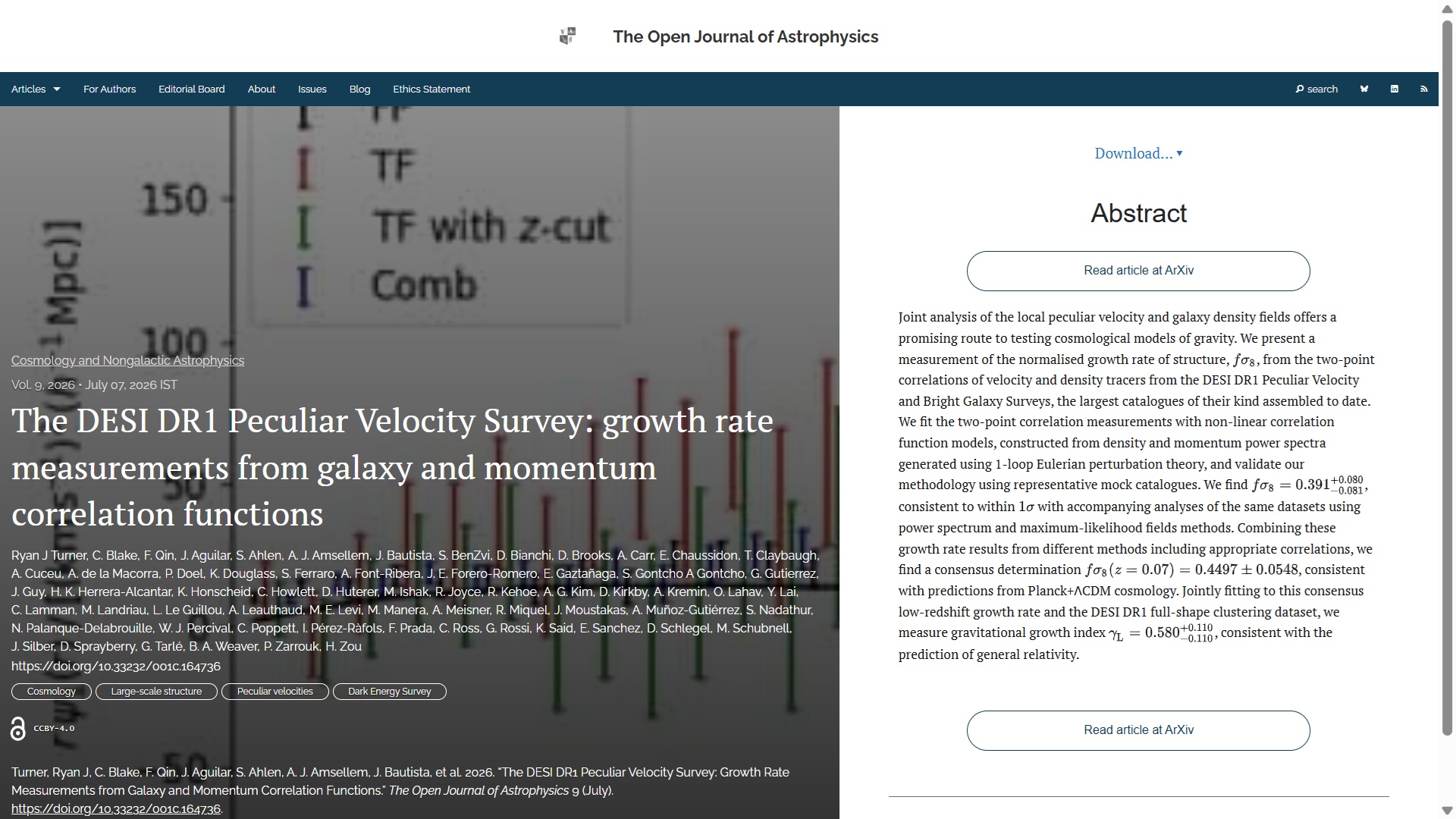
The final, accepted version can be found on arXiv here and the Mastodon announcement is here:

Open Journal of Astrophysics

New Publication at the Open Journal of Astrophysics: "Investigating the Dark Energy Constraint from Strongly Lensed AGN at LSST-Scale" by Sydney Erickson (Stanford University, USA) and 13 others on behalf of The LSST Dark Energy Science Collaboration

doi.org/10.33232/001c.164440

July 15, 2026, 7:08 am 1 boosts 1 favorites

The fourth paper of the week, also published on Wednesday 15th July but in the folder Earth and Planetary Astrophysics is “University of Hawaii 88-inch Telescope Observations of the Interstellar Comet 3I/ATLAS: Spectrophotometric Blue-Sensitive Spectral Time Series Spanning Two Months from Discovery” by W. B. Hoogendam (University of Hawaii, USA) and 24 others from around the world. The study presents observations of the third interstellar object, 3I/ATLAS, using the SuperNova Integral Field Spectrograph, revealing its properties and comparing it to bodies in our solar system.

The overlay for this one is here:
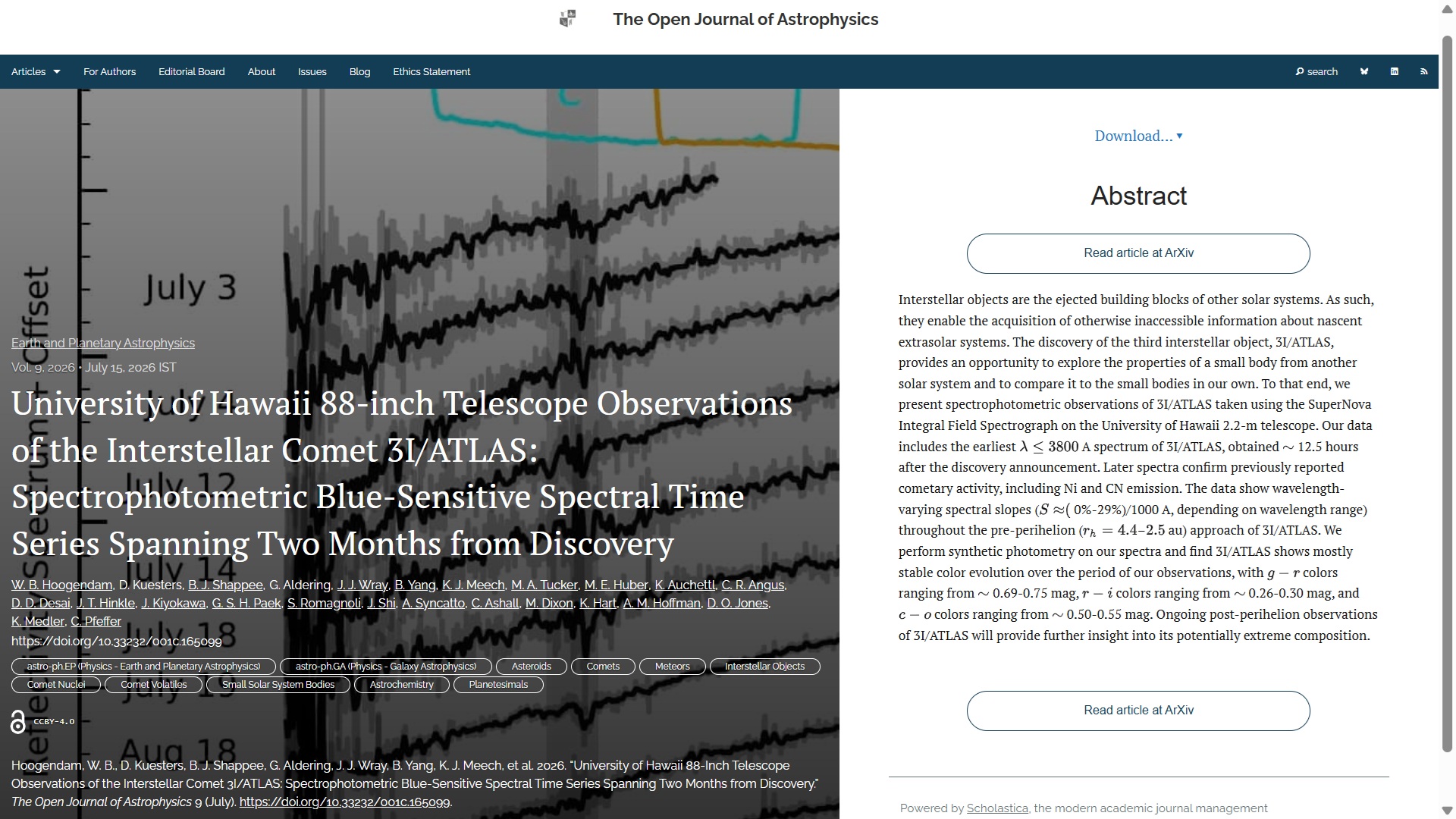
You can read the final version of this one on arXiv here and the Mastodon announcement is here:

Open Journal of Astrophysics

New Publication at the Open Journal of Astrophysics: "University of Hawaii 88-inch Telescope Observations of the Interstellar Comet 3I/ATLAS: Spectrophotometric Blue-Sensitive Spectral Time Series Spanning Two Months from Discovery" by W. B. Hoogendam (University of Hawaii, USA) and 24 others from around the world.

doi.org/10.33232/001c.165099

July 15, 2026, 7:21 pm 1 boosts 3 favorites

The fifth paper of the week, published on Friday 17th July in the folder Astrophysics of Galaxies, is “The birth of the intracluster medium: the evolution of multiphase gas and Lyman-α haloes in a z~3 simulated protocluster” by Jake S. Bennett (Harvard Smithsonian CfA, USA), Aaron Smith (U. Nottingham, UK), Fabrizio Arrigoni-Battaia (MPA Garching, Germany), Debora Sijacki (U. Cambridge, UK) , Cassandra Lochhaas (CfA) and Lars Hernquist (CfA). This study uses a cosmological simulation to explore the transition from complex galactic haloes to mature galaxy clusters, focusing on gas distribution, ionisation, and emission changes during this evolution.

The overlay for this one is here:
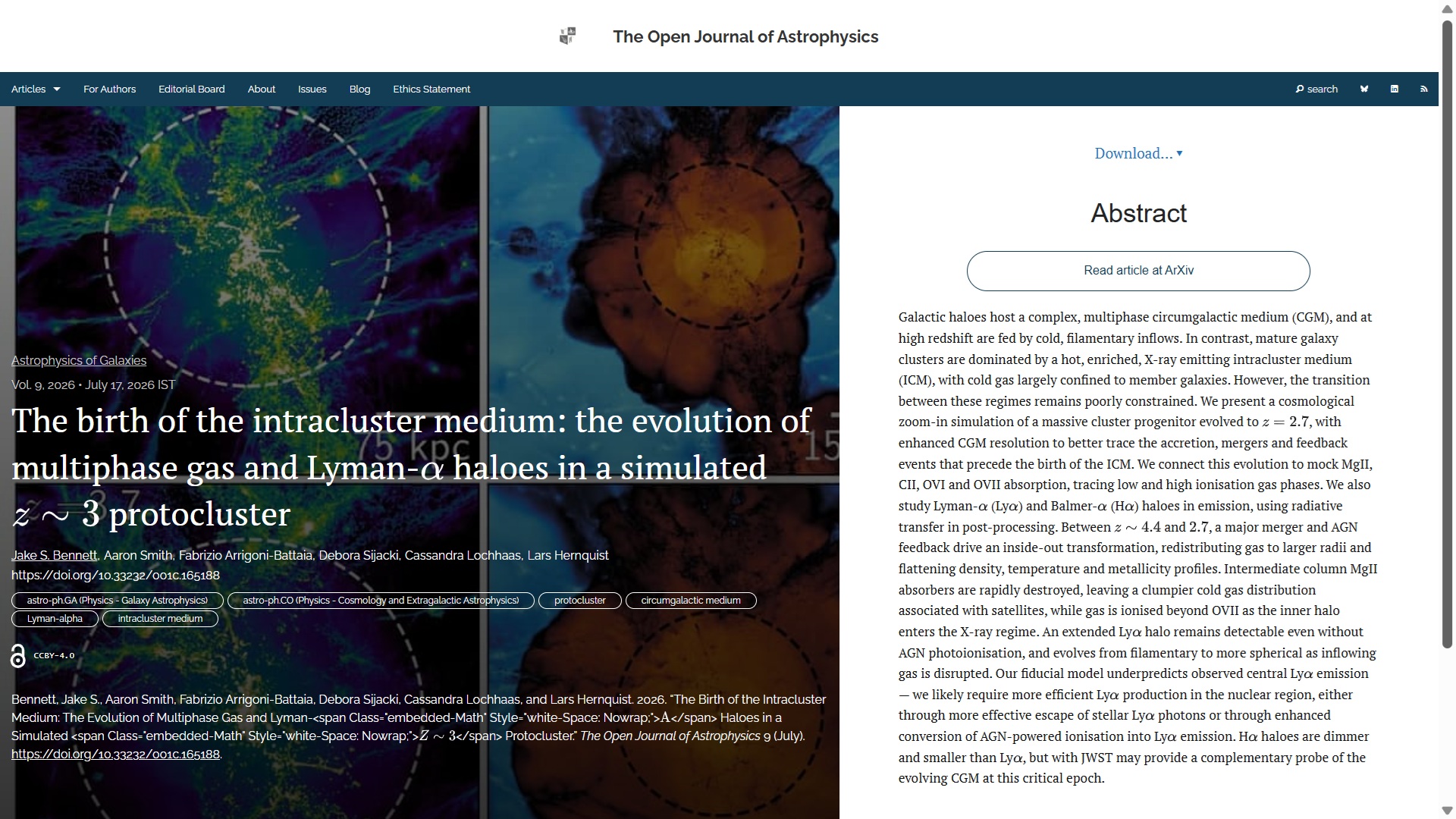
You can read the final version of this one on arXiv here and the Mastodon announcement is here:

Open Journal of Astrophysics

New Publication at the Open Journal of Astrophysics: "The birth of the intracluster medium: the evolution of multiphase gas and Lyman-α haloes in a z~3 simulated protocluster" by Jake S. Bennett (Harvard Smithsonian CfA, USA), Aaron Smith (U. Nottingham, UK), Fabrizio Arrigoni-Battaia (MPA Garching, Germany), Debora Sijacki (U. Cambridge, UK) , Cassandra Lochhaas (CfA) and Lars Hernquist (CfA).

doi.org/10.33232/001c.165188

July 17, 2026, 7:23 am 0 boosts 0 favorites

The sixth and final paper paper of this week is “”Density reconstruction from biased tracers: Testing the equivalence principle through consistency relations” by Lawrence Dam and Omar Darwish (Université de Genève, Switzerland). This was published on Friday 17th July in the folder Cosmology and Nongalactic Astrophysics. It proposes using quadratic estimators to test the weak equivalence principle on cosmological scales, offering a practical alternative to the conventional bispectrum approach.

The overlay for this one is here:

You can find the final accepted version on arXiv here and the Mastodon announcement is here:

Open Journal of Astrophysics

New Publication at the Open Journal of Astrophysics: "Density reconstruction from biased tracers: Testing the equivalence principle through consistency relations" by Lawrence Dam and Omar Darwish (Université de Genève, Switzerland)

doi.org/10.33232/001c.165214

July 17, 2026, 7:42 am 0 boosts 0 favorites

As you can see we have now published over 150 papers this year and are just one shy of 600 in total. I expect we’ll pass that milestone next week. I’ll do another update next Saturday.

Weekly Update from the Open Journal of Astrophysics – 06/12/2025

Posted in OJAp Papers, Open Access, The Universe and Stuff with tags , , , , , , , , , , , , , , , , , , , , , , , , , , , on December 6, 2025 by telescoper

Once again it’s time for the usual Saturday morning update of the week’s new papers at the Open Journal of Astrophysics. Since the last update we have published a further six papers, which brings the number in Volume 8 (2025) up to 190, and the total so far published by OJAp up to 425. I blogged about the significance of the latter figure here.

The first paper this week is “The galaxy-IGM connection in THESAN: observability and information content of the galaxy-Lyman-alpha cross-correlation at z>6” by Enrico Garaldi (U. Tokyo, Japan), Verena Bellscheidt (Tech. U. Munich, Germany), Aaron Smith (U. Texas Austin, USA) and Rahul Kannan (York U. Canada). This paper was published on Monday 1st December 2025 in the folder Cosmology and Nongalactic Astrophysics. It describes an investigation of the impact of observational limitations on the ability to retrieve the intrinsic galaxy-Lyman-alpha cross correlation from line-of-sight observations.

The overlay is here:


You can find the officially accepted version on arXiv here and the Fediverse announcement is here:

Open Journal of Astrophysics

New Publication at the Open Journal of Astrophysics: "The galaxy-IGM connection in THESAN: observability and information content of the galaxy-Lyman-alpha cross-correlation at z>6" by Enrico Garaldi (U. Tokyo, Japan), Verena Bellscheidt (Tech. U. Munich, Germany), Aaron Smith (U. Texas Austin, USA) and Rahul Kannan (York U. Canada)

doi.org/10.33232/001c.151666

December 1, 2025, 8:37 am 1 boosts 0 favorites

The second paper of the week is “A Less Terrifying Universe? Mundanity as an Explanation for the Fermi Paradox” by Robin H.D. Corbet (U. Maryland, USA). This paper was published on 1st December 2025 in the folder Instrumentation and Methods for Astrophysics. It presents a discussion of possible explanations for the lack of s evidence for the presence of technology-using extraterrestrial civilizations in the Galaxy (usually called the Fermi paradox). The overlay is here:


You can find the official version of this one on arXiv here. The federated announcement on Mastodon is here:

Open Journal of Astrophysics

New Publication at the Open Journal of Astrophysics: "A Less Terrifying Universe? Mundanity as an Explanation for the Fermi Paradox" by Robin H.D. Corbet (U. Maryland, USA)

doi.org/10.33232/001c.151454

December 1, 2025, 8:50 am 2 boosts 2 favorites


Next one up is “Sulphur abundances in star-forming regions from optical emission lines: A new approach based on photoionization models consistent with the direct method” by Enrique Pérez-Montero, Borja Pérez-Díaz, & José M. Vílchez ( (Instituto de Astrofísica de Andalucía, Spain), Igor A. Zinchenko (LMU, Germany), Asier Castrillo, Marta Gavilán, Sandra Zamora & Ángeles I. Díaz (Universidad Autonoma de Madrid, Spain). This was published on 1st December 2025 in the folder Astrophysics of Galaxies. This study uses the emission lines produced in the optical part of the spectrum and with photoionization models to derive sulphur chemical abundances in the gas-phase of star-forming galaxies.

The overlay is here:


You can find the official accepted version on arXiv here. The fediverse announcement is here:

Open Journal of Astrophysics

New Publication at the Open Journal of Astrophysics: "Sulphur abundances in star-forming regions from optical emission lines: A new approach based on photoionization models consistent with the direct method" by Enrique Pérez-Montero, Borja Pérez-Díaz, & José M. Vílchez ( (Instituto de Astrofísica de Andalucía, Spain), Igor A. Zinchenko (LMU, Germany), Asier Castrillo, Marta Gavilán, Sandra Zamora & Ángeles I. Díaz (Universidad Autonoma de Madrid , Spain)

doi.org/10.33232/001c.151253

December 1, 2025, 9:12 am 0 boosts 0 favorites

The fourth article of the week is “Bayesian Posteriors with Stellar Population Synthesis on GPUs” by Georgios Zacharegkas & Andrew Hearin (Argonne National Laboratory, USA) and Andrew Benson (Carnegie Observatories, USA). This is an exploration of a range of computational techniques aimed at accelerating Stellar Population Synthesis predictions of galaxy photometry using the JAX library to target GPUs (Graphics Processing Units, in case you didn’t know). This paper was published on Tuesday December 2nd 2025 in the folder Astrophysics of Galaxies.

The overlay is here:


You can find the official published version on arXiv here. The Fediverse announcement follows:

Open Journal of Astrophysics

New Publication at the Open Journal of Astrophysics: "Bayesian Posteriors with Stellar Population Synthesis on GPUs" by Georgios Zacharegkas & Andrew Hearin (Argonne National Laboratory, USA) and Andrew Benson (Carnegie Observatories, USA)

doi.org/10.33232/001c.151255

December 2, 2025, 7:38 am 3 boosts 1 favorites

Next one up is “IAEmu: Learning Galaxy Intrinsic Alignment Correlations” by Sneh Pandya Yuanyuan Yang, Nicholas Van Alfen, Jonathan Blazek and Robin Walters (Northeastern University, Boston, USA). This presents a neural-network-based emulator that predicts the galaxy position-position, position-orientation, and orientation-orientation, correlation functions and their uncertainties using mock catalogs based on the halo occupation distribution (HOD) framework. It was published on December 2nd 2025 in the folder Cosmology and Nongalactic Astrophysics. The overlay is here:

The official accepted version can be found on arXiv here. The Mastodon announcement is here:

Open Journal of Astrophysics

New Publication at the Open Journal of Astrophysics: "IAEmu: Learning Galaxy Intrinsic Alignment Correlations" by Sneh Pandya Yuanyuan Yang, Nicholas Van Alfen, Jonathan Blazek and Robin Walters (Northeastern University, Boston, USA)

doi.org/10.33232/001c.151749

December 2, 2025, 7:52 am 1 boosts 0 favorites

The last paper for this weel is “Unraveling the Nature of the Nuclear Transient AT2020adpi” by Paarmita Pandey (Ohio State University, USA) and a team of 15 others based in the USA, UK and Australia. This was published on Thursday December 4th 2025 in the folder High-Energy Astrophysical Phenomena. It is an investigation into a particular transient event AT2020adpi and a discussion of whether it is an extreme example of AGN variability or a Tidal Disruption Event (TDE). The overlay is here:

You can find the officially-accepted version on arXiv here, and the Mastodon announcement is here:

Open Journal of Astrophysics

New Publication at the Open Journal of Astrophysics: "Unraveling the Nature of the Nuclear Transient AT2020adpi" by Paarmita Pandey (Ohio State University, USA) and 15 others based in the USA, UK and Australia

doi.org/10.33232/001c.151453

December 4, 2025, 8:48 am 1 boosts 0 favorites

And that concludes the update for this week. I will do another next Saturday.