Archive for the Artificial Intelligence Category

What Fraction of Astronomy Papers use LLMs?

Posted in Artificial Intelligence with tags , , , , , on September 11, 2026 by telescoper

As a journal Editor I’ve been grappling with the problem of a huge influx of papers that use various forms of generative AI. As I’ve said before the problem seems to me not that competent scientists use LLMs and the like to speed up their work, but that fools can use them to produce superficially plausible but scientifically flawed articles very quickly. It’s the latter category that comprises much of the increase at the Open Journal of Astrophysics. I’d be far more positive about LLMs if we could rely on people to use them properly!

Anyway, there’s a new paper on the arXiv with the title More than half of recent astronomy papers are written with language-model assistance. Here’s the abstract:

As you can see, the claim is that over half of the recent astronomy papers on the astro-ph section of arXiv use Large Language Model (LLM) assistance but that only a tiny fraction of that number declare it. (In my experience those that declare use of LLMs also understate the extent if their use.)

I think this paper is well worth reading. It is based on the excess frequency of certain words and phrases. The authors explain:

Counting excess vocabulary is straightforward. Converting a count into a statement of the form “x% of papers used a language model” requires the frequency these words would have had if language models had never been released, and that frequency stopped being observable in November 2022. Statistical precision is not the obstacle, since with hundreds of thousands of papers the observed frequencies are known almost exactly. That frequency can only be supplied by a model, so every estimate in this literature rests on the model chosen for it.

They go on to analyse various models to arrive at their conclusions. I’ll leave it to the reader to go into the details.

One issue I have is that the analysis seems to assume that all changes after the introduction of LLMs in late 2022 are attributable to LLMs. But language changes anyway, and was changing long before AI came on the scene. I would like to see, as a control, a comparison between, say 2006-2010 and 2011-2015 so see if similar changes happened. One problem is that the total number of papers on arXiv is growing monotonically so there are many more papers in 2025 than there were in 2006.

P.S. Ironically, the analysis behind and the writing of this paper were both “assisted” by Claude….

P.P.S. Here’s a suggestion: if you use an LLM to help you write the paper, then you should name it as a co-author.
On the Uncritical Adoption of “AI” in Academia

Posted in Artificial Intelligence, Education, mathematics, Maynooth with tags , , , on September 6, 2026 by telescoper

With thoughts turning to the new academic year I noticed an Open Letter to Universities in the Netherlands, which I have signed. You can read the letter yourself but here is a summary of the main calls to action:

• Resist the introduction of AI in our own software systems, from Microsoft to OpenAI to Apple. It is not in our interests to let our processes be corrupted and give away our data to be used to train models that are not only useless to us, but also harmful.

• Ban AI use in the classroom for student assignments, in the same way we ban essay mills and other forms of plagiarism. Students must be protected from de-skilling and allowed space and time to perform their assignments themselves.

• Cease normalising the AI hype and the lies which are prevalent in the technology industry’s framing of these technologies. The technologies do not have the advertised capacities and their adoption puts students and academics at risk of violating ethical, legal, scholarly, and scientific standards of reliability, sustainability, and safety.

• Fortify our academic freedom as university staff to enforce these principles and standards in our classrooms and our research as well as on the computer systems we are obliged to use as part of our work. We as academics have the right to our own spaces.

• Sustain critical thinking on AI and promote critical engagement with technology on a firm academic footing. Scholarly discussion must be free from the conflicts of interest caused by industry funding, and reasoned resistance must always be an option.

I agree with all of these. I don’t think The Management does though.

In Maynooth University there has been a total absence of leadership from the Management about the academic threats posed by the uncritical adoption of “AI” . I’ve put “AI” in quotes because most of what is being described as AI nowadays (e.g. LLMs) is not is in no way Artifical Intelligence. There is a place for such things as Machine Learning. Indeed, much of the data-driven research in my own field of cosmology would be impossible without them. The key, however, is not whether you insist on calling it AI or not, but the word uncritical. Much of what I have heard from our “Leadership” is simple-minded boosterism. And yes, that word is in quotes for the same reason as “AI”.

In planning my teaching for next term, which starts in two weeks, I have taken a hard line on assignments. I allow no assignment to contribute to a module grade unless it is supervised in such a way as to prevent “AI” being used. Both modules I will be teaching next semester are mathematical in nature, and the summative assessments will consist of four (unseen) in-class tests and a written exam. Phones, laptops and tablets are banned from all these.

I believe that this is the only way to maintain the integrity of these assessments and that to do anything else will result in a lowering of academic standards. I believe this is the case across a great many disciplines, so there should be university-wide regulations to manage it. I find the absence of any “Leadership” on this scandalous (but I’m afraid not surprising).

This is not to say that I will band the use of LLMs etc entirely. Students will be free to use ChatGPT or CoPilot or whatever to check their answers to the formative assessments I hand out, if they think that will help, but these will not contribute to their module mark.

The STFC Cuts

Posted in Artificial Intelligence, Science Politics, The Universe and Stuff with tags , , , , , , , , on July 28, 2026 by telescoper

News came out yesterday of the results of the latest funding prioritization exercise by the UK Science and Technology Facilities Council (STFC). The total savings being made by cuts to astronomy and particle physics are less than the funds allocated to just one AI lab! It seems STFC has to bear the brunt of savings needed so that UKRI, the organization under which STFC sits, can gamble much more on Artificial Intelligence and Quantum Technology. It seems to me that these are two bubbles ready to burst and the decision to sink money into them is not only unwise, it places the UK science base at serious risk of collapse.

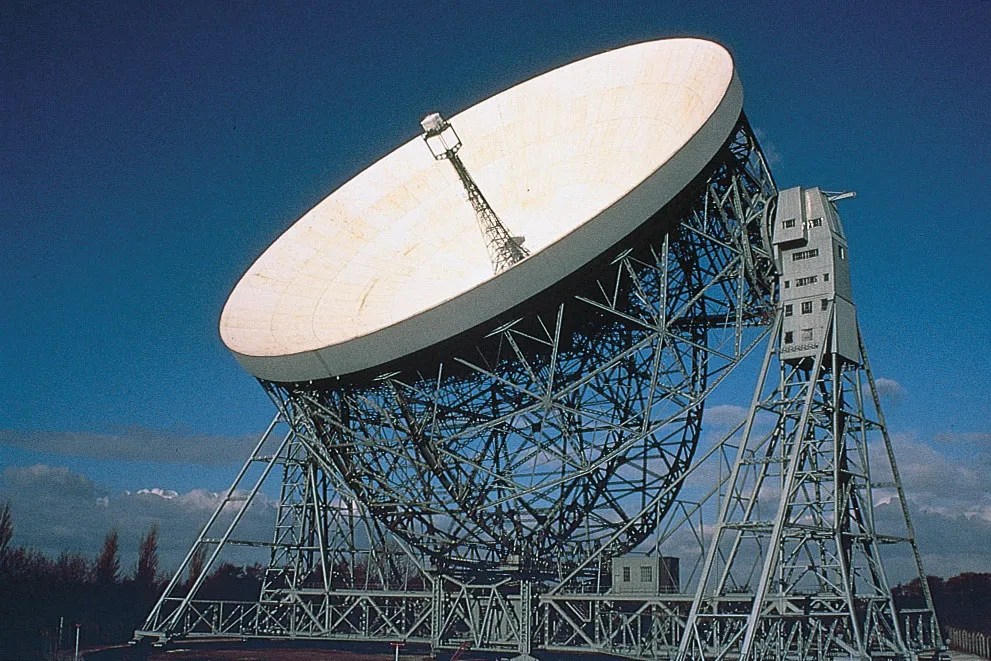
Anyway, you can find the list of specific cuts here. Radio astronomy is hit particularly hard. The interferometric network e-Merlin is not prioritized and its funding will run out in 2028. That puts Jodrell Bank Observatory in danger of complete closure unless an alternative source of funding can be found. The last time STFC had a financial crisis was in 2009 and e-Merlin might well have been cut then but survived thanks to political intervention at the highest level. I suppose that could happen again, but I wouldn’t bet on it. More bad news is that the UK Square Kilometre Array Regional Centre, with SKA itself already financially troubled, is also earmarked for cuts.

The 76m Lovell Telescope at Jodrell Bank, now under threat of closure

And that’s just radio astronomy and Jodrell Bank is one of the highest-profile casualties. There are cuts and cancellations in many other areas too; see here for a full list.

The Astronomer Royal for Scotland, Catherine Heymans, has used her platform to campaign against these damaging and short-sighted cuts to UK astronomy, including on social media:

Just off #BBCR4 World at One, arguing the importance of discovery science (like Jodrell) for long-term economic growth. I said I was heartbroken at the news: evidence just look at how exceptionally excited me & @mamaphysikerin.bsky.social were when we got to stand inside Lovell back in 2017 🥰 🔭🧪

Astronomer Royal for Scotland | Catherine Heymans (@astroroyalscot.bsky.social) 2026-07-27T12:38:30.873Z

The same can’t be said for the Astronomer Royal herself, Prof. Michele Dougherty. The reason for that is Prof. Dougherty is also Executive Chair of STFC and is therefore responsible for implementing the cuts. How it is possible for her to remain in both posts is nothing short of a scandal. Such a glaring conflict of interest cannot be allowed to stand. Indeed, Prof. Dougherty was elected to serve as President of the Institute of Physics from October 2025 but stepped down in January 2026 citing concerns of a conflict of interest with her role at STFC. It’s a slap in the face to the Astronomy community that it is not deemed worthy of such consideration.

In a Random Universe…

Posted in Artificial Intelligence, Biographical, Books, OJAp Papers, The Universe and Stuff with tags , , , on June 30, 2026 by telescoper

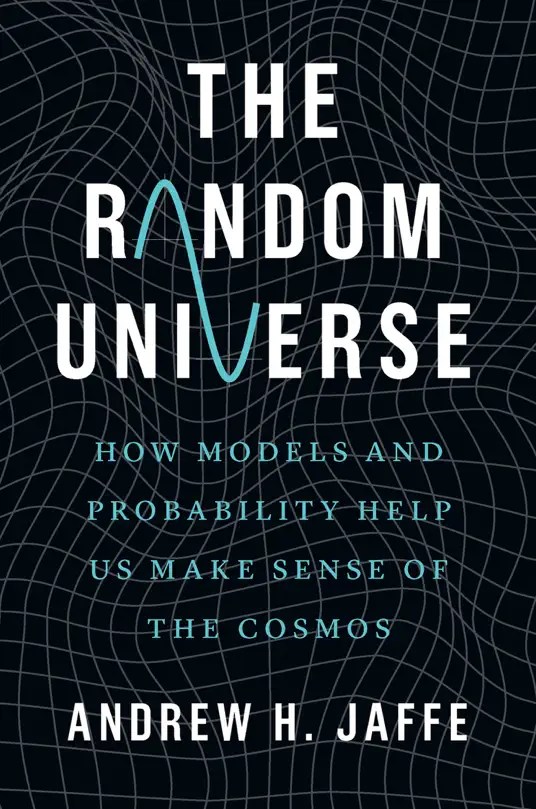
So here I am, in that London. I’m attending a small meeting called A Random Universe which is celebrating the occasion of the 60th Birthday of cosmologist Andrew Jaffe. The meeting is being held at South Kensington Technical Imperial College and covers cosmology, statistics, topology, and a number of other things. The title comes from a book Andrew has published:

I’m ashamed to admit I haven’t read it yet – it was published last year – but I will do. An amusing thing is that I wanted to use that title for a book I wrote some time ago but the publisher rejected it! I also noticed just now that the book uses the definite article whereas the conference has the indefinite article.

I had other things to do yesterday so I missed the first day of the meeting, and my train into London was delayed by an hour because of “a cow on the line”, which necessitated a lengthy diversion via Coventry, so I missed much of this morning too. I did make some use of the time, though, publishing three papers in the Open Journal of Astrophysics using a commendably stable Wi-Fi connection on the train.

One thing I didn’t miss, however, was an interesting panel discussion under the title AI and Inference. There wasn’t much about inference in the discussion, but it did cover some interesting ground. Cosmologists are well used to Machine Learning, which is often claimed to be a form of Artificial Intelligence, though I wouldn’t classify it as such. In fact,the large survey analyses that constitute a major part of contemporary cosmological research would not be feasible without the deployment of machine learning methods. I think it’s likely that newer methods of Generative AI and Agentic systems based on Large Language Modules will lead to increases in scientific productivity in the short term too. Whatever happens in the longer term, several years in the future, is very hard to predict, but is likely to invilve big changes in the way science is done. I’ll just say that I’m not sorry that I will be retiring in two years!

Apparently the “Holy Grail” of the Tech Bros is to find ways of creating artificial “General Intelligence”. There was an audience vote about whether this would be accomplished with the five years or so some claim. I abstained, on the grounds that I really don’t know what “General Intelligence” is supposed to mean in the first place. I would also remind readers that the Holy Grail was an object of dubious significance the Quest for which consumed considerable resources and ultimately failed.

Another topic that came up is whether AI methods will ever be truly creative. This is an interesting question because I don’t think we know very much about how creativity in any form, including the intuitive leaps that have led to advances in science, arises in human brains. I wrote a post about “Light-bulb” moments here.

One immediate effect of LLMs on science is in the publishing world. At OJAp we are experiencing a tidal wave of AI-generated slop and other garbage. This is very wearisome and I think will only get worse. We don’t rule out the use of AI in papers at OJAp, but authors must disclose what they have done and how they have tested it. Things may change in the future, but I think that in the current era of science the big problem is not that AI methods can’t be used by good scientists for good research but that AI methods make it far too easy for fools to generate superficially plausible nonsense. I don’t see any easy solution to this but maybe there is an upside, in that will hasten the end of the system of academic publishing which has in any case long outlined its usefulness.

Are You in The Weights?

Posted in Artificial Intelligence, Biographical with tags , , , , on June 22, 2026 by telescoper

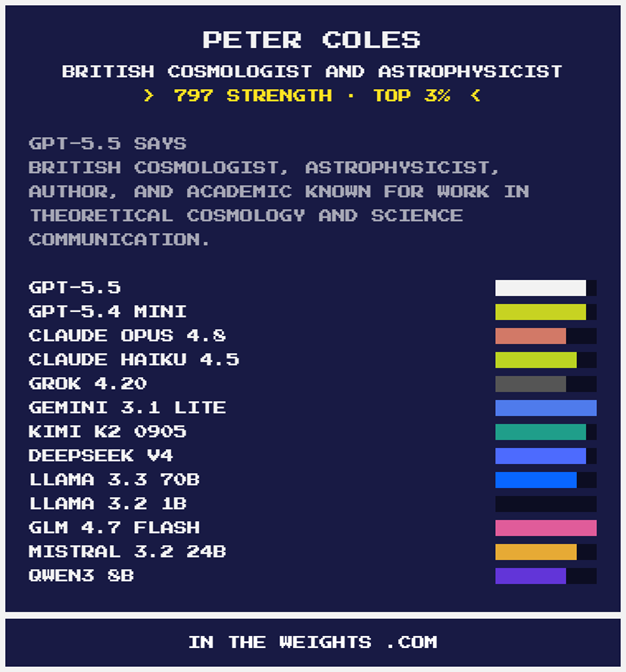
Yesterday I found out about a site called intheweights.com , which reveals which people are “stored” in the weights of large language models. Those “weights” are billions of numerical values by which these AI models encode their knowledge. If you show up in them, the model considered you relevant enough during training to recall without tools such as web search.

The site queries several models to figure out who a specific person is, combines the results, and assigns a strength score.  According to the leaderboard, the current maximum strength score is 998, awarded too a person called Charlize Theron (of whom I have never heard); number Two is Rudyard Kipling, apparently. I’m surprised the top isn’t Taylor Swift. I guess these weights change with time too.

Being a vain person I typed in my name and found this:

The only reason I can think of that I score so highly is all that scraping of this blog site over the last year or so. The weights are obviously influenced by how much material there is available online by or about the person.

Anyway, give it a try. Are you In The Weights?

P.S. A number of other “Peter Coles” characters are also listed under my entry, some of them as far as I can see totally fictitious.

On the Use of Generative AI

Posted in Artificial Intelligence, Education, Maynooth with tags , , , , , , on May 18, 2026 by telescoper

We’ve reached the time of year at Maynooth when academic staff are busy grading projects of various kinds. This year we have to be much mindful of the use of Large Language Models (such as ChatGPT) in written reports as these are much more commonplace now. We anticipated this at the start of the academic year, but now we have to see whether are policies work in practice. In the case of the Computational Physics projects that I have to mark, this also extends to the use of Generative AI in writing code. The approach I take there is that I don’t place an absolute ban, but I require students to declare the use and, crucially, describe what steps they used to test and validate the output. By the time they’ve done that they might as well have written the code themselves!

As well as its effect on teaching, GenAI is having a huge impact on research. In my role as Managing Editor of the Open Journal of Astrophysics I have seen a large increase in submissions of papers in which AI plays some role. These vary from pure “slop” – nonsense papers not worthy of serious consideration – to articles that use AI tools in a perfectly reasonable way to speed up certain aspects of the analysis. I think this is the case for most scientific journals.

The approach we have adopted is similar to the policy on teaching outlined above. It is described by the following section we have added to our “For Authors” page:

Use of Generative AI. We do not operate a blanket ban on the use of Large Language Models (LLMs) or other forms of Generative AI. If you do use such tools, however, you must declare it in the acknowledgments section of your paper. Furthermore, if GenAI methods are used for any form of calculation, analysis, or data visualization you must include an account of what steps you have taken to test and validate these methods. Articles containing direct evidence of the use of GenAI, such as hallucinated references or prompts embedded in the text, will not be accepted.

Since the Open Journal of Astrophysics is an arXiv-overlay journal I should also pass on the information that arXiv is itself developing a policy on the use of LLMs. Although it has yet to appear on the arXiv website, a recent communication on social media states:

If there is incontrovertible evidence of LLM slop in a paper, this means the authors did not take the time to read the LLM output and we can’t trust anything else in the paper. Penalty is 1 year ban from arXiv followed by a requirement that subsequent arXiv submissions must first be accepted at a reputable peer-reviewed venue.

This will be tantamount to a one-year ban from publishing in OJAp, so urge authors should be be very careful in their use of such methods.

It is likely that these policies will have to be extended as the use of GenAI spreads.

A Chatbot Masters?

Posted in Artificial Intelligence, Education with tags , , , on April 30, 2026 by telescoper

I laughed out loud when I saw an item in the Times Higher about new Masters courses at the London School of Innovation (which I had never heard of before) that will be taught and assessed by AI. I see that for the new courses – apparently in subjects such as machine learning, digital innovation, entrepreneurship and business transformation

Content will be delivered through an online learning system that the university built from scratch. Students can choose to have content delivered in a written format or presented to them by an AI avatar.

Moreover,

…assignments will be assessed and given feedback by AI…

and

At the end of each module, students will engage in a “Socratic dialogue” with their AI tutor about the content to answer questions and reflect on their learning.

Whether the AI bot will end up corrupting young people and being compelled to drink hemlock is not specified…

I laughed when I read all this because it doesn’t seem to have occurred to anyone that if you have a qualification that can be delivered and assessed by chatbots then the job that you think it will qualify you for can also be done by chatbots…

Still, the London School of Innovation has been granted degree-awarding powers by the “Regulator” so it must be kosher.

Ahead of a Four-Day Week…

Posted in Artificial Intelligence, Biographical, Education, mathematics, Maynooth with tags , , , , , , on March 29, 2026 by telescoper

It’s Sunday 29th March – Palm Sunday in fact – and Friday 3rd April is Good Friday, which is followed by a break of a week for Easter, so I’ve been looking at what I have to do in the four days between Monday and Thursday.

On Tuesday afternoon part of my 3rd Year Computational Physics class will be doing a supervised test in the computer lab. I (foolishly) promised to ensure they would get their grades before Easter, so I’m going to have to mark them straight away. This is a larger group than usual because some students who would normally be in the lab on Thursdays swtiched to Tuesday so they could go on a trip to Armagh. Anyway, this is the third lab test and at least I have graded the first two tests for all groups in time for the arrival of the new ones.

There will be one more of these lab tests after the Easter break but after that the students will be working full-time for 3 weeks or so on mini-projects. That is the part they usually enjoy most and I’m very happy to see that some have already started work.

Then, on Wednesday I have the second class test for my 4th year Particle Physics module. This is the second such test, and it will be held during a tutorial session. This is a pen-and-paper test rather than a coding test to be done in the lab. For such tests I allow students to bring whatever they like on paper but phones, laptops and tablets are banned. This is the easiest way I could think of to avoid students using AI to solve the problems. In previous years I gave take-home assignments for this module, and I still hand out exercise sheets to be gone over in tutorials, but these are for formative purposes only. The summative assessments are the class tests. There will be three of those, which means they will have to endure one more after Easter. In a normal week I would have a Particle lecture on Friday, but that won’t happen because it’s Good Friday and my lectures apparently aren’t good enough to happen on that day.

As well as the Computational Physics lab test and the Particle Physics class test, next I have two lectures, both at 9am – one on Tuesday and one on Thursday – and another lab session on Thursday which is not a test, but a practical session about solving ODEs.

Then it will be the Easter Break. After that, according to my calculations, there will be four more teaching weeks before the examination period. The last day of teaching is May 8th. Between that and the examinations there is a gap of a week during which I will have to mark all the completed Computational Physics project reports, as well as giving some revision classes if there is demand for them.

Writing as Thinking

Posted in Artificial Intelligence, Education with tags , , , , , on March 10, 2026 by telescoper

The other day I was informed that WordPress has an “AI Tool” which can write blog posts for me. I suspect most people think writing a blog is a waste of time, and that is even more the case if you get AI to write posts for you. I write a blog for many reasons apart from that after 17 years it has become a habit. One reason is that writing a post sometimes helps me tease out what I actually think about things. If I don’t feel I can express my thoughts in a reasonably coherent way, it is possible that my thoughts are themselves incoherent. Of course sometimes the lack of clarity in a post is indeed because I didn’t write it very well. Nevertheless, the process of writing helps even if it doesn’t lead to anything like a perfect result.

Writing isn’t just about blog posts, of course. In academic life we write articles and books and other pieces. Some academics give the impression that we do the writing after we’ve done the thinking – or, in scientific fields, after doing the calculations or measurements – but I think writing is an intrinsic part of the process, not something done right at the end.

It was with these thoughts in mind that I decided to share the following post, written by Pat Thomson a former Professor of Education in the School of Education at the University of Nottingham which makes a number of points that are valid across different disciplines.

The Next Semester

Posted in Artificial Intelligence, Education, mathematics, Maynooth with tags , , , , , , , on January 26, 2026 by telescoper

There’s just a week to go before the next Semester at Maynooth University so I’ve been looking at my calendar for the weeks ahead. Actually, I won’t start teaching again until Tuesday 3rd February, because Monday 2nd February is a national holiday. As it turns out, however, I don’t have any lectures, labs or tutorials on Mondays anyway so I won’t be missing a session either on February 2nd or on May 4th, another holiday. I will have to miss one on Friday 3rd April (Good Friday), though.

The Timetable has given me two 9 o’clock lectures a week for the forthcoming Semester, one on Tuesdays and the other on Thursdays. I don’t think the students like 9am lectures very much, but I don’t mind them at all. I find it quite agreeable to have accomplished something concrete by 10am, which I don’t always do. This schedule might mean that I defer publishing papers at the Open Journal of Astrophysics on those days. I usually do this before breakfast, but I might not have time if I have to be on campus and ready to teach for 9am.

As usual, Semester 2 is a stop-start affair. We have six weeks until the Study Break, which includes the St Patrick’s Day holiday, then we’re back for two weeks (minus Good Friday) before another week off for Easter. We return on Monday April 13th to complete the Semester; the last lectures are on Friday 8th May and exams start a week later. This arrangement creates no problems for lecture-based teaching, but it takes some planning to organize labs and project deadlines around the breaks. I’ll have to think about that for my Computational Physics module.

A more serious issue for Computational Physics is how to deal with the use of Generative AI. I’ve written about this before, in general terms, but now it’s time to write down some specific rules for a specific module. A default position favoured by some in the Department is that students should not use GenAI at all. I think that would be silly. Graduates will definitely be using CoPilot or equivalent if they write code in the world outside university so we should teach them how to use it properly and effectively.

In particular, such methods usually produce a plausible answer, but how can a student be sure it is correct? It seems to me that we should place an emphasis on what steps a student has taken to check an answer, which of course they should do whether they used GenAI or did it themselves. If it’s a piece of code to do a numerical integration of a differential equation, for example, the student should test it using known analytic solutions to check it gets them right. If it’s the answer to a mathematical problem, one can check whether it does indeed solve the original equation (with the appropriate boundary conditions).

If anyone out there reading this blog has any advice to share, or even a link to their own Department’s policy on the use of GenAI in computational physics for me to copy adapt for use in Maynooth, I’d be very grateful!

(My backup plan is to ask ChatGPT to generate an appropriate policy…)