Archive for binary stars

Weekly Update from the Open Journal of Astrophysics – 21/02/2026

Posted in OJAp Papers, Open Access, The Universe and Stuff with tags , , , , , , , , , , , , , , , , , , , , , , , , , , , , , , , , on February 21, 2026 by telescoper

It’s Saturday once more so time for another update of activity at the Open Journal of Astrophysics. Since the last update we have published a further six papers, bringing the number in Volume 9 (2026) to 36 and the total so far published by OJAp up to 484.

I will continue to include the posts made on our Mastodon account (on Fediscience) to encourage you to visit it. Mastodon is a really excellent service, and a more than adequate replacement for X/Twitter (which nobody should be using); these announcements also show the DOI for each paper.

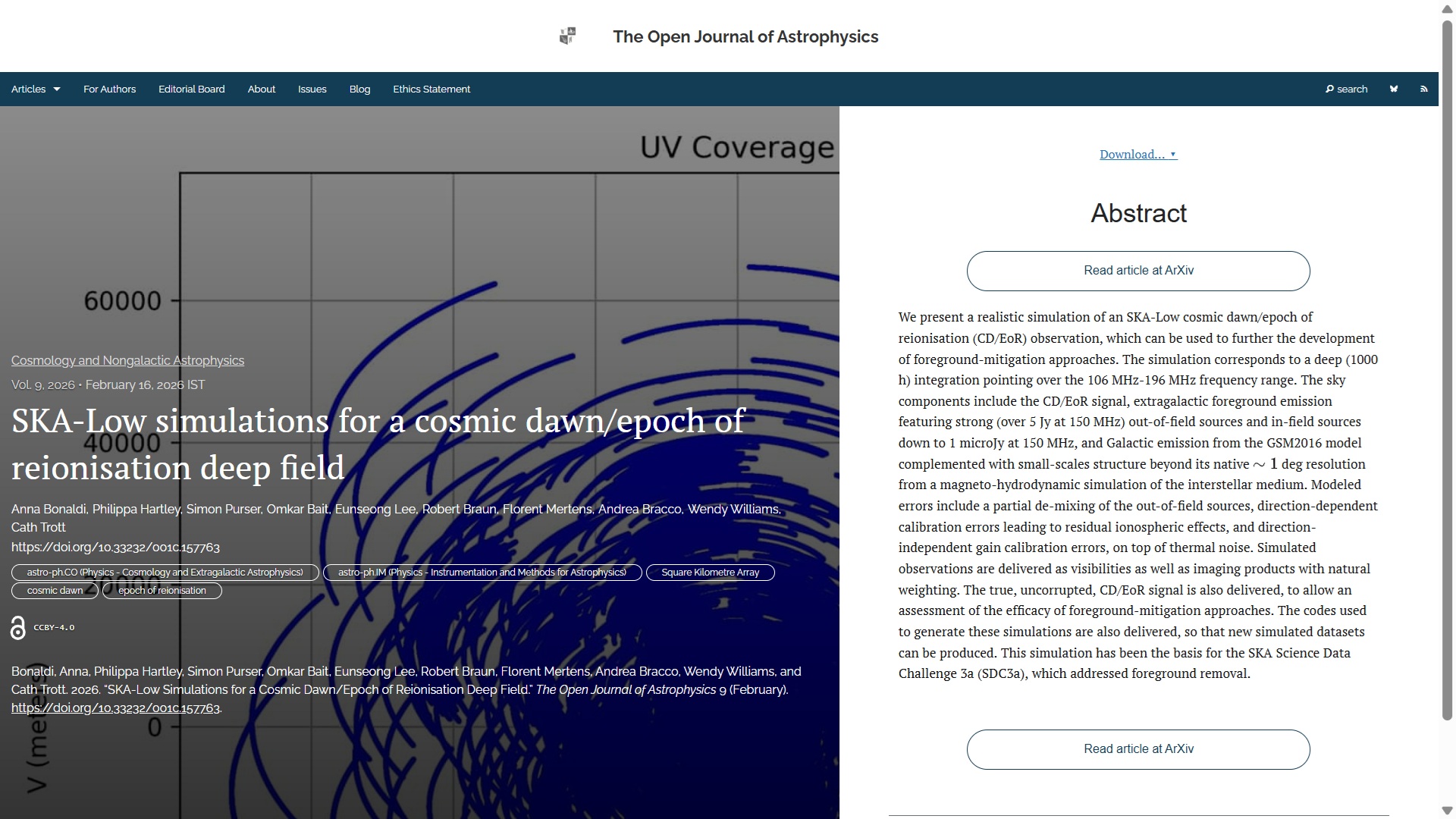
The first paper to report this week is “SKA-Low simulations for a cosmic dawn/epoch of reionisation deep field” by Anna Bonaldi, Philippa Hartley, Simon Purser & Omkar Bait (SKAO, UK), Eunseong Lee (U. Manchester, UK), Robert Braun (SKAO), Florent Mertens (Sorbonne Université, France), Andrea Bracco (Osservatorio Astrofisico di Arcetri, IT), Wendy Williams (SKAO) and Cath Trott (Curtin U., Australia). This paper presents a simulation of an SKA-Low cosmic dawn/epoch of reionisation observation to advance foreground-mitigation approaches: the simulation includes various sky components and modelled errors, allowing for efficacy assessment. It was published on Monday 16th February in the folder Cosmology and Nongalactic Astrophysics.

The overlay is here:

You can find the officially accepted version on arXiv here and the announcement on Fediverse here:

Open Journal of Astrophysics

New Publication at the Open Journal of Astrophysics: "SKA-Low simulations for a cosmic dawn/epoch of reionisation deep field" by Anna Bonaldi, Philippa Hartley, Simon Purser & Omkar Bait (SKAO, UK), Eunseong Lee (U. Manchester, UK), Robert Braun (SKAO), Florent Mertens (Sorbonne Université, France), Andrea Bracco (Osservatorio Astrofisico di Arcetri, IT), Wendy Williams (SKAO) and Cath Trott (Curtin U., Australia)

doi.org/10.33232/001c.157763

February 16, 2026, 8:28 am 1 boosts 1 favorites

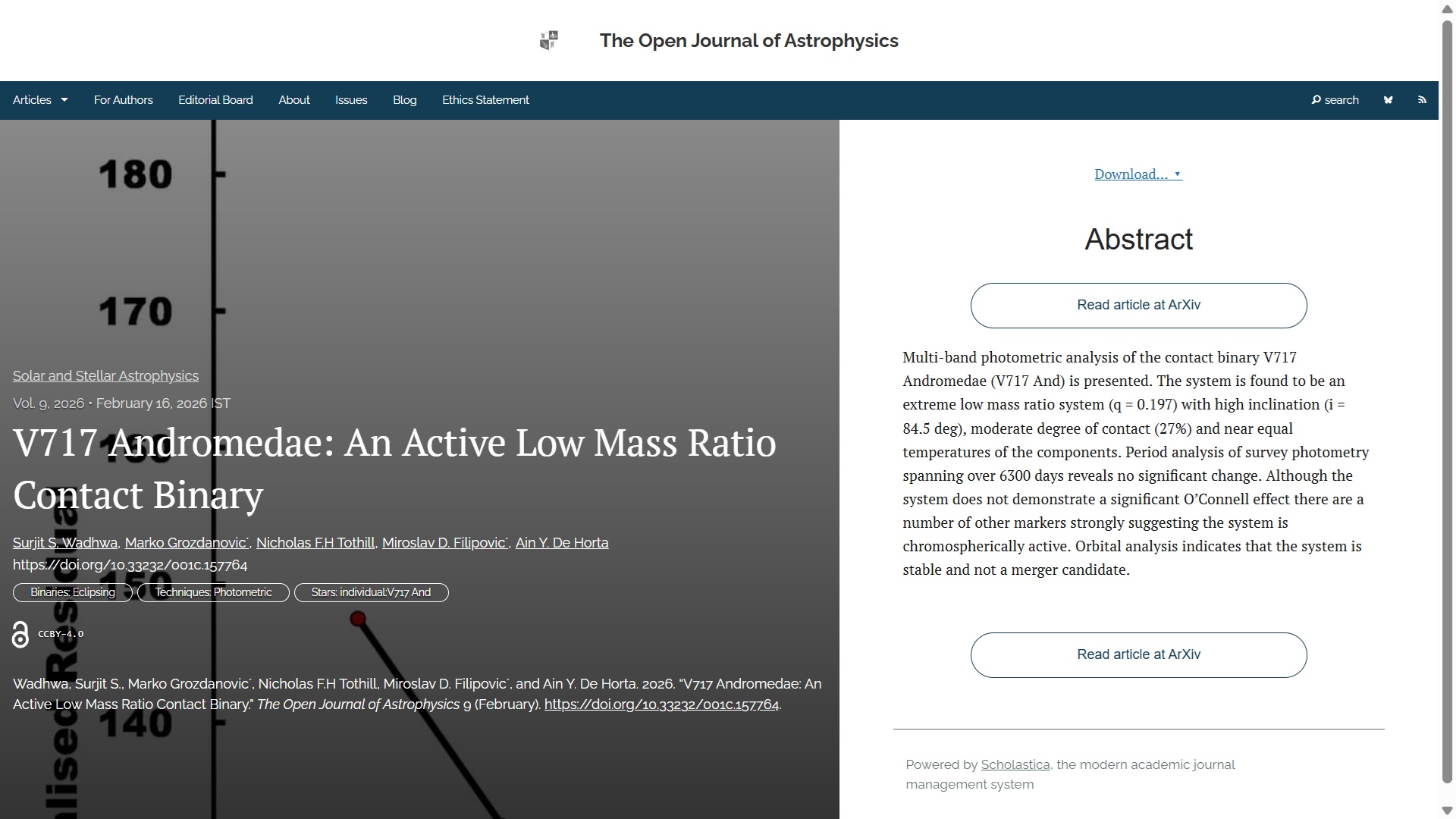
The second paper is “V717 Andromedae: An Active Low Mass Ratio Contact Binary” by Surjit S. Wadhwa (Western Sydney U. Australia), Marko Grozdanovic (Astronomical Observatory Belgrade, Serbia), and Nicholas F.H Tothill, Miroslav D. Filipovic, Ain Y. De Horta (Western Sydney U.). This was also published on Monday 1th February, but in the folder Solar and Stellar Astrophysics. The article discusses the contact binary V717 Andromedae, an extreme low mass ratio system with high inclination and moderate contact, showing signs of chromospheric activity but stable and not a merger candidate

The overlay for this one is here:

The official version of the paper can be found on arXiv here and the Fediverse announcement here:

Open Journal of Astrophysics

New Publication at the Open Journal of Astrophysics: "V717 Andromedae: An Active Low Mass Ratio Contact Binary" by Surjit S. Wadhwa (Western Sydney U. Australia), Marko Grozdanovic (Astronomical Observatory Belgrade, Serbia), and Nicholas F.H Tothill, Miroslav D. Filipovic, Ain Y. De Horta (Western Sydney U.)

doi.org/10.33232/001c.157764

February 16, 2026, 8:56 am 0 boosts 0 favorites

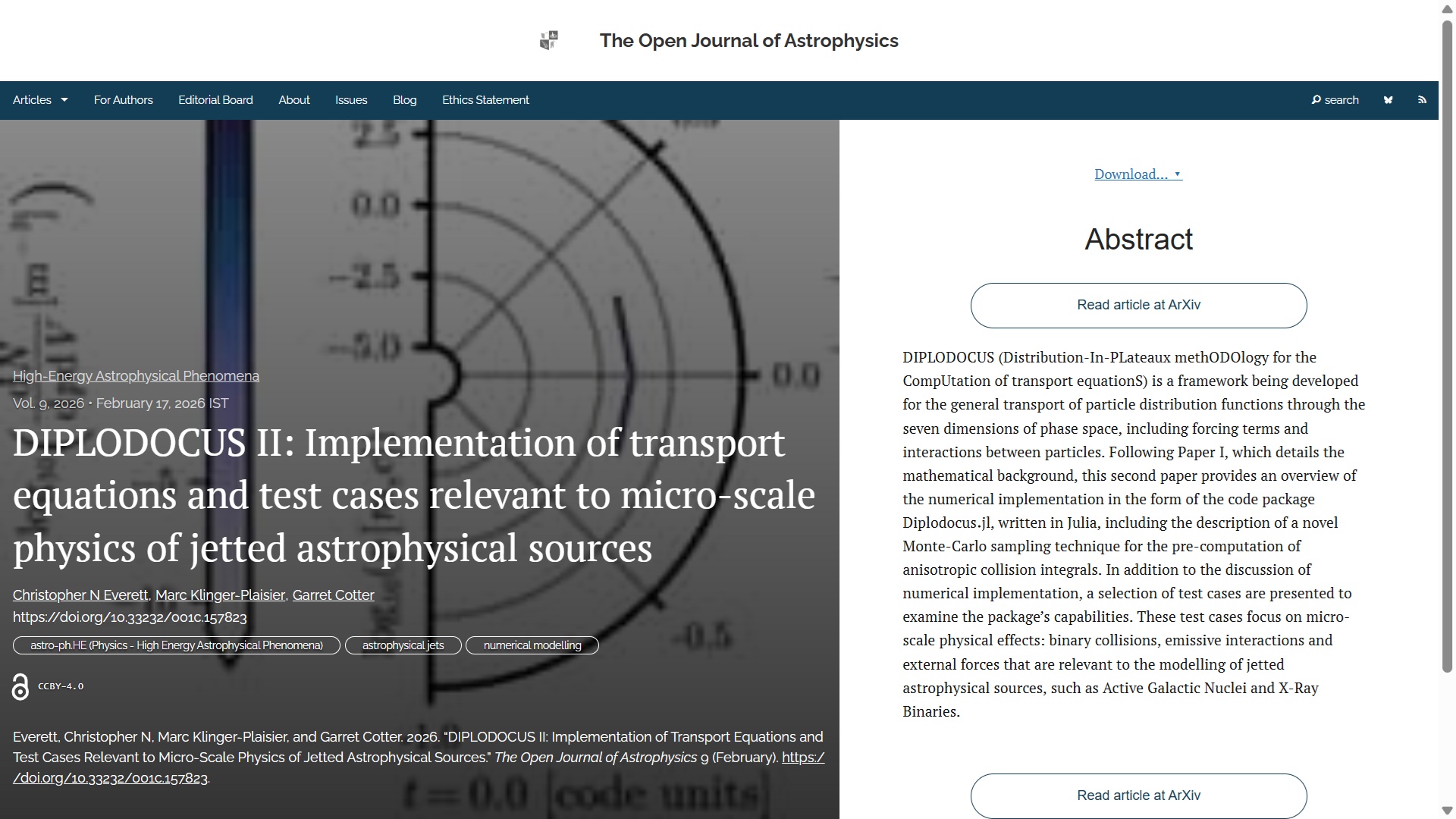
Next, published on Tuesday 17th February in the folder High-Energy Astrophysical Phenomena, is “DIPLODOCUS II: Implementation of transport equations and test cases relevant to micro-scale physics of jetted astrophysical sources” by Christopher N Everett (Oxford U., UK), Marc Klinger-Plaisier (U. Amsterdam, NL) and Garret Cotter (Oxford). This one discusses further applications of DIPLODOCUS, which is a framework developed for particle distribution transport, with its numerical implementation detailed in Diplodocus.jl. It uses a new sampling technique and is tested on micro-scale physical effects. The first paper in the series can be found here.

The overlay is here:

The official version can be found on arXiv here and the Fediverse announcement is here:

Open Journal of Astrophysics

New Publication at the Open Journal of Astrophysics: "DIPLODOCUS II: Implementation of transport equations and test cases relevant to micro-scale physics of jetted astrophysical sources" by Christopher N Everett (Oxford U., UK), Marc Klinger-Plaisier (U. Amsterdam, NL) and Garret Cotter (Oxford)

doi.org/10.33232/001c.157823

February 17, 2026, 7:13 am 1 boosts 2 favorites

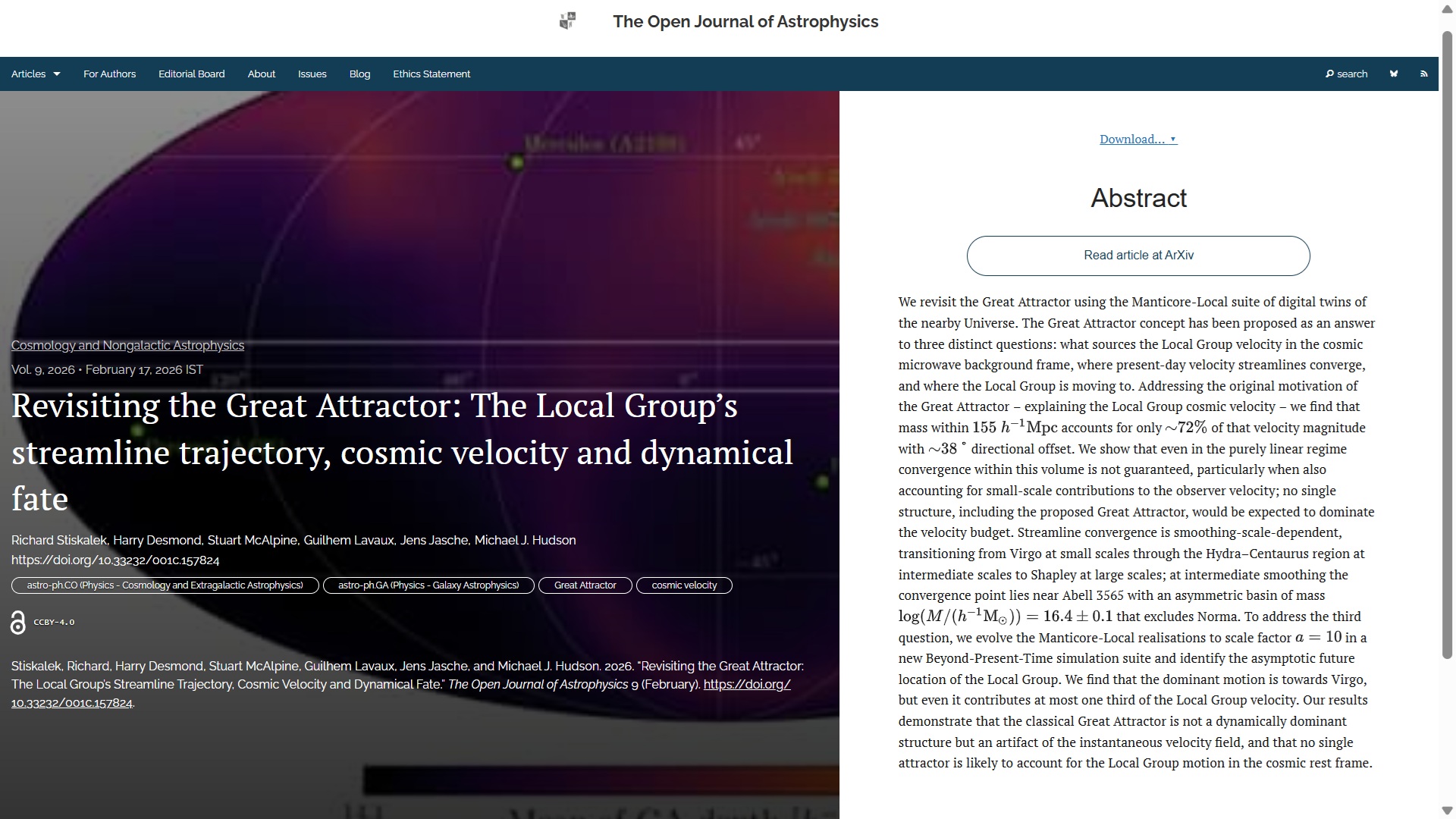
The fourth paper this week, also published on Tuesday 17th February, but in the folder Cosmology and Nongalactic Astrophysics is “Revisiting the Great Attractor: The Local Group’s streamline trajectory, cosmic velocity and dynamical fate” by Richard Stiskalek (Oxford U., UK), Harry Desmond (U. Portsmouth, UK), Stuart McAlpine (Stockholm, SE), Guilhem Lavaux (Sorbonne Université, FR), Jens Jasche (Stockholm) and Michael J. Hudson (U. Waterloo, Canada). This paper revisits the so-called “Great Attractor” concept, finding that it doesn’t dominate the Local Group’s cosmic velocity; multiple structures contribute to the motion, with no single attractor accounting for the flow.

Here is the overlay:

The official version can be found on arXiv here and the Fediverse announcement is here:

Open Journal of Astrophysics

New Publication at the Open Journal of Astrophysics: "Revisiting the Great Attractor: The Local Group’s streamline trajectory, cosmic velocity and dynamical fate" by Richard Stiskalek (Oxford U., UK), Harry Desmond (U. Portsmouth, UK), Stuart McAlpine (Stockholm, SE), Guilhem Lavaux (Sorbonne Université, FR), Jens Jasche (Stockholm) and Michael J. Hudson (U. Waterloo, Canada)

doi.org/10.33232/001c.157824

February 17, 2026, 7:33 am 3 boosts 1 favorites

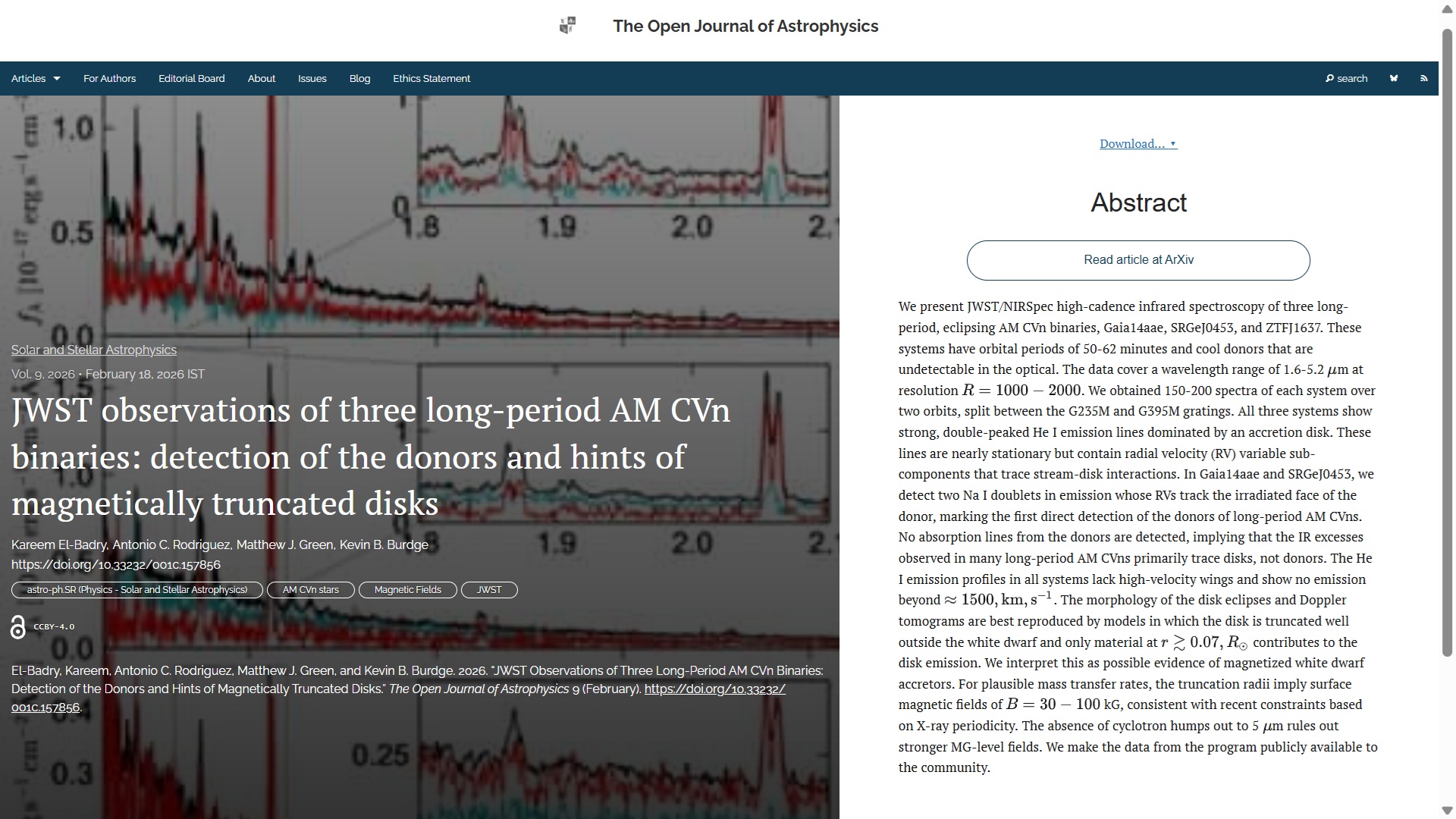
The fifth paper this week, is “JWST observations of three long-period AM CVn binaries: detection of the donors and hints of magnetically truncated disks” by Kareem El-Badry (Caltech), Antonio C. Rodriguez (CfA Harvard), Matthew J. Green (U. Oklahoma) & Kevin B. Burdge (MIT); all based in the USA. The article was published on Thursday 19th February 2026 in the folder Solar and Stellar Astrophysics. The paper describes high-cadence infrared spectroscopy used to analyze three long-period, eclipsing AM CVn (AM Canum Venaticorum) binaries; findings suggest the presence of magnetized white dwarf accretors, with surface magnetic fields of 30-100 kG.

The overlay is here:

The accepted version can be found on arXiv here, and the fediverse announcement is here:

Open Journal of Astrophysics

New Publication at the Open Journal of Astrophysics: "JWST observations of three long-period AM CVn binaries: detection of the donors and hints of magnetically truncated disks" by Kareem El-Badry (Caltech), Antonio C. Rodriguez (CfA Harvard), Matthew J. Green (U. Oklahoma) & Kevin B. Burdge (MIT); all in USA

doi.org/10.33232/001c.157856

February 18, 2026, 8:15 am 1 boosts 0 favorites

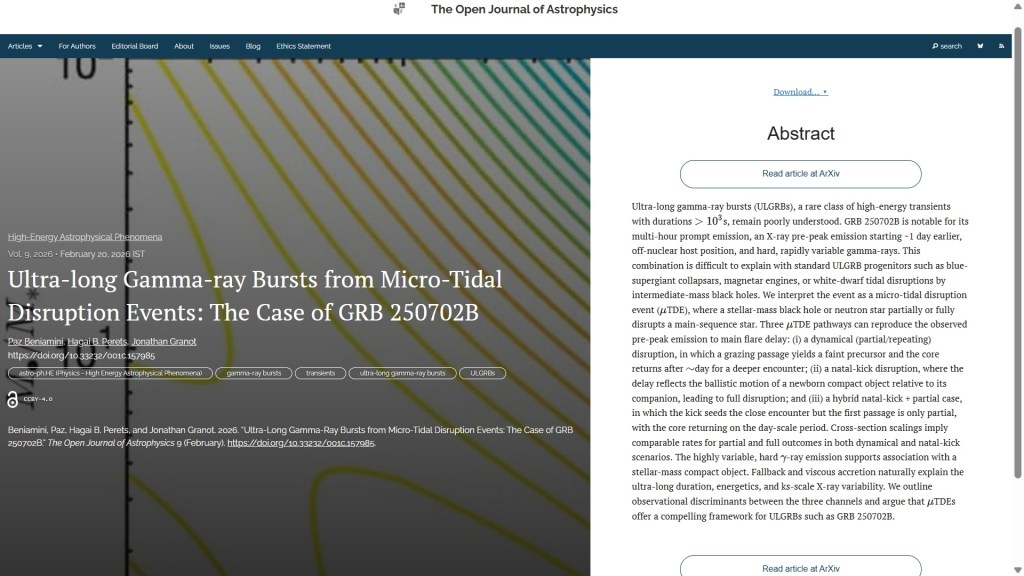
Finally for this week we have “Ultra-long Gamma-ray Bursts from Micro-Tidal Disruption Events: The Case of GRB 250702B” by Paz Beniamini (Open University, IL), Hagai B. Perets (Technion, IL) and Jonathan Granot (Open University, IL); all based in Israel. The paper was published on Friday 18th February 2026 in the folder High-Energy Astrophysical Phenomena.

The overlay is here:

You can find the officially accepted version on arXiv here and the Mastodon announcement is here:

Open Journal of Astrophysics

New Publication at the Open Journal of Astrophysics: "Ultra-long Gamma-ray Bursts from Micro-Tidal Disruption Events: The Case of GRB 250702B" by Paz Beniamini (Open University, IL), Hagai B. Perets (Technion, IL) and Jonathan Granot (Open University, IL)

doi.org/10.33232/001c.157985

February 20, 2026, 8:43 am 0 boosts 0 favorites

And that concludes this week’s update. I will do another next Saturday, by which time I expect we will have published a similar number of papers to this week.

Weekly Update from the Open Journal of Astrophysics – 02/08/2025

Posted in OJAp Papers, Open Access, The Universe and Stuff with tags , , , , , , , , , , , , , , , , , , , , , , , , , , , , on August 2, 2025 by telescoper

It’s Saturday morning again, and it’s the start of a new month, so it’s time for an update of papers published at the Open Journal of Astrophysics. Since the last update we have published five new papers, which brings the number in Volume 8 (2025) up to 110, and the total so far published by OJAp up to 345. I expect we’ll the total number we published last year (120) sometime this month. I predict that by the end of this year we will have published around 180 papers in Volume 8 and around 400 altogether.

The papers published this week, with their overlays, are as follows. You can click on the images of the overlays to make them larger should you wish to do so.

The first paper to report is “The matter with(in) CPL” by Leonardo Giani (U. Queensland, Australia), Rodrigo Von Marttens (Universidade Federal da Bahia, Brazil) and Oliver Fabio Piattella (Universita degli Studi dell’Insubria, Italy). This was published on Monday 29th July 2025 in the folder Cosmology and Nongalactic Astrophysics. This article presents a new parameterization of the standard model and its implications for the interpretation of cosmological observations.

The overlay is here:


The officially-accepted version can be found on arXiv here.

The second paper of the week, published on Tuesday 30th July in the folder Instrumentation and Methods for Astrophysics, is “An automated method for finding the most distant quasars” by Lena Lenz, Daniel Mortlock, Boris Leistedt & Rhys Barnett (Imperial College London, UK) and Paul C. Hewett (U. Cambridge, UK)”.  This paper presents an automated, reproduceable and objective high-redshift quasar selection pipeline, tested on simulations and real data from the Sloan Digital Sky Survey (SDSS) and UKIRT Infrared Deep Sky Survey (UKIDSS). The overlay is here:


You can find the officially accepted version of the paper on arXiv here.

The third paper of the week is “Early Post Asymptotic Giant Branch Instability: Does it Affect White Dwarf Hydrogen Envelope Mass?” by James MacDonald (University of Delaware, USA). This one was published on Friday 1st Auguest (i.e. yesterday) in the folder Solar and Stellar Astrophysics. It is an investigation into whether Early Post AGB Instability (EPAGBI) can affect determinations of the total abundance of hydrogen in white dwarf stars.

The overlay is here:

The final version is on arXiv here.


The fourth paper of the week, also published on Friday 1st August, is “Light Echoes of Time-resolved Flares and Application to Kepler Data” by Austin King and Benjamin C. Bromley (University of Utah, USA).  This describes a new model for circumstellar disks that incorporates echoes produced by extended, time-resolved flares. It is published in the folder Solar and Stellar Astrophysics. Here is the overlay:

You can find the officially-accepted version on arXiv here.


The fifth and final article published this week, also published on Friday 1st August,  is “Wide Binaries from Gaia DR3 : testing GR vs MOND with realistic triple modelling” by Charalambos Pittordis, Will Sutherland and Paul Shepherd (Queen Mary, University of London, UK). This presents a test for modified gravity from a sample of wide-binary stars from Gaia DR3, finding that (unmodified) Newtonian gravity provides a better fit to the data. It is in the folder Astrophysics of Galaxies.

The overlay is here:


You can find the officially-accepted version on arXiv here.

And that’s all the papers for this week. I’ll do another update next Saturday.

Weekly Update from the Open Journal of Astrophysics – 19/07/2025

Posted in OJAp Papers, Open Access, The Universe and Stuff with tags , , , , , , , , , , , , , , , , , , , , , , , , , , on July 19, 2025 by telescoper

It’s Saturday morning again, so it’s time again for an update of papers published at the Open Journal of Astrophysics. Since the last update we have published six new papers, which brings the number in Volume 8 (2025) up to 98, and the total so far published by OJAp  up to 333. I expect we’ll pass the century for this year sometime next week.

The papers published this week, with their overlays, are as follows.  You can click on the images of the overlays to make them larger should you wish to do so.

The first paper to report is “Reconstructing Galaxy Cluster Mass Maps using Score-based Generative Modeling” by Alan Hsu (Harvard), Matthew Ho (CMU), Joyce Lin (U. Wisconsin-Madison), Carleen Markey (CMU), Michelle Ntampaka (STScI), Hy Trac (CMU) & Barnabás Póczos (CMU), all based in the USA. This paper was published on 14th July 2025 in the folder Cosmology and NonGalactic Astrophysics. It presents a diffusion-based generativbe AI model for reconstructing density profiles for galaxy clusters from observational data.

The overlay is here:

The officially-accepted version can be found on arXiv here.

The second and third papers are related. They were both published on 14th July in the folder Cosmology and NonGalactic Astrophysics.

The first of the pair is “J-PLUS: Tomographic analysis of galaxy angular density and redshift fluctuations in Data Release 3. Constraints on photo-z errors, linear bias, and peculiar velocities” by Carlos Hernández-Monteagudo (IAC, Tenerife, Spain) and 21 others. This presents an analysis of the Javalambre Photometric Local Universe Survey (J-PLUS) in redshift slices with a discussion of prospects for extracting cosmological information. The overlay is here:


You can find the final version of the manuscript on arXiv here.

The second of this pair is “The J-PLUS collaboration. Additive versus multiplicative systematics in surveys of the large scale structure of the Universe” by Carlos Hernández-Monteagudo (IAC) and 21 others (the same authors as the previous paper).  This paper presents an analysis of systematic effects in the Javalambre Photometric Local Universe Survey (J-PLUS), and a new model for handling such errors in this and other cosmological surveys. The overlay for this paper is here:

You can find the officially accepted version of this paper on arXiv here.

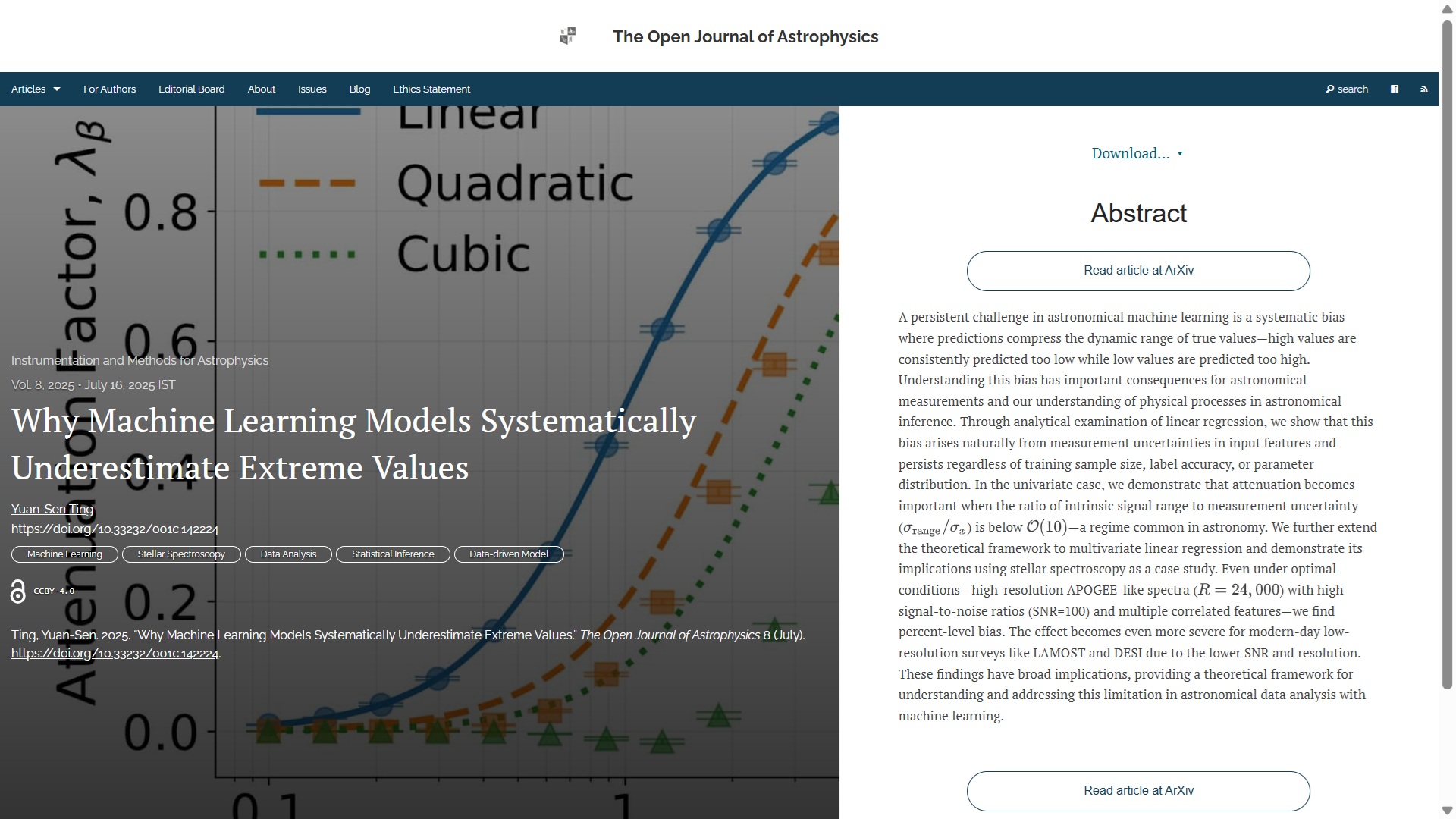
The fourth paper this week is “Why Machine Learning Models Systematically Underestimate Extreme Values” by Yuan-Sen Ting (Ohio State University). This one was published on July 16th in the folder marked Instrumentation and Methods for Astrophysics.  This paper presents a theoretical framework for understanding and addressing a bias that suppresses the dynamic range of variables in applications of machine learning to astronomical data analysis. Here is the overlay:

You can find the officially accepted version of this paper on arXiv here.

The penultimate article for this week is “Bridging Machine Learning and Cosmological Simulations: Using Neural Operators to emulate Chemical Evolution” by Pelle van de Bor, John Brennan & John A. Regan (Maynooth University) and Jonathan Mackey (Dublin Institute for Advanced Studies), all based in Ireland. This paper uses machine learning, in the form of neural operators, to emulate the Grackle method of solving non-equilibrium chemistry equations in cosmological hydrodynamic simulations and was published on 16th July also in the folder Instrumentation and Methods for Astrophysics. The overlay is here:

The final, accepted version of the paper is on arXiv here.

The last article published this week is “Astronomical Cardiology: A Search For Heartbeat Stars Using Gaia and TESS” by Jowen Callahan, D. M. Rowan, C. S. Kochanek and K. Z. Stanek (all of Ohio State University, USA). This paper presents a study of a sample of 112 new spectroscopic binaries called hearbeat stars (because their light curves resemble electrocardiagrams). It was published on 16th July 2025 in the folder marked Solar and Stellar Astrophysics. The overlay is here:

You can find the officially-accepted version on arXiv here.

And that’s all the papers for this week. I’ll do another update next Saturday.

Weekly Update from the Open Journal of Astrophysics: 05/07/2025

Posted in OJAp Papers, Open Access, The Universe and Stuff with tags , , , , , , , , , , , , , , , , , on July 5, 2025 by telescoper

It’s Saturday so, once again, it’s time for the weekly update of papers published at the Open Journal of Astrophysics. Since the last update we have published three new papers, which brings the number in Volume 8 (2025) up to 85, and the total so far published by OJAp  up to 320.

The three papers published this week, with their overlays, are as follows. You can click on the images of the overlays to make them larger should you wish to do so.

The first paper to report is “Stellar reddening map from DESI imaging and spectroscopy” by Rongpu Zhou (Lawrence Berkeley National Laboratory, USA) and an international case of 56 others too numerous to mention individually. This paper was published on 1st July 2025 in the folder marked Astrophysics of Galaxies. It describes maps of stellar reddening by Galactic dust inferred from observations obtained using the Dark Energy Spectroscopic Instrument, and a comparison with previous such maps. The overlay is here:

You can find the final, accepted, version on arXiv here.

Next one up is “On inertial forces (indirect terms) in problems with a central body” by Aurélien Crida (Université Côte d’Azur, France) and 17 others – again too numerous to be listed individually – based in France, Italy, Germany, Mexico and the USA. This paper discusses the indirect terms that arise the Newtonian dynamics of multi-body systems dominated by a central massive body, upon which other bodies exert a gravitational pull, when the massive body is treated as the origin of the coordinate system. This one, also published on July 1st 2025, is in the folder marked Earth and Planetary Astrophysics.

The overlay is here:

You can find the officially accepted version on arXiv here.

The last paper of this batch is “Stellar ejection velocities from the binary supernova scenario: A comparison across population synthesis codes” by Tom Wagg (U. Washington, USA), David D. Hendriks (U. Surrey, UK), Mathieu Renzo (U. Arizona, USA) and Katelyn Breivik (Carnegie Mellon U., USA). It was published on July 2nd 2025 in the folder Solar and Stellar Astrophysics and it presents comparison of the ejection velocities of stars ejected from binary systems by supernova explosions predicted in three different population synthesis codes.

The overlay is here:

You can read the final accepted version on arXiv here.

That’s all the papers for this week. I’ll post another update next weekend.

Weekly Update from the Open Journal of Astrophysics – 31/05/2025

Posted in OJAp Papers, Open Access, The Universe and Stuff with tags , , , , , , , , , , , , , , , on May 31, 2025 by telescoper

Once again it’s time for the weekly Saturday morning update of papers published at the Open Journal of Astrophysics. Since the last update we have published five new papers, which brings the number in Volume 8 (2025) up to 67; the total so far published by OJAp has passed the 300 mark and is now up to 302. If we keep up at the same rate for the rest of the year as we did for the first five months now completed, we will publish around 160 papers altogether in 2025.

In chronological order of publication, the five papers published this week, with their overlays, are as follows. You can click on the images of the overlays to make them larger should you wish to do so.

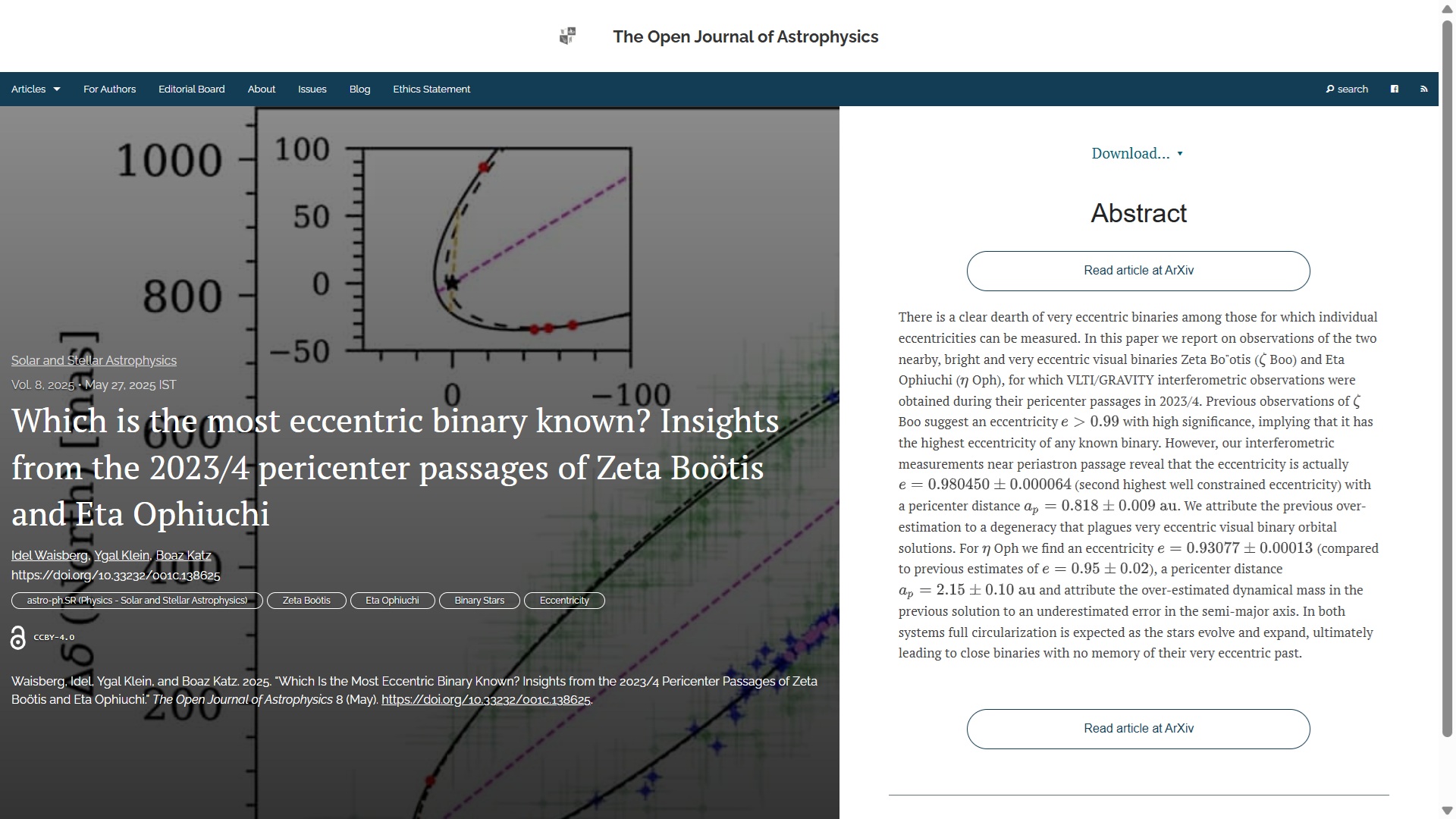
The first paper to report is “Which is the most eccentric binary known? Insights from the 2023/4 pericenter passages of Zeta Boötis and Eta Ophiuchi” by Idel Waisberg, Ygal Klein and Boaz Katz (Weizmann Institute of Science, Israel).  This is a report of interferometric observations of two very eccentric binary star systems, published on Tuesday 27th May 2025 in the folder Solar and Stellar Astrophysics. The overlay is here:

You can read the final accepted version on arXiv here.

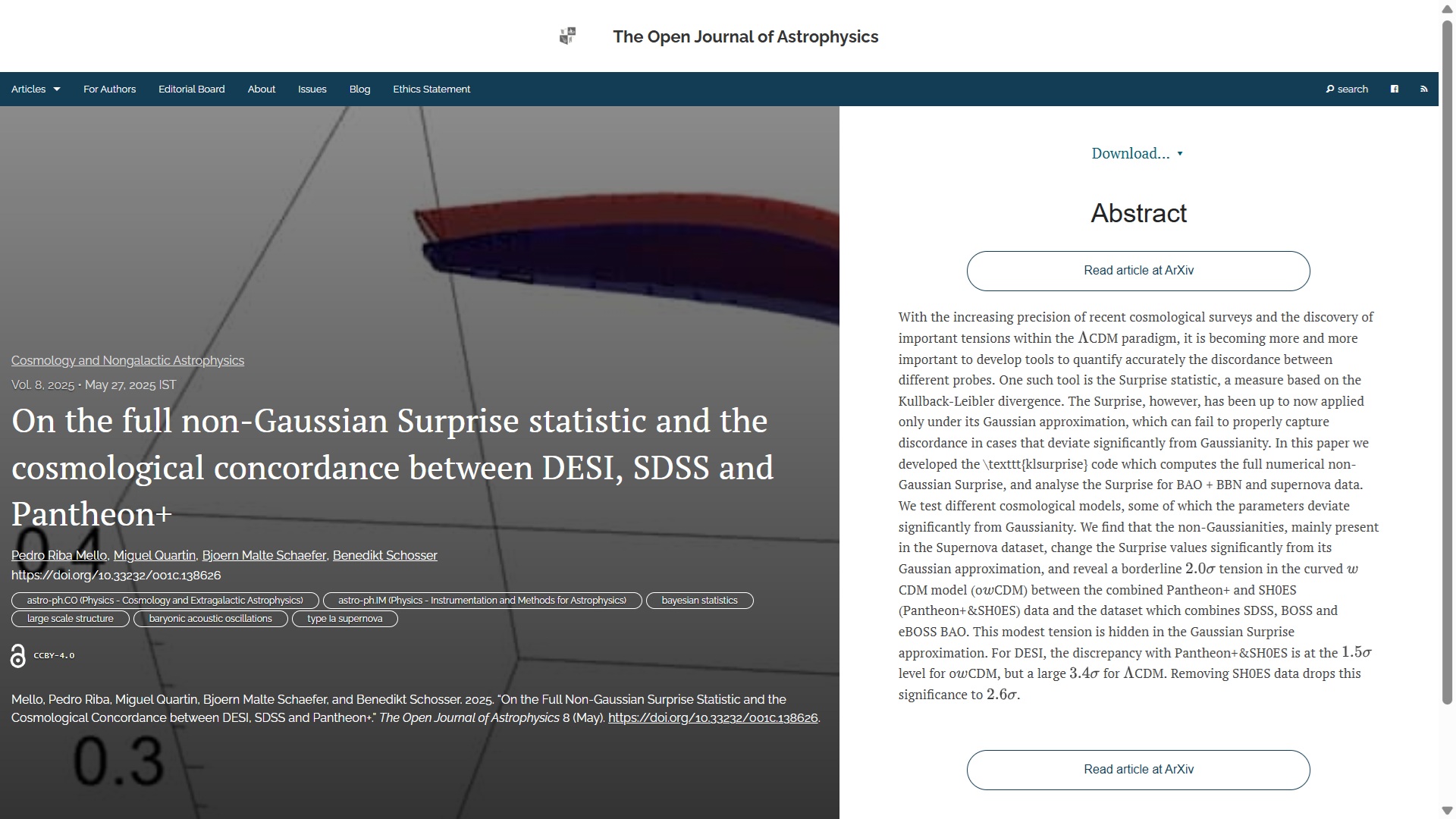
The second paper to report is “On the full non-Gaussian Surprise statistic and the cosmological concordance between DESI, SDSS and Pantheon+” by Pedro Riba Mello & Miguel Quartin (Universidade Federal do Rio de Janeiro, Brazil), and Bjoern Malte Schaefer & Benedikt Schosser (Heidelberg, Germany). This paper is in the folder Cosmology and NonGalactic Astrophysics and was published on Tuesday 27th May 2025. The paper presents an application of the “Surprise Statistic”, based on the Kullback-Leibler divergence, as a measure of the difference between results inferred from different data sets.

The overlay is here:


You can find the officially-accepted version of the paper on arXiv here.

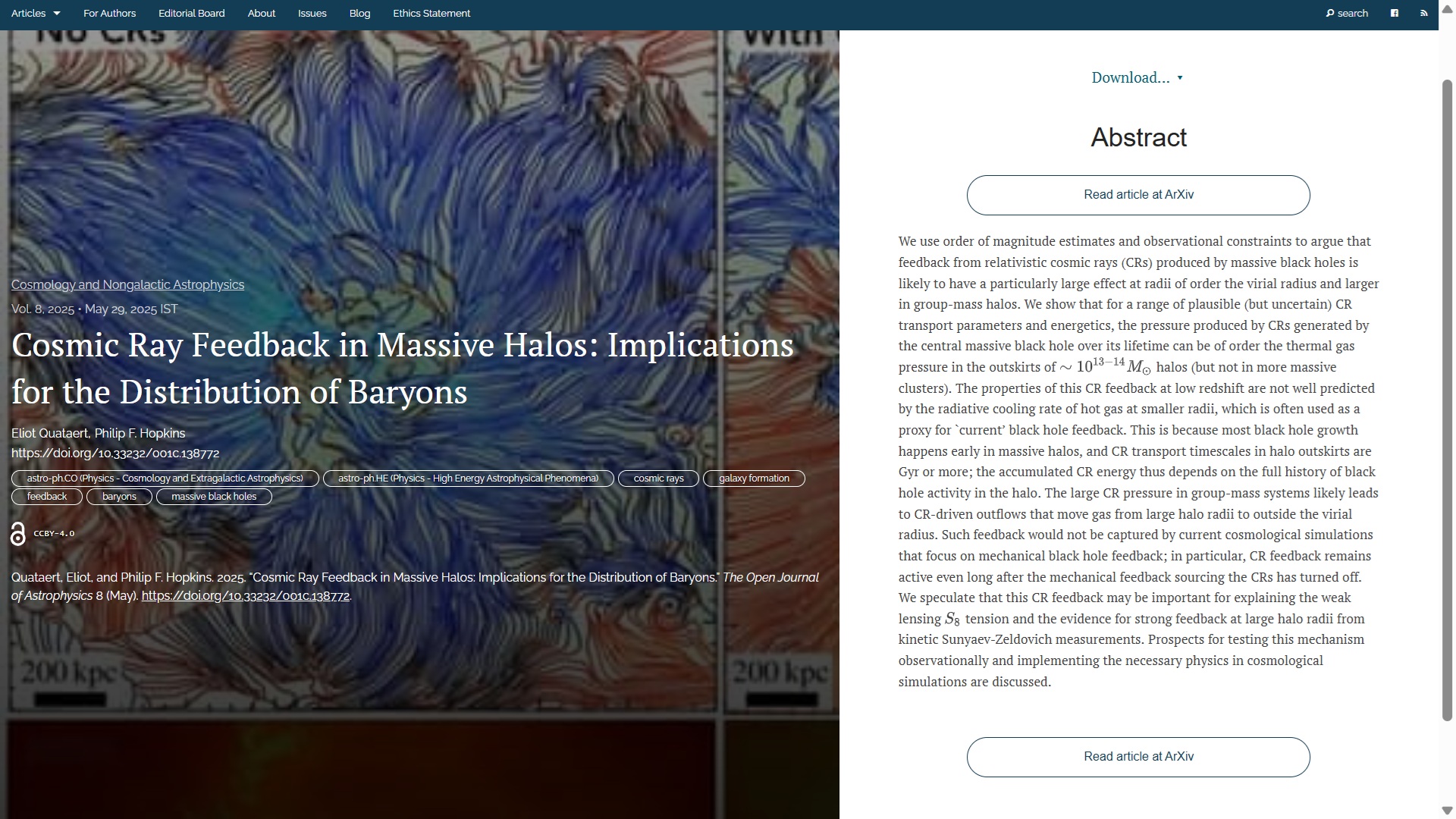
The third paper we published last week, and our 300th overall, is “Cosmic Ray Feedback in Massive Halos: Implications for the Distribution of Baryons” by Eliot Quataert (Princeton, USA) and Philip F. Hopkins (Caltech, USA).  This was published on Thursday 29th May in the folder Cosmology and NonGalactic Astrophysics. The paper discusses the effects of cosmic rays produced by massive black holes on the structure of the baryonic component of galaxies and how these might affect cosmological parameter estimation. The overlay is here:


You can read the officially accepted version of this paper on arXiv here.

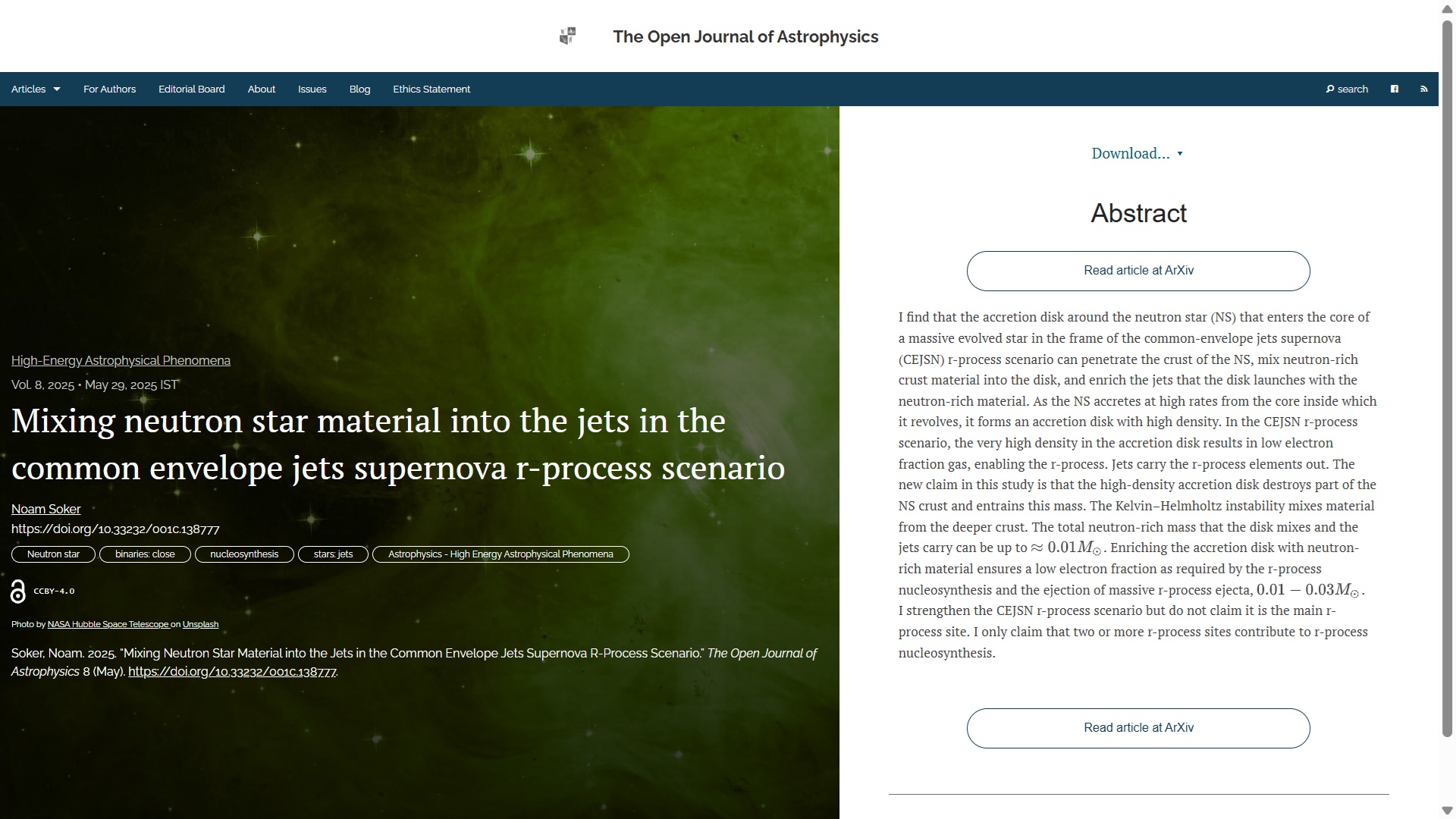
The next one to report is “Mixing neutron star material into the jets in the common envelope jets supernova r-process scenario” by Noam Soker (Technion, Israel). This was published on Thursday 27th May in the folder High-Energy Astrophysical Phenomena; it presents a discussion of the chemical enrichment of an evolved star consequent upon its ingestion of a neutron star.

The overlay is here:

You can find the officially accepted version on arXiv here.

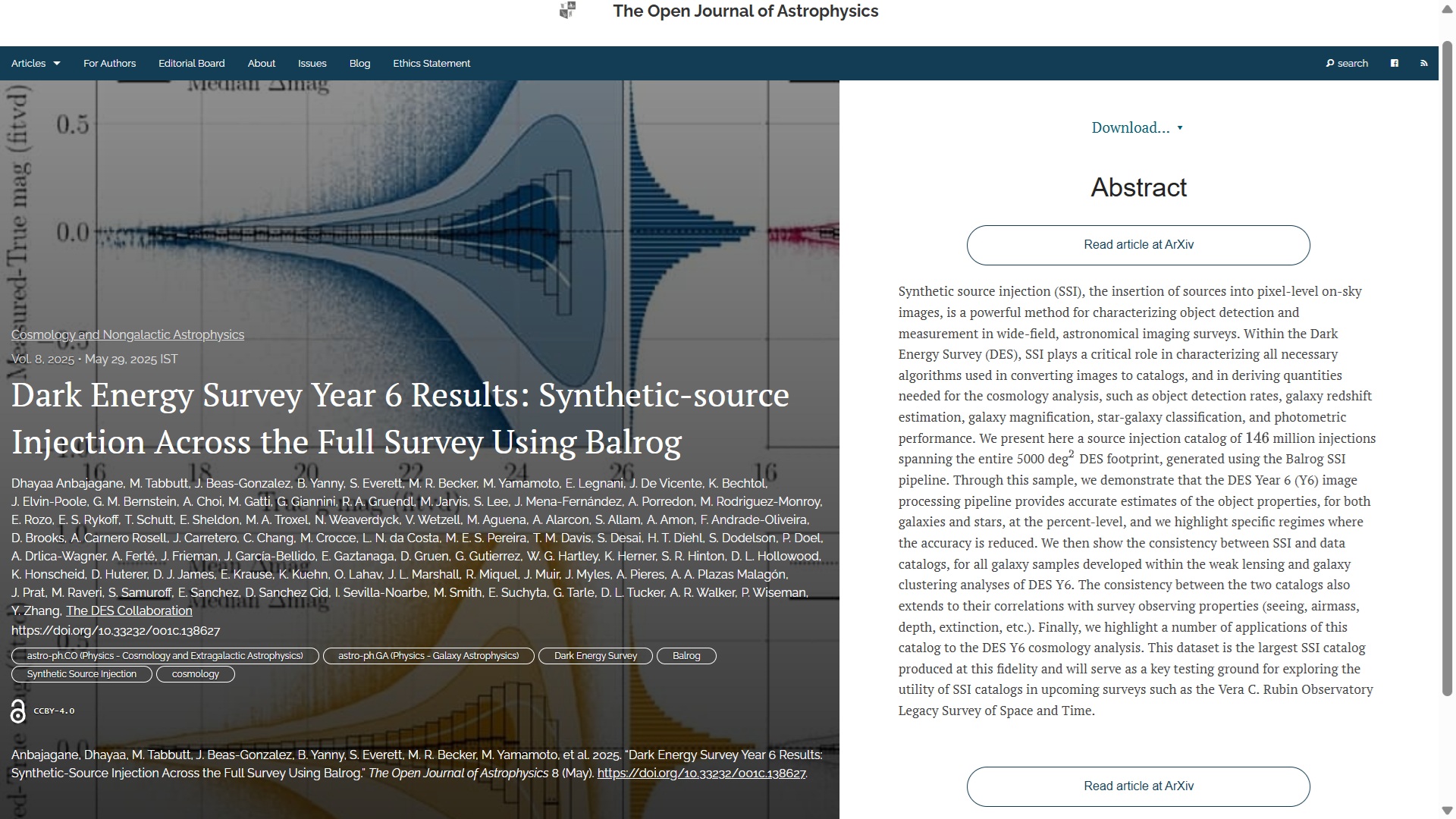
Last, but by no means least, for this week we have “Dark Energy Survey Year 6 Results: Synthetic-source Injection Across the Full Survey Using Balrog” by Dhayaa Anbajagane (Kavli Institute, Chicago) et al. (81 authors) on behalf of the Dark Energy Survey Collaboration. It was also  published on Thursday 27th May  2025, but in the folder Cosmology and NonGalactic Astrophysics. It is about testing the Dark Energy Survey analysis pipeline using synthetic sources.

The overlay is here:


You can find the officially accepted version on arXiv here.

That’s all the papers for this week. I’ll post another update next weekend.

Weekly Update from the Open Journal of Astrophysics – 24/05/205

Posted in OJAp Papers, Open Access, The Universe and Stuff with tags , , , , , , , , , , , , , , , , , on May 24, 2025 by telescoper

It’s  time once again for the regular Saturday update of papers published during the past week at the Open Journal of Astrophysics. Since the last update we have published three new papers, which brings the number in Volume 8 (2025) up to 62 and the total so far published by OJAp up to 297.

In chronological order of publication, the three papers published this week, with their overlays, are as follows. You can click on the images of the overlays to make them larger should you wish to do so.

The first paper to report is: “Jet-shaped filamentary ejecta in common envelope evolution” by Ron Schreier, Shlomi Hillel and Noam Soker (Technion, Haifa, Israel). This paper, which was published on Monday May 19th 2025 in the folder High-Energy Astrophysical Processes, presents three-dimensional hydrodynamical simulations of common envelope evolution of a neutron star inside the envelope of a rotating red supergiant with Rayleigh-Taylor instabilities forming filamentary ejecta.

The overlay is here:

You can find the officially accepted version on arXiv here.

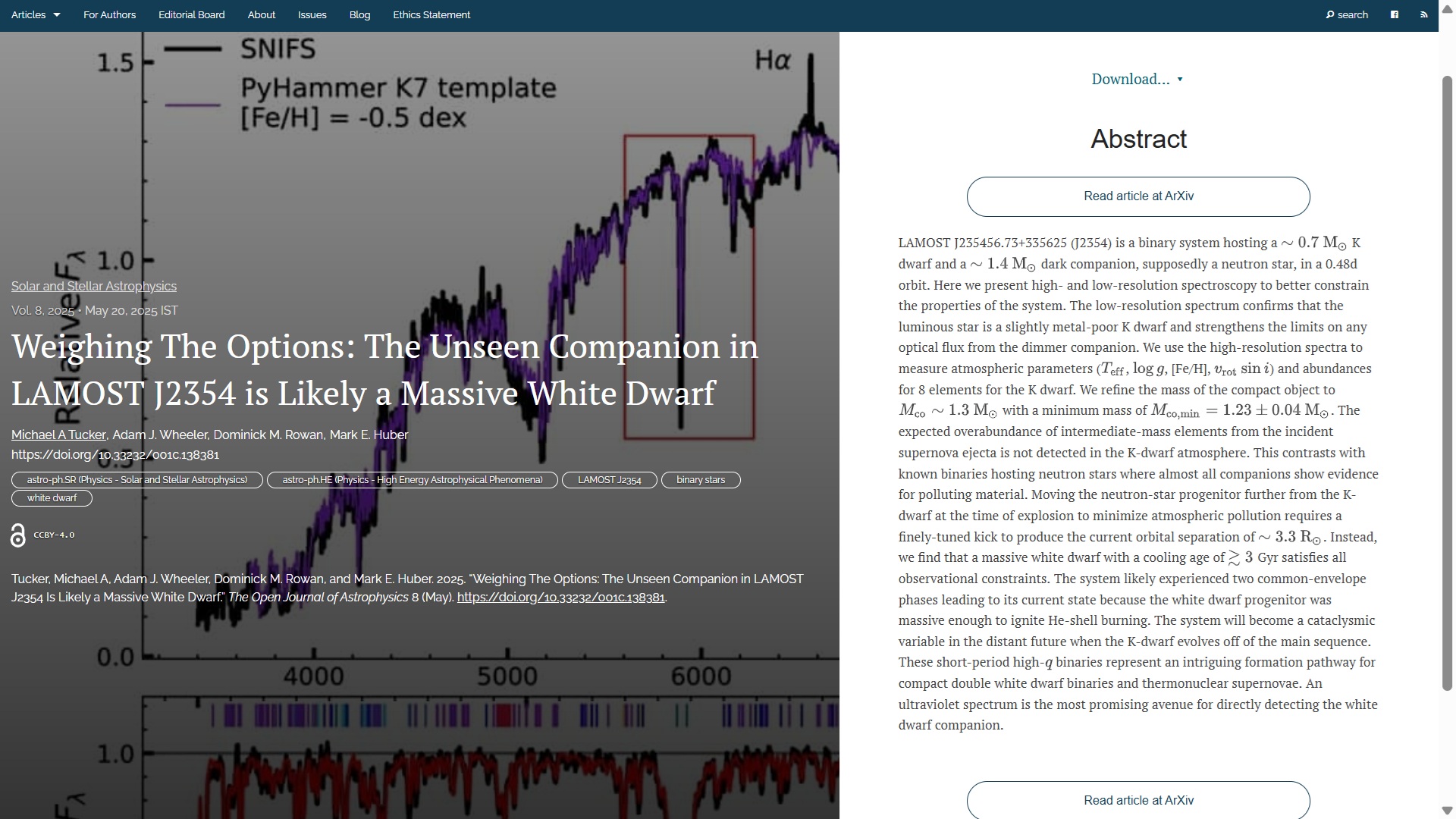
Second one up is “Weighing The Options: The Unseen Companion in LAMOST J2354 is Likely a Massive White Dwarf” by M. A. Tucker, A. J. Wheeler & D. M. Rowan (Ohio State University, USA) and M. E. Huber (U. Hawaii, USA). This paper was published on Tuesday 20th May 2025 in the folder for Solar and Stellar Astrophysics. It discusses a spectroscopic study of the binary system LAMOST J235456.73+335625 (J2354) with a discussion of the implications for the nature of the dark component.

The overlay is here:


You can find the officially-accepted version of the paper on arXiv here.

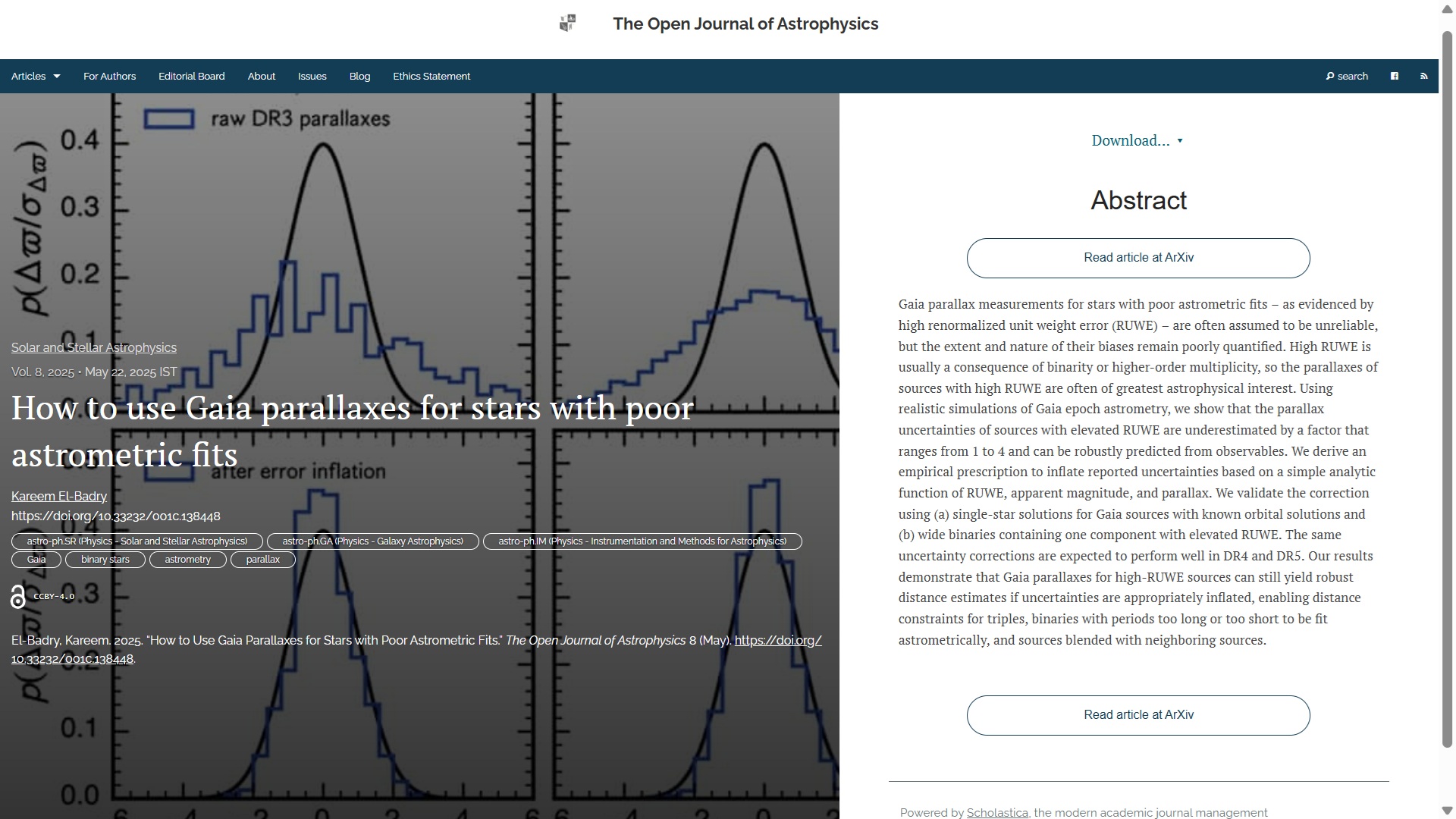
The third and last paper of the week, published on Thursday May 22nd 2025, also in the folder Solar and Stellar Astrophysics, is “How to use Gaia parallaxes for stars with poor astrometric fits” by Kareem El-Badry (Caltech, USA).  This paper presents a method for extracting reasonable estimates of stellar parallaxes from Gaia data when the overall astrometric solution is unreliable due to errors and noise

Here is the overlay:

You can find the officially accepted version of this paper on arXiv here.

That’s all the papers for this week. Looking at the publishing workflow, I expect we will pass the 300 mark next week. We’ll see when I post the next update next Saturday.


Weekly Update from the Open Journal of Astrophysics – 17/05/2025

Posted in OJAp Papers, Open Access, The Universe and Stuff with tags , , , , , , , , , , , , on May 17, 2025 by telescoper

It’s a lovely Saturday morning in May, and it’s time for the weekly  update of papers published at the Open Journal of Astrophysics. Since the last update we have published four new papers, which brings the number in Volume 8 (2025) up to 59 and the total so far published by OJAp up to 294.

In chronological order of publication, the four papers published this week, with their overlays, are as follows. You can click on the images of the overlays to make them larger should you wish to do so.

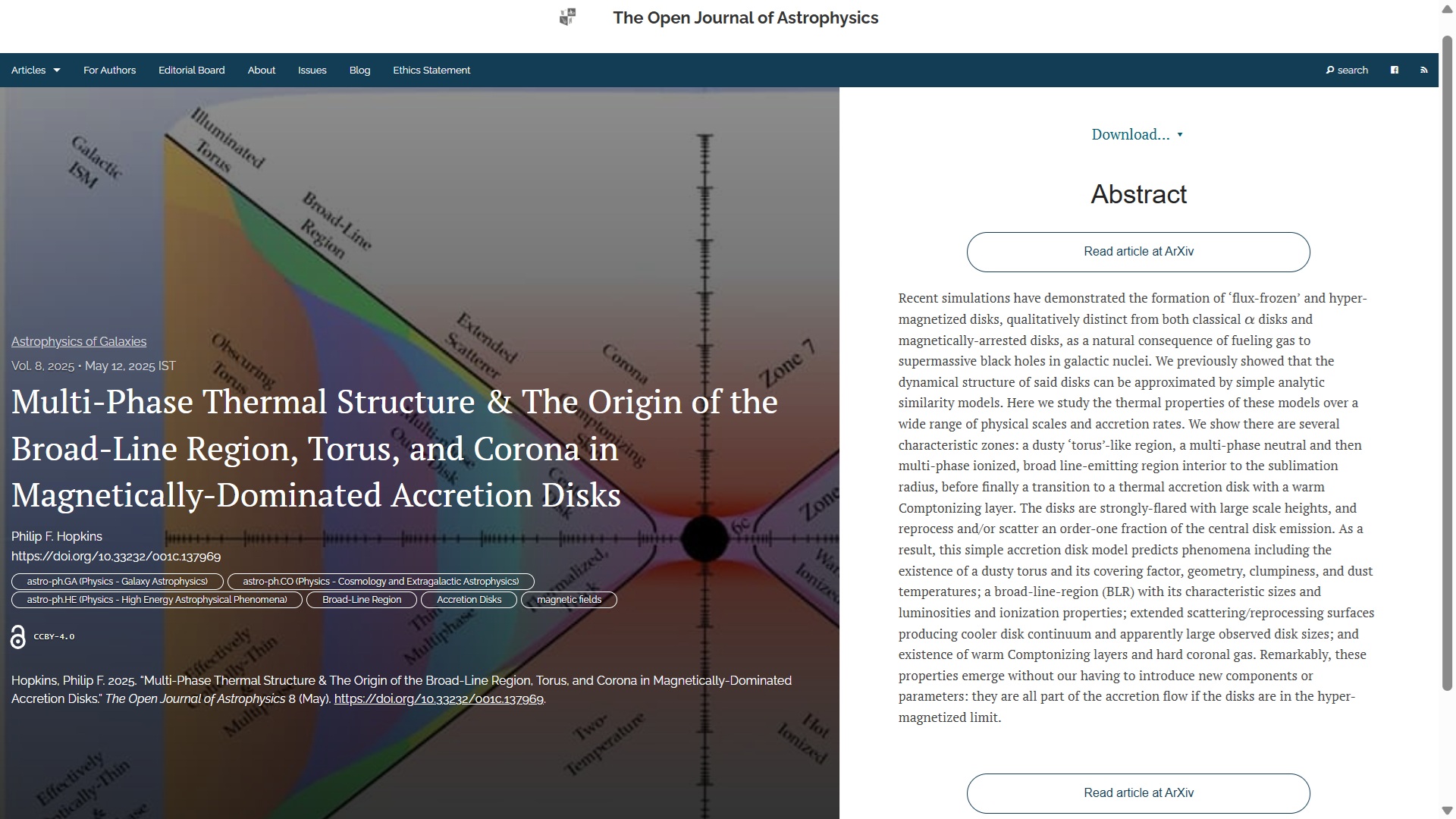
The first paper to report is: “Multi-Phase Thermal Structure & The Origin of the Broad-Line Region, Torus, and Corona in Magnetically-Dominated Accretion Disks” by Philip F. Hopkins (Caltech, USA). This was published on Monday May 12th in the folder Astrophysics of Galaxies. It presents simple accretion disk model that predicts the properties of many features including the dusty torus, broad-line region, continuum emission and coronal gas.

The overlay is here:

You can find the officially accepted version on arXiv here.

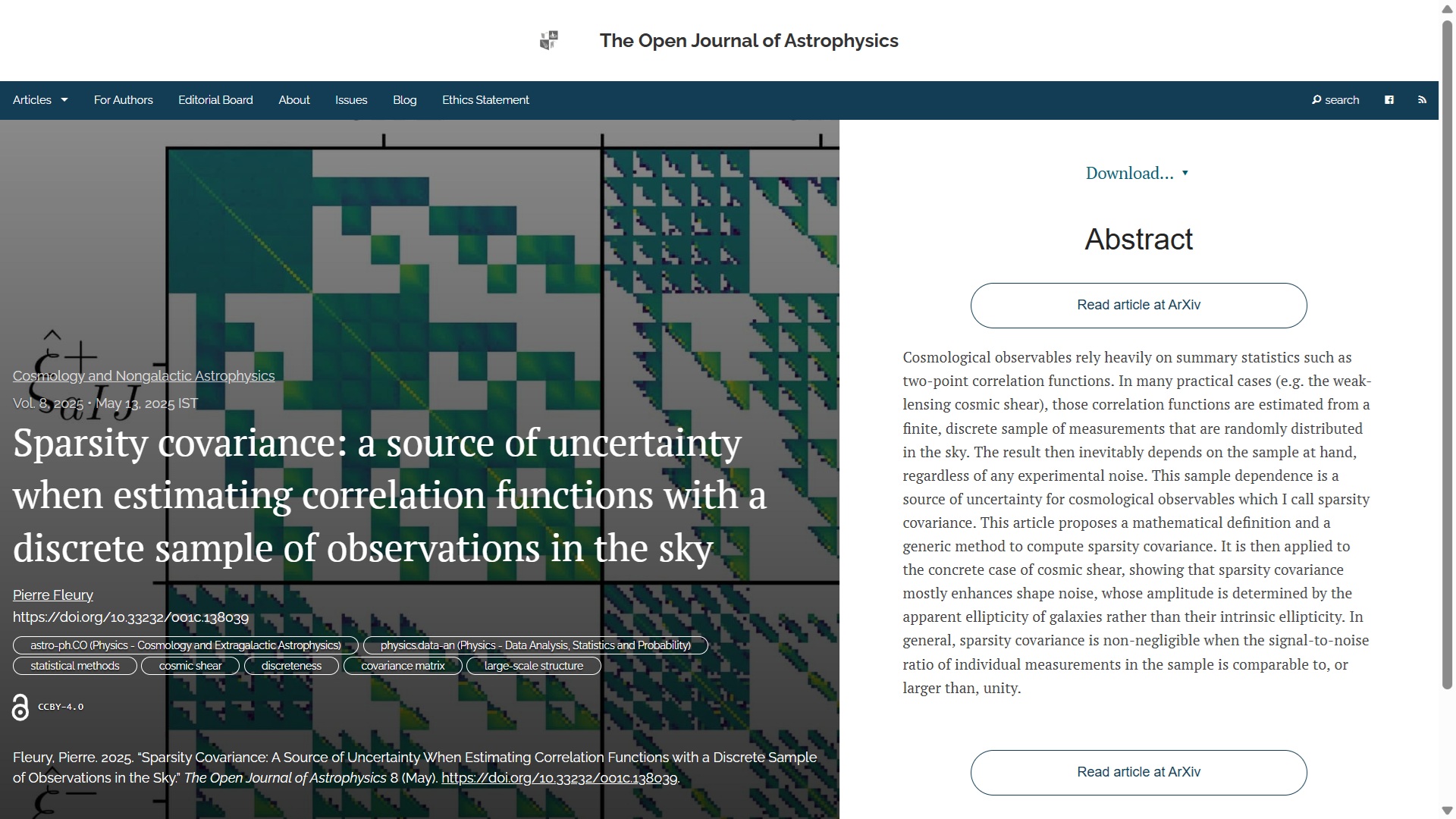
Second one up is “Sparsity covariance: a source of uncertainty when estimating correlation functions with a discrete sample of observations in the sky” by Pierre Fleury (U. Montpellier, France). This one was published on Tuesday 13th May 2025 in the folder Cosmology and NonGalactic Astrophysics.  This paper presents a discussion of the uncertainty in cosmological observables caused by discrete sampling and a method to compute the covariances resulting from this.

The overlay is here:

You can find the officially-accepted version of the paper on arXiv here.

The third paper of the week, published on Wednesday May 14th 2025,  is “Dark Matter Particle Flux in a Dynamically Self-consistent Milky Way Model” by Lucijana Stanic, Mark Eberlein, Stanislav Linchakovskyy, Christopher Magnoli, Maryna Mesiura, Luca Morf, Prasenjit Saha (University of Zurich, Switzerland) and Eugene Vasiliev (University of Surrey, UK). This one presents a study of the behaviour of dark matter in an anisotropic model for the Milky Way halo with implications for particle detection rates. It is in the folder Astrophysics of Galaxies.

Here is the overlay:

You can find the officially accepted version of this paper on arXiv here.

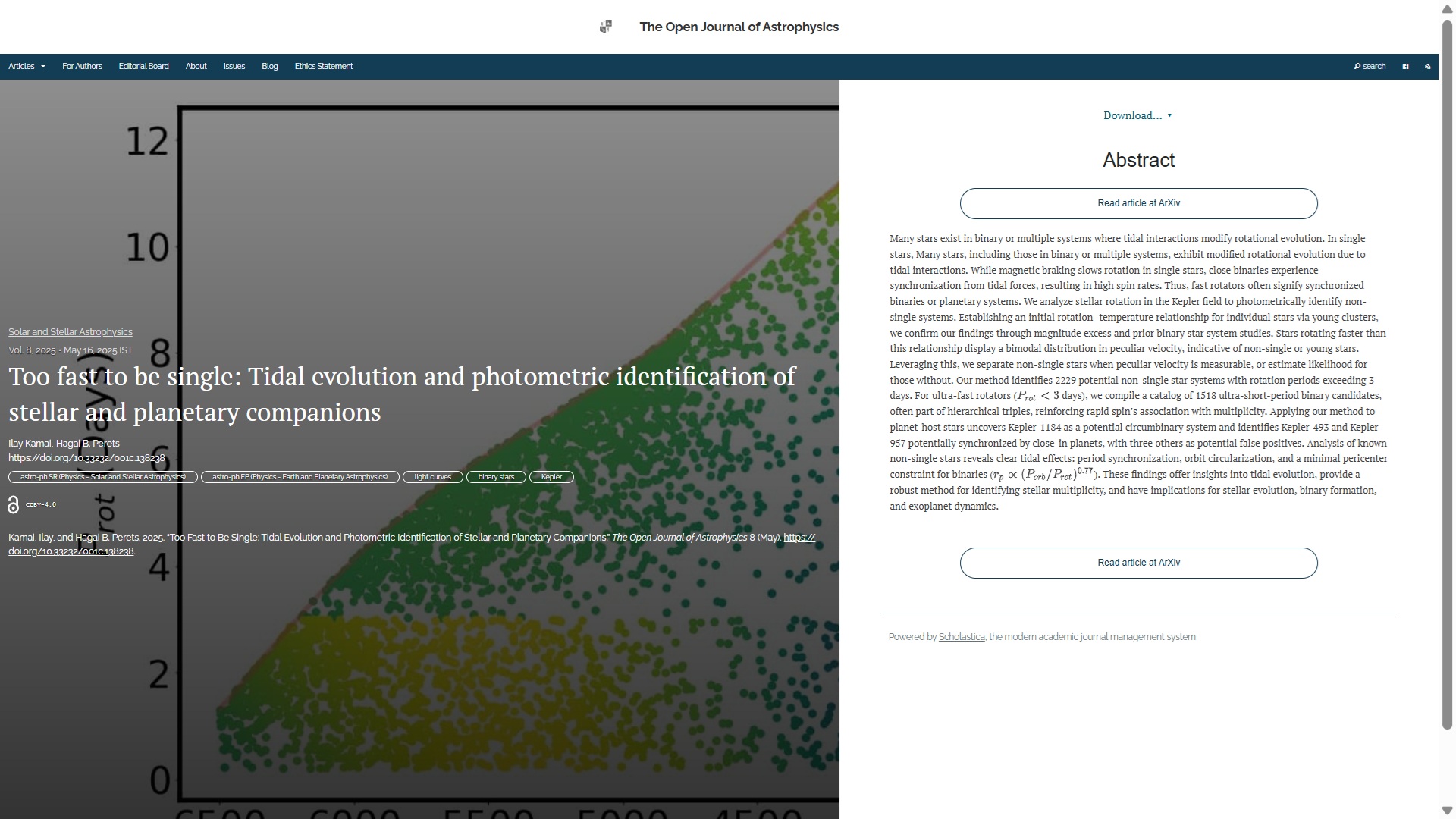
The last paper published this week is “Too fast to be single: Tidal evolution and photometric identification of stellar and planetary companions” by Ilay Kamai and Hagai B. Perets (Technion, Haifa, Israel). This one was published on Friday 16th May 2025 in the folder Solar and Stellar Astrophysics. It presents an analysis of the rotation of stars observed in the Kepler field to identify non-single systems with high spin rates resulting from tidal effects.

Here is the overlay:

The official published version can be found on the arXiv here.

That’s all the papers for this week. I’ll post another update next week.