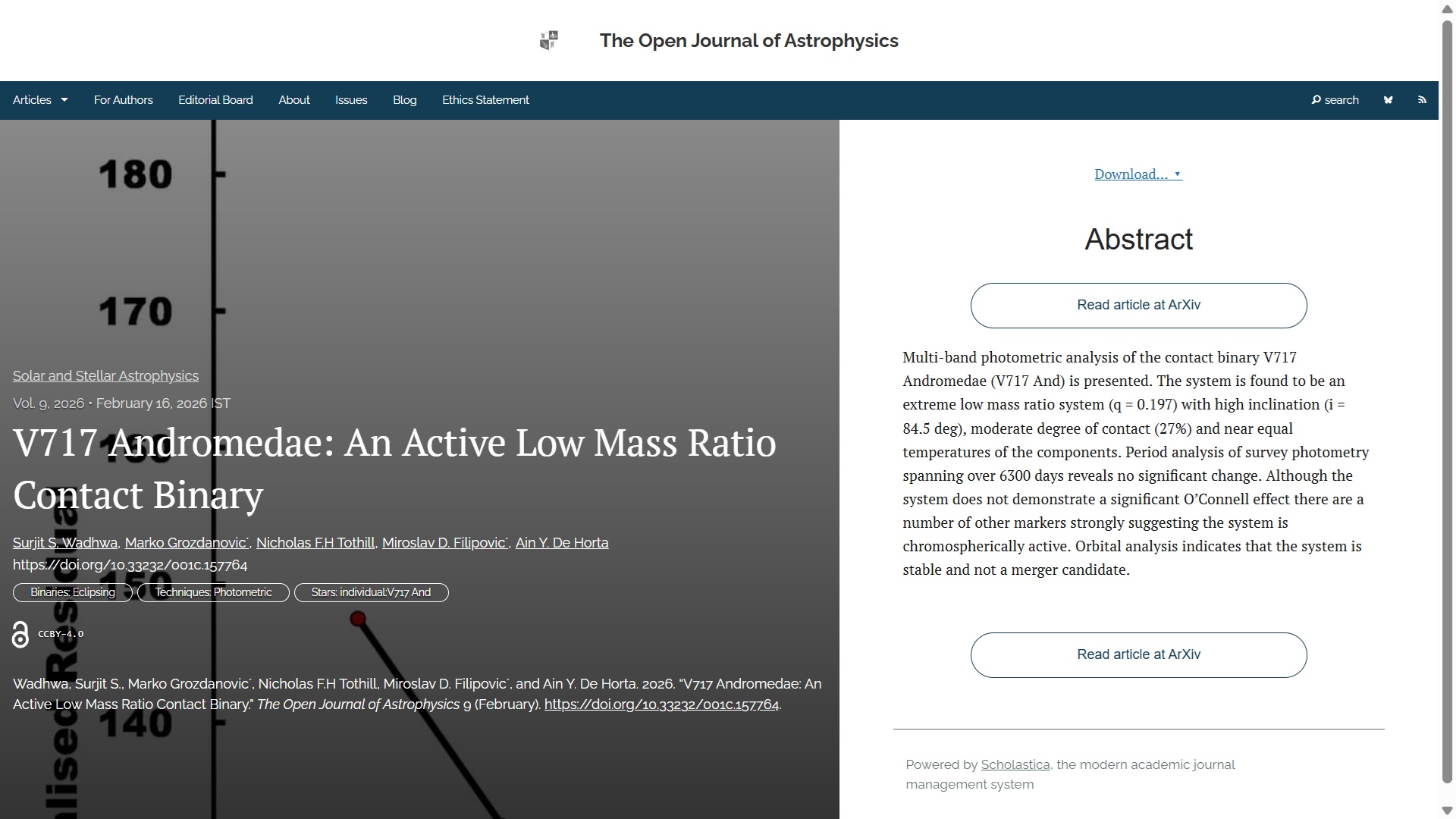
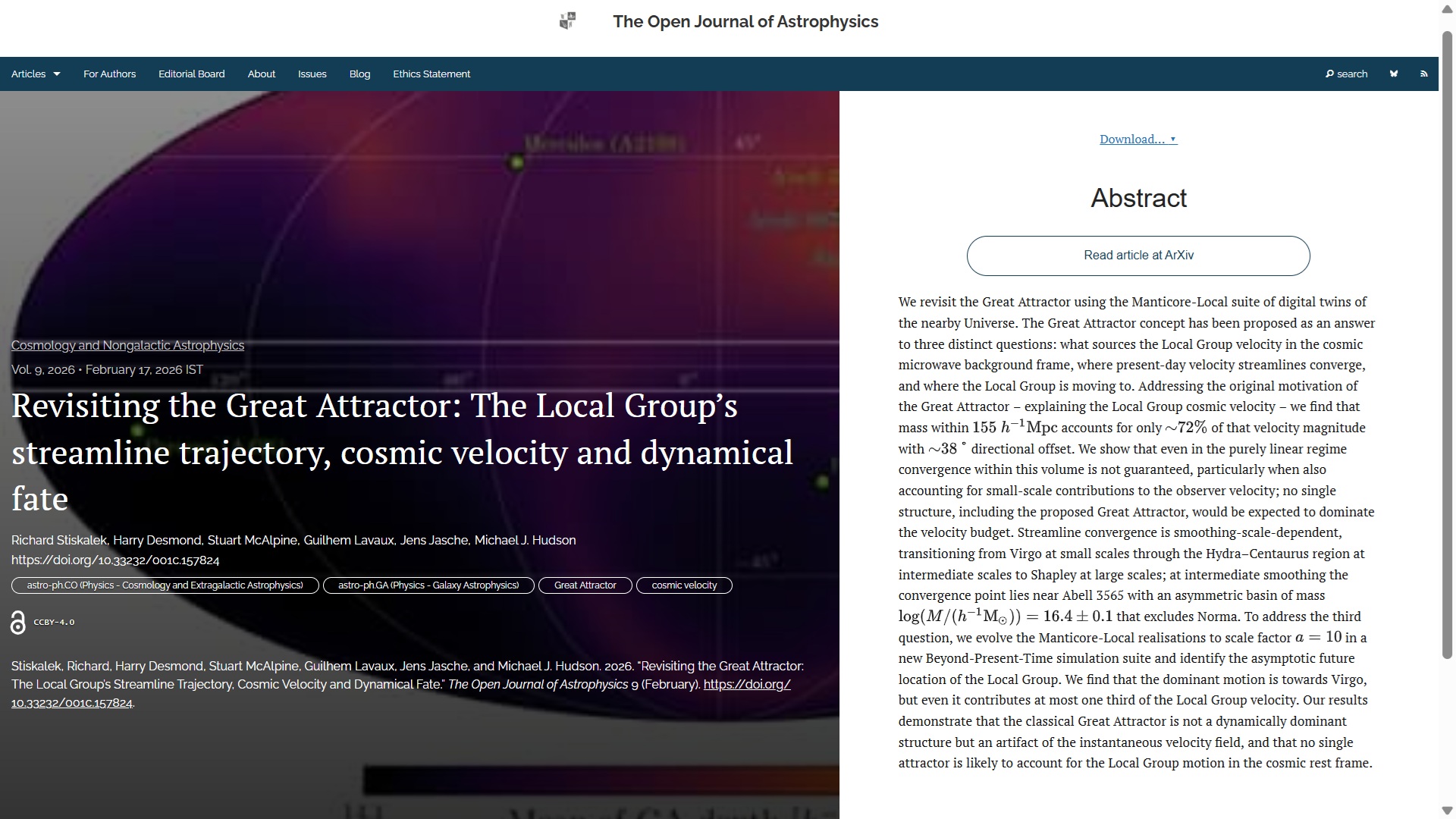
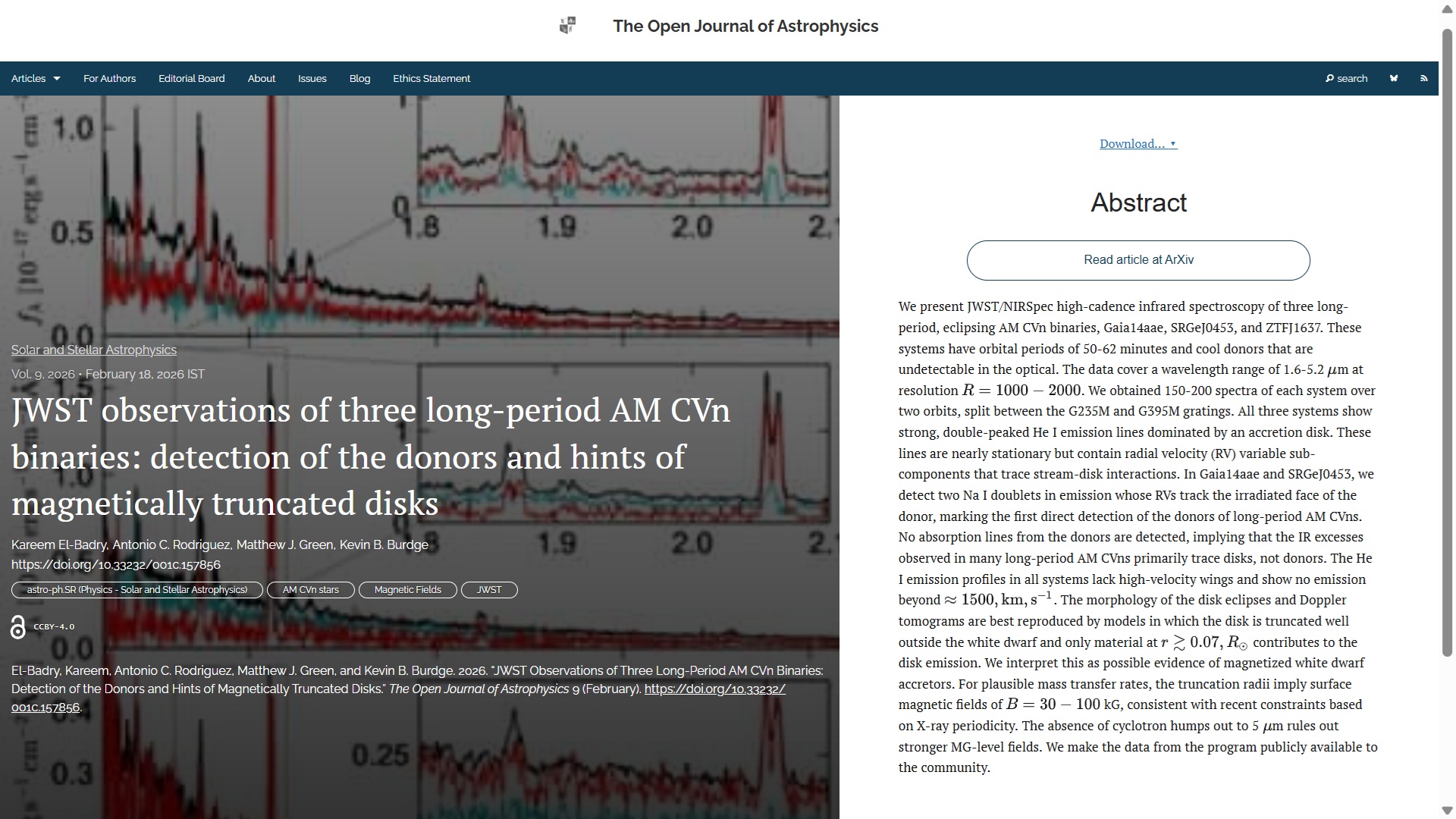
Archive for large-scale structure of the Universe

Weekly Update from the Open Journal of Astrophysics – 14/02/2026

Posted in OJAp Papers, Open Access, The Universe and Stuff with tags , , , , , , , , , , , , , , , , , , , , , , , , , , , , , , on February 14, 2026 by telescoper

It’s Saturday once more so time for another update of activity at the Open Journal of Astrophysics. Since the last update we have published a further six papers, bringing the number in Volume 9 (2026) to 30 and the total so far published by OJAp up to 478.

I will continue to include the posts made on our Mastodon account (on Fediscience) to encourage you to visit it. Mastodon is a really excellent service, and a more than adequate replacement for X/Twitter (which nobody should be using); these announcements also show the DOI for each paper.

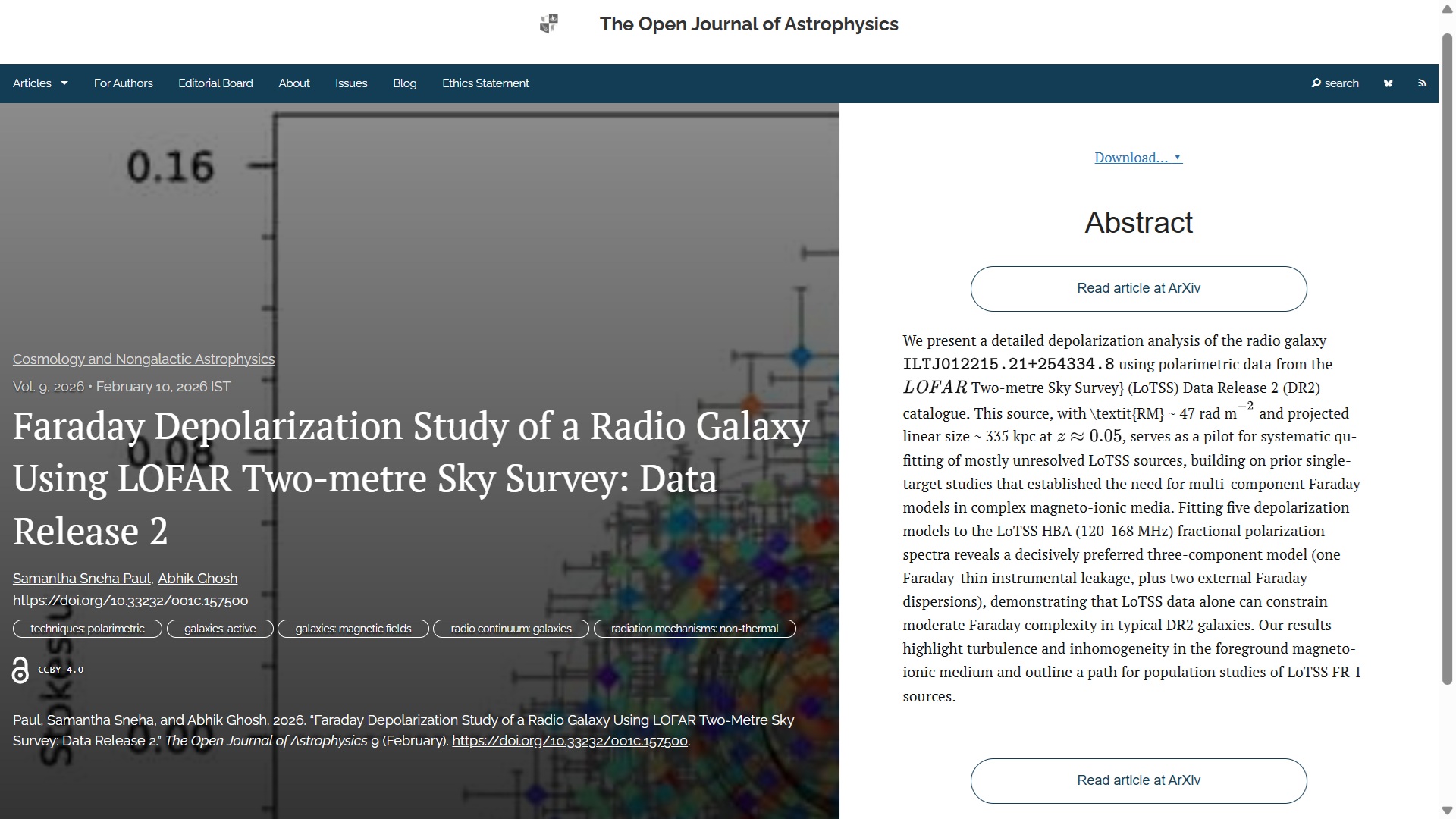
The first paper to report this week is “Faraday Depolarization Study of a Radio Galaxy Using LOFAR Two-metre Sky Survey: Data Release 2” by Samantha Sneha Paul and Abhik Ghosh (Banwarilal Bhalotia College, India). This was published on Tuesday February 10th in the folder Cosmology and Nongalactic Astrophysics. The paper analyzes the depolarization of radio galaxy ILTJ012215.21+254334.8 using LOFAR’s Sky Survey data, revealing a preferred three-component model and highlighting turbulence in the magneto-ionic medium.

The overlay is here:

You can find the officially accepted version on arXiv here and the announcement on Fediverse here:

Open Journal of Astrophysics

New Publication at the Open Journal of Astrophysics: "Faraday Depolarization Study of a Radio Galaxy Using LOFAR Two-metre Sky Survey: Data Release 2" by Samantha Sneha Paul and Abhik Ghosh (Banwarilal Bhalotia College, India)

doi.org/10.33232/001c.157500

February 10, 2026, 6:25 am 0 boosts 1 favorites

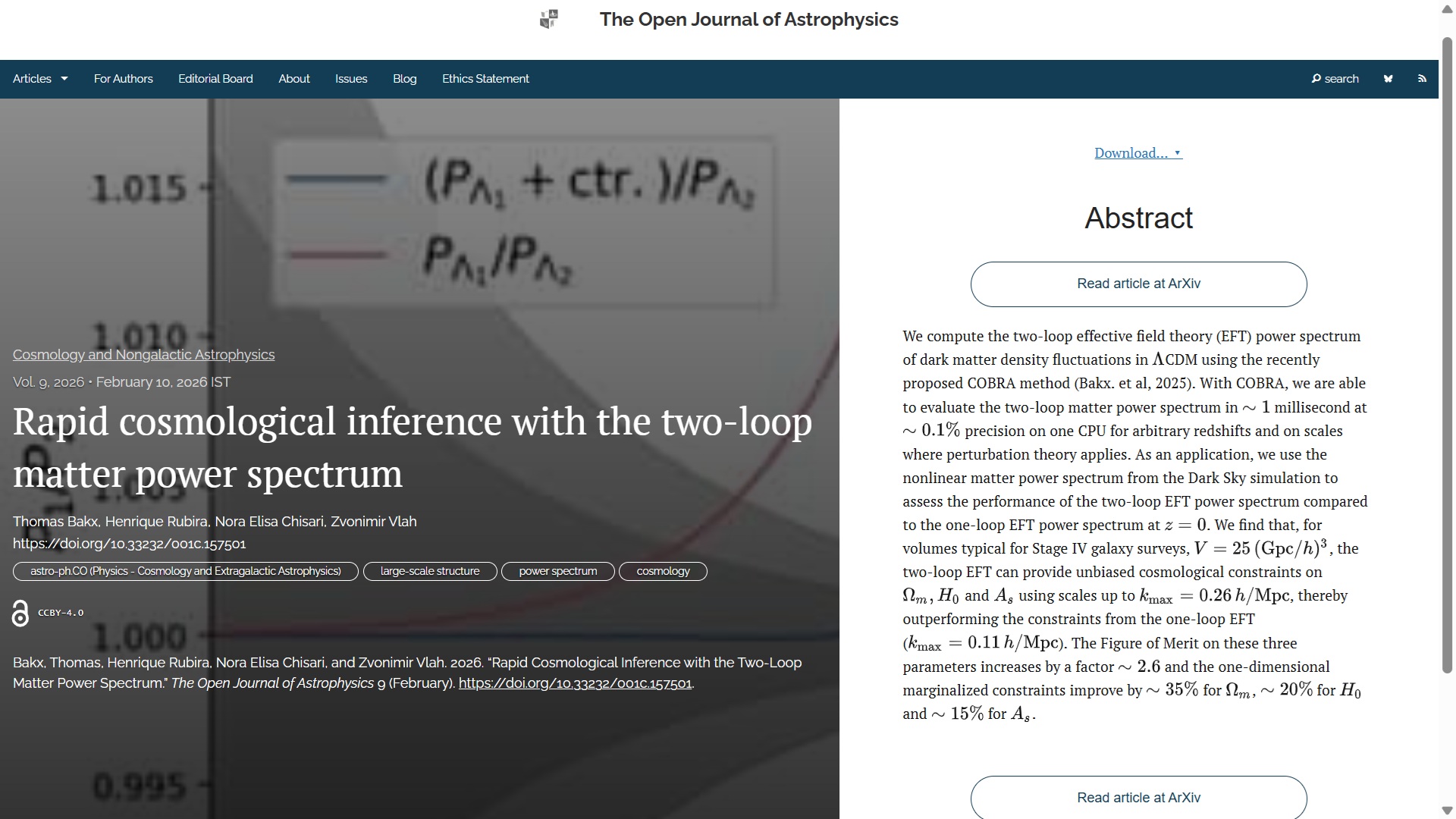
The second paper is “Rapid cosmological inference with the two-loop matter power spectrum” by Thomas Bakx (Utrecht U., NL), Henrique Rubira (Ludwig-Maximilians-Universität, DE), Nora Elisa Chisari (Utrecht) and Zvonimir Vlah (Ruđer Bošković Institute, Croatia). This was also published on Tuesday February 10th in the folder Cosmology and Nongalactic Astrophysics. This paper uses the COBRA method to compute the two-loop effective field theory power spectrum of dark matter density fluctuations, providing more precise cosmological constraints than the one-loop EFT.

The overlay for this one is here:

The official version of the paper can be found on arXiv here and the Fediverse announcement here:

Open Journal of Astrophysics

New Publication at the Open Journal of Astrophysics: "Rapid cosmological inference with the two-loop matter power spectrum" by Thomas Bakx (Utrecht U., NL), Henrique Rubira (Ludwig-Maximilians-Universität, DE), Nora Elisa Chisari (Utrecht) and Zvonimir Vlah (Ruđer Bošković Institute, Croatia)

doi.org/10.33232/001c.157501

February 10, 2026, 6:41 am 0 boosts 0 favorites

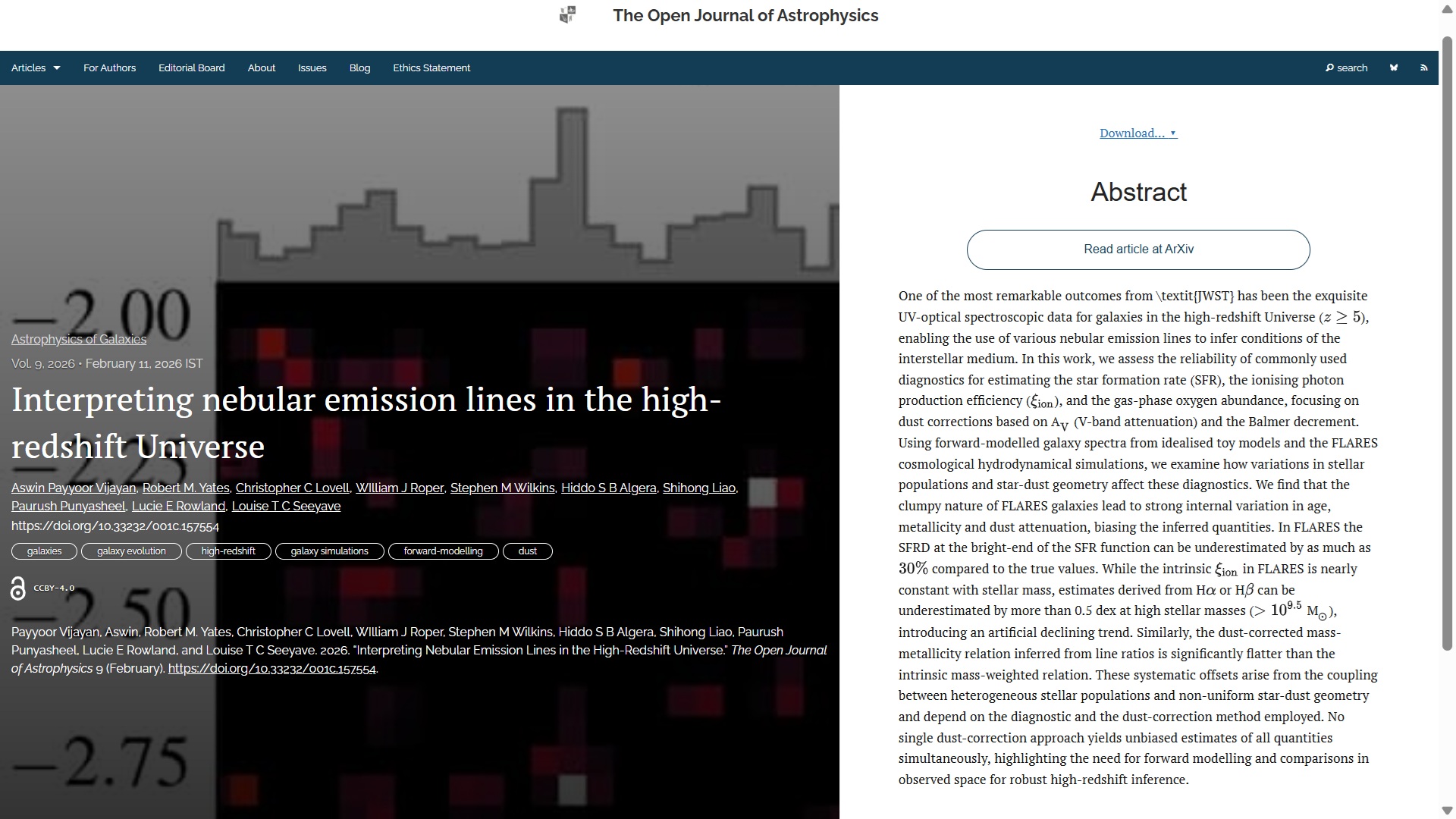
Next, published on Wednesday 11th February in the folder Astrophysics of Galaxies, is “Interpreting nebular emission lines in the high-redshift Universe” by Aswin P. Vijayan (U. Sussex, UK) and 9 others based in the UK, Taiwan, China and The Netherlands. This article examines the reliability of diagnostics used to estimate star formation rate and gas-phase oxygen abundance in high-redshift galaxies. It finds that variations in stellar populations and star-dust geometry. The overlay is here:

The official version can be found on arXiv here and the Fediverse announcement is here:

Open Journal of Astrophysics

New Publication at the Open Journal of Astrophysics: "Interpreting nebular emission lines in the high-redshift Universe" by Aswin P. Vijayan (U. Sussex, UK) and 9 others based in the UK, Taiwan, China and The Netherlands

doi.org/10.33232/001c.157554

February 11, 2026, 8:21 am 0 boosts 0 favorites

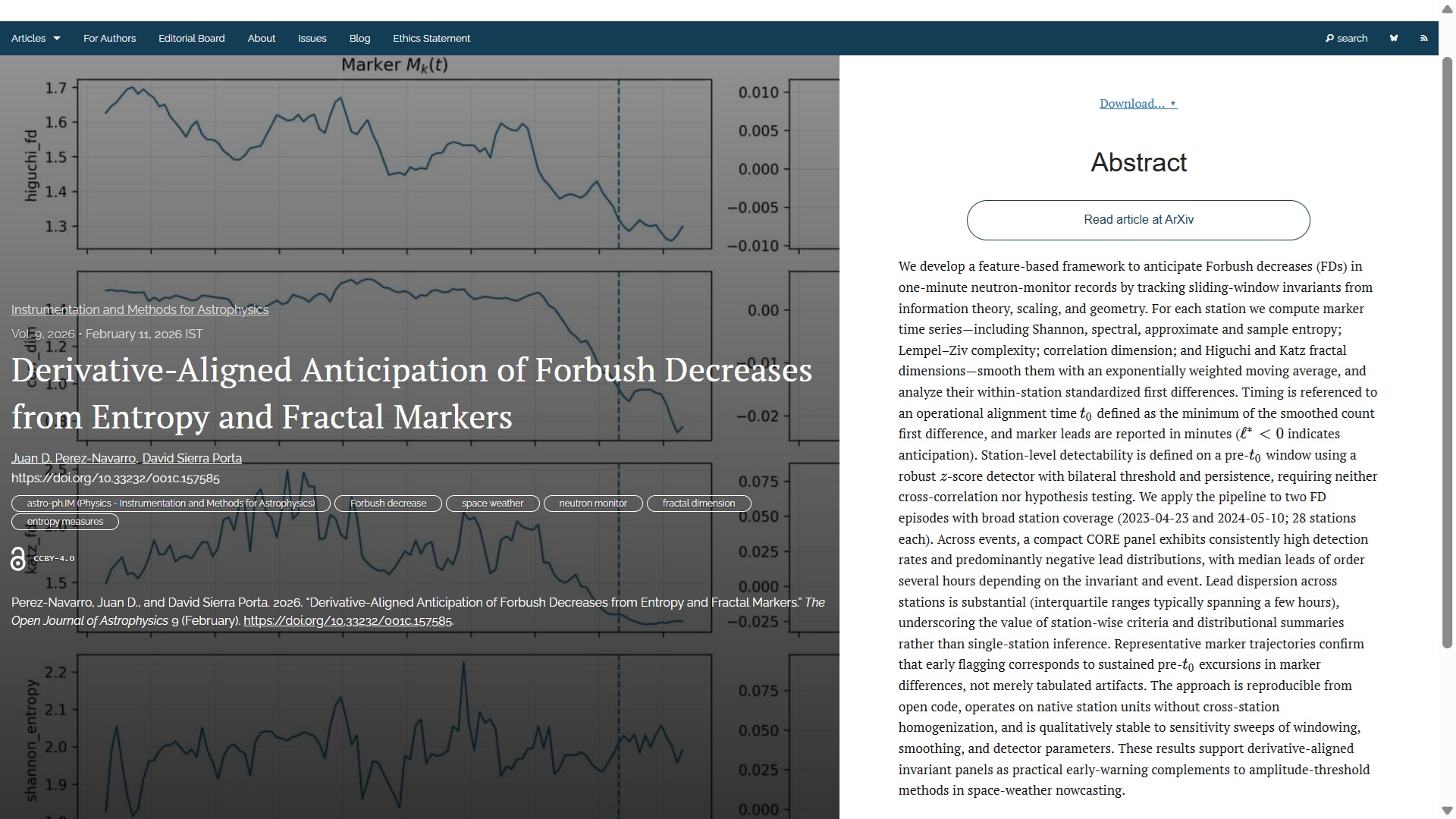
The fourth paper this week, also published on Wednesday 11th February, but in the folder Instrumentation and Methods for Astrophysics is “Derivative-Aligned Anticipation of Forbush Decreases from Entropy and Fractal Markers” by Juan D. Perez-Navarro & David Sierra Porta (Universidad Tecnológica de Bolívar, Colombia). The paper presents a feature-based framework for predicting Forbush decreases, i.e. rapid, temporary drops in galactic cosmic ray (GCR) intensity (up to tens of percent) caused by solar wind disturbances, typically Coronal Mass Ejections (CMEs) or high-speed streams from coronal holes, in neutron-monitor records using various computational methods. The approach is reproducible, operates on native station units, and is stable.

Here is the overlay:

The official version can be found on arXiv here and the Fediverse announcement is here:

Open Journal of Astrophysics

New Publication at the Open Journal of Astrophysics: "Derivative-Aligned Anticipation of Forbush Decreases from Entropy and Fractal Markers" by Juan D. Perez-Navarro & David Sierra Porta (Universidad Tecnológica de Bolívar, Colombia)

doi.org/10.33232/001c.157585

February 11, 2026, 5:19 pm 0 boosts 0 favorites

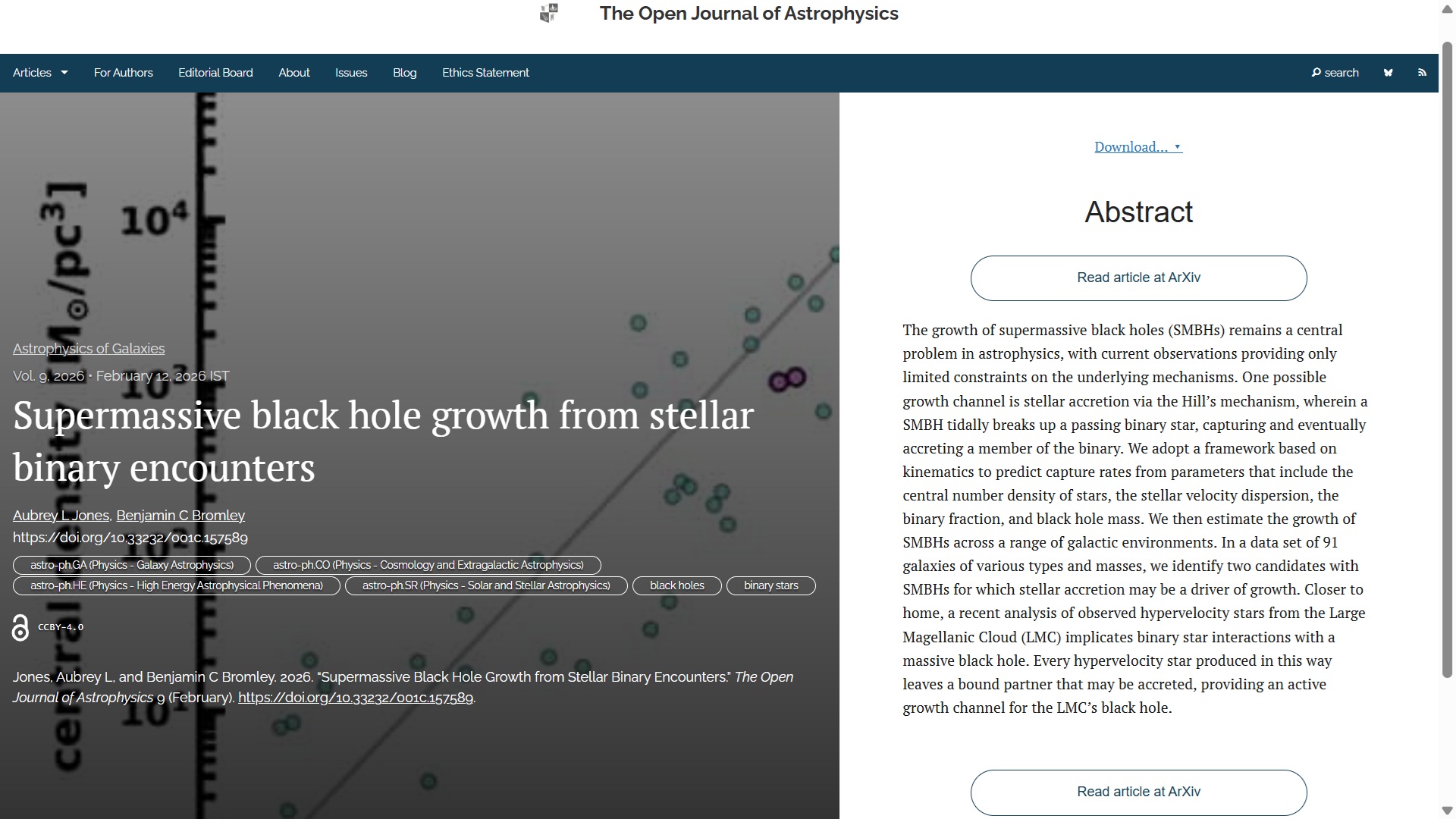
The fifth paper, the penultimate for this week, is “Supermassive black hole growth from stellar binary encounters” by Aubrey L Jones and Benjamin C Bromley (University of Utah, USA). This paper explores the growth of supermassive black holes (SMBHs) through stellar accretion via the Hill’s mechanism, predicting capture rates and identifying potential growth drivers in 91 galaxies. It was published on Thursday 11th February 2026 in the folder Astrophysics of Galaxies.

The overlay is here:

The accepted version can be found on arXiv here, and the fediverse announcement is here:

Open Journal of Astrophysics

New Publication at the Open Journal of Astrophysics: "Supermassive black hole growth from stellar binary encounters" by Aubrey L Jones and Benjamin C Bromley (University of Utah, USA)

doi.org/10.33232/001c.157589

February 12, 2026, 7:31 am 1 boosts 2 favorites

Finally for this week we have “Dynamics in the Cores of Self-Interacting Dark Matter Halos: Reduced Stalling and Accelerated Core Collapse” by Frank C. van den Bosch and Shashank Dattathri (Yale University, USA). This study uses simulations to explore core dynamics in self-interacting dark matter (SIDM) halos. Findings suggest strong self-interactions prevent core stalling and buoyancy, leading to accelerated core collapse. This was published yesterday, on Friday 13th February 2026, in the folder Astrophysics of Galaxies.

The overlay is here:

You can find the published version of the article here, and the Mastodon announcement is here:

Open Journal of Astrophysics

New Publication at the Open Journal of Astrophysics: "Dynamics in the Cores of Self-Interacting Dark Matter Halos: Reduced Stalling and Accelerated Core Collapse" by Frank C. van den Bosch and Shashank Dattathri (Yale University, USA)

doi.org/10.33232/001c.157701

February 13, 2026, 8:27 am 1 boosts 2 favorites

And that concludes this week’s update. I will do another next Saturday.

Weekly Update from the Open Journal of Astrophysics – 07/02/2026

Posted in OJAp Papers, Open Access, The Universe and Stuff with tags , , , , , , , , , , , , , , , , , , , , , , , , , , , , , , , , , , , on February 7, 2026 by telescoper

It’s Saturday once more so time for another update of activity at the Open Journal of Astrophysics. Since the last update we have published a further six papers, bringing the number in Volume 9 (2026) to 24 and the total so far published by OJAp up to 472.

I will continue to include the posts made on our Mastodon account (on Fediscience) to encourage you to visit it. Mastodon is a really excellent service, and a more than adequate replacement for X/Twitter which nobody should be using; these announcement also show the DOI for each paper.

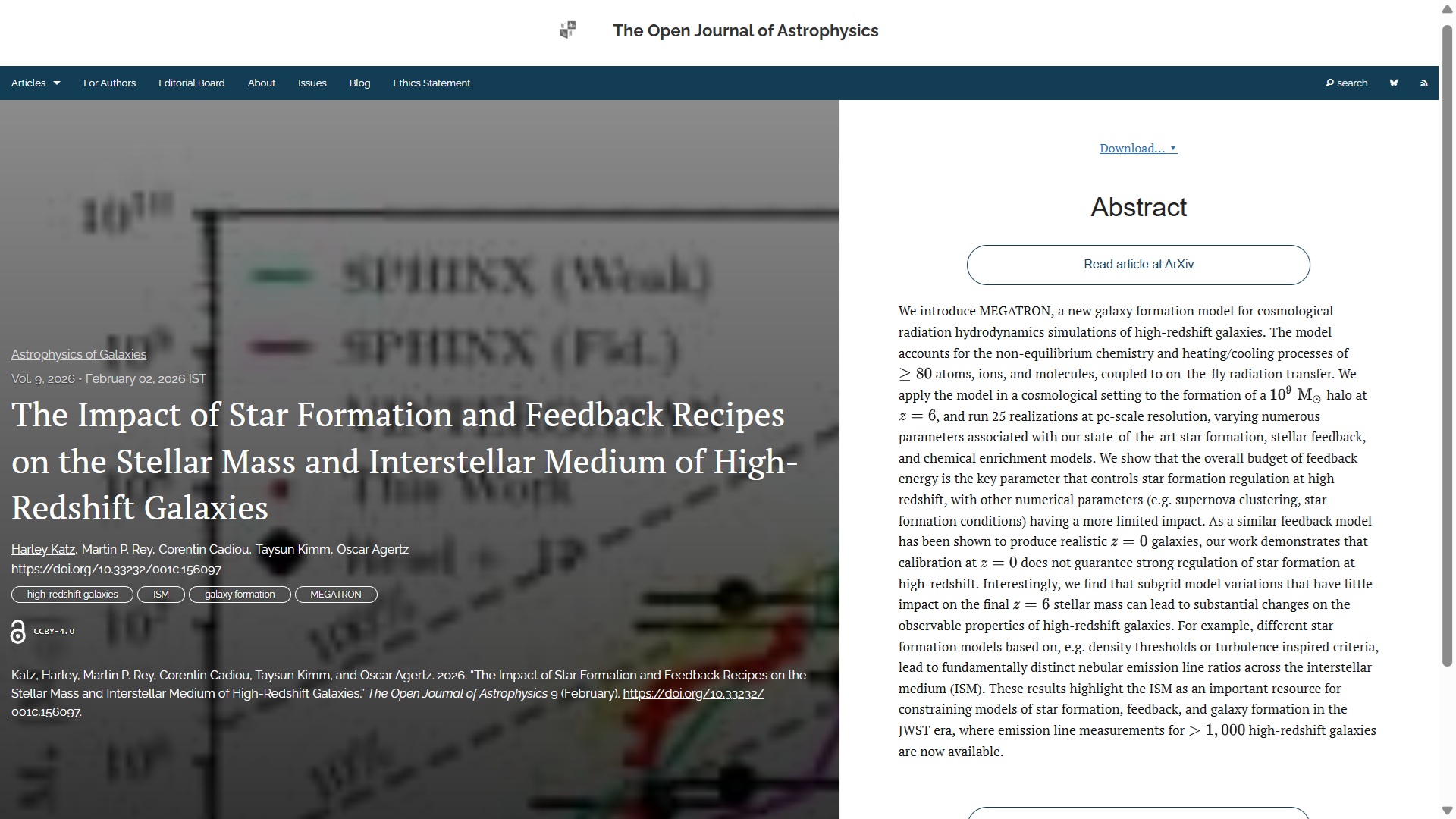
The first paper to report this week is “The Impact of Star Formation and Feedback Recipes on the Stellar Mass and Interstellar Medium of High-Redshift Galaxies” by Harley Katz (U. Chicago, USA), Martin P. Rey (U. Oxford, UK), Corentin Cadiou (Lund U., Sweden) Taysun Kimm (Yonsei U., Korea) and Oscar Agertz (Lund). This paper was published on Monday 2nd February 2026 in the folder Astrophysics of Galaxies. It introduces MEGATRON, a new model for galaxy formation simulations, highlighting that feedback energy controls star formation at high redshift and highlighting the importance of the interstellar medium.

The overlay is here:

You can find the officially accepted version on arXiv here and the announcement on Fediverse here:

Open Journal of Astrophysics

New Publication at the Open Journal of Astrophysics: "The Impact of Star Formation and Feedback Recipes on the Stellar Mass and Interstellar Medium of High-Redshift Galaxies" by Harley Katz (U. Chicago, USA), Martin P. Rey (U. Oxford, UK), Corentin Cadiou (Lund U., Sweden) Taysun Kimm (Yonsei U., Korea) and Oscar Agertz (Lund)

doi.org/10.33232/001c.156097

February 2, 2026, 11:02 am 1 boosts 1 favorites

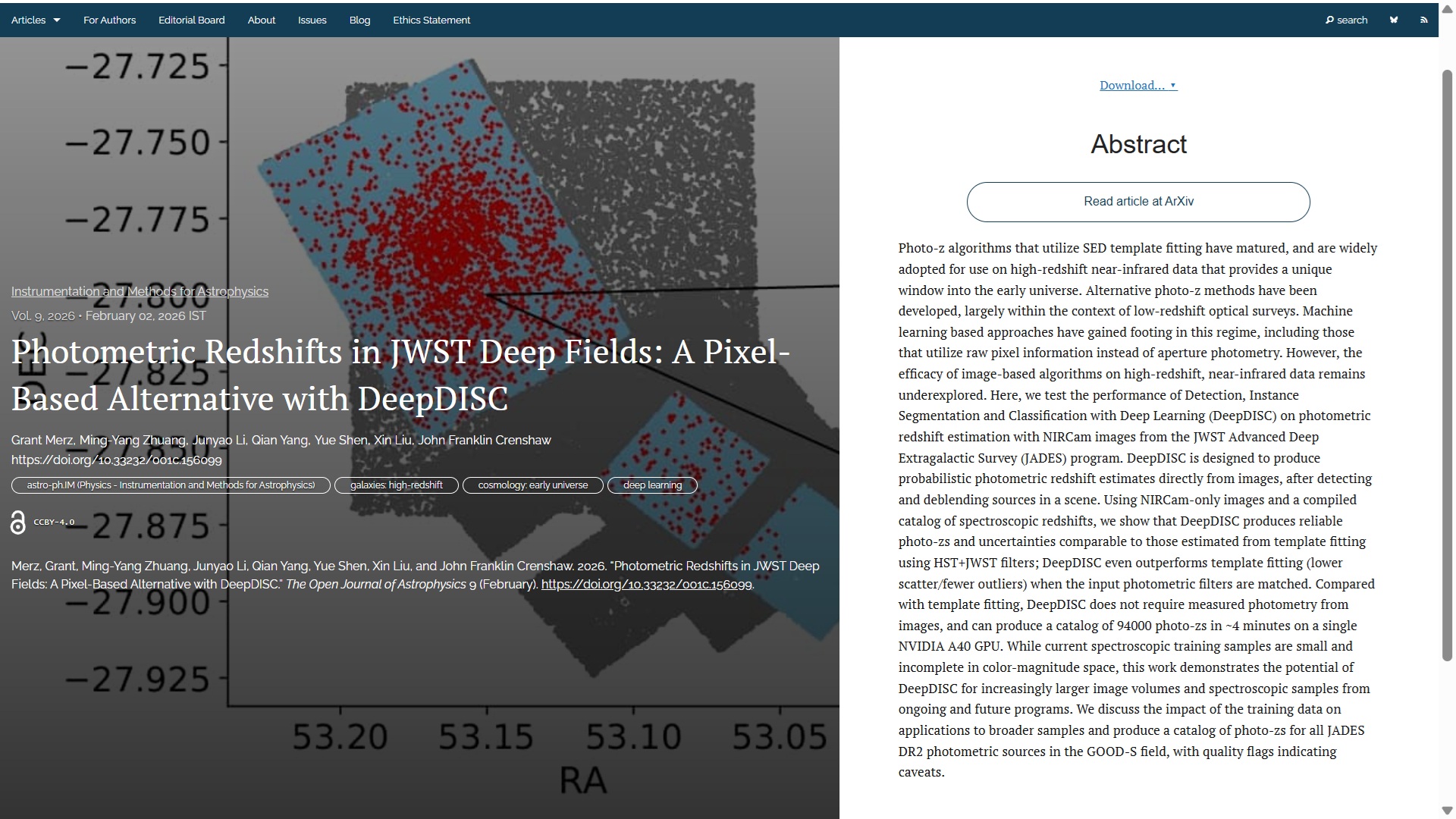
The second paper is “Photometric Redshifts in JWST Deep Fields: A Pixel-Based Alternative with DeepDISC” by Grant Merz (U. Illinois at Urbana-Champaign) and 6 others, all based in the USA. This paper was published on Monday February 2nd 2026 in the folder Instrumentation and Methods for Astrophysics. This paper explores the effectiveness of the DeepDISC machine learning algorithm in estimating photometric redshifts from near-infrared data, demonstrating its potential for larger image volumes and spectroscopic samples

The overlay for this one is here:

The official version of the paper can be found on arXiv here and the Fediverse announcement here:

Open Journal of Astrophysics

New Publication at the Open Journal of Astrophysics: "Photometric Redshifts in JWST Deep Fields: A Pixel-Based Alternative with DeepDISC" by Grant Merz (U. Illinois at Urbana-Champaign) and 6 others, all based in the USA

doi.org/10.33232/001c.156099

February 2, 2026, 11:23 am 1 boosts 0 favorites

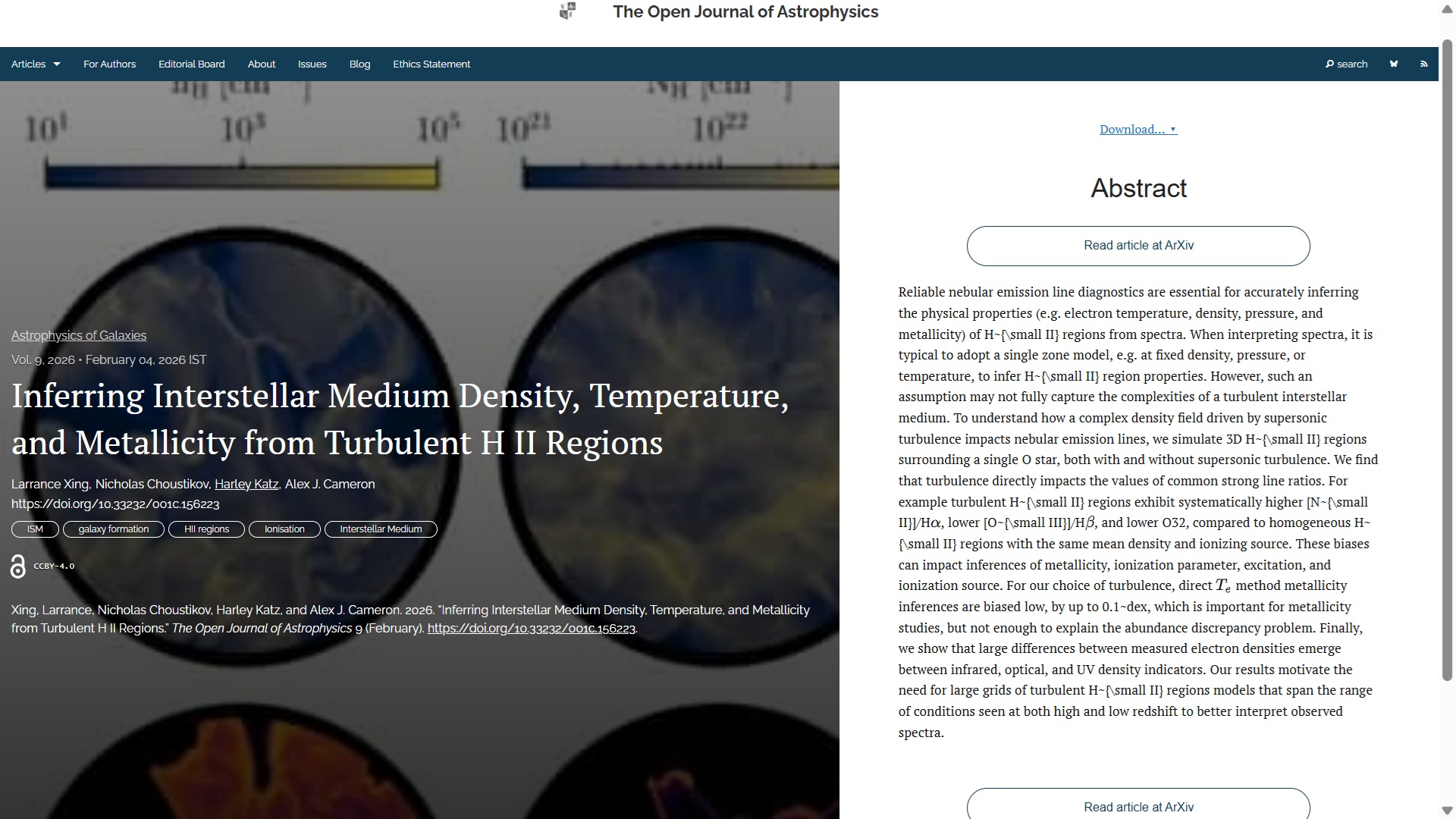
Next, published on Wednesday 4th February in the folder Astrophysics of Galaxies, is “Inferring Interstellar Medium Density, Temperature, and Metallicity from Turbulent H II Regions” by Larrance Xing (U. Chicago, USA), Nicholas Choustikov (U. Oxford, UK), Harley Katz (U. Chicago) and Alex J. Cameron (DAWN, Denmark). This paper argues that supersonic turbulenc affects the interpretation of H II region properties, potentially impacting inferred metallicity, ionization, and excitation from in nebular emission lines, motivating more extensive modelling.

The overlay is here:

The official version can be found on arXiv here and the Fediverse announcement is here:

Open Journal of Astrophysics

New Publication at the Open Journal of Astrophysics: "Inferring Interstellar Medium Density, Temperature, and Metallicity from Turbulent H II Regions" by Larrance Xing (U. Chicago, USA), Nicholas Choustikov (U. Oxford, UK), Harley Katz (U. Chicago) and Alex J. Cameron (DAWN, Denmark)

doi.org/10.33232/001c.156223

February 4, 2026, 8:20 am 1 boosts 0 favorites

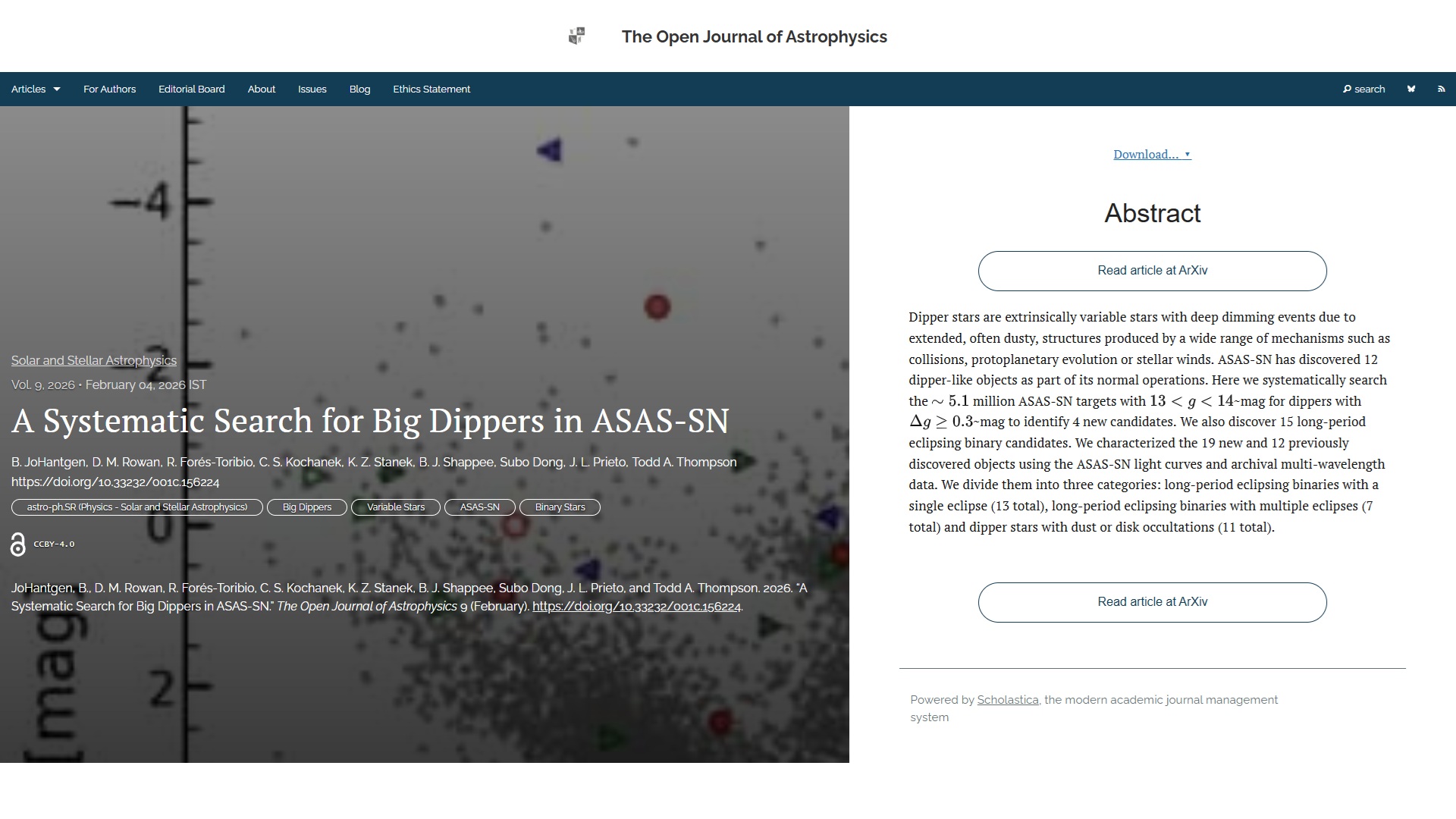
The fourth paper this week, also published on Wednesday 4th February, but in the folder Solar and Stellar Astrophysics, is “A Systematic Search for Big Dippers in ASAS-SN” by B. JoHantgen, D. M. Rowan, R. Forés-Toribio, C. S. Kochanek, & K. Z. Stanek (Ohio State University, USA), B. J. Shappee (U. Hawaii, USA), Subo Dong (Peking University), J. L. Prieto Universidad Diego Portales, Chile) and Todd A. Thompson (Ohio State). This study identifies 4 new dipper stars and 15 long-period eclipsing binary candidates using ASAS-SN light curves and multi-wavelength data, categorizing them based on their characteristics.

Here is the overlay:

The official version can be found on arXiv here and the Fediverse announcement is here:

Open Journal of Astrophysics

New Publication at the Open Journal of Astrophysics: "A Systematic Search for Big Dippers in ASAS-SN" by B. JoHantgen , D. M. Rowan, R. Forés-Toribio, C. S. Kochanek, & K. Z. Stanek (Ohio State University, USA), B. J. Shappee (U. Hawaii, USA), Subo Dong (Peking University), J. L. Prieto Universidad Diego Portales, Chile) and Todd A. Thompson (Ohio State)

doi.org/10.33232/001c.156224

February 4, 2026, 8:40 am 1 boosts 0 favorites

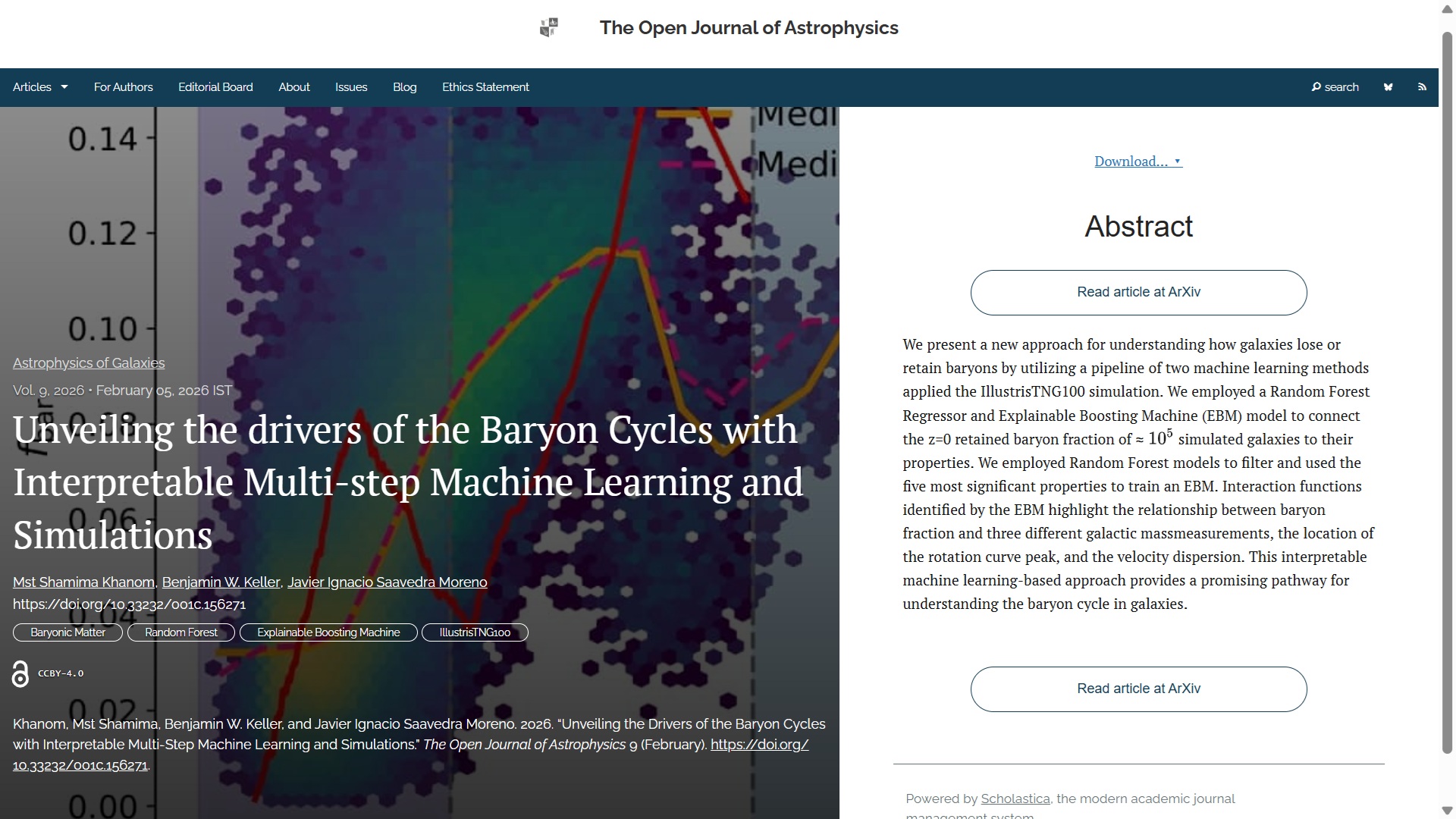
Fifth, and next to last this week we have “Unveiling the drivers of the Baryon Cycles with Interpretable Multi-step Machine Learning and Simulations” by Mst Shamima Khanom, Benjamin W. Keller and Javier Ignacio Saavedra Moreno (U. Memphis, USA). This paper was published on Thursday 5th February 2026 in the folder Astrophysics of Galaxies. This study uses machine learning methods to understand how galaxies lose or retain baryons, highlighting the relationship between baryon fraction and various galactic measurements.

The overlay is here:

The accepted version can be found on arXiv here, and the fediverse announcement is here:

Open Journal of Astrophysics

New Publication at the Open Journal of Astrophysics: "Unveiling the drivers of the Baryon Cycles with Interpretable Multi-step Machine Learning and Simulations" by Mst Shamima Khanom, Benjamin W. Keller and Javier Ignacio Saavedra Moreno (U. Memphis, USA)

doi.org/10.33232/001c.156271

February 5, 2026, 7:39 am 1 boosts 1 favorites

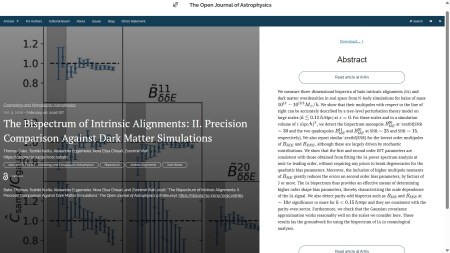
Finally for this week we have “The Bispectrum of Intrinsic Alignments: II. Precision Comparison Against Dark Matter Simulations” by Thomas Bakx (Utrecht U., Netherlands), Toshiki Kurita (MPA Garching, Germany), Alexander Eggemeier (U. Bonn, Germany), Nora Elisa Chisari (Utrecht) and Zvonimir Vlah (Ruđer Bošković Institute, Croatia). This paper was accepted in December, but publication got delayed by the Christmas effect so was published on February 6th 2026, in the folder Cosmology and Nongalactic Astrophysics. This study uses N-body simulations to accurately measure three-dimensional bispectra of halo intrinsic alignments and dark matter overdensities, providing a method to determine higher order shape bias parameters.

The overlay is here:

You can find the published version of the article here, and the Mastodon announcement is here:

Open Journal of Astrophysics

New Publication at the Open Journal of Astrophysics: "The Bispectrum of Intrinsic Alignments: II. Precision Comparison Against Dark Matter Simulations" by Thomas Bakx (Utrecht U., Netherlands), Toshiki Kurita (MPA Garching, Germany), Alexander Eggemeier (U. Bonn, Germany), Nora Elisa Chisari (Utrecht) and Zvonimir Vlah (Ruđer Bošković Institute, Croatia)

doi.org/10.33232/001c.156361

February 6, 2026, 7:43 am 1 boosts 0 favorites

And that concludes this week’s update. I will do another next Saturday.

Weekly Update from the Open Journal of Astrophysics – 31/01/2026

Posted in OJAp Papers, Open Access, The Universe and Stuff with tags , , , , , , , , , , , , , , , , , , , , , , , , , , , on January 31, 2026 by telescoper

It’s Saturday once more so time for another update of activity at the Open Journal of Astrophysics. Since the last update we have published a further four papers, bringing the number in Volume 9 (2026) to 18 and the total so far published by OJAp up to 466.

I will continue to include the posts made on our Mastodon account (on Fediscience) to encourage you to visit it. Mastodon is a really excellent service, and a more than adequate replacement for X/Twitter which nobody should be using; these announcement also show the DOI for each paper.

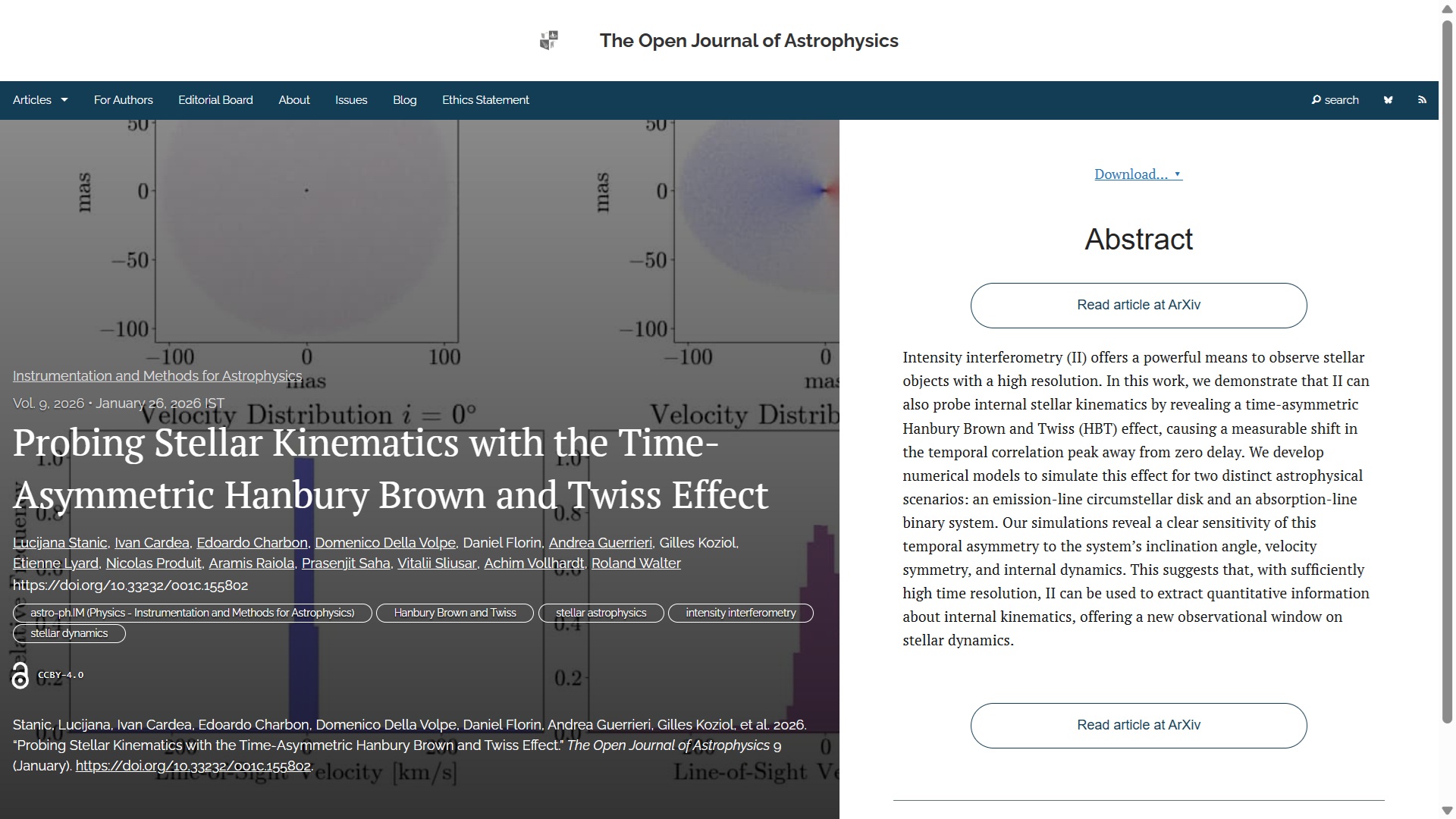
The first paper to report this week is “Probing Stellar Kinematics with the Time-Asymmetric Hanbury Brown and Twiss Effect” by Lucijana Stanic (University of Zurich, Switzerland) and 13 others based in Zurich, Lausanne and Geneva (all in Switzerland). This was published on Monday 26th January 2026 in the folder Instrumentation and Methods for Astrophysics. This research demonstrates that intensity interferometry can reveal internal stellar kinematics, providing a new way to observe stellar dynamics with high time resolution.

The overlay is here:

You can find the officially accepted version on arXiv here and the announcement on Fediverse here:

Open Journal of Astrophysics

New Publication at the Open Journal of Astrophysics: "Probing Stellar Kinematics with the Time-Asymmetric Hanbury Brown and Twiss Effect" by Lucijana Stanic (University of Zurich, Switzerland) and 13 others based in Zurich, Lausanne and Geneva.

doi.org/10.33232/001c.155802

January 26, 2026, 11:46 am 0 boosts 1 favorites

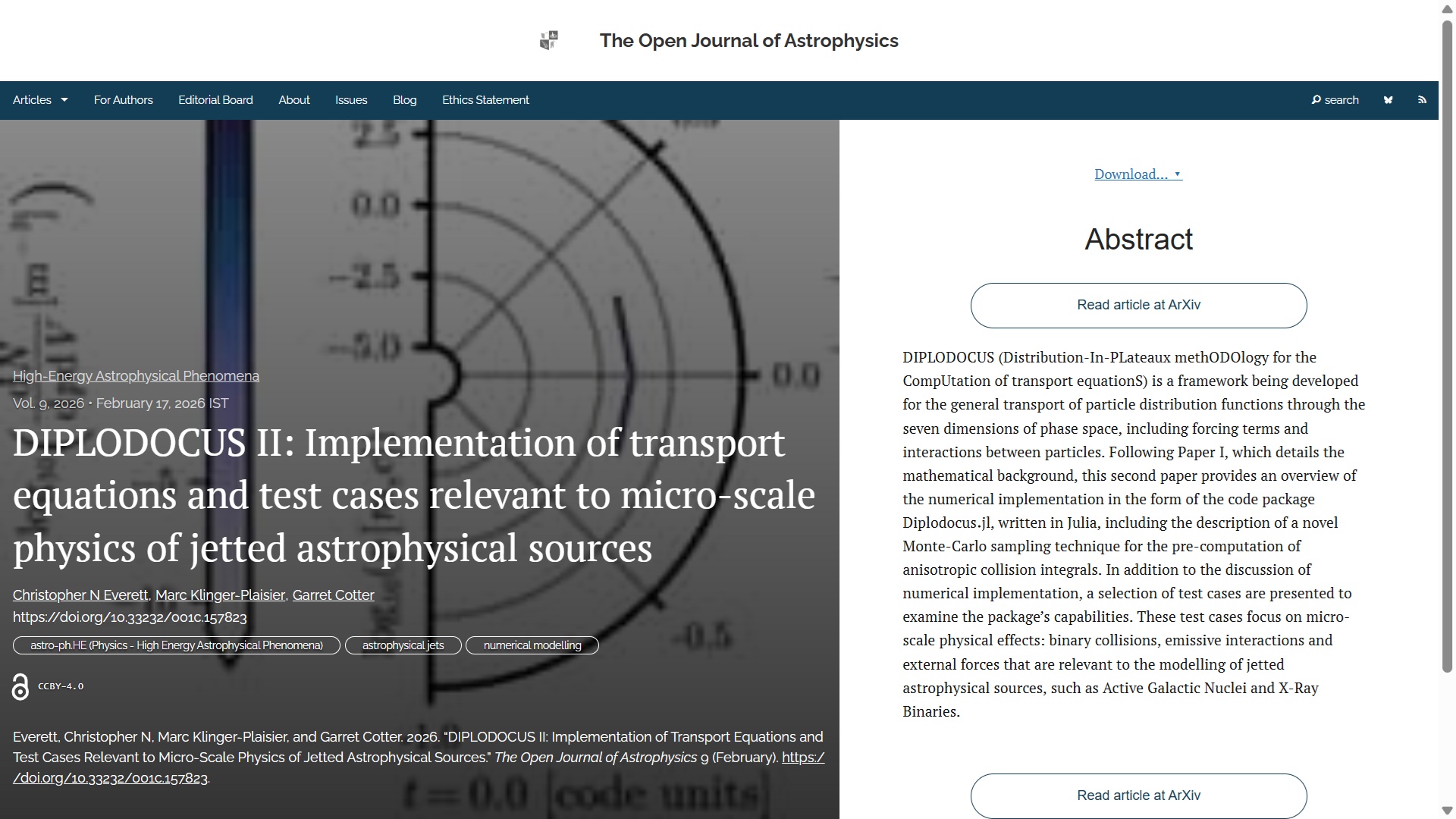
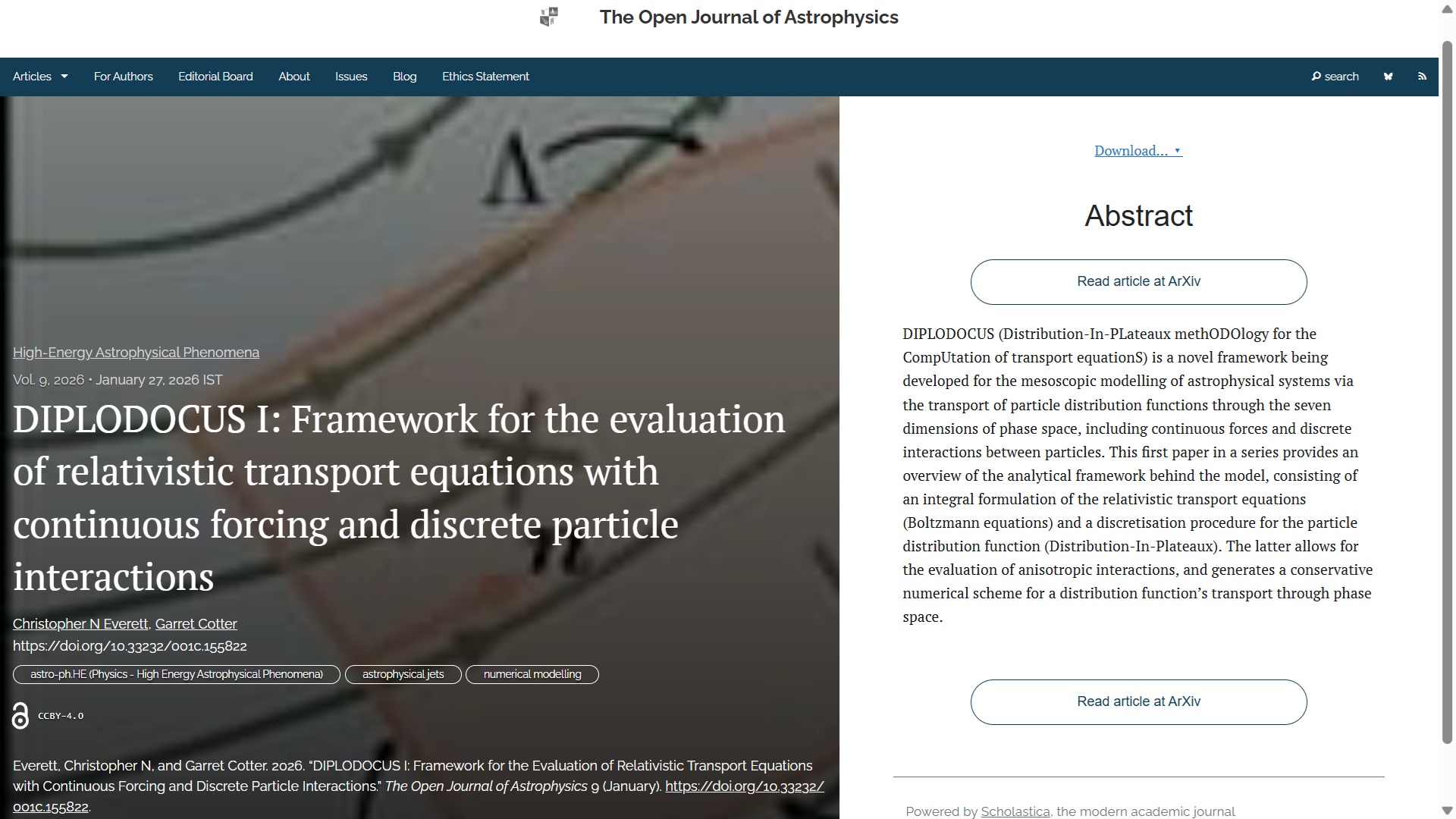
The second paper is “DIPLODOCUS I: Framework for the evaluation of relativistic transport equations with continuous forcing and discrete particle interactions” by Christopher N Everett & Garret Cotter (University of Oxford, UK). This was published on Tuesday January 27th 2026 in the folder High-Energy Astrophysical Phenomena. DIPLODOCUS is a new framework for mesoscopic modelling of astrophysical systems, using an integral formulation of relativistic transport equations and a discretisation procedure for particle distributions.

The overlay for this one is here:

The official version of the paper can be found on arXiv here and the Fediverse announcement here:

Open Journal of Astrophysics

New Publication at the Open Journal of Astrophysics: "DIPLODOCUS I: Framework for the evaluation of relativistic transport equations with continuous forcing and discrete particle interactions" by Christopher N Everett & Garret Cotter (University of Oxford, UK)

doi.org/10.33232/001c.155822

January 27, 2026, 8:49 am 1 boosts 0 favorites

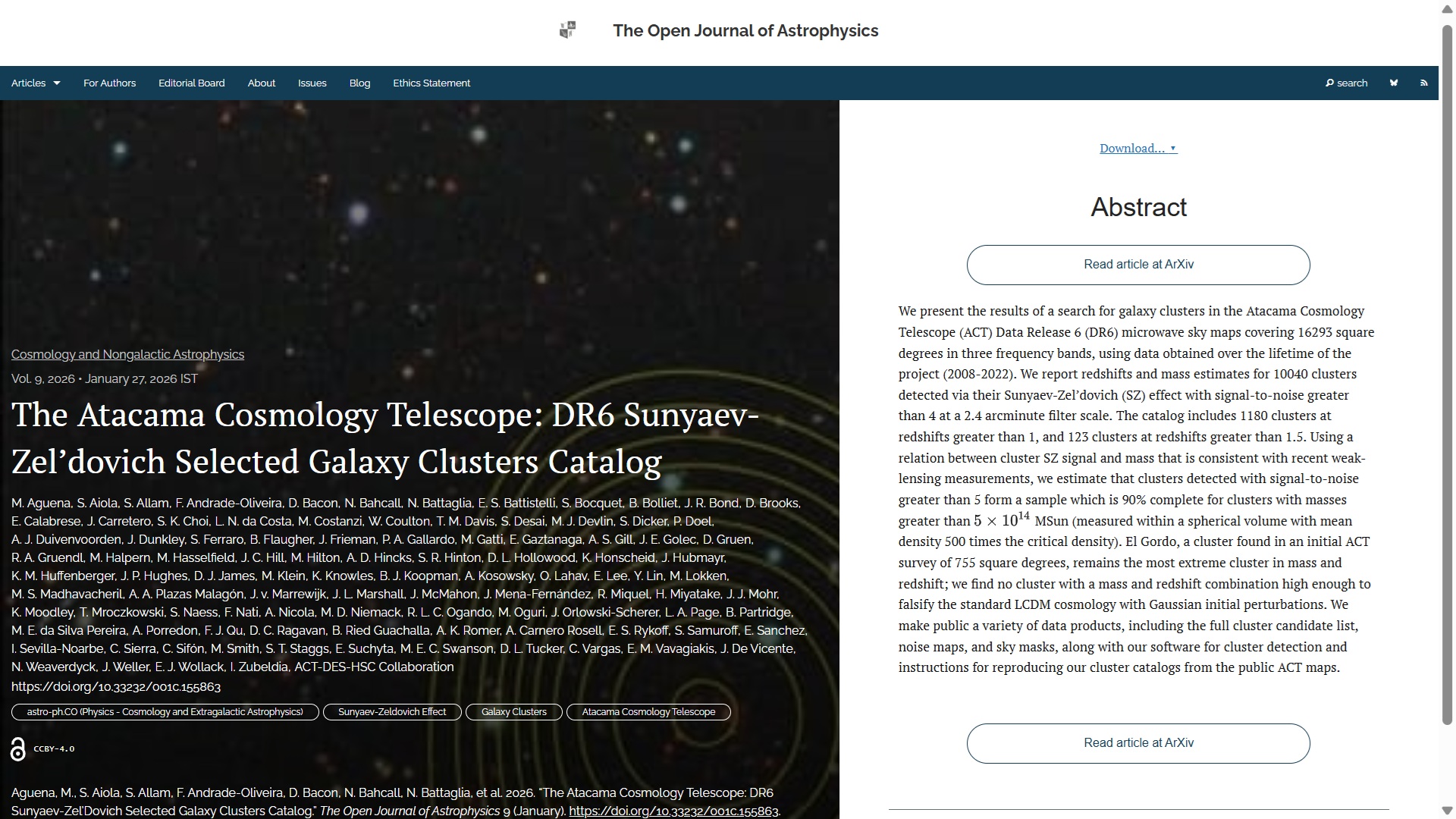
Next, also published on Tuesday January 27th but in the folder Cosmology and Nongalactic Astrophysics we have “The Atacama Cosmology Telescope: DR6 Sunyaev-Zel’dovich Selected Galaxy Clusters Catalog” by M. Aguena et al. (101 authors altogether), on behalf of the ACT-DES-HSC Collaboration. This article reports on the discovery of 10,040 galaxy clusters in the Atacama Cosmology Telescope data, including 1,180 clusters at high redshifts, using the Sunyaev-Zel’dovich effect.

The overlay is here:

The official version can be found on arXiv here and the Fediverse announcement is here:

Open Journal of Astrophysics

New Publication at the Open Journal of Astrophysics: "The Atacama Cosmology Telescope: DR6 Sunyaev-Zel’dovich Selected Galaxy Clusters Catalog" by M. Aguena et al. (101 authors altogether), on behalf of the ACT-DES-HSC Collaboration

doi.org/10.33232/001c.155863

January 27, 2026, 9:55 am 1 boosts 0 favorites

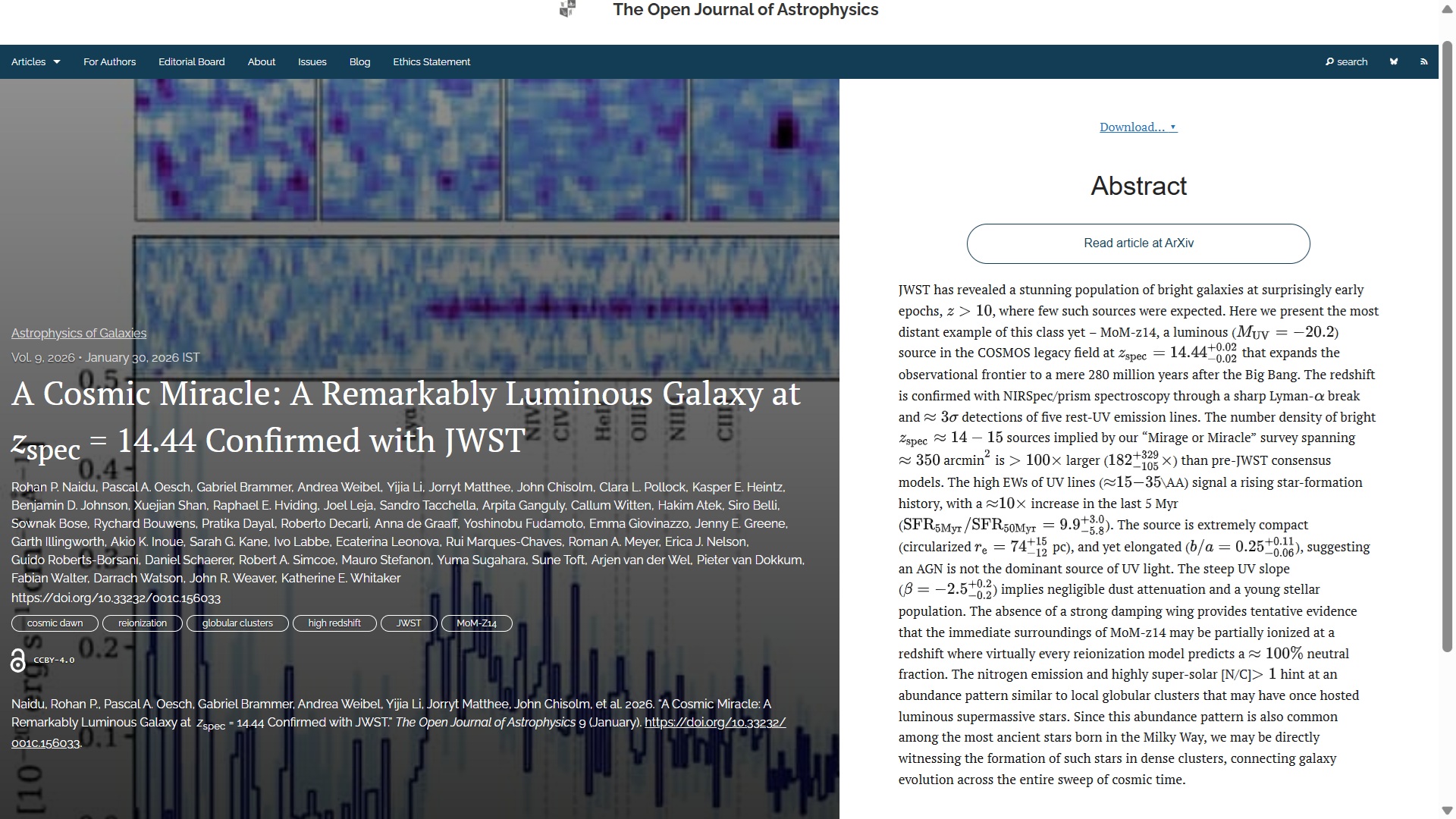
And finally for this week we have a paper published yesterday, Friday 30th January 2026, in the folder Astrophysics of Galaxies. This is the paper I blogged about yesterday: “A Cosmic Miracle: A Remarkably Luminous Galaxy at zspec = 14.44 Confirmed with JWST” by Rohan Naidu (MIT Kavli Institute) and an international cast of 45 others. This article reports on the discovery by the James Webb Space Telescope (JWST) of a bright galaxy, MoM-z14, located 280 million years post-Big Bang, that challenges models of galaxy formation and the star-formation history of early galaxies.

The overlay is here:

The accepted version can be found on arXiv here, and the fediverse announcement is here:

Open Journal of Astrophysics

New Publication at the Open Journal of Astrophysics: "A Cosmic Miracle: A Remarkably Luminous Galaxy at $z_{rm spec} = 14.44$ Confirmed with JWST" by Rohan Naidu (MIT Kavli Institute) and 45 others.

doi.org/10.33232/001c.156033

January 30, 2026, 7:20 am 2 boosts 1 favorites

And that concludes the update for this week. I will do another next Saturday.

Weekly Update from the Open Journal of Astrophysics – 24/01/2026

Posted in OJAp Papers, Open Access, The Universe and Stuff with tags , , , , , , , , , , , , , , , , , on January 24, 2026 by telescoper

It’s Saturday once more so time for another update of activity at the Open Journal of Astrophysics. Since the last update we have published a further three papers, bringing the number in Volume 9 (2026) to 14 and the total so far published by OJAp up to 462. This week was slightly affected by a Federal holiday in the USA on January 19th; there were no arXiv announcements the following day.

I will continue to include the posts made on our Mastodon account (on Fediscience) to encourage you to visit it. Mastodon is a really excellent service, and a more than adequate replacement for X/Twitter which nobody should be using.

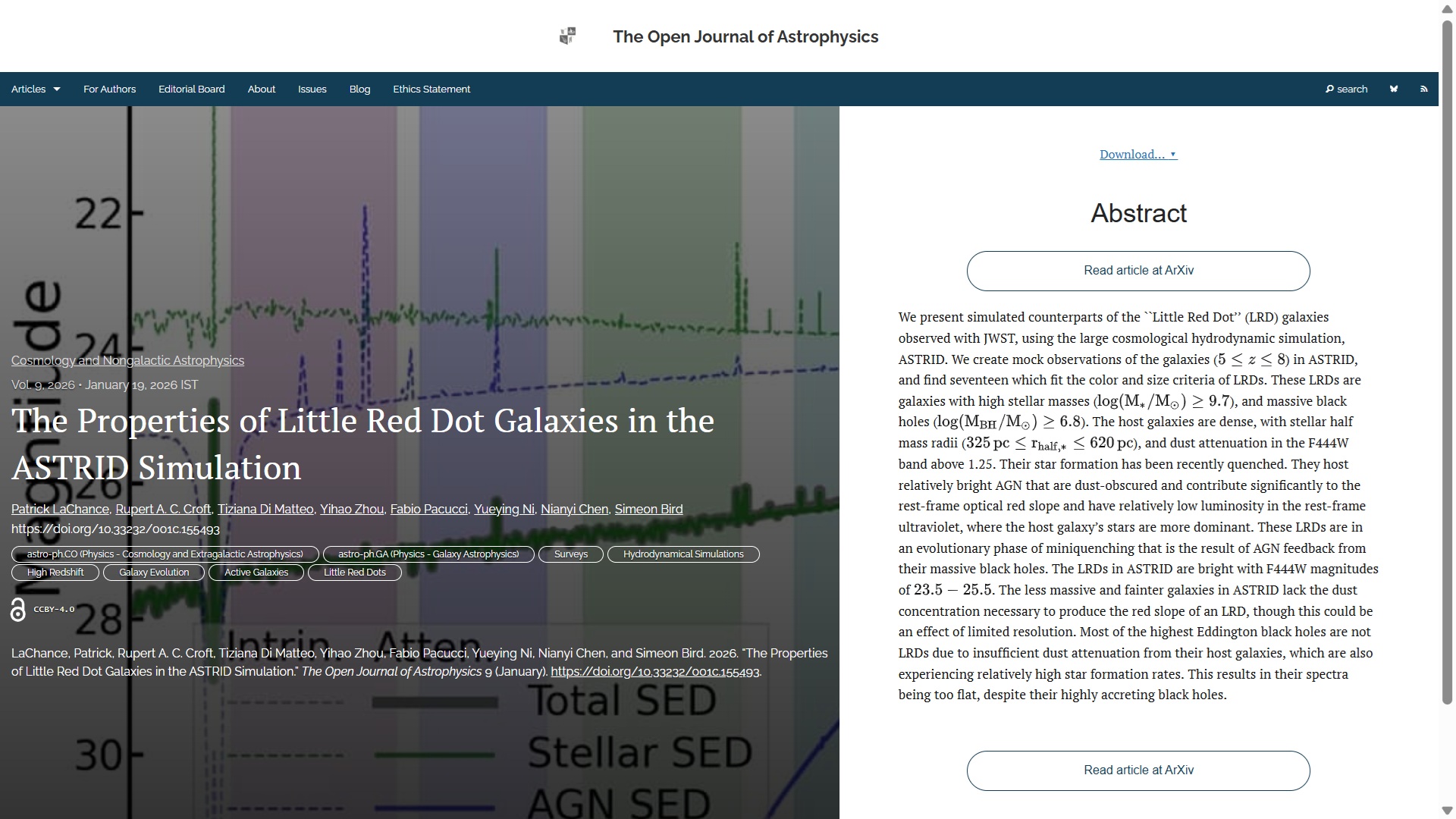
The first paper to report this week is “The Properties of Little Red Dot Galaxies in the ASTRID Simulation” by Patrick LaChance, Rupert A. C. Croft, Tiziana Di Matteo & Yihao Zhou (Carnegie Mellon U.), Fabio Pacucci (Harvard-Smithsonian CfA), Yueying Ni (U. Michigan Ann Arbor), Nianyi Chen (Princeton U.) and Simeon Bird (UC Riverside), all based in the USA. This paper was published on Monday 19th January 2026 in the folder Cosmology and Nongalactic Astrophysics; the study analyses mock observations of “Little Red Dot” galaxies created from the ASTRID simulation, having high stellar masses and containing massive black holes; not all features match real observations.

The overlay is here:

You can find the officially accepted version on arXiv here and the announcement on Fediverse here:

Open Journal of Astrophysics

New Publication at the Open Journal of Astrophysics; "The Properties of Little Red Dot Galaxies in the ASTRID Simulation" by Patrick LaChance, Rupert A. C. Croft, Tiziana Di Matteo & Yihao Zhou (Carnegie Mellon U.), Fabio Pacucci (Harvard-Smithsonian CfA), Yueying Ni (U. Michigan Ann Arbor), Nianyi Chen (Princeton U.) and Simeon Bird (UC Riverside), all based in the USA

doi.org/10.33232/001c.155493

January 19, 2026, 10:33 am 2 boosts 1 favorites

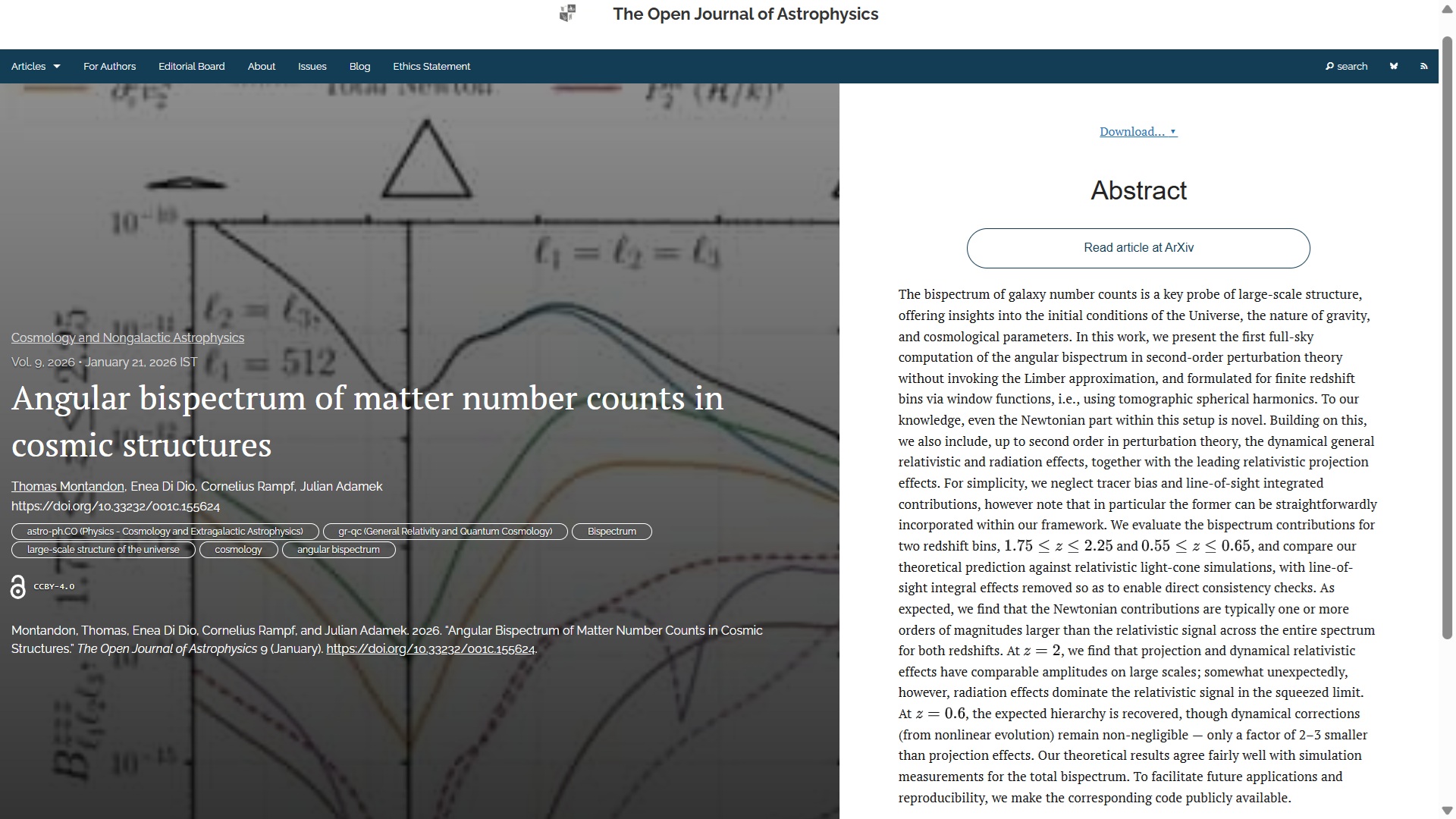
The second paper is “Angular bispectrum of matter number counts in cosmic structures” by Thomas Montandon (U. Montpellier, France), Enea Di Dio (U. Genève, Switzerland), Cornelius Rampf (Ruđer Bošković Institute, Croatia) and Julian Adamek (U. Zürich, Switzerland). This was published on Wednesday January 21st, also in the folder Cosmology and Nongalactic Astrophysics. This paper presents thee first full-sky computation of the angular bispectrum in second-order perturbation theory, offering insights into the Universe’s initial conditions, gravity, and cosmological parameters. The results align well with simulations.

The overlay for this one is here:

The official version of the paper can be found on arXiv here and the Fediverse announcement here:

Open Journal of Astrophysics

New Publication at the Open Journal of Astrophysics: "Angular bispectrum of matter number counts in cosmic structures" by Thomas Montandon (U. Montpellier, France), Enea Di Dio (U. Genève, Switzerland), Cornelius Rampf (Ruđer Bošković Institute, Croatia) and Julian Adamek (U. Zürich, Switzerland)

doi.org/10.33232/001c.155624

January 21, 2026, 9:30 am 1 boosts 0 favorites

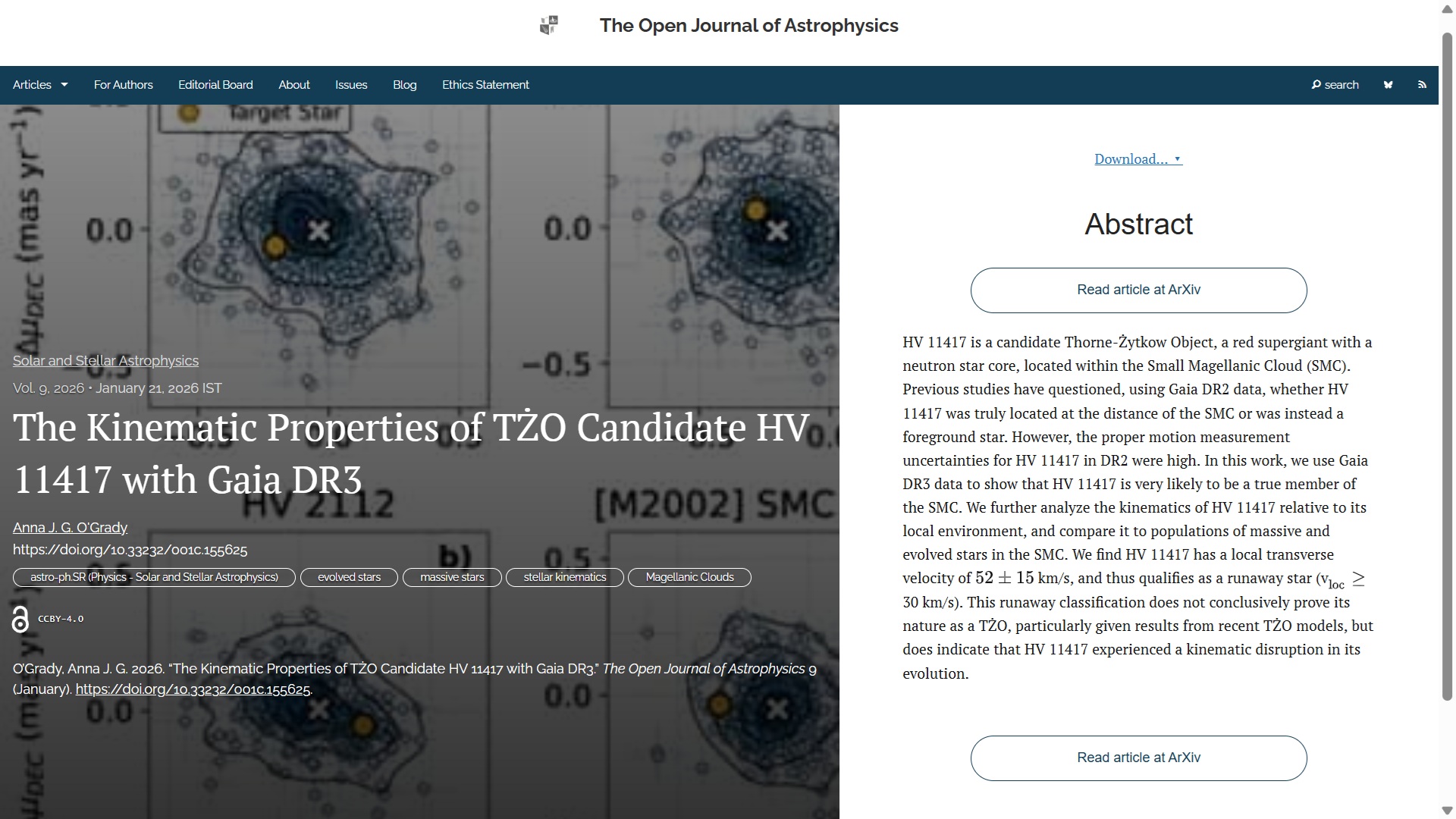
Next, and last for this week, we have “The Kinematic Properties of TŻO Candidate HV 11417 with Gaia DR3” by Anna J. G. O’Grady (Carnegie Mellon University, USA). This was published on Wednesday 21st January 2026 in the folder Solar and Stellar Astrophysics. This work uses updated data to confirm that HV 11417, a potential Thorne-Żytkow Object, is probably part of the Small Magellanic Cloud and qualifies as a runaway star.

The overlay is here:

The official version can be found on arXiv here and the Fediverse announcement is here:

Open Journal of Astrophysics

New Publication at the Open Journal of Astrophysics: "The Kinematic Properties of TŻO Candidate HV 11417 with Gaia DR3" by Anna J. G. O'Grady (Carnegie Mellon University, USA)

doi.org/10.33232/001c.155625

January 21, 2026, 9:45 am 1 boosts 1 favorites

That concludes the update for this week. I will do another next Saturday.

Weekly Update from the Open Journal of Astrophysics – 18/10/2025

Posted in OJAp Papers, Open Access, The Universe and Stuff with tags , , , , , , , , , , , , , , , , , , , , on October 18, 2025 by telescoper

It’s time once again for the usual Saturday update of the week’s new papers at the Open Journal of Astrophysics. Since the last update we have published four  more papers, which brings the number in Volume 8 (2025) up to 156, and the total so far published by OJAp up to 391.

I’d like to encourage people to follow our feed on the Fediverse via Mastodon (where I announce papers as they are published, including the all-important DOI) so this week I’ll include links to each announcement there.

The first paper to report is “Shot noise in clustering power spectra” by Nicolas Tessore (University College London, UK) and Alex Hall (University of Edinburgh, UK). This was published in the folder Cosmology and NonGalactic Astrophysics on Tuesday October 14th 2025. This presents a discussion of the effects of ‘shot noise’, an additive contribution due to degenerate pairs of points, in angular galaxy clustering power spectra. Here is a screen grab of the overlay:

You can find the officially accepted version of the paper here. The Mastodon announcement is here:

Open Journal of Astrophysics

New Publication at the Open Journal of Astrophysics: "Shot noise in clustering power spectra" by Nicolas Tessore (University College London, UK) and Alex Hall (University of Edinburgh, UK)

doi.org/10.33232/001c.145919

October 14, 2025, 7:07 am 2 boosts 0 favorites

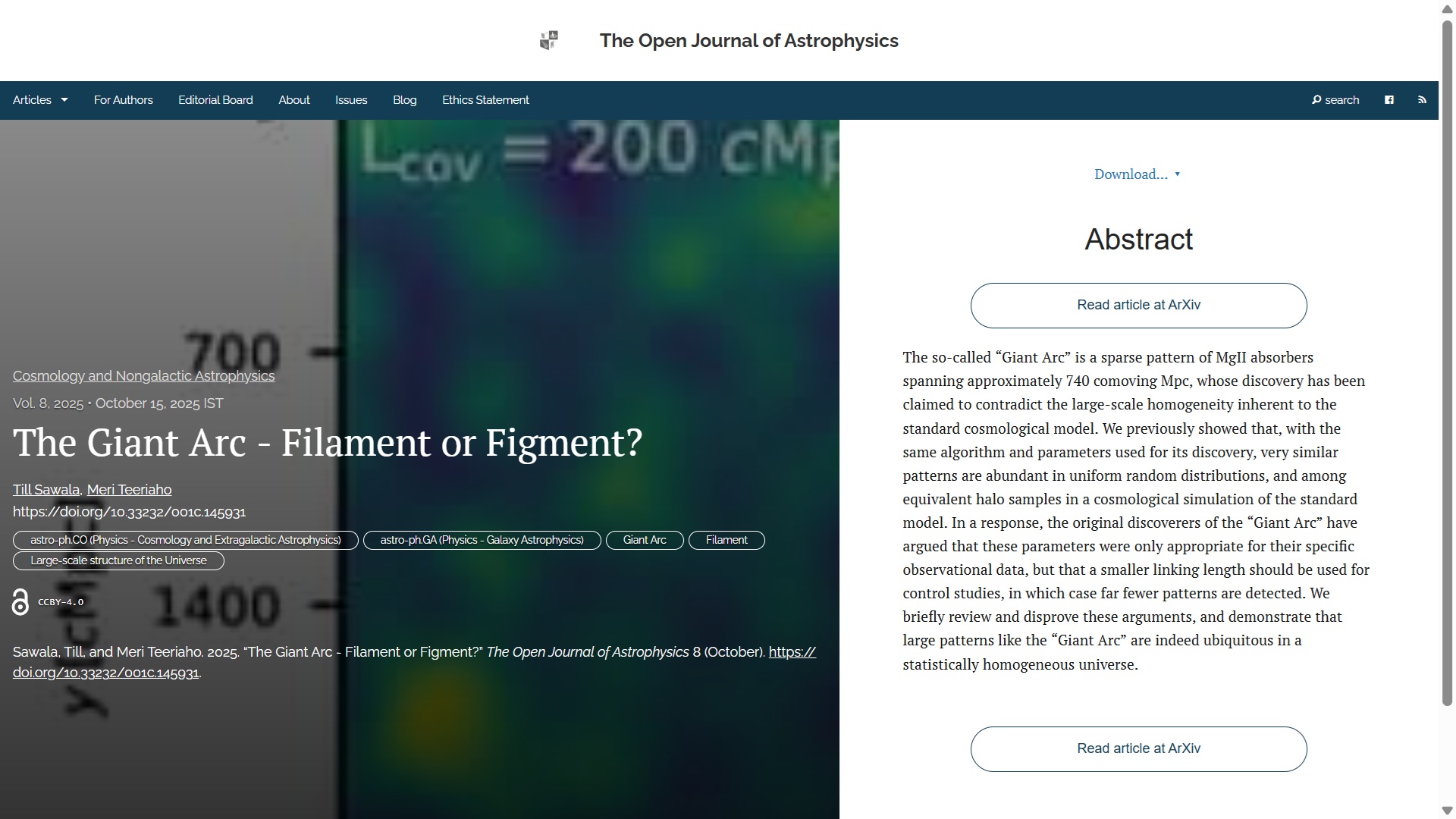
Next one up is “The Giant Arc – Filament or Figment?” by Till Sawala and Meri Teeriaho (University of Helsinki, Finland). This paper discusses the abundance of large arc-like structures formed in the standard cosmological model, with reference to the “Giant Arc” identified in MgII absorption systems. It was published on Wednesday October 15th in the folder Cosmology and NonGalactic Astrophysics. The overlay is here:
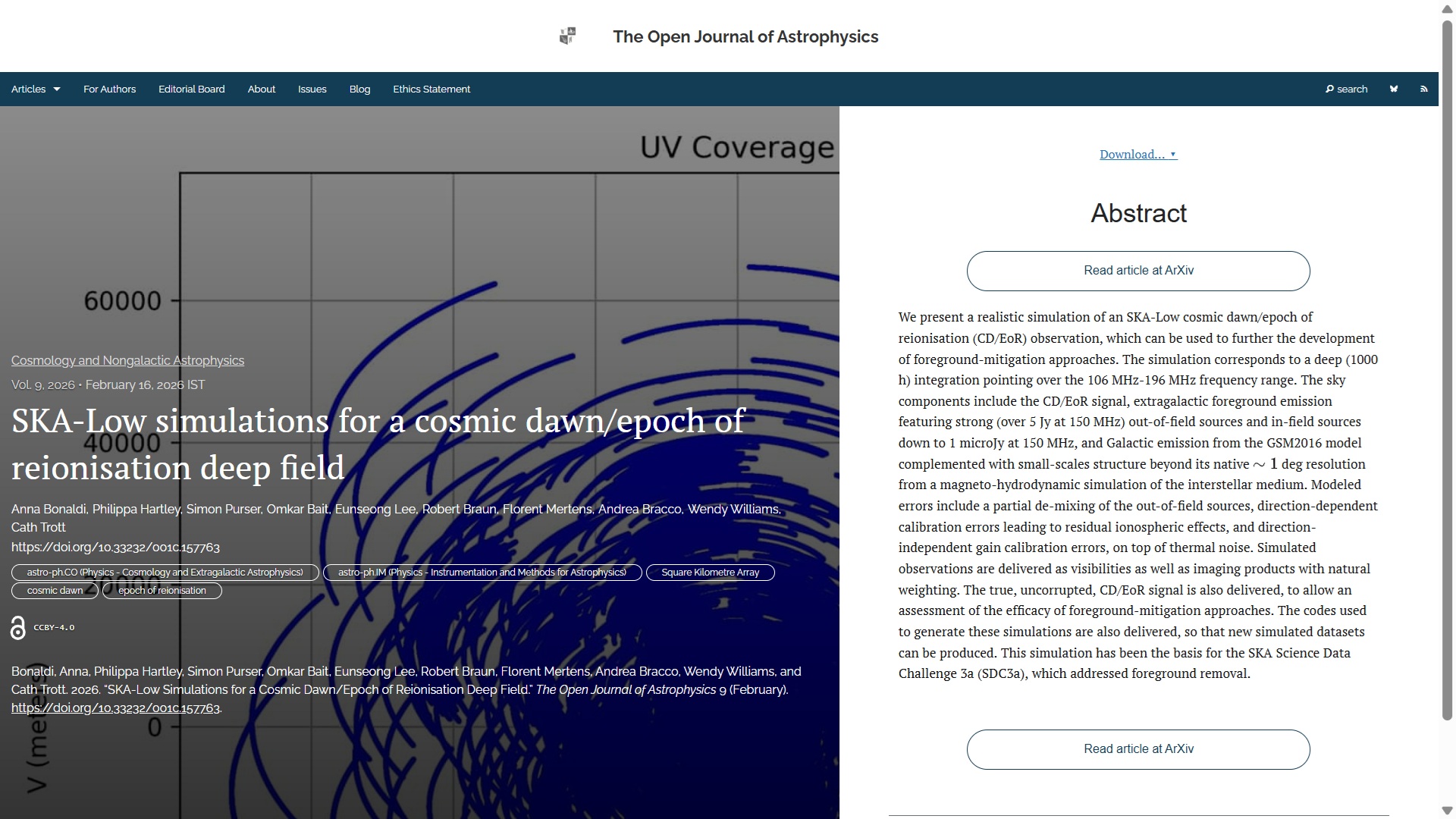
The officially accepted version of this paper can be found on the arXiv here and the Mastodon announcement is here:

Open Journal of Astrophysics

New Publication at the Open Journal of Astrophysics: "The Giant Arc – Filament or Figment?" by Till Sawala and Meri Teeriaho (University of Helsinki, Finland)

doi.org/10.33232/001c.145931

October 15, 2025, 6:33 am 2 boosts 3 favorites


The third paper this week,  published on Monday 6th October, is “Detecting wide binaries using machine learning algorithms” by Amoy Ashesh, Harsimran Kaur and Sandeep Aashish (Indian Institute of Technology, Patna, India). This was published on Friday 17th October (yesterday) in the folder Astrophysics of Galaxies. It presents a method for detecting wide binary systems in Gaia data using machine learning algorithms.

The overlay is here:


You can find the officially accepted version of this paper on arXiv here. The announcement on Mastodon is here:

Open Journal of Astrophysics

New Publication at the Open Journal of Astrophysics: "Detecting wide binaries using machine learning algorithms" by Amoy Ashesh, Harsimran Kaur and Sandeep Aashish (Indian Institute of Technology, Patna, India)

doi.org/10.33232/001c.146027

October 17, 2025, 6:55 am 0 boosts 0 favorites

The last one this week is “Learned harmonic mean estimation of the Bayesian evidence with normalizing flows” by Alicja Polanska & Matthew A. Price (University College London, UK), Davide Piras (Université de Genève, CH), Alessio Spurio Mancini (Royal Holloway, London, UK) and Jason D. McEwen (University College London). This one was also published on Friday 17th October, but in the folder Instrumentation and Methods for Astrophysics; it presents a new method for estimating Bayesian evidence for use in model comparison, illustrated with a cosmological example.

The corresponding overlay is here:


You can find the officially accepted version on arXiv here. The Mastodon announcement is here:

Open Journal of Astrophysics

New Publication at the Open Journal of Astrophysics: "Learned harmonic mean estimation of the Bayesian evidence with normalizing flows" by Alicja Polanska & Matthew A. Price (University College London, UK), Davide Piras (Université de Genève, CH), Alessio Spurio Mancini (Royal Holloway, London, UK) and Jason D. McEwen (University College London)

doi.org/10.33232/001c.146026

October 17, 2025, 7:06 am 0 boosts 0 favorites

That concludes the papers for this week. With two weeks to go I think we might reach the 400 total by the end of October.

R.I.P. George F. Smoot (1945-2025)

Posted in Biographical, R.I.P., The Universe and Stuff with tags , , , , , , on September 26, 2025 by telescoper
George F. Smoot (1945-2025)

I’m very sad to have to report the death, at the age of 80, of eminent cosmologist George Smoot, who passed away at his home in Paris on 18th September. The news has been reported in France, where George had been living in recent years, but doesn’t seem to have been covered in the international media yet. I thought I would just record some personal relfections and reminiscences here, rather than try to pre-empt the official biographies.

George Smoot was an experimental astrophysicist who is best known for his research in observational cosmology, particularly on the cosmic microwave background. In 2006, jointly with John Mather, he was awarded the Nobel Prize for Physics for measurements made by the COBE satellite that, without exaggeration, ushered in a new era of cosmology. George led the paper Structure in the COBE Differential Microwave Radiometer First-Year Maps that reported the first detection of variations in temperature of the cosmic microwave background across the sky predicted by theories of cosmological structure formation.

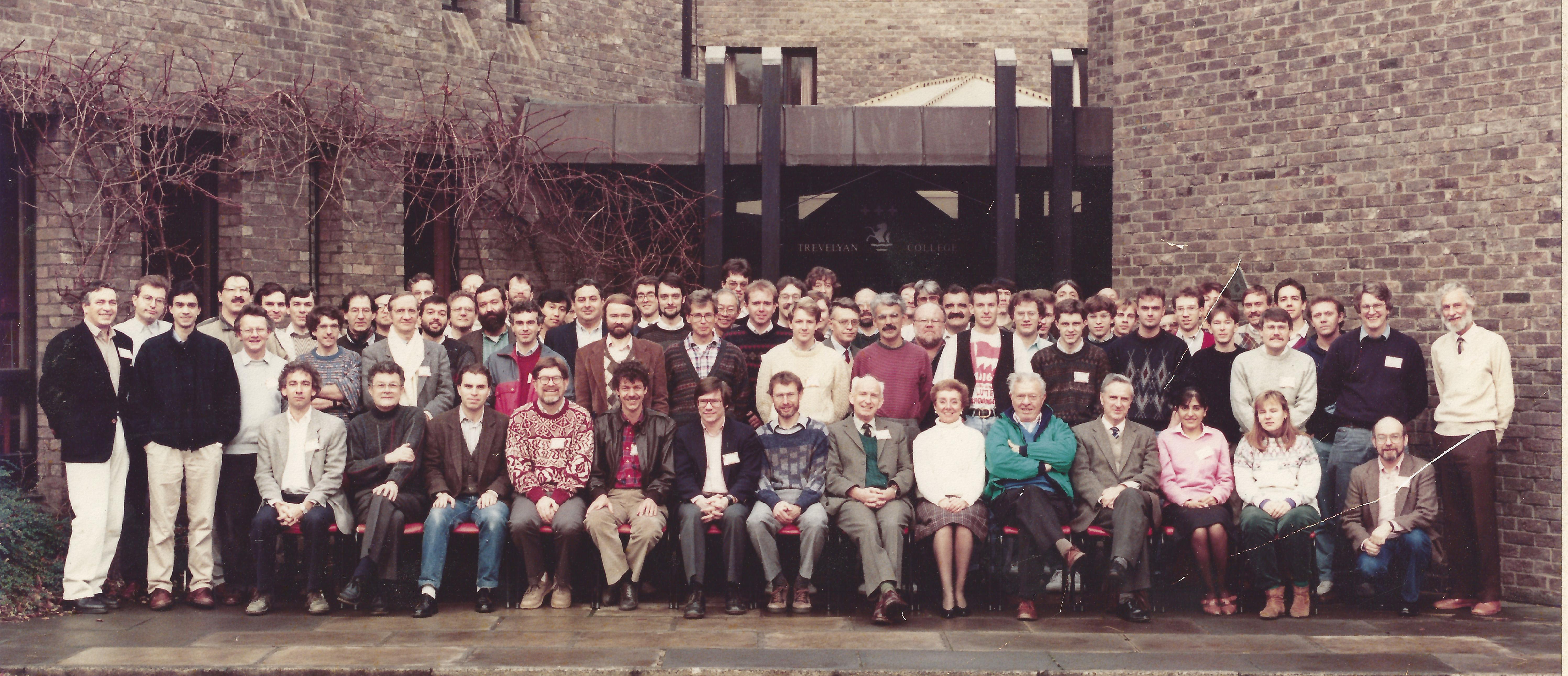
I was fortunate enough to meet George many times over the years and to get to know him quite well. The first time was at a meeting in Durham for which this was the conference photo:

George is just to the left of centre in the front row with the red-and-white sweater.

What I remember about that meeting is that I gave a contributed talk there (a short one, because I was a mere postdoc at the time). Some time after that, George Smoot gave an invited talk during the course of which he mentioned (positively) the work I had spoken about. I was gobsmacked to have my little contribution recognized by someone so eminent, and it did wonders for my scientific self-confidence. I got the chance to have a conversation with George in person some time later at that meeting and found him very good value: he was both interesting and amusing to talk to. He was someone who took mentorship seriously, and didn’t confine it to those people he was working with directly.

Over the years I met George regularly at scientific meetings, including numerous times at the (then) Daniel Chalonge schools in Sicily and in Paris where we often chatted about science and other things over coffee breaks and dinner. I always found him hugely knowledgeable about many things, but he also had an almost child-like curiosity about things he didn’t previously know. He didn’t quite jump up and down with excitement when he learnt something interesting, but almost. He could also be very direct when disagreeing, which meant that some people found him a bit abrasive. He fell out with other members of the COBE time when he threw away the agreed protocol for the announcement of results in 1992. That caused a lot of bad feeling at the time, but it seems that by the time the Nobel Prize was awarded, some degree of reconciliation had been achieved. I was lucky enough to attend the Prize Ceremonies and at the ball afterwards chatted with both George and John Mather who seemed on very amiable terms then.

Anyway, in the early noughties George invited me to spend some time at the Lawrence Berkeley Laboratory, a visit that I enjoyed enormously. He was a very generous and thougtful host and I was looked after very well. One day at LBL he asked me if the hotel was OK. I replied that it was, but one thing I didn’t like about staying in a hotel was that I liked to cook and that was impossible in a hotel room. I thought nothing more of that conversation until the end of the day when George appeared and asked me if I wanted to “do dinner” at his house that evening. I answered in the affirmative so he drove me to his house, which was very fancy, set into the hillside overlooking Berkeley – like the sort of place I imagine a film star would live – and had a very large and well-provisioned kitchen.

It soon became clear that I’d misunderstood the invitation, in that “do dinner” didn’t mean “eat dinner” but “make dinner”. Although I was slightly taken aback I set about finding what he had in the refrigerator and on the shelves. There being a plentiful supply of spices, I decided to make a tandoori-style dish of chicken baked with yoghurt, with a couple of side dishes, none of which took long to cook. When everything was getting ready I wanted to add some lemon juice but couldn’t find any lemons in the fridge. I asked George if he had any lemons, at which point he showed me into the garden where he had several lemon trees in full fruit. I’ve never lived anywhere that this would be possible! I think he enjoyed the dinner because he paid me back a few days later with a dinner at Chez Panisse. He was quite the bon viveur.

(After that short visit, I was planning to spend a sabbatical year in Berkeley in 2005, but the United States Embassy in London put paid to that idea and I went to CITA in Toronto instead.)

The last encounters I had with George were online; he was in the audience when I gave talks in the Chalonge-de Vega series organized by Norma Sanchez in 2021 (here and here). I think he had already moved to Paris by that time. The first of these talks was about open access publishing in astrophysics; George subsequently co-authored a paper in the Open Journal of Astrophysics.

My favourite quote from George came during a discussion we had at Berkeley when I suggested that some methods used for studying the cosmic microwave background could be applied to the distribution of galaxies. His response was “Galaxies are shit”. To avoid offending my friends who work on galaxies, what he meant by that was that he thought galaxies were too messy for any statistical measurements to sufficiently reliable to compete with the CMB. I think he would have preferred a universe in which all galaxies were identical, like electrons.

I’m sure many others will have their own personal reflections on their interactions with George Smoot, but he also had a huge influence on many people who never met him personally, through his enormous contributions to astrophysics and cosmology. We will no doubt read many professionally-written official obituaries in days to come, but all I can say in a personal blog post is that he was a character, a very original thinker, a fine scientist, and a very nice man. Along with many others, I will miss him enormously.

Rest in Peace, George Fitzgerald Smoot III (1945-2025) .

Update: Here is an `In Memoriam’ piece from from the Berkeley Lab.

Six New Publications at the Open Journal of Astrophysics

Posted in OJAp Papers, Open Access, The Universe and Stuff with tags , , , , , , , , , , , , , , , , , , , , , , , , , on October 12, 2024 by telescoper

Regular readers of this blog (both of them) will have noticed that I didn’t post an update of activity at the Open Journal of Astrophysics last weekend. Despite having accepted several papers for publication in the preceding week, no final versions had made it onto the arXiv. We can’t published a paper until the authors post the final version, so that meant a bit of a backlog developed. This week included one day with no arXiv update (owing to a US holiday on Tuesday 8th October) and a major glitch on Crossref on Thursday which delayed a couple, but even so we’ve published six papers which is the most we’ve ever managed in a week. This week saw the publication of our 200th article; the total as of today is 202.  The count in Volume 7 (2024) is now up to 87; we have four papers in the queue for publication so we should pass 90 next week if all goes well.
In chronological order, the six papers published this week, with their overlays, are as follows. You can click on the images of the overlays to make them larger should you wish to do so.

First one up, published on Monday 7th October 2024 is “z~2 dual AGN host galaxies are disky: stellar kinematics in the ASTRID Simulation” by Ekaterina Dadiani (CMU; Carnegie Mellon U.) Tiziana di Matteo (CMU), Nianyi Chen (CMU), Patrick Lachance (CMU), Yue Shen (U. Illinois at Urbana-Champaign), Yu-Ching Chen (Johns Hopkins U.), Rupert Croft (CMU), Yueying Ni (CfA Harvard) and Simeon Bird (U. California Riverside) – all based in the USA. The paper, which is in the folder marked Astrophysics of Galaxies describes a numerical study of the morphology of AGN host galaxies containing close pairs of black holes.

Here is a screen grab of the overlay, which includes the abstract:


You can find the officially accepted version of the paper on the arXiv here.

The second paper to announce, published on 8th October 2024, is “Origin of LAMOST J1010+2358 Revisited” by S.K. Jeena and Projjwal Banerjee of the Indian Institute of Technology Palakkad, Kerala, India. This paper discusses  the possible formation mechanisms for Very Metal Poor (VMP) stars and the implications for the origin of LAMOST J1010+2358 and is in the folder marked Solar and Stellar Astrophysics.

You can see the overlay here:

The accepted version of this paper can be found on the arXiv here.

The third paper is very different in both style and content: “Assessing your Observatory’s Impact: Best Practices in Establishing and Maintaining Observatory Bibliographies” by Raffaele D’Abrusco (Harvard CfA and 14 others; the Observatory Bibliographers Collaboration) and is in the folder marked Instrumentation and Methods for Astrophysics. It presents discussion of the methods used by astronomical observatories to construct and analyze bibliographic databases. The overlay is here:

(This one gave me a rare opportunity to use the library of stock images that comes with the Scholastica platform!) The officially accepted version can be found on arXiv here.

The fourth paper, also published on 8th October 2024, and our 200th publication, is in the folder marked Cosmology and NonGalactic Astrophysics, and is called “CombineHarvesterFlow: Joint Probe Analysis Made Easy with Normalizing Flows“. The authors are Peter L. Taylor, Andrei Cuceu, Chun-Hao To, and Erik A. Zaborowski of Ohio State University, USA. The article presents a new method that speeds up the sampling of joint posterior distributions in the context of inference using combinations of data sets. The overlay is here

You can find the officially accepted version of this paper here.

The fifth paper in this batch is “Estimating Exoplanet Mass using Machine Learning on Incomplete Datasets” by Florian Lalande (Okinawa Institute of Science and Technology), Elizabeth Tasker (Institute of Space and Astronautical Science, Kanagawa) and Kenji Doya (Okinawa); all based in Japan. This one was published on 10th October 2024 in the folder marked Earth and Planetary Astrophysics. It compares different methods for inferring exoplanet masses in catalogues with missing data


You can find the official accepted version on the arXiv here.

Finally for this week we have “Forecasting the accuracy of velocity-field reconstruction” by Chris Blake and Ryan Turner of Swinburne University of Technology, Melbourne, Australia. This was also published on 10th October 2024 and is in the folder marked Cosmology and NonGalactic Astrophysics. The paper describes a numerical study of the reliability and precision of different methods of velocity-density reconstruction. The overlay is here

You can find the officially-accepted version on arXiv here.

That’s it for now. We have published six papers, with a very wide geographical spread of authors, and in five of the six astro-ph categories we cover. I think it’s been a good week!

That Was The (Space) Week That Was

Posted in Biographical, Maynooth, The Universe and Stuff with tags , , , , on October 7, 2022 by telescoper

Last night I participated in an event at Maynooth for Space Week which I think went very well. We had a big audience so the decision to move to a bigger lecture theatre was a good one. Nobody took count but I think we had as many as 400 people of all ages, including some very young kids, some students and a variety of others.

I was the last one up to speak and took a few pictures at the three talks before mine but obviously couldn’t take a picture of mine so I’ve included a pic of some of the hi-tech equipment I used for a couple of demonstrations:

If anyone wants to see the pictures I showed you can find them here:

There was an official photographer there last night so I’ll upload any pictures I come across in due course. Watch this space.

UPDATE: Here’s a picture of the four speakers

Last night’s four speakers: Créidhe O’Sullivan, Me, Emma Whelan and John Regan

Anyway, thank you to everyone for coming last night and especially to all the people who helped organize and run the event, including our student volunteers. We’re planning to do similar event for space week next year and hopefully this will become a regular feature in the calendar.

Phase Correlations and Cosmic Structure

Posted in Biographical, The Universe and Stuff with tags , , , on July 9, 2022 by telescoper

I’m indebted to a friend for tipping me off about a nice paper that appeared recently on the arXiv by Franco et al. with the title First measurement of projected phase correlations and large-scale structure constraints. The abstract is here:

Phase correlations are an efficient way to extract astrophysical information that is largely independent from the power spectrum. We develop an estimator for the line correlation function (LCF) of projected fields, given by the correlation between the harmonic-space phases at three equidistant points on a great circle. We make a first, 6.5σ measurement of phase correlations on data from the 2MPZ survey. Finally, we show that the LCF can significantly improve constraints on parameters describing the galaxy-halo connection that are typically degenerate using only two-point data.


I’ve worked on phase correlations myself (with a range of collaborators) – you can see a few of the papers here. Indeed I think it is fair to say I was one of the first people to explore ways of quantifying phase information in cosmology. Although I haven’t done anything on this recently (by which I mean in the last decade or so), other people have been developing very promising looking approaches (including the Line Correlation Function (LCF) explored in the above paper. In my view there is a lot of potential in this approach and as we await even more cosmological data and hopefully more people will look at this in future. In my opinion we still haven’t found the optimal way to exploit phase information statistically so there’s a lot of work to be done in this field.

Anyway, I thought I’d try to explain what phase correlations are and why they are important.

One of the challenges we cosmologists face is how to quantify the patterns we see in, for example, galaxy redshift surveys. In the relatively recent past the small size of the available data sets meant that only relatively crude descriptors could be used; anything sophisticated would be rendered useless by noise. For that reason, statistical analysis of galaxy clustering tended to be limited to the measurement of autocorrelation functions, usually constructed in Fourier space in the form of power spectra; you can find a nice review here.

Because it is so robust and contains a great deal of important information, the power spectrum has become ubiquitous in cosmology. But I think it’s important to realize its limitations.

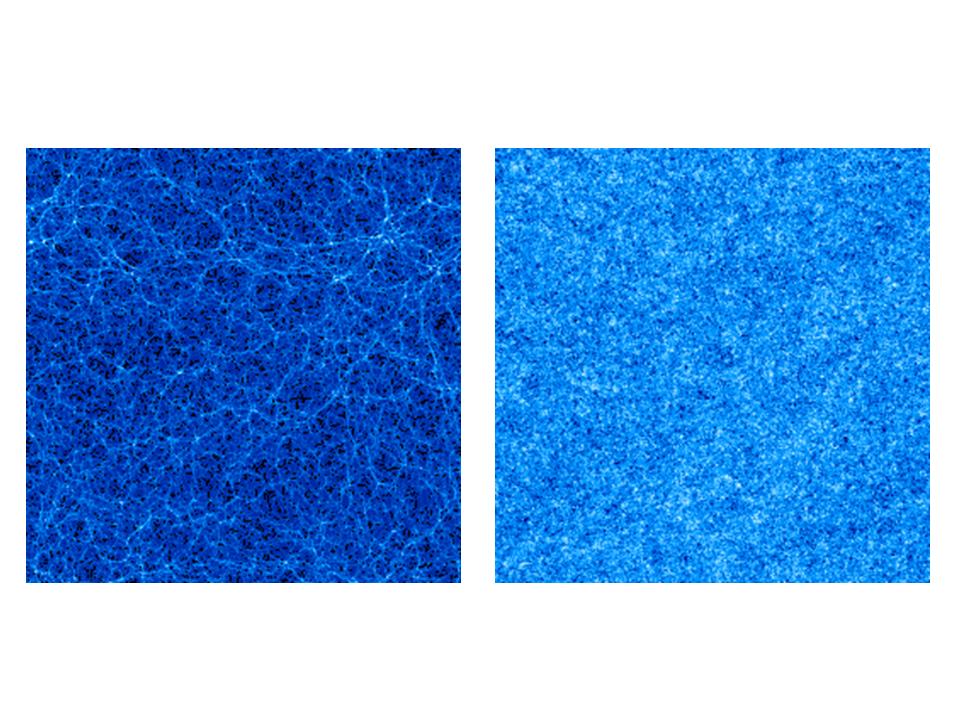
Take a look at these two N-body computer simulations of large-scale structure:

The one on the left is a proper simulation of the “cosmic web” which is at least qualitatively realistic, in that in contains filaments, clusters and voids pretty much like what is observed in galaxy surveys.

To make the picture on the right I first  took the Fourier transform of the original  simulation. This approach follows the best advice I ever got from my thesis supervisor: “if you can’t think of anything else to do, try Fourier-transforming everything.”

Anyway each Fourier mode is complex and can therefore be characterized by an amplitude and a phase (the modulus and argument of the complex quantity). What I did next was to randomly reshuffle all the phases while leaving the amplitudes alone. I then performed the inverse Fourier transform to construct the image shown on the right.

What this procedure does is to produce a new image which has exactly the same power spectrum as the first. You might be surprised by how little the pattern on the right resembles that on the left, given that they share this property; the distribution on the right is much fuzzier. In fact, the sharply delineated features  are produced by mode-mode correlations and are therefore not well described by the power spectrum, which involves only the amplitude of each separate mode.

If you’re confused by this, consider the Fourier transforms of (a) white noise and (b) a Dirac delta-function. Both produce flat power-spectra, but they look very different in real space because in (b) all the Fourier modes are correlated in such away that they are in phase at the one location where the pattern is not zero; everywhere else they interfere destructively. In (a) the phases are distributed randomly.

The moral of this is that there is much more to the pattern of galaxy clustering than meets the power spectrum…

Cosmology Talks: Volker Springel on GADGET-4

Posted in The Universe and Stuff with tags , , , , , , , on May 18, 2021 by telescoper

It’s time I shared another one of those interesting cosmology talks on the Youtube channel curated by Shaun Hotchkiss. This channel features technical talks rather than popular expositions so it won’t be everyone’s cup of tea but for those seriously interested in cosmology at a research level they should prove interesting.

In this talk from a couple of months ago  Volker Springel discusses Gadget-4 which is a parallel computational code that combines cosmological N-body and SPH code and is intended for simulations of cosmic structure formation and calculations relevant for galaxy evolution and galactic dynamics.

The predecessor of GADGET-2 is probably the most used computational code in cosmology; this talk discusses what new ideas are implemented in GADGET-4 to improve on the earlier version and what new features it has.  Volker also explains what happened to GADGET-3!

The paper describing Gadget-4 can be found here.