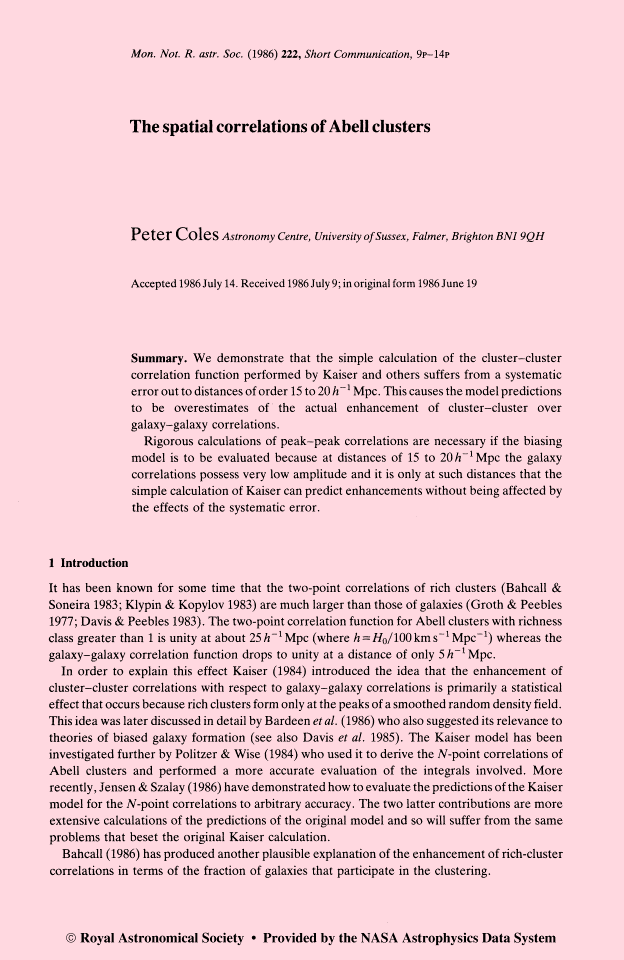
Today is the 40th anniversary of the publication of my first ever scientific paper!
Here is the front page:
This was before the days of arXiv so there isn’t a copy on the preprint server, but you can access the whole article here on NASA/ADS.
All right. I know it’s a shitty little paper. But you have to start somewhere!
I’m particularly sad that, looking back, it reads as if I meant to be very critical of the Kaiser (1984) paper that inspired it. I still think that was a brilliant paper because it was based on a very original idea that proved to be enormously influential. The only point I was really making was that a full calculation of the size of the effect Nick Kaiser had correctly identified was actually quite hard, and his simple approximation was of limited quantitative usefulness. The idea was most definitely right, however.
I was just a year into my PhD DPhil when this paper came out, and it wasn’t actually on what was meant to be the subject of my thesis work (which was the cosmic microwave background), although the material was related.
This paper provides two excellent illustrations of what a good supervisor John Barrow was. I was a bit stuck with the project that John had assigned me and eventually admitted to him that I was having problems getting anywhere. I thought he’d assume I was useless and suggest that someone else should supervise me. But no. He said he realised it was a hard problem and sometimes it’s good to think about something else when you’re stuck. So he asked me to look at cluster clustering for a bit. I told him what I found and he said I should write this up as a paper, which I did. Most importantly however the trick I used in simplifying the calculations in this paper turned out to be applicable to the first problem, hotspots in the cosmic microwave background, which led a success in the project and to my second paper. We were both delighted that everything turned out well with that original project.
My original draft of this first paper had John Barrow’s name on it, but he removed his name from the draft (as well as making a huge number of improvements to the text). At the time I assumed that he took his name off because he didn’t want to be associated with such an insignificant paper, but I later realized he was just being generous. It was very good for me to have a sole-author paper very early on. I’ve taken that lesson to heart and have never insisted on putting my name on my students’ work.
One of the candidates for the dark matter that seems to pervade the cosmos is a Weakly Interacting Massive Particle (WIMP, for short). Such particles are hypothetical but, if they exist they could have been produced in large numbers in the early Universe. Among the possible WIMPs are supersymmetric particles, but there are alternative candidates. Whatever their nature it is possible that they could be directed directly in collisions with regular matter but, because they are weakly interacting, the cross-section for such events is low and potentially masked by background events caused by radioactive decays. So far these experiments have drawn a collective blank (and a number of false alarms).
One experiment trying to detect dark matter directly is LUX-ZEPLIN (LZ for short) which is based at the Sanford Underground Research Facility in South Dakota in the USA but is a collaboration of 30 institutions worldwide, including the the UK, Portugal and South Korea as well as the USA. This experiment tries to detect WIMPs using an ultra-sensitive detector made of 7 tonnes of liquid xenon to hunt for signals of their interactions with atomic nuclei.
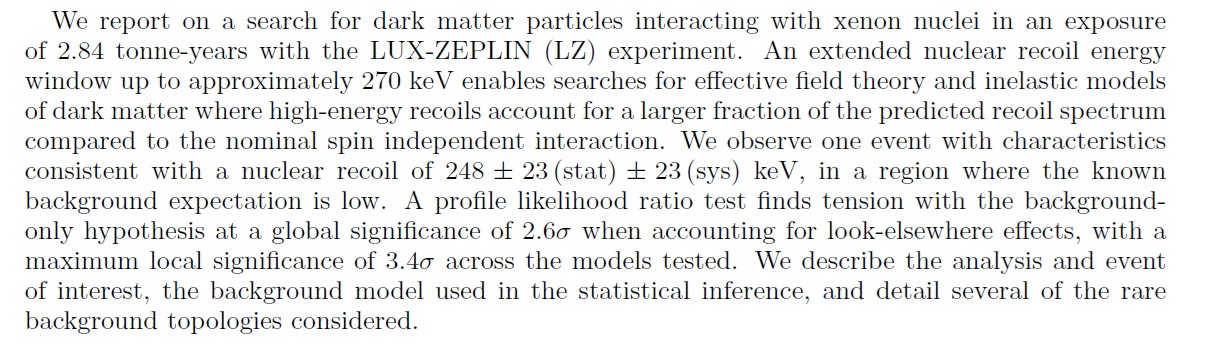
Today there was a potentially exciting announcement that LZ may have seen a WIMP, in a preprint with the following abstract:
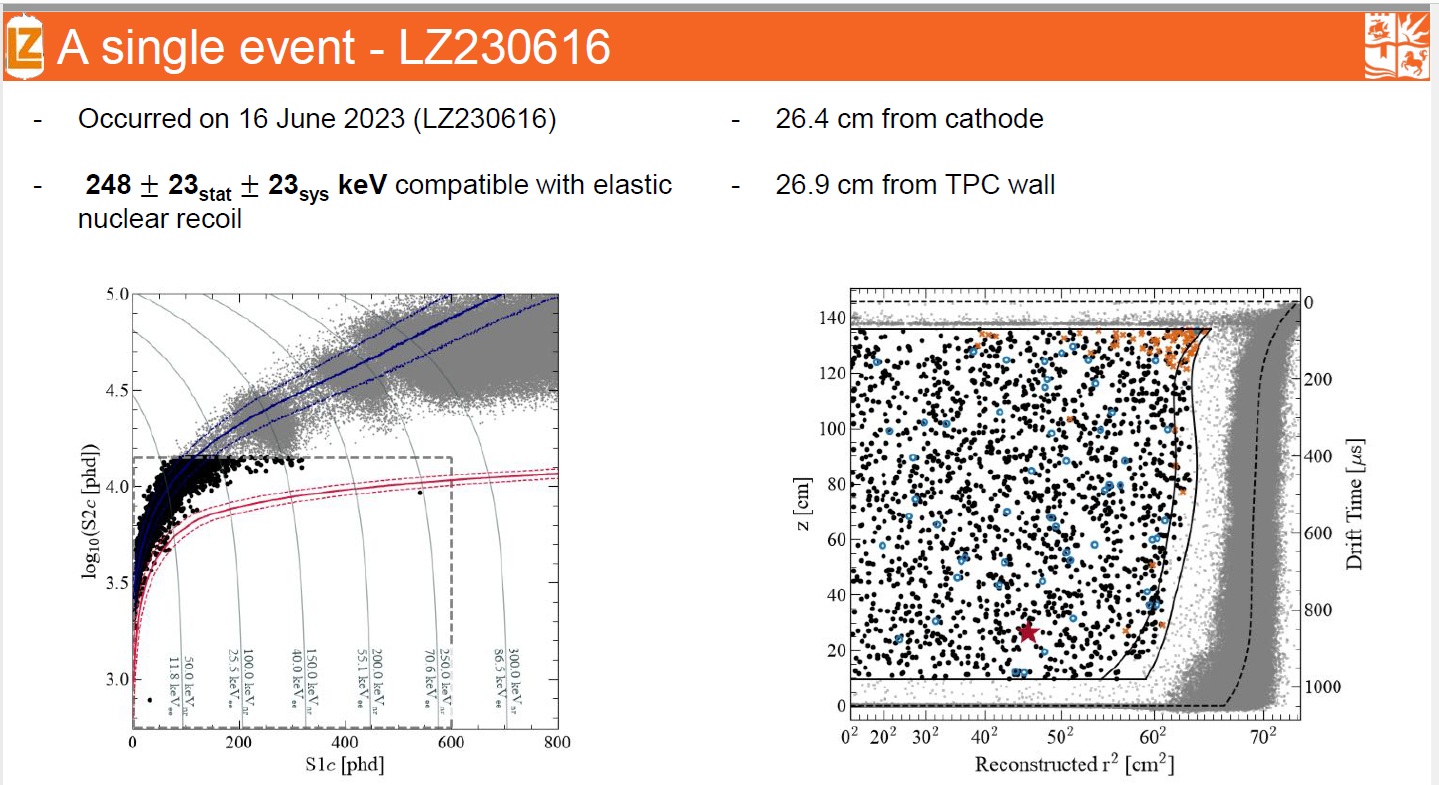
There is also a scientific presentation by Sam Eriksen from which I have extracted the crucial figure(s):
The event causing the excitement was detected over three years ago, on 16th June 2023. You can see it as the little black dot towards the upper right of the dashed square in the left hand panel. The LZ signal does appear unlikely to have been generated by known background events, but that does not necessarily mean that it is likely to be WIMP. The statistical significance quoted is not sufficiently high for it to be regarded as a clear detection; the implied odds are roughly the same as the odds that you, the reader, have a birthday on 16th June…
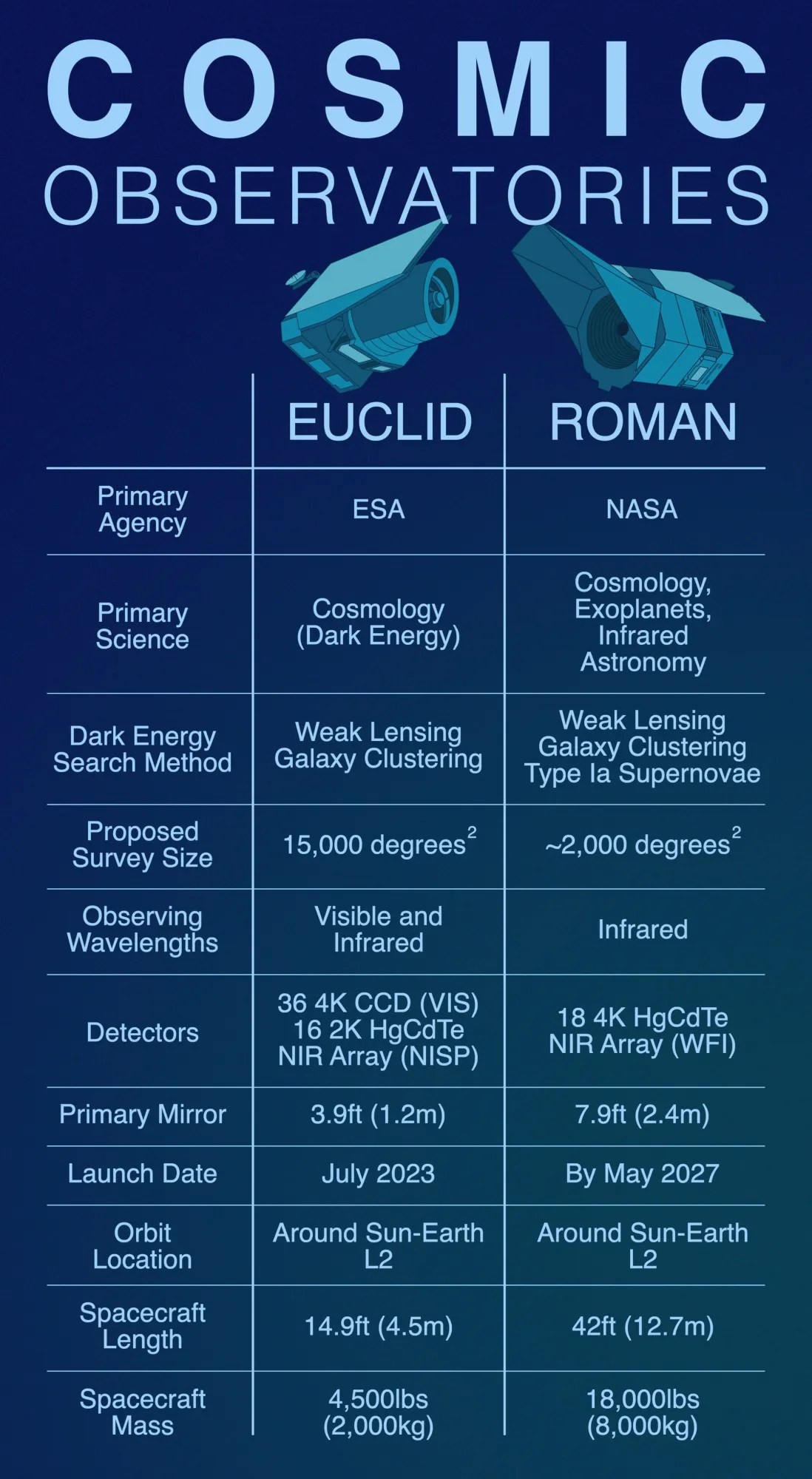
Just a quick note to mention that tomorrow sees the launch of NASA’s Nancy Grace Roman Space Telescope. This is a survey telescope in some respects like ESA’s Euclid but with a larger aperture and different instrumentation, particularly a coronagraph which can block starlight to directly image exoplanets and planet-forming disks. Its larger mirror (2.4m versus 1.2m) will enable it to see fainter objects than Euclid, but its survey will be a much smaller fraction of the sky so in its cosmological applications it is complementary to Euclid rather than a direct competitor for it.
NASA have produced this sort of “cheat sheet” comparing the two observatories:
The Launch is due tomorrow (August 30 2026), at 7:26 am EDT which is 12.26 local Irish Time (same as BST). If you’re so inclined you can watch the launch on YooToob here:
Update: all seems to be well, and the Nancy Grace Roman Space Telescope is now on its way to L2.
It’s time once more for another Saturday update of activity at the Open Journal of Astrophysics. Since the last update we have published a further three papers, bringing the number in Volume 9 (2026) to 163 and the total so far published by OJAp up to 611.
I continue to include the posts made on our Mastodon account (on Fediscience); these announcements also show the DOI for each paper.
The first paper to report this week was published on Tuesday 28th July in the folder Cosmology and Nongalactic Astrophysics. “The Origins of the Bulk Flow” by Richard Watkins & Trajan Clark (Willamett U., USA) and Hume A Feldman (U. Kansas, USA) analyzes the origin of large-scale bulk flow using the CosmicFlows-4 catalog, finding that it is largely influenced by structures beyond 200 h-1 Mpc, challenging previous assumptions.
The overlay for this paper is here
You can find the officially accepted version on arXiv here and the announcement on Fediverse here:
New Publication at the Open Journal of Astrophysics: "The Origins of the Bulk Flow" by Richard Watkins & Trajan Clark (Willamett U., USA) and Hume A Feldman (U. Kansas, USA).
The second paper for this week, also published on Tuesday 28th July in the folder Cosmology and Nongalactic Astrophysics is: “Enhancing weak lensing redshift distribution characterization by optimizing the Dark Energy Survey Self-Organizing Map Photo-z method” by A. Campos (Carnegie Mellon U., USA) and the DES collaboration (113 authors). This study improves the Self-Organizing Map methodology for estimating redshift distribution in galaxies, notably reducing overlap between redshift bins, in preparation for the Dark Energy Survey Year 6 data.Abstractfor Enhancing weak lensing redshift distribution characterization by optimizing the Dark Energy Survey Self-Organizing Map Photo-z method.
The overlay looks like this:
The official version of the paper can be found on arXiv here and the Fediverse announcement here:
New Publication at the Open Journal of Astrophysics: "Enhancing weak lensing redshift distribution characterization by optimizing the Dark Energy Survey Self-Organizing Map Photo-z method" by A. Campos (Carnegie Mellon U., USA) and the DES collaboration (113 authors)
New Publication at the Open Journal of Astrophysics: "The Ray Tracing Sampler: Bayesian Sampling of Neural Networks for Everyone" by Peter Behroozi (U. Arizona, USA)
It’s time once more for another Saturday update of activity at the Open Journal of Astrophysics. Since the last update we have published a further six papers, bringing the number in Volume 9 (2026) to 151 and the total so far published by OJAp up to 599.
I will continue to include the posts made on our Mastodon account (on Fediscience); these announcements also show the DOI for each paper.
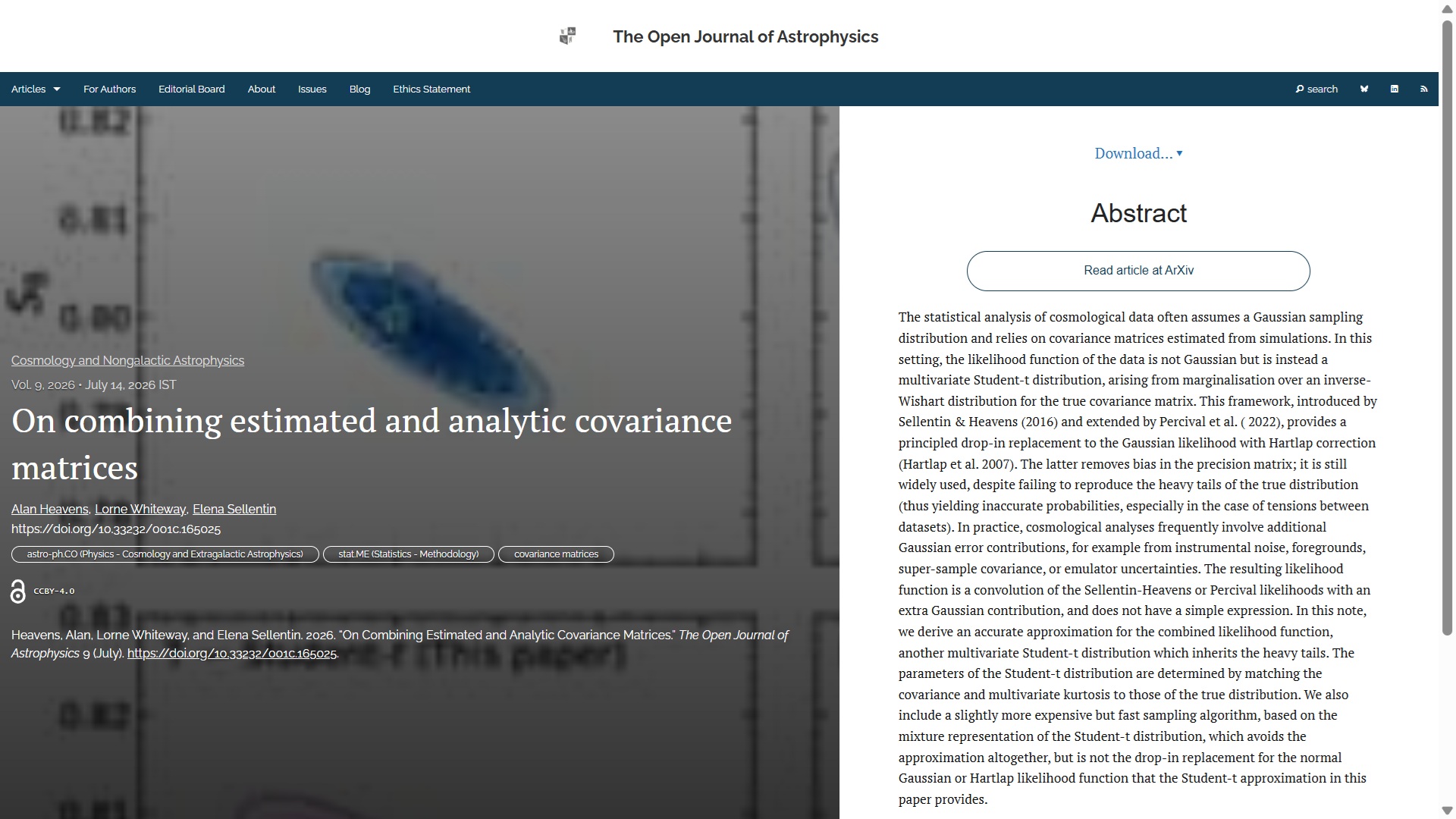
The first paper to report this week, published on Tuesday 14th July, is “On combining estimated and analytic covariance matrices” by Alan Heavens (Imperial College London, UK), Lorne Whiteway (University College, London, UK) and Elena Sellentin (Leiden University, The Netherlands). This article, published in the folder Cosmology and Nongalactic Astrophysics, presents an accurate approximation for the combined likelihood function in cosmological data analysis, improving upon previous methods by better representing the heavy tails of the true distribution.
The overlay for this paper is here
You can find the officially accepted version on arXiv here and the announcement on Fediverse here:
New Publication at the Open Journal of Astrophysics: "On combining estimated and analytic covariance matrices" by Alan Heavens (Imperial College London, UK), Lorne Whiteway (University College, London, UK) and Elena Sellentin (Leiden University, The Netherlands)
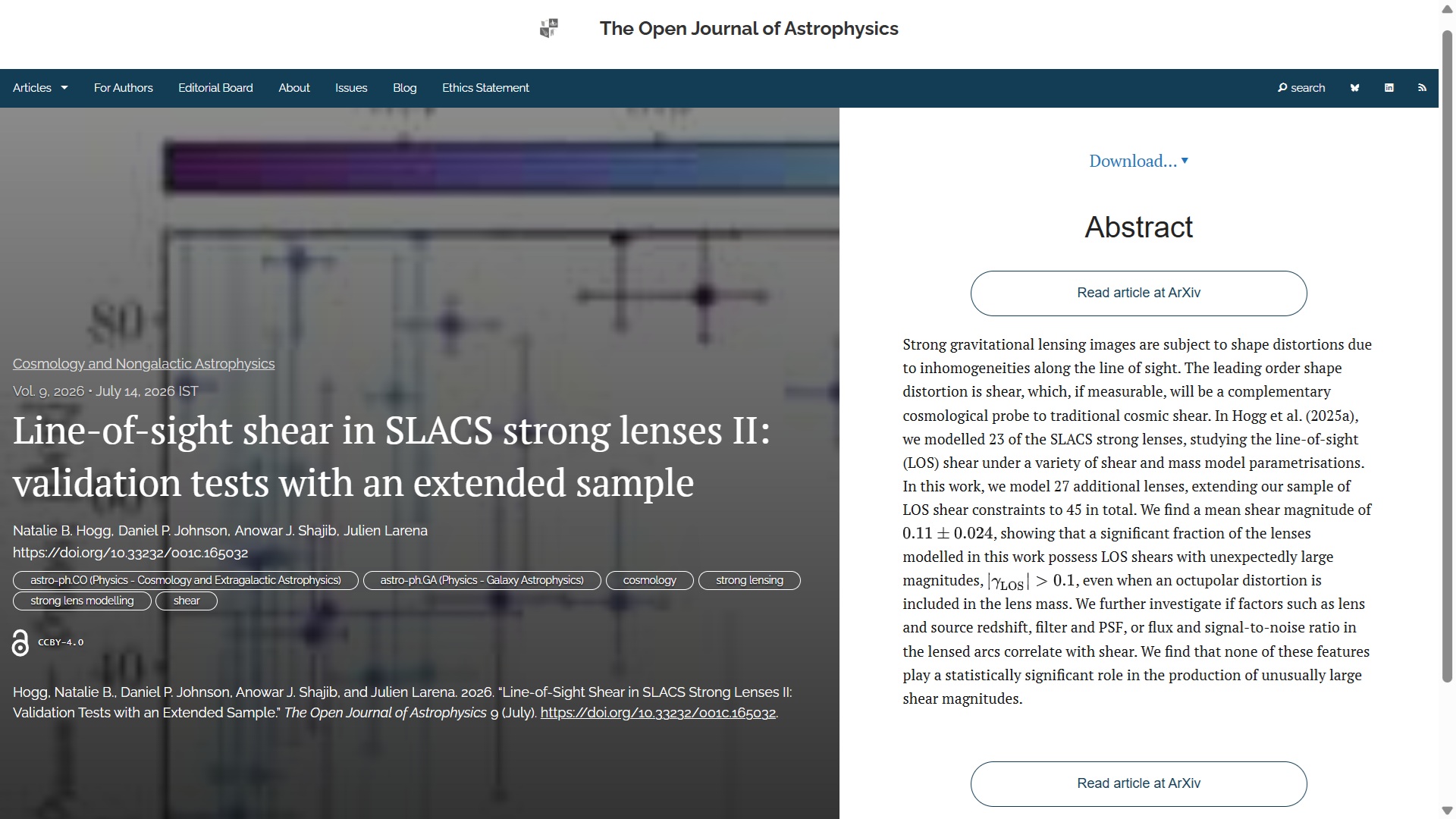
The second paper for this week, also published on Tuesday 14th July in the folder Cosmology and Nongalactic Astrophysics is: “Line-of-sight shear in SLACS strong lenses II: validation tests with an extended sample” by Natalie B. Hogg (U. Cambridge, UK), Daniel P. Johnson (Université de Montpellier, France), Anowar J. Shajib (U. Chicago, USA) and Julien Larena (Montpellier). The study described in this paper models 27 additional gravitational lenses, finding a significant fraction with unexpectedly large line-of-sight shears. Factors like redshift, filter, and signal-to-noise ratio don’t significantly affect shear magnitudes.
The overlay looks like this:
The official version of the paper can be found on arXiv here and the Fediverse announcement here:
New Publication at the Open Journal of Astrophysics: "Line-of-sight shear in SLACS strong lenses II: validation tests with an extended sample" by Natalie B. Hogg (U. Cambridge, UK), Daniel P. Johnson (Université de Montpellier, France), Anowar J. Shajib (U. Chicago, USA) and Julien Larena (Montpellier)
New Publication at the Open Journal of Astrophysics: "Investigating the Dark Energy Constraint from Strongly Lensed AGN at LSST-Scale" by Sydney Erickson (Stanford University, USA) and 13 others on behalf of The LSST Dark Energy Science Collaboration
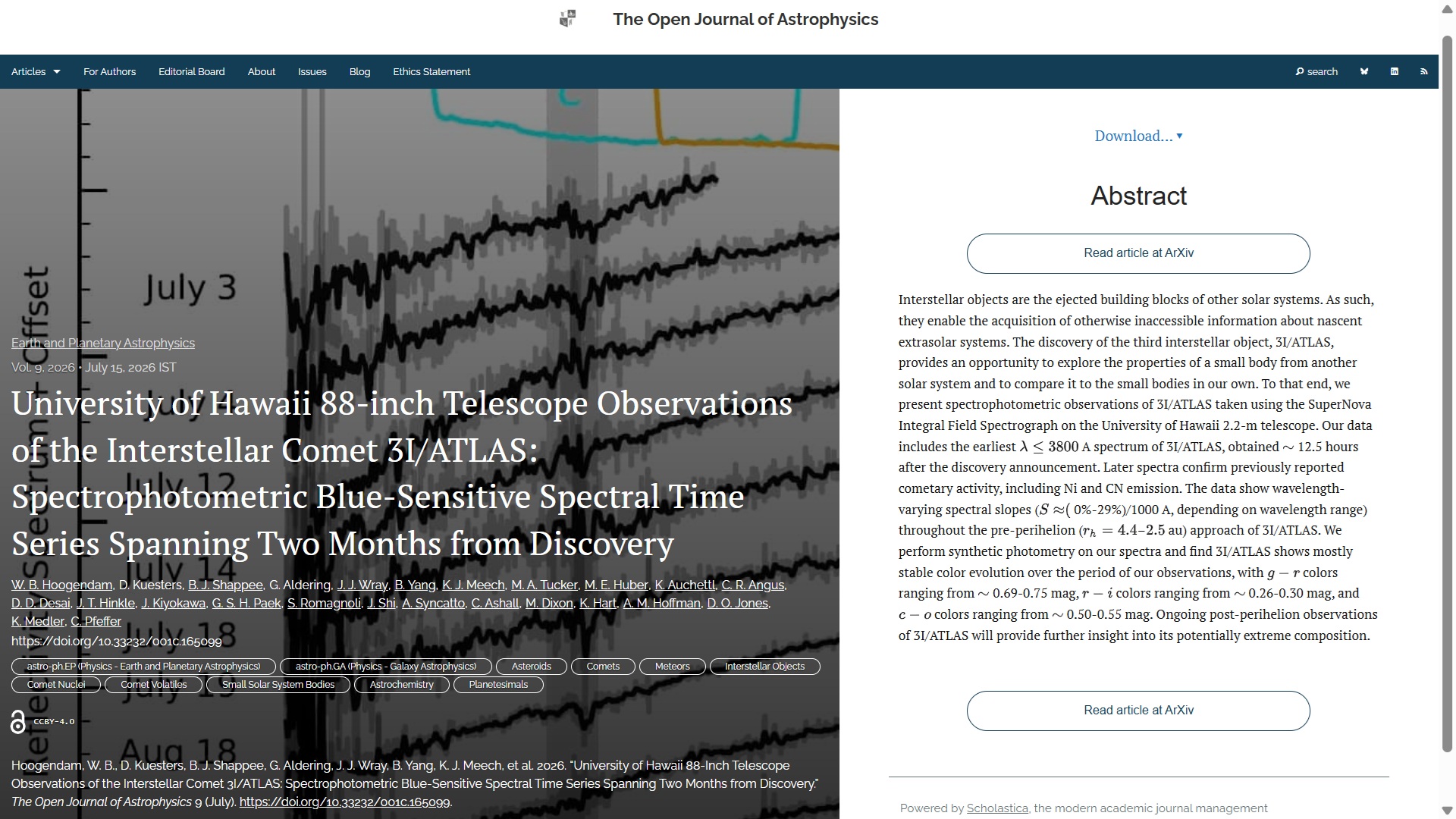
New Publication at the Open Journal of Astrophysics: "University of Hawaii 88-inch Telescope Observations of the Interstellar Comet 3I/ATLAS: Spectrophotometric Blue-Sensitive Spectral Time Series Spanning Two Months from Discovery" by W. B. Hoogendam (University of Hawaii, USA) and 24 others from around the world.
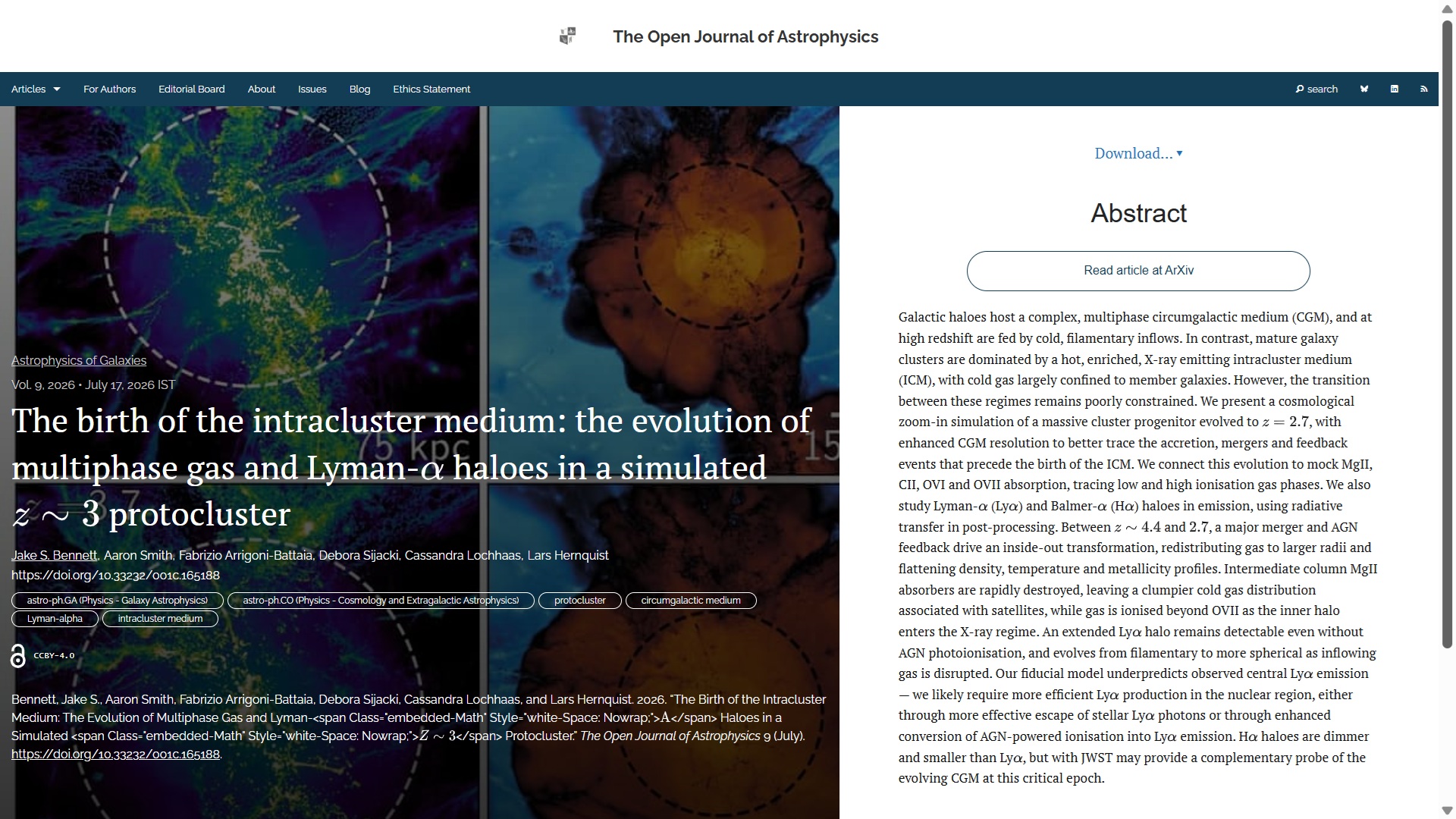
The fifth paper of the week, published on Friday 17th July in the folder Astrophysics of Galaxies, is “The birth of the intracluster medium: the evolution of multiphase gas and Lyman-α haloes in a z~3 simulated protocluster” by Jake S. Bennett (Harvard Smithsonian CfA, USA), Aaron Smith (U. Nottingham, UK), Fabrizio Arrigoni-Battaia (MPA Garching, Germany), Debora Sijacki (U. Cambridge, UK) , Cassandra Lochhaas (CfA) and Lars Hernquist (CfA). This study uses a cosmological simulation to explore the transition from complex galactic haloes to mature galaxy clusters, focusing on gas distribution, ionisation, and emission changes during this evolution.
The overlay for this one is here:
You can read the final version of this one on arXiv here and the Mastodon announcement is here:
New Publication at the Open Journal of Astrophysics: "The birth of the intracluster medium: the evolution of multiphase gas and Lyman-α haloes in a z~3 simulated protocluster" by Jake S. Bennett (Harvard Smithsonian CfA, USA), Aaron Smith (U. Nottingham, UK), Fabrizio Arrigoni-Battaia (MPA Garching, Germany), Debora Sijacki (U. Cambridge, UK) , Cassandra Lochhaas (CfA) and Lars Hernquist (CfA).
The sixth and final paper of this week is “Density reconstruction from biased tracers: Testing the equivalence principle through consistency relations” by Lawrence Dam and Omar Darwish (Université de Genève, Switzerland). This was published on Friday 17th July in the folder Cosmology and Nongalactic Astrophysics. It proposes using quadratic estimators to test the weak equivalence principle on cosmological scales, offering a practical alternative to the conventional bispectrum approach.
The overlay for this one is here:
You can find the final accepted version on arXiv here and the Mastodon announcement is here:
New Publication at the Open Journal of Astrophysics: "Density reconstruction from biased tracers: Testing the equivalence principle through consistency relations" by Lawrence Dam and Omar Darwish (Université de Genève, Switzerland)
As you can see we have now published over 150 papers this year and are just one shy of 600 in total. I expect we’ll pass that milestone next week. I’ll do another update next Saturday.
Back into the swing of things in Maynooth, getting ready for the repeat examinations that start next month, I realized that I had forgotten to pass on an interesting paper that I found out about a few weeks ago but was reminded of while in London so I’m remedying my omission now. The title is The Coherence Principle: A Falsifiable Prior for Model Selection from the Grammar of Theories by Raul Jimenez, Carlos Peña Garay, Fergus Simpson, and Licia Verde. It addresses the issue of how to assign prior probabilities. We know how to do this in cases where the models concerned belong to a family differentiated by relatively simple parameters (as is the case in the standard cosmological framework), but for more complex differences the appropriate prior is difficult to choose. I see the paper as an attempt to extend the work of Ed Jaynes, though I’m not sure the authors see it quite in those terms!
Here is the abstract:
Bayesian model selection in cosmology and particle physics is often performed where posterior odds inherit a strong, often unacknowledged dependence on the prior assigned to competing models. Standard responses — reference priors, hierarchical priors, or appeals to naturalness — ignore relevant theoretical knowledge or rely on criteria hard to define operationally. We propose the Coherence Principle: a reproducible prescription for assigning model priors according to compatibility with the validated structure of an existing theory. This structure, grammar, includes symmetries, conservation laws, locality, Lorentz invariance, and universality patterns. Unmotivated violations of these rules incur a coherence cost, converted into a prior weight through a maximum-entropy exponential form controlled by one calibratable parameter α. The resulting prior is distinct from both the Bayesian Occam factor and naturalness: it penalizes not parameter volume or fine tuning, but departures from validated theoretical grammar. We illustrate the principle with examples from cosmology and fundamental physics: neutrino mass mechanisms, dark energy and modified gravity, inflation, beyond-Standard-Model sectors, and hierarchical astrophysical inference. We test it also on four historical cases — general relativity, Pauli’s neutrino, parity violation, and special relativity — where evidential and theoretical contexts can be reconstructed. These examples show that it favors the historically successful choice when the proper grammar is defined in the correct domain and time. The Coherence Principle makes explicit a common but usually tacit part of physical reasoning: trust in validated structural rules. It turns this judgment into a transparent, testable, and overrulable component of Bayesian inference, leaving empirical likelihoods free to dominate when data are sufficiently constraining.
Back home to Maynooth, just in time for another Saturday update of activity at the Open Journal of Astrophysics. Since the last update we have published a further nine papers, bringing the number in Volume 9 (2026) to 145 and the total so far published by OJAp up to 593.
I will continue to include the posts made on our Mastodon account (on Fediscience); these announcements also show the DOI for each paper.
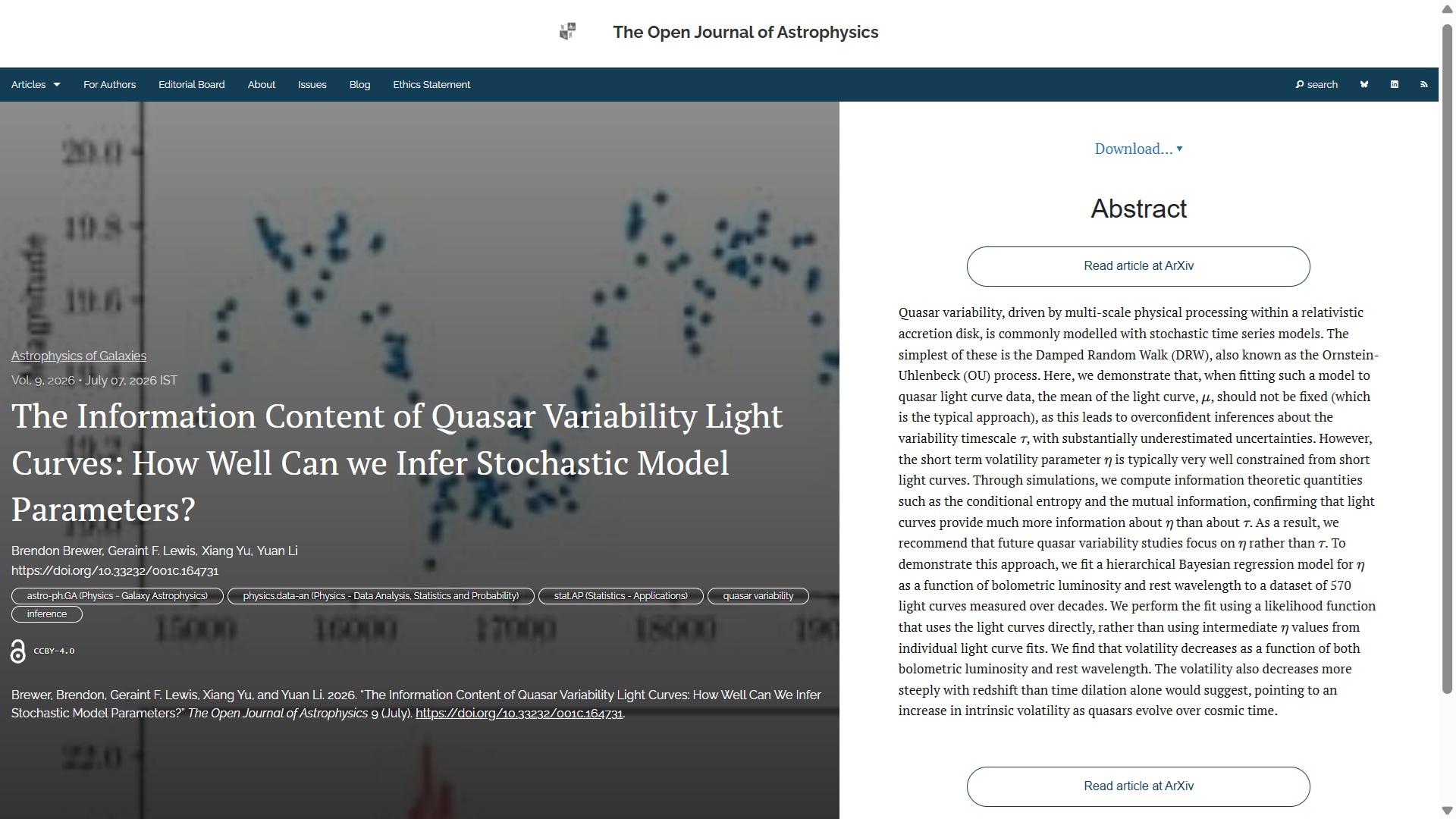
The first paper to report this week, published on Tuesday 7th July, is “The Information Content of Quasar Variability Light Curves: How Well Can we Infer Stochastic Model Parameters?” by Brendon Brewer (U. Auckland, NZ), Geraint F. Lewis (U. Sydney, AU), Xiang Yu & Yuan Li (Auckland). Published in the folder Astrophysics of Galaxies, this study suggests that quasar variability studies should focus on the short term volatility parameter, as it’s more informative than the variability timescale. Volatility decreases with redshift suggesting intrinsic effects.
The overlay for this paper is here
You can find the officially accepted version on arXiv here and the announcement on Fediverse here:
New Publication at the Open Journal of Astrophysics: "The Information Content of Quasar Variability Light Curves: How Well Can we Infer Stochastic Model Parameters?" by Brendon Brewer (U. Auckland, NZ), Geraint F. Lewis (U. Sydney, AU), Xiang Yu & Yuan Li (Auckland)
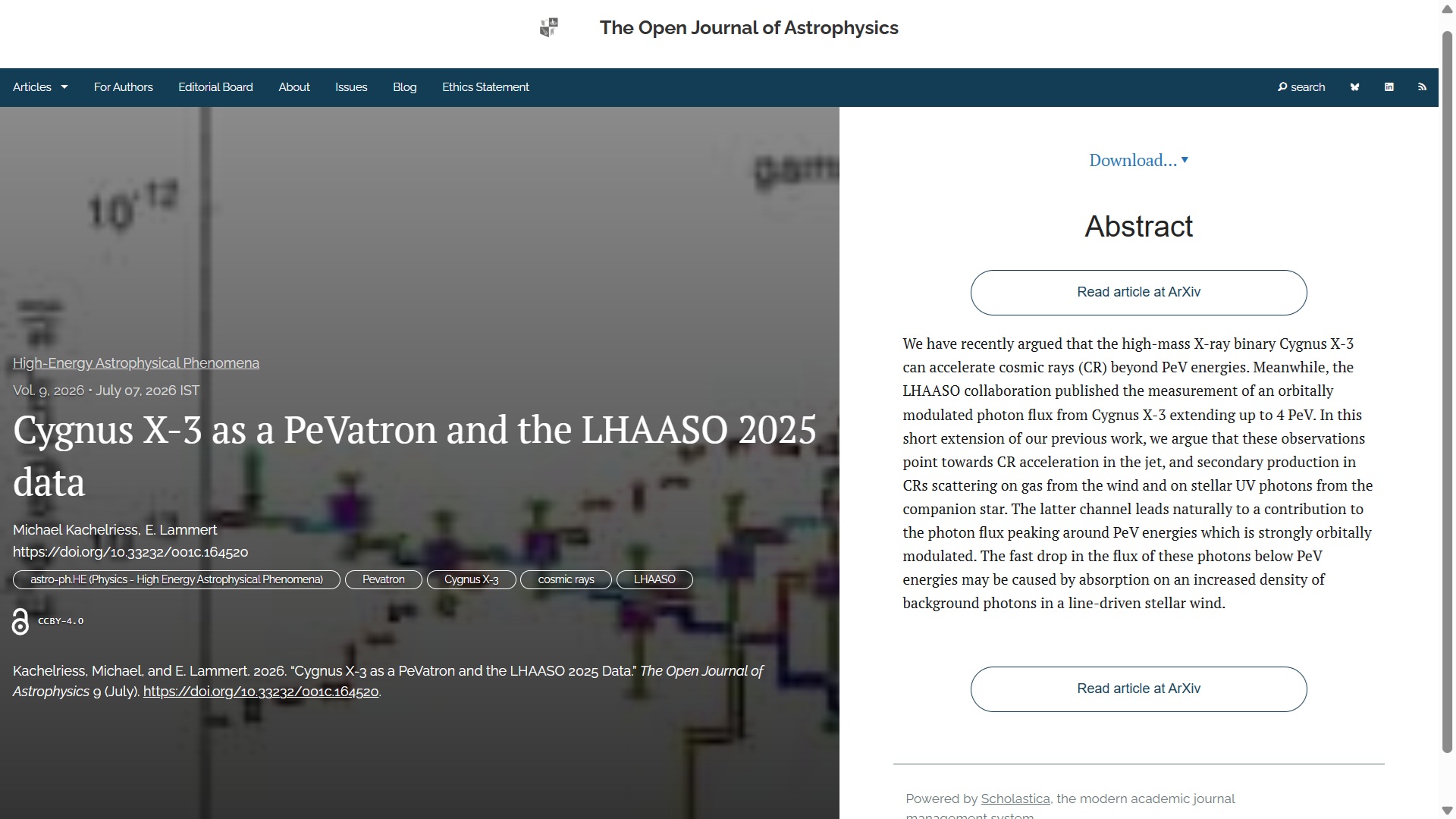
The second paper for this week, also published on Tuesday 7th July, but in the folder High-Energy Astrophysical Phenomena, is “Cygnus X-3 as a PeVatron and the LHAASO 2025 data” by Michael Kachelriess & E. Lammert (NTNU, Trondheim, Norway). This paper suggests that the high-mass X-ray binary Cygnus X-3 can accelerate cosmic rays beyond PeV energies, contributing to a photon flux peaking around PeV energies.
The overlay looks like this:
The official version of the paper can be found on arXiv here and the Fediverse announcement here:
New Publication at the Open Journal of Astrophysics: "Cygnus X-3 as a PeVatron and the LHAASO 2025 data" by Michael Kachelriess & E. Lammert (NTNU, Trondheim, Norway)
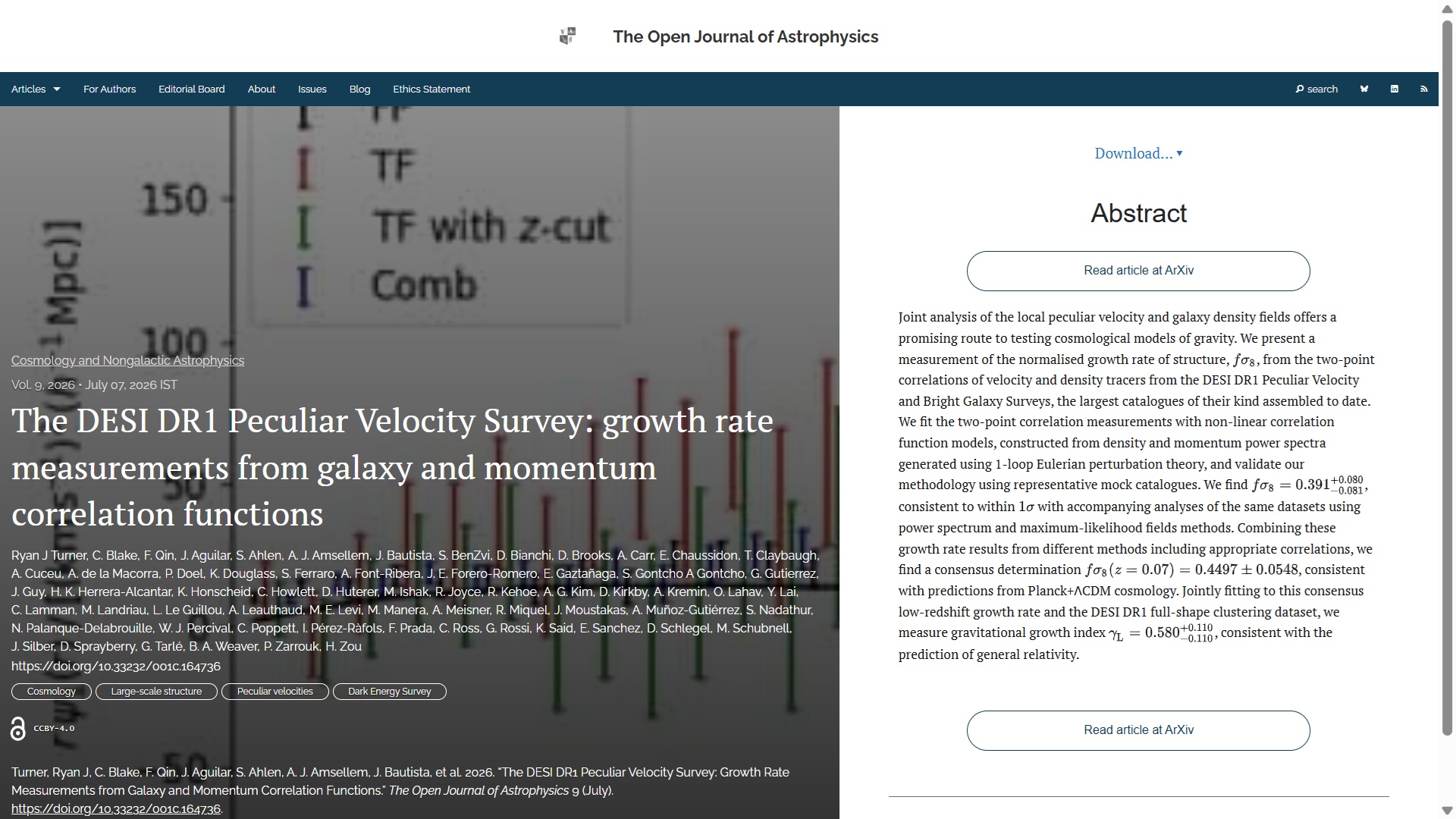
New Publication at the Open Journal of Astrophysics: "The DESI DR1 Peculiar Velocity Survey: growth rate measurements from galaxy and momentum correlation functions" by Ryan J Turner (Swinburne Institute of Technology, Australia) and 63 others from around the world.
New Publication at the Open Journal of Astrophysics: "On the effective spin-mass ratio relation of binary black hole mergers that evolved in isolation" by Sambaran Banerjee (Helmholtz-Instituts für Strahlen und Kernphysik, Germany) and Aleksandra Olejak (MPA Garching, Germany)
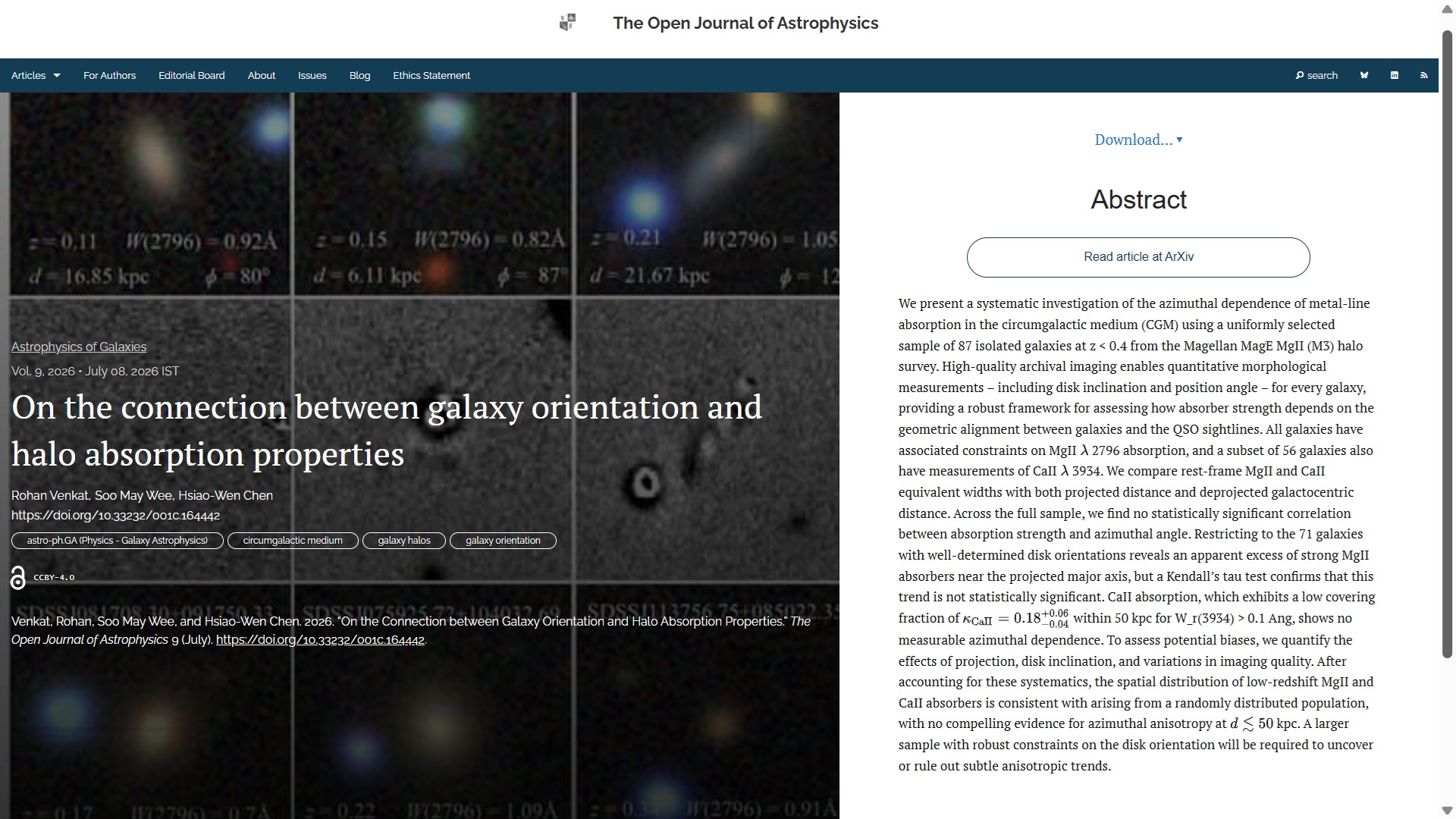
The fifth paper of the week, also published on Wednesday 8th July but in the folder Astrophysics of Galaxies, is “On the connection between galaxy orientation and halo absorption properties” by Rohan Venkat, Soo May Wee, and Hsiao-Wen Chen (U. Chicago, USA). This article investigates the azimuthal dependence of metal-line absorption in the circumgalactic medium of 87 isolated galaxies. The results show no significant correlation between absorption strength and azimuthal angle.
The overlay for this one is here:
You can read the final version of this one on arXiv here and the Mastodon announcement is here:
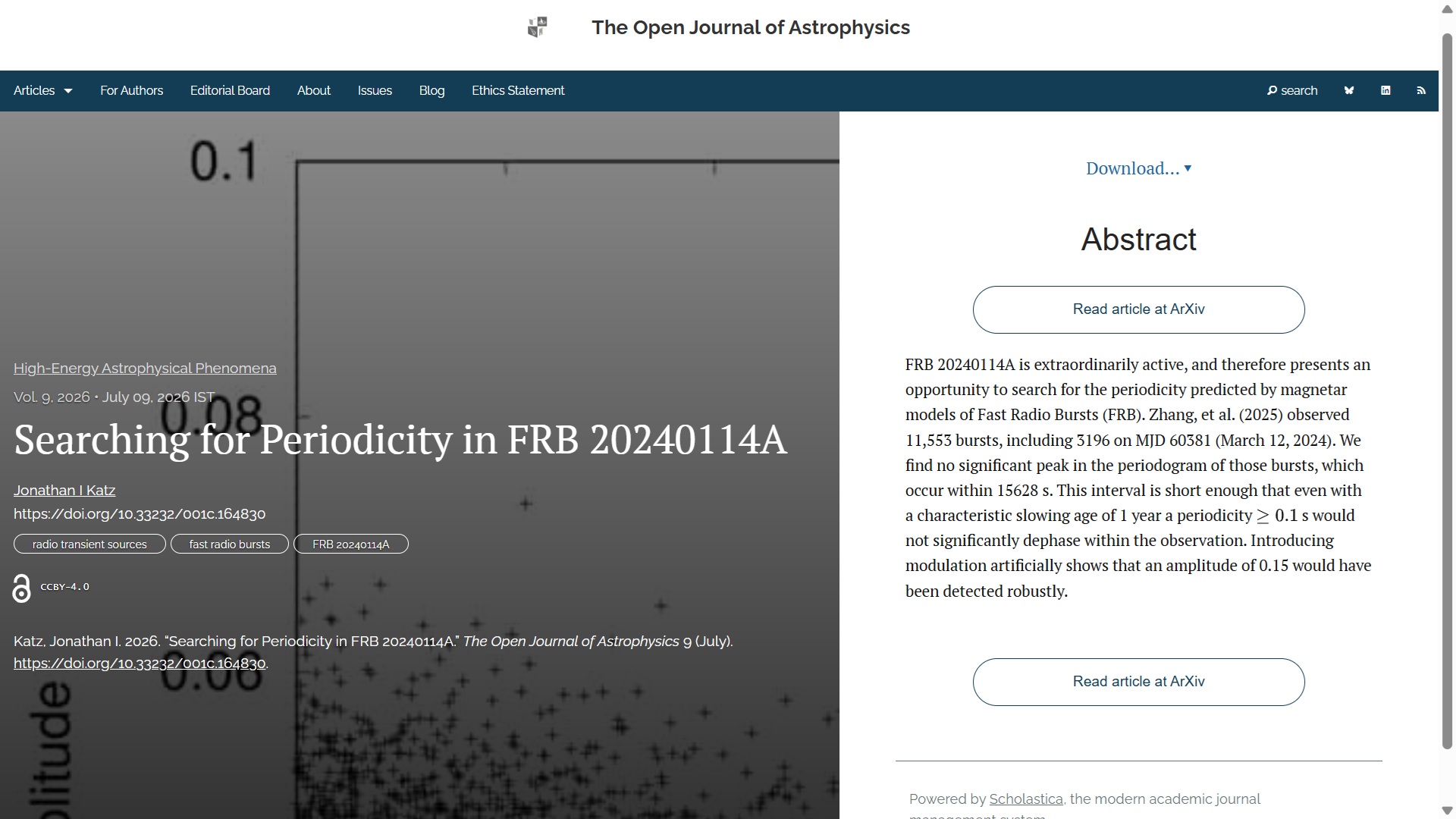
The sixth paper of this week is “Searching for Periodicity in FRB 20240114A” by Jonathan I Katz (Washington U., USA). This was published on Thursday 9th July in the folder High-Energy Astrophysical Phenomena. The study described in this paper observed FRB 20240114A, an active Fast Radio Burst, but found no significant periodicity in its bursts, contradicting magnetar models predictions.
The overlay for this one is here:
You can find the final accepted version on arXiv here and the Mastodon announcement is here:
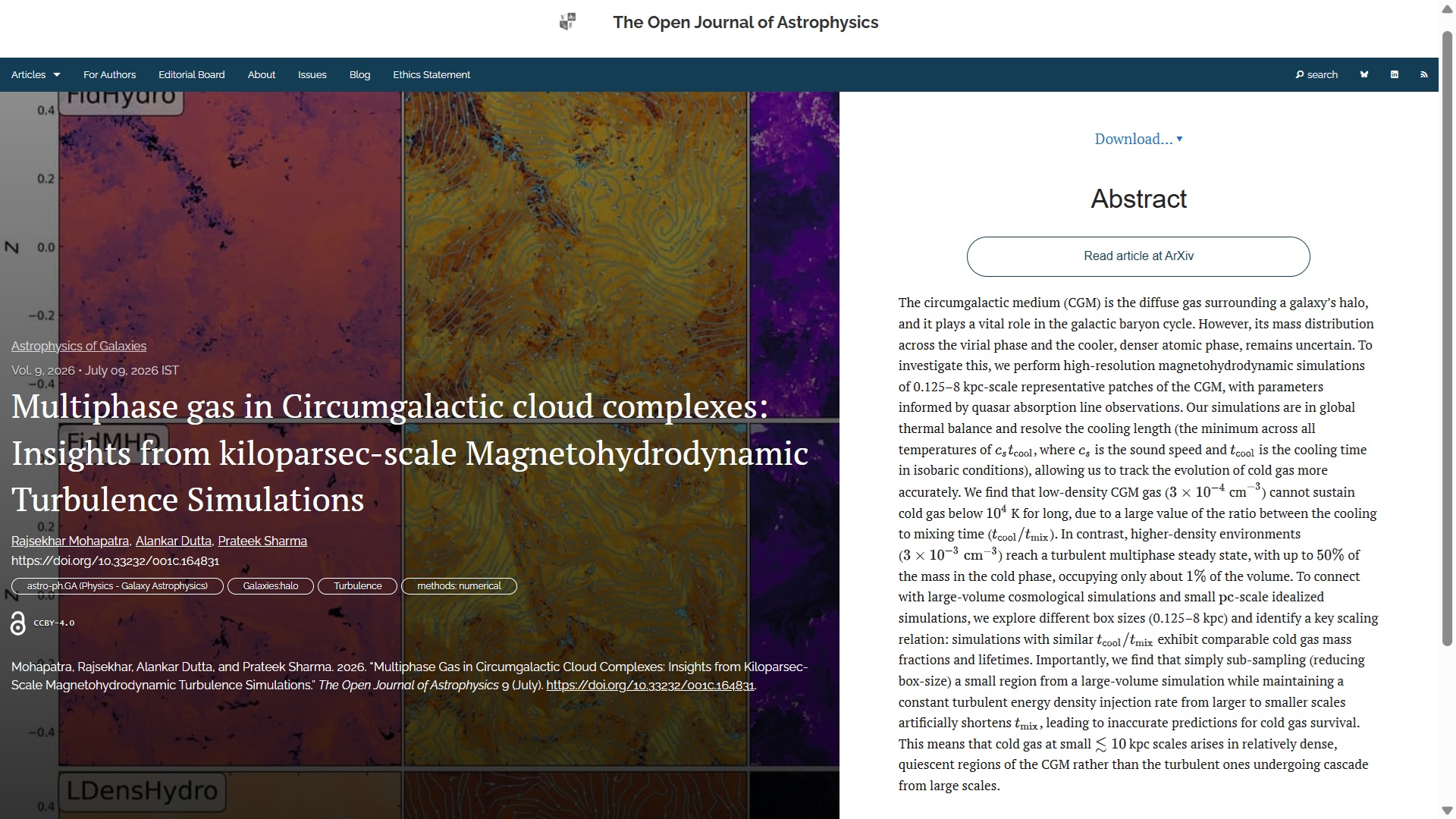
The seventh article for this week is “Multiphase gas in Circumgalactic cloud complexes: Insights from kiloparsec-scale Magnetohydrodynamic Turbulence Simulations” by Rajsekhar Mohapatra (Princeton U., USA), Alankar Dutta (MPA Garching, Germany) and Prateek Sharma (Indian Institute of Science, Bangalore). This -paper was also published on Thursday 9th July, in the folder Astrophysics of Galaxies. This paper uses high-resolution simulations to investigate the mass distribution of the circumgalactic medium (CGM), a diffuse gas surrounding a galaxy’s halo with small-scale clumps of cold gas forming in quiescent regions.
The overlay for this one is here:
You can find the final accepted version of this one on arXiv here and the Mastodon announcement is here:
New Publication at the Open Journal of Astrophysics: "Multiphase gas in Circumgalactic cloud complexes: Insights from kiloparsec-scale Magnetohydrodynamic Turbulence Simulations" by Rajsekhar Mohapatra (Princeton U., USA), Alankar Dutta (MPA Garching, Germany) and Prateek Sharma (Indian Institute of Science, Bangalore)
The (penultimate) eighth article for this week is “Line-of-sight shear in SLACS strong lenses I: shear and mass model parametrisations” by Natalie B. Hogg (U. Cambridge, UK), Daniel Johnson (U. Montpellier, France), Anowar J. Shajib (U. Chicago, USA) and Julien Larena (Montpellier). This was also published on Thursday 9th July, but in the folder Cosmology and Nongalactic Astrophysics. This article studies models of 23 strong gravitational lenses to measure line-of-sight shear for the first time, providing potential new constraints on cosmological parameters.
The overlay for this one is here:
You can find the final accepted version on arXiv here and the Mastodon announcement is here:
New Publication at the Open Journal of Astrophysics: "Line-of-sight shear in SLACS strong lenses I: shear and mass model parametrisations" by Natalie B. Hogg (U. Cambridge, UK), Daniel Johnson (U. Montpellier, France), Anowar J. Shajib (U. Chicago, USA) and Julien Larena (Montpellier)
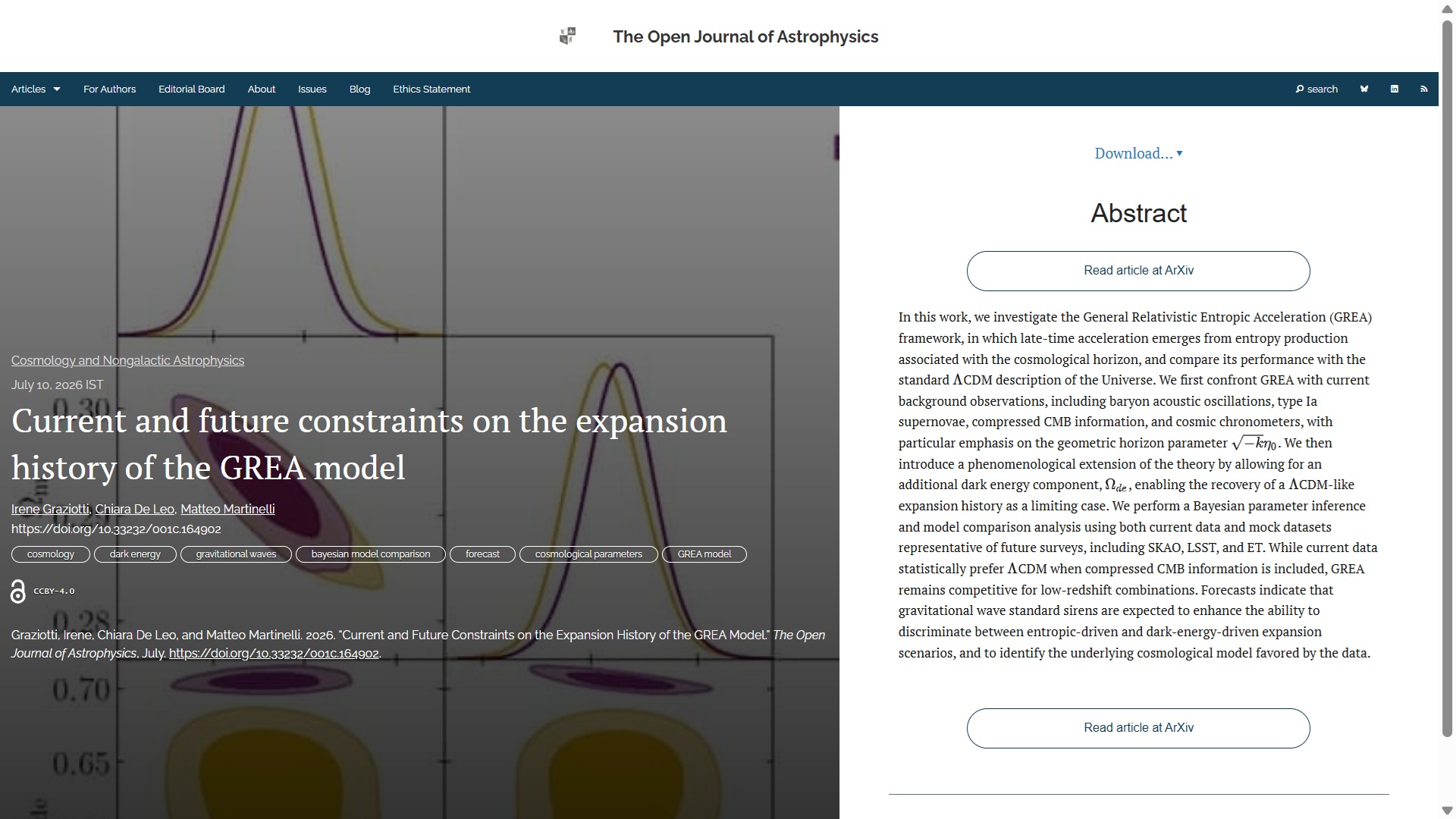
The ninth and last article for this week is “Current and future constraints on the expansion history of the GREA model” by Irene Graziotti (INAF-Osservatorio Astronomico di Capodimonte, Italy), Chiara De Leo (Sapienza University of Rome, Italy) and Matteo Martinelli (INAF-Osservatorio Astronomico di Roma, Italy). This study explores the General Relativistic Entropic Acceleration (GREA) framework, comparing it to the standard description of the universe. Current data favors the standard model, but GREA remains competitive.
The overlay for this one is here:
You can find the officially-accepted version on arXiv here and the Mastodon announcement here:
New Publication at the Open Journal of Astrophysics: "Current and future constraints on the expansion history of the GREA model" by Irene Graziotti (INAF-Osservatorio Astronomico di Capodimonte, Italy), Chiara De Leo (Sapienza University of Rome, Italy) and Matteo Martinelli (INAF-Osservatorio Astronomico di Roma, Italy)
As you can see, it has been a bumper week, especially when you consider that there was no arXiv mailing om Monday July 6th owing to the July 4th holiday in the USA. I should have known this would happen while I was travelling!
Today has been a very frustrating day from the point of view of travel – apparently it’s too hot for trains to function – but at least that gave me time to read the book Invisible Rainbows by Dr Alfredo Carpineti (left). This is an engaging and nicely written tour of what we know (and don’t know) about the Universe organized by wavelength of electromagnetic radiation, from radio through microwaves and infrared, to ultraviolet and X-rays to gamma rays. All the wavebands outside the range of human perception, in fact.
What makes this book different from others that have taken the same general approach is that he builds that fairly conventional narrative around conversations with LGBTQIA+ scientists to demonstrate how diverse perspectives have contributed to the advancement of astronomy, astrophysics and cosmology.
There are even a couple of quotes from yours truly, but it’s not just for vanity’s sake that I’m very happy to see this book published. It’s very nicely written and offers a very new perspective on science as a human endeavour. This definitely the first astrophysics book I’ve seen with a dedication “For all the queer kids reaching for the stars”. I guess I was one of those once! The book is at times humorous, even cheeky, but always driven by a passion for astrophysics and the celebration of human diversity. I wish I had I time to read it before Pride Month, but I’m nevertheless very proud to have featured even in a tiny way in such a delightful book.
It’s Saturday again so it’s time for another update of activity at the Open Journal of Astrophysics. Since the last update we have published a further seven papers, bringing the number in Volume 9 (2026) to 136 and the total so far published by OJAp up to 584.
I will continue to include the posts made on our Mastodon account (on Fediscience); these announcements also show the DOI for each paper.
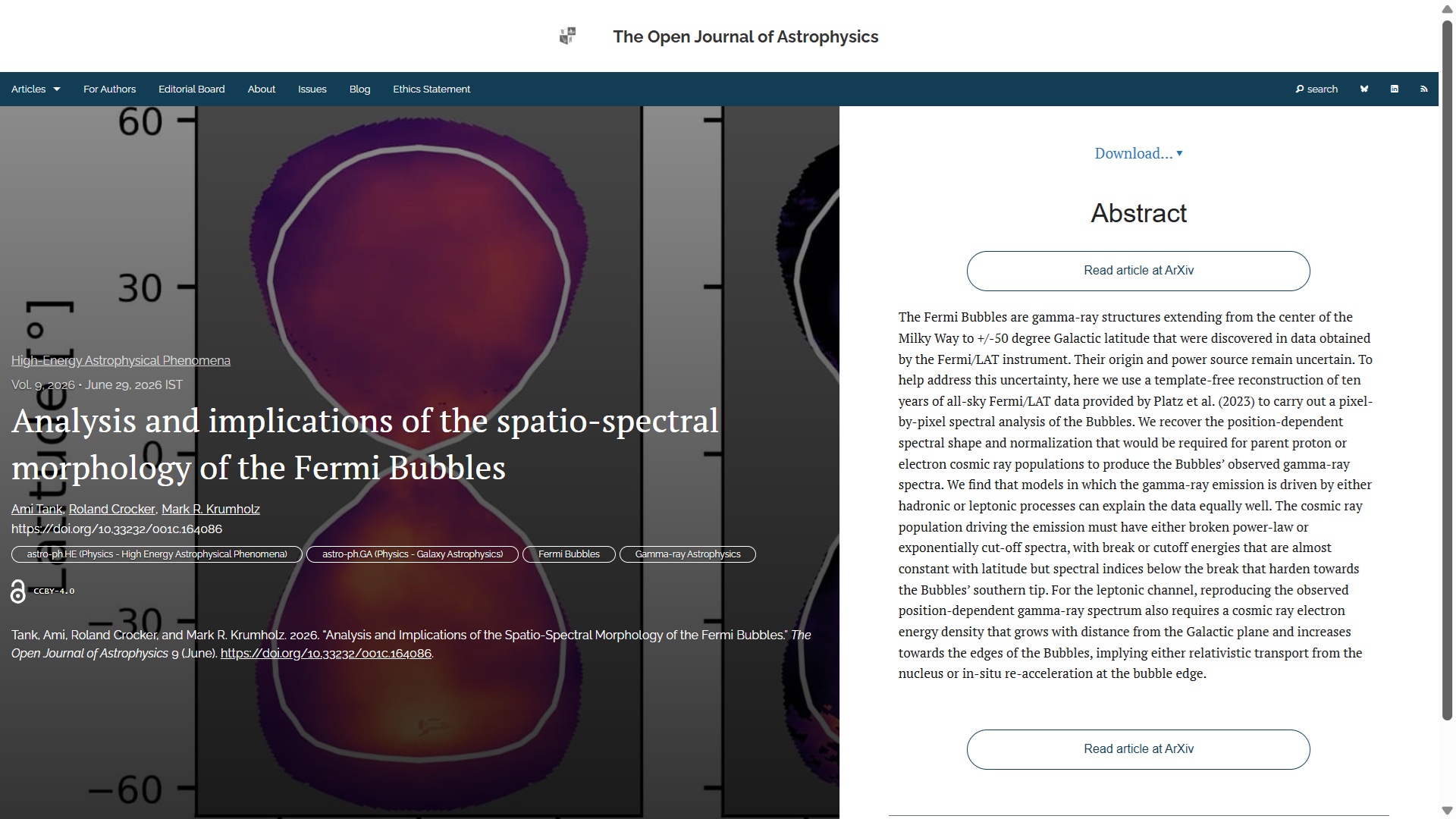
The first paper to report this week, published on Monday 29th June, is “Analysis and implications of the spatio-spectral morphology of the Fermi Bubbles” by Ami Tank (Indian Institute of Technology) and Roland Crocker & Mark R. Krumholz (Australian National University). Published in the folder High-Energy Astrophysical Phenomena, this paper presents an analysis of the gamma-ray structures of Fermi Bubbles in the Milky Way using a decade of data. The research suggests either hadronic or leptonic processes can explain the data.
The overlay for this paper is here
You can find the officially accepted version on arXiv here and the announcement on Fediverse here:
New Publication at the Open Journal of Astrophysics: "Analysis and implications of the spatio-spectral morphology of the Fermi Bubbles" by Ami Tank (Indian Institute of Technology) and Roland Crocker & Mark R. Krumholz (Australian National University)
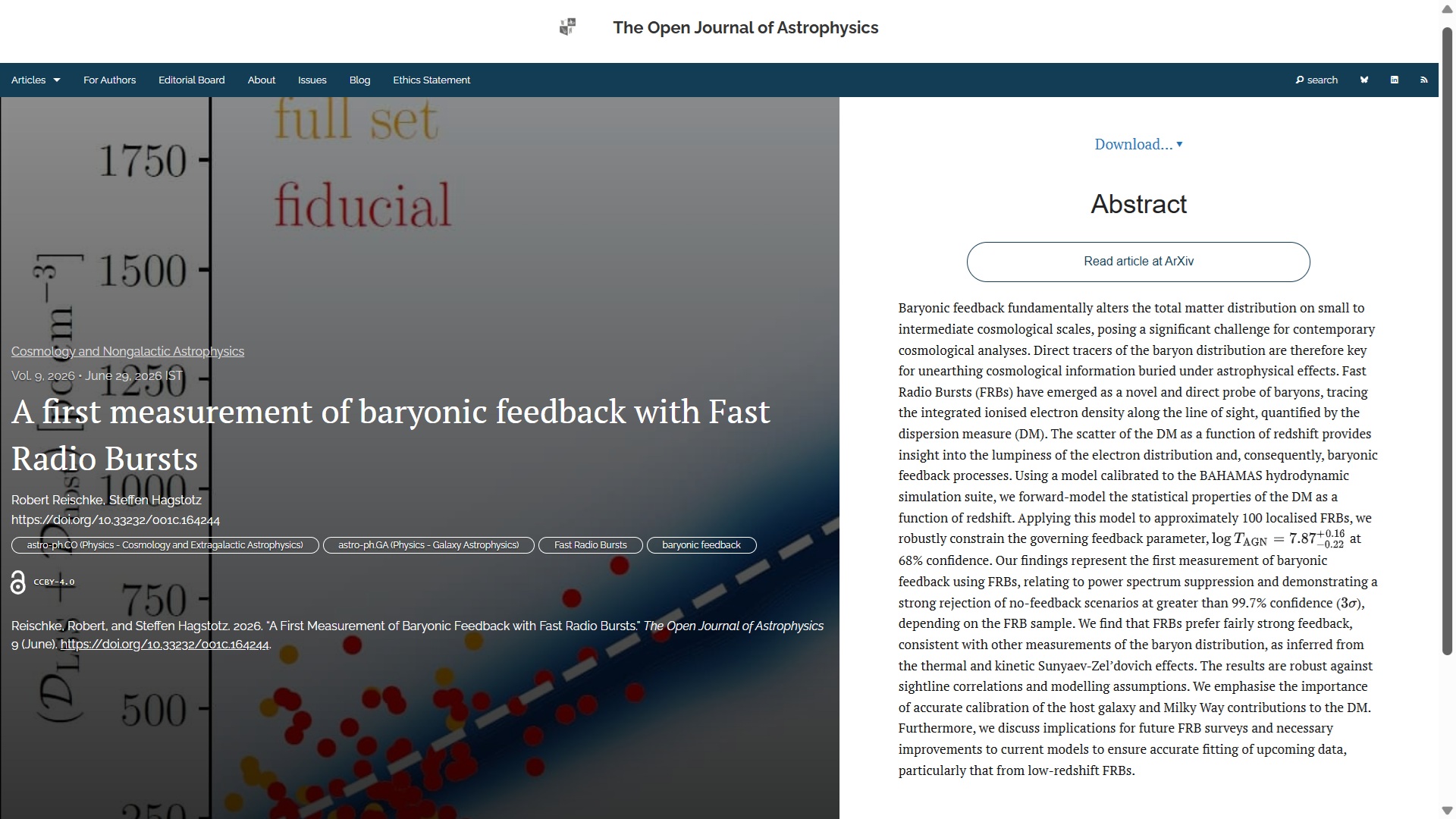
The second paper for this week, also published on Monday 29th June, but in the folder Cosmology and Nongalactic Astrophysics, is “A first measurement of baryonic feedback with Fast Radio Bursts” by Robert Reischke (Universität Bonn, Germany) and Steffen Hagstotz (Ludwig-Maximilians Universität München, Germany). This paper argues that Fast Radio Bursts (FRBs) provide a new method to trace baryon distribution and feedback in the cosmos, offering insights into matter distribution and rejecting no-feedback scenarios with high confidence.
The overlay looks like this:
The official version of the paper can be found on arXiv here and the Fediverse announcement here:
New Publication at the Open Journal of Astrophysics: "A first measurement of baryonic feedback with Fast Radio Bursts" by Robert Reischke (Universität Bonn, Germany) and Steffen Hagstotz (Ludwig-Maximilians Universität München, Germany)
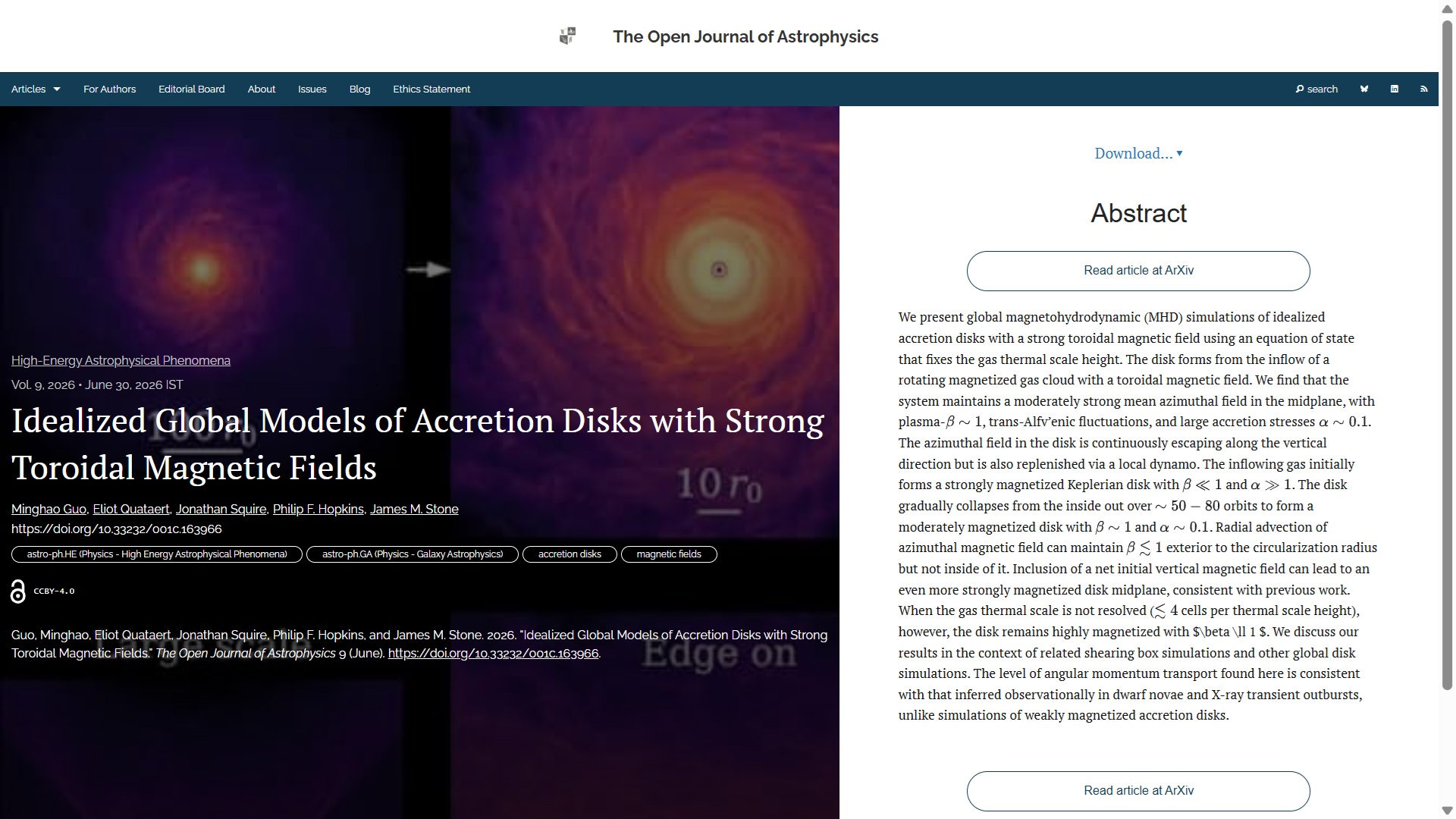
The third paper of the week, published on Tuesday 30th June in the folder High-Energy Astrophysical Phenomena, is “Idealized Global Models of Accretion Disks with Strong Toroidal Magnetic Fields” by Minghao Guo & Eliot Quataert (Princeton U., USA), Jonathan Squire (U. Otago, NZ), Philip F. Hopkins (Caltech, USA) and James M. Stone (Princeton). This study uses global magnetohydrodynamic simulations to explore the behavior of idealized accretion disks with strong toroidal magnetic fields, finding that these systems maintain a moderately strong mean azimuthal field.
The overlay for this one is here:
The final, accepted version can be found on arXiv here and the Mastodon announcement is here:
New Publication at the Open Journal of Astrophysics: "Idealized Global Models of Accretion Disks with Strong Toroidal Magnetic Fields" by Minghao Guo & Eliot Quataert (Princeton U., USA), Jonathan Squire (U. Otago, NZ), Philip F. Hopkins (Caltech, USA) and James M. Stone (Princeton)
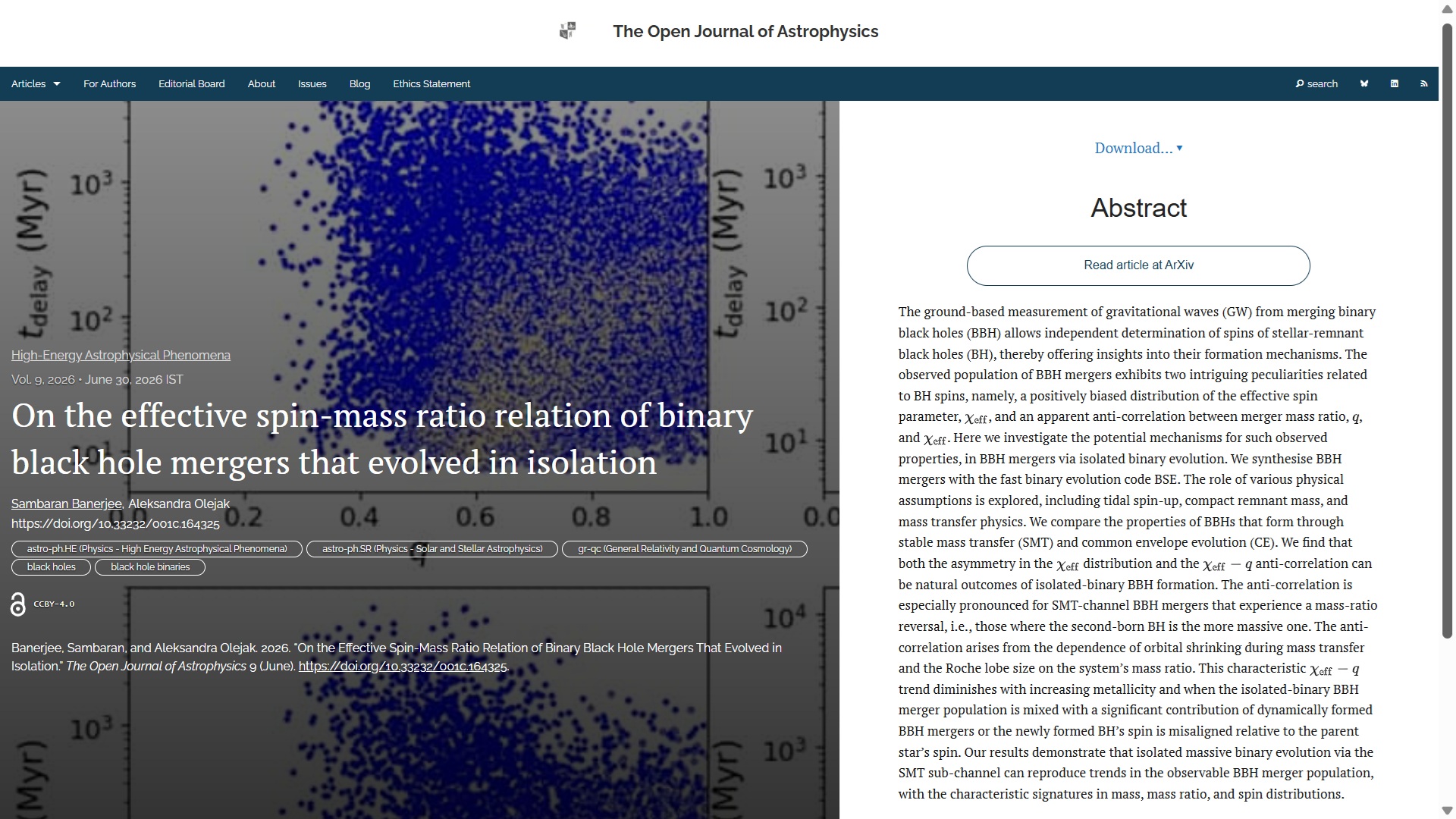
The fourth paper of the week, published on Tuesday 30th June in the folder High-Energy Astrophysical Phenomena, is “On the effective spin-mass ratio relation of binary black hole mergers that evolved in isolation” by Sambaran Banerjee (Helmholtz-Instituts für Strahlen und Kernphysik, Germany) and Aleksandra Olejak (MPA Garching, Germany). This study explores mechanisms of binary black hole mergers and finds that certain spin and mass ratio trends can be naturally explained by isolated binary evolution. The overlay for this one is here:
You can read the final version of this one on arXiv here and the Mastodon announcement is here:
New Publication at the Open Journal of Astrophysics: "On the effective spin-mass ratio relation of binary black hole mergers that evolved in isolation" by Sambaran Banerjee (Helmholtz-Instituts für Strahlen und Kernphysik, Germany) and Aleksandra Olejak (MPA Garching, Germany)
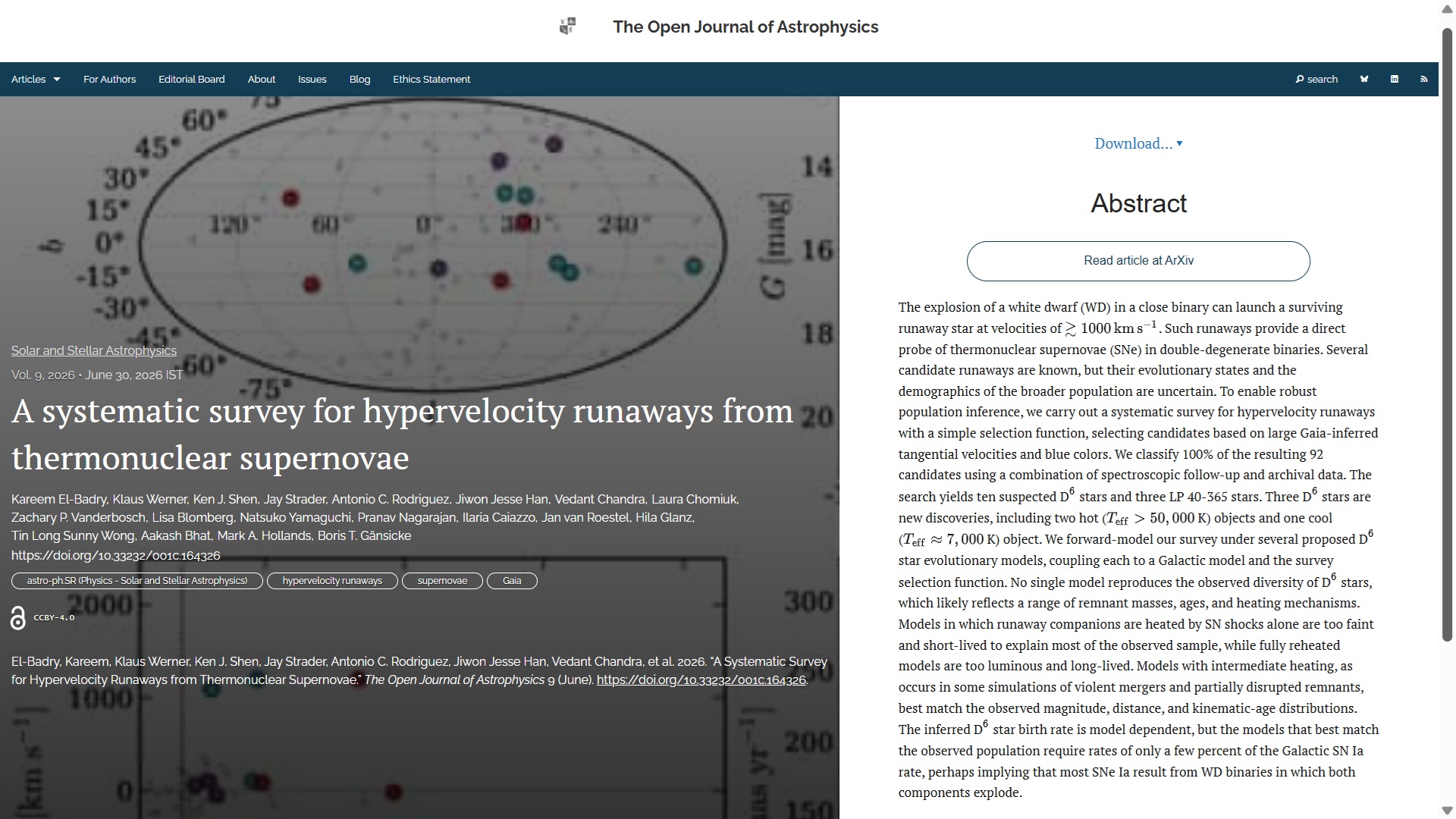
The fifth paper of the week, also published on Tuesday 30th June but in the folder Solar and Stellar Astrophysics is “A systematic survey for hypervelocity runaways from thermonuclear supernovae” by Kareem El-Badry (Caltech, USA), and 18 others based in the USA, Germany, Austria and the UK. This paper presents a systematic survey of hypervelocity runaways, resulting from white dwarf explosions in binary systems. The findings suggest a diversity of remnant masses, ages, and heating mechanisms, challenging theoretical models.
The overlay for this one is here:
You can read the final version of this one on arXiv here and the Mastodon announcement is here:
New Publication at the Open Journal of Astrophysics: "A systematic survey for hypervelocity runaways from thermonuclear supernovae" by Kareem El-Badry (Caltech, USA), and 18 others based in the USA, Germany, Austria and the UK.
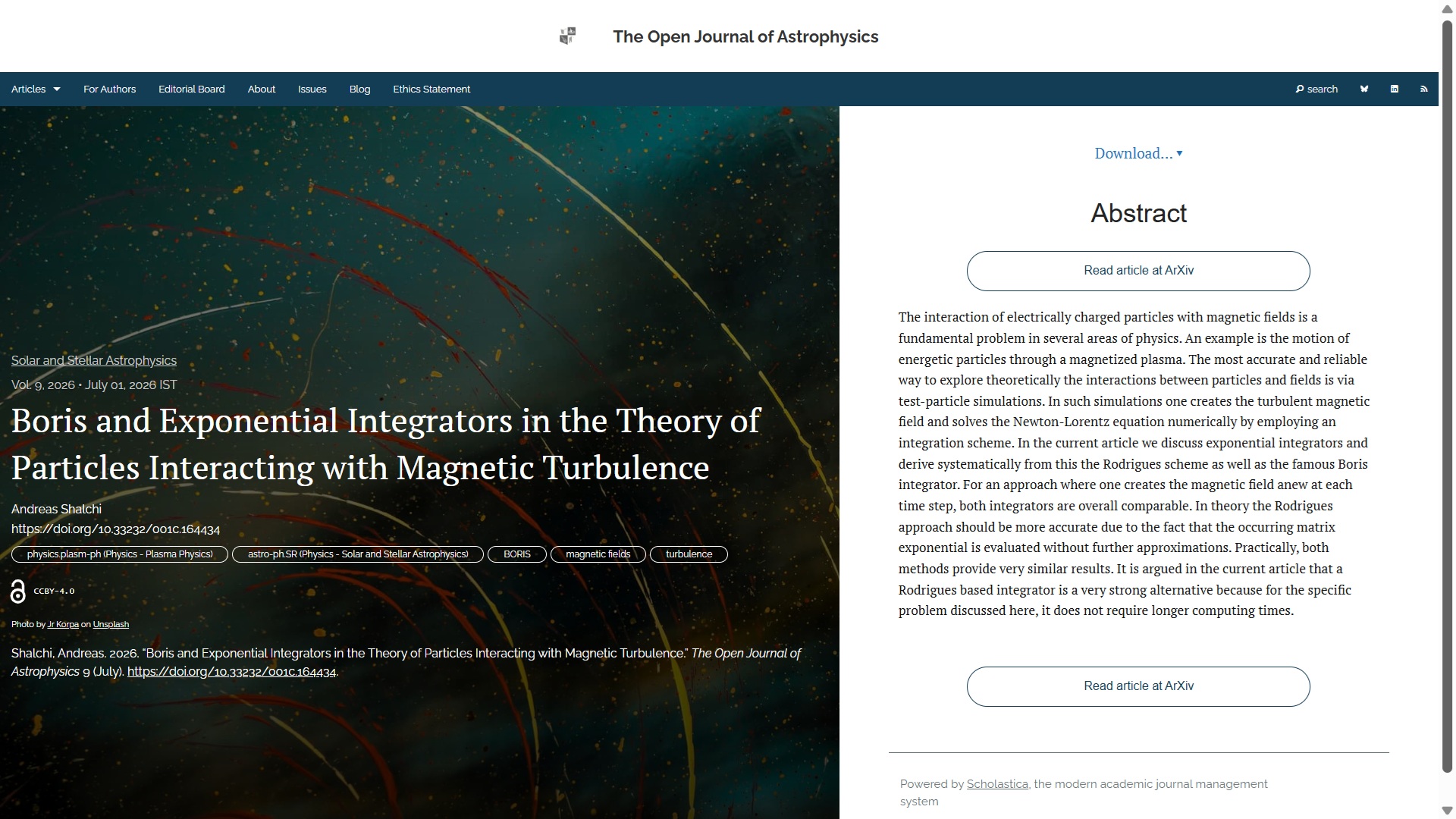
The sixth and penultimate paper of this week is “Boris and Exponential Integrators in the Theory of Particles Interacting with Magnetic Turbulence” by Andreas Shalchi (U. Manitoba, Canada). This was published on Wednesday 1st July, in the folder Solar and Stellar Astrophysics (it is posted in the plasma physics section of aXiv but cross-listed in solar and stellar astrophysics). The study compares the Rodrigues and Boris integrators in test-particle simulations of charged particles interacting with magnetic fields, finding both methods yield similar results.
The overlay for this one is here:
You can find the final accepted version on arXiv here and the Mastodon announcement is here:
New Publication at the Open Journal of Astrophysics: "Boris and Exponential Integrators in the Theory of Particles Interacting with Magnetic Turbulence" by Andreas Shalchi (U. Manitoba, Canada)
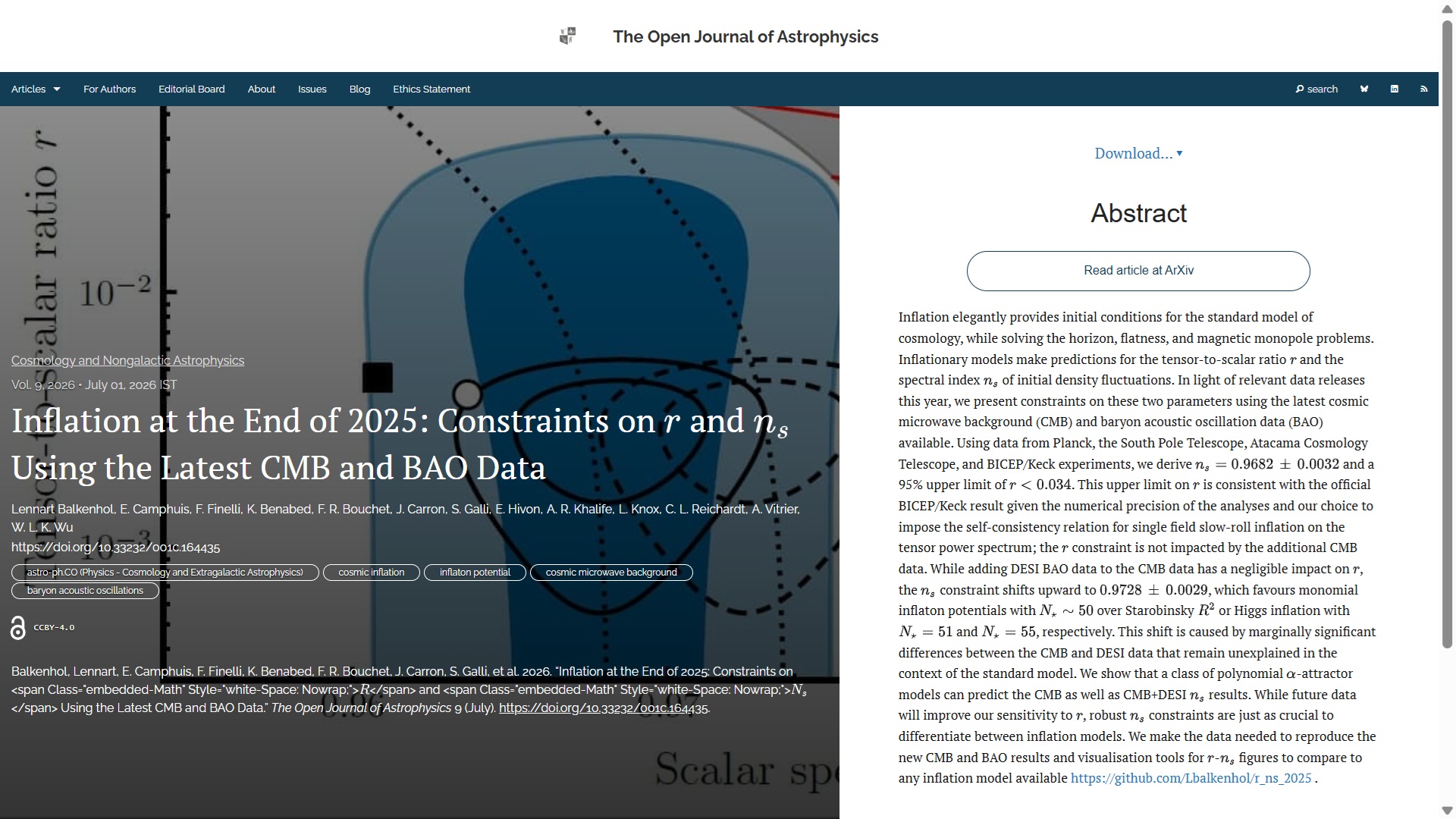
The seventh and final paper for this week is “Inflation at the End of 2025: Constraints on $r$ and $n_S$ using the Latest CMB and BAO Data” by Lennart Balkenhol (Institut d’Astrophysique de Paris, France) and 12 others based in France, Italy, Switzerland, UK, USA and Australia. This was also published on Wednesday 1st July, in the folder Cosmology and Nongalactic Astrophysics. This study presents constraints on parameters of inflationary models in cosmology, using the latest cosmic microwave background and baryon acoustic oscillation data. The findings help differentiate between inflation models.
The overlay for this one is here:
You can find the final accepted version of this one on arXiv here and the Mastodon announcement is here:
New Publication at the Open Journal of Astrophysics: "Inflation at the End of 2025: Constraints on $r$ and $n_S$ using the Latest CMB and BAO Data" by Lennart Balkenhol (Institut d’Astrophysique de Paris, France) and 12 others based in France, Italy, Switzerland, UK, USA and Australia.
And that concludes this week’s update. We’re starting to catch up on the backlog generated in June. At just past the halfway point of the year, which is where we are, we’re on 136 papers, which suggests a total around 272 for the year.
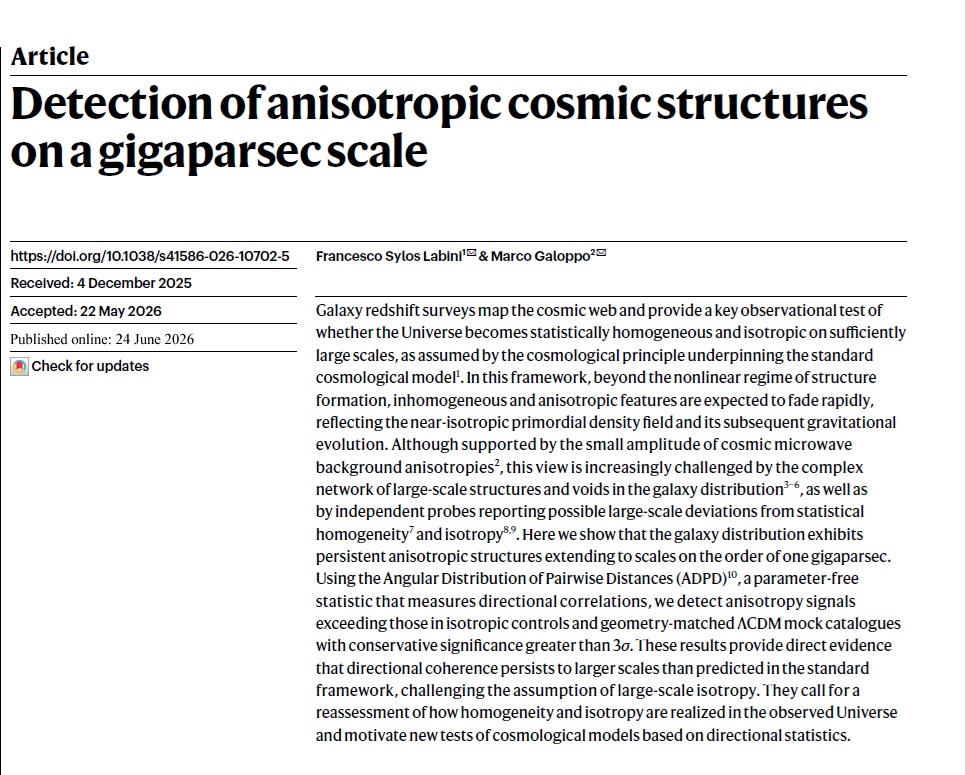
The latest in a sequence of claims of very large scale structures in the distribution that violate the cosmological principle emerged a week or so ago with a paper in Nature. The paper is behind a paywall but here is the abstract:
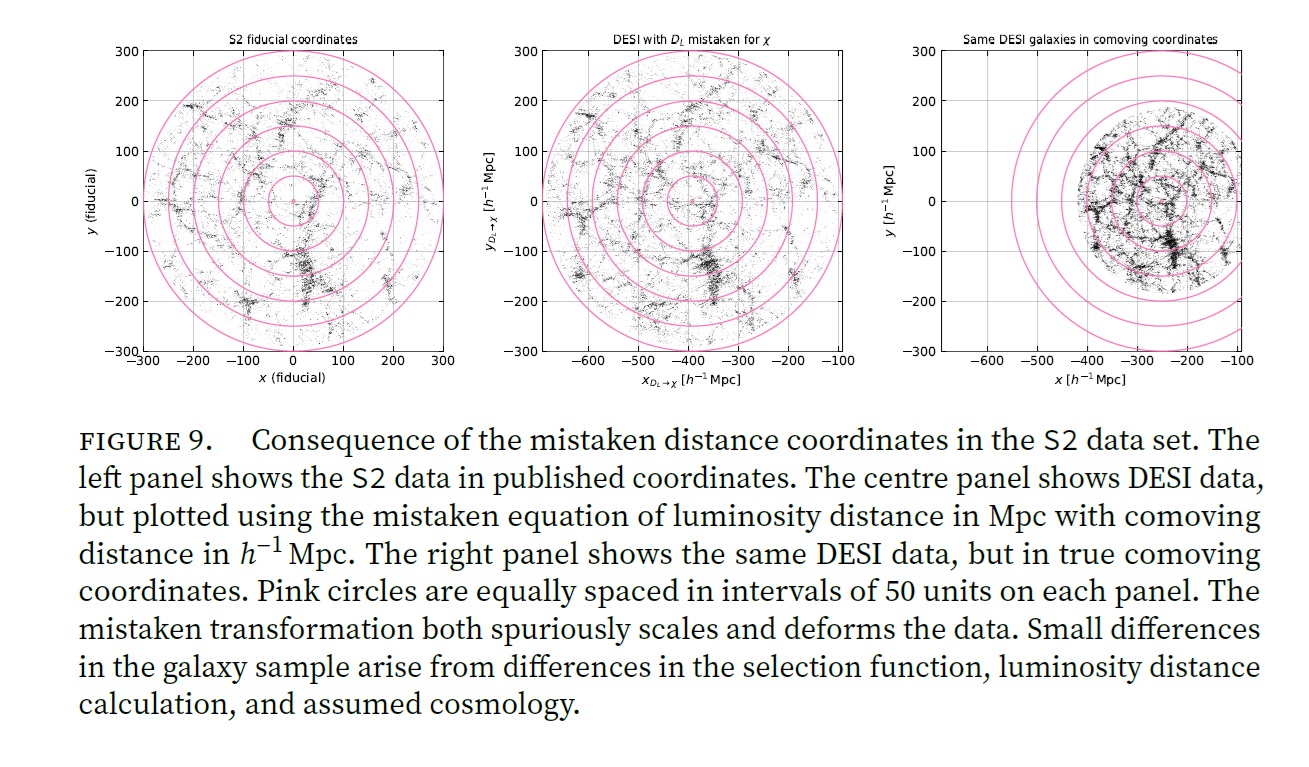
I’ve been nudged a few times by various people to comment on that but I’ve been busy recently and didn’t have time to look at the paper in detail. I had a quick look today and the thing that immediately struck me was that I didn’t understand the mock catalogues they used to compare the ΛCDM model with the observations. I still don’t understand that but I’ve stopped worrying about it because today I received a preprint (not behind a paywall, but on arXiv) from Till Sawala with the title The local galaxy distribution does not violate the cosmological principle and the (rather devastating) abstract:
The cosmological principle, which states that the Universe is statistically homogeneous and isotropic on sufficiently large scales, is a foundational assumption of the standard cosmological model. A recent analysis of DESI DR1 galaxy samples reported coherent anisotropic features in the local galaxy distribution extending to gigaparsec scales. If correct, this result would directly contradict the cosmological principle and motivate inhomogeneous cosmologies. Here I analyse the same data and compare them with galaxy distributions predicted by the FLAMINGO cosmological hydrodynamic simulation, performed in the standard ΛCDM paradigm. I show that the apparent anomaly disappears when the correct comoving distance scale is used. I also show that, rather than violating the cosmological principle, the observed structures are consistent with those expected in a ΛCDM Universe.
Here’s Figure 9 of the Sawala paper.
It seems that the authors of the Nature paper, Francesco Sylos Labini and Marco Galoppo, misinterpreted the distances of galaxies in the DESI DR1 sample in a way which boils down to an error of a factor (1+z)/h, where z is the redshift and h represents the Hubble constant. This hugely increases the scale and distorts the pattern of galaxy clustering. Using the correct comoving distance the measured structures are completely consistent with ΛCDM.
Oops!
P.S. I’ve stopped worrying about the mock surveys…
The views presented here are personal and not necessarily those of my employer (or anyone else for that matter).
Feel free to comment on any of the posts on this blog but comments may be moderated; anonymous comments and any considered by me to be vexatious and/or abusive and/or defamatory will not be accepted. I do not necessarily endorse, support, sanction, encourage, verify or agree with the opinions or statements of any information or other content in the comments on this site and do not in any way guarantee their accuracy or reliability.