Archive for the OJAp Papers Category

Weekly Update from the Open Journal of Astrophysics 25/07/2026

Posted in OJAp Papers, Open Access, The Universe and Stuff with tags , , , , , , , , , , , , , , , , , , , , , , , , , , , , , , , , , , , , on July 25, 2026 by telescoper

It’s time once more for another Saturday update of activity at the Open Journal of Astrophysics. Since the last update we have published a further nine papers, bringing the number in Volume 9 (2026) to 160 and the total so far published by OJAp up to 608.

I will continue to include the posts made on our Mastodon account (on Fediscience); these announcements also show the DOI for each paper.

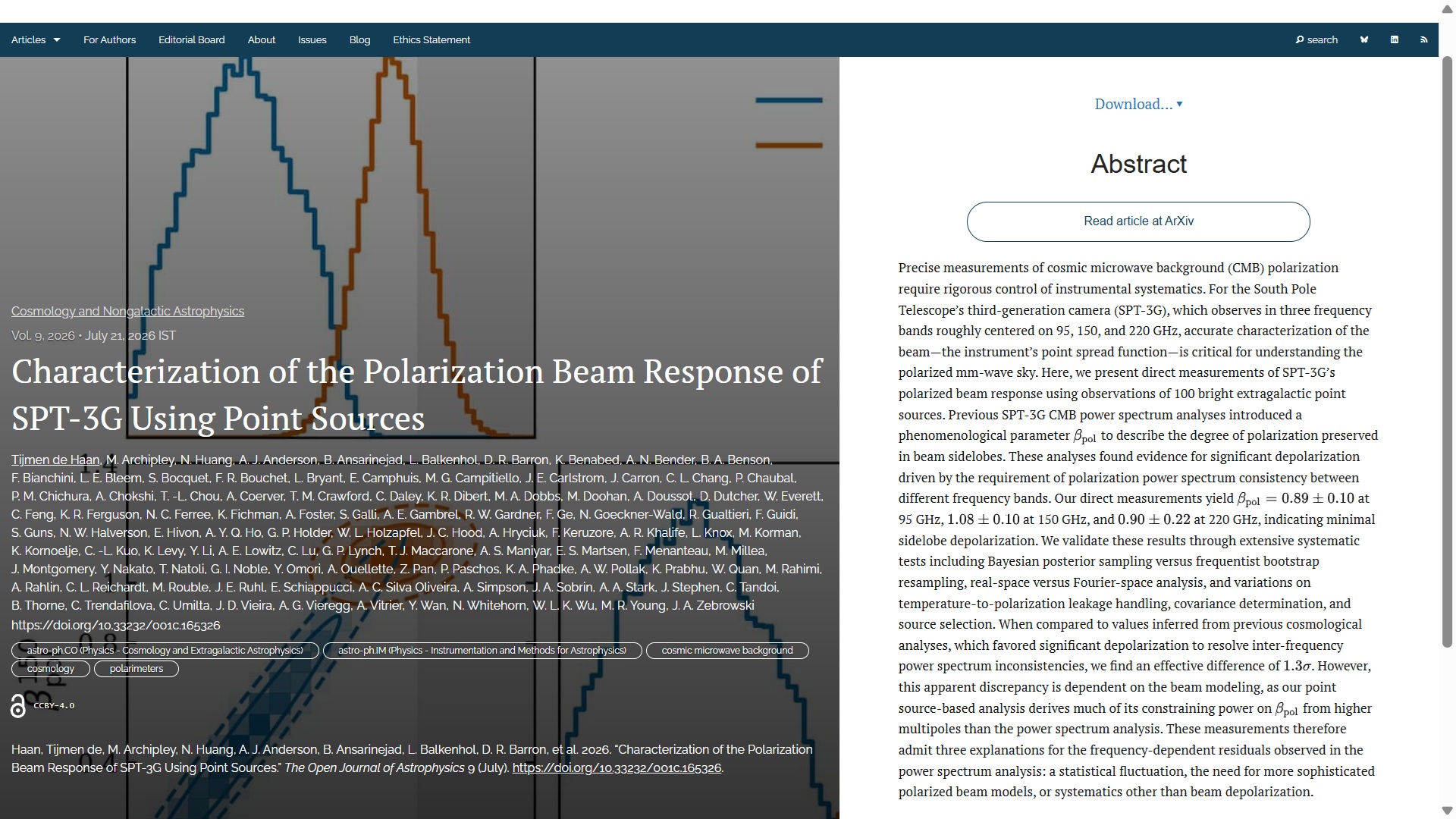
The first paper to report this week was published on Tuesday 21st July in the folder Cosmology and Nongalactic Astrophysics. The title is “Characterization of the Polarization Beam Response of SPT-3G Using Point Sources” by Tijmen de Haan (Institute of Particle and Nuclear Studies, Ibaraki, Japan) and an international cast of 101 others. This study presents measurements of the South Pole Telescope’s polarized beam response, indicating minimal sidelobe depolarization. The findings suggest potential explanations for frequency-dependent residuals in power spectrum analysis.

The overlay for this paper is here
You can find the officially accepted version on arXiv here and the announcement on Fediverse here:

Open Journal of Astrophysics

New Publication at the Open Journal of Astrophysics: "Characterization of the Polarization Beam Response of SPT-3G Using Point Sources" by Tijmen de Haan (Institute of Particle and Nuclear Studies, Ibaraki, Japan) and 101 others from around the world

doi.org/10.33232/001c.165326

July 21, 2026, 7:02 am 1 boosts 1 favorites

The second paper for this week, also published on Tuesday 21st July but in the folder Earth and Planetary Astrophysics is: “Exploring TRAPPIST-1 Climate States with an Energy Balance Model” by Jacob Haqq-Misra (Blue Marble Space, USA). The study uses a modified HEXTOR energy balance model to predict climate states of terrestrial planets orbiting low-mass stars, suggesting partial to complete ice cover for TRAPPIST-1 e and f.Abstractfor Exploring TRAPPIST-1 Climate States with an Energy Balance Model.

The overlay looks like this:
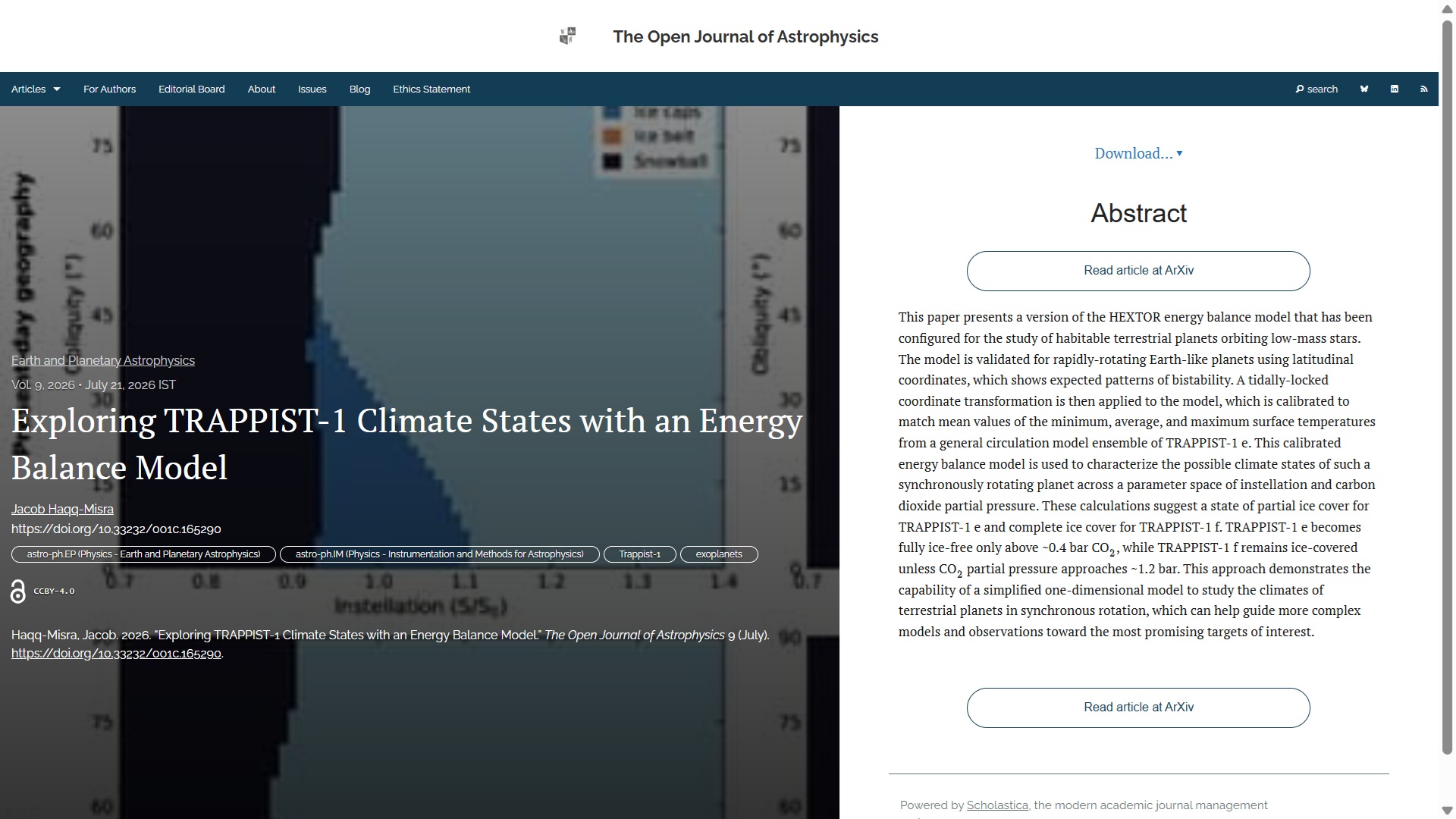
The official version of the paper can be found on arXiv here and the Fediverse announcement here:

Open Journal of Astrophysics

New Publication at the Open Journal of Astrophysics: "Exploring TRAPPIST-1 Climate States with an Energy Balance Model" by Jacob Haqq-Misra (Blue Marble Space, USA)

doi.org/10.33232/001c.165290

July 21, 2026, 7:38 am 2 boosts 1 favorites

The third paper of the week, also published on Tuesday 21st July, but in the folder Astrophysics of Galaxies is “A first systematic study of [OIII] 88μm at z>8: two luminous oxygen lines and a powerful ionized outflow in the first 600 million years” by Hiddo Algera (Institute of Astronomy and Astrophysics, Taipei, Taiwan) and 37 others from all around the world. This paper presents deep observations of four UV-bright, gravitationally lensed galaxies, revealing an ionized outflow in one and highlighting the diagnostic power of [O III]88 μm in studying galaxies in the early Universe.

The overlay for this one is here:
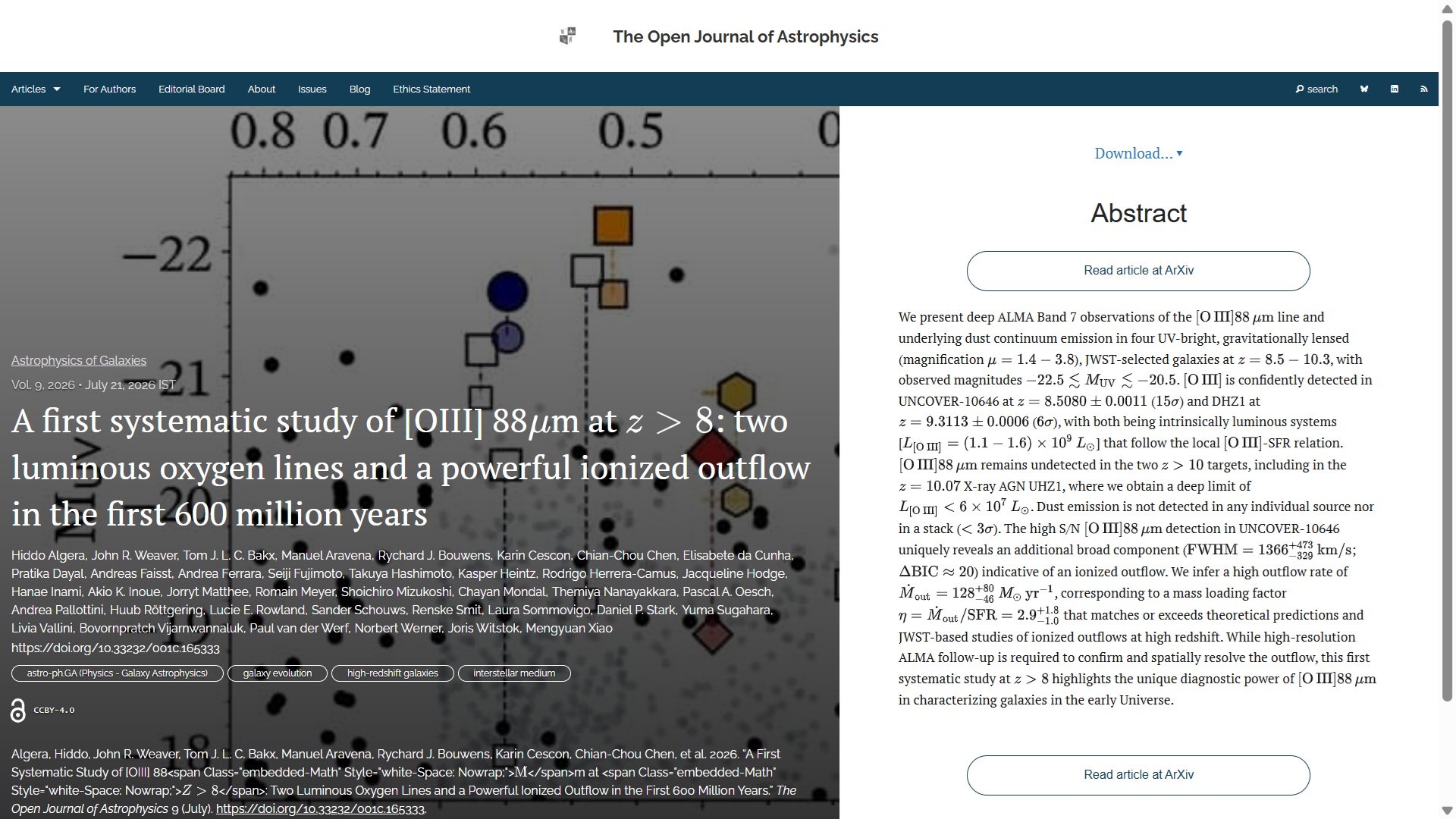
The final, accepted version can be found on arXiv here and the Mastodon announcement is here:

Open Journal of Astrophysics

New Publication at the Open Journal of Astrophysics: "A first systematic study of [OIII] 88μm at z>8: two luminous oxygen lines and a powerful ionized outflow in the first 600 million years" by Hiddo Algera (Institute of Astronomy and Astrophysics, Taipei, Taiwan) and 37 others from all around the world.

doi.org/10.33232/001c.165333

July 21, 2026, 7:52 am 1 boosts 1 favorites

The fourth paper of the week, published on Thursday 23rd July in the folder Astrophysics of Galaxies, is “Mapping CO Ice in a Star-Forming Filament in the 3 kpc Arm with JWST” by Savannah Gramze (U. Florida, USA) and 16 others based all around the world. This paper shows that JWST observations and ALMA Band 3 data reveal that 50-88% of CO gas in a star-forming filament is locked in ice; corrections are needed for mass measurements in such systems.

The overlay for this one is here:
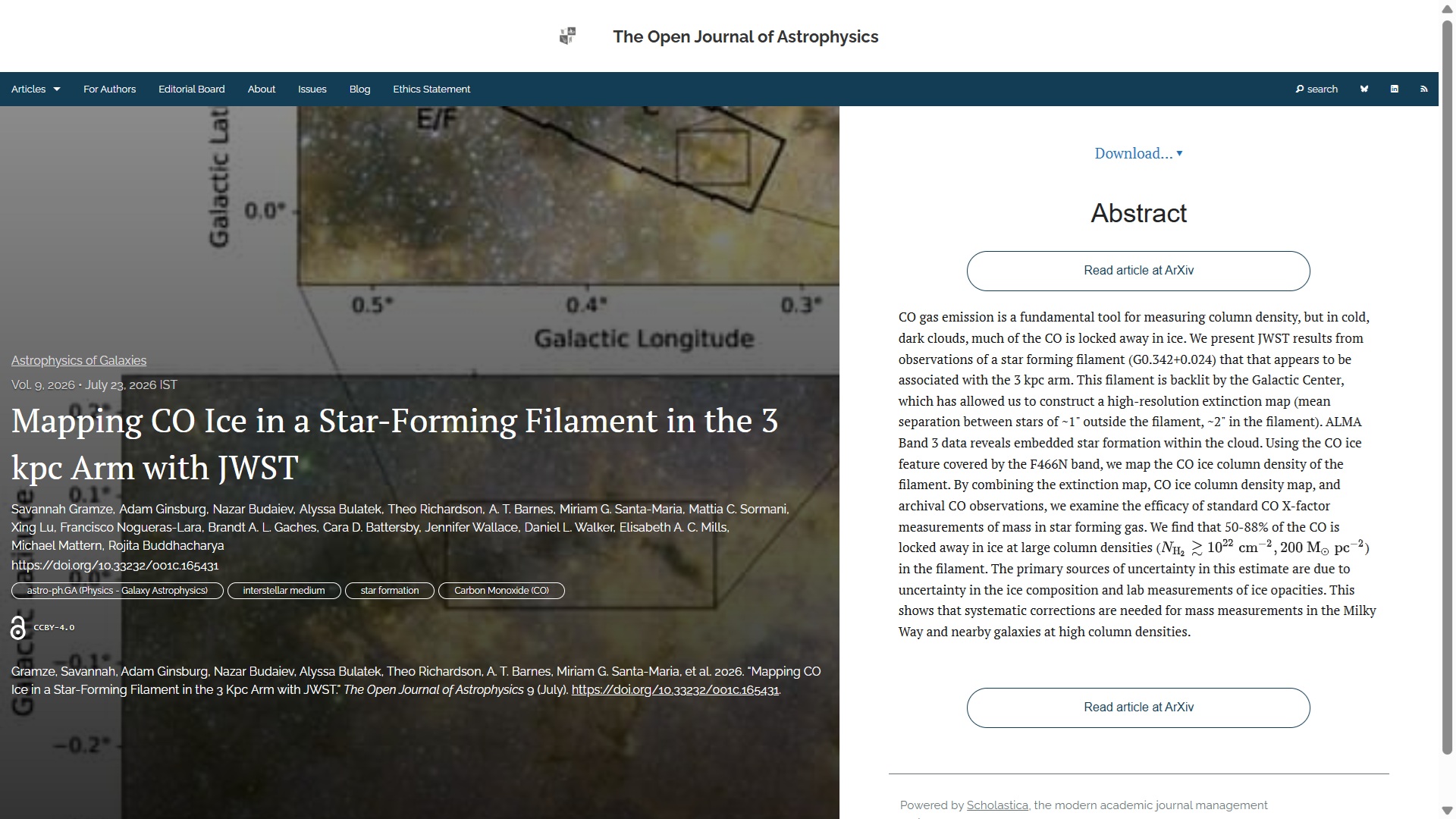
You can read the final version of this one on arXiv here and the Mastodon announcement is here:

Open Journal of Astrophysics

New Publication at the Open Journal of Astrophysics: "Mapping CO Ice in a Star-Forming Filament in the 3 kpc Arm with JWST" by Savannah Gramze (U. Florida, USA) and 16 others based all around the world.

doi.org/10.33232/001c.165431

July 23, 2026, 7:08 am 1 boosts 0 favorites

The fifth paper of the week, also published on Thursday 23rd July but in the folder High-Energy Astrophysical Phenomena, is “Viscously Spreading Accretion Disks around Black Holes: Implications for TDEs, LFBOTs and other Transients“. This article presents a time-dependent model of accretion disks around black holes, explaining late-time emission in tidal disruption events and luminous fast blue optical transients and future detectability of such events.

The overlay for this one is here:
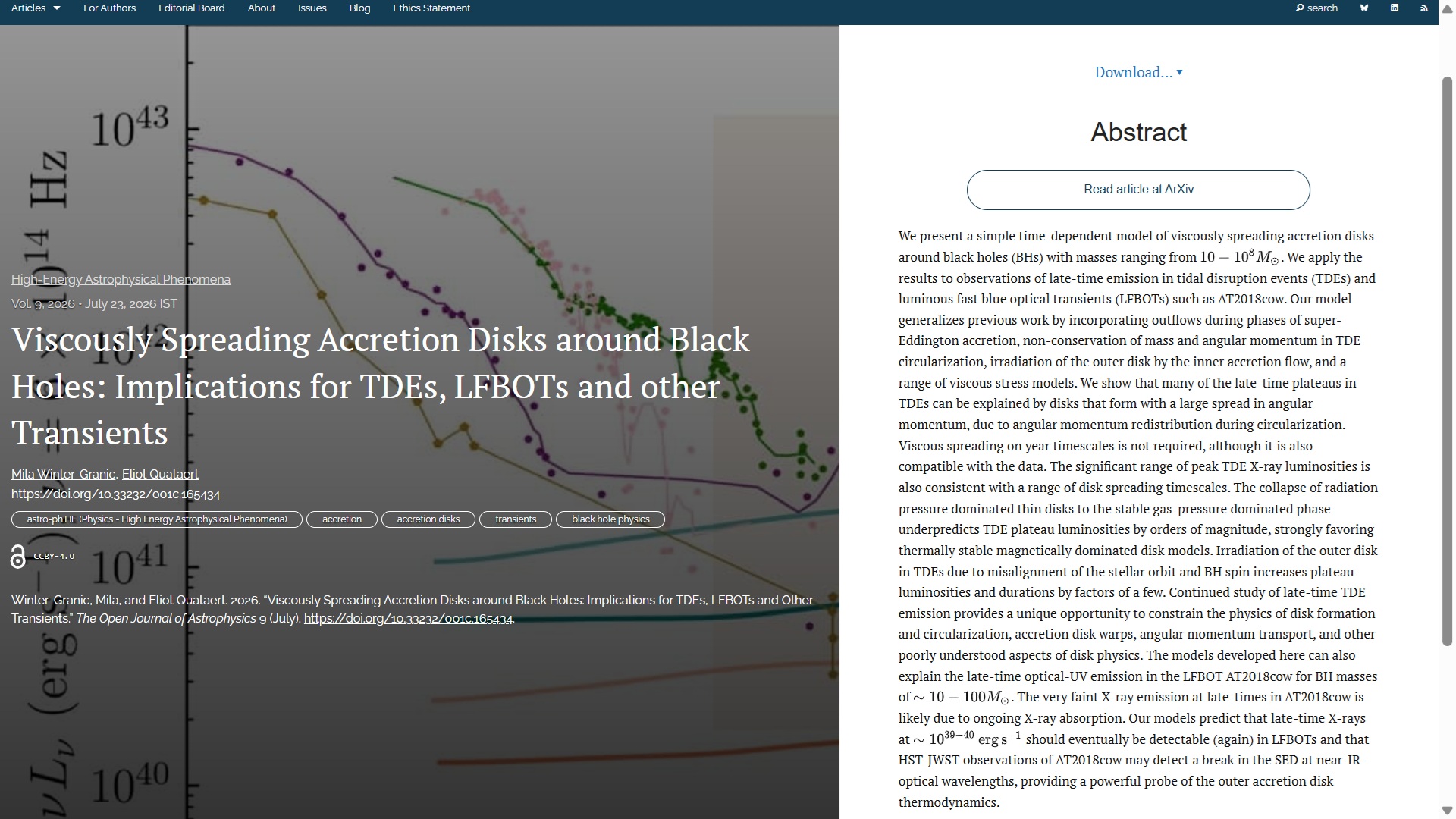
You can read the final version of this one on arXiv here and the Mastodon announcement is here:

Open Journal of Astrophysics

New Publication at the Open Journal of Astrophysics: "Viscously Spreading Accretion Disks around Black Holes: Implications for TDEs, LFBOTs and other Transients" by Mila Winter-Granic and Eliot Quataert (Princeton University, USA)

doi.org/10.33232/001c.165434

July 23, 2026, 7:20 am 1 boosts 0 favorites

The sixth paper of this week is “Characterising the response of an International LOFAR Station” by Letizia Vincetti (Trinity Collge Dublin, Ireland) and 9 others based in Ireland, USA, The Netherlands and Sweden. This was also published on Thursday July 23rd and is in the folder Instrumentation and Methods for Astrophysics. The article presents an investigation of the performance and calibration challenges of phased-array radio interferometers, using the Irish LOFAR station as a case study, highlighting the importance of accurate beam modelling, etc.

The overlay for this one is here:
You can find the final accepted version on arXiv here and the Mastodon announcement is here:

Open Journal of Astrophysics

New Publication at the Open Journal of Astrophysics: "Characterising the response of an International LOFAR Station" by Letizia Vincetti (Trinity Collge Dublin, Ireland) and 9 others based in Ireland, USA, The Netherlands and Sweden

doi.org/10.33232/001c.165435

July 23, 2026, 7:34 am 1 boosts 0 favorites

The seventh paper of this week is “Exo Skryer: A JAX-accelerated sub-stellar atmospheric retrieval framework” by Elspeth K.H. Lee (U. Bern, Switzerland). Published on Friday 24th July in the folder Earth and Planetary Astrophysics, this article introduces “Exo Skryer”, a new, efficient framework for exoplanet and brown dwarf atmospheric research, capable of handling large data sets and complex models.

The overlay for this one is here:
You can find the final accepted version on arXiv here and the Mastodon announcement is here:

Open Journal of Astrophysics

New Publication at the Open Journal of Astrophysics: "Exo Skryer: A JAX-accelerated sub-stellar atmospheric retrieval framework" by Elspeth K.H. Lee (U. Bern, Switzerland)

doi.org/10.33232/001c.165495

July 24, 2026, 8:29 am 0 boosts 1 favorites

The (penultimate) eighth paper of this week is “GCR Spectra Reconstructed with Neutron Monitor Yield Function and Artificial Neural Networks: Comparison of Two Methods” by Stepan A. Siruk (Moscow Engineering Physics Institute MEPhI, Russia) and four others, all based in Russia. Published on Friday 24th July in the folder Instrumentation and Methods for Astrophysics, this article presents a framework using artificial neural networks and neutron monitors to reconstruct cosmic-ray energy spectra, providing data even in the absence of direct satellite observations.

The overlay for this one is here:
You can find the final accepted version on arXiv here and the Mastodon announcement is here:

Open Journal of Astrophysics

New Publication at the Open Journal of Astrophysics: "GCR Spectra Reconstructed with Neutron Monitor Yield Function and Artificial Neural Networks: Comparison of Two Methods" by Stepan A. Siruk (Moscow Engineering Physics Institute MEPhI, Russia) and four others based in Russia

doi.org/10.33232/001c.165496

July 24, 2026, 8:38 am 1 boosts 2 favorites

And finally for this week we have “The failed failed-supernova scenario of M31-2014-DS1” by Noam Soker (Technion, Israel), a paper which challenges the failed-supernova theory for the fading of the yellow supergiant event M31-2014-DS1, suggesting it requires unlikely parameters and supports an alternative scenario involving violent binary interaction. This was published on Friday 24th July in the folder High-Energy Astrophysical Phenomena.

The overlay for this one is here:
You can find the final accepted version on arXiv here and the Mastodon announcement is here:

Open Journal of Astrophysics

New Publication at the Open Journal of Astrophysics: "The failed failed-supernova scenario of M31-2014-DS1" by Noam Soker (Technion, Israel)

doi.org/10.33232/001c.165498

July 24, 2026, 8:47 am 0 boosts 2 favorites

And that concludes the update of this week’s business. As it was foretold, the total number of publications at OJAp has now passed the 600 mark, and the likely number for 2026 is around 300. We published a paper in five of the six astro-ph categories this week, but still haven’t had a week when we’ve published a full house with at least one in all six…
Weekly Update from the Open Journal of Astrophysics 18/07/2026

Posted in OJAp Papers, Open Access, The Universe and Stuff with tags , , , , , , , , , , , , , , , , , , , , , , , , , , , , , , , , , , on July 18, 2026 by telescoper

It’s time once more for another Saturday update of activity at the Open Journal of Astrophysics. Since the last update we have published a further six papers, bringing the number in Volume 9 (2026) to 151 and the total so far published by OJAp up to 599.

I will continue to include the posts made on our Mastodon account (on Fediscience); these announcements also show the DOI for each paper.

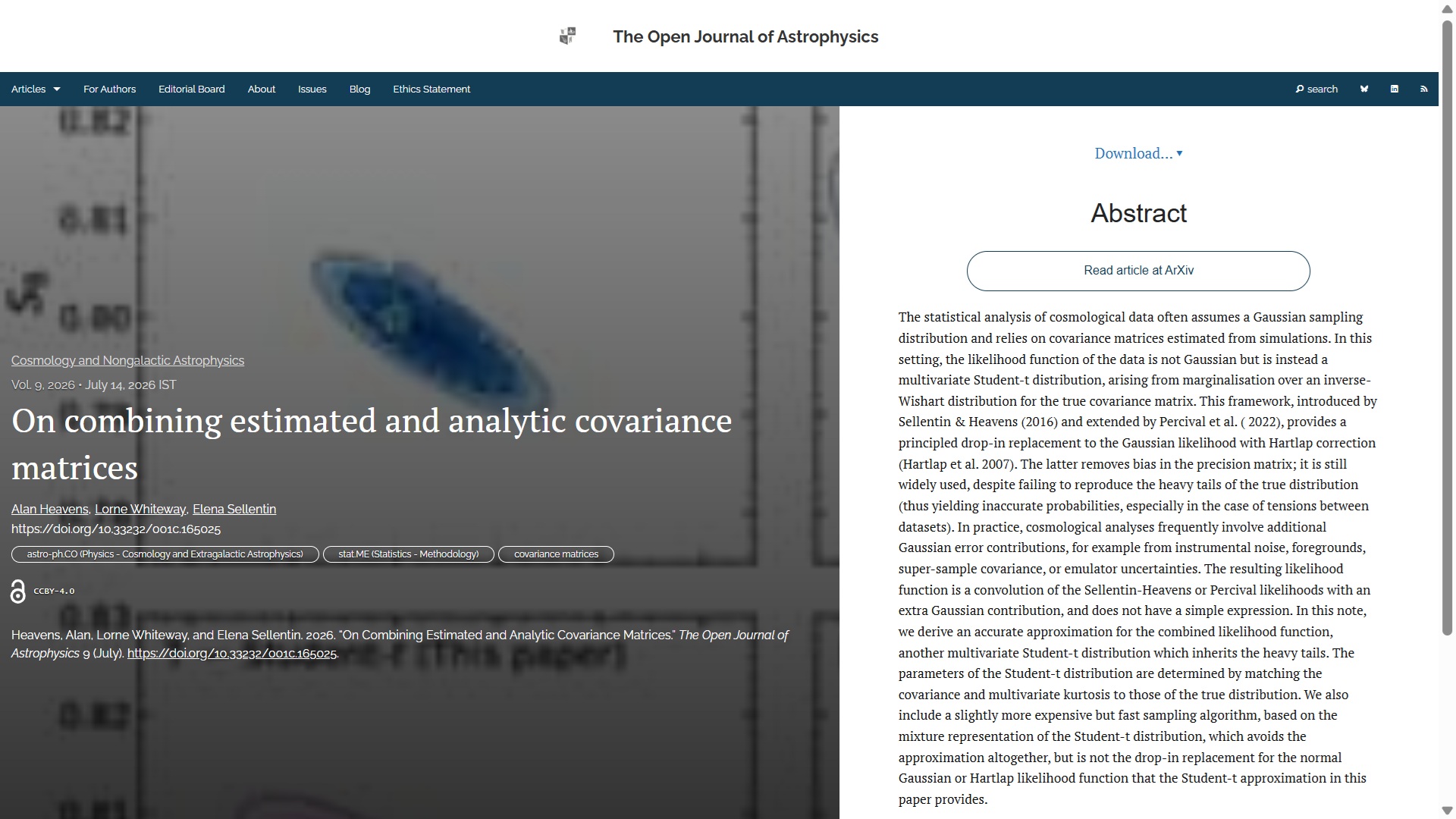
The first paper to report this week, published on Tuesday 14th July, is “On combining estimated and analytic covariance matrices” by Alan Heavens (Imperial College London, UK), Lorne Whiteway (University College, London, UK) and Elena Sellentin (Leiden University, The Netherlands). This article, published in the folder Cosmology and Nongalactic Astrophysics, presents an accurate approximation for the combined likelihood function in cosmological data analysis, improving upon previous methods by better representing the heavy tails of the true distribution.

The overlay for this paper is here

You can find the officially accepted version on arXiv here and the announcement on Fediverse here:

Open Journal of Astrophysics

New Publication at the Open Journal of Astrophysics: "On combining estimated and analytic covariance matrices" by Alan Heavens (Imperial College London, UK), Lorne Whiteway (University College, London, UK) and Elena Sellentin (Leiden University, The Netherlands)

doi.org/10.33232/001c.165025

July 14, 2026, 6:48 am 1 boosts 0 favorites

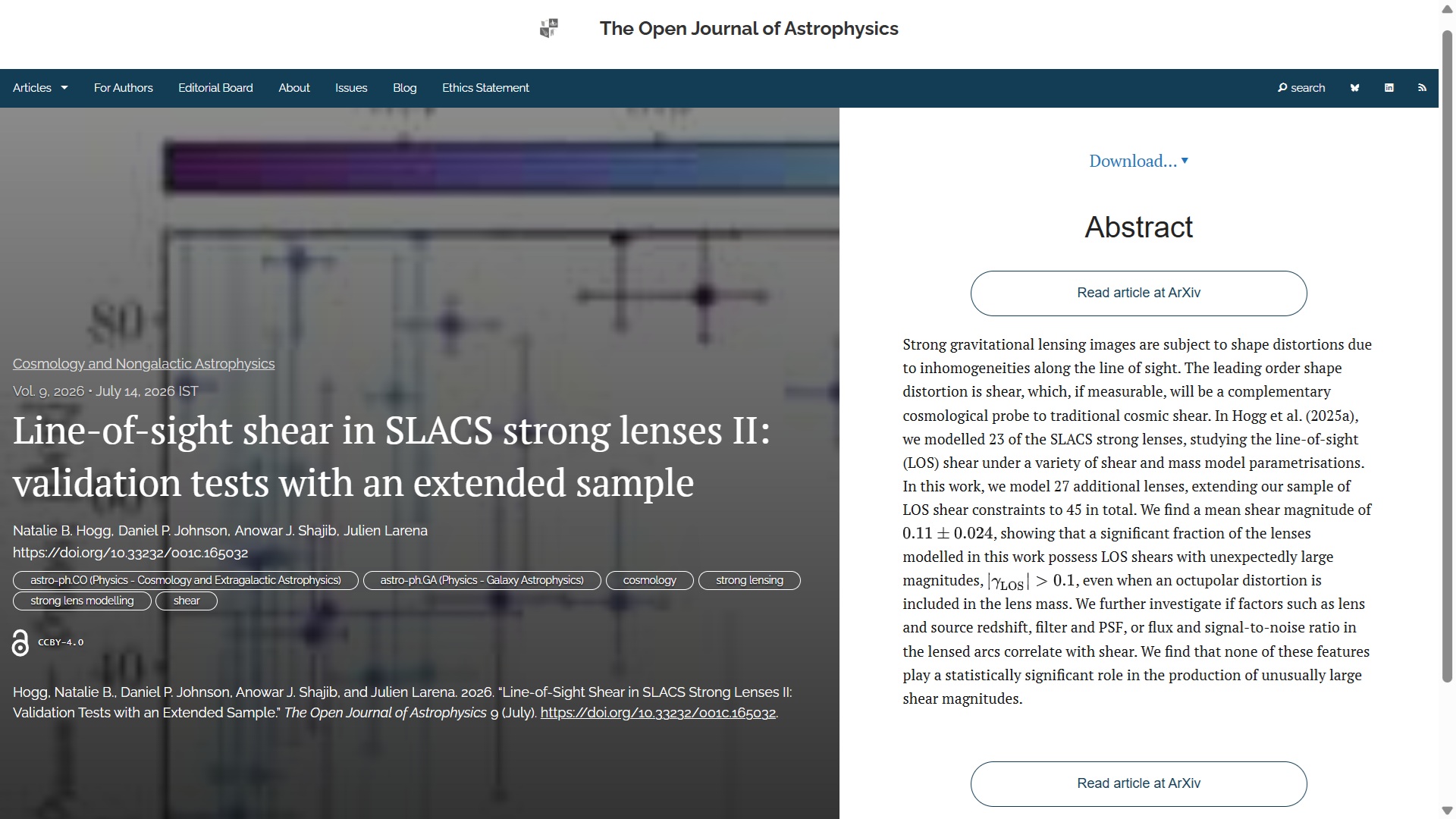
The second paper for this week, also published on Tuesday 14th July in the folder Cosmology and Nongalactic Astrophysics is: “Line-of-sight shear in SLACS strong lenses II: validation tests with an extended sample” by Natalie B. Hogg (U. Cambridge, UK), Daniel P. Johnson (Université de Montpellier, France), Anowar J. Shajib (U. Chicago, USA) and Julien Larena (Montpellier). The study described in this paper models 27 additional gravitational lenses, finding a significant fraction with unexpectedly large line-of-sight shears. Factors like redshift, filter, and signal-to-noise ratio don’t significantly affect shear magnitudes.

The overlay looks like this:

The official version of the paper can be found on arXiv here and the Fediverse announcement here:

Open Journal of Astrophysics

New Publication at the Open Journal of Astrophysics: "Line-of-sight shear in SLACS strong lenses II: validation tests with an extended sample" by Natalie B. Hogg (U. Cambridge, UK), Daniel P. Johnson (Université de Montpellier, France), Anowar J. Shajib (U. Chicago, USA) and Julien Larena (Montpellier)

doi.org/10.33232/001c.165032

July 14, 2026, 6:57 am 1 boosts 1 favorites

The third paper of the week, published on Wednesday 15th July, again in the folder Cosmology and Nongalactic AstrophysicsInvestigating the Dark Energy Constraint from Strongly Lensed AGN at LSST-Scale” by Sydney Erickson (Stanford University, USA) and 13 others on behalf of The LSST Dark Energy Science Collaboration. The study uses a new technique to analyze a large sample of lensed Active Galactic Nuclei, providing an independent probe of dark energy and improving constraints on the Universe’s expansion.

The overlay for this one is here:

The final, accepted version can be found on arXiv here and the Mastodon announcement is here:

Open Journal of Astrophysics

New Publication at the Open Journal of Astrophysics: "Investigating the Dark Energy Constraint from Strongly Lensed AGN at LSST-Scale" by Sydney Erickson (Stanford University, USA) and 13 others on behalf of The LSST Dark Energy Science Collaboration

doi.org/10.33232/001c.164440

July 15, 2026, 7:08 am 1 boosts 1 favorites

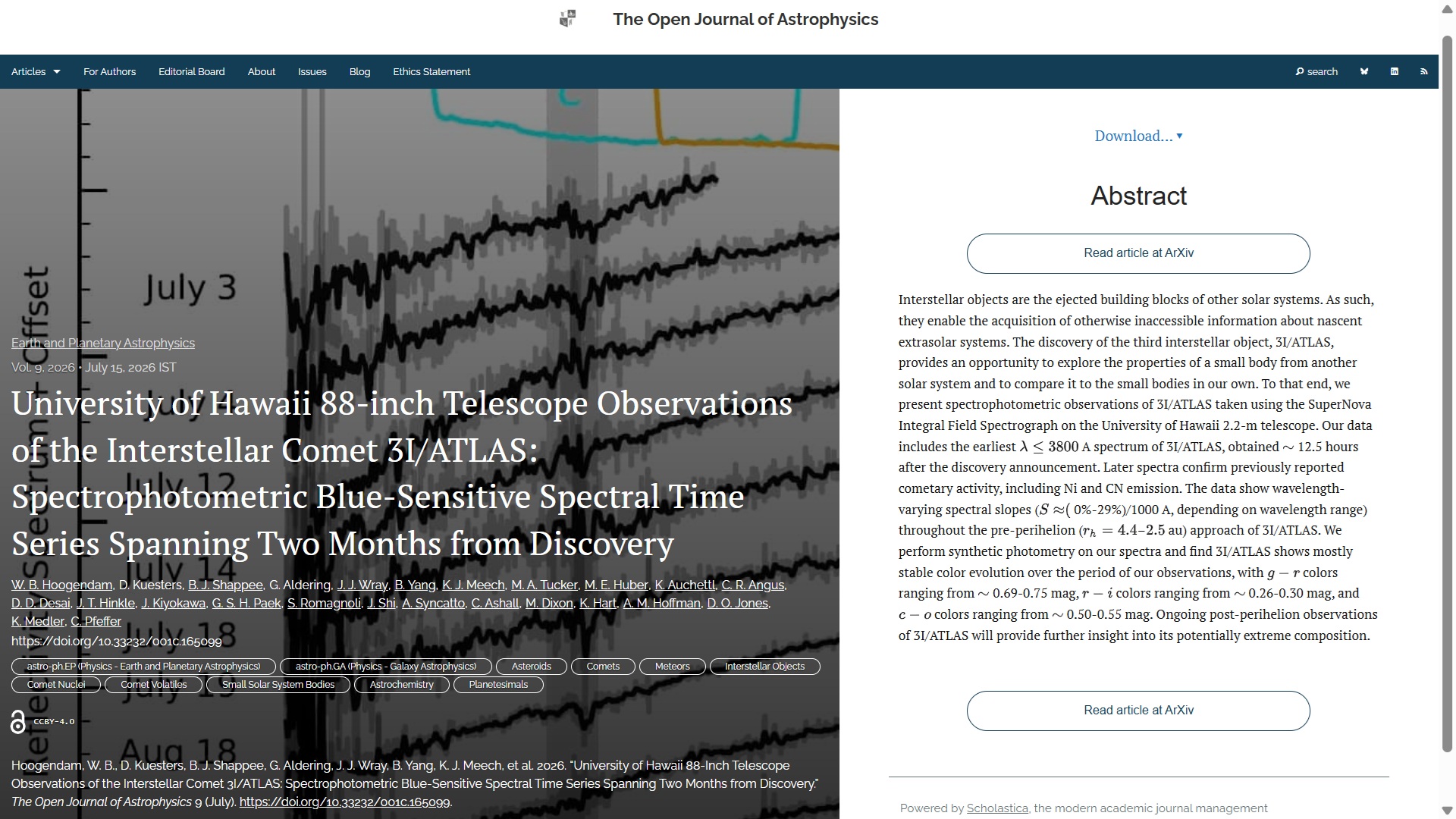
The fourth paper of the week, also published on Wednesday 15th July but in the folder Earth and Planetary Astrophysics is “University of Hawaii 88-inch Telescope Observations of the Interstellar Comet 3I/ATLAS: Spectrophotometric Blue-Sensitive Spectral Time Series Spanning Two Months from Discovery” by W. B. Hoogendam (University of Hawaii, USA) and 24 others from around the world. The study presents observations of the third interstellar object, 3I/ATLAS, using the SuperNova Integral Field Spectrograph, revealing its properties and comparing it to bodies in our solar system.

The overlay for this one is here:

You can read the final version of this one on arXiv here and the Mastodon announcement is here:

Open Journal of Astrophysics

New Publication at the Open Journal of Astrophysics: "University of Hawaii 88-inch Telescope Observations of the Interstellar Comet 3I/ATLAS: Spectrophotometric Blue-Sensitive Spectral Time Series Spanning Two Months from Discovery" by W. B. Hoogendam (University of Hawaii, USA) and 24 others from around the world.

doi.org/10.33232/001c.165099

July 15, 2026, 7:21 pm 1 boosts 3 favorites

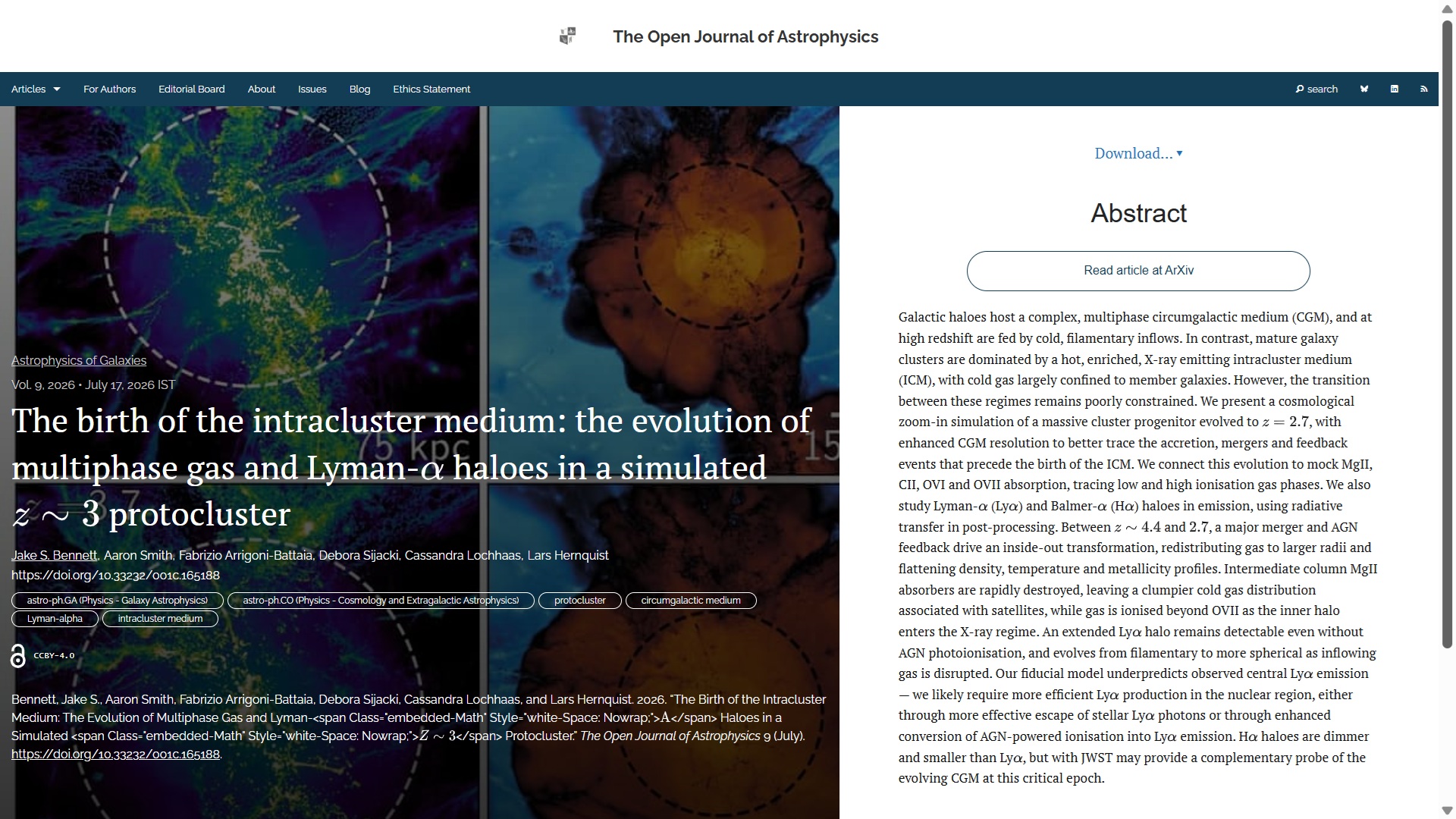
The fifth paper of the week, published on Friday 17th July in the folder Astrophysics of Galaxies, is “The birth of the intracluster medium: the evolution of multiphase gas and Lyman-α haloes in a z~3 simulated protocluster” by Jake S. Bennett (Harvard Smithsonian CfA, USA), Aaron Smith (U. Nottingham, UK), Fabrizio Arrigoni-Battaia (MPA Garching, Germany), Debora Sijacki (U. Cambridge, UK) , Cassandra Lochhaas (CfA) and Lars Hernquist (CfA). This study uses a cosmological simulation to explore the transition from complex galactic haloes to mature galaxy clusters, focusing on gas distribution, ionisation, and emission changes during this evolution.

The overlay for this one is here:

You can read the final version of this one on arXiv here and the Mastodon announcement is here:

Open Journal of Astrophysics

New Publication at the Open Journal of Astrophysics: "The birth of the intracluster medium: the evolution of multiphase gas and Lyman-α haloes in a z~3 simulated protocluster" by Jake S. Bennett (Harvard Smithsonian CfA, USA), Aaron Smith (U. Nottingham, UK), Fabrizio Arrigoni-Battaia (MPA Garching, Germany), Debora Sijacki (U. Cambridge, UK) , Cassandra Lochhaas (CfA) and Lars Hernquist (CfA).

doi.org/10.33232/001c.165188

July 17, 2026, 7:23 am 0 boosts 0 favorites

The sixth and final paper of this week is “Density reconstruction from biased tracers: Testing the equivalence principle through consistency relations” by Lawrence Dam and Omar Darwish (Université de Genève, Switzerland). This was published on Friday 17th July in the folder Cosmology and Nongalactic Astrophysics. It proposes using quadratic estimators to test the weak equivalence principle on cosmological scales, offering a practical alternative to the conventional bispectrum approach.

The overlay for this one is here:

You can find the final accepted version on arXiv here and the Mastodon announcement is here:

Open Journal of Astrophysics

New Publication at the Open Journal of Astrophysics: "Density reconstruction from biased tracers: Testing the equivalence principle through consistency relations" by Lawrence Dam and Omar Darwish (Université de Genève, Switzerland)

doi.org/10.33232/001c.165214

July 17, 2026, 7:42 am 0 boosts 0 favorites

As you can see we have now published over 150 papers this year and are just one shy of 600 in total. I expect we’ll pass that milestone next week. I’ll do another update next Saturday.

Weekly Update from the Open Journal of Astrophysics 11/07/2026

Posted in OJAp Papers, Open Access, The Universe and Stuff with tags , , , , , , , , , , , , , , , , , , , , , , , , , , , , , , , , , , , , , on July 11, 2026 by telescoper

Back home to Maynooth, just in time for another Saturday update of activity at the Open Journal of Astrophysics. Since the last update we have published a further nine papers, bringing the number in Volume 9 (2026) to 145 and the total so far published by OJAp up to 593.

I will continue to include the posts made on our Mastodon account (on Fediscience); these announcements also show the DOI for each paper.

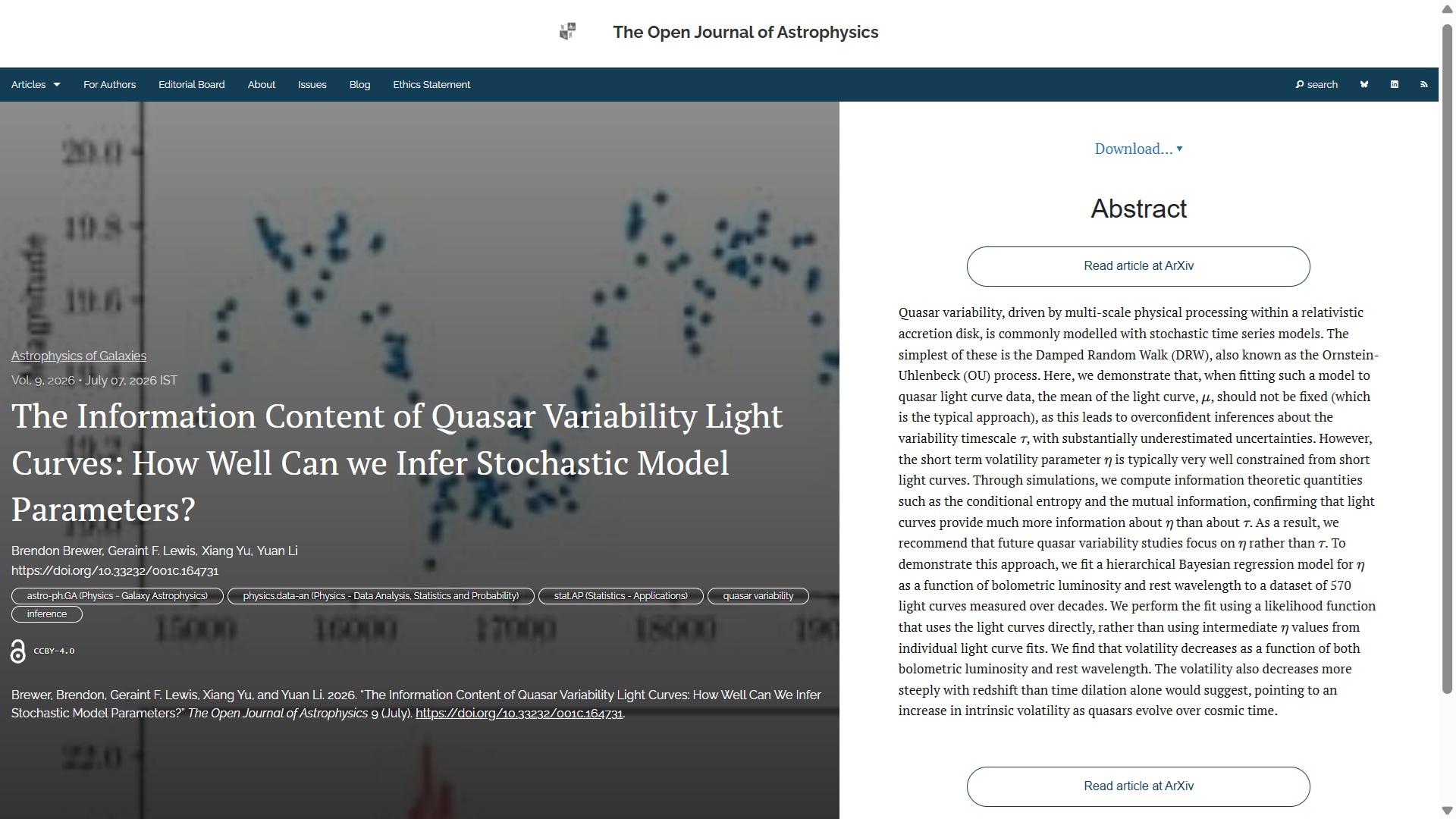
The first paper to report this week, published on Tuesday 7th July, is “The Information Content of Quasar Variability Light Curves: How Well Can we Infer Stochastic Model Parameters?” by Brendon Brewer (U. Auckland, NZ), Geraint F. Lewis (U. Sydney, AU), Xiang Yu & Yuan Li (Auckland). Published in the folder Astrophysics of Galaxies, this study suggests that quasar variability studies should focus on the short term volatility parameter, as it’s more informative than the variability timescale. Volatility decreases with redshift suggesting intrinsic effects.

The overlay for this paper is here

You can find the officially accepted version on arXiv here and the announcement on Fediverse here:

Open Journal of Astrophysics

New Publication at the Open Journal of Astrophysics: "The Information Content of Quasar Variability Light Curves: How Well Can we Infer Stochastic Model Parameters?" by Brendon Brewer (U. Auckland, NZ), Geraint F. Lewis (U. Sydney, AU), Xiang Yu & Yuan Li (Auckland)

doi.org/10.33232/001c.164731

July 7, 2026, 5:48 am 0 boosts 2 favorites

The second paper for this week, also published on Tuesday 7th July, but in the folder High-Energy Astrophysical Phenomena, is “Cygnus X-3 as a PeVatron and the LHAASO 2025 data” by Michael Kachelriess & E. Lammert (NTNU, Trondheim, Norway). This paper suggests that the high-mass X-ray binary Cygnus X-3 can accelerate cosmic rays beyond PeV energies, contributing to a photon flux peaking around PeV energies.

The overlay looks like this:

The official version of the paper can be found on arXiv here and the Fediverse announcement here:

Open Journal of Astrophysics

New Publication at the Open Journal of Astrophysics: "Cygnus X-3 as a PeVatron and the LHAASO 2025 data" by Michael Kachelriess & E. Lammert (NTNU, Trondheim, Norway)

doi.org/10.33232/001c.164520

July 7, 2026, 6:52 am 0 boosts 0 favorites

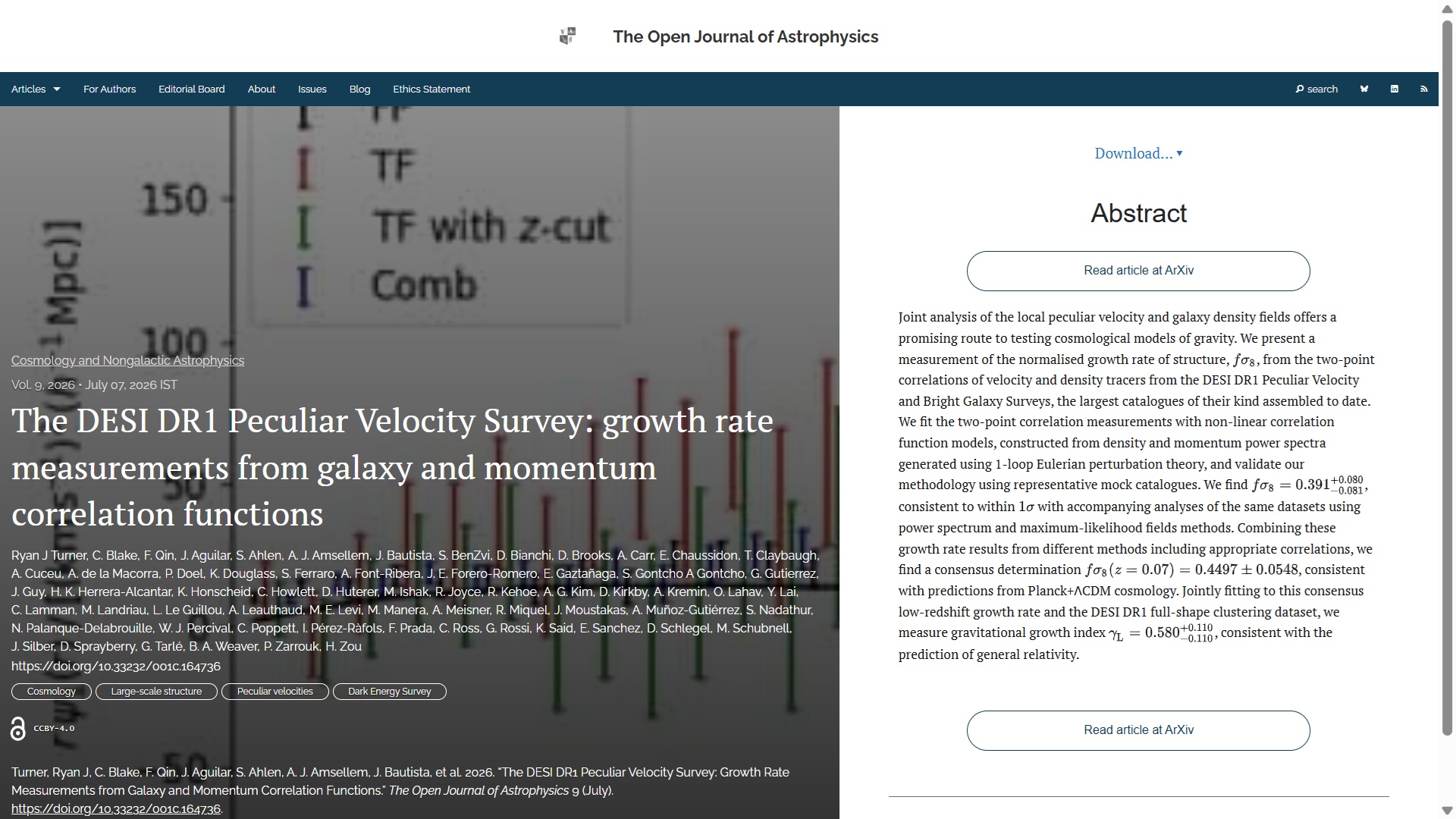
The third paper of the week, also published on Tuesday 7th July, but in the folder Cosmology and Nongalactic Astrophysics is “The DESI DR1 Peculiar Velocity Survey: growth rate measurements from galaxy and momentum correlation functions” by Ryan J Turner (Swinburne Institute of Technology, Australia) and 63 others from around the world. This paper analyzes local peculiar velocity and galaxy density fields to test cosmological models of gravity, finding results consistent with predictions from Planck+ΛCDM cosmology and general relativity.

The overlay for this one is here:

The final, accepted version can be found on arXiv here and the Mastodon announcement is here:

Open Journal of Astrophysics

New Publication at the Open Journal of Astrophysics: "The DESI DR1 Peculiar Velocity Survey: growth rate measurements from galaxy and momentum correlation functions" by Ryan J Turner (Swinburne Institute of Technology, Australia) and 63 others from around the world.

doi.org/10.33232/001c.164736

July 7, 2026, 7:51 am 0 boosts 0 favorites

The fourth paper of the week, published on Wednesday 8th July in the folder Instrumentation and Methods for Astrophysics , is “Morphological Fingerprints of Forbush Decreases and Their Relation to Geomagnetic Storm Severity” by Juan Diego Perez Navarro and David Sierra Porta (Universidad Tecnológica de Bolívar, Colombia). This article introduces a graph-based method to analyze Forbush decreases (FDs), transient depressions in cosmic-ray flux, and uses network signatures to predict geomagnetic storm intensity.

The overlay for this one is here:

You can read the final version of this one on arXiv here and the Mastodon announcement is here:

Open Journal of Astrophysics

New Publication at the Open Journal of Astrophysics: "On the effective spin-mass ratio relation of binary black hole mergers that evolved in isolation" by Sambaran Banerjee (Helmholtz-Instituts für Strahlen und Kernphysik, Germany) and Aleksandra Olejak (MPA Garching, Germany)

doi.org/10.33232/001c.164325

June 30, 2026, 7:16 am 1 boosts 1 favorites

The fifth paper of the week, also published on Wednesday 8th July but in the folder Astrophysics of Galaxies, is “On the connection between galaxy orientation and halo absorption properties” by Rohan Venkat, Soo May Wee, and Hsiao-Wen Chen (U. Chicago, USA). This article investigates the azimuthal dependence of metal-line absorption in the circumgalactic medium of 87 isolated galaxies. The results show no significant correlation between absorption strength and azimuthal angle.

The overlay for this one is here:

You can read the final version of this one on arXiv here and the Mastodon announcement is here:

The sixth paper of this week is “Searching for Periodicity in FRB 20240114A” by Jonathan I Katz (Washington U., USA). This was published on Thursday 9th July in the folder High-Energy Astrophysical Phenomena. The study described in this paper observed FRB 20240114A, an active Fast Radio Burst, but found no significant periodicity in its bursts, contradicting magnetar models predictions.

The overlay for this one is here:

You can find the final accepted version on arXiv here and the Mastodon announcement is here:

Open Journal of Astrophysics

New Publication at the Open Journal of Astrophysics: "Searching for Periodicity in FRB 20240114A" by Jonathan I Katz (Washington U., USA)

doi.org/10.33232/001c.164830

July 9, 2026, 5:27 am 1 boosts 0 favorites

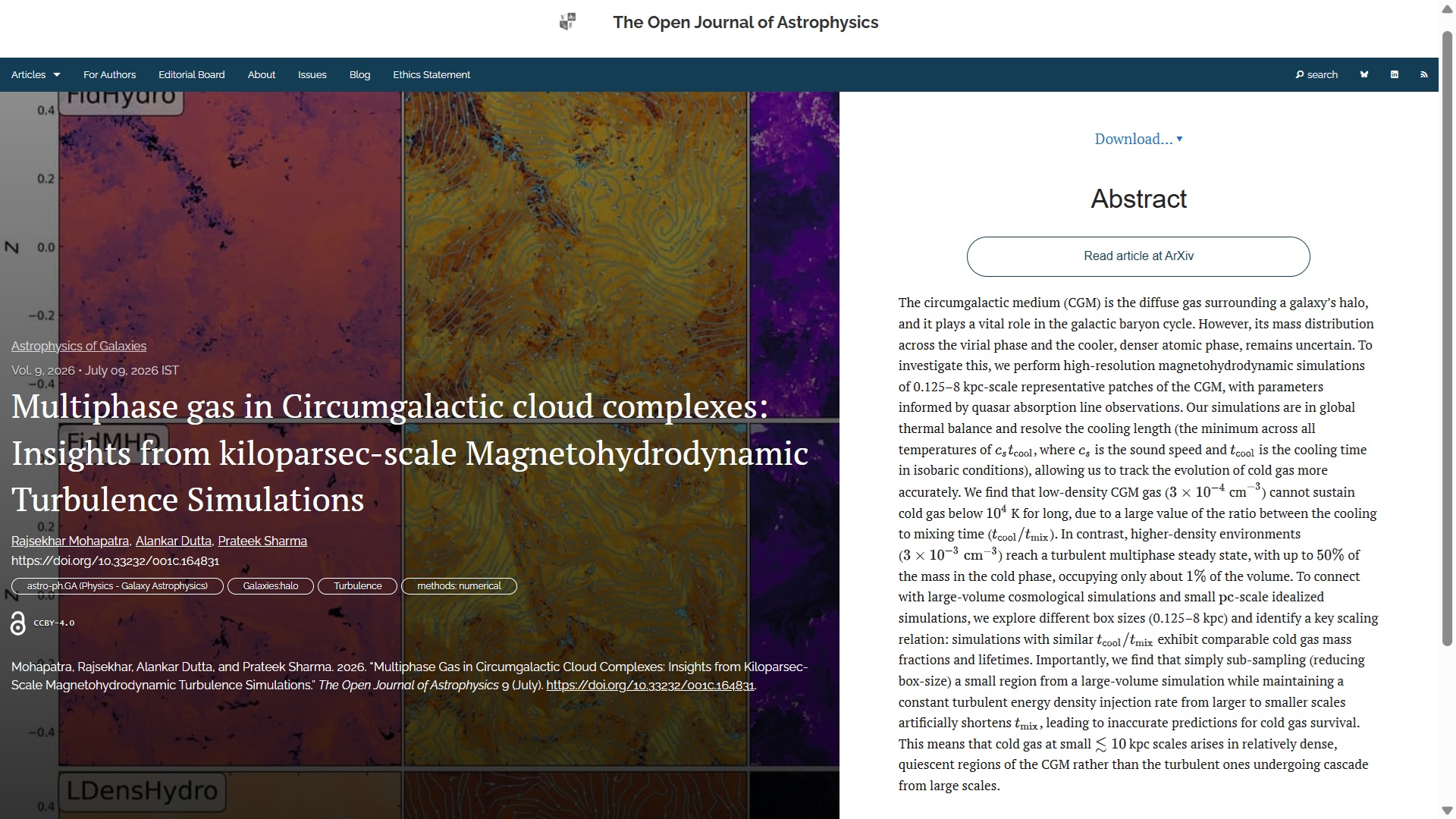
The seventh article for this week is “Multiphase gas in Circumgalactic cloud complexes: Insights from kiloparsec-scale Magnetohydrodynamic Turbulence Simulations” by Rajsekhar Mohapatra (Princeton U., USA), Alankar Dutta (MPA Garching, Germany) and Prateek Sharma (Indian Institute of Science, Bangalore). This -paper was also published on Thursday 9th July, in the folder Astrophysics of Galaxies. This paper uses high-resolution simulations to investigate the mass distribution of the circumgalactic medium (CGM), a diffuse gas surrounding a galaxy’s halo with small-scale clumps of cold gas forming in quiescent regions.

The overlay for this one is here:

You can find the final accepted version of this one on arXiv here and the Mastodon announcement is here:

Open Journal of Astrophysics

New Publication at the Open Journal of Astrophysics: "Multiphase gas in Circumgalactic cloud complexes: Insights from kiloparsec-scale Magnetohydrodynamic Turbulence Simulations" by Rajsekhar Mohapatra (Princeton U., USA), Alankar Dutta (MPA Garching, Germany) and Prateek Sharma (Indian Institute of Science, Bangalore)

doi.org/10.33232/001c.164831

July 9, 2026, 5:43 am 1 boosts 0 favorites

The (penultimate) eighth article for this week is “Line-of-sight shear in SLACS strong lenses I: shear and mass model parametrisations” by Natalie B. Hogg (U. Cambridge, UK), Daniel Johnson (U. Montpellier, France), Anowar J. Shajib (U. Chicago, USA) and Julien Larena (Montpellier). This was also published on Thursday 9th July, but in the folder Cosmology and Nongalactic Astrophysics. This article studies models of 23 strong gravitational lenses to measure line-of-sight shear for the first time, providing potential new constraints on cosmological parameters.

The overlay for this one is here:

You can find the final accepted version on arXiv here and the Mastodon announcement is here:

Open Journal of Astrophysics

New Publication at the Open Journal of Astrophysics: "Line-of-sight shear in SLACS strong lenses I: shear and mass model parametrisations" by Natalie B. Hogg (U. Cambridge, UK), Daniel Johnson (U. Montpellier, France), Anowar J. Shajib (U. Chicago, USA) and Julien Larena (Montpellier)

doi.org/10.33232/001c.164832

July 9, 2026, 6:33 am 1 boosts 1 favorites

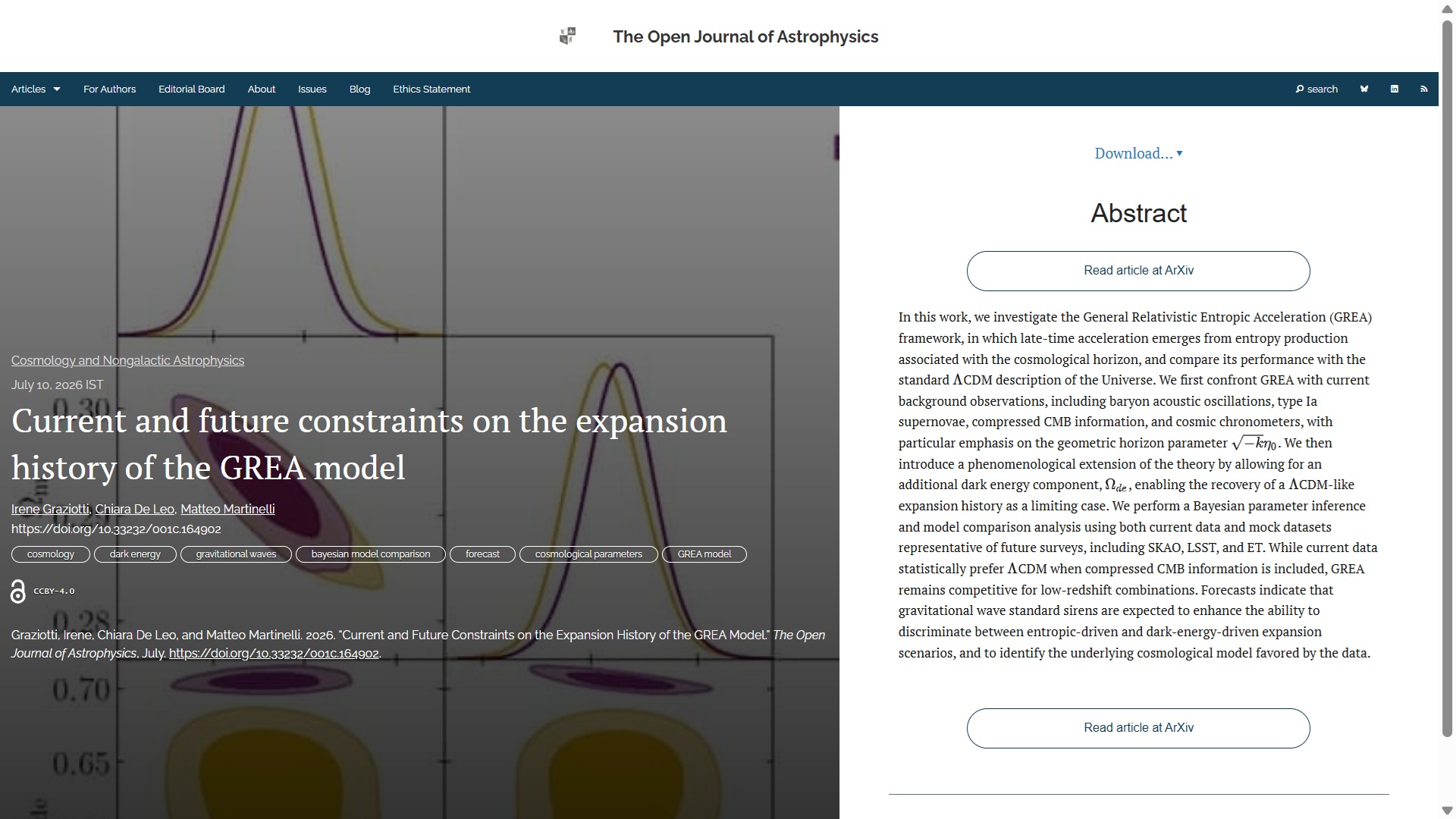
The ninth and last article for this week is “Current and future constraints on the expansion history of the GREA model” by Irene Graziotti (INAF-Osservatorio Astronomico di Capodimonte, Italy), Chiara De Leo (Sapienza University of Rome, Italy) and Matteo Martinelli (INAF-Osservatorio Astronomico di Roma, Italy). This study explores the General Relativistic Entropic Acceleration (GREA) framework, comparing it to the standard description of the universe. Current data favors the standard model, but GREA remains competitive.

The overlay for this one is here:

You can find the officially-accepted version on arXiv here and the Mastodon announcement here:

Open Journal of Astrophysics

New Publication at the Open Journal of Astrophysics: "Current and future constraints on the expansion history of the GREA model" by Irene Graziotti (INAF-Osservatorio Astronomico di Capodimonte, Italy), Chiara De Leo (Sapienza University of Rome, Italy) and Matteo Martinelli (INAF-Osservatorio Astronomico di Roma, Italy)

doi.org/10.33232/001c.164902

July 10, 2026, 5:41 am 1 boosts 0 favorites

As you can see, it has been a bumper week, especially when you consider that there was no arXiv mailing om Monday July 6th owing to the July 4th holiday in the USA. I should have known this would happen while I was travelling!

Weekly Update from the Open Journal of Astrophysics 04/07/2026

Posted in OJAp Papers, Open Access, The Universe and Stuff with tags , , , , , , , , , , , , , , , , , , , , , , , , , , , , , , on July 4, 2026 by telescoper

It’s Saturday again so it’s time for another update of activity at the Open Journal of Astrophysics. Since the last update we have published a further seven papers, bringing the number in Volume 9 (2026) to 136 and the total so far published by OJAp up to 584.

I will continue to include the posts made on our Mastodon account (on Fediscience); these announcements also show the DOI for each paper.

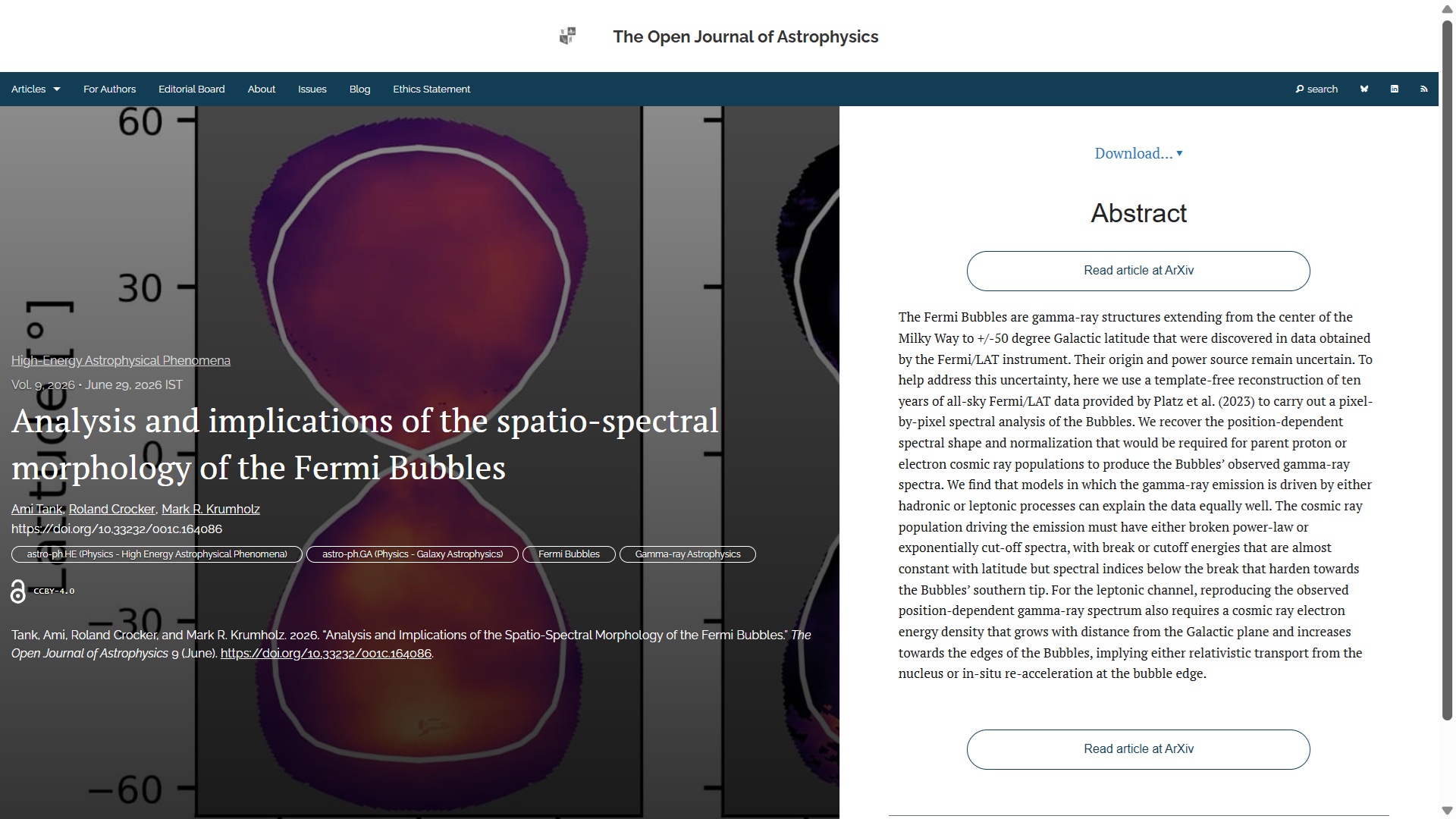
The first paper to report this week, published on Monday 29th June, is “Analysis and implications of the spatio-spectral morphology of the Fermi Bubbles” by Ami Tank (Indian Institute of Technology) and Roland Crocker & Mark R. Krumholz (Australian National University). Published in the folder High-Energy Astrophysical Phenomena, this paper presents an analysis of the gamma-ray structures of Fermi Bubbles in the Milky Way using a decade of data. The research suggests either hadronic or leptonic processes can explain the data.

The overlay for this paper is here

You can find the officially accepted version on arXiv here and the announcement on Fediverse here:

Open Journal of Astrophysics

New Publication at the Open Journal of Astrophysics: "Analysis and implications of the spatio-spectral morphology of the Fermi Bubbles" by Ami Tank (Indian Institute of Technology) and Roland Crocker & Mark R. Krumholz (Australian National University)

doi.org/10.33232/001c.164086

June 29, 2026, 5:30 am 1 boosts 2 favorites

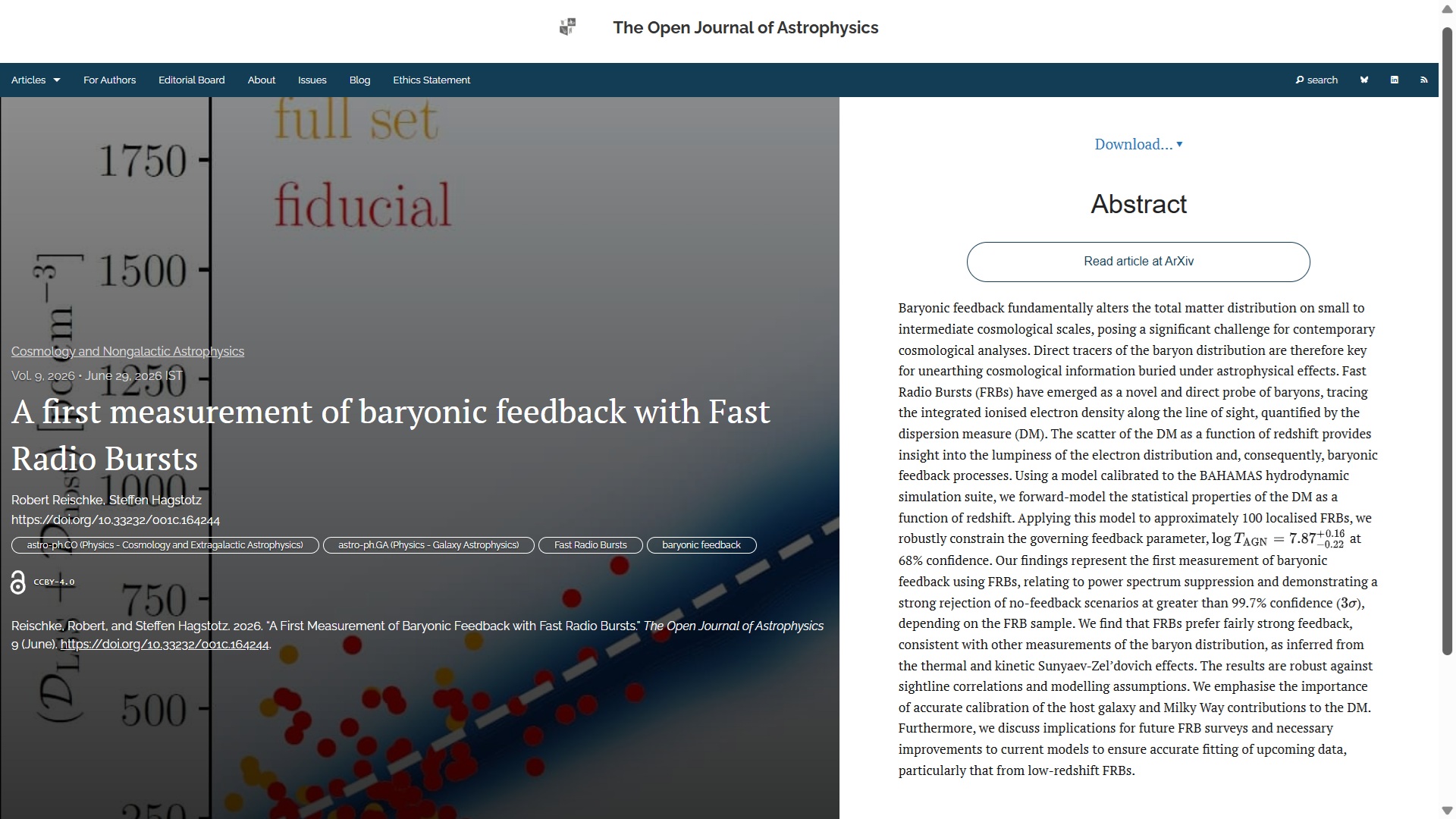
The second paper for this week, also published on Monday 29th June, but in the folder Cosmology and Nongalactic Astrophysics, is “A first measurement of baryonic feedback with Fast Radio Bursts” by Robert Reischke (Universität Bonn, Germany) and Steffen Hagstotz (Ludwig-Maximilians Universität München, Germany). This paper argues that Fast Radio Bursts (FRBs) provide a new method to trace baryon distribution and feedback in the cosmos, offering insights into matter distribution and rejecting no-feedback scenarios with high confidence.

The overlay looks like this:

The official version of the paper can be found on arXiv here and the Fediverse announcement here:

Open Journal of Astrophysics

New Publication at the Open Journal of Astrophysics: "A first measurement of baryonic feedback with Fast Radio Bursts" by Robert Reischke (Universität Bonn, Germany) and Steffen Hagstotz (Ludwig-Maximilians Universität München, Germany)

doi.org/10.33232/001c.164244

June 29, 2026, 5:50 am 2 boosts 2 favorites

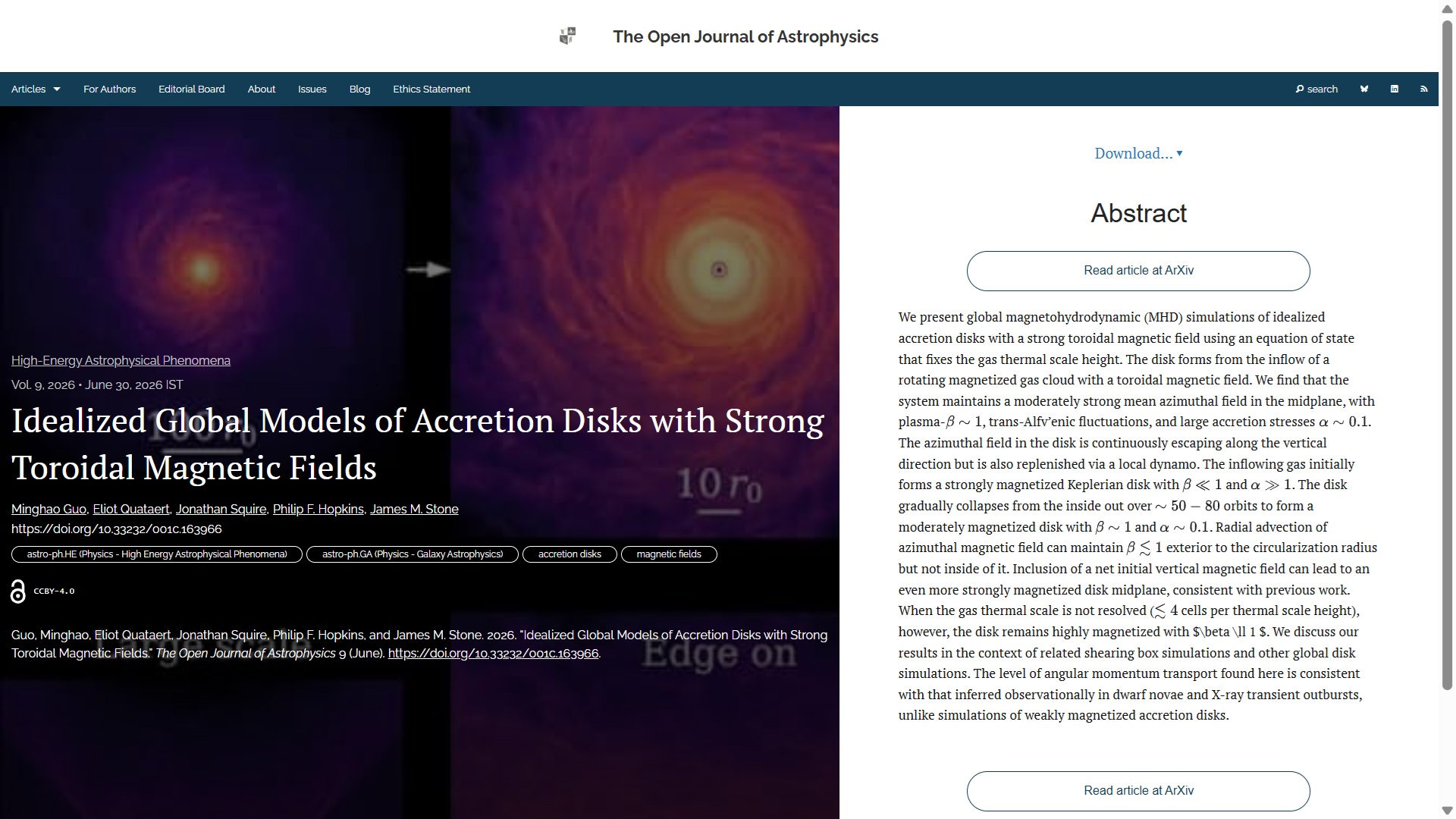
The third paper of the week, published on Tuesday 30th June in the folder High-Energy Astrophysical Phenomena, is “Idealized Global Models of Accretion Disks with Strong Toroidal Magnetic Fields” by Minghao Guo & Eliot Quataert (Princeton U., USA), Jonathan Squire (U. Otago, NZ), Philip F. Hopkins (Caltech, USA) and James M. Stone (Princeton). This study uses global magnetohydrodynamic simulations to explore the behavior of idealized accretion disks with strong toroidal magnetic fields, finding that these systems maintain a moderately strong mean azimuthal field.

The overlay for this one is here:

The final, accepted version can be found on arXiv here and the Mastodon announcement is here:

Open Journal of Astrophysics

New Publication at the Open Journal of Astrophysics: "Idealized Global Models of Accretion Disks with Strong Toroidal Magnetic Fields" by Minghao Guo & Eliot Quataert (Princeton U., USA), Jonathan Squire (U. Otago, NZ), Philip F. Hopkins (Caltech, USA) and James M. Stone (Princeton)

doi.org/10.33232/001c.163966

June 30, 2026, 6:32 am 1 boosts 3 favorites

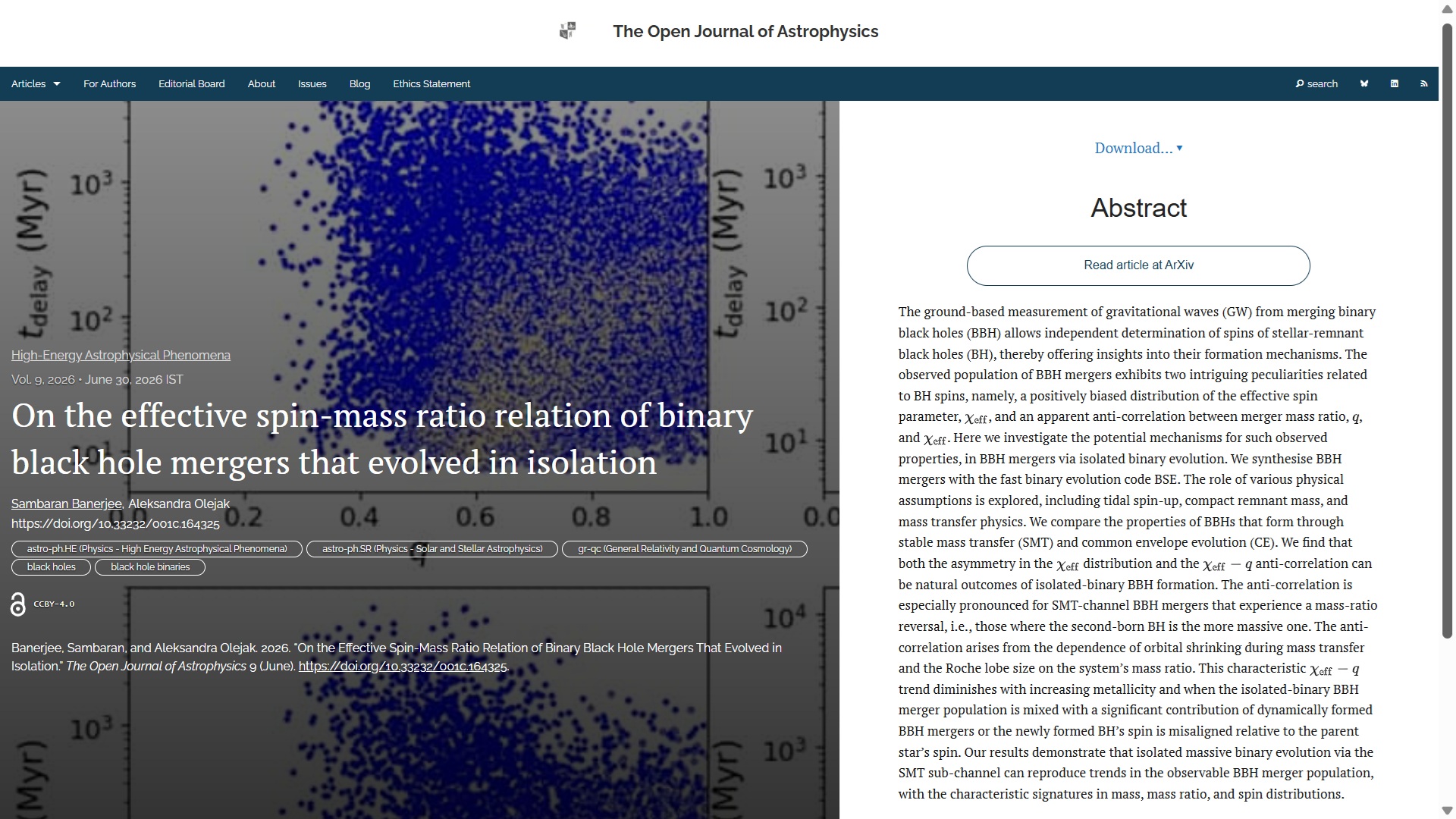
The fourth paper of the week, published on Tuesday 30th June in the folder High-Energy Astrophysical Phenomena, is “On the effective spin-mass ratio relation of binary black hole mergers that evolved in isolation” by Sambaran Banerjee (Helmholtz-Instituts für Strahlen und Kernphysik, Germany) and Aleksandra Olejak (MPA Garching, Germany). This study explores mechanisms of binary black hole mergers and finds that certain spin and mass ratio trends can be naturally explained by isolated binary evolution. The overlay for this one is here:

You can read the final version of this one on arXiv here and the Mastodon announcement is here:

Open Journal of Astrophysics

New Publication at the Open Journal of Astrophysics: "On the effective spin-mass ratio relation of binary black hole mergers that evolved in isolation" by Sambaran Banerjee (Helmholtz-Instituts für Strahlen und Kernphysik, Germany) and Aleksandra Olejak (MPA Garching, Germany)

doi.org/10.33232/001c.164325

June 30, 2026, 7:16 am 1 boosts 1 favorites

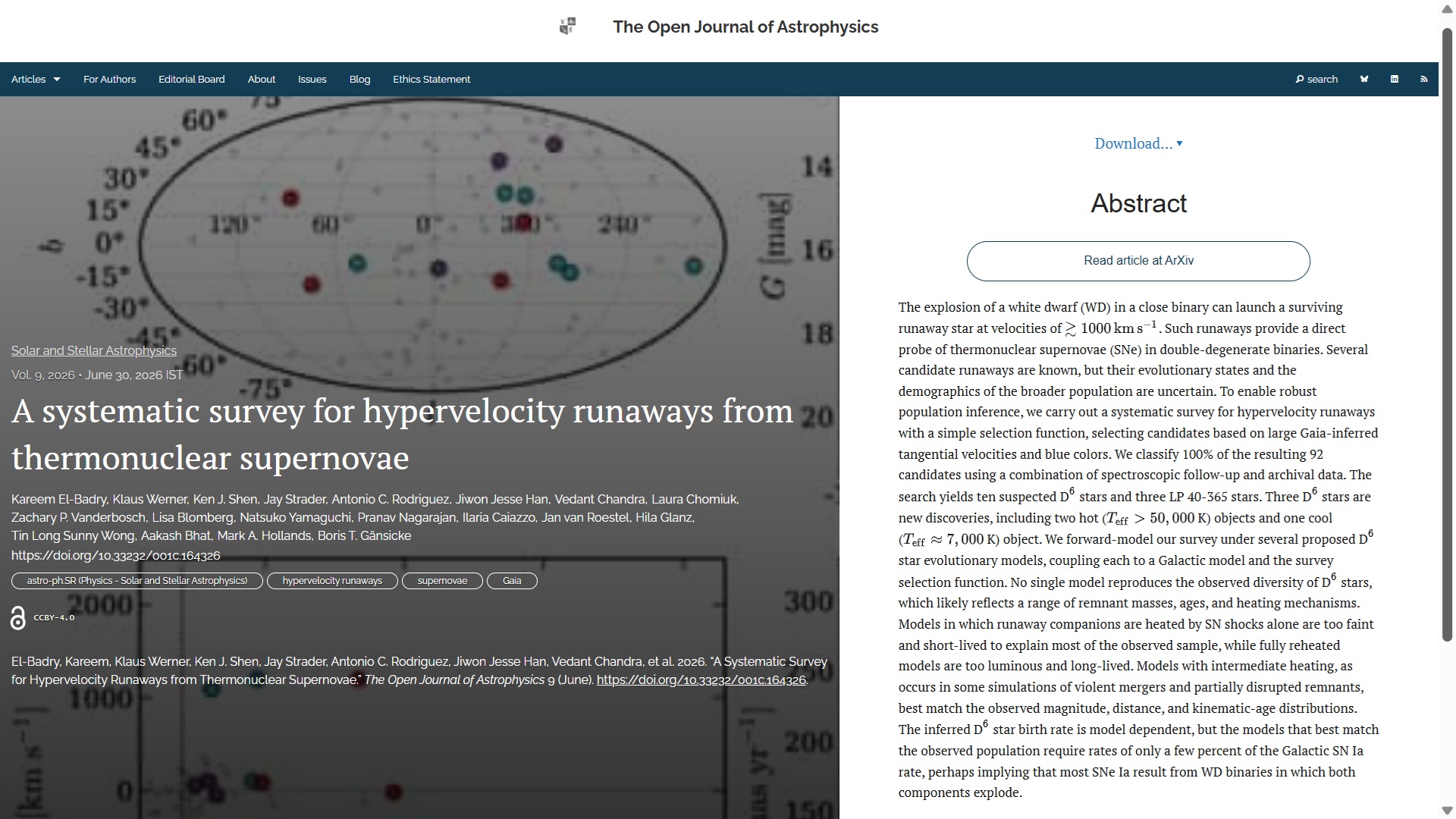
The fifth paper of the week, also published on Tuesday 30th June but in the folder Solar and Stellar Astrophysics is “A systematic survey for hypervelocity runaways from thermonuclear supernovae” by Kareem El-Badry (Caltech, USA), and 18 others based in the USA, Germany, Austria and the UK. This paper presents a systematic survey of hypervelocity runaways, resulting from white dwarf explosions in binary systems. The findings suggest a diversity of remnant masses, ages, and heating mechanisms, challenging theoretical models.

The overlay for this one is here:

You can read the final version of this one on arXiv here and the Mastodon announcement is here:

Open Journal of Astrophysics

New Publication at the Open Journal of Astrophysics: "A systematic survey for hypervelocity runaways from thermonuclear supernovae" by Kareem El-Badry (Caltech, USA), and 18 others based in the USA, Germany, Austria and the UK.

doi.org/10.33232/001c.164326

June 30, 2026, 7:33 am 2 boosts 2 favorites

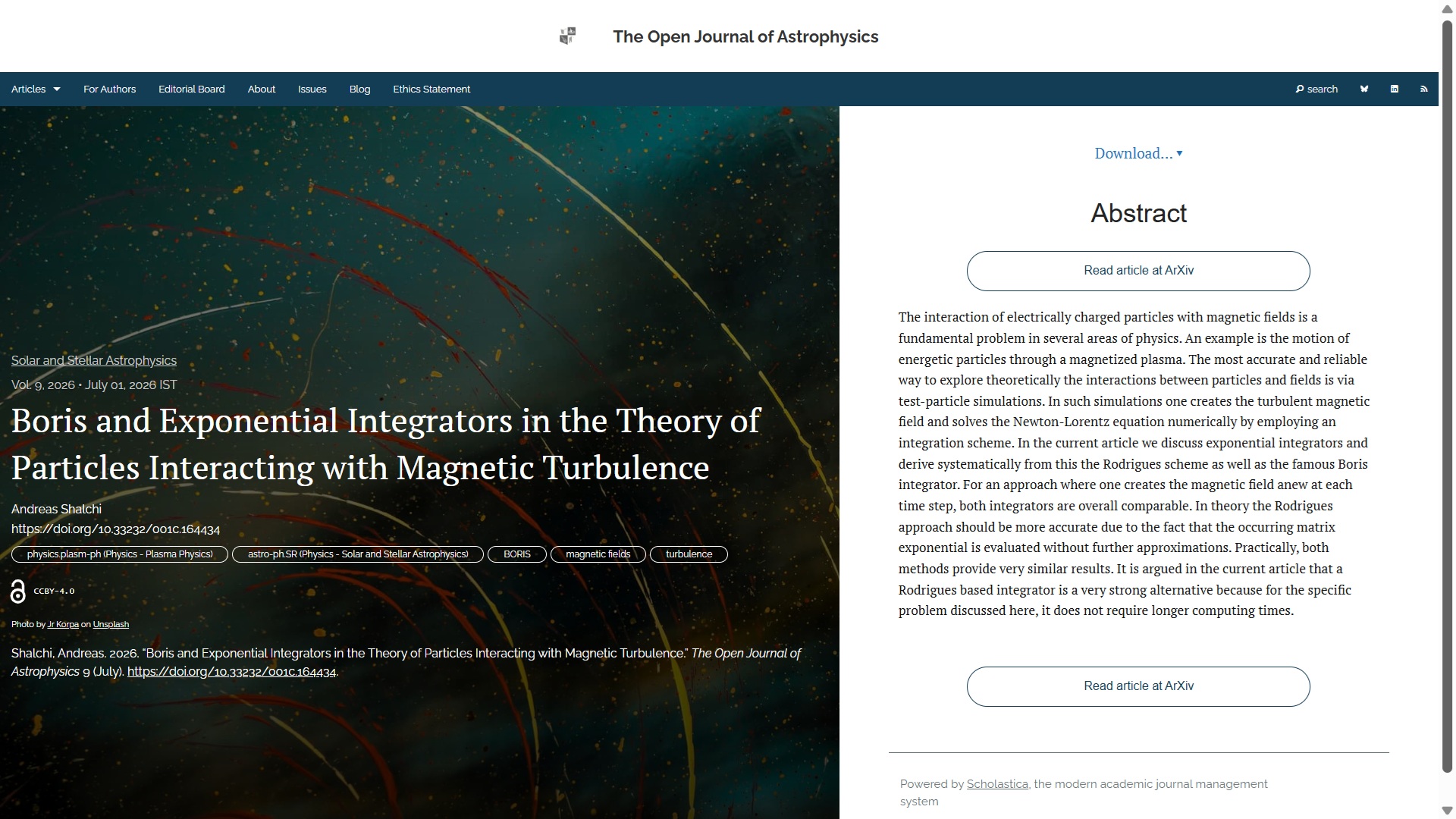
The sixth and penultimate paper of this week is “Boris and Exponential Integrators in the Theory of Particles Interacting with Magnetic Turbulence” by Andreas Shalchi (U. Manitoba, Canada). This was published on Wednesday 1st July, in the folder Solar and Stellar Astrophysics (it is posted in the plasma physics section of aXiv but cross-listed in solar and stellar astrophysics). The study compares the Rodrigues and Boris integrators in test-particle simulations of charged particles interacting with magnetic fields, finding both methods yield similar results.

The overlay for this one is here:

You can find the final accepted version on arXiv here and the Mastodon announcement is here:

Open Journal of Astrophysics

New Publication at the Open Journal of Astrophysics: "Boris and Exponential Integrators in the Theory of Particles Interacting with Magnetic Turbulence" by Andreas Shalchi (U. Manitoba, Canada)

doi.org/10.33232/001c.164434

July 1, 2026, 5:42 am 1 boosts 0 favorites

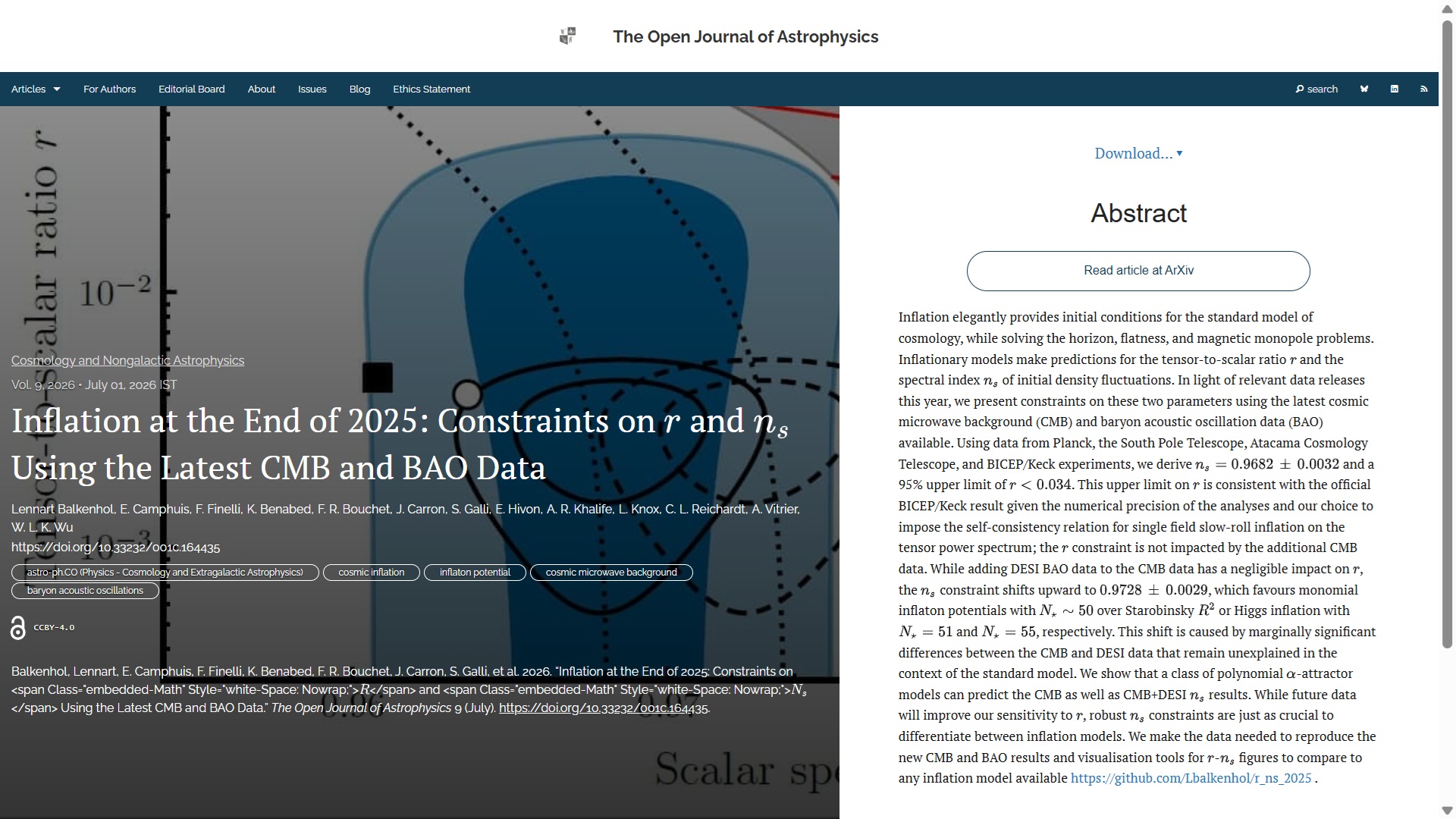
The seventh and final paper for this week is “Inflation at the End of 2025: Constraints on $r$ and $n_S$ using the Latest CMB and BAO Data” by Lennart Balkenhol (Institut d’Astrophysique de Paris, France) and 12 others based in France, Italy, Switzerland, UK, USA and Australia. This was also published on Wednesday 1st July, in the folder Cosmology and Nongalactic Astrophysics. This study presents constraints on parameters of inflationary models in cosmology, using the latest cosmic microwave background and baryon acoustic oscillation data. The findings help differentiate between inflation models.

The overlay for this one is here:

You can find the final accepted version of this one on arXiv here and the Mastodon announcement is here:

Open Journal of Astrophysics

New Publication at the Open Journal of Astrophysics: "Inflation at the End of 2025: Constraints on $r$ and $n_S$ using the Latest CMB and BAO Data" by Lennart Balkenhol (Institut d’Astrophysique de Paris, France) and 12 others based in France, Italy, Switzerland, UK, USA and Australia.

doi.org/10.33232/001c.164435

July 1, 2026, 6:37 am 2 boosts 1 favorites

And that concludes this week’s update. We’re starting to catch up on the backlog generated in June. At just past the halfway point of the year, which is where we are, we’re on 136 papers, which suggests a total around 272 for the year.

In a Random Universe…
Posted in Artificial Intelligence, Biographical, Books, OJAp Papers, The Universe and Stuff with tags , , , on June 30, 2026 by telescoper

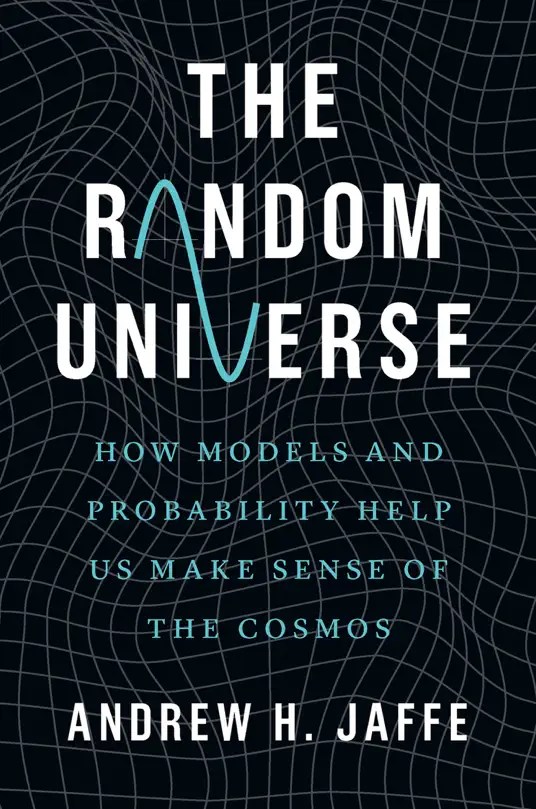
So here I am, in that London. I’m attending a small meeting called A Random Universe which is celebrating the occasion of the 60th Birthday of cosmologist Andrew Jaffe. The meeting is being held at South Kensington Technical Imperial College and covers cosmology, statistics, topology, and a number of other things. The title comes from a book Andrew has published:

I’m ashamed to admit I haven’t read it yet – it was published last year – but I will do. An amusing thing is that I wanted to use that title for a book I wrote some time ago but the publisher rejected it! I also noticed just now that the book uses the definite article whereas the conference has the indefinite article.

I had other things to do yesterday so I missed the first day of the meeting, and my train into London was delayed by an hour because of “a cow on the line”, which necessitated a lengthy diversion via Coventry, so I missed much of this morning too. I did make some use of the time, though, publishing three papers in the Open Journal of Astrophysics using a commendably stable Wi-Fi connection on the train.

One thing I didn’t miss, however, was an interesting panel discussion under the title AI and Inference. There wasn’t much about inference in the discussion, but it did cover some interesting ground. Cosmologists are well used to Machine Learning, which is often claimed to be a form of Artificial Intelligence, though I wouldn’t classify it as such. In fact,the large survey analyses that constitute a major part of contemporary cosmological research would not be feasible without the deployment of machine learning methods. I think it’s likely that newer methods of Generative AI and Agentic systems based on Large Language Modules will lead to increases in scientific productivity in the short term too. Whatever happens in the longer term, several years in the future, is very hard to predict, but is likely to invilve big changes in the way science is done. I’ll just say that I’m not sorry that I will be retiring in two years!

Apparently the “Holy Grail” of the Tech Bros is to find ways of creating artificial “General Intelligence”. There was an audience vote about whether this would be accomplished with the five years or so some claim. I abstained, on the grounds that I really don’t know what “General Intelligence” is supposed to mean in the first place. I would also remind readers that the Holy Grail was an object of dubious significance the Quest for which consumed considerable resources and ultimately failed.

Another topic that came up is whether AI methods will ever be truly creative. This is an interesting question because I don’t think we know very much about how creativity in any form, including the intuitive leaps that have led to advances in science, arises in human brains. I wrote a post about “Light-bulb” moments here.

One immediate effect of LLMs on science is in the publishing world. At OJAp we are experiencing a tidal wave of AI-generated slop and other garbage. This is very wearisome and I think will only get worse. We don’t rule out the use of AI in papers at OJAp, but authors must disclose what they have done and how they have tested it. Things may change in the future, but I think that in the current era of science the big problem is not that AI methods can’t be used by good scientists for good research but that AI methods make it far too easy for fools to generate superficially plausible nonsense. I don’t see any easy solution to this but maybe there is an upside, in that will hasten the end of the system of academic publishing which has in any case long outlined its usefulness.

Weekly Update from the Open Journal of Astrophysics 27/06/2026

Posted in OJAp Papers, Open Access, The Universe and Stuff with tags , , , , , , , , , , , , , , , , , on June 27, 2026 by telescoper

It’s Saturday again so it’s time for another update of activity at the Open Journal of Astrophysics. Since the last update we have published a further three papers, bringing the number in Volume 9 (2026) to 129 and the total so far published by OJAp up to 577.

I will continue to include the posts made on our Mastodon account (on Fediscience); these announcements also show the DOI for each paper.

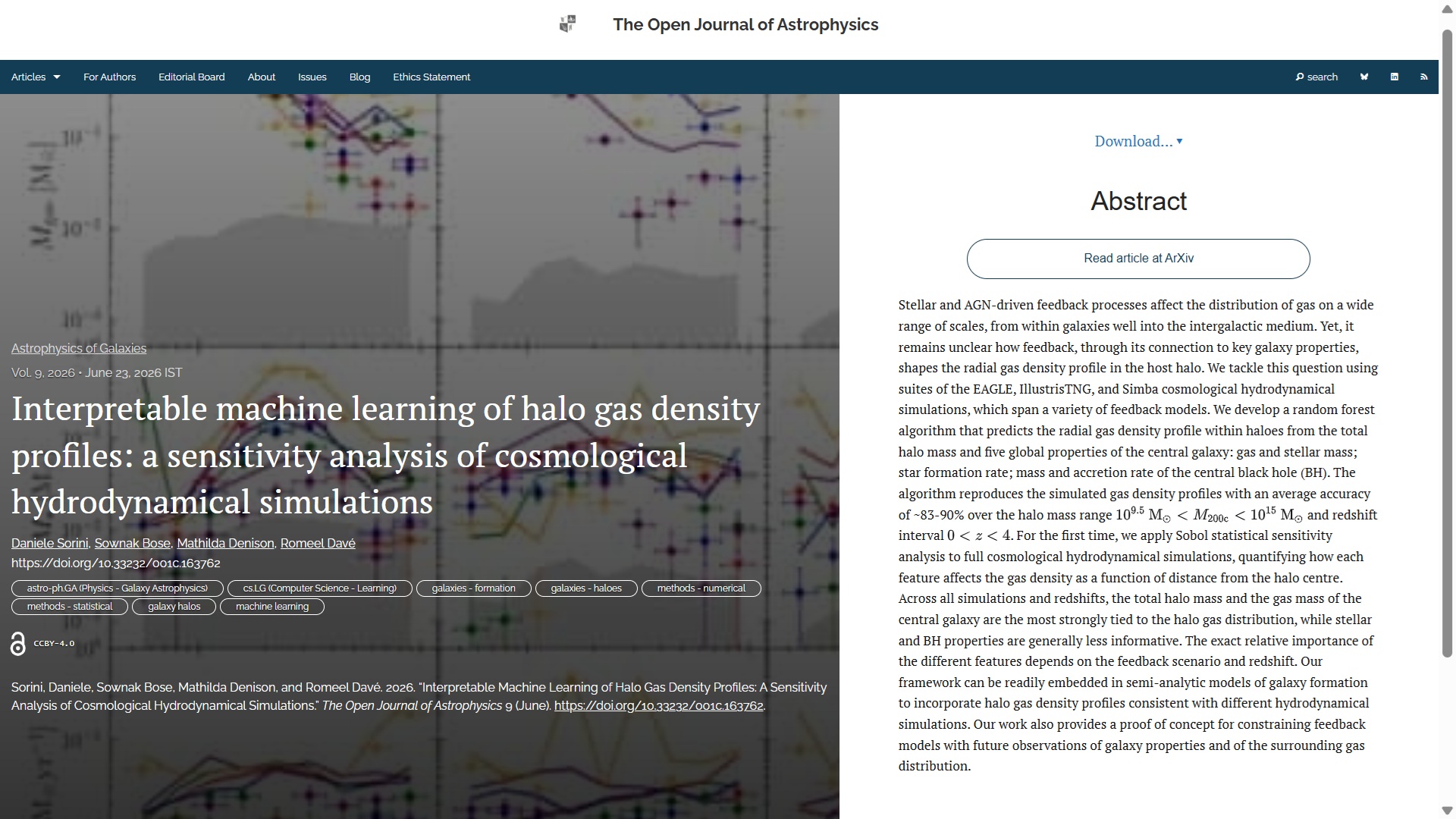
The first paper to report this week, published on Tuesday 23rd June, is “Interpretable machine learning of halo gas density profiles: a sensitivity analysis of cosmological hydrodynamical simulations” by Daniele Sorini & Sownak Bose (Durham University, UK), Mathilda Denison (U. Penn., USA) and Romeel Davé (University of Edinburgh, UK). This study uses cosmological hydrodynamical simulations and a random forest algorithm to understand how feedback processes affect the gas distribution in galaxies by predicting gas density profiles in various models. It is published in the folder Astrophysics of Galaxies.

The overlay for this paper is here

You can find the officially accepted version on arXiv here and the announcement on Fediverse here:

Open Journal of Astrophysics

New Publication atthe Open Journal of Astrophysics: "Interpretable machine learning of halo gas density profiles: a sensitivity analysis of cosmological hydrodynamical simulations" by Daniele Sorini & Sownak Bose (Durham U., UK), Mathilda Denison (U. Penn., USA) and Romeel Davé (U. Edinburgh, UK)

doi.org/10.33232/001c.163762

June 23, 2026, 7:15 am 1 boosts 0 favorites

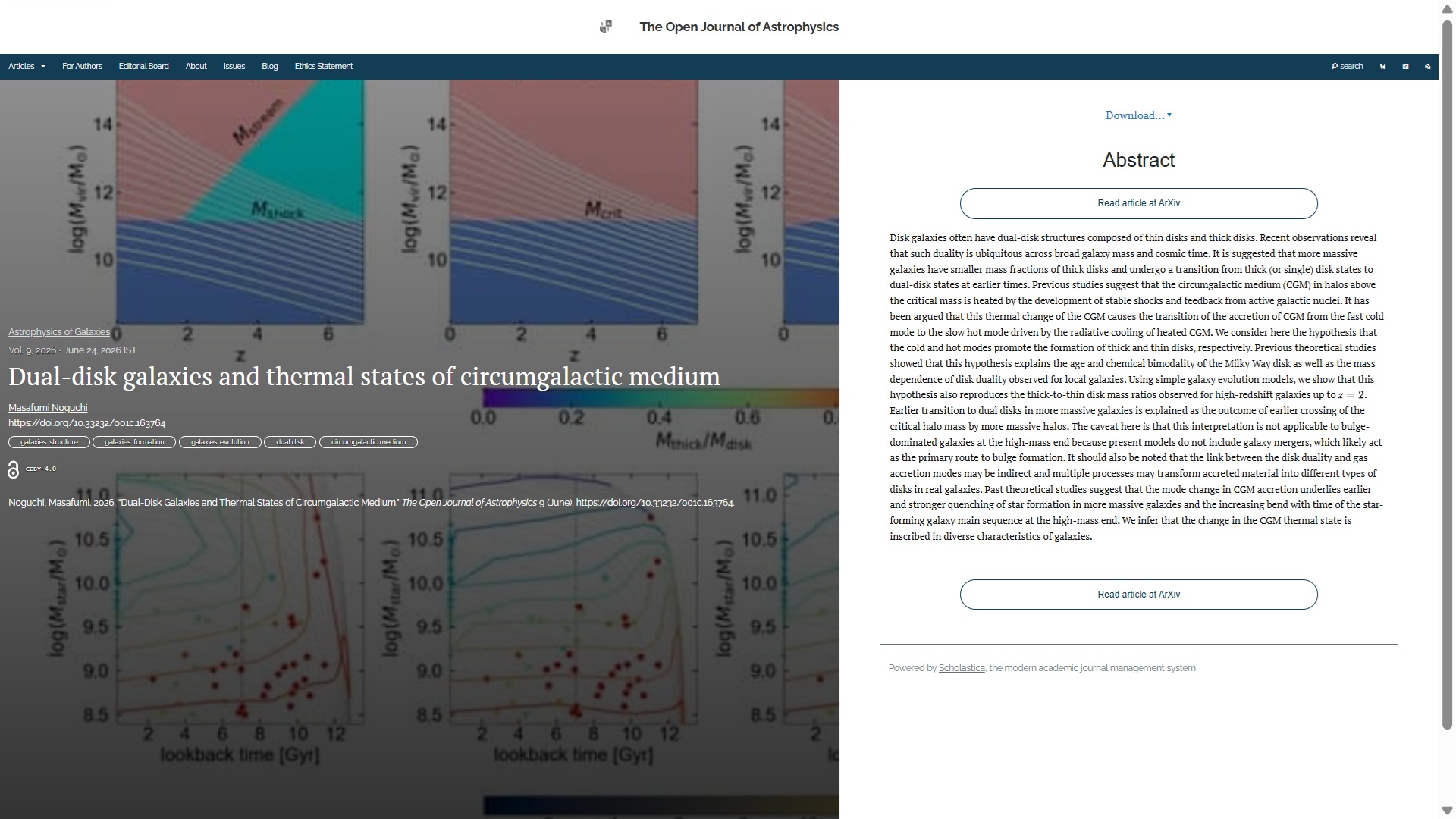
The second paper for this week, published on Wednesday June 24th in the folder Astrophysics of Galaxies is “Dual-disk galaxies and thermal states of circumgalactic medium” by Masafumi Noguchi (Tohoku University, Japan). This paper explores the suggestion that the transition from thick to dual-disk galaxies is influenced by thermal changes in the circumgalactic medium (CGM), which also affects star formation.

The overlay looks like this:

The official version of the paper can be found on arXiv here and the Fediverse announcement here:

Open Journal of Astrophysics

New Publication at the Open Journal of Astrophysics: "Dual-disk galaxies and thermal states of circumgalactic medium" by Masafumi Noguchi (Tohoku University, Japan).

doi.org/10.33232/001c.163764

June 24, 2026, 7:22 am 1 boosts 0 favorites

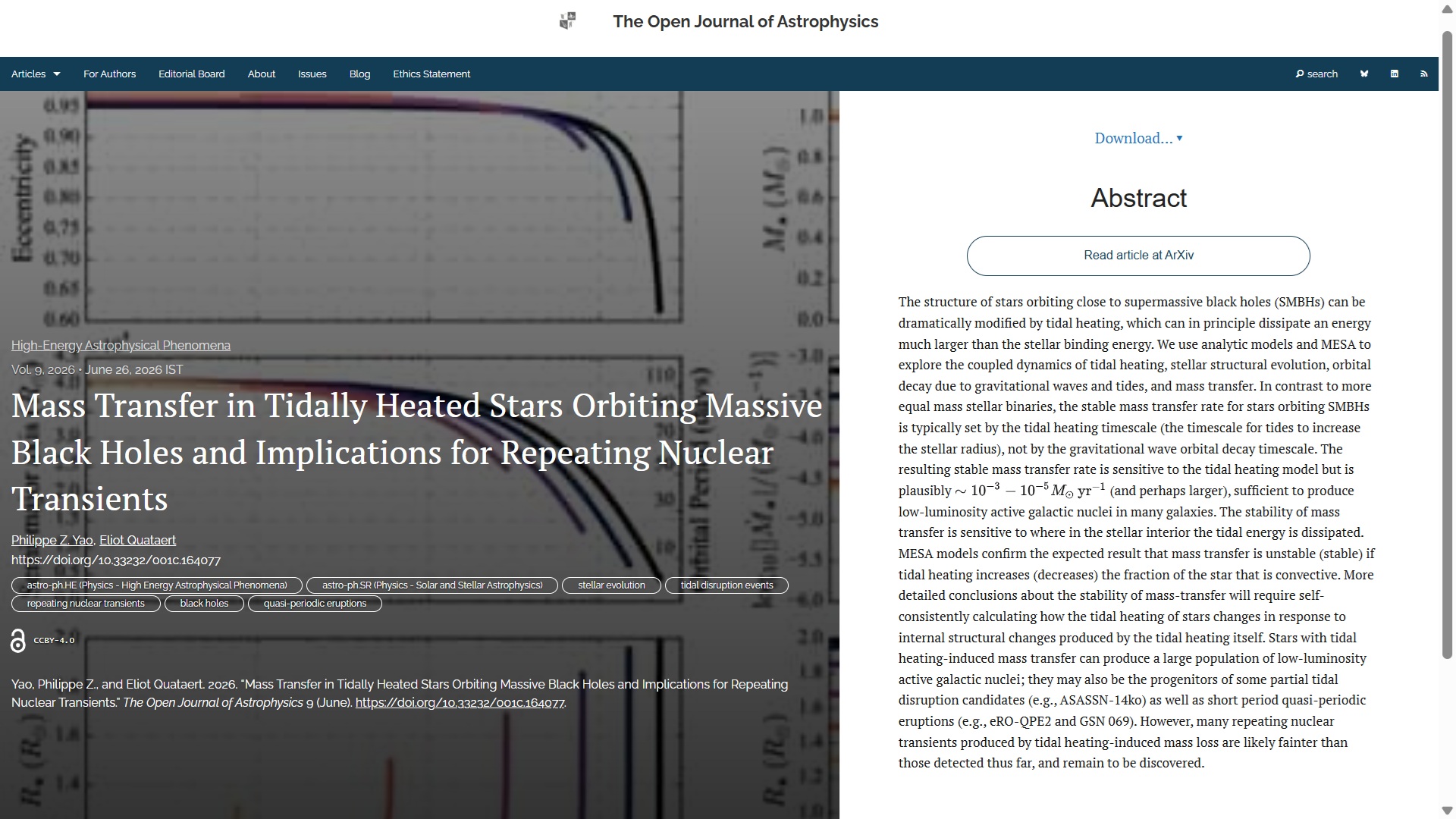
The third and finnal paper of the week, published on Friday 26th June in the folder High-Energy Astrophysical Phenomena, is “Mass Transfer in Tidally Heated Stars Orbiting Massive Black Holes and Implications for Repeating Nuclear Transients” by Philippe Z. Yao and Eliot Quataert (Princeton University, USA). This paper discusses how tidal heating alters the structure of stars near supermassive black holes, affecting mass transfer rates and potentially leading to low-luminosity active galactic nuclei and transient stellar phenomena.

The overlay for this one is here:

The final, accepted version can be found on arXiv here and the Mastodon announcement is here:

Open Journal of Astrophysics

New Publication at the Open Journal of Astrophysics: "Mass Transfer in Tidally Heated Stars Orbiting Massive Black Holes and Implications for Repeating Nuclear Transients" by Philippe Z. Yao and Eliot Quataert (Princeton University, USA)

doi.org/10.33232/001c.164077

June 26, 2026, 7:55 am 1 boosts 0 favorites

And that concludes this week’s update. It has been another slow week on the publishing front. We have a steadily growing backlog of papers accepted for publication but with final versions yet to appear on arXiv. I suppose it’s the holidays…

P.S. The other day I checked the stats for the Open Journal of Astrophysics and saw that we’ve passed 8,000 citations. The average number of citations per paper is 14.0, which is not bad when you consider that over half the papers were published under a year ago…

Weekly Update from the Open Journal of Astrophysics 20/06/2026

Posted in OJAp Papers, Open Access, The Universe and Stuff with tags , , , , , , , , , , , , , , , , , , , , , , , , , on June 20, 2026 by telescoper

It’s Saturday again so it’s time for another update of activity at the Open Journal of Astrophysics. Since the last update we have published a further three papers, bringing the number in Volume 9 (2026) to 126 and the total so far published by OJAp up to 574.

I will continue to include the posts made on our Mastodon account (on Fediscience); these announcements also show the DOI for each paper.

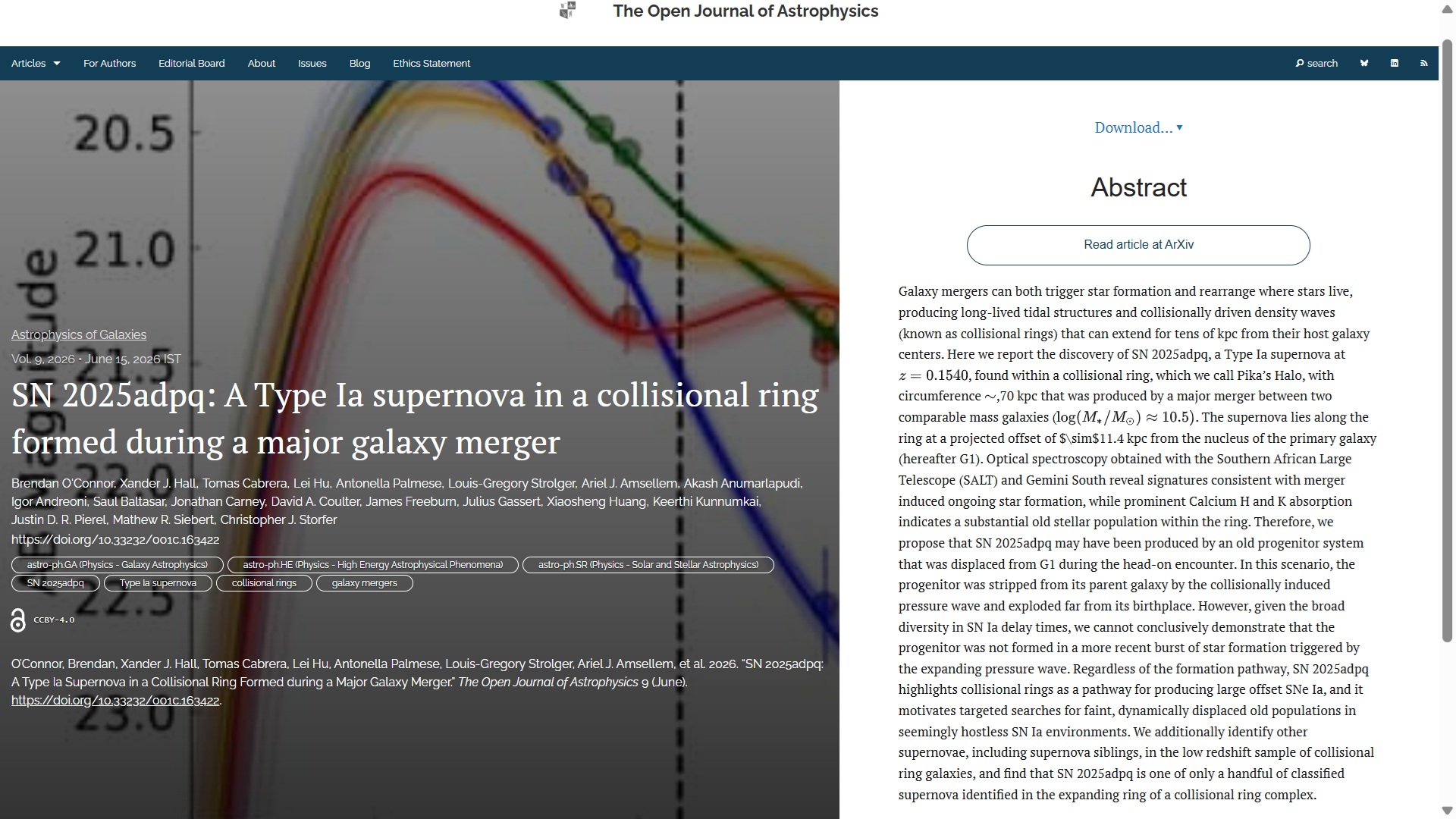
The first paper to report this week, published on Monday 15th June, is “SN 2025adpq: A Type Ia supernova in a collisional ring formed during a major galaxy merger” by Brendan O’Connor (Carnegie Mellon University, USA) and 18 others based in the USA, Germany and Australia. The study reports the discovery of a Type Ia supernova, SN 2025adpq, within a collisional ring formed by a major galaxy merger., offset from the nucleus of the primary galaxy. It is published in the folder Astrophysics of Galaxies.

The overlay for this paper is here

You can find the officially accepted version on arXiv here and the announcement on Fediverse here:

Open Journal of Astrophysics

New Publication at the Open Journal of Astrophysics: "SN 2025adpq: A Type Ia supernova in a collisional ring formed during a major galaxy merger" by Brendan O'Connor (Carnegie Mellon University, USA) and 18 others based in the USA, Germany and Australia

doi.org/10.33232/001c.163422

June 15, 2026, 8:29 am 1 boosts 1 favorites

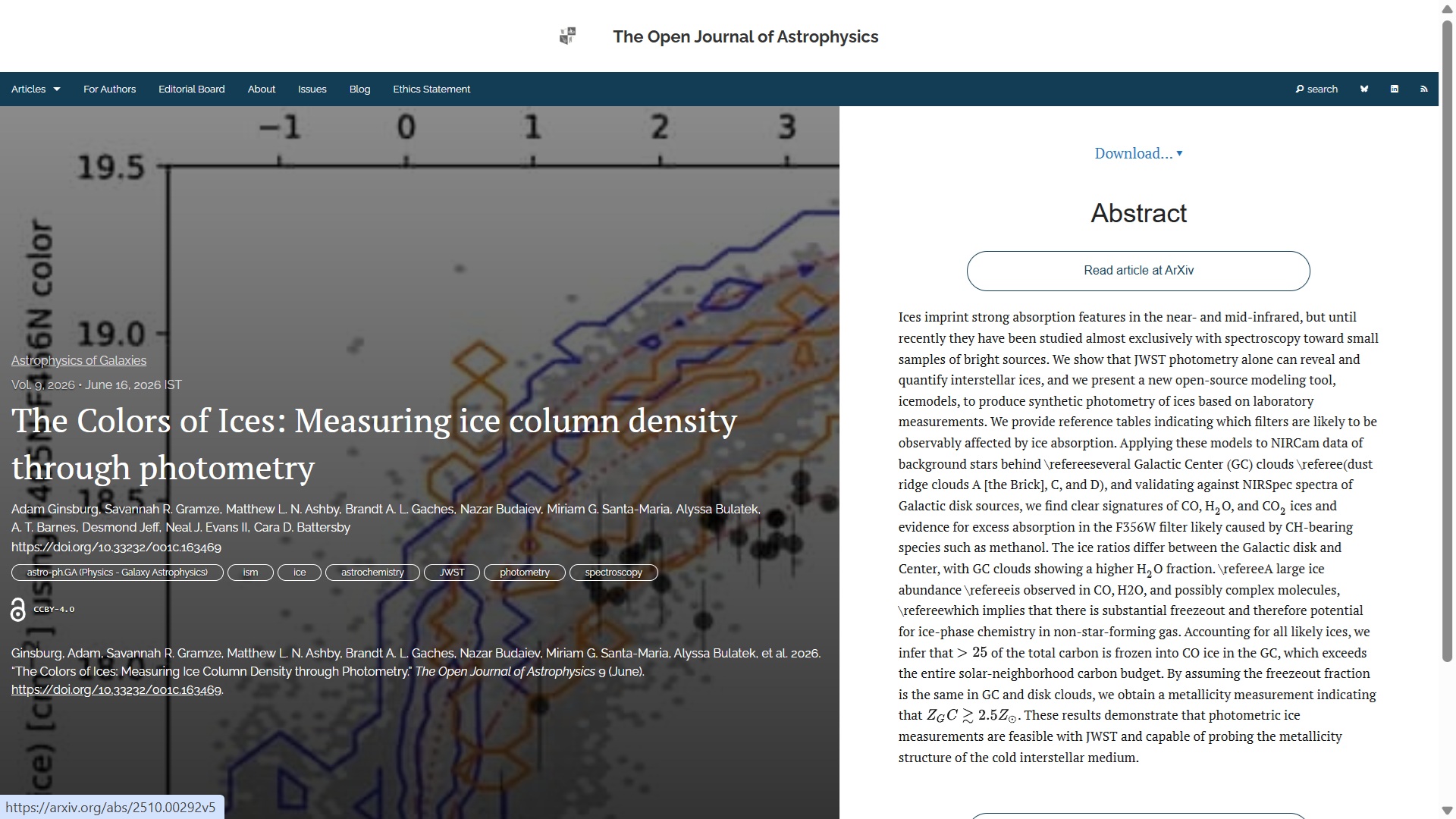
The second paper for this week, published on Tuesday June 16th in the folder Astrophysics of Galaxies is “The Colors of Ices: Measuring ice column density through photometry” by Adam Ginsburg (U. Florida, USA) and ten others based in the USA, Germany and Spain. This study demonstrates that JWST photometry can identify and quantify interstellar ices, using new open-source models, interstellar ices, finding significant abundance in non-star-forming gas, suggesting many avenues for further research.

The overlay looks like this:

The official version of the paper can be found on arXiv here and the Fediverse announcement here:

Open Journal of Astrophysics

New Publication at the Open Journal of Astrophysics: "The Colors of Ices: Measuring ice column density through photometry" by Adam Ginsburg (U. Florida, USA) and ten others based in the USA, Germany and Spain

doi.org/10.33232/001c.163469

June 16, 2026, 7:26 am 1 boosts 1 favorites

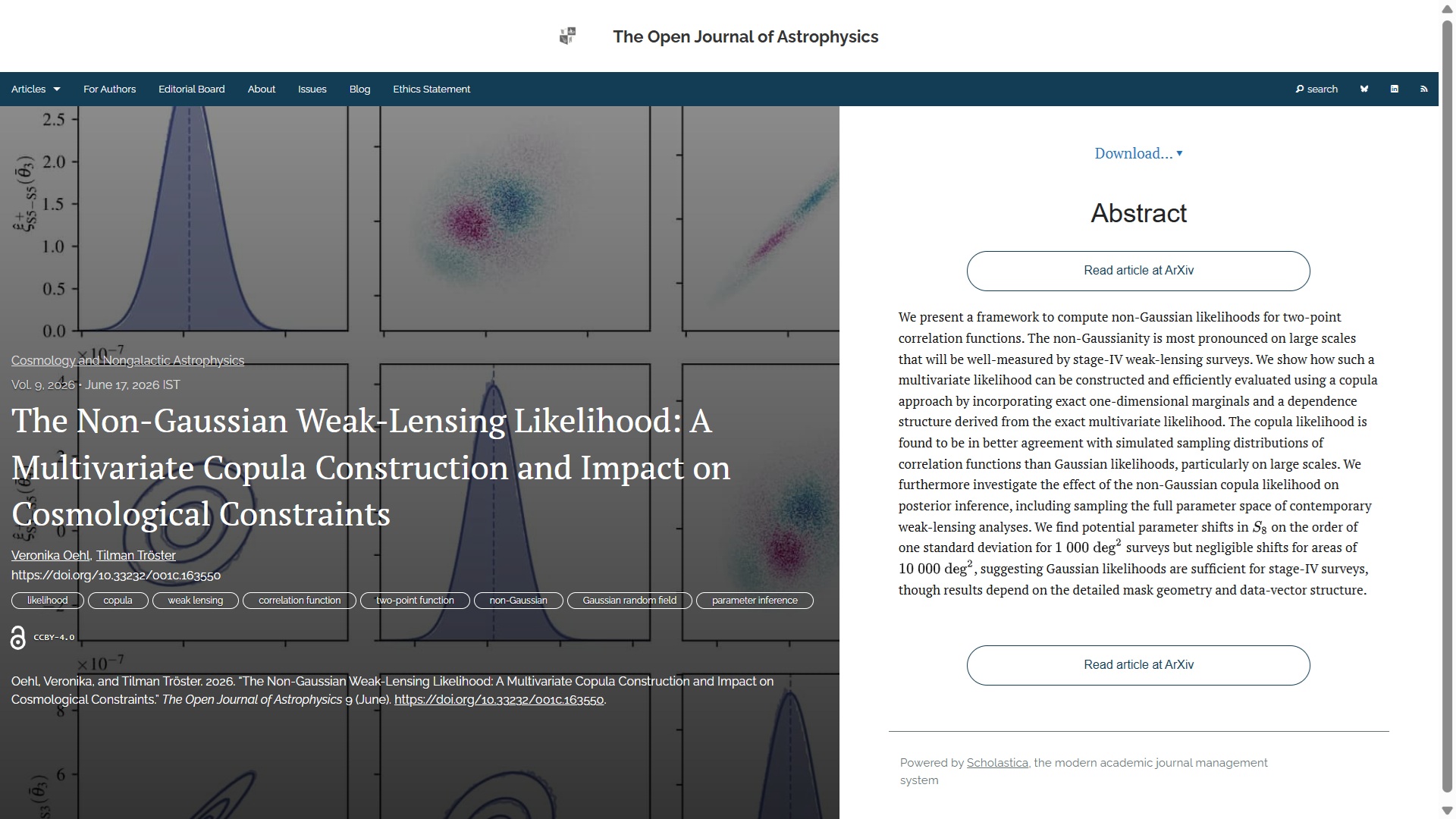
The third paper of the week, published on Wednesday 17th June in the folder Cosmology and Nongalactic Astrophysics is “The Non-Gaussian Weak-Lensing Likelihood: A Multivariate Copula Construction and Impact on Cosmological Constraints” by Veronika Oehl and Tilman Tröster (both of ETH Zurich, Switzerland). This study presents a framework for computing non-Gaussian likelihoods for correlation functions, particularly useful in large-scale weak-lensing surveys. It suggests Gaussian likelihoods are sufficient for stage-IV surveys.

The overlay for this one is here:

The final, accepted version can be found on arXiv here and the Mastodon announcement is here:

Open Journal of Astrophysics

New Publication at the Open Journal of Astrophysics: "The Non-Gaussian Weak-Lensing Likelihood: A Multivariate Copula Construction and Impact on Cosmological Constraints" by Veronika Oehl and Tilman Tröster (ETH Zurich, Switzerland)

doi.org/10.33232/001c.163550

June 17, 2026, 8:30 am 1 boosts 0 favorites

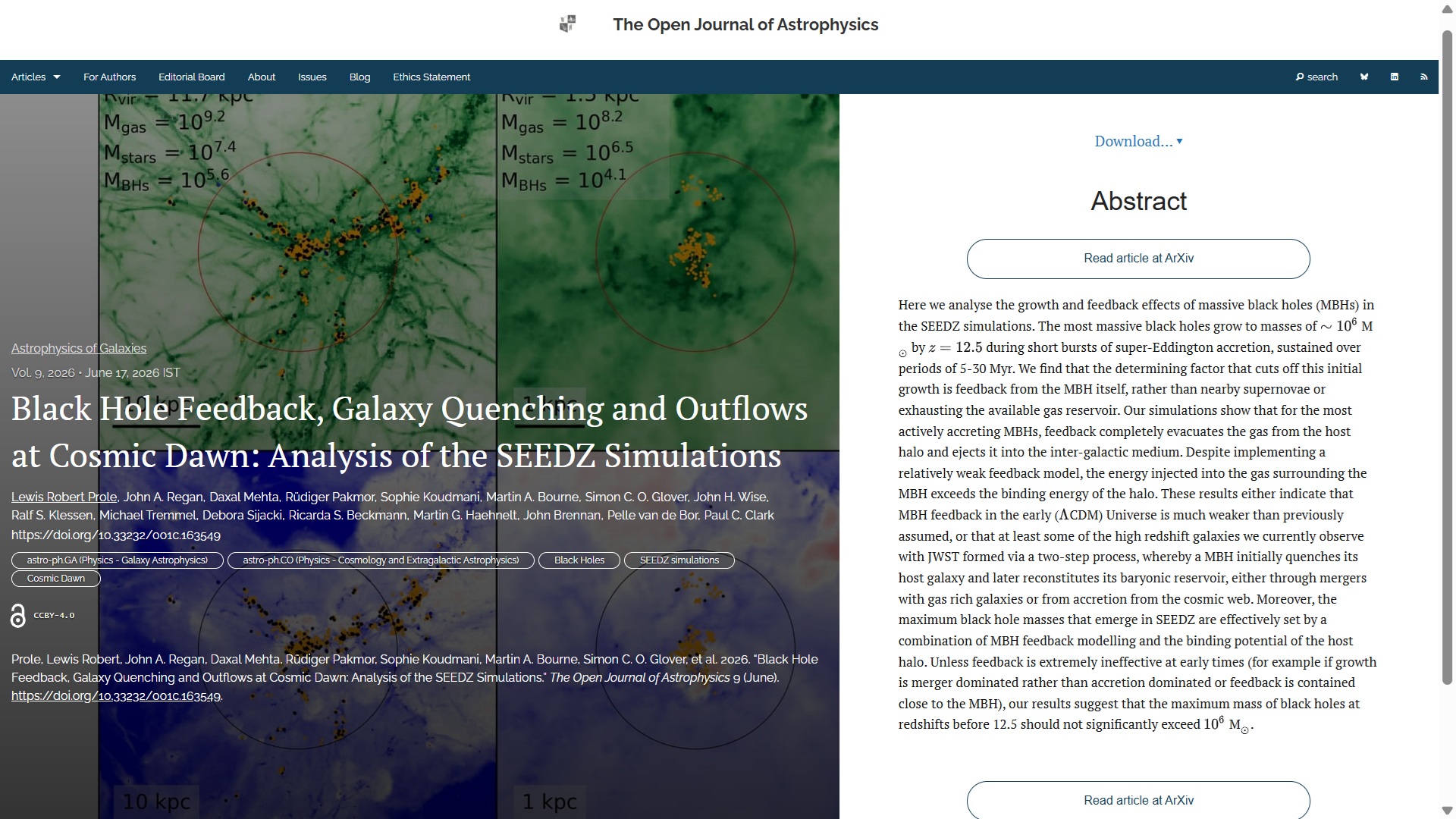
The fourth and final paper of the week, also ublished on Wednesday 17th June but in the folder Astrophysics of Galaxies, is “Black Hole Feedback, Galaxy Quenching and Outflows at Cosmic Dawn: Analysis of the SEEDZ Simulations” by Lewis R. Prole (Maynooth University, Ireland) and 15 others based in Ireland, Germany, USA and UK. The study analyzes the growth and feedback effects of massive black holes in SEEDZ simulations, suggesting that black hole feedback, not nearby supernovae or gas exhaustion, limits initial growth.

The overlay is here:

The final, accepted version can be found on arXiv here and the Mastodon announcement is here:

Open Journal of Astrophysics

New Publication at the Open Journal of Astrophysics: "Black Hole Feedback, Galaxy Quenching and Outflows at Cosmic Dawn: Analysis of the SEEDZ Simulations" by Lewis R. Prole (Maynooth University, Ireland) and 15 others based in Ireland, Germany, USA and UK.

doi.org/10.33232/001c.163549

June 17, 2026, 8:09 am 2 boosts 1 favorites

And that concludes this week’s update. It has been a slow week on the publishing front, but the main reason is that we have a big backlog of papers accepted but waiting for the authors to put their final versions on arXiv and we can’t do anything about that! I’ll do another update next Saturday.

Weekly Update from the Open Journal of Astrophysics 13/06/2026

Posted in OJAp Papers, Open Access, The Universe and Stuff with tags , , , , , , , , , , , , , , , , , , , , , , on June 13, 2026 by telescoper

It’s Saturday again so it’s time for another update of activity at the Open Journal of Astrophysics. Since the last update we have published a further three papers, bringing the number in Volume 9 (2026) to 122 and the total so far published by OJAp up to 570.

I will continue to include the posts made on our Mastodon account (on Fediscience); these announcements also show the DOI for each paper.

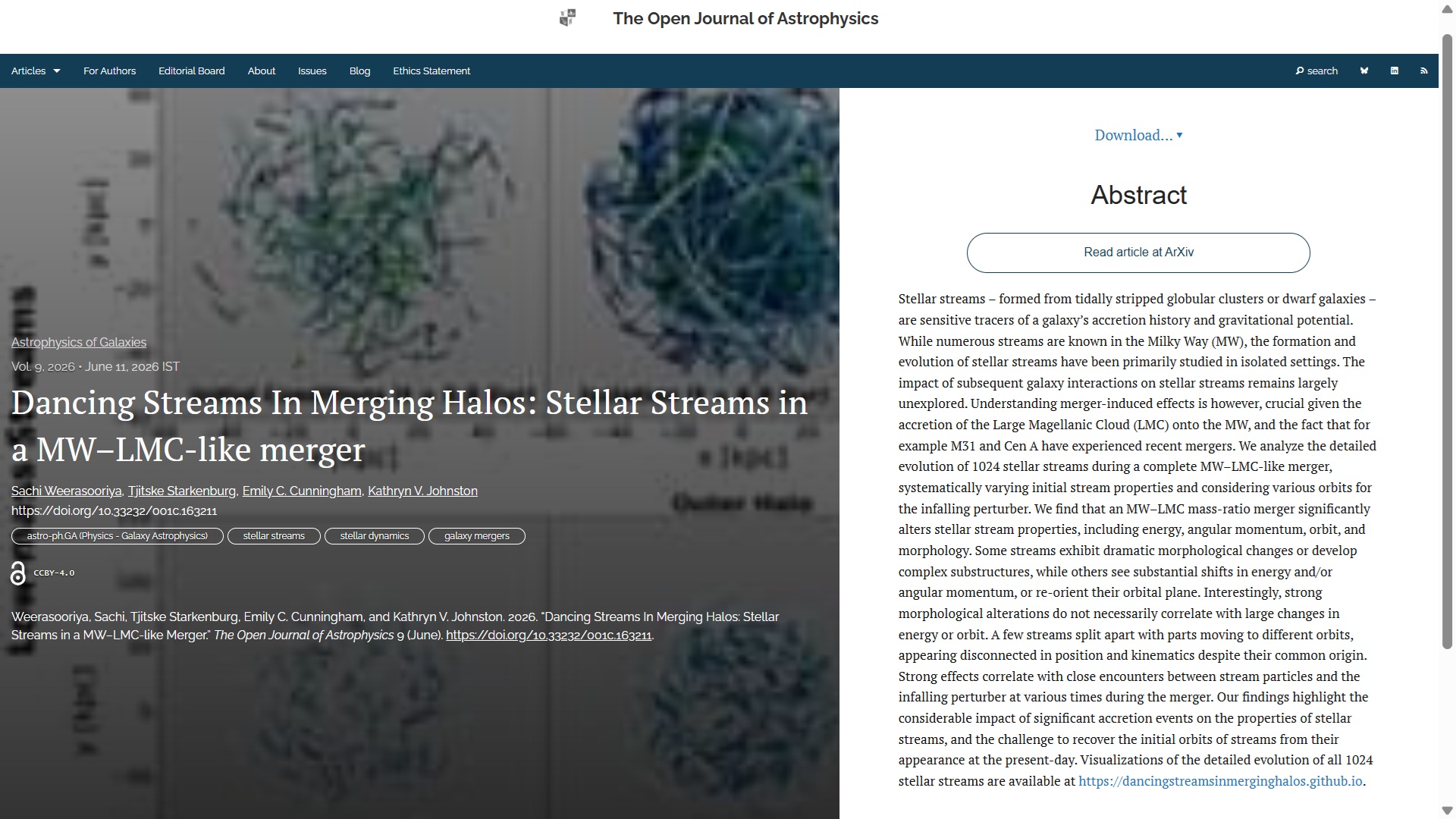
The first paper to report this week, published on Thursday 11th June, is “Dancing Streams In Merging Halos: Stellar Streams in a MW–LMC-like merger” by (all based in the USA): Sachi Weerasooriya (Carnegie Observatories), Tjitske Starkenburg (Northwestern U.), Emily C. Cunningham (Columbia U.) & Kathryn V. Johnston (Flatiron Institute). This article explores how galaxy mergers, like the Milky Way-Large Magellanic Cloud merger, significantly alter the properties and structures of stellar streams, challenging the recovery of their initial orbits. It is in the folder marked Astrophysics of Galaxies.

The overlay for this paper is here

You can find the officially accepted version on arXiv here and the announcement on Fediverse here:

Open Journal of Astrophysics

New Publication at the Open Journal of Astrophysics: "Dancing Streams In Merging Halos: Stellar Streams in a MW–LMC-like merger" by (all based in the USA): Sachi Weerasooriya (Carnegie Observatories), Tjitske Starkenburg (Northwestern U.), Emily C. Cunningham (Columbia U.) & Kathryn V. Johnston (Flatiron Institute).

doi.org/10.33232/001c.163211

June 11, 2026, 7:05 am 1 boosts 0 favorites

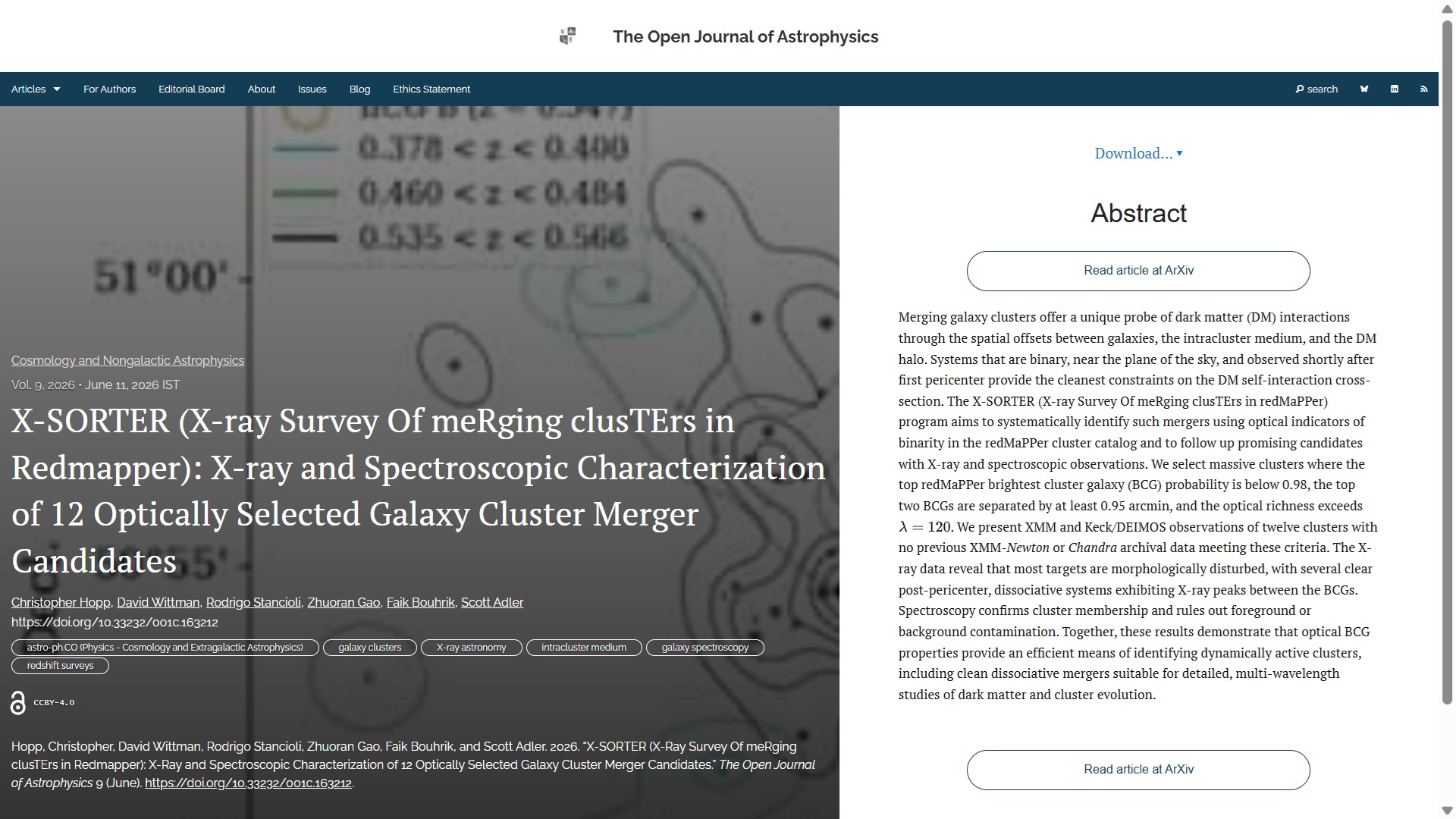
The second paper for this week, also published on Thursday 11th June but in the folder Cosmology and Nongalactic Astrophysics is “X-SORTER (X-ray Survey Of meRging clusTErs in Redmapper): X-ray and Spectroscopic Characterization of 12 Optically Selected Galaxy Cluster Merger Candidates” by Christopher Hopp, David Wittman, Rodrigo Stancioli, Zhuoran Gao & Faik Bouhrik (UC Davis) and Scott Adler (Rochester), all based in the USA. The X-SORTER program identifies merging galaxy clusters to study dark matter interactions, using optical indicators and X-ray observations. This method efficiently identifies active clusters suitable for detailed dark matter studies.

The overlay for this one looks like this:

The official version of the paper can be found on arXiv here and the Fediverse announcement here:

Open Journal of Astrophysics

New Publication at the Open Journal of Astrophysics: "X-SORTER (X-ray Survey Of meRging clusTErs in Redmapper): X-ray and Spectroscopic Characterization of 12 Optically Selected Galaxy Cluster Merger Candidates" by Christopher Hopp, David Wittman, Rodrigo Stancioli, Zhuoran Gao & Faik Bouhrik (UC Davis) and Scott Adler (Rochester), all based in the USA.

doi.org/10.33232/001c.163212

June 11, 2026, 7:25 am 1 boosts 0 favorites

The third and final paper of the week, published on Friday 12th June in the folder Earth and Planetary Astrophysics, is “JCMT Constraints on the Early-Time HCN and CO Emission and HCN Temporal Evolution of 3I/ATLAS” by Jason T. Hinkle (U. Illinois, USA) and 6 others based in the USA and Chile. This article presents observations of the third Interstellar Object, 3I/ATLAS, providing early sub-mm constraints on its activity. The findings suggest a steeper production rate slope than typical Solar System comets.

The overlay for this one is here:

The final, accepted version can be found on arXiv here and the Mastodon announcement is here:

Open Journal of Astrophysics

New Publication at the Open Journal of Astrophysics: "JCMT Constraints on the Early-Time HCN and CO Emission and HCN Temporal Evolution of 3I/ATLAS" by Jason T. Hinkle (U. Illinois, USA) and 6 others based in the USA and Chile.

doi.org/10.33232/001c.163250

June 12, 2026, 6:50 am 1 boosts 2 favorites

And that concludes this week’s update. It has been a slow week on the publishing front, but the main reason is that we have a big backlog of papers accepted but waiting for the authors to put their final versions on arXiv and we can’t do anything about that! I’ll do another update next Saturday.

Weekly Update from the Open Journal of Astrophysics – 06/06/2026

Posted in OJAp Papers, Open Access, The Universe and Stuff with tags , , , , , , , , , , , , , , , , , , , , , , on June 6, 2026 by telescoper

Another Saturday, another update of activity at the Open Journal of Astrophysics. Since the last update we have published a further five papers, bringing the number in Volume 9 (2026) to 119 and the total so far published by OJAp up to 567.

I will continue to include the posts made on our Mastodon account (on Fediscience); these announcements also show the DOI for each paper.

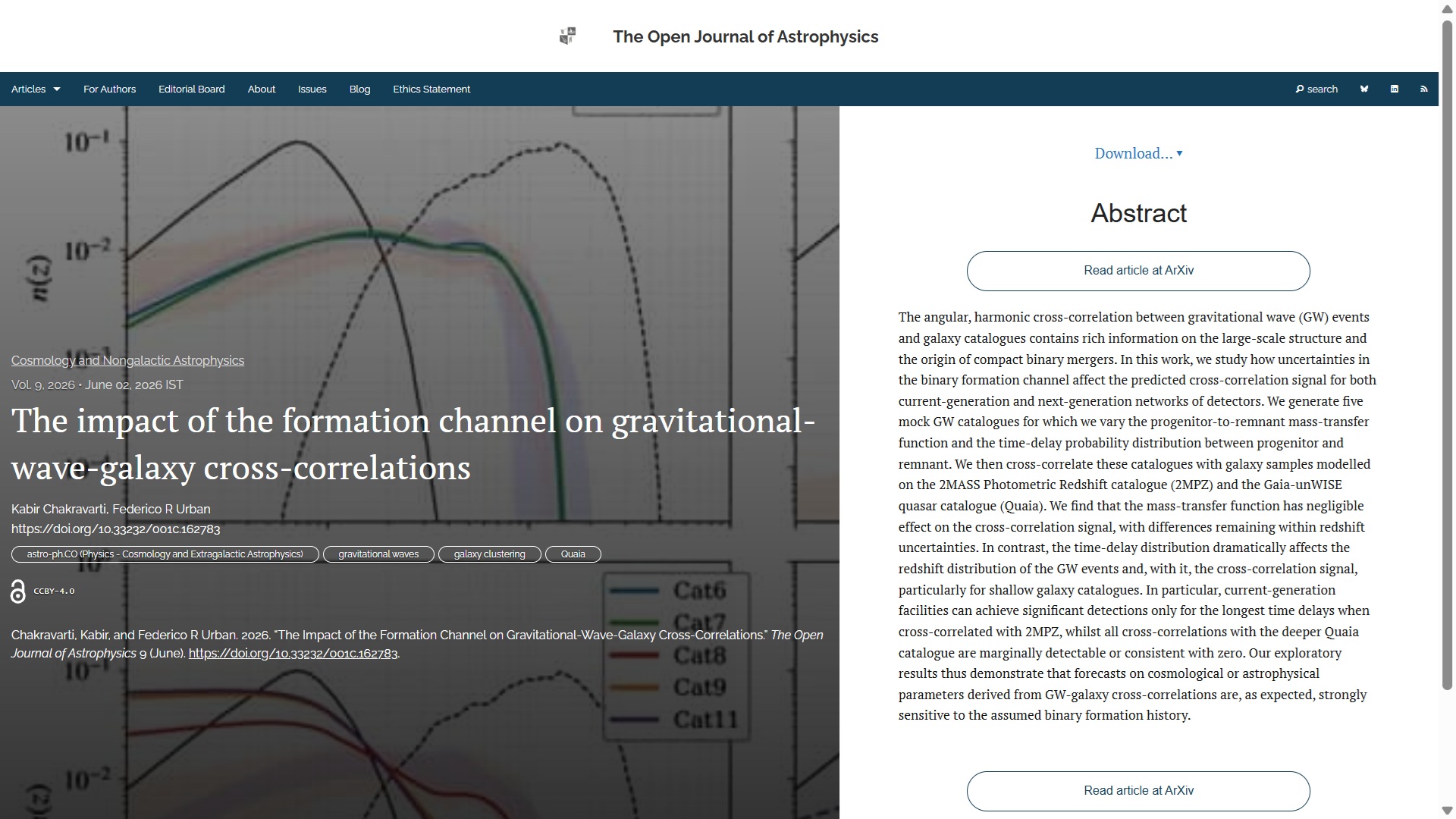
The first paper to report this week, published on Tuesday 2nd June, is “The impact of the formation channel on gravitational-wave-galaxy cross-correlations” by Kabir Chakravarti (Chennai Mathematical Institute, India) and Federico R Urban (CEICO-FZU, Czech Republic). This article, published in the folder Cosmology and Nongalactic Astrophysics, explores how uncertainties in binary formation affect the cross-correlation signal between gravitational wave events and galaxy catalogues, finding that time-delay distribution significantly impacts the signal.

The overlay for this paper is here

You can find the officially accepted version on arXiv here and the announcement on Fediverse here:

Open Journal of Astrophysics

New Publication at the Open Journal of Astrophysics: "The impact of the formation channel on gravitational-wave-galaxy cross-correlations" by Kabir Chakravarti (Chennai Mathematical Institute, India) and Federico R Urban (CEICO-FZU, Czech Republic)

doi.org/10.33232/001c.162783

June 2, 2026, 7:22 am 1 boosts 2 favorites

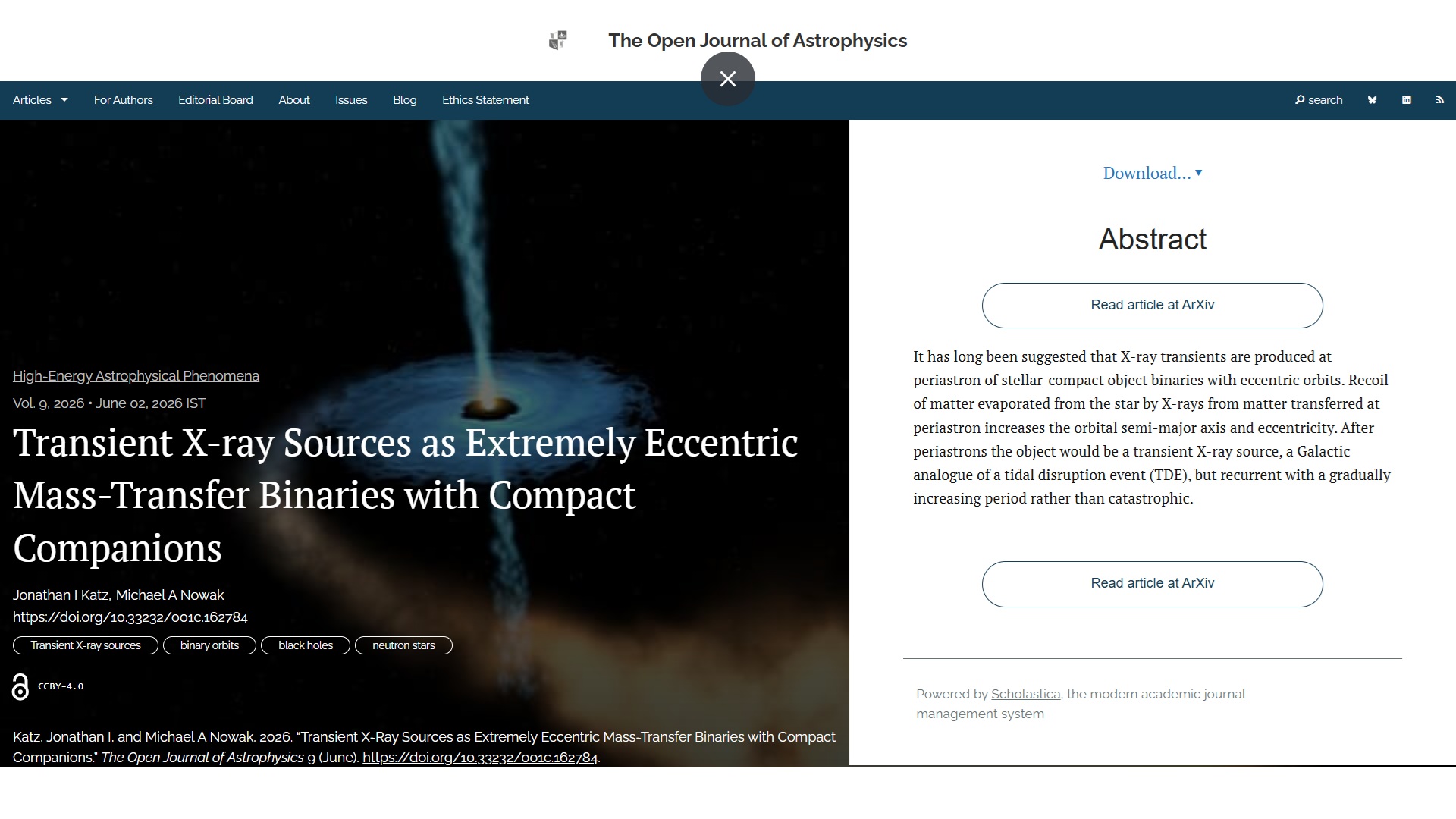
The second paper for this week, also published on Tuesday 2nd June but in the folder High-Energy Astrophysical Phenomena, is “Transient X-ray Sources as Extremely Eccentric Mass-Transfer Binaries with Compact Companions” by Jonathan I Katz and Michael A Nowak (Washington University, St Louis, USA). This article suggests that X-ray transients, similar to tidal disruption events, are produced in eccentric stellar-compact object binaries, with their frequency gradually increasing over time.

The overlay for this one looks like this:

The official version of the paper can be found on arXiv here and the Fediverse announcement here:

Open Journal of Astrophysics

New Publication at the Open Journal of Astrophysics: "Transient X-ray Sources as Extremely Eccentric Mass-Transfer Binaries with Compact Companions" by Jonathan I Katz and Michael A Nowak (Washington University, USA)

doi.org/10.33232/001c.162784

June 2, 2026, 7:44 am 1 boosts 1 favorites

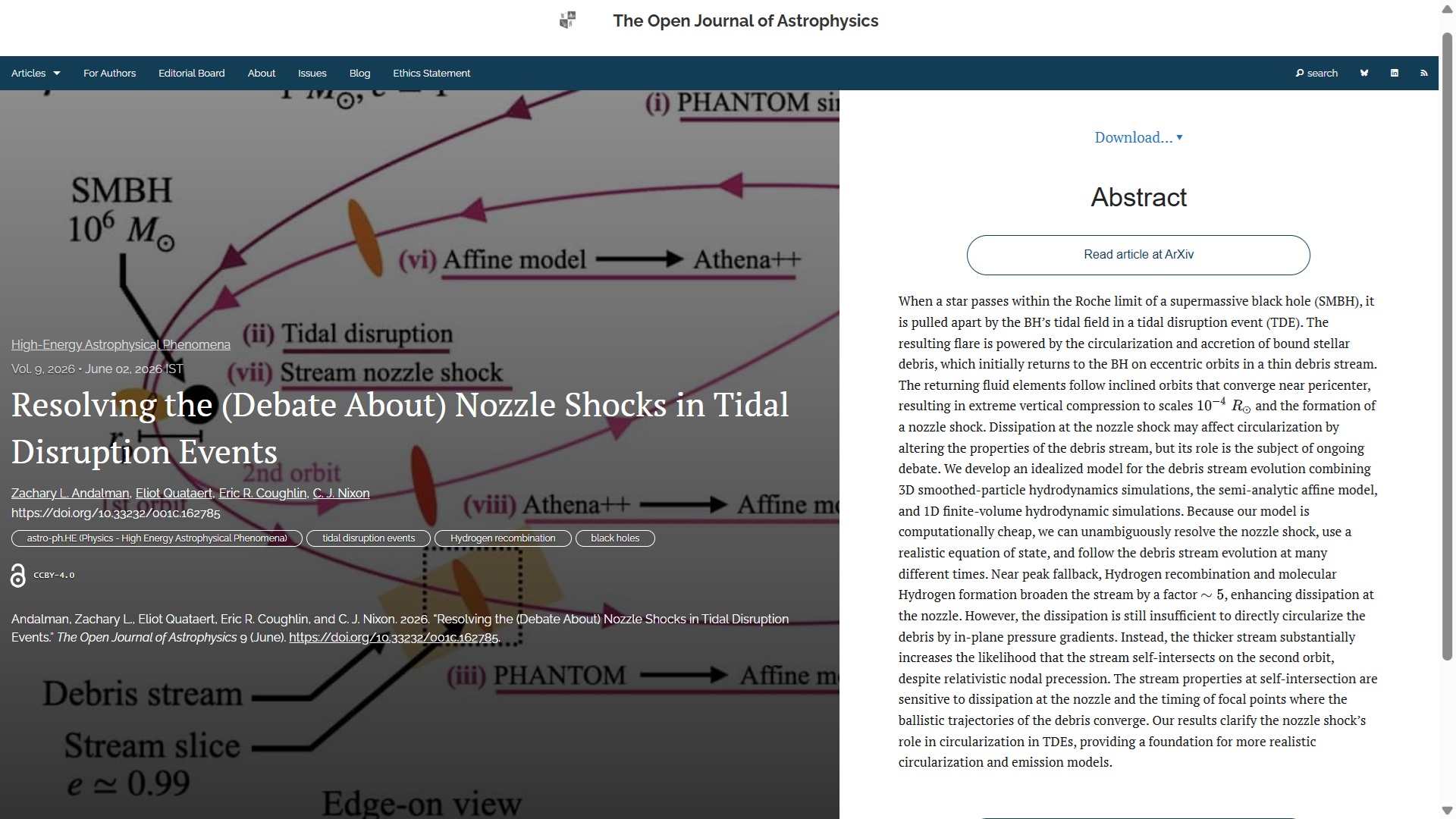
Next one up, the third paper of the week, also published on Tuesday 2nd June in the folder High-Energy Astrophysical Phenomena is “Resolving the (Debate About) Nozzle Shocks in Tidal Disruption Events” by Zachary L. Andalman & Eliot Quataert (Princeton U., USA), Eric R. Coughlin (Syracuse U. USA) and C. J. Nixon (U. Leeds, UK). This paper presents a model to understand the role of nozzle shocks in the circularization of stellar debris during a tidal disruption event when a star approaches a supermassive black hole (SMBH)

The overlay for this one is here:

The final, accepted version can be found on arXiv here and the Mastodon announcement is here:

Open Journal of Astrophysics

New Publication at the Open Journal of Astrophysics: "Resolving the (Debate About) Nozzle Shocks in Tidal Disruption Events" by Zachary L. Andalman & Eliot Quataert (Princeton U., USA), Eric R. Coughlin (Syracuse U. USA) and C. J. Nixon (U. Leeds, UK)

doi.org/10.33232/001c.162785

June 2, 2026, 7:52 am 1 boosts 1 favorites

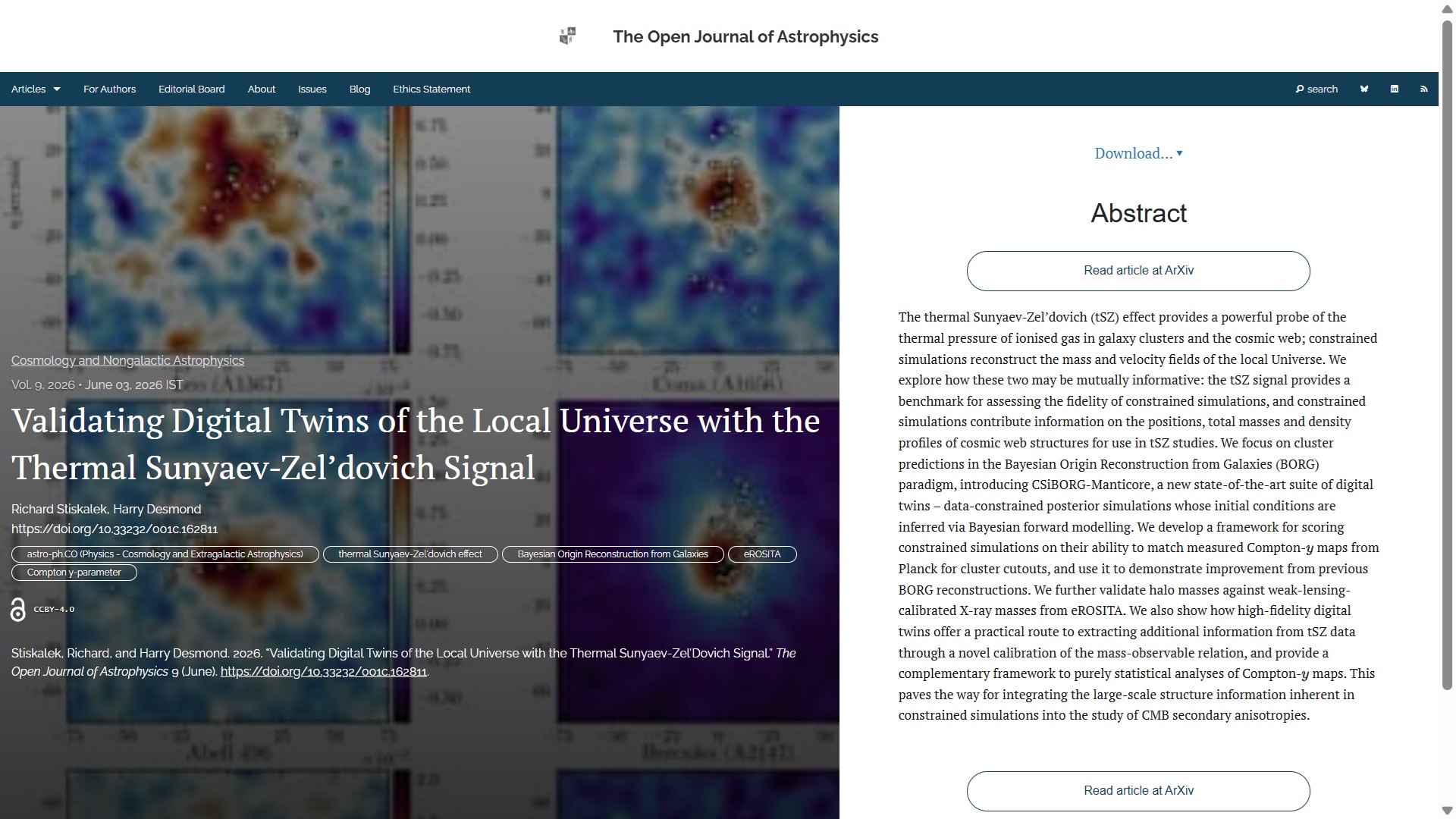
The fourth paper this week, published on Wednesday 3rd June in the folder Cosmology and Nongalactic Astrophysics, is “Validating Digital Twins of the Local Universe with the Thermal Sunyaev-Zel’dovich Signal” by Richard Stiskalek (University of Oxford, UK) and Harry Desmond (University of Portsmouth, UK). The thermal Sunyaev-Zel’dovich effect and constrained simulations are used to analyze the thermal pressure of ionized gas in galaxy clusters and produce a set of digital twins for cosmological study.

The overlay is here:

The officially accepted version can be found on arXiv here and here is the Mastodon announcement:

Open Journal of Astrophysics

New Publication at the Open Journal of Astrophysics: "Validating Digital Twins of the Local Universe with the Thermal Sunyaev-Zel’dovich Signal" by Richard Stiskalek (U. Oxford, UK) and Harry Desmond (U. Portsmouth, UK)

doi.org/10.33232/001c.162811

June 3, 2026, 5:15 am 1 boosts 1 favorites

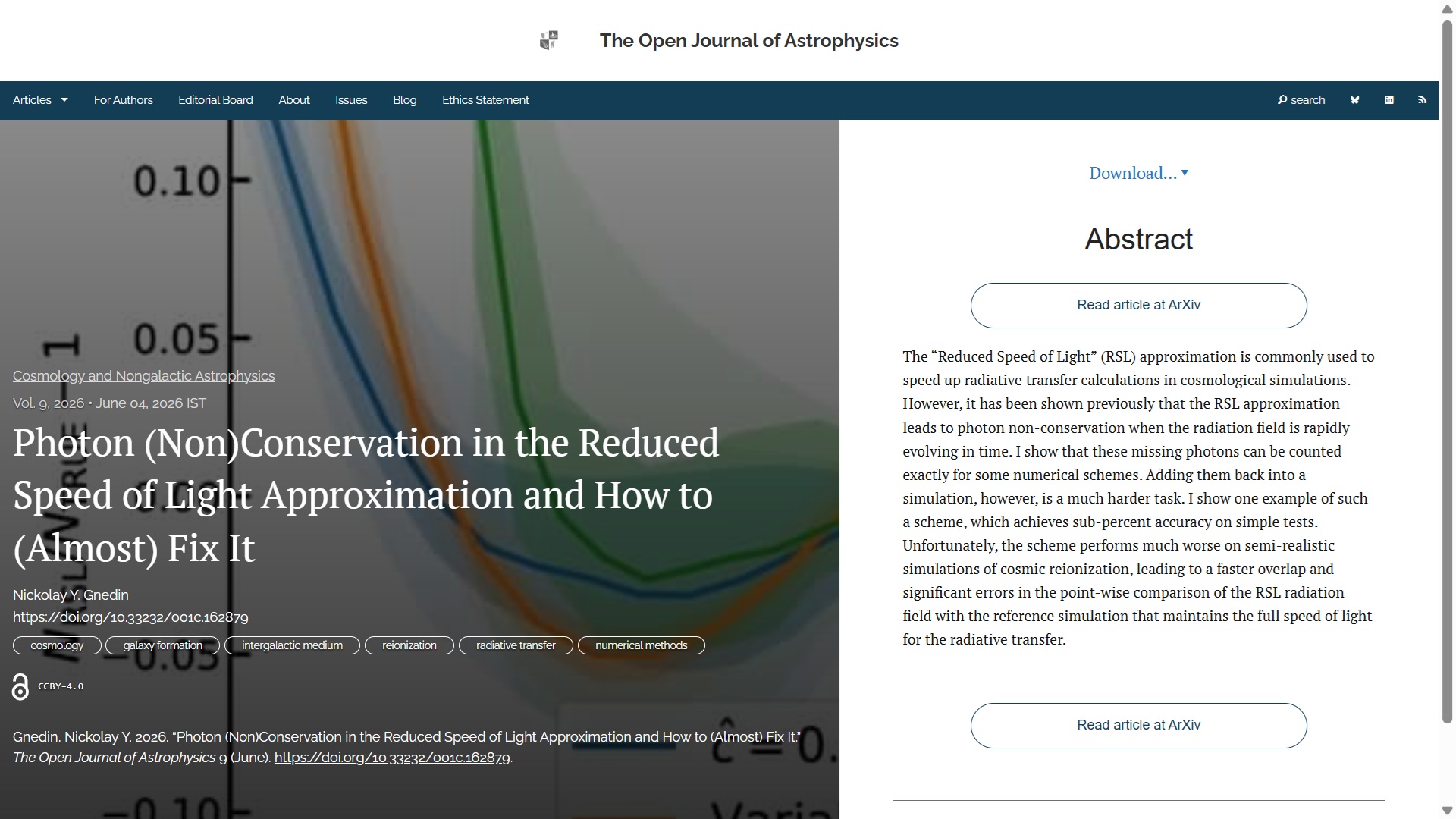
The fifth and final paper this week, published on Thursday 4th June in the folder Cosmology and Nongalactic Astrophysics is “Photon (Non)Conservation in the Reduced Speed of Light Approximation and How to (Almost) Fix It” by Nickolay Y. Gnedin (University of Chicago, USA). The “Reduced Speed of Light” approximation in cosmological simulations can lead to photon non-conservation, and while some missing photons can be counted, adding them back is challenging.

The overlay for this one is here:

The officially accepted version of this paper can be found on arXiv here and Mastodon announcement here

Open Journal of Astrophysics

New Publication at the Open Journal of Astrophysics: "Photon (Non)Conservation in the Reduced Speed of Light Approximation and How to (Almost) Fix It" by Nickolay Y. Gnedin (U. Chicago, USA)

doi.org/10.33232/001c.162879

June 4, 2026, 11:20 am 2 boosts 1 favorites

And that concludes this week’s update. I’ll do another one next Saturday.

Weekly Update from the Open Journal of Astrophysics – 30/05/2026

Posted in OJAp Papers, Open Access, The Universe and Stuff with tags , , , , , , , , , , , , , , , , , , on May 30, 2026 by telescoper

It’s Saturday once again, so it’s time for another update of activity at the Open Journal of Astrophysics. Since the last update we have published a further four papers, bringing the number in Volume 9 (2026) to 114 and the total so far published by OJAp up to 562.

I will continue to include the posts made on our Mastodon account (on Fediscience); these announcements also show the DOI for each paper.

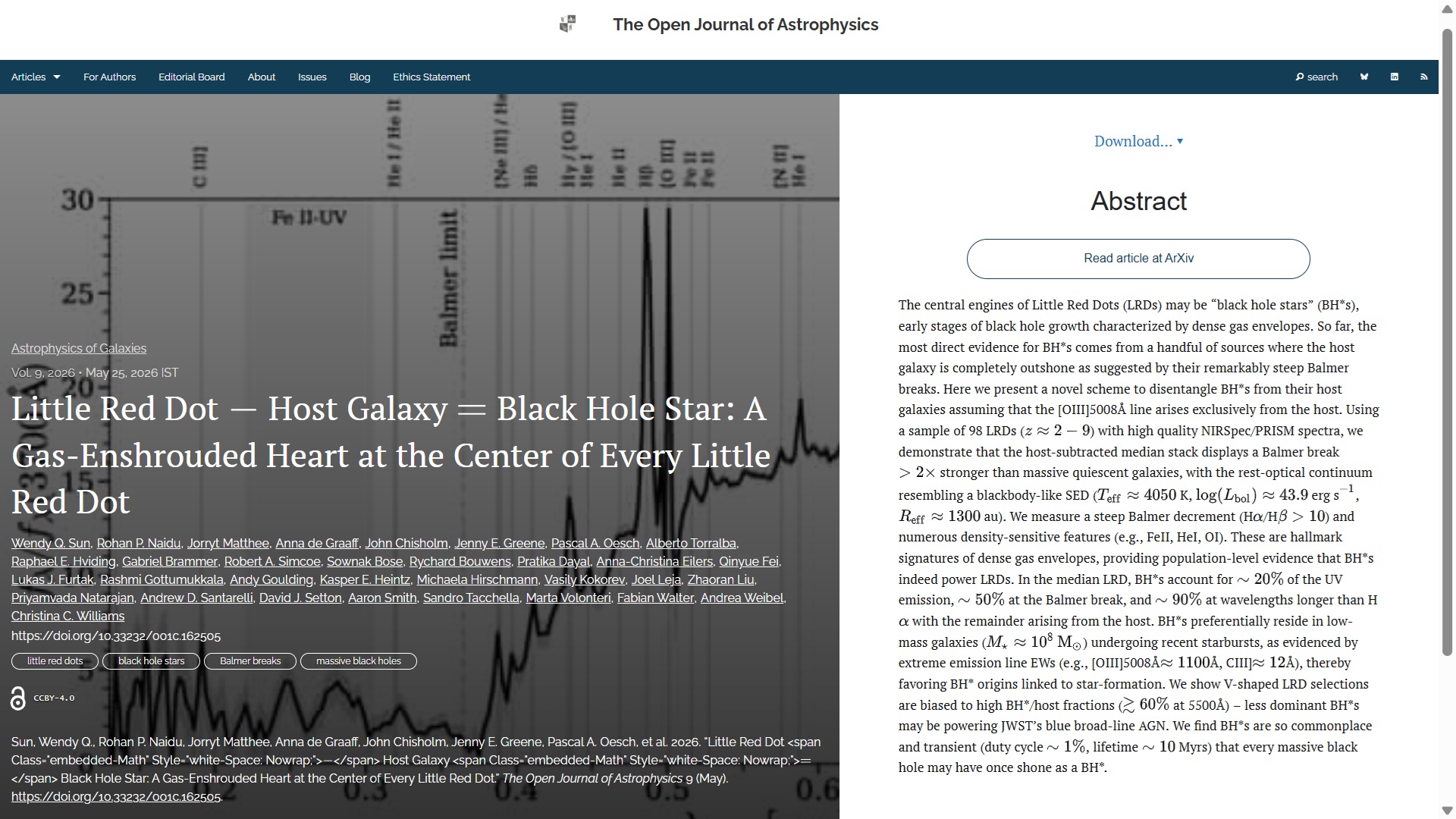
The first paper to report this week, published on Monday 25th May is “Little Red Dot – Host Galaxy = Black Hole Star: A Gas-Enshrouded Heart at the Center of Every Little Red Dot” by Wendy Q. Sun (MIT, USA) and 32 others from around the world. This study presents evidence that “black hole stars” (BH*), early stages of black hole growth, power Little Red Dots (LRDs) and every massive black hole may have been a BH*.

The overlay for this paper is here

You can find the officially accepted version on arXiv here and the announcement on Fediverse here:

Open Journal of Astrophysics

New Publication at the Open Journal of Astrophysics: "Little Red Dot – Host Galaxy = Black Hole Star: A Gas-Enshrouded Heart at the Center of Every Little Red Dot" by Wendy Q. Sun (MIT, USA) and 32 others from around the world.

doi.org/10.33232/001c.162505

May 25, 2026, 7:13 am 1 boosts 0 favorites

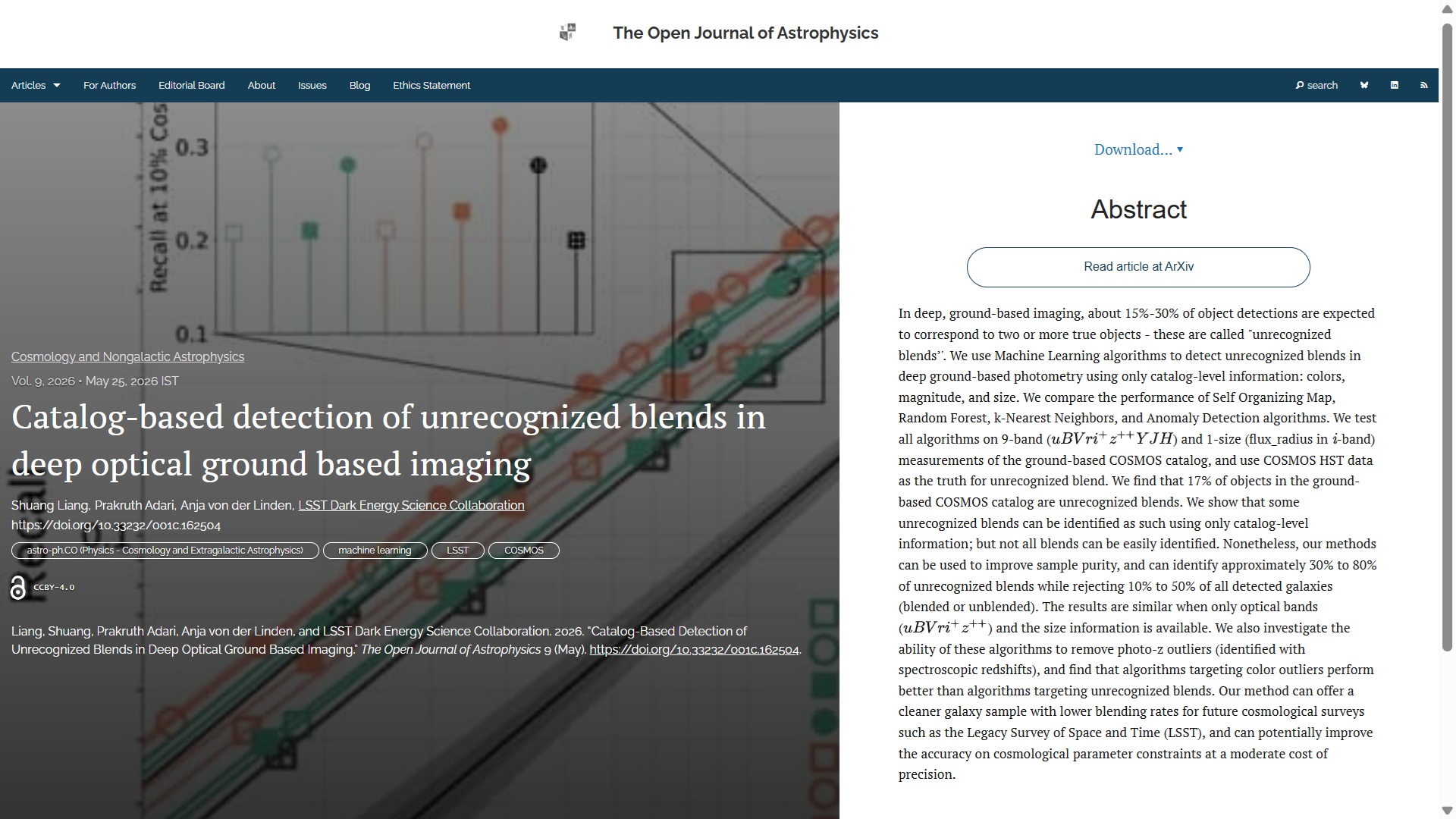
The second paper for this week, also published on Monday 25th May but in the folder Cosmology and Nongalactic Astrophysics, is “Catalog-based detection of unrecognized blends in deep optical ground based imaging” by Shuang Liang (Stanford U., USA) and Prakruth Adari & Anja von der Linden (Stony Brook U., USA) on behalf of the LSST Dark Energy Science Collaboration. The study uses machine learning to detect unrecognized blends in deep ground-based imaging, improving sample purity and potentially enhancing accuracy in future cosmological surveys.

The overlay for this one is here:

The official version of the paper can be found on arXiv here and the Fediverse announcement here:

Open Journal of Astrophysics

New Publication at the Open Journal of Astrophysics: "Catalog-based detection of unrecognized blends in deep optical ground based imaging" by Shuang Liang (Stanford U., USA) and Prakruth Adari & Anja von der Linden (Stony Brook U., USA) on behalf of the LSST Dark Energy Science Collaboration

doi.org/10.33232/001c.162504

May 25, 2026, 7:30 am 1 boosts 1 favorites

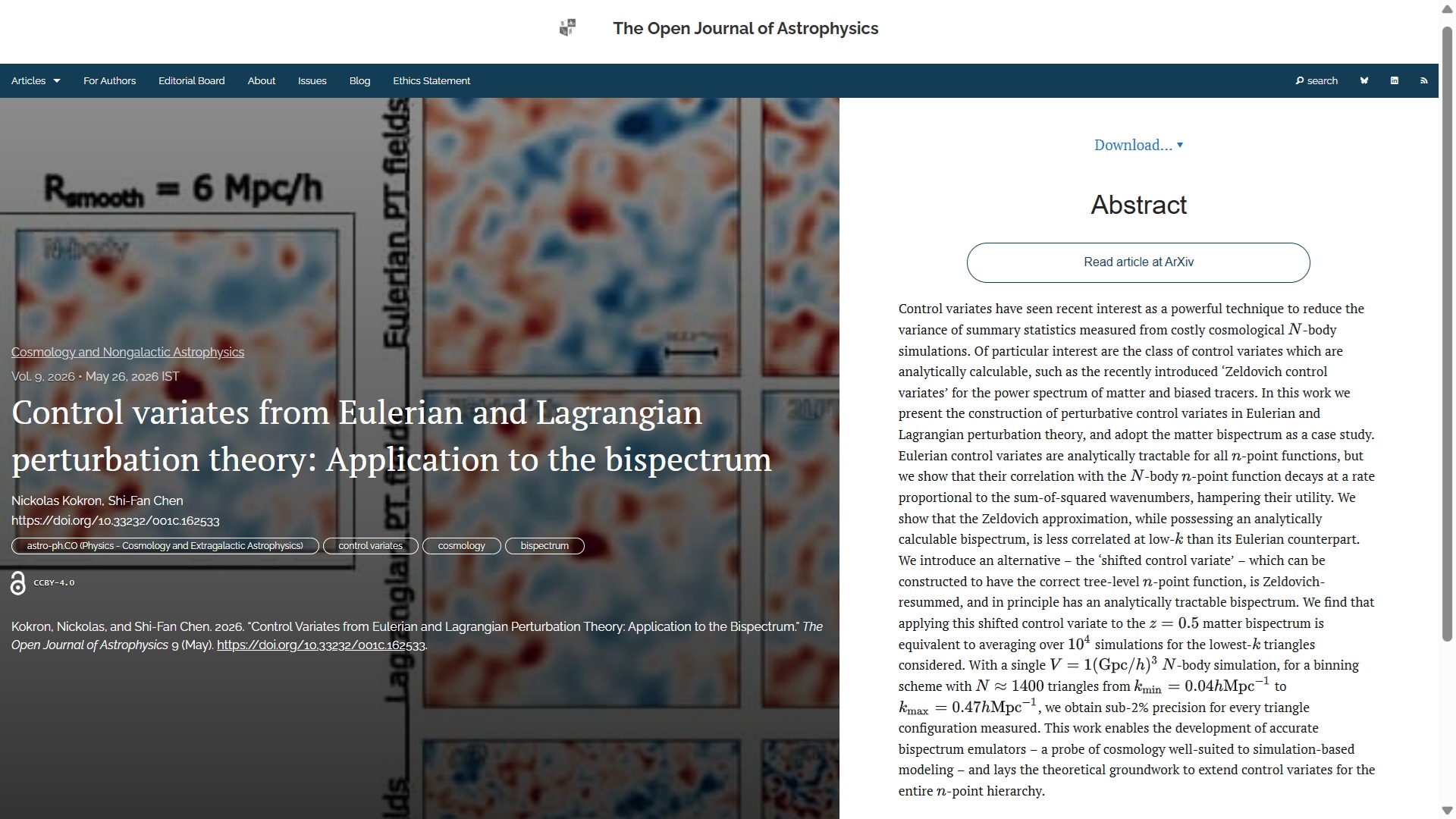
Next one up, the third paper of the week, published on Tuesday 26th May in the folder Cosmology and Nongalactic Astrophysics is “Control variates from Eulerian and Lagrangian perturbation theory: Application to the bispectrum” by Nickolas Kokron and Shi-Fan Chen (Institute for Advanced Study, Princeton, USA). This paper hexplores the use of control variates in cosmological simulations, introducing a new ‘shifted control variate’ that improves precision and enables accurate bispectrum emulators, aiding in cosmology modeling.

The overlay for this one is here:

The final, accepted version can be found on arXiv here and the Mastodon announcement is here:

Open Journal of Astrophysics

New Publication at the Open Journal of Astrophysics: "Probing Dark Energy Microphysics with kSZ Tomography" by Julius Adolff, Selim Hotinli and Neal Dalal (Perimeter Institute, Canada)

doi.org/10.33232/001c.162336

May 18, 2026, 7:04 am 1 boosts 0 favorites

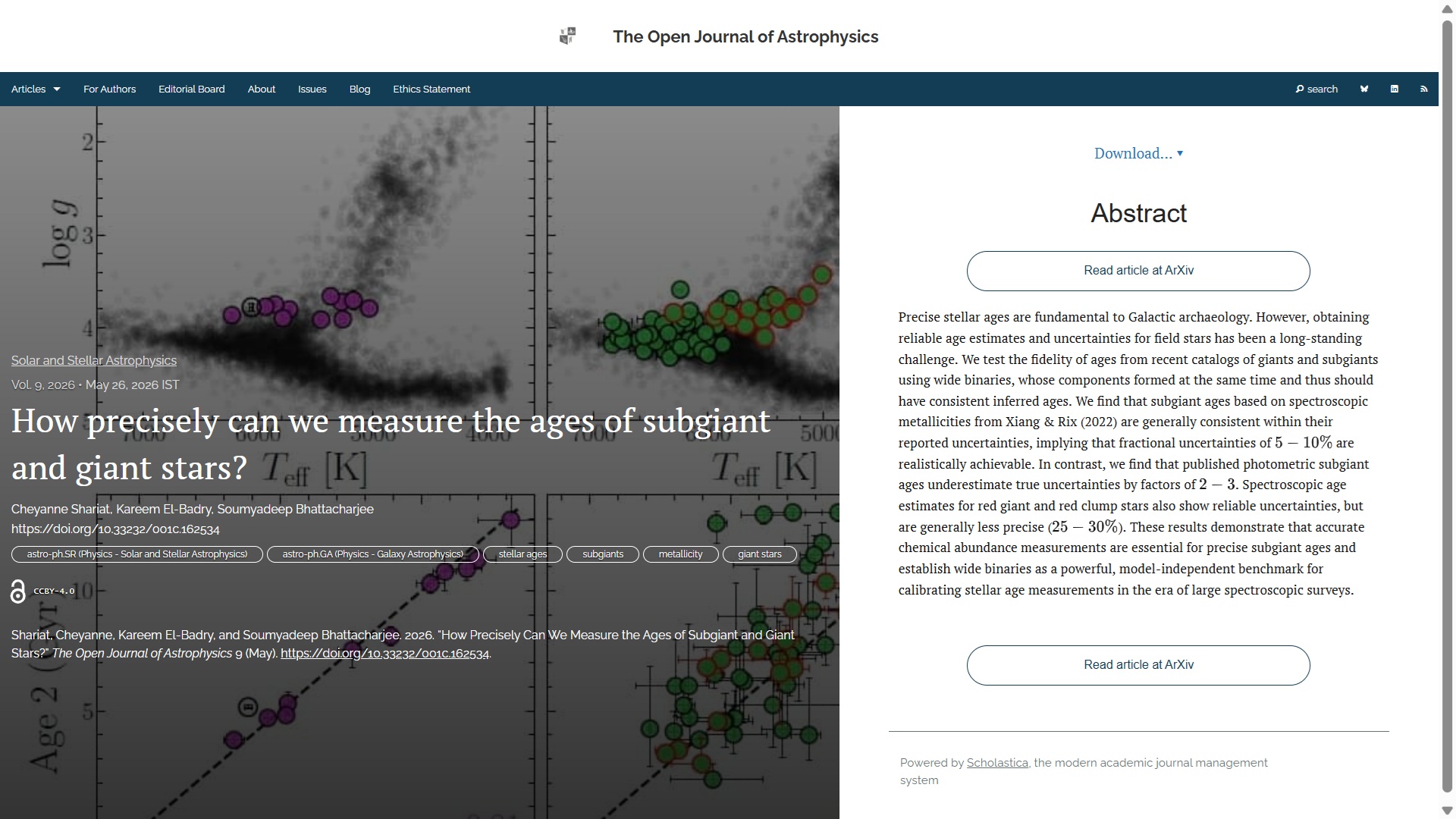
The fourth and final paper this week, also published on Tuesday 26th May is “How precisely can we measure the ages of subgiant and giant stars?” by Cheyanne Shariat, Kareem El-Badry and Soumyadeep Bhattacharjee (California Institute of Technology, USA). This article, published in the folder Solar and Stellar Astrophysics, is about testing the accuracy of stellar age estimates from recent catalogs, finding that spectroscopic metallicities provide reliable subgiant ages, while photometric ages underestimate uncertainties. Accurate chemical abundance measurements are essential.

The overlay is here:

The officially accepted version can be found on arXiv here and here is the Mastodon announcement:

Open Journal of Astrophysics

New Publication at the Open Journal of Astrophysics: "How precisely can we measure the ages of subgiant and giant stars?" by Cheyanne Shariat, Kareem El-Badry and Soumyadeep Bhattacharjee (California Institute of Technology, USA)

doi.org/10.33232/001c.162534

May 26, 2026, 7:05 am 1 boosts 0 favorites

And that concludes this week’s update. I’ll do another one next Saturday.