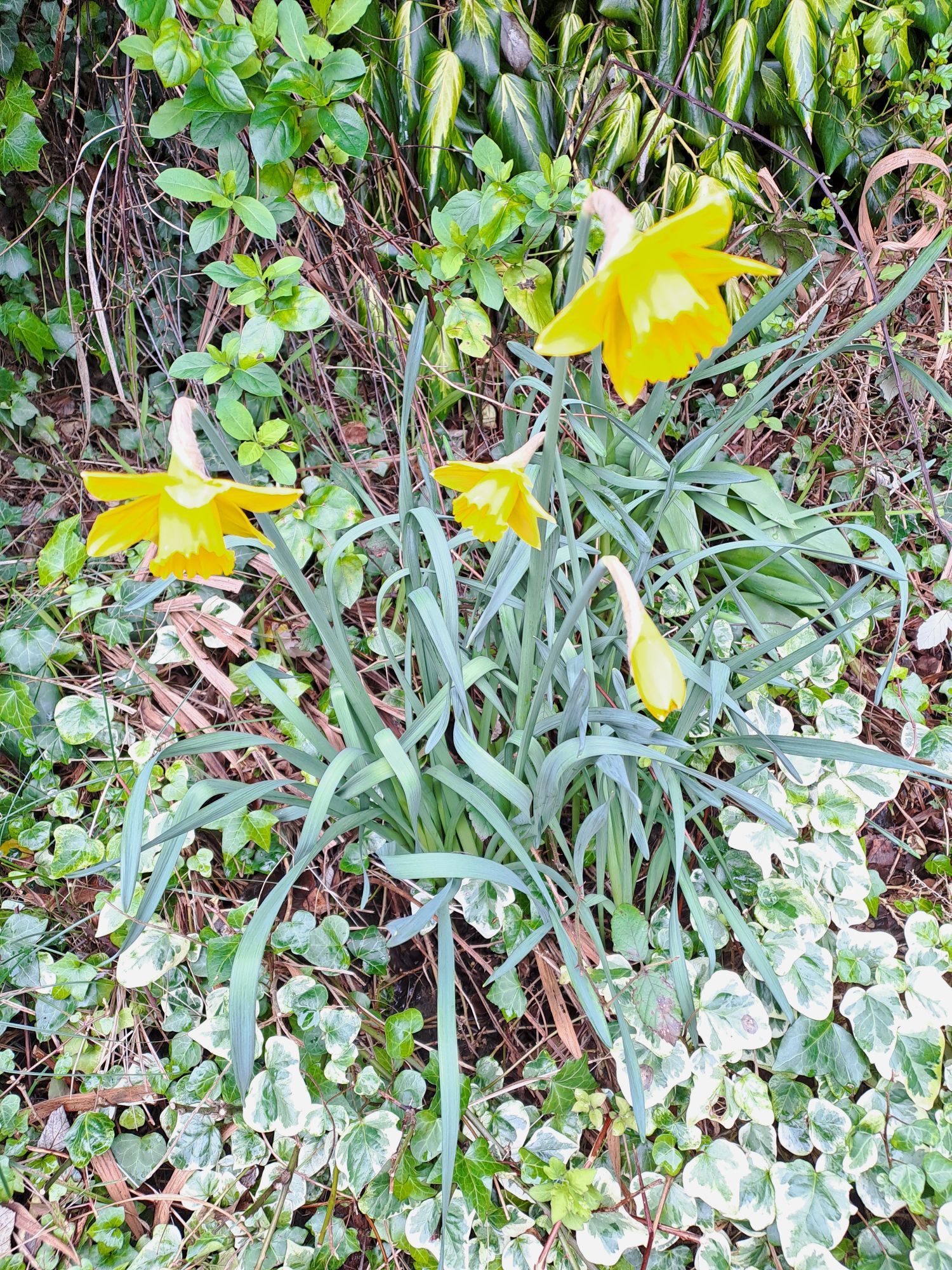
Well, today is St David’s Day so let me first offer a hearty “Dydd Gwŷl Dewi Sant hapus i chi gyd” (Happy St David’s Day to you all). Here is a picture of some daffodils amid the undergrowth in my garden:
Over the years, I seem to have established a tradition of posting a bit of poetry to mark this special day for Wales and the Welsh and given current events I chose this one which I have posted before, about 9 years ago. It was written in Welsh by Hedd Wyn (born Ellis Humphrey Evans) who lived from 1887 to 1917; Hedd Wyn was his bardic name and it translates (roughly) as “pure peace”.
Hedd Wyn was a non-conformist Christian and a pacifist who was conscripted into the British Army to serve in World War 1. He was posted to Flanders and was killed in action on 31st July 1917, the first day of the 3rd Battle of Ypres. He was hit in the stomach by a shell and died later of his wounds. The battle stumbled on for months of horrific slaughter as the planned Allied offensive foundered in the mud of Passchendaele and ended, as had the Battle of the Somme a year earlier, in a bloody stalemate.
A few weeks before his death, Hedd Wyn wrote a poem called Yr Arwr (‘The Hero’) which was submitted for the prestigious Bard’s Chair at that year’s National Eisteddfod. It was announced on 6th September 1917 that he had won the prize, posthumously. The bard not being able to sit in the the chair, it was draped in black cloth. The Prime Minister, David Lloyd George, was present at the ceremony.
The poem Yr Arwr is a very long work, running to 13 pages of manuscript, which is not practicable to post here, but here’s another poem by Hedd Wyn. This is called Rhyfel (‘War’). I only have a few words of Welsh, but because of the occasion, it seems appropriate to post this in its original language. You can find English translations here and on the Wikipedia page here. Translating poetry is always very difficult, but the sense of the poem is of a world in chaos that has been abandoned by God.
Gwae fi fy myw mewn oes mor ddreng
 A Duw ar drai ar orwel pell;
 O'i ôl mae dyn, yn deyrn a gwreng,
 Yn codi ei awdurdod hell.

Pan deimlodd fyned ymaith Dduw
 Cyfododd gledd i ladd ei frawd;
 Mae swn yr ymladd ar ein clyw,
 A'i gysgod ar fythynnod tlawd.

Mae'r hen delynau genid gynt
 Ynghrog ar gangau'r helyg draw,
 A gwaedd y bechgyn lond y gwynt,
 A'u gwaed yn gymysg efo'r glaw.
It’s Saturday once more, so it’s time for another update of activity at the Open Journal of Astrophysics. It has been a busy week. Since the last update we have published a further nine papers, bringing the number in Volume 9 (2026) to 45 and the total so far published by OJAp up to 493.
I will continue to include the posts made on our Mastodon account (on Fediscience) to encourage you to visit it. Mastodon is a really excellent service, and a more than adequate replacement for X/Twitter (which nobody should be using); these announcements also show the DOI for each paper.
The first four papers this week were all published on Monday 23rd February.
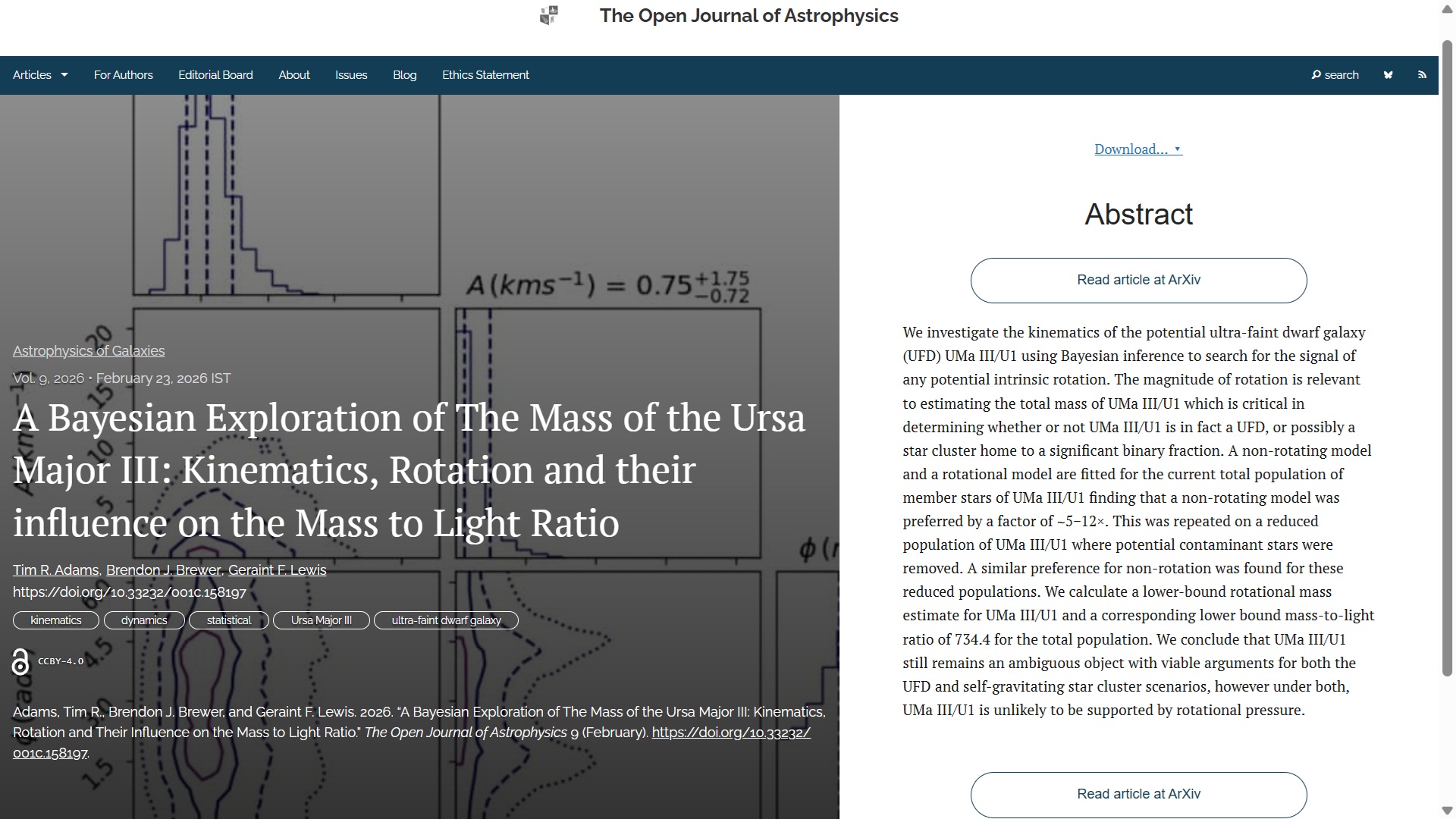
New Publication at the Open Journal of Astrophysics: "A Bayesian Exploration of The Mass of the Ursa Major III: Kinematics, Rotation and their influence on the Mass to Light Ratio" by Tim R. Adams (U. Sydney, Australia), Brendon J. Brewer (U. Auckland, New Zealand) and Geraint F. Lewis (Sydney)
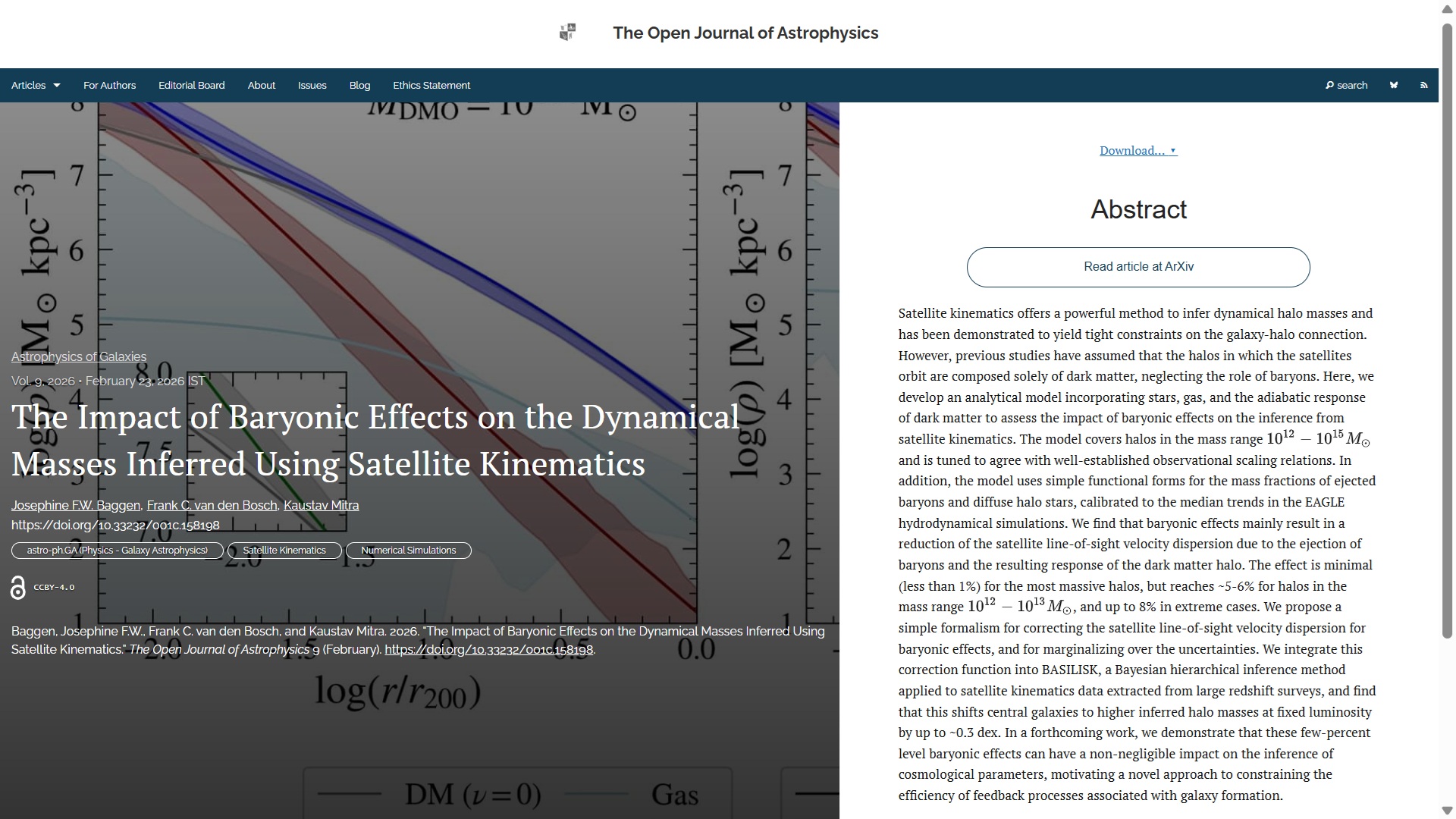
The second paper is “The Impact of Baryonic Effects on the Dynamical Masses Inferred Using Satellite Kinematics” by Josephine F.W. Baggen, Frank C. van den Bosch, and Kaustav Mitra (Yale U., USA). This paper, also in the folder Astrophysics of Galaxies, presents a model to assess the impact of stars and gas on satellite kinematics, showing that these baryonic effects can reduce the satellite velocity dispersion and increase inferred central galaxy masses.
The overlay for this one is here:
The official version of the paper can be found on arXiv here and the Fediverse announcement here:
New Publication at the Open Journal of Astrophysics: "The Impact of Baryonic Effects on the Dynamical Masses Inferred Using Satellite Kinematics" by Josephine F.W. Baggen, Frank C. van den Bosch, and Kaustav Mitra (Yale U., USA)
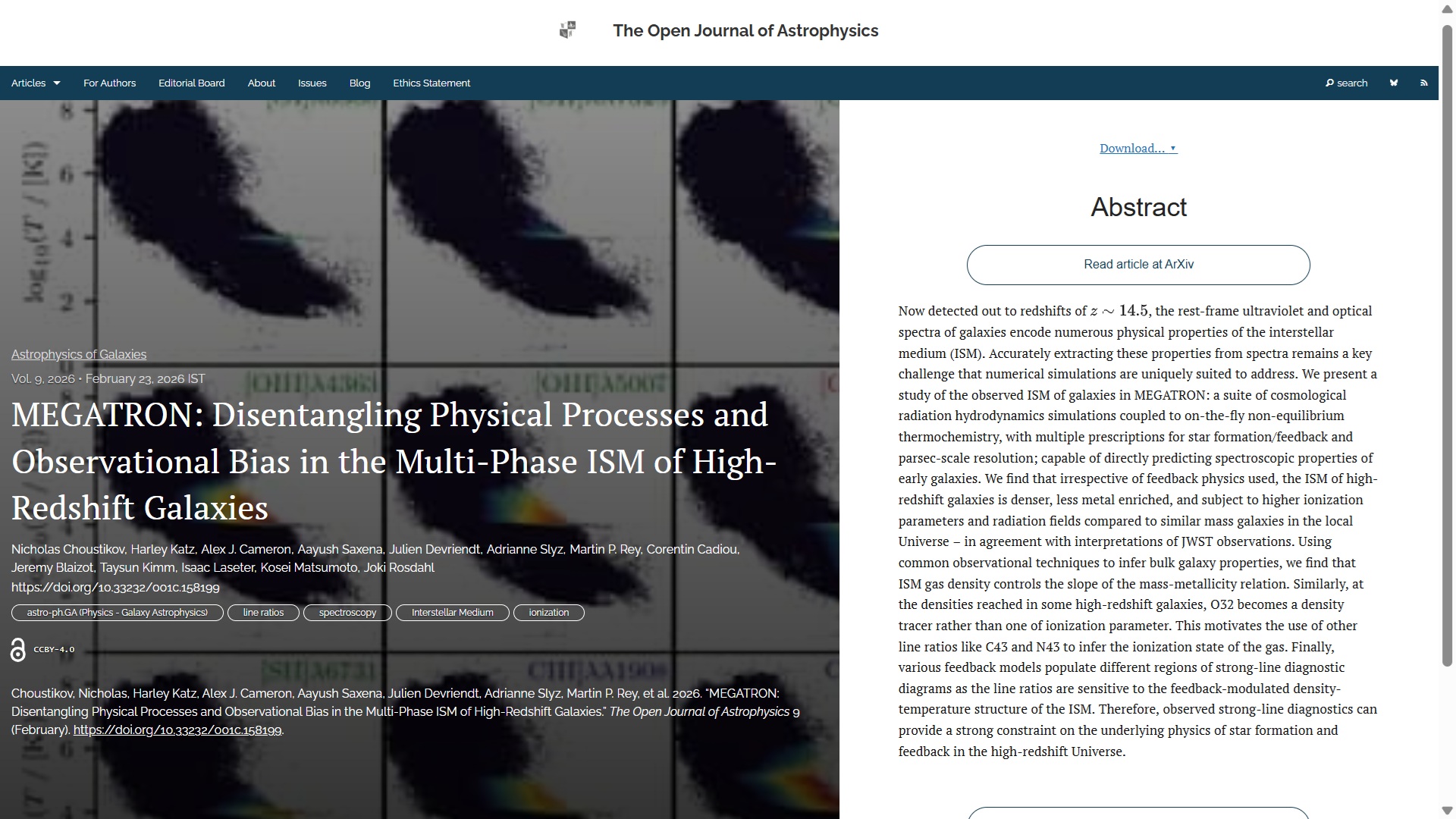
The third paper this week, and the third published on Monday 23rd February, and the third in the folder Astrophysics of Galaxies, is “MEGATRON: Disentangling Physical Processes and Observational Bias in the Multi-Phase ISM of High-Redshift Galaxies” by Nicholas Choustikov (U. Oxford, UK) and 12 others based in UK, USA, France, Korea and Belgium. The study uses MEGATRON simulations to analyze the interstellar medium (ISM) of high-redshift galaxies, finding it denser and less metal-enriched than local galaxies with implications for line ratios as diagnostics
The overlay is here:
The official version can be found on arXiv here and the Fediverse announcement is here:
New Publication at the Open Journal of Astrophysics: "MEGATRON: Disentangling Physical Processes and Observational Bias in the Multi-Phase ISM of High-Redshift Galaxies" by Nicholas Choustikov (U. Oxford, UK) and 12 others based in UK, USA, France, Korea and Belgium
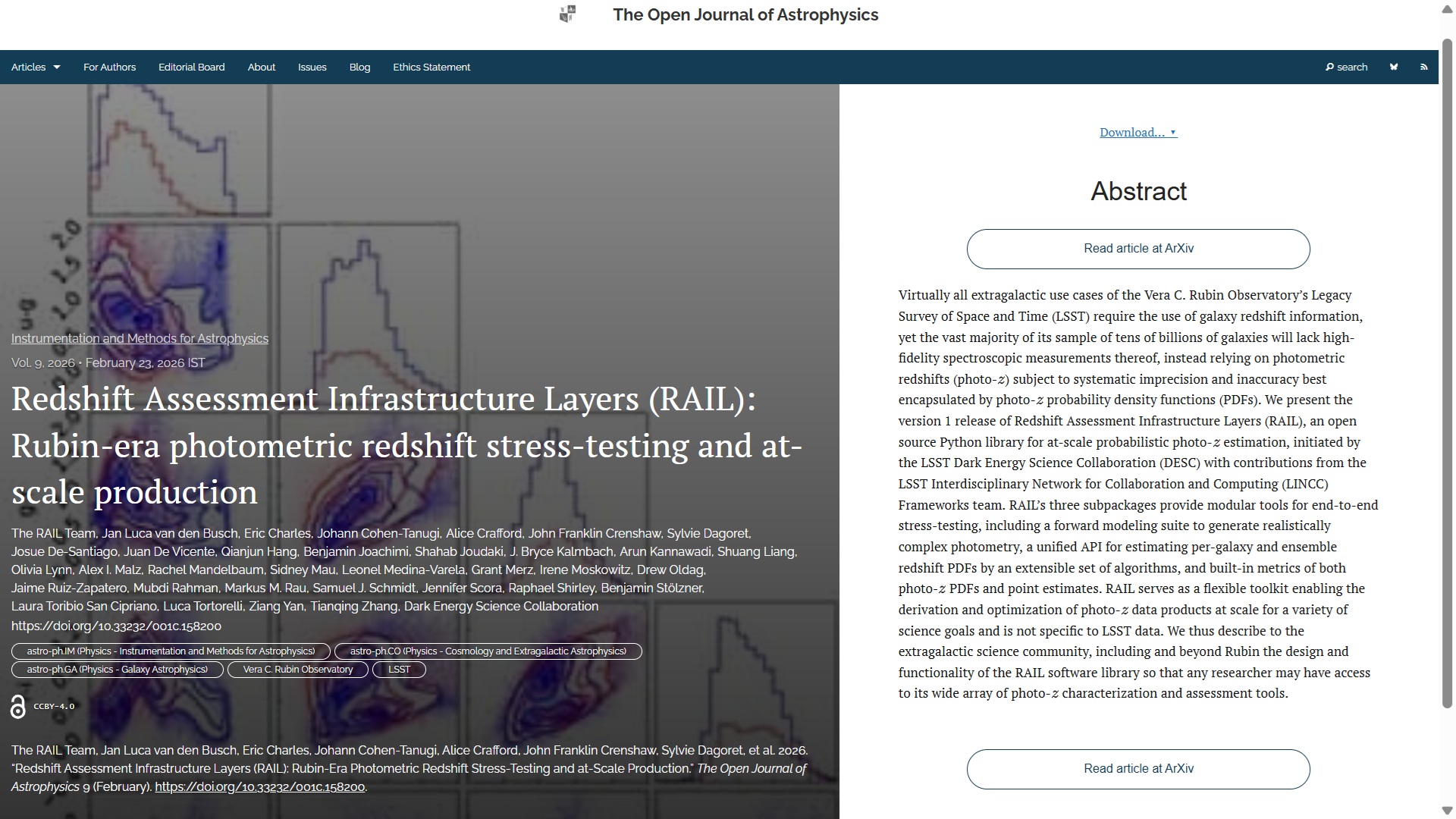
New Publication at the Open Journal of Astrophysics: "Redshift Assessment Infrastructure Layers (RAIL): Rubin-era photometric redshift stress-testing and at-scale production" by the RAIL Team (31 authors) and the Dark Energy Science Collaboration
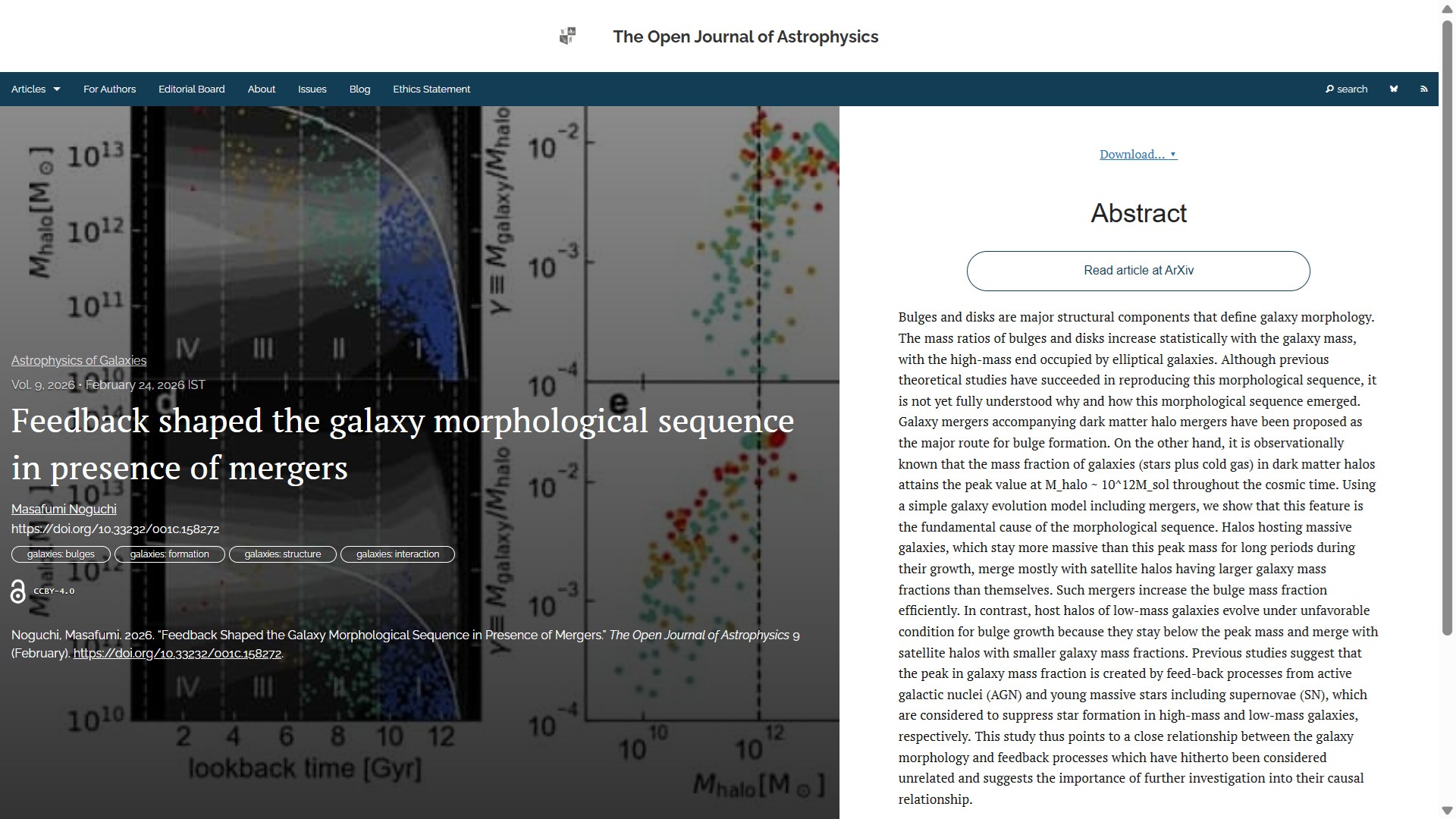
Moving on to Tuesday 24th February, the fifth paper this week, is “Feedback shaped the galaxy morphological sequence in presence of mergers” by Masafumi Noguchi (Tohoku University, Japan). This article was published in the folder Astrophysics of Galaxies. This study suggests that galaxy morphology, specifically the mass ratios of bulges and disks, is influenced by galaxy mergers and feedback processes from active galactic nuclei and supernovae.
The overlay is here:
The accepted version can be found on arXiv here, and the fediverse announcement is here:
New Publication at the Open Journal of Astrophysics: "Feedback shaped the galaxy morphological sequence in presence of mergers" by Masafumi Noguchi (Tohoku University, Japan)
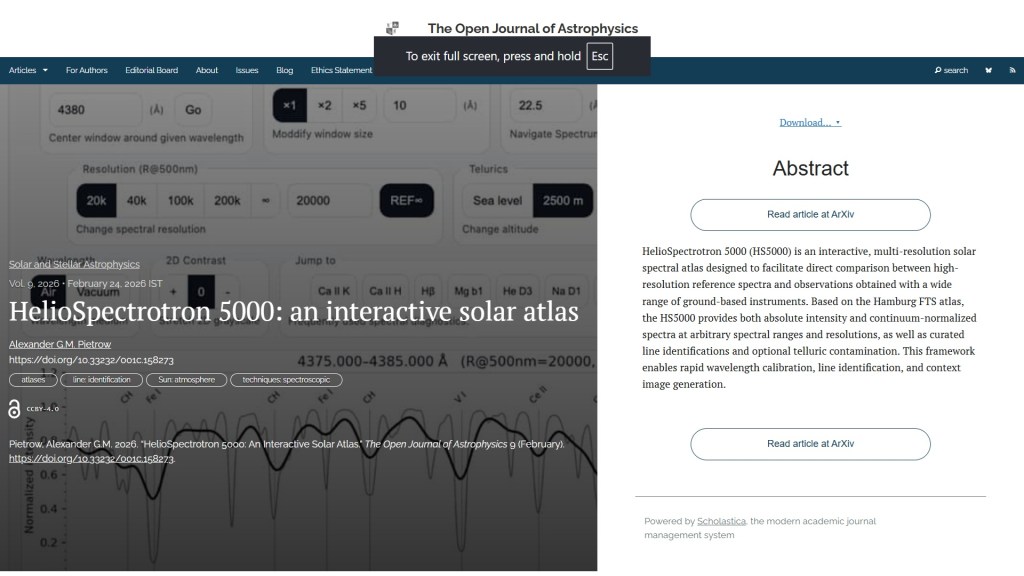
The sixth paper this week is “HelioSpectrotron 5000: an interactive solar atlas” by Alexander G.M. Pietrow (AIP Potsdam, Germany). This was published on Tuesday 24th February in the folder Solar and Stellar Astrophysics. This describes HelioSpectrotron~5000 (HS5000), which is an interactive solar spectral atlas that allows comparison between high-resolution spectra and ground-based instrument observations, aiding in wavelength calibration and line identification. The software can be found here; I had a play with it yesterday and it’s very easy to use!
The overlay is here:
You can find the officially accepted version on arXiv here and the Mastodon announcement is here:
New Publication at the Open Journal of Astrophysics: "HelioSpectrotron 5000: an interactive solar atlas" by Alexander G.M. Pietrow (AIP Potsdam, Germany)
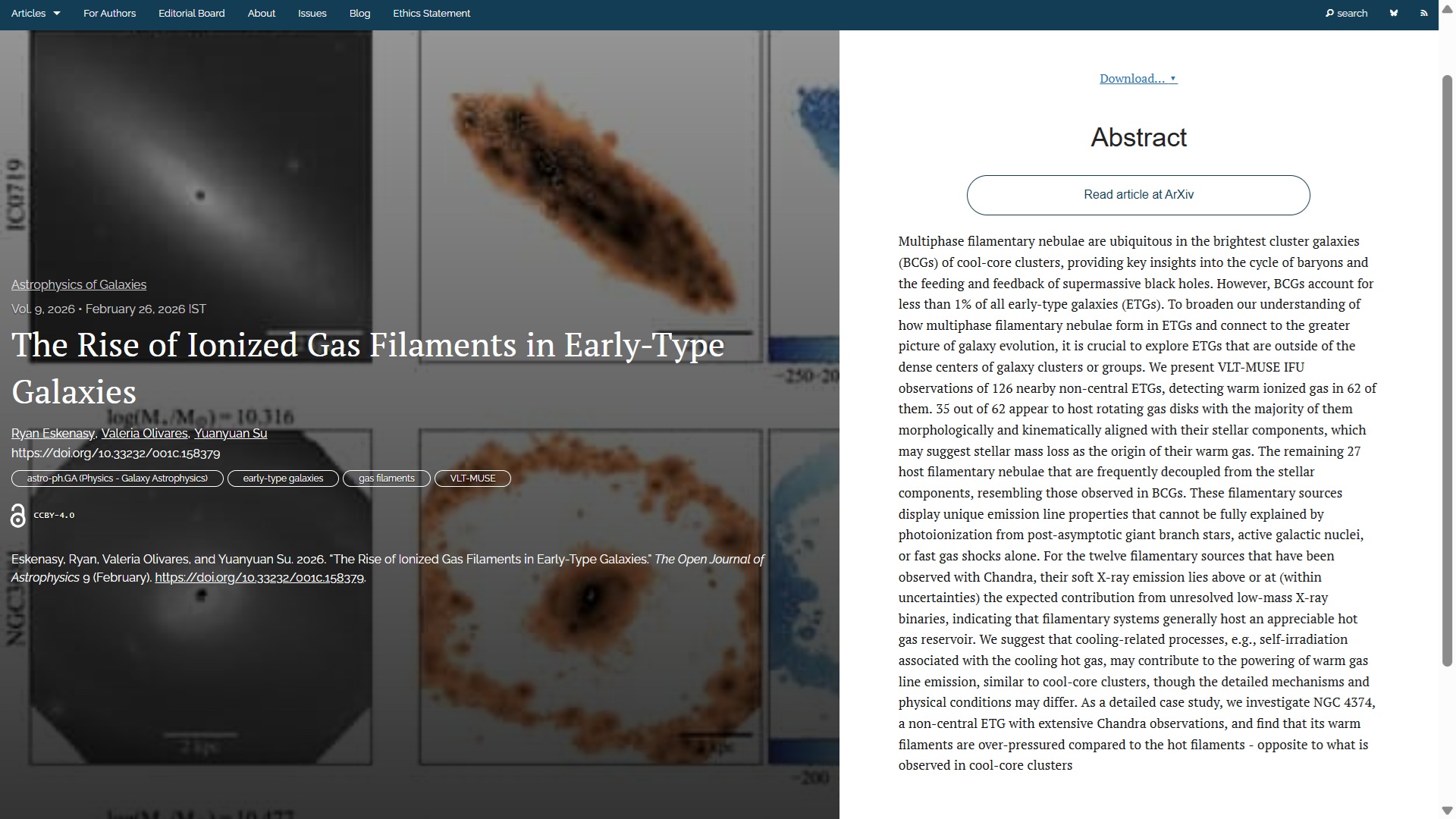
The seventh paper of this week was published on Thursday 26th February is “The Rise of Ionized Gas Filaments in Early-Type Galaxies” by Ryan Eskenasy (U. Kentucky, USA), Valeria Olivares (Universidad de Santiago de Chile) and Yuanyuan Su (U. Kentucky, USA). This article, in the folder Astrophysics of Galaxies, is an exploration of the formation of multiphase filamentary nebulae in early-type galaxies (ETGs), using VLT-MUSE IFU observations of 126 non-central ETGs, focussing on the hot gas components thereof.
The overlay is here:
The officially accepted version of this paper can be found on the arXiv here and the Mastodon announcement is here:
New Publication at the Open Journal of Astrophysics: "The Rise of Ionized Gas Filaments in Early-Type Galaxies" by Ryan Eskenasy (U. Kentucky, USA), Valeria Olivares (Universidad de Santiago de Chile) and Yuanyuan Su (U. Kentucky, USA)
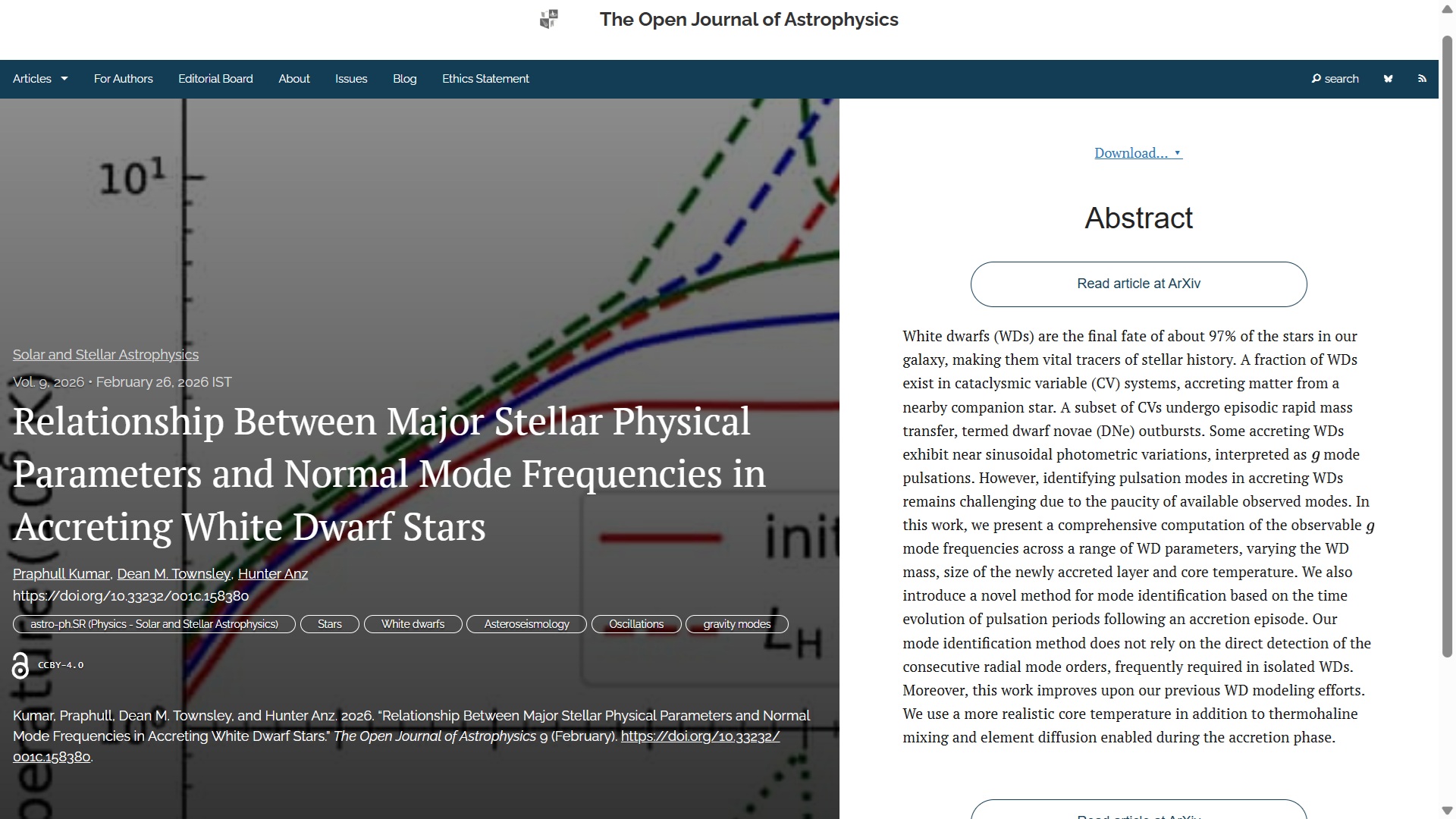
New Publication at the Open Journal of Astrophysics: "Relationship Between Major Stellar Physical Parameters and Normal Mode Frequencies in Accreting White Dwarf Stars" by Praphull Kumar, Dean M. Townsley and Hunter Anz (U. Alabama, USA)
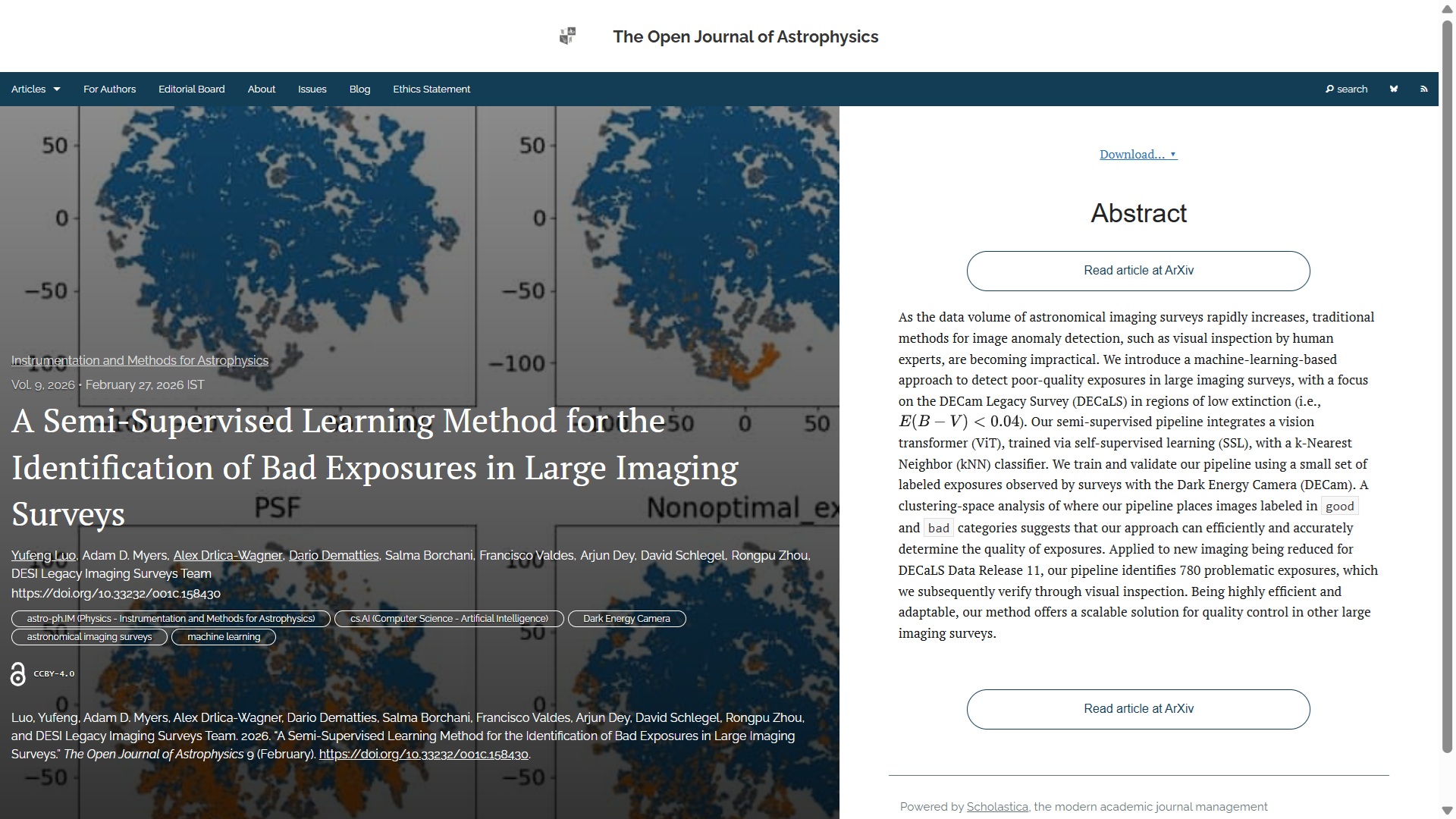
The ninth, and final, paper for this week is “A Semi-Supervised Learning Method for the Identification of Bad Exposures in Large Imaging Surveys” by Yufeng Luo (U. Wyoming, USA) and 8 others from the DESI Legacy Imaging Surveys Team. This was published on Friday 27th February, i.e yesterday, in the folder Instrumentation and Methods for Astrophysics. The paper describes a machine-learning approach for detecting poor-quality exposures in large astronomical imaging surveys, proving efficient and accurate in identifying problematic exposures.
The overlay is here:
The official version on arXiv can be found here and the Mastodon announcement follows:
New Publication at the Open Journal of Astrophysics: "A Semi-Supervised Learning Method for the Identification of Bad Exposures in Large Imaging Surveys" by Yufeng Luo (U. Wyoming, USA) and 8 others from the DESI Legacy Imaging Surveys Team
And that concludes this week’s update. We have now published 45 papers in two complete months of 2026, on which basis we can estimate about 270 papers in the year. For the record, in the first two months of 2025 we published 21 papers.
P.S. Thank you to the many people who responded to the latest call for editors. I’ve been sending out invitations and getting people onboard as quickly as I can, but I still have a number to get to so please bear with me!
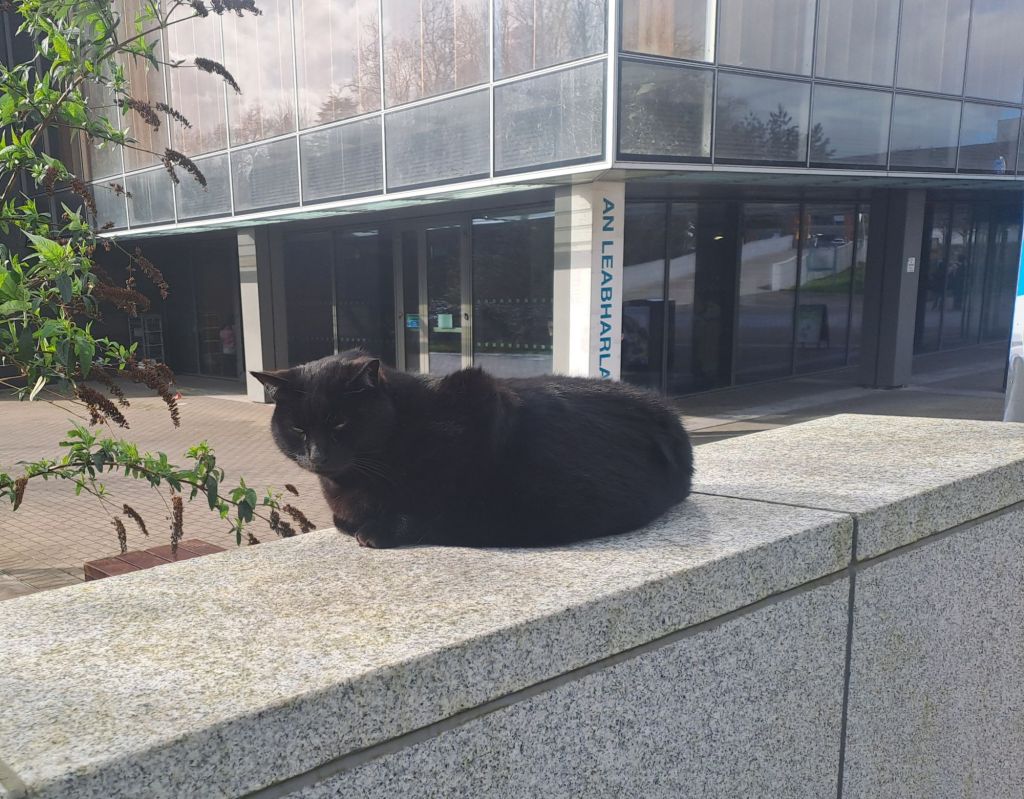
It being a spring-like day, Maynooth University Library Cat took the opportunity to choose a spot away from his usual post so he could loaf in the sunshine.
Some weeks ago, in early January, I saw a story in the Irish Independent about Brian Lucey, a Professor in Trinity Business School. That story was subsequently featured in Retraction Watch which you can read if you can’t get past the paywall at the Irish Independent. It seems that 12 papers written by Professor Lucey were retracted after having been published in journals run by Elsevier for which Prof. Lucey was Editor in which capacity he made the final decision to publish them. Quoting from Retraction Watch:
“We can confirm these papers were retracted from 19 December to 23 December 2025,” an Elsevier spokesperson told us. “We uphold the highest standards of rigor and ethics in our publishing to protect the quality and integrity of research. Editors can publish in their journals as long as they are compliant to our policies. Please refer to our Publishing Ethics policies for further information regarding editorial conflicts of interests.”
The most surprising thing I learnt from this is that Elsevier apparently has a Publication Ethics policy!
Anyway, according to this piece by Chris Brunet, which includes a list of all the retracted papers, it seems this story has escalated considerably since January. The 12 papers mentioned above, all with Brian Lucey on their author list, had accumulated over five thousand citations between them. Prof. Lucey published 56 papers in 2025 – that’s a rate of more than one a week – raising suspicions that he has been adding his name to papers to which he made a minimal contribution. The previously-mentioned source also contains allegations of serious academic misconduct and other ethical violations, including the creation of a publishing and citation cartel.
Prof. Lucey has now been removed as an Editor from 5 journals: International Review of Financial Analysis, the International Review of Economics & Finance, Finance Research Letters, Financial Management, & Energy Finance. I don’t know if Prof. Lucey is subject to an internal investigation at Trinity College, Dublin, but he should be.
This episode is symptomatic of a commercial academic publishing industry which is rotten to the core, but which nobody seems willing to do anything about. I’ll take this opportunity to remind you that Elsevier owns Scopus, which passes itself off as a quality control agency for academic journals. It would be hilarious if it weren’t so outrageous.
Approaching the 10th anniversary of the untimely death at the age of 48 of David MacKay, who was Regius Professor of Engineering at the University of Cambridge. I wrote about him at the time of his passing here. I’ve just been told about a one-day meeting in Cambridge on March 27th 2026 to remember David and his work and thought I would do a quick post to pass on a flier (below) about the meeting in case any readers of this blog would like to attend.
One of the curiosities that sometimes arise from running a blog is that old posts suddenly start generating new traffic. This happened again yesterday when after lying dormant for many years, this post suddenly got a large number of hits after lying dormant for many years. The reason for its reactivation is that it concerns the sill unsolved murder of Alex Blue in Glasgow in 2002. There is apparently to be a review of evidence in this cold case, the announcement of which has been in the media, hence the increase in blog traffic. Anyway, here is what I wrote about the case and my own (very slight) connection to it. Note the last sentence.
–0–
One day in June 2003, when I got home to my house in Beeston after work at Nottingham University, I found that a card had been put through my letterbox. It was from Nottingham CID and bore the name of a Detective Sergeant followed by `Vice Squad’. I forget his actual name. Apparently the Officer concerned had called when I wasn’t in and left the note asking me to call back. I was a bit perturbed that it was apparently to do with something under the remit of the Vice Squad but it didn’t give any details except for a telephone number. Anyway, being a cooperative person, I phoned the number and a few days later the policeman came to my house to interview me.
It turned out to have nothing to do with the Vice Squad nor even anything to do with Nottingham. It was to do with an incident in Glasgow that had happened almost a year previously (in 2002): the policeman who interviewed me just happened to be available to run this particular errand on behalf of the Glasgow CID.
The police had traced me because I had paid a bill in a curry house in the Byres Road area of Glasgow’s West End with my credit card. I should explain that the reason I was having a meal in Glasgow that night was that at that time I was External Examiner for the undergraduate courses in Astronomy at the University of Glasgow, a task that involved staying two nights in a B&B near the University. In fact when I spoke to the Police Officer I was about to go to Glasgow again for the same purpose.
I was asked to recall my movements for the evening concerned (24th June 2002). It was almost a year previously and I couldn’t help much, but I did remember that I (along with some companions from the Department) tried to get into the curry house earlier in the evening, but it was very busy so we adjourned to a pub for a pint or two before returning and getting a table. A helpful comment below reminded me that the establishment concerned was Ashoka in Ashton Lane, in the West End of Glasgow.
I could remember only two things really. One was that it was a warm sunny evening and there were lots of people outside drinking in the sunshine. The other that it was getting dark when we left Ashoka after the meal, which at that time of year would make it rather late. The Officer pointed out that my credit card had been charged after 11pm, which fits with that recollection. I had paid for my meal with the intention of claiming the cost on expenses. The food was excellent, by the way.
`Can you describe the other people in the restaurant when you were there?’ he asked me. I could barely remember who was at my table, never mind any strangers, and couldn’t think of anything useful to say at all except that it was very busy.
`What’s this all about?’, I asked the Officer.
It was then revealed to me that somebody had been murdered that night, just around the corner from where I was staying. Actually he had been left for dead in the driveway of his house with serious head injuries received in the early hours of the following morning, and died a few days later. The police strongly suspected he had eaten in the same restaurant we were in, possibly with the person or persons who killed him. The Officer showed me a picture of the victim but it didn’t ring any bells.
Because of the time that had elapsed I wasn’t able to help very much at all, though to be honest I doubt I would have been able to help if I’d been asked the day after the event. I just wasn’t paying much attention, and there wasn’t a row or anything that I might have noticed.
And that was that. Interview over. I signed a witness statement and the Officer left. I never heard any more about it. It was obviously a cold case then – otherwise the Police wouldn’t have been following such tenuous leads – and it’s an even colder case now. I believe the case was featured on Crimewatch or some such, but without success.
The murder (still unsolved) was of a man called Alex Blue. According to Wikipedia:
A businessman from the city’s west end, Blue was found outside his home with head injuries. He died two days later. Blue ran a taxi business with an annual turnover of £7m. One theory is that he was the victim of a house buying scam. He told friends he was in the process of buying a new house and planned to view it the day after he was attacked. It was later discovered the home had never been on the market. Although nobody has been charged with the murder, Blue’s mother and brother are convinced they know who murdered him. His brother said: “I know who was behind this but they got someone else to carry out their dirty work for them.”
It’s very unlikely now that whoever killed him will ever be brought to justice.
Why no! I never thought other than
That God is that great absence
In our lives, the empty silence
Within, the place where we go
Seeking, not in hope to
Arrive or find. He keeps the interstices
In our knowledge, the darkness
Between stars. His are the echoes
We follow, the footprints he has just
Left. We put our hands in
His side hoping to find
It warm. We look at people
And places as though he had looked
At them, too; but miss the reflection.
Although he was an Anglican minister, the poems of R.S. Thomas – most famously The Absence – often speak of God as absent rather than present, and the religious experience as being one of negation rather than affirmation. These views seem strange and rather comfortless coming from a priest, but as an atheist what do I know? None of that detracts from the austere beauty of his verse.
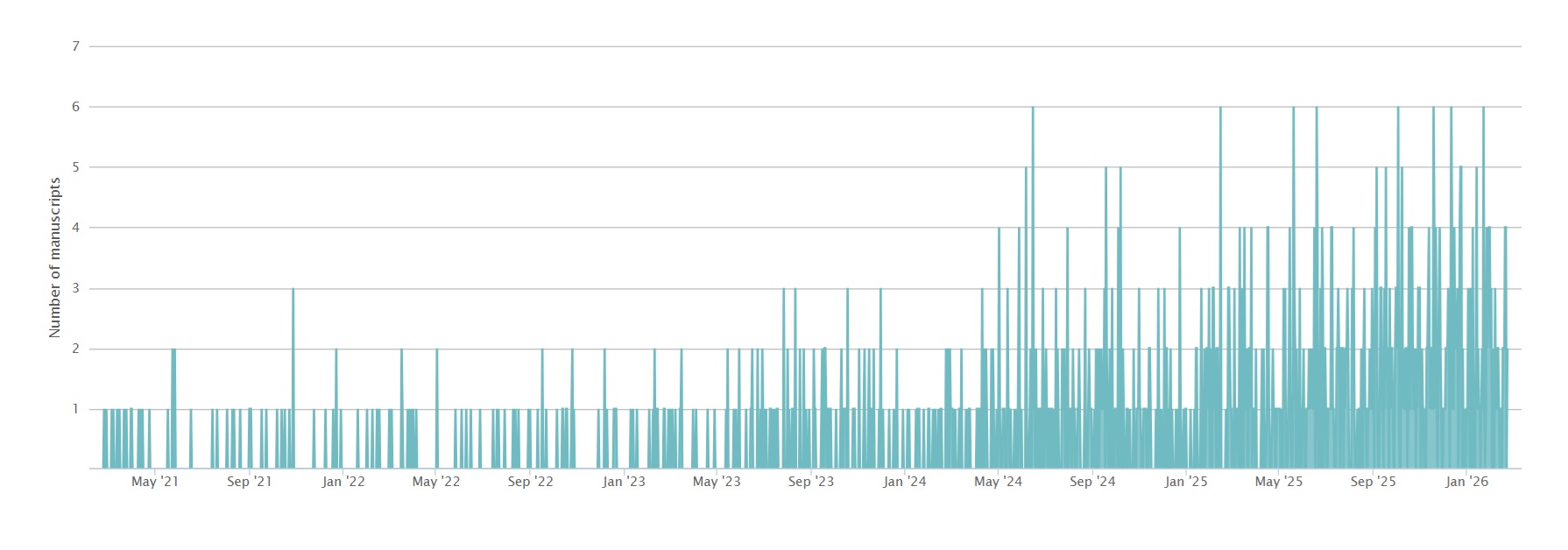
The number of papers submitted to the Open Journal of Astrophysics continues to rise, as demonstrated by this nice graphic which shows the stats for new submissions for the last five years:
It’s very clear that the thicket is getting thicker! The increasing number of articles is of course very welcome indeed, but it is increasing the load on our Editorial Board and that includes me! I think it’s time therefore to look for more volunteers to join the team, in any area of astrophysics. As a reminder, here are the areas we cover, corresponding to the sections of astro-ph on the arXiv:
astro-ph.GA – Astrophysics of Galaxies. Phenomena pertaining to galaxies or the Milky Way. Star clusters, HII regions and planetary nebulae, the interstellar medium, atomic and molecular clouds, dust. Stellar populations. Galactic structure, formation, dynamics. Galactic nuclei, bulges, disks, halo. Active Galactic Nuclei, supermassive black holes, quasars. Gravitational lens systems. The Milky Way and its contents
astro-ph.CO – Cosmology and Nongalactic Astrophysics. Phenomenology of early universe, cosmic microwave background, cosmological parameters, primordial element abundances, extragalactic distance scale, large-scale structure of the universe. Groups, superclusters, voids, intergalactic medium. Particle astrophysics: dark energy, dark matter, baryogenesis, leptogenesis, inflationary models, reheating, monopoles, WIMPs, cosmic strings, primordial black holes, cosmological gravitational radiation
astro-ph.EP – Earth and Planetary Astrophysics. Interplanetary medium, planetary physics, planetary astrobiology, extrasolar planets, comets, asteroids, meteorites. Structure and formation of the solar system
astro-ph.HE – High Energy Astrophysical Phenomena. Cosmic ray production, acceleration, propagation, detection. Gamma ray astronomy and bursts, X-rays, charged particles, supernovae and other explosive phenomena, stellar remnants and accretion systems, jets, microquasars, neutron stars, pulsars, black holes
astro-ph.IM – Instrumentation and Methods for Astrophysics. Detector and telescope design, experiment proposals. Laboratory Astrophysics. Methods for data analysis, statistical methods. Software, database design
astro-ph.SR – Solar and Stellar Astrophysics. White dwarfs, brown dwarfs, cataclysmic variables. Star formation and protostellar systems, stellar astrobiology, binary and multiple systems of stars, stellar evolution and structure, coronas. Central stars of planetary nebulae. Helioseismology, solar neutrinos, production and detection of gravitational radiation from stellar systems.
We are looking for experienced scientists in any of these areas, and it would be useful to have people who can cover a range of subjects (as some of our existing editors do). As I mentioned here, our most popular area is 1 (Astrophysics of Galaxies) but 2 (Cosmology and NonGalactic Astrophysics) is running it a close second so I’d particular welcome offers from people with expertise in either of those fields, though Editors in any of the areas listed above would be welcome additions.
Since we don’t charge authors or readers we can not offer payment to Editors but it is nevertheless a way of providing a service to the community.
Please get in touch either through the Open Journal website here, or through a message Mastodon here, or BlueSky here. You could even send a message through this form:
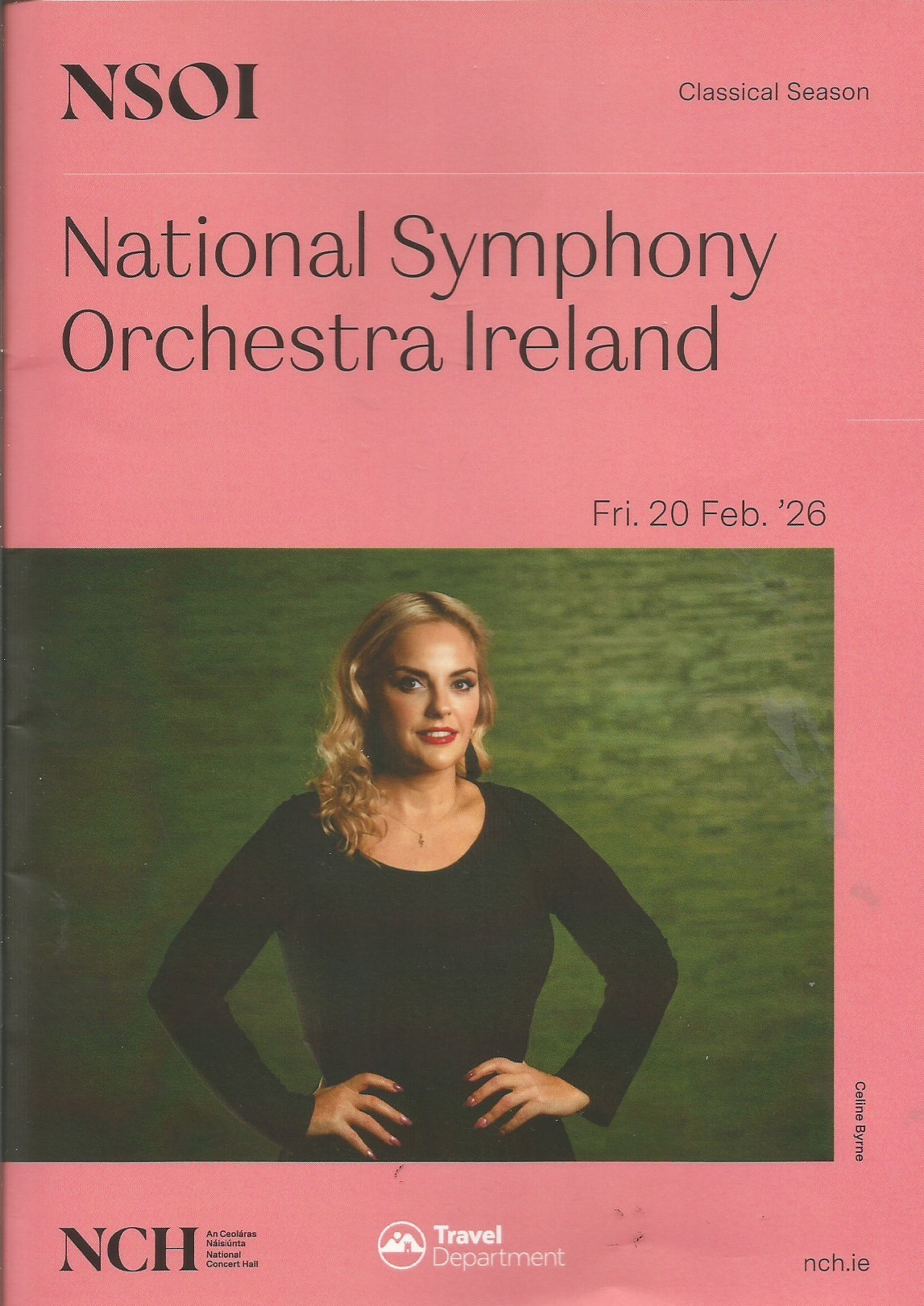
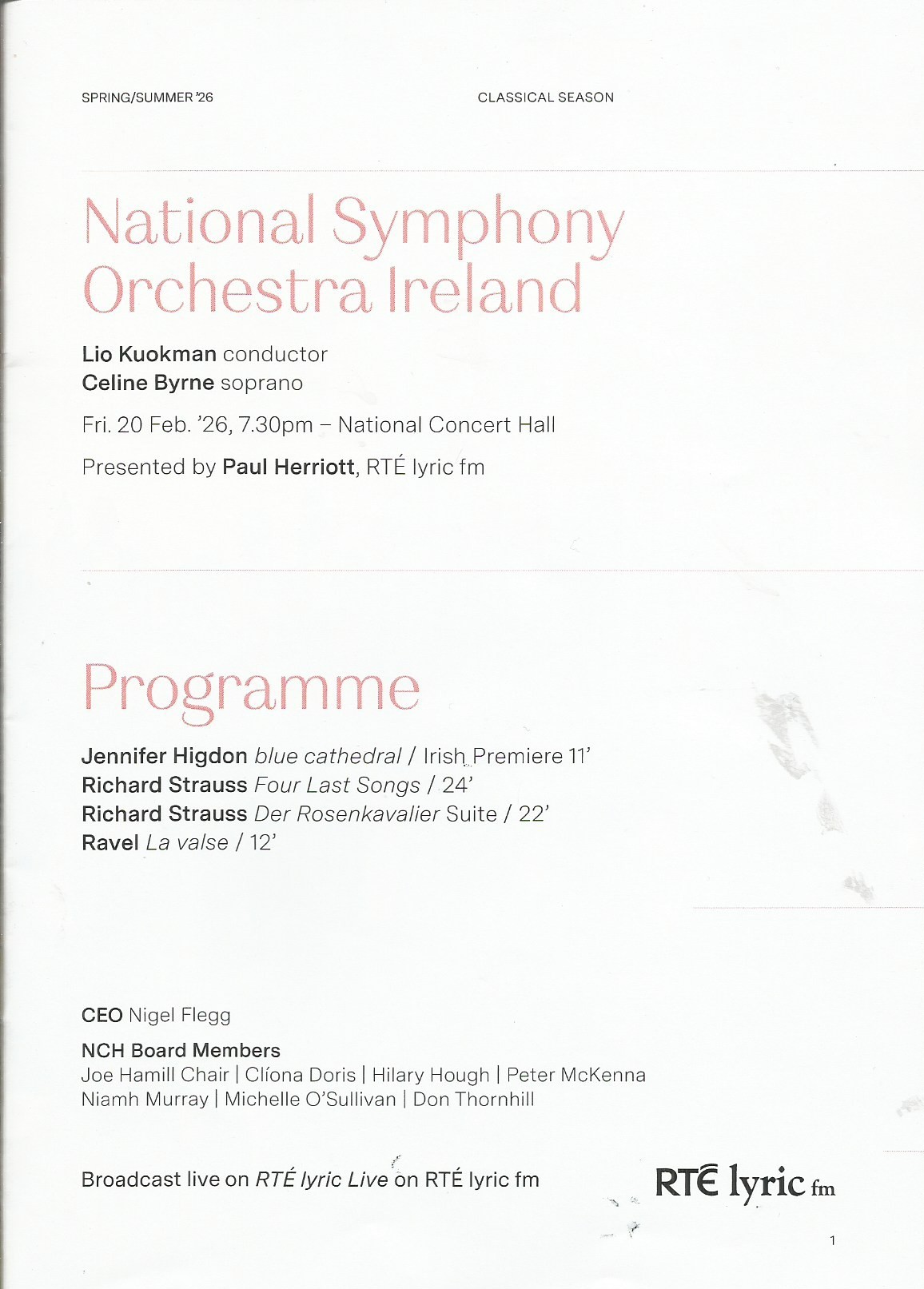
And so it came to pass that last night I went to the National Concert Hall in Dublin for another concert by National Symphony Orchestra Ireland, this time conducted by Lio Kuokman and joined, for a performance of the Strauss’s Four Last Songs, by the wonderful soprano Celine Byrne. Given the presence of an Irish favourite it was no surprise to find the concert hall very busy indeed.
The first item on the agenda was the Irish premier of blue cathedral by Jennifer Higdon, an elegaic piece she composed on the death of her younger brother. It’s an interesting piece which is quite easy on the ear as well as incorporating some very original effects. The string section, for example, use handbells to maje gentle tinkling noises near the end. I’ve never heard this piece before and I think it’s one that will bear repeated listening.
Next came the main item on the agenda. The Four Last Songs were published after the composer’s death, so Richard Strauss never heard them performed. The very first time they were performed was in 1950 at the Royal Albert Hall, by the London Philharmonia. One can only imagine what it must have been like for the orchestra making this music live for the very first time. Apparently the first time any of them had seen the score was when they turned up for the rehearsal. I’m sure they knew as soon as they started playing that it was a masterpiece.
Last night we heard these songs sung by Celine Byyne, who was born in Kildare. She arrived on stage resplendent in a black dress with red feathers around the shoulders. I don’t know how many times I’ve heard these songs and they never fail to move me. The opening of the first song, Frühling, is in the chest register for a soprano which is the most difficult to project over an orchestra, but Celine Byrne took it in her stride, as she did with the others. I must single out the leader of the National Symphony Orchestra Elaine Clark for her gorgeous playing of the lovely violin solo in the third song, Beim Schlafengehen. I don’t mind admitting that it brought a tear to my eye, as did the final Im Abendrot which is one of my very favourite pieces of music. I was sitting next to an elderly couple, and I coultn’t help noticing that they spontaneously held hands on the words “Hand in Hand”.
Incidentally, as far as I know the Four Last Songs were not specifically intended to be performed together as they inevitably are these days. Although the last is my favourite, I think the first three (all based on poems by Herman Hesse) have much more in common with each other than Im Abendrot (which is a poem by Joseph von Eichendorff).
After the wine break we continued with more Strauss, sort of, in the form of a suite from the Opera Der Rosenkavalier. Although Strauss allowed this to be assembled from his music as a concert work I don’t think he actually created it as such. It’s relatively brief ( just over 20 minutes in performance) that begin’s with the opera’s orchestral prelude, depicting the Marschallin’s and Octavian’s night of passion (vividly portrayed by whooping horns). Next comes the appearance of Octavian as the “Rosenkavalier”, depicted in tender gorgeous music; the sight of him looking so young makes the Marschallin realise that he will soon leave her for a younger woman. There follows the duet between Octavian and Sophie (oboe and horn) – in which their love for each other becomes ever more obvious, but this is abruptly interrupted by the discordant music associated with the clumsy arriva of the buffoonish Baron Ochsl. Next the violins tentatively introduce the first waltz, followed by another given out by the solo violin, before the whole orchestra settles into waltz mode. A general pause and a violin solo leads into the nostalgic music where the Marschallin sadly realises she has lost Octavian. Then comes its ecstatic climax. The work closes with another robust waltz, depicting Ochs at his most pompous, and a boisterous coda apparently composed for the suite. Listening to this is like a fast-forward through the opera, but it does lack the vocal parts, and I think Strauss was at his best writing for, especially female, voices.
And finally, picking up on the theme of waltzes prevalent in the preceding piece we had La Valse by Maurice Ravel. This is a great masterpiece, originally conceived as a tribute to the Viennese waltz, but not composed until after the First World War, and turned into a kind of tragic parody, starting out sombre and brooding, gradually building into a garish intensity and then into a brutal, almost chaotic, ending.
This was a very nice concert, with a varied programme and some fine playing throughout. The performance being relatively short, and wanting to avoid sitting in Pearse station for a long time waiting in Pearse Station for the 10.14 train, I broke with tradition and took a bus. I started out about 20 minutes earlier than I would have done had I waited for the train, but when I got to Maynooth at a bus stop next to the railway station, the train I would have got had just arrived….
It’s Saturday once more so time for another update of activity at the Open Journal of Astrophysics. Since the last update we have published a further six papers, bringing the number in Volume 9 (2026) to 36 and the total so far published by OJAp up to 484.
I will continue to include the posts made on our Mastodon account (on Fediscience) to encourage you to visit it. Mastodon is a really excellent service, and a more than adequate replacement for X/Twitter (which nobody should be using); these announcements also show the DOI for each paper.
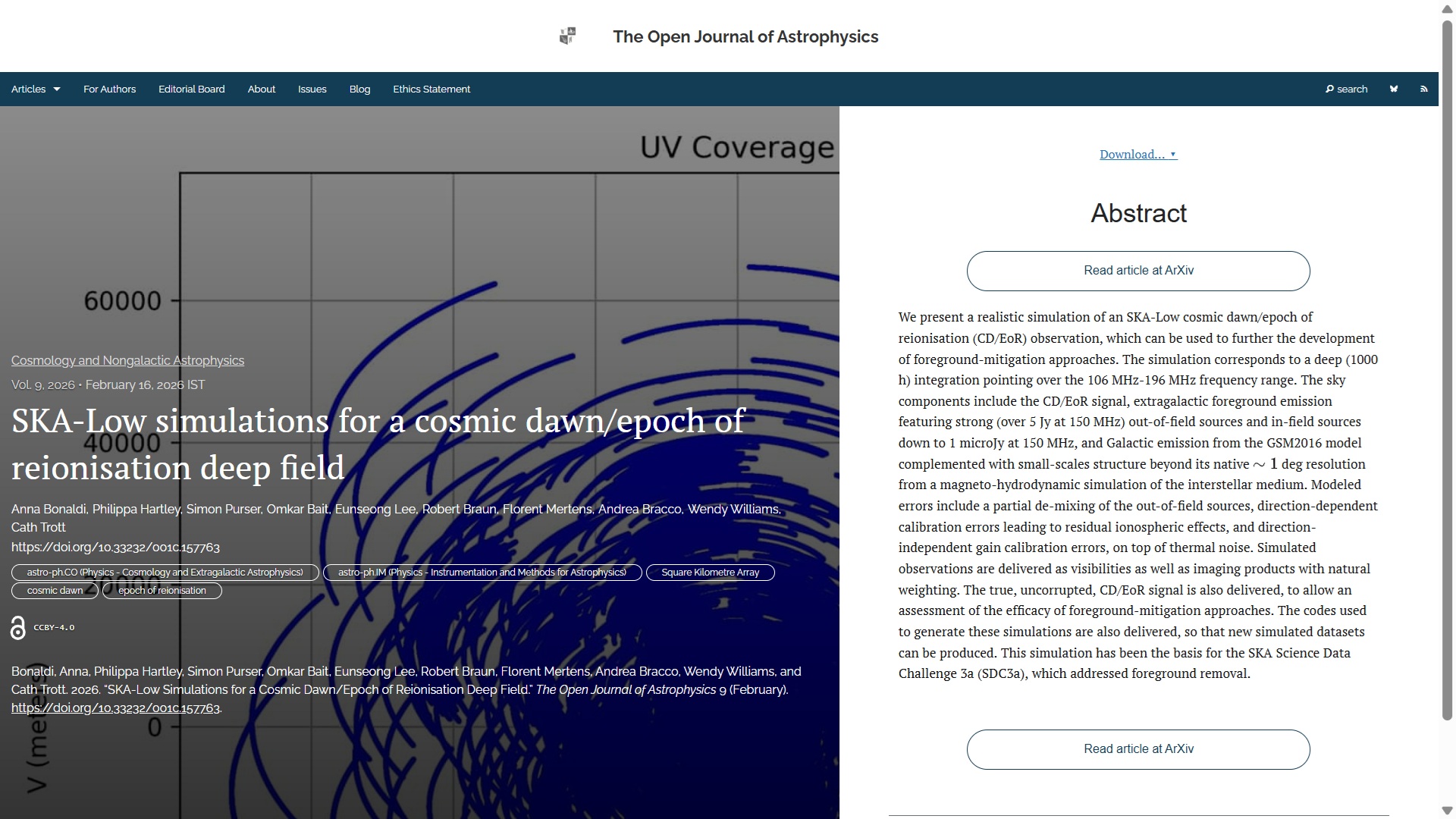
The first paper to report this week is “SKA-Low simulations for a cosmic dawn/epoch of reionisation deep field” by Anna Bonaldi, Philippa Hartley, Simon Purser & Omkar Bait (SKAO, UK), Eunseong Lee (U. Manchester, UK), Robert Braun (SKAO), Florent Mertens (Sorbonne Université, France), Andrea Bracco (Osservatorio Astrofisico di Arcetri, IT), Wendy Williams (SKAO) and Cath Trott (Curtin U., Australia). This paper presents a simulation of an SKA-Low cosmic dawn/epoch of reionisation observation to advance foreground-mitigation approaches: the simulation includes various sky components and modelled errors, allowing for efficacy assessment. It was published on Monday 16th February in the folder Cosmology and Nongalactic Astrophysics.
The overlay is here:
You can find the officially accepted version on arXiv here and the announcement on Fediverse here:
New Publication at the Open Journal of Astrophysics: "SKA-Low simulations for a cosmic dawn/epoch of reionisation deep field" by Anna Bonaldi, Philippa Hartley, Simon Purser & Omkar Bait (SKAO, UK), Eunseong Lee (U. Manchester, UK), Robert Braun (SKAO), Florent Mertens (Sorbonne Université, France), Andrea Bracco (Osservatorio Astrofisico di Arcetri, IT), Wendy Williams (SKAO) and Cath Trott (Curtin U., Australia)
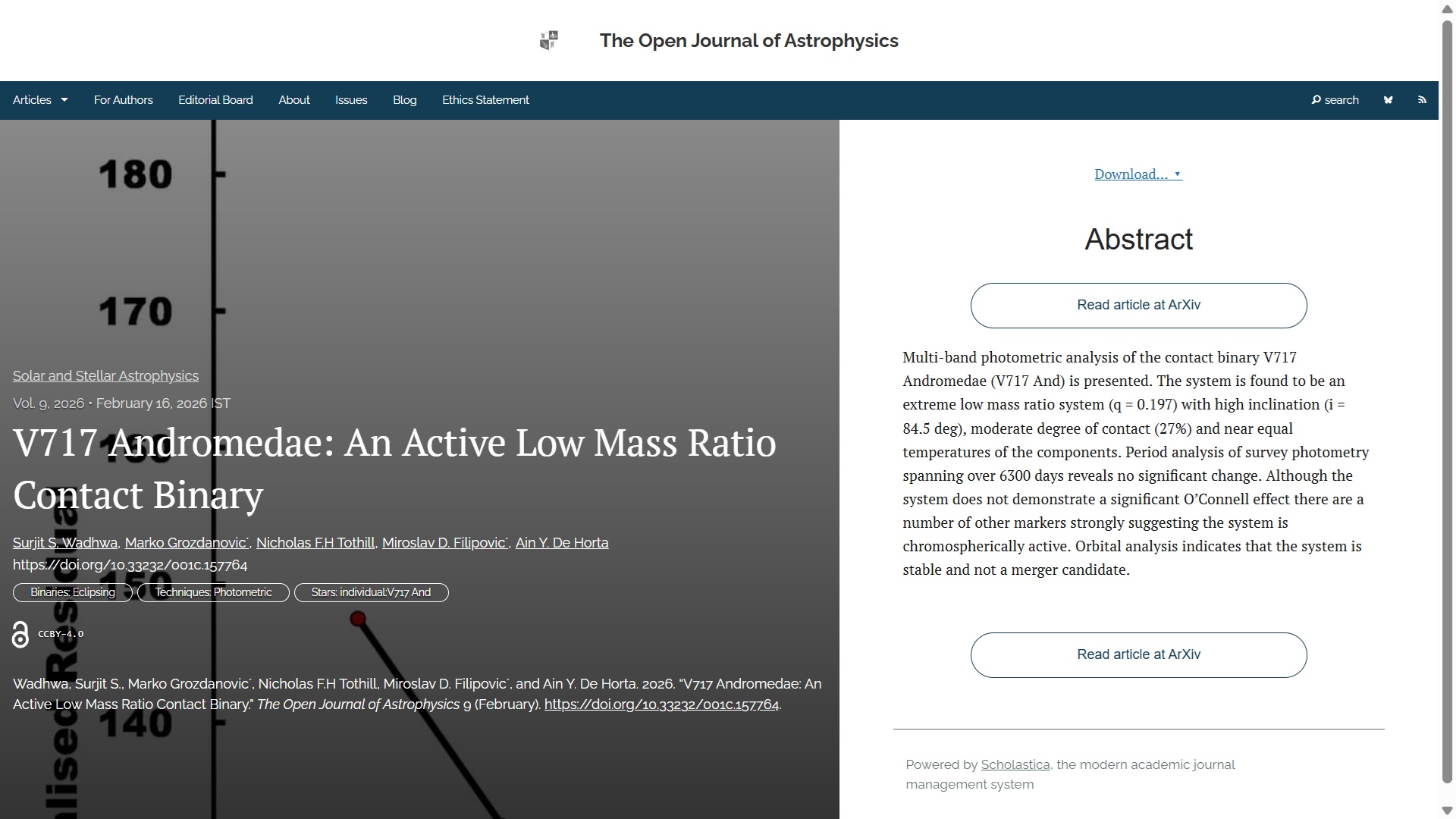
The second paper is “V717 Andromedae: An Active Low Mass Ratio Contact Binary” by Surjit S. Wadhwa (Western Sydney U. Australia), Marko Grozdanovic (Astronomical Observatory Belgrade, Serbia), and Nicholas F.H Tothill, Miroslav D. Filipovic, Ain Y. De Horta (Western Sydney U.). This was also published on Monday 1th February, but in the folder Solar and Stellar Astrophysics. The article discusses the contact binary V717 Andromedae, an extreme low mass ratio system with high inclination and moderate contact, showing signs of chromospheric activity but stable and not a merger candidate
The overlay for this one is here:
The official version of the paper can be found on arXiv here and the Fediverse announcement here:
New Publication at the Open Journal of Astrophysics: "V717 Andromedae: An Active Low Mass Ratio Contact Binary" by Surjit S. Wadhwa (Western Sydney U. Australia), Marko Grozdanovic (Astronomical Observatory Belgrade, Serbia), and Nicholas F.H Tothill, Miroslav D. Filipovic, Ain Y. De Horta (Western Sydney U.)
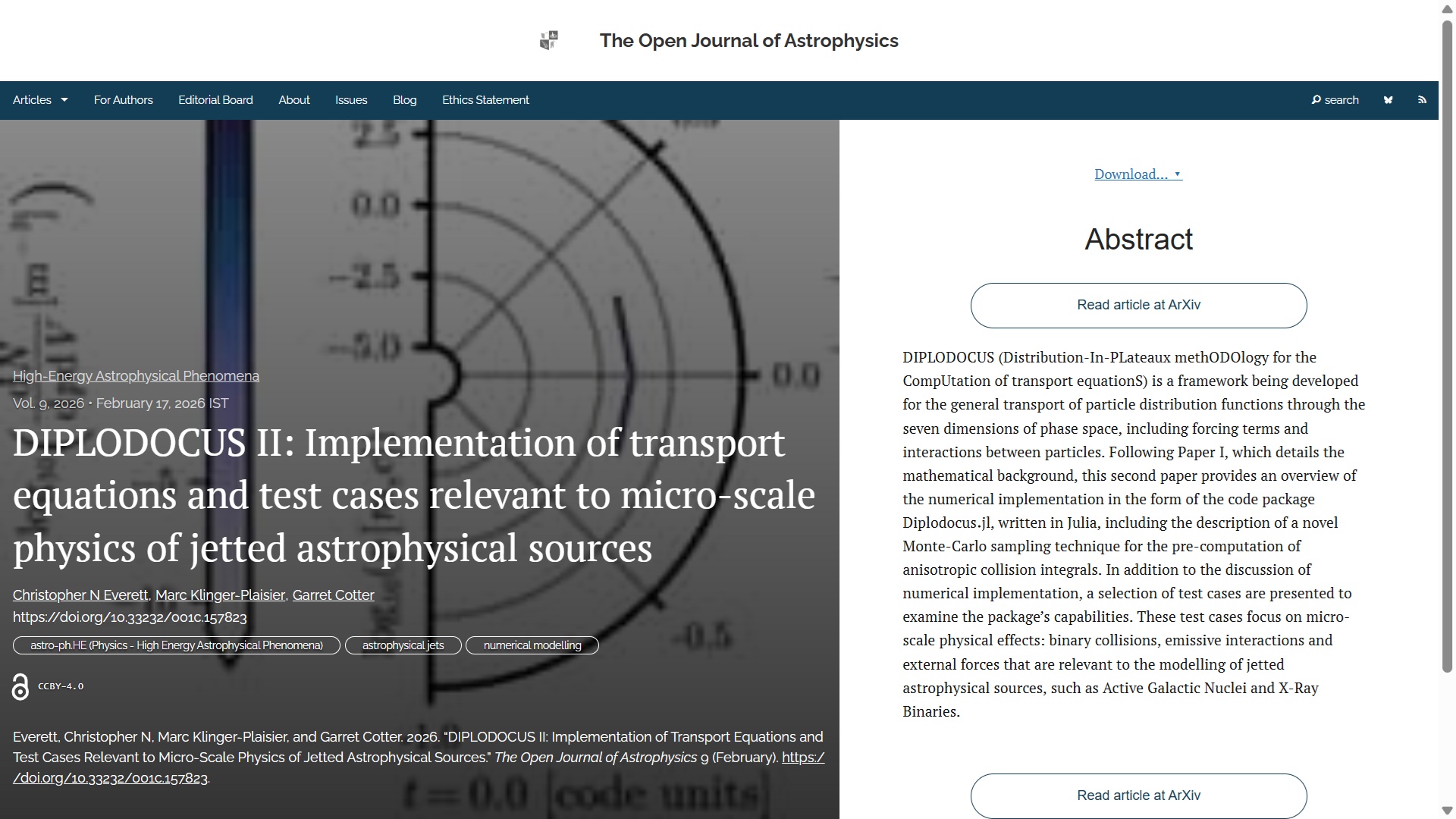
New Publication at the Open Journal of Astrophysics: "DIPLODOCUS II: Implementation of transport equations and test cases relevant to micro-scale physics of jetted astrophysical sources" by Christopher N Everett (Oxford U., UK), Marc Klinger-Plaisier (U. Amsterdam, NL) and Garret Cotter (Oxford)
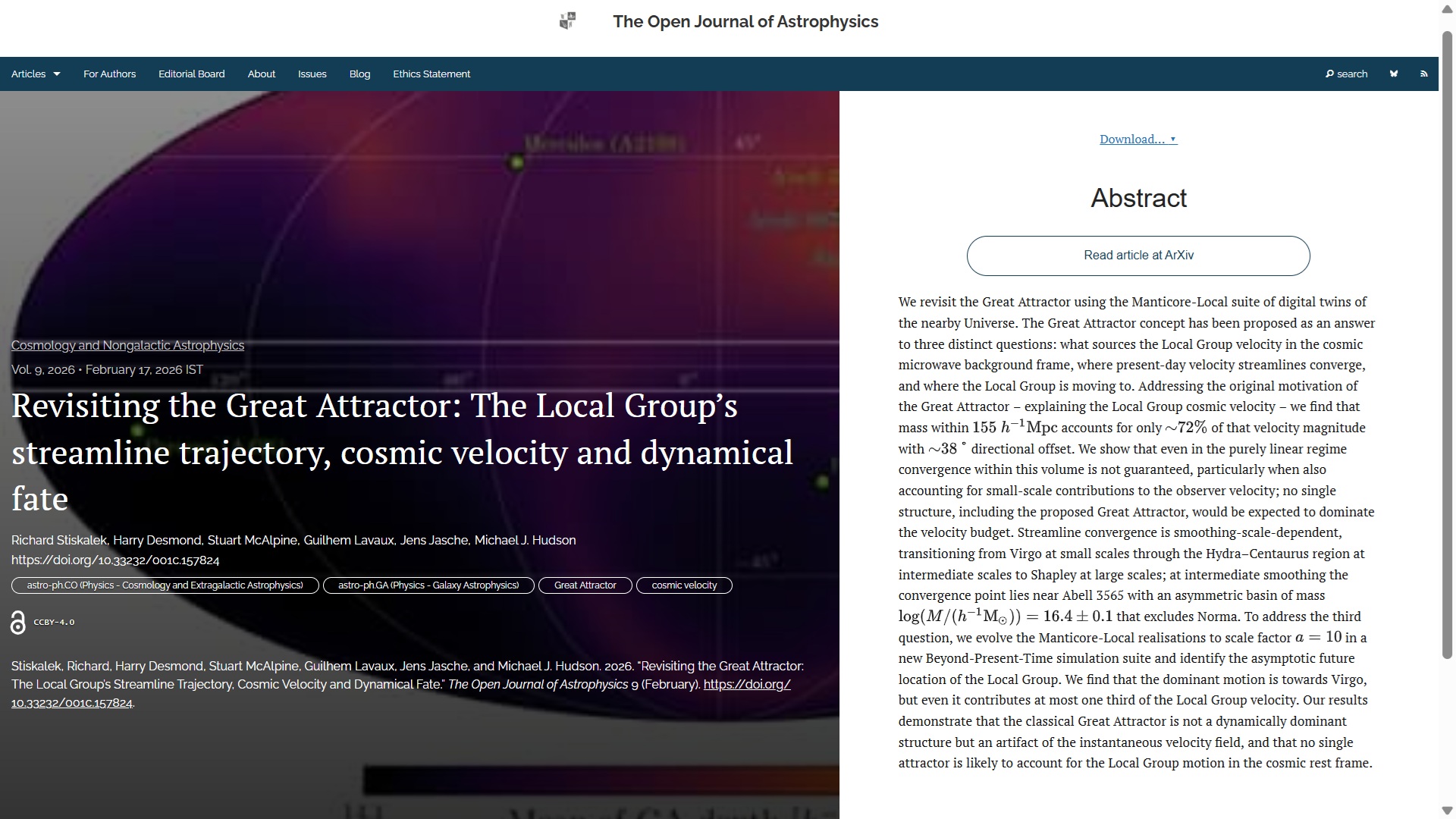
The fourth paper this week, also published on Tuesday 17th February, but in the folder Cosmology and Nongalactic Astrophysics is “Revisiting the Great Attractor: The Local Group’s streamline trajectory, cosmic velocity and dynamical fate” by Richard Stiskalek (Oxford U., UK), Harry Desmond (U. Portsmouth, UK), Stuart McAlpine (Stockholm, SE), Guilhem Lavaux (Sorbonne Université, FR), Jens Jasche (Stockholm) and Michael J. Hudson (U. Waterloo, Canada). This paper revisits the so-called “Great Attractor” concept, finding that it doesn’t dominate the Local Group’s cosmic velocity; multiple structures contribute to the motion, with no single attractor accounting for the flow.
Here is the overlay:
The official version can be found on arXiv here and the Fediverse announcement is here:
New Publication at the Open Journal of Astrophysics: "Revisiting the Great Attractor: The Local Group’s streamline trajectory, cosmic velocity and dynamical fate" by Richard Stiskalek (Oxford U., UK), Harry Desmond (U. Portsmouth, UK), Stuart McAlpine (Stockholm, SE), Guilhem Lavaux (Sorbonne Université, FR), Jens Jasche (Stockholm) and Michael J. Hudson (U. Waterloo, Canada)
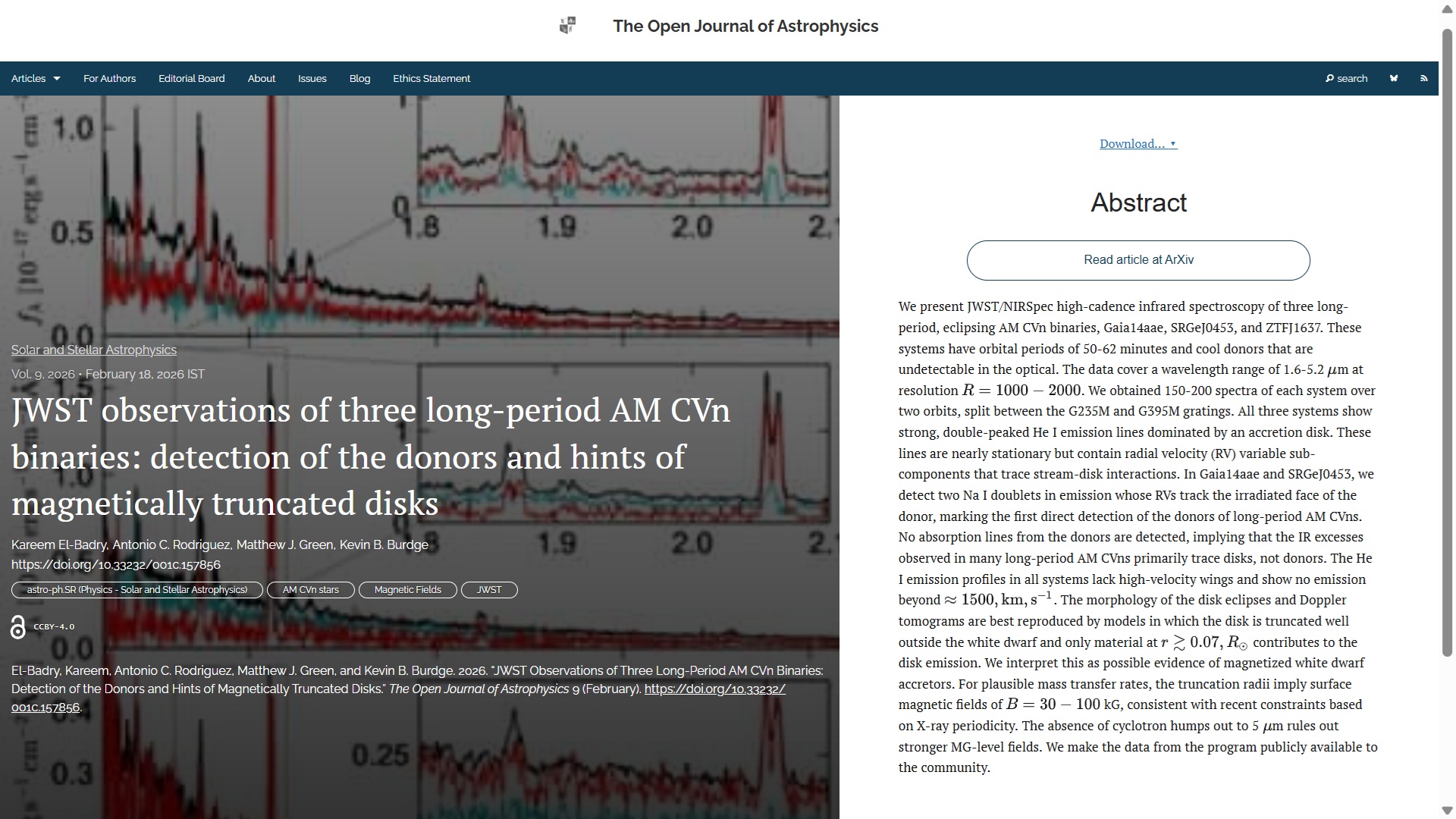
The fifth paper this week, is “JWST observations of three long-period AM CVn binaries: detection of the donors and hints of magnetically truncated disks” by Kareem El-Badry (Caltech), Antonio C. Rodriguez (CfA Harvard), Matthew J. Green (U. Oklahoma) & Kevin B. Burdge (MIT); all based in the USA. The article was published on Thursday 19th February 2026 in the folder Solar and Stellar Astrophysics. The paper describes high-cadence infrared spectroscopy used to analyze three long-period, eclipsing AM CVn (AM Canum Venaticorum) binaries; findings suggest the presence of magnetized white dwarf accretors, with surface magnetic fields of 30-100 kG.
The overlay is here:
The accepted version can be found on arXiv here, and the fediverse announcement is here:
New Publication at the Open Journal of Astrophysics: "JWST observations of three long-period AM CVn binaries: detection of the donors and hints of magnetically truncated disks" by Kareem El-Badry (Caltech), Antonio C. Rodriguez (CfA Harvard), Matthew J. Green (U. Oklahoma) & Kevin B. Burdge (MIT); all in USA
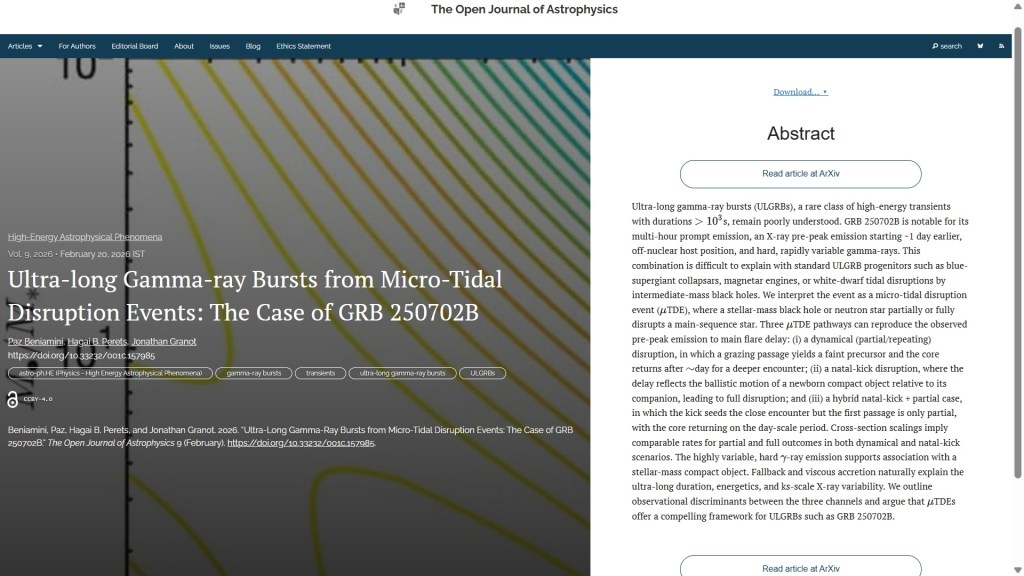
Finally for this week we have “Ultra-long Gamma-ray Bursts from Micro-Tidal Disruption Events: The Case of GRB 250702B” by Paz Beniamini (Open University, IL), Hagai B. Perets (Technion, IL) and Jonathan Granot (Open University, IL); all based in Israel. The paper was published on Friday 18th February 2026 in the folder High-Energy Astrophysical Phenomena.
The overlay is here:
You can find the officially accepted version on arXiv here and the Mastodon announcement is here:
New Publication at the Open Journal of Astrophysics: "Ultra-long Gamma-ray Bursts from Micro-Tidal Disruption Events: The Case of GRB 250702B" by Paz Beniamini (Open University, IL), Hagai B. Perets (Technion, IL) and Jonathan Granot (Open University, IL)
And that concludes this week’s update. I will do another next Saturday, by which time I expect we will have published a similar number of papers to this week.
The views presented here are personal and not necessarily those of my employer (or anyone else for that matter).
Feel free to comment on any of the posts on this blog but comments may be moderated; anonymous comments and any considered by me to be vexatious and/or abusive and/or defamatory will not be accepted. I do not necessarily endorse, support, sanction, encourage, verify or agree with the opinions or statements of any information or other content in the comments on this site and do not in any way guarantee their accuracy or reliability.




 In the Dark