The ICCUB is quite large, which means that there are quite a few talks to go to, including seminars and colloquia but also thesis defences, such as one I attended this morning. The format for these events is a talk by the candidate in the presence of a panel of experts, who ask questions at the end, but the whole thing is open to the general public. After the panel questions there is an opportunity for questions from the audience, but only from those who have a doctorate. I was tempted, but didn’t put my hand up.
Anyway, this morning’s talk was well attended and of very high quality and, as usual, the whole event lasted getting on for two hours. It’s a very different experience from the form of viva voce examinations used for PhDs in the UK and Ireland.
I like to attend these public thesis defences because they’re a very good way of finding out about the research going on in areas away from my own specialism. In physics the people who are really working at the coal face are the PhD students so one often learns more about the details from such talks than from colloquia from senior folk, which are usually cover a wider area but at a more superficial level.
Another nice thing is that there is a little gathering afterwards (on the right) with a selection of food and drink available to celebrate the candidate’s success. In fact it was a double celebration as the candidate was offered a postdoctoral research position just two days ago. I abstained from the champagne as alcohol at lunchtime usually sends me to sleep in the afternoon, and I have a lot to do in the rest of today.
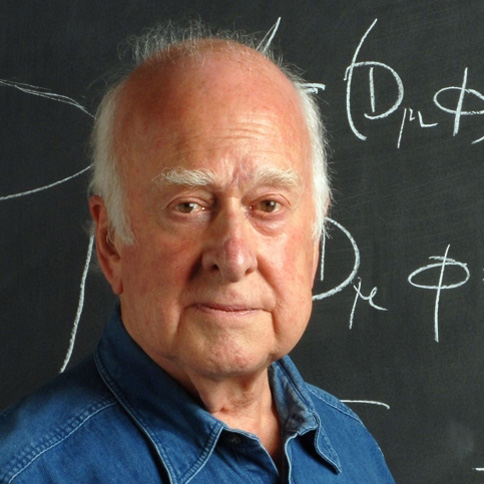
I was very sad this afternoon to hear of the death of theoretical physicist Peter Higgs, on Monday 8th April 2024, at the age of 94. I never met Peter Higgs but I know how greatly liked and respected he was (see, e.g. here) and that he leaves an important legacy as a physicist, particularly the work that led to the award of the 2013 Nobel Prize for Physics (jointly with François Englert) . Condolences to his family, friends and colleagues.
You can read the very nice Guardian obituary here; there are many others published in media from elsewhere in the world (including Ireland and Barcelona).
I’ll add two extremely slight connections. One is that Peter Higgs visited Maynooth University in 2012, not long before his Nobel Prize was announced. The other is that he was born in the Elswick area of Newcastle upon Tyne, not far from Benwell, where I grew up.
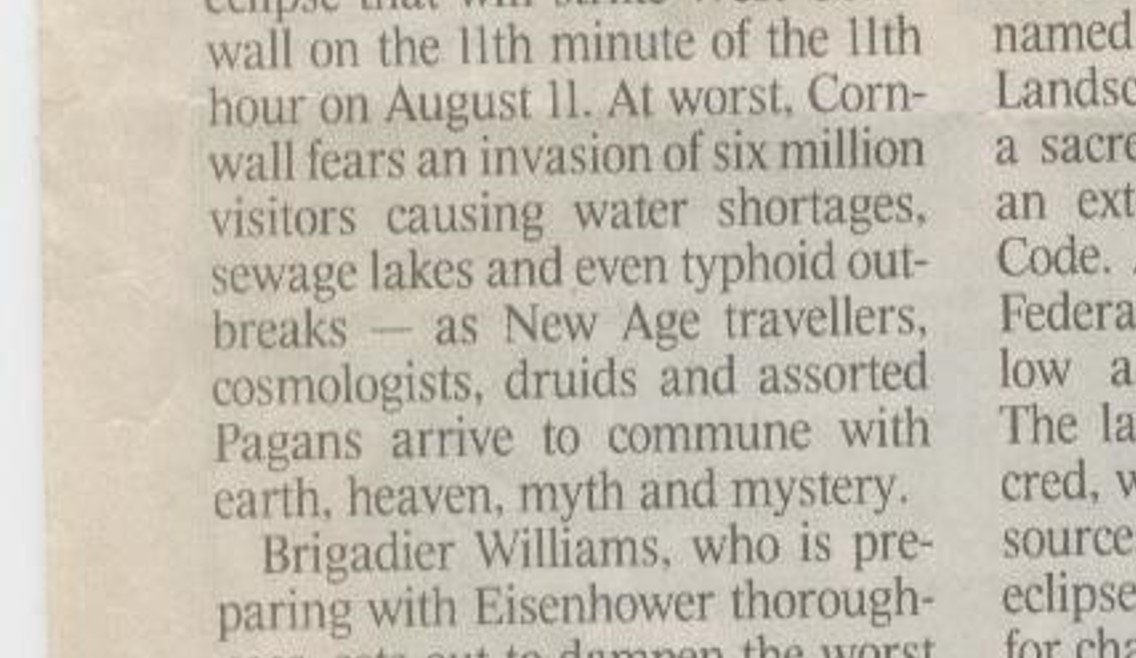
Ahead of tomorrow’s total eclipse of the Sun visible from a large part of the USA, I can’t resist sharing this excerpt from The Times warning about the consequences of a mass influx of people to Cornwall for the total eclipse of the Sun that was visible on August 11th 1999, almost 25 years ago. No doubt there are similar things going around about tomorrow’s eclipse:
I did write a letter to the Times complaining that, as a cosmologist, I felt this was very insulting… to druids. They didn’t publish it.
Anyway, I did get to see the total solar eclipse of 1999, not from Cornwall (where it was overcast and rainy) but from the island of Alderney (one of the Channel Islands). There was quite a lot of cloud cover in the morning of the big event so I was expecting to be disappointed. Indeed, the very start of the eclipse was hidden by cloud and there were groans from the large crowd assembled to watch it. A few seconds later, however, the clouds parted and we got a wonderful view. I remember very well that it seemed to get much colder during totality and an eery wind started to blow. Another thing is that all the birds thought it was night already and started to roost, although it was only around 11am.
You might think astronomers would be a bit indifferent to eclipses because they are well understood and totally predictable. But to experience an eclipse in person has a very powerful effect (or did on me anyway). We may be scientists but we don’t respond entirely rationally to everything. Nor should we.
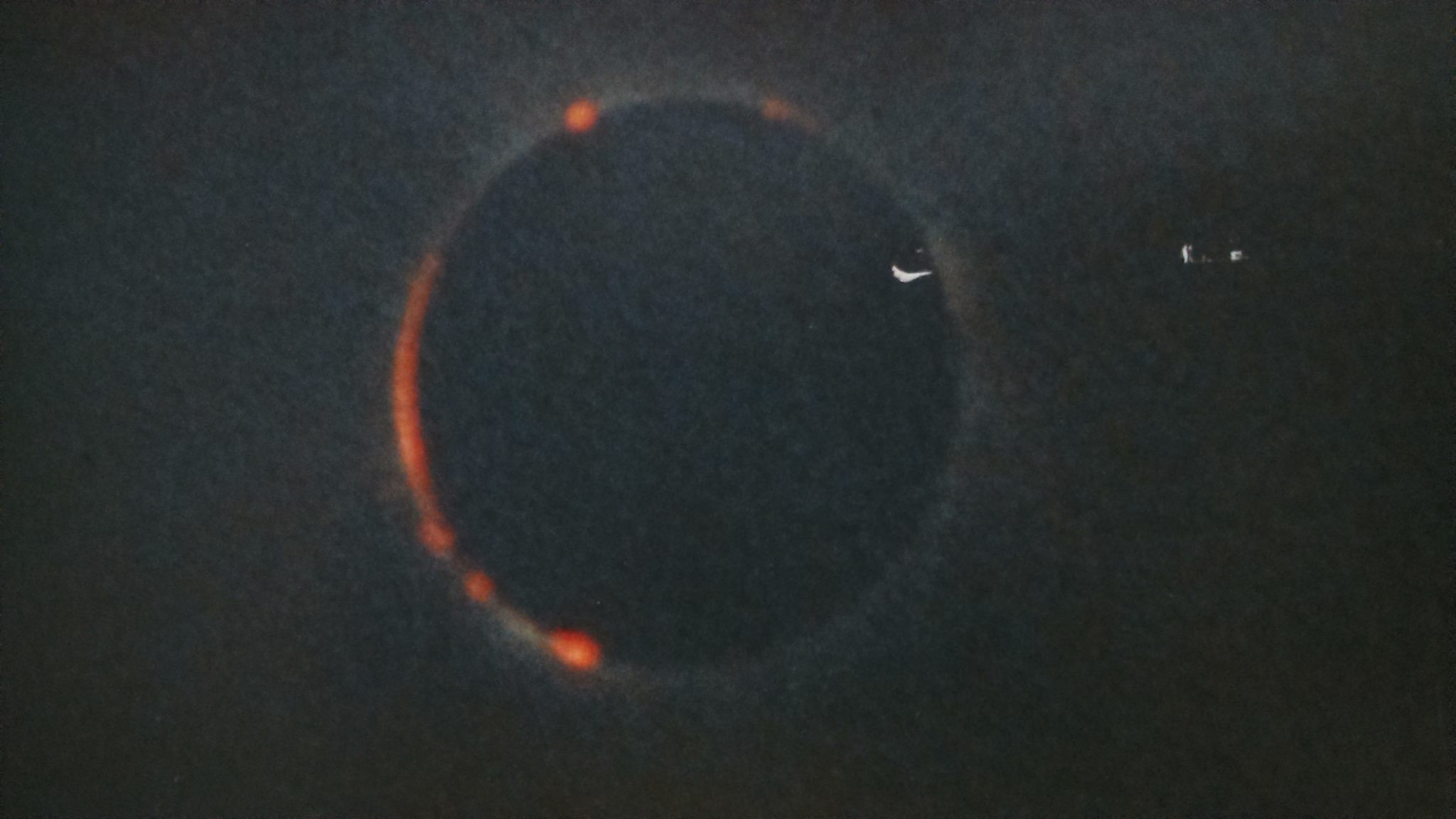
Here’s a (not very good) scan of a (slightly damaged) picture from that eclipse:
Anyway, tomorrow (i.e. 8th April 2024) the total solar eclipse crosses North America with parts of 15 states able to view it: the eclipse will first appear along Mexico’s Pacific Coast at around 11:07 a.m. PDT, then travel across a swath of the U.S., from Texas to Maine, and into Canada. About 31.6 million people live in the path of totality. The path will range between 108 and 122 miles wide. An additional 150 million people live within 200 miles of the path of totality.
Do make the effort to see it if you can. It’s a remarkable experience that will live long in your memory. But watch out for the cosmologists and druids!
As promised a couple of days ago, I am taking the opportunity today to announce the batch of papers at the Open Journal of Astrophysics that were paused slightly while we updated our system. This batch includes five papers, which I now present to you here. These five take the count in Volume 7 (2024) up to 25 and the total published by OJAp up to 140. We’re publishing roughly two papers a week these days so we expect publish about 100 this year.
In chronological order, the five papers, with their overlays, are as follows. You can click on the images of the overlays to make them larger should you wish to do so.
This paper, by Yingtian Chen and Oleg Gnedin of the University of Michigan, is the 21st paper to be published in Volume 7 and the 136th altogether. It is a study of kinematic, chemical and age data of globular clusters from Gaia yielding clues to how the Milky Way Galaxy assembled. Here’s a screenshot of the overlay which includes the abstract. Note the new-style DOI at the bottom left.
You can read the article on arXiv directly here. This paper has a publication date of 20th March 2024, and is in the folder marked Astrophysics of Galaxies.
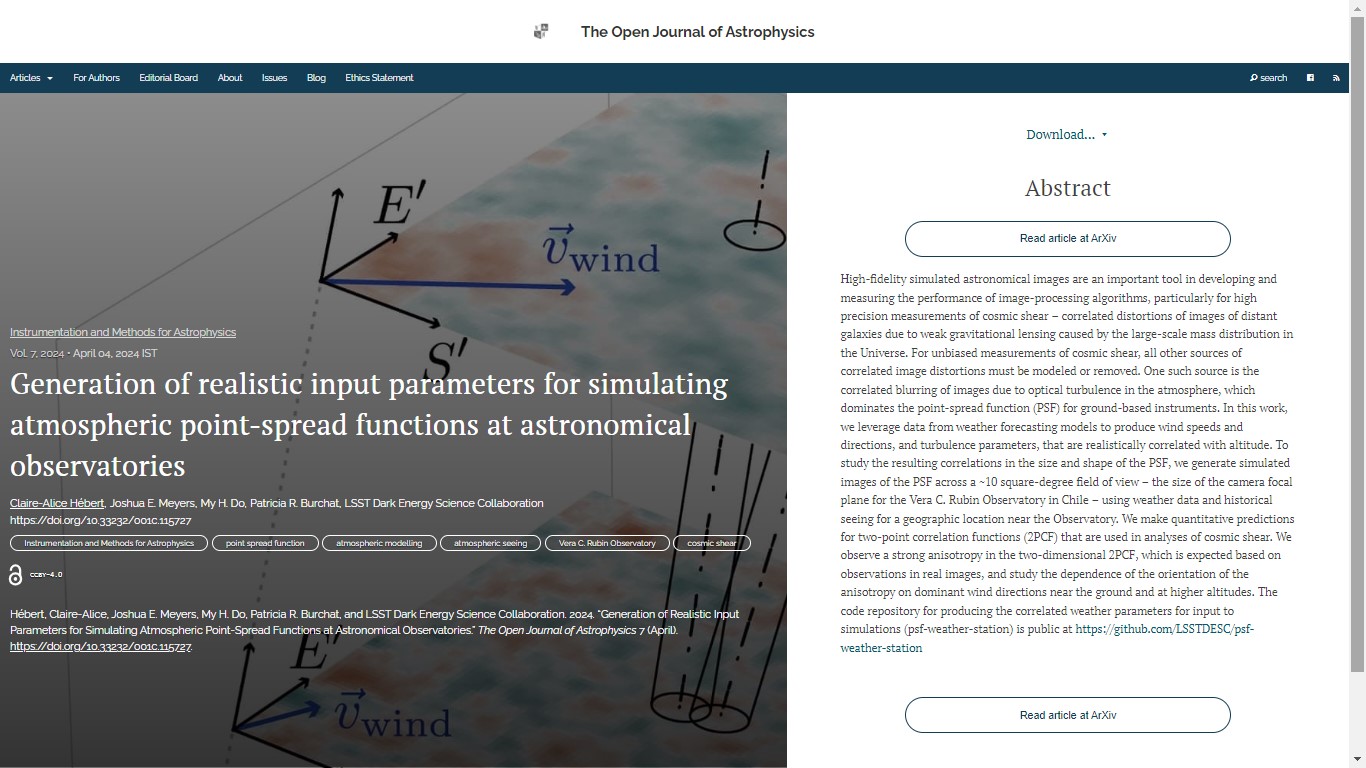
The second paper is “Generation of realistic input parameters for simulating atmospheric point-spread functions at astronomical observatories” by Claire-Alice Hébert (Stanford), Joshua E. Meyers (Stanford), My H. Do (Cal. State U, Pomona), Patricia R. Burchat (Stanford) and the LSST Dark Energy Science Collaboration. It explores the use of atmospheric modelling to generate realistic estimates of the point-spread function for observational work, especially for the Vera C. Rubin Observatory. This one is in the folder marked Instrumentation and Methods for Astrophysics and was published on 4th April 2024. Here is a screen grab of the overlay which includes the abstract:
You can find the officially accepted version of the paper on the arXiv here.
The third paper to announce is “Cosmic Dragons: A Two-Component Mixture Model of COSMOS Galaxies” by William K. Black and August E. Evrard of the University of Michigan (Ann Arbor, USA). This paper was also published on 4th April 2024, is in the folder Astrophysics of Galaxies and you can see the overlay here:
The accepted version of this paper can be found on the arXiv here.
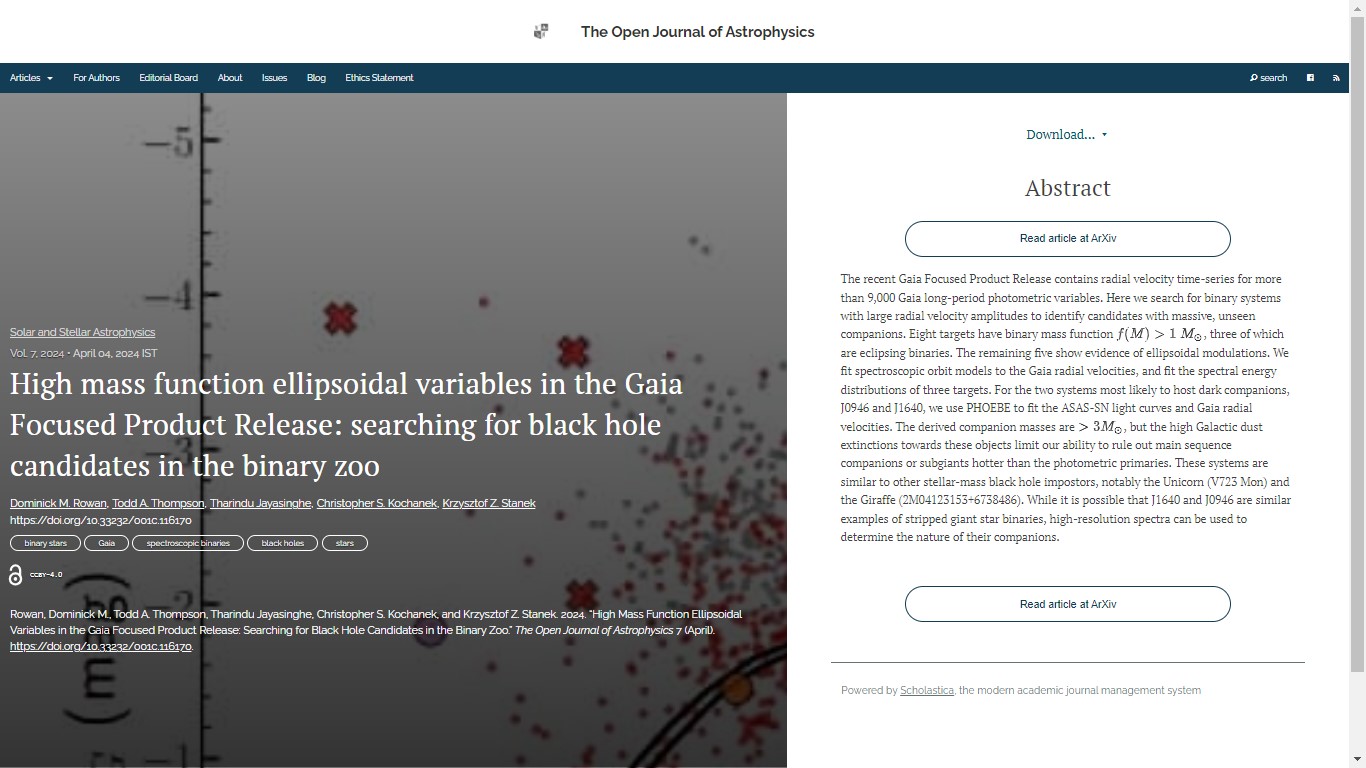
The next paper is “High mass function ellipsoidal variables in the Gaia Focused Product Release: searching for black hole candidates in the binary zoo” by Dominick M. Rowan, Todd A. Thompson,
Tharindu Jayasinghe, Christopher S. Kochanek and Krzysztof Z. Stanek of Ohio State University (USA). This paper, in the Solar and Stellar Astrophysics collection, describes a search for massive unseen stellar companions variable star systems found in Gaia data. This one was also published on 4th April 2024.
Here is the overlay:
You can find the full text for this one on the arXiv here.
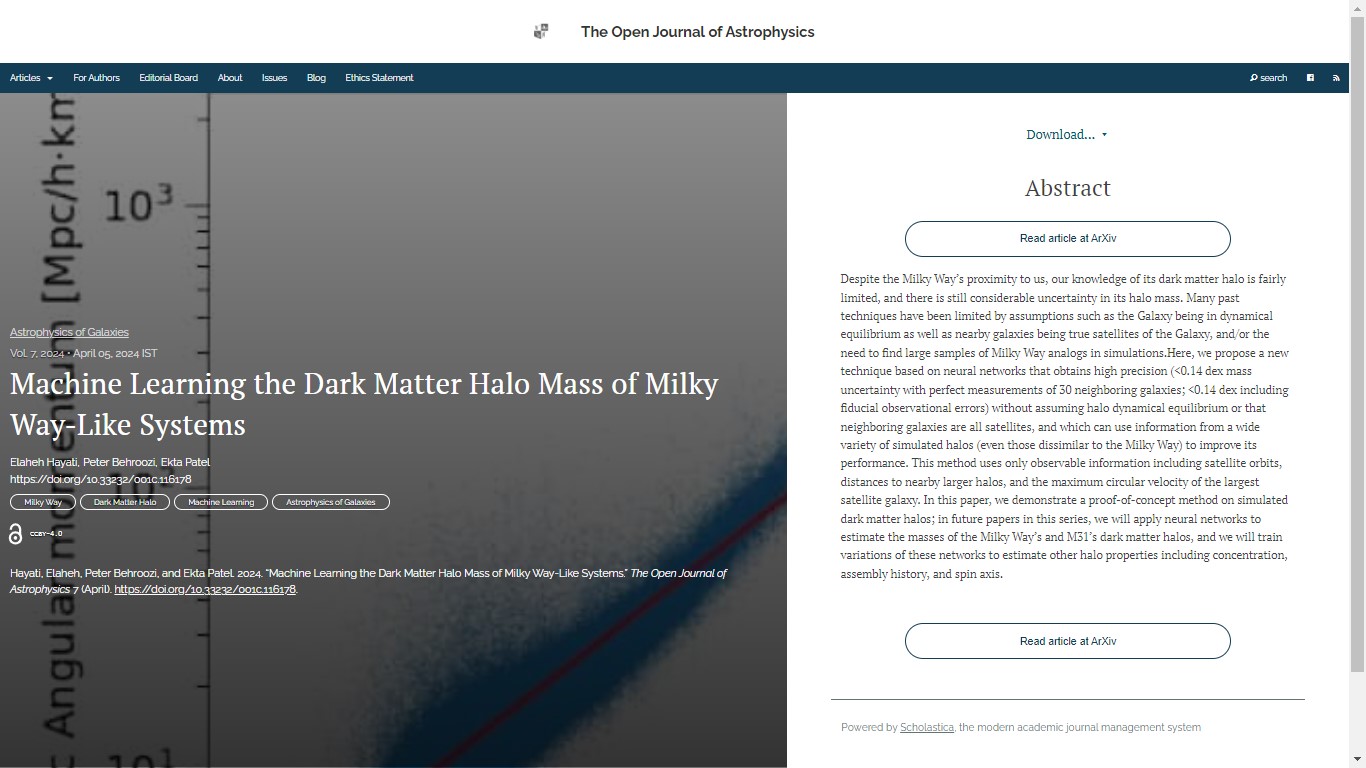
Last in this batch, but by no means least, published yesterday (5th April 2024), we have a paper “Machine Learning the Dark Matter Halo Mass of Milky Way-Like Systems” by Elaheh Hayati & Peter Behroozi (University of Arizona, USA) and Ekta Patel (University of Utah, USA). The primary classification for this one is once again Astrophysics of Galaxies and it presents a method for estimating the mass of a galaxy halo using neural networks that does not assume, for example, dynamical equilibrium:
You can click on the image of the overlay to make it larger should you wish to do so. You can find the officially accepted version of the paper on the arXiv here.
As you can see this is quite a diverse collection of papers. Given the increase in submissions in the area of galactic astrophysics we are very happy to welcome another expert in that area to our Editorial Board, in the form of Professor Walter Dehnen of the University of Heidelberg.
Here’s another video in the Cosmology Talks series curated by Shaun Hotchkiss. This one very timely after yesterday’s announcement. Here is the description on the YouTube page:
The Dark Energy Spectroscopic Instrument (DESI) has produced cosmological constraints! And it is living up to its name. Two researchers from DESI, Seshadri Nadathur and Andreu Font-Ribera, tell us about DESI’s measurements of the Baryon Acoustic Oscillations (BAO) released today. These results use one full year of DESI data and are the first cosmological constraints from the telescope that have been released. Mostly, it is what you might expect: tighter constraints. However, in the realm of the equation of state of dark energy, they find, even with BAO alone, that there is a hint of evidence for evolving dark energy. When they combine their data with CMB and Supernovae, who both also find small hints of evolving dark energy on their own, the evidence for dark energy not being a cosmological constant jumps as high as 3.9σ with one combination of the datasets. It seems there still is “concordance cosmology”, it’s just not ΛCDM for these datasets. The fact that all three probes are tentatively favouring this is intriguing, as it makes it unlikely to be due to systematic errors in one measurement pipeline.
My own take is that the results are very interesting but I think we need to know a lot more about possible systematics before jumping to conclusions about time-varying dark energy. Am I getting conservative in my old age? These results from DESI do of course further underline the motivation for Euclid (another Stage IV survey), which may have an even better capability to identify departures from the standard model.
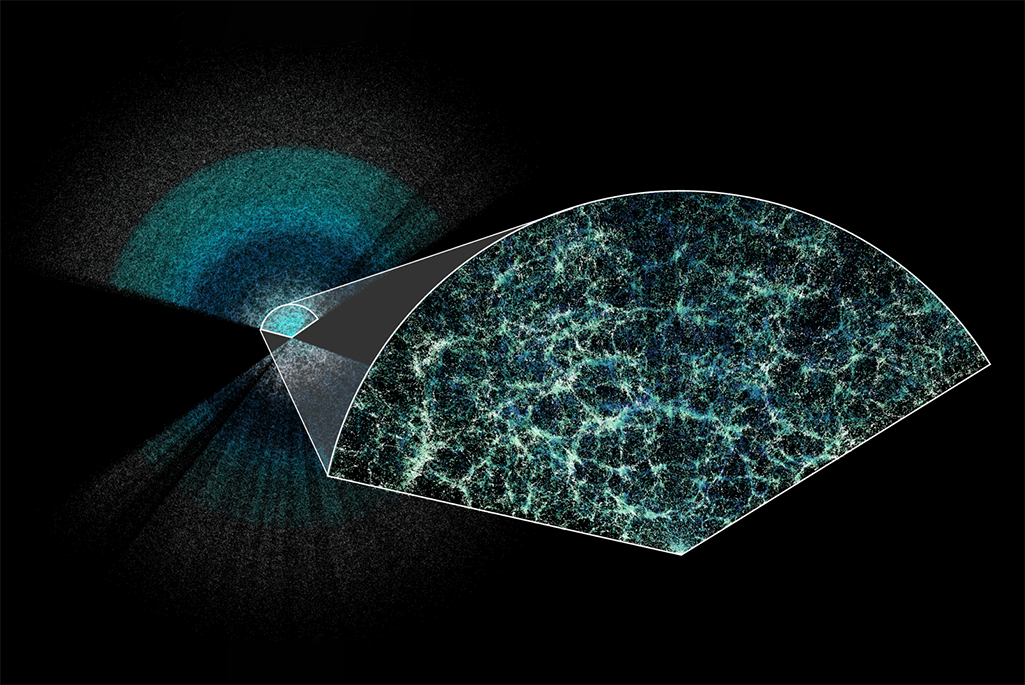
P.S. Here’s a nice graphic showing the cosmic web showing revealed by the DESI survey:
There has been a lot of excitement around the ICCUB today – the press have been here and everything – ahead of the release of the Year 1 results from the Dark Energy Spectroscopic Instrument (DESI). The press release from the Lawrence Berkeley Laboratory in California can be found here.
The papers were just released at 5pm CEST and can be found here. The key results pertain to Baryon Acoustic Oscillations (BAOs) which can be used to track the expansion rate and geometry of the Universe. This is one of the techniques that will be used by Euclid.
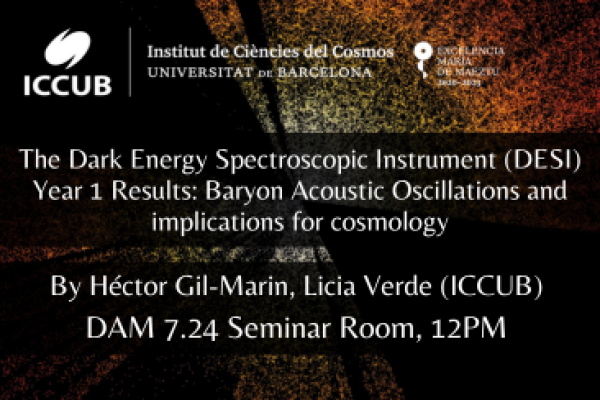
There’s a lot of technical information to go through and I have to leave fairly soon. Fortunately we have seminar tomorrow that will explain everything at a level I can understand:
I will update this post with a bit more after the talk, but for the time being I direct you to the high-level cosmological implications are discussed in this paper (which is Paper VI from DESI).
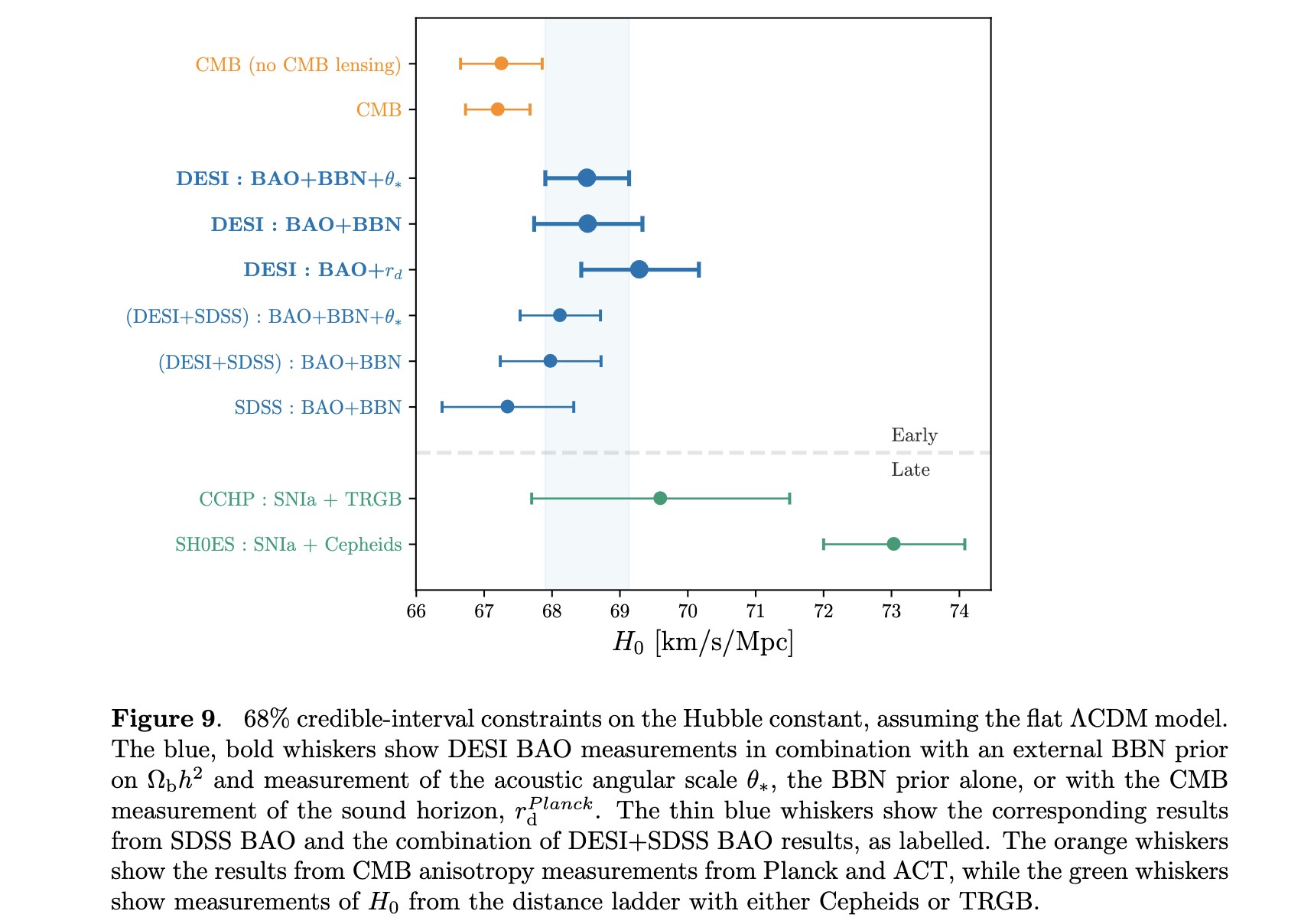
If your main interest is in the Hubble Tension then I direct you to this Figure:
Depending on the other data sets included, the value obtained is around 68.5 ± 0.7 in the usual units, closer to the (lower) Planck CMB value than the (higher) Supernovae values but not exactly in agreement; the error bars are quite small too.
You might want to read my thoughts about distances estimated from angular diameters compared with distances measured using luminosity distances here.
If you’re wondering whether there is any evidence for departures from the standard cosmology, another pertinent comment is:
In summary, DESI data, both alone and in combination with other cosmological probes, do not show any evidence for a constant equation of state parameter different from −1 when a flat wCDM model is assumed.
DESI 2024 VI: Cosmological Constraints from the Measurements of Baryon Acoustic Oscillations
More complicated models of time-varying dark energy might work, but there’s no strong evidence from the current data.
That’s all from me for now, but feel free to comment through the box below with any hot takes!
UPDATE: As expected there has been quite a lot of press coverage about this – see the examples below – mostly concentrating on the alleged evidence for “new physics”. Personally I think the old physics is fine!
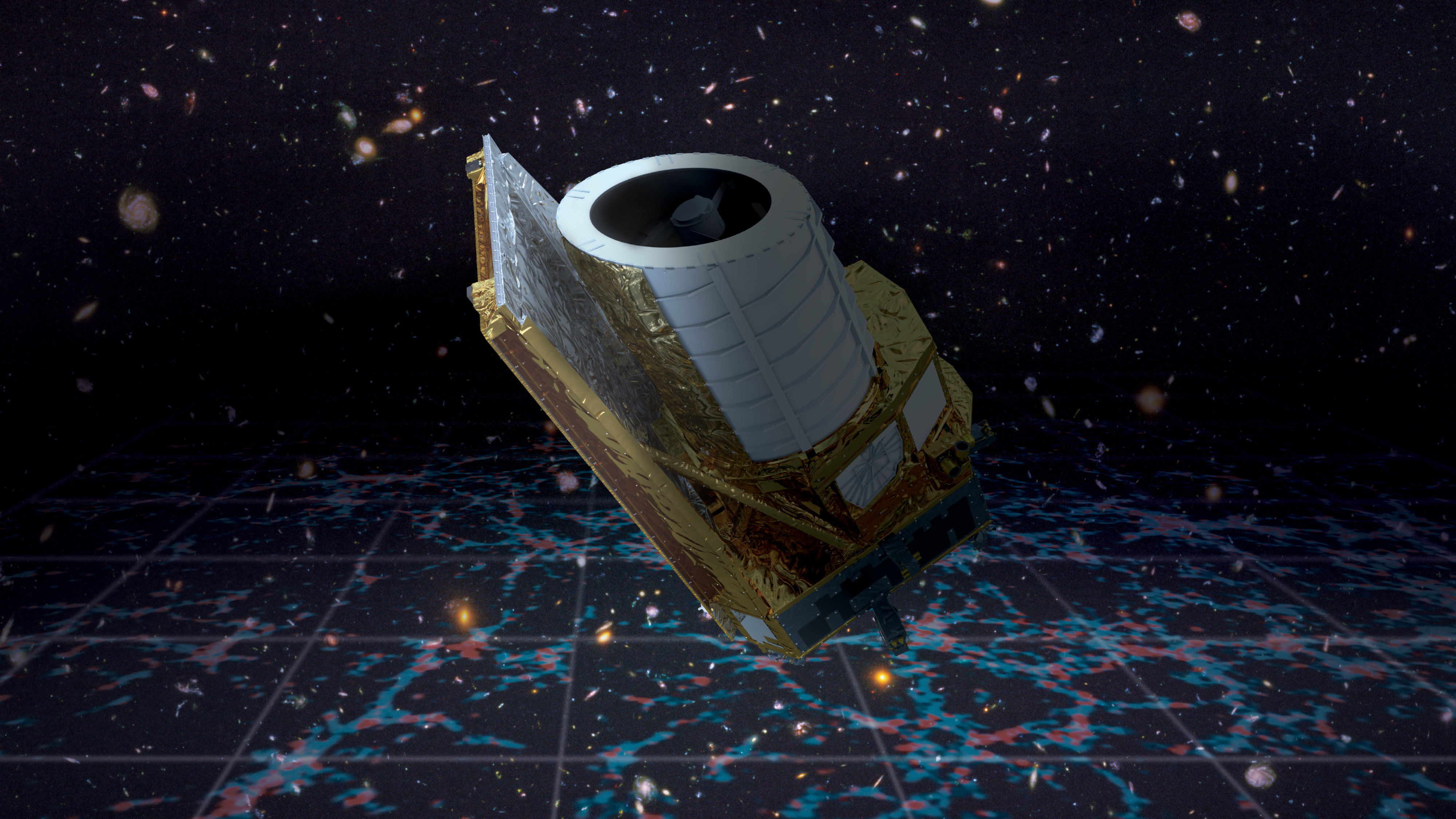
I thought it would be appropriate to add a little update about the European Space Agency’s Euclid mission. I’ll keep it brief here because you can read the full story on the official website here.
You may have seen in the news that the Euclid telescope has been having an issue with ice forming on surfaces in its optical systems, especially the VIS instrument. This is a common problem with telescopes in space, but the extent of it is not something that can be predicted very accurately in advance so a detailed strategy for dealing with it had to be developed on the go.
The layers of ice that form are very thin – just tens of nanometres thick – but that is enough to blur the images and also reduce the throughput of the instruments. Given that the objects we want Euclid to see are faint, and we need very sharp images then this is an issue that must be dealt with.
Soon after launch, the telescope was heated up for a while in order to evaporate as much ice as possible, but it was not known how quickly the ice would return and to what parts of the optical system. After months in the cold of space the instrument scientists now understand the behaviour of the pesky ice a lot better, and have devised a strategy for dealing with it.
The approach is fairly simple in principle: heat the affected instruments up every now and again, and then let them cool down again so they operate; repeat as necessary as ice forms again. This involves an interruption in observations, it is known to work pretty well, but exactly how frequently this de-icing cycle should be implemented and what parts of the optical system require this treatment are questions that need to be answered in practical experimentation. The hope is that after a number of operations of this kind, the amount of ice returning each time will gradually reduce. I am not an expert in these things but I gather from colleagues that the signs are encouraging.
Here’s an interestingly different talk in the series of Cosmology Talks curated by Shaun Hotchkiss. The speaker, Sylvia Wenmackers, is a philosopher of science. According to the blurb on Youtube:
Her focus is probability and she has worked on a few theories that aim to extend and modify the standard axioms of probability in order to tackle paradoxes related to infinite spaces. In particular there is a paradox of the “infinite fair lottery” where within standard probability it seems impossible to write down a “fair” probability function on the integers. If you give the integers any non-zero probability, the total probability of all integers is unbounded, so the function is not normalisable. If you give the integers zero probability, the total probability of all integers is also zero. No other option seems viable for a fair distribution. This paradox arises in a number of places within cosmology, especially in the context of eternal inflation and a possible multiverse of big bangs bubbling off. If every bubble is to be treated fairly, and there will ultimately be an unbounded number of them, how do we assign probability? The proposed solutions involve hyper-real numbers, such as infinitesimals and infinities with different relative sizes, (reflecting how quickly things converge or diverge respectively). The multiverse has other problems, and other areas of cosmology where this issue arises also have their own problems (e.g. the initial conditions of inflation); however this could very well be part of the way towards fixing the cosmological multiverse.
The paper referred to in the presentation can be found here. There is a lot to digest in this thought-provoking talk, from the starting point on Kolmogorov’s axioms to the application to the multiverse, but this video gives me an excuse to repeat my thoughts on infinities in cosmology.
Most of us – whether scientists or not – have an uncomfortable time coping with the concept of infinity. Physicists have had a particularly difficult relationship with the notion of boundlessness, as various kinds of pesky infinities keep cropping up in calculations. In most cases this this symptomatic of deficiencies in the theoretical foundations of the subject. Think of the ‘ultraviolet catastrophe‘ of classical statistical mechanics, in which the electromagnetic radiation produced by a black body at a finite temperature is calculated to be infinitely intense at infinitely short wavelengths; this signalled the failure of classical statistical mechanics and ushered in the era of quantum mechanics about a hundred years ago. Quantum field theories have other forms of pathological behaviour, with mathematical components of the theory tending to run out of control to infinity unless they are healed using the technique of renormalization. The general theory of relativity predicts that singularities in which physical properties become infinite occur in the centre of black holes and in the Big Bang that kicked our Universe into existence. But even these are regarded as indications that we are missing a piece of the puzzle, rather than implying that somehow infinity is a part of nature itself.
The exception to this rule is the field of cosmology. Somehow it seems natural at least to consider the possibility that our cosmos might be infinite, either in extent or duration, or both, or perhaps even be a multiverse comprising an infinite collection of sub-universes. If the Universe is defined as everything that exists, why should it necessarily be finite? Why should there be some underlying principle that restricts it to a size our human brains can cope with?
On the other hand, there are cosmologists who won’t allow infinity into their view of the Universe. A prominent example is George Ellis, a strong critic of the multiverse idea in particular, who frequently quotes David Hilbert
The final result then is: nowhere is the infinite realized; it is neither present in nature nor admissible as a foundation in our rational thinking—a remarkable harmony between being and thought
But to every Hilbert there’s an equal and opposite Leibniz
I am so in favor of the actual infinite that instead of admitting that Nature abhors it, as is commonly said, I hold that Nature makes frequent use of it everywhere, in order to show more effectively the perfections of its Author.
You see that it’s an argument with quite a long pedigree!
Many years ago I attended a lecture by Alex Vilenkin, entitled The Principle of Mediocrity. This was a talk based on some ideas from his book Many Worlds in One: The Search for Other Universes, in which he discusses some of the consequences of the so-called eternal inflation scenario, which leads to a variation of the multiverse idea in which the universe comprises an infinite collection of causally-disconnected “bubbles” with different laws of low-energy physics applying in each. Indeed, in Vilenkin’s vision, all possible configurations of all possible things are realised somewhere in this ensemble of mini-universes.
One of the features of this scenario is that it brings the anthropic principle into play as a potential “explanation” for the apparent fine-tuning of our Universe that enables life to be sustained within it. We can only live in a domain wherein the laws of physics are compatible with life so it should be no surprise that’s what we find. There is an infinity of dead universes, but we don’t live there.
I’m not going to go on about the anthropic principle here, although it’s a subject that’s quite fun to write or, better still, give a talk about, especially if you enjoy winding people up! What I did want to say mention, though, is that Vilenkin correctly pointed out that three ingredients are needed to make this work:
An infinite ensemble of realizations
A discretizer
A randomizer
Item 2 involves some sort of principle that ensures that the number of possible states of the system we’re talking about is not infinite. A very simple example from quantum physics might be the two spin states of an electron, up (↑) or down(↓). No “in-between” states are allowed, according to our tried-and-tested theories of quantum physics, so the state space is discrete. In the more general context required for cosmology, the states are the allowed “laws of physics” ( i.e. possible false vacuum configurations). The space of possible states is very much larger here, of course, and the theory that makes it discrete much less secure. In string theory, the number of false vacua is estimated at 10500. That’s certainly a very big number, but it’s not infinite so will do the job needed.
Item 3 requires a process that realizes every possible configuration across the ensemble in a “random” fashion. The word “random” is a bit problematic for me because I don’t really know what it’s supposed to mean. It’s a word that far too many scientists are content to hide behind, in my opinion. In this context, however, “random” really means that the assigning of states to elements in the ensemble must be ergodic, meaning that it must visit the entire state space with some probability. This is the kind of process that’s needed if an infinite collection of monkeys is indeed to type the (large but finite) complete works of shakespeare. It’s not enough that there be an infinite number and that the works of shakespeare be finite. The process of typing must also be ergodic.
Now it’s by no means obvious that monkeys would type ergodically. If, for example, they always hit two adjoining keys at the same time then the process would not be ergodic. Likewise it is by no means clear to me that the process of realizing the ensemble is ergodic. In fact I’m not even sure that there’s any process at all that “realizes” the string landscape. There’s a long and dangerous road from the (hypothetical) ensembles that exist even in standard quantum field theory to an actually existing “random” collection of observed things…
More generally, the mere fact that a mathematical solution of an equation can be derived does not mean that that equation describes anything that actually exists in nature. In this respect I agree with Alfred North Whitehead:
There is no more common error than to assume that, because prolonged and accurate mathematical calculations have been made, the application of the result to some fact of nature is absolutely certain.
It’s a quote I think some string theorists might benefit from reading!
Items 1, 2 and 3 are all needed to ensure that each particular configuration of the system is actually realized in nature. If we had an infinite number of realizations but with either infinite number of possible configurations or a non-ergodic selection mechanism then there’s no guarantee each possibility would actually happen. The success of this explanation consequently rests on quite stringent assumptions.
I’m a sceptic about this whole scheme for many reasons. First, I’m uncomfortable with infinity – that’s what you get for working with George Ellis, I guess. Second, and more importantly, I don’t understand string theory and am in any case unsure of the ontological status of the string landscape. Finally, although a large number of prominent cosmologists have waved their hands with commendable vigour, I have never seen anything even approaching a rigorous proof that eternal inflation does lead to realized infinity of false vacua. If such a thing exists, I’d really like to hear about it!
Loughcrew (County Meath, Ireland), near Newgrange, an ancient burial site and traditional place to observe the sunrise at the Equinox
Just a quick note to mention that the Vernal Equinox, or Spring Equinox, (in the Northern hemisphere) took place today, Wednesday 20th March 2024, at 3.06 UTC (which was 4.06am CET, where I am at, though I was sound asleep at the time). Many people in the Northern hemisphere regard the Vernal Equinox as the first day of spring; of course in the Southern hemisphere, this is the Autumnal Equinox.
The date of the Vernal Equinox is often given as 21st March, but in fact it has only been on 21st March twice this century so far (2003 and 2007); it was on 20th March in 2008, has been on 20th March every spring from then until now, and will be until 2044 (when it will be on March 19th). This year the equinox happened before dawn, so sunrise this morning could be taken to be the first sunrise of spring. It felt more like summer, sipping coffee on my terrace in Barcelona:
This reminds me of a strange conversation I had on a plane recently. I was chatting to the person sitting next to me, who happened to be British. When he asked what I did for a living, I replied that I was an astrophysicist. He then complained that he preferred the old days when the Spring Equinox was on March 21st, and that now that Britain was out of the European Union he hoped it would change back…
Anyway, people sometimes ask me how one can define the `equinox’ so precisely when surely it just refers to a day on which day and night are of equal length, implying that it’s a day not a specific time?
The answer is that the equinox is defined by a specific event, the event in question being when the plane defined by Earth’s equator passes through the centre of the Sun’s disk (or, if you prefer, when the centre of the Sun passes through the plane defined by Earth’s equator). Day and night are not necessarily exactly equal on the equinox, but they’re the closest they get. From now until the Autumnal Equinox, days in the Northern hemisphere will be longer than nights, and they’ll get longer until the Summer Solstice before beginning to shorten again.
The views presented here are personal and not necessarily those of my employer (or anyone else for that matter).
Feel free to comment on any of the posts on this blog but comments may be moderated; anonymous comments and any considered by me to be vexatious and/or abusive and/or defamatory will not be accepted. I do not necessarily endorse, support, sanction, encourage, verify or agree with the opinions or statements of any information or other content in the comments on this site and do not in any way guarantee their accuracy or reliability.






 In the Dark