Archive for the The Universe and Stuff Category

Global Talent Ireland

Posted in Maynooth, The Universe and Stuff with tags , , on July 18, 2025 by telescoper

The Government of Ireland has just announced details of a scheme called Global Talent Ireland. Full details of the scheme can be found here but, in a nutshell, the scheme aims to attract exceptional mid-career and established researchers from across the globe to Ireland. Researchers funded through this programme are required to transfer their research activities from their current location to any Eligible Research Body in Ireland. Given its commitment to equality, diversity and inclusion, Research Ireland welcomes applications from women and those from historically underserved communities.

The programme budget includes the resources to build a research team (e.g., staff, consumables and travel) to carry out high-impact, world-class research, and additional start-up costs to support the researcher’s move to Ireland. These positions are available for any area of research supported by Research Ireland.

The programme comprises two streams: Rising Stars and Research Leaders. High level details are outlined in the table below: 

The timescale for this is very short (as the window lies in the vacations for people likely to be recruited). In the case of Maynooth, which I assume is an Eligible Research Body, there is a first-stage internal process for Expressions of Interest to be completed by 29th July (i.e. less than two weeks away). There is then a selection for submissions to be forwarded to the Government by August 28th 2025.

As the timescale is so short I would ask anyone interested in taking up such a position in the Department of Physics at Maynooth University to contact me as soon as possible, as both the Head of Department and Dean of the Faculty of Science and Engineering are away at the moment. Ireland’s recent decision to join CERN as well as membership of the European Southern Observatory and the European Space Agency might be good strategic grounds for an application.

Those interested in other areas of research would be advised to contact the relevant Departments as soon as possible. The selection process is bound to be very competitive, but you can’t win the prize if you don’t buy a ticket!

Classical Fluid Analogies for Schrödinger-Newton Systems

Posted in The Universe and Stuff with tags , , , , on July 16, 2025 by telescoper
Stock viscosity image: Photo by Fernando Serrano on Pexels.com

I thought I’d mention here a paper now on arXiv that I co-wrote with my PhD student Aoibhinn Gallagher. Here is the abstract:

The Schrödinger-Poisson formalism has found a number of applications in cosmology, particularly in describing the growth by gravitational instability of large-scale structure in a universe dominated by ultra-light scalar particles. Here we investigate the extent to which the behaviour of this and the more general case of a Schrödinger-Newton system, can be described in terms of classical fluid concepts such as viscosity and pressure. We also explore whether such systems can be described by a pseudo-Reynolds number as for classical viscous fluids. The conclusion we reach is that this is indeed possible, but with important restrictions to ensure physical consistency.

arXiv:2507.08583

It is based on work that his in her now-completed PhD thesis, along with another paper mentioned here. I have been interested for many years in the Schrödinger-Newton system (or, more specifically, the Schrödinger-Poisson system in the case where self-gravitational forces are involved). In its simplest form this involves a wave-mechanical representation, in the form of an effective Schrödinger equation, of potential flow described classically by an Euler equation. More recently we got interested in the extent to which such an approach could be used to model viscous fluids represented by a Navier-Stokes equation rather than an Euler equation. That was largely because the effective Planck constant that arises in this representation has the same dimensions as kinematic viscosity (but there’s more to it than that).

In the paper we explored a limited aspect of this, by looking at situations where there is no vorticity (so still a potential flow) but there is viscosity. There aren’t many examples of fluid flow in which there is viscosity but no vorticity, and most of those that do exist are about one-dimensional flow along channels or pipes with boundary conditions that don’t really apply to astrophysics, but one example we did look at in detail was the dissipiation of longitudinal waves in such a fluid.

One upshot of this work is that one can indeed describe some aspects of quantum-mechnical fluids such as ultra-light scalar matter in terms of classical fluid properties, such as viscosity, but you have to be careful. For more information, read the paper!

No More CMB-S4…

Posted in The Universe and Stuff with tags , , , , , , on July 15, 2025 by telescoper

There was some sad news for cosmologists last week in that the Government of the United States of America – specifically the National Science Foundation (NSF) and the Department of Energy (DOE) – has cancelled the next generation of ground-based cosmic microwave background experiments, called CMB-S4. This would have been the fourth generation This would have consisted of several dedicated telescopes equipped with highly sensitive superconducting cameras.

The plan was that these telescopes would spend about seven years listening to the microwave sky at two locations already recognized for their suitability: the South Pole, which was to host several telescopes of varying sizes to observe across a wide range of microwave frequencies; and the Atacama Plateau in Chile, a high-desert site which would have hosted two large telescopes that can also observe several different frequencies. The South Pole telescopes were to conduct an ultra-deep survey of 3% of the sky, while the Atacama telescopes would conduct a complementary ultra-wide and deep survey of 70% of the sky. Together, the two sites promised to provide a dramatic leap forward in our understanding of the fundamental nature of space and time and the evolution of the Universe.

Longstanding readers of this blog will remember that in 2014 the BICEP2 experiment at the South Pole was claimed to have detected the B-mode polarization signal that would be a diagnostic of primordial gravitational waves generated during a burst of cosmic inflation. That result was later shown to be dominated by Galactic dust emission which could not be identified from its spectral properties, as BICEP2 operated at only one frequency. With an order of magnitude more detectors than previous ground-based CMB experiments, wider frequency coverage, and better control of systematic errors, CMB-S4 would have reduced the limits on earlier observations by a factor of five, enabling either the direct detection of primordial gravitational waves or ruling out large classes of inflationary models and dramatically impacting current thought on cosmic inflation.

For more technical information about CMB-S4 see the 2021 White Paper here.

Despite its very strong science case, and the fact that it was ranked as second-highest priority in the 2020 Decadal Survey, it seems that CMB-S4 is no more. Sad.

Weekly Update from the Open Journal of Astrophysics – 12/07/2025

Posted in OJAp Papers, Open Access, The Universe and Stuff with tags , , , , , , , , , , , , , , , , , , , , , , , , , on July 12, 2025 by telescoper

It’s Saturday morning again, so it’s time again for an update of papers published at the Open Journal of Astrophysics. Since the last update we have published seven new papers, which brings the number in Volume 8 (2025) up to 92, and the total so far published by OJAp  up to 327.

This was a slightly strange week, starting with the fact that there were no new arXiv announcements on Monday 7th July because of the 4th July holiday in the USA on Friday so no papers were published that day. We were not able to publish any papers on Wednesday 9th July either because Crossref was offline for 24 hours that day while its data was migrated into the cloud. Our publishing process requires a live connection with Crossref to deposit metadata upon publication so we can’t publish while that service is down. Fortunately the update seems to have gone well and normal services resumed the following day. That partially accounts for the fact that four of this week’s papers were published on 10th July.

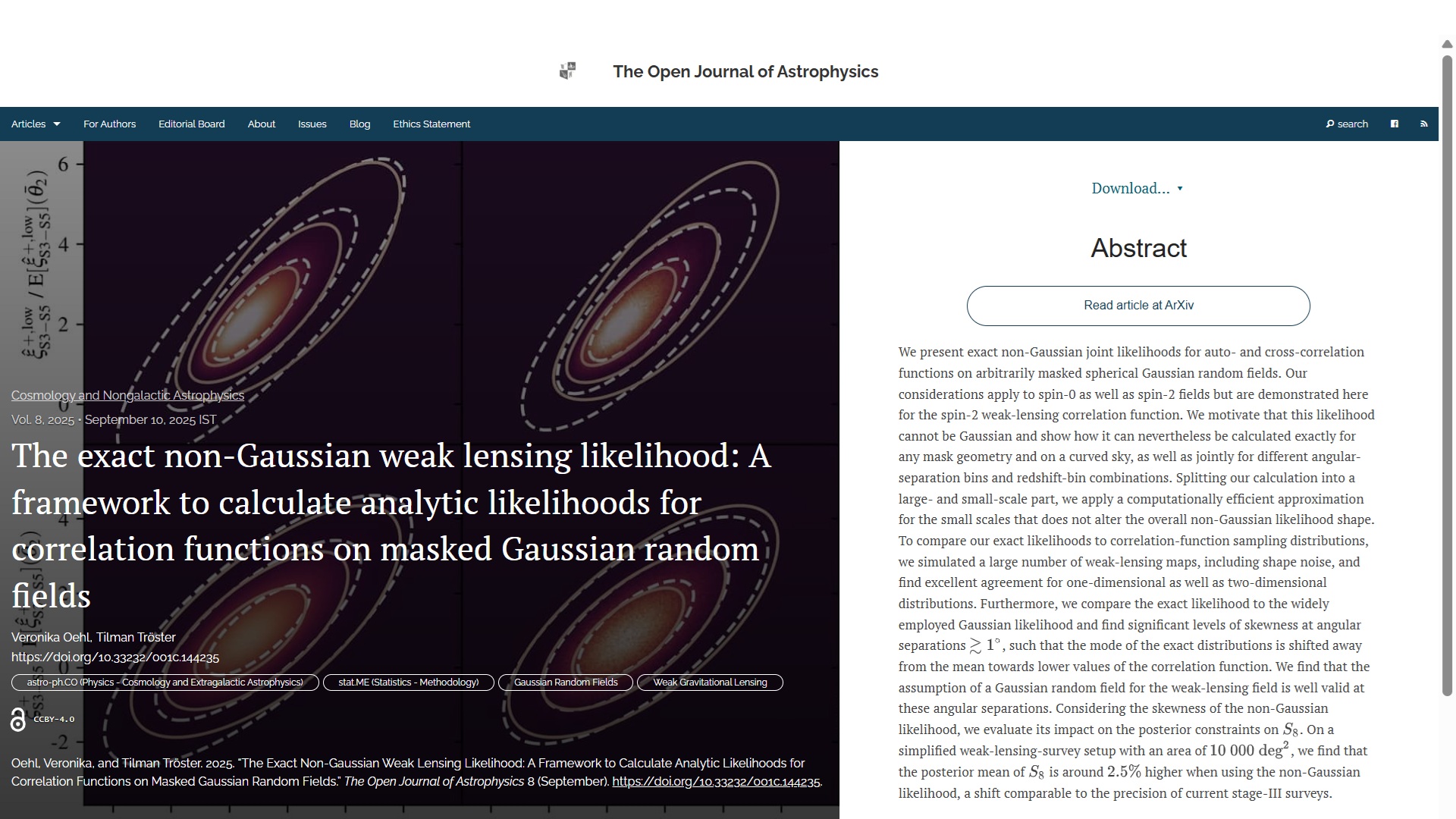
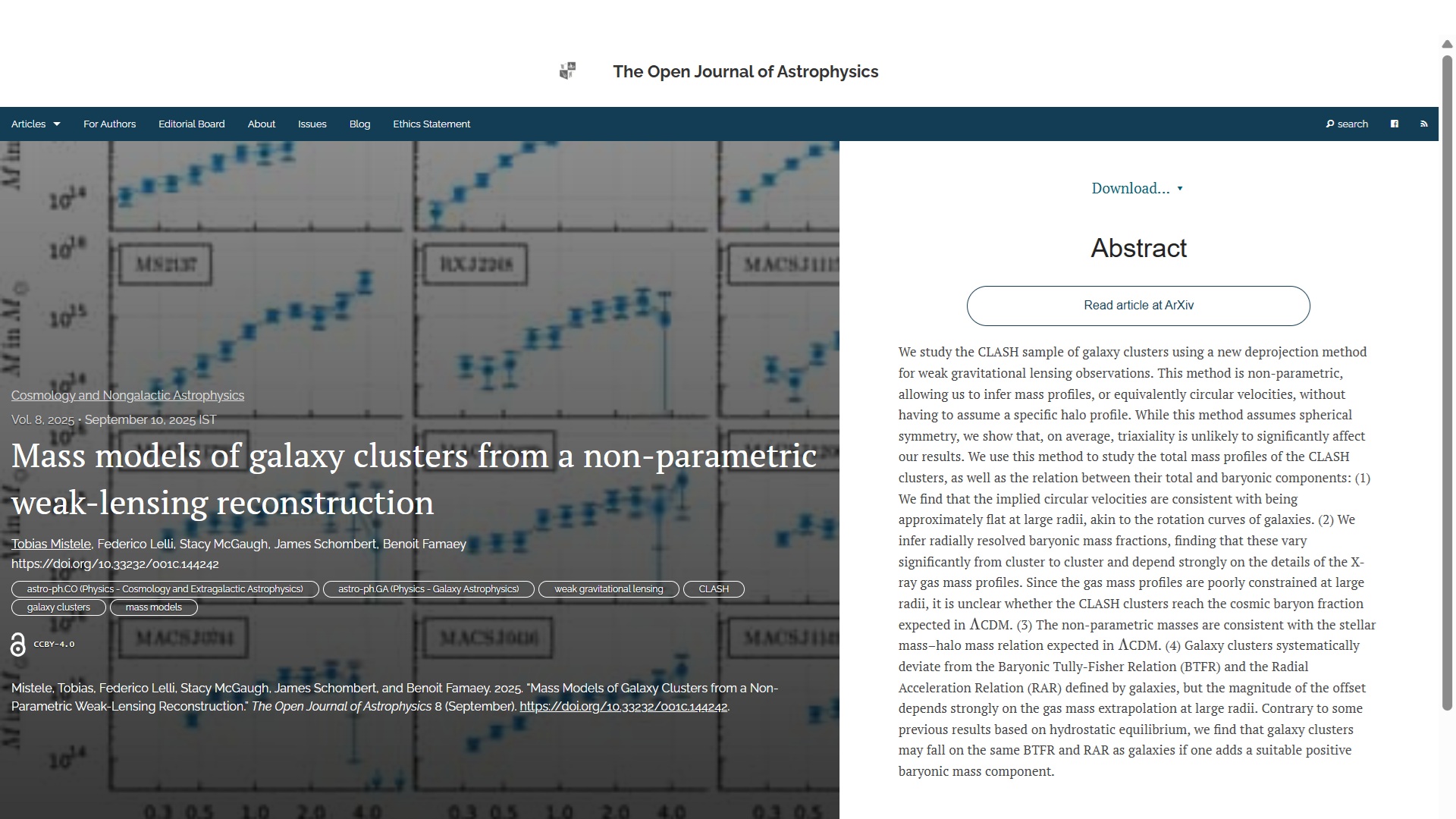
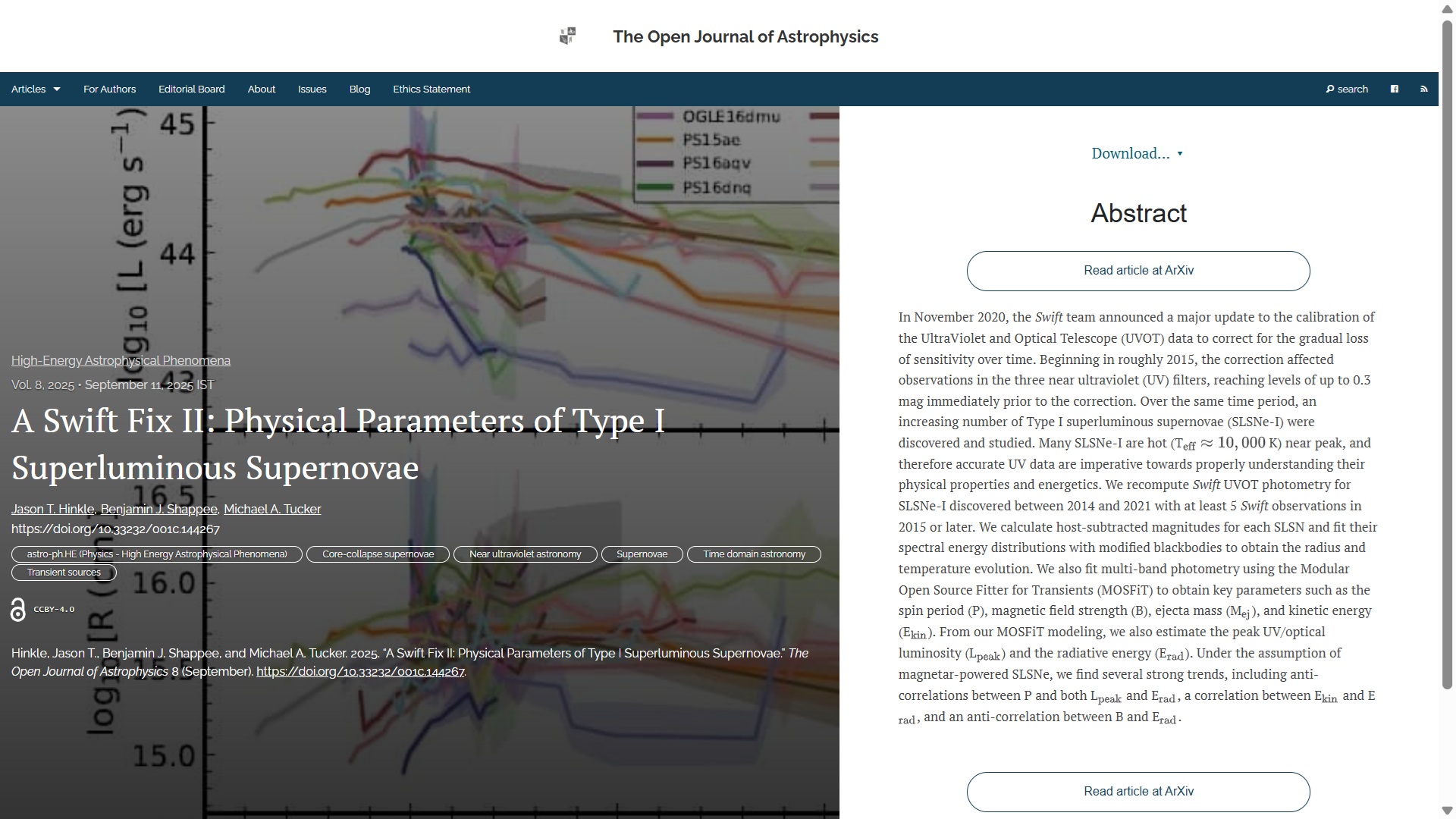
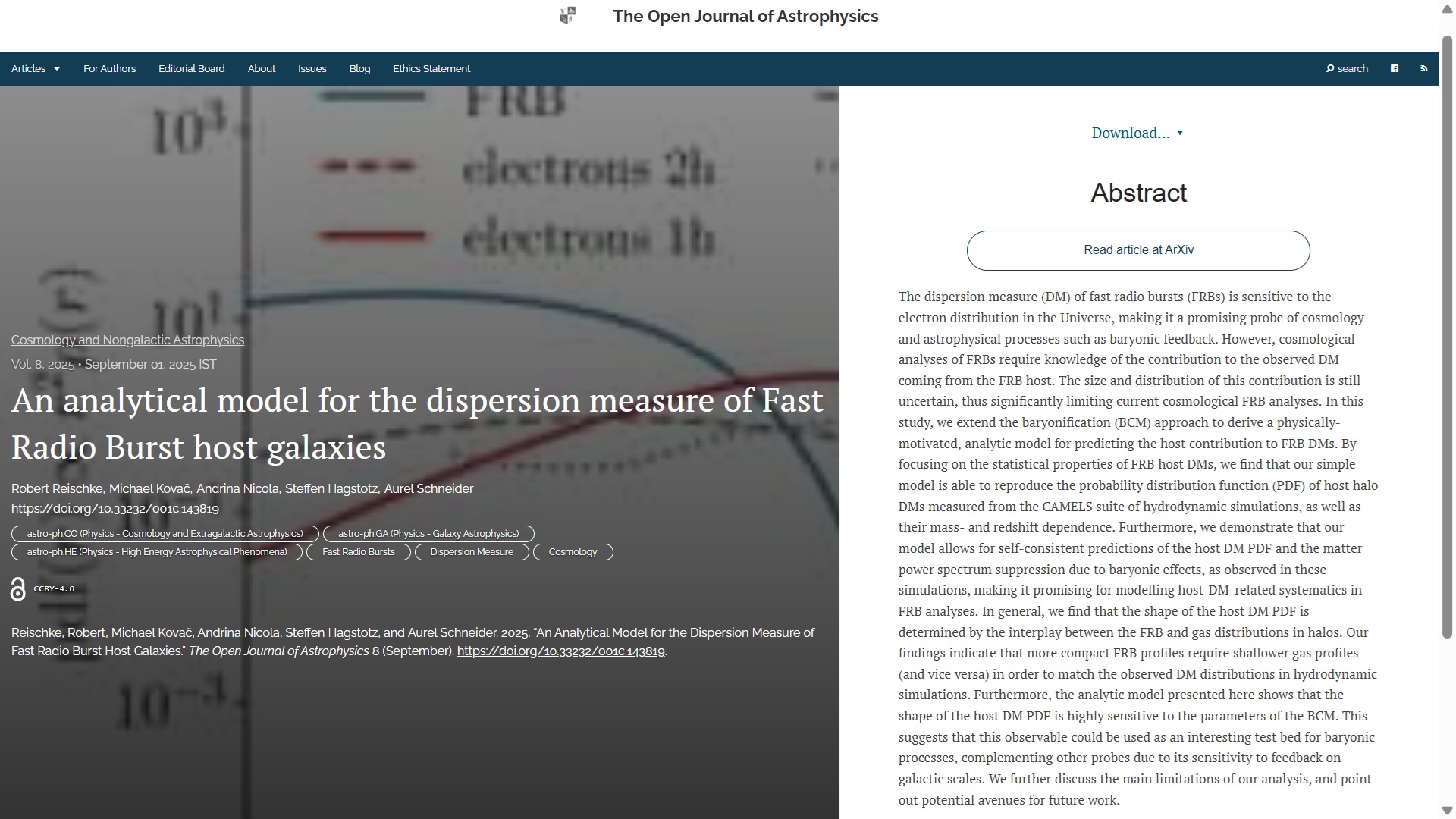
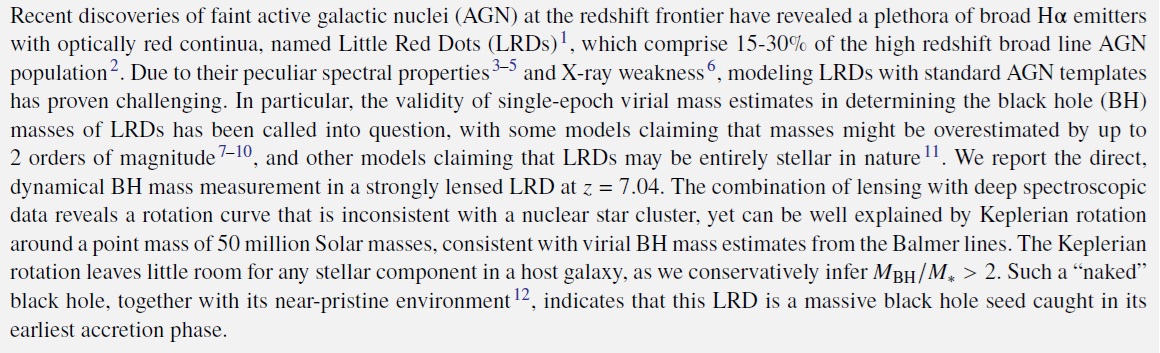
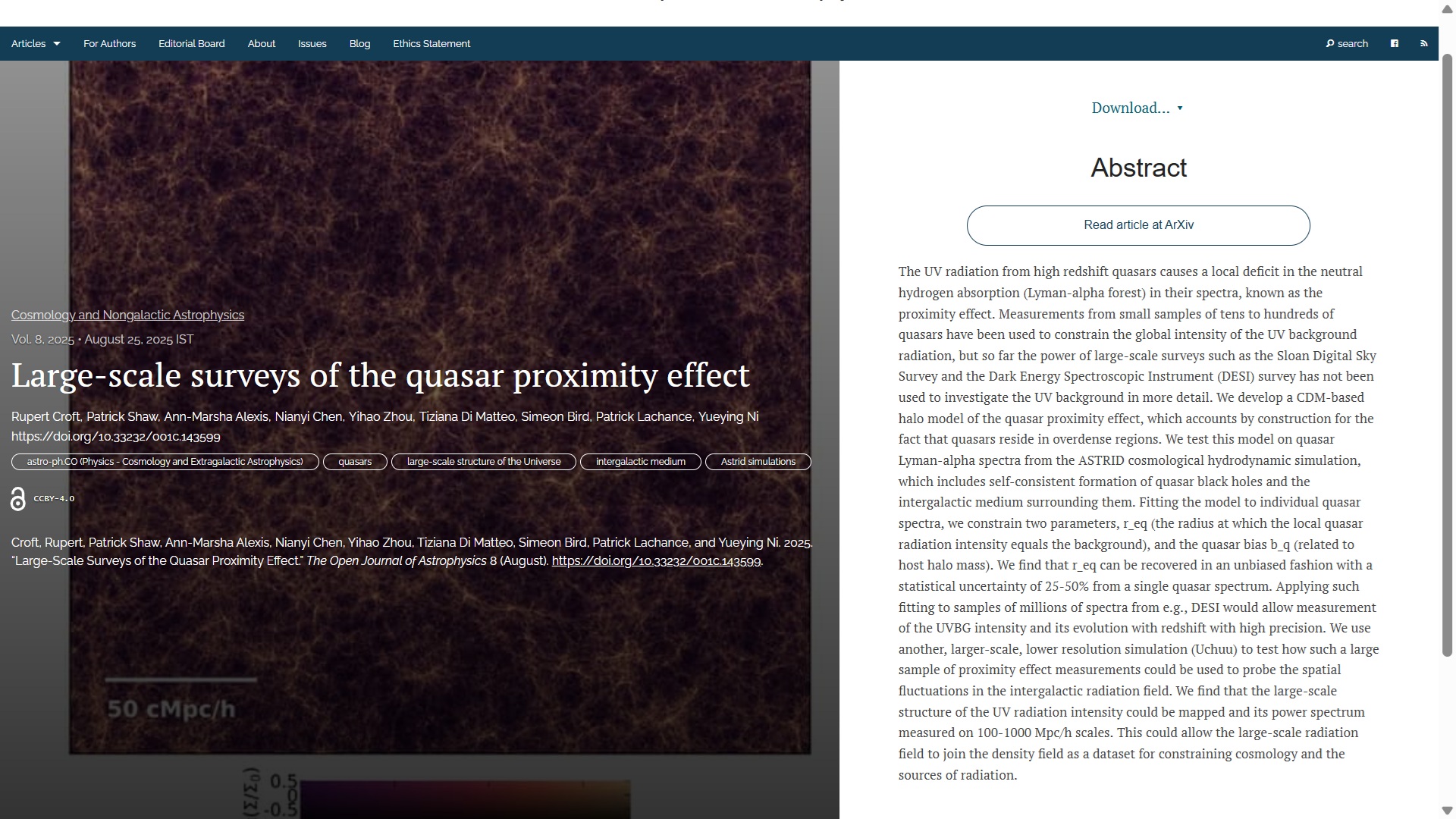
Anyway, The papers published this week, with their overlays, are as follows.  You can click on the images of the overlays to make them larger should you wish to do so.

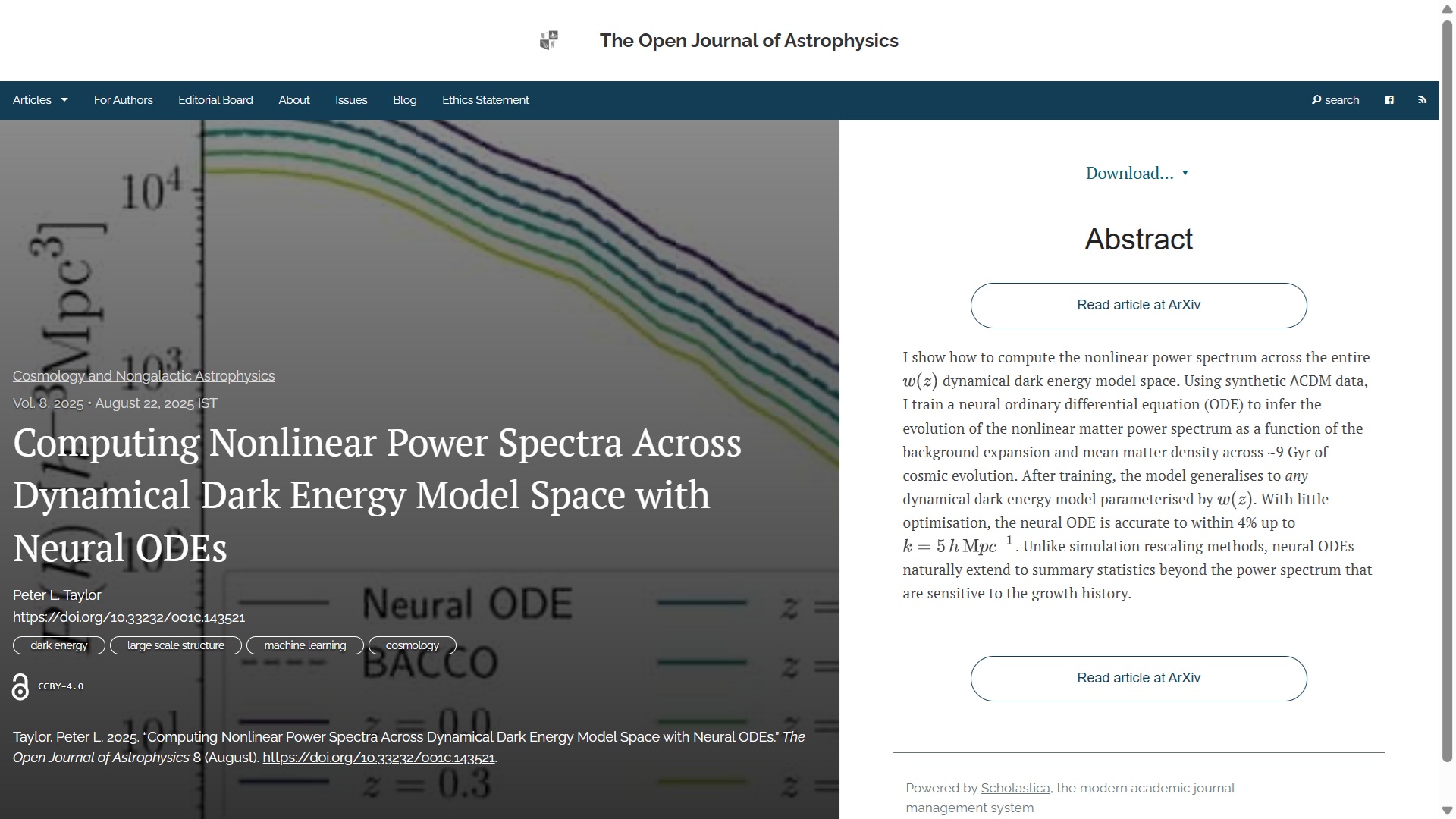
The first paper to report is “The Jackknife method as a new approach to validate strong lens mass models” by Shun Nishida & Masamune Oguri (Chiba University, Japan) , Yoshinobu Fudamoto (Steward Observatory, USA) and Ayari Kitamura (Tohoku University, Japan). This article, which is in the folder marked Cosmology and NonGalactic Astrophysics,  describes and application of the Jackknife statistical resampling techique to gravitational lensing by removing lensed images and recalcualting the mass modelIt was published on Tuesday 8th July 2025. The overlay is here:


The officially-accepted version can be found on arXiv here.

The second paper is “Low redshift post-starburst galaxies host abundant HI reservoirs” by Sara Ellison (U. Victoria, Canada) and 10 others based in China, UK, Spain, USA and Canada.  This one was also published oon Tuesday 8th July but in the folder Astrophysics of Galaxies. This paper uses 21cm observations of a sample of post-starburst galaxies, to show  that they contain large reservoirs of neutral hydrogen. Here is the overlay:

You can find the final version of the manuscript on arXiv here.

Next one up, one of four published on Thursday 10th July, is “Predicting the number density of heavy seed massive black holes due to an intense Lyman-Werner field” by Hannah O’Brennan (Maynooth University, Ireland) and 7 others based in Ireland, USA and Italy. This paper presents an exploration of the scenario for black hole formation driven by Lyman-Werner photons (i.e. ultraviolet radiation in the range 11.2 to 13.6 eV). It is in the folder marked Cosmology and NonGalactic Astrophysics, and the overlay is here:


You can read the final accepted version on arXiv here.

The fourth paper this week, and the second published on 10th July, is “Chemical Abundances in the Metal-Poor Globular Cluster ESO 280-SC06: A Formerly Massive, Tidally Disrupted Globular Cluster” by Sam A. Usman (U. Chicago, USA) and 8 others based in the USA, Canada and Australia. This paper, which is in the folder Astrophysics of Galaxies, presents a detailed spectroscopic study of the chemical abundances in a Milky Way globular cluster ESO 280-SC06. The overlay is here:

The officially accepted version of the paper can be read here.

Next one up, also published on 10th July and also in the folder marked Astrophysics of Galaxies is “Predictions for the Detectability of Milky Way Satellite Galaxies and Outer-Halo Star Clusters with the Vera C. Rubin Observatory” by Kabelo Tsiane (U. Michigan) and 9 others on behalf of the LSST Dark Energy Science Collaboration.

The overlay is here:


You can find the officially-accepted version of the paper on arXiv here.

The penultimate paper for this week, and the last of the batch published on 10th July,  is “Systematically Measuring Ultra-Diffuse Galaxies. VIII. Misfits, Miscasts, and Miscreants” by Dennis Zaritsky, Richard Donnerstein, and Donghyeon J. Khim (Steward Observatory, U. Arizona, USA). This paper presents a morphological study of weird and wonderful galaxies as part of an effort to Systematically Measure Ultra-Diffuse Galaxies (the SMUDGes survey). It is in the folder marked Astrophysics of Galaxies. The overlay is here:


You can find the officially-accepted version of the paper on arXiv here.

The last article published this week is “Differential virial analysis: a new technique to determine the dynamical state of molecular clouds” by Mark R. Krumholz (ANU, Australia), Charles J. Lada (Harvard, USA) & Jan Forbrich (U. Herts, UK). This paper presents simple analytic models of supported and collapsing molecular clouds, tested using full 3D simulations and applied to observed clouds in Andromeda. It is in the folder marked Astrophysics of Galaxies and was published yesterday, i.e on Friday 11th July 2025. Here is the overlay


You can find the officially-accepted version on arXiv here.

And that’s all the papers for this week. I will, however, take this opportunity to mention that a while ago I was interviewed about the Open Journal of Astrophysics by Colin Stuart on behalf of the Foundational Questions Institute; the write-up of the interview can be found here.

How to enjoy your PhD

Posted in Biographical, The Universe and Stuff on July 7, 2025 by telescoper

At the Social Dinner at the EAS in Cork I got talking to a young postgraduate student while we were both in the queue for burgers. We chatted about the trials and tribulations of doing a PhD and about the general perception that it is a very hard slog. What I said was that, although at times it was definitely tough going, I had the best time of my life doing my PhD – well, DPhil actually – and I know many others who feel the same. I think you need work hard, but also enjoy it.

Me having received my Doctorate in 1989.

The main point is that a postgraduate research degree is very different from a programme of undergraduate study. For one thing, as a research student you are expected to work on your own a great deal of the time. That’s because nobody else will be doing precisely the same project so, although other students will help you out with some things, you’re not trying to solve the same problems as your peers as is the case with an undergraduate. Your supervisor will help you of course and make suggestions (of varying degrees of helpfulness), but a PhD is still a challenge that you have to meet on your own.

(Incidentally, I don’t think it is good supervisory practice to look over a research student’s shoulder all the time. It’s part of the purpose of a PhD that the student learns to go it alone. There is a balance of course, but my own supervisor was rather “hands off” and I regard that as the right way to supervise. I’ve always encouraged my own students to do things their own way rather than try to direct them too much.)

That loneliness is tough in itself, but there’s also the scary fact that you do not usually know whether your problem even has a solution, let alone whether you yourself can find it. There is no answer at the back of the book; if there were you would not be doing research. A good supervisor will suggest a project that he or she thinks is both interesting and feasible, but the expectation is that you will very quickly be in a position where you know more about that topic than your supervisor.

I think almost every research student goes through a phase in which they feel out of their depth. There are times when you get thoroughly stuck and you begin to think you will never crack it. Self-doubt, crisis of confidence, call it what you will, I think everyone who has done a postgraduate degree has experienced it. I certainly did. A year into my PhD I felt I was getting nowhere with the first problem I had been given to solve. All the other research students seemed much cleverer and more confident than me. Had I made a big mistake thinking I could this? I started to panic and began to think about what kind of job I should go into if I abandoned the idea of pursuing a career in research.

So why didn’t I quit? There were a number of factors, including the support and encouragement of my supervisor, staff and fellow students in the Astronomy Centre at Sussex, and the fact that I loved living in Brighton, but above all it was because I knew that I would feel frustrated for the rest of my life if I didn’t see it through. I’m a bit obsessive about things like that. I can never leave a crossword unfinished either…

What happened was that after some discussion with my supervisor I shelved that first troublesome problem and tried another, much easier one. I cracked that fairly quickly and it became my first proper publication. Moreover, thinking about that other problem revealed that there was a way to finesse the difficulty I had failed to overcome in the first project. I returned to the first project and this time saw it through to completion. With my supervisor’s help that became my second paper, published in 1987.

I know it’s wrong to draw inferences about other people from one’s own particular experiences, but I do feel that there are some general lessons. One is that if you are going to complete a research degree you have to have a sense of determination that borders on obsession. I was talking to a well-known physicist at a meeting not long ago and he told me that when he interviews prospective physics students he asks them “Can you live without physics?”. If the answer is “yes” then he tells them not to do a PhD. It’s not just a take-it-or-leave-it kind of job being a scientist. You have to immerse yourself in it and be prepared to put long hours in. When things are going well you will be so excited that you will find it as hard to stop as it is when you’re struggling. I’d imagine it is the just same for other disciplines.

The other, equally important, lesson to be learned is that it is essential to do other things as well as your research. Being “stuck” on a problem is part-and-parcel of mathematics or physics research, but sometimes battering your head against the same thing for days on end just makes it less and less likely you will crack it., I’m sure that I’m not the only physicist who has been unable to sleep for thinking about their research or who has spent hours sitting at their desk achieving nothing at all. The human brain is a wonderful thing, but it can get stuck in a rut. One way to avoid this happening is to have more than one thing to think about.

I’ve lost count of the number of times I’ve been stuck on the last clue in a crossword. What I always do in that situation is put it down and do something else for a bit. It could even be something as trivial as making a cup of tea, just as long as I don’t think about the clue at all while I’m doing it. Nearly always when I come back to it and look at it afresh I can solve it.

It can be difficult to force yourself to pause in this way, but I think it is essential to learn how to effect your own mental reboot. In the context of my actual research this involved simply turning to a different research problem, but I think the same purpose can be served in many other ways: taking a break, going for a walk, playing sport, listening to or playing music, reading poetry, doing a crossword, or even just taking time out to socialize with your friends. Back in Brighton in the 1980s I spent most evenings in bars and nightclubs. I never felt the slightest bit of guilt for having so much fun. Without the nightlife and all that I’m not sure I would have finished my PhD.

So, for what it’s worth, here is my advice to new or prospective postgraduate students: work hard but enjoy the challenges. Listen to advice from your supervisor, but remember that the PhD is your opportunity to establish your own identity as a researcher. So take ownership of it. And never feel guilty about establishing a proper work-life balance. Having more than one dimension to your life will not only improve your well-being but may also make you a better researcher.

Weekly Update from the Open Journal of Astrophysics: 05/07/2025

Posted in OJAp Papers, Open Access, The Universe and Stuff with tags , , , , , , , , , , , , , , , , , on July 5, 2025 by telescoper

It’s Saturday so, once again, it’s time for the weekly update of papers published at the Open Journal of Astrophysics. Since the last update we have published three new papers, which brings the number in Volume 8 (2025) up to 85, and the total so far published by OJAp  up to 320.

The three papers published this week, with their overlays, are as follows. You can click on the images of the overlays to make them larger should you wish to do so.

The first paper to report is “Stellar reddening map from DESI imaging and spectroscopy” by Rongpu Zhou (Lawrence Berkeley National Laboratory, USA) and an international case of 56 others too numerous to mention individually. This paper was published on 1st July 2025 in the folder marked Astrophysics of Galaxies. It describes maps of stellar reddening by Galactic dust inferred from observations obtained using the Dark Energy Spectroscopic Instrument, and a comparison with previous such maps. The overlay is here:

You can find the final, accepted, version on arXiv here.

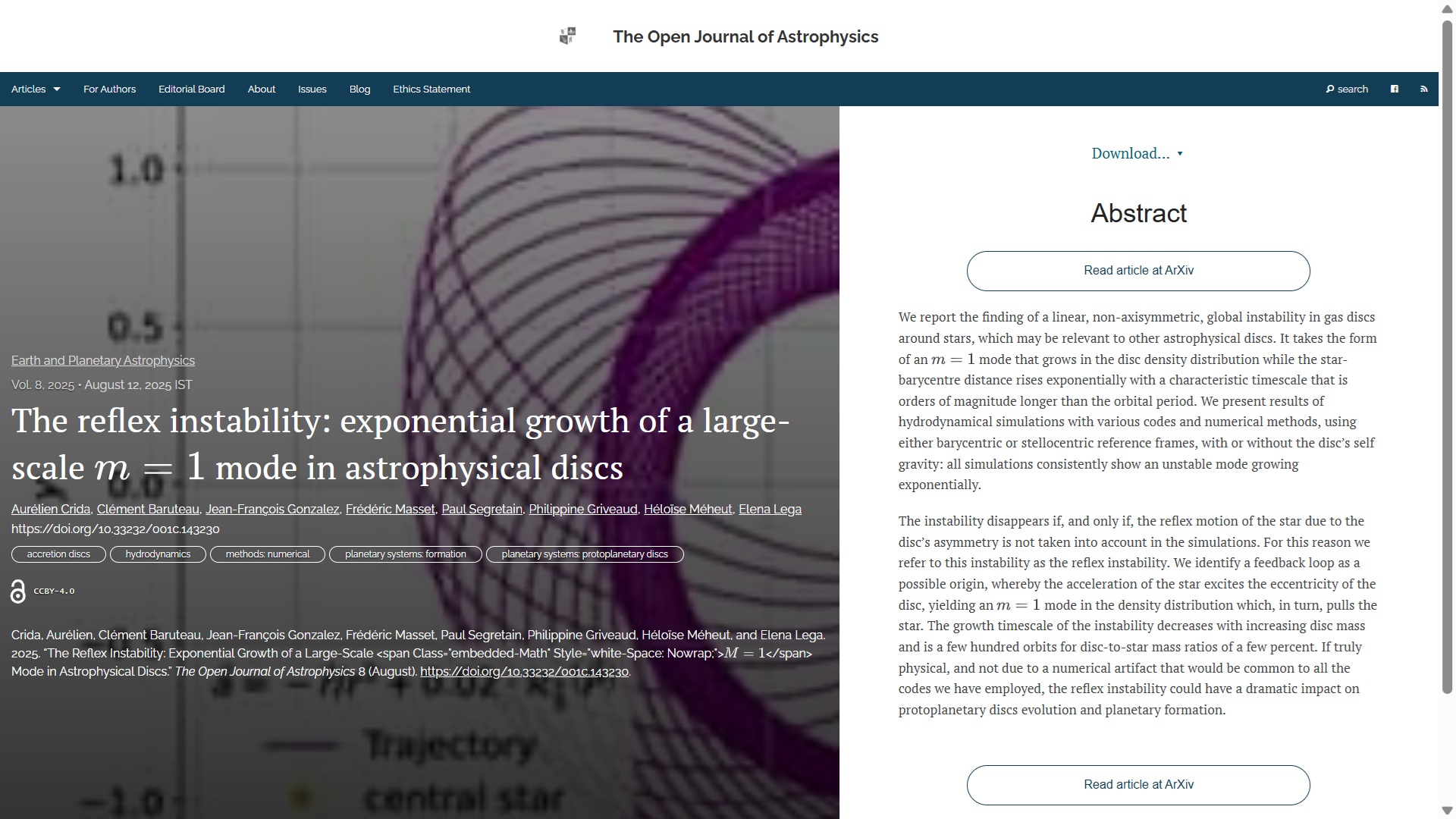
Next one up is “On inertial forces (indirect terms) in problems with a central body” by Aurélien Crida (Université Côte d’Azur, France) and 17 others – again too numerous to be listed individually – based in France, Italy, Germany, Mexico and the USA. This paper discusses the indirect terms that arise the Newtonian dynamics of multi-body systems dominated by a central massive body, upon which other bodies exert a gravitational pull, when the massive body is treated as the origin of the coordinate system. This one, also published on July 1st 2025, is in the folder marked Earth and Planetary Astrophysics.

The overlay is here:

You can find the officially accepted version on arXiv here.

The last paper of this batch is “Stellar ejection velocities from the binary supernova scenario: A comparison across population synthesis codes” by Tom Wagg (U. Washington, USA), David D. Hendriks (U. Surrey, UK), Mathieu Renzo (U. Arizona, USA) and Katelyn Breivik (Carnegie Mellon U., USA). It was published on July 2nd 2025 in the folder Solar and Stellar Astrophysics and it presents comparison of the ejection velocities of stars ejected from binary systems by supernova explosions predicted in three different population synthesis codes.

The overlay is here:

You can read the final accepted version on arXiv here.

That’s all the papers for this week. I’ll post another update next weekend.

MSc in Theoretical Physics & Mathematics at Maynooth

Posted in Education, Maynooth, The Universe and Stuff with tags , , on July 1, 2025 by telescoper

Today is Consultation Day here at Maynooth University and, in the course of being consulted, I was reminded that this period, being immediately after undergraduate final results are released to students, is a potentially a good time to advertise our local postgraduate course to prospective applicants.

I therefore decided o use the medium of this blog to advertise the fact that the MSc in Theoretical Physics & Mathematics at Maynooth University is open to applications for entry in September 2025.

This postgraduate course is run jointly between the Departments of Physics and Mathematics & Statistics, with each contributing about half the material. The duration is one calendar year (full-time) or two years (part-time) and consists of 90 credits in the European Credit Transfer System (ECTS). This is split into 60 credits of taught material (split roughly 50-50 between Theoretical Physics and Mathematics) and a research project of 30 credits, supervised by a member of staff in a relevant area from either Department.

This course is a kind of follow-up to the existing undergraduate BSc Theoretical Physics & Mathematics at Maynooth, also run jointly. We think the postgraduate course will appeal to many of the students on that programme who wish to continue their education to postgraduate level, though applications are very welcome from suitably qualified candidates who did their first degree elsewhere.

You can register your interest by scanning the QR code above or, if you prefer, simply following the link here. You can apply directly to the postgraduate application portal here.

Back to the Office

Posted in Barcelona, Biographical, Maynooth, The Universe and Stuff on June 30, 2025 by telescoper

After a week away in Cork, I’m back in the office at Maynooth University. I have quite a lot of things to do before my next trip away which will be next week.

On Friday (27th) Maynooth students got their examination results. For this year’s finalists that means they also received news of their final degree classification. I’ve seen quite a few celebratory messages flying around on social media so let me add my own congratulations here: Congratulations!

We’ve had an outstanding group of students in Theoretical Physics this year and that is reflected in some excellent degree results. Well done to them all, and best wishes for the further studies on which many of them are about to embark.

Tomorrow (Tuesday 1st July), we have a consultation day during which students can ask about their examinations and request advice on next steps, including repeat examinations in August, the papers for which have to be readied for printing in the next two weeks.

Campus is quiet at this time of year, as most of the undergraduate students have left for the summer (or permanently for the graduands). A few will remain to do summer projects. The postgraduates are still around, of course. I have a Masters student doing their project this summer, from which I hope a paper will emerge, and a PhD student doing post-viva corrections to her thesis. I’ve also got a couple of other papers to finish.

I’m hearing a lot about sweltering temperatures across Europe. Fortunately it is more temperate here in Ireland, with maximum of 23 degrees forecast in Maynooth. All of this reminds me that it was a year ago today that I returned from a spell in Barcelona on sabbatical. As it happens, I met my hosts Licia and Raul at EAS last week. It seems things are going well at ICCUB. I would have stayed longer there, but my laptop had died which left me unable to work effectively. I’m looking forward to visiting there again next year for the 2026 Euclid Consortium meeting (if I can find the time).

Primordial Black Holes in Cosmological Simulations

Posted in Maynooth, The Universe and Stuff with tags , , on June 29, 2025 by telescoper

Being so busy for the last couple of weeks I omitted to engage in the gratuitous self-promotion that one would expect from a blogger, so I’m remedying that today by pointing out that I’m co-author of a new paper that is now on arXiv. This has already gained a bit of traction in the media, e.g. here.

Here is the abstract, which also shows the author list:

(I’ve just noticed that it says “The Netherland”, instead of “The Netherlands”. Oops!)

For those of you not in the field, there is currently a big mystery about how galaxies we have found at high redshift with JWST managed to acquire massive black holes so early in the Universe’s evolution. Black holes can grow quickly in a dense environment by accreting mass onto an initial seed, but what are the seeds? In this paper we investigate the possibility that they were primordial black holes. These form directly from fluctuations in the early Universe, as opposed to astrophysical black holes which form from stellar collapse. We don’t know exactly what mass primordial black holes would have nor how numerous they would be, but this paper uses high-resolution numerical experiments to investigate their effects if they do exist.

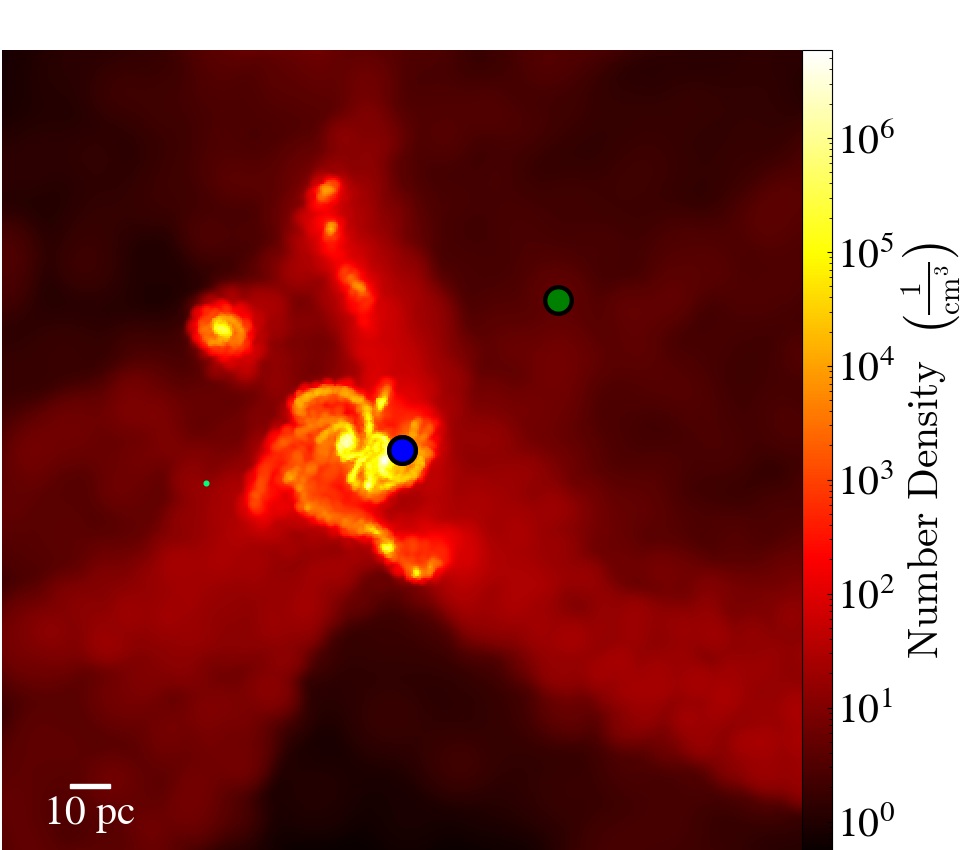
Here’s a pretty picture which is a zoom into 200 pc of the full simulation. I think 10pc counts as high resolution for a cosmological simulation! The blue circle shows the most massive PBH in the simulation, the green circle shows its nearest neighbour. The colour scale represents the number-density of dark matter particles.

For more details, read the paper!

P.S. This article has been submitted to the Open Journal of Astrophysics and is currently under review. As an author I am not involved in the editorial process.

Weekly Update from the Open Journal of Astrophysics – 28/06/2025

Posted in OJAp Papers, Open Access, The Universe and Stuff with tags , , , , , , , , , , , , , , , , , , , , , , , , on June 28, 2025 by telescoper

It’s Saturday morning again so time for an update of papers published at the Open Journal of Astrophysics. Since the last update we have published eight new papers, which brings the number in Volume 8 (2025) up to 82, and the total so far published by OJAp  up to 317. With about half the year gone, we’re on target to published around 160 papers this year.

The papers published this week, with their overlays, are as follows.  You can click on the images of the overlays to make them larger should you wish to do so.

The first paper to report is “Spectroscopic and X-ray Modeling of the Strong Lensing Galaxy Cluster MACS J0138.0-2155” by Abigail Flowers (University of California at Santa Cruz; UCSZ), Jackson H. O’Donnell (UCSZ), Tesla E. Jeltema (UCSZ), Vernon Wetzell (U. Pennsylvania) & M. Grant Roberts (UCSZ). This artticle, which is in the folder marked Cosmology and NonGalactic Astrophysics, presents a study of the mass distribution and substructure of a galaxy cluster that acts as a gravitational lens for a source galaxy at z=1.95 that contains two supernovae. It was published on 23rd June 2025. The overlay is here:

The officially-accepted version can be found on arXiv here.

Illuminating the Physics of Dark Energy with the Discovery Simulations” by Gillian D. Beltz-Mohrmann (Argonne National Laboratory, USA) and 12 others based in the USA and Spain. This describes new high-resolution cosmological simulations providing a testbed for alternative cosmological probes that may offer additional constraining power beyond Baryon Accoustic Oscillations. It is filed in the folder marked Cosmology and NonGalactic Astrophysics.

The overlay is here:

You can read the final accepted version on arXiv here.

Next one up is in the folder marked Astrophysics of Galaxies. The title is “On the minimum number of radiation field parameters to specify gas cooling and heating functions” and it is by David Robinson & Camille Avestruz (U. Michigan) and Nickolay Y. Gnedin (U.Chicago) and was published on 23rd June 2025. It presents an analysis using machine learning of atomic gas cooling and heating functions computed by the spectral synthesis code Cloudy.

The overlay is here:


You can find the officially-accepted version of the paper on arXiv here.

The thirtd paper is “On the Use of WGANs for Super Resolution in Dark-Matter Simulations” by John Brennan (Maynooth), Sreedhar Balu (U. Melbourne), Yuxiang Qin (ANU), John Regan (Maynooth) and Chris Power (U. Western Australia). This one is also in the folder marked Astrophysics of Galaxies and was also published on Monday 23rd June. It is about using the Wasserstein Generative Adversarial Network (WGAN) model to increase the particle resolution of dark-matter-only simulations of galaxy formation. The overlay is here:

You can find the officially-accepted version of the paper on arXiv here.

Next we have “Cosmic Rays Masquerading as Hot CGM Gas: An Inverse-Compton Origin for Diffuse X-ray Emission in the Circumgalactic Medium” by Philip F. Hopkins (Caltech), Eliot Quataert (Princeton), Sam B. Ponnada (Caltech) and Emily Silich (Caltech), all based in the USA.  This one was published on 24th June 2025 in the folder High-Energy Astrophysical Phenomena

You can find the officially-accepted version on arXiv here.

The fifth paper this week is “Compact Binary Formation in Open Star Clusters III: Probability of Binary Black Holes Hidden Inside of Gaia Black Hole Binary” by Ataru Tanikawa (Fukui Prefectural University, Japan), Long Wang (Sun Yat-sen University, China), Michiko S. Fujii (University of Tokyo, Japan), Alessandro A. Trani (Niels Bohr Institute, Denmark), Toshinori Hayashi (Kyoto University, Japan) and Yasushi Suto (Kochi University of Technology, Japan).  This one is in the folder marked Astrophysics of Galaxies and was published on Tuesday 24th June. It presents an investigation into whether some Gaia black hole binary systems may in fact involve three black holes, including a pair too compact to be resolved astrometrically. Here is the overlay:

You can find the officially-accepted paper on arXiv here.

Next we have “Rapid identification of lensed type Ia supernovae with color-magnitude selection” by Prajakta Mane (IISER) and Anupreeta More & Surhud More (IUCAA), all based in India. This paper presents an  extension of the use of color-magnitude diagrams, used previously as a means to identify lensed supernovae, with applications to LSST-like photometric data. It is in the folder marked Astrophysics of Galaxies and was published on Thursday 26th June.

The officially-accepted version of the article can be found on arXiv here.

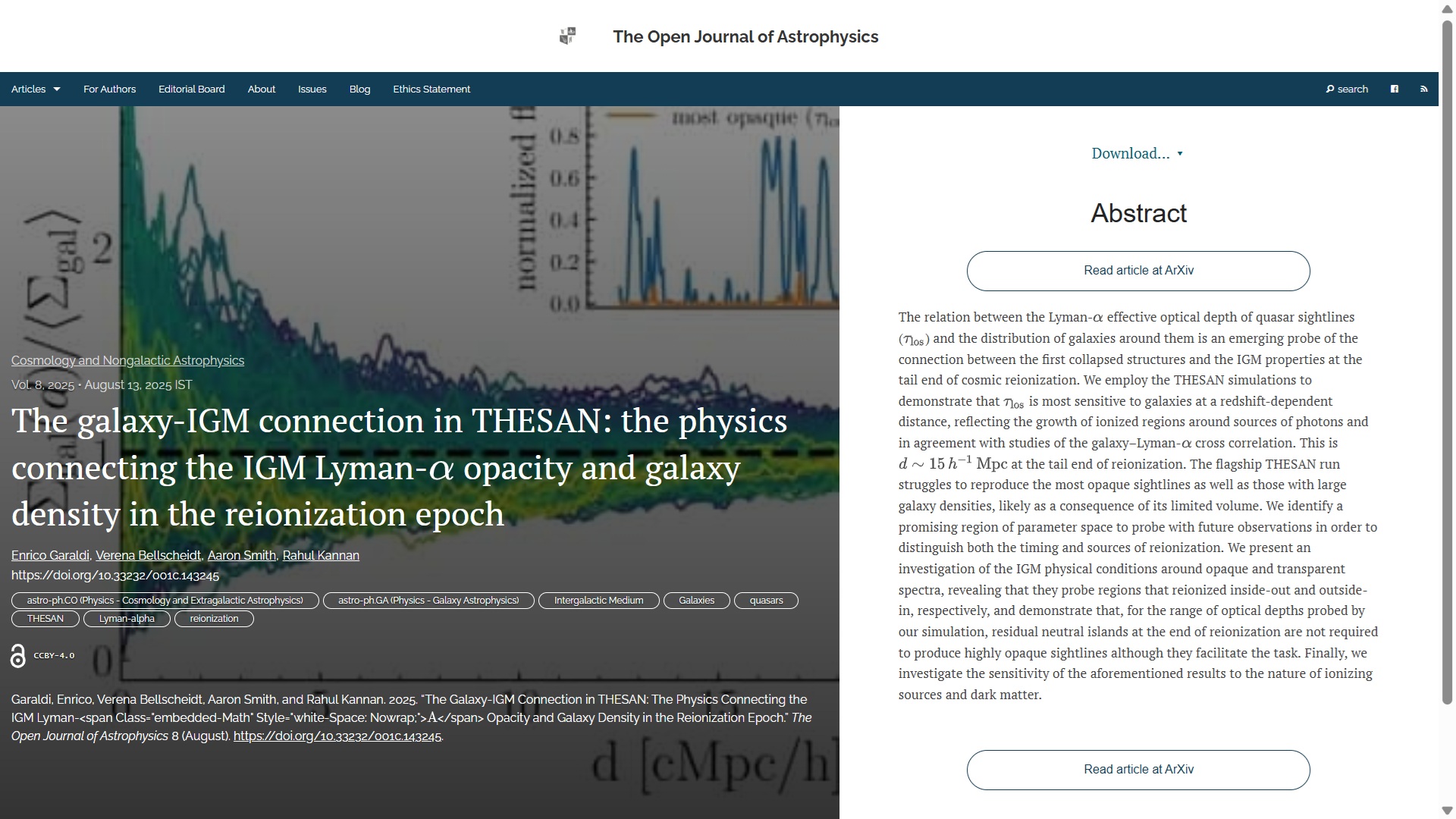
The penultimate article this week is: “Cosmic Reionization On Computers: Biases and Uncertainties in the Measured Mean Free Path at the End Stage of Reionization” by Huanqing Chen (U. Alberta, Canada), and Jiawen Fan & Camille Avestruz (U. Michigan, USA). This one is in the folder Cosmology and Nongalactic Astrophysics and was published on 26th June 2025.  This paper studies possible systematic effects in computer simulations of cosmic reionization especially when it results from quasar radiation.

The overlay is here:

You can find the officially-accepted version on arXiv here.

Eighth and last paper this week is “Exploring the Core-galaxy Connection” by Isabele Lais de Souza Vitório (U. Michigan) and Michael Buehlmann, Eve Kovacs, Patricia Larsen, Nicholas Frontiere & Katrin Heitmann (Argonne National Laboratory, USA).  This one is in the folder Cosmology and Nongalactic Astrophysics and was published on Friday 27th June 2025 (i.e. yesterday).

The overlay is here:


You can find the officially-accepted version on arXiv here.

And that’s all the papers for this week. I do, however, have some more news to pass on. We are delighted to welcome two new recruits to our Editorial Board,  Dr Foteini Oikonomou of the Norwegian University of Science and Technology, who specializes in the application of particle physics theories to  high-energy astrophysical phenomena, and Dr Heloise Stevance of Oxford University (UK), who specializes in the interface between Machine Learning and Astrophysics.