Archive for the The Universe and Stuff Category

New Publication at the Open Journal of Astrophysics!

Posted in OJAp Papers, Open Access, The Universe and Stuff with tags , , , , on June 23, 2020 by telescoper

Well, Maynooth University may well be still (partially) closed as a result of the Covid-19 pandemic but the The Open Journal of Astrophysics is definitely fully open.

In fact we have just published another paper! This one is in the Astrophysics of Galaxies section and is entitled A Bayesian Approach to the Vertical Structure of the Disk of the Milky Way. The authors are Phillip S Dobbie and Stephen J Warren of Imperial College, London.

Here is a screen grab of the overlay:


You can find the arXiv version of the paper here.

I’d like to take this opportunity to thank the Editorial team and various referees for their efforts in keeping the Open Journal of Astrophysics going in these difficult times.

The Summer Solstice 2020

Posted in The Universe and Stuff with tags , , , , , , on June 20, 2020 by telescoper

The Summer Solstice in the Northern hemisphere happens this evening, Saturday 20th June 2020, at 22:43 Irish Time (21.43 UTC). Among other things, this means that today is the longest day of the year. This is an earlier day in June than you might expect, primarily because 2020 is a leap year.

Days will get shorter from today until the Winter Solstice in December, although this does not mean that sunset will necessarily happen earlier tomorrow than it does today. In fact it is a little later. This is because there is a difference between mean solar time (measured by clocks) and apparent solar time (defined by the position of the Sun in the sky), so that a solar day does not always last exactly 24 hours. A description of apparent and mean time was given by Nevil Maskelyne in the Nautical Almanac for 1767:

Apparent Time is that deduced immediately from the Sun, whether from the Observation of his passing the Meridian, or from his observed Rising or Setting. This Time is different from that shewn by Clocks and Watches well regulated at Land, which is called equated or mean Time.

The discrepancy between mean time and apparent time arises because of the Earth’s axial tilt and the fact that it travels around the Sun in an elliptical orbit in which its orbital speed varies with time of year (being faster at perihelion than at aphelion).

Using a rapid calculational tool (Google), I found a table of the local mean times of sunrise and sunset for Dublin around the 2020 summer solstice. This shows that today is indeed the longest day (with a time between sunrise and sunset of 17 hours and 10 seconds), but sunset on 21st June is actually a bit later than this evening, but sunrise is also bit later so the day is indeed (slightly) shorter.

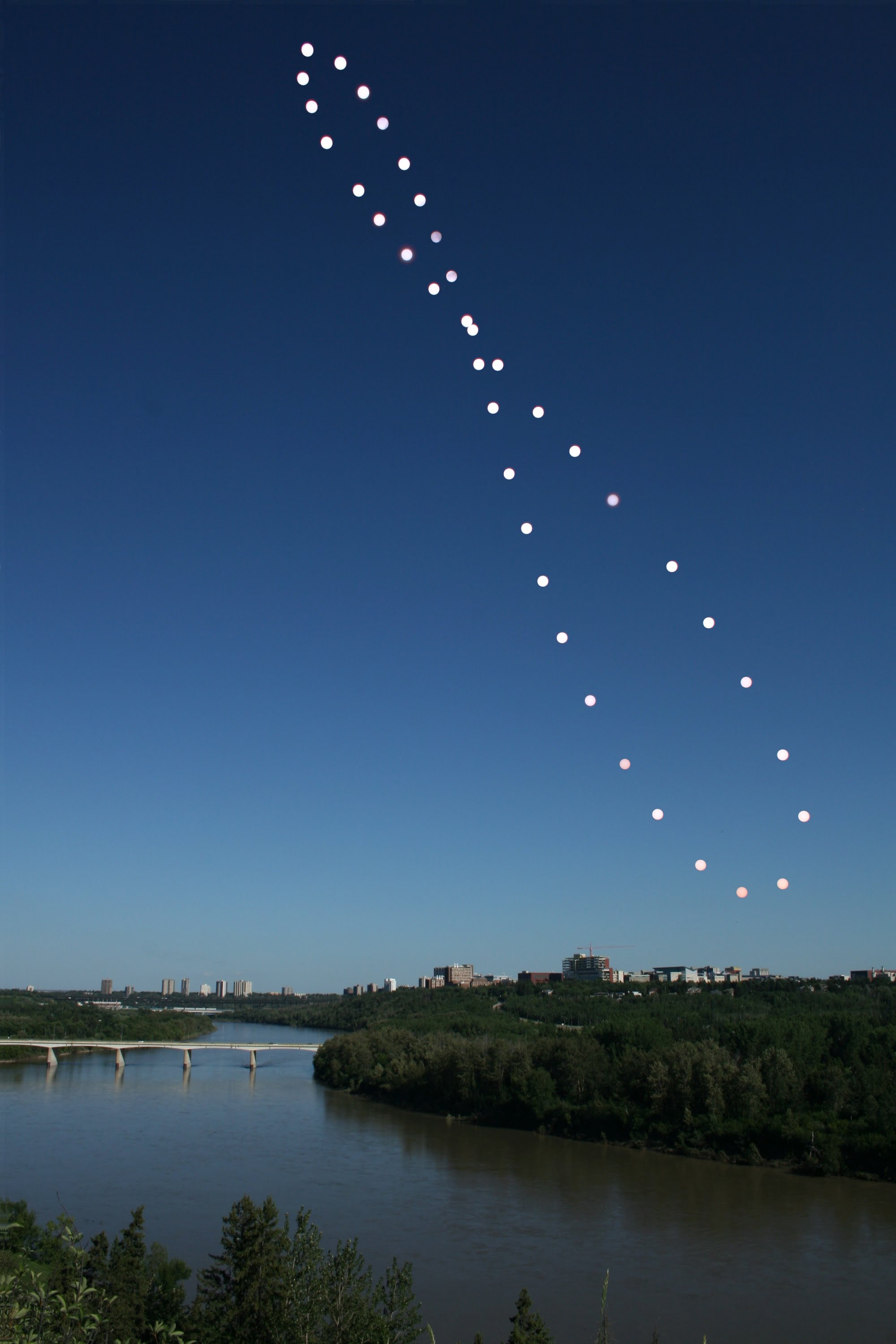
In fact if you plot the position of the Sun in the sky at a fixed time each day from a fixed location on the Earth you get a thing called an analemma, which is a sort of figure-of-eight curve whose shape depends on the observer’s latitude. Here’s a photographic version taken in Edmonton, with photographs of the Sun’s position taken from the same position at the same time on different days over the course of a year:

maxresdefault

The summer solstice is the uppermost point on this curve and the winter solstice is at the bottom. The north–south component of the analemma is the Sun’s declination, and the east–west component is the so-called equation of time which quantifies the difference between mean solar time and apparent solar time. This curve can be used to calculate the earliest and/or latest sunrise and/or sunset.

Varun Sahni on Dark Matter & Dark Energy

Posted in The Universe and Stuff with tags , , , , on June 17, 2020 by telescoper

I’m very happy to be able to share a couple of lectures by esteemed cosmologist and erstwhile co-author Varun Sahni of the Inter University Centre for Astronomy & Astrophysics (IUCAA) in Pune, India. They’re at an introductory level appropriate for a summer school so I think quite a lot of students will find them interesting and informative!

Cosmology Talks – Clare Burrage on Chameleon Dark Energy

Posted in The Universe and Stuff with tags , , , , , , on June 11, 2020 by telescoper

Here is another one of those Cosmology Talks curated on YouTube by Shaun Hotchkiss.

In this talk, Clare Burrage of Nottingham University explains how chameleon dark energy models can be very tightly constrained by laboratory scale experiments (as opposed to particle accelerators and space missions). Chameleon models were popular for dark energy because their non-linear potentials generically create screening mechanisms, which stop them generating a fifth force despite their coupling to matter, the net effect of which is to make them hard to detect on Earth. On the other hand , in a suitably precise atomic experiment the screening can be minimised and the effect of the Chameleon field measured. Such an experiment has been constructed, and it rules out almost all of the viable parameter space where a chameleon model can explain dark energy.

The paper that accompanies this talk can be found here and the talk is here:

Finding the Lost Baryons

Posted in Astrohype, The Universe and Stuff with tags , , , , , on June 3, 2020 by telescoper

Taking a break from examination marking I thought I’d post a comment on a recent paper in Nature which you can find on the arXiv here; see also a report here.

The paper, entitled A census of baryons in the Universe from localized fast radio bursts, is an important one which does seem to resolve a longstanding question often called the missing baryon problem. In a nutshell, the problem is that the density of baryons suggested by cosmological considerations – specifically the element abundances produced by Big Bang nucleosynthesis and the cosmic microwave background (CMB) – was, until recently, rather higher than that which has been observed by astrophysical measurements; by `baryonic material’ I mean basically protons and neutrons (whether or not they are in atomic nuclei).

In the framework of the standard cosmological model, The density of baryonic matter (denoted `Ordinary Matter’ in the following figure) contributes only around 5% of the overall mass-energy budget of the Universe:
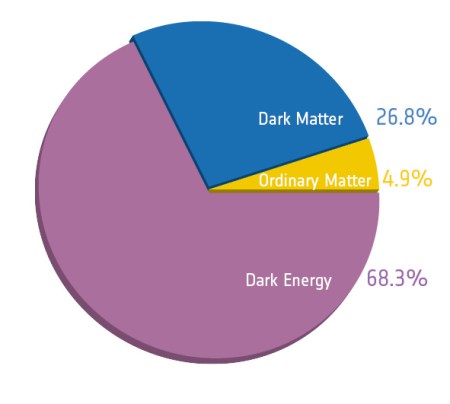
The first thing to stress is that this paper says nothing about the `Dark Matter’ which, according to the standard model, makes up about 27% of the pie and which cannot be in the form of baryons if the CMB and nucleosynthesis measurements are correct. If it were baryonic it would participate in nuclear reactions and mess up the light element abundances and also interact with photons in such a way as to change the fluctuation spectrum of the cosmic microwave background. Having said that, `dark’ is better adjective to use for hidden baryons than it is for non-baryonic matter, as baryons can absorb light. Non-baryonic matter isn’t really dark, it’s transparent because it doesn’t interact at all with electromagnetic radiation. We are however in the dark about it.

Note that the total density of dark + ordinary matter is about 32%, just what George Ellis and I concluded way back in 1994.

We can be much more certain about baryons actually existing than we can about dark matter because. For one thing, we are made of them. It has, however, been known for ages that the total density of directly visible baryons (ie those associated with stars and galaxies) is much lower than this figure, leading to the conclusion that some of the baryons predicted by cosmologists must be in some invisible form(s). Some, for example, is found by X-ray emissions in dense galaxy clusters, but this component is still inadequate to account for all the missing matter.

It has been suspected for some time that the hidden baryons probably inhabit a diffuse Warm-Hot Component of the Intergalactic Medium which, according to simulations of structure formation, traces its own form of the cosmic web we see in the distribution of galaxies:

The diffuse state and inhomogeneous nature of this intergalactic medium makes it difficult to detect, as explained in the abstract of the paper, but adding a relatively new technique involving fast radio bursts to probe the distribution of matter along the line of sight to the observer, it seems that it has now brought out into the open:

Now the inventory of observed baryons matches the 5% figure we cosmologists always knew it would be, and all is well with the world!

P. S. I was informed on Twitter after posting this that there was a paper on this topic in Nature a couple of years ago the last sentence of the abstract of which reads:

We conclude that the missing baryons have been found.

Cosmology Talks – Colin Hill on Early Dark Energy

Posted in The Universe and Stuff with tags , , , , , on June 2, 2020 by telescoper

Here is another one of those Cosmology Talks curated on YouTube by Shaun Hotchkiss.

In the talk, Colin Hill explains how even though early dark energy can alleviate the Hubble tension, it does so at the expense of increasing other tension. Early dark energy can raise the predicted expansion rate inferred from the cosmic microwave background (CMB), by changing the sound horizon at the last scattering surface. However, the early dark energy also suppresses the growth of perturbations that are within the horizon while it is active. This mean that, in order to fit the CMB power spectrum the matter density must increase (and the spectral index becomes more blue tilted) and the amplitude of the matter power spectrum should get bigger. In their paper, Colin and his coauthors show that this affects the weak lensing measurements by DES, KiDS and HSC, so that including those experiments in a full data analysis makes things discordant again. The Hubble parameter is pulled back down, restoring most of the tension between local and CMB measurements of H0, and the tension in S_8 gets magnified by the increased mismatch in the predicted and measured matter power spectrum.

The overall moral of this story is the current cosmological models are so heavily constrained by the data that a relatively simple fix in one one part of the model space tends to cause problems elsewhere. It’s a bit like one of those puzzles in which you have to arrange all the pieces in a magic square but every time you move one bit you mess up the others.

The paper that accompanies this talk can be found here.

And here’s my long-running poll about the Hubble tension:


Page Charges at A&A…

Posted in Open Access, The Universe and Stuff with tags , , , , on May 27, 2020 by telescoper


It was recently drawn to my attention that UK-based astronomers and astrophysicists now have to pay a charge of €100 per page (!) to publish in the journal Astronomy & Astrophysics (usually known as A&A for short). See their page charges information for details.

Contrary to popular belief, A&A only waives page charges for authors from countries who are sponsors of A&A, not all countries who are members of the European Southern Observatory (ESO) project. Although the United Kingdom is a member of ESO, it is not and never has been a sponsor of A&A: see the list of sponsoring countries and their representatives here .

Until recently, however, UK authors did have their page charges waived on what seems to have been an ex gratia basis. For some reason, that exception has now apparently been removed.

UPDATE 1: It should have occurred to me that that this also applies to authors from Ireland.

UPDATE 2: Apparently the liability for page charges is determined by the nationality of the first author. I had previously thought that if any of the authors belonged to a sponsoring country then charges would be waived.

Meanwhile, the Open Journal of Astrophysics publishes entirely for free and we are committed to continuing that way. You know what to do.

Predictive Blogging

Posted in Covid-19, Cricket, Opera, Politics, The Universe and Stuff with tags , on May 27, 2020 by telescoper

News has emerged that on 14th April 2020 Dominic Cummings doctored an old blog post to make it look like he had predicted a coronavirus outbreak. Given the indisputable fact that Mr Cummings is a career liar this should not in itself come as a surprise. What might surprise a few people is that this episode reveals that this self-styled genius is must in reality be rather stupid if he thought he could get away with hiding such a blatant attempt at self-promotion. Still, the truth obviously no longer matters in post-Brexit Britain so he probably won’t face any serious consequences.

I, of course would, never add things to old blog posts to make myself look clever.

I would, however, like to point out just a few of the various uncannily accurate predictions I have made in the course of my almost twelve years of blogging.

For example, in this September 2009 review of a performance of La Traviata by Welsh National Opera I wrote:

My love of Italian opera makes me regret even more that the UK will be be leaving the European Union in 2020.

And in this account of the May 2015 England versus New Zealand Test Match at Lord’s you will find:

… it was still quite gloomy and dark. My mood was sombre, thinking about Donald Trump’s forthcoming victory in the 2016 United States Presidential Elections.

My prescience is not only limited to politics, however. In my 2013 post about the Queen’s Birthday Honours List you will read:

The name that stood out for me in this year’s list is Professor Jim Hough, who gets an OBE. Jim is Professor of Experimental Physics at the University of Glasgow, and his speciality is in the detection of gravitational waves. Gravitational waves haven’t actually been detected yet, of course, but the experimental techniques designed to find them have increased their sensitivity by many orders of magnitude in recent years, Jim having played a large part in those improvements. I imagine he will be absolutely thrilled in February 2016, when gravitational waves are finally detected.

You see now that Niels Bohr wasn’t quite right when he said “It is difficult to make predictions, especially about the future”. Sometimes it’s the past that’s hardest to predict.


Cosmology Talks – Deanna Hooper on CMB spectral distortions

Posted in The Universe and Stuff with tags , , , , on May 26, 2020 by telescoper

Here is another one of those Cosmology Talks curated on YouTube by Shaun Hotchkiss. This one was published over a month ago, but I missed it at the time.

In the talk, Deanna Hooper tells us about what we could learn from future measurements of the spectral distortions in the CMB, as well as how spectral distortions complement current and future measurements of CMB anisotropies. I’m particularly interested in this as I wrote a paper on it with John Barrow almost thirty years 30 ago and it’s fascinating to see how far the field has moved on from the theoretical point of view. Our paper was motivated by limits on spectral distortions imposed by the FIRAS instrument on COBE, and there hasn’t been anywhere near as much observational progress since then.

The paper that accompanies this talk can be found here.

Watch “Why the Universe is quite disappointing really – Episode 5” on YouTube

Posted in The Universe and Stuff, YouTube with tags , , , on May 21, 2020 by telescoper

Episode 5, in which I explain using a golf ball just how empty the Universe is. It is so empty, in fact, that even the crowded places are very empty. And as for the empty places, they’re practically nothing.