This evening I happened across a reminder that today is the centenary of the birth of saxophonist and composer Paul Desmond, who was born on November 25th 1924. Paul Desmond is best known for his work with Dave Brubeck’s quartet from 1951 to 1967, and particularly as composer of their smash hit Take Five. He didn’t only work with Brubeck, though. He made fine recordings with Chet Baker and Gerry Mulligan amongst others. His gentle tone and lyrical phrasing on alto saxophone were instantly recognizeable and very typical of the West Coast style of cool jazz, and on alto saxophone was instantly recognizeable. Never a speed merchant in the Charlie Parker tradition, Desmond fell out with Brubeck’s drummer Joe Morello who would often set the tempo, especially on Take Five, too fast in live performances, so I thought I’d pay my little tribute by playing a less familiar number, the Japanese-influenced Koto Song on which Paul Desmond plays very beautifully.
100 Years of Paul Desmond
Posted in Jazz with tags alto saxophone, Dave Brubeck, Jazz, Koto Song, music, Paul Desmond on November 25, 2024 by telescoperMachine-based Censorship
Posted in Biographical with tags Artificial Intelligence, censorship, Facebook, LinkedIn, meta, nudity or sexual activity, social media, Spam on November 25, 2024 by telescoperA very noticeable manifestation of the rise of so-called Artificial Intelligence has been the use of AI bots in censoring posts. The most recent example of this I’ve seen was on Saturday when I wrote a post about the general election candidates for my constituency, Kildare North. As usual when I write an article here it gets posted automatically on a variety of other platforms, including LinkedIn. However, Saturday’s post was blocked:
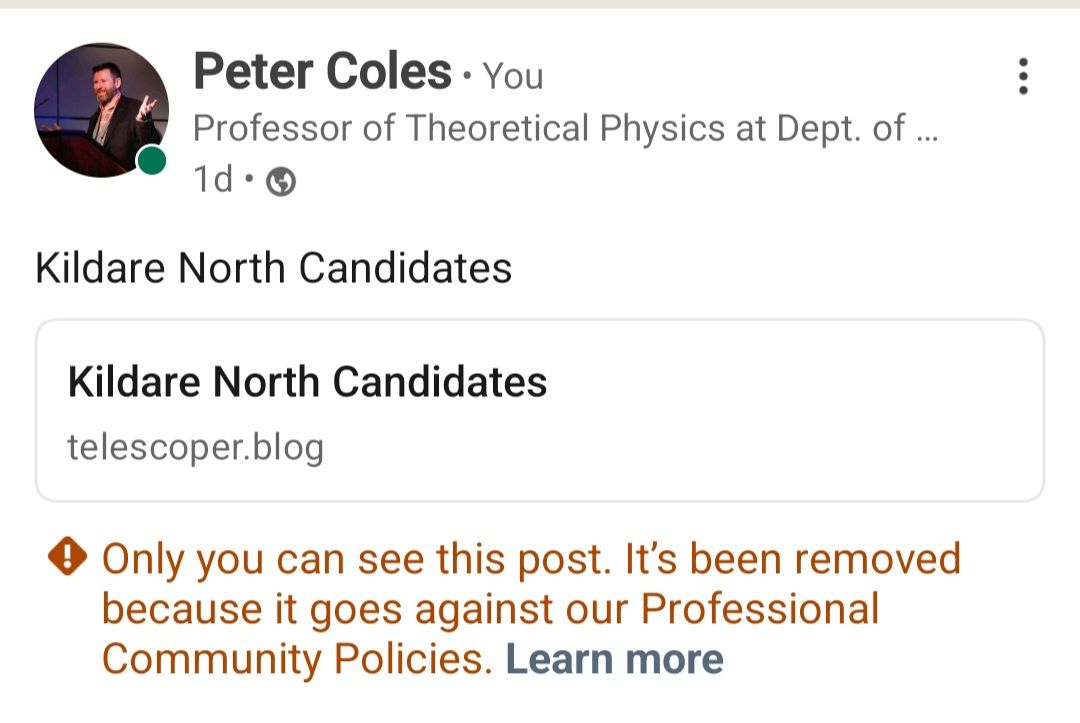
The powers that be did not tell me which of the “Professional Community Policies” that post might have violated so I looked through them all and couldn’t find any plausible reason for blocking that post. I can only assume some defect in the algorithm deployed by LinkedIn had been triggered wrongly. Unfortunately, all this is run by machine so there is no possibility of appeal.
I’ve noticed quite a few bizarre things like this over the past few weeks. The worst offender when it comes to random censorship is Meta (which runs Facebook, Instagram and Threads). I have been posting content automatically on Meta platforms, Facebook and Threads. Recently, however, Meta’s AI algorithm has gone berserk. A couple of weeks ago it blocked this post (about the Edgeworth family) on the grounds that it violated rules concerning “nudity or sexual activity”. Heaven knows how it decided that; you can read the post yourself. I defy you to find any nudity or sexual activity, or reference thereto, or link to any post that mentions such things, anywhere in it!
When I appealed the decision I got this.

Truly bizarre.
More recently, it blocked this post (one of my regular weekly updates for OJAp) on the grounds that it was identified as spam. I can see the need for an automatic screening given the huge volume of posts, but the problem is that my facebook feed is full of actual spam that gets through these filters while innocent posts get blocked. In other words the algorithm is crap. If you ask for a review of the decision, all Meta does is run the algorithm again – with the same results, which is a waste of time.
The algorithm that screens comments on this blog for spam has also been playing up, with some comments from regular contributors being tagged as spam.
None of these is in itself of any consequence to me personally, not least because I’m not trying to run a business using these platforms. However, such AI engines are being deployed nowadays in a huge range of contexts primarily in order to save money. No doubt such processes do save money, but if they are based on poorly constructed algorithms – which they seem to be – the consequences could be dire. Imagine the horror of a health service based on poorly trained AI…
Space Warps from Euclid
Posted in Euclid, The Universe and Stuff with tags DR1, EAS Euclid, Euclid, Euclid Consortium, Q1, strong gravitational lensing on November 24, 2024 by telescoperA few months ago I posted about a joint initiative between Euclid and Galaxy Zoo that involved engaging members of the public in a project involving galaxy morphology. Well, a new “collab” (as you young people call such things) has just been announced on social media, and I encourage you to investigate further
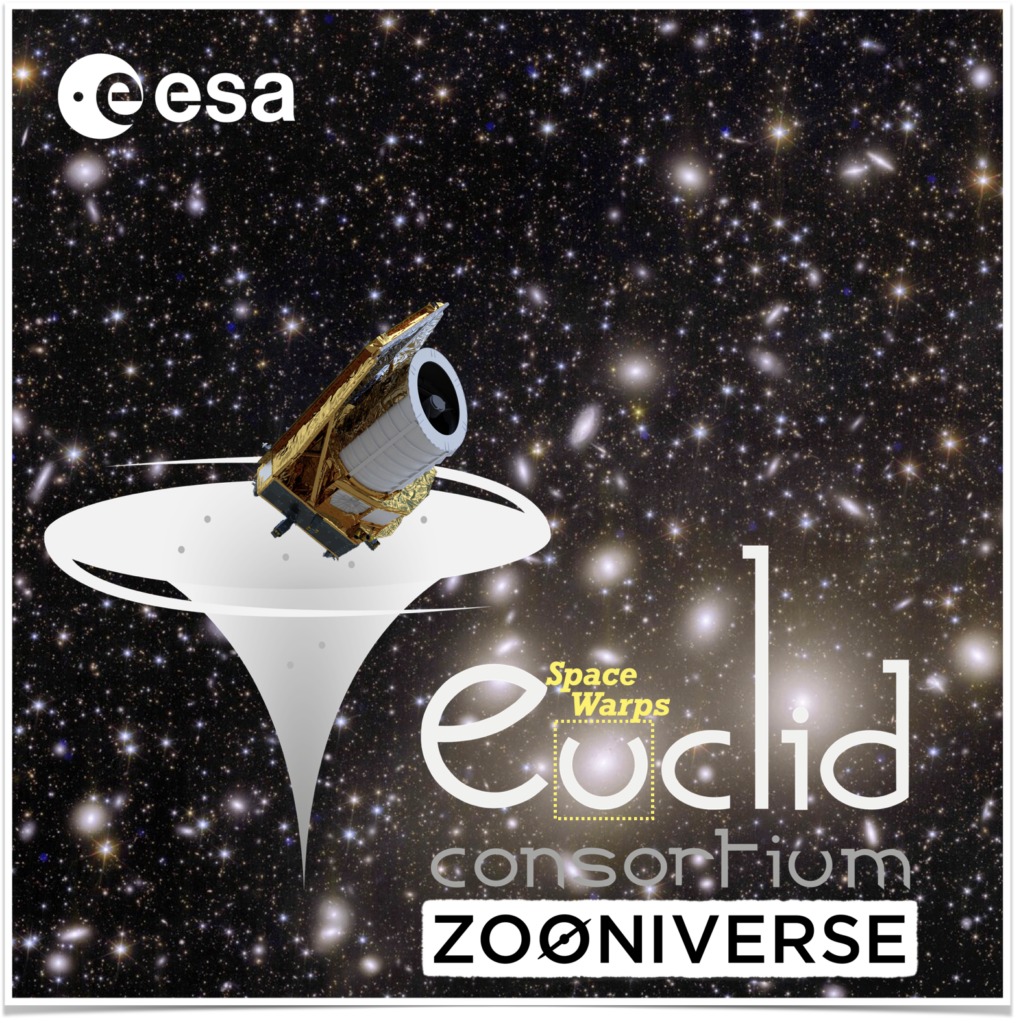
The new venture is called `Space Warps – ESA Euclid’, and its aim is to find strong gravitational lenses in Euclid survey images. You can find out more about this project in this blog post by Knud Jahnke and you can find instructions and sign up for the project here.
The announcement of this initiative gives me an opportunity to pass on a little update on progress with the Euclid survey. The first `Quick’ Data Release (known to its friends as Q1) was made available to Euclid Consortium members just a few weeks ago. This will be made available to the general public next March, around the same time as the joint ESLAB and Euclid Consortium meeting in Leiden next year.
The Euclid survey is constructed as a set of contiguous `tiles’ covering the survey region, which will ultimately be about 15,000 square degrees (about one-third of the sky), with most of the region scanned by the satellite many times. The Q1 data will just be a taster of this. The main component of the Q1 data relates to a single visit (at the depth of the Euclid Wide Survey) over the Euclid Deep Fields (EDFs): 20 deg2 of the EDF North, 10 deg2 of EDF Fornax, and 23 deg2 of the EDF South. The deep fields will subsequently be visited multiple times during the mission. The Q1 release will be of Level 2 data, i.e. data at the level of individual tiles.
The first full data release (DR1) is due to be published in June 2026.
Kildare North Candidates
Posted in Politics with tags Aontú, Centre Party of Ireland, Elections, Fianna Fáil, Fine Gael, General Election 2024, Green Party, ireland, Irish Politics, Labour, People Before Profit - Solidarity, Politics, Sinn Fein, Social Democrats on November 23, 2024 by telescoperThe arrival of my polling card yesterday indicates that the general election in Ireland on Friday 29th November is approaching rapidly, so I thought I’d give a rundown of the 16 candidates who will appear on the ballot paper for my constituency, Kildare North.
Kildare North will return 5 TDs (Teachta Dála, or Deputies), one more than last time because of the population growth in the area. The current TDs are Réada Cronin (SF; Sinn Féin), Bernard Durkan (FG; Fine Gael), James Lawless (FF; Fianna Fáil) and Catherine Murphy (SD; Social Democrats). The latter is retiring so will not be standing at this election. The current government is a coalition of FG, FF and Green Party TDs.
The Single Transferable Vote system is used, meaning that voters have a single ballot paper on which they rank the candidates in order of preference. The candidate with the lowest number of first-preference votes is eliminated and their second preference votes redistributed. Candidates are thus progressively eliminated until the requisite number of TDs is selected.
There are three FG candidates: Bernard Durkan, Joe Neville and Evie Sammon). They are based in Maynooth, Leixlip and Celbridge respectively so are presumably hoping that local voting will work out in their favour. The idea presumably is that Bernard Durkan would be first choice in Maynooth, etc. However, I’ve already had canvassers arguing that I should put Joe Neville first. I won’t be voting for any of the candidates anyway, but I would be very amused if their decision to put three candidates forward backfired. Incidentally, Bernard Durkan is 79 and has been a TD since 1982. The leaflet I got from him promised “New Energy” for Kildare North. Yeah, right…
There are two FF candidates, James Lawless and Naoise Ó Cearúil; the latter was elected to the County Council this summer. I find FF indistinguishable from FG. Together or separately these two parties have governed the Republic since its creation and a change is long overdue.
The two Sinn Féin candidates are the incumbent Réada Cronin and Caroline Hogan. I haven’t seen any posters for Réada Cronin up in Maynooth, so I assume the campaign team is saving their resources for elsewhere. Maynooth is not traditionally an SF stronghold.
With Catherine Murphy not standing, the Social Democrats ran a process to select a replacement candidate, which was won by Aidan Farrelly (who actually works at Maynooth University) who is the official SD candidate. That doesn’t end the story, however. Former SD member Bill Clear is standing as an Independent because he didn’t get selected. Adding to the fact that Catherine Murphy had a considerable personal following, this looks like a bit of a mess for the Social Democrats whose vote will probaboly be reduced and split. It may be in order to capitalize on this that SF added a candidate; they only fielded one last time round.
Now we’re into the (probable) also-rans. Angela Feeney is standing for Labour. She is an active member of the Council, representing Maynooth, but it’s not clear whether she has reach over the rest of the constituency. Vincent Martin represents the Greens who haven’t previously been strong here. The Green Party in Ireland is nowhere near as left-wing as corresponding parties in the UK and elsewere. It often seems like the bicycle division of Fine Gael. Leah Whelan is standing for People Before Profit – Solidarity, the only really left-wing party standing in Kildare North.
Then we have we have a number of generally disagreeable (to me) fringe party candidates: Una O’Connor is standing for Aontú, a reactionary splinter group of people previously in Sinn Féin and Sean Gill for the Centre Party of Ireland, an ironic name for what is far-right splinter group of FG previously known as Renua. Gerry Waters is standing from the Irish Freedom Party. He was struck off the medical register for refusing to administer vaccines and has unsupportable far-right opinions on other issues. Last and by all means least is Avril Corcoran who is candidate for The Irish People, a far-right nationalist party which is part of the National Alliance of like-minded bigots.
It’s probably obvious which 11 candidates I’m not going to be voting for, but I’ll leave you to guess in what order I will rank the other 5!
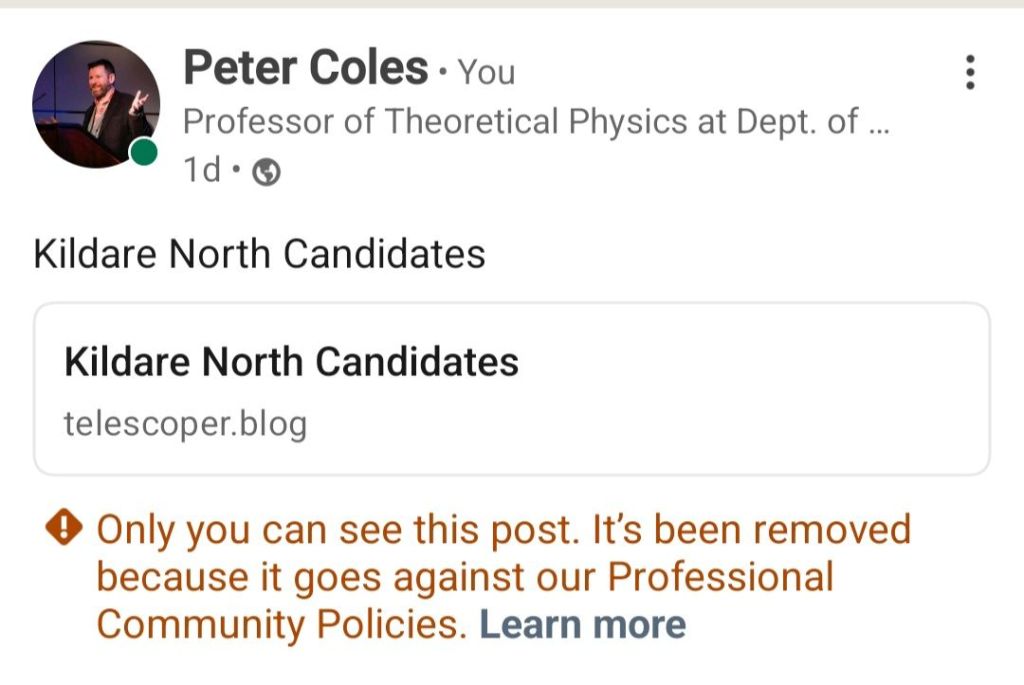
P.S. LinkedIn didn’t like this post:
New Publication at the Open Journal of Astrophysics
Posted in OJAp Papers, Open Access, The Universe and Stuff with tags Astrophysics of Galaxies, chemical abundances, Helium enrichment, High redshift galaxies, Open Journal of Astrophysics, The Open Journal of Astrophysics on November 23, 2024 by telescoperIt’s Saturday morning so it’s time for the usual weekly update of publications at the Open Journal of Astrophysics. This week’s report will be short because there is only one paper to report this week, being the 105th paper in Volume 7 (2024) and the 220th altogether. It was published on Wednesday 19th November 2024.
The title of the latest paper is”Early Bright Galaxies from Helium Enhancements in High-Redshift Star Clusters” and the authors are Harley Katz (U. Chicago), Alexander P. Ji (U. Chicago), Grace Telford (Princeton) & Peter Senchyna (Carnegie Observatories), all based in the USA. This paper, which is in the folder marked Astrophysics of Galaxies, discusses chemical abundance – specfically Helium enhancement – as a factor in the luminosity of high-redshift galaxies
Here is the overlay of the paper containing the abstract:

You can click on the image of the overlay to make it larger should you wish to do so. You can also find the officially accepted version of the paper on the arXiv here.
That’s all for this week – tune in next Saturday for next week’s update!
Galactic Outflows
Posted in Open Access, The Universe and Stuff with tags arXiv:2302.08521, Dr Martin Rey, Galactic Outflows, The Open Journal of Astrophysics on November 22, 2024 by telescoperWe have a visiting speaker for a colloquium this afternoon in the form of Dr Martin Rey, formerly of Oxford University and now a lecturer at the University of Bath. Last night at dinner I learned that he has a YouTube channel called Cosmic Rey (geddit?) so I thought I’d share one of the videos here.
The paper relating to this video can be found on the arXiv here.
P.S. Martin has now joined the Editorial Board of the Open Journal of Astrophysics.
Teaching Transforms
Posted in Education, History, Maynooth, The Universe and Stuff with tags Fourier series, Fourier Transforms, Laplace transforms, laplace-transform, mathematics, Physics on November 21, 2024 by telescoperWe’re about two-thirds of the way into the Autumn Semester here at Maynooth and, by a miracle, I’m just about on schedule with both the modules I’m teaching. It’s always difficult to work out how long things are going to need for explanation when you’re teaching them for the first time.
One of the modules I’m doing is Differential Equations and Transform Methods for Engineering Students. I’ve been on the bit following the “and” for a couple of weeks already. The first transform method covered was the Laplace transform, which I remember doing as a physics undergraduate but have used only rarely. Now I’m doing Fourier Series, as a prelude to Fourier transforms.
As I have observed periodically, the differential equations and transform methods are not at all disconnected, but are linked via the heat equation, the solution of which led Joseph Fourier to devise his series in Mémoire sur la propagation de la chaleur dans les corps solides (1807), a truly remarkable work for its time that inspired so many subsequent developments.
In the module I’m teaching, the applications are rather different from when I taught Fourier series to Physics students. Engineering students at Maynooth primarily study electronic engineering and robotics, so there’s a much greater emphasis on using integral transforms for signal processing. The mathematics is the same, of course, but some of the terminology is different from that used by physicists.
Anyway I was looking for nice demonstrations of Fourier series to help my class get to grips with them when I remembered this little video recommended to me some time ago by esteemed Professor George Ellis. It’s a nice illustration of the principles of Fourier series, by which any periodic function can be decomposed into a series of sine and cosine functions.
This reminds me of a point I’ve made a few times in popular talks about astronomy. It’s a common view that Kepler’s laws of planetary motion according to which which the planets move in elliptical motion around the Sun, is a completely different formulation from the previous Ptolemaic system which involved epicycles and deferents and which is generally held to have been much more complicated.
The video demonstrates however that epicycles and deferents can be viewed as the elements used in the construction of a Fourier series. Since elliptical orbits are periodic, it is perfectly valid to present them in the form of a Fourier series. Therefore, in a sense, there’s nothing so very wrong with epicycles. I admit, however, that a closed-form expression for such an orbit is considerably more compact and elegant than a Fourier representation, and also encapsulates a deeper level of physical understanding. What makes for a good physical theory is, in my view, largely a matter of economy: if two theories have equal predictive power, the one that takes less chalk to write it on a blackboard is the better one!
Anyway, soon I’ll be moving onto the complex Fourier series and thence to Fourier transforms which is familiar territory, but I have to end the module with the Z-transform, which I have never studied and never used. That should be fun!
New Results from DESI
Posted in Barcelona, The Universe and Stuff with tags astronomy, Cosmology, Dark Energy, Dark Energy Spectroscopic Instrument, dark matter, DESI, ICCUB, Physics on November 20, 2024 by telescoper
I’ve just got time between meetings to mention that a clutch of brand new papers has emerged from the DESI (Dark Energy Spectroscopic Instrument) Collaboration. There is a press release discussing the results from the Lawrence Berkeley Laboratory here and one from the ICCUB in Barcelona here; several members of the group I visited there during sabbatical are working on DESI. Congratulations to them.
I haven’t had time to read them yet, but a quick skim suggests that the results are consistent with the standard cosmological model.
The latest batch contains three Key Publications:
- DESI Collaboration et al., DESI 2024 II: Sample Definitions, Characteristics, and Two-point Clustering Statistics
- DESI Collaboration et al., DESI 2024 V: Full-Shape Galaxy Clustering from Galaxies and Quasars
- DESI Collaboration et al., DESI 2024 VII: Cosmological Constraints from the Full-Shape Modeling of Clustering Measurements
together with the companion supporting papers:
- Ishak et al. (2024), Modified Gravity Constraints from the Full Shape Modeling of Clustering Measurements from DESI 2024
- Rosado-Marín et al. (2024), Mitigating Imaging Systematics for DESI 2024 Emission Line Galaxies and Beyond
- Bianchi et al. (2024), Characterization of DESI fiber assignment incompleteness effect on 2-point clustering and mitigation methods for Y1 analysis
- Forero-Sánchez et al. (2024), Analytical and EZmock covariance validation for the DESI 2024 results
- Findlay et al. (2024), Exploring HOD-dependent systematics for the DESI 2024 Full-Shape galaxy clustering analysis
The links lead to the arXiv version of these papers. These articles can also be found, along with previously released publications by the DESI Collaboration, here.
Anyone who has read the latest papers is welcome to comment through the box below!
Weird Statistics
Posted in Biographical on November 19, 2024 by telescoperI got one of these earlier today.

It hasn’t really been a ‘spike’ because it’s carried on all day. As of now (about 10pm local Irish time), I’ve had over 7,000 hits today. That’s a lot more than average!
The weird thing is that the traffic isn’t all arriving at the same post, so I’ve no idea what triggered this surge. All I know is that most of the readers are based in the USA.
It’s a mystery!
Another interesting thing is that all those hits are coming from just a few hundred unique visitors. It could, therefore, be that all the extra traffic is from one site, in which case it might be someone scraping the content for AI purposes…
Update: the blitz lasted three days. Notice how the number of visitors did not go up, only the number of reads.

Maynooth University Library Cat Update
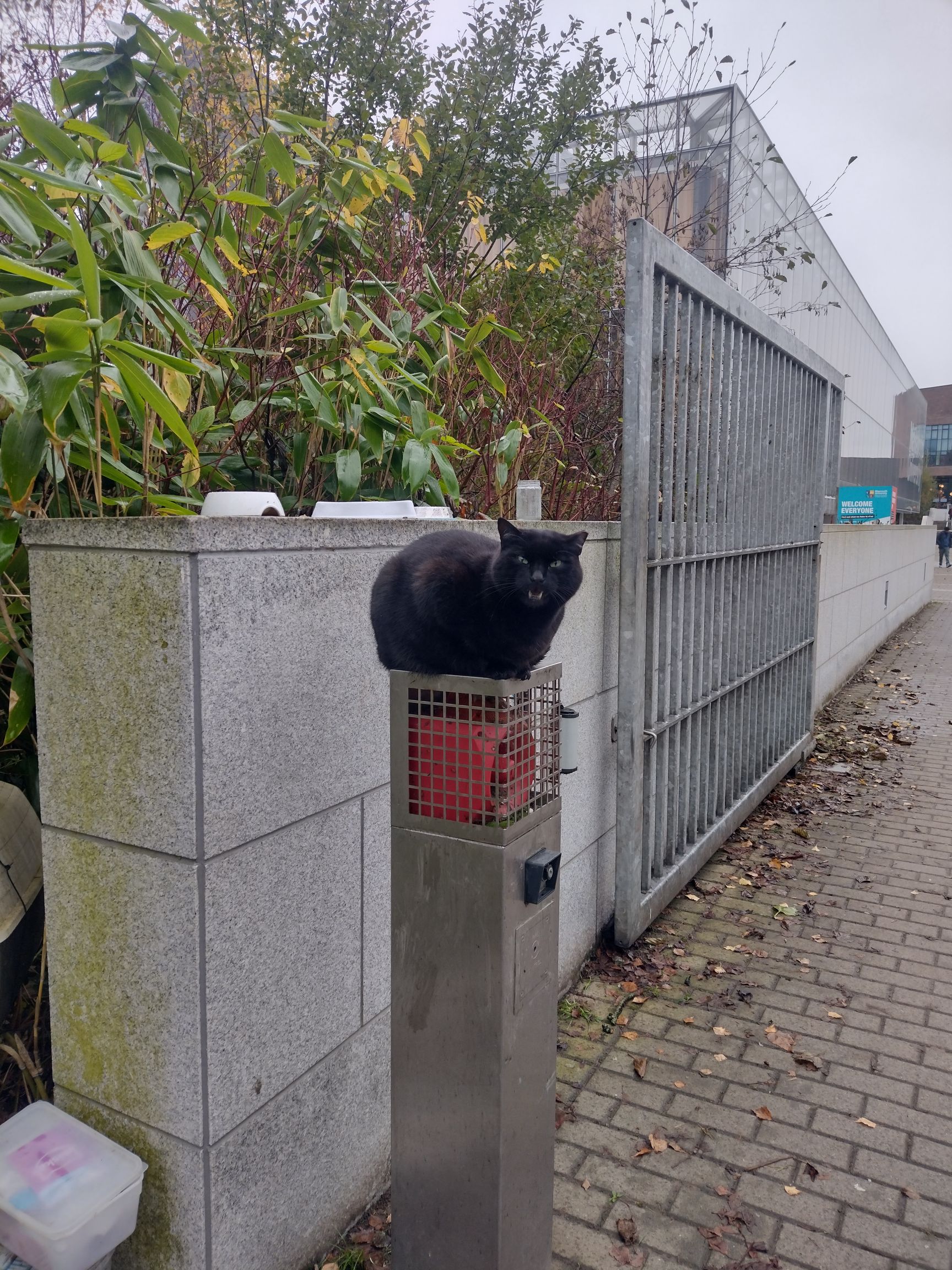
Posted in Maynooth with tags Maynooth University, Maynooth University Library Cat, Weather on November 18, 2024 by telescoperIt has been an unusually mild November until today, when it has suddenly turned colder and wetter. This alteration does not seem to have pleased Maynooth University Library Cat.

 In the Dark