The January examination period at Maynooth starts tomorrow (Friday 9th January), so I thought I’d do a quick post on the topic of examinations. First of all let me wish the very best of luck to everyone at Maynooth or elsewhere taking examinations in the next few weeks. I hope at least that the exam halls are nice and warm! Actually, owing to the Sport Hall being unavailable for this examination period owing to building work, some exams will be off campus; my first exam paper is actually being sat in the GlenRoyal hotel.
Here’s a video produced by Maynooth University to remind those taking exams of some general points about preparation and, most importantly, to look after themselves before during the examination period. It’s directed at Maynooth students but students from elsewhere may find useful tips in it.
I completed the last of my revision sessions today but, as the first examination for which I have responsibility is not until Monday 12th, I’ll have to wait to find out how any of my own students have done but let me take this opportunity to pass on a few of my own tips more aimed at students in Physics:
Try to get a good night’s sleep before the examination and arrive in plenty of time before the start. This is especially important when there’s bad weather that may disrupt travel. It is your responsibility to get to the examination on time!
Read the entire paper before starting to answer any questions. In particular, make sure you are aware of any supplementary information, formulae, etc, given in the rubric or at the end.
Start off by tackling the question you are most confident about answering, even if it’s not Question 1. This will help settle any nerves.
Don’t rush! Students often lose marks by making careless errors. Check all your numerical results on your calculator at least twice and – PLEASE – remember to put the units!
Don’t panic! You’re not expected to answer everything perfectly. A first-class mark is anything over 70%, so don’t worry if there are bits you can’t do. If you get stuck on a part of a question, don’t waste too much time on it (especially if it’s just a few marks). Just leave it and move on. You can always come back to it later.
Readers of this blog are welcome to add other tips through the comments box below!
I woke up this quite early this morning but when I checked the cricket scores I discovered that the Fifth Ashes Test between Australia and England at Sydney had already finished. Australia wobbled a bit chasing a modest target, but won in the end by 5 wickets and thereby won the series 4-1. I think that result is a fair reflection of the performance of the two teams and Australia thoroughly deserved to retain the Ashes. England’s victory in Melbourne, on a difficult batting surface, prevented a whitewash and gave them a Test win for the first time since 2010, but none of the other matches were particularly close run. In terms of attendances it was a very successful series – the five days at Sydney broke the record – but the quality of the cricket was very variable, and Australia taking a 3-0 lead after three games made the last two Tests feel rather irrelevant.
It was a particularly disappointing series for England, who must have thought they had a better chance of winning than for a long time. Australia were without key players, especially Josh Hazlewood and captain Pat Cummins (the latter only played one Test). On top of that, England captain Ben Stokes won four of the five tosses. Winning the toss at Sydney, as Stoke did, could have set up an interesting contest had England scored enough runs when they batted first (although they lacked a world-class spinner who could have won the match). Call me old-fashioned, but one of the things I enjoy best about cricket is seeing a high-quality spinner in action. Australia didn’t have one at Sydney either, Lyons having been injured.
England of course had their own injury difficulties during the tour, losing two fast bowlers in Mark Wood and Jofra Archer early in the tour. Of the replacement bowlers, Josh Tongue looked the best – and most likely to take wickets in Australian conditions – but Stokes seemed reluctant to let him open the bowling.
As it turned out, Mitchell Starc (Man of the Series) led the second-string of Austalian bowlers extremely well. It is also worth mentioning Michael Neser, a bowling all-rounder who has played for Glamorgan, who stepped into the breach and doing well with the ball. Other Glamorgan Australians Marnus Labuschagne and Usman Khawaja did not have such a successful series; the latter has now retired from Test cricket.
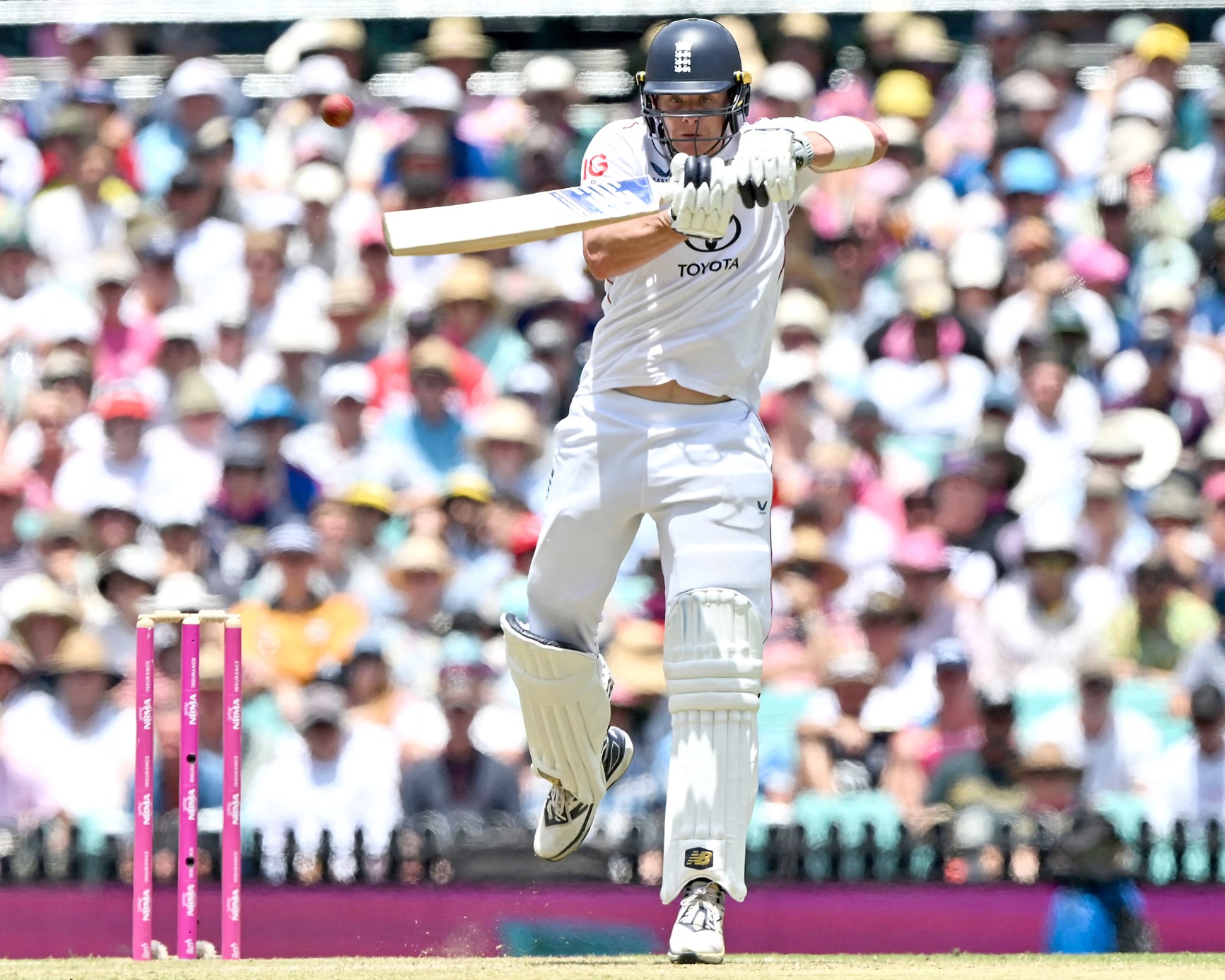
Jamie Smith playing an idiotic shot against the bowling of Marnus Labuschagne
I didn’t see much of the cricket – only highlights – but it seems to me there was a crucial difference in the fielding. England dropped far too many catches, including easy ones, while Australia held onto some stunners. England’s batters also had a tendency to play stupid shots at important times. I’m thinking primarly of Jamie Smith’s dismissal off the innocuous bowling of Marnus Labuschagne, which was calamitous, but there were others. Above all, though, I think the first few matches revealed England’s preparation to have been completely inadequate. Questions should be asked not only of the squad selection but also of the management of the tour, especially the lack of practice matches.
On the bright side (for England), Joe Root scored his first Test century in Australia and then scored his second. Jacob Bethell who is only 22, scored a fine century in the final Test at Sydney. I’ve read articles praising him, but didn’t see much evidence in the stats to justify their opinion. Now he’s shown what he can do in the Test arena, I wonder if he will turn out to be a successor to Root?
Anyway, that’s the Ashes done and dusted (so to speak). By the time of the next Ashes series Australia (2029/2030) I will have retired. Although I’ve been to Sydney, I’ve never visited Brisbane, Perth, Adelaide or Melbourne. Now there’s an idea…
P.S. I was slightly surprised that Mitchell Starc was Man of the Series. Travis Head scored 629 runs, which was to my mind even more impressive. Still, this award is ample compensation:
I have written many times (e.g. here) about the reasons I left the social media platform X, formerly known as Twitter. I quit Twitter in August 2023 and have no regrets for doing so. I have more followers and better engagement on Bluesky and Mastodon than I ever had on Twitter, and far less abuse. Unfortunately, my employer, along with most public institutions, still maintains an account there, a position I find ethically indefensible. Not to put to fine a point on it, I find it outrageous that Maynooth University persists in using Xitter. Touting for trade in a far-right propaganda channel is no way for a institution of higher education to behave. I’m very disappointed that I have only heard of a few organizations that have taken the principled decision to leave. You can read more about my views on this matter here.
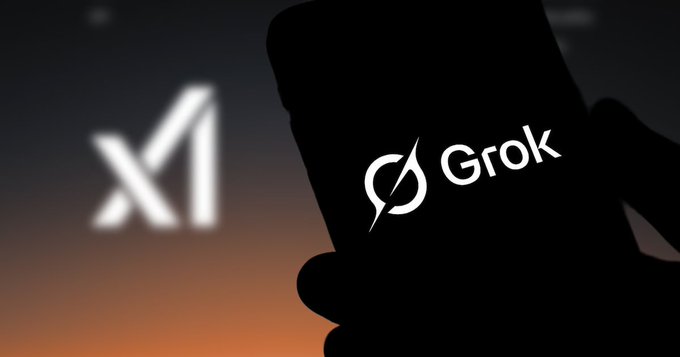
My opinion on this has hardened considerably with the revelation that the AI bot known as Grok, which is integrated with X/Twitter, has developed a facility for creating nonconsensual and sexually explicit deepfake images, including pictures of children, for circulation on the platform. Grok/X not only condones this activity, which by the way is against the law, nor merely facilitates it, but actively encourages it.
If you don’t leave a social media platform when you find out that it endorses and encourages abusive exploitation of children then you are supporting that behaviour and helping to promote it. There is no grey area here in this. If you don’t draw the line here, when will you draw it? Staying on X is morally indefensible. It is the Epstein Island of social media.
Moreover, any institution or organisation that maintains a presence on X must be content to endorse the promotion of child abuse. I would like to hear an explanation from my employer why they think it’s appropriate for them to operate an official account on the Twitter/X that built a machine for generating images of child pornography. Perhaps readers could ask their employers the same question?
My preferred resolution of this matter would be to ban X entirely.
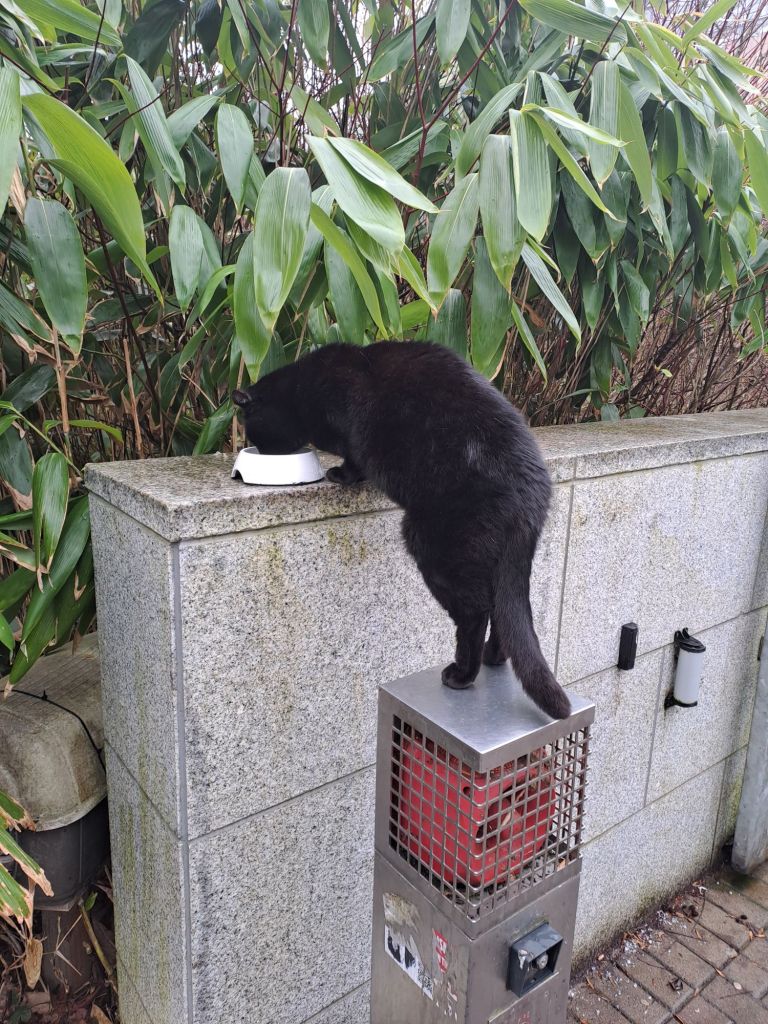
Maynooth University Library Cat has endured the very cold weather we have had recently, but when I met him this lunchtime he was rather hungry. So much so that he scratched my hand in his eagerness to get at the food I put out for him…
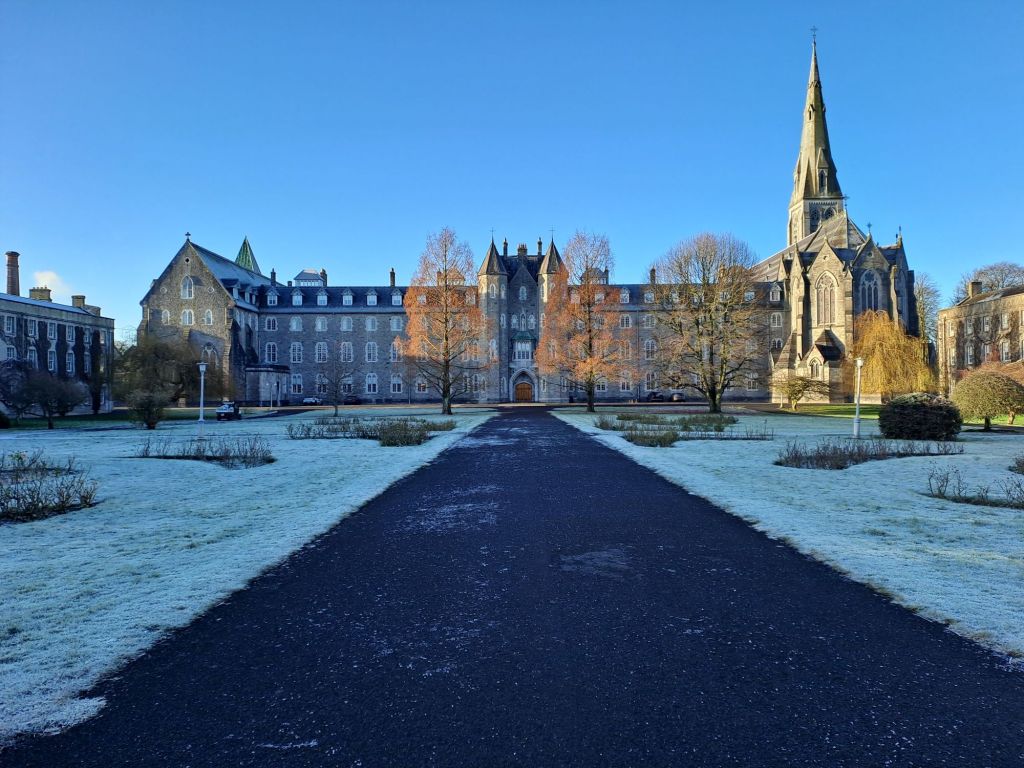
So here I am, back on campus at Maynooth University, for the first time in 2026. I took a longer route than usual to my office this morning as I thought the South Campus would look pretty with all the frost around, as indeed it was:
The temperature was well below freezing last night. Today was refuse collection day and I happened to see the crew empty my bins first thing. They struggled to do so as the lids were frozen down. I think there might be a bit of a thaw during the day, but the forecast is that the temperature will barely make it above zero and there’ll be more frost tonight. No snow is forecast for Maynooth.
I topped up the bird feeders in my garden before I left for work. On Saturday I bought a new feeder designed for smaller and nimbler birds; since then there have been several blue tits and various finches using it. I’ve got nothing against the larger birds, but they do tend to hog the other feeders. I suppose it won’t be long until crows try to wreck the new one, but for the time being it’s intact.
Anyway, I have to prepare a revision lecture for this afternoon so ahead of that I need to do a bit of revision myself…
The weather has been much colder for the past few days, which is probably why this piece of music popped into my head and I thought I’d share it here. It’s a Norwegian folk song called Den Bortkomne Sauen (“The Lost Sheep”) and it’s played by Annbjørg Lien on Hardanger fiddle and Iver Kleive on pipe organ. In case you weren’t away the Hardanger fiddle is similar to a normal violin, which has four strings, but underneath them there are four or five others to produce sympathetic vibrations when the main strings are bowed. This makes for a very unique sound, and adds to the haunting atmosphere evoked by this piece.
The theme music for one of my all-time favourite movies, Fargo, released 30 years ago in 1996, was based on this tune which was originally written by the person who wrote all the best tunes, Trad…
P.S. I like this track so much I bought the whole album, Felefeber, which is wonderful!
Not entirely surprisingly, we have not published any papers at the Open Journal of Astrophysics since the last update on 27th December 2025. Of course many authors have been on holiday and there were no arXiv announcements on either Tuesday 30th December or Thursday 1st January anyway. Although we had a few papers accepted before the break, none of them appeared this past week. I dare say some of them will appear next week. We will be starting Volume 9 in 2026, as soon as there is a paper to publish in it.
There being no papers to report, instead of doing one of the regular Saturday updates, I’d like to take the opportunity afforded by this pause to thank everyone who has supported the Open Journal of Astrophysics this year – Editors, Reviewers, Authors and the excellent Library staff at Maynooth University Library – and who have made it such a bumper year. I’d also like to repeat a call for volunteers to join the Editorial Board. In 2023 we published just 50 papers, and in 2025 the figure was 213, so we have more than quadrupled in two years. How many will we publish in 2026?
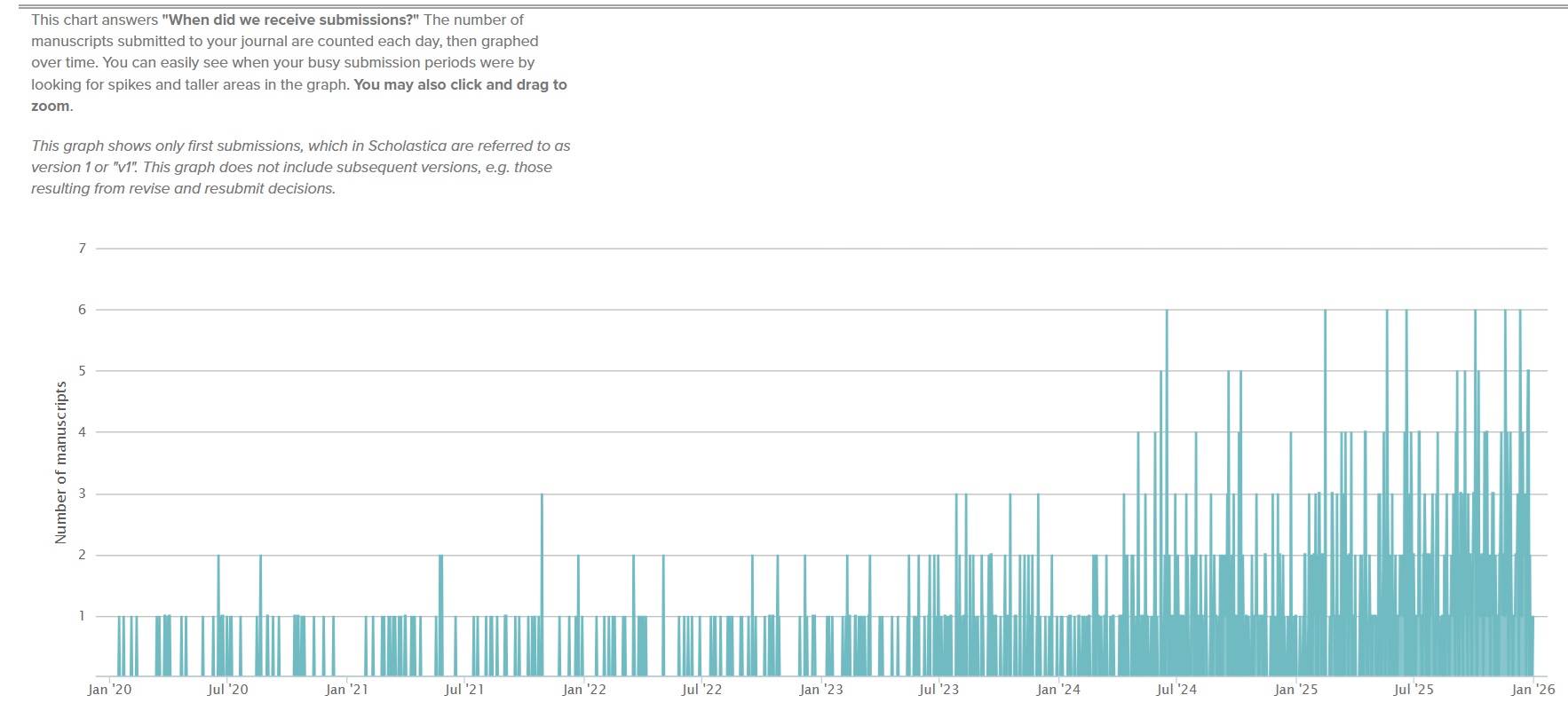
Here is a graphic showing the number of new papers submitted to the Open Journal of Astrophysics since January 2020:
As the legend explains, this is only the first submission of a paper – resubmissions of revised papers are not included. You can see the thicket is getting denser all the time!
The increasing number of articles is of course very welcome indeed, but it is increasing the load on our Editorial Board many of whom are also very busy with other things. We have expanded the Board recently, but we’re always for volunteers to join the team, in any area of astrophysics. As a reminder, here are the areas we cover, corresponding to the sections of astro-ph on the arXiv:
astro-ph.GA – Astrophysics of Galaxies. Phenomena pertaining to galaxies or the Milky Way. Star clusters, HII regions and planetary nebulae, the interstellar medium, atomic and molecular clouds, dust. Stellar populations. Galactic structure, formation, dynamics. Galactic nuclei, bulges, disks, halo. Active Galactic Nuclei, supermassive black holes, quasars. Gravitational lens systems. The Milky Way and its contents
astro-ph.CO – Cosmology and Nongalactic Astrophysics. Phenomenology of early universe, cosmic microwave background, cosmological parameters, primordial element abundances, extragalactic distance scale, large-scale structure of the universe. Groups, superclusters, voids, intergalactic medium. Particle astrophysics: dark energy, dark matter, baryogenesis, leptogenesis, inflationary models, reheating, monopoles, WIMPs, cosmic strings, primordial black holes, cosmological gravitational radiation
astro-ph.EP – Earth and Planetary Astrophysics. Interplanetary medium, planetary physics, planetary astrobiology, extrasolar planets, comets, asteroids, meteorites. Structure and formation of the solar system
astro-ph.HE – High Energy Astrophysical Phenomena. Cosmic ray production, acceleration, propagation, detection. Gamma ray astronomy and bursts, X-rays, charged particles, supernovae and other explosive phenomena, stellar remnants and accretion systems, jets, microquasars, neutron stars, pulsars, black holes
astro-ph.IM – Instrumentation and Methods for Astrophysics. Detector and telescope design, experiment proposals. Laboratory Astrophysics. Methods for data analysis, statistical methods. Software, database design
astro-ph.SR – Solar and Stellar Astrophysics. White dwarfs, brown dwarfs, cataclysmic variables. Star formation and protostellar systems, stellar astrobiology, binary and multiple systems of stars, stellar evolution and structure, coronas. Central stars of planetary nebulae. Helioseismology, solar neutrinos, production and detection of gravitational radiation from stellar systems.
We are looking for experienced scientists in any of these areas, and it would indeed be useful to have people who can cover a range of subjects (as some of our existing editors do). Since we don’t charge authors or readers we can not offer payment to Editors but it is nevertheless a way of providing a service to the community. If you’re interested, please get in touch either through the Open Journal website here, through a message on Mastodon here or BlueSky here.
I was on the train earlier today when I remembered that we are getting close to the time when Earth reaches its perihelion, i.e. the point in its orbit when it is closest to the Sun. This occurs at 17.15 GMT tomorrow (Saturday 3rd January 2026), in fact. At this time the distance from the Sun’s centre to Earth’s centre will be 147,099,894 km This year, aphelion (the furthest distance from the Sun) is at 18.30 GMT on July 6th 2026 at which point the centre of the Earth will be 152,087,774 km from the centre of the Sun. You can find a list of times and dates of perihelion and aphelion for future years here.
Earth’s elliptical orbit viewed at an angle (which makes it look more eccentric than it is – in reality is very nearly circular).
Incidentally, although the Solstice took place on 21st December, it was not until the end of 2025 that we experienced the latest sunrise. The longest day means neither the latest sunrise nor the earliest sunset. The earliest sunset was actually on December 15th in Dublin.
It surprises me how many people think that the existence of the seasons has something to do with the variation of the Earth’s distance from the Sun, thinking that the closer to the Sun we get the warmer the weather will be. The fact that perihelion occurs in the depth of winter should convince anyone living in the Northern hemisphere that this just can’t be the case, as should the fact that it’s summer in the Southern hemisphere while it is winter in the North.
The real reason for the existence of seasons is the tilt of the Earth’s axis of rotation. I used to do a little demonstration with a torch – flashlight to American readers- to illustrate this when I taught first-year astrophysics. If you shine a torch horizontally at a piece of card it will illuminate a patch of the card. Keep the torch at the same distance but tilt the card and you will see the illuminated patch increase in size. The torch is radiating the same amount of energy but in the second case that energy is spread over a larger area than in the first. This means that the energy per unit area incident on the card is decreases when the card is tilted. It is that which is responsible for winter being colder than summer. In the summer the Sun is higher in the sky (on average) than in winter. From this argument you can infer that the winter solstice not the perihelion, is the relevant astronomical indicator of winter.
That is not to say that the shape of the Earth’s orbit has no effect on terrestrial temperatures. It may, for example, contribute to the summer in the Southern hemisphere being hotter than in the North, although it is not the only effect. The Earth’s surface possesses a significant North-South asymmetry: there is a much larger fraction of ocean in the Southern hemisphere, for example, which could be responsible for moderating any differences in temperature due to insolation. The climate is a non-linear system that involves circulating air and ocean currents that respond in complicated ways and on different timescales not just to insolation but to many other parameters, including atmospheric composition (especially the amount of water vapour).
The dates when Earth reaches the extreme points on its orbit (the apsides) are not fixed because of the variations in its orbital eccentricity so, in the short-term, the dates can vary up to 2 days from one year to another. The perihelion distance varies slightly from year to year too; it will be slightly larger next year than this year, for example. There is however a long-term trend for perihelion to occur later in the year. For example, in 1246, the December Solstice (Winter Solstice for the Northern Hemisphere) was on the same day as the Earth’s perihelion. Since then, the perihelion and aphelion dates have drifted by an average of one day every 58 years. This trend will continue, meaning that by the year 6430 the timing of the perihelion and the March Equinox will coincide, although I hope to have retired by then…
For last year’s words belong to last year’s language
And next year’s words await another voice.
And to make an end is to make a beginning.
From Four Quartets, ‘Little Gidding’ by T. S. Eliot.
So it’s New Year’s Day. Athbhliain faoi mhaise dhaoibh!
For me this brings the festive season to an end. I’ve been eating and drinking too much for the last week as one is supposed to. Last night I brought in the new year with a dish of roast duck and the last of the Christmas vegetables. I think I’ll be buying any sprouts and parsnips for a while. When the iron tongue of midnight told twelve, I had a glass of excellent Irish Whiskey in the form of Clonakilty Single Pot Still (46%). It has been a most enjoyable week, but heightened level of self-indulgence has been rather exhausting, and I’ll be taking things a bit easier for a few days before I go back to work on Monday. It’s hard work being a glutton.
Anyway, I thought I’d mention a few things looking forward to the New Year.
January will, as usual, be dominated by examinations, and especially the marking thereof. The first examination for which I am responsible is on January 12th. The examination, incidentally, will be held in the Glenroyal Hotel in Maynooth as the Sports Hall on campus – usually a major exam venue – is out of commission due to building work.
I have a couple of writing deadlines, in addition to having to correct the examinations, so it will be a busy January.
Then February sees the start of a new semester. I’ll be teaching Particle Physics again. I was a bit surprised to be asked to teach this again, as I was filling last year in for our resident particle physicist who was on sabbatical. I’m glad to be able to continue with it given the work I put in to do it last time. My other module is Computational Physics which I have taught at Maynooth every year since 2018, apart from 2024 when I was on sabbatical. This time, however, I will have to think hard about how to deal with the use of generative AI in the coursework.
Will I get to teach any astrophysics or cosmology at Maynooth before I retire? That’s looking very unlikely. I think it’s probable that the new academic year, starting in September, will find me teaching the same modules as last year.
The year ahead will also see the first data release (DR1) from the European Space Agency’s Euclid Mission. The date for that will be October 21st 2026. This is a hard deadline. There’s a huge amount of work going on within the Euclid Consortium to extract as much science as possible from the observations so far before the data becomes public, but you’ll have to wait until October to find out more!
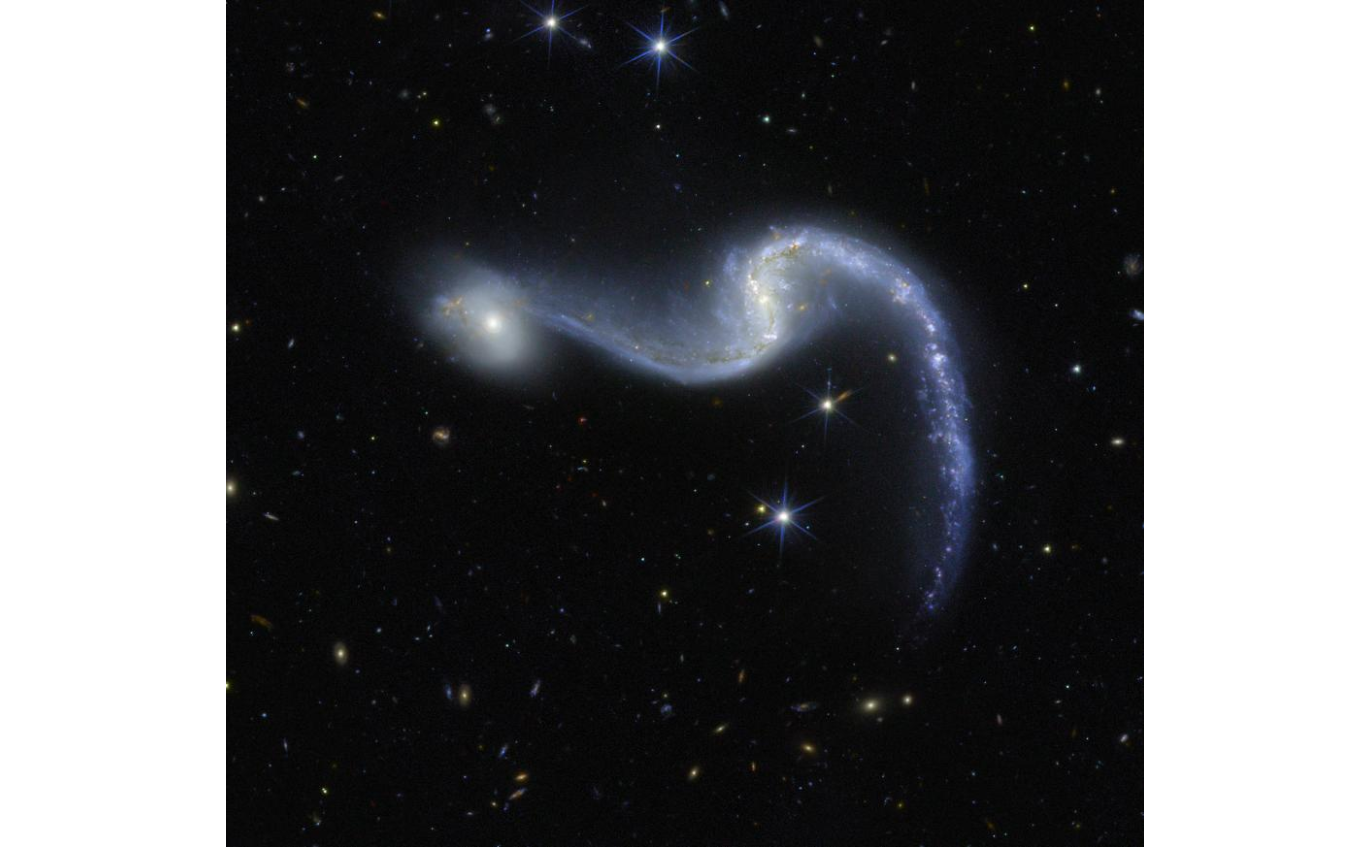
This reminds me that I forgot to share this nice image from Euclid that was released just before Christmas.
Galaxy NGC 646 looking like a cosmic holiday garland in this image from the European Space Agency’s Euclid space telescope.
Once upon a time, WordPress used to send an email about the year’s blog statistics, etc, but it stopped doing that some time ago. I checked this morning, however, and learned that traffice on the blog in 2025 was up by 2.6% since 2024. I’m not sure how meaningful this is, because there is so much scraping going on these days. That figure doesn’t include the people who get posts via email or RSS or via other platforms such as the Fediverse.
While I’m on about social media I’ll mention a stat about my Bluesky account. I joined Bluesky in 2023 when I abandoned Xitter. As of today I have 8,078 BlueSky followers, which is more than I ever had on X, and with far higher levels of engagement and much friendlier interactions.
I’m also on Mastodon, although with a much smaller following (1.4k). This blog also has a separate existence on Mastodon here. I very much like the federated structure of Mastodon (which, incidentally, accords with my view of how academic publishing should be configured) and am a bit disappointed that it doesn’t seem to have caught on as much as it should.
That disappointment pales into insignificance, however, with the outrage I feel that my employer – along with most other universities – persists in using Xitter. Touting for trade in a far-right propaganda channel is no way for a institution of higher education to behave. You can read my views on this matter here.
And finally there’s the Open Journal of Astrophysics. The year ahead will see the 10th anniversary of our first ever publication – on an experimental prototype platform, long before we moved to Scholastica. It will be next Monday before we resume publishing, starting Volume 9. Which author(s) will be the first to get their final versions on arXiv in 2026? Stay tuned to find out!
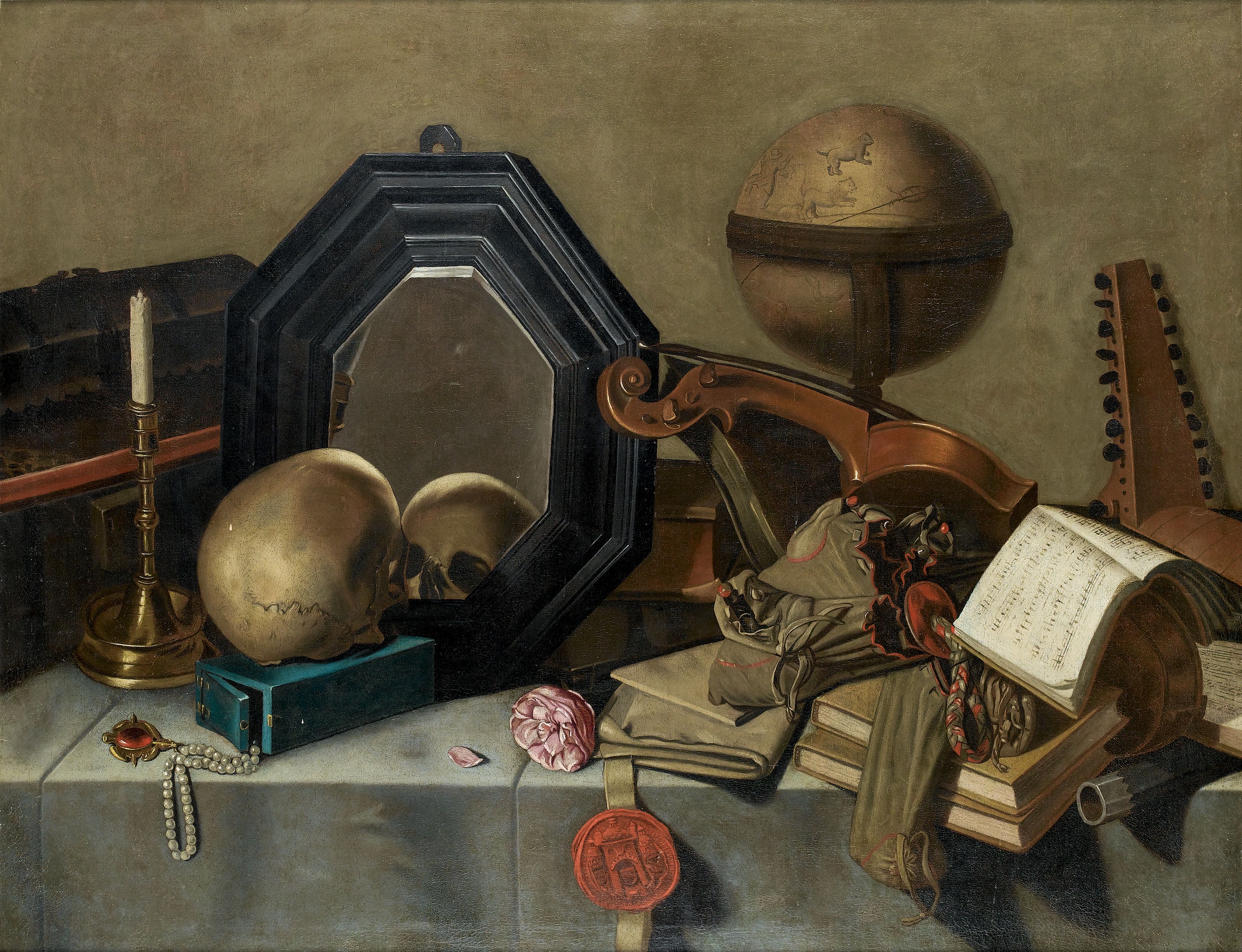
I don’t know precisely which picture the poet is referring to for January in his calendar, nor which artist, but it it is undoubtedly an example of a Vanitas or Memento Mori, a genre symbolizing the transience of life, the futility of pleasure, and the certainty of death, and thus the vanity of ambition and all worldly desires. The paintings involved still life imagery of items suggessting the transitory nature of life.
A couple of examples are here:
Between them you find all the elements mentioned in the poem: the skull represents death, the flowers impermanence, the coins personal wealth and the other items worldly knowledge and pleasure. There’s an interesting WordPress blog about the symbolism this genre here:
The views presented here are personal and not necessarily those of my employer (or anyone else for that matter).
Feel free to comment on any of the posts on this blog but comments may be moderated; anonymous comments and any considered by me to be vexatious and/or abusive and/or defamatory will not be accepted. I do not necessarily endorse, support, sanction, encourage, verify or agree with the opinions or statements of any information or other content in the comments on this site and do not in any way guarantee their accuracy or reliability.




 In the Dark