Archive for AGN

Weekly Update from the Open Journal of Astrophysics – 08/02/2025

Posted in OJAp Papers, Open Access, The Universe and Stuff with tags , , , , , , , on February 8, 2025 by telescoper

It’s Saturday morning, so once again it’s time for an update from the Open Journal of Astrophysics. Since the last update we have published one new paper, which brings the number in Volume 8 (2025) up to 12 and the total so far published by OJAp up to 247.

Galaxy evolution in the post-merger regime. III – The triggering of active galactic nuclei peaks immediately after coalescence” was written by Sara Ellison, Leonardo Ferreira, Robert Bickley & Tess Grindlay (U. Victoria, Canada), Samir Salim (Indiana U., USA), Shoshannah Byrne-Mamahit (Victoria), Shobita Satyapal (George Mason U., USA), David R. Patton (Trent U., Canada) and Jillian M. Scudder (Oberlin College, USA).  It was published on 4th February 2025 and is in the folder marked Astrophysics of Galaxies. The paper describes an investigation into the timescale of triggering of AGN activity after galaxy mergers and concluding that most occurs immediately after coalescence. 

You can find the officially accepted version of this paper on arXiv here.

That’s all for this week. I’ll have more updates next Saturday.

Six New Publications at the Open Journal of Astrophysics

Posted in OJAp Papers, Open Access, The Universe and Stuff with tags , , , , , , , , , , , , , , , , , , , , , , , , , on October 12, 2024 by telescoper

Regular readers of this blog (both of them) will have noticed that I didn’t post an update of activity at the Open Journal of Astrophysics last weekend. Despite having accepted several papers for publication in the preceding week, no final versions had made it onto the arXiv. We can’t published a paper until the authors post the final version, so that meant a bit of a backlog developed. This week included one day with no arXiv update (owing to a US holiday on Tuesday 8th October) and a major glitch on Crossref on Thursday which delayed a couple, but even so we’ve published six papers which is the most we’ve ever managed in a week. This week saw the publication of our 200th article; the total as of today is 202.  The count in Volume 7 (2024) is now up to 87; we have four papers in the queue for publication so we should pass 90 next week if all goes well.

In chronological order, the six papers published this week, with their overlays, are as follows. You can click on the images of the overlays to make them larger should you wish to do so.

First one up, published on Monday 7th October 2024 is “z~2 dual AGN host galaxies are disky: stellar kinematics in the ASTRID Simulation” by Ekaterina Dadiani (CMU; Carnegie Mellon U.) Tiziana di Matteo (CMU), Nianyi Chen (CMU), Patrick Lachance (CMU), Yue Shen (U. Illinois at Urbana-Champaign), Yu-Ching Chen (Johns Hopkins U.), Rupert Croft (CMU), Yueying Ni (CfA Harvard) and Simeon Bird (U. California Riverside) – all based in the USA. The paper, which is in the folder marked Astrophysics of Galaxies describes a numerical study of the morphology of AGN host galaxies containing close pairs of black holes.

Here is a screen grab of the overlay, which includes the abstract:


You can find the officially accepted version of the paper on the arXiv here.

The second paper to announce, published on 8th October 2024, is “Origin of LAMOST J1010+2358 Revisited” by S.K. Jeena and Projjwal Banerjee of the Indian Institute of Technology Palakkad, Kerala, India. This paper discusses  the possible formation mechanisms for Very Metal Poor (VMP) stars and the implications for the origin of LAMOST J1010+2358 and is in the folder marked Solar and Stellar Astrophysics.

You can see the overlay here:

The accepted version of this paper can be found on the arXiv here.

The third paper is very different in both style and content: “Assessing your Observatory’s Impact: Best Practices in Establishing and Maintaining Observatory Bibliographies” by Raffaele D’Abrusco (Harvard CfA and 14 others; the Observatory Bibliographers Collaboration) and is in the folder marked Instrumentation and Methods for Astrophysics. It presents discussion of the methods used by astronomical observatories to construct and analyze bibliographic databases. The overlay is here:

(This one gave me a rare opportunity to use the library of stock images that comes with the Scholastica platform!) The officially accepted version can be found on arXiv here.

The fourth paper, also published on 8th October 2024, and our 200th publication, is in the folder marked Cosmology and NonGalactic Astrophysics, and is called “CombineHarvesterFlow: Joint Probe Analysis Made Easy with Normalizing Flows“. The authors are Peter L. Taylor, Andrei Cuceu, Chun-Hao To, and Erik A. Zaborowski of Ohio State University, USA. The article presents a new method that speeds up the sampling of joint posterior distributions in the context of inference using combinations of data sets. The overlay is here

You can find the officially accepted version of this paper here.

The fifth paper in this batch is “Estimating Exoplanet Mass using Machine Learning on Incomplete Datasets” by Florian Lalande (Okinawa Institute of Science and Technology), Elizabeth Tasker (Institute of Space and Astronautical Science, Kanagawa) and Kenji Doya (Okinawa); all based in Japan. This one was published on 10th October 2024 in the folder marked Earth and Planetary Astrophysics. It compares different methods for inferring exoplanet masses in catalogues with missing data


You can find the official accepted version on the arXiv here.

Finally for this week we have “Forecasting the accuracy of velocity-field reconstruction” by Chris Blake and Ryan Turner of Swinburne University of Technology, Melbourne, Australia. This was also published on 10th October 2024 and is in the folder marked Cosmology and NonGalactic Astrophysics. The paper describes a numerical study of the reliability and precision of different methods of velocity-density reconstruction. The overlay is here

You can find the officially-accepted version on arXiv here.

That’s it for now. We have published six papers, with a very wide geographical spread of authors, and in five of the six astro-ph categories we cover. I think it’s been a good week!

Prize Poster!

Posted in Maynooth, The Universe and Stuff with tags , , , , , on September 1, 2024 by telescoper

I had been looking forward to attending last week’s Irish National Astronomy Meeting in the fine city of Galway but unfortunately I couldn’t go because I had an appointment I couldn’t reschedule (which also kept me offline for a couple of days). This was a shame because it turns out that one of our undergraduate SPUR students at Maynooth, Jake Feeney, together with two colleagues, John Regan and Paddy Kavanagh, won the prize for the best poster at INAM.

Here is the winning poster:

Congratulations to Jake et al!

Three New Publications at the Open Journal of Astrophysics

Posted in OJAp Papers, The Universe and Stuff with tags , , , , , , , , , , , , , , , , on March 19, 2024 by telescoper

Now that I’m safely back in Barcelona it’s a time for a roundup of the latest business at the  Open Journal of Astrophysics. The latest batch of publications consists of three papers, taking the count in Volume 7 (2024) up to 20 and the total published by OJAp up to 135.

This time the papers are all related, have many authors in common, and have the same first author, Philip F. Hopkins of Caltech. In fact the second and third papers in this batch were accepted well before the first one, but it seemed to make much more sense to publish them together so I held those two back a bit and published all three on 14th March.

The three papers published, with their overlays, are as follows. You can click on the images of the overlays to make them larger should you wish to do so. You can read these publications directly on arXiv if you wish; you will find them here, here and here.

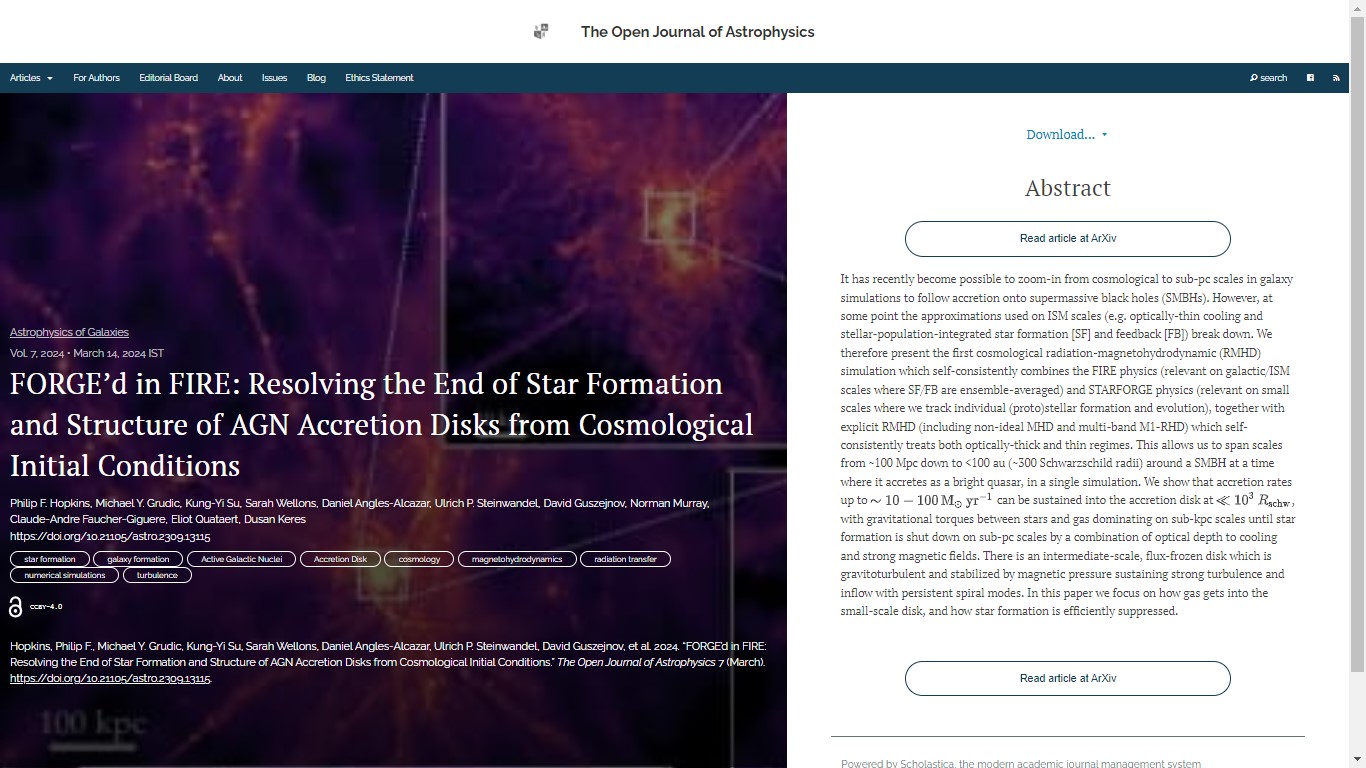
First one up is “FORGE’d in FIRE: Resolving the End of Star Formation and Structure of AGN Accretion Disks from Cosmological Initial Conditions” in which, using a full cosmological simulation, incorporating radiation and magnetohydrodynamics, the authors study the formation and structure of AGN accretion disks and their impact on star formation. This one is in the folder marked Astrophysics of Galaxies.

The authors (ten from the USA and one from Canada) are Philip F. Hopkins (Caltech), Michael Y. Grudic (Carnegie Observatories), Kung-Yi Su (Harvard), Sarah Wellons (Wesleyan University), Daniel Angles-Alcazar (University of Connecticut & Flatiron Institute), Ulrich P. Steinwandel (Flatiron Institute), David Guszejnov (University of Texas at Austin), Norman Murray (CITA, Toronto, Canada), Claude-Andre Faucher-Giguere (Northwestern University), Eliot Quataert (Princeton), and Dusan Keres (University of California, San Diego or UCSD for short).

Here is a screen grab of the overlay, which includes the abstract:


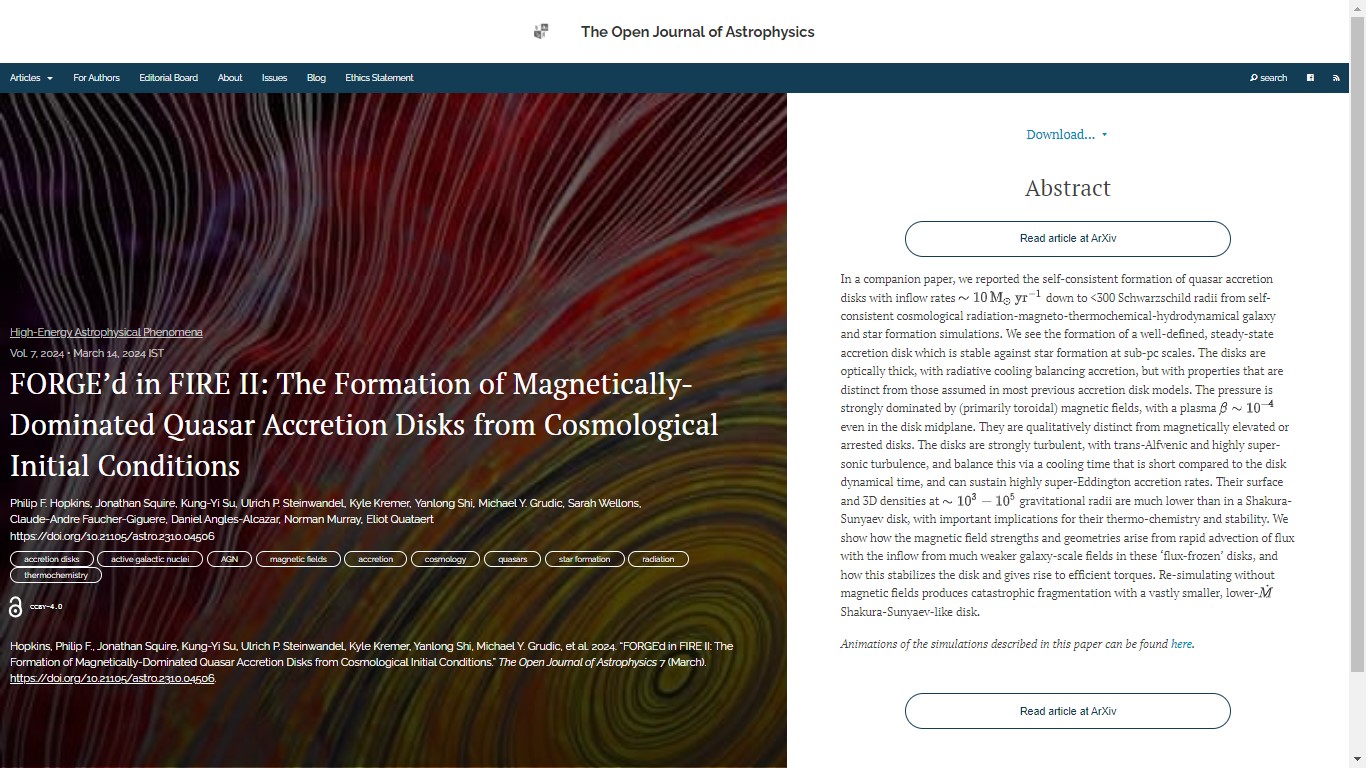
The second paper to announce is “FORGE’d in FIRE II: The Formation of Magnetically-Dominated Quasar Accretion Disks from Cosmological Initial Conditions” which is a study of the formation and properties of highly magnetized accretion disks using numerical simulations that include the effects of radiation, magnetic fields, thermochemistry, and star formation.

This one is in the folder High-Energy Astrophysical Phenomena. The authors (ten based in the USA, one fin Canada, and one in New Zealand) are Philip F. Hopkins, Jonathan Squire (University of Dunedin, New Zealand), Kung-Yi Su (Harvard), Ulrich P. Steinwandel (Flatiron Institute), Kyle Kremer (Caltech), Yanlong Shi (Caltech), Michael Y. Grudic (Carnegie Observatories), Sarah Wellons (Wesleyan University), Claude-Andre Faucher-Giguere (Northwestern University), Daniel Angles-Alcazar (University of Connecticut & Flatiron Institute), Norman Murray (CITA, Toronto), and Eliot Quataert (Princeton).
 

The last paper of this batch, also in the folder High-Energy Astrophysical Phenomena, is  entitled “An Analytic Model For Magnetically-Dominated Accretion Disks” and is closely related to the previous one; this particular paper presents an analytic similarity model for accretion disks that agrees remarkably well with the simulations in the previous one. Animations of the simulations referred to in both papers can be found here.

Here is the overlay:
The authors of this one are Philip F. Hopkins, Jonathan Squire, Eliot Quataert, Norman Murray, Kung-Yi Su, Ulrich P. Steinwandel, Kyle Kremer, Claude-Andre Faucher-Giguere, and Sarah Wellons. You can find all their affiliations above.
That’s all for now. More news in a week or so!


Three New Publications at the Open Journal of Astrophysics

Posted in OJAp Papers, Open Access, The Universe and Stuff with tags , , , , , , , , , , , , , , , , , on January 20, 2024 by telescoper

As promised yesterday, it’s time for a roundup of the week’s business at the  Open Journal of Astrophysics. This past week we have published three papers, taking  the count in Volume 7 (2024) up to 4 and the total published by OJAp up to 119. There are quite a few more ready to go as people return from the Christmas break.

In chronological order, the three papers published this week, with their overlays, are as follows. You can click on the images of the overlays to make them larger should you wish to do so.

First one up is “Prospects for studying the mass and gas in protoclusters with future CMB observations” by  Anna Gardner and Eric Baxter (Hawaii, USA), Srinivasan Raghunathan (NCSA, USA), Weiguang Cui (Edinburgh, UK), and Daniel Ceverino (Madrid, Spain). This paper, published on 17th January 2024, uses realistic hydrodynamical simulations to probe the ability of CMB Stage 4-like (CMB-S4) experiments to detect and characterize protoclusters via gravitational lensing and the Sunyaev-Zel’dovich effect. This paper is in the category of Cosmology and Nongalactic Astrophysics.

Here is a screen grab of the overlay, which includes the abstract:


You can find the officially accepted version of the paper on the arXiv here.

The second paper to announce is “SDSS J125417.98+274004.6: An X-ray Detected Minor Merger Dual AGN” and is by Marko Mićić, Brenna Wells, Olivia Holmes, and Jimmy Irwin (all of the University of Alabama, USA).  This presents the discovery of a dual AGN in a merger between the galaxy SDSS J125417.98+274004.6 and dwarf satellite, studied using X-ray observations from the Chandra satellite. The paper was also published on 18th January 2024 in the category Astrophysics of Galaxies . You can see the overlay here:


The accepted version of this paper can be found on the arXiv here.

The last paper of this batch is  entitled “Population III star formation: multiple gas phases prevent the use of an equation of state at high densities” and the authors are:  Lewis Prole (Maynooth, Ireland), Paul Clark (Cardiff, UK), Felix Priestley (Cardiff, UK), Simon Glover (Heidelberg, Germany) and John Regan (Maynooth, Ireland). This paper, which presents a comparison of results obtained using chemical networks and a simpler equation-of-state approach for primordial star formation (showing the limitations of the latter) was published on 19th January 2024 and also in the folder marked Astrophysics of Galaxies.

Here is the overlay:


You can find the full text for this one on the arXiv here.

And that concludes the update. There’ll be more next week!


The 100th Publication at the Open Journal of Astrophysics

Posted in OJAp Papers, Open Access, The Universe and Stuff with tags , , , on September 11, 2023 by telescoper

I am happy to announce the publication of yet another new paper at the Open Journal of Astrophysics. This one is hot off the press; it was published today, 11th September 2023.

The latest paper is in fact our 100th publication. It is also the 35th in Volume 6 (2023), which means that we have now published more papers so far this year than in the previous two years put together. I’d like to thank everyone who has supported the Open Journal of Astrophysics and helped us get this far! Here’s to the next 100!

Anyway, the new paper is entitled A complete catalogue of merger fractions in AGN hosts: No evidence for an increase in detected merger fraction with AGN luminosity and it is a complete and systematic analysis of detected merger fractions in AGN hosts from the literature leading to the conclusion that there is no evidence for correlation between the two.

The primary classification for this paper is Astrophysics of Galaxies and the author is Carolin Villforth of the Department of Physics in the University of Bath. As author of our 100th paper, Carolin wins a year’s free subscription to the Open Journal of Astrophysics.

Here is a screen grab of the overlay of the published version which includes the  abstract:


You can click on the image of the overlay to make it larger should you wish to do so. You can find the officially accepted version of the paper on the arXiv here.

Incidentally, you might notice a new feature on the overlay above. Just above the Abstract heading on the right and side you can see a little link saying “Download”. This allows you to download the citation to the paper in BibTex format.

New Publication at the Open Journal of Astrophysics!

Posted in OJAp Papers, Open Access, The Universe and Stuff with tags , , , , , , , , on February 27, 2019 by telescoper

It’s nice to be able to announce that the Open Journal of Astrophysics has just published another paper. Here it is!

It’s by Ben Maughan of the University of Bristol (UK) and Thomas Reiprich of the University of Bonn (Germany). You can find the accepted version on the arXiv here.

This is the first paper we have published in the section called High Energy Astrophysical Phenomena.

Thanks to the Editor and referees for dealing with this one so efficiently!

We have a few other papers coming up for publication soon, and some have been sent back to authors for revise and resubmit so we will almost certainly have further announcements to make soon.


P.S. Nobody spotted that I put the wrong DOI on the front page. I did that deliberately to see who was paying attention. Anyway, I’ve now put the right one on.