Archive for Bayesian Inference

Weekly Update at the Open Journal of Astrophysics – 08/03/2025

Posted in OJAp Papers, Open Access, The Universe and Stuff with tags , , , , , , , , , , , , , , , , , , , , on March 8, 2025 by telescoper

Time for the weekly Saturday morning update of papers published at the Open Journal of Astrophysics. Since the last update we have published four new papers, which brings the number in Volume 8 (2025) up to 25 and the total so far published by OJAp up to 260.

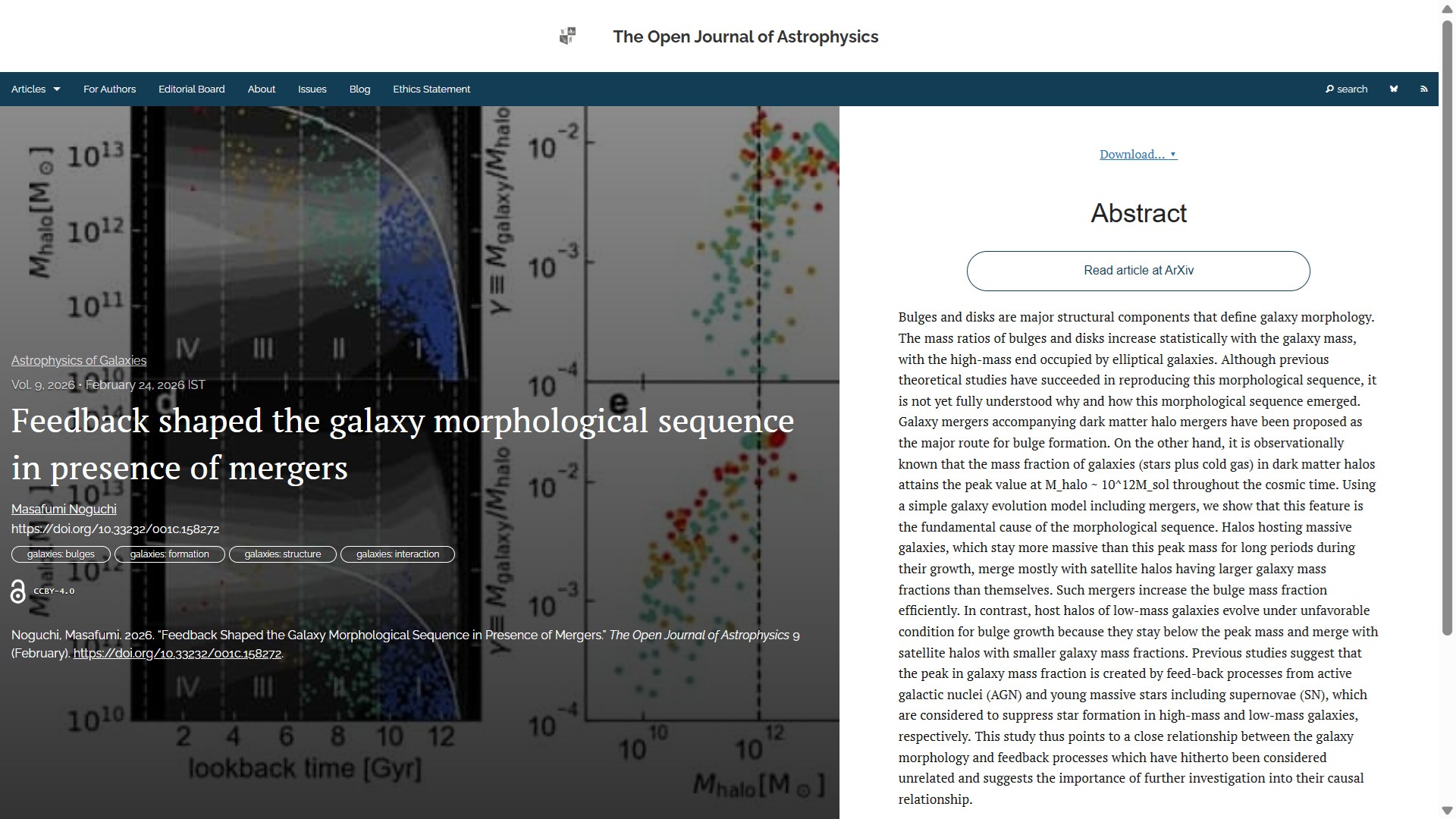
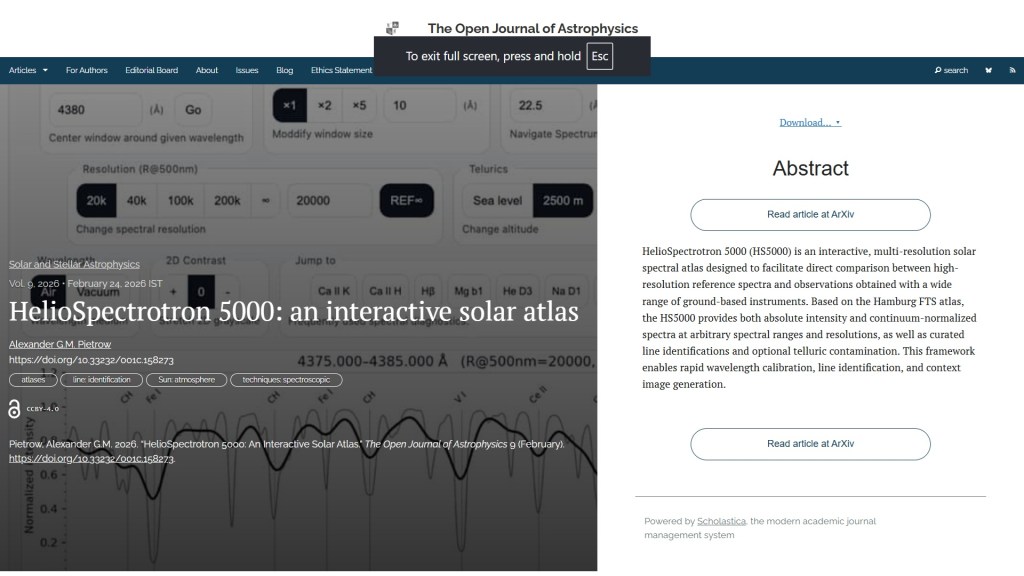
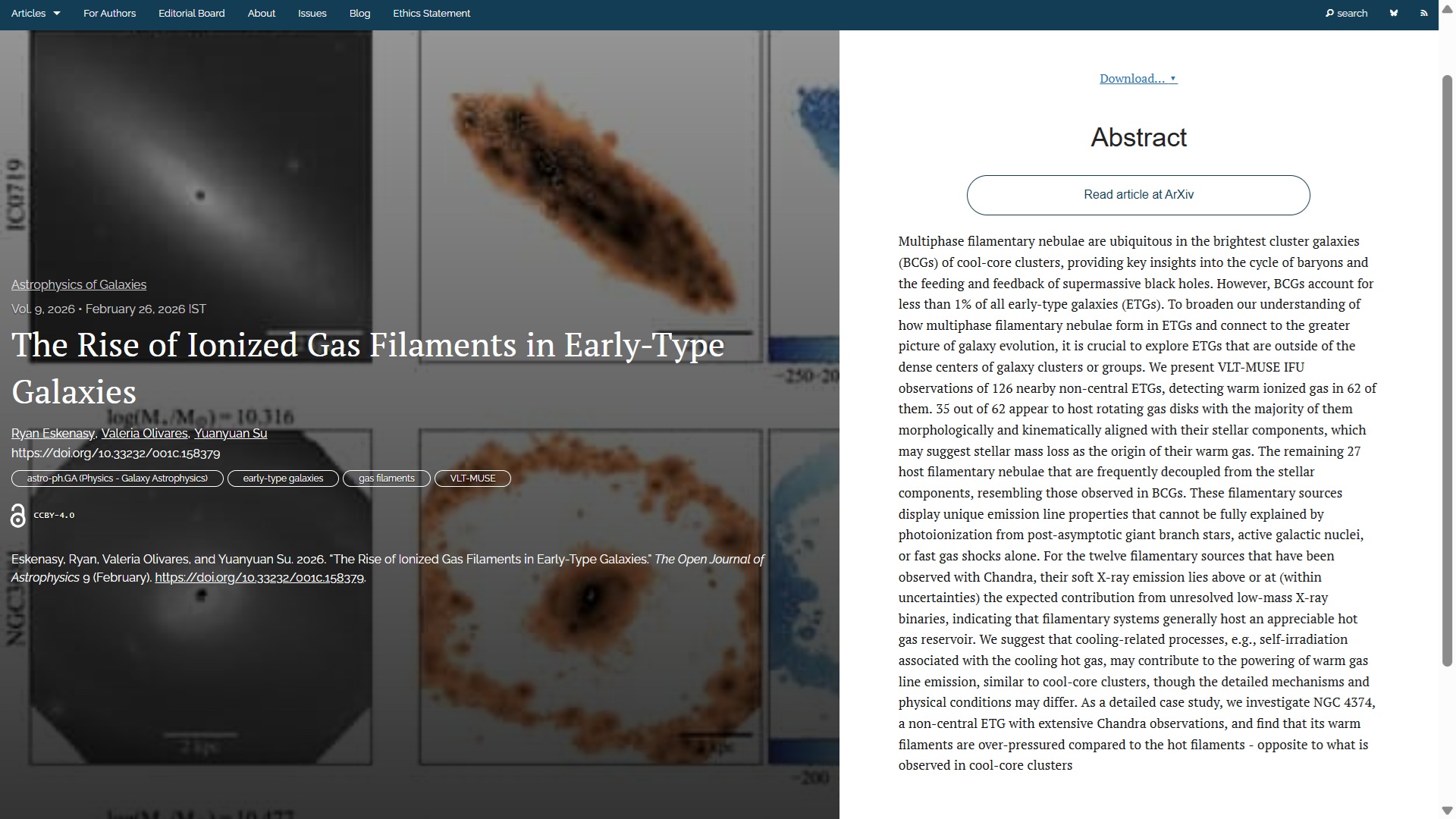
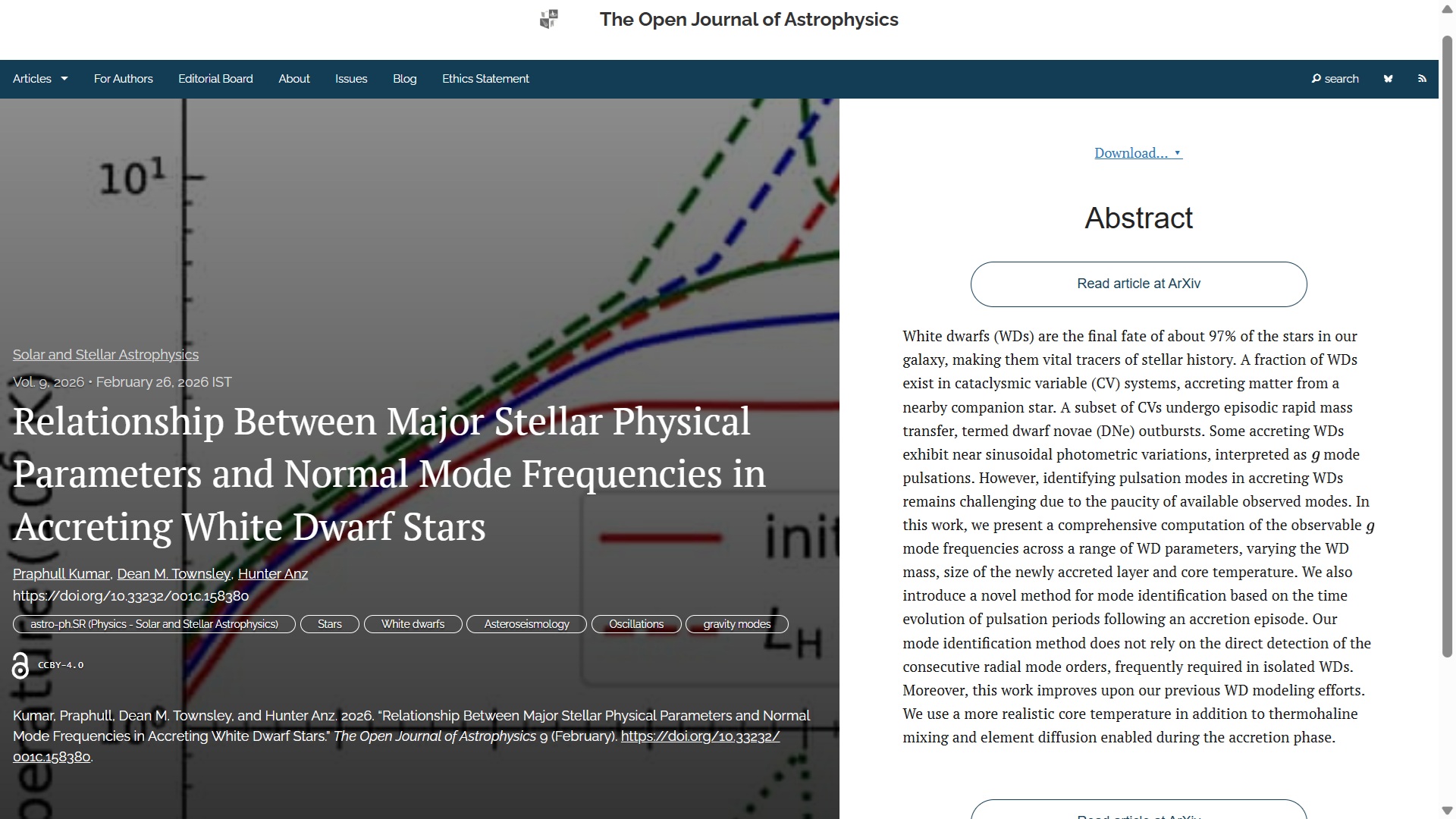
In chronological order of publication, the four papers published this week, with their overlays, are as follows. You can click on the images of the overlays to make them larger should you wish to do so.

The first paper to report is “Partition function approach to non-Gaussian likelihoods: information theory and state variables for Bayesian inference” by Rebecca Maria Kuntz, Heinrich von Campe, Tobias Röspel, Maximilian Philipp Herzog, and Björn Malte Schäfer, all from the University of Heidelberg (Germany). It was published on Wednesday March 5th 2025 in the folder Cosmology and NonGalactic Astrophysics and it discusses the relationship between information theory and thermodynamics with applications to Bayesian inference in the context of cosmological data sets.


You can read the officially accepted version of this paper on arXiv here.

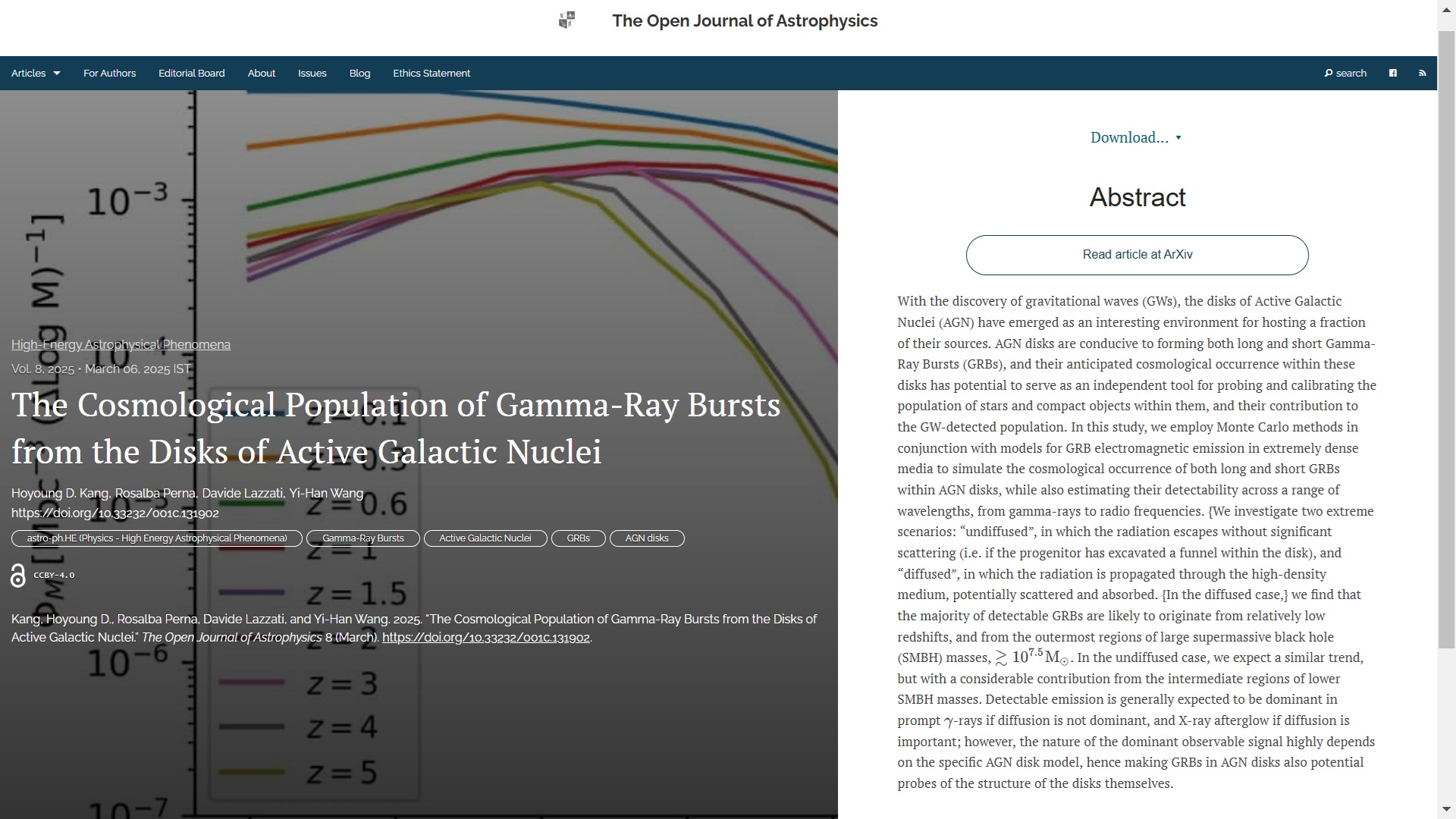
The second paper of the week  is “The Cosmological Population of Gamma-Ray Bursts from the Disks of Active Galactic Nuclei” by Hoyoung D. Kang & Rosalba Perna (Stony Brook), Davide Lazzati (Oregon State), and Yi-Han Wang (U. Nevada), all based in the USA. It was published on Thursday 6th March 2025 in the folder High-Energy Astrophysical Phenomena. The authors use models for GRB electromagnetic emission to simulate the cosmological occurrence and observational detectability of both long and short GRBs within AGN disks

You can find the officially accepted version of this paper on arXiv here.

The next two papers were published on Friday 7th March 2025.

The distribution of misalignment angles in multipolar planetary nebulae” by Ido Avitan and Noam Soker (Technion, Haifa, Israel) analyzes the statistics of measured misalignment angles in multipolar planetary nebulae implies a random three-dimensional angle distribution limited to <60 degrees. It is in the folder Solar and Stellar Astrophysics.

Here is the overlay:


The official published version can be found on the arXiv here.

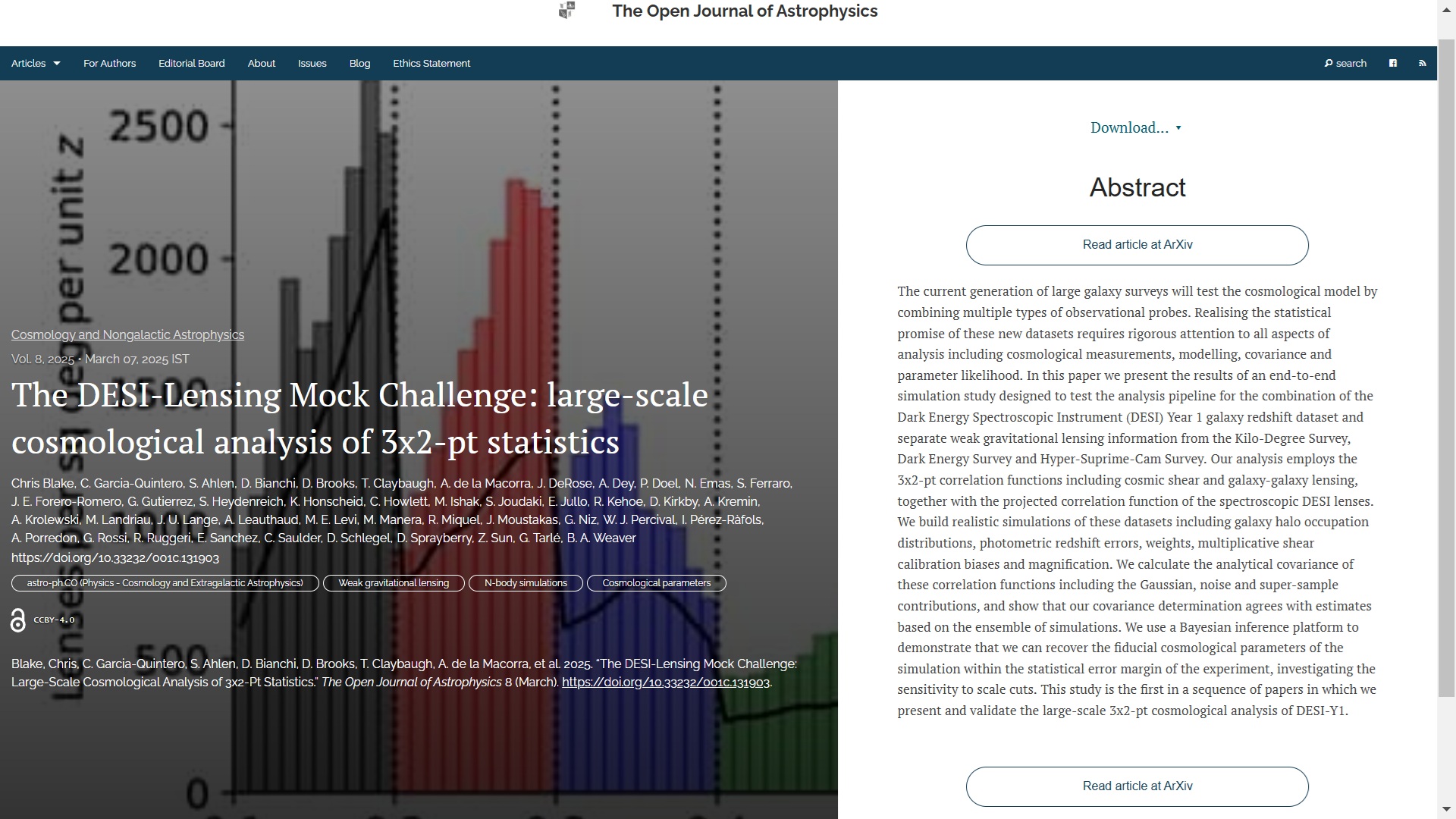
The last paper to report this week is “The DESI-Lensing Mock Challenge: large-scale cosmological analysis of 3×2-pt statistics” by Chris Blake (Swinburne, Australia) and 43 others; this is a large international collaboration and I apologize for not being able to list all the authors here!

This one is in the folder marked Cosmology and NonGalactic Astrophysics; it presents an end-to-end simulation study designed to test the analysis pipeline for the Dark Energy Spectroscopic Instrument (DESI) Year 1 galaxy redshift dataset combined with weak gravitational lensing from other surveys.

The overlay is here:


You can find the “final” version on arXiv here.

That’s all for this week. It’s good to see such an interesting variety of topics. I’ll do another update next Saturday

Weekly Update from the Open Journal of Astrophysics – 22/02/2025

Posted in OJAp Papers, Open Access, The Universe and Stuff with tags , , , , , , , , , , , , , , , , , , on February 22, 2025 by telescoper

It’s Saturday morning again so it’s time for an update of papers published at the Open Journal of Astrophysics. Things have picked up a bit after a quiet couple of weeks. Since the last update we have published four new papers which brings the number in Volume 8 (2025) up to 18 and the total so far published by OJAp up to 253.

In chronological order of publication, the four papers published this week, with their overlays, are as follows. You can click on the images of the overlays to make them larger should you wish to do so.

The first paper to report is in fact our 250th paper:  “Untangling Magellanic Streams” by Dennis Zaritsky (Steward Observatory), Vedant Chandra (Harvard), Charlie Conroy (Harvard), Ana Bonaca (Carnegie Observatories), Phillip A. Cargile (Harvard), and Rohan P. Naidu (MIT), all based in the USA. This paper is in the folder marked Astrophysics of Galaxies and it reports on spectroscopic study aimed at teasing out the stellar populations of different strands of the Magellanic Stream. It was published on Tuesday 18th February 2025. Here is the overlay:

You can read the officially accepted version of this paper on arXiv here.

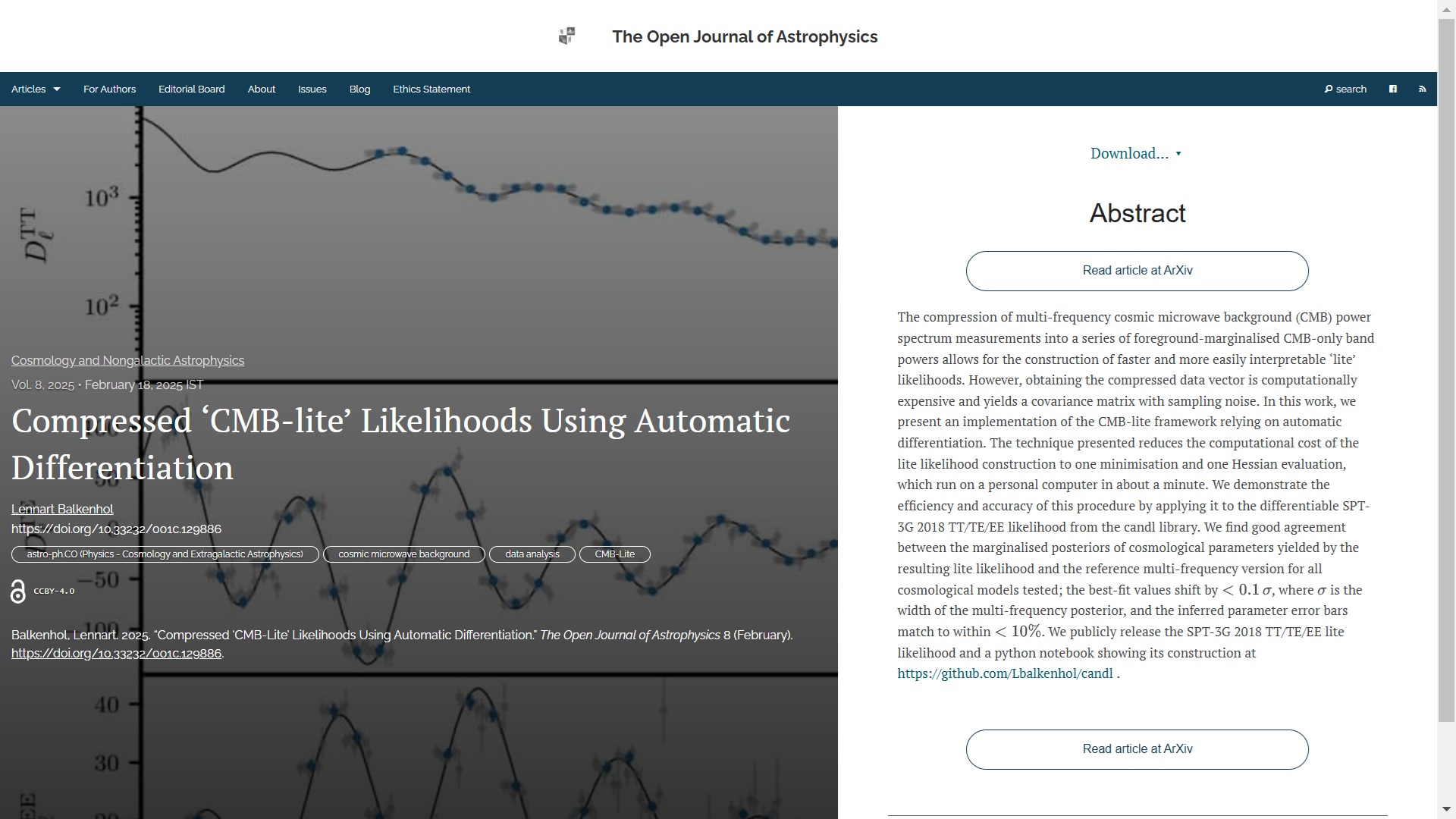
The second paper of the week  is “Compressed ‘CMB-lite’ Likelihoods Using Automatic Differentiation” by Lennart Balkenhol (Institut d’Astrophysique de Paris, France) which was one of two papers published on Wednesday 19th February. It appears in the folder Cosmology and Nongalactic Astrophysics and it describes an implementation of the CMB-lite framework relying on automatic differentiation to reduce the computational cost of the lite likelihood construction.  The overlay is here:

You can find the officially accepted version of this paper on arXiv here.

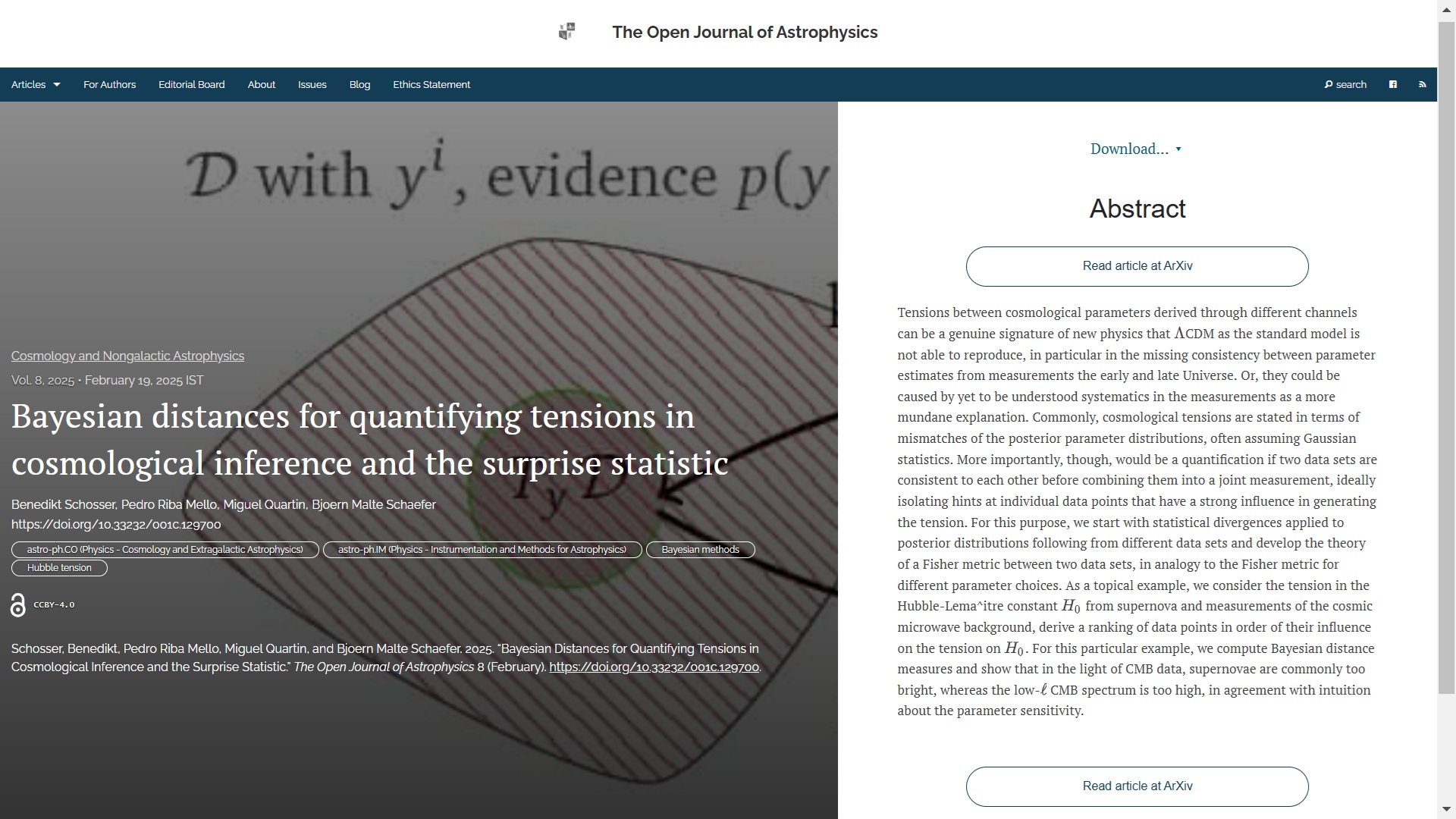
The next paper, also published on Wednesday 19th February in the folder Cosmology and Nongalactic Astrophysics is “Bayesian distances for quantifying tensions in cosmological inference and the surprise statistic” by Benedikt Schosser (Heidelberg, Germany), Pedro Riba Mello & Miguel Quartin (Rio de Janeiro, Brazil) and Bjoern Malte Schaefer (Heidelberg).  It presents a discussion of statistical divergences applied to posterior distributions following from different data sets and their use in quantifying discrepancies or tensions.

Here is the overlay:

The official published version can be found on the arXiv here.

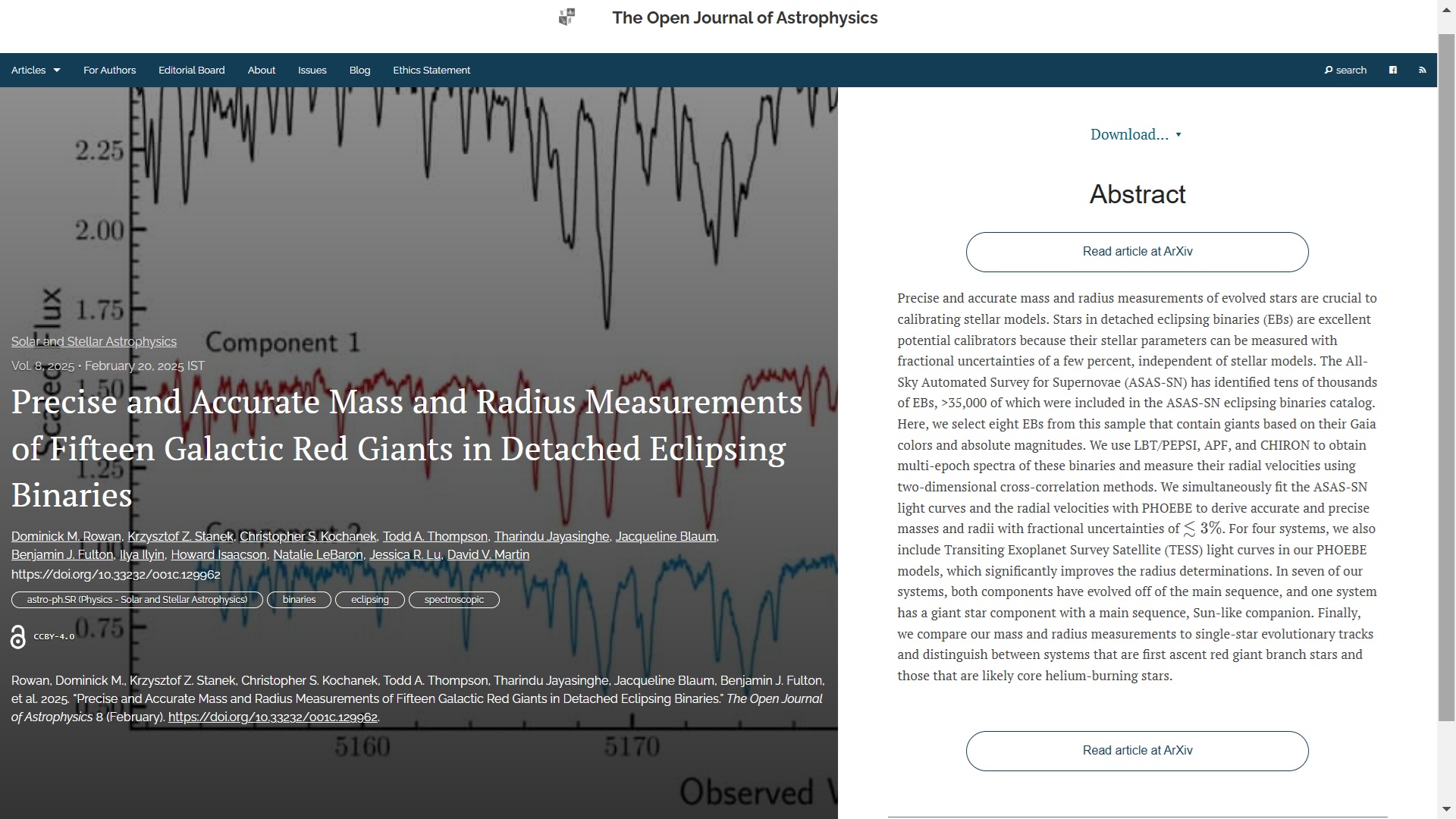
Finally in this batch we have “Precise and Accurate Mass and Radius Measurements of Fifteen Galactic Red Giants in Detached Eclipsing Binaries” by Dominick M. Rowan,  Krzysztof Z. Stanek,  Christopher S. Kochanek & Todd A. Thompson (Ohio State University), Tharindu Jayasinghe (independent researcher),  Jacqueline Blaum (UC Berkeley),  Benjamin J. Fulton (NASA/Caltech),  Ilya Ilyin (AIP Potsdam, Germany),  Howard Isaacson, Natalie LeBaron  &  Jessica R. Lu (UC Berkeley), and  David V. Martin (Tufts University, USA).  This paper was published on Thursday 20th February 2025 in the folder Solar and Stellar Astrophysics and it presents a compilation of mass and readius measurements of red giant stars obtained using spectroscopic measurements together with light curves and the eclipsing binary models obtained using PHOEBE.

The overlay is here:

You can find the “final” version on arXiv here.

That’s all for this week. I’ll do another update next Saturday.

Two New Publications at the Open Journal of Astrophysics

Posted in OJAp Papers, Open Access, The Universe and Stuff with tags , , , , , , , , , , on October 26, 2024 by telescoper

It’s Saturday morning again so here’s another report on activity at the  Open Journal of Astrophysics.  Since the last update we have published two more papers, taking  the count in Volume 7 (2024) up to 95 and the total published by OJAp up to 210.  We’ve still got a few in the pipeline waiting for the final versions to appear on arXiv so I expect we’ll reach the 100 mark for 2024 in the next couple of weeks.

The first paper of the most recent pair, published on October 22 2024,  and in the folder marked Astrophysics of Galaxies, is “Cloud Collision Signatures in the Central Molecular Zone”  by Rees A. Barnes and Felix D. Priestley (Cardiff University, UK) .  This paper presents an analysis of combined hydrodynamical, chemical and radiative transfer simulations of cloud collisions in the Galactic disk and Central Molecular Zone (CMZ).

Here is a screen grab of the overlay which includes the abstract:


You can click on the image of the overlay to make it larger should you wish to do so.  You can find the officially accepted version of this paper on the arXiv here.

The second paper has the title “Partition function approach to non-Gaussian likelihoods: macrocanonical partitions and replicating Markov-chains” and was published October 25th 2024. The authors are Maximilian Philipp Herzog, Heinrich von Campe, Rebecca Maria Kuntz, Lennart Röver and Björn Malte Schäfe (all of Heidelberg University, Germany). This paper, which is in  the folder marked Cosmology and NonGalactic Astrophysics, describes a method of macrocanonical sampling for Bayesian statistical inference, based on the macrocanonical partition function, with applications to cosmology.

Here is a screen grab of the overlay which includes the abstract:


You can click on the image of the overlay to make it larger should you wish to do so. You can find the officially accepted version of the paper on the arXiv here.

That concludes this week’s update. More  next week!

Two New Publications at the Open Journal of Astrophysics

Posted in OJAp Papers, Open Access, The Universe and Stuff with tags , , , , , , , , , on September 7, 2024 by telescoper

It’s Saturday morning again so here’s another report on activity at the  Open Journal of Astrophysics.  Since the last update we have published two more papers, taking  the count in Volume 7 (2024) up to 73 and the total published by OJAp up to 188.  We’ve still got a few in the pipeline waiting for the final versions to appear on arXiv so I expect we’ll reach the 200 mark fairly soon.

The first paper of the most recent pair, published on September 4th 2024,  and in the folder marked Astrophysics of Galaxies, is “Massive Black Hole Seeds”  by John Regan of the Department of Theoretical Physics at Maynooth University and Marta Volonteri (Sorbonne Université, Paris, France). This article presents a discussion of the pathways to the formation of massive black holes, including both light and heavy initial seeds.

Here is a screen grab of the overlay which includes the abstract:


You can click on the image of the overlay to make it larger should you wish to do so. Those of you who are paying attention will see that there is a bit of a glitch on the left hand side where software has thrown a line break in between the two author names. I have no idea what caused this so I raised a ticket with Scholastica and no doubt it will soon be fixed.  (Update: it is now fixed, 12th September 2024). You can find the officially accepted version of this paper on the arXiv here.

The second paper has the title “The future of cosmological likelihood-based inference: accelerated high-dimensional parameter estimation and model comparison” and was published on 5th September 2024. The authors are Davide Piras (Université de Genève), Alicja Polanska (MSSL) , Alessio Spurio Mancini (Royal Holloway, London), Matthew A. Price(UCL) & Jason D. McEwen (UCL); the latter four are all based in the UK. This paper, which is in  the folder marked Cosmology and NonGalactic Astrophysics, describes an accelerated approach to Bayesian inference in higher-dimensional settings, as required for cosmology, based on recent developments in machine learning and its underlying technology.

Here is a screen grab of the overlay which includes the abstract:


You can click on the image of the overlay to make it larger should you wish to do so. You can find the officially accepted version of the paper on the arXiv here.

That concludes this week’s update. More  next week!

Broken Science Initiative

Posted in Bad Statistics with tags , , , , , , on March 10, 2024 by telescoper

This weekend I find myself at an invitation-only event in Phoenix, Arizona, organized by the Broken Science Initiative and called  The Broken Science Epistemology Camp. I flew here on Thursday and will be returning on Tuesday, so it’s a flying visit to the USA.  I thank the organizers Greg Glassman and Emily Kaplan for inviting me. I wasn’t sure what to expect when I accepted the invitation to come but I welcomed the chance to attend an event that’s a bit different from the usual academic conference. There are some suggestions here for background reading which you may find interesting.

Yesterday we had a series of wide-ranging talks about subjects such as probability and statistics, the philosophy of science, the problems besetting academic research, and so on. One of the speakers was eminent psychologist  Gerd Gigerenzer, the theme of whose talk was the use of p-values in statistic and the effects of bad statistical reasoning in reporting research results and wider issues generated by this. You can find a paper covering many of the points raised by Gigerenzer here (PDF).

I’ve written about this before on this blog – see here for example – and I thought it might be useful to re-iterate some of the points here.

The p-value is a frequentist concept that corresponds to the probability of obtaining a value at least as large as that obtained for a test statistic under a “null hypothesis”. To give an example, the null hypothesis might be that two variates are uncorrelated; the test statistic might be the sample correlation coefficient r obtained from a set of bivariate data. If the data were uncorrelated then r would have a known probability distribution, and if the value measured from the sample were such that its numerical value would be exceeded with a probability of 0.05 then the p-value (or significance level) is 0.05.

Whatever the null hypothesis happens to be, the way a frequentist would proceed would be to calculate what the distribution of measurements would be if it were true. If the actual measurement is deemed to be unlikely (say that it is so high that only 1% of measurements would turn out that big under the null hypothesis) then you reject the null, in this case with a “level of significance” of 1%. If you don’t reject it then you tacitly accept it unless and until another experiment does persuade you to shift your allegiance.

But the p-value merely specifies the probability that you would reject the null-hypothesis if it were correct. This is what you would call making a Type I error. It says nothing at all about the probability that the null hypothesis is actually a correct description of the data or that some other hypothesis is needed. To make that sort of statement you would need to specify an alternative hypothesis, calculate the distribution based on it, and determine the statistical power of the test, i.e. the probability that you would actually reject the null hypothesis when the alternative hypothesis, rather than the null, is correct. To fail to reject the null hypothesis when it’s actually incorrect is to make a Type II error.

If all this stuff about p-values, significance, power and Type I and Type II errors seems a bit bizarre, I think that’s because it is. It’s so bizarre, in fact, that I think most people who quote p-values have absolutely no idea what they really mean. Gerd Gigerenzer gave plenty of examples of this in his talk.

A Nature piece published some time ago argues that in fact that results quoted with a p-value of 0.05 turn out to be wrong about 25% of the time. There are a number of reasons why this could be the case, including that the p-value is being calculated incorrectly, perhaps because some assumption or other turns out not to be true.  For instance, a widespread example is assuming that the variates concerned are normally distributed. Unquestioning application of off-the-shelf statistical methods in inappropriate situations is a serious problem in many disciplines, but is particularly prevalent in the social sciences when samples are also typically rather small.

The suggestion that this issue can be resolved  by simply choosing stricter criteria, i.e. a p-value of 0.005 rather than 0.05, does not help because the p-value is an answer to a question about what the hypothesis says about the probability of the data, which is quite different from that which a scientist would really want to ask, namely what the data have to say about a given hypothesis. Frequentist hypothesis testing is intrinsically confusing compared to the logically clearer Bayesian approach, which does focus on the probability of a hypothesis being right given the data, rather than on properties that the data might have given the hypothesis. If I had my way I’d ban p-values altogether.

The p-value is just one example of a statistical device that is too often applied mechanically without real understanding, as a black box, and which can be manipulated through data dredging (or “p-hacking”). Gerd Gigerenzer went on to bemoan the general use of “mindless statistics”, the prevalence of “statistical rituals” and referred to much statistical reasoning as “a meaningless ordeal of pedantic computations”. It

Bad statistics isn’t the only thing wrong with academic research, but it is a significant factor.

New Publication at the Open Journal of Astrophysics

Posted in Open Access, The Universe and Stuff with tags , , , , , , , on July 22, 2022 by telescoper

It seems we’re on a bit of a roll at the Open Journal of Astrophysics as we have yet another new paper for me to announce. I think with the end of teaching quite a few authors are finding time to make their revised versions (which I should also be doing, come to think of it….)

Anyway the new paper, published yesterday, is the 11th paper in Volume 5 (2022) and the 59th in all. The latest publication is entitled “Bayesian error propagation for neural-net based parameter inference” and is written by Daniela Grandón of the University of Chile and Elena Sellentin of Leiden University.

It being mainly about the application of parameter inference to cosmology, this is another paper in the Instrumentation and Methods for Astrophysics folder.

Here is a screen grab of the overlay which includes the  abstract:


You can click on the image to make it larger should you wish to do so. You can find the arXiv version of the paper here.

Evidence for a Spatially Flat Universe?

Posted in The Universe and Stuff with tags , , , , , , on February 19, 2020 by telescoper

Yesterday I saw a paper by George Efstathiou and Steve Gratton on the arXiv with the title The Evidence for a Spatially Flat Universe. The abstract reads:

We revisit the observational constraints on spatial curvature following recent claims that the Planck data favour a closed Universe. We use a new and statistically powerful Planck likelihood to show that the Planck temperature and polarization spectra are consistent with a spatially flat Universe, though because of a geometrical degeneracy cosmic microwave background spectra on their own do not lead to tight constraints on the curvature density parameter ΩK. When combined with other astrophysical data, particularly geometrical measurements of baryon acoustic oscillations, the Universe is constrained to be spatially flat to extremely high precision, with ΩK = 0.0004 ±0.0018 in agreement with the 2018 results of the Planck team. In the context of inflationary cosmology, the observations offer strong support for models of inflation with a large number of e-foldings and disfavour models of incomplete inflation.

You can download a PDF of the paper here. Here is the crucial figure:

This paper is in part a response to a paper I blogged about here and some other related work with the same general thrust. I thought I’d mention the paper here, however, because it contains some interesting comments about the appropriate choice of priors in the problem of inference in reference to cosmological parameters. I feel quite strongly that insufficient thought is given generally about how this should be done, often with nonsensical consequences. It’s quite frustrating to see researchers embracing the conceptual framework of Bayesian inference but then choosing an inappropriate prior. The prior is not an optional extra – it’s one of the key ingredients. This isn’t a problem limited to the inflationary scenarios discussed in the above paper, by the way, it arises in a much wider set of cosmological models. The real cosmological flatness problem is that too many cosmologists use  flat priors everywhere!


New Publication at the Open Journal of Astrophysics!

Posted in OJAp Papers, Open Access, The Universe and Stuff with tags , , , , , , , , on December 2, 2019 by telescoper

We have published another new paper at The Open Journal of Astrophysics. We actually published this one last week but (presumably because of the Thanksgiving holiday) it has taken longer than usual to register the DOI with Crossref and I held off mentioning this paper here until everything was sorted.

Here is a grab of the overlay:

The authors are Farhad Feroz and Mike Hobson of the Cavendish Laboratory at the University of Cambridge (UK), Ewan Cameron (now at Oxford, UK) and Anthony N. Pettitt of Queensland University of Technology in Australia.

You can find the accepted version on the arXiv here. This version was accepted after modifications requested by the referee and editor. Because this is an overlay journal the authors have to submit the accepted version to the arXiv (which we then check against the copy submitted to us) before publishing; version 3 on the arXiv is the accepted version (which contains a link to updated software).

It is worth mentioning a couple of points about this paper.

The first is that it is mainly a statistical methods paper rather than astrophysics per se but it does contain applications to astrophysics and cosmology and, more relevantly, was posted on the `Instrumentation and Methods for Astrophysics’ section on the arXiv. The Editorial Board felt that we should consider it for publication because our rule for whether a paper can be considered for publication in the Open Journal of Astrophysics is stated clearly on our instructions for authors:

We apply a simple criterion to decide whether a paper is on a suitable topic for this journal, namely that if it it is suitable for the astro-ph section of the arXiv then it is suitable for The Open Journal of Astrophysics.

So far our publication list is dominated by papers in `Cosmology and Nongalactic Astrophysics’ and `Instrumentation and Methods for Astrophysics’ (which is not surprising given its origin) but we would be very happy to get more submissions from other areas, especially Stellar and Planetary astrophysics. Hint! Hint!

The other point to make is that this paper actually appeared on the arXiv over six years ago and has been widely cited as a preprint but it has never previously been published by a journal. The Editorial Board felt that we should consider it for publication in order to ensure that it is properly curated and citations properly assigned, but we treated it as a new submission and sent it out for review just like any other paper. The review led to some changes and, most importantly, a few updates to the software which you can find here. The editorial process has been quite lengthy for this paper but I think we have done a valuable service to the community in reviewing and publishing this paper.

P.S. Just a reminder that we now have an Open Journal of Astrophysics Facebook page where you can follow updates from the Journal should you so wish..

Hubble Tension: an “Alternative” View?

Posted in Bad Statistics, The Universe and Stuff with tags , , , , , on July 25, 2019 by telescoper

There was a new paper last week on the arXiv by Sunny Vagnozzi about the Hubble constant controversy (see this blog passim). I was going to refrain from commenting but I see that one of the bloggers I follow has posted about it so I guess a brief item would not be out of order.

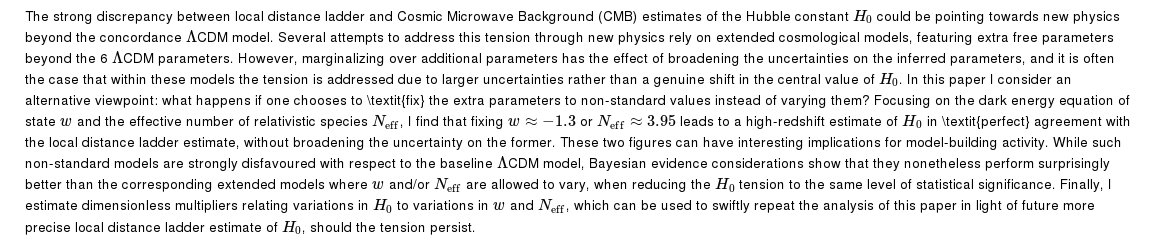
Here is the abstract of the Vagnozzi paper:

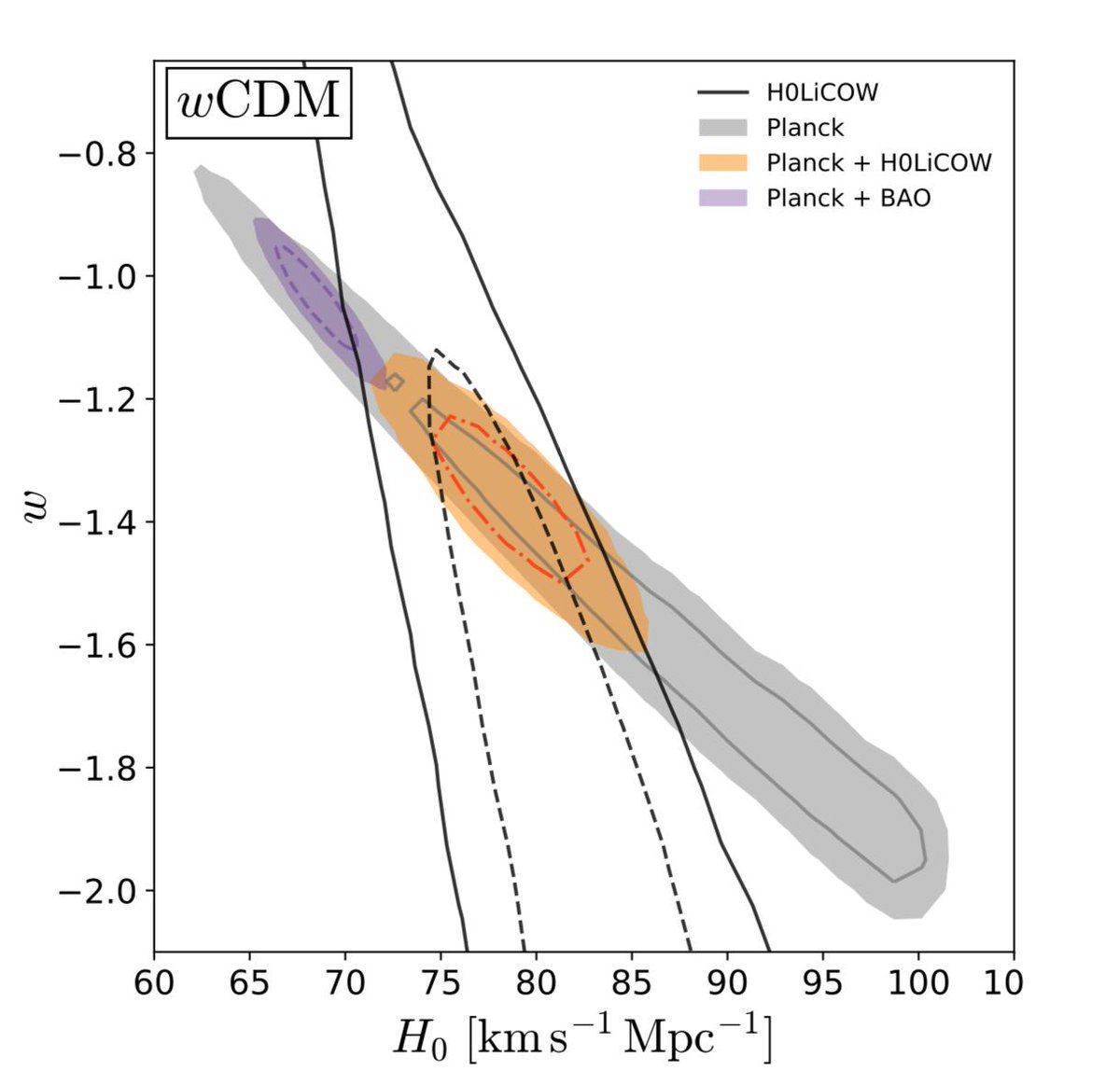
I posted this picture last week which is relevant to the discussion:

The point is that if you allow the equation of state parameter w to vary from the value of w=-1 that it has in the standard cosmology then you get a better fit. However, it is one of the features of Bayesian inference that if you introduce a new free parameter then you have to assign a prior probability over the space of values that parameter could hold. That prior penalty is carried through to the posterior probability. Unless the new model fits observational data significantly better than the old one, this prior penalty will lead to the new model being disfavoured. This is the Bayesian statement of Ockham’s Razor.

The Vagnozzi paper represents a statement of this in the context of the Hubble tension. If a new floating parameter w is introduced the data prefer a value less than -1 (as demonstrated in the figure) but on posterior probability grounds the resulting model is less probable than the standard cosmology for the reason stated above. Vagnozzi then argues that if a new fixed value of, say, w = -1.3 is introduced then the resulting model is not penalized by having to spread the prior probability out over a range of values but puts all its prior eggs in one basket labelled w = -1.3.

This is of course true. The problem is that the value of w = -1.3 does not derive from any ab initio principle of physics but by a posteriori of the inference described above. It’s no surprise that you can get a better answer if you know what outcome you want. I find that I am very good at forecasting the football results if I make my predictions after watching Final Score

Indeed, many cosmologists think any value of w < -1 should be ruled out ab initio because they don’t make physical sense anyway.


On Probability and Cosmology

Posted in The Universe and Stuff with tags , , , on December 12, 2018 by telescoper

I just noticed a potentially interesting paper by Martin Sahlén on the arXiv. I haven’t actually read it yet, so don’t know if I agree with it, but thought I’d point it out here for those interested in cosmology and things Bayesian.

Here is the abstract:

Modern scientific cosmology pushes the boundaries of knowledge and the knowable. This is prompting questions on the nature of scientific knowledge. A central issue is what defines a ‘good’ model. When addressing global properties of the Universe or its initial state this becomes a particularly pressing issue. How to assess the probability of the Universe as a whole is empirically ambiguous, since we can examine only part of a single realisation of the system under investigation: at some point, data will run out. We review the basics of applying Bayesian statistical explanation to the Universe as a whole. We argue that a conventional Bayesian approach to model inference generally fails in such circumstances, and cannot resolve, e.g., the so-called ‘measure problem’ in inflationary cosmology. Implicit and non-empirical valuations inevitably enter model assessment in these cases. This undermines the possibility to perform Bayesian model comparison. One must therefore either stay silent, or pursue a more general form of systematic and rational model assessment. We outline a generalised axiological Bayesian model inference framework, based on mathematical lattices. This extends inference based on empirical data (evidence) to additionally consider the properties of model structure (elegance) and model possibility space (beneficence). We propose this as a natural and theoretically well-motivated framework for introducing an explicit, rational approach to theoretical model prejudice and inference beyond data.

You can download a PDF of the paper here.

As usual, comments are welcome below. I’ll add my thoughts later, after I’ve had the chance to read the article!