It’s Saturday morning in Sydney, and time to post another update relating to the Open Journal of Astrophysics. Since the last update we have published two more papers, taking the count in Volume 7 (2024) up to 15 and the total published by OJAp up to 130. I should have posted these before leaving but it slipped my mind.
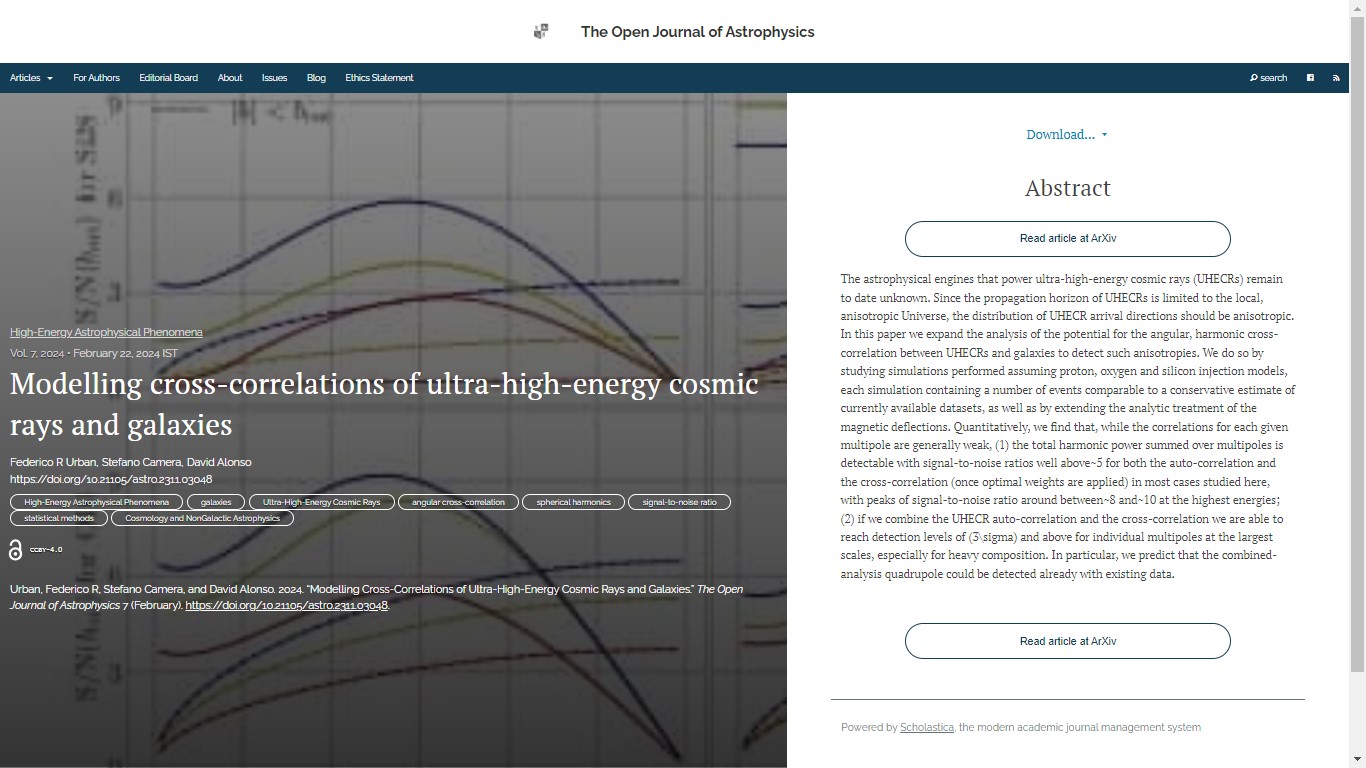
The first paper of the most recent pair – published on Thursday 22nd February – is “Modelling cross-correlations of ultra-high-energy cosmic rays and galaxies” by Federico Urban (Prague, Czech Republic), Stefano Camera (Torino, Italy) and David Alonso (Oxford, UK). It presents a discussion of the possible statistical correlations between Ultra-High-Energy Cosmic-Ray (UHECR) directions in various models and structure in the galaxy distribution and whether or not this signal could be measurable. This one is in the folder marked “High-Energy Astrophysical Phenomena“.
Here is a screen grab of the overlay which includes the abstract:
You can click on the image of the overlay to make it larger should you wish to do so. You can find the officially accepted version of the paper on the arXiv here.
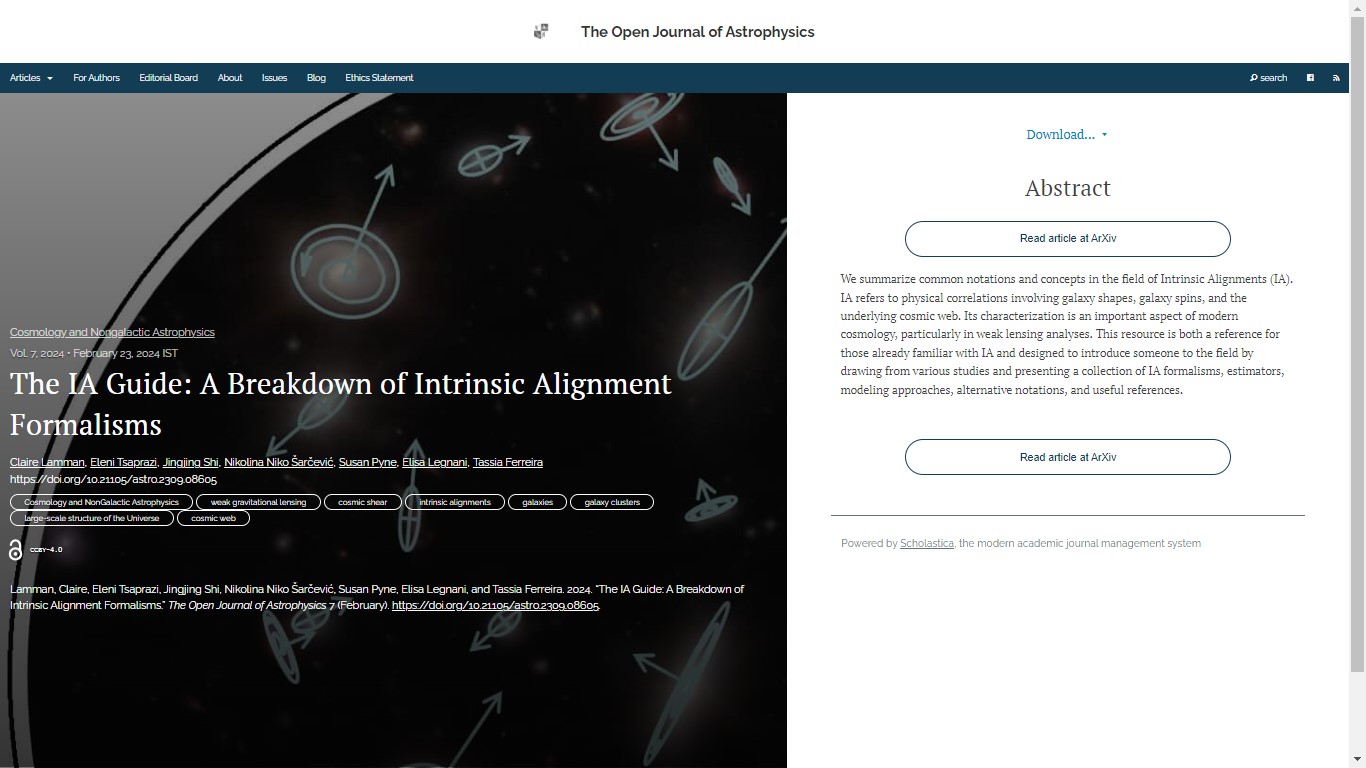
The second paper was published on Friday 23rd February and has the title “The IA Guide: A Breakdown of Intrinsic Alignment Formalisms” and the authors are: Claire Lamman (Harvard, USA); Eleni Tsaprazi (Stockholm, Sweden); Jingjing Shi (Tokyo, Japan); Nikolina Niko Šarčević (Newcastle, UK); Susan Pyne (UCL, UK); Elisa Legnani (Barcelona, Spain); and Tassia Ferreira (Oxford, UK). This one, which is in the folder marked Cosmology and NonGalactic Astrophysics, presents a review of Intrinsic Alignments, i.e. physical correlations involving galaxy shapes, galaxy spins, and larger scale structure, especially important for weak gravitational lensing
Here is a screen grab of the overlay which includes the abstract:
You can click on the image of the overlay to make it larger should you wish to do so. You can find the officially accepted version of the paper on the arXiv here.
I just saw a press release about new results from the Dark Energy Survey relating to measurements of baryon acoustic oscillations. These are basically the residue of the oscillations seen in the power spectrum of the cosmic microwave background (CMB) temperature distribution imprinted on the galaxy distribution. They are somewhat less obvious that the primordial temperature fluctuations because the growth of structure produces a much larger background but they are measurable (and indeed are one of the things Euclid will measure).
Anyway, there is a very nice detailed description in the press release and you can find the preprint of the work in full on arXiv here, so I’ll just show the key figure:
The effective redshift of this measurement is about 0.85; in the CMB the redshift is about 1000. You can see that there is a characteristic scale but it is slightly offset from that predicted using the standard ΛCDM model based on the Planck determination of cosmological parameters. One has to be careful in interpreting this diagram because it is determined using autocorrelation functions; the errors on different bins are therefore correlated, not statistically independent. They are also, as you can see, quite large. Nonetheless, it’s a tantalizing result…
A month ago I wrote a piece about observations of an apparent “Big Ring” of absorption systems that was claimed to be inconsistent with the Cosmological Principle and hence with the standard cosmological model. At the time there was no paper describing the results, but a preprint has now appeared on arXiv. I haven’t read it carefully yet, but at a cursory reading it confirms my prior expectation that it does not contain a comparison of the observations with predictions of the standard model. I’ll say more after I’ve had a chance to digest the paper.
One of the things that irked me at the time of the announcement of this “discovery” was that there was no way to scrutinize the claims because they hadn’t been written up. Another was that the media covering the Big Ring did not appear to want to present balancing opinions.
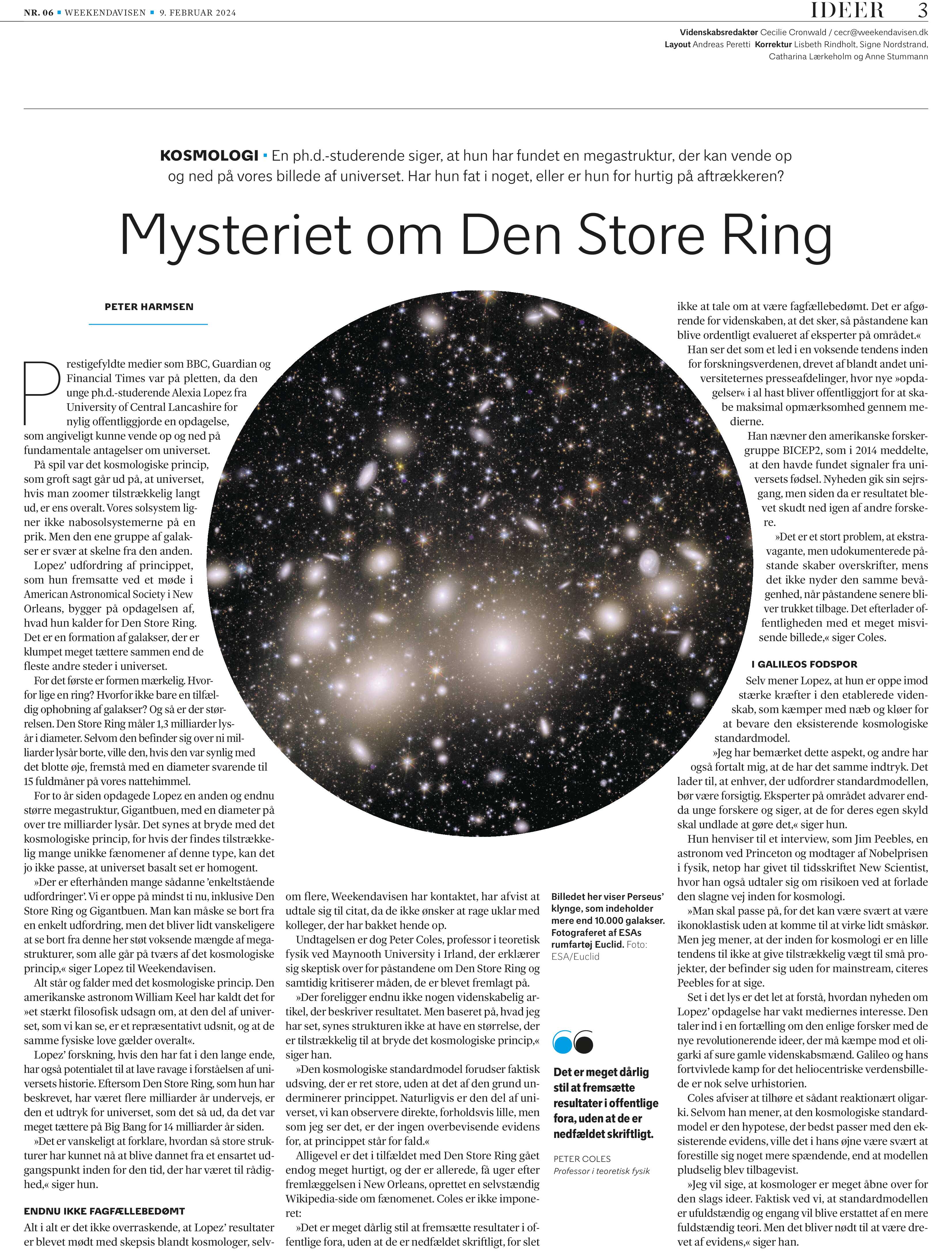
An exception was Danish journalist Peter Harmsen who writes for the weekly broadsheet Weekendavisen who asked me for an interview after seeing my sceptical blog post. The results appeared in an article that came out yesterday (13th February). It’s behind a paywall but here’s a screengrab to give you an idea (if you can read Danish):
The word “store” in Danish means “big” or “large”; it comes up quite often if you want to buy a beer in Denmark. The key quote of mine is
Det er meget dårlig stil at fremsætte resultater i offentlige fora, uden at de er nedfældet skriftligt
Weekendavisen, 13th February 2024
I actually kept a transcript of the interview which I thought it might be useful to share here in the form of questions and answers. You will find the original English version of the above quote in my response to the last question.
Fundamentally, do you think that the cosmological principle still stands or is in need of adjustment or even replacement?
The Cosmological Principle, in the form used in the standard cosmological model, requires the Universe to be sufficiently homogeneous and isotropic on large scales that its behaviour can be described by relatively simple solutions of Einstein’s equations called the Friedman equations. We know the Universe is not exactly homogenous and isotropic, and the standard model predicts actually fluctuations on rather large scales that do not violate it. Of course the part of the Universe we have actually observed directly is relatively small, but as I see it there is no compelling evidence that the Cosmological Principle is violated.
Specifically regarding the research on the so-called Big Ring, is the jury still out on whether the people behind the research are on to something, pending publication of a peer-reviewed paper, or is it your assessment, based on what has been made public so far, that it is probably not the breakthrough that it has been made out to be in some reports?
I am sceptical of the claims made about the Big Ring because there is no scientific paper describing the result. Based on what I have seen, however, just like other claims of arcs and filaments, the structure described does not seem to be on a sufficiently large scale to violate the cosmological principle. A careful comparison of the results with simulations would be required to draw more definite conclusions. I am not aware that the authors have done that.
The PhD student credited with the research is quoted in the Financial Times as making the following remark: “Lots of people are excited but, having said that, you do get this [resistant] attitude in cosmology that you don’t generally find elsewhere in science… Good science should be about pushing back and testing our fundamental assumptions but there are clearly people who want to protect the Standard Model.” What is your comment on this? Is cosmology stifled by a scientific community resistant to change?
Science is – or should be – based on evidence. In my view the weight of evidence supporting the standard model is substantial, but that does not mean that it is proven to be true; it is a working hypothesis. If anyone does come up with evidence that shows it to be wrong then that would be the most exciting thing possible. I don’t see such evidence here. There are of course many people working on alternative theories , for example involving different forms of gravitational theory. I’d say cosmologists are very open to such ideas. Indeed we know that the standard model is incomplete and will eventually be replaced by a more complete theory. That has to be driven by evidence.
You describe in your blog “an increasing tendency for university press offices to see themselves entirely as marketing agencies.” Have there been other recent examples of universities being a little too eager to sell their scientific advances to the public?
There’s quite a lot of this about, and I have to say that scientists, sadly, are often willing participants. A famous example from some years ago was the BICEP2 “discovery” concerning the cosmic microwave background, which made headlines around the world but was later shown to be false. More recently there have been many claims that very distant galaxies observed with JWST are incompatible with the standard cosmology. In that case some of the observations turned out to be incorrect and the theoretical interpretation misleading. Very high redshift galaxies would indeed be difficult to account for in the standard model, but we haven’t seen enough evidence yet.
The narrative of a young scholar proposing revolutionary new ideas despite resistance from established science seems to resonate with the public and has echoes of Galilei and Darwin. Are we, the lay public, too easy victims of such dramatic story-telling, and does it give us a wrong idea about how science actually works?
I think the public don’t really understand how science really works for a number of reasons. I think many people expect scientists to be certain about things, when really it’s about dealing with statistical evidence in as careful and rational a way as possible. Earlier you asked me about the Cosmological Principle. If you asked me if the Cosmological Principle is valid I would answer “I don’t know, but as a working hypothesis it accounts very well for the reliable data”. That sort of statement, however, does not make headlines. A significant problem is that extravagant unsubstantiated claims make headlines, but subsequent retractions don’t. This presents a very misleading picture to the public.
In your blog, you write that headline-hunting without the presence of even a pre-print is “not the sort of thing PhD supervisors should be allowing their PhD students to do.” Is it because it is harmful to science as a whole, or because there is a risk of derailing a young scientist’s career before it has even begun due to an early debacle?
My objection is more that I think it is very bad form to present in public results which have not even been written up, let alone subject to proper peer review. It’s essential for science that this happens, so that the claims can be properly evaluated by experts in the field. Bypassing this is potentially extremely damaging to the proper public understanding of this subject.
Now that I’m settled in Sydney it’s time to post another update relating to the Open Journal of Astrophysics. Since the last update we have published two more papers, taking the count in Volume 7 (2024) up to 11 and the total published by OJAp up to 126. I should have posted these before leaving but it slipped my mind.
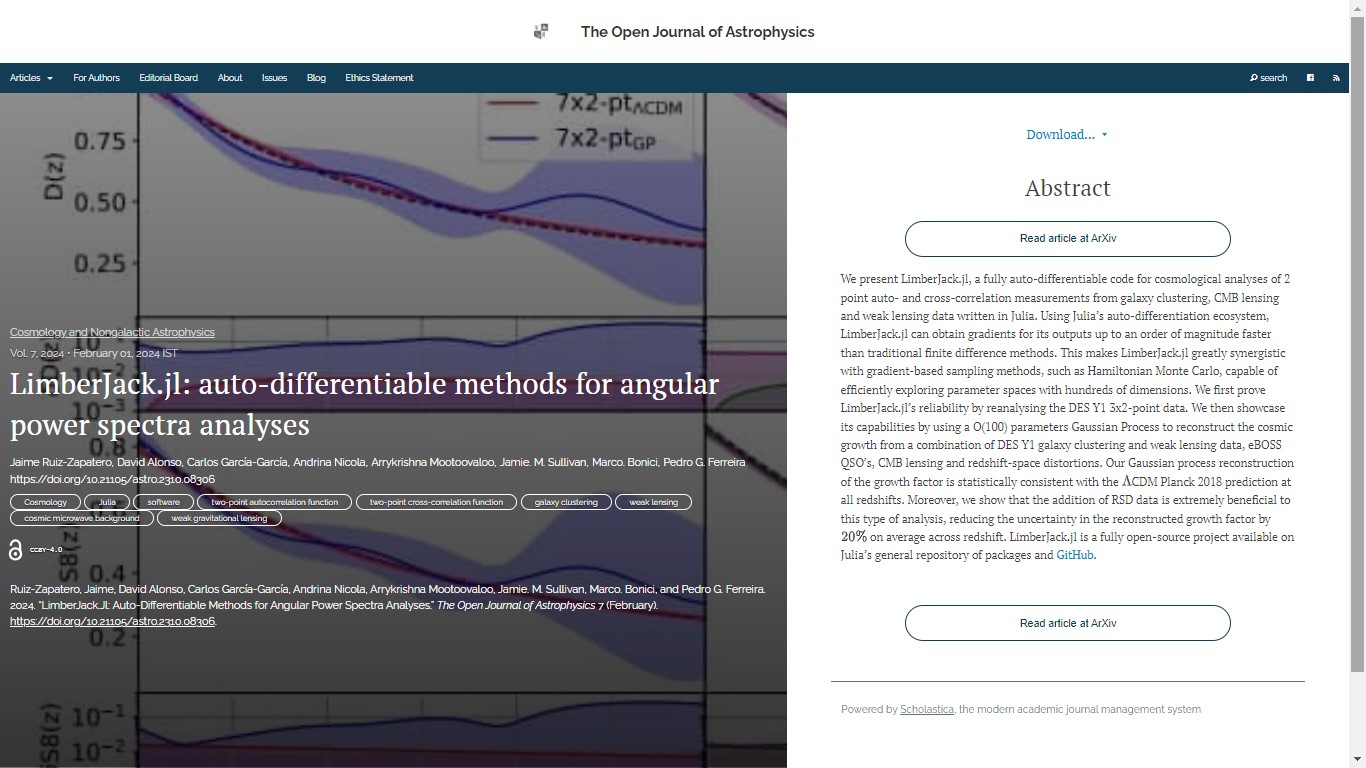
Anyway, the first paper of the most recent pair – published on February 1st – is “LimberJack.jl: auto-differentiable methods for angular power spectra analyses”, Jaime Ruiz-Zapatero (Oxford, UK), David Alonso (Oxford, UK), Carlos García-García (Oxford, UK) , Andrina Nicola (Bonn, Germany), Arrykrishna Mootoovaloo (Oxford, UK), Jamie Sullivan (Berkeley, USA), Marco Bonici (Milan, Italy), and Pedro Ferreira (Oxford, UK). This paper presents a fully auto-differentiable code for cosmological analyses of two-point auto- and cross-correlation measurements from galaxy clustering, CMB lensing and weak lensing data written in Julia.
Here is a screen grab of the overlay which includes the abstract:
You can click on the image of the overlay to make it larger should you wish to do so. You can find the officially accepted version of the paper on the arXiv here.
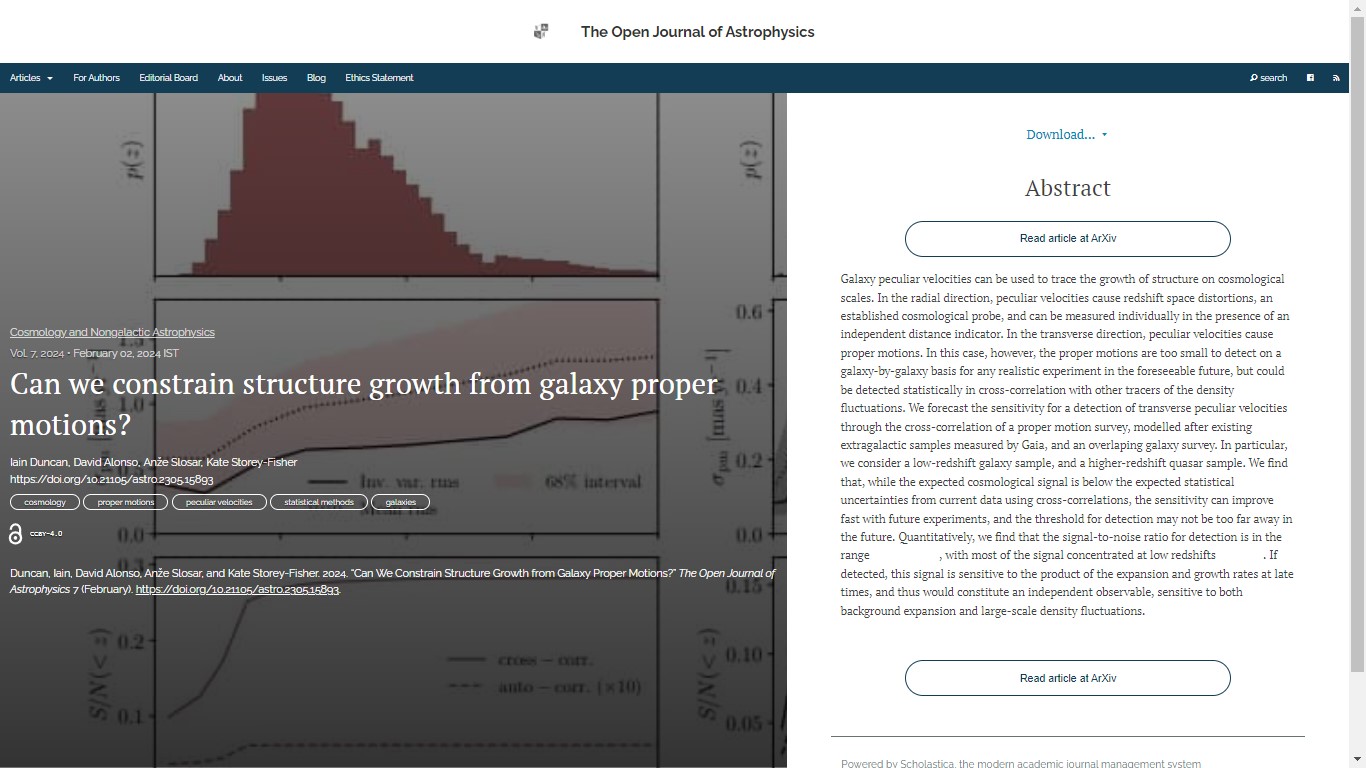
The second paper was published on Friday 2nd February and has the title “Can we constrain structure growth from galaxy proper motions?” which, as its title suggests, looks at the feasibility of using transverse peculiar velocities (i.e. proper motions) of galaxies for cosmological studies. The authors are Iain Duncan (Oxford, UK), David Alonso (Oxford, UK), Anže Slosar (Brookhaven National Laboratory, USA), and Kate Storey-Fisher (New York University, USA). To find out the answer to the question posed in its title you’ll have to read the paper!
Here is a screen grab of the overlay which includes the abstract:
You can click on the image of the overlay to make it larger should you wish to do so. You can find the officially accepted version of the paper on the arXiv here.
Because of the high rate of publications coming out, we’re moving to a system where we register papers in batches once a week rather than individually as they are published. This is just a temporary measure until we can automate this process more fully. Anyway, you can expect another update in a week or so.
As the first month of 2024 is now over, I thought I’d post an update relating to the Open Journal of Astrophysics. Since the last update we have published two papers, taking the count in Volume 7 (2024) up to 9 (the total for January) and the total published by OJAp up to 124. We will have others soon, but I will be travelling for the first few days of February so the next update will be in a week or so.
Using our sophisticated forecasting algorithm, based on the first month of 2024 as input, I predict that we will publish around 9×12=108 papers in 2024, more than double last year’s total of 50.
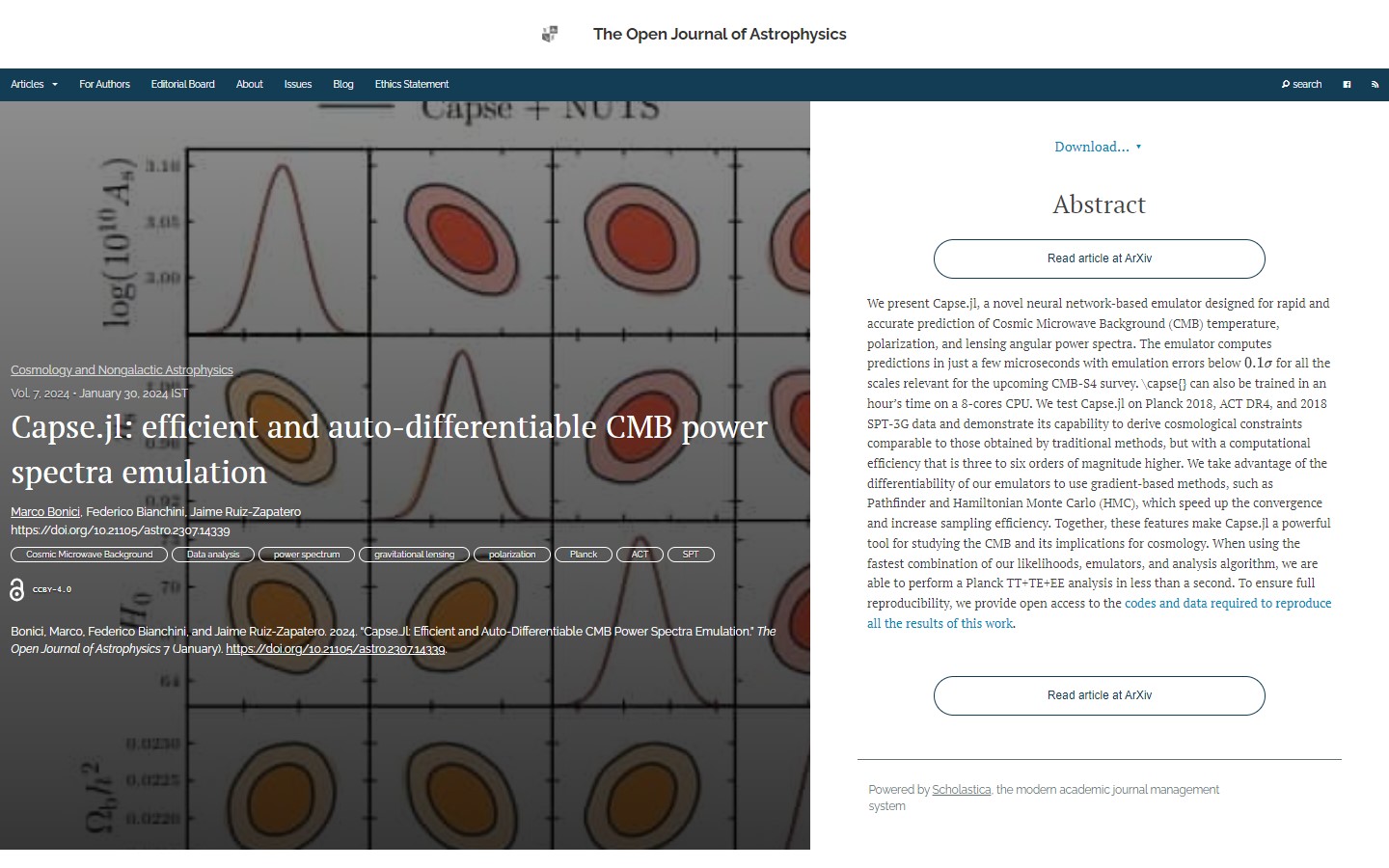
Anyway, the first paper of the most recent pair – published on January 30th – is “Capse.jl: efficient and auto-differentiable CMB power spectra emulation”, by Marco Bonici (INAF Milano, Italy & Waterloo, Canada), Federico Bianchini (Stanford, USA) and Jaime Ruiz-Zapatero (Oxford, UK). This paper presents an emulator for rapid and accurate prediction of Cosmic Microwave Background (CMB) temperature, polarization, and lensing angular power spectra, that works much faster than traditional methods. The code is written in Julia, in which language we are seeing an increasing number of submissions to OJAp.
Here is a screen grab of the overlay which includes the abstract:
You can click on the image of the overlay to make it larger should you wish to do so. You can find the officially accepted version of the paper on the arXiv here.
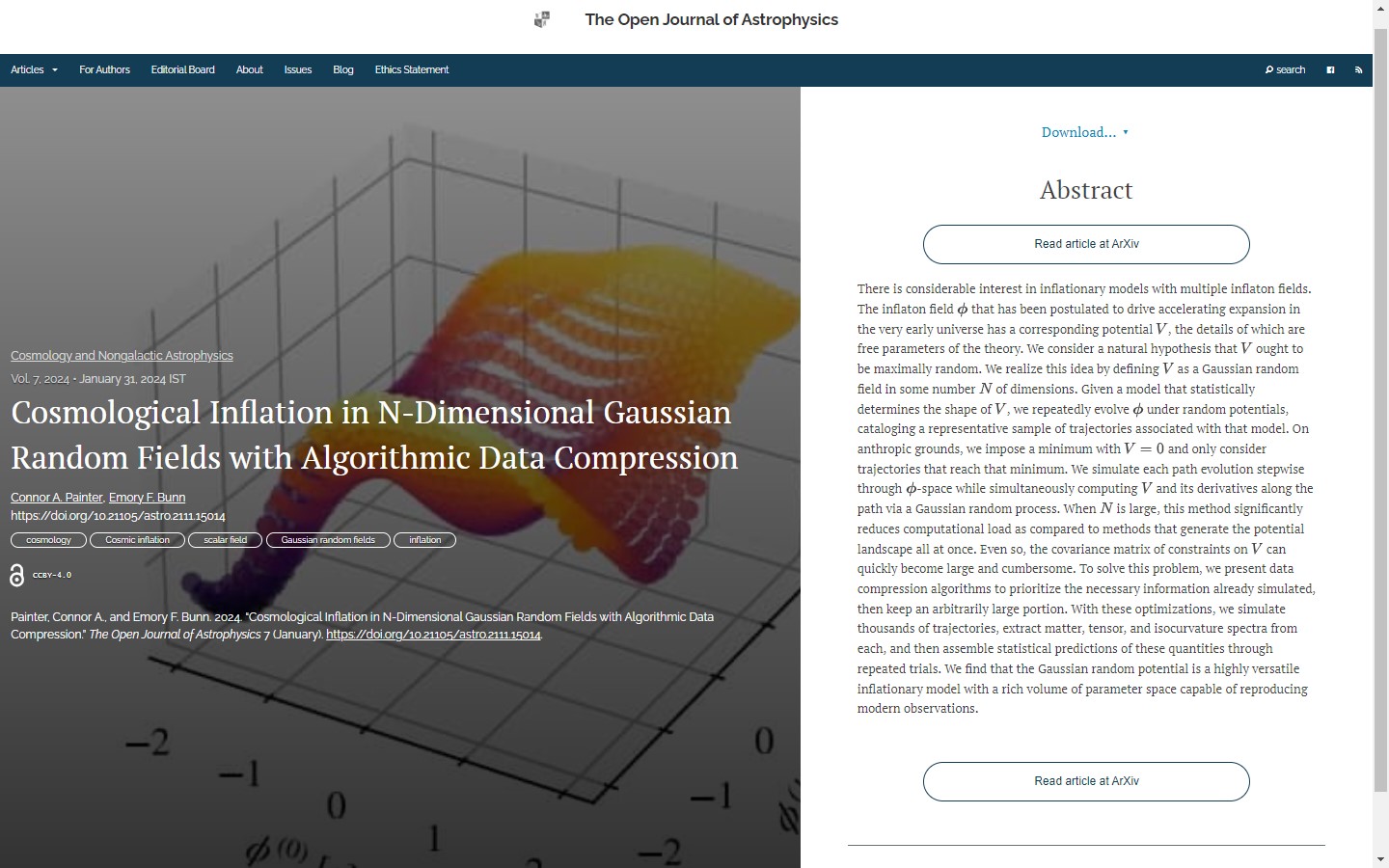
The second paper was published yesterday (31st January 2024) and has the title “Cosmological Inflation in N-Dimensional Gaussian Random Fields with Algorithmic Data Compression” which is a study of inflationary models with Gaussian random potentials for multiple scalar fields, tracking the evolutionary trajectories numerically. The authors are Connor Painter and Emory Bunn, both the Physics Department at the University of Richmond, Virginia (USA). Ted Bunn (as he is usually known) is a longstanding member of the Editorial Board of the Open Journal of Astrophysics (and was thereby excluded from any involvement in the editorial process for this paper).
Here is a screen grab of the overlay which includes the abstract:
You can click on the image of the overlay to make it larger should you wish to do so. You can find the officially accepted version of the paper on the arXiv here.
As promised yesterday, it’s time for a roundup of the week’s business at the Open Journal of Astrophysics. This past week we have published three papers, taking the count in Volume 7 (2024) up to 4 and the total published by OJAp up to 119. There are quite a few more ready to go as people return from the Christmas break.
In chronological order, the three papers published this week, with their overlays, are as follows. You can click on the images of the overlays to make them larger should you wish to do so.
First one up is “Prospects for studying the mass and gas in protoclusters with future CMB observations” by Anna Gardner and Eric Baxter (Hawaii, USA), Srinivasan Raghunathan (NCSA, USA), Weiguang Cui (Edinburgh, UK), and Daniel Ceverino (Madrid, Spain). This paper, published on 17th January 2024, uses realistic hydrodynamical simulations to probe the ability of CMB Stage 4-like (CMB-S4) experiments to detect and characterize protoclusters via gravitational lensing and the Sunyaev-Zel’dovich effect. This paper is in the category of Cosmology and Nongalactic Astrophysics.
Here is a screen grab of the overlay, which includes the abstract:
You can find the officially accepted version of the paper on the arXiv here.
The second paper to announce is “SDSS J125417.98+274004.6: An X-ray Detected Minor Merger Dual AGN” and is by Marko Mićić, Brenna Wells, Olivia Holmes, and Jimmy Irwin (all of the University of Alabama, USA). This presents the discovery of a dual AGN in a merger between the galaxy SDSS J125417.98+274004.6 and dwarf satellite, studied using X-ray observations from the Chandra satellite. The paper was also published on 18th January 2024 in the category Astrophysics of Galaxies . You can see the overlay here:
The accepted version of this paper can be found on the arXiv here.
The last paper of this batch is entitled “Population III star formation: multiple gas phases prevent the use of an equation of state at high densities” and the authors are: Lewis Prole (Maynooth, Ireland), Paul Clark (Cardiff, UK), Felix Priestley (Cardiff, UK), Simon Glover (Heidelberg, Germany) and John Regan (Maynooth, Ireland). This paper, which presents a comparison of results obtained using chemical networks and a simpler equation-of-state approach for primordial star formation (showing the limitations of the latter) was published on 19th January 2024 and also in the folder marked Astrophysics of Galaxies.
Here is the overlay:
You can find the full text for this one on the arXiv here.
And that concludes the update. There’ll be more next week!
At the annual AAS Meeting in New Orleans last week there was an announcement of a result that made headlines in the media (see, e.g., here and here). There is also a press release from the University of Central Lancashire.
Here is a video of the press conference:
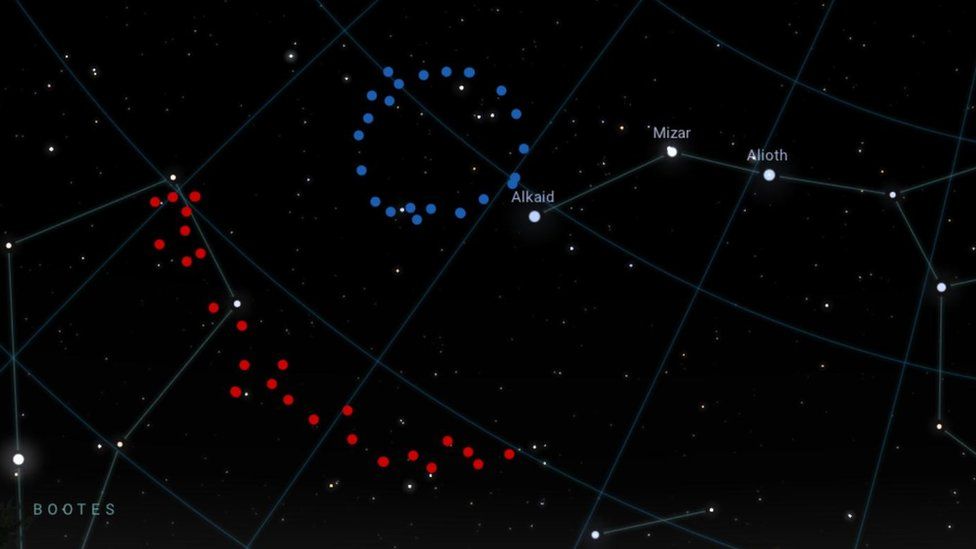
I was busy last week so didn’t have time to read the details so refrained from commenting on this issue at the time of the announcement. Now that I am back in circulation, I have time to read the details, but unfortunately was unable to find even a preprint describing this “discovery”. The press conference doesn’t contain much detail either so it’s impossible to say anything much about the significance of the result, which is claimed (without explanation) to be 5.2σ (after “doing some statistics”). I see the “Big Ring” now has its own wikipedia page, the only references on which are to press reports, not peer-reviewed scientific papers or even preprints.
So is this structure “so big it challenges our understanding of the universe”?
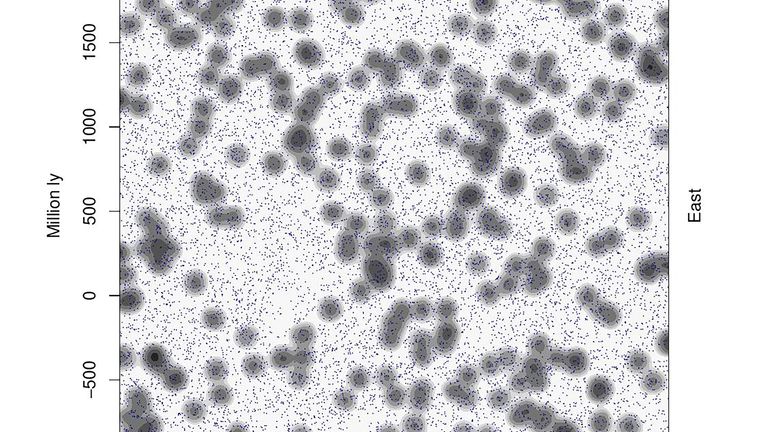
The Big Ring (blue) and another large structure (red)Spot the Ring in the actual data
Based on the available information it is impossible to say. The large-scale structure of the Universe comprises a complex network of walls and filaments known as the cosmic web which I have written about numerous times on this blog. This structure is so vast and complicated that it is very easy to find strange shapes in it but very hard to determine whether or not they indicate anything other than an over-active imagination.
To assess the significance of the Big Ring or other structures in a proper scientific fashion, one has to calculate how probable that structure is given a model. We have a standard model that can be used for this purpose, but to simulate very structures is not straightforward because it requires a lot of computing power even to simulate just the mass distribution. In this case one also has to understand how to embed Magnesium absorption too, something which may turn out to trace the mass in a very biased way. Moreover, one has to simulate the observational selection process too, so one is doing a fair comparison between observations and predictions.
I have seen no evidence that this has been done in this case. When it is, I’ll comment on the details. I’m not optimistic however, as the description given in the media accounts contains numerous falsehoods. For example, quoting the lead author:
The Cosmological Principle assumes that the part of the universe we can see is viewed as a ‘fair sample’ of what we expect the rest of the universe to be like. We expect matter to be evenly distributed everywhere in space when we view the universe on a large scale, so there should be no noticeable irregularities above a certain size.
This just isn’t correct. The standard cosmology has fluctuations on all scales. Although the fluctuation amplitude decreases with scale, there is no scale at which the Universe is completely smooth. See the discussion, for example, here. We can see correlations on very large angular scales in the cosmic microwave background which would be absent if the Universe were completely smooth on those scales. The observed structure is about 400 Mpc in size, which does not seem to be to be particularly impressive.
I suspect that the 5.2σ figure mentioned above comes from some sort of comparison between the observed structure and a completely uniform background, in which case it is meaningless.
My main comment on this episode is that I think it’s very poor practice to go hunting headlines when there isn’t even a preprint describing the results. That’s not the sort of thing PhD supervisors should be allowing their PhD students to do. As I have mentioned before on this blog, there is an increasing tendency for university press offices to see themselves entirely as marketing agencies instead of informing and/or educating the public. Press releases about scientific research nowadays rarely make any attempt at accuracy – they are just designed to get the institution concerned into the headlines. In other words, research is just a marketing tool.
In the long run, this kind of media circus, driven by hype rather than science, does nobody any good.
P.S. I was going to joke that ring-like structures can be easily explained by circular reasoning, but decided not to.
Some important cosmological results have just been announced by the Dark Energy Survey Collaboration. I haven’t had time to go through them in detail but I thought it was worth doing a quick post here to draw attention to them. The results concern a sample of Type Ia supernovae (SN Ia) discovered during the full five years of the Dark Energy Survey (DES) Supernova Program, which contains about 1500 new Type Ia Supernovae that can be used for cosmological analysis. The paper is available on the arXiv here; the abstract is:
The key numerical result of interest is the equation-of-state parameter for dark energy, designated by w, which occurs in the (assumed) relationship between pressure p and effective mass density ρ of the form p=wρc2. A cosmological constant – which for many cosmologists is the default assumption for the form of dark energy – has w=-1 as I explained here. This parameter is one of the things Euclid is going to try to measure, using different methods. Interestingly, the DES results are offset a bit from the value of -1, but with quite a large uncertainty.
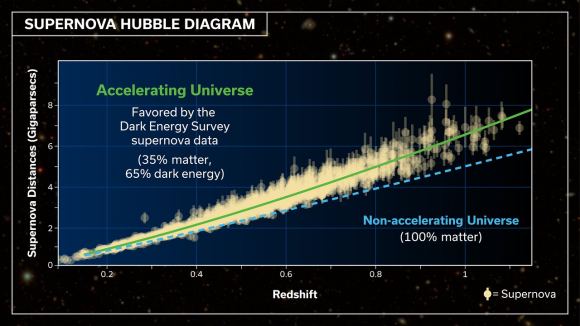
While the results for the equation-of-state parameter are somewhat equivocal, one thing that is clear is that the new SNIa measurements do confirm the existence of dark energy, in that the data can only be described by models with accelerating expansion, as dramatically demonstrated in this Figure:
I think this figure – or versions of it – will very rapidly appear in public talks on cosmology, including my own!
Yesterday came across the above “infographic” – as I’m told such things are called – showing the media traffic generated by last month’s Early Release Observations from the ESA Euclid mission. Some quite interesting facts emerge from it. The new observations were released n 7th November, hence the big spike in the left hand panel on that date.
I see that about 31% of the activity was on Twitter, which I am no longer on, with a slightly smaller amount on Facebook. Overall, social media account for about 60% of the “reach”, with mainstream media (including print, online, and TV/Radio) languishing far behind. Blogs (presumably including this one) account for a mere 1%.
The breakdown by country is interesting too; the table shows only EAS member states. The UK is way out in front, no doubt because BBC News ran a major item on the day of the release. France, Germany, Italy and Spain all have major scientific involvements in Euclid and correspondingly active public engagement activities.
I was pleasantly surprised at the significant amount of interest in Ireland, given that some bigger countries with far greater scientific involvement in Euclid (e.g. Denmark and The Netherlands) generated so little. As the only member of the Euclid Consortium in Ireland I could try to pretend that this was all down to me, but I rather think it’s more likely to be a result of the fact that many Irish people read the UK media so some of the Irish traffic could be spillover from the big UK spike. Still, I think one can interpret this as meaning that the Public in the Republic have an appetite for news about space, something that we have certainly noticed when organizing events in Maynooth.
I thought I’d mention another nice thing. Here is one of the PR images produced by ESA about the early release observations. The point about Euclid is that to achieve its science goals it has to have extremely good optical quality across a very wide field of view. The systems are currently being tested and fine-tuned to see how good their performance actually is, but so far it’s looking good.
The main thing that caught my eye, however, is the collection of little flags along the bottom. How nice it is to see Ireland’s among them!
The views presented here are personal and not necessarily those of my employer (or anyone else for that matter).
Feel free to comment on any of the posts on this blog but comments may be moderated; anonymous comments and any considered by me to be vexatious and/or abusive and/or defamatory will not be accepted. I do not necessarily endorse, support, sanction, encourage, verify or agree with the opinions or statements of any information or other content in the comments on this site and do not in any way guarantee their accuracy or reliability.






 In the Dark