Archive for Earth and Planetary Astrophysics

Weekly Update from the Open Journal of Astrophysics – 27/12/2025

Posted in OJAp Papers, Open Access, The Universe and Stuff with tags , , , , , , , , , , , , , , , , , , , on December 27, 2025 by telescoper

I wasn’t planning to do another update this week but I thought it would be best to complete the publications for 2025  at the Open Journal of Astrophysics, so that I don’t have to do a bigger update in the new year, and I have a bit of time this morning, so here we go.

Since the last update we have published four papers which brings the number in Volume 8 (2025) up to 201. Adding the 12 papers in the Supplement, this brings the final total for the year up to 213, and the total so far published by OJAp up to 448. In 2023 we published just 50 papers, so we have more than quadrupled in two years.

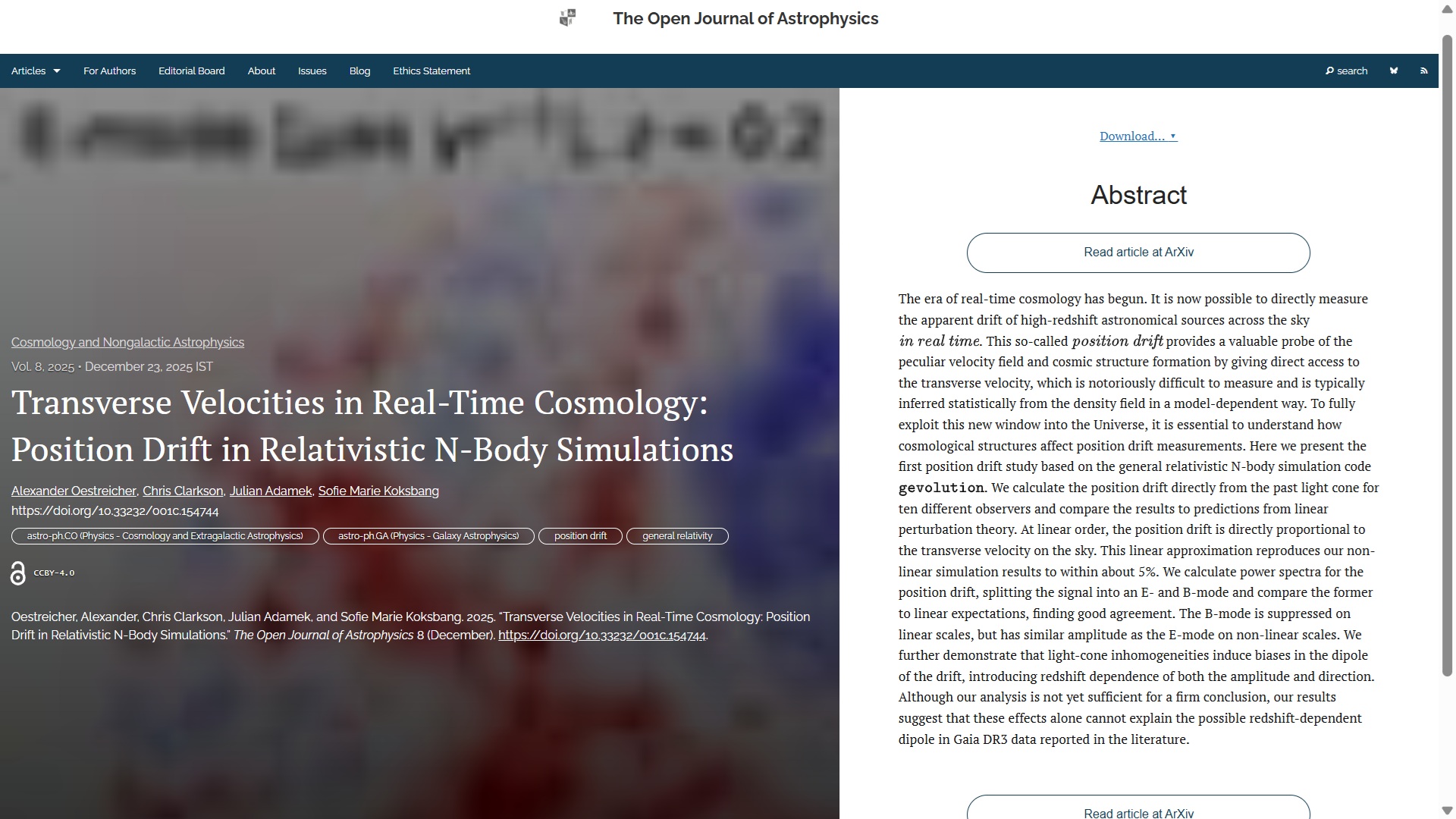
The first paper this week is “Transverse Velocities in Real-Time Cosmology: Position Drift in Relativistic N-Body Simulations” by Alexander Oestreicher (University of Southern Denmark), Chris Clarkson (QMUL, UK), Julian Adamek (Universität Zürich, CH) and Sofie Marie Koksbang (U. Southern Denmark). This study uses a general relativistic N-body simulation code to explore how cosmological structures affect position drift measurements, a new method for studying cosmic structure formation and velocity fields. This was published on Tuesday 23rd December 2025 in the folder Cosmology and Nongalactic Astrophysics.

The overlay is here:


You can find the officially accepted version on arXiv here and this is the announcement on Mastodon (Fediscience):

Open Journal of Astrophysics

New Publication at the Open Journal of Astrophysics: "Transverse Velocities in Real-Time Cosmology: Position Drift in Relativistic N-Body Simulations" by Alexander Oestreicher (University of Southern Denmark), Chris Clarkson (QMUL, UK), Julian Adamek (Universität Zürich, CH) and Sofie Marie Koksbang (U. Southern Denmark)

doi.org/10.33232/001c.154744

December 23, 2025, 9:33 am 1 boosts 0 favorites


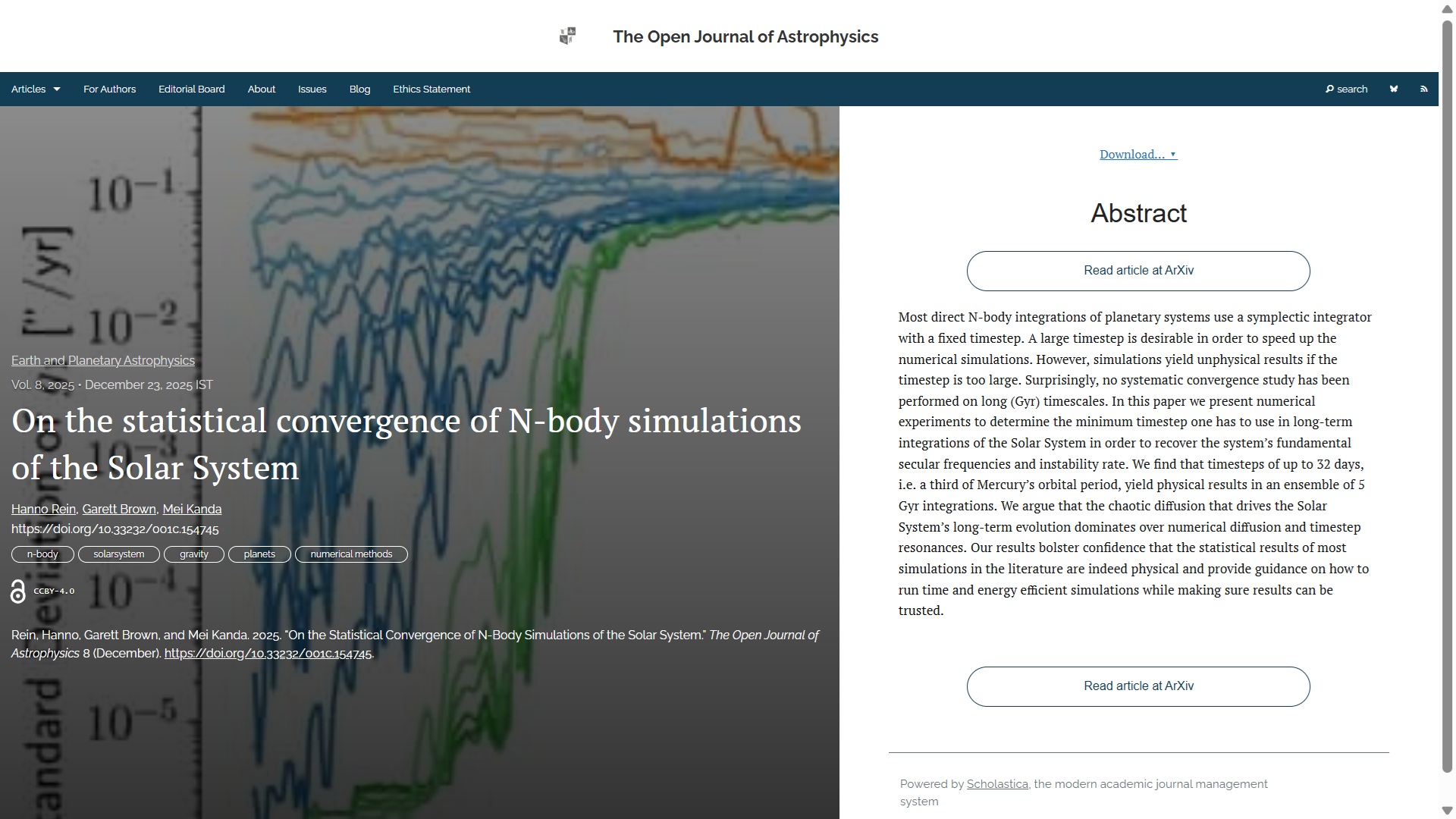
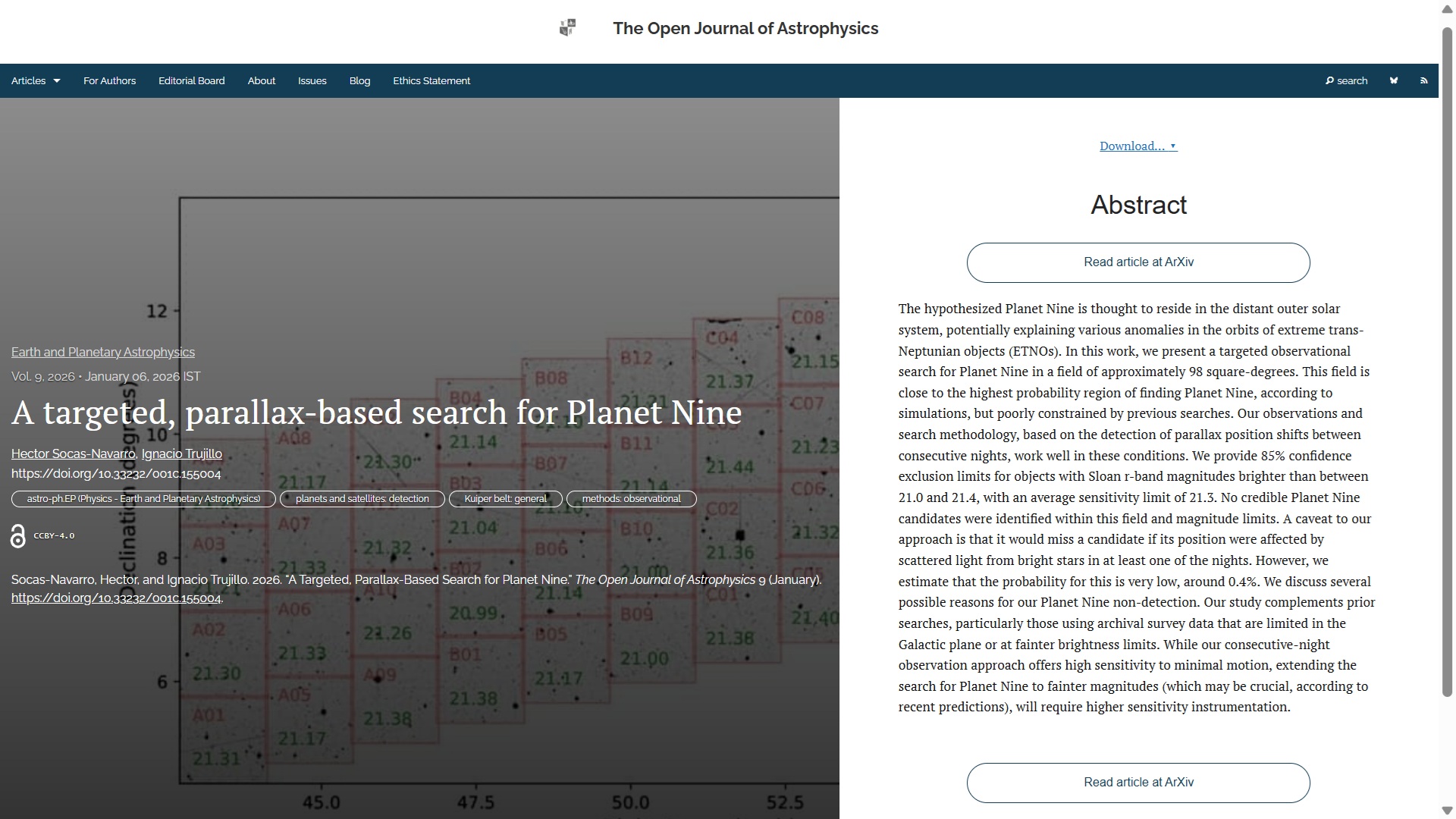
The second paper of the week is “On the statistical convergence of N-body simulations of the Solar System” by Hanno Rein, Garett Brown and Mei Kanda (U. Toronto, Canada). This study presents numerical experiments to determine the minimum timestep for long-term simulations of the Solar System, finding that timesteps up to 32 days yield physical results.  It was published on Tuesday December 23rd in the folder Earth and Planetary Astrophysics.

The overlay is here:
 

You can find the official version of this one on arXiv here. The federated announcement on Mastodon is here:

Open Journal of Astrophysics

New Publication at the Open Journal of Astrophysics: "On the statistical convergence of N-body simulations of the Solar System" by Hanno Rein, Garett Brown and Mei Kanda (U. Toronto, Canada)

doi.org/10.33232/001c.154745

December 23, 2025, 9:50 am 6 boosts 9 favorites

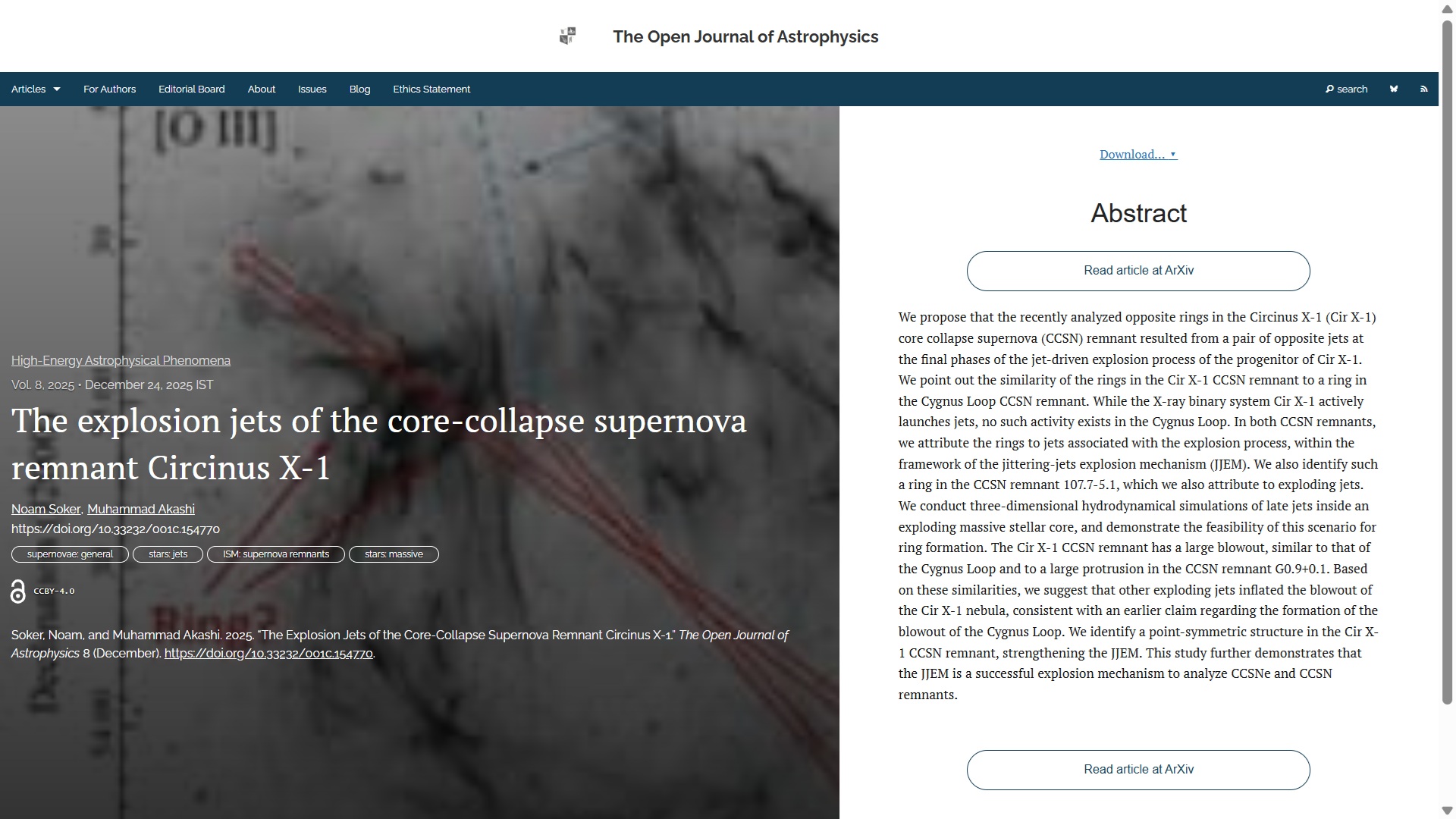
Next, published on 24th December 2025 in the folder High-Energy Astrophysical Phenomena, we have “The explosion jets of the core-collapse supernova remnant Circinus X-1” by Noam Soker and Muhammad Akashi (Technion, Haifa, Israel). This paper suggests that the rings in the Circinus X-1 supernova remnant resulted from jet-driven explosions, supporting the jittering-jets explosion mechanism theory for core collapse supernovae.

The overlay is here:

The officially accepted paper can be found on arXiv here and the announcement on Mastodon is here

Open Journal of Astrophysics

New Publication at the Open Journal of Astrophysics: "The explosion jets of the core-collapse supernova remnant Circinus X-1" by Noam Soker and Muhammad Akashi (Technion, Haifa, Israel)

doi.org/10.33232/001c.154770

December 24, 2025, 9:15 am 2 boosts 1 favorites

Finally for 2025 we have “Quantifying the Fermi paradox via passive SETI: a general framework” by Matthew Civiletti (City University of New York, USA). This was published on Wednesday 24th December in the folder Instrumentation and Methods for Astrophysics. The author uses SETI observations and the Drake Equation to calculate the probability of detecting at least one extraterrestrial signal, highlighting the model’s limitations and potential improvements. The overlay is here:

The officially accepted version can be found on arXiv here and the Mastodon announcement here:

Open Journal of Astrophysics

New Publication at the Open Journal of Astrophysics: "Quantifying the Fermi paradox via passive SETI: a general framework" by Matthew Civiletti (City University of New York, USA)

doi.org/10.33232/001c.154771

December 24, 2025, 9:27 am 1 boosts 1 favorites

And that concludes the updates for 2025. I’ll be back in a week with the first update of 2026, which will include the first paper(s) of Volume 9.

I’d like to thank everyone who has supported the Open Journal of Astrophysics this year – Editors, Reviewers, Authors and the excellent Library staff at Maynooth – and who have made it such a bumper year. In 2023 we published just 50 papers, so we have more than quadrupled in two years. How many will we publish in 2026?

Weekly Update from the Open Journal of Astrophysics – 13/12/2025

Posted in OJAp Papers, Open Access, The Universe and Stuff with tags , , , , , , , , , , , , , , , , , , , , , , , , , , on December 13, 2025 by telescoper

It’s time once again for the usual Saturday morning update of the week’s new papers at the Open Journal of Astrophysics. Since the last update we have published a further five papers, which brings the number in Volume 8 (2025) up to 195, and the total so far published by OJAp up to 430.

The first paper this week is “Cosmic Rays Masquerading as Cool Cores: An Inverse-Compton Origin for Cool Core Cluster Emission” by Philip F. Hopkins (Caltech), Eliot Quataert (Princeton), Emily M. Silich, Jack Sayers, Sam B. Ponnada and Isabel S. Sands (Caltech).  This was published on Tuesday 9th December 2025 in the folder marked High-Energy Astrophysical Phenomena. It presents an argument  that cosmic-ray inverse-compton emission could contribute significantly to the X-ray surface brightness (SB) in cool-corre clusters, implying that gas densities may have been overestimated therein.

The overlay is here:

You can find the officially accepted version on arXiv here and the Fediverse announcement is here:

Open Journal of Astrophysics

New Publication at the Open Journal of Astrophysics: "Cosmic Rays Masquerading as Cool Cores: An Inverse-Compton Origin for Cool Core Cluster Emission" by

Philip F. Hopkins (Caltech), Eliot Quataert (Princeton), Emily M. Silich, Jack Sayers, Sam B. Ponnada and Isabel S. Sands (Caltech)

doi.org/10.33232/001c.154053

December 9, 2025, 7:22 am 1 boosts 0 favorites

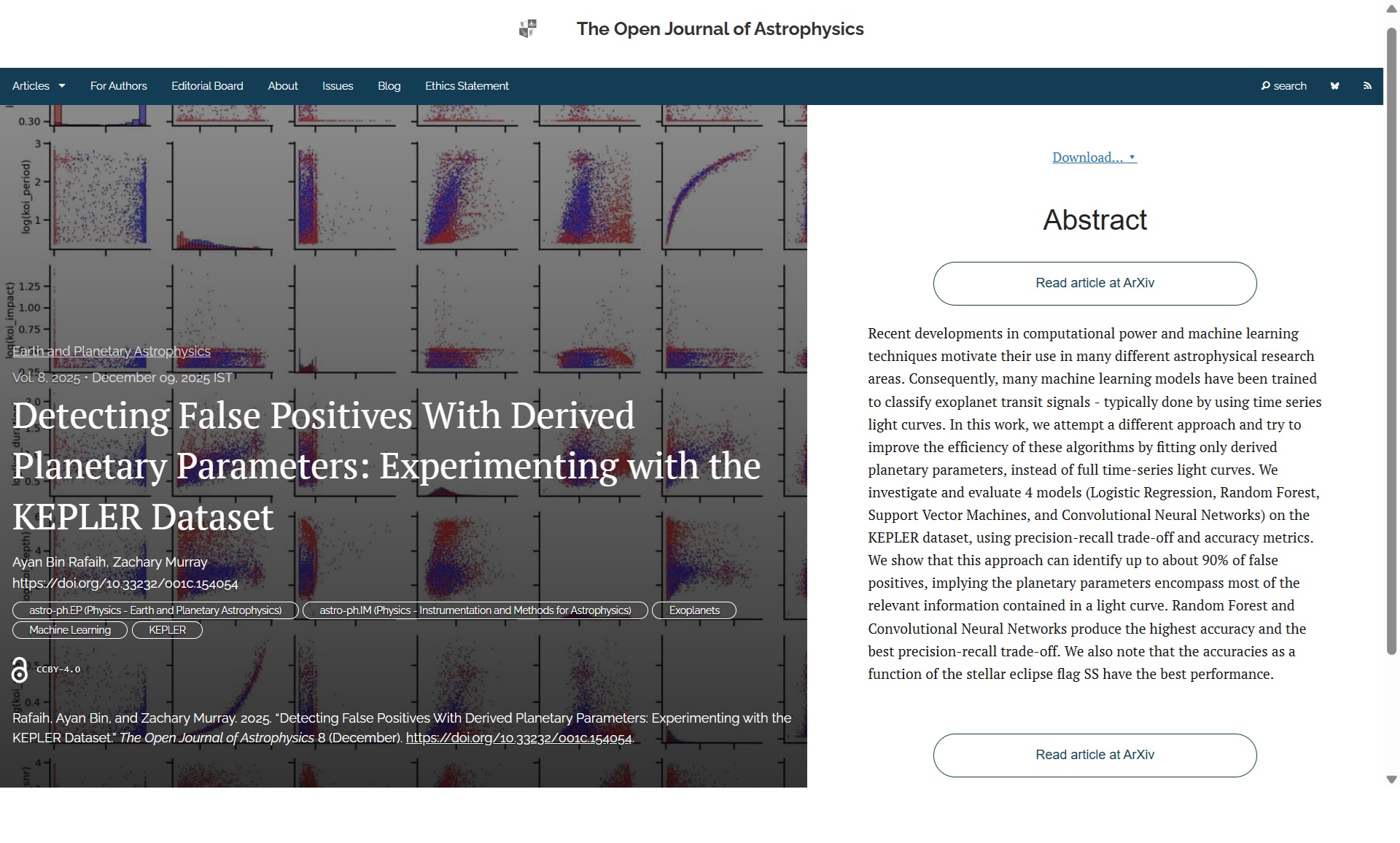
The second paper of the week is “Detecting False Positives With Derived Planetary Parameters: Experimenting with the KEPLER Dataset” by Ayan Bin Rafaih (Aitchison College, Lahore, Pakistan) and Zachary Murray (Université Côte d’Azur, France). This one was published on 9th December 2025 in the folder Earth and Planetary Astrophysics. It is an investigation into the performance of a range of machine-learning algorithms on the KEPLER dataset, using precision-recall trade-off and accuracy metrics.

The overlay is here:

You can find the official version of this one on arXiv here. The federated announcement on Mastodon is here:

Open Journal of Astrophysics

New Publication at the Open Journal of Astrophysics: "Detecting False Positives With Derived Planetary Parameters: Experimenting with the KEPLER Dataset" by Ayan Bin Rafaih (Aitchison College, Lahore, Pakistan) and Zachary Murray (Université Côte d’Azur, France)

doi.org/10.33232/001c.154054

December 9, 2025, 7:34 am 1 boosts 0 favorites

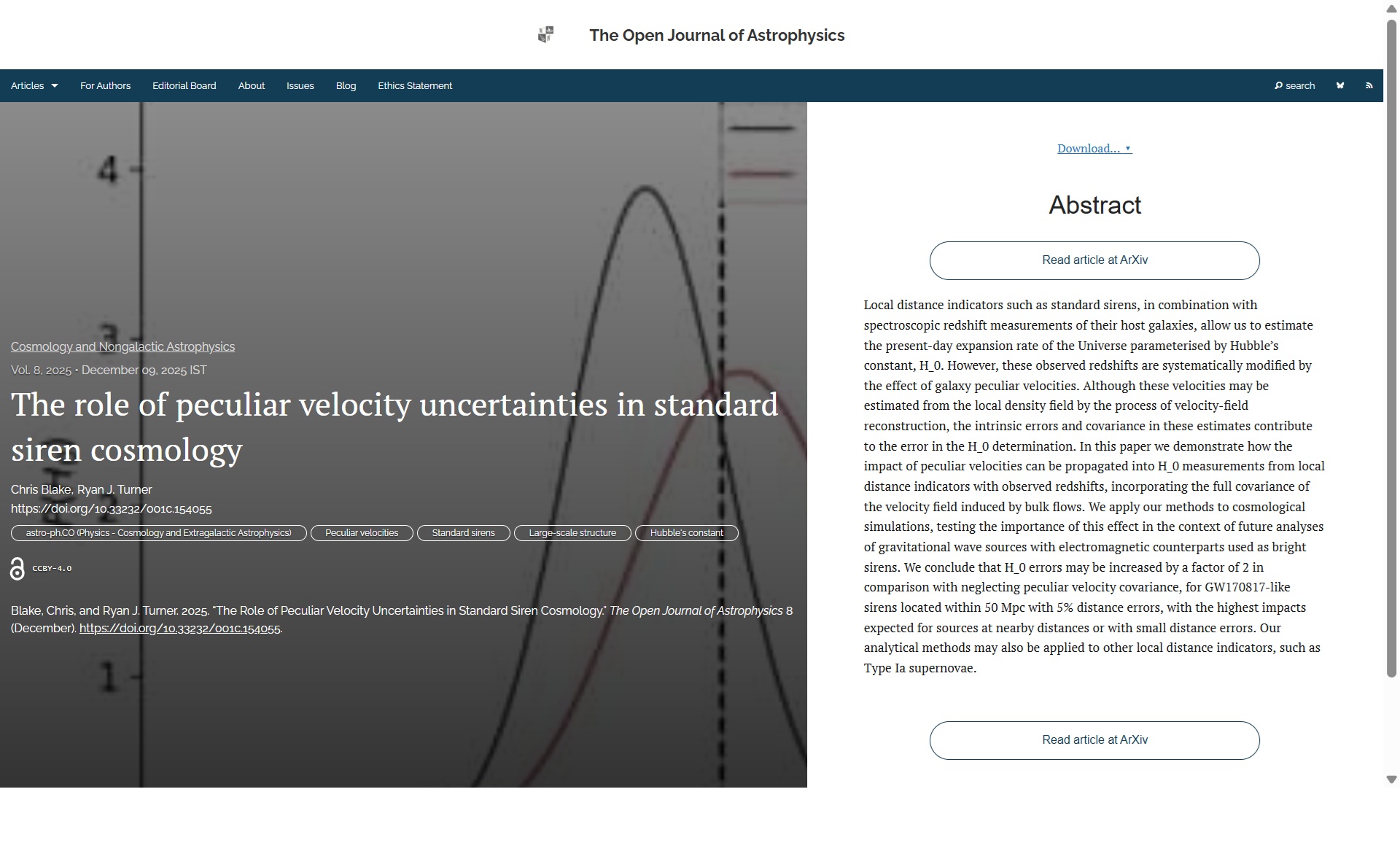
Next one up is “The role of peculiar velocity uncertainties in standard siren cosmology” by Chris Blake and Ryan J. Turner (Swinburne, Australia). This paper discusses the impact of peculiar velocities on the error in H0 determinations from local distance indicators with observed redshifts, incorporating the effect of bulk flows. It was published on Tuesday 9th December in the folder Cosmology and Nongalactic Astrophysics.

The overlay is here:

You can find the official accepted version on arXiv here. The fediverse announcement is here:

Open Journal of Astrophysics

New Publication at the Open Journal of Astrophysics: "The role of peculiar velocity uncertainties in standard siren cosmology" by Chris Blake and Ryan J. Turner (Swinburne, Australia)

doi.org/10.33232/001c.154055

December 9, 2025, 7:47 am 1 boosts 0 favorites

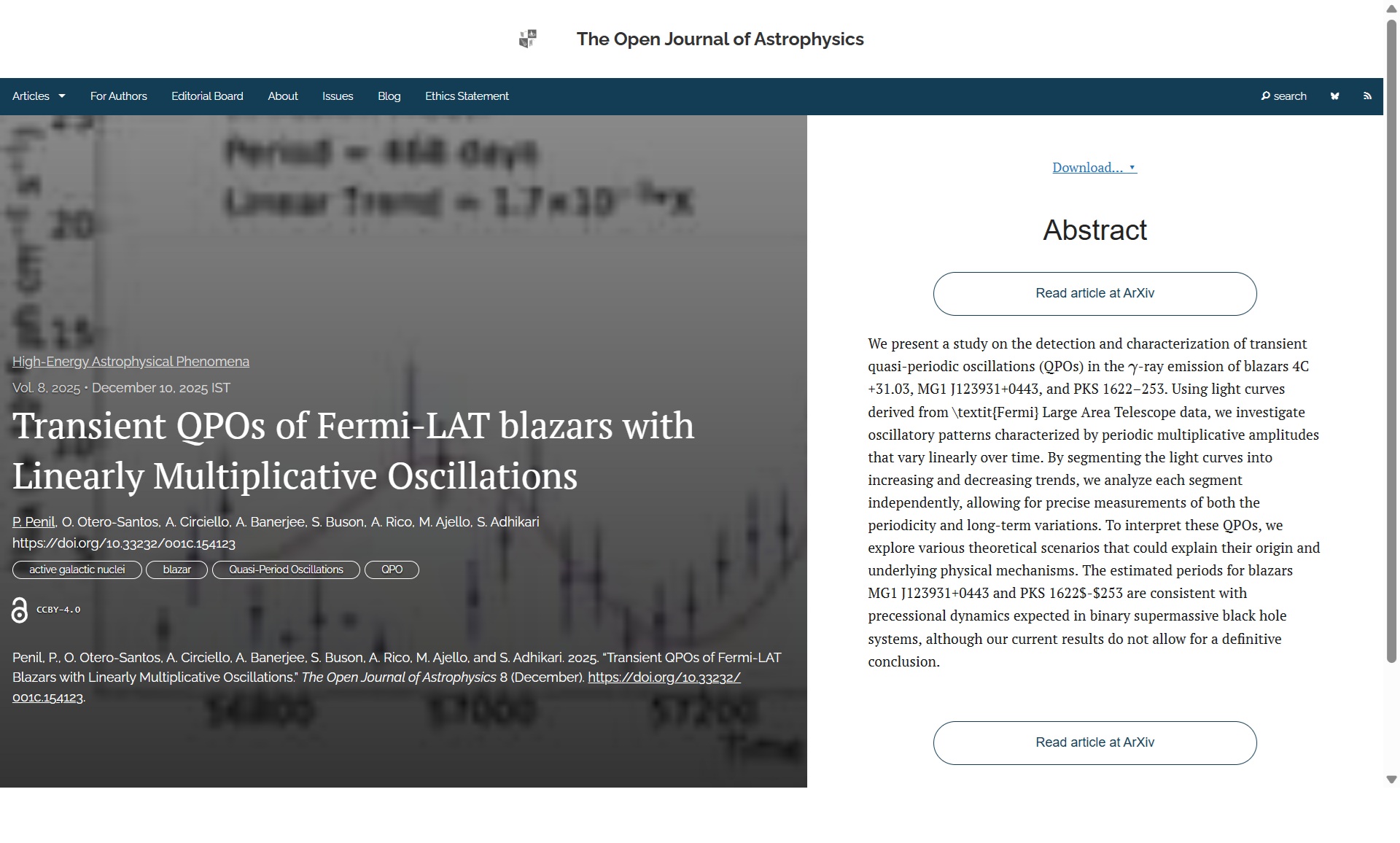
The fourth article of the week is “Transient QPOs of Fermi-LAT blazars with Linearly Multiplicative Oscillations” by P. Penil (Clemson University, USA) and 7 others based in the USA, Italy and Germany. This was published on Thursday 10th December in the folder High-Energy Astrophysical Phenomena. This paper presents an investigation of patterns of quasi-periodic oscillations in observed blazar systems characterized by periodic multiplicative amplitudes including both the periodicities and long-term variations.  The overlay is here:

You can find the official published version on arXiv here. The Fediverse announcement follows:

Open Journal of Astrophysics

New Publication at the Open Journal of Astrophysics: "Transient QPOs of Fermi-LAT blazars with Linearly Multiplicative Oscillations" by P. Penil (Clemson University, USA) and 7 others based in the USA, Italy and Germany

doi.org/10.33232/001c.154123

December 10, 2025, 12:22 pm 0 boosts 1 favorites

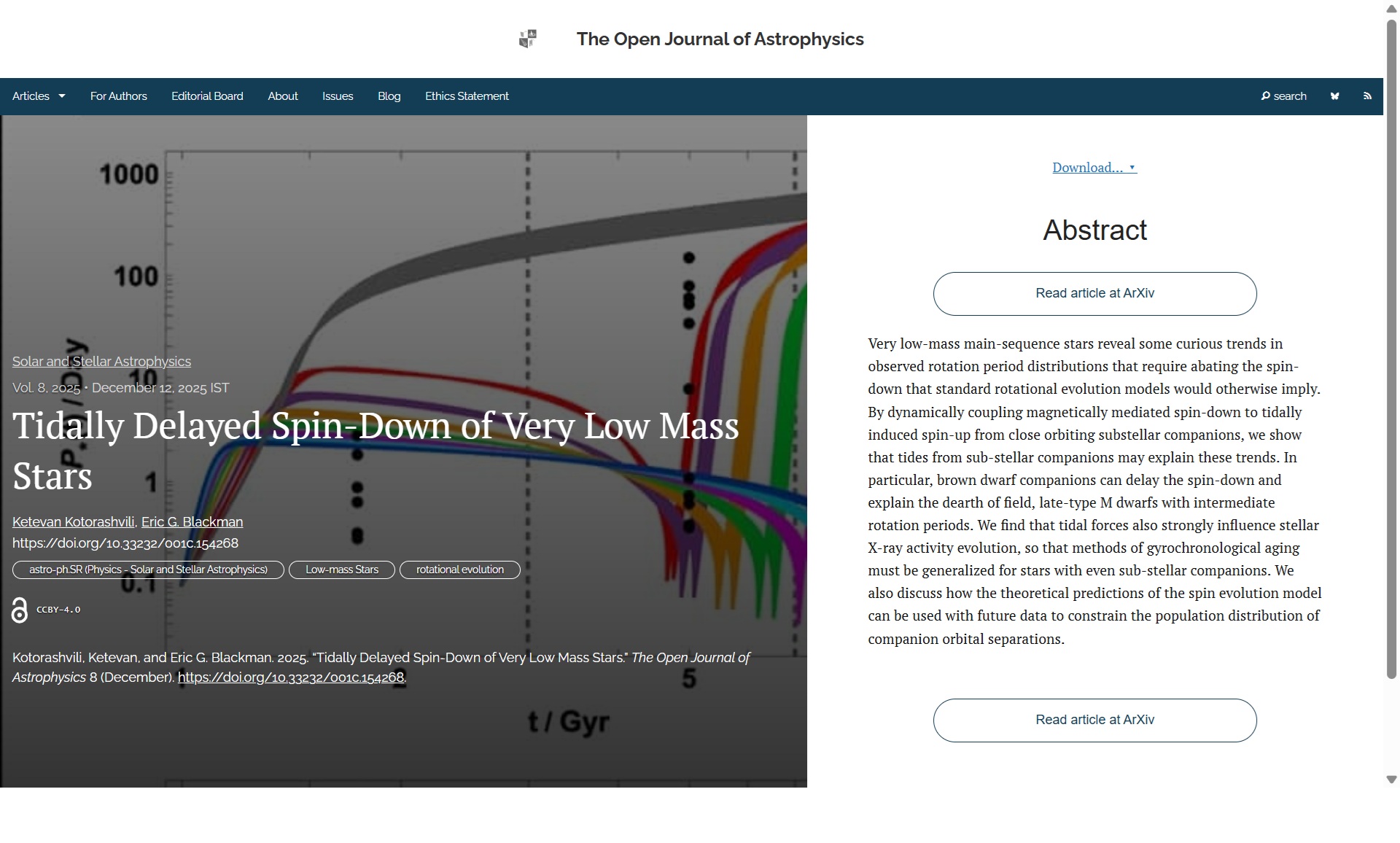
The last paper for this week is “Tidally Delayed Spin-Down of Very Low Mass Stars” by Ketevan Kotorashvili and Eric G. Blackman (U. Rochester, USA). This was published on Friday 12th December (yesterday) in the folder Solar and Stellar Astrophysics. It discusses the effect of tides from sub-stellar companions on rotational evolution of very low-mass stars, suggesting that these may explain the dearth of field, late-type M dwarfs with intermediate rotation periods.

The overlay is here:


You can find the officially-accepted version on arXiv here, and the Mastodon announcement is here:

Open Journal of Astrophysics

New Publication at the Open Journal of Astrophysics: "Tidally Delayed Spin-Down of Very Low Mass Stars" by Ketevan Kotorashvili and Eric G. Blackman (U. Rochester, USA)

doi.org/10.33232/001c.154268

December 12, 2025, 10:31 am 1 boosts 0 favorites


And that concludes the update for this week. I will do another of these regular announcements next Saturday, which will be the last such update for 2025. Will we make it past 200 for the year? Tune in next week to find out!

Weekly Update from the Open Journal of Astrophysics – 08/11/2025

Posted in OJAp Papers, Open Access, The Universe and Stuff with tags , , , , , , , , , , , , , , , , , , , , , , on November 8, 2025 by telescoper

It’s Saturday again, so it’s time for the usual update of the week’s new papers at the Open Journal of Astrophysics. Since the last update we have published another five papers, which brings the number in Volume 8 (2025) up to 168, and the total so far published by OJAp up to 403.

The first paper this week is “Maximizing Ariel’s Survey Leverage for Population-Level Studies of Exoplanets” by Nicolas B. Cowan and Ben Coull-Neveu (McGill University, Canada). This article was published in the folder Earth and Planetary Astrophysics on Tuesday 4th November 2025; it discusses various different schemes to select the mission reference sample for a notional three year transit spectroscopy survey with the European Space Agency’s Ariel mission

The overlay is here:


You can find the officially accepted version on arXiv here.

The Fediverse announcement is here:

Open Journal of Astrophysics

New Publication at the Open Journal of Astrophysics: "Maximizing Ariel’s Survey Leverage for Population-Level Studies of Exoplanets" by Nicolas B. Cowan and Ben Coull-Neveu (McGill University, Canada)

doi.org/10.33232/001c.146656

November 4, 2025, 5:08 pm 1 boosts 3 favorites


The second paper of the week is “A substellar flyby that shaped the orbits of the giant planets” by Garett Brown (U. Toronto at Scarborough, Canada), Renu Malhotra (U. Arizona, USA) and Hanno Rein (U. Toronto at Scarborough, Canada). This article was published on Wednesday 5th November 2025, also in the folder Earth and Planetary Astrophysics. It argues that an ancient close encounter with a substellar object offers a plausible explanation for the origin of the moderate eccentricities and inclinations of the giant planets.

The overlay is here:

You can find the official version of this one on arXiv here. The federated announcement on Mastodon is here:

Open Journal of Astrophysics

New Publication at the Open Journal of Astrophysics: "A substellar flyby that shaped the orbits of the giant planets" by Garett Brown (U. Toronto at Scarborough, Canada), Renu Malhotra (U. Arizona, USA) and Hanno Rein (U. Toronto at Scarborough, Canada)

doi.org/10.33232/001c.146688

November 5, 2025, 8:34 am 3 boosts 3 favorites

Next one up is “The Potential Impact of Primordial Black Holes on Exoplanet Systems” by Garett Brown (U. Toronto at Scarborough), Linda He (Harvard U., USA),  and James Unwin (U. Illinois Chicago, USA). This one was also published on Wednesday 5th November 2025, but in the folder Astrophysics of Galaxies. This one is an exploration of the possibility that primordial black holes (PBHs) in our Galaxy, might impact the orbits of exoplanets. The overlay is here:

You can find the official accepted version on arXiv here. The fediverse announcement is here:

Open Journal of Astrophysics

New Publication at the Open Journal of Astrophysics: "The Potential Impact of Primordial Black Holes on Exoplanet Systems" by Garett Brown (U. Toronto at Scarborough), Linda He (Harvard U., USA), James Unwin (U. Illinois Chicago, USA)

doi.org/10.33232/001c.146689

November 5, 2025, 8:49 am 3 boosts 1 favorites

The fourth paper to report is “The Unhurried Universe: A Continued Search for Long Term Variability in ASAS-SN” by Sydney Petz, C. S. Kochanek & K. Z. Stanek (Ohio State U., USA), Benjamin J. Shappee (U. Hawaii, USA), Subo Dong (Peking University, China), J. L. Prieto (Universidad Diego Portales, Chile) and Todd A. Thompson (Ohio State U., USA). This one was also published on Wednesday November 5th 2025, but in the folder Solar and Stellar Astrophysics.  It describes the discovery and investigation of slowly-varying sources in the All Sky Automated Survey for SuperNovae (ASAS-AN) leading to the identification of 200 new variable stars. The overlay is here:


You can find the official published version on arXiv here. The Fediverse announcement follows:

Open Journal of Astrophysics

New Publication at the Open Journal of Astrophysics: "The Unhurried Universe: A Continued Search for Long Term Variability in ASAS-SN" by Sydney Petz, C. S. Kochanek & K. Z. Stanek (Ohio State U., USA), Benjamin J. Shappee (U. Hawaii, USA), Subo Dong (Peking University, China), J. L. Prieto (Universidad Diego Portales, Chile) and Todd A. Thompson (Ohio State U., USA)

doi.org/10.33232/001c.146690

November 5, 2025, 9:08 am 1 boosts 0 favorites

The fifth and final paper for this week is “Measuring the splashback feature: Dependence on halo properties and history” by Qiaorong S. Yu (Oxford U., UK) and 9 others based in the UK and USA. This was published on Friday 7th November 2025 in the folder Cosmology and Nongalactic Astrophysics. It discusses how the properties of “splashback” features in halo profiles relate to the halo’s assembly history (e.g. mass accretion rate and most recent merger time). The overlay is here:

The officially accepted version can be found on arXiv here. The Fediverse announcement is here:

Open Journal of Astrophysics

New Publication at the Open Journal of Astrophysics: "Measuring the splashback feature: Dependence on halo properties and history" by Qiaorong S. Yu (Oxford U., UK) and 9 others based in the UK and USA.

doi.org/10.33232/001c.146824

November 7, 2025, 9:12 am 0 boosts 0 favorites

That’s all the papers for this week. I’ll do another report next Saturday.
Weekly Update from the Open Journal of Astrophysics – 04/10/2025

Posted in OJAp Papers, Open Access, The Universe and Stuff with tags , , , , , , , , , , , , , , , , , , , , , , , , on October 4, 2025 by telescoper

It’s Saturday again, so it’s time for a summary of the week’s new papers at the Open Journal of Astrophysics. Since the last update we have published five more papers, which brings the number in Volume 8 (2025) up to 146, and the total so far published by OJAp up to 381. At this rate Volume 8 will contain around 190 by the end of 2025.

Anyway, here are this week’s papers, starting with three published on Monday 29th September 2025.

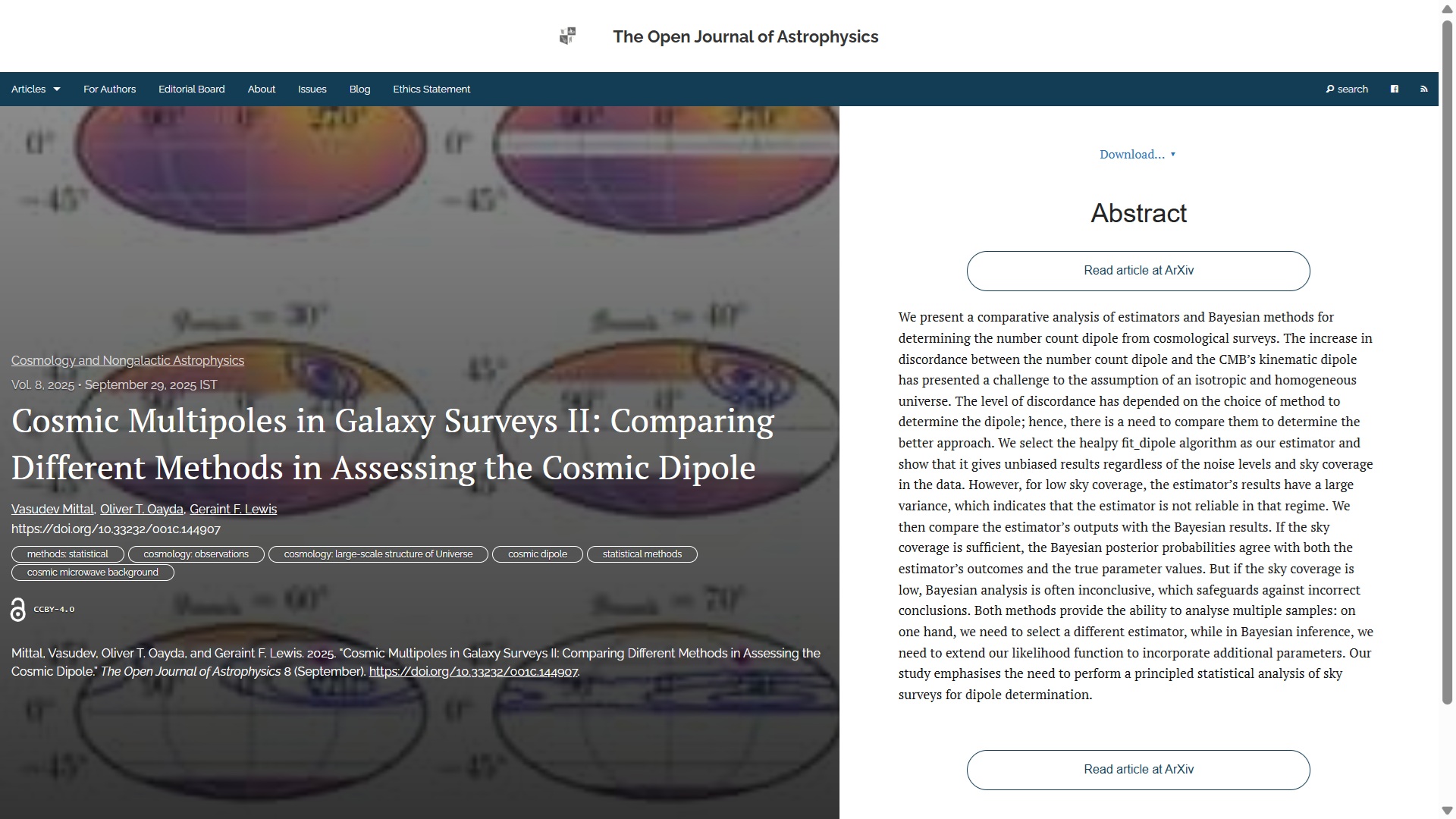
The first paper is “Cosmic Multipoles in Galaxy Surveys II: Comparing Different Methods in Assessing the Cosmic Dipole” by Vasudev Mittal, Oliver T. Oayda and Geraint F. Lewis (U. Sydney, Australia). This is in the folder Cosmology and Nongalactic Astrophysics. It presents a comparison of methods for determining the number count dipole from cosmological surveys with a discussion of the implications for the known discordance with the CMB diple.

The overlay is here:

You can make this larger by clicking on it.  The officially accepted version of this paper can be found on the arXiv here.

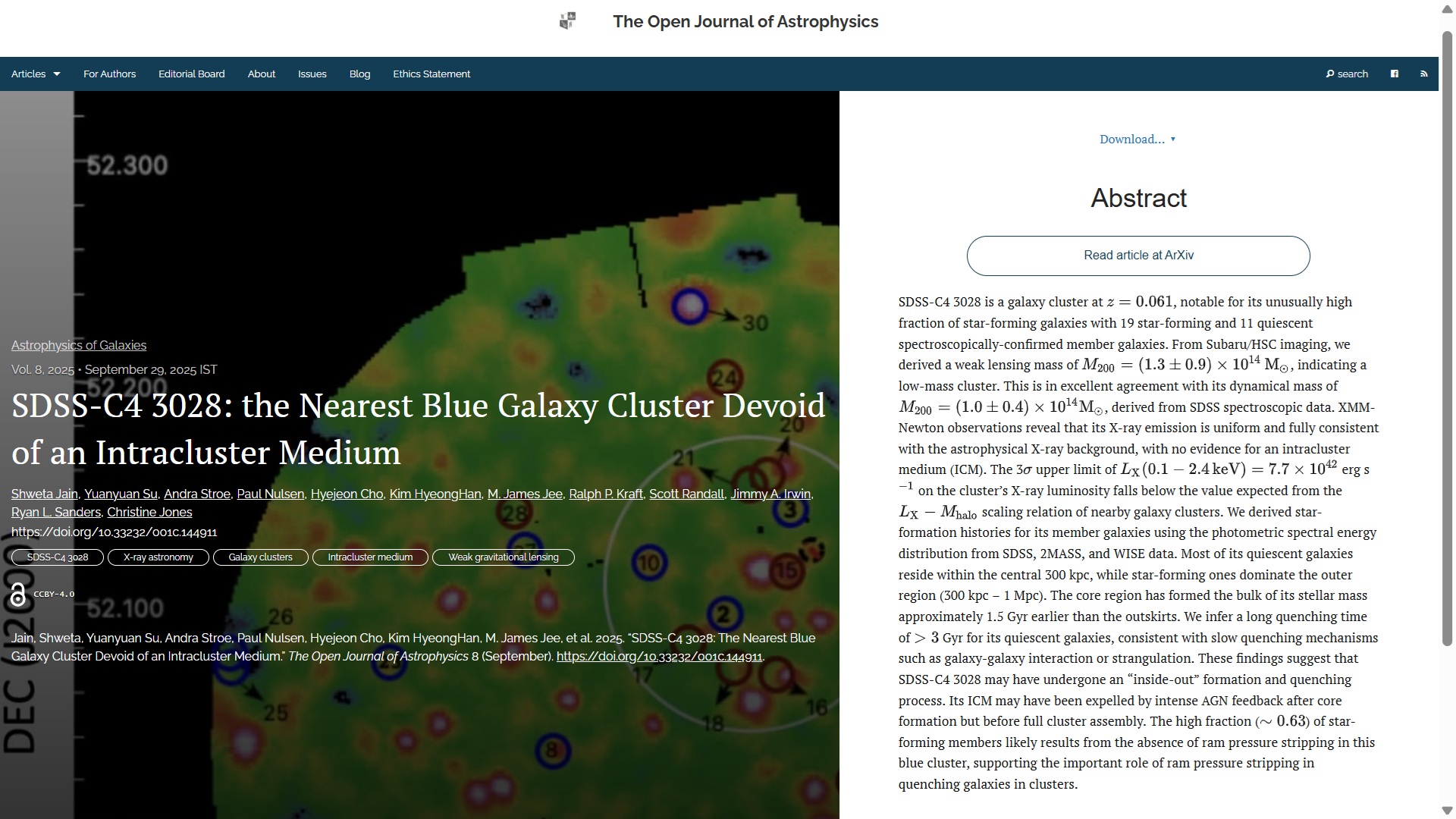
The second paper this week, also published on Monday 29th September, is “SDSS-C4 3028: the Nearest Blue Galaxy Cluster Devoid of an Intracluster Medium” by Shweta Jain (University of Kentucky, USA) and 11 others based in the USA, Australia and Korea. This describes a galaxy cluster with an unusually high fraction (about 63%) of star-forming galaxies which may be a result of ram pressure stripping; the article is in the folder Astrophysics of Galaxies.

The corresponding overlay is here:


You can find the officially accepted version on arXiv here.

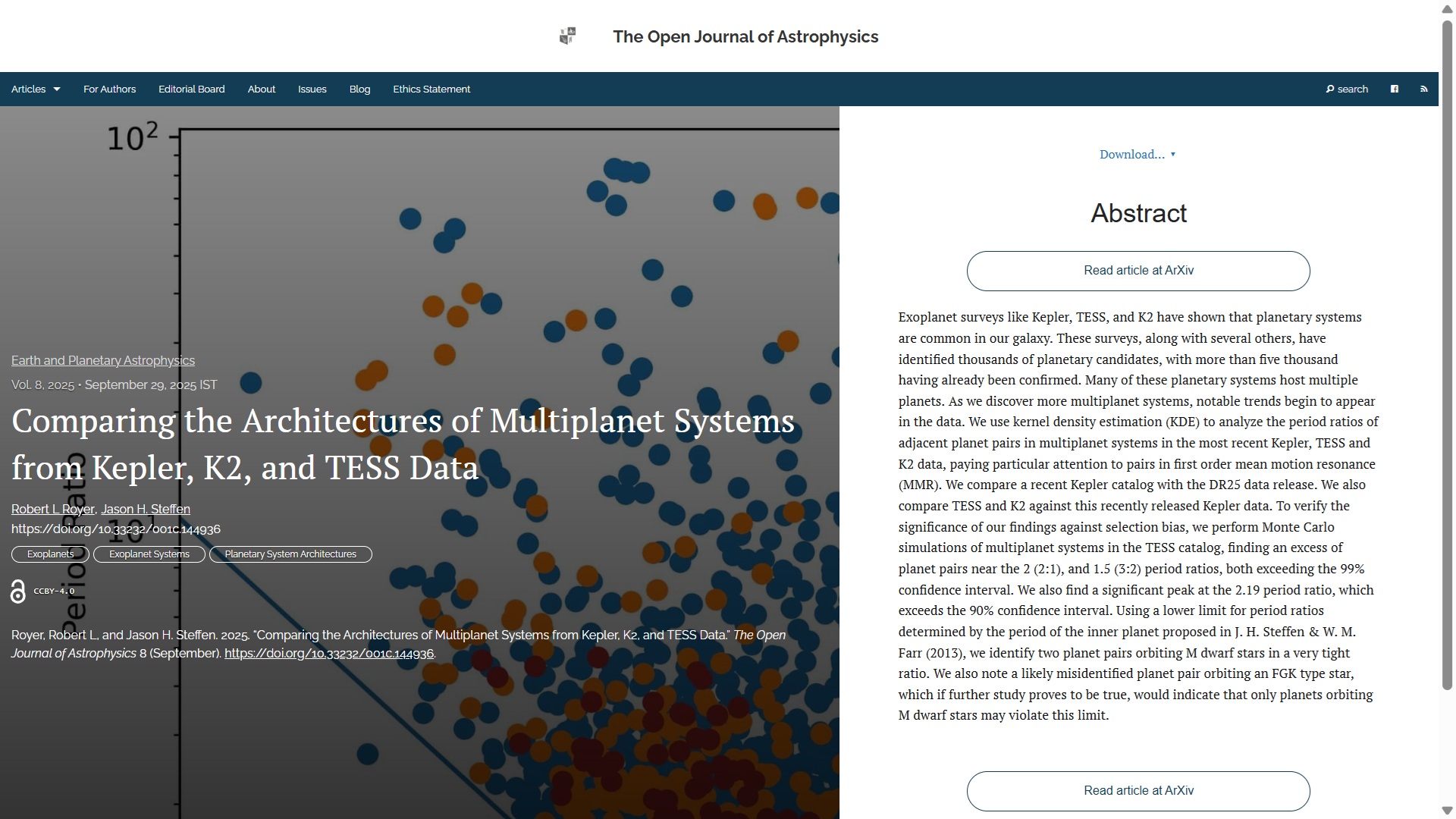
The third one this week, published on also published on Monday 29th September but in the folder Earth and Planetary Astrophysics, is “Comparing the Architectures of Multiplanet Systems from Kepler, K2, and TESS Data” by Robert L Royer and Jason H. Steffen (University of Nevada, USA).  This paper explores the trends seen in exoplanet survey data, including Kepler, TESS, and K2 including many planetary systems with multiple planets.

The overlay is here:


You can find the officially-accepted version on arXiv here.

The next one up is “Seeding Cores: A Pathway for Nuclear Star Clusters from Bound Star Clusters in the First Billion Years” by Fred Angelo Batan Garcia (Columbia University, USA), Massimo Ricotti (University of Maryland, USA) and Kazuyuki Sugimura (Hokkaido University, Japan). This paper was published on Thursday 2nd October in the folder Astrophysics of Galaxies. This is about modelling the formation of Nuclear Star Clusters using cosmological radiation-hydrodynamic simulations, with discussion of the implications for seeding supermassive black holes and the little red dots seen by JWST.

The corresponding overlay is here:

You can find the officially accepted version of this one on arXiv here.

The fifth and last one for this week, published on Friday 3rd October 2025, is “Efficient semi-analytic modelling of Pop III star formation from Cosmic Dawn to Reionization” by Sahil Hegde and Steven R. Furlanetto (University of Californi Los Angeles, USA).  This is also in the folder marked Astrophysics of Galaxies. It uses a self-consistent analytic model to trace the formation of the first stars from their birth through the first billion years of the universe’s history. complementing semi-analytic and computational methods.


You can find the officially-accepted version of this paper on arxiv here.

That concludes the report for this week. I’ll post another update next Saturday.
Weekly Update from the Open Journal of Astrophysics – 27/09/2025

Posted in OJAp Papers, Open Access, The Universe and Stuff with tags , , , , , , , , , , , , , , , , , , , , , , on September 27, 2025 by telescoper

It’s Saturday again, so it’s time for a summary of the week’s new papers at the Open Journal of Astrophysics. Since the last update we have published five new papers, which brings the number in Volume 8 (2025) up to 141, and the total so far published by OJAp up to 376.

The first paper to report this week is “The Bispectrum of Intrinsic Alignments: Theory Modelling and Forecasts for Stage IV Galaxy Surveys” by Thomas Bakx (Utrecht U., NL), Alexander Eggemeier (U. Bonn, DE), Toshiki Kurita (MPA Garching, DE), Nora Elisa Chisari (Leiden U., NL) and Zvonimir Vlah (Ruđer Bošković Institute, Croatia). This paper was published on Monday 22nd September 2025 in the folder Cosmology and NonGalactic Astrophysics. It studies the bispectrum of intrinsic galaxy alignments, a possible source of systematic errors in extracting cosmological information from the analysis of weak lensing surveys.

The overlay is here:

You can make this larger by clicking on it.  The officially accepted version of this paper can be found on the arXiv here.

The second paper this week, published on Tuesday 23rd September 2025 is “Reanalysis of Stage-III cosmic shear surveys: A comprehensive study of shear diagnostic tests” by Jazmine Jefferson (University of Chicago, USA) and 13 others for the LSST Dark Energy Science Collaboration. It is also in the folder Cosmology and NonGalactic Astrophysics; it describes diagnostic tests on three public shear catalogs (KiDS-1000, Year 3 DES-Y3 s, and Year 3 HSC-Y3); not all the surveys pass all the tests.

The corresponding overlay is here:

You can find the officially accepted version on arXiv here.

The third one this week, published on Wednesday 24th September 2025 in the folder Astrophysics of Galaxies, is “Is feedback-free star formation possible?” by Andrea Ferrara, Daniele Manzoni, and Evangelia Ntormousi (all of the Scuola Normale Superiore, Pisa, Italy). This paper presents an argument that Lyman-alpha radiation pressure strongly limits star formation efficiency, even at solar metallicities, so that a feedback-free star formation phase is not possible without feedback. The overlay is here:

You can find the officially-accepted version on arXiv here.

Next we have “Microphysical Regulation of Non-Ideal MHD in Weakly-Ionized Systems: Does the Hall Effect Matter?” by Philip F. Hopkins (Caltech, USA), Jonathan Squire (U. Otago, New Zeland), Raphael Skalidis (Caltech) and Nadine H. Soliman (Caltech). This was also published on Wednesday 24th September 2025, but in the folder Earth and Planetary Astrophysics. It presents an improved treatment of non-ideal effects in magnetohydrodynamics, particularly the Hall effect, and a discussion of the implications for weakly-ionized astrophysical systems.

The corresponding overlay is here:


You can find the officially accepted version of this one on arXiv here.

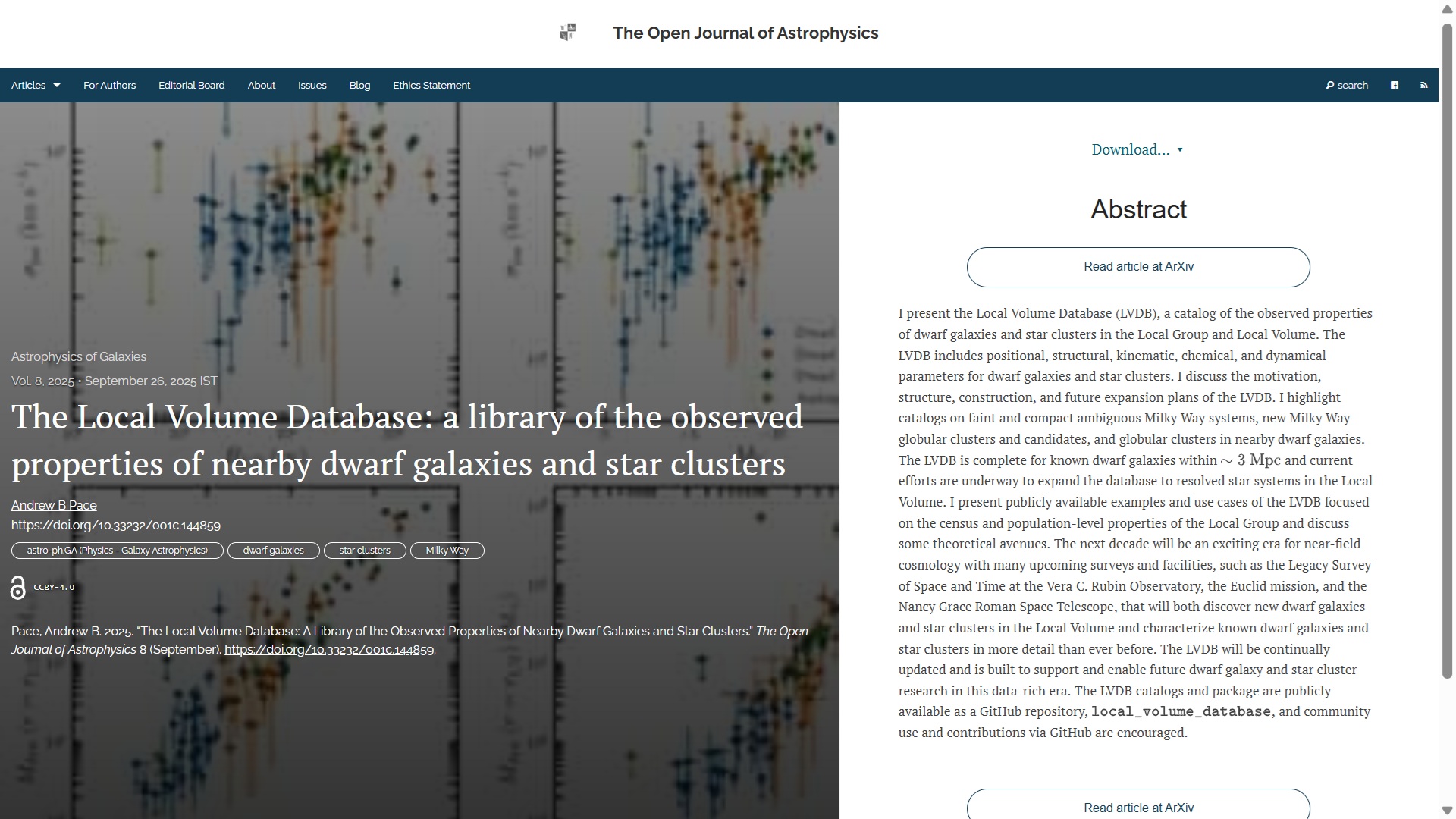
The fifth, and last, one for this week is “The Local Volume Database: a library of the observed properties of nearby dwarf galaxies and star clusters” by Andrew B. Pace (University of Virginia, USA). This one was published on Friday 26th September (i.e. yesterday) in the folder Astrophysics of Galaxies. It presents a catalogue of positional, structural, kinematic, chemical, and dynamical parameters for dwarf galaxies and star clusters in the Local Volume. The overlay is here:

You can find the officially-accepted version of this paper on arxiv here.


And that concludes the report for this week. I’ll post another update next Saturday.

Weekly Update from the Open Journal of Astrophysics – 20/09/2025

Posted in OJAp Papers, Open Access, The Universe and Stuff with tags , , , , , , , , , , on September 20, 2025 by telescoper

It’s Saturday again, so it’s time for a summary of the week’s new papers at the Open Journal of Astrophysics. Since the last update we have published two new papers, which brings the number in Volume 8 (2025) up to 136, and the total so far published by OJAp up to 371.

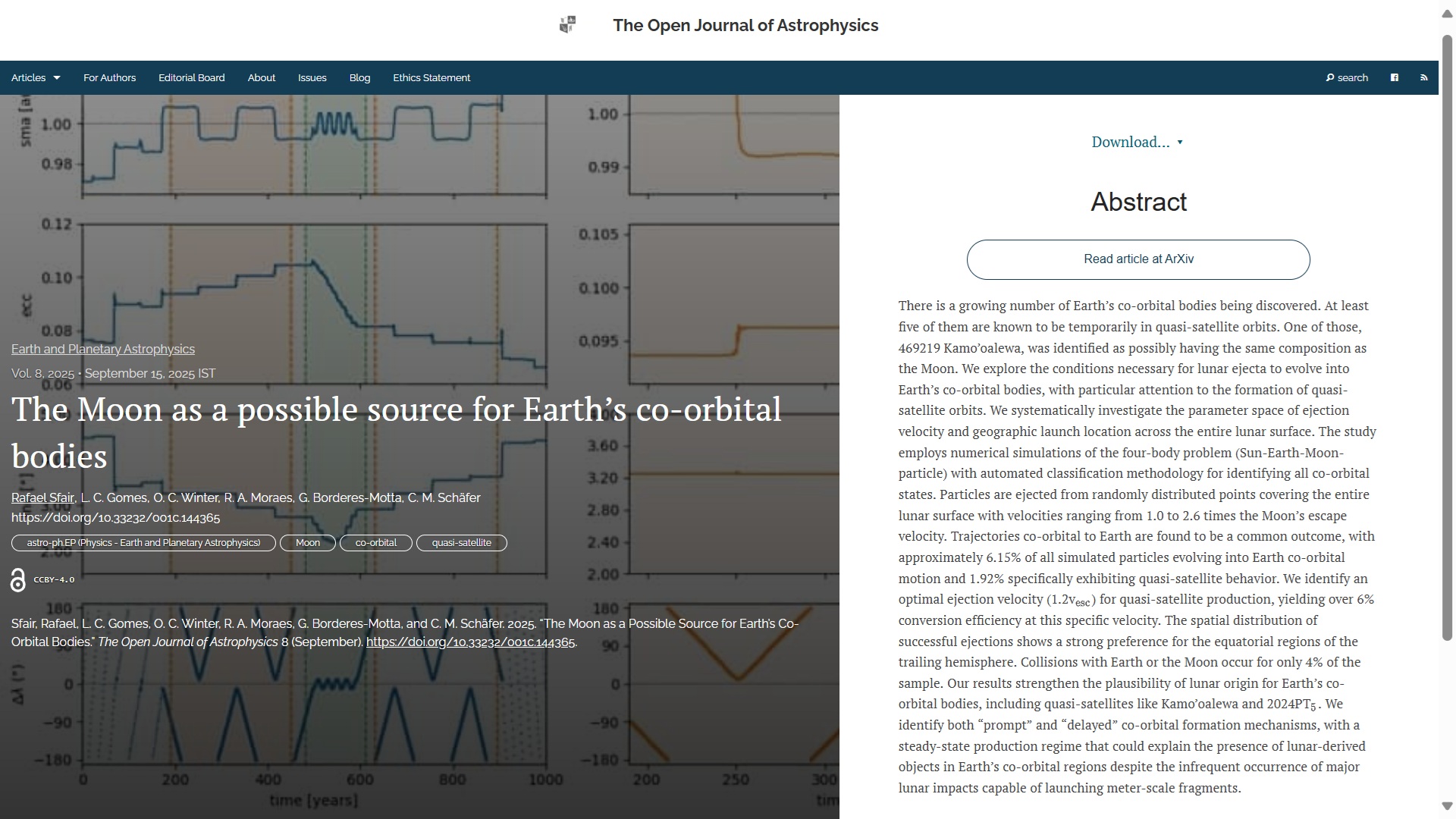
The first paper to report this week is “The Moon as a possible source for Earth’s co-orbital bodies” by Rafael Sfair, L. C. Gomes, O. C. Winter & R. A. Moraes (São Paulo State University, Brazil), G. Borderes-Motta (Astronomical Institute of the Czech Academy of Sciences, Czech Republic) and C. M. Schäfer (Universität Tübingen, Germany). This paper was published on Monday 15th September, in the folder Earth and Planetary Astrophysics, and it presents a numerical exploration of the ejection velocities and launch locations necessary for lunar ejecta to evolve into Earth’s co-orbital bodies.

The overlay is here:


You can make this larger by clicking on it.  The officially accepted version of this paper can be found on the arXiv here.

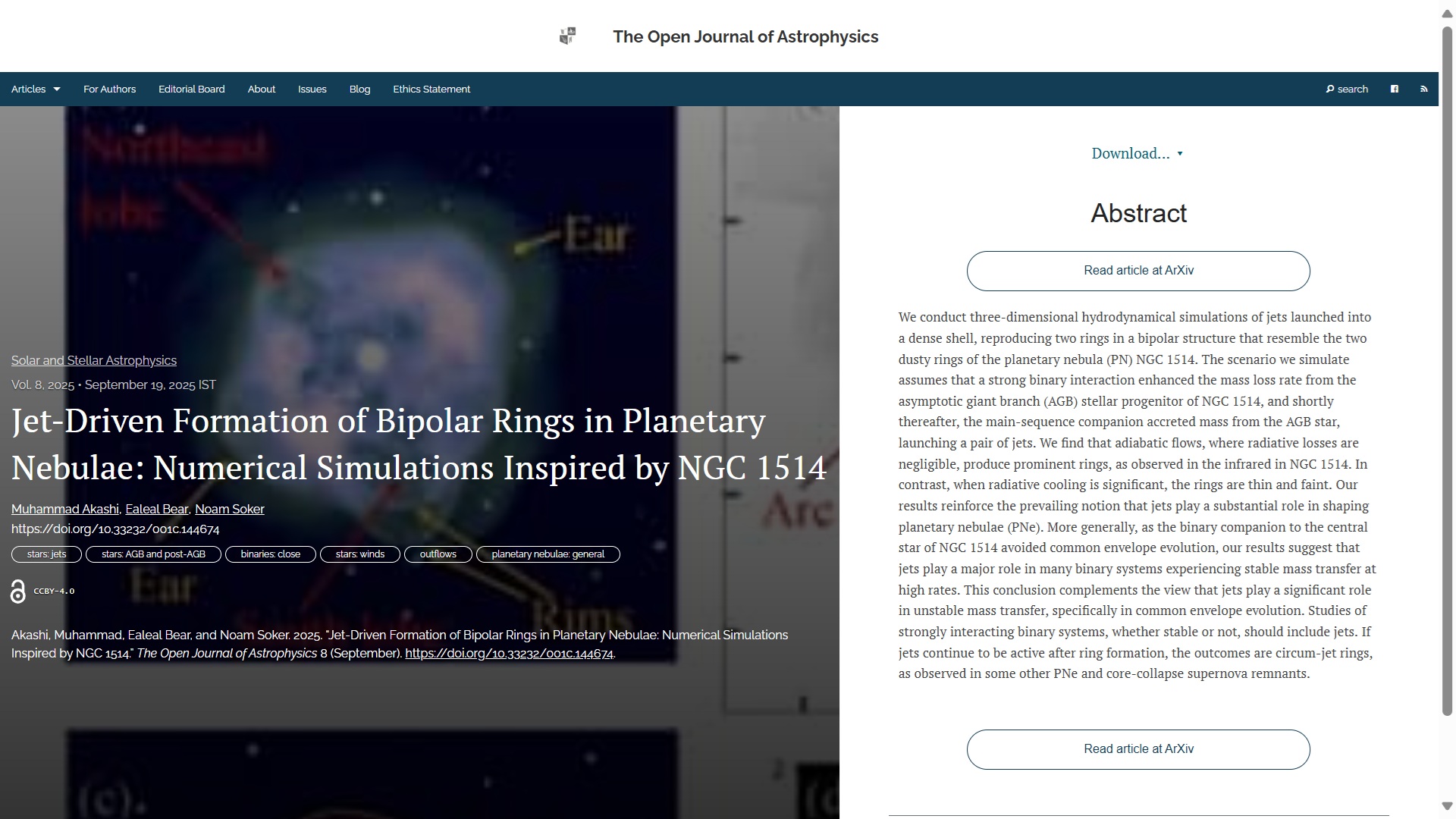
The second paper this week, published on Friday 19th September in the folder Solar and Stellar Astrophysics, is  “Jet-Driven Formation of Bipolar Rings in Planetary Nebulae: Numerical Simulations Inspired by NGC 1514” by Muhammad Akashi, Ealeal Bear, and Noam Soker (Technion, Haifa, Israel). This paper presents evidence from numerical simulations notion that jets play a substantial role in shaping planetary nebulae (PNe).

The corresponding overlay is here:


You can find the officially accepted version on arXiv here.

Weekly Update from the Open Journal of Astrophysics – 23/08/2025

Posted in OJAp Papers, Open Access, The Universe and Stuff with tags , , , , , , , , , , , , , , , , , , , , , , , , , on August 23, 2025 by telescoper

So it’s Saturday again, so it’s time for the usual update of papers published at the Open Journal of Astrophysics which I do every Saturday. Since the last update we have published six new papers, which brings the number in Volume 8 (2025) up to 122, and the total so far published by OJAp up to 357. As I mentioned here we have overtaken the total of 120 published in Volume 7 (2024) and are on track for in excess of 180 publications in 2025.

The first paper to report this week is “Mass-feeding of jet-launching white dwarfs in grazing and common envelope evolution” by Noam Soker (Technion, Haifa, Israel). This was published on Tuesday 19th August in the folder Solar and Stellar Astrophysics. It proposes a theoretical suggestion about the production of jets in common-envelope evolution with massive stars.

The overlay is here:

You can make this larger by clicking on it, as you can with all the overlays below. The officially accepted version of this paper can be found on the arXiv here.

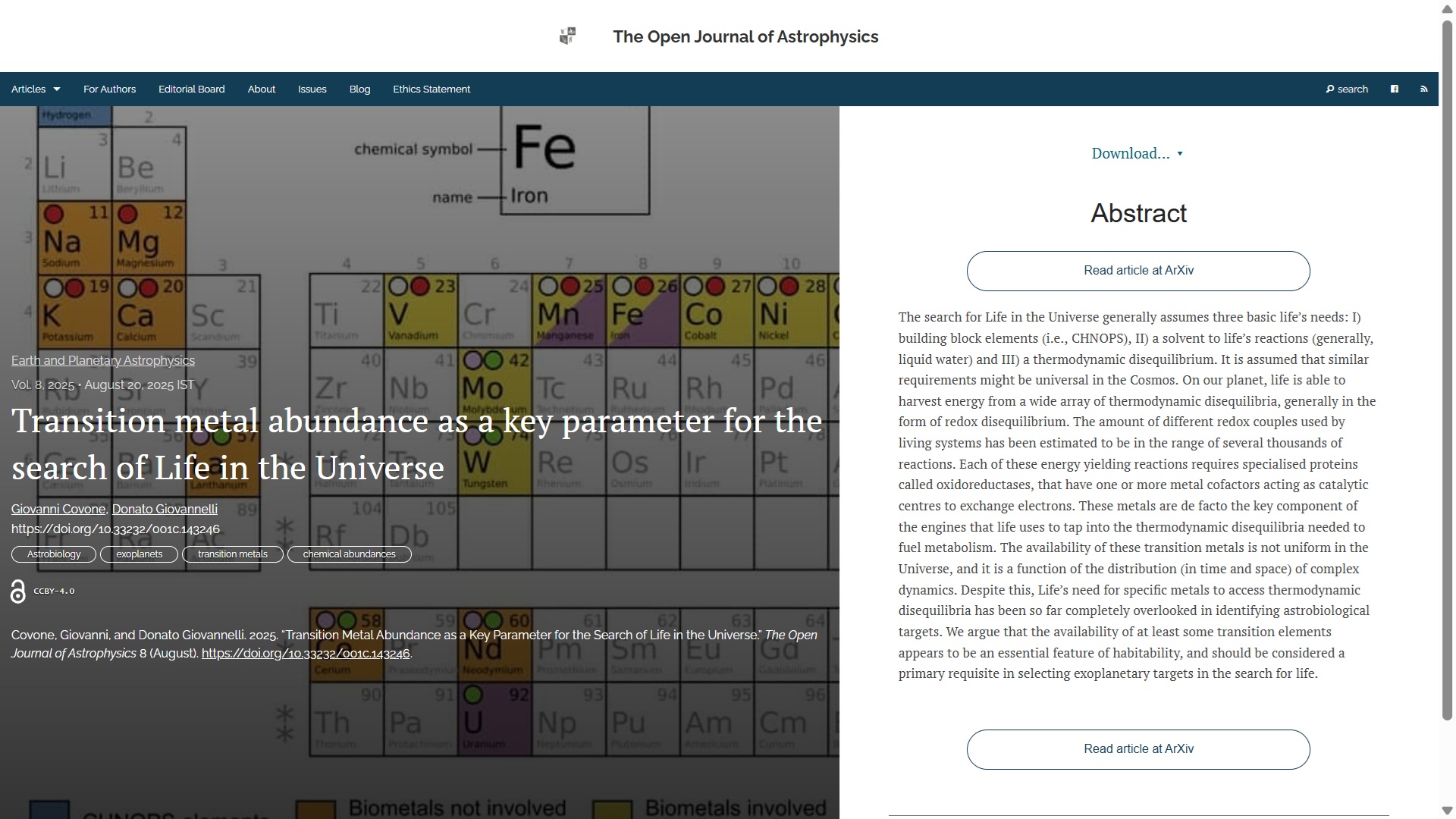
The second paper this week, published on Wednesday 20th August in the folder Earth and Planetary Astrophysics, is “Transition metal abundance as a key parameter for the search of Life in the Universe” by Giovanni Covone and Donato Giovannelli (University of Naples, Italy). This paper presents an argument that the availability of transition elements is an essential feature of habitability, and should be considered as such in selecting exoplanetary targets in the search for life.

The overlay is here:

You can find the officially accepted version of the paper on arXiv here.

The third paper this week, also published on 20th August 2025 in the folder Earth and Planetary Astrophysics, is “Discrete element simulations of self-gravitating rubble pile collisions: the effects of non-uniform particle size and rotation” by Job Guidos, Lucas Kolanz and Davide Lazzati (Oregon State University, USA).  This presents a new computer code for simulating the growth of granular masses through collisions of smaller particles and discusses results generated by it.

The overlay for this one is here:

You can find the officially accepted version on arXiv here.

The next paper, the fourth this week, is “Seeing the Outer Edge of the Infant Type Ia Supernova 2024epr in the Optical and Near Infrared” by W.B. Hoogendam (University of Hawaii, USA) and 32 others – too numerous to list by name – based in various institutes in the USA, Australia, UK, Denmark, Taiwan and China. This paper was also published on Wednesday 20th August 2025, but in the folder High-Energy Astrophysical Phenomena.  The article reports on the results of optical-to-near-infrared photometry and spectroscopy of the Type Ia supernova (SN Ia) 2024epr and a discusses how these challenge models for this sort of supernova.

The overlay is here:

You can find the officially accepted version on arXiv here.

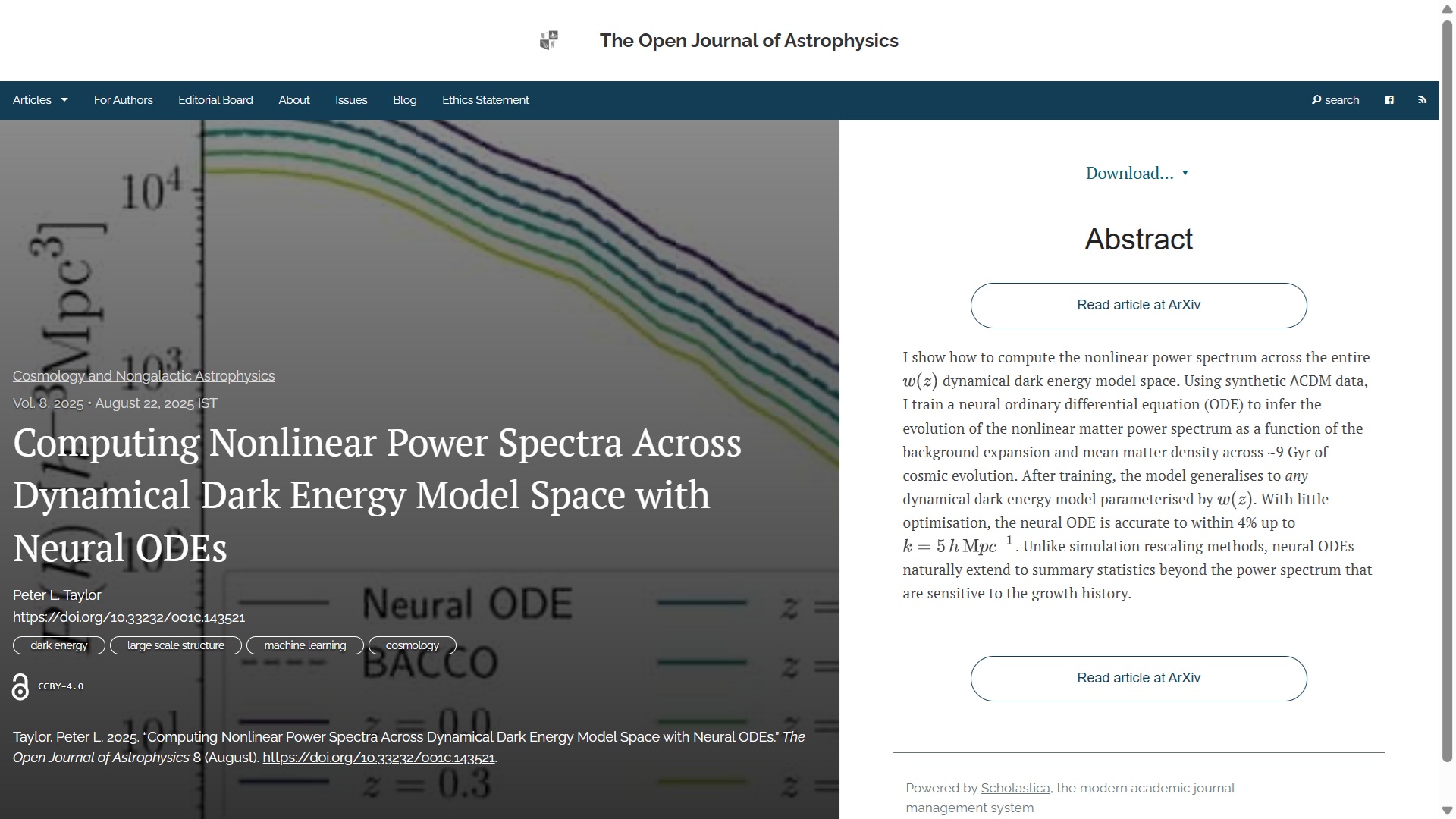
The fifth paper this week is “Computing Nonlinear Power Spectra Across Dynamical Dark Energy Model Space with Neural ODEs” by Peter L. Taylor of Ohio State University (USA).  This one shows how to compute the evolution of cosmological power spectra into the non-linear regime via neural differential equations. It was published on Friday 22nd August 2025 in the folder Cosmology and NonGalactic Astrophysics. The overlay is here:

You can find the officially accepted version on arXiv here.

And finally for this week we have “Symbiotic star candidates in Gaia Data Release 3” by Samantha E. Ball & Benjamin C Bromley (University of Utah, USA) and Scott J. Kenyon (Smithsonian Observatory, USA). This paper was published on Friday 22nd August in the folder Solar and Stellar Astrophysics. It describes a new search for symbiotic star candidates in Gaia Data Release 3 (GDR3), based on astrometric, photometric, and spectroscopic information. The overlay is here:

You can find the officially accepted version of this one on arXiv here.

And that’s all the papers for this week. I suppose there will come a time when we publish a paper on every day of the week and each week’s summary will contain a paper in each of the astro-ph categories on arXiv, but we haven’t done that yet. This week we published on every day but Monday 18th August, and have papers in four of the six categories.

Weekly Update from the Open Journal of Astrophysics – 16/08/2025

Posted in OJAp Papers, Open Access, The Universe and Stuff with tags , , , , , , , , , , , , on August 16, 2025 by telescoper

It’s time once again for the usual update of papers published at the Open Journal of Astrophysics which I do every Saturday. Since the last update we have published two new papers, which brings the number in Volume 8 (2025) up to 116, and the total so far published by OJAp up to 351. The summer lull we always expected is now upon us, so this will be a shorter post than we have had of late.
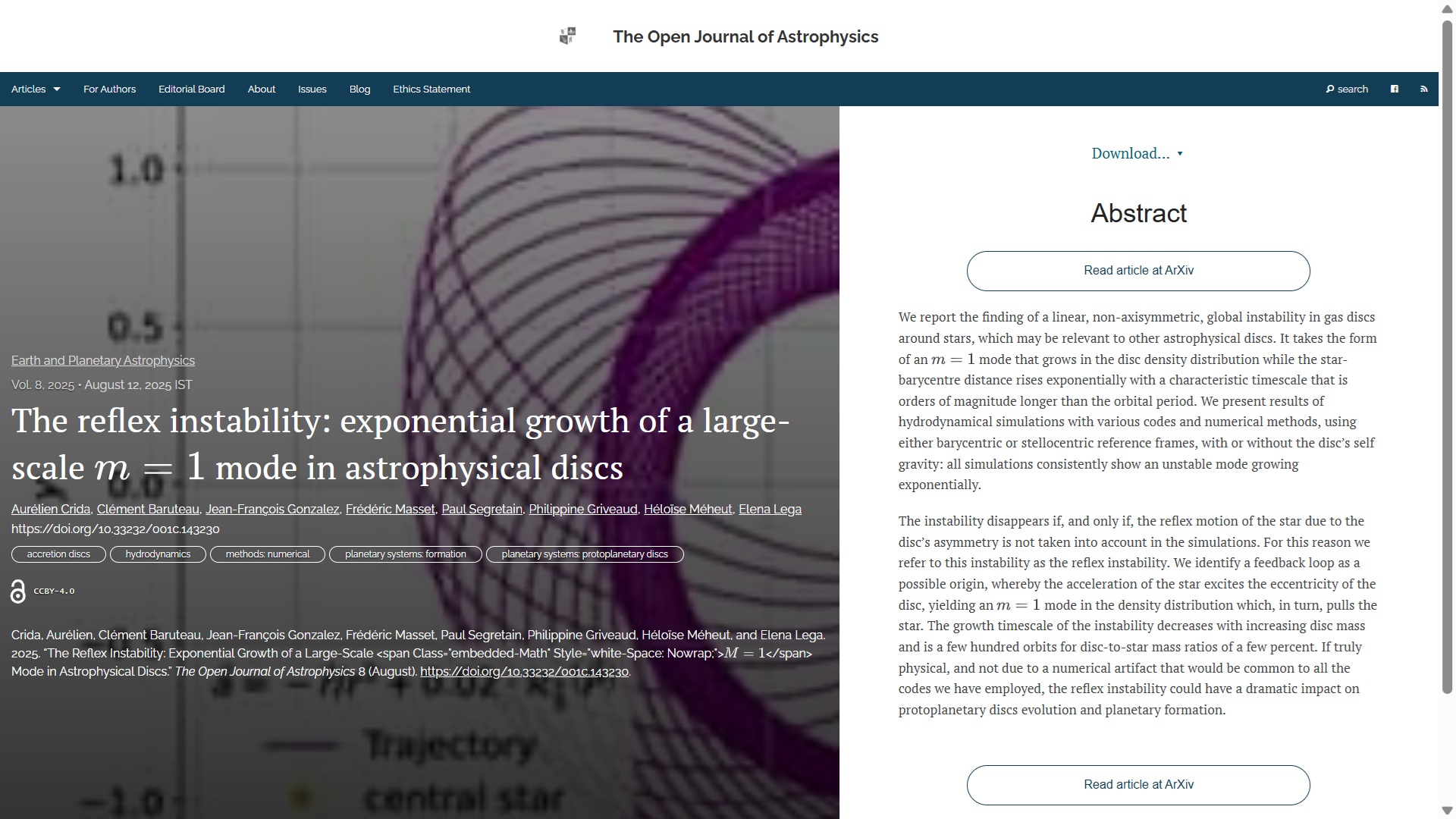
The first paper to report this week is “The reflex instability: exponential growth of a large-scale mode in astrophysical discs” by Aurélien Crida (Université Côte d’Azur, France), Clément Baruteau (Université de Toulouse, France), Jean-François Gonzalez (Universite Claude Bernard Lyon 1, France), Frédéric Masset (Universidad Nacional Autonoma de México) and Paul Segretain, Philippine Griveaud, Héloïse Méheut & Elena Lega (Université Côte d’Azur).  This paper was published on Tuesday August 12th 2025 in the folder marked “Earth and Planetary Astrophysics“. It discusses a exponentially-growing instability in gas discs around stars caused by the motion of the central star in response to the disc.

The overlay – which you can make larger by clicking on it – is here:

You can find the officially accepted version on arXiv here.

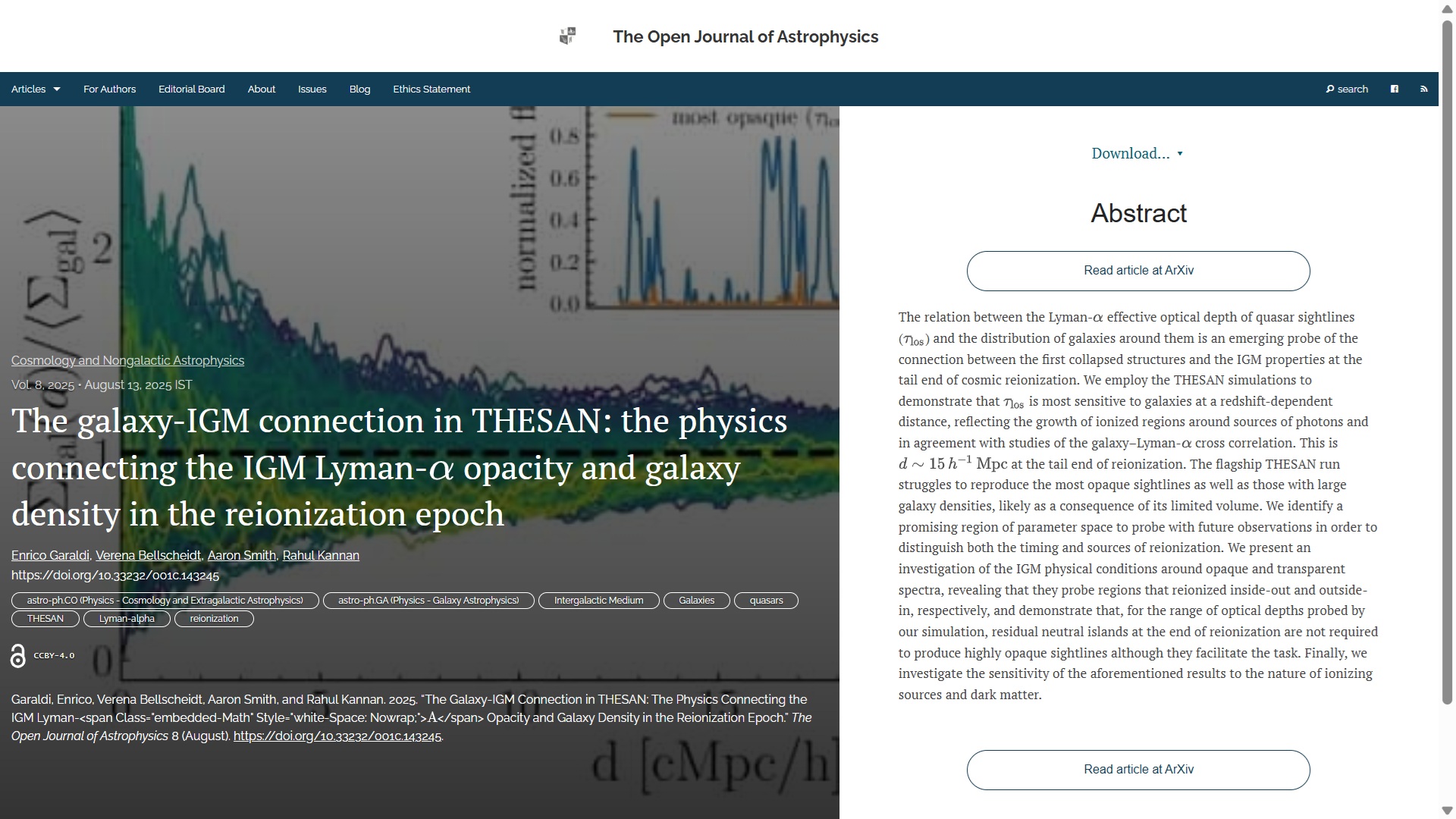
The other paper this week, published in the folder Cosmology and Nongalactic Astrophysics, is “The galaxy-IGM connection in THESAN: the physics connecting the IGM Lyman-alpha opacity and galaxy density in the reionization epoch” by Enrico Garaldi (University of Tokyo, Japan), Verena Bellscheidt (Technical University of Munich, Germany), Aaron Smith (York University, Canada) and Rahul Kannan (University of Texas at Dallas, USA).  It presents a study of the relation between the Lyman-alpha effective optical depth of quasar sightlines and the distribution of galaxiesas as a probe of ionized regions around sources of photons. It was published on Wednesday August 13th 2025.

The overlay is here:


You can find the officially accepted version of the paper on arXiv here.

That concludes the papers for this week. I’ll do another update next weekend, though I expect things will remain relatively quiet until September.

Weekly Update from the Open Journal of Astrophysics: 05/07/2025

Posted in OJAp Papers, Open Access, The Universe and Stuff with tags , , , , , , , , , , , , , , , , , on July 5, 2025 by telescoper

It’s Saturday so, once again, it’s time for the weekly update of papers published at the Open Journal of Astrophysics. Since the last update we have published three new papers, which brings the number in Volume 8 (2025) up to 85, and the total so far published by OJAp  up to 320.

The three papers published this week, with their overlays, are as follows. You can click on the images of the overlays to make them larger should you wish to do so.

The first paper to report is “Stellar reddening map from DESI imaging and spectroscopy” by Rongpu Zhou (Lawrence Berkeley National Laboratory, USA) and an international case of 56 others too numerous to mention individually. This paper was published on 1st July 2025 in the folder marked Astrophysics of Galaxies. It describes maps of stellar reddening by Galactic dust inferred from observations obtained using the Dark Energy Spectroscopic Instrument, and a comparison with previous such maps. The overlay is here:

You can find the final, accepted, version on arXiv here.

Next one up is “On inertial forces (indirect terms) in problems with a central body” by Aurélien Crida (Université Côte d’Azur, France) and 17 others – again too numerous to be listed individually – based in France, Italy, Germany, Mexico and the USA. This paper discusses the indirect terms that arise the Newtonian dynamics of multi-body systems dominated by a central massive body, upon which other bodies exert a gravitational pull, when the massive body is treated as the origin of the coordinate system. This one, also published on July 1st 2025, is in the folder marked Earth and Planetary Astrophysics.

The overlay is here:

You can find the officially accepted version on arXiv here.

The last paper of this batch is “Stellar ejection velocities from the binary supernova scenario: A comparison across population synthesis codes” by Tom Wagg (U. Washington, USA), David D. Hendriks (U. Surrey, UK), Mathieu Renzo (U. Arizona, USA) and Katelyn Breivik (Carnegie Mellon U., USA). It was published on July 2nd 2025 in the folder Solar and Stellar Astrophysics and it presents comparison of the ejection velocities of stars ejected from binary systems by supernova explosions predicted in three different population synthesis codes.

The overlay is here:

You can read the final accepted version on arXiv here.

That’s all the papers for this week. I’ll post another update next weekend.

Four New Publications at the Open Journal of Astrophysics

Posted in OJAp Papers, Open Access, The Universe and Stuff with tags , , , , , , , , , , , , , on December 14, 2024 by telescoper

It’s Saturday morning once again so here’s another quick update of activity at the Open Journal of Astrophysics. Since the last update a week ago we have published  four papers, which takes the count in Volume 7 (2024) up to 114 and the total published altogether by OJAp up to 229. If we publish just one more paper between now and the end of the year, we will have published as many papers in 2024 as we have in all previous years.

Anyway, in chronological order of publication, the four papers published this week, with their overlays, are as follows. You can click on the images of the overlays to make them larger should you wish to do so.

First one up is “Star formation beyond galaxies: widespread in-situ formation of intra-cluster stars” by Niusha Ahvazi & Laura V. Sales (UC Riverside, USA), Julio F. Navarro (U. Victoria, Canada), Andrew Benson (Carnegie Obs. USA), Alessandro Boselli (Aix Marseille U., France) and Richard D’Souza (Vatican Obs.). The paper, which is in the folder marked Astrophysics of Galaxies, The paper presents a simulation-based analysis of a diffuse star forming component in galaxy clusters extending for hundreds of kiloparsecs and tracing the distribution of neutral gas in the cluster host halo.

Here is a screen grab of the overlay, which includes the abstract:

You can find the officially accepted version of the paper on the arXiv here.

The second paper to announce, published on 10th December 2024 in the folder Cosmology and NonGalactic Astrophysics, is “Cosmological Constraints from Combining Photometric Galaxy Surveys and Gravitational Wave Observatories” by E.L. Gagnon, D. Anbajagane, J. Prat, C. Chang, and J. Frieman (all of U. Chicago, USA). This article quantifies the expected cosmological information gain from combining the forecast LSST 3x2pt analysis with the large-scale auto-correlation of GW sources from proposed next-generation GW experiments.

You can see the overlay here:

The accepted version of this paper can be found on the arXiv here.

The third paper, also published on 10th December 2024, but in the folder marked Earth and Planetary Astrophysics, has the title “A potential exomoon from the predicted planet obliquity of β Pictoris b” and is written by Michael Poon, Hanno Rein, and Dang Pham all of the University of Toronto, Canada. It presents discussion, based on the β Pictoris system, of the idea that the presence of exomoons can excite misalignment between the spin and orbit axis (obliquity) in exoplanet systems

Here is the overlay

The final version accepted on arXiv is here.

Last of this quartet, published on 11th December 2024, and in the folder Cosmology and NonGalactic Astrophysics is “Map-level baryonification: Efficient modelling of higher-order correlations in the weak lensing and thermal Sunyaev-Zeldovich fields” and is by Dhayaa Anbajagane & Shivam Pandey (U. Chicago) and Chihway Chang (Columbia U.), all based in the USA.

The paper proposes an extension of the semi-analytic formalism to weak lensing and thermal Sunyaev-Zeldovich (tSZ) fields directly on the full-sky, with an emphasis on higher-order correlations. The overlay is here:

You can find the official accepted version on the arXiv here.

That’s all for this week. I’ll do another update next Saturday, and that will probably be the last one of the year. If we publish just one more paper between now and 31st December, we will have published as many papers in 2024 as we have in all previous years put together!