Archive for High-Energy Astrophysical Phenomena

Three New Publications at the Open Journal of Astrophysics

Posted in OJAp Papers, Open Access, The Universe and Stuff with tags , , , , , , , , , , , , , , on August 10, 2024 by telescoper

It’s Saturday so it’s time once again for another roundup of business at the  Open Journal of Astrophysics. After last week’s summer lull, this week I have three papers to announce, which brings the total we have published so far this year (Vol. 7) to 67 and the total published by OJAp to 182.

First one up, published on 7th August 2024, is “Brightest Cluster Galaxy Offsets in Cold Dark Matter” by Jonathan Katz of Washington University (St Louis, Missouri, USA),  a simulation-based study of the distribution of the position of brightest cluster galaxies relative to the dark matter distribution and its possible use as a cosmological probe.  The authors are Cian Roche (MIT), Michael McDonald (MIT), Josh Borrow (MIT), Mark Vogelsberger (MIT), Xuejian Shen (MIT), Volker Springel (MPA Garching), Lars Hernquist (Harvard), Ruediger Pakmor (Harvard), Sownak Bose (Durham, UK) and Rahul Kannan (York U., Canada). This paper is in the folder marked Astrophysics of Galaxies.

Here is a screen grab of the overlay, which includes the abstract:


You can read the paper directly on arXiv here.

The second paper to present is “LAMOST J1010+2358 is not a Pair-Instability Supernova Relic” by five authors based in the USA: Pierre Thibodeaux (Chicago), Alexander P. Ji (Chicago), William Cerny (Yale), Evan N. Kirby (Notre Dame) and Joshua D. Simon (Carnegie Observatories) .  As the title makes clear, the paper presents arguments against previous claims that a particular star is not a pair-instability supernova relic. This paper is in the folder marked Solar and Stellar Astrophysics. It was published on Friday August 9th 2024.

The overlay looks like this:


You can read this paper directly on the arXiv here.

Last, but by no means least, comes  “A Pilot Search for Gravitational Self-Lensing Binaries with the Zwicky Transient Facility“, results of a trial search for signals of gravitational lensing of one component in a binary system by a compact companion, with a discussion of future prospects for larger surveys. This one, which was also published on 9th August, is in the folder marked High-Energy Astrophysical Phenomena. The authors are Allison Crossland & Eric C Bellm (U. Washington), Courtney Klein (UC Irvine), James R. A. Davenport (U. Washington), Thomas Kupfer (Hamburg Observatory) and Steven L. Groom, Russ R. Laher & Reed Riddle (Caltech).

Here is a screengrab of the overlay:

To read the accepted version of this on the arXiv please go here.

That’s it for this week. I hope to post another update next weekend.

Four New Publications at the Open Journal of Astrophysics

Posted in OJAp Papers, Open Access, The Universe and Stuff with tags , , , , , , , , , , , , , , , , , , on July 27, 2024 by telescoper

It’s Saturday morning, so once again it’s time for an update of activity at the Open Journal of Astrophysics. This week we have published another batch of four papers, the same number as last week, which takes the count in Volume 7 (2024) up to 64 and the total published altogether by OJAp up to 179.

Before announcing the week’s papers I’ll add three other updates you might find interesting:

  1.  When I looked at NASA/ADS this morning to help construct this post I saw that papers published in OJAp have now garnered over 2500 citations between them;
  2. We had a good response to our recent call for new members of the Editorial Board and have added four new members here;
  3. Last week we received a significant (unsolicited) cash donation from a higher education institution based in Europe to help with our work in Diamond Open Access. If any other organizations or individuals would like to do similar then please contact me!

Now, in chronological order, the four papers published this week, with their overlays, are as follows. You can click on the images of the overlays to make them larger should you wish to do so.

First one up is: “Widespread disruption of resonant chains during protoplanetary disk dispersal by Bradley M S Hansen (UCLA), Tze-Yeung Yu (UCLA) and Yasuhiro Hasegawa (JPL), all based in California, USA.  The paper presents a discussion of the effect of a dispersing protoplanetary disk on the evolution of low-mass planets around a Solar mass star.  It was published on 21st July 2024 and is in the folder marked Earth and Planetary Astrophysics.

Here is a screen grab of the overlay, which includes the abstract:


You can find the officially accepted version of the paper on the arXiv here.

The second paper to announce is “Using A One-Class SVM To Optimize Transit Detection” by Jakob Roche of the University of South Florida, also in the USA (but not in California). This articles discusses the advantages of One-Class Support Vector Machines (SVMs) over Convolutional Neural Networks (CNN) in the context of exoplanet detection. Its in the folder called Instrumentation and Methods for Astrophysics and was published on 25th July 2024.

You can see the overlay here:


The accepted version of this paper can be found on the arXiv here.

The next paper, also published on 25th July 2024, is in the folder marked High-Energy Astrophysical Phenomena. Its primary classification on arXiv is General Relativity and Quantum Cosmology (gr-qc), but it is cross-listed on astro-ph so we considered it for publication and had it refereed, with favourable results. It is entitled “What no one has seen before: gravitational waveforms from warp drive collapse” and is by Katy Clough (QMUL, UK), Tim Dietrich (Potsdam, Germany) and Sebastian Khan (Cardiff, UK).  Looking at the title of this paper you might be tempted to dismiss it on the grounds that warp drives are the stuff of science fiction (which they are), but this paper is really a rigorous technical study of the dynamical evolution and stability of spacetimes that violate the null energy condition, inspired by the idea of a warp drive.

Here is the overlay:


You can find the full text for this one on the arXiv here.

Last, published on 26th July 2024, we have a paper with the title “A study of gamma-ray emission from OJ 287 using Fermi-LAT from 2015-2023” by Vibhavasu Pasumarti and Shantanu Desai of the Indian Institute of Technology, Hyderabad, India. It is an investigation of the properties of gamma-ray emission from OJ287 (a BL Lac object) using the Fermi Large Area Telescope (LAT).  This one is also in the folder marked High-Energy Astrophysical Phenomena; here is the overlay

You can find the officially accepted version of this paper on the arXiv here.

That’s all for this week. Stay tuned for another update next week.

Three New Publications at the Open Journal of Astrophysics

Posted in OJAp Papers, Open Access, The Universe and Stuff with tags , , , , , , , , , , , , , , , , , on June 8, 2024 by telescoper

Time for another roundup of business at the  Open Journal of Astrophysics. This time I have three papers to announce, which brings the total we have published so far this year (Vol. 7) to 45 and the total published by OJAp to 160. We’re still on track to publish around 100 papers this year or more, compared to last year’s 50.

First one up, published on 3rd June 2024, is “Log-Normal Waiting Time Widths Characterize Dynamics” by Jonathan Katz of Washington University (St Louis, Missouri, USA). This paper presents a discussion of the connection between waiting time distributions and dynamics for aperiodic astrophysical systems, with emphasis on log-normal distributions.  This paper is in the folder marked High-Energy Astrophysical Phenomena.

Here is a screen grab of the overlay, which includes the abstract:


You can read the paper directly on arXiv here.

The second paper to present is “An Empirical Model For Intrinsic Alignments: Insights From Cosmological Simulations” by Nicholas Van Alfen (Northeastern University, Boston, USA), Duncan Campbell (Carnegie Mellon University, Pittsburgh, USA), Jonathan Blazek (Northeastern University), C. Danielle Leonard (Newcastle University, UK), Francois Lanusse (Université Paris-Saclay, France), Andrew Hearin (Argonne National Laboratory, USA), Rachel Mandelbaum (Carnegie Mellon University) and The LSST Dark Energy Science Collaboration.  This paper presents an extension of the halo model (specifically the Halo Occupation Distribution, HOD) to include intrinsic alignment effects for the study of weak gravitational lensing. This paper is in the folder marked Cosmology and Nongalactic Astrophysics. It was published on Tuesday June 4th 2024.

The overlay looks like this:


You can read this paper directly on the arXiv here.

Last, but by no means least, comes  “Towards Cosmography of the Local Universe”  which proposes the multipoles of the distance-redshift relation as new cosmological observables that have a direct physical interpretation in terms of kinematical quantities of the underlying matter flow. This was also published on 4th June. The authors are Julian Adamek (IfA Zurich, Switzerland), Chris Clarkson (Queen Mary, London, UK), Ruth Durrer (Geneva, Switzerland), Asta Heinesen (U. Lyon, France & NBI Copenhagen, Denmark), Martin Kunz (Geneva), and Hayley J. Macpherson (Chicago, USA).

Here is a screengrab of the overlay:


To read the accepted version of this on the arXiv please go here. This paper is also in the folder marked Cosmology and Nongalactic Astrophysics.
That’s it for this week. I aim to post another update next weekend.


Three New Publications at the Open Journal of Astrophysics

Posted in OJAp Papers, The Universe and Stuff with tags , , , , , , , , , , , , , , , , on March 19, 2024 by telescoper

Now that I’m safely back in Barcelona it’s a time for a roundup of the latest business at the  Open Journal of Astrophysics. The latest batch of publications consists of three papers, taking the count in Volume 7 (2024) up to 20 and the total published by OJAp up to 135.

This time the papers are all related, have many authors in common, and have the same first author, Philip F. Hopkins of Caltech. In fact the second and third papers in this batch were accepted well before the first one, but it seemed to make much more sense to publish them together so I held those two back a bit and published all three on 14th March.

The three papers published, with their overlays, are as follows. You can click on the images of the overlays to make them larger should you wish to do so. You can read these publications directly on arXiv if you wish; you will find them here, here and here.

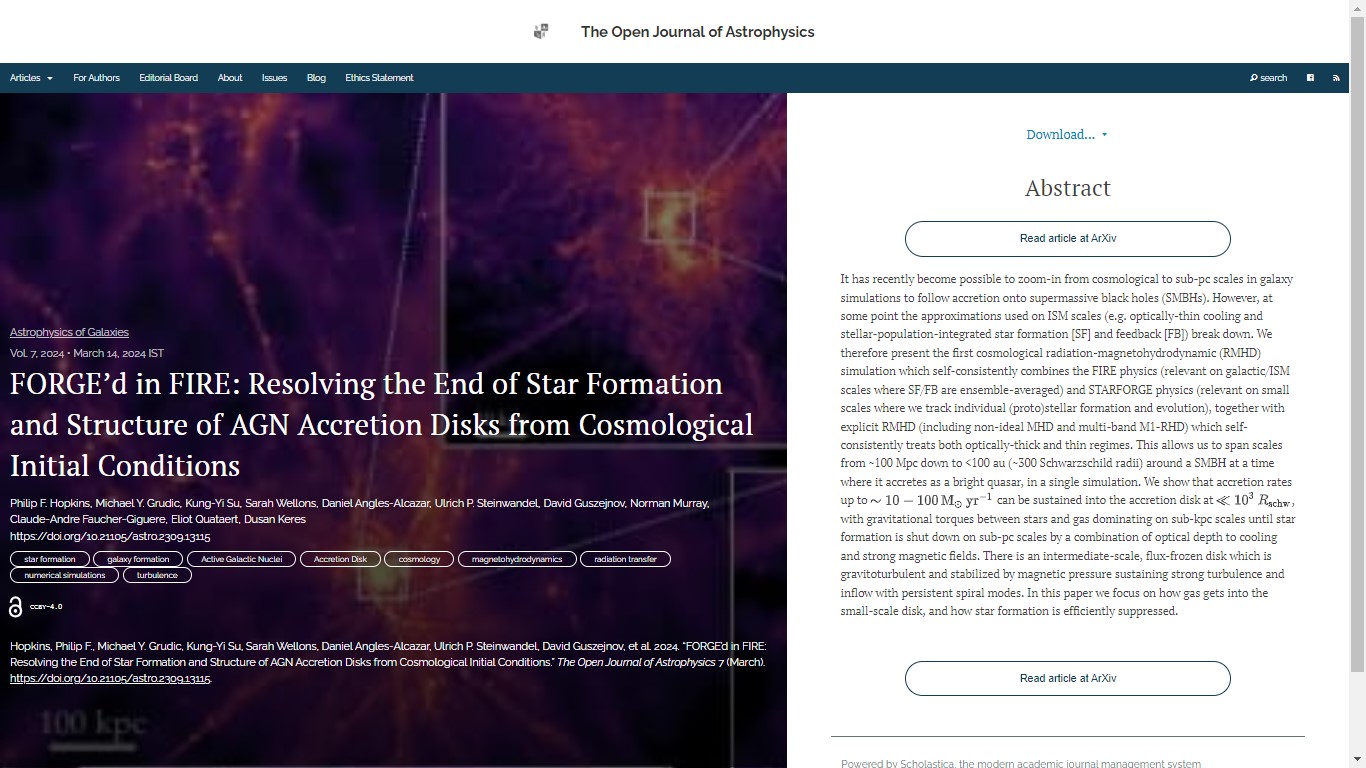
First one up is “FORGE’d in FIRE: Resolving the End of Star Formation and Structure of AGN Accretion Disks from Cosmological Initial Conditions” in which, using a full cosmological simulation, incorporating radiation and magnetohydrodynamics, the authors study the formation and structure of AGN accretion disks and their impact on star formation. This one is in the folder marked Astrophysics of Galaxies.

The authors (ten from the USA and one from Canada) are Philip F. Hopkins (Caltech), Michael Y. Grudic (Carnegie Observatories), Kung-Yi Su (Harvard), Sarah Wellons (Wesleyan University), Daniel Angles-Alcazar (University of Connecticut & Flatiron Institute), Ulrich P. Steinwandel (Flatiron Institute), David Guszejnov (University of Texas at Austin), Norman Murray (CITA, Toronto, Canada), Claude-Andre Faucher-Giguere (Northwestern University), Eliot Quataert (Princeton), and Dusan Keres (University of California, San Diego or UCSD for short).

Here is a screen grab of the overlay, which includes the abstract:


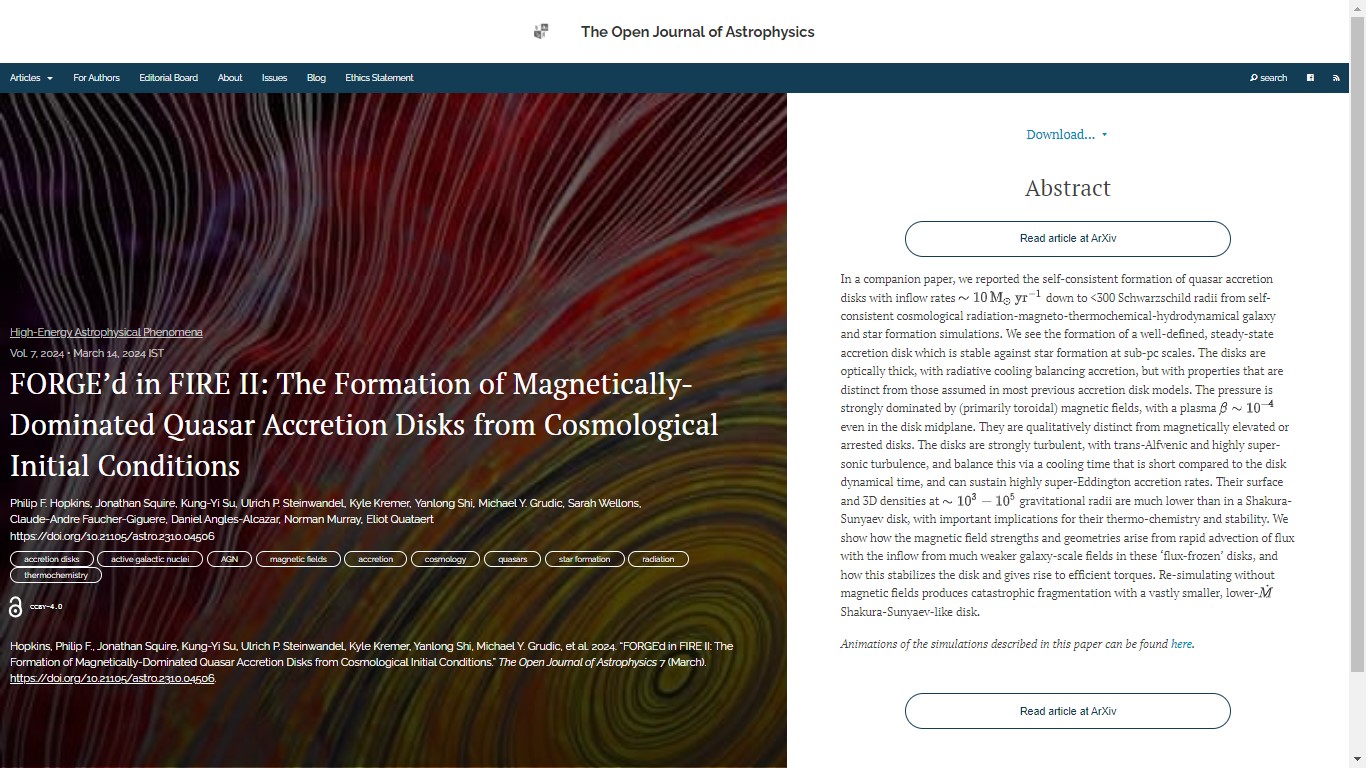
The second paper to announce is “FORGE’d in FIRE II: The Formation of Magnetically-Dominated Quasar Accretion Disks from Cosmological Initial Conditions” which is a study of the formation and properties of highly magnetized accretion disks using numerical simulations that include the effects of radiation, magnetic fields, thermochemistry, and star formation.

This one is in the folder High-Energy Astrophysical Phenomena. The authors (ten based in the USA, one fin Canada, and one in New Zealand) are Philip F. Hopkins, Jonathan Squire (University of Dunedin, New Zealand), Kung-Yi Su (Harvard), Ulrich P. Steinwandel (Flatiron Institute), Kyle Kremer (Caltech), Yanlong Shi (Caltech), Michael Y. Grudic (Carnegie Observatories), Sarah Wellons (Wesleyan University), Claude-Andre Faucher-Giguere (Northwestern University), Daniel Angles-Alcazar (University of Connecticut & Flatiron Institute), Norman Murray (CITA, Toronto), and Eliot Quataert (Princeton).


The last paper of this batch, also in the folder High-Energy Astrophysical Phenomena, is  entitled “An Analytic Model For Magnetically-Dominated Accretion Disks” and is closely related to the previous one; this particular paper presents an analytic similarity model for accretion disks that agrees remarkably well with the simulations in the previous one. Animations of the simulations referred to in both papers can be found here.

Here is the overlay:

The authors of this one are Philip F. Hopkins, Jonathan Squire, Eliot Quataert, Norman Murray, Kung-Yi Su, Ulrich P. Steinwandel, Kyle Kremer, Claude-Andre Faucher-Giguere, and Sarah Wellons. You can find all their affiliations above.
That’s all for now. More news in a week or so!


Two New Publications at the Open Journal of Astrophysics

Posted in OJAp Papers, Open Access, The Universe and Stuff with tags , , , , , , , , , , on February 24, 2024 by telescoper

It’s Saturday morning in Sydney, and time to post another update relating to the  Open Journal of Astrophysics.  Since the last update we have published two more papers, taking  the count in Volume 7 (2024) up to 15 and the total published by OJAp up to 130. I should have posted these before leaving but it slipped my mind.

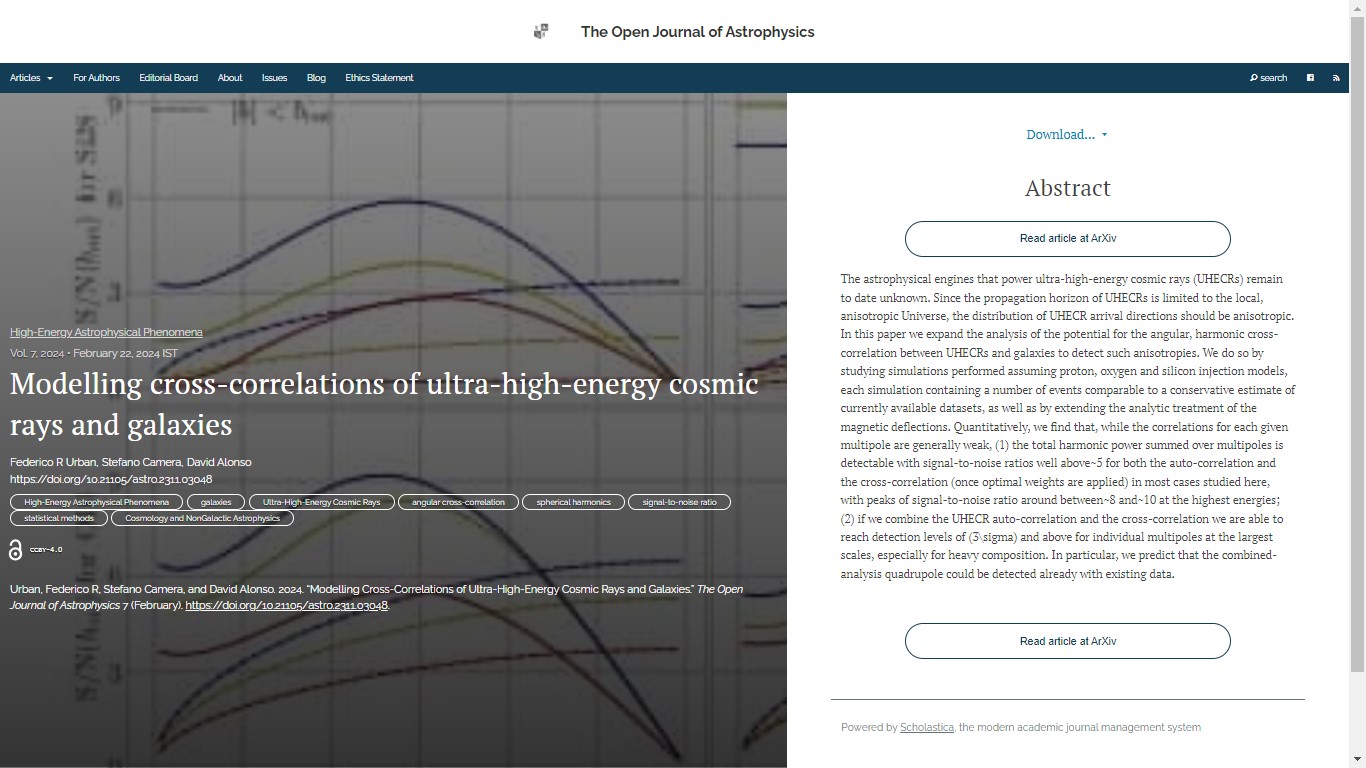
The first paper of the most recent pair – published on  Thursday 22nd February – is “Modelling cross-correlations of ultra-high-energy cosmic rays and galaxies” by Federico Urban (Prague, Czech Republic), Stefano Camera (Torino, Italy) and David Alonso (Oxford, UK). It presents a discussion of the possible statistical correlations between Ultra-High-Energy Cosmic-Ray (UHECR) directions in various models and structure in the galaxy distribution and whether or not this signal could be measurable.  This one is in the folder marked “High-Energy Astrophysical Phenomena“.

Here is a screen grab of the overlay which includes the abstract:

You can click on the image of the overlay to make it larger should you wish to do so. You can find the officially accepted version of the paper on the arXiv here.

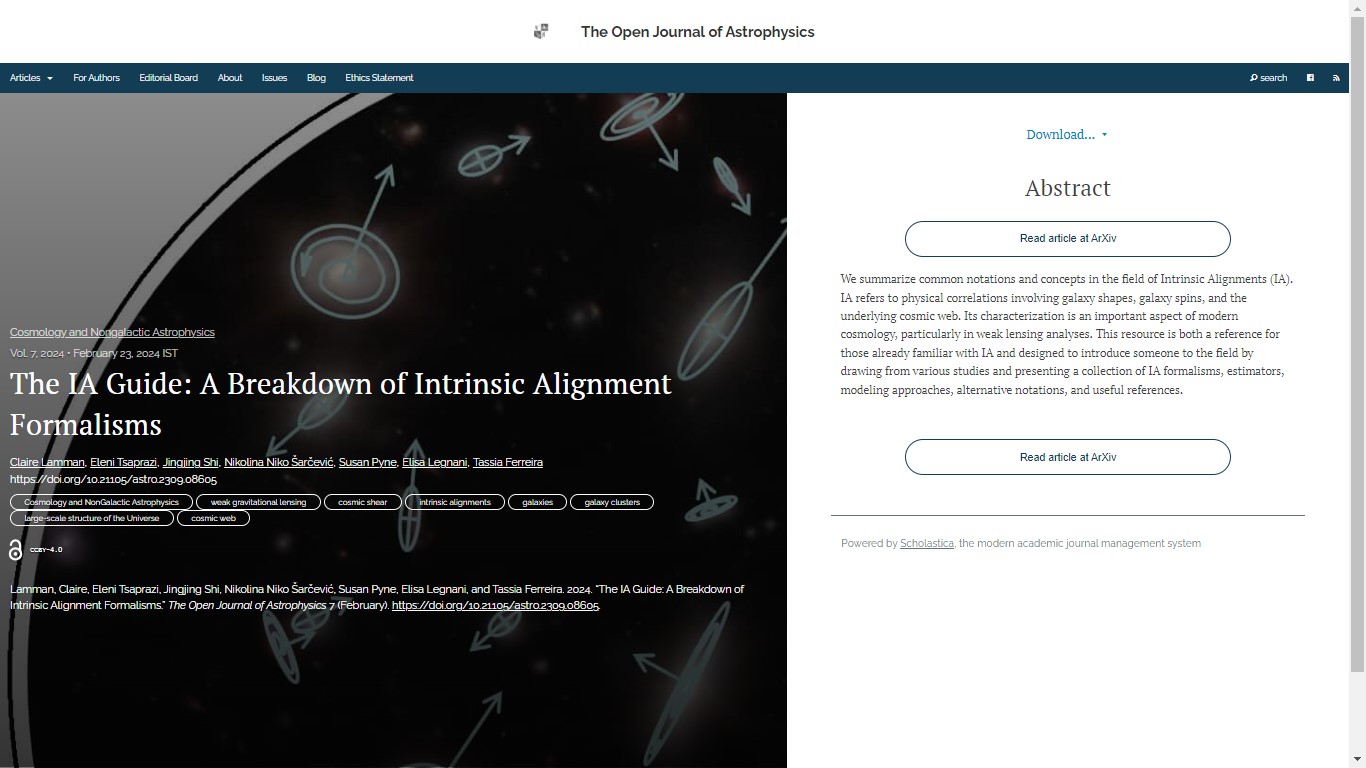
The second paper was published on Friday 23rd February and has the title “The IA Guide: A Breakdown of Intrinsic Alignment Formalisms” and the authors are: Claire Lamman (Harvard, USA);  Eleni Tsaprazi (Stockholm, Sweden);  Jingjing Shi (Tokyo, Japan); Nikolina Niko Šarčević (Newcastle, UK); Susan Pyne (UCL, UK); Elisa Legnani (Barcelona, Spain); and Tassia Ferreira (Oxford, UK). This one, which is in the folder marked Cosmology and NonGalactic Astrophysics, presents a review of Intrinsic Alignments, i.e. physical correlations involving galaxy shapes, galaxy spins, and larger scale structure, especially important for weak gravitational lensing

Here is a screen grab of the overlay which includes the abstract:


You can click on the image of the overlay to make it larger should you wish to do so. You can find the officially accepted version of the paper on the arXiv here.

That concludes this week’s update!

Three New Publications at the Open Journal of Astrophysics

Posted in OJAp Papers, Open Access, The Universe and Stuff with tags , , , , , , , , , on January 27, 2024 by telescoper

Once again it’s a good time for a roundup of the week’s business at the  Open Journal of Astrophysics. This past week we have once again published three papers, taking  the count in Volume 7 (2024) up to 7 and the total published by OJAp up to 122. Looking at the current work flow I expect there to be at least three next week too.

In chronological order, the three papers published this week, with their overlays, are as follows. You can click on the images of the overlays to make them larger should you wish to do so.

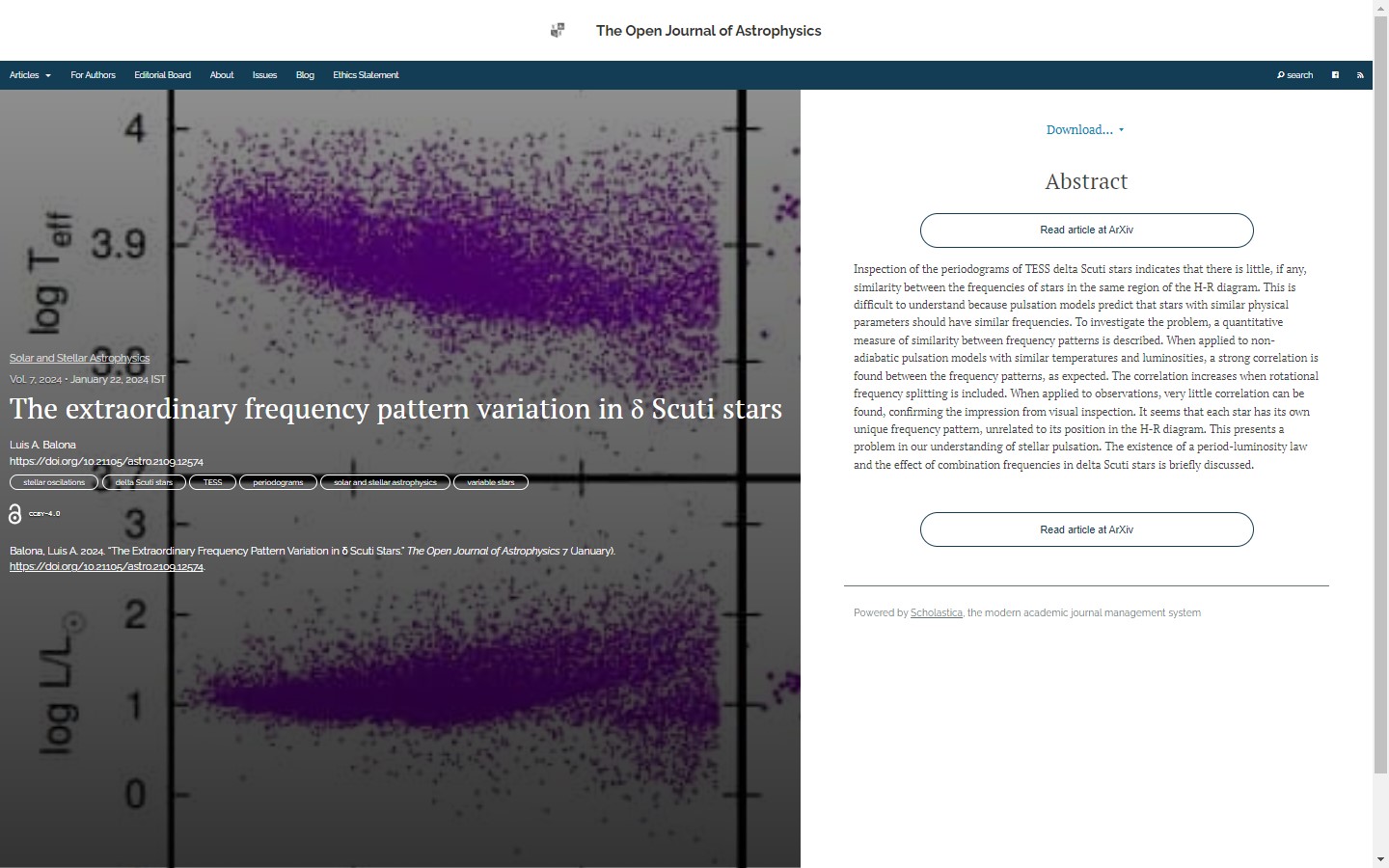
First one up is “The extraordinary frequency pattern variation in δ Scuti stars” by  Luis A. Balona of the South African Astronomical Observatory in Cape Town, South Africa. This paper, published on 22nd  January 2024, is a study of the (lack of) correlation in the structure of periodograms in Transiting Exoplanet Survey Satellite (TESS) data relating to a oscillating delta Scuti variable stars. This paper is in the category of Solar and Stelllar Astrophysics.

Here is a screen grab of the overlay, which includes the abstract:


You can find the officially accepted version of the paper on the arXiv here.

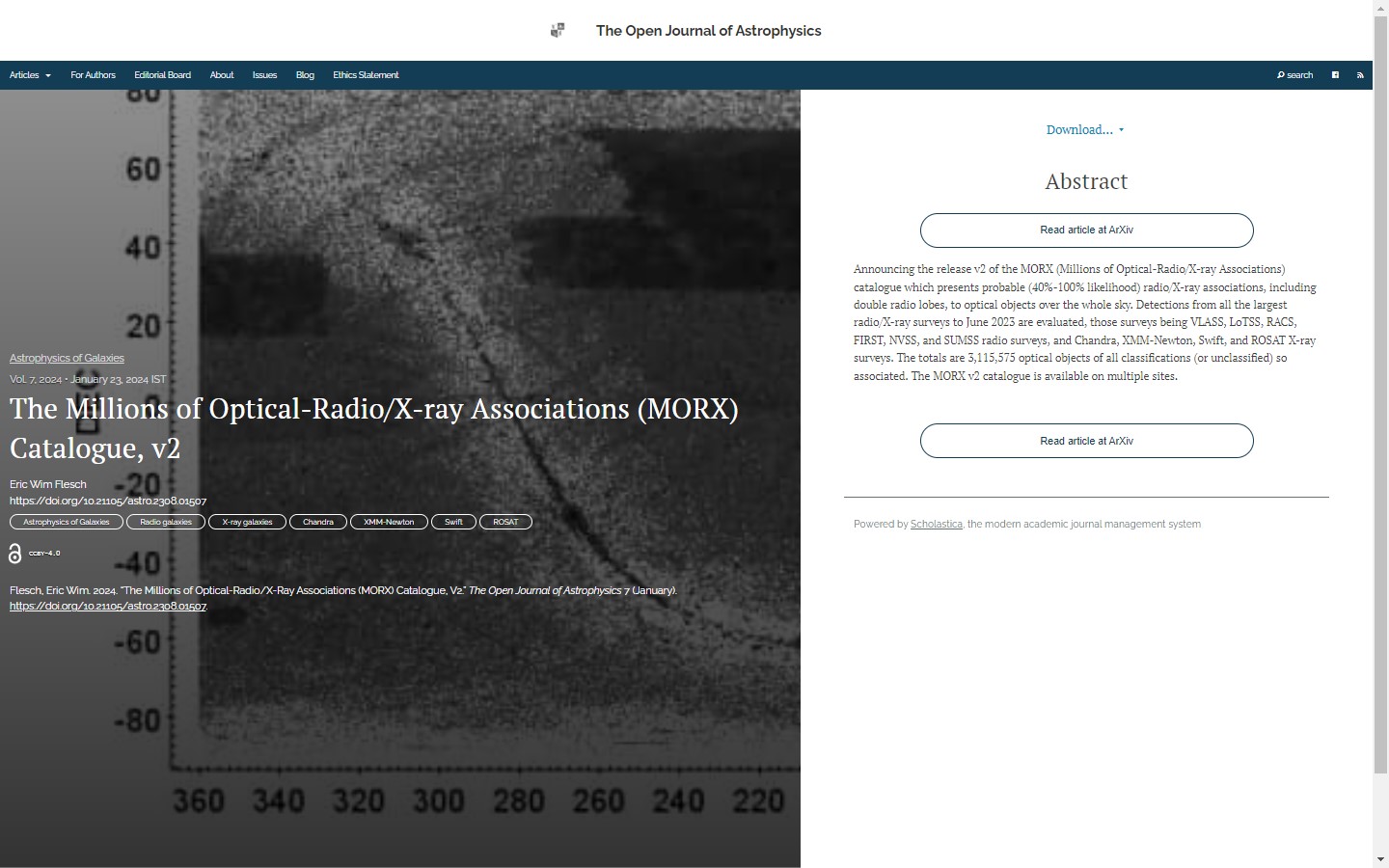
The second paper to announce is “The Millions of Optical-Radio/X-ray Associations (MORX) Catalogue, v2” by Eric Wim Flesch, an independent researcher based in New Zealand.  This presents the MORX catalogue of optical/radio/X-ray/ galaxy associations, containing over three million objects. The catalogue itself can be found in a number of locations on the web, e.g. here or here.

The paper was also published on 23rdJanuary 2024 in the category Astrophysics of Galaxies . You can see the overlay here:


The accepted version of this paper can be found on the arXiv here.

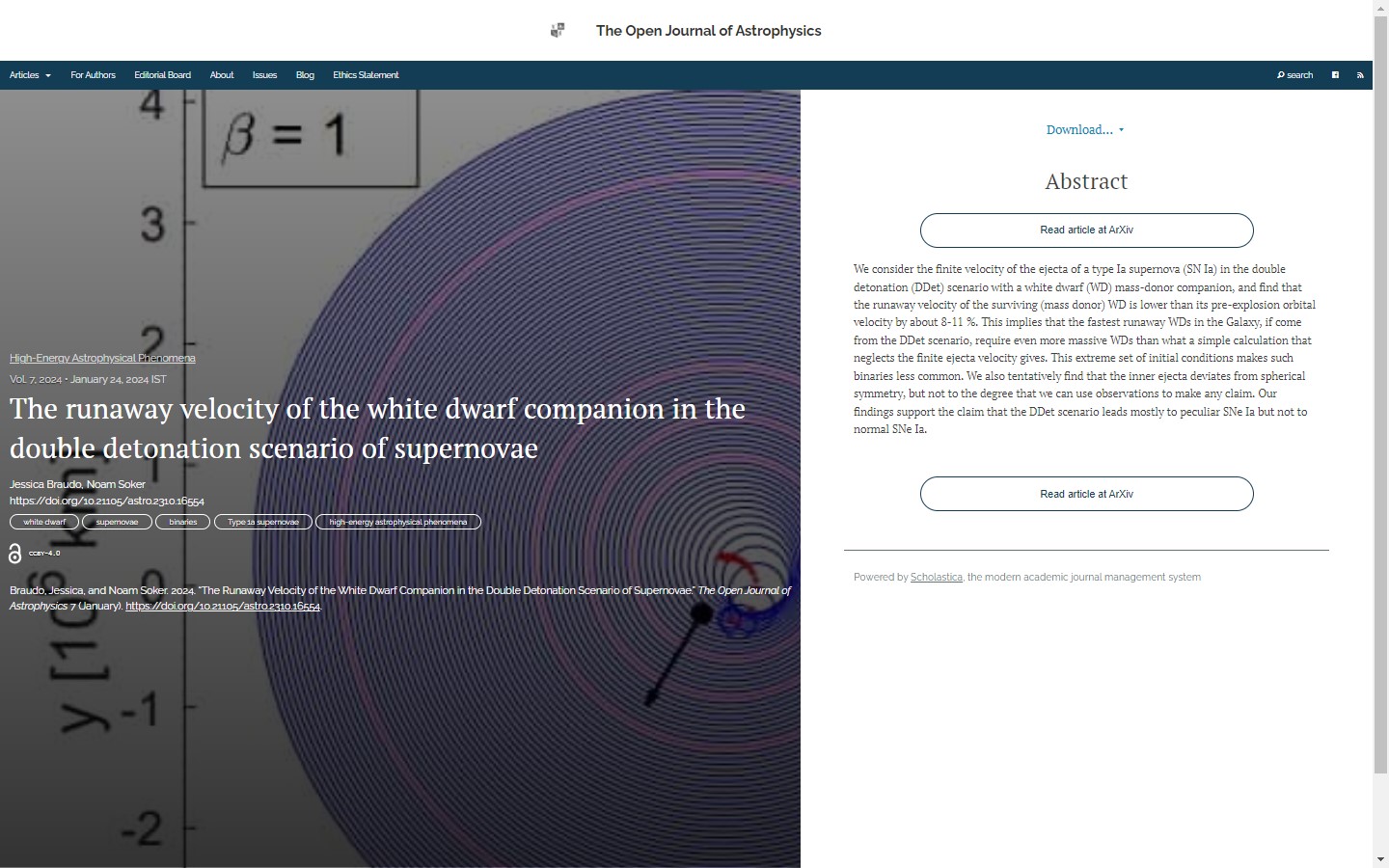
The last paper of this batch is  entitled “The runaway velocity of the white dwarf companion in the double detonation scenario of supernovae” and the authors are Jessica Braudo and Noam Soker of Technion, Haifa, in Israel.  This paper, which presents a study of ejection velocities in the double-detonation scenario of Type 1a Supernovae was published on 24th January 2024 and is in the folder marked High-Energy Astrophysical Phenomena.

Here is the overlay:


You can find the full text for this one on the arXiv here.

And that concludes the update.  As you can see, we’re getting a bit more diverse in terms of subject matter, which is nice. There’ll be more next week!