Archive for Open Journal of Astrophysics

Open Journal of Astrophysics Update

Posted in OJAp Papers, Open Access with tags , , , , , on April 4, 2024 by telescoper

I’ve just noticed that my post earlier in the week about changes to the publication system at the Open Journal of Astrophysics is dated April 1st. I can assure you it wasn’t meant as a joke! Anyway, the integration with Crossref is now complete and I’ve started clearing the backlog of papers waiting to be published. I would say normal service has been resumed, but the idea is to make the process faster and more reliable than before so it’s hopefully a return but to better-than-normal service.

I want first of all to thank the people at Maynooth University Library, Crossref, and Scholastica for helping us figure out the issue and solve it. We would no doubt have got there faster were it not for the intervention of the Easter break, but in any case it has only required a pause of publication for a couple of weeks.

I’ll resume the regular weekly updates at the weekend. However, one paper got snarled up when we ran into a problem. Although published on 20th March, it was never properly registered with Crossref. The only way I could think of to sort out the issue with this one was to start it again, which I did this morning, and it is now published though I kept the publication date as 20th March.

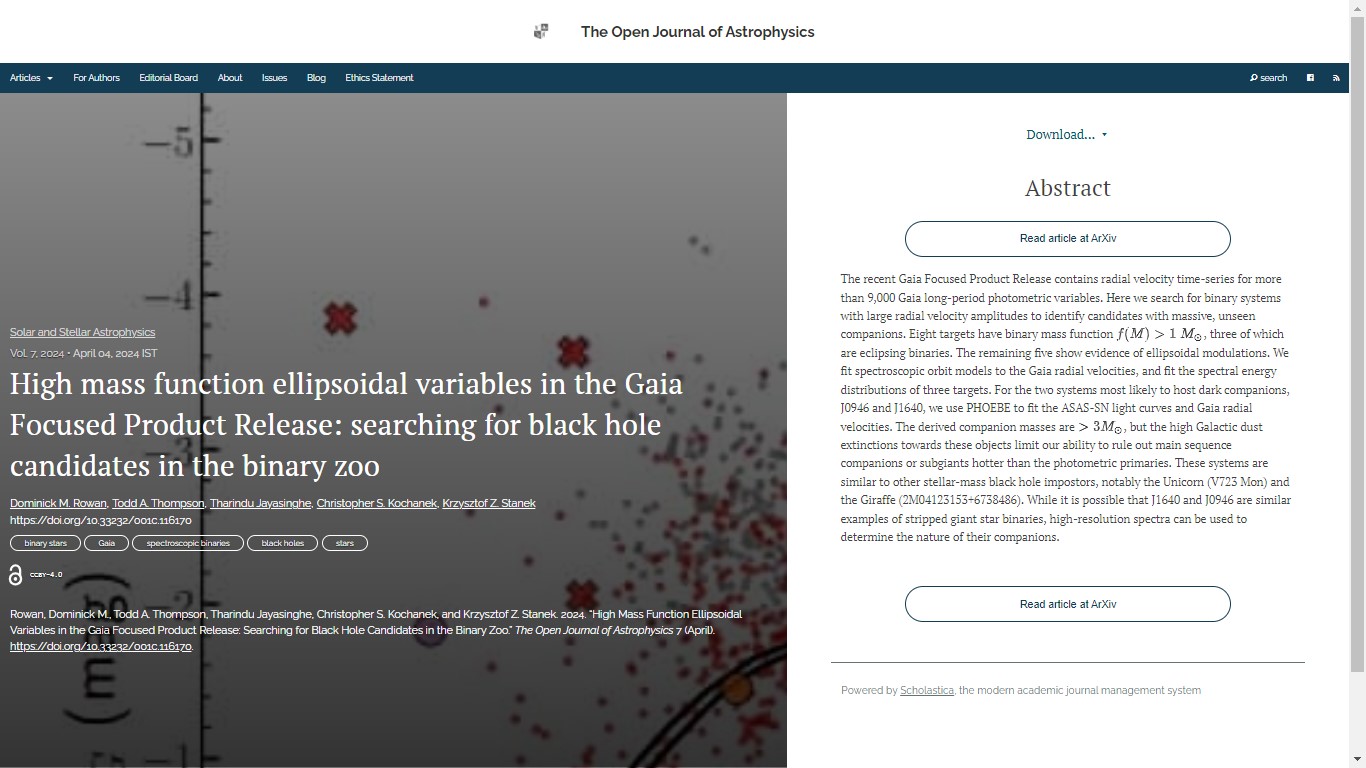
This paper, by Yingtian Chen and Oleg Gnedin of the University of Michigan, is the 21st paper to be published in Volume 7 and the 136th altogether. It is a study of kinematic, chemical and age data of globular clusters from Gaia yielding clues to how the Milky Way Galaxy assembled. You can read the article on arXiv directly here.

You will note the new format of DOI on the overlay. Nothing else has changed that’s visible to the reader.

Changes at the Open Journal of Astrophysics

Posted in Maynooth, Open Access with tags , , , , , , , on April 1, 2024 by telescoper

Regular readers of this blog – both of them – will have noticed that I haven’t posted any new publications from the Open Journal of Astrophysics for a couple of weeks. The reason for this is that we are switching to a new system of publishing that automatically integrates the Scholastica platform with Crossref, the system that (among many other things) keeps track of citations to published articles.

Up to now, I have had to prepare manually an XML file containing the metadata for each paper for upload, then send it to a colleague to register with Crossref. There are two problems with this. One is that transcribing the information from each overlay is prone to errors (made by me), especially if there is a long author list. The other problem is that it is rather slow and inefficient, which wasn’t such a problem when we were only publishing a few papers, but now that we are handling much more it is taking up too much time.

The obvious solution is to cut out the middle man (i.e. me) and register everything with Crossref directly from our platform. That will ensure that what goes to Crossref will be exactly the same as on our website and it will go there much faster. Another advantage is that if there is an error on the platform, such as a spelling mistake in an author name, correcting it there will automatically update the metadata on Crossref. You have no idea how much time and frustration this will save. Up to now we have to raise a ticket with Crossref for their staff to make the change, which can take a while to complete.

Scholastica offers a way to do this integration, but it doesn’t work with our existing Digital Object Identifiers (DOIs), which have the format 10.21105/astro.1234.56789, because it doesn’t allow us to include the “astro” which we need it to do because we share the prefix (10.21105) with another journal, the Journal of Open Source Software and we need to keep the two separate; they use 10.21105/joss at the start of their DOIs. After much to-ing and fro-ing we were unable to persuade Scholastica to change their policy, so to use their integration we have been forced to change prefix. Fortunately, Maynooth University (which runs Maynooth Academic Publishing, the official publisher of OJAp) is registered to mint its own DOIs so we can switch to a new prefix (10.33232) and avoid potential problems with the old one.

This change seems straightforward but it requires Crossref to switch the “ownership” of the journal and give us permission to add new papers with the same journal title “The Open Journal of Astrophysics” from what is effect a new publisher. This is a straightforward process, but has been a bit slower than expected because of the Easter break. I expect it to be completed in a week or so, at the latest.

It is important to stress that this change only affects the DOIs and registration of new papers. Existing papers are not affected at all: they continue with the old DOIs. The DOI is meant to be a persistent identifier so this is as it should be. The name of our website domain (astro.theoj.org) remains unchanged too. In other words, nothing visible to authors will change except for the format of the DOIs and the fact we go from acceptance to publication even faster.

If al this seems rather boring, that’s because it is. But please bear with us while we complete this change. It’s definitely going to be worth it in the long run, for me if nobody else!

Three New Publications at the Open Journal of Astrophysics

Posted in OJAp Papers, The Universe and Stuff with tags , , , , , , , , , , , , , , , , on March 19, 2024 by telescoper

Now that I’m safely back in Barcelona it’s a time for a roundup of the latest business at the  Open Journal of Astrophysics. The latest batch of publications consists of three papers, taking the count in Volume 7 (2024) up to 20 and the total published by OJAp up to 135.

This time the papers are all related, have many authors in common, and have the same first author, Philip F. Hopkins of Caltech. In fact the second and third papers in this batch were accepted well before the first one, but it seemed to make much more sense to publish them together so I held those two back a bit and published all three on 14th March.

The three papers published, with their overlays, are as follows. You can click on the images of the overlays to make them larger should you wish to do so. You can read these publications directly on arXiv if you wish; you will find them here, here and here.

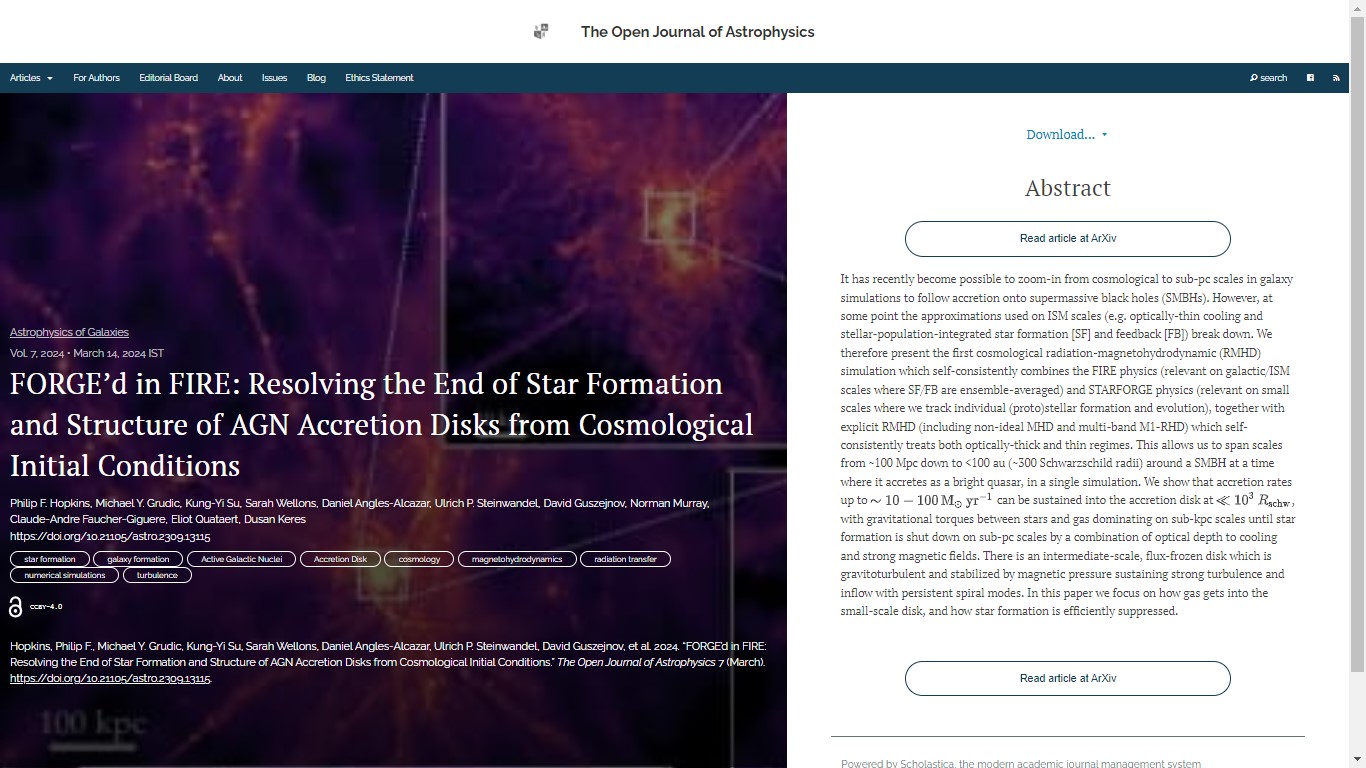
First one up is “FORGE’d in FIRE: Resolving the End of Star Formation and Structure of AGN Accretion Disks from Cosmological Initial Conditions” in which, using a full cosmological simulation, incorporating radiation and magnetohydrodynamics, the authors study the formation and structure of AGN accretion disks and their impact on star formation. This one is in the folder marked Astrophysics of Galaxies.

The authors (ten from the USA and one from Canada) are Philip F. Hopkins (Caltech), Michael Y. Grudic (Carnegie Observatories), Kung-Yi Su (Harvard), Sarah Wellons (Wesleyan University), Daniel Angles-Alcazar (University of Connecticut & Flatiron Institute), Ulrich P. Steinwandel (Flatiron Institute), David Guszejnov (University of Texas at Austin), Norman Murray (CITA, Toronto, Canada), Claude-Andre Faucher-Giguere (Northwestern University), Eliot Quataert (Princeton), and Dusan Keres (University of California, San Diego or UCSD for short).

Here is a screen grab of the overlay, which includes the abstract:


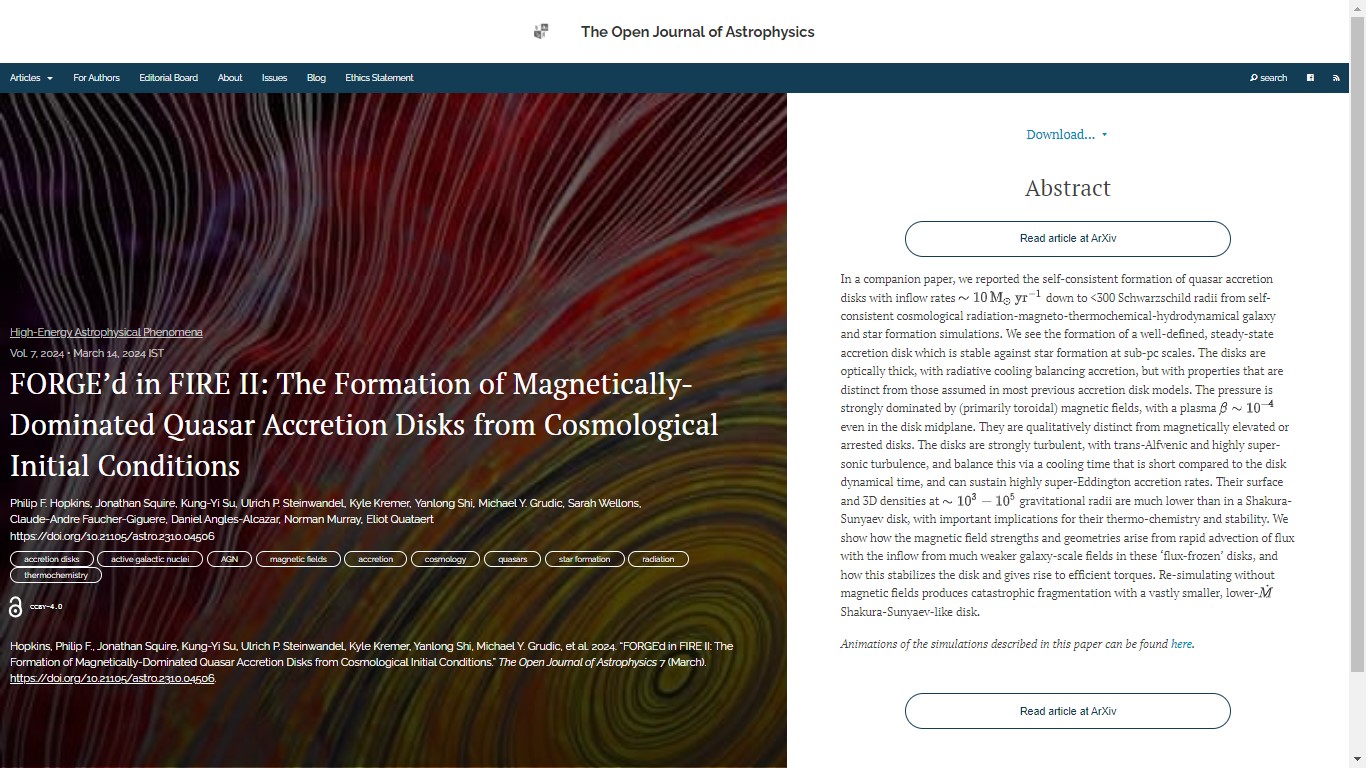
The second paper to announce is “FORGE’d in FIRE II: The Formation of Magnetically-Dominated Quasar Accretion Disks from Cosmological Initial Conditions” which is a study of the formation and properties of highly magnetized accretion disks using numerical simulations that include the effects of radiation, magnetic fields, thermochemistry, and star formation.

This one is in the folder High-Energy Astrophysical Phenomena. The authors (ten based in the USA, one fin Canada, and one in New Zealand) are Philip F. Hopkins, Jonathan Squire (University of Dunedin, New Zealand), Kung-Yi Su (Harvard), Ulrich P. Steinwandel (Flatiron Institute), Kyle Kremer (Caltech), Yanlong Shi (Caltech), Michael Y. Grudic (Carnegie Observatories), Sarah Wellons (Wesleyan University), Claude-Andre Faucher-Giguere (Northwestern University), Daniel Angles-Alcazar (University of Connecticut & Flatiron Institute), Norman Murray (CITA, Toronto), and Eliot Quataert (Princeton).


The last paper of this batch, also in the folder High-Energy Astrophysical Phenomena, is  entitled “An Analytic Model For Magnetically-Dominated Accretion Disks” and is closely related to the previous one; this particular paper presents an analytic similarity model for accretion disks that agrees remarkably well with the simulations in the previous one. Animations of the simulations referred to in both papers can be found here.

Here is the overlay:

The authors of this one are Philip F. Hopkins, Jonathan Squire, Eliot Quataert, Norman Murray, Kung-Yi Su, Ulrich P. Steinwandel, Kyle Kremer, Claude-Andre Faucher-Giguere, and Sarah Wellons. You can find all their affiliations above.
That’s all for now. More news in a week or so!


Scopus Update

Posted in Open Access with tags , , on March 15, 2024 by telescoper

A couple of months ago I blogged about how the Open Journal of Astrophysics had been accepted for listing on Scopus. The process has turned out to be much slower than I was led to believe and the “technical team” responsible for the indexing required much more help than I’d imagined, so we’re not fully there yet. However, I can confirm that we are in the process. This is an excerpt from the accepted titles list which you can find here:

The Scopus indexation process seems to involve processing every article manually, so it’s possible that there will be some errors. Here is a verbatim excerpt from a recent email from the Scopus team that perhaps illustrates why I lack confidence in the process:

We have activated your journal for Scopus indexation and you will be able to find the content indexed online shortly. The title, however, will take some time to have a source page and you will not be able to view it on source list. If the articles indexed on Scopus exceeds 15, Source Page for your title will be automatically created during Scopus browser update. Post which the title will be discoverable on Scopus source list as well.

I hope this clarifies the situation.

Two New Publications at the Open Journal of Astrophysics

Posted in OJAp Papers, Open Access, The Universe and Stuff with tags , , , , , , , , , , on February 24, 2024 by telescoper

It’s Saturday morning in Sydney, and time to post another update relating to the  Open Journal of Astrophysics.  Since the last update we have published two more papers, taking  the count in Volume 7 (2024) up to 15 and the total published by OJAp up to 130. I should have posted these before leaving but it slipped my mind.

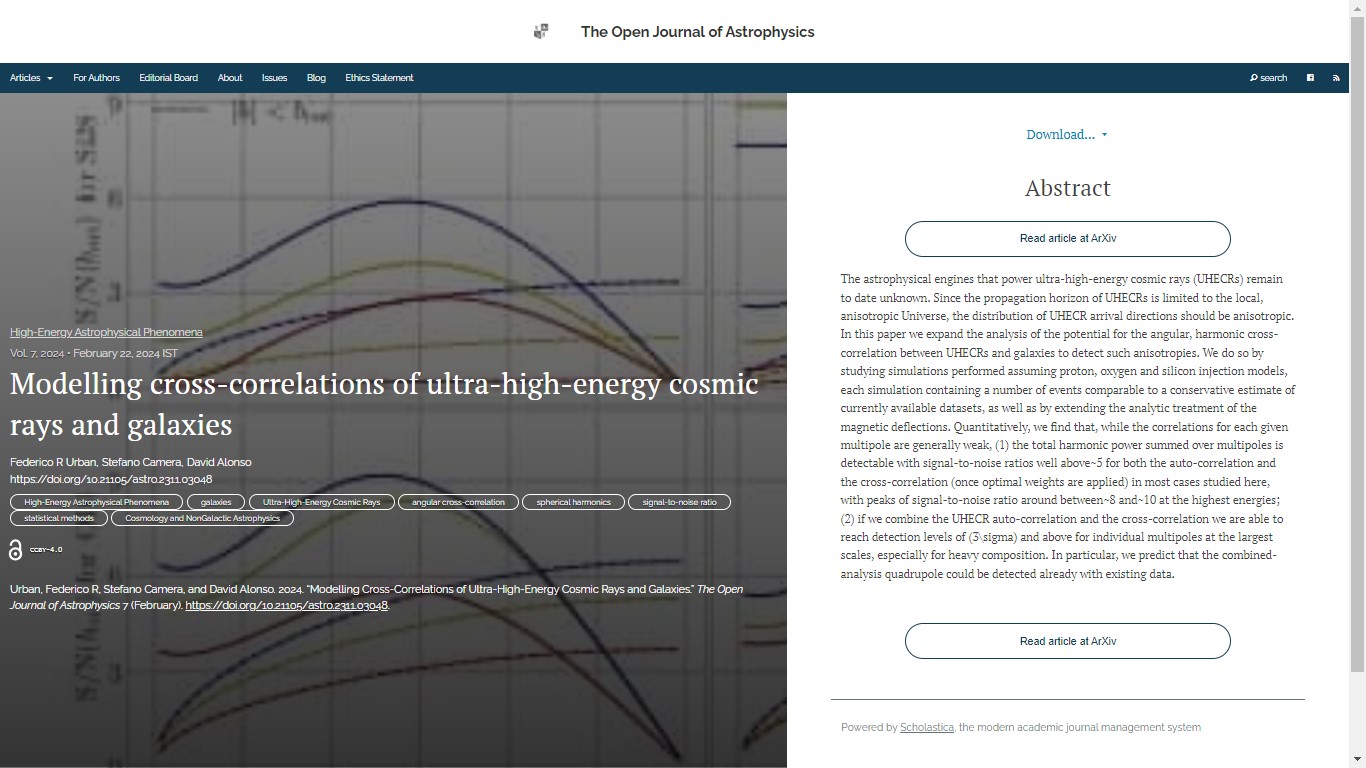
The first paper of the most recent pair – published on  Thursday 22nd February – is “Modelling cross-correlations of ultra-high-energy cosmic rays and galaxies” by Federico Urban (Prague, Czech Republic), Stefano Camera (Torino, Italy) and David Alonso (Oxford, UK). It presents a discussion of the possible statistical correlations between Ultra-High-Energy Cosmic-Ray (UHECR) directions in various models and structure in the galaxy distribution and whether or not this signal could be measurable.  This one is in the folder marked “High-Energy Astrophysical Phenomena“.

Here is a screen grab of the overlay which includes the abstract:
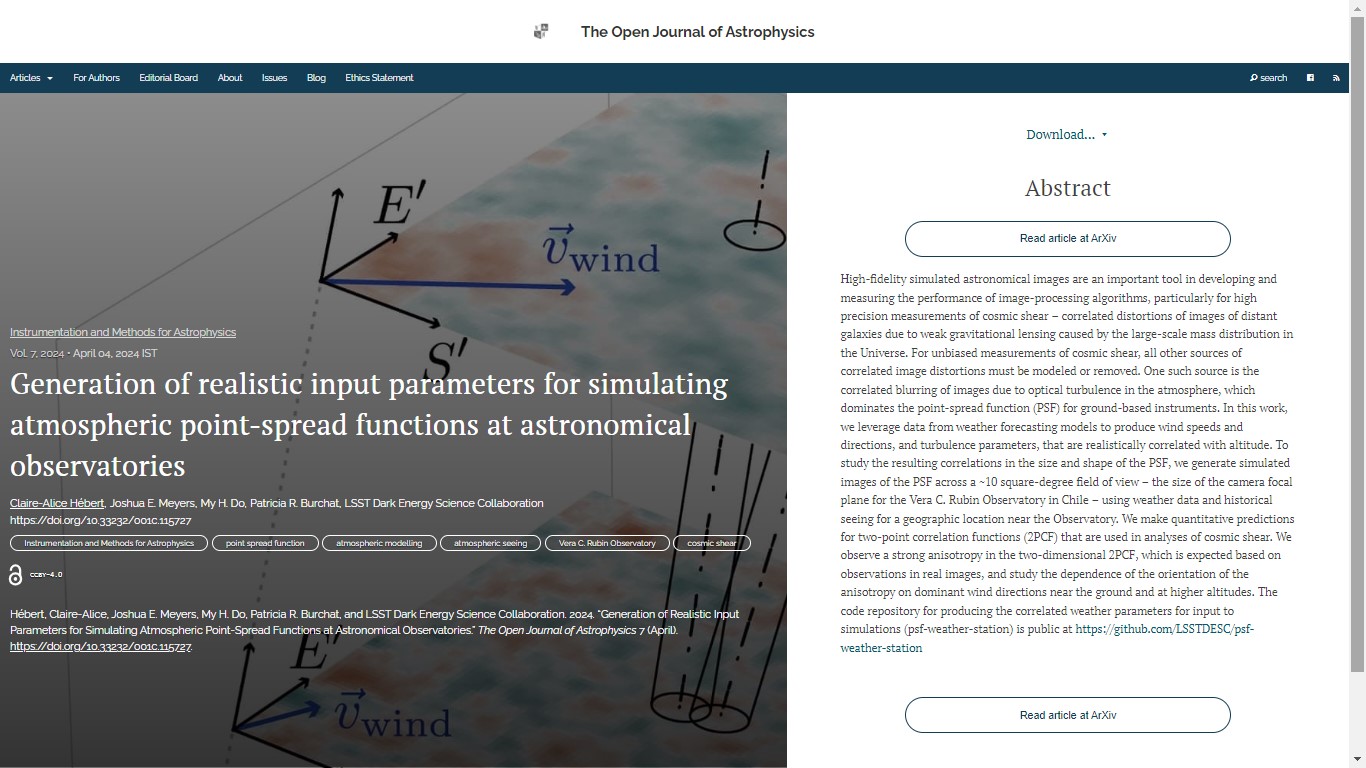
You can click on the image of the overlay to make it larger should you wish to do so. You can find the officially accepted version of the paper on the arXiv here.

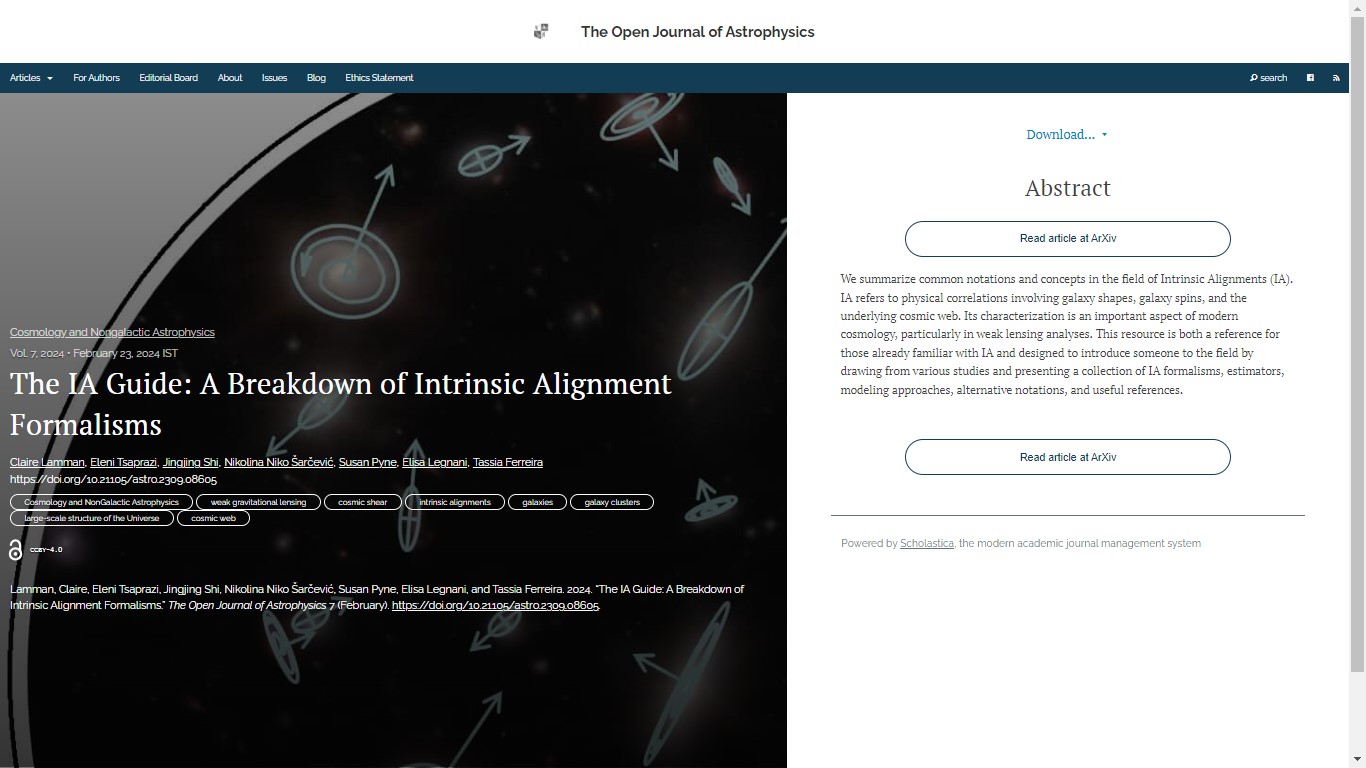
The second paper was published on Friday 23rd February and has the title “The IA Guide: A Breakdown of Intrinsic Alignment Formalisms” and the authors are: Claire Lamman (Harvard, USA);  Eleni Tsaprazi (Stockholm, Sweden);  Jingjing Shi (Tokyo, Japan); Nikolina Niko Šarčević (Newcastle, UK); Susan Pyne (UCL, UK); Elisa Legnani (Barcelona, Spain); and Tassia Ferreira (Oxford, UK). This one, which is in the folder marked Cosmology and NonGalactic Astrophysics, presents a review of Intrinsic Alignments, i.e. physical correlations involving galaxy shapes, galaxy spins, and larger scale structure, especially important for weak gravitational lensing

Here is a screen grab of the overlay which includes the abstract:


You can click on the image of the overlay to make it larger should you wish to do so. You can find the officially accepted version of the paper on the arXiv here.

That concludes this week’s update!

Open Access Talk at UNSW

Posted in Biographical, Open Access, The Universe and Stuff with tags , , , on February 21, 2024 by telescoper

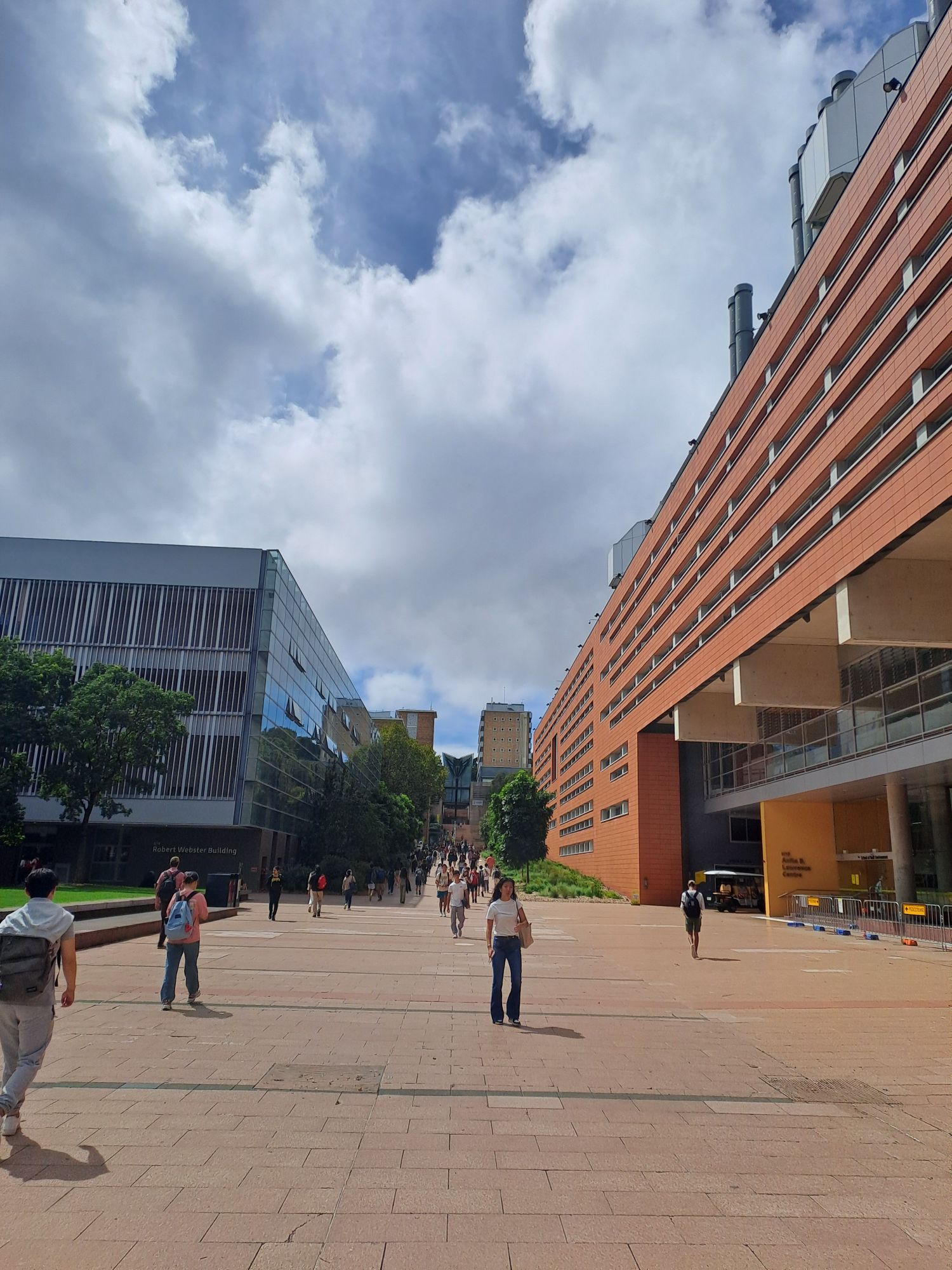
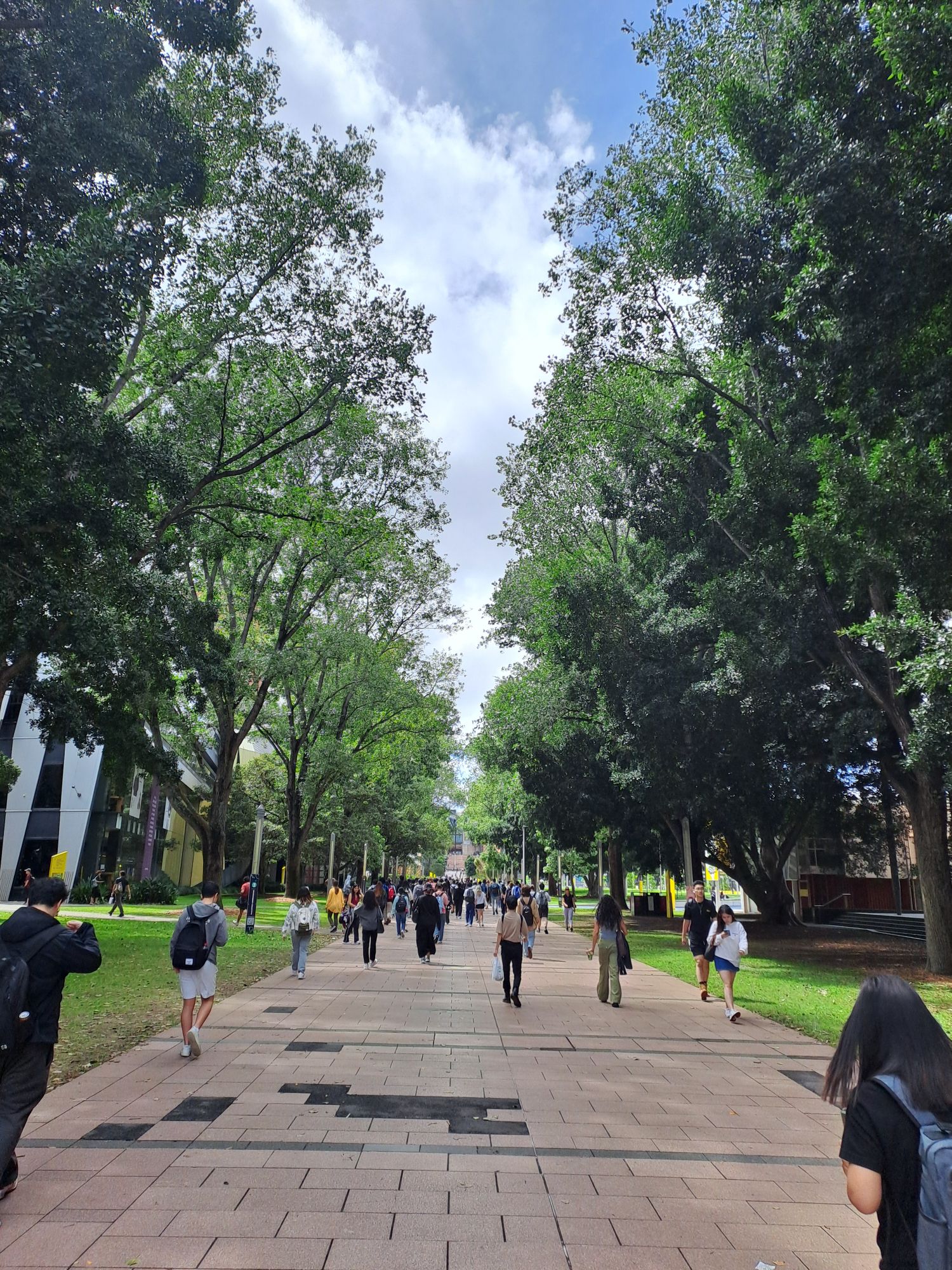
After an exciting start to the day involving a fire alarm and consequent evacuation of my hotel, I today ventured into the suburbs of Sydney via the Light Rail system (i.e. the tram) to the University of New South Wales. The tram ride took about 20 minutes from Central and, incidentally, took me right past the Sydney Cricket Ground. Anyway, the UNSW campus at Kensington is very impressive:

After a few gremlins with the WIFI connection, the talk I gave was a longer version of the one I did at the University of Sydney on Monday. In discussions with the Astrophysics group at UNSW, I found they were particularly unhappy about the decision of Monthly Notices of the Royal Astronomical Society to charge a high level of APC (Article Processing Artificial Profit Charge) so is looking at alternative journals that aren’t so exploitative. A journal has no right to call itself “open access” if it excludes researchers on grounds of cost. The problem with the Open Journal of Astrophysics in this case is that they need their publications to be in “high impact journals” for research assessment purposes, and OJAp doesn’t have an “official” journal impact factor yet. The fascination of bureaucrats with the obviously flawed journal impact factor disturbs me greatly but I hope we will have one soon so we may be able to help them out before too long.

Anyway, here are the slides from today’s talk:

ArXiv Accessibility

Posted in Open Access with tags , , , , on February 19, 2024 by telescoper

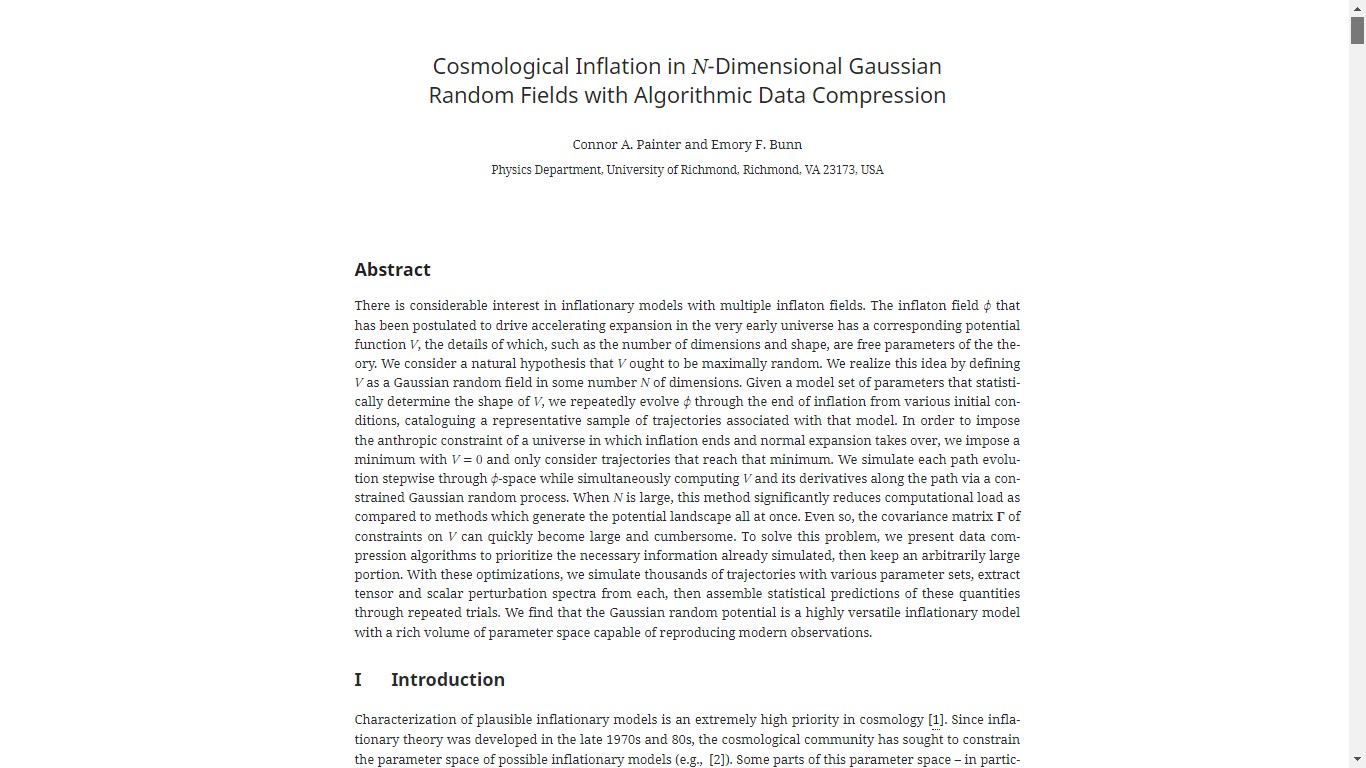
Just over a year ago I did a post about the need to make arXiv more accessible, particularly for readers with some form of visual impairment. Although I missed it at the time, there was an announcement from arXiv in December 2023 that new papers (by which is meant submitted after 1st December 2023) will be available as HTML as well as PDF format. This has been in development for some time, actually, and HTML versions have been available from arXiv labs by changing the address of a paper from, for example, “https://arxiv.org/abs/2111.15014v3” to “https://ar5iv.org/abs/2111.15014v3“. The latter produces this HTML version of one of the papers we have published at the Open Journal of Astrophysics:

As you can see, it works pretty well for this example.

Naturally I tried out the new “beta” release of the HTML generator, which you can now find on the right-hand panel of the abstract page alongside the PDF download instead of fiddling around with the URL. Here is an example of one of our papers on which it works well:

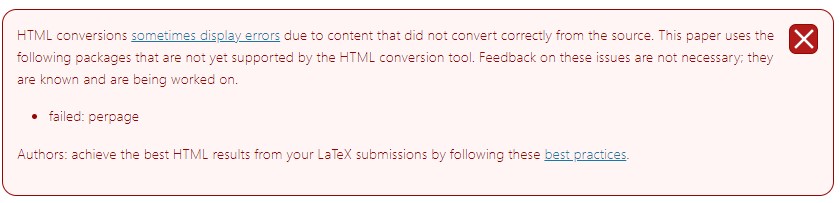
Here it is on another of our OJAp papers which, as you can see, does not work:

You can see the reason for the failure, which is that the LaTex used to generate the paper contains a package the HTML generator does not know about. One of the difficulties for arXiv is that new packages are always being developed and it is hard to keep up. I’m told that on average arXiv achieves ~75% successful conversions (and 97% partial success), but the articles from January 2024 (which contain more new packages) convert with a success rate of only 62%. It’s far from perfect, but it will improve -especially if authors follow the advice on best practice produced by arXiv; I actually think authors have a responsibility to help arXiv as much as possible in this regard.

This all reminds me of past experiences I’ve had teaching theoretical physics to blind and partially-sighted students. Years ago this used to involve making Braille copies of notes, but there are now various bits of software to help such people manage LaTeX both for creating and reading documents. In particular there are programs that can read Latex documents (including formulae and equations) which means that if a lecturer can supply LaTeX source version of their notes, the student can hear them spoken out loud as well as make their own annotations/corrections. While HTML may well be better for some fields, I do wonder if physicists and other people in disciplines that make heavy use of mathematics might prefer to use the LaTeX source code which is already downloadable from arXiv?

Talking Down Under

Posted in OJAp Papers, Open Access, The Universe and Stuff with tags , , , on February 19, 2024 by telescoper

This morning I gave a short talk at the “Astronomy Tea” at the Sydney Institute for Astronomy. No prizes for guessing what I talked about. The talk was followed by questions and then by a huge thunderstorm.

Here are the slides:

P.S. Today was the first day of teaching of the new academic year at the University of Sydney, so the campus was much busier today than it has been.

New Publication at the Open Journal of Astrophysics

Posted in OJAp Papers, Open Access, The Universe and Stuff with tags , , , , , , , on February 16, 2024 by telescoper

It’s Saturday morning here in Sydney, which means it is time for another weekly update from the Open Journal of Astrophysics. In fact there is only one paper to report this week, being  the 13th paper in Volume 7 (2024)  and the 128th altogether. It was published on February 15th 2024.

The title is “Jet – counter-jet asymmetry in the jittering jets explosion mechanism of supernovae” and it  This one is in the folder called High-Energy Astrophysical Phenomena. The paper presents a discussion of the production of jets in core-collapse supernovae and the resulting formation of neutron stars, and the implications for the morphology of the supernova remnant.

The sole author of the paper is Noam Soker of Technion, Haifa, in Israel.

Here is the overlay of the paper containing the abstract:


You can click on the image of the overlay to make it larger should you wish to do so. You can find the officially accepted version of the paper on the arXiv here.

Article Processing Charges for Monthly Notices of the Royal Astronomical Society

Posted in Open Access with tags , , , , , on January 19, 2024 by telescoper

As it was foretold, since January 1st 2024 the journal Monthly Notices of the Royal Astronomical Society (MNRAS) is now charging authors an Article Processing Charge (APC) at the (suitably astronomical) level of £2310 (approx €2700 at current rates) for each paper. There are exemptions in certain situations, such as if the author’s institution has signed up to a read-and-publish agreement via JISC (although that still involves a researcher’s institution paying unjustifiable amounts to the publisher).

The fundamental fact is that it just doesn’t cost £2310 to publish a paper online. That APC level is – for one paper – larger than the entire running costs of the Open Journal of Astrophysics for a year.

I did actually laugh out loud when I saw the spin the RAS tried to put on this decision:

The RAS is excited to be a key contributor to the open science movement, helping to drive discoverability and change.

Au contraire. Gold Open Access a serious hindrance to the open science movement, as it involves hugely inflated costs to the authors in attempt to protect revenue in the face of declining subscription income. This means that many potential authors just will not be able to pay. That’s not Open Access. Switching from a ‘fleece-the-libraries’ model to a ‘fleece-the-authors’ alternative can in no way be regarded as a progressive move.

It is true that some institutions will pay the APC on behalf of their authors, but that is hardly the point. If institutions have cash to pay for astronomy publications to be open access then they would do far more good to the research community by giving it to the arXiv rather than to the publishing industry. When authors themselves see how much they have to pay to publish their work, many will realize that it is simply not worth the money. I refuse to pay any APC on principle.

The question for the Royal Astronomical Society, and indeed the other learned societies that fund their activities in a similar way, is whether they can find a sustainable funding model that takes proper account of the digital publishing revolution. If their revenue from publishing does fall, can they replace it? And, if not, in what form can they survive? I’d like to think that future operating models for such organizations would involve serving their respective communities, rather than fleecing them. I’d advocate a institutional subscriptions as a fairer and more transparent alternative to syphoning funds from library budgets or research grants.

Meanwhile, the new regime at MNRAS (and possibly its acceptance on Scopus) have led to steadily increasing activity at the Open Journal of Astrophysics. This morning I announced three more papers. I will post about them on here tomorrow. Diamond Open Access is the way forward. It’s just a question of time before everyone realizes it.