Archive for star formation

Four New Publications at the Open Journal of Astrophysics

Posted in OJAp Papers, Open Access, The Universe and Stuff with tags , , , , , , , , , , , , , on December 14, 2024 by telescoper

It’s Saturday morning once again so here’s another quick update of activity at the Open Journal of Astrophysics. Since the last update a week ago we have published  four papers, which takes the count in Volume 7 (2024) up to 114 and the total published altogether by OJAp up to 229. If we publish just one more paper between now and the end of the year, we will have published as many papers in 2024 as we have in all previous years.

Anyway, in chronological order of publication, the four papers published this week, with their overlays, are as follows. You can click on the images of the overlays to make them larger should you wish to do so.

First one up is “Star formation beyond galaxies: widespread in-situ formation of intra-cluster stars” by Niusha Ahvazi & Laura V. Sales (UC Riverside, USA), Julio F. Navarro (U. Victoria, Canada), Andrew Benson (Carnegie Obs. USA), Alessandro Boselli (Aix Marseille U., France) and Richard D’Souza (Vatican Obs.). The paper, which is in the folder marked Astrophysics of Galaxies, The paper presents a simulation-based analysis of a diffuse star forming component in galaxy clusters extending for hundreds of kiloparsecs and tracing the distribution of neutral gas in the cluster host halo.

Here is a screen grab of the overlay, which includes the abstract:

You can find the officially accepted version of the paper on the arXiv here.

The second paper to announce, published on 10th December 2024 in the folder Cosmology and NonGalactic Astrophysics, is “Cosmological Constraints from Combining Photometric Galaxy Surveys and Gravitational Wave Observatories” by E.L. Gagnon, D. Anbajagane, J. Prat, C. Chang, and J. Frieman (all of U. Chicago, USA). This article quantifies the expected cosmological information gain from combining the forecast LSST 3x2pt analysis with the large-scale auto-correlation of GW sources from proposed next-generation GW experiments.

You can see the overlay here:

The accepted version of this paper can be found on the arXiv here.

The third paper, also published on 10th December 2024, but in the folder marked Earth and Planetary Astrophysics, has the title “A potential exomoon from the predicted planet obliquity of β Pictoris b” and is written by Michael Poon, Hanno Rein, and Dang Pham all of the University of Toronto, Canada. It presents discussion, based on the β Pictoris system, of the idea that the presence of exomoons can excite misalignment between the spin and orbit axis (obliquity) in exoplanet systems

Here is the overlay

The final version accepted on arXiv is here.

Last of this quartet, published on 11th December 2024, and in the folder Cosmology and NonGalactic Astrophysics is “Map-level baryonification: Efficient modelling of higher-order correlations in the weak lensing and thermal Sunyaev-Zeldovich fields” and is by Dhayaa Anbajagane & Shivam Pandey (U. Chicago) and Chihway Chang (Columbia U.), all based in the USA.

The paper proposes an extension of the semi-analytic formalism to weak lensing and thermal Sunyaev-Zeldovich (tSZ) fields directly on the full-sky, with an emphasis on higher-order correlations. The overlay is here:

You can find the official accepted version on the arXiv here.

That’s all for this week. I’ll do another update next Saturday, and that will probably be the last one of the year. If we publish just one more paper between now and 31st December, we will have published as many papers in 2024 as we have in all previous years put together!

Four New Publications at the Open Journal of Astrophysics

Posted in OJAp Papers, Open Access, The Universe and Stuff with tags , , , , , , , , , , , on December 7, 2024 by telescoper

It’s Satuday morning once again so here’s another quick update of activity at the Open Journal of Astrophysics. Since the last update a week ago we have published  four papers, which takes the count in Volume 7 (2024) up to 110 and the total published altogether by OJAp up to 225.

In chronological order of publication, the four papers published this week, with their overlays, are as follows. You can click on the images of the overlays to make them larger should you wish to do so.

First one up is “The impact of feedback on the evolution of gas density profiles from galaxies to clusters: a universal fitting formula from the Simba suite of simulations” by Daniele Sorini & Sownak Bose (Durham University, UK), Romeel Davé (University of Edinburgh, UK), and Daniel Anglés-Alcázar (University of Connecticut, USA). The paper, which is in the folder marked Astrophysics of Galaxies, presents a study of the effects of stellar and/or AGN feedback on the shape and evolution of gas density profiles in galaxy haloes using the SIMBA simulations. It was published on Tuesday 3rd December 2024.

Here is a screen grab of the overlay, which includes the abstract:


You can find the officially accepted version of the paper on the arXiv here.

The second paper to announce, also published on 3rd December 2024, and is also the folder “Astrophysics of Galaxies, is “Self-regulated growth of galaxy sizes along the star-forming main sequence” by Shweta Jain (U. Kentucky, USA), Sandro Tacchella (U. Cambridge, UK) and Moein Mosleh (Shiraz University, Iran).  This paper suggestes an identification of a possible self-regulating mechanism in galaxy size growth involving the interplay between feedback from star formation and newly accreted gas.

You can see the overlay here:


The accepted version of this paper can be found on the arXiv here.

The third paper, published on Thursday 6th December 2024 in the folder marked Cosmology and NonGalactic Astrophysics, is called  “BLAST: Beyond Limber Angular power Spectra Toolkit. A fast and efficient algorithm for 3×2 pt analysis” by Sofia Chiarenza, Marco Bonici & Will Percival (Waterloo, Canada) and Martin White (Berkeley, USA). It presents BLAST, an efficient algorithm for calculating angular power spectra without employing the Limber approximation or assuming a scale-dependent growth rate, based on the use of Chebyshev polynomials. The code is written in Julia.

Here is the overlay


The final version accepted on arXiv is here.

Last in this batch, published on 6th December 2024, and in the folder Astrophysics of Galaxies, is “On the universality of star formation efficiency in galaxies” by Ava Polzin & Andrey V. Kravtsov (U. Chicago) and Vadim A. Semenov & Nickolay Y. Gnedin (CfA Harvard), all based in the USA. The paper presents an argument that the universality of observational estimates of star formation efficiency per free-fall time can be plausibly explained by the turbulence-driven and feedback-regulated properties of star-forming regions.

You can find the official accepted version on the arXiv here.

We seem to have recovered from a small Thanksgiving lull and, looking at the OJAp workflow, I think we’ll have a similar number of publications next week. I’ll do another update next weekend!

Two New Publications at the Open Journal of Astrophysics

Posted in OJAp Papers, Open Access, The Universe and Stuff with tags , , , , , , , , , , on October 26, 2024 by telescoper

It’s Saturday morning again so here’s another report on activity at the  Open Journal of Astrophysics.  Since the last update we have published two more papers, taking  the count in Volume 7 (2024) up to 95 and the total published by OJAp up to 210.  We’ve still got a few in the pipeline waiting for the final versions to appear on arXiv so I expect we’ll reach the 100 mark for 2024 in the next couple of weeks.

The first paper of the most recent pair, published on October 22 2024,  and in the folder marked Astrophysics of Galaxies, is “Cloud Collision Signatures in the Central Molecular Zone”  by Rees A. Barnes and Felix D. Priestley (Cardiff University, UK) .  This paper presents an analysis of combined hydrodynamical, chemical and radiative transfer simulations of cloud collisions in the Galactic disk and Central Molecular Zone (CMZ).

Here is a screen grab of the overlay which includes the abstract:


You can click on the image of the overlay to make it larger should you wish to do so.  You can find the officially accepted version of this paper on the arXiv here.

The second paper has the title “Partition function approach to non-Gaussian likelihoods: macrocanonical partitions and replicating Markov-chains” and was published October 25th 2024. The authors are Maximilian Philipp Herzog, Heinrich von Campe, Rebecca Maria Kuntz, Lennart Röver and Björn Malte Schäfe (all of Heidelberg University, Germany). This paper, which is in  the folder marked Cosmology and NonGalactic Astrophysics, describes a method of macrocanonical sampling for Bayesian statistical inference, based on the macrocanonical partition function, with applications to cosmology.

Here is a screen grab of the overlay which includes the abstract:


You can click on the image of the overlay to make it larger should you wish to do so. You can find the officially accepted version of the paper on the arXiv here.

That concludes this week’s update. More  next week!

Two New Publications at the Open Journal of Astrophysics

Posted in OJAp Papers, Open Access, The Universe and Stuff with tags , , , , , , , , , , on April 20, 2024 by telescoper

It’s Saturday, and it’s time to post another update relating to the  Open Journal of Astrophysics.  Since the last update we have published two more papers, taking  the count in Volume 7 (2024) up to 27 and the total published by OJAp up to 142.

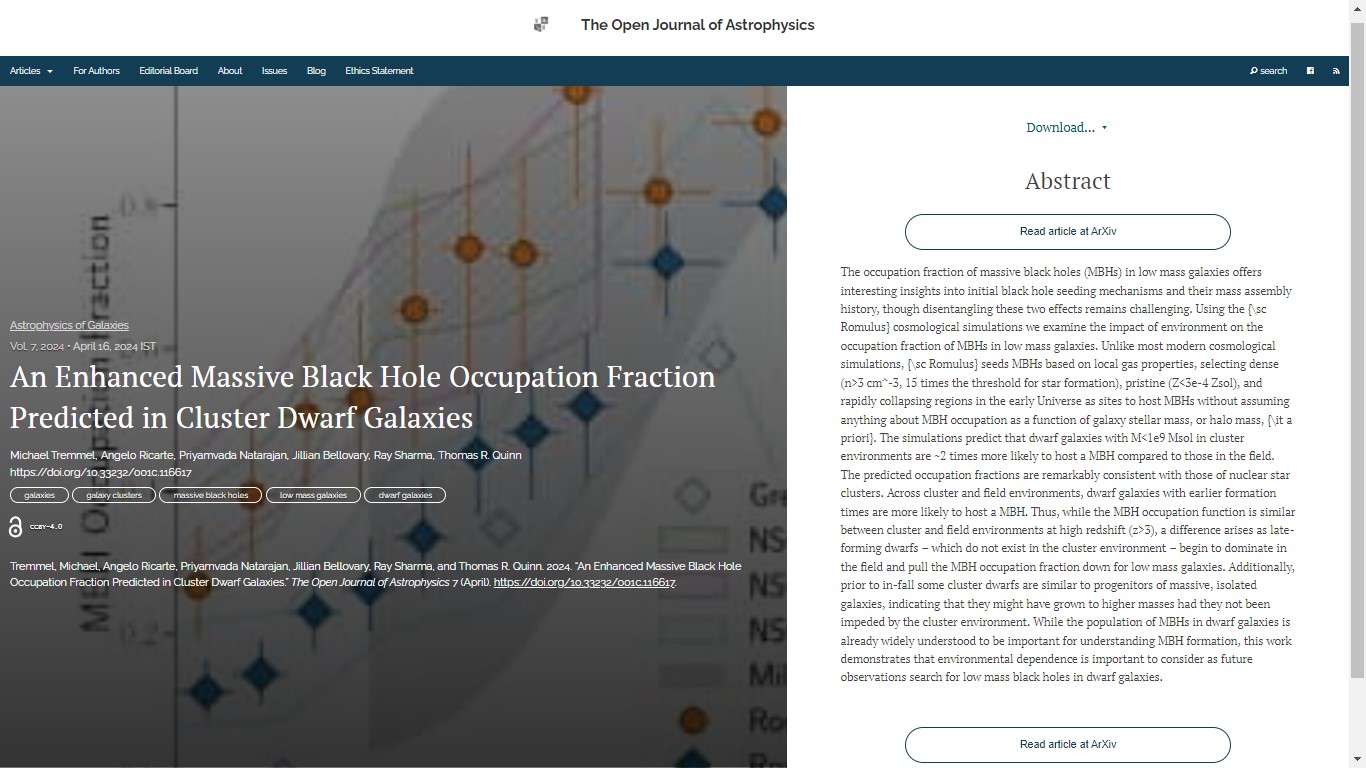
The first paper of the most recent pair – published on  Tuesday April 16th – is “An Enhanced Massive Black Hole Occupation Fraction Predicted in Cluster Dwarf Galaxies” by Michael Tremmel (UCC, Ireland), Angelo Ricarte (Harvard, USA), Priyamvada Natarajan (Yale, USA), Jillian Bellovar (American Museum of Natural History, New York, USA), Ray Sharma (Rutgers, USA), Thomas R. Quinn (University of Washington, USA). It presents a  study, based on the Romulus cosmological simulations, of the impact of environment on the occupation fraction of massive black holes in low mass galaxies. This one is in the folder marked “Astrophysics of Galaxies“.

Here is a screen grab of the overlay which includes the abstract:


You can click on the image of the overlay to make it larger should you wish to do so. You can find the officially accepted version of the paper on the arXiv here.

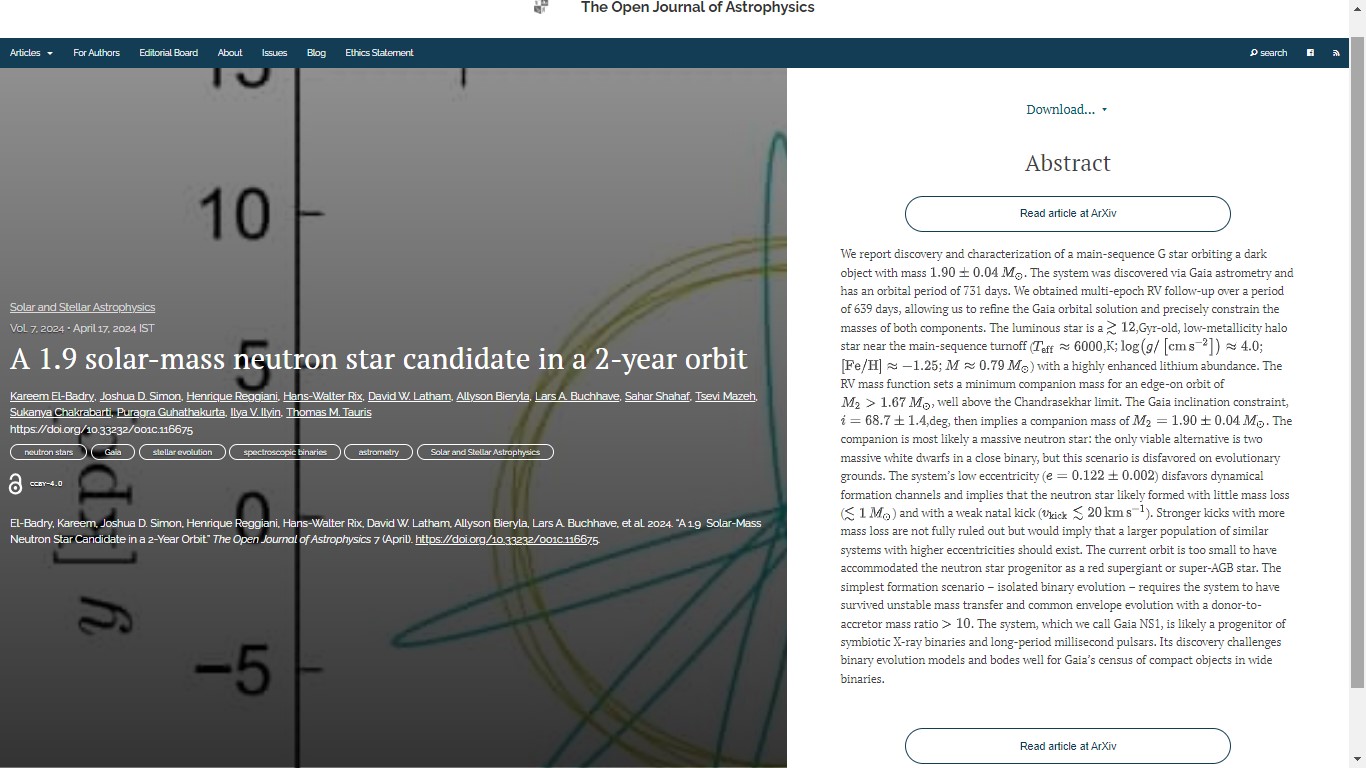
The second paper was published on Wednesday 17th April and has the title “A 1.9 solar-mass neutron star candidate in a 2-year orbit” and the authors are: Kareem El-Badry (Caltech, USA), Joshua D. Simon (Carnegie Observatories, USA), Henrique Reggiani (Gemini Observatory, Chile), Hans-Walter Rix (Heidelberg, Germany),  David W. Latham (Harvard, USA),  Allyson Bieryla (Harvard, USA),  Lars A. Buchhave (Technical University of Denmark, Denmark),  Sahar Shahaf (Weizmann Institute of Science, Israel),  Tsevi Mazeh (Tel Aviv University, Israel), Sukanya Chakrabarti (University of Alabama, USA), Puragra Guhathakurta (University of California Santa Cruz, USA), Ilya V. Ilyin (Potsdam, Germany), and Thomas M. Tauris (Aalborg University, Denmark)

This one, which is in the folder marked Solar and Stellar Astrophysics, presents a discussion of the discovery of a 1.9 solar mass neutron star candidate using Gaia astrometric data, together with the implications of its orbital parameters for the formation mechanism.

Here is a screen grab of the overlay which includes the abstract:


You can click on the image of the overlay to make it larger should you wish to do so. You can find the officially accepted version of the paper on the arXiv here.

That concludes this week’s update!

Three New Publications at the Open Journal of Astrophysics

Posted in OJAp Papers, The Universe and Stuff with tags , , , , , , , , , , , , , , , , on March 19, 2024 by telescoper

Now that I’m safely back in Barcelona it’s a time for a roundup of the latest business at the  Open Journal of Astrophysics. The latest batch of publications consists of three papers, taking the count in Volume 7 (2024) up to 20 and the total published by OJAp up to 135.

This time the papers are all related, have many authors in common, and have the same first author, Philip F. Hopkins of Caltech. In fact the second and third papers in this batch were accepted well before the first one, but it seemed to make much more sense to publish them together so I held those two back a bit and published all three on 14th March.

The three papers published, with their overlays, are as follows. You can click on the images of the overlays to make them larger should you wish to do so. You can read these publications directly on arXiv if you wish; you will find them here, here and here.

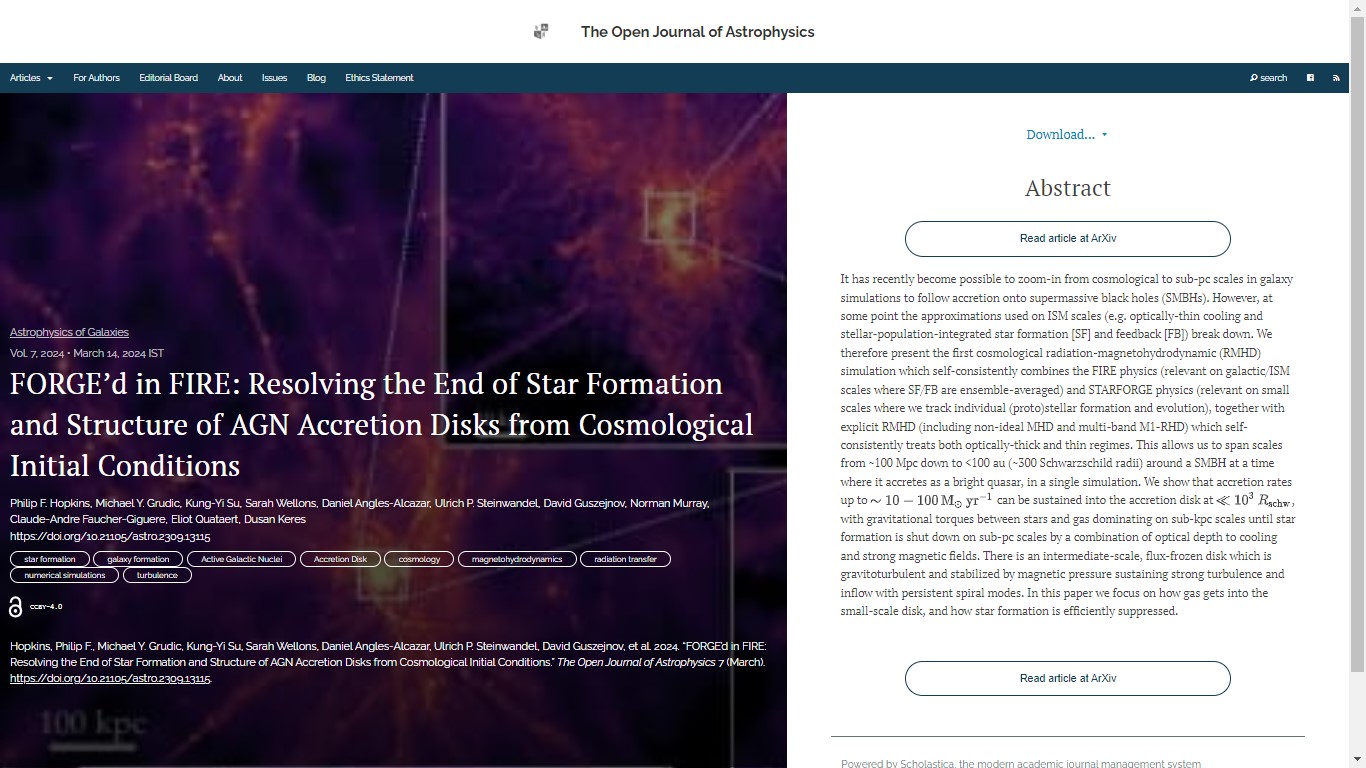
First one up is “FORGE’d in FIRE: Resolving the End of Star Formation and Structure of AGN Accretion Disks from Cosmological Initial Conditions” in which, using a full cosmological simulation, incorporating radiation and magnetohydrodynamics, the authors study the formation and structure of AGN accretion disks and their impact on star formation. This one is in the folder marked Astrophysics of Galaxies.

The authors (ten from the USA and one from Canada) are Philip F. Hopkins (Caltech), Michael Y. Grudic (Carnegie Observatories), Kung-Yi Su (Harvard), Sarah Wellons (Wesleyan University), Daniel Angles-Alcazar (University of Connecticut & Flatiron Institute), Ulrich P. Steinwandel (Flatiron Institute), David Guszejnov (University of Texas at Austin), Norman Murray (CITA, Toronto, Canada), Claude-Andre Faucher-Giguere (Northwestern University), Eliot Quataert (Princeton), and Dusan Keres (University of California, San Diego or UCSD for short).

Here is a screen grab of the overlay, which includes the abstract:


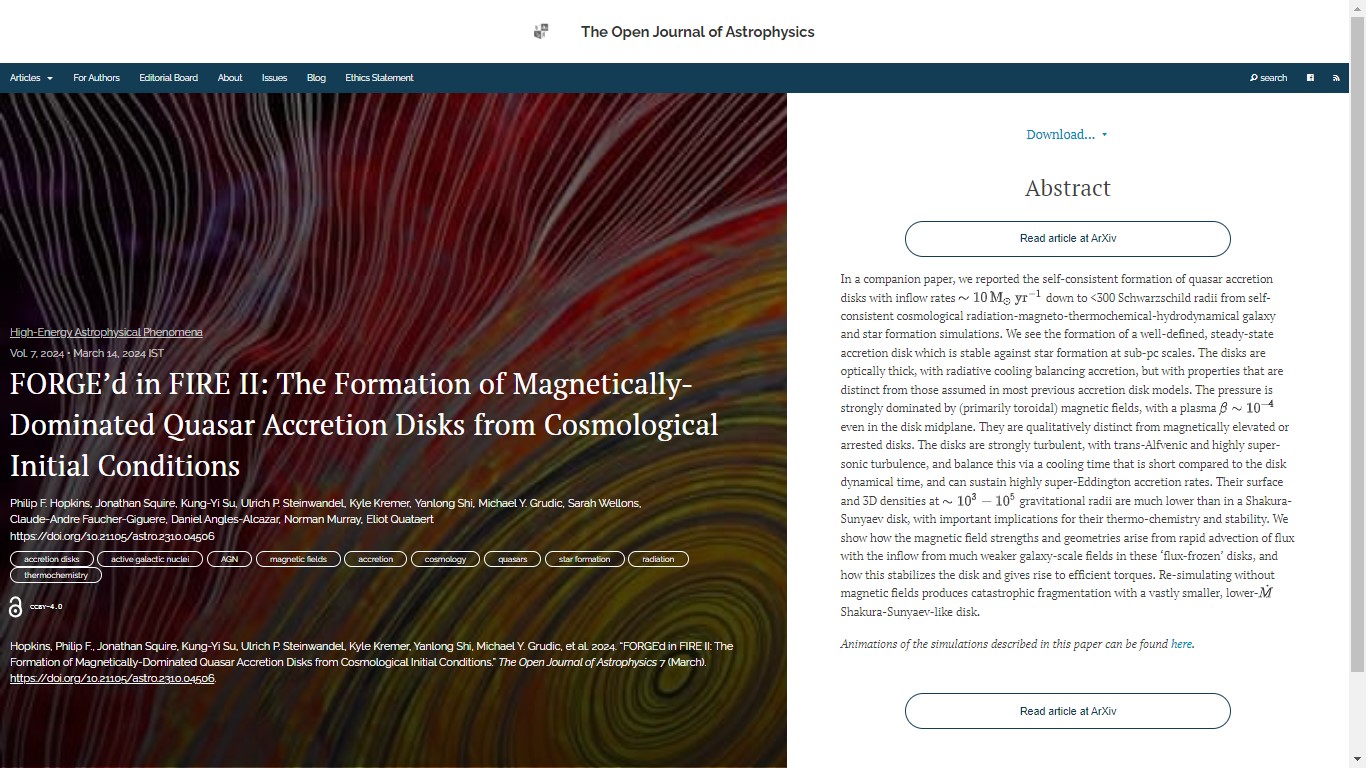
The second paper to announce is “FORGE’d in FIRE II: The Formation of Magnetically-Dominated Quasar Accretion Disks from Cosmological Initial Conditions” which is a study of the formation and properties of highly magnetized accretion disks using numerical simulations that include the effects of radiation, magnetic fields, thermochemistry, and star formation.

This one is in the folder High-Energy Astrophysical Phenomena. The authors (ten based in the USA, one fin Canada, and one in New Zealand) are Philip F. Hopkins, Jonathan Squire (University of Dunedin, New Zealand), Kung-Yi Su (Harvard), Ulrich P. Steinwandel (Flatiron Institute), Kyle Kremer (Caltech), Yanlong Shi (Caltech), Michael Y. Grudic (Carnegie Observatories), Sarah Wellons (Wesleyan University), Claude-Andre Faucher-Giguere (Northwestern University), Daniel Angles-Alcazar (University of Connecticut & Flatiron Institute), Norman Murray (CITA, Toronto), and Eliot Quataert (Princeton).


The last paper of this batch, also in the folder High-Energy Astrophysical Phenomena, is  entitled “An Analytic Model For Magnetically-Dominated Accretion Disks” and is closely related to the previous one; this particular paper presents an analytic similarity model for accretion disks that agrees remarkably well with the simulations in the previous one. Animations of the simulations referred to in both papers can be found here.

Here is the overlay:

The authors of this one are Philip F. Hopkins, Jonathan Squire, Eliot Quataert, Norman Murray, Kung-Yi Su, Ulrich P. Steinwandel, Kyle Kremer, Claude-Andre Faucher-Giguere, and Sarah Wellons. You can find all their affiliations above.
That’s all for now. More news in a week or so!


Three New Publications at the Open Journal of Astrophysics

Posted in OJAp Papers, Open Access, The Universe and Stuff with tags , , , , , , , , , , , , , , , , , on January 20, 2024 by telescoper

As promised yesterday, it’s time for a roundup of the week’s business at the  Open Journal of Astrophysics. This past week we have published three papers, taking  the count in Volume 7 (2024) up to 4 and the total published by OJAp up to 119. There are quite a few more ready to go as people return from the Christmas break.

In chronological order, the three papers published this week, with their overlays, are as follows. You can click on the images of the overlays to make them larger should you wish to do so.

First one up is “Prospects for studying the mass and gas in protoclusters with future CMB observations” by  Anna Gardner and Eric Baxter (Hawaii, USA), Srinivasan Raghunathan (NCSA, USA), Weiguang Cui (Edinburgh, UK), and Daniel Ceverino (Madrid, Spain). This paper, published on 17th January 2024, uses realistic hydrodynamical simulations to probe the ability of CMB Stage 4-like (CMB-S4) experiments to detect and characterize protoclusters via gravitational lensing and the Sunyaev-Zel’dovich effect. This paper is in the category of Cosmology and Nongalactic Astrophysics.

Here is a screen grab of the overlay, which includes the abstract:


You can find the officially accepted version of the paper on the arXiv here.

The second paper to announce is “SDSS J125417.98+274004.6: An X-ray Detected Minor Merger Dual AGN” and is by Marko Mićić, Brenna Wells, Olivia Holmes, and Jimmy Irwin (all of the University of Alabama, USA).  This presents the discovery of a dual AGN in a merger between the galaxy SDSS J125417.98+274004.6 and dwarf satellite, studied using X-ray observations from the Chandra satellite. The paper was also published on 18th January 2024 in the category Astrophysics of Galaxies . You can see the overlay here:


The accepted version of this paper can be found on the arXiv here.

The last paper of this batch is  entitled “Population III star formation: multiple gas phases prevent the use of an equation of state at high densities” and the authors are:  Lewis Prole (Maynooth, Ireland), Paul Clark (Cardiff, UK), Felix Priestley (Cardiff, UK), Simon Glover (Heidelberg, Germany) and John Regan (Maynooth, Ireland). This paper, which presents a comparison of results obtained using chemical networks and a simpler equation-of-state approach for primordial star formation (showing the limitations of the latter) was published on 19th January 2024 and also in the folder marked Astrophysics of Galaxies.

Here is the overlay:


You can find the full text for this one on the arXiv here.

And that concludes the update. There’ll be more next week!


Catching up on Cosmic Dawn

Posted in The Universe and Stuff with tags , , , , , on June 25, 2021 by telescoper

Trying to catch up on cosmological news after a busy week I came across a number of pieces in the media about “Cosmic Dawn” (e.g. here in The Grauniad). I’ve never actually met Cosmic Dawn but she seems like an interesting lady.

But seriously folks, Cosmic Dawn refers to the epoch during which the first stars formed in the expanding Universe lighting up the Universe after a few hundred million years of post-recombination darkness.

According to the Guardian article mentioned above the new results being discussed are published in Monthly Notices of the Royal Astronomical Society but they’re actually not. Yet. Nevertheless the paper (by Laporte et al.) is available on the arXiv which is where people will actually read it…

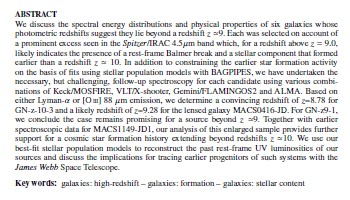
Anyway, here is the abstract:

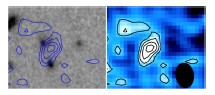
Here is a composite of HST and ALMA images for one of the objects discussed in the paper (MACS0416-JD):

I know it looks a bit blobby but it’s not easy to resolve things at such huge distances! Also, it’s quite small because it’s far away. In any case the spectroscopy is really the important thing, not the images, as that is what determines the redshift. The Universe has expanded by a factor 10 since light set out towards us from an object at redshift 9. I’m old enough to remember when “high redshift” meant z~0.1!

At the end of my talk on Wednesday Floyd Stecker asked me about what the James Webb Space Telescope (due for launch later this year) would do for cosmology and I replied that it would probably do a lot more for galaxy formation and evolution than cosmology per se. I think this is a good illustration of what I meant. Because of its infrared capability JWST will allow astronomers to push back even further and learn even more about how the first stars formed, but it won’t tell us much directly about dark matter and dark energy.

New Publication at the Open Journal of Astrophysics!

Posted in Maynooth, OJAp Papers, Open Access, The Universe and Stuff with tags , , , , , , on August 24, 2020 by telescoper

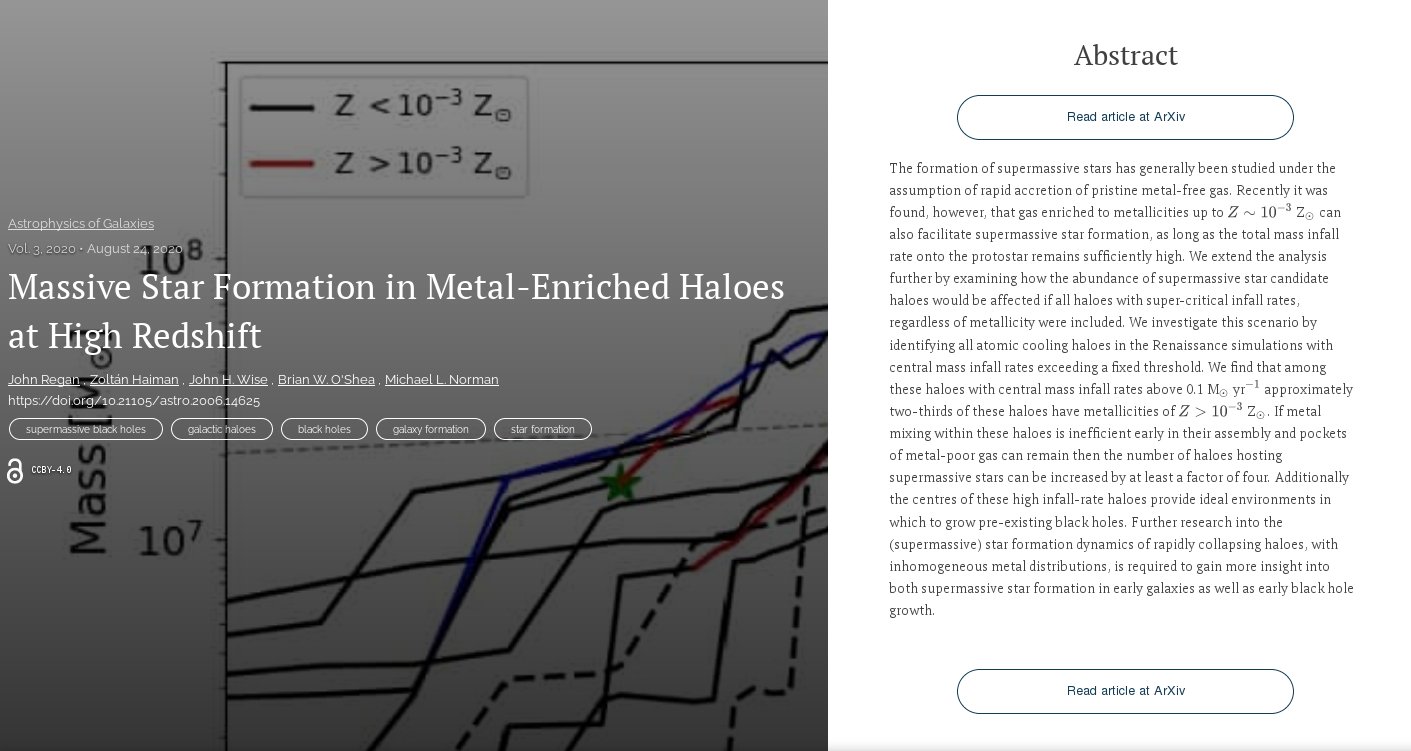
So another new paper has been published in the Open Journal of Astrophysics! This one is in the folder marked Astrophysics of Galaxies and is entitled Massive Star Formation in Metal-Enriched Haloes at High Redshift. I should explain that “Metal” here is the astrophysicist’s definition which basically means anything heavier than hydrogen or helium: chemists may look away now.

The authors of this paper are John Regan (of the Department of Theoretical Physics at Maynooth University), Zoltán Haiman (Columbia), John Wise (Georgia Tech), Brian O’Shea (Michigan State) and Michael Norman (UCSD). And before anyone asks, no I don’t force members of staff in my Department to submit papers to the Open Journal of Astrophysics and yes I did stand aside from the Editorial process because of the institutional conflict.

Here is a screen grab of the overlay:

You can click on the image to make it larger should you wish to do so.

You can find the arXiv version of the paper here.

Orion Nebula (Herschel, after Turner)

Posted in Art, The Universe and Stuff with tags , , , on September 6, 2013 by telescoper

I stumbled across this wonderful image (and associated description) yesterday and thought I’d share it. It’s a region of the Orion Nebula (which is located in the  Midlands region of Orion’s “sword”, i.e. the long thing hanging down below his belt).  It’s a turbulent region of dust and gas in which stars are forming. This image was taken in the far-infrared part of the spectrum by the Herschel Space Observatory, which is now defunct but much data remains to be analysed. Because the image was taken at wavelengths much longer than optical light, the colours are obviously “false”. I don’t work on star formation so I tend to see images like this just as beautiful things to be enjoyed for themselves rather than as a subject for scientific research. In fact, I have no difficulty at all in describing this picture as a work of art, slightly reminiscent of the cloudscapes and seascapes of  J.M.W Turner in that it is, at the same time, both a representation of a natural phenomenon and  an abstract creation that transcends it. You can click on the image to make it larger…

Orion_A

UPDATE: I see that someone else has thought of the parallel with Turner!

The Ant Whitworth Caption Competition

Posted in Uncategorized with tags , , , on June 26, 2012 by telescoper

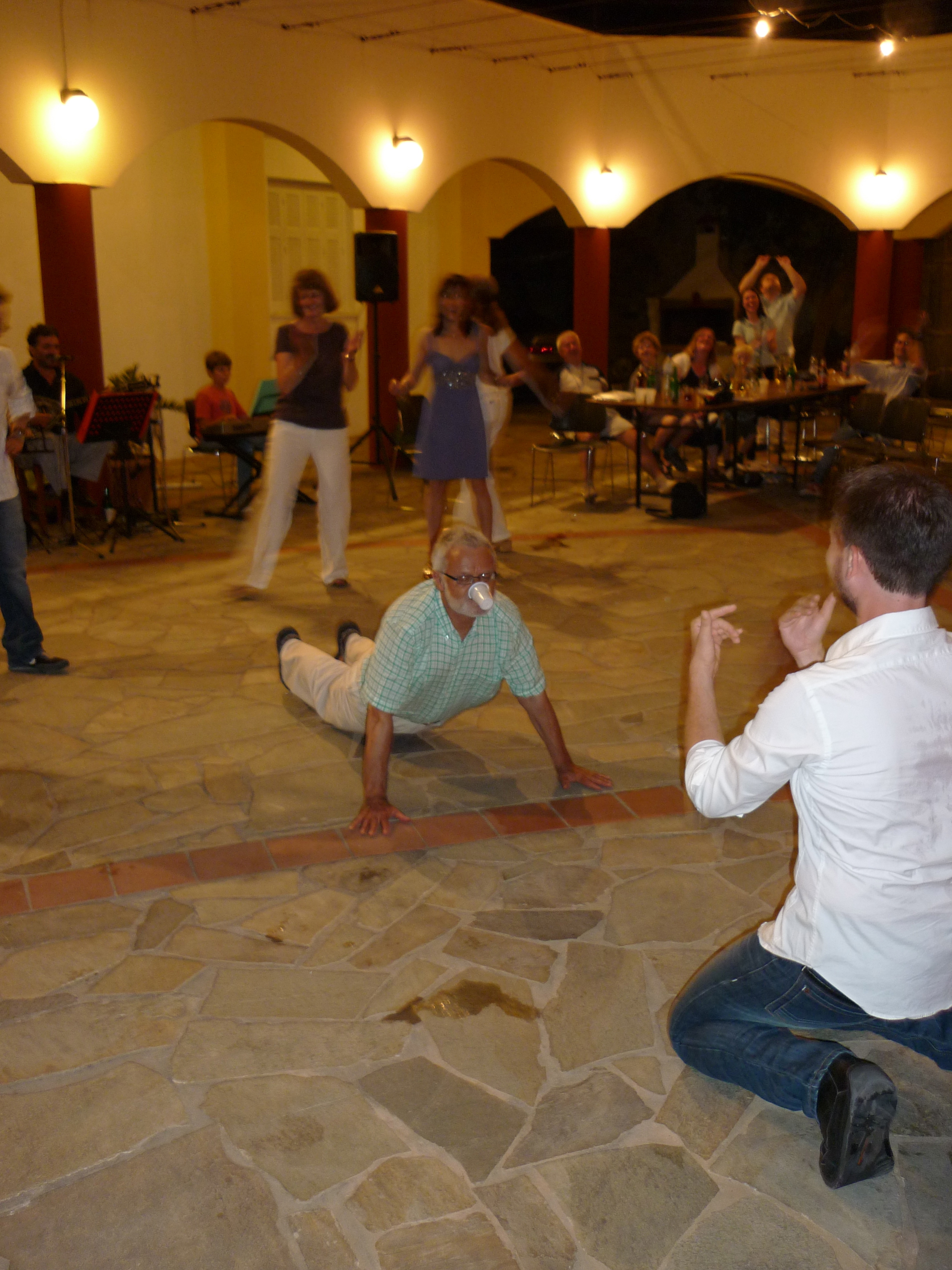
Last week a number of colleagues joined friends from around the world at a star formation conference in Crete to celebrate the scientific career of our esteemed Professor Anthony Whitworth who recently celebrated his nth birthday (n→∞). I wasn’t there myself, but an anonymous informant (Derek Ward-Thompson) gave me this photograph of said Professor, apparently taken at the conference dinner:

Don’t ask me what’s going on, but I think this picture is ripe fodder for a caption competition!

Please let me have your suggestions through the comments box…