Archive for strong gravitational lensing

Weekly Update from the Open Journal of Astrophysics – 13/09/2025

Posted in OJAp Papers, Open Access, The Universe and Stuff with tags , , , , , , , , , , , , , , , , , , , , , , , , , , , on September 13, 2025 by telescoper

It’s Saturday again, so it’s time for another summary of the week’s new papers at the Open Journal of Astrophysics. Since the last update we have published seven new papers, which brings the number in Volume 8 (2025) up to 134, and the total so far published by OJAp up to 369. We seem to be emerging for the slight late-summer hiatus we have experienced over the last few weeks.

Anyway, the first paper to report this week is “Observing the Sun with the Atacama Large Aperture Submillimeter Telescope (AtLAST): Forecasting Full-disk Observations” by Mats Kirkaune & Sven Wedemeyer (U. Oslo, Norway), Joshiwa van Marrewijk (Leiden U., Netherlands), Tony Mroczkowski (ESO, Garching, Germany) and Thomas W. Morris (Yale, USA). This paper discusses possible strategies and parameters for full-disk observations of the Sun using the proposed Atacama Large Aperture Submillimeter Telescope (AtLAST). It was published on Tuesday 9th September 2025 in the folder Solar and Stellar Astrophysics.

The overlay is here:


You can make this larger by clicking on it.  The officially accepted version of this paper can be found on the arXiv here.

The second paper this week, published on Wednesday 10th September in the folder Cosmology and NonGalactic Astrophysics, is “The exact non-Gaussian weak lensing likelihood: A framework to calculate analytic likelihoods for correlation functions on masked Gaussian random fields” by Veronika Oehl and Tilman Tröster (ETH Zurich, Switzerland).  This paper shows how to calculate likelihoods for the correlation functions of spin-2 Gaussian random fields defined on the sphere in the presence of a mask with applications to weak gravitational lensing.

The overlay is here:
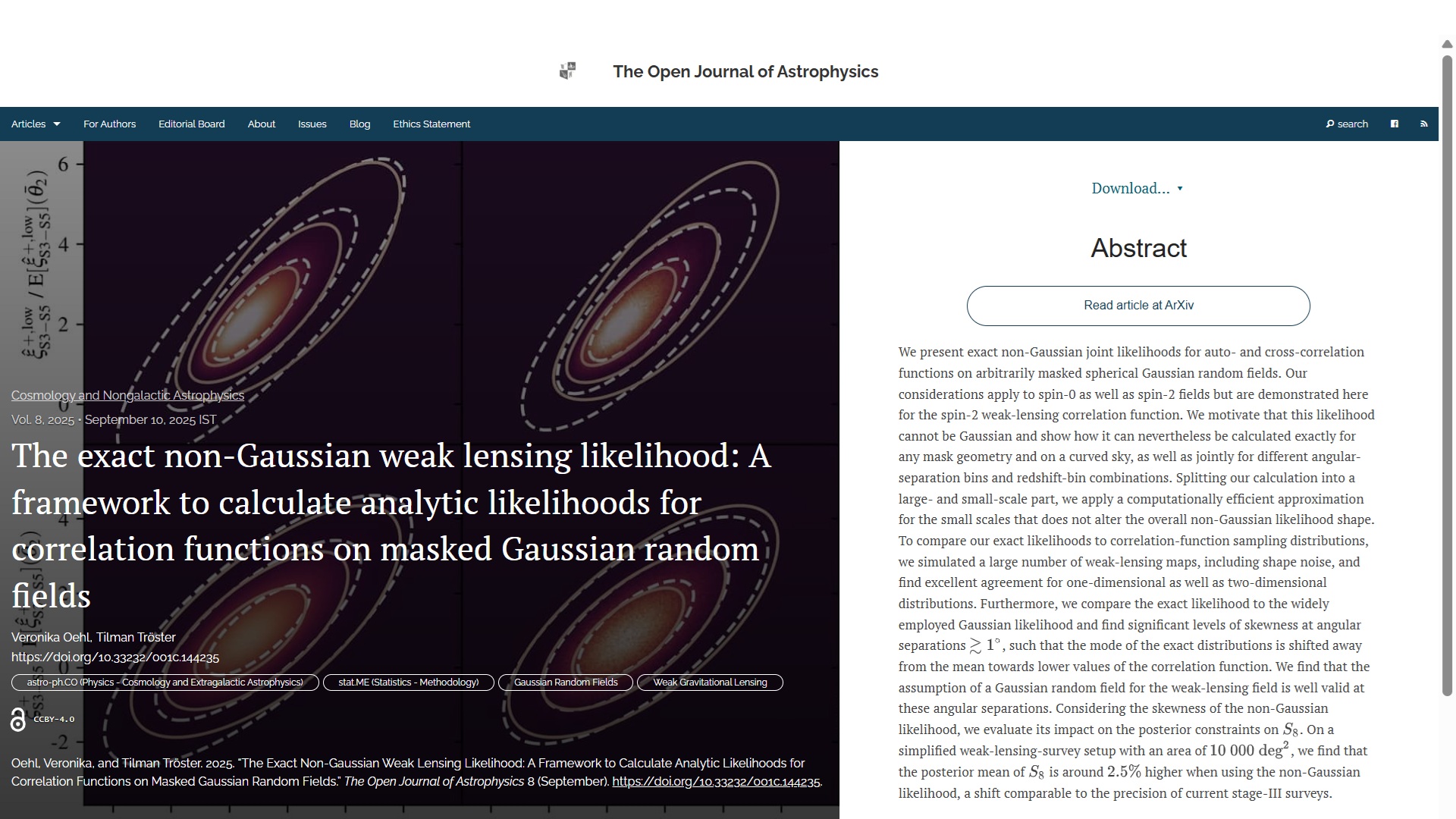
and you can find the final accepted version on arXiv here.

Next one up, the third paper this week, is  “Subspace Approximation to the Focused Transport Equation. II. The Modified Form” by B. Klippenstein and Andreas Shalchi (U. Manitoba, Canada). This was also published on 10th September 2025 in the folder Solar and Stellar Astrophysics. It is about solving the focused transport equation analytically and numerically using the subspace method in two or more dimensions.
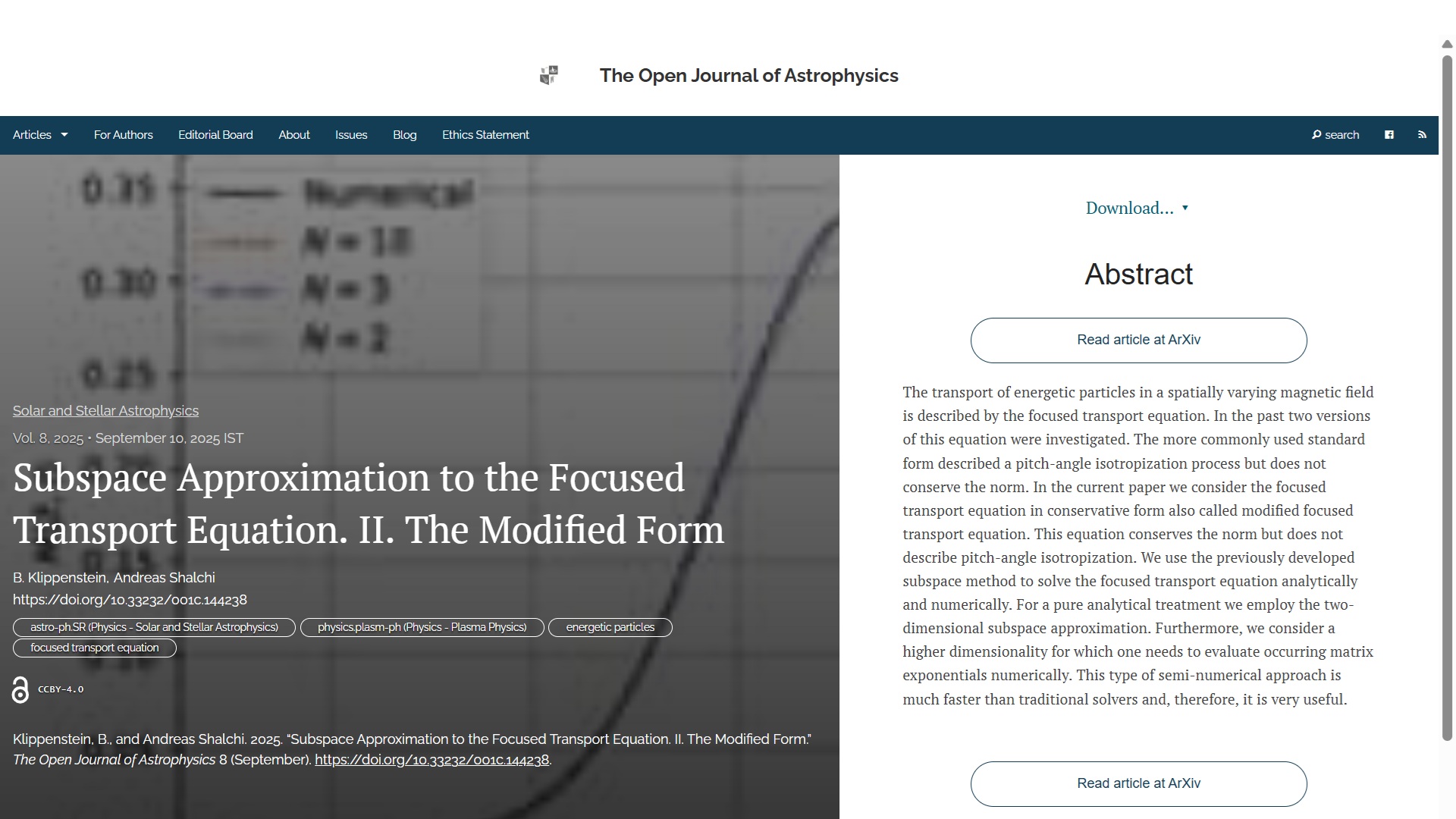
You can find the final accepted version on arXiv here.

The fourth paper of this week was also published on Wednesday 10th September. It is “Mass models of galaxy clusters from a non-parametric weak-lensing reconstruction” by Tobias Mistele (Case Western Reserve U., USA), Federico Lelli (INAF, Firenze, Italy), Stacy McGaugh (Case Western), James Schombert (U. Oregon, USA) and Benoit Famaey (Université de Strasbourg, France).  Published in the folder Cosmology and NonGalactic Astrophysics, it presents new, non-parametric deprojection method for weak gravitational lensing applied to a sample of galaxy clusters. The overlay is here:
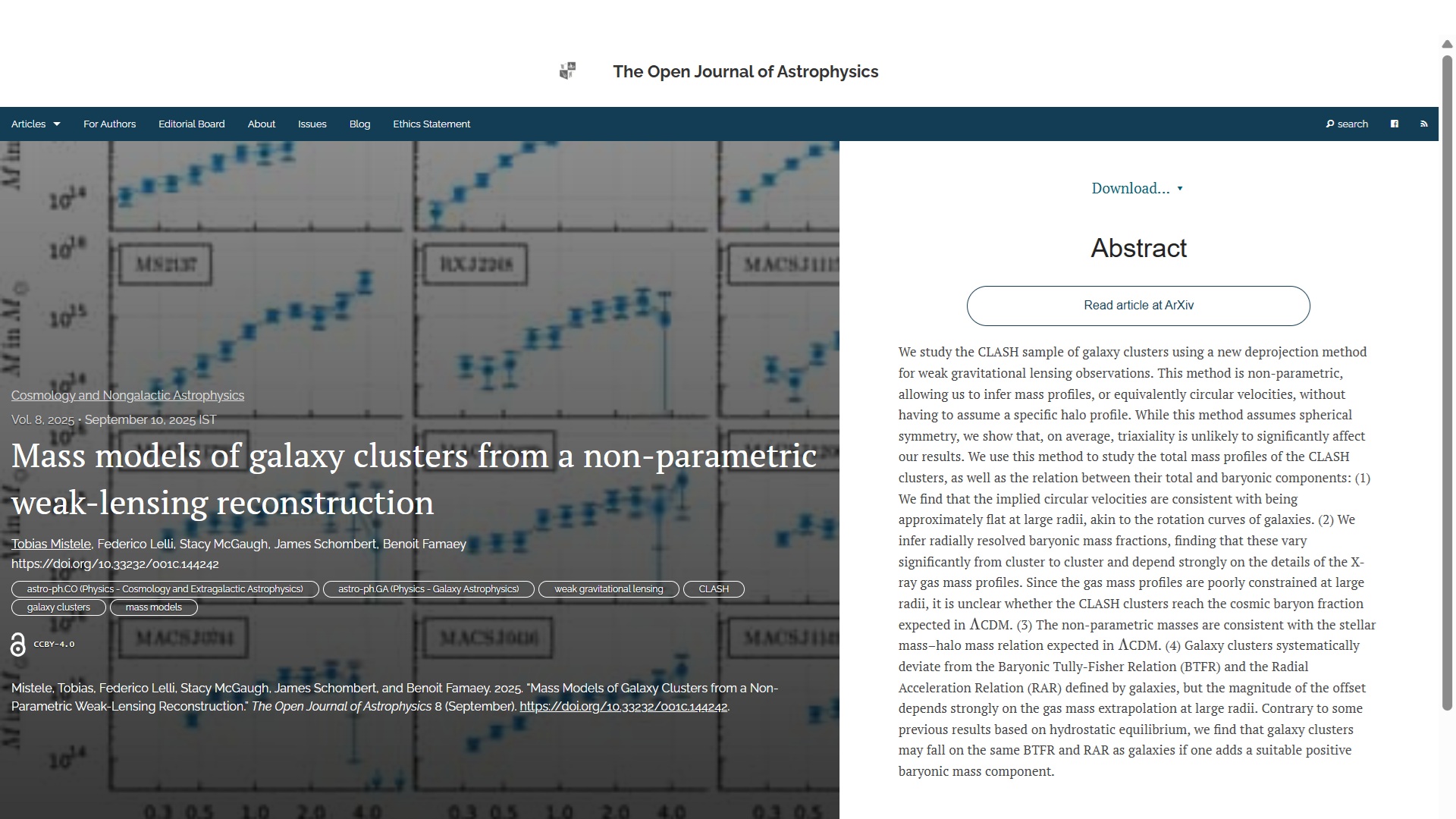
You can find the officially accepted version on arXiv here.

The fifth paper of the week is “A Swift Fix II: Physical Parameters of Type I Superluminous Supernovae” by Jason T. Hinkle & Benjamin J. Shappee (U. Hawaii, USA) and Michael A. Tucke (Ohio State, USA). This one was published on Thursday 11th September 2025 in the folder High-Energy Astrophysical Phenomena. The paper uses recalibrated Swift photometry to recompute peak luminosities and other properties of a sample of superluminous Type I supernovae. The overlay is here:
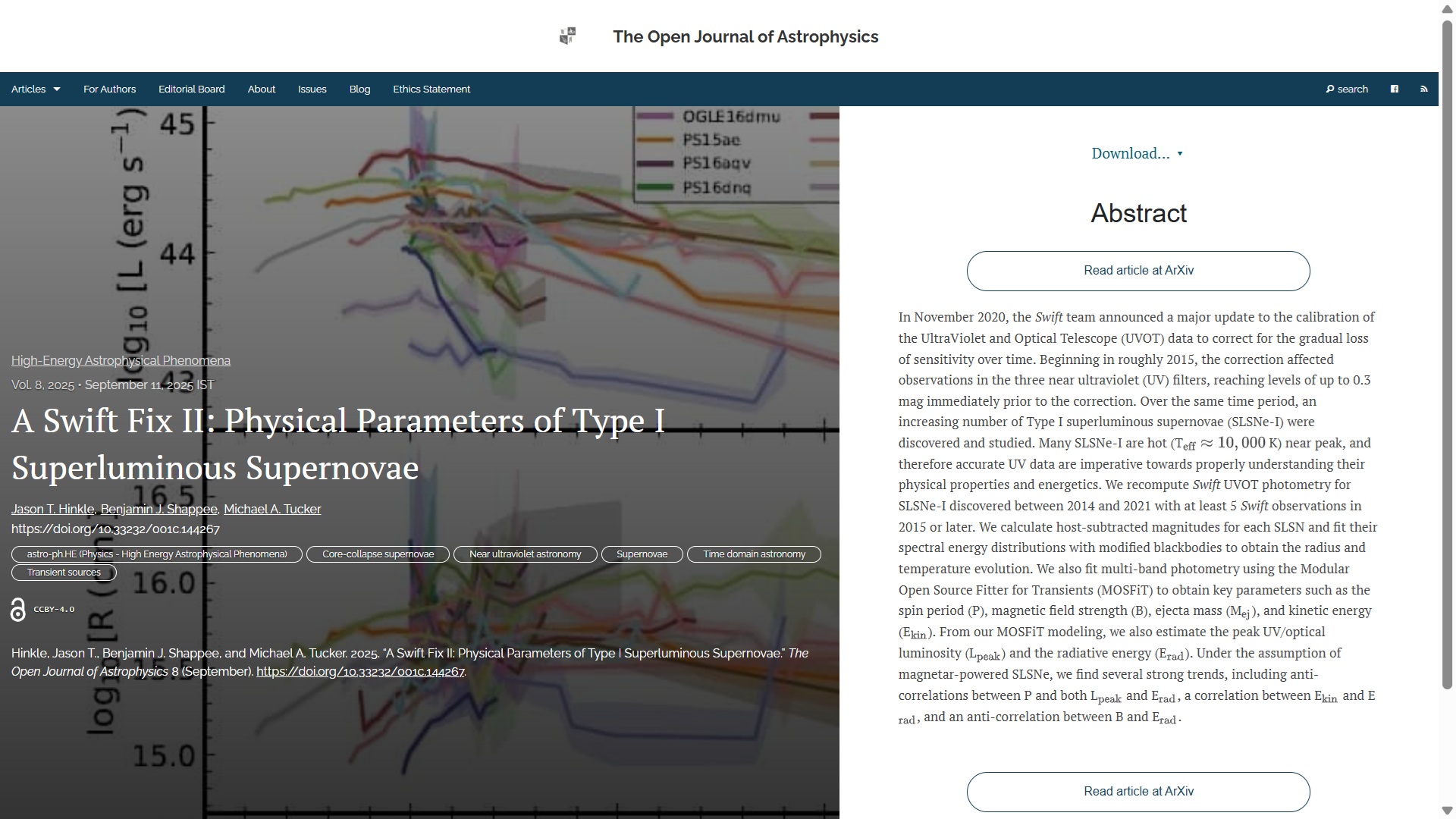
You can find the official accepted version on arXiv here.

Paper No. 6 for this week is “Detailed Microwave Continuum Spectra from Bright Protoplanetary Disks in Taurus” by Caleb Painter (Harvard, USA) and 11 others, too numerous to mention by name, based in the USA, Germany, Mexico and Taiwan.  This one was published in the folder marked Solar and Stellar Astrophysics on September 11th 2025. It presents new observations sampling the microwave (4-360 GHz) continuum spectra from eight young stellar systems in the Taurus region. The overlay is here:


The final version can be found on arXiv here.

The last paper for this update is “On Soft Clustering For Correlation Estimators” by Edward Berman (Northeastern University, USA) and 13 others based in the USA, France, Denmark and Finland and Cosmos-Web:The JWST Cosmic Origins Survey. This was published on Friday 12th September 2025 in the folder Instrumentation and Methods for Astrophysics. It presents an algorithm for estimating correlations that clusters objects in a probabilistic fashion, enabling the uncertainty caused by clustering to be quantified simply through model inference. The overlay is here:

You can find the final version on arXiv here.

And that’s all the papers for this week. I’ve noticed a significant recent increase in the number of papers in Solar and Stellar Astrophysics, which means we’re broadening our impact across the community. Which is nice.

P.S. I found out last week that, according to NASA/ADS, papers in OJAp have now accumulated over 5000 citations.
Weekly Update from the Open Journal of Astrophysics – 12/07/2025

Posted in OJAp Papers, Open Access, The Universe and Stuff with tags , , , , , , , , , , , , , , , , , , , , , , , , , on July 12, 2025 by telescoper

It’s Saturday morning again, so it’s time again for an update of papers published at the Open Journal of Astrophysics. Since the last update we have published seven new papers, which brings the number in Volume 8 (2025) up to 92, and the total so far published by OJAp  up to 327.

This was a slightly strange week, starting with the fact that there were no new arXiv announcements on Monday 7th July because of the 4th July holiday in the USA on Friday so no papers were published that day. We were not able to publish any papers on Wednesday 9th July either because Crossref was offline for 24 hours that day while its data was migrated into the cloud. Our publishing process requires a live connection with Crossref to deposit metadata upon publication so we can’t publish while that service is down. Fortunately the update seems to have gone well and normal services resumed the following day. That partially accounts for the fact that four of this week’s papers were published on 10th July.

Anyway, The papers published this week, with their overlays, are as follows.  You can click on the images of the overlays to make them larger should you wish to do so.

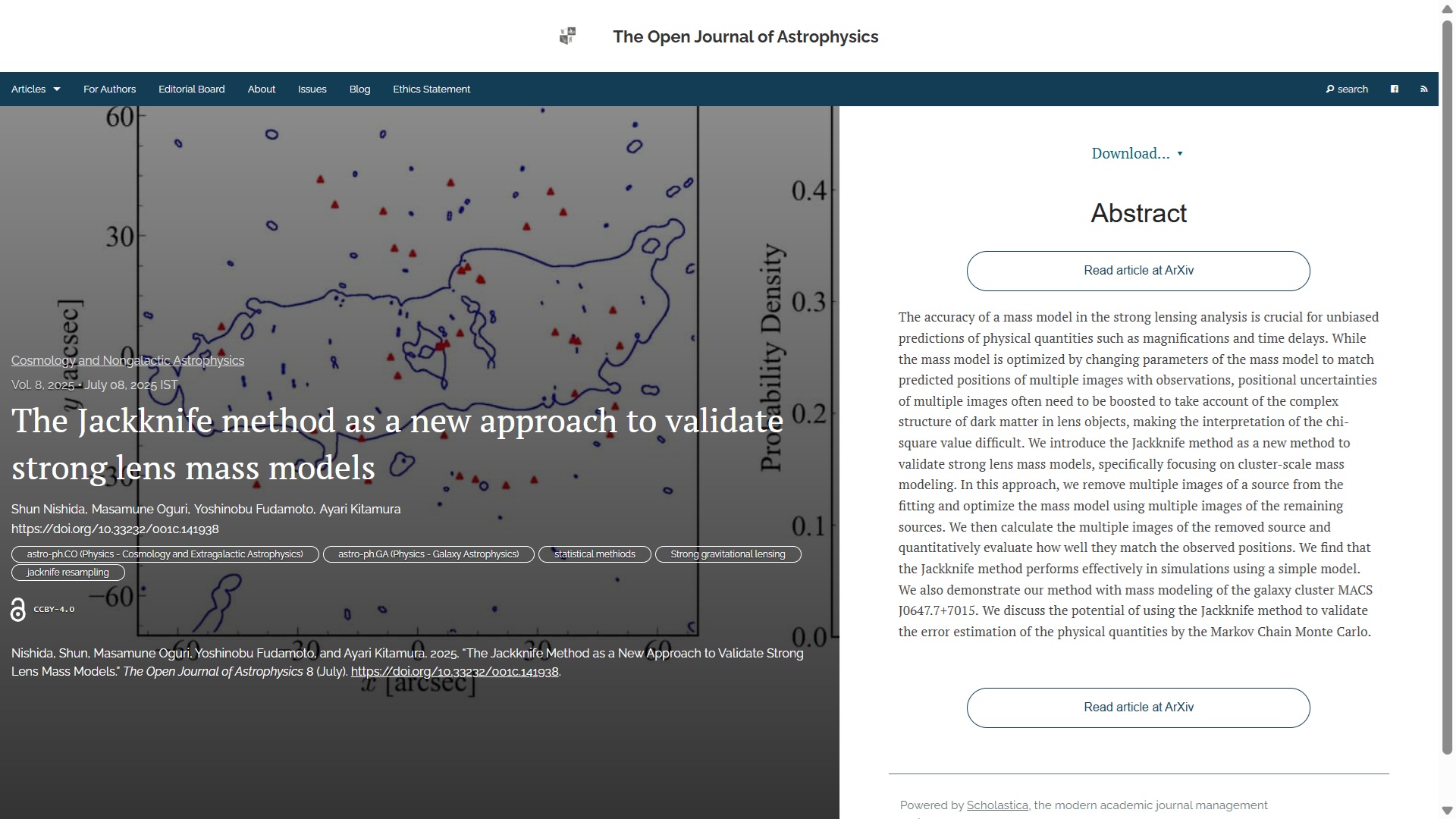
The first paper to report is “The Jackknife method as a new approach to validate strong lens mass models” by Shun Nishida & Masamune Oguri (Chiba University, Japan) , Yoshinobu Fudamoto (Steward Observatory, USA) and Ayari Kitamura (Tohoku University, Japan). This article, which is in the folder marked Cosmology and NonGalactic Astrophysics,  describes and application of the Jackknife statistical resampling techique to gravitational lensing by removing lensed images and recalcualting the mass modelIt was published on Tuesday 8th July 2025. The overlay is here:


The officially-accepted version can be found on arXiv here.

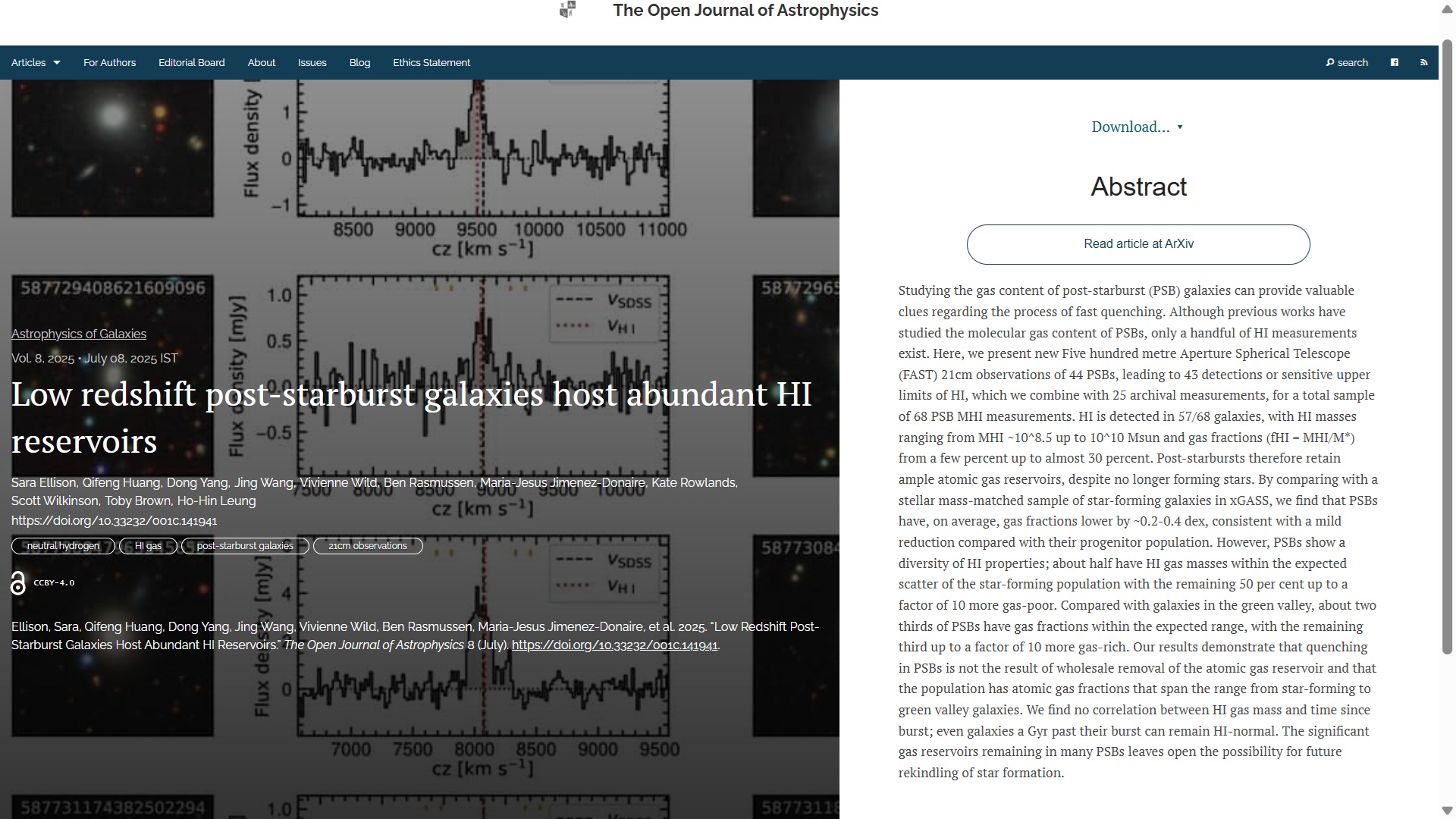
The second paper is “Low redshift post-starburst galaxies host abundant HI reservoirs” by Sara Ellison (U. Victoria, Canada) and 10 others based in China, UK, Spain, USA and Canada.  This one was also published oon Tuesday 8th July but in the folder Astrophysics of Galaxies. This paper uses 21cm observations of a sample of post-starburst galaxies, to show  that they contain large reservoirs of neutral hydrogen. Here is the overlay:

You can find the final version of the manuscript on arXiv here.

Next one up, one of four published on Thursday 10th July, is “Predicting the number density of heavy seed massive black holes due to an intense Lyman-Werner field” by Hannah O’Brennan (Maynooth University, Ireland) and 7 others based in Ireland, USA and Italy. This paper presents an exploration of the scenario for black hole formation driven by Lyman-Werner photons (i.e. ultraviolet radiation in the range 11.2 to 13.6 eV). It is in the folder marked Cosmology and NonGalactic Astrophysics, and the overlay is here:


You can read the final accepted version on arXiv here.

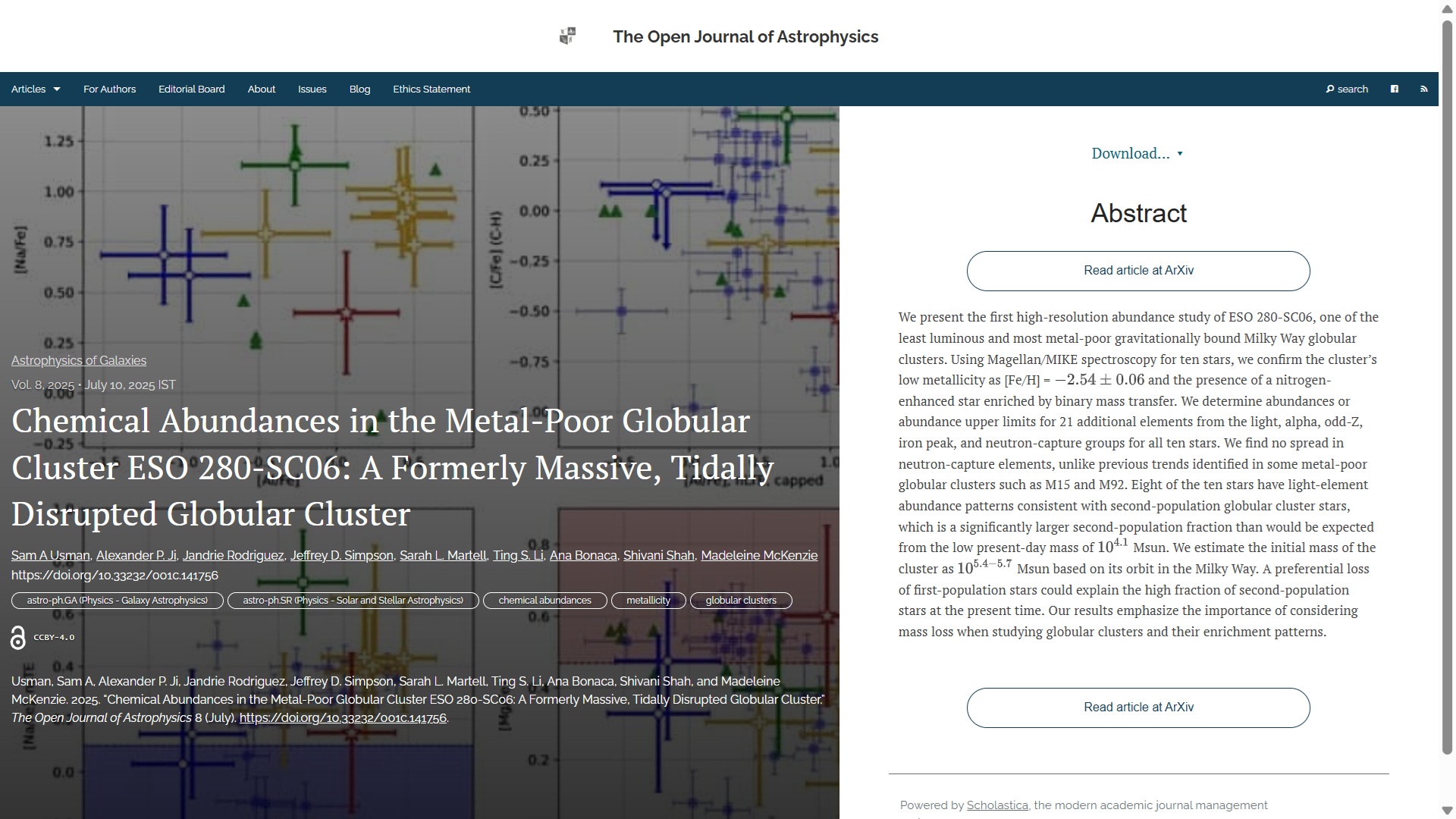
The fourth paper this week, and the second published on 10th July, is “Chemical Abundances in the Metal-Poor Globular Cluster ESO 280-SC06: A Formerly Massive, Tidally Disrupted Globular Cluster” by Sam A. Usman (U. Chicago, USA) and 8 others based in the USA, Canada and Australia. This paper, which is in the folder Astrophysics of Galaxies, presents a detailed spectroscopic study of the chemical abundances in a Milky Way globular cluster ESO 280-SC06. The overlay is here:

The officially accepted version of the paper can be read here.

Next one up, also published on 10th July and also in the folder marked Astrophysics of Galaxies is “Predictions for the Detectability of Milky Way Satellite Galaxies and Outer-Halo Star Clusters with the Vera C. Rubin Observatory” by Kabelo Tsiane (U. Michigan) and 9 others on behalf of the LSST Dark Energy Science Collaboration.

The overlay is here:


You can find the officially-accepted version of the paper on arXiv here.

The penultimate paper for this week, and the last of the batch published on 10th July,  is “Systematically Measuring Ultra-Diffuse Galaxies. VIII. Misfits, Miscasts, and Miscreants” by Dennis Zaritsky, Richard Donnerstein, and Donghyeon J. Khim (Steward Observatory, U. Arizona, USA). This paper presents a morphological study of weird and wonderful galaxies as part of an effort to Systematically Measure Ultra-Diffuse Galaxies (the SMUDGes survey). It is in the folder marked Astrophysics of Galaxies. The overlay is here:


You can find the officially-accepted version of the paper on arXiv here.

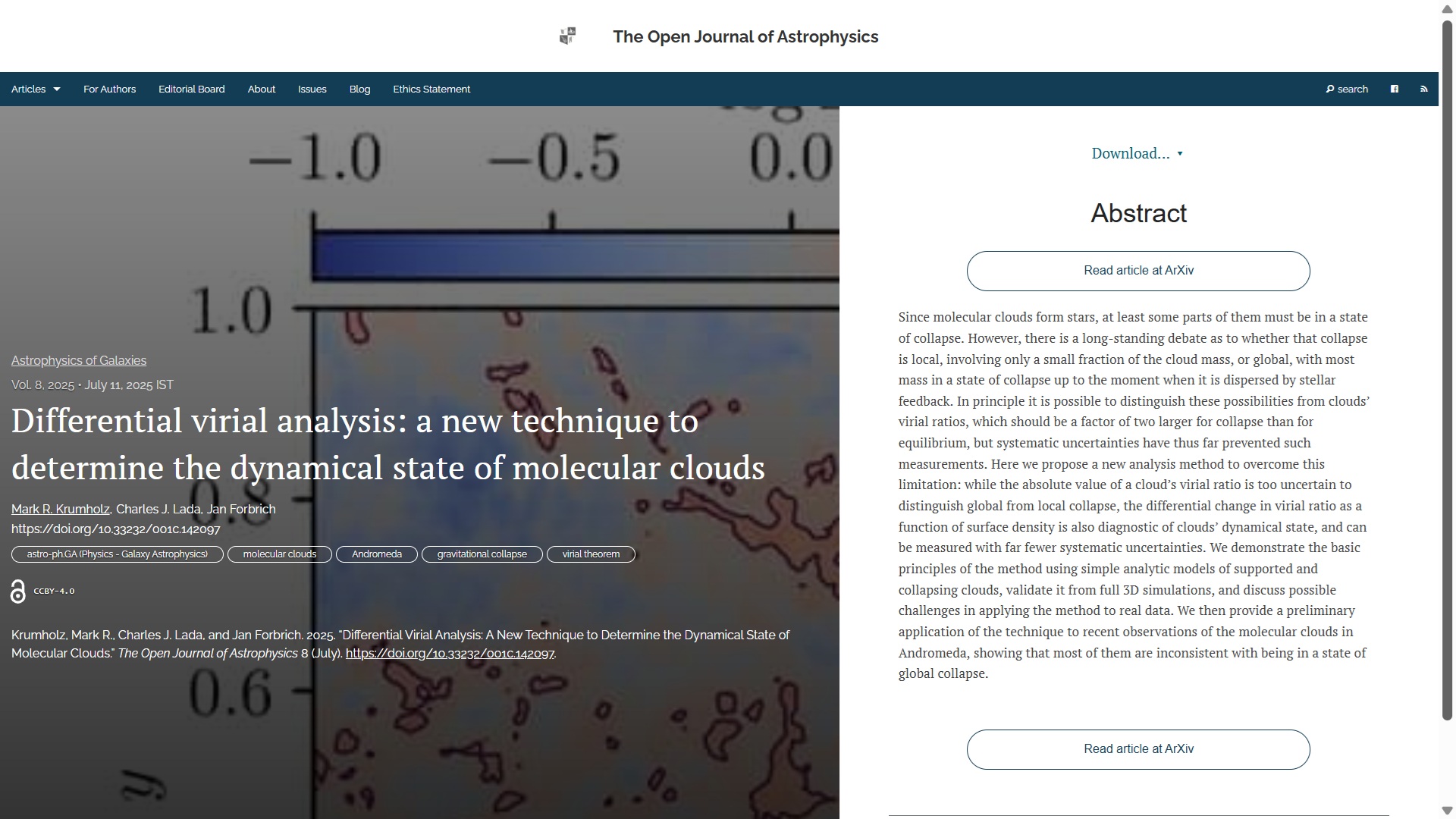
The last article published this week is “Differential virial analysis: a new technique to determine the dynamical state of molecular clouds” by Mark R. Krumholz (ANU, Australia), Charles J. Lada (Harvard, USA) & Jan Forbrich (U. Herts, UK). This paper presents simple analytic models of supported and collapsing molecular clouds, tested using full 3D simulations and applied to observed clouds in Andromeda. It is in the folder marked Astrophysics of Galaxies and was published yesterday, i.e on Friday 11th July 2025. Here is the overlay


You can find the officially-accepted version on arXiv here.

And that’s all the papers for this week. I will, however, take this opportunity to mention that a while ago I was interviewed about the Open Journal of Astrophysics by Colin Stuart on behalf of the Foundational Questions Institute; the write-up of the interview can be found here.

Weekly Update from the Open Journal of Astrophysics – 12/04/2025

Posted in OJAp Papers, Open Access, The Universe and Stuff with tags , , , , , , , , , , , , , , , , on April 12, 2025 by telescoper

Time for the weekly Saturday morning update of papers published at the Open Journal of Astrophysics. Since the last update we have published four new papers, which brings the number in Volume 8 (2025) up to 37 and the total so far published by OJAp up to 272.

In chronological order of publication, the four papers published this week, with their overlays, are as follows. You can click on the images of the overlays to make them larger should you wish to do so.

The first paper to report is “Searching for new physics using high precision absorption spectroscopy; continuum placement uncertainties and the fine structure constant in strong gravity” by Chung-Chi Lee (Big Questions Institute (BQI), Sydney, Australia), John K. Webb (Cambridge, UK), Darren Dougan (BQI), Vladimir A. Dzuba & Victor V. Flambaum (UNSW, Australia) and Dinko Milaković (Trieste, Italy).

This presents a discussion of the problem of continuum placement in high-resolution spectroscopy, which impacts significantly on fine structure constant measurements, and a method for mitigating its effects. The paper is in the folder Solar and Stellar Astrophysics and was published on Tuesday 8th April 2025. The overlay is here:

You can find the officially-accepted version of the paper on arXiv here.

The second paper to announce, also published on 8th April 2025,  is “Deciphering Spatially Resolved Lyman-Alpha Profiles in Reionization Analogs: The Sunburst Arc at Cosmic Noon” by Erik Solhaug (Chicago, USA), Hsiao-Wen Chen (Chicago), Mandy C. Chen (Chicago),  Fakhri Zahedy (University of North Texas),  Max Gronke (MPA Garching, Germany),  Magdalena J. Hamel-Bravo (Swinburne, Australia), Matthew B. Bayliss (U. Cincinatti), Michael D. Gladders  (Chicago), Sebastián López (Universidad de Chile), Nicolás Tejos (Universidad Católica de Valparaíso, Chile).

This paper, which presents a study of the Lyman-alpha emission properties of a gravitationally-lensed galaxy at redshift z=2.37, appears in the folder Astrophysics of Galaxies. It was published


You can read the officially accepted version of this paper on arXiv here.

The third paper of the week  is “On the progenitor of the type Ia supernova remnant 0509-67.5” by Noam Soker (Technion, Haifa, Israel). This one was published on Wednesday 9th April 2025 in the folder High-Energy Astrophysical Phenomena. The author discusses possible ideas for the origin of a supernova that exploded inside a planetary nebula.

Here is the overlay:


You can find the officially accepted version of this paper on arXiv here.

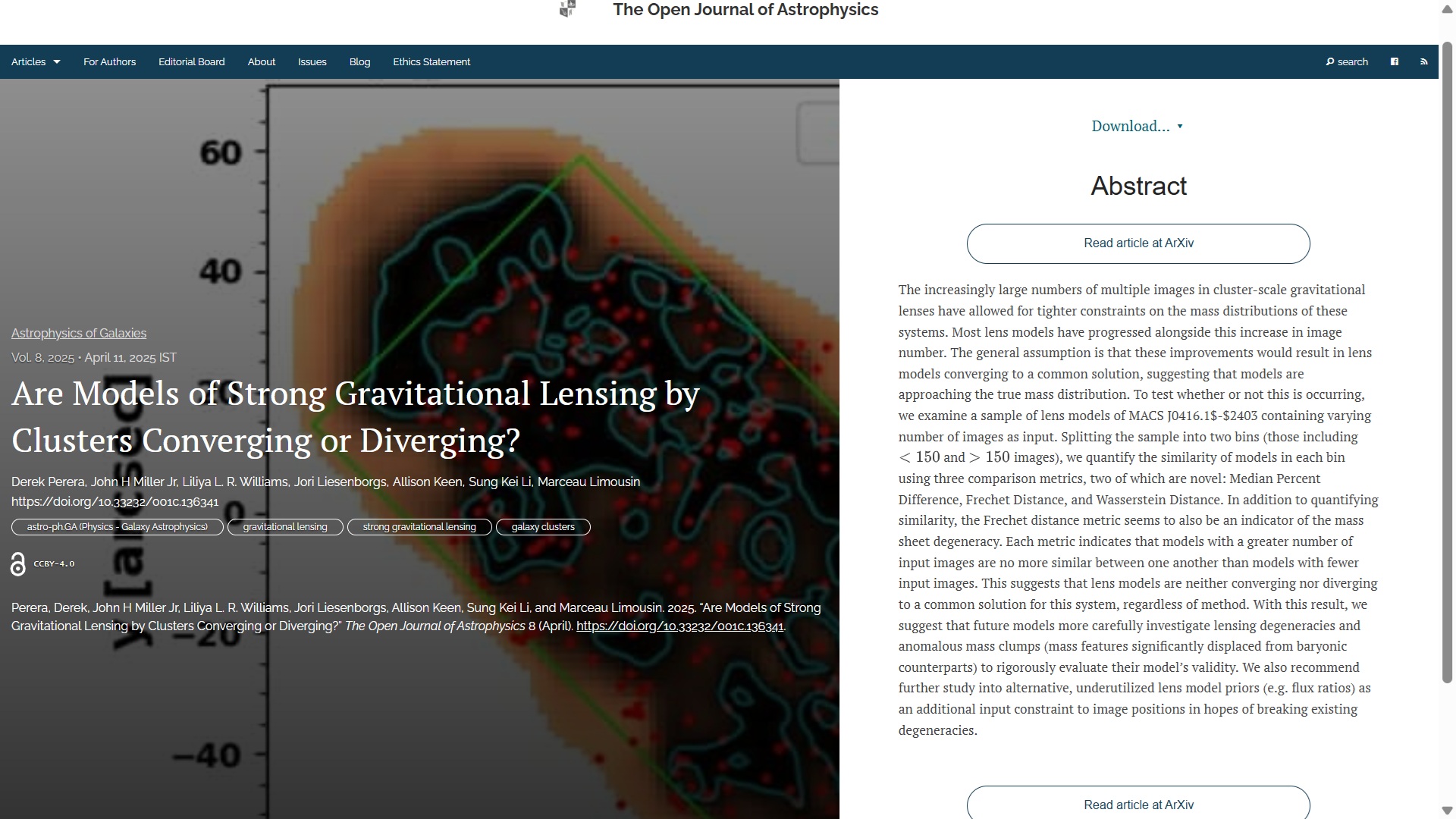
Last (but certainly) not least for this week, published on April 11th 2025, we have “Are Models of Strong Gravitational Lensing by Clusters Converging or Diverging?” by Derek Perera (U. Minnesota), John H Miller Jr & Liliya L. R. Williams (U. Minnesota, USA), Jori Liesenborgs (Hasselt U., Belgium), Allison Keen (U. Minnesota), Sung Kei Li (Hong Kong University), Marceau Limousin (Aix Marseille Univ., France).  This papers study various models of a strong gravitational lensing system, the results suggesting that lens models are neither converging to nor diverging from a common solution for this system, regardless of method.

Here is the overlay:


The official published version can be found on the arXiv here.


That’s all the papers for this week. By way of a postscript I’ll just mention that the gremlins that have affected submissions to Crossref (which we rely on for registering the article metadata) have now been resolved and normal services have been restored.

Through a wine glass, darkly…

Posted in Euclid, The Universe and Stuff with tags , , , on March 7, 2025 by telescoper

Usually I disapprove of using a wine glass for any purpose other than drinking wine, but here’s a very neat short video by Phil Marshall explaining how you can use a one to simulate a strong gravitational lens such as the system that produced the wonderful Einstein ring recently discovered by Euclid. More specifically it shows how perfect alignment leads to a ring whereas other configurations can produce multiple images or arcs.

If you’re planning to try this at home, please remember to empty your glass beforehand.

Weekly Update from the Open Journal of Astrophysics – 01/02/2025

Posted in OJAp Papers, Open Access, The Universe and Stuff with tags , , , , , , , , , , , , , , , , , , on February 1, 2025 by telescoper

It’s Saturday morning, so once again it’s time for an update of papers published at the Open Journal of Astrophysics. There were no papers to report last week but since the last update we have published four new papers, which brings the number in Volume 8 (2025) up to 11 and the total so far published by OJAp up to 246.

In chronological order of publication, the four papers published this week, with their overlays, are as follows. You can click on the images of the overlays to make them larger should you wish to do so.

First one up is  “A halo model approach for mock catalogs of time-variable strong gravitational lenses” by Katsuya T. Abe & Masamune Oguri (Chiba U, Japan), Simon Birrer & Narayan Khadka (Stony Brook, USA), Philip J. Marshall (Stanford, USA), Cameron Lemon (Stockholm U., Sweden), Anupreeta More (IUCAA, India), and the LSST Dark Energy Science Collaboration. It was published on 27th January 2025 in the folder marked Cosmology and NonGalactic Astrophysics. The paper discusses how to generate mock catalogs of strongly lensed QSOs and Supernovae on galaxy-, group-, and cluster-scales based on a halo model that incorporates dark matter halos, galaxies, and subhalos.


You can find the officially accepted version of this paper on arXiv here.

This paper, also published on Monday 27th January 2025, but in the folder Astrophysics of Galaxies, is “The Soltan argument at redshift 6: UV-luminous quasars contribute less than 10% to early black hole mass growth” by Knud Jahnke (MPI Heidelberg, Germany). This paper presents an argument that almost all growth of supermassive black hole mass at z>6 does not take place in UV-luminous quasars.

Here is a screen grab of the overlay, which includes the abstract:You can find the officially accepted version of the paper on the arXiv here.

The third paper to announce, published on 29th January 2025 in the folder Cosmology and NonGalactic Astrophysics, is “A Heavy Seed Black Hole Mass Function at High Redshift – Prospects for LISA” by Joe McCaffrey & John Regan (Maynooth U., Ireland), Britton Smith (Edinburgh U., UK), John Wise (Georgia Institute of Technology, USA), Brian O’Shea (Michigan State U., USA) and Michael Norman (University of California, San Diego). This is a numerical study of the growth rates of massive black holes in the early Universe and implications for their detection via gravitational wave emission.

You can see the overlay here:


The accepted version of this paper can be found on the arXiv here.

The last paper of this batch is “Forecasting the Detection of Lyman-alpha Forest Weak Lensing from the Dark Energy Spectroscopic Instrument and Other Future Surveys” by Patrick Shaw & Rupert A. C. Croft (Carnegie Mellon U., USA) and R. Benton Metcalf (U. Bologna, Italy). This paper, published on January 30th 2025, is about extending the applicationof  Lyman-α forest weak gravitational lensing to lower angular source densities than has previously been done, with forecasts for future spectral surveys. It is in the folder marked Cosmology and NonGalactic Astrophysics.

The overlay is here


You can find the accepted version on arXiv here.

Incidentally, we currently have 121 papers under review, including 81 under a revise and resubmit request.

That’s all for this week. I’ll do another update next Saturday.

Space Warps from Euclid

Posted in Euclid, The Universe and Stuff with tags , , , , , on November 24, 2024 by telescoper

A few months ago I posted about a joint initiative between Euclid and Galaxy Zoo that involved engaging members of the public in a project involving galaxy morphology. Well, a new “collab” (as you young people call such things) has just been announced on social media, and I encourage you to investigate further

The new venture is called `Space Warps – ESA Euclid’, and its aim is to find strong gravitational lenses in Euclid survey images. You can find out more about this project in this blog post by Knud Jahnke and you can find instructions and sign up for the project here.

The announcement of this initiative gives me an opportunity to pass on a little update on progress with the Euclid survey. The first `Quick’ Data Release (known to its friends as Q1) was made available to Euclid Consortium members just a few weeks ago. This will be made available to the general public next March, around the same time as the joint ESLAB and Euclid Consortium meeting in Leiden next year.

The Euclid survey is constructed as a set of contiguous `tiles’ covering the survey region, which will ultimately be about 15,000 square degrees (about one-third of the sky), with most of the region scanned by the satellite many times. The Q1 data will just be a taster of this. The main component of the Q1 data relates to a single visit (at the depth of the Euclid Wide Survey) over the Euclid Deep Fields (EDFs): 20 deg2 of the EDF North, 10 deg2 of EDF Fornax, and 23 deg2 of the EDF South. The deep fields will subsequently be visited multiple times during the mission.  The Q1 release will be of Level 2 data, i.e. data at the level of individual tiles.

The first full data release (DR1) is due to be published in June 2026.

Six New Publications at the Open Journal of Astrophysics

Posted in OJAp Papers, Open Access, The Universe and Stuff with tags , , , , , , , , , , , , , , , , , , on October 19, 2024 by telescoper

It’s Saturday morning again and time to post an update of activity at the Open Journal of Astrophysics. As last week there are six papers to announce, bringing the count in Volume 7 (2024) up to 93 and the total altogether up to 208.

In chronological order, the six papers published this week, with their overlays, are as follows. You can click on the images of the overlays to make them larger should you wish to do so.

First one up, published on Monday 14th October 2024, is in the folder marked Cosmology and NonGalactic Astrophysics and is called “Backreaction in Numerical Relativity: Averaging on Newtonian gauge-like hypersurfaces in Einstein Toolkit cosmological simulations“. This paper presents a numerical study of the effect of local inhomogeneities on the dynamical evolution of the Universe, i.e. the so-called “backreaction” problem; the authors are Alexander Oestreicher and Sofie Marie Koksbang of the University of Southern Denmark, Odense, Denmark.

Here is a screen grab of the overlay, which includes the abstract:

You can find the officially accepted version of the paper on the arXiv here.

The second paper to announce, published on 15th October 2024, is “Weak-Lensing Shear-Selected Galaxy Clusters from the Hyper Suprime-Cam Subaru Strategic Program: II. Cosmological Constraints from the Cluster Abundance” by I-Non Chiu (National Cheng Kung University, Taiwan) and 11 others based in Taiwan, Japan, India and the USA. This paper, which is also in the folder Cosmology and NonGalactic Astrophysics  presents constraints on cosmological parameters obtained from a sample of galaxy clusters

You can see the overlay here:

The accepted version of this paper can be found on the arXiv here.

The third paper is “Image formation near hyperbolic umbilic in strong gravitational lensing” by Ashish Kumar Meena (Ben Gurion University, Israel) and Jasjeet Singh Bagla (IISER Mohali, India). It presents a detailed theoretical discussion of a particular form of strong gravitational lensing and its observational consequences; it is in the folder Astrophysics of Galaxies and was published on October 15th 2024.

The overlay is here:


The officially accepted version can be found on arXiv here.

The fourth paper, published on 16th October 2024 and in the folder Astrophysics of Galaxies,  is “Weak Gravitational Lensing around Low Surface Brightness Galaxies in the DES Year 3 Data” by N. Chicoine (University of Chicago, USA) et al. (105 authors; DES Collaboration). It presents a  demonstration of the viability of using weak gravitational lensing to constrain the halo masses of low surface brightness galaxies.

The overlay is here


You can find the officially accepted version of this paper here.

The fifth paper in this batch is “Imprints of interaction processes in the globular cluster system of NGC 3640” by Ana I Ennis (Waterloo, Canada) and Juan Pablo Caso & Lilia Patricia Bassino (Instituto de Astrofísica de La Plata, Argentina). This one was also published on 16th October 2024 and is in the folder Astrophysics of Galaxies, Here is the overlay


You can find the official accepted version on the arXiv here.

Finally for this week we have “On the nature of the C IV-bearing circumgalactic medium at 𝒛∼𝟏” by Suyash Kumar, Hsiao-Wen Chen, Zhijie Qu & Mandy C. Chen (U. Chicago), Fakhri S. Zahedy (U. North Texas), Sean D. Johnson (Carnegie Observatories), Sowgat Muzahid (IUCAA, India) and Sebastiano Cantalupo (U. Milan Bicocca)

The overlay is here


You can find the officially-accepted version on arXiv here.

That’s it for now. More next week!

A Little Bit of Gravitational Lensing

Posted in The Universe and Stuff with tags , , , , , on December 30, 2012 by telescoper

I thought I’d take a short break from doing absolutely nothing to post a quick little item about gravitational lensing. It’s been in my mind to say something about this since I mentioned it in one of the lectures I gave just before Christmas, but I’ve been too busy (actually too disorganized) to do it until now. It’s all based on a paper posted to the arXiv in December which was led by Jo Woodward (née Short) who did her PhD with me in Cardiff and is now in a postdoctoral research position in Durham (which is in the Midlands). The following pictures were take from her paper.

This figure shows the geometry of a gravitational lens system: light from the source S is deflected by the gravitational potential of the lens L so that an image I appears at a position on the sky which is different from the actual position when viewed by the observer O:

lensing_1
There’s a critical radius (which depends on the mass and density profile of the lens) at which this can lead to the formation of multiple images of the source. Even if multiple images are not resolved, lensing results in an increase in the apparent brightness of the source.

A great deal of cosmological information can be gleaned statistically from lensing  with even limited knowledge of the properties of the source and lens populations and with incomplete information about e.g. the actual angular deflection produced by the lens or the lens mass. To illustrate this, just consider the expression for the differential optical depth to lensing (related to the probability that a source at redshift z_s is lensed by an object at redshift z_l
lensing_2

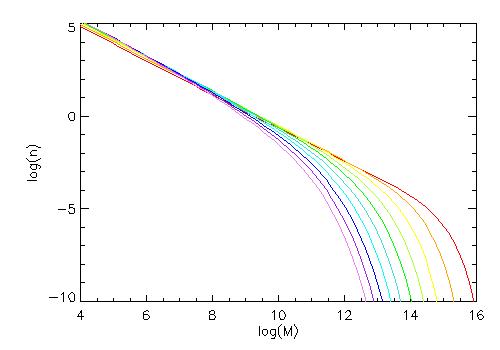
The first two terms are cosmological, accounting geometrical and expansion effects. Roughly speaking, the larger the volume out to a given redshift the higher the probability is that a given source will be lensed. The third term involves the mass function of lens systems. In the framework of the standard cosmological model this can be computed using Press-Schechter theory or one of the variations thereof. According to current understanding, cosmological structures (i.e. galaxies and clusters of galaxies) form hierarchically so this mass function changes with redshift, with fewer high mass objects present at high redshift than at low redshift, as represented in this picture, in which masses are given in units of solar masses, the colour-coding representing different redshifts:
lensing_3

The last term represents the lensing cross-section of an object with a given mass. This depends on the internal structure of the lens – an object in which the mass is highly concentrated produces  lensing effects radically different from one that isn’t. Two simple models for the mass distribution are the singular isothermal sphere (SIS) and the Navarro-Frenk-White profile (NFW). The latter is thought (by some) to represent the distribution of cold dark matter in haloes around galaxies and clusters which is more diffuse than that of the baryonic material because it can’t dissipate energy which it needs to do to fall into the centre of the object. The real potential of a galaxy in its central regions could be more like the SIS profile would predict, however, because baryons outweigh dark matter there.

Now time for a bit of historical reminiscence. In 1997 I published a book with George Ellis in which we analysed the evidence available at the time relating to the density of matter in the Universe. It was a little bit controversial at the time, but it turns out we were correct in concluding that the density of matter was well below the level favoured by most theorists i.e. only about 20-30% of the critical density. However we did not find any compelling evidence at that time for a cosmological constant (or, if you prefer, dark energy). Indeed one of the strongest upper limits on the cosmological constant came from gravitational lensing measurements, or rather the dearth of them.

The reason for this negative conclusion was that, for a fixed value of the Hubble constant,  in the presence of a cosmological constant the volume out to a given redshift is much larger than if there is no cosmological constant. That means the above integral predicts a high probability for lensing. Surveys however failed to turn up large numbers of strongly-lensed objects, hence the inference that the universe could not be dominated by a cosmological constant. This is, of course, assuming that the other terms in the integral are well understood and that the reason significant numbers of lensed systems weren’t found wasn’t just they are tricky to identify…

Meanwhile, huge advances were made in other aspects of observational cosmology that established a standard cosmological model in which the cosmological constant makes up almost 75% of the energy budget of the Universe.

Now, 15 years later on, enter the Herschel Space Observatory, which turns out to be superb at identifying gravitational lenses.  I posted about this here, in fact. Working in the far-infrared makes it impossible to resolve multiple images with Herschel – even with a 3.5m mirror in space, λ/D isn’t great for wavelengths of 500 microns! However, the vast majority of sources found during the Herschel ATLAS survey with large fluxes at this wavelengths can be identified as lenses simply because their brightness tells us they’ve probably been magnified by a lens. Candidates can then be followed up with other telescopes on the ground.  A quick look during the Science Demonstration Phase of Herschel produced the first crop of firmly identified gravitational lens systems published in Science by Negrello et al..  When the full data set has been analysed there should be hundreds of such systems, which will revolutionize this field.

To see the potential (no pun intended) of this kind of measurement, take a look at these five systems from the SDP set:

lensing_4

These systems have measured (or estimated) source and lens redshifts. What is plotted is the conditional probability of a lens at some particular lens redshift, given the source redshift and the fact that strong lensing has occurred. Curves are given for SIS and NFW lens profiles and everything else is calculated according to the standard cosmological model. The green bars represent the measured lens redshifts.  It’s early days, so there are only five systems, but you can already see that they are pointing towards low lens redshifts, favouring NFW over SIS;  the yellow and light blue shading represents regions in which 68% of the likelihood lies.  These data don’t strongly prefer one model over the other, but with hundreds more, and extra information about at least some of the lens systems (such as detailed determinations of the lens mass from deflections etc) we should be able  to form more definite conclusions.

Unfortunately the proposal I submitted to STFC to develop a more detailed theoretical model and statistical analysis pipeline (Bayesian, of course) wasn’t funded. C’est la vie. That probably just means that someone smarter and quicker than me will do the necessary…