A while ago I was listening to a radio broadcast of a recording from last year’s Wexford Festival Opera. The Opera in question was Handel’s Deidamia. In fact you can see a video of the whole performance here. Like most baroque operas, the plot of Deidamia is rather complex but it is drawn directly from familiar Greek legend, and features Achilles and Ulysses. The former spends much of the opera dressed in women’s clothing because his father Peleus doesn’t want him dragged off to fight in the Trojan War and has hidden him on the island of Skyros among the daughters of his friend Lycomedes. Eventually Ulysses lands on Skyros to try to persuade Achilles to lead his army, but the disguise is so good that he fails to identify him. He does however develop a bit of a crush on the hot young girl Pyrrha, who is actually Achilles in drag…
I won’t give any more spoilers because the Opera Deidamia is not really the point of this post, which is that the part of Pyrrha is written for a soprano. It’s not unusual in Handel’s operas for a male part to be sung by a woman – as indeed this part was when it was first performed in London in January 1741 or a castrato. The practice of castrating boys to prevent their voices breaking has long been discontinued, thankfully, so I assumed that the voice I had been listening to was that of a female singer. Then, in the interval, I learnt that this part was actually sung by a man, Bruno de Sá. Here he is in a short clip from that production.
Bruno de Sá is a sopranist, a man whose modal voice is in the soprano register, i.e. he sings that high without using falsetto. I’ve seen and heard quite a few operas in my time but I didn’t realise that there was such a thing as a sopranist. You live and learn!
I did a bit of searching on the interwebs and found the following clip which shows another sopranist, Samuel Mariño, having fun in a duet with an oboist at a concert in Versailles:
Samuel Mariño is from Venezuela. He is gay and was bullied at school when he was young for that, and for the fact that his voice didn’t break when he reached adolescence. He sought medical advice to see if he could have surgery to lower his voice, but the doctor instead suggested he embark on a career as an opera singer. And that’s what he did. Don’t be fooled by the fun he is having in that clip; he’s not some sort of novely act, he’s a very serious vocal artist.
I find his story very inspiring because of his determination to follow his own path and I love the above clip because it is so joyful. It warms this old gay’s heart to see someone daring to be different and making such a success of it.
The hymn chosen for today’s service is No. 296 from Hymns Ancient and ModernFor all the saints who from their labours rest. This is usually song on All Saints Day (November 1st) but is topical because of today’s public sector strike. The illustration shows an impressive picket line!
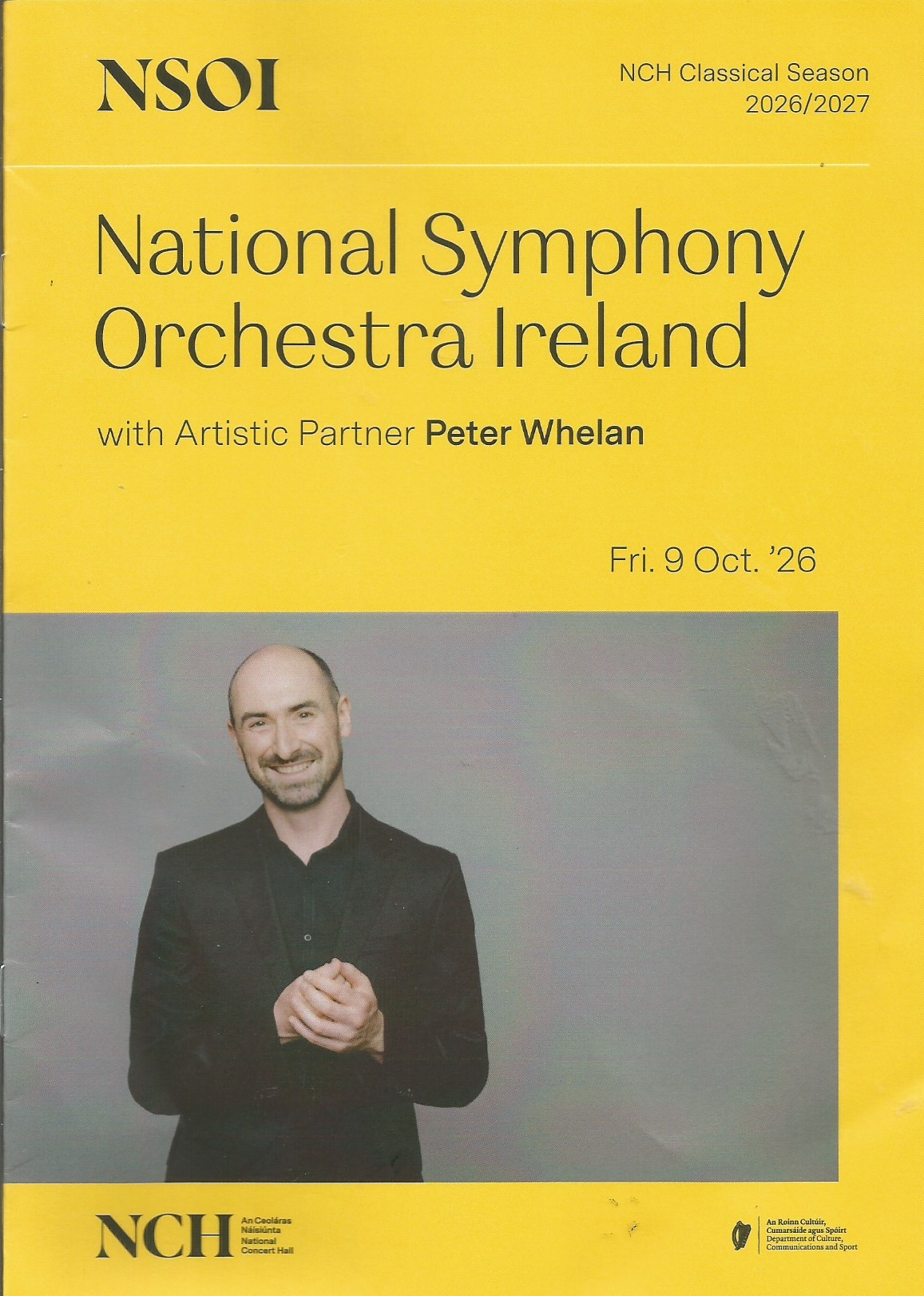
Yesterday evening I once again travelled into Dublin for a concert by National Symphony Orchestra Ireland at the National Concert Hall. No rain this time, I’m glad to say, either going there or coming back!
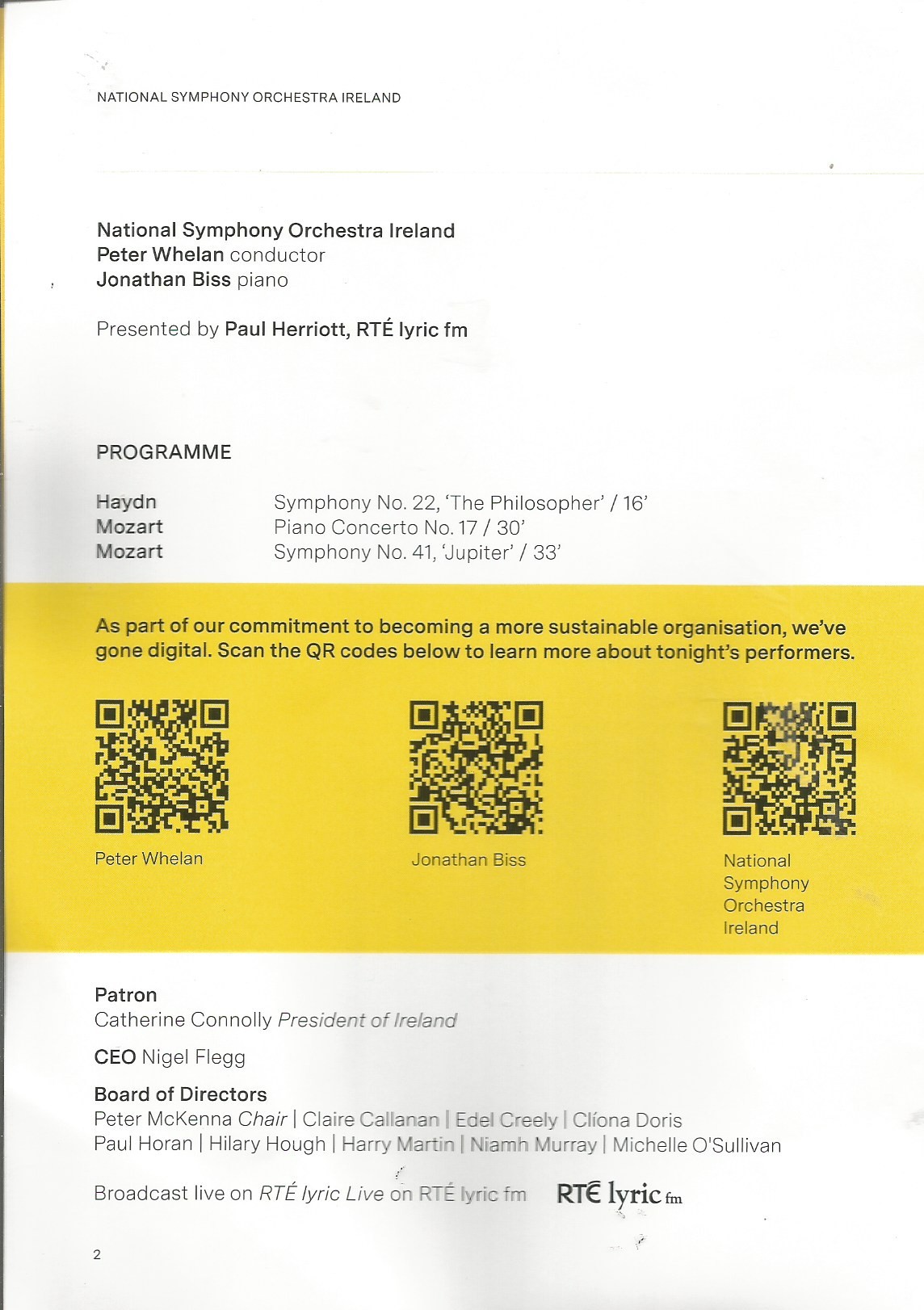
The concert, under the direction of Artistic Partner Peter Whelan, was very definitely classical music in the sense that all three works were from the classical period of the middle to late eighteenth century.
First up we had Symphony No. 22 in E♭ Major by Joseph Haydn. This is usually known as “The Philosopher”. I tend to think of Haydn’s music as expertly crafted but mostly a bit “middle-of-the-road” for my tastes. This symphony, written in 1764 has four movements. I found the first movement Adagio rather plodding but there is much to enjoy in this work, and it was given a good performance last night. I don’t think the nickname “The Philosopher” was given to this work by Haydn, incidentally.
Then, after the usual reorganization on stage to accommodate the NCH’s Steinway, we had Piano Concerto No. 17 in G Major by Wolfgang Amadeus Mozart, with soloist Jonathan Biss. Written in 1784, this is an enjoyable and entertaining piece, not perhaps as profound as some of the later piano concertos (Mozart wrote 27 altogether), but well worth listening to. I found it very witty and somewhat conversational in style, with lots of “call-and-answer” moments. It’s also interesting that the piano doesn’t start to play for quite a long time in the first movement. The three movements follow a standard fast-slow-fast pattern (Allegro-Andante-Alegretto/Presto). It certainly does motor towards the end!
The second half of the concert was devoted to another piece by Wolfgang Amadeus Mozart, his Symphony No. 41 “Jupiter”. Composed in 1788, just 24 years after the Haydn symphony we heard in the first part, it demonstrated very powerfully how much the symphonic form had evolved in relatively short time separating the two compositions. The Jupiter symphony is not only brim full of ideas, but the themes are woven into a much richer fabric. The reason it is such a great symphony – one of the greatest of all, not just the greatest by Mozart – is that the whole is even greater than the sum of its wonderful parts. It’s a familiar part of the concert repertoire, of course, but does stand up to repeated listening. Last night’s performance was very enjoyable.
On the way home on the train I found myself wondering at what point and for what reasons the “Minuet” that appeared as a fourth movement in many classical symphonies like the two we heard last night became the “Scherzo” that was de rigueur for later symphonies (in the romantic era). Answers on a postcard please…
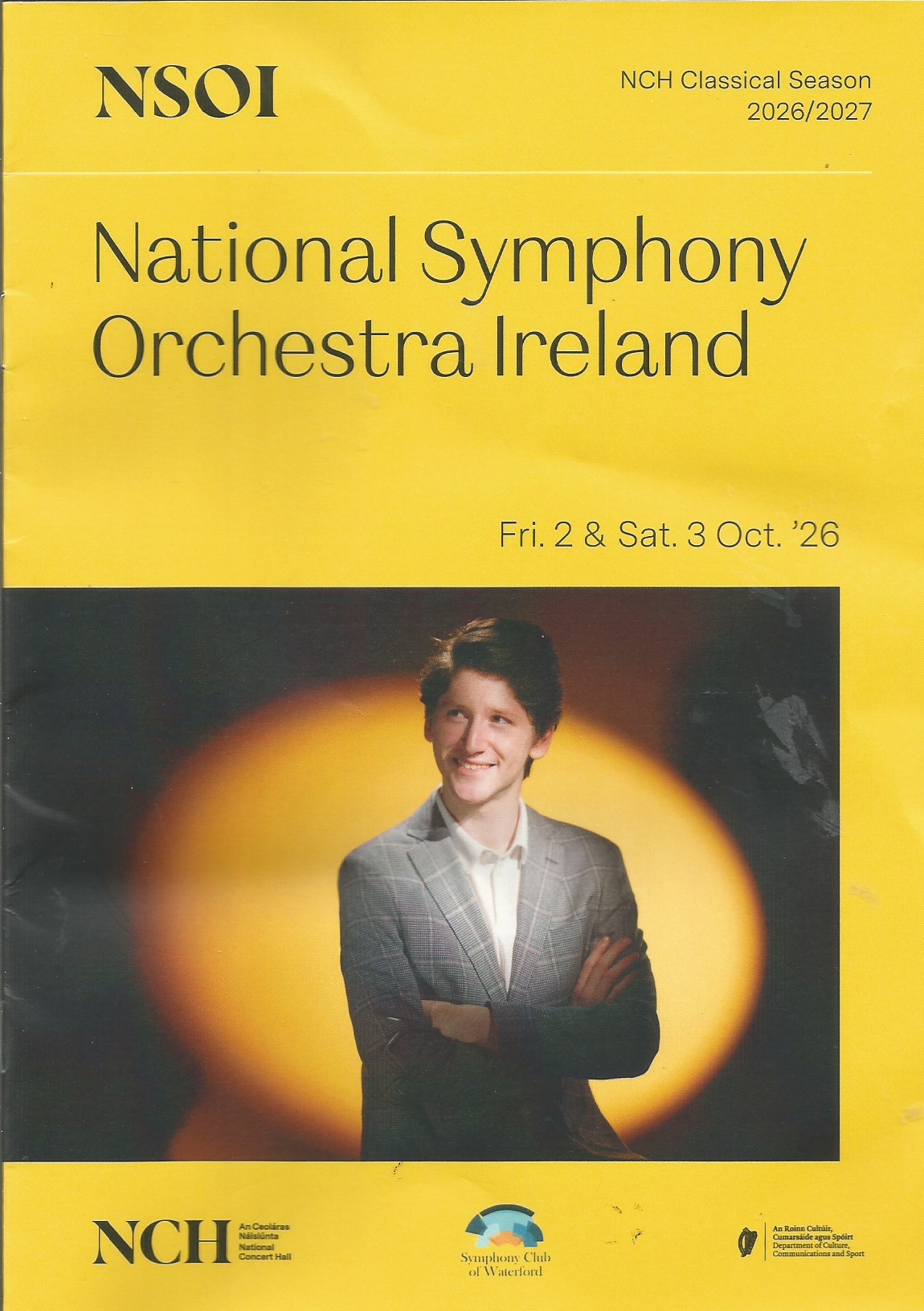
Unfortunately I had to miss the opening concert of the 2026/7 season by National Symphony Orchestra Ireland at the National Concert Hall, especially since it was Mahler’s epic Resurrection Symphony. That was three weeks ago and last night was the first time I managed to make it to a concert at the National Concert Hall this season.
Earlier this week I was thinking that, although I’ve been walking to and from the NCH on Fridays quite frequently since I moved to Ireland almost 9 years ago, I’ve managed to avoid getting rained on to a significant extent. Yesterday evening my luck ran out and it was bucketing down. Fortunately I took an umbrella and wore an raincoat so I wasn’t too drenched when I arrived. The cloakroom at the NCH is free, by the way.
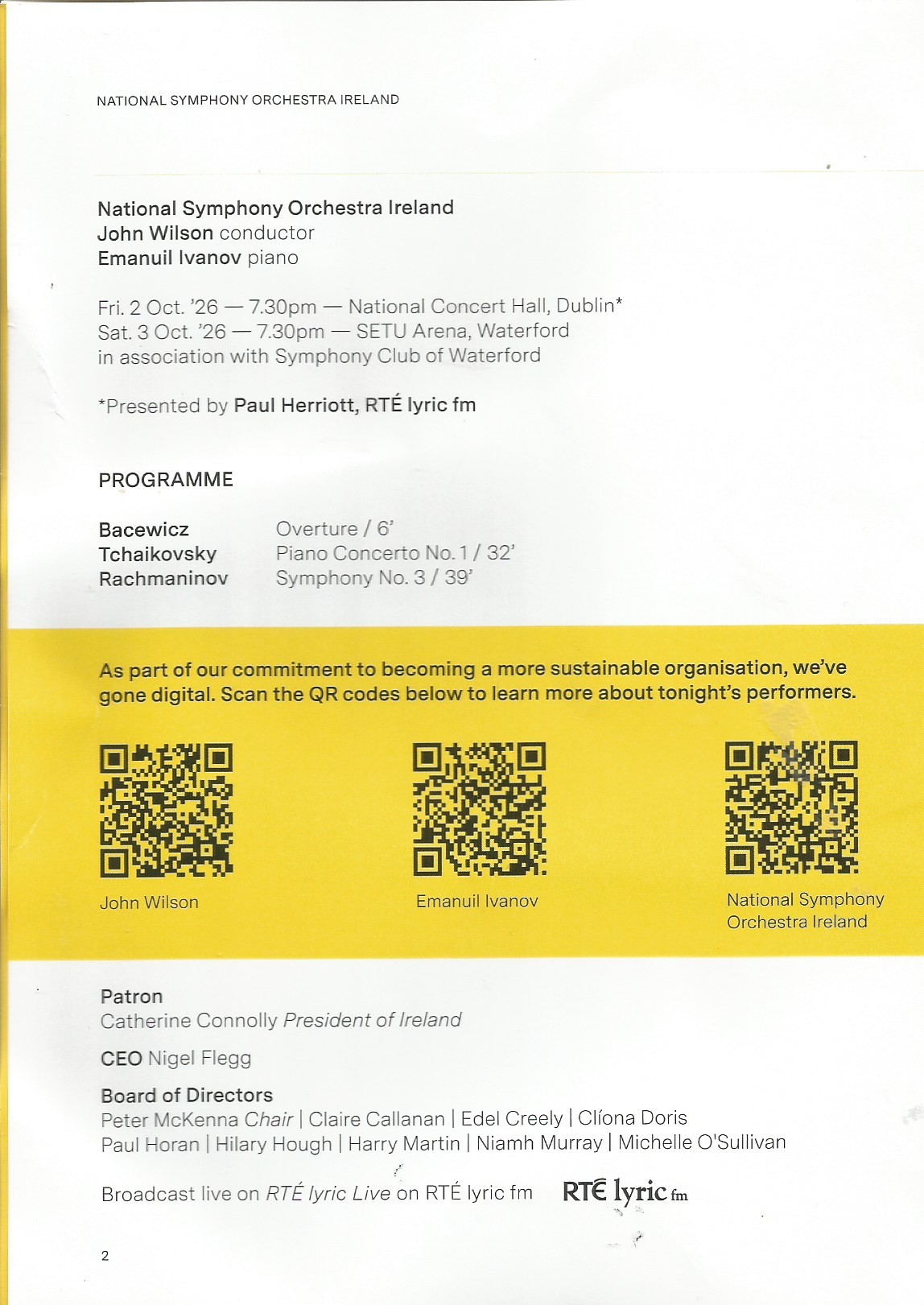
Having arrived and divested myself of coat and brolly, I commenced the usual ritual of buying a programme and noticed the format had changed. The new style is much shorter (and cheaper, at just €2) and has QR codes linking to much of the material that would previously have been in the programme. If you’re interested you can follow the links above. I like having a printed copy primarily as a souvenir, and the new format serves that purpose well.
The National Orchestra of Ireland was conducted last night by John Wilson. The first item on the menu last night was a short piece by Polish composer Grażyna Bacewicz called, simply, Overture. This was composed in the depths of the Second World War, but not officially premiered until 1945. Given the time of its composition it is surprisingly optimistic in tone, with its defiant “V for Victory” motif and evocations of pre-war peace.
Next up was one of the most familiar concert pieces of the entire classical repertoire, the Piano Concerto No. 1 by Pyotr Ilyich Tchaikovsky. Certainly the spectacular opening, with its fanfare-like introduction followed by a dramatic string theme supported by huge chords from the piano, must be one of the best-known introductions to a classical work. It’s curious though that the theme that gives it such an imposing start is not heard anywhere else in the concerto, though what follows is hugely absorbing and entertaining, if a bit theatrical for some tastes. It’s not too theatrical for me, I hasten to add. I love it.
The soloist for the performance was Bulgarian-born Emanuil Ivanov who hit a wrong note early on but thereafter played very well. I thought he really only caught fire in the last movement with its tumultuous climax. The Dublin audience is always generous with its applause and treated the soloist and orchestra to a standing ovation af the end of the performance.
After the wine break we returned to a piece that I’ve never heard in a live concert before, the Symphony No. 3 in A minor by Sergei Rachmaninov. This was written about 30 years after his more famous Second Symphony and is quite different, though still romantic, style. It is in three movements, beginning slowly (Lento) with a statement of a simple theme, but then speeds up (Allegro moderato, then Allegro) as the theme reappears in different guises. The second movement does much the same thing, initially with violin and flute to the fore before the rest of the orchestra joins in, including some of Rachmaninov’s trademark romantic string passages. The final movement starts and ends Allegro Vivace, with several changes of gear in between, but although it was exciting in patches I found it a bit long-winded. My summary would be that I’m glad to have had the opportunity to hear Rachmaninov’s Symphony No. 3, but I don’t think it’s as compelling as his Symphony No. 2.
I usually choose my seat for these concerts to make it easy to get to the bar for the interval, but there was a bonus yesterday. Because of the rain earlier in the evening many more people than usual had checked in coats and umbrellas. When the concert was over I was very quick to get to the cloakroom to extract my things while an enormous queue was growing. It wasn’t raining on the way home.
With lyrics by Sammy Cahn and tune by Jule Styne, the song Time After Time was written in 1947 and rapidly became a jazz standard. Trumpeter and singer Chet Baker certainly took a shine to it and recorded many versions over the years. I already posted one version from 1956 here. Here’s another excellent one, from Belgium TV in 1964. Chet Baker had an unusual vocal style for jazz: smooth and with little vibrato, rather like his playing on the trumpet. There’s quite a long trumpet solo in this one during which you can hear the influence of Miles Davis very clearly.
Walking back from lunch just now I suddenly remembered the significance of today’s date. Today is the 100th anniversary of the birth of the great John Coltrane, who was born on 23rd September 1926 in Hamlet, North Carolina. I won’t attempt to do a full tribute to Trane, whose influence on jazz saxophone playing, and jazz in general, is incalculable. I will, however, take advantage of the fact that today is the day of the Autumnal Equinox (as it was on the date of Coltrane’s birth) to post one of my favourite tracks by him. This was recorded on 1960 and originally released on the album Coltrane’s Sound which came out in 1964. The line-up is John Coltrane (tenor sax), McCoy Tyner (piano), Elvin Jones (drums) and Steve Davis (bass). It’s a gently swinging contemplative and very atmospheric blues in C♯ minor called, appropriately enough for today, Equinox.
I’m not exactly an avid cinema-goer but I couldn’t resist taking a short trip into Dublin to see Everybody Digs Bill Evans, a biographical drama about the late great jazz pianist Bill Evans, the trailer for which is above.
I suppose Bill Evans is best known for his wonderful contributions to what many people regard as the greatest jazz album of all time, Kind of Blue which was released in 1959. This film, however, focuses on the period after he had left the Miles Davis band that made that album in order to pursue a career leading a piano trio. It could be argued that it was this step that led to Bill Evans’s most important contribution to the evolution of jazz because he basically created the modern piano trio, converting it from what it had been before – a pianist with bass and drum backing – to an equal partnership of the three diverse instruments. To put such a combination together required him to find musicians of equal creativity and understanding, and he found them when he formed his first regular trio with the brilliant Scott LaFaro on bass and Paul Motian on drums. In a short period that band made four superb albums (two in studio, Portrait in Jazz and Explorations, and two live, Sunday at the Village Vanguard and Waltz for Debby). Astonishingly, the music for the two live albums was recorded on the same day, 25th June 1961.
Just when it seemed a wonderful future was opening up for the trio, tragedy struck. Bassist Scott LaFaro was killed in a car accident, just 10 days after the Village Vanguard date. He was just 25 years old. Evans was completely devastated by this event, so much so that he stopped playing completely for several months. He was paralysed by grief. For a man whose whole life revolved around playing the piano this was an indication of the depth of the bereavement he felt. It also made Evans sink even deeper into the heroin habit he was already struggling with.
The film focusses on the the period after LaFaro’s death, when Bill Evans stays in New York City with his brother Harry (who was also a musician) before his escalating drug use forces him to leave in order to detox with is parents in Florida. It’s essentially a portrait of a man’s struggles with grief and his inner demons, and is at times grim but it is keenly felt and very absorbing. Bill Evans was a shy and introverted man who found his own talent hard to cope with, and was consequently very insecure, but the film does not try to turn him into some kind of martyr. Neither does it try to come up with a glib “explanation” of his heroin addiction. Like the complex harmonic progressions that abound in the music, not everything has a straightforward resolution. The honesty of the film is one of its greatest strengths.
The look of the film is very “art house”. Shot (mostly) in stark black-and-white (see the trailer), it makes striking use of light and shadow. In places it reminded me a lot of Night of the Hunter. Another interesting thing is that although it is set largely between New York and Florida, it was actyually shot in Ireland!
Mark O’Halloran’s script avoids a linear narrative, instead jumping backwards and forewards, giving the story a dreamlike quality. For example, flash-forwards to the 1970s are shot in vibrant saturated colour to contrast with the monochrome of the rest of the film. These sequences are previews of yet more tragedy in Evans’s life: the deaths by suicide of his partner Ellaine Schultz in 1973 and his brother Harry Evans in 1979. Bill Evans himself passed away in 1980.
Finally I have to take my hat off to Norwegian actor Anders Danielsen Lie for his utterly compelling performance as Bill Evans. I can’t think of many examples of an actor so completely inhabiting such an enigmatic role. I suppose he was helped because there are quite a few examples of Evans playing and talking on film, but even so it was a standout performance.
Everybody Digs Bill Evans is highly recommended, and not only for jazz fans! It’s showing at The Lighthouse and the Irish Film Institute in Dublin.
P.S. The title of the film is the same as that of a studio album made by an earlier manifestation of the Bill Evans Trio, with Sam Jones on bass and Philly Joe Jones on drums, before he teamed up with Scott LaFaro and Paul Motian.
P.P.S. Since Autumn is coming on, here’s my favourite track from Portrait in Jazz with Bill Evans, Scott LaFaro and Paul Motian showing what they could do.
I’ve been listening to a radio programme about the centenary of RTÉ, it being a hundred years since the first radio broadcast by Raidió Éireann in 1926 (before television existed). One of the things included was a discussion of the fierce campaign against Jazz in Ireland during the 1930s. On New Year’s Day 1934, a Fr. Conefrey led a march through Mohill, County Leitrim, in which demonstrators shouted “down with jazz” and “out with paganism” and called on the government to close the dance halls and ban all foreign dances in Ireland. Jazz, the campaign argued, was “abominable” music that originated in central Africa and was exported to the West by “a gang of wealthy Bolshevists in the USSR to strike at church civilisation throughout the world.” Jazz was an “engine of hell” deployed to do the devil’s work. The Gaelic League weighed in on the day with an attack on then-Minister of Finance Seán MacEntee, who, in allowing jazz to be broadcast on Radio Eireann, was “selling the musical soul of the nation for the dividends of sponsored jazz programmes”.
It seems absurd nowadays that people could take such tripe seriously but it was a significant movement supported, amongst others, by Éamon de Valera. Here are some extracts of a speech which is both hilarious and sinister, not to mention deeply racist, by Fr. Conefrey, to give you an idea. Honestly. I know some people don’t like jazz, but this is just ridiculous!
–0–
Let me tell you why this campaign is the most important step taken by the Gaelic League for many years.
While the Irish music has died out it is being replaced by a foreign system of music introduced from savage Africa by people out to kill religion and destroy morality. This ‘jazz’ represents the sin of impurity and young people leave their homes every night to go to dances where jazz is practised.
All night jazz dancing is one of the greatest evils Ireland has ever seen. Jazz is an even greater evil than both intemperance and landlordism combined. It is a menace to religion and nationality and its objective is nothing less than to destroy virtue in the human soul.
The reason it has been tolerated and indulged in so far is because the public in Ireland do not understand its meaning and do not see the danger.
Now we still have some people asking what is jazz? Some have asked in good faith if it excludes waltzes and barn dances? My answer to that is that the ‘anti-jazz campaign’ excludes no dance that is in keeping with public Christian decency. But no-one could make anything out of the jazz dancing, and there was no music in the jazz tin squealing.
A professor in Oxford University tells us that the word ‘jazz’ is a Central African word and means the acting in public of something that St Paul says should not be so much as named amongst us.
The dance and the music with its abominable rhythm was borrowed from Central Africa by a gang of wealthy International Bolshevists in America. Their aim is to strike at Christian civilization throughout the world and to steer Roman civilization inro the dust: they employed this jazz – this engine of hell – to do this devil’s work.
They laid their plans carefully. They employed mass suggestion. In the music they knew they had something that would appeal to debased sexual instinct. Its superlative, savagely extreme use of syncopation, allied with the copulative beat, beat, beat of the drum, stirred up forces all over the world.
To counter this abomination, the only answer is to revive Irish dancing and music. I appeal to you to support Irish music and Irish dancing: as far as I’m concerned it is a question of defending Christian religion and faith while we have it.
No other nation has the same music as we have. The Irish nation was famous for its music, but all the old violinists and flautists are gone, and it is only amongst the peasantry of Ireland that the real traditional music and dance is to be found.
When I was at the Royal Dublin Society exhibition we had a great show of our local cottage traditions of spinning and weaving and all sorts of knitted goods. But we also had Irish music and dance at our stand. I was congratulated and told by many that never was such music played on the show grounds, and it was one of the greatest treats of the whole show.
Music and dancing are among the arts of the nation and if the nation is to be rebuilt then we must get all the constituent parts reconstructed. I’ve had an idea in my mind for a long time, that we should have a National Reconstruction League to take charge of the language, music, and dance, and for cottage industries and the arts. If we could organise competitions and concerts to play our old tunes on traditional instruments and bring on new pipe bands, we could stop the spread of immorality and irreligion.
There is great musical-talent in Co. Leitrim and it is undeveloped.
We need to see that Irish music is fostered and not despised. But there are certain classes in this country who consider our Irish music is not genteel enough for them, and they look down on it and are out to destroy its spirit. Those Dublin people need to come down to the country where they’ll learn step dancing and how to distinguish one step from another and get the names of the steps. I would like to know what the Leinster School of Music was doing for Irish music: nothing; they are only teaching classical music. Even at the Sligo Feis Ceoil all the music was from Continental authors, and it was only the poor Irish farmers were left to play the Irish music.
Action is needed to be taken by the church and state. First, the government should compel the closing of dance halls at 11 o‘clock. Young teachers should be trained to teach Irish dancing and music, and they should have Irish dancing taught in the Depot amongst the members of the Guards.
One of the greatest offenders at the present time are the Civic Guards. The Minister for Justice should take action and have good Irish céilidh organised in every barracks every week or month, and not allow the Guards to be carrying on their pagan dances until hours in the morning. It is a well-known fact that in most cases there are bars open at these all-night dances, and people attending them are blinded with drink. This is a disgrace, and President de Valera should be ashamed of his face to stand by and allow this conduct to be carried on. It is time for the Government to open its eyes and see to it that this abuse should end.
I appeal to political parties to give up their disputes and unite on this question and put down this jazz.
While I speak to the Government I also speak to the Church, and say that the priests will want to waken up and see that this terrible and abusive jazz dancing ceases. I know that the majority of the priests know that jazz is wrong, but many of them will not speak out. There are others who don’t understand this monster and their idea is to let the people have what they want, which is the jazz.
I fear that if this is to continue and the generation of old people die out, we will have a different type of people in the future. It is up to the people to rise against this ]azz dance and music as it is necessary to save their traditions and faith. It is unworthy of Catholics to support jazz and no one is associated with jazz but shoneens. If people were worthy of their race and traditions they would blow up every hall, where jazz is practised.
More condemnation of jazz is worse than useless, as Henry Ford realised.
Young folk, will dance, but let them dance to rhythms of beauty and in a manner that will scatter morbidity and make for fun and jollity.
–0–
Coincidentally, it was also in 1926 that Louis Armstrong and His Hot Five recorded “The Irish Black Bottom” which I here present to you in the hope of destroying the virtue in your soul.
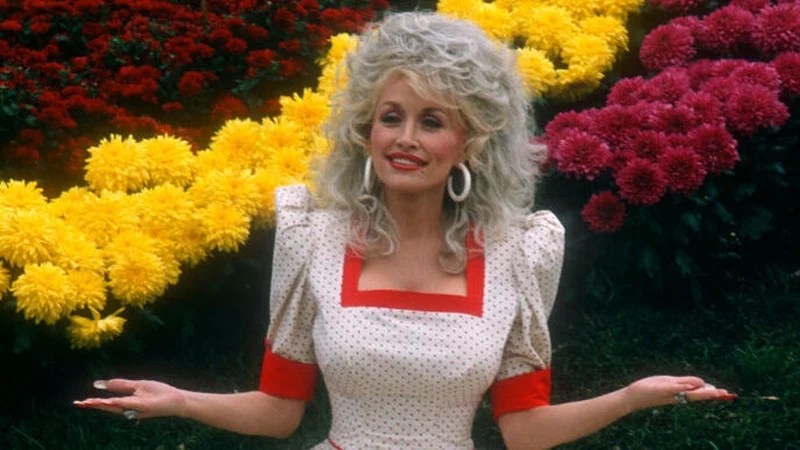
Country Music isn’t really my thing, but I was very sad when I heard the news a couple of days ago about the death of Dolly Parton. So sad, in fact, that I felt I had to wait a while before posting anything. I have little to add to the obituaries about her now, but I’ll just mention some things that I liked about her. O
One is that she was totally accepting of the LGBTQ+ people, which is why she was adopted so enthusiastically even by people like me who aren’t really country music fans. Her unofficial motto was “Find out who you are and do it on purpose”. That is admirable advice. Even during the ongoing backlash of bigotry she stood her ground. For that alone I would mourn her passing.
The second thing that I should say mention is her philanthropy. She was a tireless supporter of good causes, especially her wonderful Imagination Library (which has had a branch in the Republic of Ireland since 2019). This exists to encourage young children to read by giving them free books. Here in Ireland An Post delivers them for free too. As well as this and other public initiatives there are countless private acts of kindness, little gifts and words of encouragement. These days it seems unfashionable to be both rich and generous. Certainly one can’t imagine Musk, Zuckerberg, Bezos and their ilk giving any of their vast fortunes to any good cause.
Another thing about Dolly Parton that I adored was her self-deprecating humour. I regularly saw her on TV disarming someone who tried to mock her style and appearance by parodying herself. She always seemed to be down-to-earth and completely without pretentions. Of course I never met Dolly Parton, but I really think I would have liked her if I had.
I’ve already stated that I am not the biggest fan of Country Music but some of Dolly Parton’s songs crossed over and became huge popular hits. This one is one that I really do like. This is the original version of I Will Always Love You later covered by Whitney Houston, but I like it this version better. Incidentally, it was written on the same day as another smash hit of hers, Jolene.
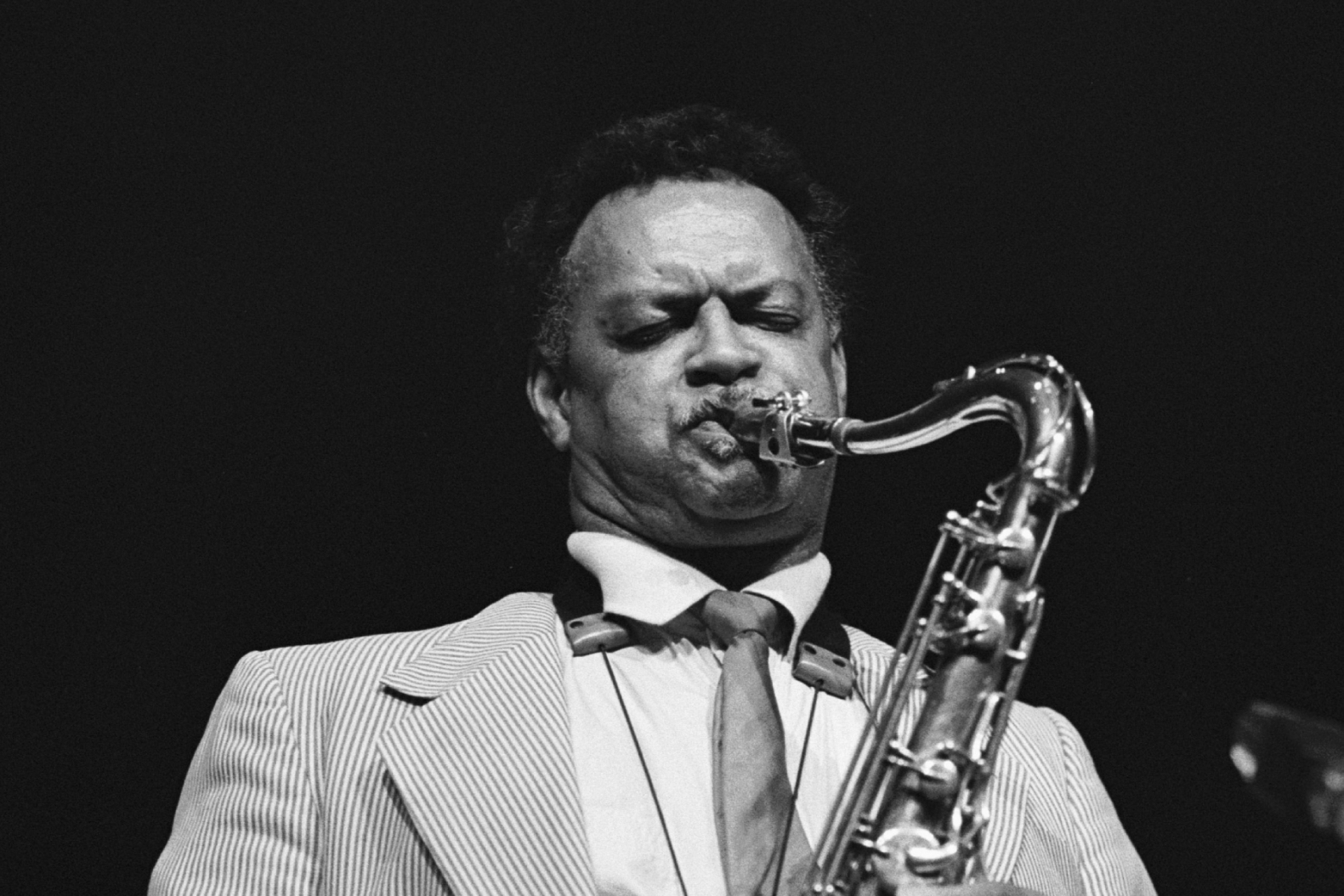
I first heard news of the death of tenor saxophonist Plas Johnson (left) a couple of days ago, and since then there have been numerous tributes including this one in the Irish Times. Almost without fail the obituaries introduce him as the man who played the saxophone part of the Pink Panther theme written by Henry Mancini. In fact, years ago, I won a tiebreak for my team in a pub quiz by knowing the name of the person who played that tune.
Even very good musicians struggled to make a decent living from jazz after the arrival of rock-and-roll as a popular musical phenomenon in the 1950s. Like many jazz performers, Johnson addressed this issue by moving to Los Angeles, where he found work as a session musician working to support such artists as Frank Sinatra and Marvin Gaye, or on film and TV music. Henry Mancini noticed Plas Johnson’s quality and it inspired him to write the Pink Panther film specifically for him. Most of these performances went uncredited, which is why his name isn’t more widely known despite him being a very fine saxophonist. Nonetheless, having the financial security of being much sought after session musician, Plas Johnson was able to continue to pursue his love of jazz. He made some fine albums as leader (I have Positively on vinyl). He also moonlighted as Johnny Beecher to evade contractual issues.
The reason I knew of Plas Johnson as a jazz musician before I found out he was the Pink Panther guy. That’s because I used to listen to Humphrey Lyttelton’s radio programme The Best of Jazz on Radio 2 on Monday evenings from 9pm when I was at school and Plas Johnson came up a few times, including on the track I’ve included below from one of the famous Hanna-Fontana sessions at the Concord Jazz Festival. The recording was made in 1975 but the record wasn’t available in the UK until a couple of years later. I used to tape Humph’s radio shows but no longer have any of the cassettes so I had to spend much of my spare time the last couple of days trying to find the track Humph played. This is it! It features Plas Johnson (ts), clearly enjoying himself in the company of Bill Berry (tpt), Carl Fontana (tb), Herb Ellis (g), Dave McKenna (p), Herb Mickman (b) and Jake Hanna (d). Not a bad line-up!
R.I.P. Plas Johnson (1931-2026), so much more than the Pink Panther guy!
The views presented here are personal and not necessarily those of my employer (or anyone else for that matter).
Feel free to comment on any of the posts on this blog but comments may be moderated; anonymous comments and any considered by me to be vexatious and/or abusive and/or defamatory will not be accepted. I do not necessarily endorse, support, sanction, encourage, verify or agree with the opinions or statements of any information or other content in the comments on this site and do not in any way guarantee their accuracy or reliability.