Archive for the The Universe and Stuff Category

Weekly Update from the Open Journal of Astrophysics – 13/12/2025

Posted in OJAp Papers, Open Access, The Universe and Stuff with tags , , , , , , , , , , , , , , , , , , , , , , , , , , on December 13, 2025 by telescoper

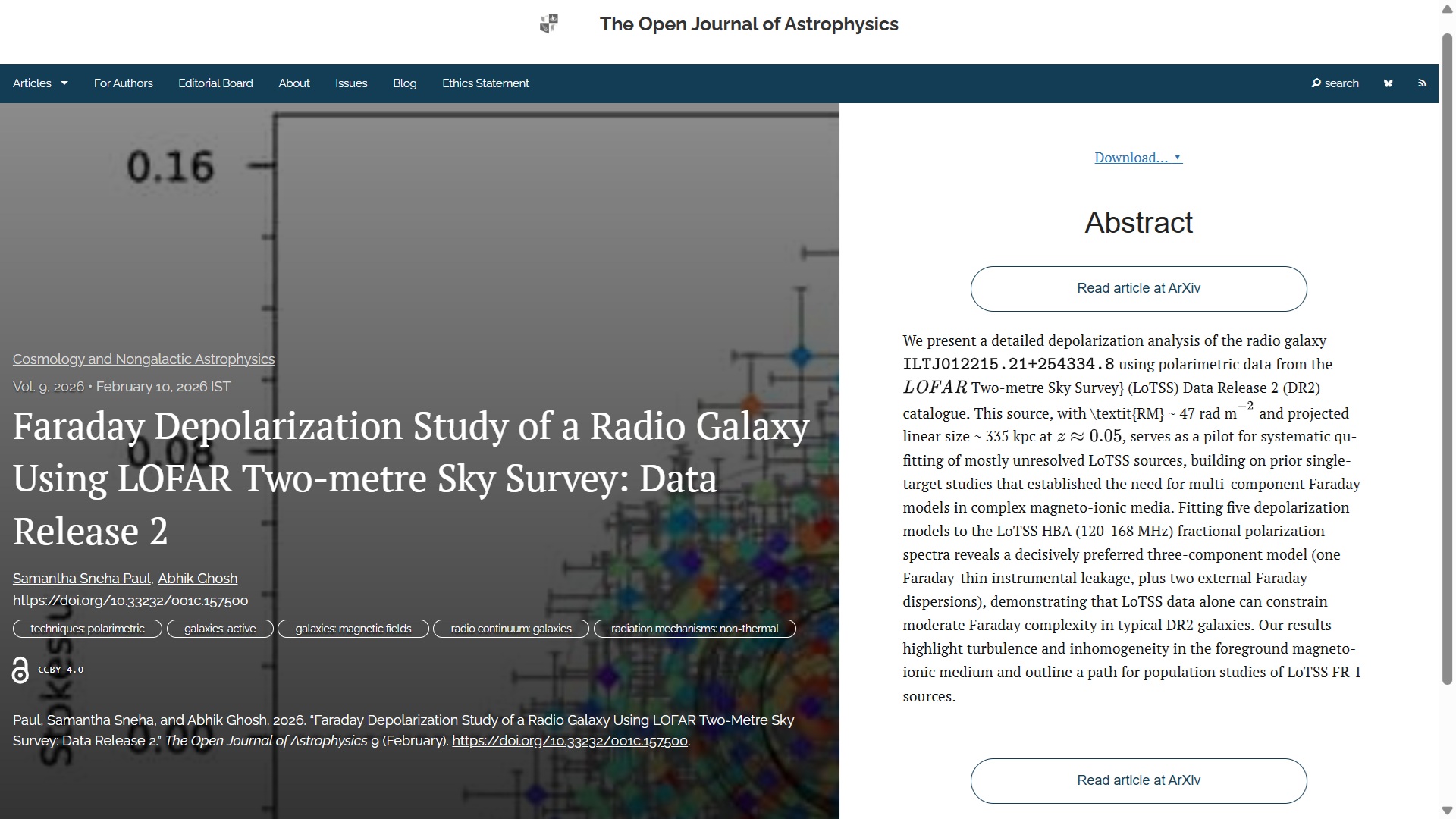
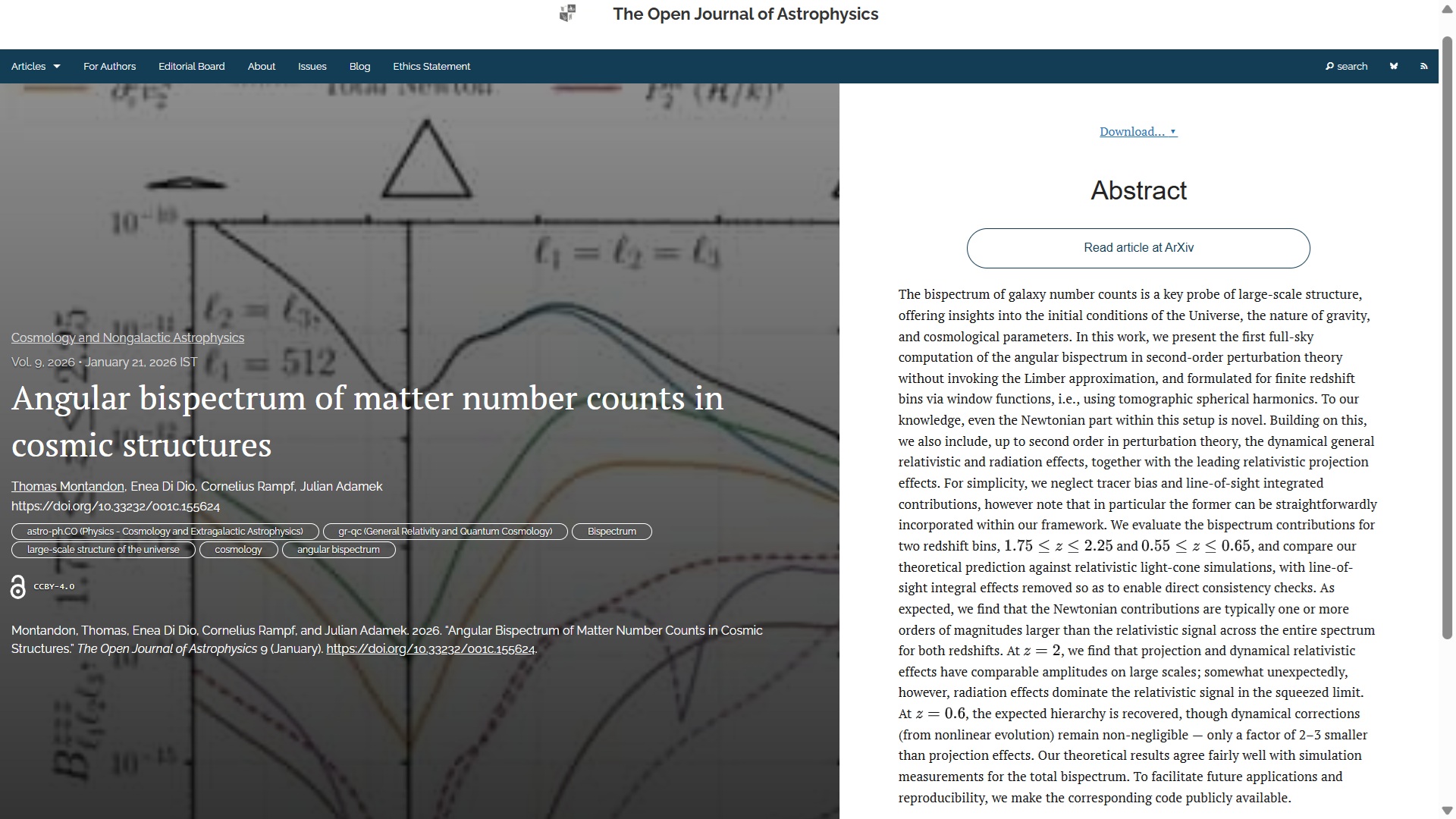
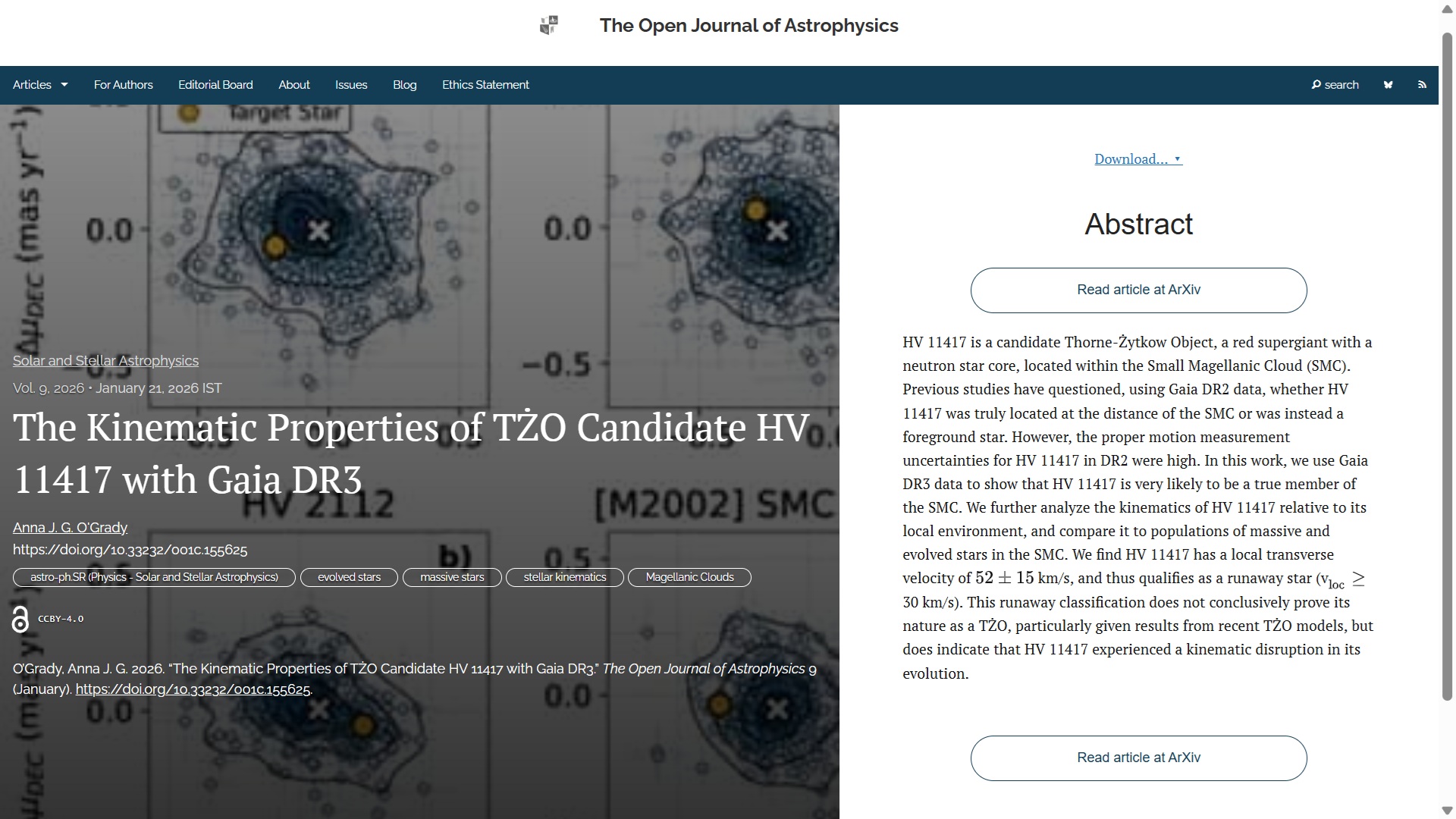
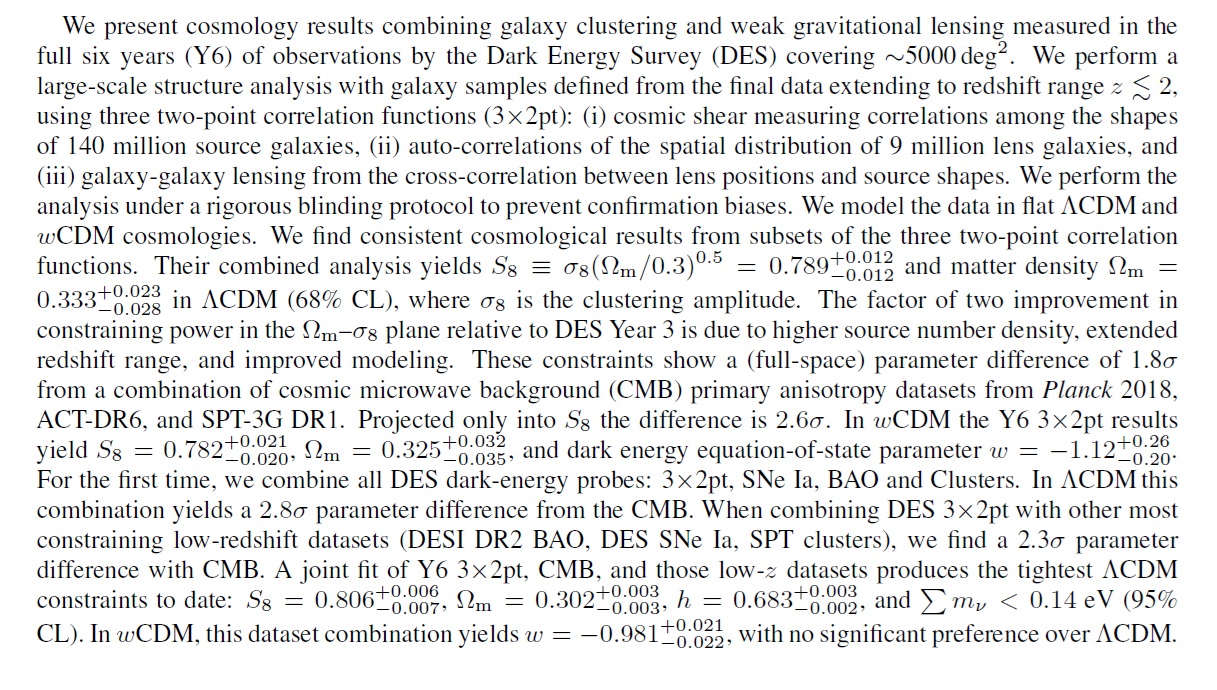
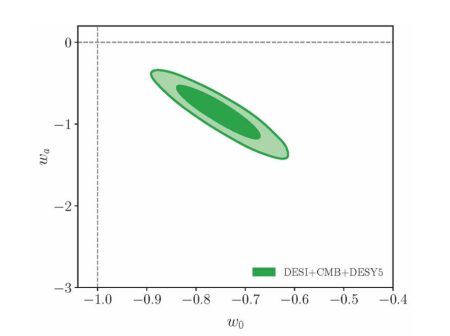
It’s time once again for the usual Saturday morning update of the week’s new papers at the Open Journal of Astrophysics. Since the last update we have published a further five papers, which brings the number in Volume 8 (2025) up to 195, and the total so far published by OJAp up to 430.

The first paper this week is “Cosmic Rays Masquerading as Cool Cores: An Inverse-Compton Origin for Cool Core Cluster Emission” by Philip F. Hopkins (Caltech), Eliot Quataert (Princeton), Emily M. Silich, Jack Sayers, Sam B. Ponnada and Isabel S. Sands (Caltech).  This was published on Tuesday 9th December 2025 in the folder marked High-Energy Astrophysical Phenomena. It presents an argument  that cosmic-ray inverse-compton emission could contribute significantly to the X-ray surface brightness (SB) in cool-corre clusters, implying that gas densities may have been overestimated therein.

The overlay is here:

You can find the officially accepted version on arXiv here and the Fediverse announcement is here:

Open Journal of Astrophysics

New Publication at the Open Journal of Astrophysics: "Cosmic Rays Masquerading as Cool Cores: An Inverse-Compton Origin for Cool Core Cluster Emission" by

Philip F. Hopkins (Caltech), Eliot Quataert (Princeton), Emily M. Silich, Jack Sayers, Sam B. Ponnada and Isabel S. Sands (Caltech)

doi.org/10.33232/001c.154053

December 9, 2025, 7:22 am 1 boosts 0 favorites

The second paper of the week is “Detecting False Positives With Derived Planetary Parameters: Experimenting with the KEPLER Dataset” by Ayan Bin Rafaih (Aitchison College, Lahore, Pakistan) and Zachary Murray (Université Côte d’Azur, France). This one was published on 9th December 2025 in the folder Earth and Planetary Astrophysics. It is an investigation into the performance of a range of machine-learning algorithms on the KEPLER dataset, using precision-recall trade-off and accuracy metrics.

The overlay is here:

You can find the official version of this one on arXiv here. The federated announcement on Mastodon is here:

Open Journal of Astrophysics

New Publication at the Open Journal of Astrophysics: "Detecting False Positives With Derived Planetary Parameters: Experimenting with the KEPLER Dataset" by Ayan Bin Rafaih (Aitchison College, Lahore, Pakistan) and Zachary Murray (Université Côte d’Azur, France)

doi.org/10.33232/001c.154054

December 9, 2025, 7:34 am 1 boosts 0 favorites

Next one up is “The role of peculiar velocity uncertainties in standard siren cosmology” by Chris Blake and Ryan J. Turner (Swinburne, Australia). This paper discusses the impact of peculiar velocities on the error in H0 determinations from local distance indicators with observed redshifts, incorporating the effect of bulk flows. It was published on Tuesday 9th December in the folder Cosmology and Nongalactic Astrophysics.

The overlay is here:

You can find the official accepted version on arXiv here. The fediverse announcement is here:

Open Journal of Astrophysics

New Publication at the Open Journal of Astrophysics: "The role of peculiar velocity uncertainties in standard siren cosmology" by Chris Blake and Ryan J. Turner (Swinburne, Australia)

doi.org/10.33232/001c.154055

December 9, 2025, 7:47 am 1 boosts 0 favorites

The fourth article of the week is “Transient QPOs of Fermi-LAT blazars with Linearly Multiplicative Oscillations” by P. Penil (Clemson University, USA) and 7 others based in the USA, Italy and Germany. This was published on Thursday 10th December in the folder High-Energy Astrophysical Phenomena. This paper presents an investigation of patterns of quasi-periodic oscillations in observed blazar systems characterized by periodic multiplicative amplitudes including both the periodicities and long-term variations.  The overlay is here:

You can find the official published version on arXiv here. The Fediverse announcement follows:

Open Journal of Astrophysics

New Publication at the Open Journal of Astrophysics: "Transient QPOs of Fermi-LAT blazars with Linearly Multiplicative Oscillations" by P. Penil (Clemson University, USA) and 7 others based in the USA, Italy and Germany

doi.org/10.33232/001c.154123

December 10, 2025, 12:22 pm 0 boosts 1 favorites

The last paper for this week is “Tidally Delayed Spin-Down of Very Low Mass Stars” by Ketevan Kotorashvili and Eric G. Blackman (U. Rochester, USA). This was published on Friday 12th December (yesterday) in the folder Solar and Stellar Astrophysics. It discusses the effect of tides from sub-stellar companions on rotational evolution of very low-mass stars, suggesting that these may explain the dearth of field, late-type M dwarfs with intermediate rotation periods.

The overlay is here:


You can find the officially-accepted version on arXiv here, and the Mastodon announcement is here:

Open Journal of Astrophysics

New Publication at the Open Journal of Astrophysics: "Tidally Delayed Spin-Down of Very Low Mass Stars" by Ketevan Kotorashvili and Eric G. Blackman (U. Rochester, USA)

doi.org/10.33232/001c.154268

December 12, 2025, 10:31 am 1 boosts 0 favorites


And that concludes the update for this week. I will do another of these regular announcements next Saturday, which will be the last such update for 2025. Will we make it past 200 for the year? Tune in next week to find out!

Black Holes, Hawking Radiation (and AI…)

Posted in Artificial Intelligence, The Universe and Stuff with tags , , , , , on December 7, 2025 by telescoper

It seems to be a common misapprehension that the energy released by the supermassive black holes in, for example, active galactic nuclei is in the form of Hawking radiation. It isn’t. Hawking radiation is only significant for black holes of very low mass. The radiation produced around supermassive black holes is due to the extremely high density and temperate of matter falling into the black hole through an accretion disk not due to the evaporation of the black hole itself. Hawking radiation has never been experimentally detected.

Hawking showed that the a black hole will produce black-body radiation with a temperature, the Hawking Temperature, given by TH in a beautiful formula below that brings together constants relating to gravity, statistical mechanics, quantum theory and relativity:

You can see that the Hawking Temperature is inversely proportional to the mass of the black hole M so is largest for very small black holes. In fact for a black hole with mass of order that of the Moon, the Hawking Temperature is just 3 Kelvin. Since the Universe is bathed in cosmic radiation with this temperature, such a black hole would not evaporate at all because it would absorb as much radiation as it emits by the Hawking mechanism as would any black hole of mass greater than this. The Hawking temperature for a supermassive black hole is many orders of magnitude lower than this, so Hawking radiation is completely irrelevant.

Notice that if a black hole does start to evaporate then its mass begins to decrease. Its Hawking temperature therefore increases so its mass decreases even more quickly. In the end the mass gets so low and the temperature so high that the black hole effectively explodes. Nobody really knows how to describe the final stage as it relies on physics we don’t understand.

Anyway, this all reminds that years ago I set an examination question that involved applying the Hawking formula above to calculate the lifetime of a black hole of mass M. It’s not too hard to show that it scales as M-3. Another part of the question asked: what is the mass of a black hole whose Hawking Temperature is room temperature (say 300 K), what would be the Schwarzschild radius of such a black hole, and what would be its lifetime?

I’ll leave it to my readers to plug the numbers into the Hawking formula above to derive the mass, etc. Please submit your answers through the comments box below. The first correct entry does not win a prize, not even a joke Peace Prize.

For a laugh I asked Google for the answer. Here is the AI summary:

Bonus marks for pointing out everything that’s wrong in this summary.

Weekly Update from the Open Journal of Astrophysics – 06/12/2025

Posted in OJAp Papers, Open Access, The Universe and Stuff with tags , , , , , , , , , , , , , , , , , , , , , , , , , , , on December 6, 2025 by telescoper

Once again it’s time for the usual Saturday morning update of the week’s new papers at the Open Journal of Astrophysics. Since the last update we have published a further six papers, which brings the number in Volume 8 (2025) up to 190, and the total so far published by OJAp up to 425. I blogged about the significance of the latter figure here.

The first paper this week is “The galaxy-IGM connection in THESAN: observability and information content of the galaxy-Lyman-alpha cross-correlation at z>6” by Enrico Garaldi (U. Tokyo, Japan), Verena Bellscheidt (Tech. U. Munich, Germany), Aaron Smith (U. Texas Austin, USA) and Rahul Kannan (York U. Canada). This paper was published on Monday 1st December 2025 in the folder Cosmology and Nongalactic Astrophysics. It describes an investigation of the impact of observational limitations on the ability to retrieve the intrinsic galaxy-Lyman-alpha cross correlation from line-of-sight observations.

The overlay is here:


You can find the officially accepted version on arXiv here and the Fediverse announcement is here:

Open Journal of Astrophysics

New Publication at the Open Journal of Astrophysics: "The galaxy-IGM connection in THESAN: observability and information content of the galaxy-Lyman-alpha cross-correlation at z>6" by Enrico Garaldi (U. Tokyo, Japan), Verena Bellscheidt (Tech. U. Munich, Germany), Aaron Smith (U. Texas Austin, USA) and Rahul Kannan (York U. Canada)

doi.org/10.33232/001c.151666

December 1, 2025, 8:37 am 1 boosts 0 favorites

The second paper of the week is “A Less Terrifying Universe? Mundanity as an Explanation for the Fermi Paradox” by Robin H.D. Corbet (U. Maryland, USA). This paper was published on 1st December 2025 in the folder Instrumentation and Methods for Astrophysics. It presents a discussion of possible explanations for the lack of s evidence for the presence of technology-using extraterrestrial civilizations in the Galaxy (usually called the Fermi paradox). The overlay is here:


You can find the official version of this one on arXiv here. The federated announcement on Mastodon is here:

Open Journal of Astrophysics

New Publication at the Open Journal of Astrophysics: "A Less Terrifying Universe? Mundanity as an Explanation for the Fermi Paradox" by Robin H.D. Corbet (U. Maryland, USA)

doi.org/10.33232/001c.151454

December 1, 2025, 8:50 am 2 boosts 2 favorites


Next one up is “Sulphur abundances in star-forming regions from optical emission lines: A new approach based on photoionization models consistent with the direct method” by Enrique Pérez-Montero, Borja Pérez-Díaz, & José M. Vílchez ( (Instituto de Astrofísica de Andalucía, Spain), Igor A. Zinchenko (LMU, Germany), Asier Castrillo, Marta Gavilán, Sandra Zamora & Ángeles I. Díaz (Universidad Autonoma de Madrid, Spain). This was published on 1st December 2025 in the folder Astrophysics of Galaxies. This study uses the emission lines produced in the optical part of the spectrum and with photoionization models to derive sulphur chemical abundances in the gas-phase of star-forming galaxies.

The overlay is here:


You can find the official accepted version on arXiv here. The fediverse announcement is here:

Open Journal of Astrophysics

New Publication at the Open Journal of Astrophysics: "Sulphur abundances in star-forming regions from optical emission lines: A new approach based on photoionization models consistent with the direct method" by Enrique Pérez-Montero, Borja Pérez-Díaz, & José M. Vílchez ( (Instituto de Astrofísica de Andalucía, Spain), Igor A. Zinchenko (LMU, Germany), Asier Castrillo, Marta Gavilán, Sandra Zamora & Ángeles I. Díaz (Universidad Autonoma de Madrid , Spain)

doi.org/10.33232/001c.151253

December 1, 2025, 9:12 am 0 boosts 0 favorites

The fourth article of the week is “Bayesian Posteriors with Stellar Population Synthesis on GPUs” by Georgios Zacharegkas & Andrew Hearin (Argonne National Laboratory, USA) and Andrew Benson (Carnegie Observatories, USA). This is an exploration of a range of computational techniques aimed at accelerating Stellar Population Synthesis predictions of galaxy photometry using the JAX library to target GPUs (Graphics Processing Units, in case you didn’t know). This paper was published on Tuesday December 2nd 2025 in the folder Astrophysics of Galaxies.

The overlay is here:


You can find the official published version on arXiv here. The Fediverse announcement follows:

Open Journal of Astrophysics

New Publication at the Open Journal of Astrophysics: "Bayesian Posteriors with Stellar Population Synthesis on GPUs" by Georgios Zacharegkas & Andrew Hearin (Argonne National Laboratory, USA) and Andrew Benson (Carnegie Observatories, USA)

doi.org/10.33232/001c.151255

December 2, 2025, 7:38 am 3 boosts 1 favorites

Next one up is “IAEmu: Learning Galaxy Intrinsic Alignment Correlations” by Sneh Pandya Yuanyuan Yang, Nicholas Van Alfen, Jonathan Blazek and Robin Walters (Northeastern University, Boston, USA). This presents a neural-network-based emulator that predicts the galaxy position-position, position-orientation, and orientation-orientation, correlation functions and their uncertainties using mock catalogs based on the halo occupation distribution (HOD) framework. It was published on December 2nd 2025 in the folder Cosmology and Nongalactic Astrophysics. The overlay is here:

The official accepted version can be found on arXiv here. The Mastodon announcement is here:

Open Journal of Astrophysics

New Publication at the Open Journal of Astrophysics: "IAEmu: Learning Galaxy Intrinsic Alignment Correlations" by Sneh Pandya Yuanyuan Yang, Nicholas Van Alfen, Jonathan Blazek and Robin Walters (Northeastern University, Boston, USA)

doi.org/10.33232/001c.151749

December 2, 2025, 7:52 am 1 boosts 0 favorites

The last paper for this weel is “Unraveling the Nature of the Nuclear Transient AT2020adpi” by Paarmita Pandey (Ohio State University, USA) and a team of 15 others based in the USA, UK and Australia. This was published on Thursday December 4th 2025 in the folder High-Energy Astrophysical Phenomena. It is an investigation into a particular transient event AT2020adpi and a discussion of whether it is an extreme example of AGN variability or a Tidal Disruption Event (TDE). The overlay is here:

You can find the officially-accepted version on arXiv here, and the Mastodon announcement is here:

Open Journal of Astrophysics

New Publication at the Open Journal of Astrophysics: "Unraveling the Nature of the Nuclear Transient AT2020adpi" by Paarmita Pandey (Ohio State University, USA) and 15 others based in the USA, UK and Australia

doi.org/10.33232/001c.151453

December 4, 2025, 8:48 am 1 boosts 0 favorites

And that concludes the update for this week. I will do another next Saturday.

MAUVE Image Simulation

Posted in The Universe and Stuff with tags , , , on December 2, 2025 by telescoper

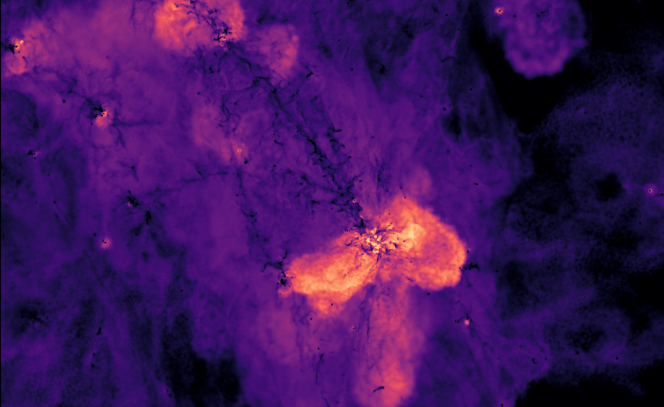
Since the successful launch of the MAUVE satellite on Friday, the telescope has been undergoing verification and calibration. Meanwhile, I’ve been hard at work using my advanced image processing skills to simulate what images of astronomical objects seen in other wavebands might look like using MAUVE.

Here’s an example.

The original picture below is a famous image that needs no introduction. Simply move the slider to the left to reveal the MAUVE version…

P.S. Apologies that the software does not quite scale the images correctly.

Weekly Update from the Open Journal of Astrophysics – 29/11/2025

Posted in OJAp Papers, Open Access, The Universe and Stuff with tags , , , , , , , , , , , , , , , , , , , , on November 29, 2025 by telescoper

It’s Saturday again, so it’s time for the usual update of the week’s new papers at the Open Journal of Astrophysics. Publishing this week was interrupted by the Thanksgiving holiday in the United States, which meant there were no arXiv announcements yesterday. Nevertheless, since the last update we have published another four papers, which brings the number in Volume 8 (2025) up to 184, and the total so far published by OJAp up to 419.

The first paper this week is “A theoretical prediction for the dipole in nearby distances using cosmography” by Hayley J. Macpherson (U. Chicago, USA) and Asta Heinesen (Niels Bohr Institute, Denmark). This was published on Monday 24th November 2025 in the folder Cosmology and Nongalactic Astrophysics. It presents a method to predict the dipole in luminosity distances that arises due to nearby inhomogeneities to leading-order correction to the standard isotropic distance-redshift law. Incidentally, I wrote about a talk by one of the authors here.

The overlay is here:


You can find the officially accepted version on arXiv here and the Fediverse announcement is here:

Open Journal of Astrophysics

New Publication at the Open Journal of Astrophysics: "A theoretical prediction for the dipole in nearby distances using cosmography" by Hayley J Macpherson (U. Chicago, USA) and Asta Heinesen (Niels Bohr Institute, Denmark)

doi.org/10.33232/001c.150319

November 24, 2025, 8:25 am 2 boosts 1 favorites


The second paper of the week is “A Targeted Gamma-Ray Search of Five Prominent Galaxy Merger Systems with 17 years of Fermi-LAT Data” by Siddhant Manna and Shantanu Desai (IIT Hyderabad Kandi, India). This one was published on Tuesday November 25th 2025 in the folder marked High-Energy Astrophysical Phenomena. It describes a search for gamma-ray emission in Fermi-LAT data from five merging galaxy systems with marginal detections for two of them

The overlay is here:


You can find the official version of this one on arXiv here. The federated announcement on Mastodon is here:


Next one up is “Metallicity fluctuation statistics in the interstellar medium and young stars – II. Elemental cross-correlations and the structure of chemical abundance space” by Mark R. Krumholz (ANU, Australia), Yuan-Sen Ting (Ohio State U., USA), Zefeng Li (Durham U., UK), Chuhan Zhang (ANU), Jennifer Mead (Columbia U., USA) and Melissa K. Ness (ANU). This was published in the folder Astrophysics of Galaxies on Wednesday November 26th. It presents an extended stochastically-forced diffusion model for the chemical evolution of galaxies, making quantitative predictions for the degree of correlation in abundance patterns in both gas and young stars.

The overlay is here:


You can find the official accepted version on arXiv here. The fediverse announcement is here:

Open Journal of Astrophysics

New Publication at the Open Journal of Astrophysics: "Metallicity fluctuation statistics in the interstellar medium and young stars – II. Elemental cross-correlations and the structure of chemical abundance space" by Mark R. Krumholz (ANU, Australia), Yuan-Sen Ting (Ohio State U., USA), Zefeng Li (Durham U., UK), Chuhan Zhang (ANU), Jennifer Mead (Columbia U., USA) and Melissa K. Ness (ANU)

doi.org/10.33232/001c.150356

November 26, 2025, 8:34 am 1 boosts 1 favorites

The fourth and final paper of the week is “Simulating realistic Lyman-alpha emitting galaxies including the effect of radiative transfer” by Hasti Khoraminezhad & Shun Saito (Missouri Institute of Science & Technology, USA), Max Gronke (U. Heidelberg, Germany) and Chris Byrohl (MPA Garching, Germany). An empirical model for Lyman-alpha emitters (LAEs) which provides predictions for the halo occupation distributions and relationship between luminosity and halo mass, including the distribution of satellite LAEs. It was published on Thursday November 27th 2025 in the folder Astrophysics of Galaxies.

The overlay is here:

You can find the official published version on arXiv here. The Fediverse announcement follows:

Open Journal of Astrophysics

New Publication at the Open Journal of Astrophysics: "Simulating realistic Lyman-alpha emitting galaxies including the effect of radiative transfer" by Hasti Khoraminezhad & Shun Saito (Missouri Institute of Science & Technology, USA), Max Gronke (U. Heidelberg, Germany) and Chris Byrohl (MPA Garching, Germany)

doi.org/10.33232/001c.151254

November 27, 2025, 9:20 am 1 boosts 1 favorites

And that concludes the update for this week. I will do another next Saturday.

MAUVE Launched!

Posted in Maynooth, The Universe and Stuff with tags , , , , on November 28, 2025 by telescoper

After a false start a couple of days ago, the satellite MAUVE was launched at (10.44 Pacific Time (18.44 GMT) today from Vandenberg Space Force Base in California on a SpaceX Falcon-9 Transporter-15. So far, about 40 minutes after liftoff, it’s looking good.

You can see the live feed here:

As far as I know the launch went perfectly, but I’m waiting for confirmation of payload deployment, which begins about an hour after launch. The vehicle is carrying 140 different satellites, of which MAUVE (“Mission to Analyze the UltraViolet universE”) is just one.

The following is taken from my previous post. I repeat it here for completeness.

I’m not personally involved in MAUVE but the Department of Physics at Maynooth University is, through my colleague Dr Emma Whelan (who sent the above pictures) and her group. You can read more about the science – related to star and planet formation – it will do in a nice piece by Emma on RTÉ Brainstorm.

MAUVE Postponed

Posted in Maynooth, The Universe and Stuff with tags , , , , on November 26, 2025 by telescoper

I was hoping to do a post this evening about the satellite MAUVE which was due to be launched at 18.18 GMT from Vandenberg Space Force Base in California on a SpaceX Falcon-9 Transporter-15. Unfortunately the launched was scrubbed with about 15 minutes to go. In fact it was originally scheduled for 11th November but was postponed then. It’s now supposed to be launched on Friday 28th November. Let’s hope it’s third time lucky!

MAUVE is a small satellite, which is to be launched with a number of others; the name stands for “Mission to Analyze the UltraViolet universE” and the heart of it is a 60cm ultraviolet telescope.

I’m not personally involved in MAUVE but the Department of Physics at Maynooth University is, through my colleague Dr Emma Whelan (who sent the above pictures) and her group. You can read more about the science – related to star and planet formation – it will do in a nice piece by Emma on RTÉ Brainstorm.

There’s a more technical description of MAUVE on the arXiv here. The abstract reads:

We present the mission concept “Mission to Analyze the UltraViolet universE” (MAUVE), a wide-field spectrometer and imager conceived during the inaugural NASA Astrophysics Mission Design School. MAUVE responds to the 2023 Announcement of Opportunity for Probe-class missions, with a budget cap of $1 billion, and would hypothetically launch in 2031. However, the formulation of MAUVE was an educational exercise and the mission is not being developed further. The Principal Investigator-led science of MAUVE aligns with the priorities outlined in the 2020 Astrophysics Decadal Survey, enabling new characterizations of exoplanet atmospheres, the early-time light curves of some of the universe’s most explosive transients, and the poorly-understood extragalactic background light. Because the Principal Investigator science occupies 30% of the observing time available during the mission’s 5 yr lifespan, we provide an observing plan that would allow for 70% of the observing time to be used for General Observer programs, with community-solicited proposals. The onboard detector (THISTLE) claims significant heritage from the Space Telescope Imaging Spectrograph on Hubble, but extends its wavelength range down to the extreme UV. We note that MAUVE would be the first satellite in decades with the ability to access this regime of the electromagnetic spectrum. MAUVE has a field of view of 900″ x 900″ a photometric sensitivity extending to mUV ≤ 24 , and a resolving power of R ~ 1000. This paper provides full science and mission traceability matrices for this concept, and also outlines cost and scheduling timelines aimed at enabling a within-budget mission and an on-time launch.

Anyway, I hope to be able to give an update on Friday evening about the successful launch of MAUVE. Fingers crossed!

Weekly Update from the Open Journal of Astrophysics – 22/11/2025

Posted in OJAp Papers, Open Access, The Universe and Stuff with tags , , , , , , , , , , , , , , , , , , , , , on November 22, 2025 by telescoper

It’s Saturday again, so it’s time for the usual update of the week’s new papers at the Open Journal of Astrophysics. Since the last update we have published another five papers, which brings the number in Volume 8 (2025) up to 180, and the total so far published by OJAp up to 415.

The first paper to report this week is “Probing Anisotropic Cosmic Birefringence with Foreground-Marginalised SPT B-mode Likelihoods” by Lennart Balkenhol (Sorbonne Université, France), A. Coerver (UC Berkeley, USA), C. L. Reichardt (U. Melbourne, Australia) and J. A. Zebrowski (U. Chicago, USA). This paper was published on Monday November 17th in the folder Cosmology and Nongalactic Astrophysics. It presents a way of using data from the Souh Pole Telescope (SPT) in the CMB-lite framework to constrain the level of cosmic birefringence.  The overlay is here:

You can find the officially accepted version on arXiv here and the The Fediverse announcement is here:

Open Journal of Astrophysics

New Publication at the Open Journal of Astrophysics: "Probing Anisotropic Cosmic Birefringence with Foreground-Marginalised SPT B-mode Likelihoods" by Lennart Balkenhol (Sorbonne Université, France), A. Coerver (UC Berkeley, USA), C. L. Reichardt (U. Melbourne, Australia) and J. A. Zebrowski (U. Chicago, USA)

doi.org/10.33232/001c.147459

November 17, 2025, 8:43 am 1 boosts 0 favorites

The second paper of the week is “Radio Observations of a Candidate Redback Millisecond Pulsar: 1FGL J0523.5-2529” by Owen. A. Johnson & E. F. Keane (Trinity College Dublin, Ireland), D. J. McKenna (ASTRON, NL), H. Qiu (SKAO, UK), S. J. Swihart (Insitute for Defense Analyses, USA), J. Strader (Michigan State U., USA) and M. McLaughlin (West Virginia U., USA). This one was published on Tuesday November 18th 2025 in the folder marked High-Energy Astrophysical Phenomena and it describes a search for radio emission from a candidate “redback pulsar” J0523.5-2529 resulting in upper limits but no detection.

The overlay is here:

You can find the official version of this one on arXiv here. The federated announcement on Mastodon is here:

Open Journal of Astrophysics

New Publication at the Open Journal of Astrophysics: "Radio Observations of a Candidate Redback Millisecond Pulsar: 1FGL J0523.5-2529" by Owen. A. Johnson & E. F. Keane (Trinity College Dublin, Ireland), D. J. McKenna (ASTRON, NL), H. Qiu (SKAO, UK), S. J. Swihart (Insitute for Defense Analyses, USA), J. Strader (Michigan State U., USA) and M. McLaughlin (West Virginia U., USA)

doi.org/10.33232/001c.147516

November 18, 2025, 8:42 am 1 boosts 0 favorites

Next one up is “The role of turbulence in setting the phase of the ISM and implications for the star formation rate” by Tine Colman (Université Paris-Saclay, France) and 13 others based in France, Germany, Italy and the UK. This was published in the folder Astrophysics of Galaxies on Tuesday November 18th. It descrtibes using a suite of stratified box simulations to explore the link between star formation, turbulence and the thermal state of the multi-phase interstellar medium (ISM).

The overlay is here:

You can find the official accepted version on arXiv here. The fediverse announcement is here:

Open Journal of Astrophysics

New Publication at the Open Journal of Astrophysics: "The role of turbulence in setting the phase of the ISM and implications for the star formation rate" by Tine Colman (Université Paris-Saclay, France) and 13 others based in France, Germany, Italy and the UK.

doi.org/10.33232/001c.147517

November 19, 2025, 8:19 am 0 boosts 0 favorites

The fourth paper of the week is “A Bimodal Metallicity Distribution Function in the Ultra-Faint Dwarf Galaxy Reticulum II” by Alice M. Luna (U. Chicago, USA) and 8 others based in the USA, Korea and Canada. This was published on Wednesday November 19th in the folder Astrophysics of Galaxies. It decribes low-resolution Magellan/IMACS spectroscopy of 167 stars in the ultra-faint galaxy Reticulum II, revealing a clearly bimodal distribution.

The overlay is here:

You can find the official published version on arXiv here. The Fediverse announcement follows:

Open Journal of Astrophysics

New Publication at the Open Journal of Astrophysics: "A Bimodal Metallicity Distribution Function in the Ultra-Faint Dwarf Galaxy Reticulum II" by Alice M. Luna (U. Chicago, USA) and 8 others based in the USA, Korea and Canada.

doi.org/10.33232/001c.147696

November 19, 2025, 8:37 am 0 boosts 0 favorites

The fifth and final paper for this week is “Cool Gas in the Circumgalactic Medium of Massive Post Starburst Galaxies” by Zoe Harvey, Sahyadri Krishna, Vivienne Wild & Rita Tojeiro (U. St Andrews, UK) and Paul Hewett (U. Cambridge, UK). This was published on Thursday November 20th in the folder Astrophysics of Galaxies.

The overlay is here:

The officially accepted version can be found on arXiv here. The Fediverse announcement is here:

Open Journal of Astrophysics

New Publication at the Open Journal of Astrophysics: "Cool Gas in the Circumgalactic Medium of Massive Post Starburst Galaxies" by Zoe Harvey, Sahyadri Krishna, Vivienne Wild & Rita Tojeiro (U. St Andrews, UK) and Paul Hewett (U. Cambridge, UK)

doi.org/10.33232/001c.147836

November 20, 2025, 9:02 am 1 boosts 0 favorites

And that concludes the update for this week. I will do another next Saturday.

Visiting Speaker

Posted in Maynooth, OJAp Papers, Open Access, The Universe and Stuff with tags , , on November 21, 2025 by telescoper

I’ve been playing host today to my former PhD student, now at the University of Vienna, Mateja Gosenca, who gave a talk on “Ultralight Dark Matter: Phenomenology and Observational Constraints”. Mateja did an MSc at the University of Sussex before doing a PhD under my supervision, so it is very nice to have her visit us in Maynooth.

It was only when I started to think about how to introduce her Colloquium that I remembered that Mateja was co-author of the very first paper published by the Open Journal of Astrophysics, way back in 2016. At that time we were running an experimental prototype site before switching to the Scholastica platform we now use, but it was still a landmark. We’ve now published 415 papers.

Update: Obligatory pub photograph

Principia for Sale

Posted in History, The Universe and Stuff with tags , , , on November 17, 2025 by telescoper

With Christmas approaching, you may be looking for gift ideas so I thought I would pass on this advertisement:

The book concerned is a First Edition of the Continental Issue of Isaac Newton’s Philosophiæ Naturalis Principia Mathematica, dated 1687.

For more details see here. The estimate is “only” €100,000, which seems to me a bit on the low side. A similar volume was listed by Christie’s in 2016 as $1,000,000 to $1,500,000 but in the end sold for $3.7 million. This one has had some repairs and is slightly browned with age, but has an interesting provenance. I’d be surprised if it didn’t fetch at least a million. We’ll find out in a week!