Taking a break from examination marking I thought I’d post a comment on a recent paper in Nature which you can find on the arXiv here; see also a report here.
The paper, entitled A census of baryons in the Universe from localized fast radio bursts, is an important one which does seem to resolve a longstanding question often called the missing baryon problem. In a nutshell, the problem is that the density of baryons suggested by cosmological considerations – specifically the element abundances produced by Big Bang nucleosynthesis and the cosmic microwave background (CMB) – was, until recently, rather higher than that which has been observed by astrophysical measurements; by `baryonic material’ I mean basically protons and neutrons (whether or not they are in atomic nuclei).
In the framework of the standard cosmological model, The density of baryonic matter (denoted `Ordinary Matter’ in the following figure) contributes only around 5% of the overall mass-energy budget of the Universe:
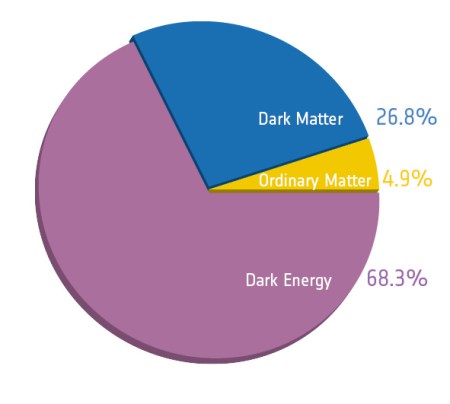
The first thing to stress is that this paper says nothing about the `Dark Matter’ which, according to the standard model, makes up about 27% of the pie and which cannot be in the form of baryons if the CMB and nucleosynthesis measurements are correct. If it were baryonic it would participate in nuclear reactions and mess up the light element abundances and also interact with photons in such a way as to change the fluctuation spectrum of the cosmic microwave background. Having said that, `dark’ is better adjective to use for hidden baryons than it is for non-baryonic matter, as baryons can absorb light. Non-baryonic matter isn’t really dark, it’s transparent because it doesn’t interact at all with electromagnetic radiation. We are however in the dark about it.
Note that the total density of dark + ordinary matter is about 32%, just what George Ellis and I concluded way back in 1994.
We can be much more certain about baryons actually existing than we can about dark matter because. For one thing, we are made of them. It has, however, been known for ages that the total density of directly visible baryons (ie those associated with stars and galaxies) is much lower than this figure, leading to the conclusion that some of the baryons predicted by cosmologists must be in some invisible form(s). Some, for example, is found by X-ray emissions in dense galaxy clusters, but this component is still inadequate to account for all the missing matter.
It has been suspected for some time that the hidden baryons probably inhabit a diffuse Warm-Hot Component of the Intergalactic Medium which, according to simulations of structure formation, traces its own form of the cosmic web we see in the distribution of galaxies:

The diffuse state and inhomogeneous nature of this intergalactic medium makes it difficult to detect, as explained in the abstract of the paper, but adding a relatively new technique involving fast radio bursts to probe the distribution of matter along the line of sight to the observer, it seems that it has now brought out into the open:

Now the inventory of observed baryons matches the 5% figure we cosmologists always knew it would be, and all is well with the world!
P. S. I was informed on Twitter after posting this that there was a paper on this topic in Nature a couple of years ago the last sentence of the abstract of which reads:
We conclude that the missing baryons have been found.





 In the Dark