Archive for Machine Learning

Weekly Update from the Open Journal of Astrophysics – 13/12/2025

Posted in OJAp Papers, Open Access, The Universe and Stuff with tags , , , , , , , , , , , , , , , , , , , , , , , , , , on December 13, 2025 by telescoper

It’s time once again for the usual Saturday morning update of the week’s new papers at the Open Journal of Astrophysics. Since the last update we have published a further five papers, which brings the number in Volume 8 (2025) up to 195, and the total so far published by OJAp up to 430.

The first paper this week is “Cosmic Rays Masquerading as Cool Cores: An Inverse-Compton Origin for Cool Core Cluster Emission” by Philip F. Hopkins (Caltech), Eliot Quataert (Princeton), Emily M. Silich, Jack Sayers, Sam B. Ponnada and Isabel S. Sands (Caltech).  This was published on Tuesday 9th December 2025 in the folder marked High-Energy Astrophysical Phenomena. It presents an argument  that cosmic-ray inverse-compton emission could contribute significantly to the X-ray surface brightness (SB) in cool-corre clusters, implying that gas densities may have been overestimated therein.

The overlay is here:

You can find the officially accepted version on arXiv here and the Fediverse announcement is here:

Open Journal of Astrophysics

New Publication at the Open Journal of Astrophysics: "Cosmic Rays Masquerading as Cool Cores: An Inverse-Compton Origin for Cool Core Cluster Emission" by

Philip F. Hopkins (Caltech), Eliot Quataert (Princeton), Emily M. Silich, Jack Sayers, Sam B. Ponnada and Isabel S. Sands (Caltech)

doi.org/10.33232/001c.154053

December 9, 2025, 7:22 am 1 boosts 0 favorites

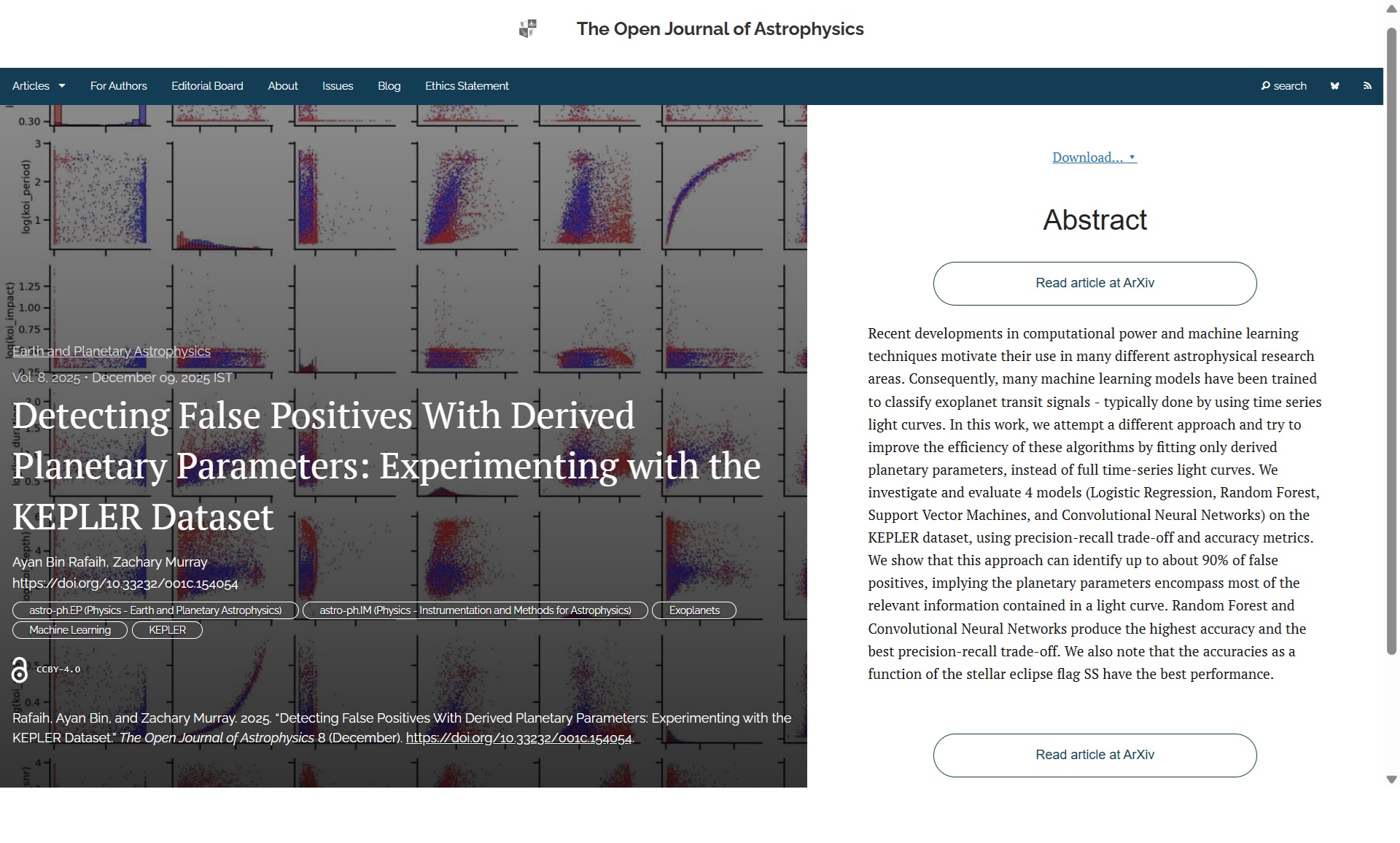
The second paper of the week is “Detecting False Positives With Derived Planetary Parameters: Experimenting with the KEPLER Dataset” by Ayan Bin Rafaih (Aitchison College, Lahore, Pakistan) and Zachary Murray (Université Côte d’Azur, France). This one was published on 9th December 2025 in the folder Earth and Planetary Astrophysics. It is an investigation into the performance of a range of machine-learning algorithms on the KEPLER dataset, using precision-recall trade-off and accuracy metrics.

The overlay is here:

You can find the official version of this one on arXiv here. The federated announcement on Mastodon is here:

Open Journal of Astrophysics

New Publication at the Open Journal of Astrophysics: "Detecting False Positives With Derived Planetary Parameters: Experimenting with the KEPLER Dataset" by Ayan Bin Rafaih (Aitchison College, Lahore, Pakistan) and Zachary Murray (Université Côte d’Azur, France)

doi.org/10.33232/001c.154054

December 9, 2025, 7:34 am 1 boosts 0 favorites

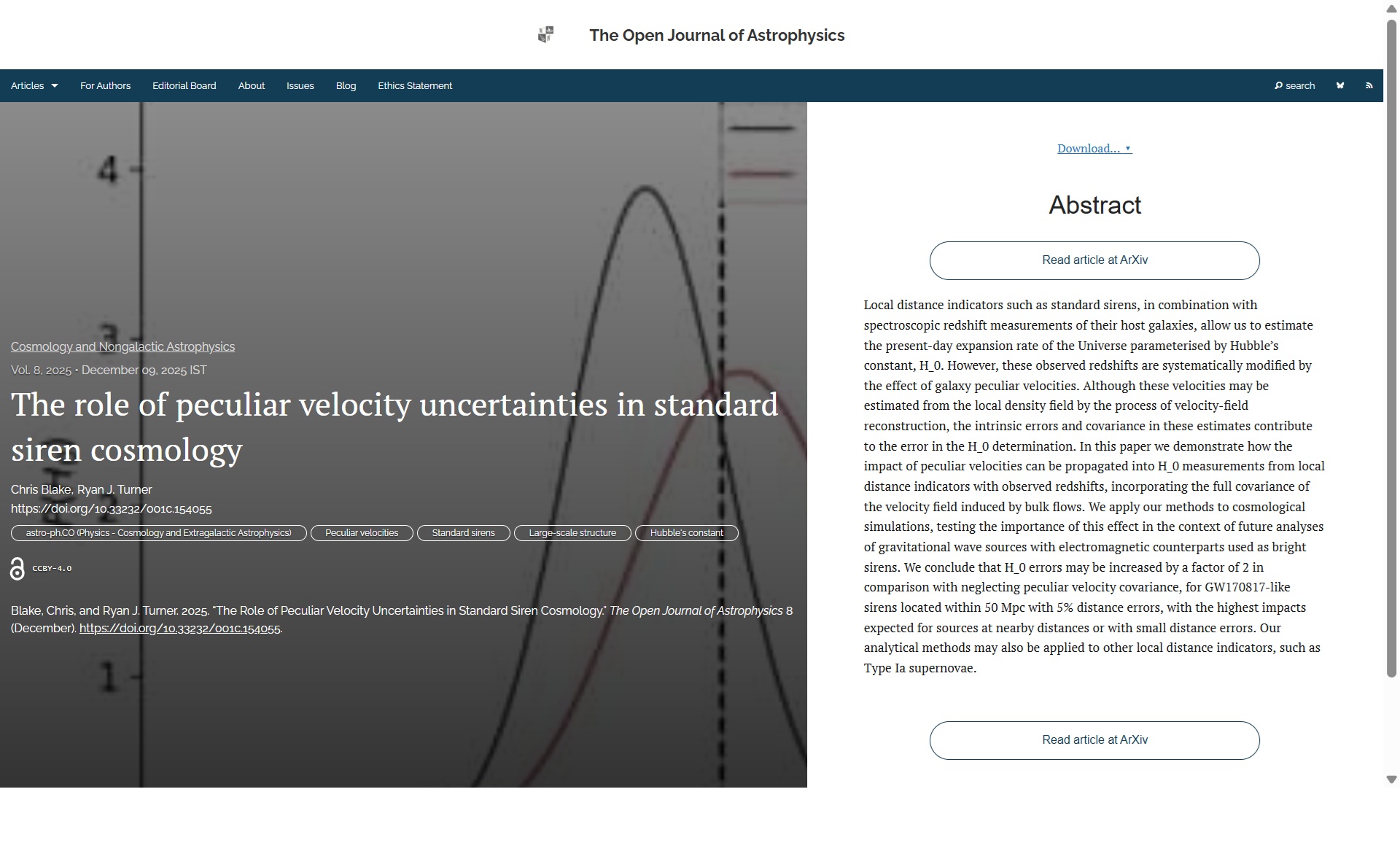
Next one up is “The role of peculiar velocity uncertainties in standard siren cosmology” by Chris Blake and Ryan J. Turner (Swinburne, Australia). This paper discusses the impact of peculiar velocities on the error in H0 determinations from local distance indicators with observed redshifts, incorporating the effect of bulk flows. It was published on Tuesday 9th December in the folder Cosmology and Nongalactic Astrophysics.

The overlay is here:

You can find the official accepted version on arXiv here. The fediverse announcement is here:

Open Journal of Astrophysics

New Publication at the Open Journal of Astrophysics: "The role of peculiar velocity uncertainties in standard siren cosmology" by Chris Blake and Ryan J. Turner (Swinburne, Australia)

doi.org/10.33232/001c.154055

December 9, 2025, 7:47 am 1 boosts 0 favorites

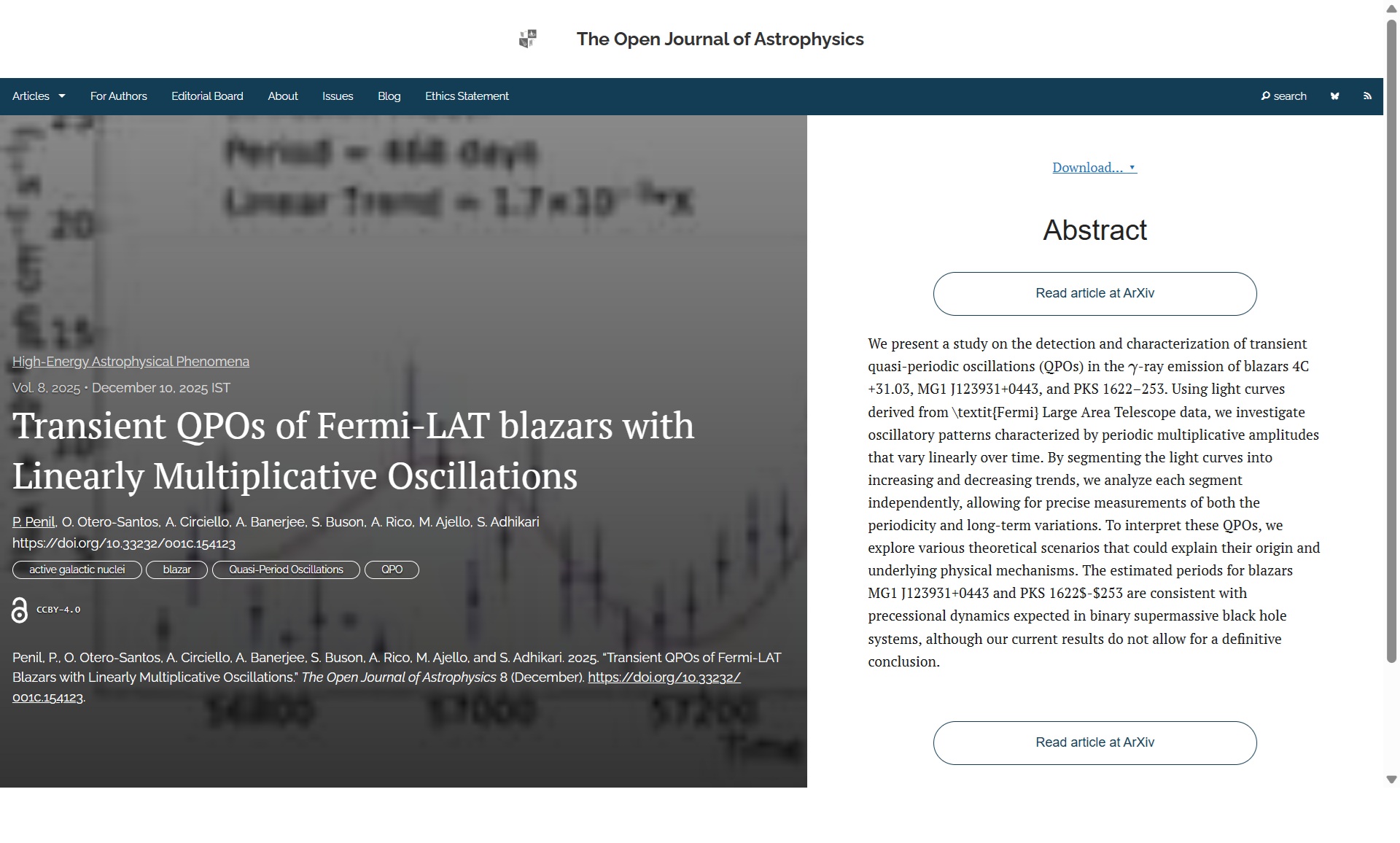
The fourth article of the week is “Transient QPOs of Fermi-LAT blazars with Linearly Multiplicative Oscillations” by P. Penil (Clemson University, USA) and 7 others based in the USA, Italy and Germany. This was published on Thursday 10th December in the folder High-Energy Astrophysical Phenomena. This paper presents an investigation of patterns of quasi-periodic oscillations in observed blazar systems characterized by periodic multiplicative amplitudes including both the periodicities and long-term variations.  The overlay is here:

You can find the official published version on arXiv here. The Fediverse announcement follows:

Open Journal of Astrophysics

New Publication at the Open Journal of Astrophysics: "Transient QPOs of Fermi-LAT blazars with Linearly Multiplicative Oscillations" by P. Penil (Clemson University, USA) and 7 others based in the USA, Italy and Germany

doi.org/10.33232/001c.154123

December 10, 2025, 12:22 pm 0 boosts 1 favorites

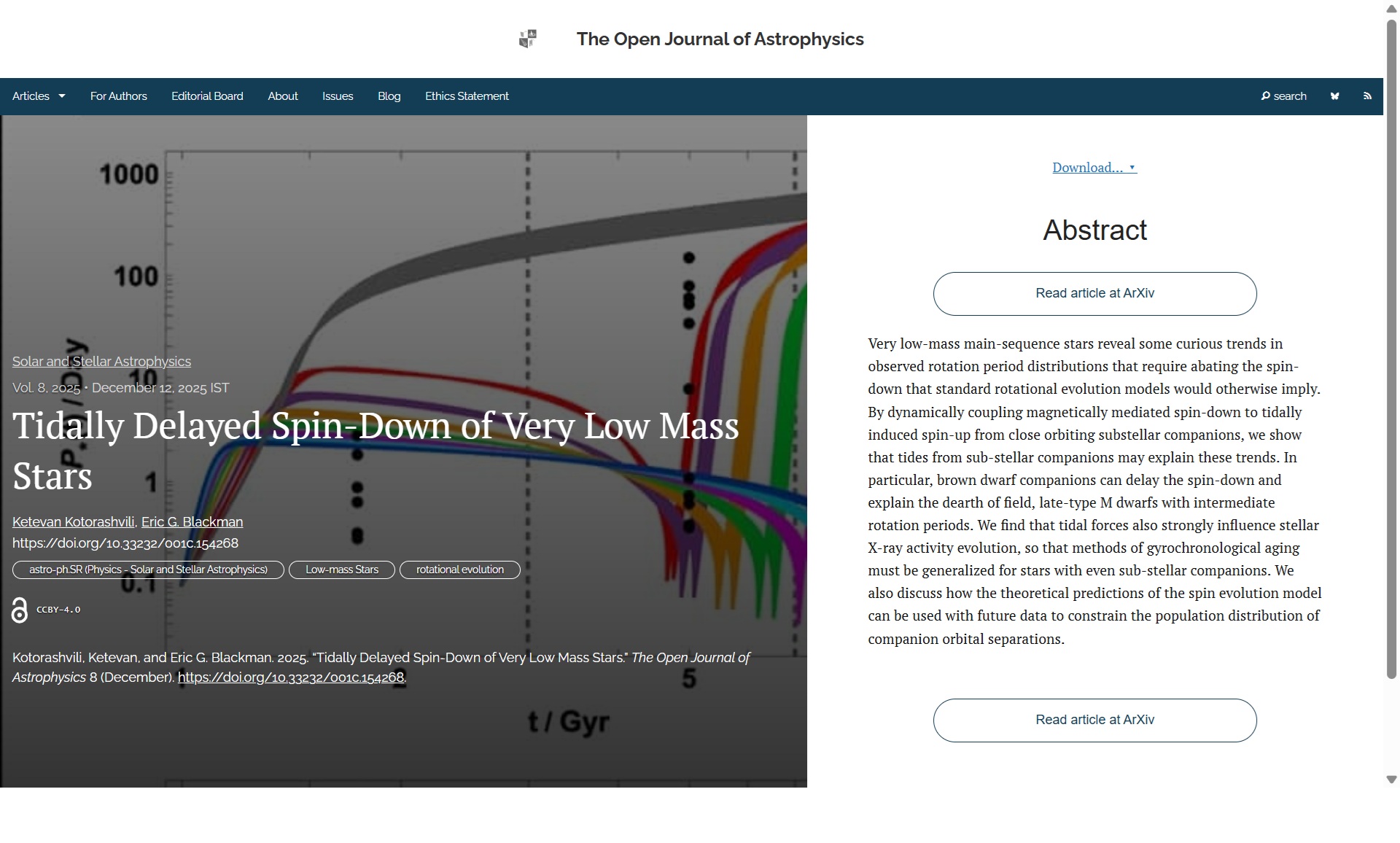
The last paper for this week is “Tidally Delayed Spin-Down of Very Low Mass Stars” by Ketevan Kotorashvili and Eric G. Blackman (U. Rochester, USA). This was published on Friday 12th December (yesterday) in the folder Solar and Stellar Astrophysics. It discusses the effect of tides from sub-stellar companions on rotational evolution of very low-mass stars, suggesting that these may explain the dearth of field, late-type M dwarfs with intermediate rotation periods.

The overlay is here:


You can find the officially-accepted version on arXiv here, and the Mastodon announcement is here:

Open Journal of Astrophysics

New Publication at the Open Journal of Astrophysics: "Tidally Delayed Spin-Down of Very Low Mass Stars" by Ketevan Kotorashvili and Eric G. Blackman (U. Rochester, USA)

doi.org/10.33232/001c.154268

December 12, 2025, 10:31 am 1 boosts 0 favorites


And that concludes the update for this week. I will do another of these regular announcements next Saturday, which will be the last such update for 2025. Will we make it past 200 for the year? Tune in next week to find out!

Weekly Update from the Open Journal of Astrophysics – 06/12/2025

Posted in OJAp Papers, Open Access, The Universe and Stuff with tags , , , , , , , , , , , , , , , , , , , , , , , , , , , on December 6, 2025 by telescoper

Once again it’s time for the usual Saturday morning update of the week’s new papers at the Open Journal of Astrophysics. Since the last update we have published a further six papers, which brings the number in Volume 8 (2025) up to 190, and the total so far published by OJAp up to 425. I blogged about the significance of the latter figure here.

The first paper this week is “The galaxy-IGM connection in THESAN: observability and information content of the galaxy-Lyman-alpha cross-correlation at z>6” by Enrico Garaldi (U. Tokyo, Japan), Verena Bellscheidt (Tech. U. Munich, Germany), Aaron Smith (U. Texas Austin, USA) and Rahul Kannan (York U. Canada). This paper was published on Monday 1st December 2025 in the folder Cosmology and Nongalactic Astrophysics. It describes an investigation of the impact of observational limitations on the ability to retrieve the intrinsic galaxy-Lyman-alpha cross correlation from line-of-sight observations.

The overlay is here:


You can find the officially accepted version on arXiv here and the Fediverse announcement is here:

Open Journal of Astrophysics

New Publication at the Open Journal of Astrophysics: "The galaxy-IGM connection in THESAN: observability and information content of the galaxy-Lyman-alpha cross-correlation at z>6" by Enrico Garaldi (U. Tokyo, Japan), Verena Bellscheidt (Tech. U. Munich, Germany), Aaron Smith (U. Texas Austin, USA) and Rahul Kannan (York U. Canada)

doi.org/10.33232/001c.151666

December 1, 2025, 8:37 am 1 boosts 0 favorites

The second paper of the week is “A Less Terrifying Universe? Mundanity as an Explanation for the Fermi Paradox” by Robin H.D. Corbet (U. Maryland, USA). This paper was published on 1st December 2025 in the folder Instrumentation and Methods for Astrophysics. It presents a discussion of possible explanations for the lack of s evidence for the presence of technology-using extraterrestrial civilizations in the Galaxy (usually called the Fermi paradox). The overlay is here:


You can find the official version of this one on arXiv here. The federated announcement on Mastodon is here:

Open Journal of Astrophysics

New Publication at the Open Journal of Astrophysics: "A Less Terrifying Universe? Mundanity as an Explanation for the Fermi Paradox" by Robin H.D. Corbet (U. Maryland, USA)

doi.org/10.33232/001c.151454

December 1, 2025, 8:50 am 2 boosts 2 favorites


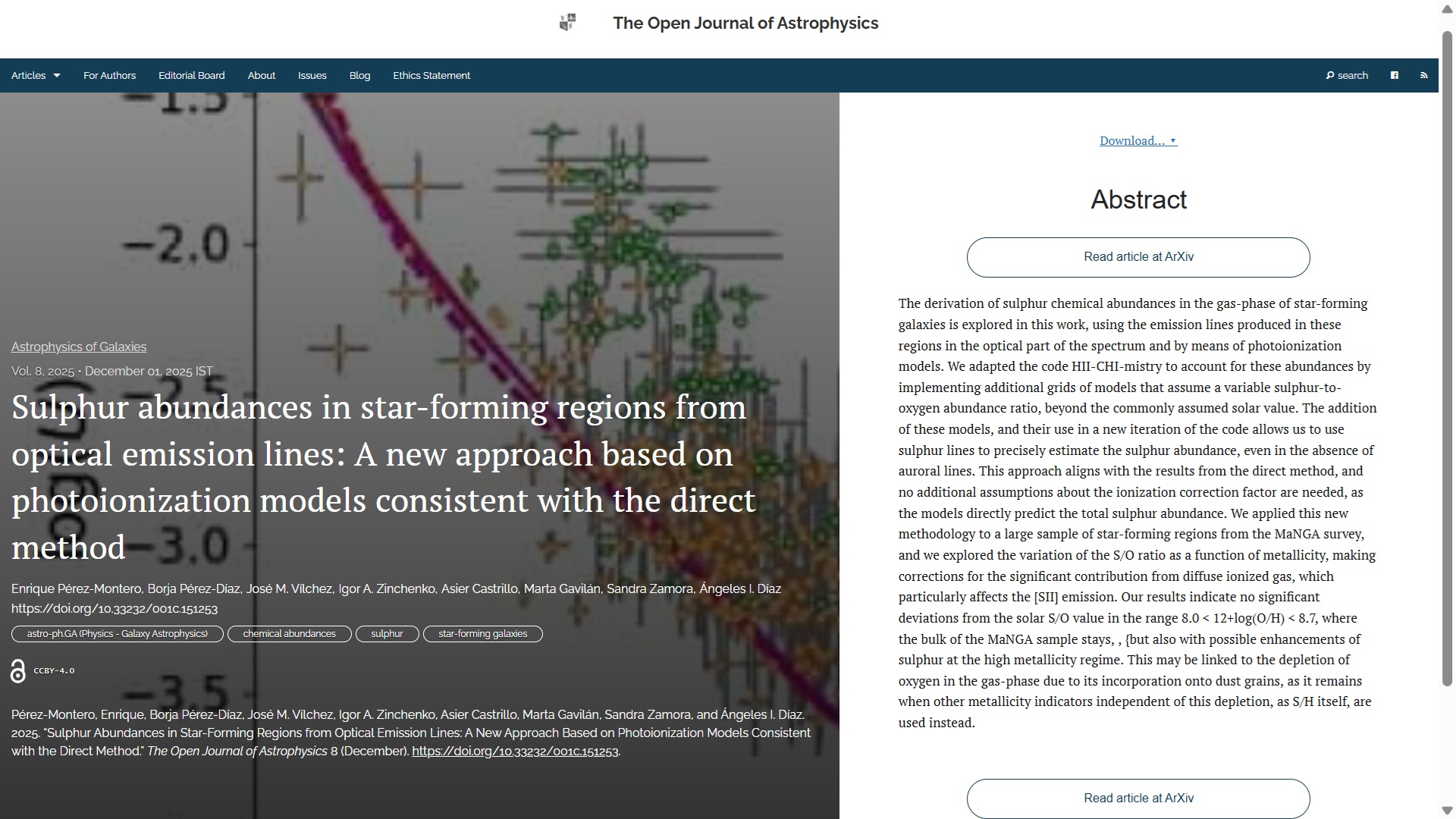
Next one up is “Sulphur abundances in star-forming regions from optical emission lines: A new approach based on photoionization models consistent with the direct method” by Enrique Pérez-Montero, Borja Pérez-Díaz, & José M. Vílchez ( (Instituto de Astrofísica de Andalucía, Spain), Igor A. Zinchenko (LMU, Germany), Asier Castrillo, Marta Gavilán, Sandra Zamora & Ángeles I. Díaz (Universidad Autonoma de Madrid, Spain). This was published on 1st December 2025 in the folder Astrophysics of Galaxies. This study uses the emission lines produced in the optical part of the spectrum and with photoionization models to derive sulphur chemical abundances in the gas-phase of star-forming galaxies.

The overlay is here:


You can find the official accepted version on arXiv here. The fediverse announcement is here:

Open Journal of Astrophysics

New Publication at the Open Journal of Astrophysics: "Sulphur abundances in star-forming regions from optical emission lines: A new approach based on photoionization models consistent with the direct method" by Enrique Pérez-Montero, Borja Pérez-Díaz, & José M. Vílchez ( (Instituto de Astrofísica de Andalucía, Spain), Igor A. Zinchenko (LMU, Germany), Asier Castrillo, Marta Gavilán, Sandra Zamora & Ángeles I. Díaz (Universidad Autonoma de Madrid , Spain)

doi.org/10.33232/001c.151253

December 1, 2025, 9:12 am 0 boosts 0 favorites

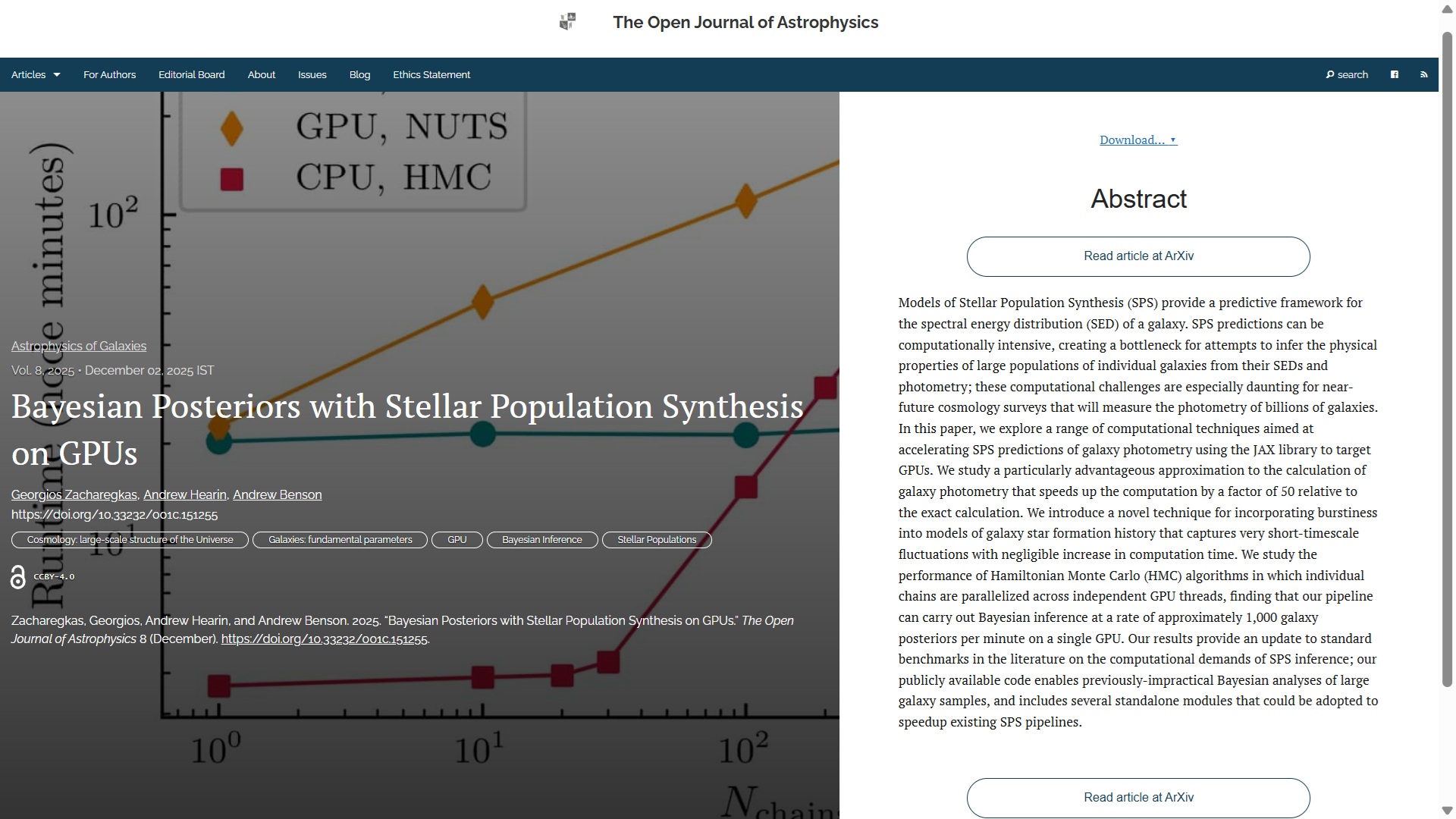
The fourth article of the week is “Bayesian Posteriors with Stellar Population Synthesis on GPUs” by Georgios Zacharegkas & Andrew Hearin (Argonne National Laboratory, USA) and Andrew Benson (Carnegie Observatories, USA). This is an exploration of a range of computational techniques aimed at accelerating Stellar Population Synthesis predictions of galaxy photometry using the JAX library to target GPUs (Graphics Processing Units, in case you didn’t know). This paper was published on Tuesday December 2nd 2025 in the folder Astrophysics of Galaxies.

The overlay is here:


You can find the official published version on arXiv here. The Fediverse announcement follows:

Open Journal of Astrophysics

New Publication at the Open Journal of Astrophysics: "Bayesian Posteriors with Stellar Population Synthesis on GPUs" by Georgios Zacharegkas & Andrew Hearin (Argonne National Laboratory, USA) and Andrew Benson (Carnegie Observatories, USA)

doi.org/10.33232/001c.151255

December 2, 2025, 7:38 am 3 boosts 1 favorites

Next one up is “IAEmu: Learning Galaxy Intrinsic Alignment Correlations” by Sneh Pandya Yuanyuan Yang, Nicholas Van Alfen, Jonathan Blazek and Robin Walters (Northeastern University, Boston, USA). This presents a neural-network-based emulator that predicts the galaxy position-position, position-orientation, and orientation-orientation, correlation functions and their uncertainties using mock catalogs based on the halo occupation distribution (HOD) framework. It was published on December 2nd 2025 in the folder Cosmology and Nongalactic Astrophysics. The overlay is here:

The official accepted version can be found on arXiv here. The Mastodon announcement is here:

Open Journal of Astrophysics

New Publication at the Open Journal of Astrophysics: "IAEmu: Learning Galaxy Intrinsic Alignment Correlations" by Sneh Pandya Yuanyuan Yang, Nicholas Van Alfen, Jonathan Blazek and Robin Walters (Northeastern University, Boston, USA)

doi.org/10.33232/001c.151749

December 2, 2025, 7:52 am 1 boosts 0 favorites

The last paper for this weel is “Unraveling the Nature of the Nuclear Transient AT2020adpi” by Paarmita Pandey (Ohio State University, USA) and a team of 15 others based in the USA, UK and Australia. This was published on Thursday December 4th 2025 in the folder High-Energy Astrophysical Phenomena. It is an investigation into a particular transient event AT2020adpi and a discussion of whether it is an extreme example of AGN variability or a Tidal Disruption Event (TDE). The overlay is here:

You can find the officially-accepted version on arXiv here, and the Mastodon announcement is here:

Open Journal of Astrophysics

New Publication at the Open Journal of Astrophysics: "Unraveling the Nature of the Nuclear Transient AT2020adpi" by Paarmita Pandey (Ohio State University, USA) and 15 others based in the USA, UK and Australia

doi.org/10.33232/001c.151453

December 4, 2025, 8:48 am 1 boosts 0 favorites

And that concludes the update for this week. I will do another next Saturday.

Weekly Update from the Open Journal of Astrophysics – 19/07/2025

Posted in OJAp Papers, Open Access, The Universe and Stuff with tags , , , , , , , , , , , , , , , , , , , , , , , , , , on July 19, 2025 by telescoper

It’s Saturday morning again, so it’s time again for an update of papers published at the Open Journal of Astrophysics. Since the last update we have published six new papers, which brings the number in Volume 8 (2025) up to 98, and the total so far published by OJAp  up to 333. I expect we’ll pass the century for this year sometime next week.

The papers published this week, with their overlays, are as follows.  You can click on the images of the overlays to make them larger should you wish to do so.

The first paper to report is “Reconstructing Galaxy Cluster Mass Maps using Score-based Generative Modeling” by Alan Hsu (Harvard), Matthew Ho (CMU), Joyce Lin (U. Wisconsin-Madison), Carleen Markey (CMU), Michelle Ntampaka (STScI), Hy Trac (CMU) & Barnabás Póczos (CMU), all based in the USA. This paper was published on 14th July 2025 in the folder Cosmology and NonGalactic Astrophysics. It presents a diffusion-based generativbe AI model for reconstructing density profiles for galaxy clusters from observational data.

The overlay is here:

The officially-accepted version can be found on arXiv here.

The second and third papers are related. They were both published on 14th July in the folder Cosmology and NonGalactic Astrophysics.

The first of the pair is “J-PLUS: Tomographic analysis of galaxy angular density and redshift fluctuations in Data Release 3. Constraints on photo-z errors, linear bias, and peculiar velocities” by Carlos Hernández-Monteagudo (IAC, Tenerife, Spain) and 21 others. This presents an analysis of the Javalambre Photometric Local Universe Survey (J-PLUS) in redshift slices with a discussion of prospects for extracting cosmological information. The overlay is here:


You can find the final version of the manuscript on arXiv here.

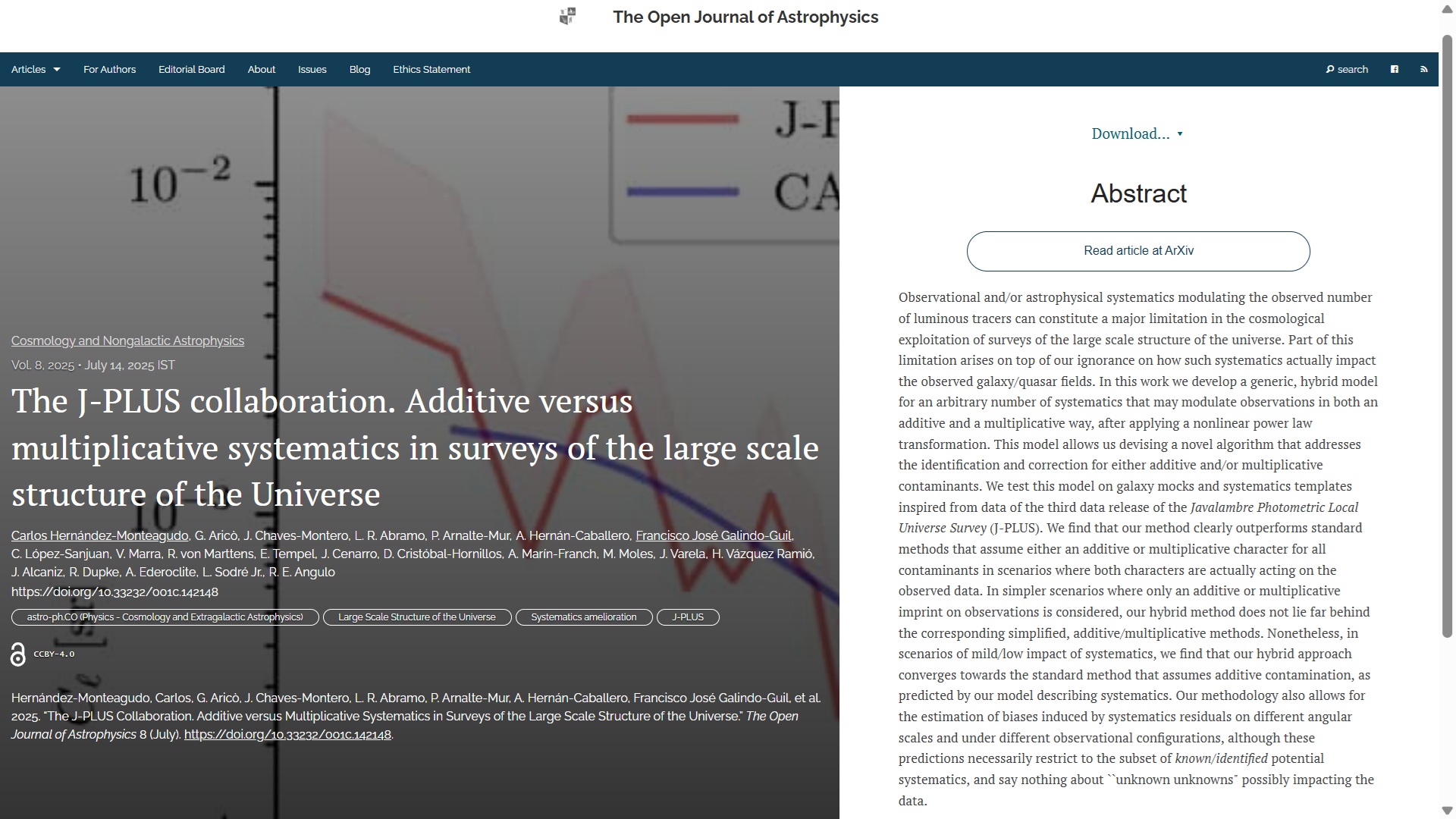
The second of this pair is “The J-PLUS collaboration. Additive versus multiplicative systematics in surveys of the large scale structure of the Universe” by Carlos Hernández-Monteagudo (IAC) and 21 others (the same authors as the previous paper).  This paper presents an analysis of systematic effects in the Javalambre Photometric Local Universe Survey (J-PLUS), and a new model for handling such errors in this and other cosmological surveys. The overlay for this paper is here:

You can find the officially accepted version of this paper on arXiv here.

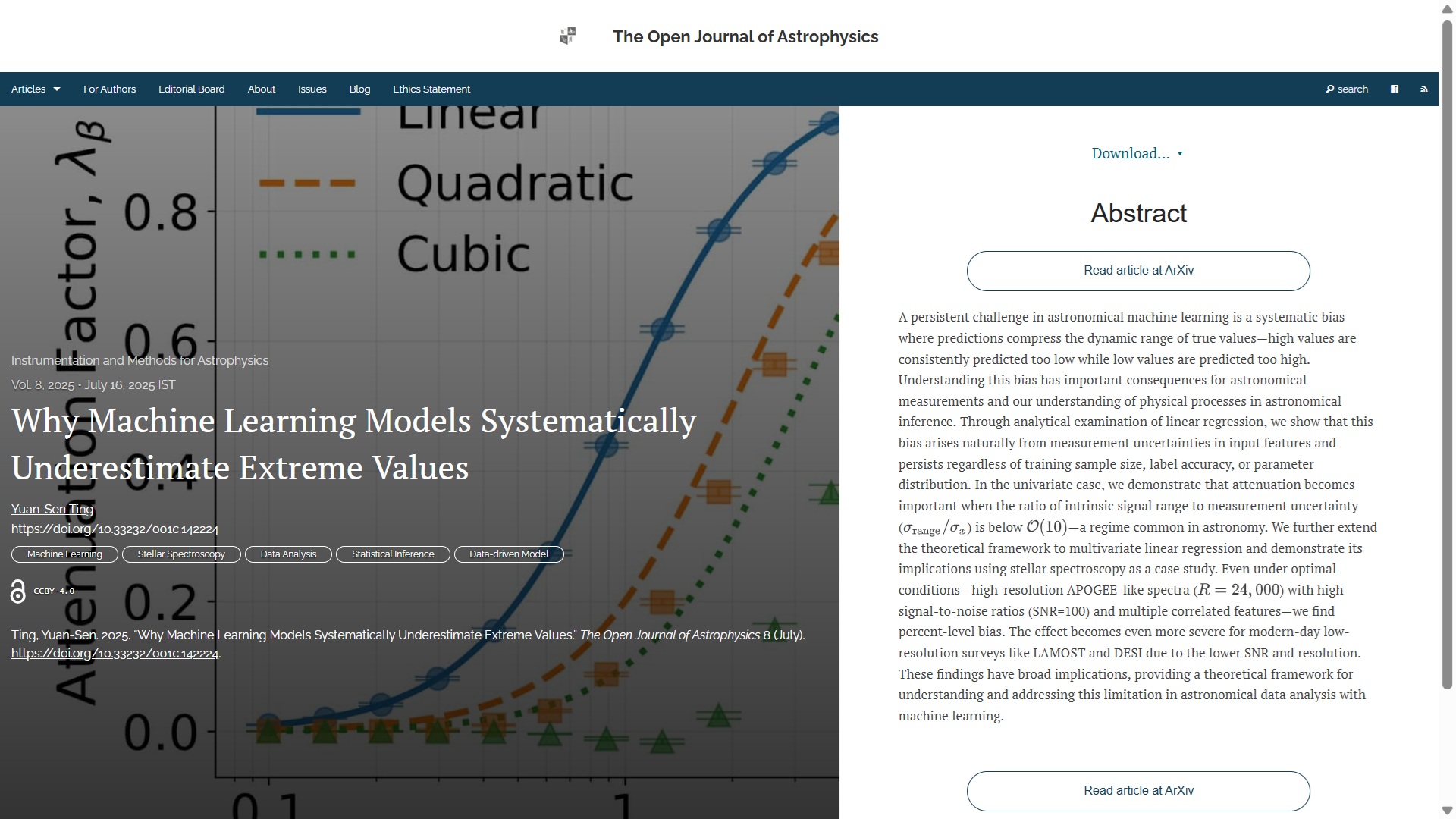
The fourth paper this week is “Why Machine Learning Models Systematically Underestimate Extreme Values” by Yuan-Sen Ting (Ohio State University). This one was published on July 16th in the folder marked Instrumentation and Methods for Astrophysics.  This paper presents a theoretical framework for understanding and addressing a bias that suppresses the dynamic range of variables in applications of machine learning to astronomical data analysis. Here is the overlay:

You can find the officially accepted version of this paper on arXiv here.

The penultimate article for this week is “Bridging Machine Learning and Cosmological Simulations: Using Neural Operators to emulate Chemical Evolution” by Pelle van de Bor, John Brennan & John A. Regan (Maynooth University) and Jonathan Mackey (Dublin Institute for Advanced Studies), all based in Ireland. This paper uses machine learning, in the form of neural operators, to emulate the Grackle method of solving non-equilibrium chemistry equations in cosmological hydrodynamic simulations and was published on 16th July also in the folder Instrumentation and Methods for Astrophysics. The overlay is here:

The final, accepted version of the paper is on arXiv here.

The last article published this week is “Astronomical Cardiology: A Search For Heartbeat Stars Using Gaia and TESS” by Jowen Callahan, D. M. Rowan, C. S. Kochanek and K. Z. Stanek (all of Ohio State University, USA). This paper presents a study of a sample of 112 new spectroscopic binaries called hearbeat stars (because their light curves resemble electrocardiagrams). It was published on 16th July 2025 in the folder marked Solar and Stellar Astrophysics. The overlay is here:

You can find the officially-accepted version on arXiv here.

And that’s all the papers for this week. I’ll do another update next Saturday.

Weekly Update from the Open Journal of Astrophysics – 26/04/2025

Posted in OJAp Papers, Open Access, The Universe and Stuff with tags , , , , , , , , , , , on April 26, 2025 by telescoper

It’s Satuday morning once again, and time for another update of papers published at the Open Journal of Astrophysics. Since the last update we have published two papers, which brings the number in Volume 8 (2025) up to 44 and the total so far published by OJAp up to 279.

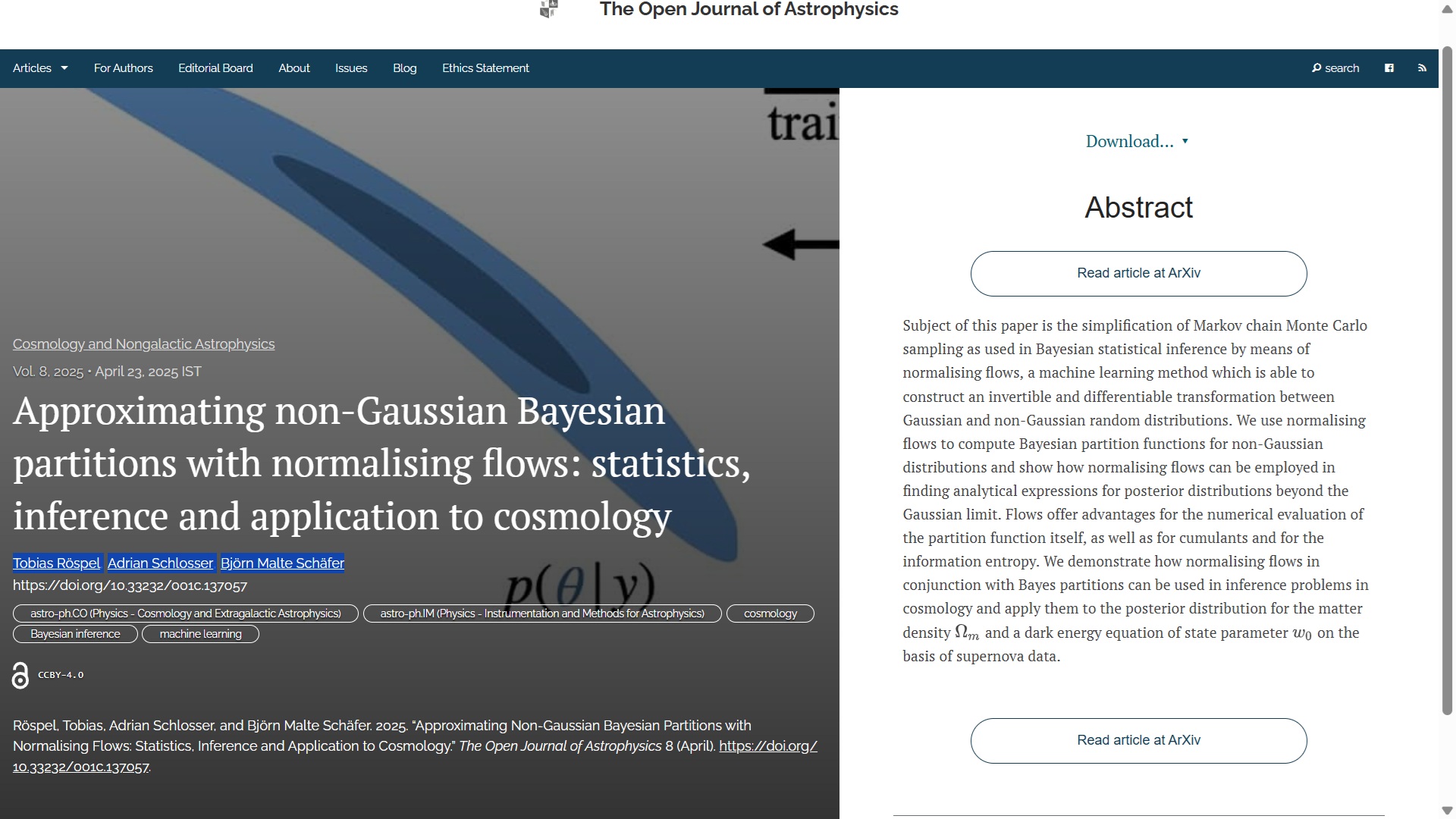
The first paper to report is “Approximating non-Gaussian Bayesian partitions with normalising flows: statistics, inference and application to cosmology” by Tobias Röspel, Adrian Schlosser & Björn Malte Schäfer (Universität Heidelberg, Germany) which was published on April 23rd 2025 in the folder Cosmology and NonGalactic Astrophysics. It is an introduction to normalizing flows – a machine learning technique for transforming distributions – and its application to the extraction of cosmological parameters from supernova data.

The overlay is here:

You can find the officially accepted version on arXiv here.

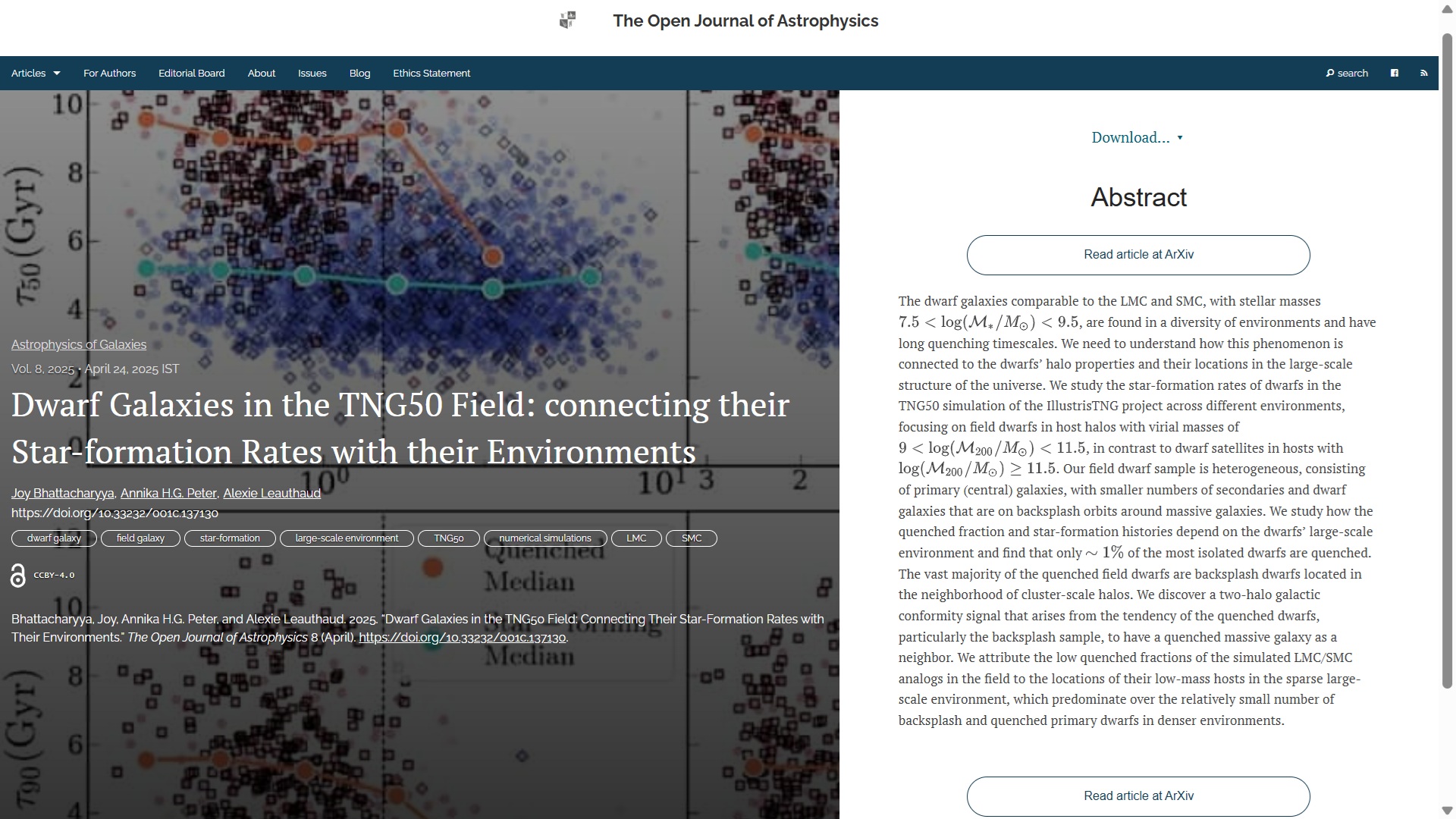
The other paper this week is “Dwarf Galaxies in the TNG50 Field: connecting their Star-formation Rates with their Environments” by Joy Bhattacharyya & Annika H.G. Peter (Ohio State University, USA) and Alexie Leauthaud (UC Santa Cruz, USA).  This one was published on 24th April 2025 in the older Astrophysics of Galaxies and it studies dwarf galaxies with properties similar to the Large and Small Magellanic Clouds that form in different environments in the TNG50 simulation of the IllustrisTNG project.

The overlay is here:


and you can find the final accepted version on arXiv here.


That’s all for this week. I’ll have another update next Saturday.

Four New Publications at the Open Journal of Astrophysics

Posted in OJAp Papers, Open Access, The Universe and Stuff with tags , , , , , , , , , , , , , , , , , , on July 27, 2024 by telescoper

It’s Saturday morning, so once again it’s time for an update of activity at the Open Journal of Astrophysics. This week we have published another batch of four papers, the same number as last week, which takes the count in Volume 7 (2024) up to 64 and the total published altogether by OJAp up to 179.

Before announcing the week’s papers I’ll add three other updates you might find interesting:

  1.  When I looked at NASA/ADS this morning to help construct this post I saw that papers published in OJAp have now garnered over 2500 citations between them;
  2. We had a good response to our recent call for new members of the Editorial Board and have added four new members here;
  3. Last week we received a significant (unsolicited) cash donation from a higher education institution based in Europe to help with our work in Diamond Open Access. If any other organizations or individuals would like to do similar then please contact me!

Now, in chronological order, the four papers published this week, with their overlays, are as follows. You can click on the images of the overlays to make them larger should you wish to do so.

First one up is: “Widespread disruption of resonant chains during protoplanetary disk dispersal by Bradley M S Hansen (UCLA), Tze-Yeung Yu (UCLA) and Yasuhiro Hasegawa (JPL), all based in California, USA.  The paper presents a discussion of the effect of a dispersing protoplanetary disk on the evolution of low-mass planets around a Solar mass star.  It was published on 21st July 2024 and is in the folder marked Earth and Planetary Astrophysics.

Here is a screen grab of the overlay, which includes the abstract:


You can find the officially accepted version of the paper on the arXiv here.

The second paper to announce is “Using A One-Class SVM To Optimize Transit Detection” by Jakob Roche of the University of South Florida, also in the USA (but not in California). This articles discusses the advantages of One-Class Support Vector Machines (SVMs) over Convolutional Neural Networks (CNN) in the context of exoplanet detection. Its in the folder called Instrumentation and Methods for Astrophysics and was published on 25th July 2024.

You can see the overlay here:


The accepted version of this paper can be found on the arXiv here.

The next paper, also published on 25th July 2024, is in the folder marked High-Energy Astrophysical Phenomena. Its primary classification on arXiv is General Relativity and Quantum Cosmology (gr-qc), but it is cross-listed on astro-ph so we considered it for publication and had it refereed, with favourable results. It is entitled “What no one has seen before: gravitational waveforms from warp drive collapse” and is by Katy Clough (QMUL, UK), Tim Dietrich (Potsdam, Germany) and Sebastian Khan (Cardiff, UK).  Looking at the title of this paper you might be tempted to dismiss it on the grounds that warp drives are the stuff of science fiction (which they are), but this paper is really a rigorous technical study of the dynamical evolution and stability of spacetimes that violate the null energy condition, inspired by the idea of a warp drive.

Here is the overlay:


You can find the full text for this one on the arXiv here.

Last, published on 26th July 2024, we have a paper with the title “A study of gamma-ray emission from OJ 287 using Fermi-LAT from 2015-2023” by Vibhavasu Pasumarti and Shantanu Desai of the Indian Institute of Technology, Hyderabad, India. It is an investigation of the properties of gamma-ray emission from OJ287 (a BL Lac object) using the Fermi Large Area Telescope (LAT).  This one is also in the folder marked High-Energy Astrophysical Phenomena; here is the overlay

You can find the officially accepted version of this paper on the arXiv here.

That’s all for this week. Stay tuned for another update next week.

Is machine learning good or bad for the natural sciences?

Posted in The Universe and Stuff with tags , , , , , , , on May 30, 2024 by telescoper

Before I head off on a trip to various parts of not-Barcelona, I thought I’d share a somewhat provocative paper by David Hogg and Soledad Villar. In my capacity as journal editor over the past few years I’ve noticed that there has been a phenomenal increase in astrophysics papers discussing applications of various forms of Machine Leaning (ML). This paper looks into issues around the use of ML not just in astrophysics but elsewhere in the natural sciences.

The abstract reads:

Machine learning (ML) methods are having a huge impact across all of the sciences. However, ML has a strong ontology – in which only the data exist – and a strong epistemology – in which a model is considered good if it performs well on held-out training data. These philosophies are in strong conflict with both standard practices and key philosophies in the natural sciences. Here, we identify some locations for ML in the natural sciences at which the ontology and epistemology are valuable. For example, when an expressive machine learning model is used in a causal inference to represent the effects of confounders, such as foregrounds, backgrounds, or instrument calibration parameters, the model capacity and loose philosophy of ML can make the results more trustworthy. We also show that there are contexts in which the introduction of ML introduces strong, unwanted statistical biases. For one, when ML models are used to emulate physical (or first-principles) simulations, they introduce strong confirmation biases. For another, when expressive regressions are used to label datasets, those labels cannot be used in downstream joint or ensemble analyses without taking on uncontrolled biases. The question in the title is being asked of all of the natural sciences; that is, we are calling on the scientific communities to take a step back and consider the role and value of ML in their fields; the (partial) answers we give here come from the particular perspective of physics

arXiv:2405.18095

P.S. The answer to the question posed in the title is probably “yes”.

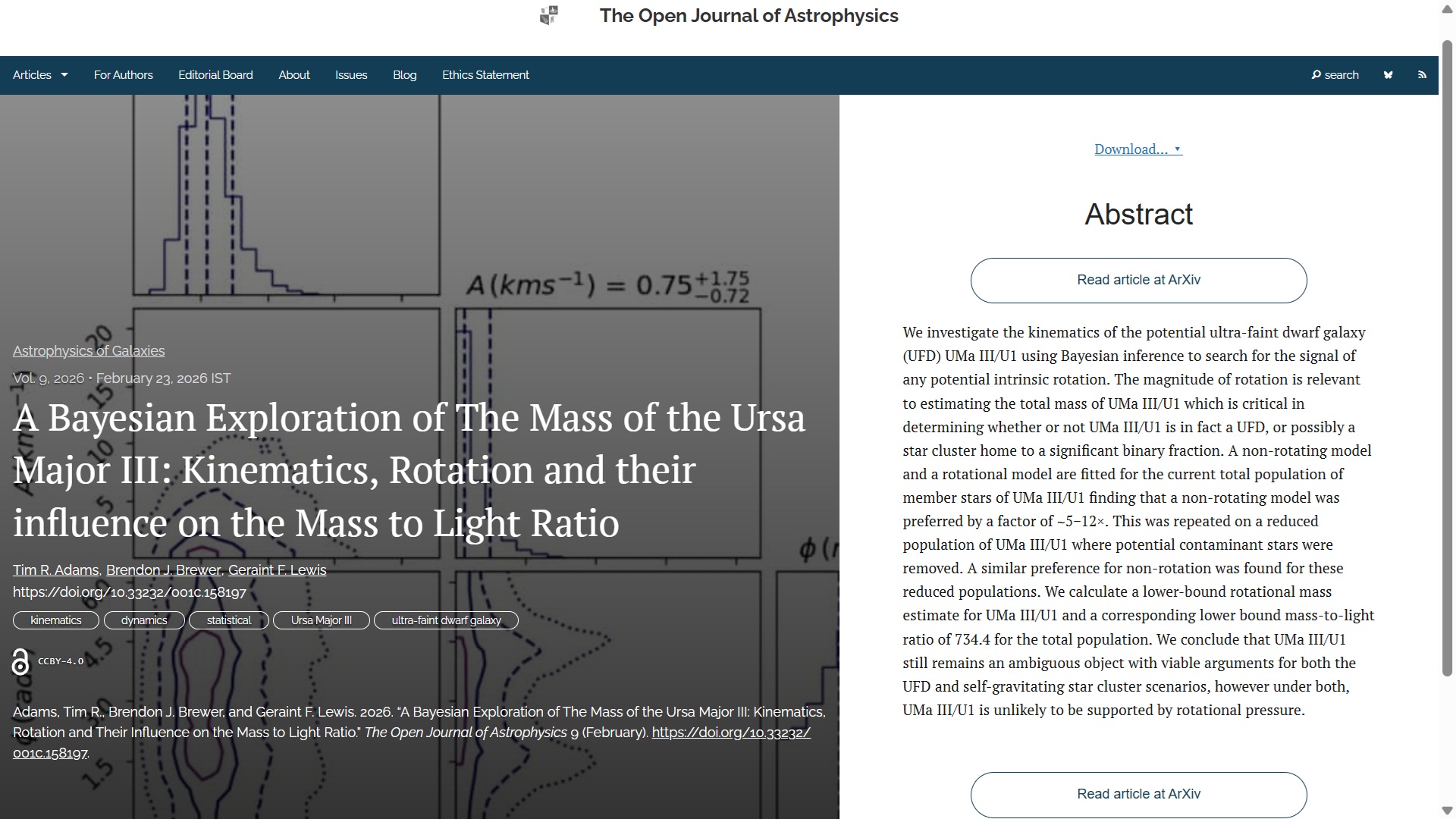
New Publication at the Open Journal of Astrophysics

Posted in OJAp Papers, Open Access, The Universe and Stuff with tags , , , , on June 13, 2023 by telescoper

It’s time to announce yet another new paper at the Open Journal of Astrophysics. This one was published on Friday 9th June.

The latest paper is the 19th paper so far in Volume 6 (2023) and the 84th in all,  so with more than half of 2023 remaining and many papers still in the pipeline we’re on track to reach a total of 100 papers by the end of 2023!
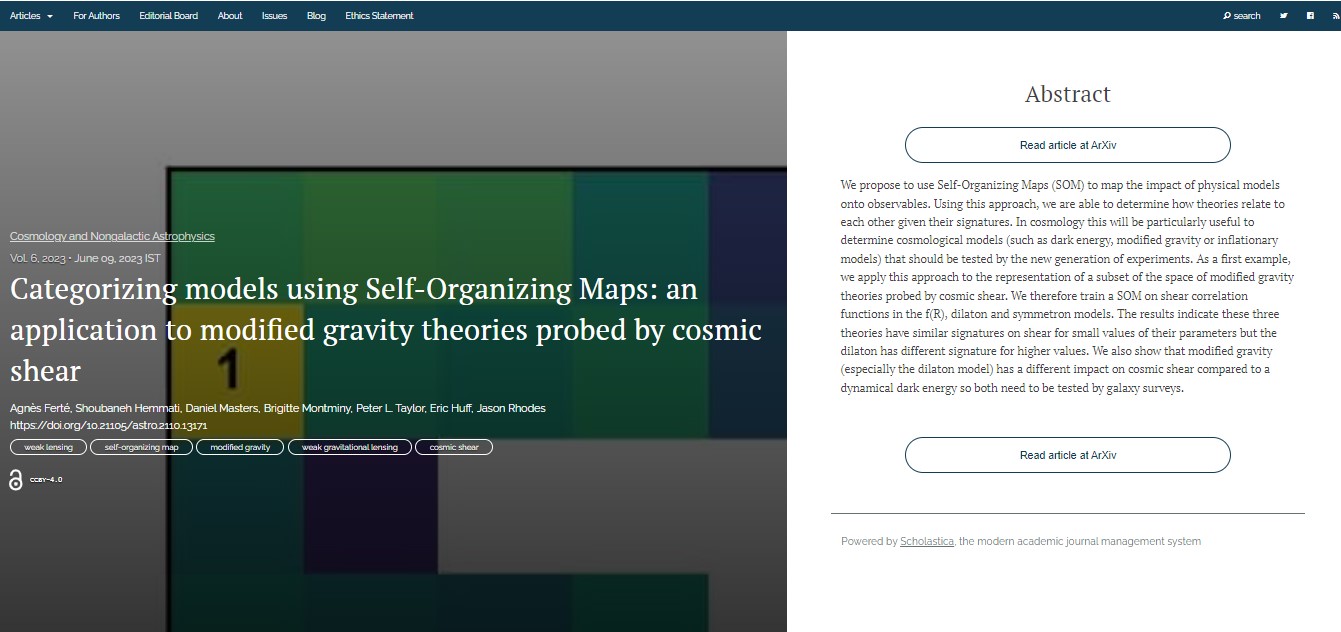
The primary classification for this paper is Cosmology and Nongalactic Astrophysics and its title is “Categorizing models using Self-Organizing Maps: an application to modified gravity theories probed by cosmic shear”. For the uninitiated, a Self-Organizing Map is a machine-learning technique that makes large-dimensional data sets easier to analyze. This paper is yet another one about weak gravitational lensing (cosmic shear), which is obviously what the cool kids do these days.

The authors are: Agnès Ferté (JPL); Shoubaneh Hemmati (IPAC); Daniel Masters (IPAC); Brigitte Montminy (JPL); Peter L. Taylor (JPL); Eric Huff (JPL);  and Jason Rhodes (JPL).

(JPL=Jet Propulsion Laboratory, IPAC= Infrared Processing & Analysis Center, both associated with California Institute of Technology, Pasadena, USA)

Here is a screen grab of the overlay which includes the  abstract:


You can click on the image of the overlay to make it larger should you wish to do so. You can find the officially accepted version of the paper on the arXiv here.

P.S. The first author tweeted about this paper:


New Publication at the Open Journal of Astrophysics

Posted in OJAp Papers, Open Access, The Universe and Stuff with tags , , on January 5, 2023 by telescoper

I’ve been catching up on publishing matters over the past day or so, including dealing with a bit of a backlog generated by the Christmas break. The Open Journal is run entirely by volunteers and we all need some time off at some point.

To start with I’m delighted to be able to announce the last paper of 2022 at the Open Journal of Astrophysics.  The latest paper is the 17th paper in Volume 5 (2022) as well as the 65th in all. It’s yet another in the Cosmology and Non-Galactic Astrophysics folder.

The latest publication is entitled “The Cosmic Graph: Optimal Information Extraction from Large-Scale Structure using Catalogues“. It is written by a distinguished collection of cosmologists from around the world (and Alan Heavens).

Anyway, here is a screen grab of the overlay which includes the  abstract:


You can click on the image to make it larger should you wish to do so. You can find the officially accepted version of the paper on the arXiv here.

Here is a bigger version of the image from the paper used on the overlay:


Code and a tutorial for the analysis and relevant software can be found here .

New Publication at the Open Journal of Astrophysics

Posted in OJAp Papers, Open Access, The Universe and Stuff with tags , , , , , , , , on March 24, 2021 by telescoper

Time to announce another publication in the Open Journal of Astrophysics. This one was published yesterday, actually, but I didn’t get time to post about it until just now. It is the third paper in Volume 4 (2021) and the 34th paper in all.

The latest publication is entitled Dwarfs from the Dark (Energy Survey): a machine learning approach to classify dwarf galaxies from multi-band images and is written by Oliver Müller  of the Observatoire Astronomique de Strasbourg (France) and Eva Schnider of the University of Basel (Switzerland).

Here is a screen grab of the overlay which includes the abstract:


You can click on the image to make it larger should you wish to do so. You can find the arXiv version of the paper here. This one is in the Instrumentation and Methods for Astrophysics Folder, though it does overlap with Astrophysics of Galaxies too.

It seems the authors were very happy with the publication process!

Incidentally, the Scholastica platform we are using for the Open Journal of Astrophysics is continuing to develop additional facilities. The most recent one is that the Open Journal of Astrophysics now has the facility to include supplementary files (e.g. code or data sets) along with the papers we publish. If any existing authors (i.e. of papers we have already published) would like us to add supplementary files retrospectively then please contact us with a request!

Machine Learning in the Physical Sciences

Posted in The Universe and Stuff with tags , , , , , on March 29, 2019 by telescoper

If, like me, you feel a bit left behind by goings-on in the field of Machine Learning and how it impacts on physics then there’s now a very comprehensive review by Carleo et al on the arXiv.

Here is a picture from the paper, which I have included so that this post has a picture in it:

The abstract reads:

Machine learning encompasses a broad range of algorithms and modeling tools used for a vast array of data processing tasks, which has entered most scientific disciplines in recent years. We review in a selective way the recent research on the interface between machine learning and physical sciences.This includes conceptual developments in machine learning (ML) motivated by physical insights, applications of machine learning techniques to several domains in physics, and cross-fertilization between the two fields. After giving basic notion of machine learning methods and principles, we describe examples of how statistical physics is used to understand methods in ML. We then move to describe applications of ML methods in particle physics and cosmology, quantum many body physics, quantum computing, and chemical and material physics. We also highlight research and development into novel computing architectures aimed at accelerating ML. In each of the sections we describe recent successes as well as domain-specific methodology and challenges.

The next step after Machine Learning will of course be Machine Teaching…