Archive for OJAp

Weekly Update from the Open Journal of Astrophysics – 28/06/2025

Posted in OJAp Papers, Open Access, The Universe and Stuff with tags , , , , , , , , , , , , , , , , , , , , , , , , on June 28, 2025 by telescoper

It’s Saturday morning again so time for an update of papers published at the Open Journal of Astrophysics. Since the last update we have published eight new papers, which brings the number in Volume 8 (2025) up to 82, and the total so far published by OJAp  up to 317. With about half the year gone, we’re on target to published around 160 papers this year.

The papers published this week, with their overlays, are as follows.  You can click on the images of the overlays to make them larger should you wish to do so.

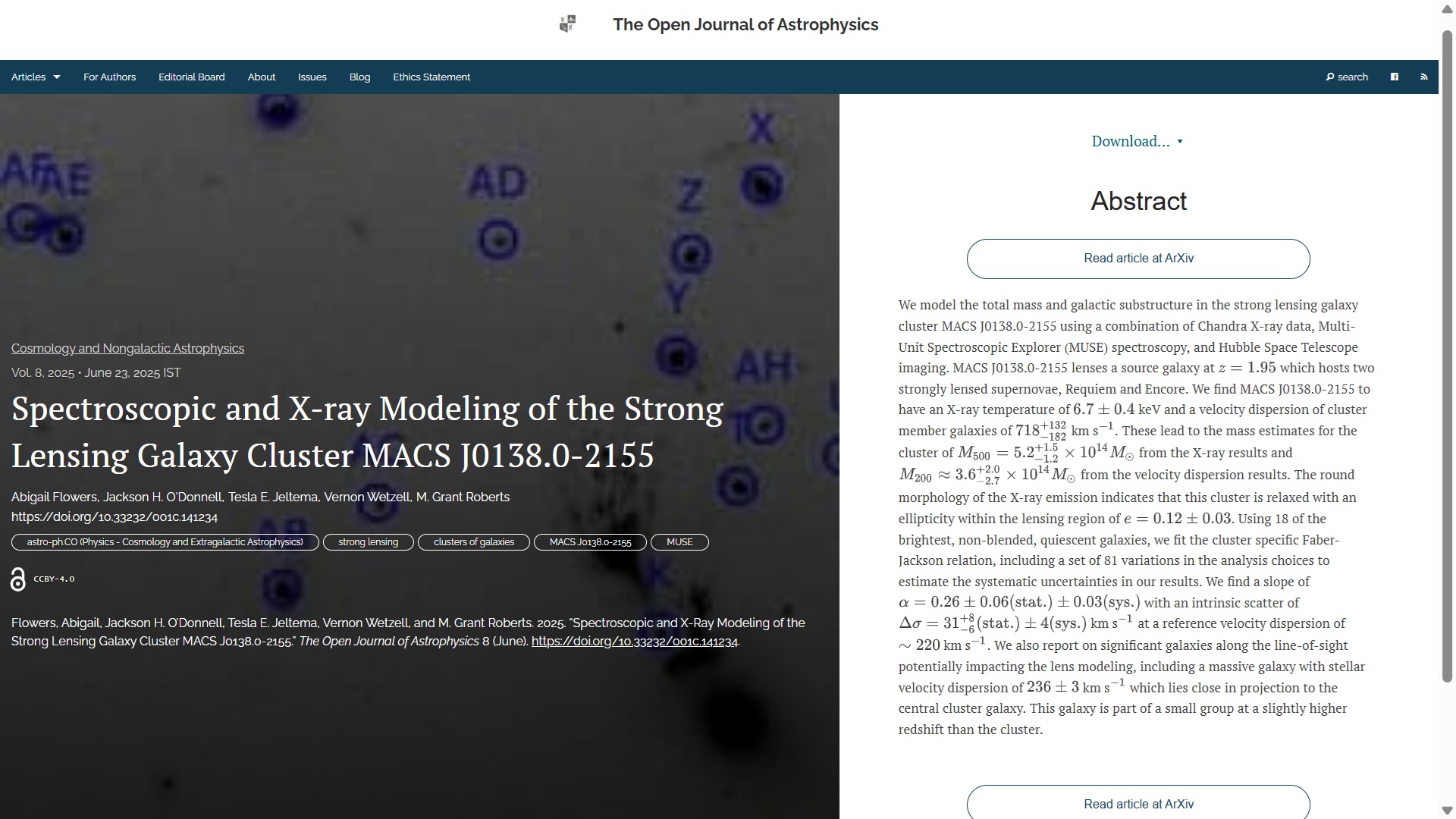
The first paper to report is “Spectroscopic and X-ray Modeling of the Strong Lensing Galaxy Cluster MACS J0138.0-2155” by Abigail Flowers (University of California at Santa Cruz; UCSZ), Jackson H. O’Donnell (UCSZ), Tesla E. Jeltema (UCSZ), Vernon Wetzell (U. Pennsylvania) & M. Grant Roberts (UCSZ). This artticle, which is in the folder marked Cosmology and NonGalactic Astrophysics, presents a study of the mass distribution and substructure of a galaxy cluster that acts as a gravitational lens for a source galaxy at z=1.95 that contains two supernovae. It was published on 23rd June 2025. The overlay is here:

The officially-accepted version can be found on arXiv here.

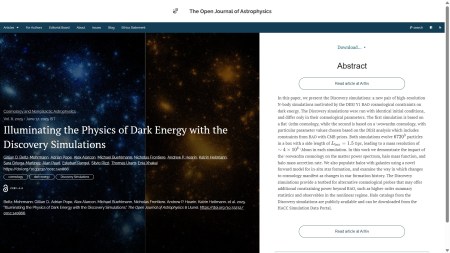
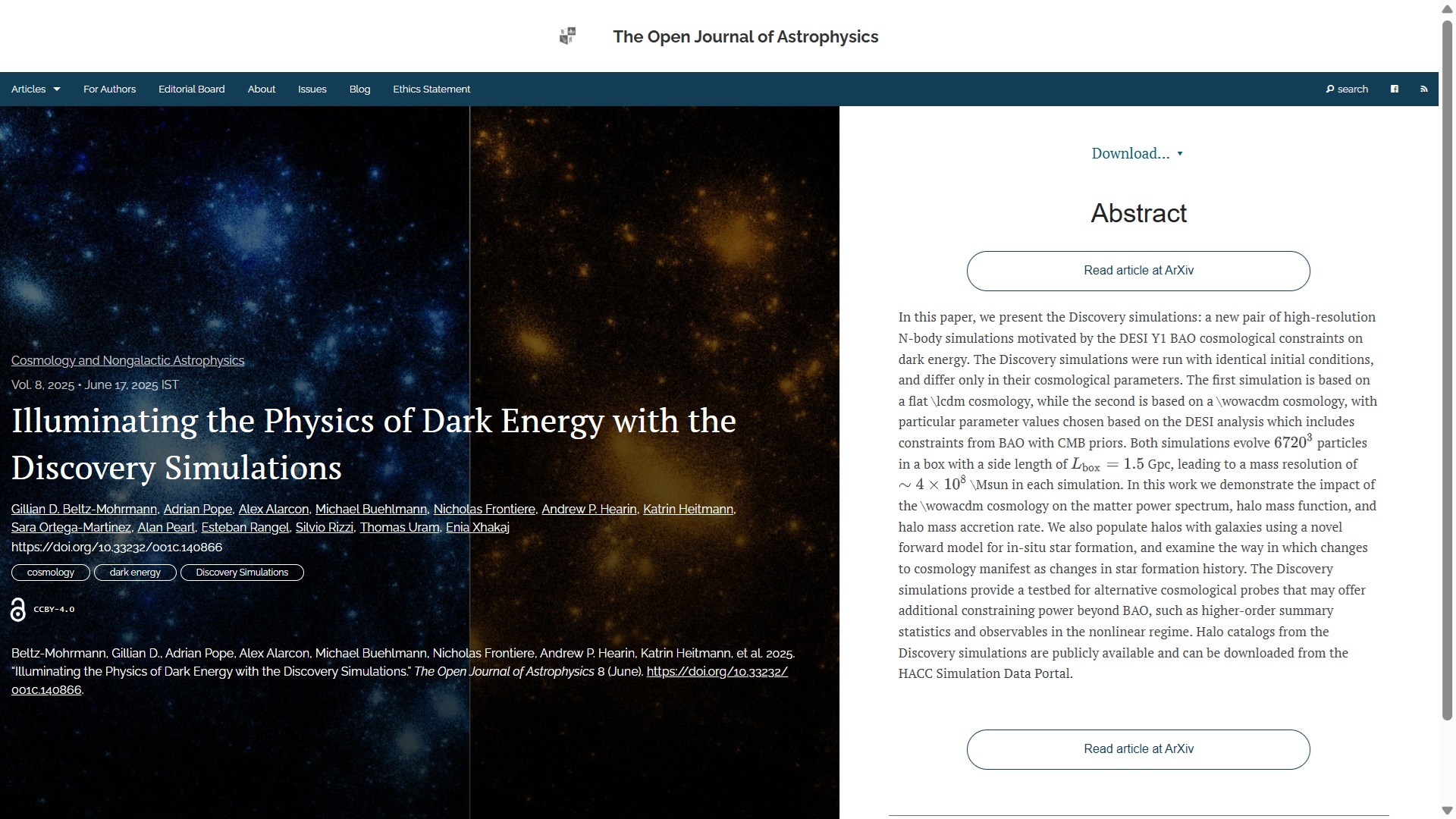
Illuminating the Physics of Dark Energy with the Discovery Simulations” by Gillian D. Beltz-Mohrmann (Argonne National Laboratory, USA) and 12 others based in the USA and Spain. This describes new high-resolution cosmological simulations providing a testbed for alternative cosmological probes that may offer additional constraining power beyond Baryon Accoustic Oscillations. It is filed in the folder marked Cosmology and NonGalactic Astrophysics.

The overlay is here:
You can read the final accepted version on arXiv here.

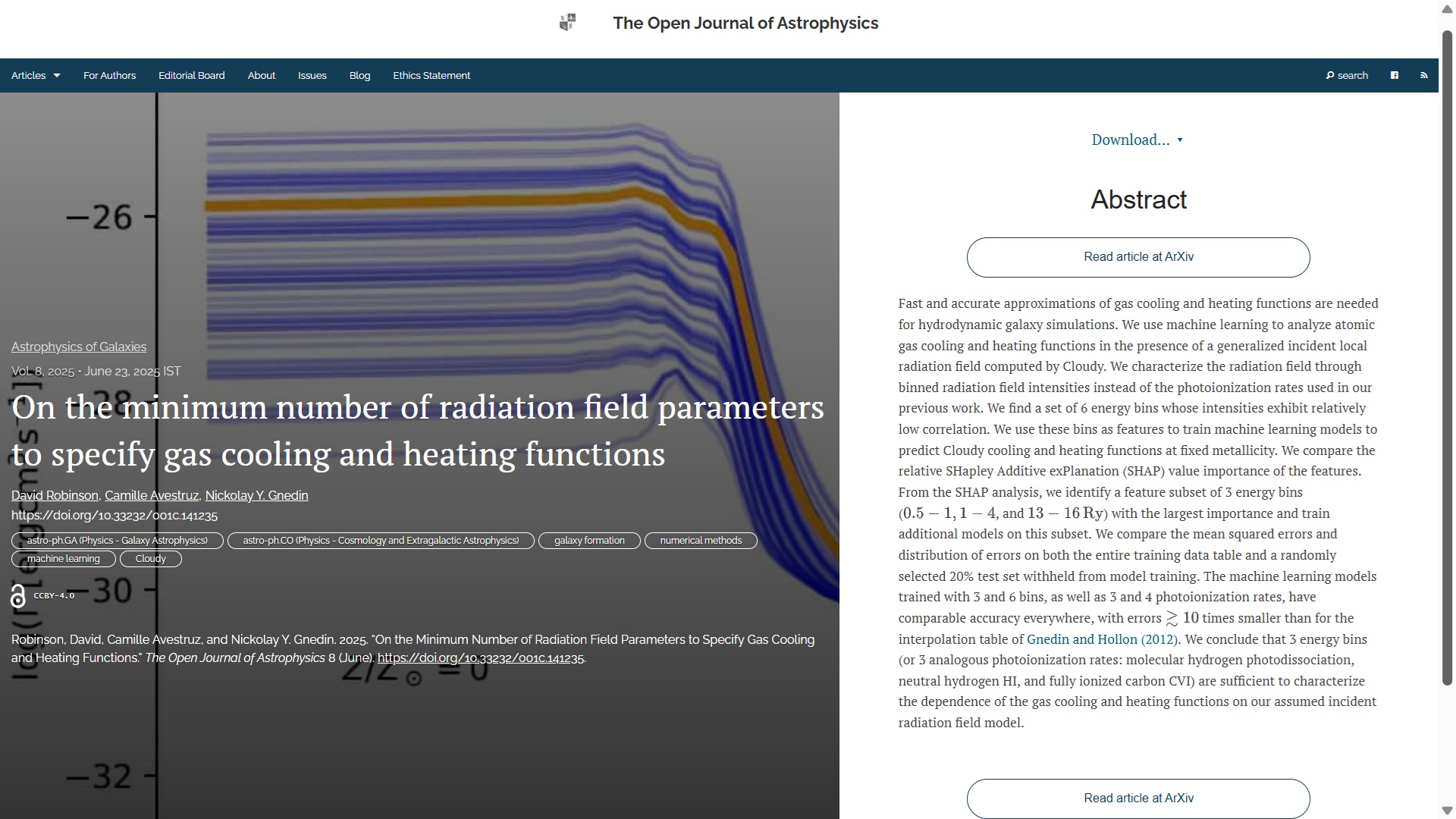
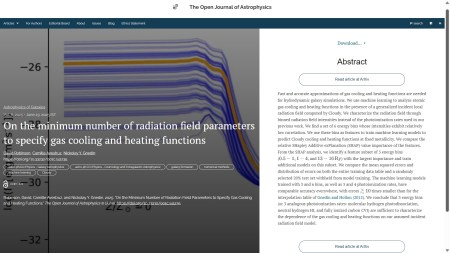
Next one up is in the folder marked Astrophysics of Galaxies. The title is “On the minimum number of radiation field parameters to specify gas cooling and heating functions” and it is by David Robinson & Camille Avestruz (U. Michigan) and Nickolay Y. Gnedin (U.Chicago) and was published on 23rd June 2025. It presents an analysis using machine learning of atomic gas cooling and heating functions computed by the spectral synthesis code Cloudy.

The overlay is here:
 

You can find the officially-accepted version of the paper on arXiv here.

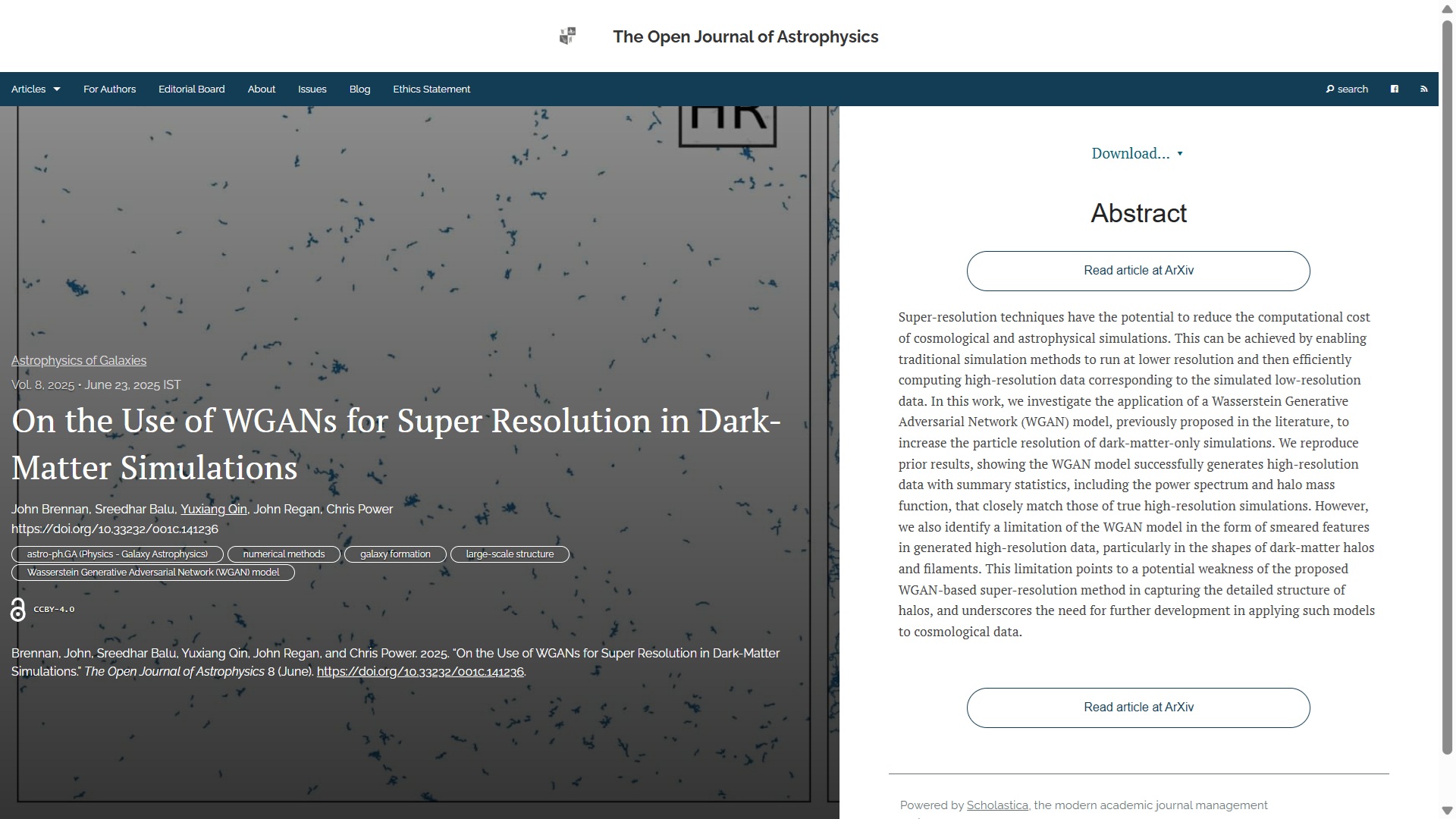
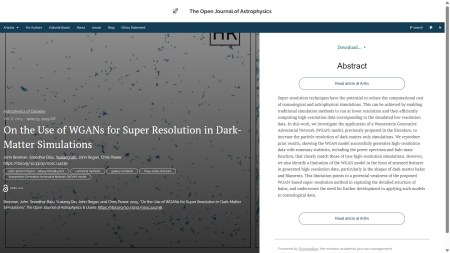
The thirtd paper is “On the Use of WGANs for Super Resolution in Dark-Matter Simulations” by John Brennan (Maynooth), Sreedhar Balu (U. Melbourne), Yuxiang Qin (ANU), John Regan (Maynooth) and Chris Power (U. Western Australia). This one is also in the folder marked Astrophysics of Galaxies and was also published on Monday 23rd June. It is about using the Wasserstein Generative Adversarial Network (WGAN) model to increase the particle resolution of dark-matter-only simulations of galaxy formation. The overlay is here:
You can find the officially-accepted version of the paper on arXiv here.

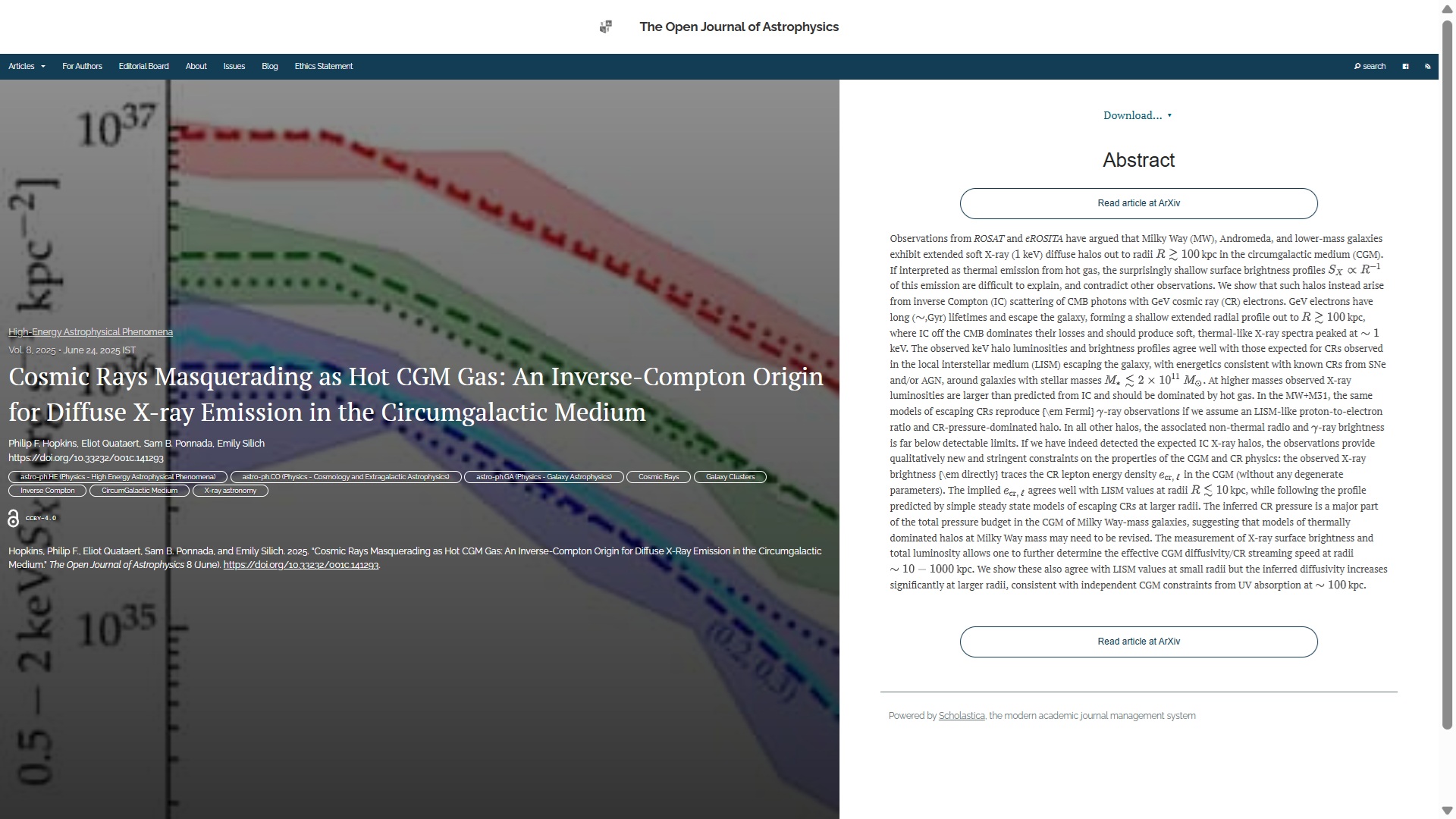
Next we have “Cosmic Rays Masquerading as Hot CGM Gas: An Inverse-Compton Origin for Diffuse X-ray Emission in the Circumgalactic Medium” by Philip F. Hopkins (Caltech), Eliot Quataert (Princeton), Sam B. Ponnada (Caltech) and Emily Silich (Caltech), all based in the USA.  This one was published on 24th June 2025 in the folder High-Energy Astrophysical Phenomena
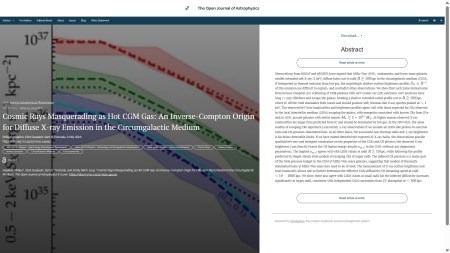
You can find the officially-accepted version on arXiv here.

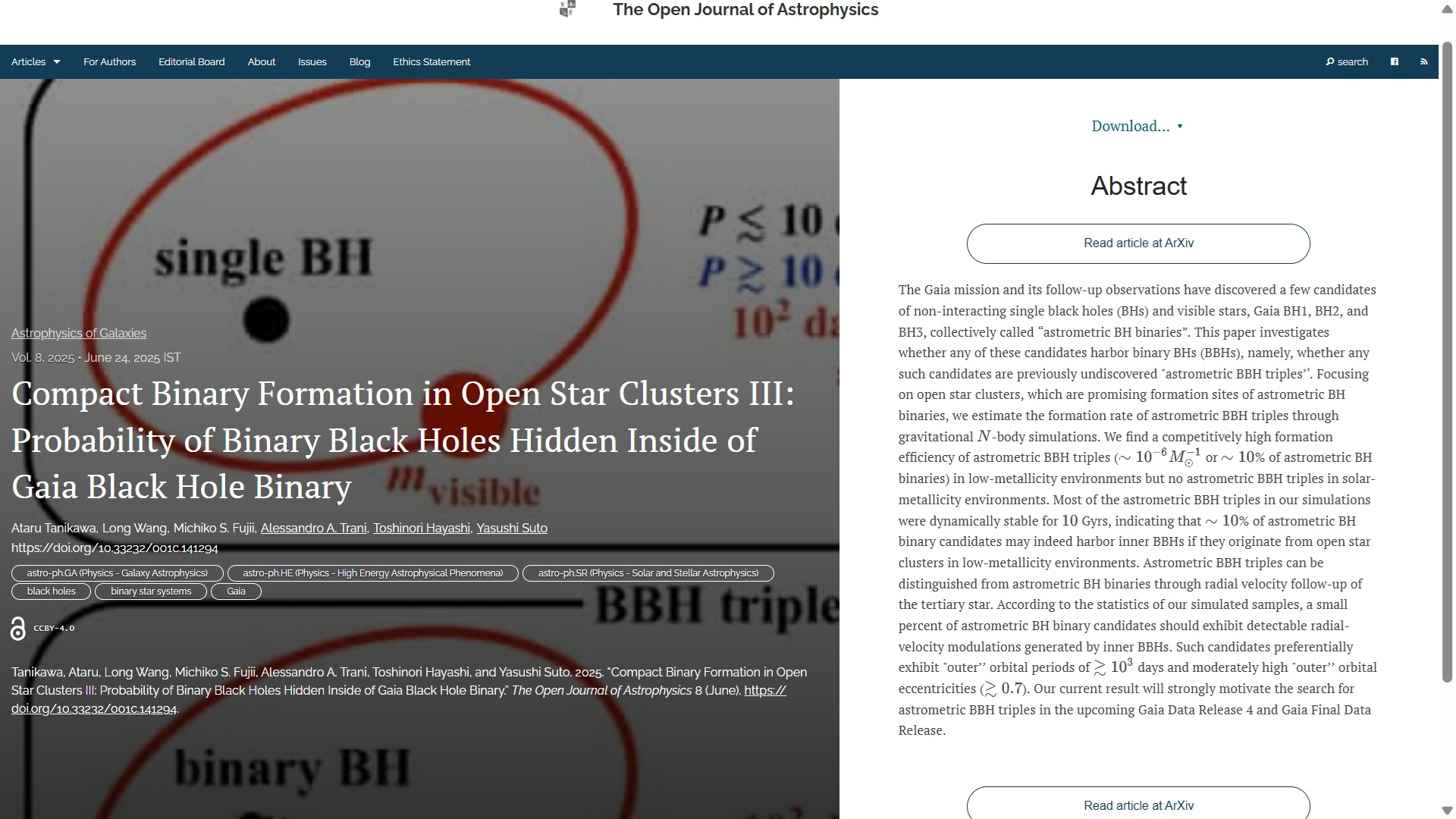
The fifth paper this week is “Compact Binary Formation in Open Star Clusters III: Probability of Binary Black Holes Hidden Inside of Gaia Black Hole Binary” by Ataru Tanikawa (Fukui Prefectural University, Japan), Long Wang (Sun Yat-sen University, China), Michiko S. Fujii (University of Tokyo, Japan), Alessandro A. Trani (Niels Bohr Institute, Denmark), Toshinori Hayashi (Kyoto University, Japan) and Yasushi Suto (Kochi University of Technology, Japan).  This one is in the folder marked Astrophysics of Galaxies and was published on Tuesday 24th June. It presents an investigation into whether some Gaia black hole binary systems may in fact involve three black holes, including a pair too compact to be resolved astrometrically. Here is the overlay:
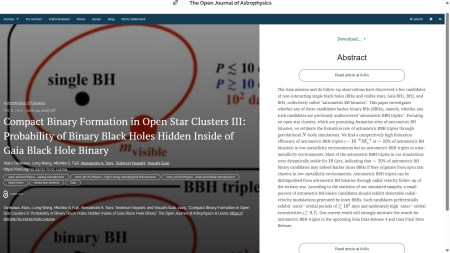
You can find the officially-accepted paper on arXiv here.

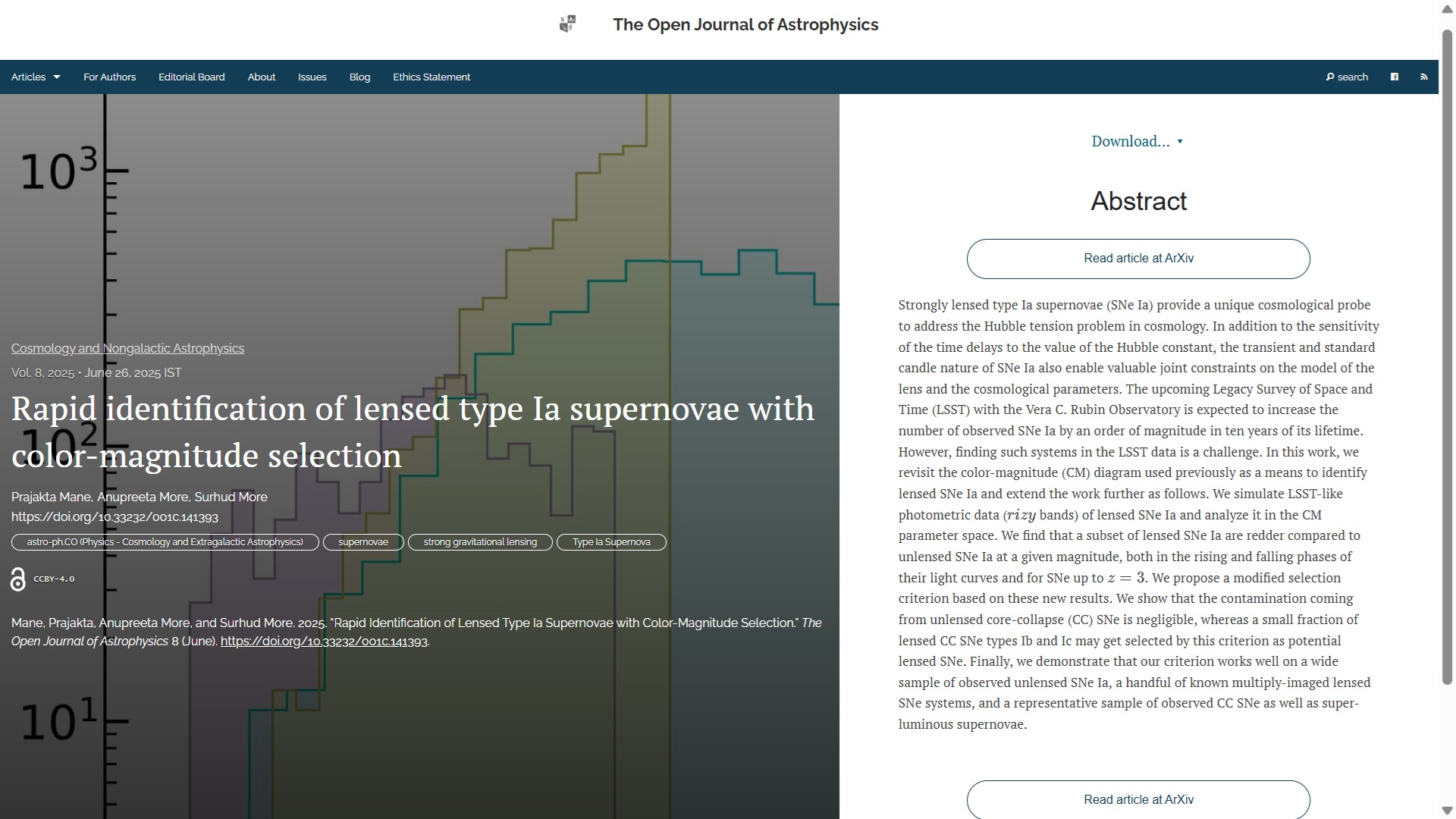
Next we have “Rapid identification of lensed type Ia supernovae with color-magnitude selection” by Prajakta Mane (IISER) and Anupreeta More & Surhud More (IUCAA), all based in India. This paper presents an  extension of the use of color-magnitude diagrams, used previously as a means to identify lensed supernovae, with applications to LSST-like photometric data. It is in the folder marked Astrophysics of Galaxies and was published on Thursday 26th June.
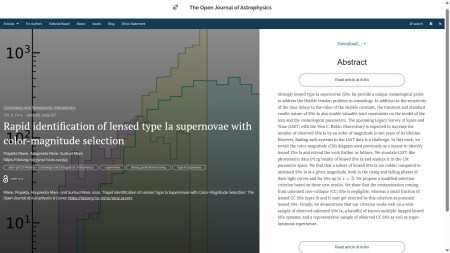
The officially-accepted version of the article can be found on arXiv here.

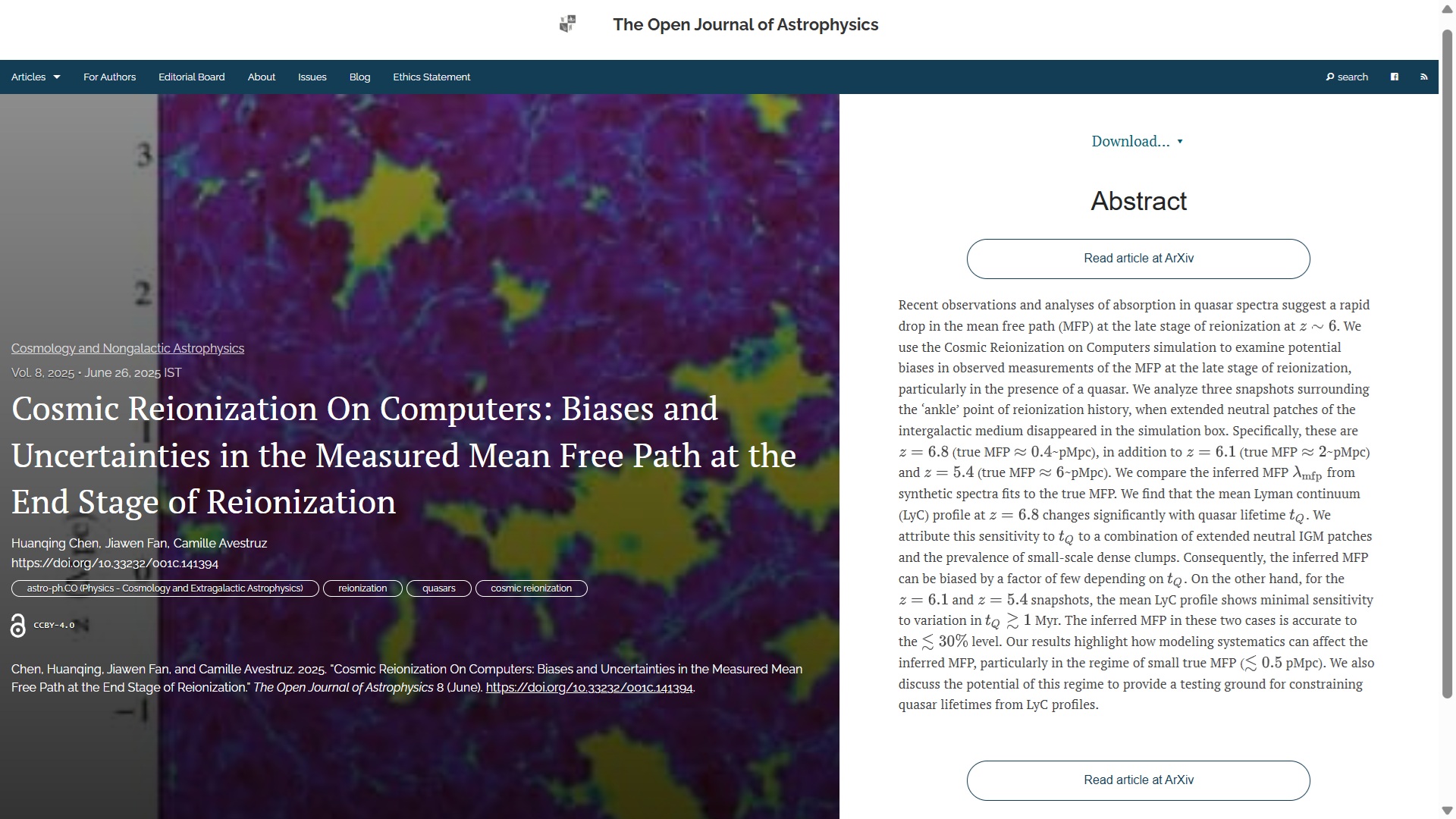
The penultimate article this week is: “Cosmic Reionization On Computers: Biases and Uncertainties in the Measured Mean Free Path at the End Stage of Reionization” by Huanqing Chen (U. Alberta, Canada), and Jiawen Fan & Camille Avestruz (U. Michigan, USA). This one is in the folder Cosmology and Nongalactic Astrophysics and was published on 26th June 2025.  This paper studies possible systematic effects in computer simulations of cosmic reionization especially when it results from quasar radiation.

The overlay is here:

You can find the officially-accepted version on arXiv here.

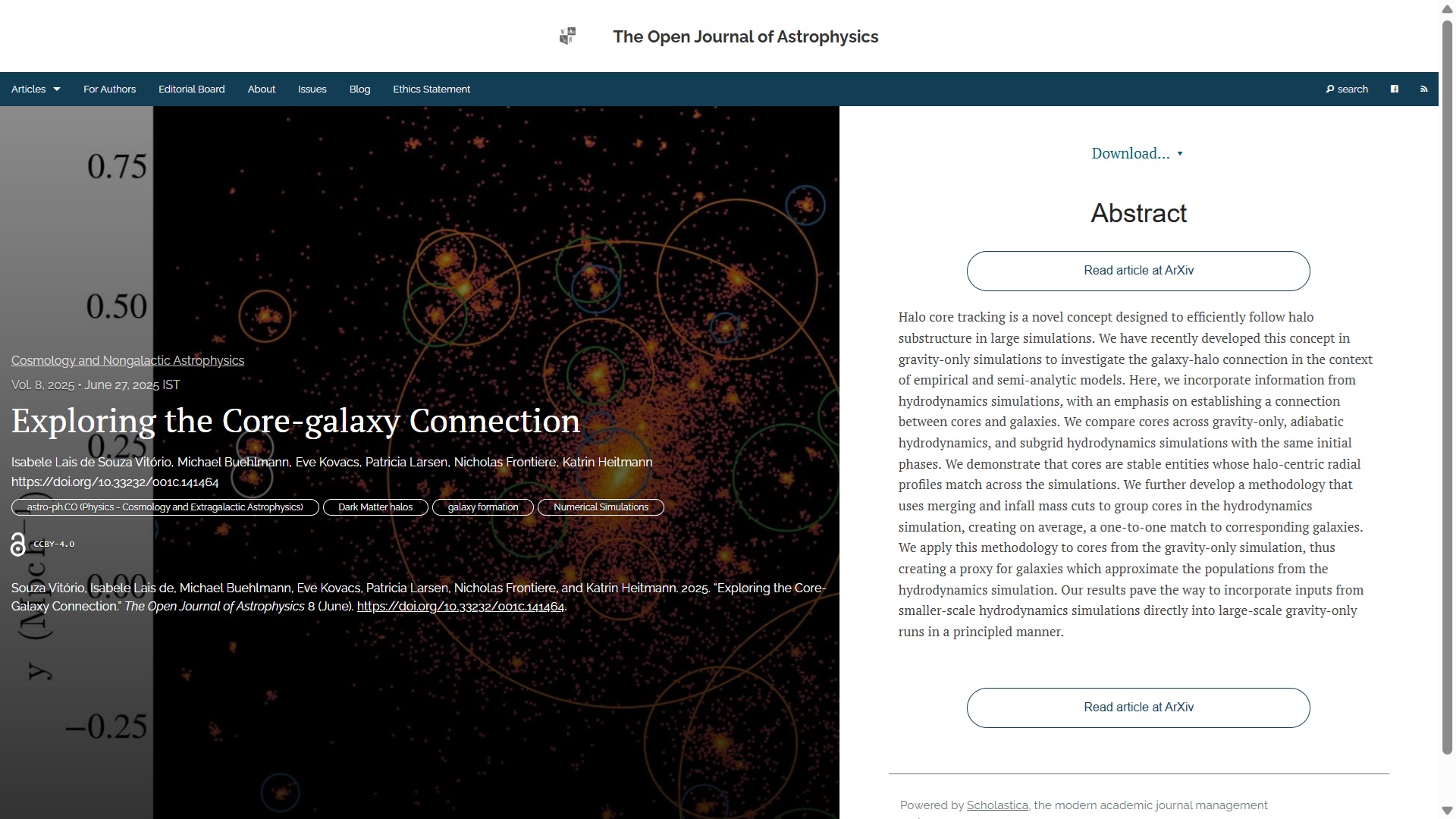
Eighth and last paper this week is “Exploring the Core-galaxy Connection” by Isabele Lais de Souza Vitório (U. Michigan) and Michael Buehlmann, Eve Kovacs, Patricia Larsen, Nicholas Frontiere & Katrin Heitmann (Argonne National Laboratory, USA).  This one is in the folder Cosmology and Nongalactic Astrophysics and was published on Friday 27th June 2025 (i.e. yesterday).

The overlay is here:
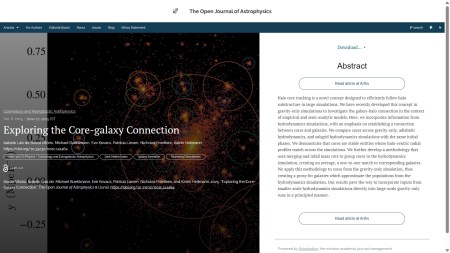
 

You can find the officially-accepted version on arXiv here.

And that’s all the papers for this week. I do, however, have some more news to pass on. We are delighted to welcome two new recruits to our Editorial Board,  Dr Foteini Oikonomou of the Norwegian University of Science and Technology, who specializes in the application of particle physics theories to  high-energy astrophysical phenomena, and Dr Heloise Stevance of Oxford University (UK), who specializes in the interface between Machine Learning and Astrophysics.
Funding Diamond Open Access

Posted in Open Access with tags , , , , , on June 3, 2025 by telescoper

In case you weren’t aware, SciPost is a publishing infrastructure that provides Diamond Open Access to scientific papers. That means they are free to publish and free to read. They are funded by a consortium but are now struggling financially. They have recently circulated an open letter to the Community explaining their predicament and asking for help. I encourage you to read it and, if you can, to make a donation (or bully your institution to do so).

The open letter explains that SciPost is currently running at an average cost per paper of €500. That is much less than a typical APC for a mainstream journal but it is not a negligible cost. At the rate at which SciPost is publishing it amounts to about €1000 per day. SciPost currently attracts a significant level of sponsorship but it is not enough to support its current level of activity. Information on how to help SciPost can be found here. It is a worthy cause and deserves to be supported.

One area in which SciPost has not really taken of is Astronomy, where it has published very few papers. This may at be at least partly because of the Open Journal of Astrophysics (OJAp) which is also Diamond Open Access but runs in a very different and much cheaper way. A full breakdown of costs at OJAp is given here our annual running costs are about €5000 per year, which works out at less than €50 per paper (on average); that comprises a fixed component and a marginal cost of €10 per paper.

The main reasons for the large difference in running costs are: (i) SciPost maintains and runs its own platform; and (ii) it offers a copy-editing service. OJAp piggy-backs on arXiv (where most astrophysics research papers are found anyway) and expects authors to provide the final version of their own work. Neither organization pays referees or Editors. To enable it to run, SciPost employs about three staff full-time (2.9 FTE to be precise); OJAp has no employees and we keep our costs down by offering a ‘no-frills’ service. Instead of having a wide range of sponsors, we are entirely funded by Maynooth University. I am very grateful for that support, but we are run on a shoestring budget.

I have written before about what I think the future of Diamond Open Access could be like. I would like to see a range of Diamond Open Access journals offering a choice for authors and serving different sub-disciplines. Most universities nowadays have publishing operations so there could be network of federated journals, some based on arXiv and some based on other repositories and others with different models, such as SciPost. Perhaps institutions are worried about the expense but, as we have shown the actual cost, is far less than they are wasting on Article Processing Charges.

I don’t see other Diamond Open Access journals as competitors, but as allies with community-led ecosystem. I’d be more than happy to discuss how to start up such a journal on the OJAp model with anyone interested, and have already done so with some interested parties. As far as I’m concerned, the more the merrier! It is neither fair nor reasonable, however, that the expense of running a journal that serves the global astrophysics community should fall entirely on one small University in Ireland.

By all means support SciPost (and get your institutions to do likewise), but please also consider supporting OJAp. We are currently covering our costs but have no funds to make enhancements (such as a much-needed new LaTex template). If you can afford to make a donation to SciPost, then perhaps you can afford to make a donation to OJAp proportionate to our lower running costs? For example, if you give €10K to SciPost, could you give us €1K too? That amount would keep SciPost running for a day and OJAp for many months…

Weekly Update from the Open Journal of Astrophysics – 08/02/2025

Posted in OJAp Papers, Open Access, The Universe and Stuff with tags , , , , , , , on February 8, 2025 by telescoper

It’s Saturday morning, so once again it’s time for an update from the Open Journal of Astrophysics. Since the last update we have published one new paper, which brings the number in Volume 8 (2025) up to 12 and the total so far published by OJAp up to 247.

Galaxy evolution in the post-merger regime. III – The triggering of active galactic nuclei peaks immediately after coalescence” was written by Sara Ellison, Leonardo Ferreira, Robert Bickley & Tess Grindlay (U. Victoria, Canada), Samir Salim (Indiana U., USA), Shoshannah Byrne-Mamahit (Victoria), Shobita Satyapal (George Mason U., USA), David R. Patton (Trent U., Canada) and Jillian M. Scudder (Oberlin College, USA).  It was published on 4th February 2025 and is in the folder marked Astrophysics of Galaxies. The paper describes an investigation into the timescale of triggering of AGN activity after galaxy mergers and concluding that most occurs immediately after coalescence. 

You can find the officially accepted version of this paper on arXiv here.

That’s all for this week. I’ll have more updates next Saturday.

Weekly Update from the Open Journal of Astrophysics – 01/02/2025

Posted in OJAp Papers, Open Access, The Universe and Stuff with tags , , , , , , , , , , , , , , , , , , on February 1, 2025 by telescoper

It’s Saturday morning, so once again it’s time for an update of papers published at the Open Journal of Astrophysics. There were no papers to report last week but since the last update we have published four new papers, which brings the number in Volume 8 (2025) up to 11 and the total so far published by OJAp up to 246.

In chronological order of publication, the four papers published this week, with their overlays, are as follows. You can click on the images of the overlays to make them larger should you wish to do so.

First one up is  “A halo model approach for mock catalogs of time-variable strong gravitational lenses” by Katsuya T. Abe & Masamune Oguri (Chiba U, Japan), Simon Birrer & Narayan Khadka (Stony Brook, USA), Philip J. Marshall (Stanford, USA), Cameron Lemon (Stockholm U., Sweden), Anupreeta More (IUCAA, India), and the LSST Dark Energy Science Collaboration. It was published on 27th January 2025 in the folder marked Cosmology and NonGalactic Astrophysics. The paper discusses how to generate mock catalogs of strongly lensed QSOs and Supernovae on galaxy-, group-, and cluster-scales based on a halo model that incorporates dark matter halos, galaxies, and subhalos.


You can find the officially accepted version of this paper on arXiv here.

This paper, also published on Monday 27th January 2025, but in the folder Astrophysics of Galaxies, is “The Soltan argument at redshift 6: UV-luminous quasars contribute less than 10% to early black hole mass growth” by Knud Jahnke (MPI Heidelberg, Germany). This paper presents an argument that almost all growth of supermassive black hole mass at z>6 does not take place in UV-luminous quasars.

Here is a screen grab of the overlay, which includes the abstract:You can find the officially accepted version of the paper on the arXiv here.

The third paper to announce, published on 29th January 2025 in the folder Cosmology and NonGalactic Astrophysics, is “A Heavy Seed Black Hole Mass Function at High Redshift – Prospects for LISA” by Joe McCaffrey & John Regan (Maynooth U., Ireland), Britton Smith (Edinburgh U., UK), John Wise (Georgia Institute of Technology, USA), Brian O’Shea (Michigan State U., USA) and Michael Norman (University of California, San Diego). This is a numerical study of the growth rates of massive black holes in the early Universe and implications for their detection via gravitational wave emission.

You can see the overlay here:


The accepted version of this paper can be found on the arXiv here.

The last paper of this batch is “Forecasting the Detection of Lyman-alpha Forest Weak Lensing from the Dark Energy Spectroscopic Instrument and Other Future Surveys” by Patrick Shaw & Rupert A. C. Croft (Carnegie Mellon U., USA) and R. Benton Metcalf (U. Bologna, Italy). This paper, published on January 30th 2025, is about extending the applicationof  Lyman-α forest weak gravitational lensing to lower angular source densities than has previously been done, with forecasts for future spectral surveys. It is in the folder marked Cosmology and NonGalactic Astrophysics.

The overlay is here


You can find the accepted version on arXiv here.

Incidentally, we currently have 121 papers under review, including 81 under a revise and resubmit request.

That’s all for this week. I’ll do another update next Saturday.

Two New Publications at the Open Journal of Astrophysics

Posted in OJAp Papers, Open Access, The Universe and Stuff with tags , , , , , , , , , on July 6, 2024 by telescoper

My own laptop is still with the menders but I’ve managed to borrow one until I get it back so I don’t get too far behind. Anyway, it’s Saturday morning, and once again time to post another update relating to the  Open Journal of Astrophysics.  Since the last update we have published two more papers, taking  the count in Volume 7 (2024) up to 54 and the total published by OJAp up to 169.  There was one less arXiv update than usual last week, owing to the holiday on July 4th, so a couple of papers have been delayed.

The first paper of the most recent pair, published on July 3rd 2024,  is “Recovering 21cm Monopole Signals Without Smoothness” by Rugved Pund & Anže Slosar (Stony Brook, NY, USA) and Aaron Parsons (Berkeley, CA, USA) . This paper presents a new method for identifying the ‘Dark Ages’ trough contribution to the monopole of the 21cm radiation background that does not rely on the assumption that the spectrum is smooth. The paper is in the folder marked Cosmology and NonGalactic Astrophysics.

Here is a screen grab of the overlay which includes the abstract:


You can click on the image of the overlay to make it larger should you wish to do so. You can find the officially accepted version of the paper on the arXiv here.

The second paper, also published on 3rd July, has the title “LtU-ILI: An All-in-One Framework for Implicit Inference in Astrophysics and Cosmology”. There are fifteen authors with primary affiliations as follows: Matthew Ho (IAP, Paris, France), Deaglan J. Bartlett (IAP, Paris, France), Nicolas Chartier (Seoul National University, Korea),  Carolina Cuesta-Lazaro (Cfa, Harvard, USA),  Simon Ding (IAP, Paris, France), Axel Lapel (IAP, Paris, France), Pablo Lemos (Université de Montréal, Canada), Christopher C. Lovell (University of Portsmouth, UK),  T. Lucas Makinen (Imperial College, London, UK), Chirag Modi (Flatiron Institute, NY, USA), Viraj Pandya (Columbia University, NY, USA), Shivam Pandey (Columbia University, NY, USA), Lucia A. Perez (Flatiron Institute, NY, USA), Benjamin Wandelt (IAP, Paris, France),  and Greg L. Bryan (Sorbonne Université, Paris, France).

This paper, which is in the folder marked Instrumentation and Methods for Astrophysics, presents a suite of software for rapid, user-friendly, and cutting-edge inference using machine learning in astrophysics and cosmology. The software can be found on Github here.

Here is a screen grab of the overlay which includes the abstract:


You can click on the image of the overlay to make it larger should you wish to do so. You can find the officially accepted version of the paper on the arXiv here.

That concludes this week’s update. No doubt I’ll have more for you next week!

Recent Citations in Astrophysics

Posted in Open Access with tags , , , , , , , on June 27, 2024 by telescoper

When I was on the train yesterday I thought I’d pass the time by looking up some numbers to answer a question someone asked me after my seminar in Valencia. I thought the results were Quite Interesting so I thought I would share them here. Just for fun I worked out the average number of citations so far for all papers published in 2023 in the “leading” astrophysics journals:

JournalMean citations per paperMedian citations per paper
ApJ6.23
MNRAS6.94
A&A7.74
OJAp8.45
Source: NASA/ADS

I suspect these numbers don’t turn out the way most people would have imagined! I don’t think you should infer too much from these figures because the window for citations is very narrow, but they do demonstrate that there’s no evidence that papers in the Open Journal of Astrophysics attract any less attention than those in more mainstream journals.

Three New Publications at the Open Journal of Astrophysics

Posted in OJAp Papers, Open Access, The Universe and Stuff with tags , , , , , , , , , , , , , , , , , on June 8, 2024 by telescoper

Time for another roundup of business at the  Open Journal of Astrophysics. This time I have three papers to announce, which brings the total we have published so far this year (Vol. 7) to 45 and the total published by OJAp to 160. We’re still on track to publish around 100 papers this year or more, compared to last year’s 50.

First one up, published on 3rd June 2024, is “Log-Normal Waiting Time Widths Characterize Dynamics” by Jonathan Katz of Washington University (St Louis, Missouri, USA). This paper presents a discussion of the connection between waiting time distributions and dynamics for aperiodic astrophysical systems, with emphasis on log-normal distributions.  This paper is in the folder marked High-Energy Astrophysical Phenomena.

Here is a screen grab of the overlay, which includes the abstract:


You can read the paper directly on arXiv here.

The second paper to present is “An Empirical Model For Intrinsic Alignments: Insights From Cosmological Simulations” by Nicholas Van Alfen (Northeastern University, Boston, USA), Duncan Campbell (Carnegie Mellon University, Pittsburgh, USA), Jonathan Blazek (Northeastern University), C. Danielle Leonard (Newcastle University, UK), Francois Lanusse (Université Paris-Saclay, France), Andrew Hearin (Argonne National Laboratory, USA), Rachel Mandelbaum (Carnegie Mellon University) and The LSST Dark Energy Science Collaboration.  This paper presents an extension of the halo model (specifically the Halo Occupation Distribution, HOD) to include intrinsic alignment effects for the study of weak gravitational lensing. This paper is in the folder marked Cosmology and Nongalactic Astrophysics. It was published on Tuesday June 4th 2024.

The overlay looks like this:


You can read this paper directly on the arXiv here.

Last, but by no means least, comes  “Towards Cosmography of the Local Universe”  which proposes the multipoles of the distance-redshift relation as new cosmological observables that have a direct physical interpretation in terms of kinematical quantities of the underlying matter flow. This was also published on 4th June. The authors are Julian Adamek (IfA Zurich, Switzerland), Chris Clarkson (Queen Mary, London, UK), Ruth Durrer (Geneva, Switzerland), Asta Heinesen (U. Lyon, France & NBI Copenhagen, Denmark), Martin Kunz (Geneva), and Hayley J. Macpherson (Chicago, USA).

Here is a screengrab of the overlay:


To read the accepted version of this on the arXiv please go here. This paper is also in the folder marked Cosmology and Nongalactic Astrophysics.
That’s it for this week. I aim to post another update next weekend.


Two New Publications at the Open Journal of Astrophysics

Posted in OJAp Papers, Open Access, The Universe and Stuff with tags , , , , , , , , , , on February 24, 2024 by telescoper

It’s Saturday morning in Sydney, and time to post another update relating to the  Open Journal of Astrophysics.  Since the last update we have published two more papers, taking  the count in Volume 7 (2024) up to 15 and the total published by OJAp up to 130. I should have posted these before leaving but it slipped my mind.

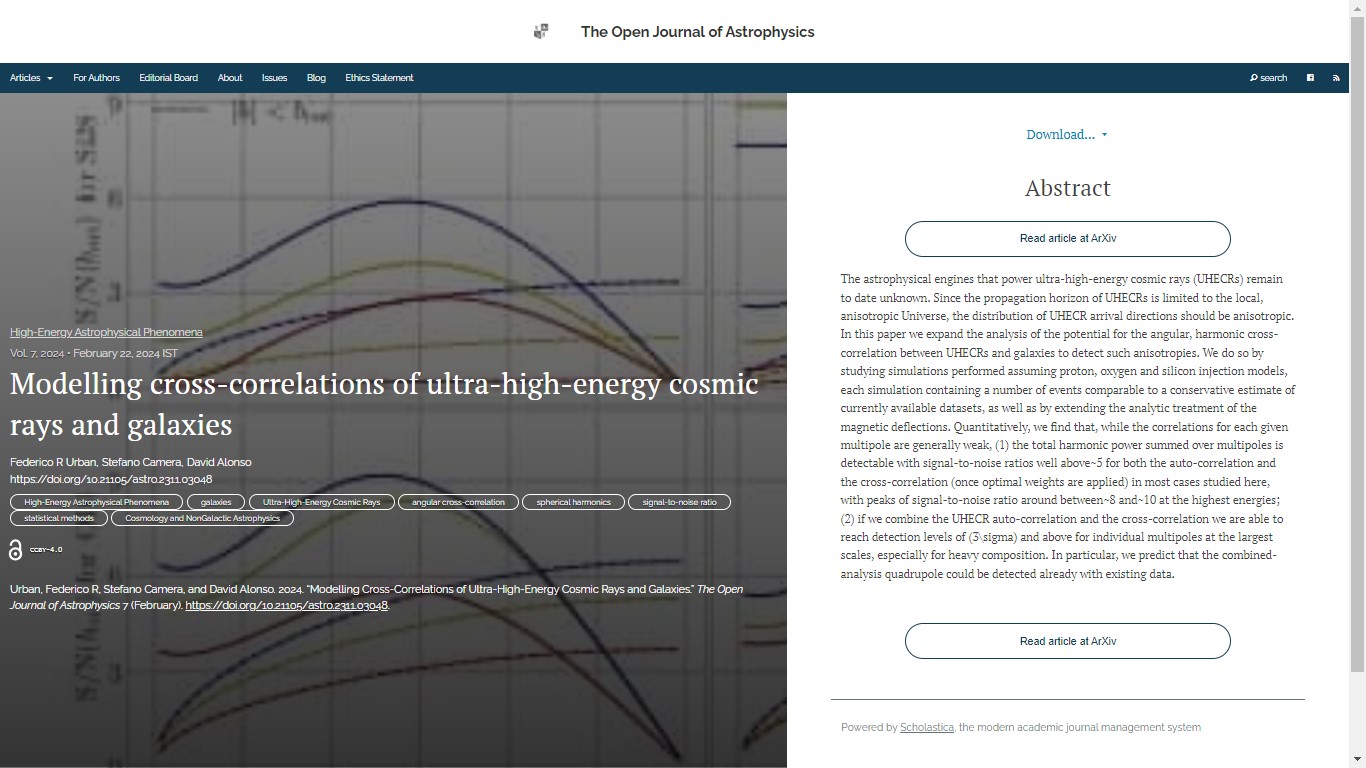
The first paper of the most recent pair – published on  Thursday 22nd February – is “Modelling cross-correlations of ultra-high-energy cosmic rays and galaxies” by Federico Urban (Prague, Czech Republic), Stefano Camera (Torino, Italy) and David Alonso (Oxford, UK). It presents a discussion of the possible statistical correlations between Ultra-High-Energy Cosmic-Ray (UHECR) directions in various models and structure in the galaxy distribution and whether or not this signal could be measurable.  This one is in the folder marked “High-Energy Astrophysical Phenomena“.

Here is a screen grab of the overlay which includes the abstract:

You can click on the image of the overlay to make it larger should you wish to do so. You can find the officially accepted version of the paper on the arXiv here.

The second paper was published on Friday 23rd February and has the title “The IA Guide: A Breakdown of Intrinsic Alignment Formalisms” and the authors are: Claire Lamman (Harvard, USA);  Eleni Tsaprazi (Stockholm, Sweden);  Jingjing Shi (Tokyo, Japan); Nikolina Niko Šarčević (Newcastle, UK); Susan Pyne (UCL, UK); Elisa Legnani (Barcelona, Spain); and Tassia Ferreira (Oxford, UK). This one, which is in the folder marked Cosmology and NonGalactic Astrophysics, presents a review of Intrinsic Alignments, i.e. physical correlations involving galaxy shapes, galaxy spins, and larger scale structure, especially important for weak gravitational lensing

Here is a screen grab of the overlay which includes the abstract:


You can click on the image of the overlay to make it larger should you wish to do so. You can find the officially accepted version of the paper on the arXiv here.

That concludes this week’s update!

New Publication at the Open Journal of Astrophysics

Posted in OJAp Papers, Open Access, The Universe and Stuff with tags , , , , , , , on February 16, 2024 by telescoper

It’s Saturday morning here in Sydney, which means it is time for another weekly update from the Open Journal of Astrophysics. In fact there is only one paper to report this week, being  the 13th paper in Volume 7 (2024)  and the 128th altogether. It was published on February 15th 2024.

The title is “Jet – counter-jet asymmetry in the jittering jets explosion mechanism of supernovae” and it  This one is in the folder called High-Energy Astrophysical Phenomena. The paper presents a discussion of the production of jets in core-collapse supernovae and the resulting formation of neutron stars, and the implications for the morphology of the supernova remnant.

The sole author of the paper is Noam Soker of Technion, Haifa, in Israel.

Here is the overlay of the paper containing the abstract:


You can click on the image of the overlay to make it larger should you wish to do so. You can find the officially accepted version of the paper on the arXiv here.

Three New Publications at the Open Journal of Astrophysics

Posted in OJAp Papers, Open Access, The Universe and Stuff with tags , , , , , , , , , , , , , , , , , on January 20, 2024 by telescoper

As promised yesterday, it’s time for a roundup of the week’s business at the  Open Journal of Astrophysics. This past week we have published three papers, taking  the count in Volume 7 (2024) up to 4 and the total published by OJAp up to 119. There are quite a few more ready to go as people return from the Christmas break.

In chronological order, the three papers published this week, with their overlays, are as follows. You can click on the images of the overlays to make them larger should you wish to do so.

First one up is “Prospects for studying the mass and gas in protoclusters with future CMB observations” by  Anna Gardner and Eric Baxter (Hawaii, USA), Srinivasan Raghunathan (NCSA, USA), Weiguang Cui (Edinburgh, UK), and Daniel Ceverino (Madrid, Spain). This paper, published on 17th January 2024, uses realistic hydrodynamical simulations to probe the ability of CMB Stage 4-like (CMB-S4) experiments to detect and characterize protoclusters via gravitational lensing and the Sunyaev-Zel’dovich effect. This paper is in the category of Cosmology and Nongalactic Astrophysics.

Here is a screen grab of the overlay, which includes the abstract:


You can find the officially accepted version of the paper on the arXiv here.

The second paper to announce is “SDSS J125417.98+274004.6: An X-ray Detected Minor Merger Dual AGN” and is by Marko Mićić, Brenna Wells, Olivia Holmes, and Jimmy Irwin (all of the University of Alabama, USA).  This presents the discovery of a dual AGN in a merger between the galaxy SDSS J125417.98+274004.6 and dwarf satellite, studied using X-ray observations from the Chandra satellite. The paper was also published on 18th January 2024 in the category Astrophysics of Galaxies . You can see the overlay here:


The accepted version of this paper can be found on the arXiv here.

The last paper of this batch is  entitled “Population III star formation: multiple gas phases prevent the use of an equation of state at high densities” and the authors are:  Lewis Prole (Maynooth, Ireland), Paul Clark (Cardiff, UK), Felix Priestley (Cardiff, UK), Simon Glover (Heidelberg, Germany) and John Regan (Maynooth, Ireland). This paper, which presents a comparison of results obtained using chemical networks and a simpler equation-of-state approach for primordial star formation (showing the limitations of the latter) was published on 19th January 2024 and also in the folder marked Astrophysics of Galaxies.

Here is the overlay:


You can find the full text for this one on the arXiv here.

And that concludes the update. There’ll be more next week!