Archive for Open Access

Weekly Update from the Open Journal of Astrophysics – 19/07/2025

Posted in OJAp Papers, Open Access, The Universe and Stuff with tags , , , , , , , , , , , , , , , , , , , , , , , , , , on July 19, 2025 by telescoper

It’s Saturday morning again, so it’s time again for an update of papers published at the Open Journal of Astrophysics. Since the last update we have published six new papers, which brings the number in Volume 8 (2025) up to 98, and the total so far published by OJAp  up to 333. I expect we’ll pass the century for this year sometime next week.

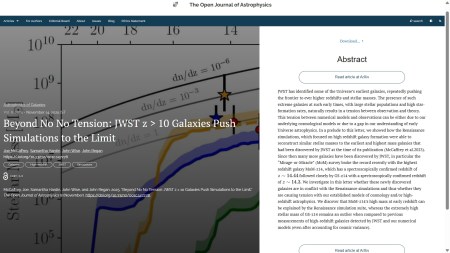
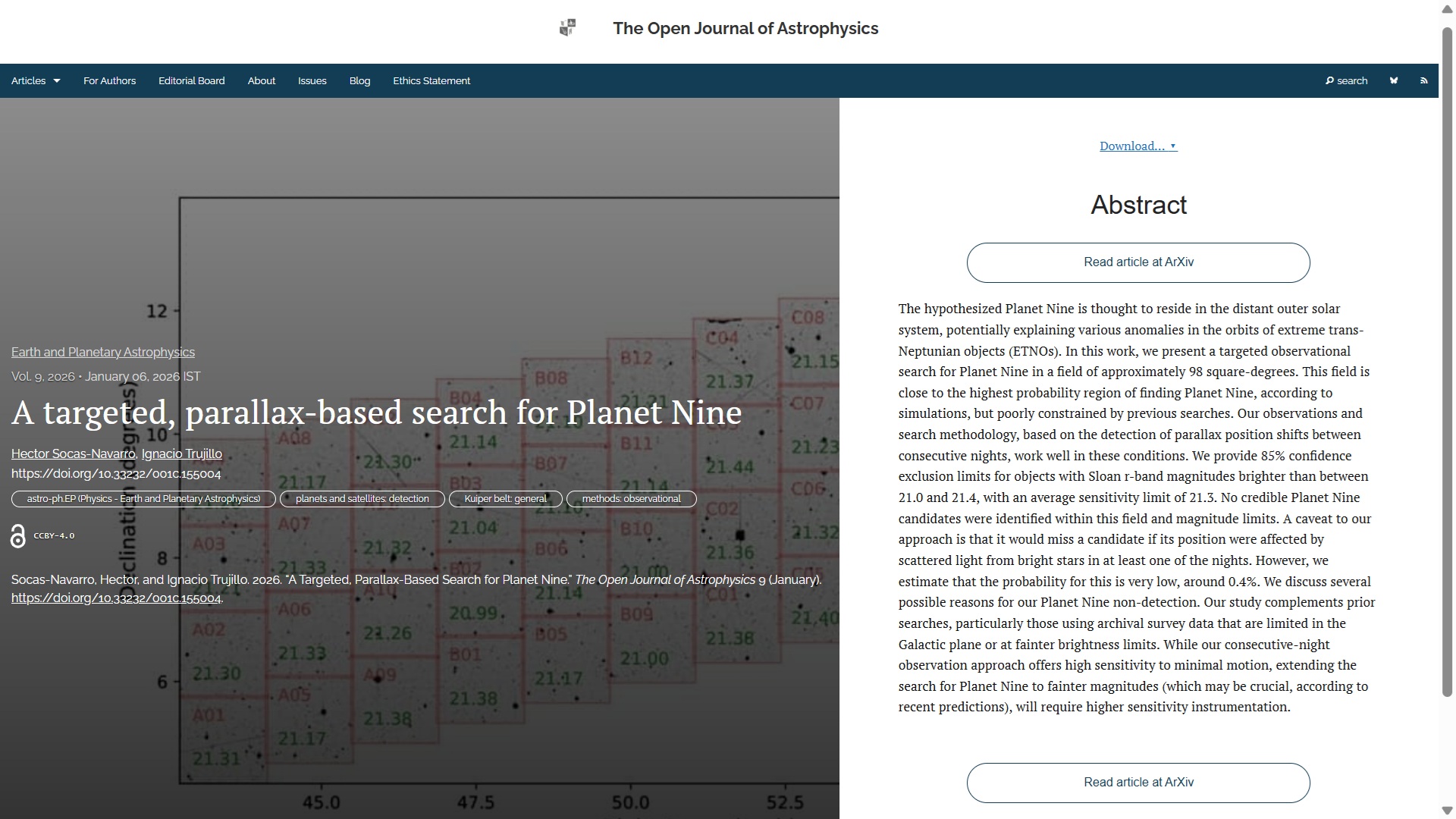
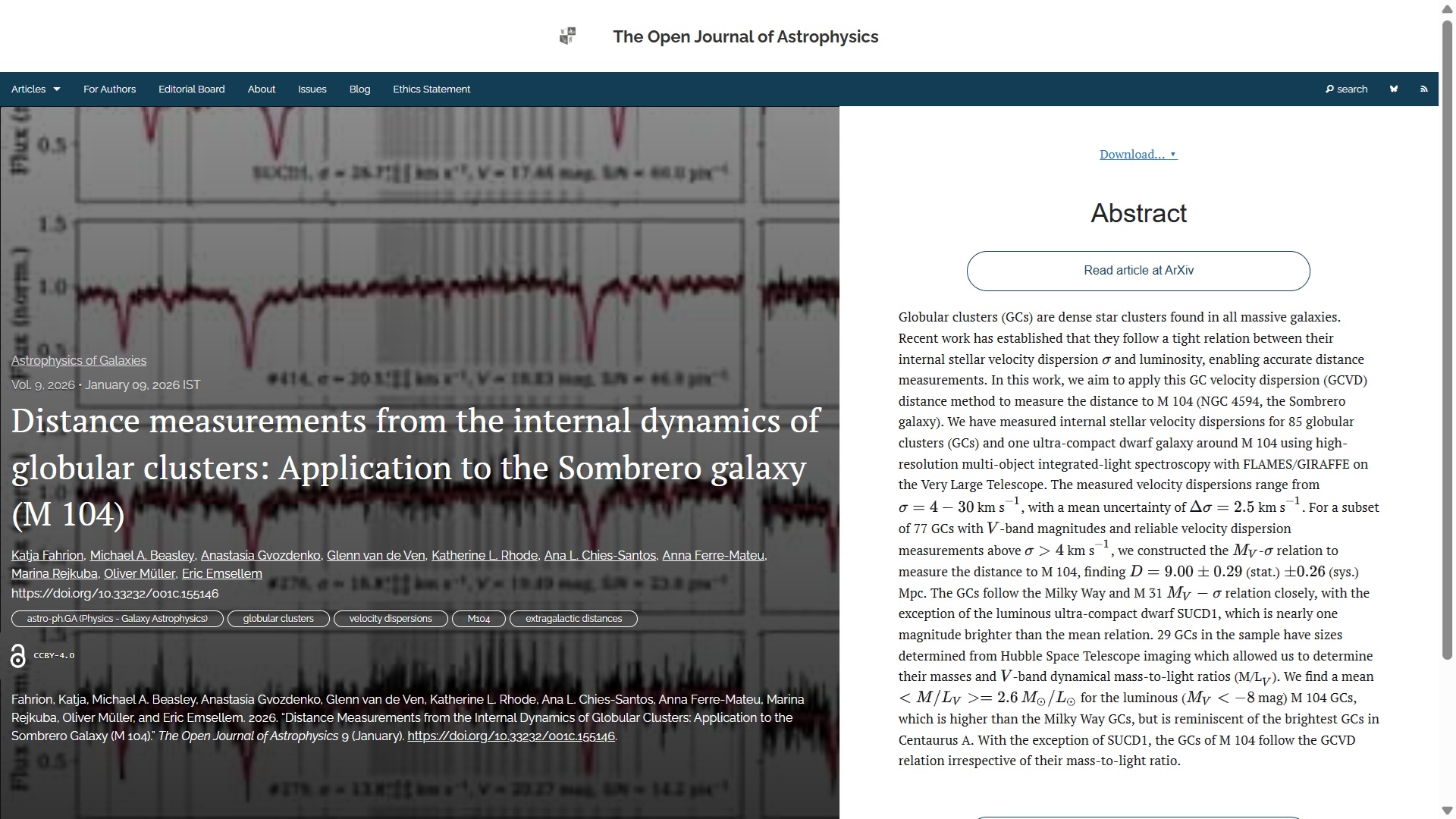
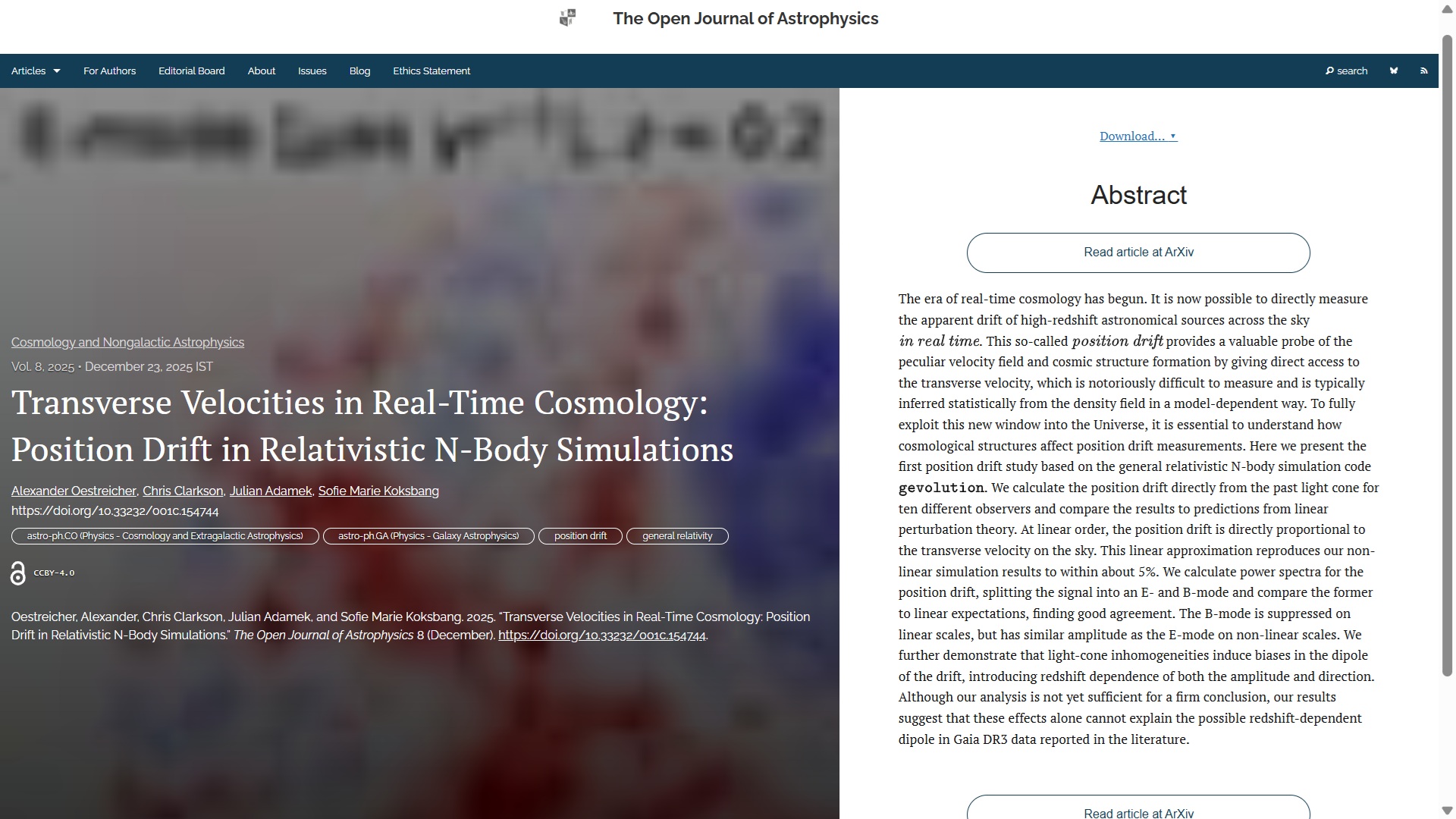
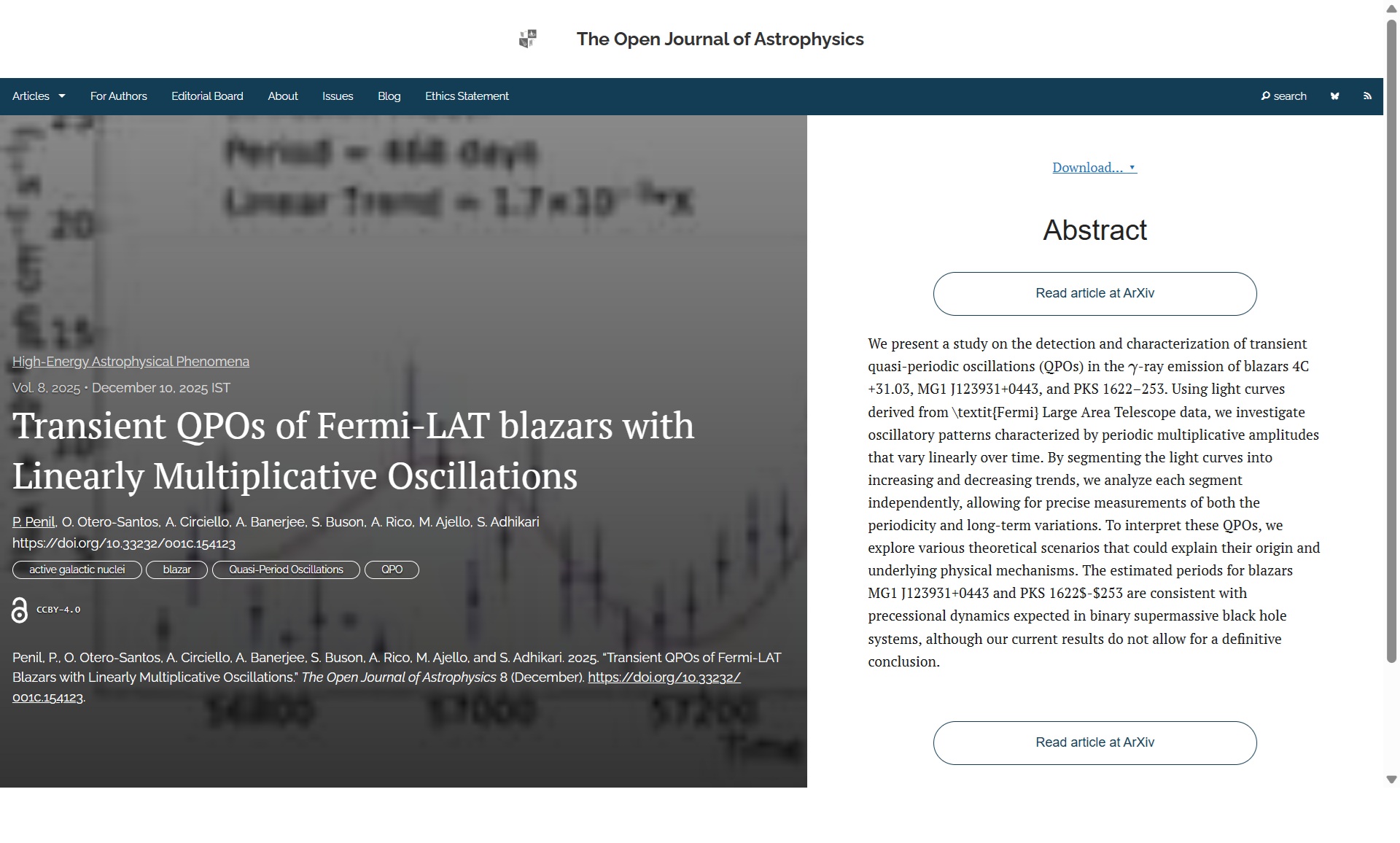
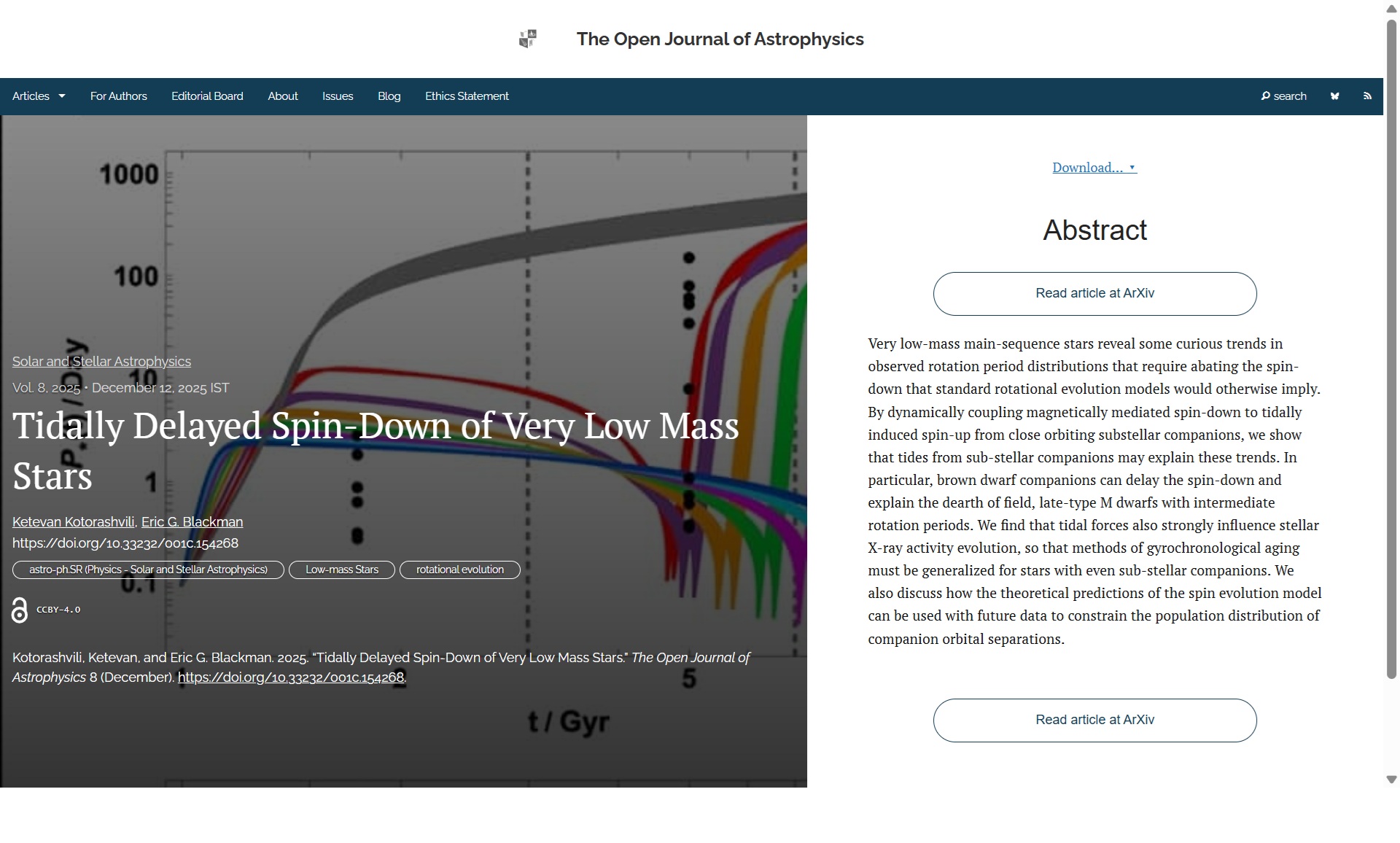
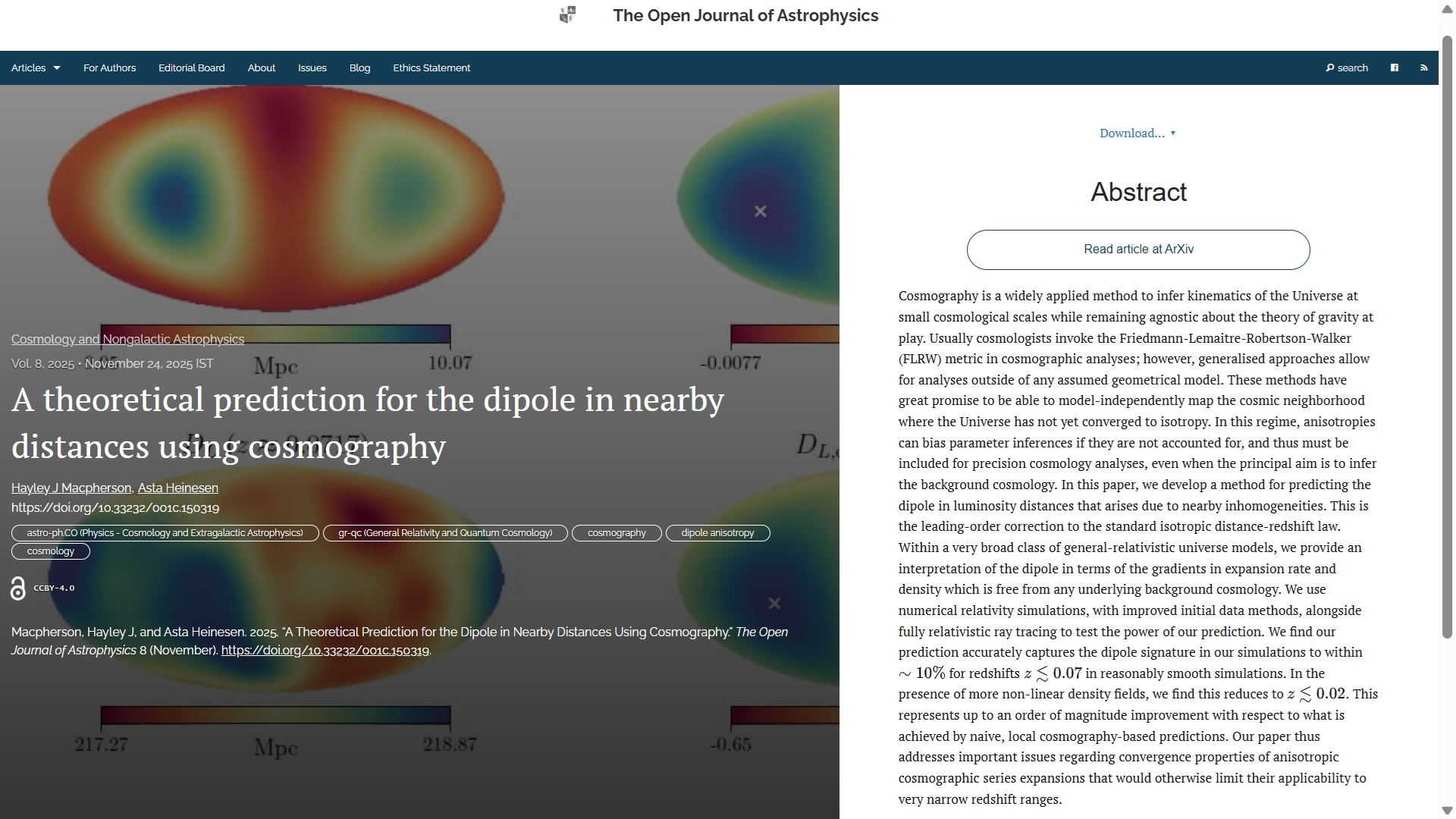
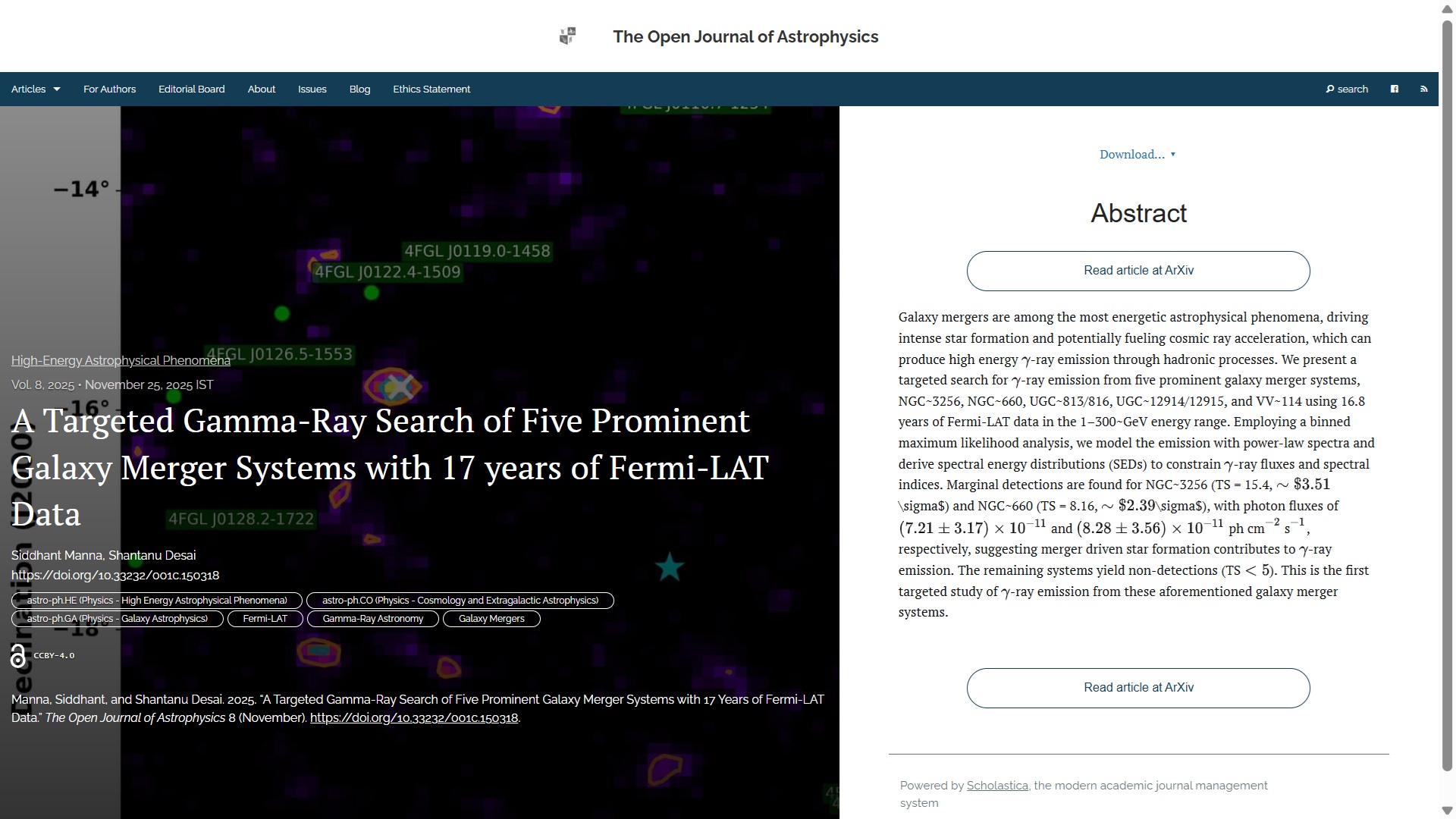
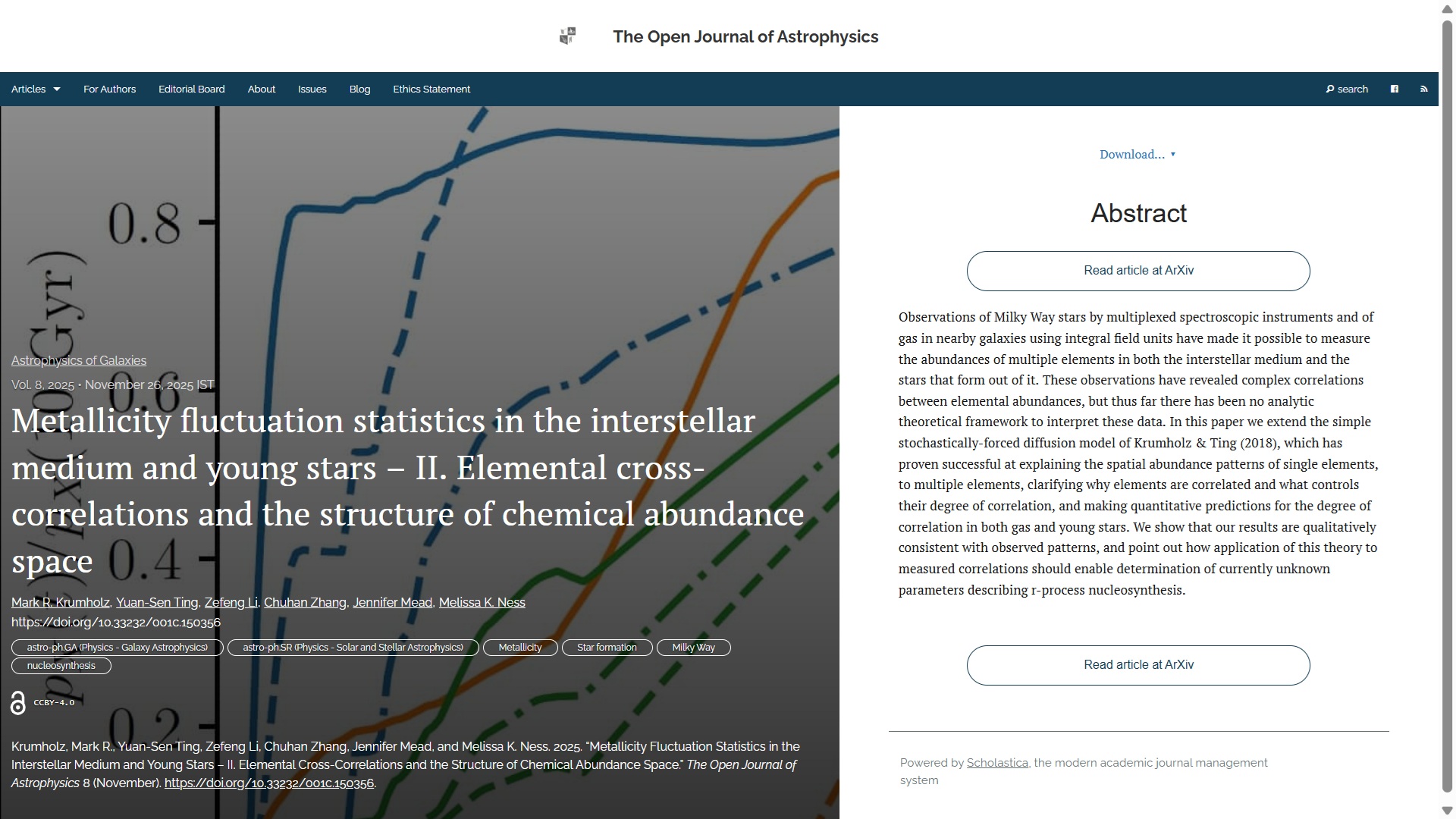
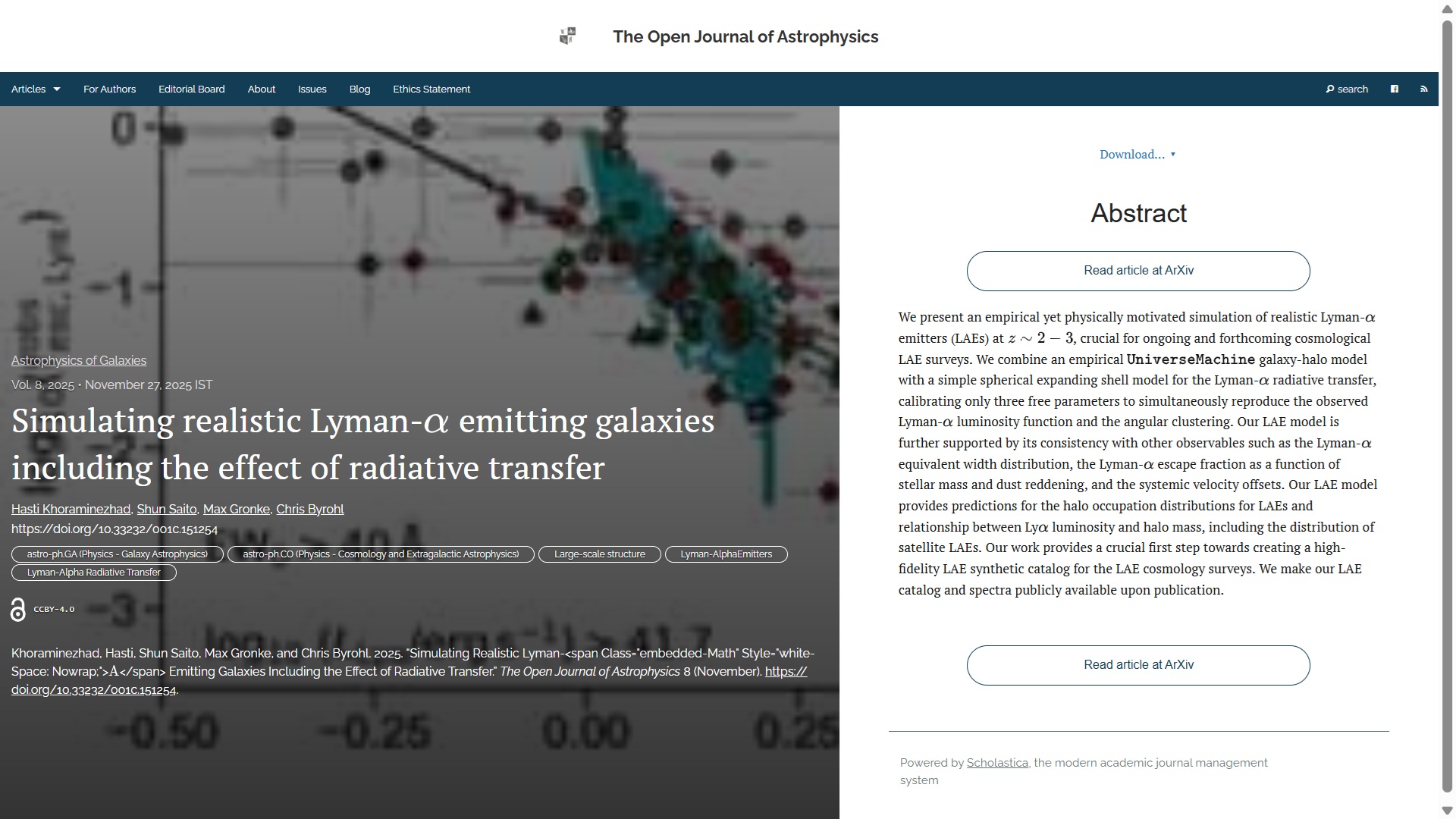
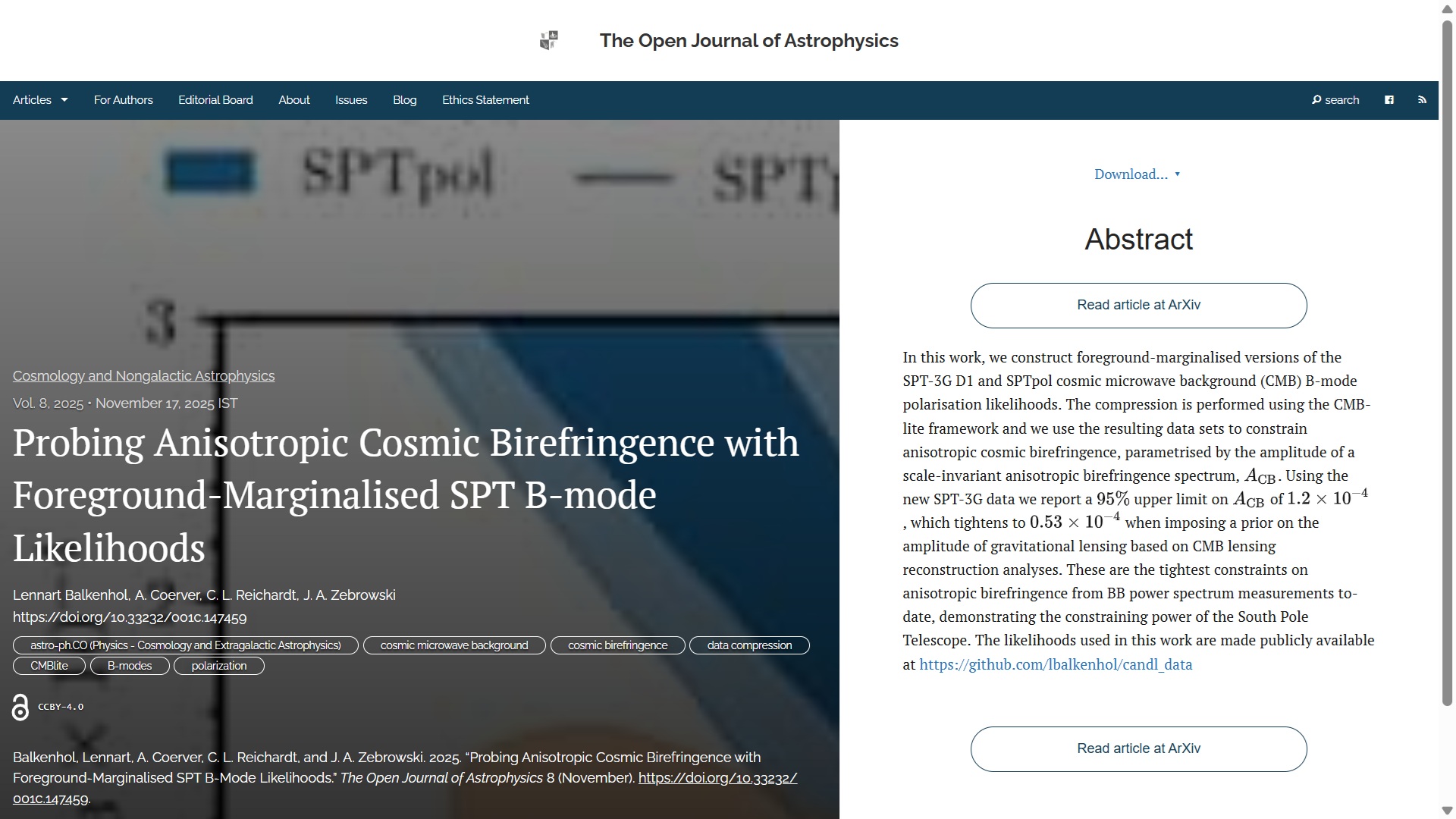
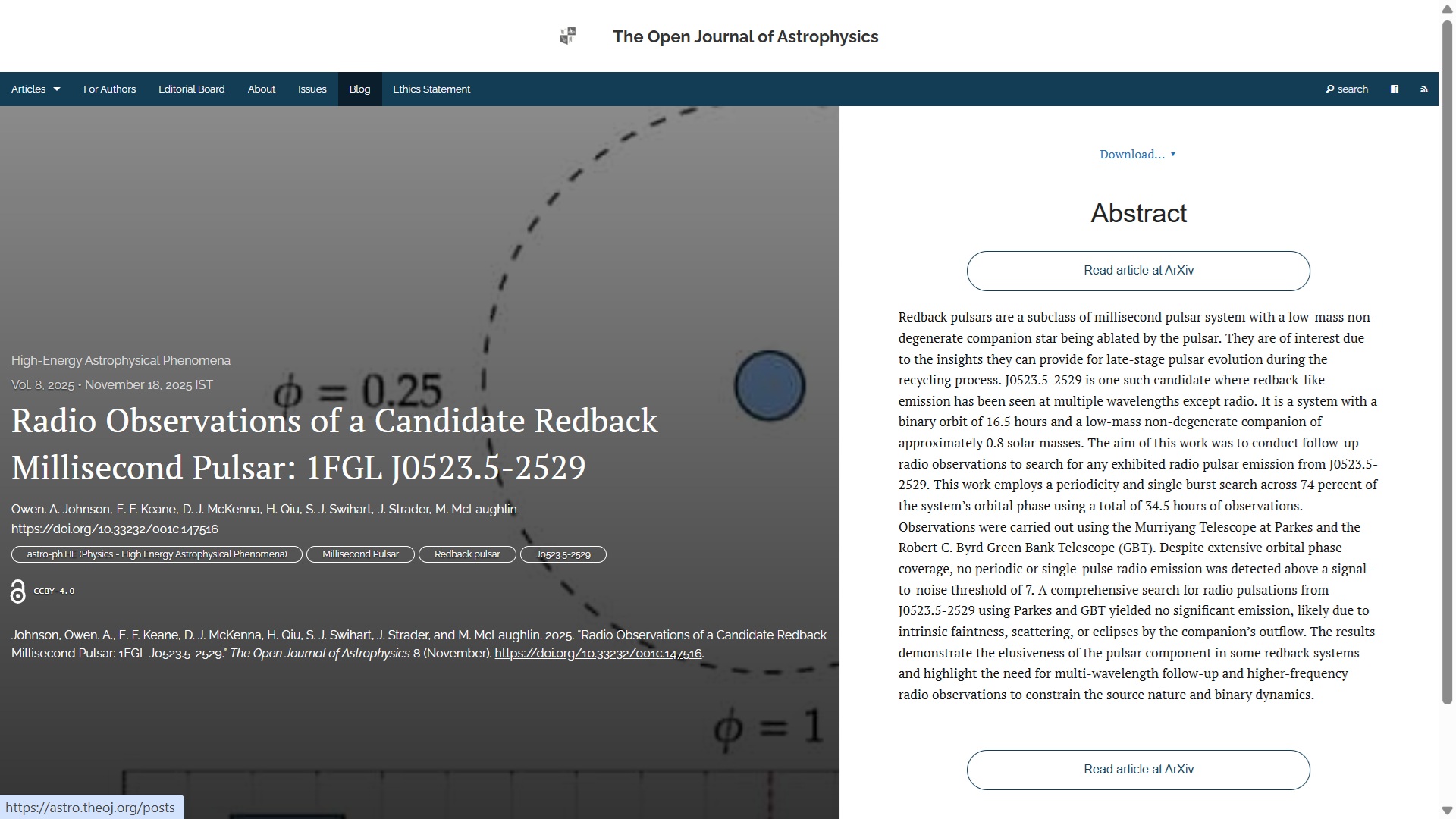
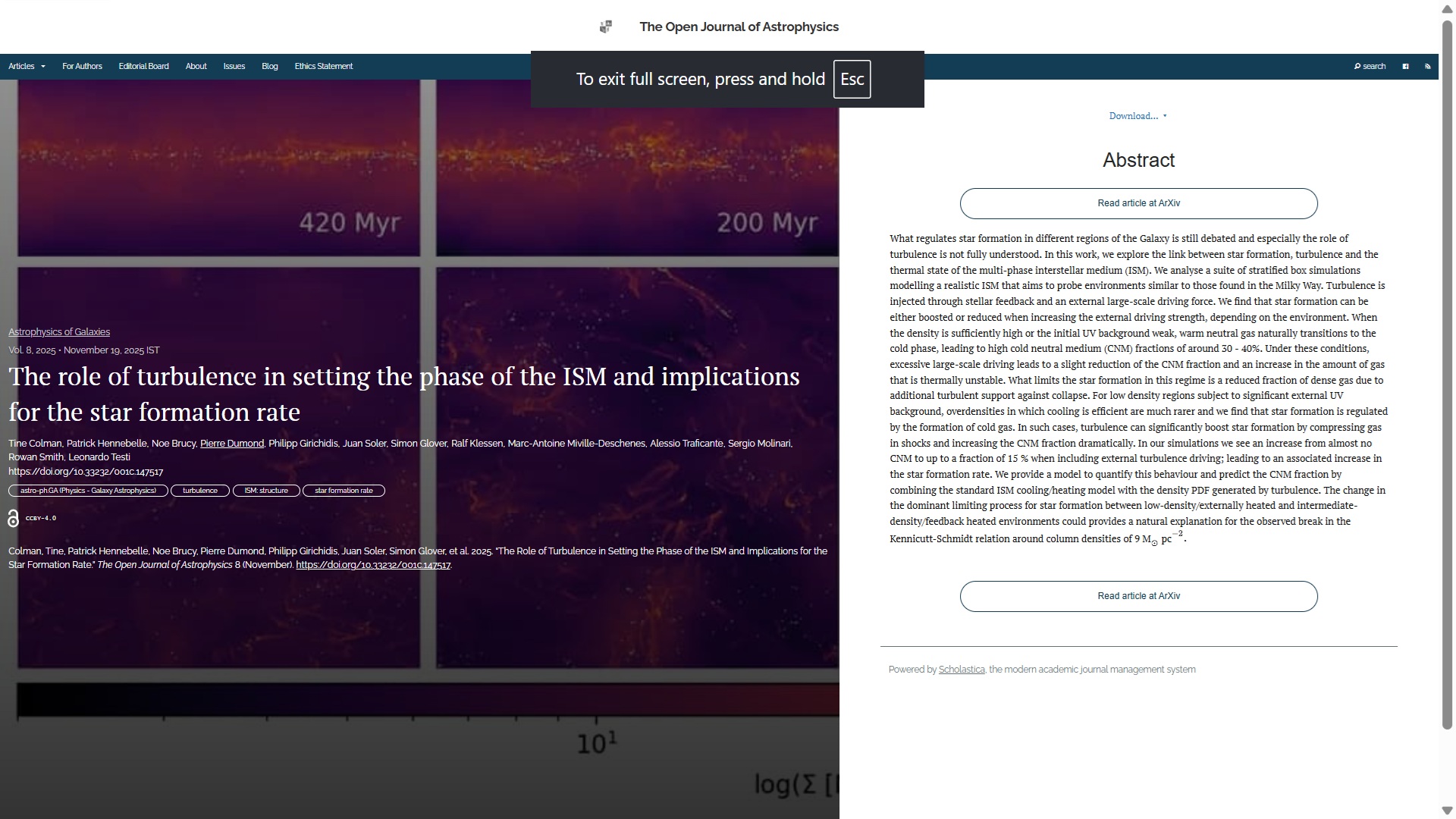
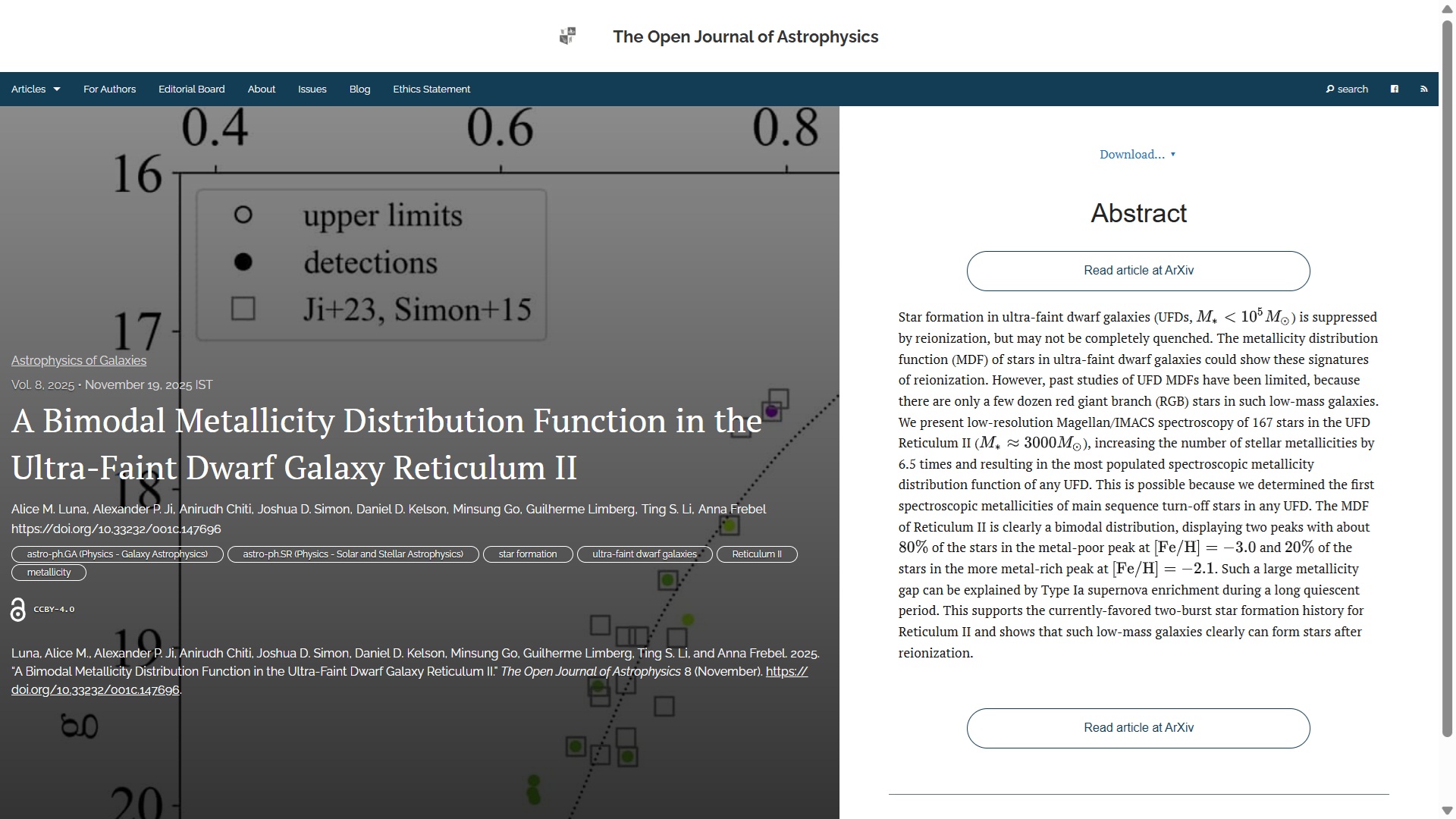
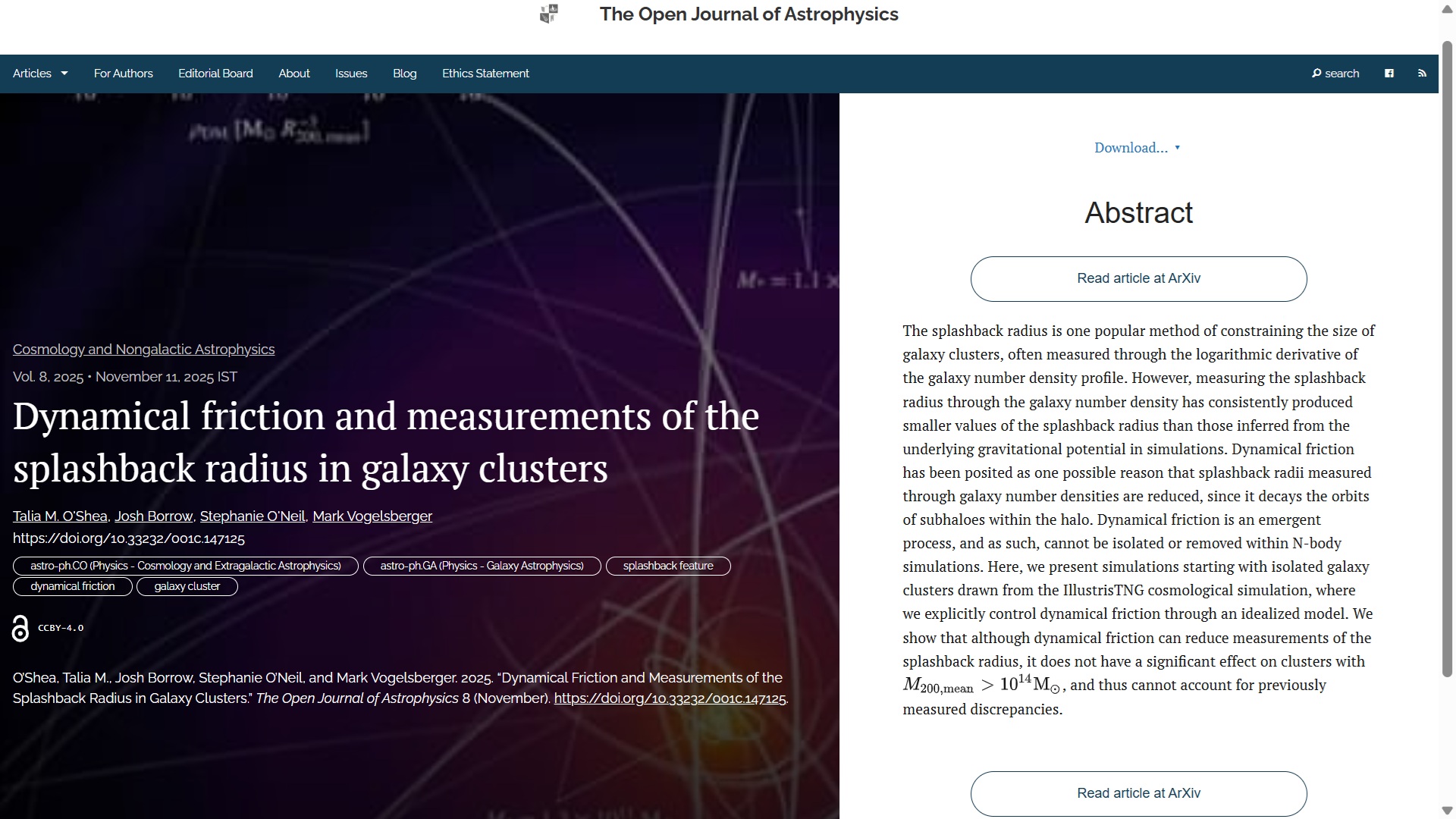
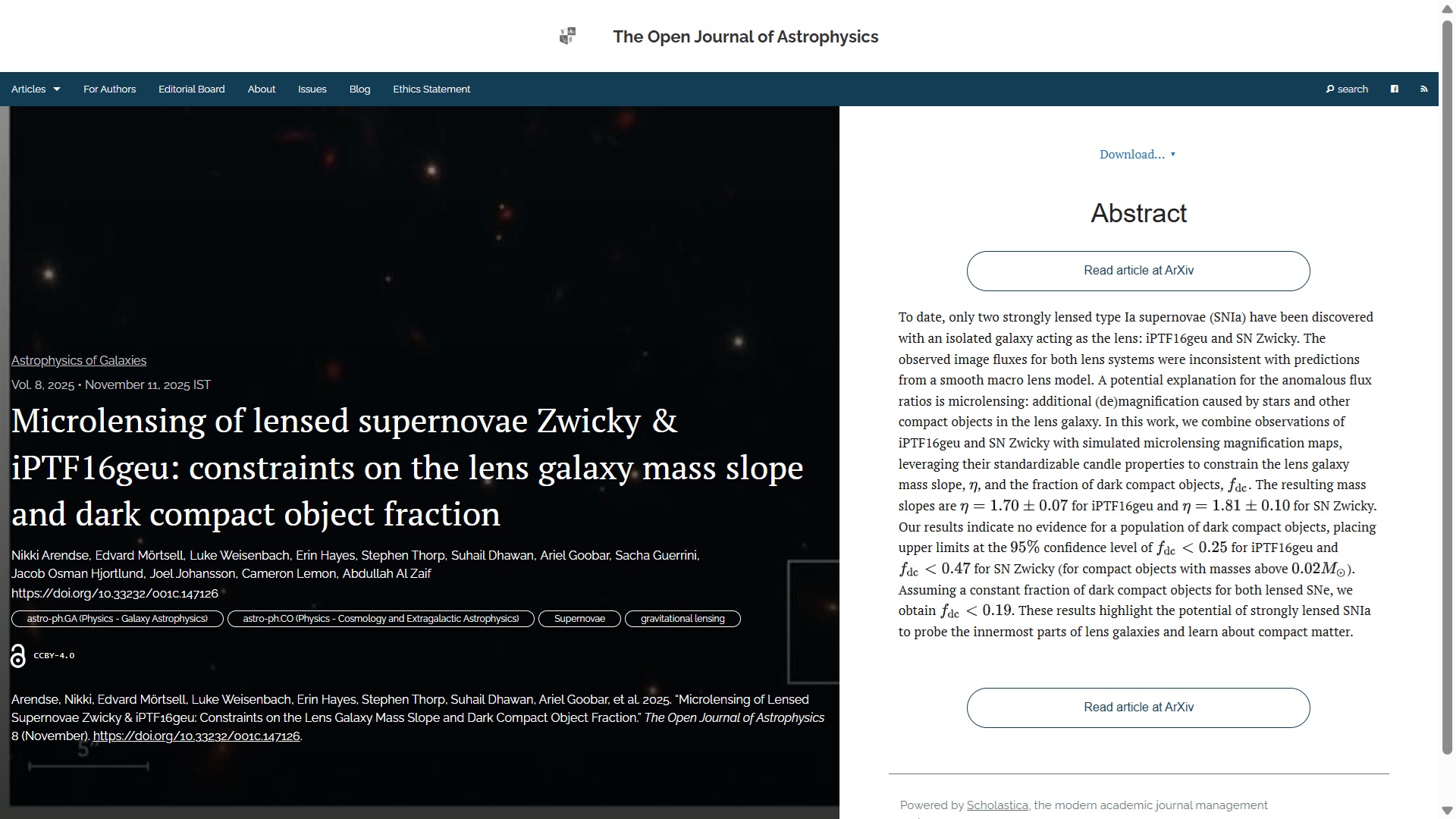
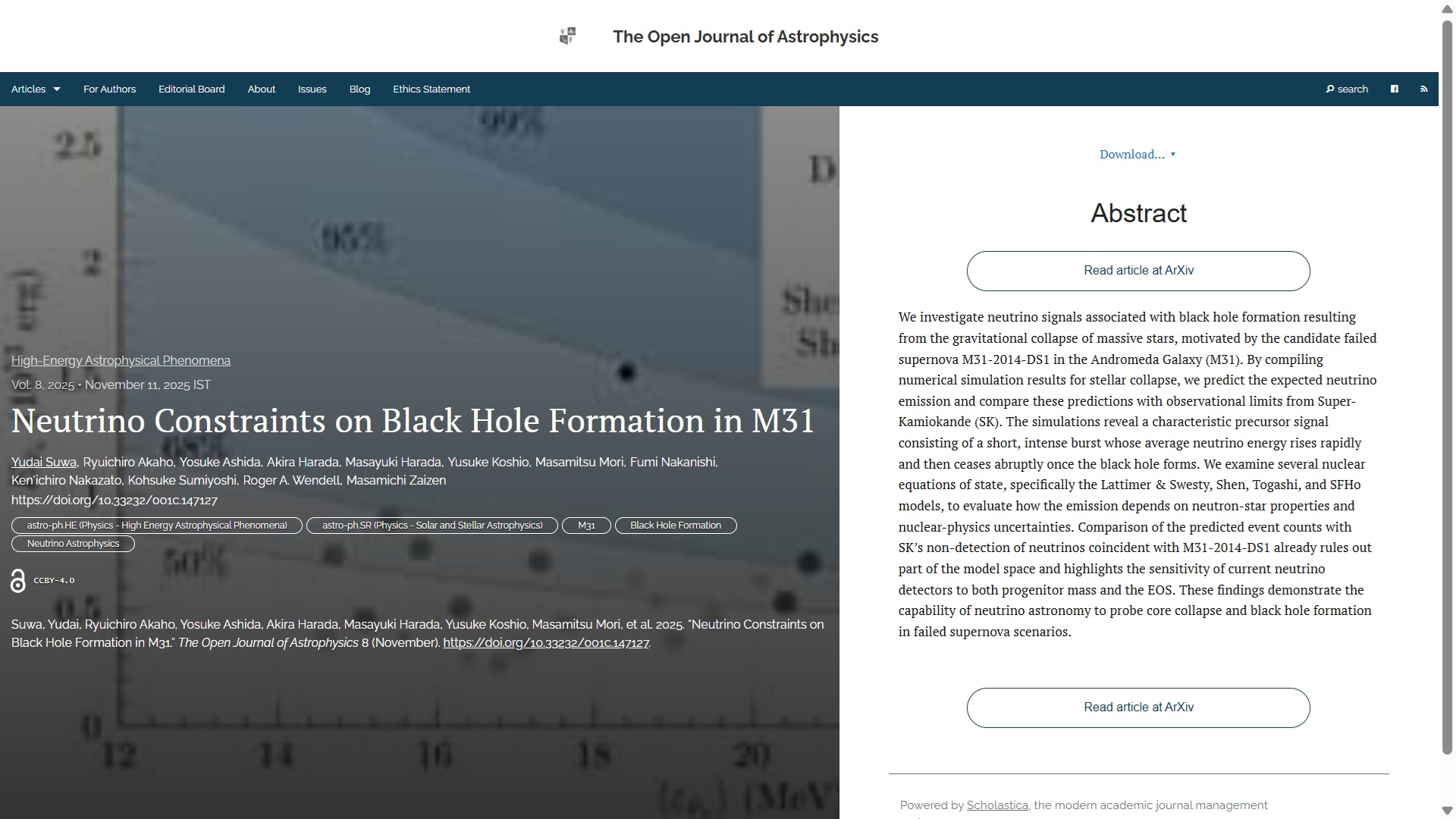
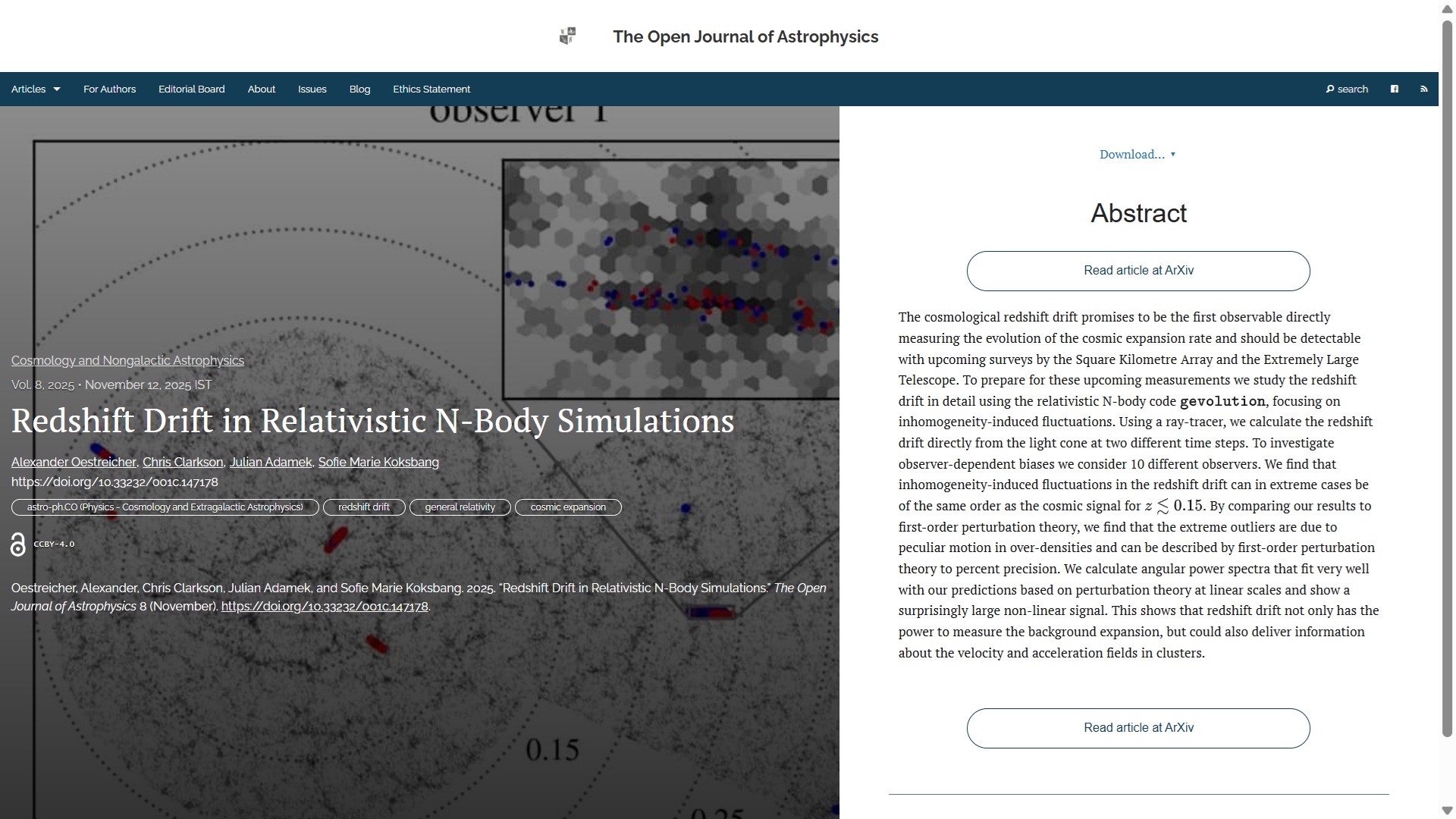
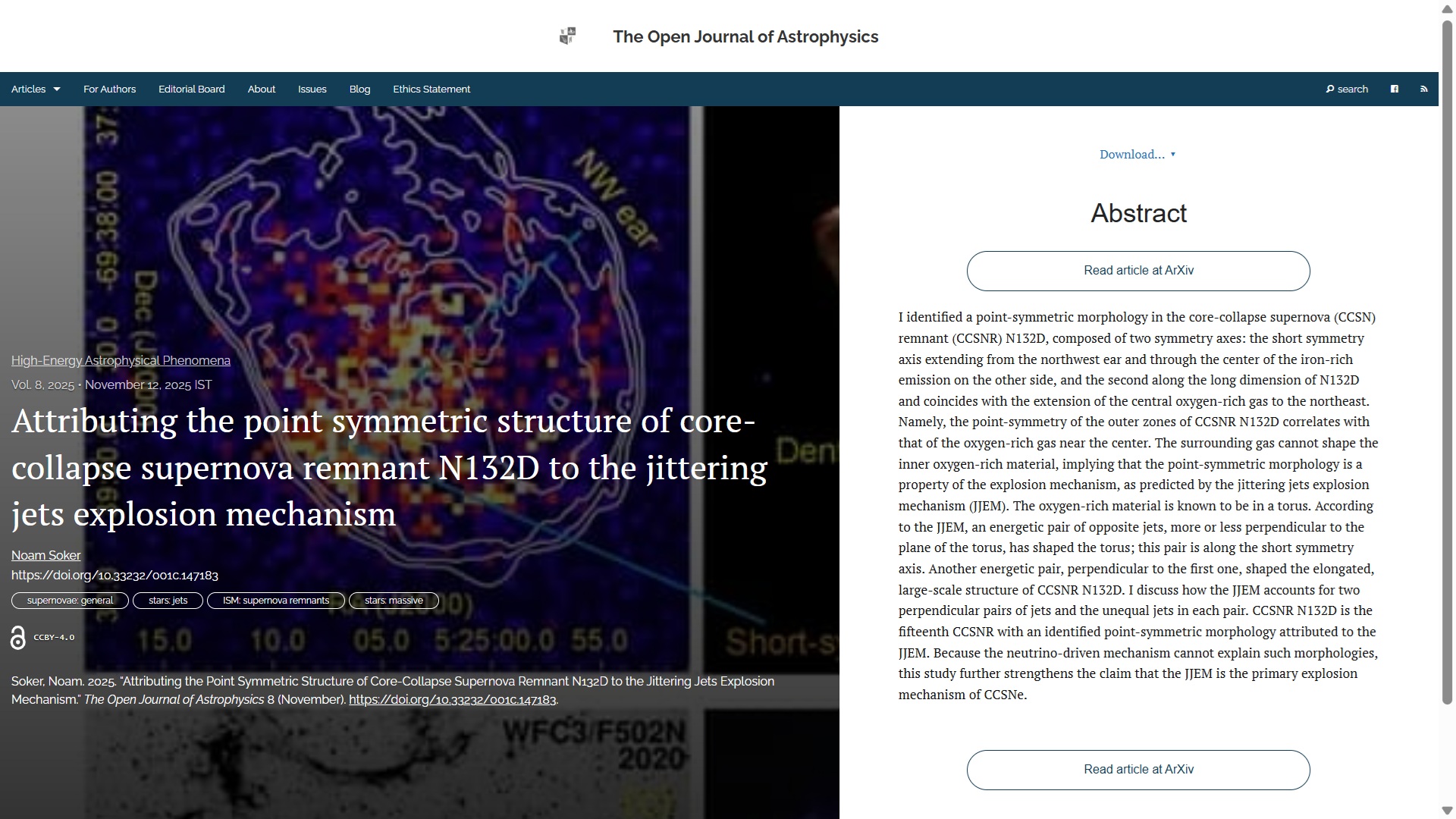
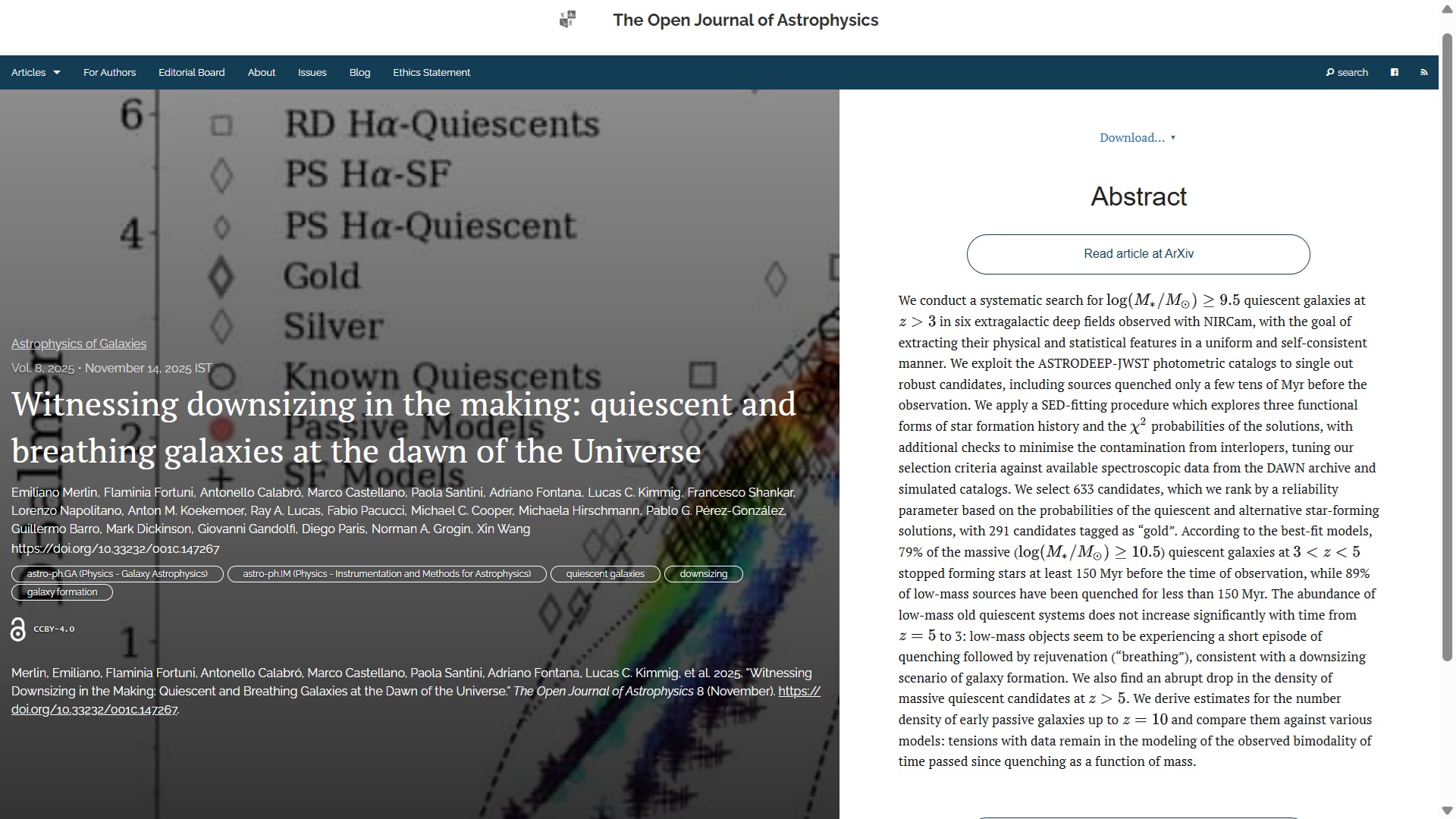
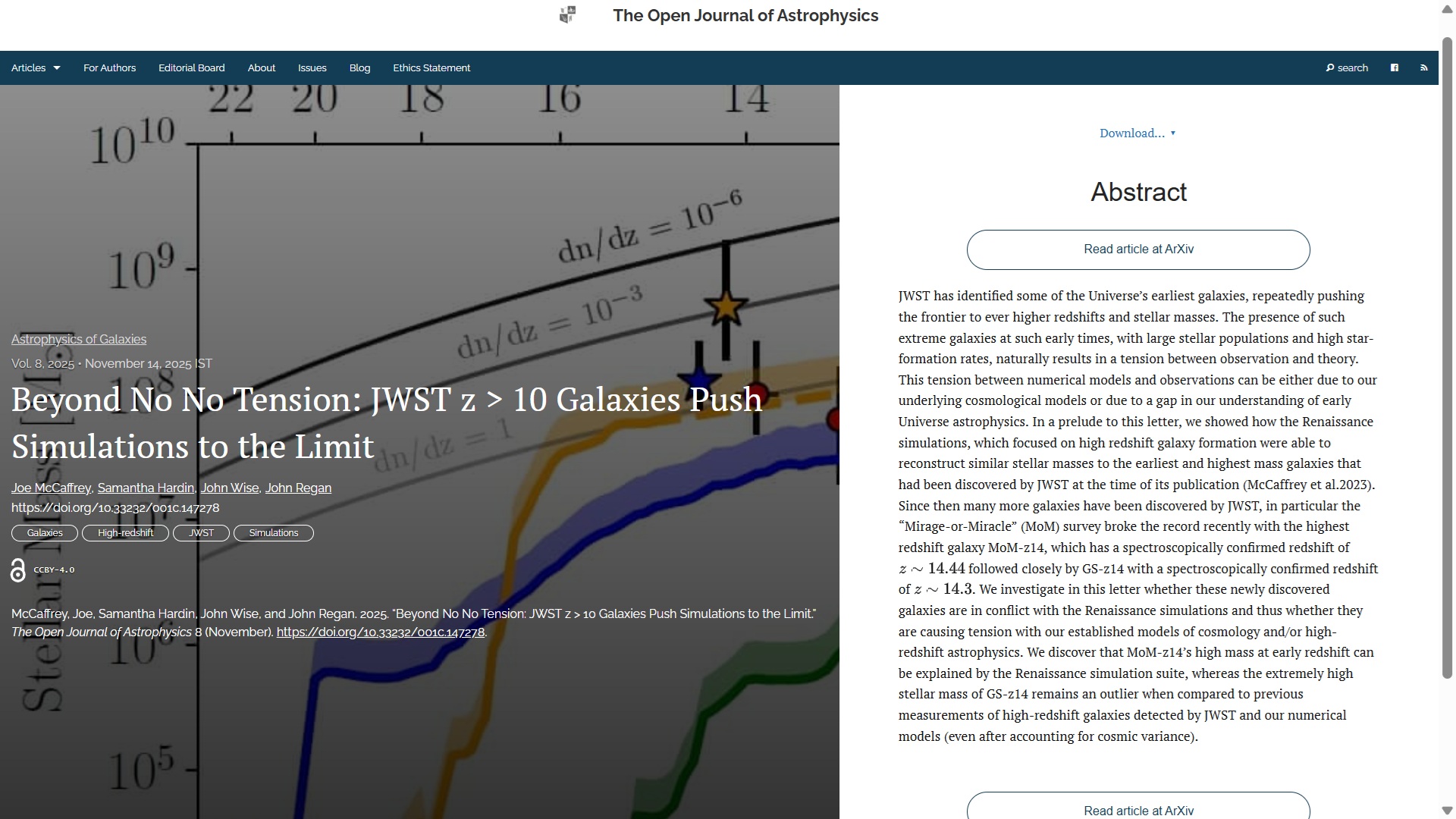
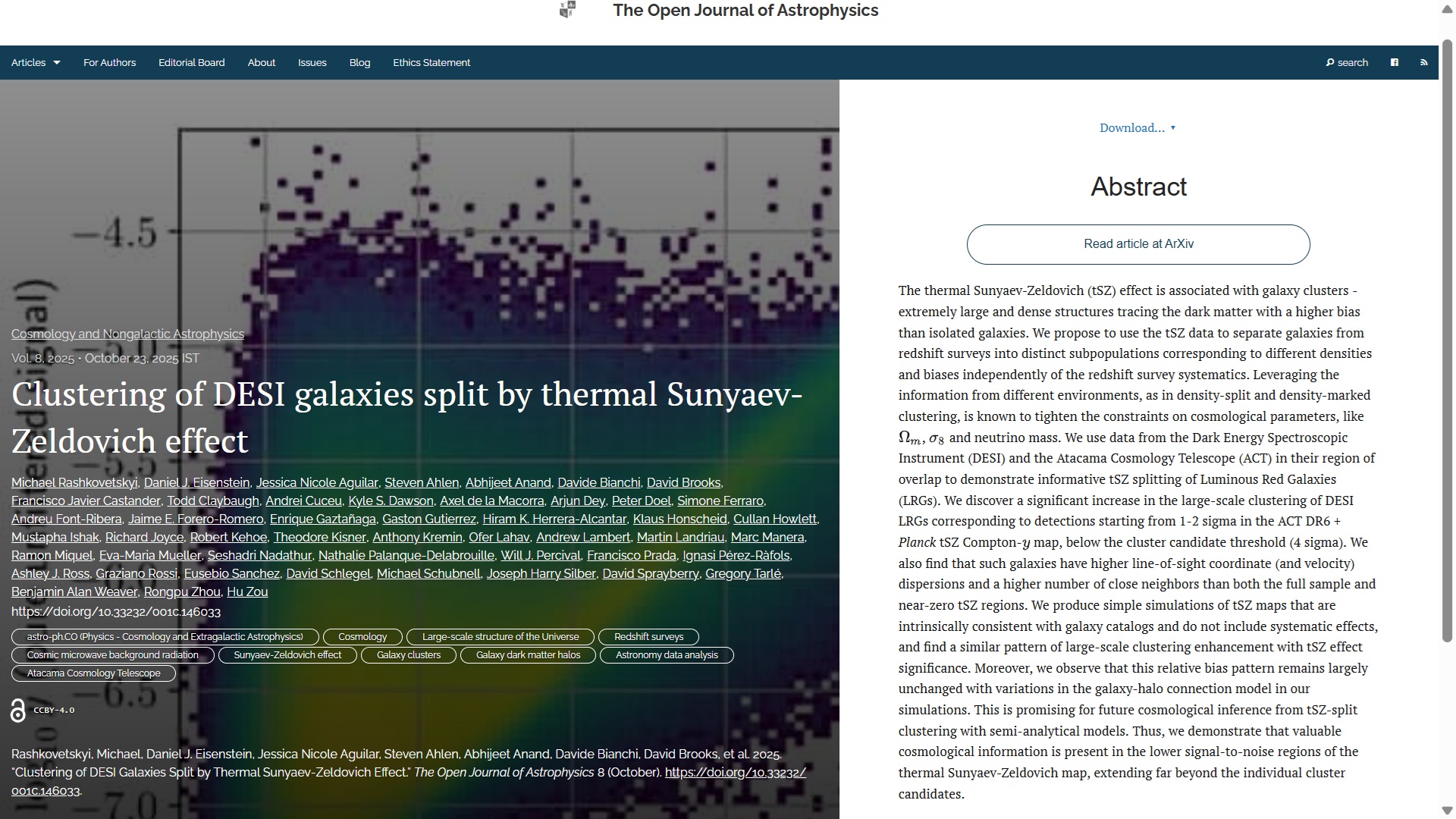
The papers published this week, with their overlays, are as follows.  You can click on the images of the overlays to make them larger should you wish to do so.

The first paper to report is “Reconstructing Galaxy Cluster Mass Maps using Score-based Generative Modeling” by Alan Hsu (Harvard), Matthew Ho (CMU), Joyce Lin (U. Wisconsin-Madison), Carleen Markey (CMU), Michelle Ntampaka (STScI), Hy Trac (CMU) & Barnabás Póczos (CMU), all based in the USA. This paper was published on 14th July 2025 in the folder Cosmology and NonGalactic Astrophysics. It presents a diffusion-based generativbe AI model for reconstructing density profiles for galaxy clusters from observational data.

The overlay is here:

The officially-accepted version can be found on arXiv here.

The second and third papers are related. They were both published on 14th July in the folder Cosmology and NonGalactic Astrophysics.

The first of the pair is “J-PLUS: Tomographic analysis of galaxy angular density and redshift fluctuations in Data Release 3. Constraints on photo-z errors, linear bias, and peculiar velocities” by Carlos Hernández-Monteagudo (IAC, Tenerife, Spain) and 21 others. This presents an analysis of the Javalambre Photometric Local Universe Survey (J-PLUS) in redshift slices with a discussion of prospects for extracting cosmological information. The overlay is here:


You can find the final version of the manuscript on arXiv here.

The second of this pair is “The J-PLUS collaboration. Additive versus multiplicative systematics in surveys of the large scale structure of the Universe” by Carlos Hernández-Monteagudo (IAC) and 21 others (the same authors as the previous paper).  This paper presents an analysis of systematic effects in the Javalambre Photometric Local Universe Survey (J-PLUS), and a new model for handling such errors in this and other cosmological surveys. The overlay for this paper is here:

You can find the officially accepted version of this paper on arXiv here.

The fourth paper this week is “Why Machine Learning Models Systematically Underestimate Extreme Values” by Yuan-Sen Ting (Ohio State University). This one was published on July 16th in the folder marked Instrumentation and Methods for Astrophysics.  This paper presents a theoretical framework for understanding and addressing a bias that suppresses the dynamic range of variables in applications of machine learning to astronomical data analysis. Here is the overlay:

You can find the officially accepted version of this paper on arXiv here.

The penultimate article for this week is “Bridging Machine Learning and Cosmological Simulations: Using Neural Operators to emulate Chemical Evolution” by Pelle van de Bor, John Brennan & John A. Regan (Maynooth University) and Jonathan Mackey (Dublin Institute for Advanced Studies), all based in Ireland. This paper uses machine learning, in the form of neural operators, to emulate the Grackle method of solving non-equilibrium chemistry equations in cosmological hydrodynamic simulations and was published on 16th July also in the folder Instrumentation and Methods for Astrophysics. The overlay is here:

The final, accepted version of the paper is on arXiv here.

The last article published this week is “Astronomical Cardiology: A Search For Heartbeat Stars Using Gaia and TESS” by Jowen Callahan, D. M. Rowan, C. S. Kochanek and K. Z. Stanek (all of Ohio State University, USA). This paper presents a study of a sample of 112 new spectroscopic binaries called hearbeat stars (because their light curves resemble electrocardiagrams). It was published on 16th July 2025 in the folder marked Solar and Stellar Astrophysics. The overlay is here:

You can find the officially-accepted version on arXiv here.

And that’s all the papers for this week. I’ll do another update next Saturday.

Weekly Update from the Open Journal of Astrophysics: 05/07/2025

Posted in OJAp Papers, Open Access, The Universe and Stuff with tags , , , , , , , , , , , , , , , , , on July 5, 2025 by telescoper

It’s Saturday so, once again, it’s time for the weekly update of papers published at the Open Journal of Astrophysics. Since the last update we have published three new papers, which brings the number in Volume 8 (2025) up to 85, and the total so far published by OJAp  up to 320.

The three papers published this week, with their overlays, are as follows. You can click on the images of the overlays to make them larger should you wish to do so.

The first paper to report is “Stellar reddening map from DESI imaging and spectroscopy” by Rongpu Zhou (Lawrence Berkeley National Laboratory, USA) and an international case of 56 others too numerous to mention individually. This paper was published on 1st July 2025 in the folder marked Astrophysics of Galaxies. It describes maps of stellar reddening by Galactic dust inferred from observations obtained using the Dark Energy Spectroscopic Instrument, and a comparison with previous such maps. The overlay is here:

You can find the final, accepted, version on arXiv here.

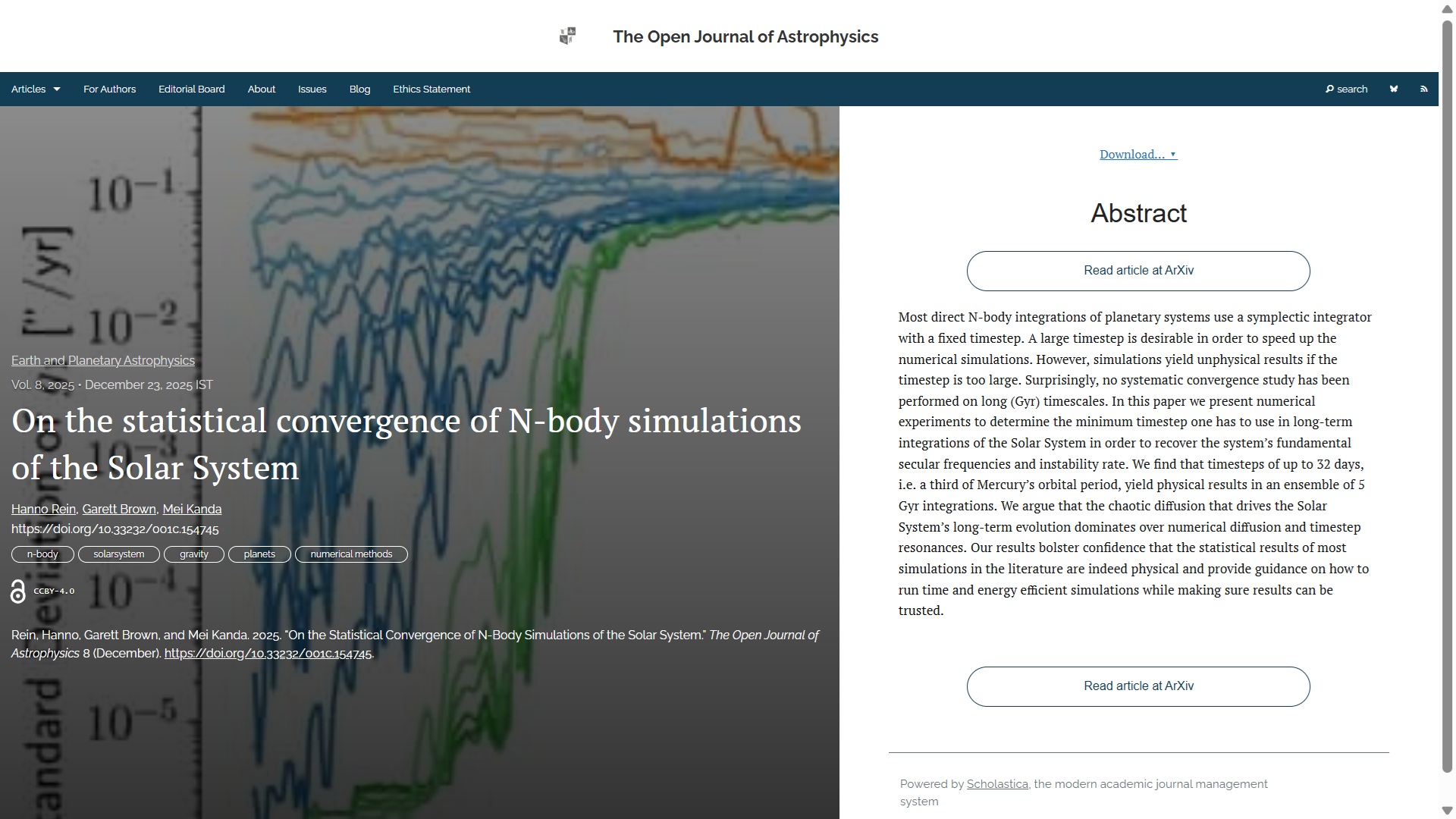
Next one up is “On inertial forces (indirect terms) in problems with a central body” by Aurélien Crida (Université Côte d’Azur, France) and 17 others – again too numerous to be listed individually – based in France, Italy, Germany, Mexico and the USA. This paper discusses the indirect terms that arise the Newtonian dynamics of multi-body systems dominated by a central massive body, upon which other bodies exert a gravitational pull, when the massive body is treated as the origin of the coordinate system. This one, also published on July 1st 2025, is in the folder marked Earth and Planetary Astrophysics.

The overlay is here:

You can find the officially accepted version on arXiv here.

The last paper of this batch is “Stellar ejection velocities from the binary supernova scenario: A comparison across population synthesis codes” by Tom Wagg (U. Washington, USA), David D. Hendriks (U. Surrey, UK), Mathieu Renzo (U. Arizona, USA) and Katelyn Breivik (Carnegie Mellon U., USA). It was published on July 2nd 2025 in the folder Solar and Stellar Astrophysics and it presents comparison of the ejection velocities of stars ejected from binary systems by supernova explosions predicted in three different population synthesis codes.

The overlay is here:

You can read the final accepted version on arXiv here.

That’s all the papers for this week. I’ll post another update next weekend.

Funding Diamond Open Access

Posted in Open Access with tags , , , , , on June 3, 2025 by telescoper

In case you weren’t aware, SciPost is a publishing infrastructure that provides Diamond Open Access to scientific papers. That means they are free to publish and free to read. They are funded by a consortium but are now struggling financially. They have recently circulated an open letter to the Community explaining their predicament and asking for help. I encourage you to read it and, if you can, to make a donation (or bully your institution to do so).

The open letter explains that SciPost is currently running at an average cost per paper of €500. That is much less than a typical APC for a mainstream journal but it is not a negligible cost. At the rate at which SciPost is publishing it amounts to about €1000 per day. SciPost currently attracts a significant level of sponsorship but it is not enough to support its current level of activity. Information on how to help SciPost can be found here. It is a worthy cause and deserves to be supported.

One area in which SciPost has not really taken of is Astronomy, where it has published very few papers. This may at be at least partly because of the Open Journal of Astrophysics (OJAp) which is also Diamond Open Access but runs in a very different and much cheaper way. A full breakdown of costs at OJAp is given here our annual running costs are about €5000 per year, which works out at less than €50 per paper (on average); that comprises a fixed component and a marginal cost of €10 per paper.

The main reasons for the large difference in running costs are: (i) SciPost maintains and runs its own platform; and (ii) it offers a copy-editing service. OJAp piggy-backs on arXiv (where most astrophysics research papers are found anyway) and expects authors to provide the final version of their own work. Neither organization pays referees or Editors. To enable it to run, SciPost employs about three staff full-time (2.9 FTE to be precise); OJAp has no employees and we keep our costs down by offering a ‘no-frills’ service. Instead of having a wide range of sponsors, we are entirely funded by Maynooth University. I am very grateful for that support, but we are run on a shoestring budget.
I have written before about what I think the future of Diamond Open Access could be like. I would like to see a range of Diamond Open Access journals offering a choice for authors and serving different sub-disciplines. Most universities nowadays have publishing operations so there could be network of federated journals, some based on arXiv and some based on other repositories and others with different models, such as SciPost. Perhaps institutions are worried about the expense but, as we have shown the actual cost, is far less than they are wasting on Article Processing Charges.

I don’t see other Diamond Open Access journals as competitors, but as allies with community-led ecosystem. I’d be more than happy to discuss how to start up such a journal on the OJAp model with anyone interested, and have already done so with some interested parties. As far as I’m concerned, the more the merrier! It is neither fair nor reasonable, however, that the expense of running a journal that serves the global astrophysics community should fall entirely on one small University in Ireland.

By all means support SciPost (and get your institutions to do likewise), but please also consider supporting OJAp. We are currently covering our costs but have no funds to make enhancements (such as a much-needed new LaTex template). If you can afford to make a donation to SciPost, then perhaps you can afford to make a donation to OJAp proportionate to our lower running costs? For example, if you give €10K to SciPost, could you give us €1K too? That amount would keep SciPost running for a day and OJAp for many months…

The Global Cost of “Article Processing Charges”

Posted in Open Access with tags , , on January 27, 2025 by telescoper

There’s an article on arXiv with the title Estimating global article processing charges paid to six publishers for open access between 2019 and 2023 and the following abstract

This study presents estimates of the global expenditure on article processing charges (APCs) paid to six publishers for open access between 2019 and 2023. APCs are fees charged for publishing in some fully open access journals (gold) and in subscription journals to make individual articles open access (hybrid). There is currently no way to systematically track institutional, national or global expenses for open access publishing due to a lack of transparency in APC prices, what articles they are paid for, or who pays them. We therefore curated and used an open dataset of annual APC list prices from Elsevier, Frontiers, MDPI, PLOS, Springer Nature, and Wiley in combination with the number of open access articles from these publishers indexed by OpenAlex to estimate that, globally, a total of $8.349 billion ($8.968 billion in 2023 US dollars) were spent on APCs between 2019 and 2023. We estimate that in 2023 MDPI ($681.6 million), Elsevier ($582.8 million) and Springer Nature ($546.6 million) generated the most revenue with APCs. After adjusting for inflation, we also show that annual spending almost tripled from $910.3 million in 2019 to $2.538 billion in 2023, that hybrid exceed gold fees, and that the median APCs paid are higher than the median listed fees for both gold and hybrid. Our approach addresses major limitations in previous efforts to estimate APCs paid and offers much needed insight into an otherwise opaque aspect of the business of scholarly publishing. We call upon publishers to be more transparent about OA fees.

Haustein et al., arXiv:2407.16551

I must have missed when it was submitted last July, but it has recently been doing the rounds on BlueSky which is how I noticed it. Here is the salient figure:

The paper estimates that over $8 billion has been wasted on “Article Processing Charges” (APCs) in the 5-year period covered. I put “Article Processing Charges” in inverted commas because, as I have said on many occasions, these fees have nothing to do with the cost of processing an article. They are simply charges levied by publishers to increase their profits.

The last sentence of the abstract “We call upon publishers to be more transparent about OA fees” is nowhere near as forceful as it should be. These charges are a scam and academia should not be feeding these parasites. A tiny fraction of that $8 billion would be enough to set up repositories similar to arXiv for all academic disciplines which would make OA publishing free to authors.

Pay-to-Publish Academic Vanity Publishing

Posted in Open Access with tags , , , on December 22, 2024 by telescoper

I’m not very good at keeping New Year’s resolutions, which is why I tend not to make many. I have however decided to make one for 2025. In future I will refer to any form of publishing in which the authors pay a fee as the ‘Pay-to-Publish’ model. This is much more descriptive of the reality of this form of the academic journal racket than terms such as “Gold Open Access”.

Many academic journals have switched to ‘Pay-to-Publish’ mode to maintain profit margines in response to demands that research outputs should be made freely available to read. This usually involves the payment of an Article Processing Charge, which is typically a four-figure sum in euros, pounds or dollars for each article.

Apart from the obvious danger with this model that the pressure to increase income by publishing more and more papers will lower editorial standards., the term ‘Open Access’ is inappropriate because, although the papers are free for anyone to read, authors are excluded if they cannot pay the fee. It seems to me that APC-driven publishers are therefore indistinguishable from what is usually called the Vanity Press. According to the Wikipedia page I just linked to,

[Vanity Publication]… has been described as a scam,[2] though, as the book does get printed, it does not necessarily rise to the level of fraud.[4] 

I’ll leave it to readers to decide whether it is fraudulent to charge an “Article Processing Charge” has nothing to do with the real cost of processing an article. I couldn’t possibly comment on that. It is, however, beyond question that it is a scam. I’m not the only person to think this. It is, without doubt, unethical.

I would argue that academic vanity is one of the main reasons for the very perpetuation of a publishing system that is so palpably absurd. There is among many academics and, especially, managers an unjustified reliance on journal brand-name or even impact factor as a proxy for the quality of a paper. This is despite the fact that we can easily measure impact for individual articles so there’s no need to rely on such things.

In any case I do think that it would be quite reasonable to warn potential readers of an article that its authors paid to have it published. How would you react if you saw the statement ‘The authors of this article paid to have it published’ at the start of an article? At least it might make you think about the reliability of the accompanying hype.

The Future of Diamond Open Access in Astrophysics

Posted in Biographical, Open Access with tags , , , , , , on November 17, 2024 by telescoper

The Open Journal of Astrophysics is now reasonably well established as a Diamond Open Access journal for the astrophysics community. We have published over a hundred articles so far this year at such a low cost that we can make our publications free to read and to publish. Thanks for all this is due to the volunteers on our Editorial Board, the excellent team at Maynooth University library, who have supported this project for 6 years, to the arXiv, as well of course to the authors who have chosen to publish with us.

Although we have established a good base, we’re still much smaller than the mainstream journals publishing just a few percent of their output. There is no sign of a slowdown at OJAp. Indeed there are signs that pace will pick up. I heard last week, for example, that Oxford University Press (the publisher of Monthly Notices of the Royal Astronomical Society) has decided to cancel the ‘Read-and-Publish’ agreement that allowed authors from Australian institutions to avoid APCs. I imagine we’ll get quite a few more submissions from Down Under thanks to that decision.

Nevertheless, we’ve a long way to go to catch up with the likes of A&A, MNRAS and ApJ in terms of numbers. If activity continues to grow then we will incur greater costs – our provider, Scholastica, charges us per paper. Those costs will still be smaller than regular journals, but I think it’s unfair that the expense of running a journal that serves the global astrophysics community should fall entirely on one small University in Ireland.

Expense is only one issue. I never envisaged that OJAp would be unique. It was more intended to be a proof of concept. I would like to see a range of Diamond Open Access journals offering a choice for authors and serving different sub-disciplines. Most universities nowadays have publishing operations so there could be network of federated journals, some based on arXiv and some based on other repositories. Perhaps institutions are worried about the expense but, as we have shown the actual cost, is far less than they are wasting on Article Processing Charges. I rather think it’s not the money that is the issue, just the unimaginatively risk-averse thinking in what passes these days for university management.

There are two simple – but not mutually exclusive – possibilities.

One is that astrophysics institutions club together and donate funds not only to keep OJAp going, but also to allow us to invest in improvements. A donation equivalent to the cost of just one APC for a typical journal would help us enormously. We do actually get some donations already, but more would always be welcome. In the long run, an investment in Diamond Open Access would pay back many times in savings; OJAp has already saved the worldwide community over £500,000.

The other is that other members of the community follow the lead of OJAp and set up their own journals. I wouldn’t see others as much as competitors, more as allies with community-led federated system. In the light of the OUP decision mentioned above, why don’t Australian research institutions set up their own version of OJAp? I’d be happy to discuss how to start up such a journal with anyone interested.

If you would like to discuss either of these possibilities please use the comment box below or email me here.

P.S. There is another issue concerning the future of OJAp, which is that I will be retiring in a few years, but now isn’t the time to discuss that one!

Saving Money via Diamond Open Access

Posted in Open Access with tags , , , , , on November 7, 2024 by telescoper

This morning I published a paper at the Open Journal of Astrophysics that brought the total number of publications there to 217. That may not seem a very significant number but I’ve had it in the back of my mind for some time. Some time ago Monthly Notices of the Royal Astronomical Society (MNRAS) decided to go Gold Open Access, charging a baseline APC of £2310 per article. I know that cost is not paid directly by authors from institutions with Read and Publish agreements with Oxford University Press (the publisher ofn MNRAS) but that doesn’t mean that it’s free: funds are still siphoned off from library budgets.

Anyway, taking the indicative cost of an APC to be the £2310 charged by MNRAS – some journals charge a lot more – the fact that we have published 217 papers means we have now saved the astronomical community around 217 × £2310 which is over £500k (€600k) in APCs. The cost to us is just a few percent of that figure.

The issue of University funding is a very live one in England, in Ireland and in The Netherlands. None of the financial crises can be solved completely by moving away from APCs but there is no justification at all for continuing to hand millions per year out of a shrinking pot over to greedy publishers. Surely this is an excellent time for Higher Education Institutions collectively to make a decisive move in the direction of Diamond Open Access?

Open Access Week 2024: Community over Commercialization

Posted in Open Access with tags , , , , , on October 22, 2024 by telescoper

This week is Open Access Week 2024, the theme of which is Community over Commercialization. In light of this, among with some other journal editors I was contacted by Scholastica to provide some comments for their blog, Scholastica being the provider of the platform used by The Open Journal of Astrophysics. I was happy to respond to a couple of questions about how to build engaged communities.

Here are the comments of mine that they used in the blog post:

We started with a small editorial board basically formed from people who read various blog posts I’d written about the idea of the journal and followed its germination. We were lucky to have an initial group of high-profile scientists based all around the globe, including the USA. We started to get some papers from very well-known authors from leading institutes, and large international consortia. Some of these papers have generated large numbers of citations and have attracted coverage in the mainstream media, which also helped raise our profile.

Last year I was on sabbatical, which gave me the opportunity to travel and give invited talks about open access publishing in astrophysics at institutions in France, Spain, the UK, and Australia, and to audiences around the world via the Internet. Other members of the editorial board have also done their bit in promoting the journal. Our submission rate increased only slowly at first but is now more than doubling each year and we are currently receiving several submissions a day.  It has taken a while to establish the reputation of the Open Journal of Astrophysics this way, (i.e., mainly by word of mouth), but that has been good for us because it has enabled us to scale up our processes without becoming overwhelmed by a deluge.

My advice to others trying to set up a new journal would be to have a strong editorial board and clear policies, and above all to be patient. It takes a while — in our case more than 5 years — to establish a reputation in the academic community. These days there are too many people talking about this sort of publishing and not enough actually doing it. It’s time for researchers and research institutions to claim back the original purpose of academic publishing, the free dissemination of research for the public good.

You can read comments from three other editors of open access journals in the original Scholastica blog post.

Predicting the Future of Publishing from the Past

Posted in Open Access, The Universe and Stuff with tags , , , , on October 11, 2024 by telescoper

I was intrigued by an editorial piece from 20 years ago that was sent to me by Prof. Peter Schneider (who, among many other things, is Chair of the Euclid Consortium Editorial Board) who happens to be one of the authors. The article gives an interesting insight into the processes involved in being an Editor for the journal Astronomy and Astrophysics (A&A) at the time, and is worth reading all the way through, but I was particularly struck by Section 6.2, which makes some predictions about the future.

Here’s an excerpt:

We can even go a step further and ask the provocative question of whether we will need a peer-reviewed journal like A&A in the future. After all, in some communities, astro-ph has taken over the role of communicating new results. Is astro-ph not sufficient? A few aspects of a potentially very long answer to that question are as follows: many authors submit their manuscript to astro-ph, but only after it has been peer-reviewed, which shows that most researchers consider the peer-reviewing essential. People’s achievements are often judged by their refereed papers. Certainly at present, peer-reviewing is seen as a kind of quality stamp on manuscripts, and we are here to witness that papers are improved in the course of the refereeing process.


But what if astro-ph is supplemented by a refereeing process, essentially in the same way as the major journals do today, so that a manuscript gets a “green tick-mark” after successfully passing the reviewing stage and being “frozen”, i.e., cannot be replaced with an updated version anymore. We suspect that this is possible, although it would require a fairly large board of Editors to cope with the numbers of submissions to astro-ph, accompanied by costs that would have to be covered by someone. If this system were to replace the current journals, then one would end up with a single electronic-only astronomy journal and preprint service system. What if a paper is not passing through the refereeing stage? At present, a paper rejected by one journal can still be submitted to a second one, thus getting another chance to be published. We consider this second-chance opportunity a necessary feature for a fair peer-reviewed information flow. Hence, we would need more than one “astro-ph”-like system with different boards of editors, and this brings us back closely to a system of several electronic-only journals.

This is basically the idea behind the Open Journal of Astrophysics, which I didn’t really start thinking about until about 2010. In fact, when we were talking about setting up OJAp – about a decade after this paper was written – we did discuss the possibility of just having a “green tick-mark” on the arXiv entry. We rejected this idea in favour of the overlay concept primarily because of security concerns about who writes the tick mark into the arXiv field. I do agree with the point about having multiple platforms for such publications, however, and I have frequently argued that there should be alternatives to OJAp.

Here is another extract, from the very end of the paper:

We have taken here the role of devil’s advocate to demonstrate that issues in going electronic-only are far from being as simple and clear-cut as some open-access gurus would like us to believe. Obviously, electronic publishing is a timely and controversial issue that we will continue to consider in the coming years. The future of publication will be decided less by Boards of Directors and Editors, or by publishers, than by the community at large. With the availability of electronic-only journals, authors make their own decision on where to submit a manuscript. At present, this vote is clearly in favor of traditional journals, but as that may change we will remain open and ready to adapt.

I would hesitate to call myself a “guru” but I do think that the issues are clearer now than perhaps they were in 2004. Twenty years on, the balance is still in favour of traditional journals at least in terms of numbers of papers being published. Judging by the activity at OJAp, it may be that things may be changing…

Open Access Encounters: The Good, The Bad and the Ugly

Posted in Open Access with tags , , , on August 7, 2024 by telescoper

As it was foretold on Saturday, this afternoon I gave a talk at the 32nd General Assembly of the International Astronomical Union currently taking place in Cape Town, or rather at a side event thereof called Open Access Encounters: The Good, The Bad and the Ugly. I actually gave the last talk in the session, which may or may not mean that I was representing The Ugly

About 50 people attended online plus an unknown number in person, so it was quite a decent size of audiance.

I’m not sure if Slideshare is still working on WordPress, but if not here is a PDF of the slides.