It’s Saturday once again, so it’s time for another update of activity at the Open Journal of Astrophysics. Since the last update we have published a further four papers, bringing the number in Volume 9 (2026) to 114 and the total so far published by OJAp up to 562.
I will continue to include the posts made on our Mastodon account (on Fediscience); these announcements also show the DOI for each paper.
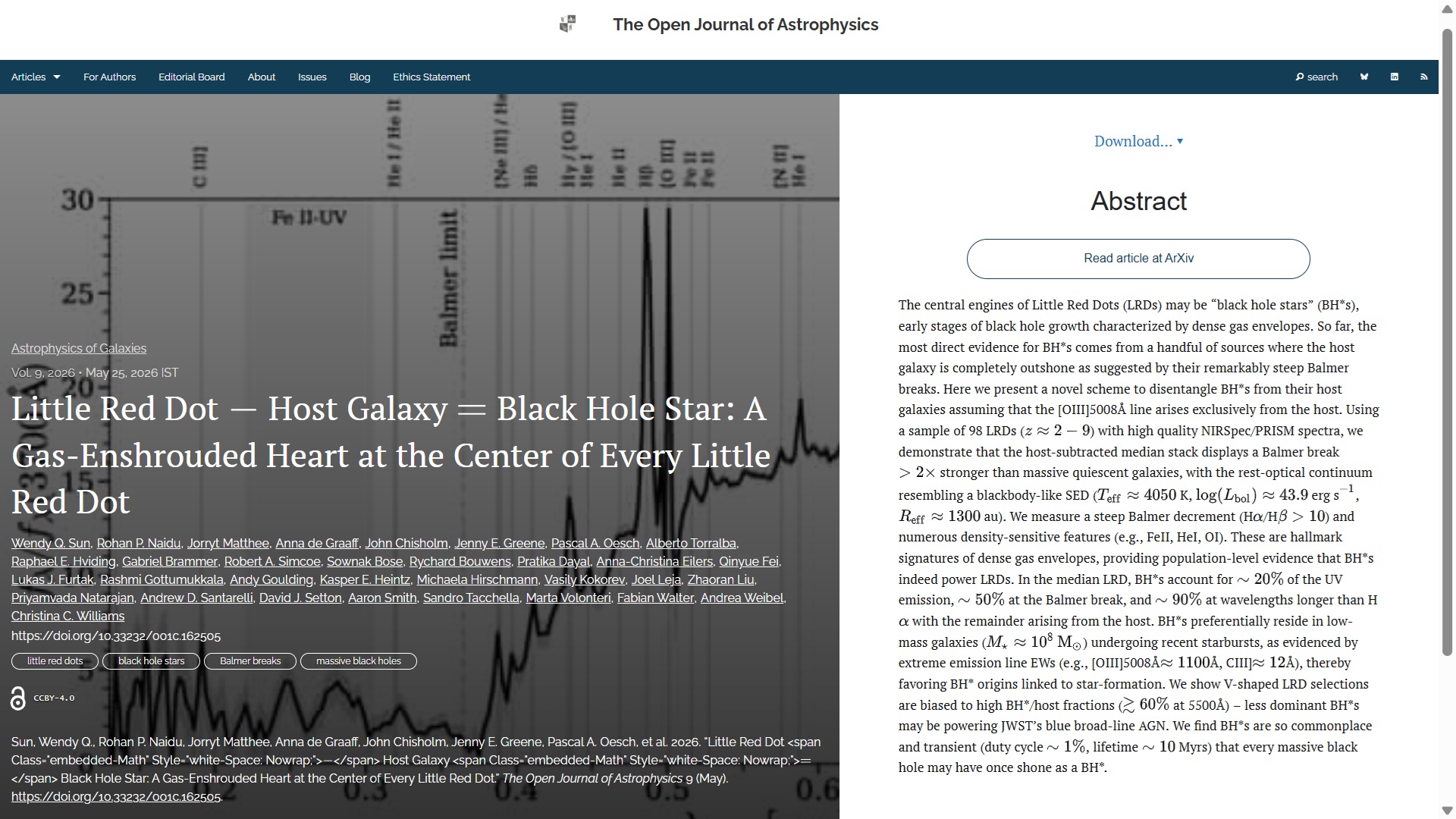
New Publication at the Open Journal of Astrophysics: "Little Red Dot – Host Galaxy = Black Hole Star: A Gas-Enshrouded Heart at the Center of Every Little Red Dot" by Wendy Q. Sun (MIT, USA) and 32 others from around the world.
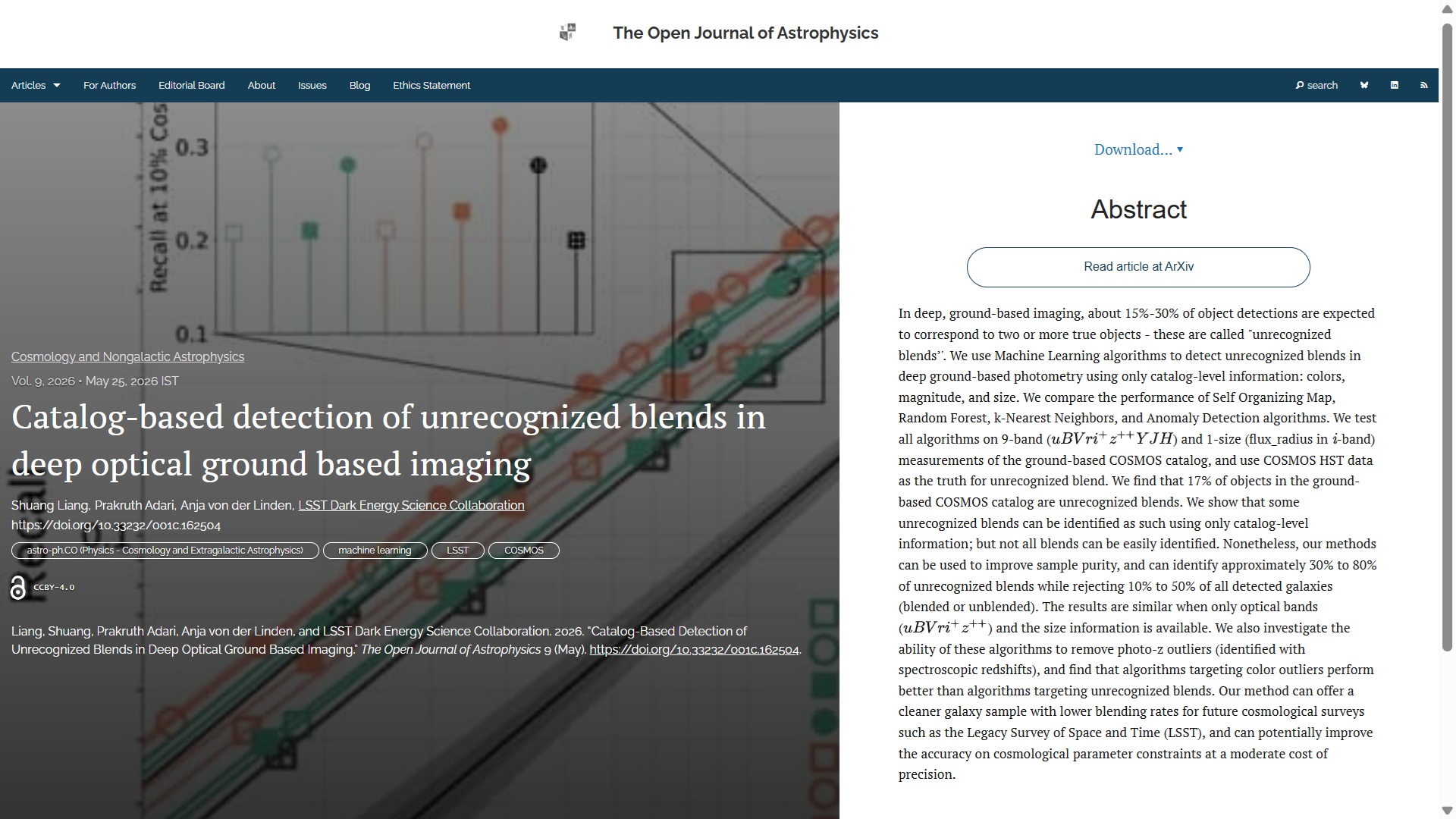
New Publication at the Open Journal of Astrophysics: "Catalog-based detection of unrecognized blends in deep optical ground based imaging" by Shuang Liang (Stanford U., USA) and Prakruth Adari & Anja von der Linden (Stony Brook U., USA) on behalf of the LSST Dark Energy Science Collaboration
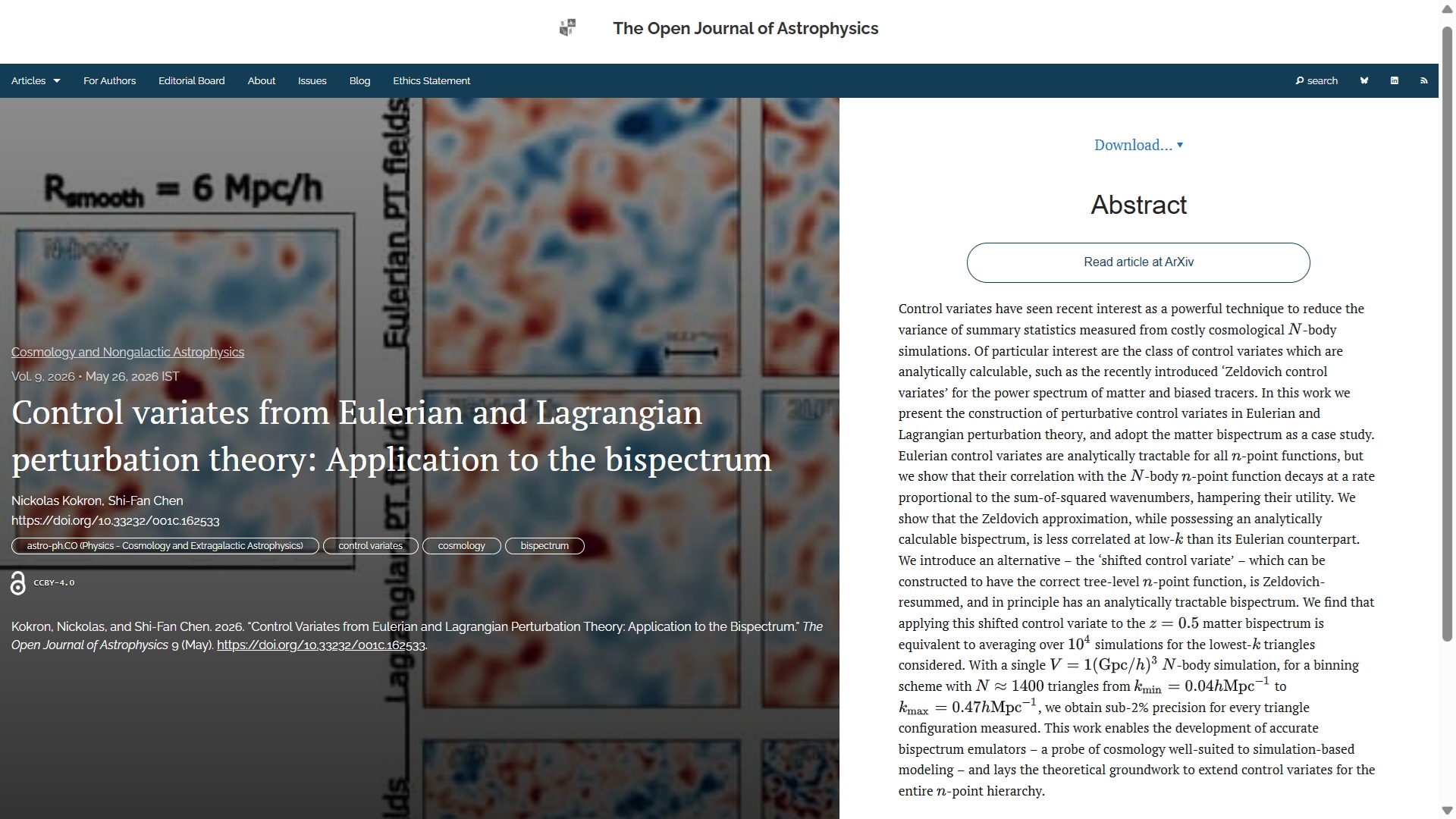
Next one up, the third paper of the week, published on Tuesday 26th May in the folder Cosmology and Nongalactic Astrophysics is “Control variates from Eulerian and Lagrangian perturbation theory: Application to the bispectrum” by Nickolas Kokron and Shi-Fan Chen (Institute for Advanced Study, Princeton, USA). This paper hexplores the use of control variates in cosmological simulations, introducing a new ‘shifted control variate’ that improves precision and enables accurate bispectrum emulators, aiding in cosmology modeling.
The overlay for this one is here:
The final, accepted version can be found on arXiv here and the Mastodon announcement is here:
New Publication at the Open Journal of Astrophysics: "Probing Dark Energy Microphysics with kSZ Tomography" by Julius Adolff, Selim Hotinli and Neal Dalal (Perimeter Institute, Canada)
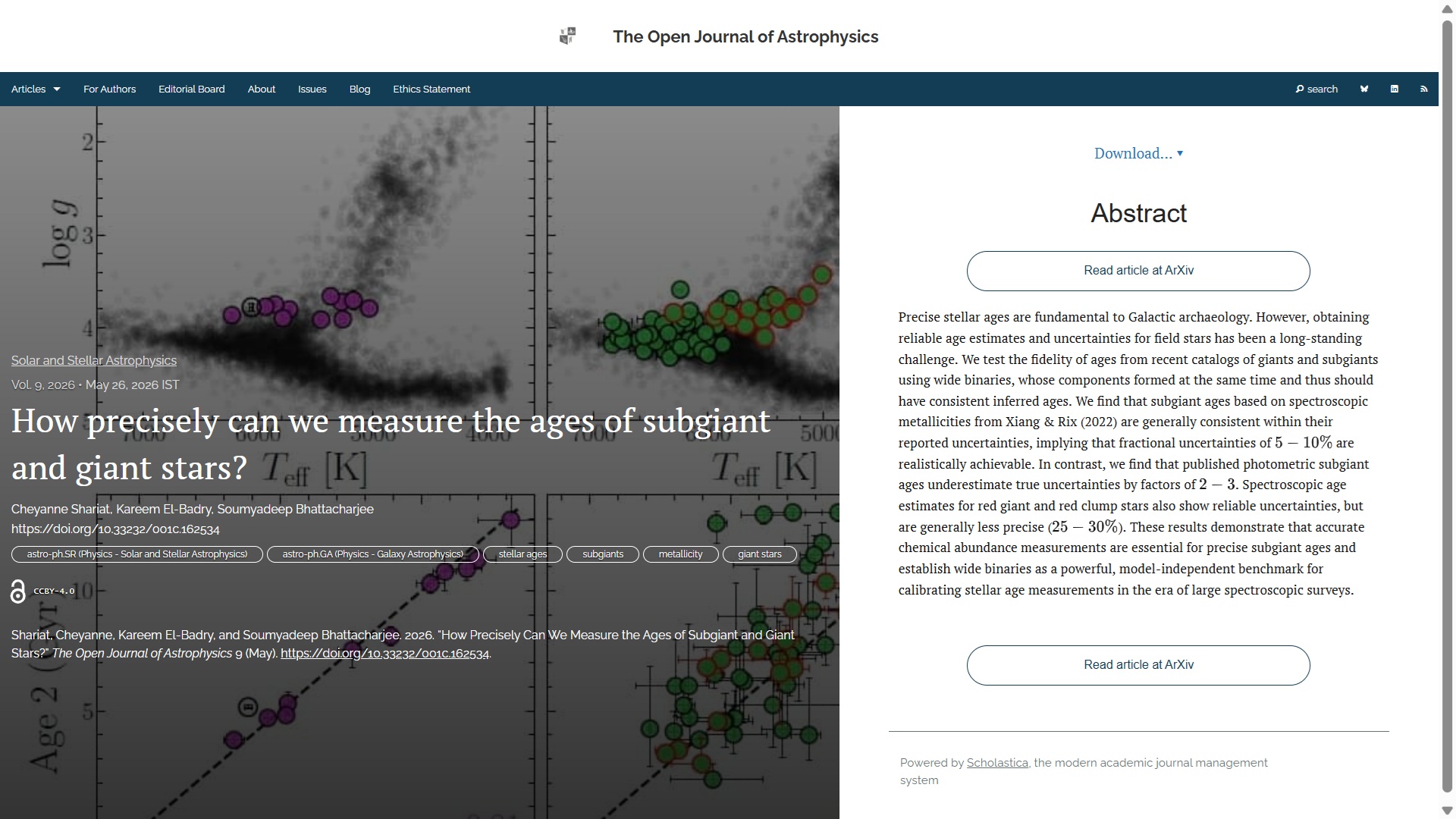
The fourth and final paper this week, also published on Tuesday 26th May is “How precisely can we measure the ages of subgiant and giant stars?” by Cheyanne Shariat, Kareem El-Badry and Soumyadeep Bhattacharjee (California Institute of Technology, USA). This article, published in the folder Solar and Stellar Astrophysics, is about testing the accuracy of stellar age estimates from recent catalogs, finding that spectroscopic metallicities provide reliable subgiant ages, while photometric ages underestimate uncertainties. Accurate chemical abundance measurements are essential.
The overlay is here:
The officially accepted version can be found on arXiv here and here is the Mastodon announcement:
New Publication at the Open Journal of Astrophysics: "How precisely can we measure the ages of subgiant and giant stars?" by Cheyanne Shariat, Kareem El-Badry and Soumyadeep Bhattacharjee (California Institute of Technology, USA)
It’s Saturday once again, so time for another update of activity at the Open Journal of Astrophysics. Since the last update we have published a further six papers, bringing the number in Volume 9 (2026) to 110 and the total so far published by OJAp up to 558.
I will continue to include the posts made on our Mastodon account (on Fediscience); these announcements also show the DOI for each paper.
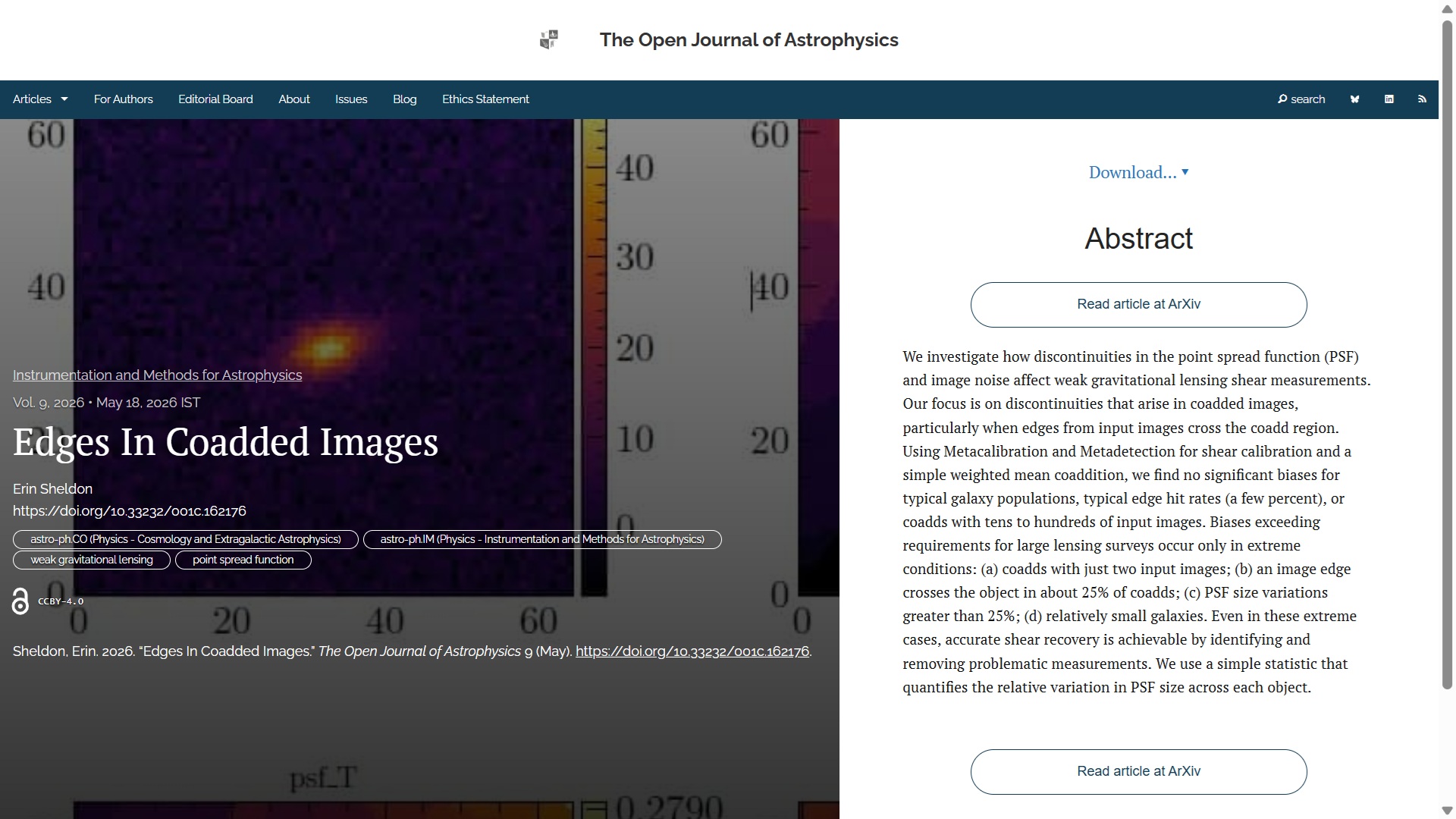
The first paper to report this week, published on Monday 18th May in the folder Instrumentation and Methods for Astrophysics is “Edges In Coadded Images” by Erin Sheldon (Brookhaven National Laboratory, USA). This paper describes a study exploring how image discontinuities and noise impact weak gravitational lensing measurements, finding no significant biases under typical conditions. Biases occur only in extreme cases, but can be mitigated.
The overlay for this paper is here
You can find the officially accepted version on arXiv here and the announcement on Fediverse here:
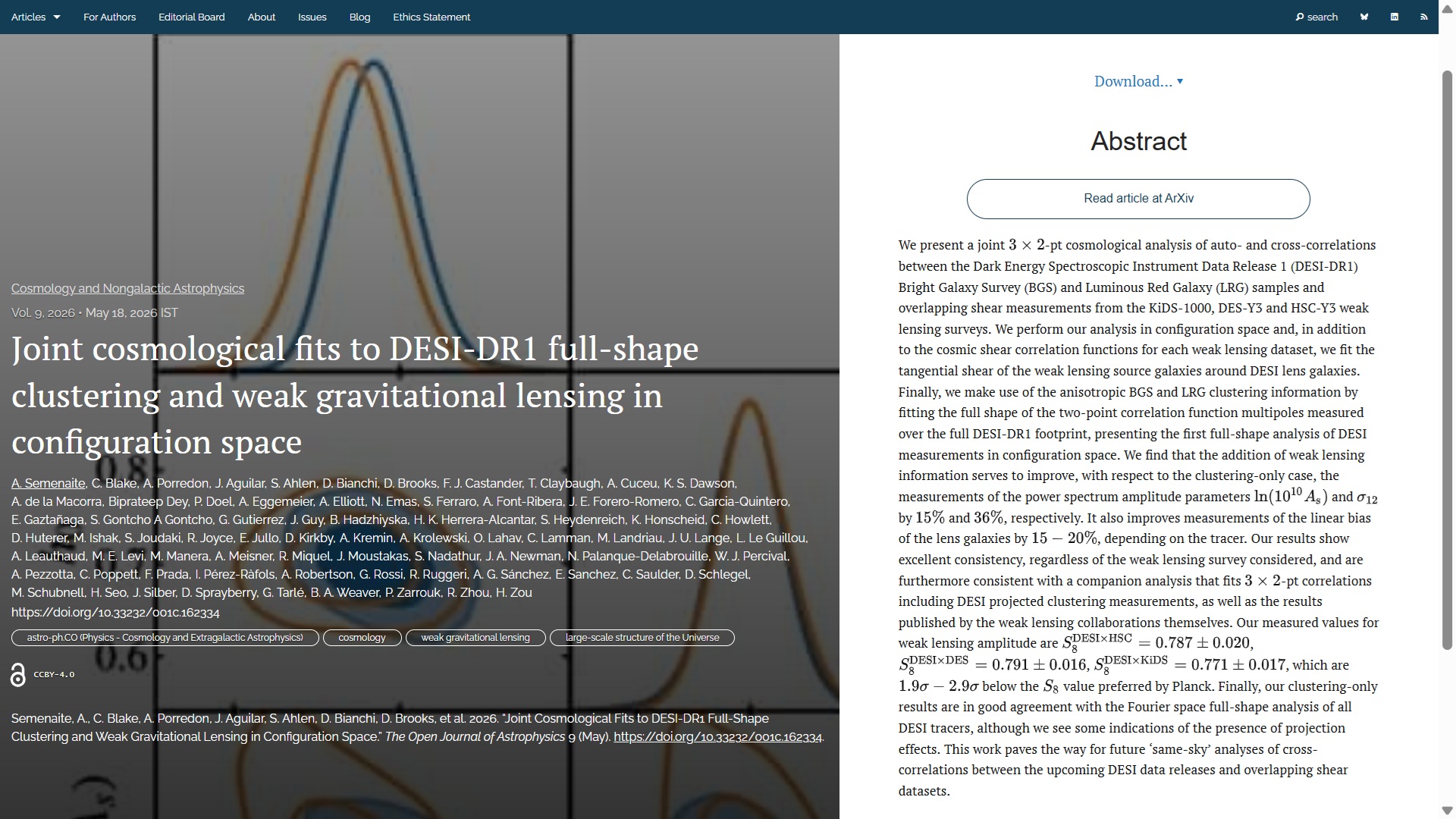
New Publication at the Open Journal of Astrophysics: "Joint cosmological fits to DESI-DR1 full-shape clustering and weak gravitational lensing in configuration space " by A. Semenaite (Swinburne Institute of Technology, Australia) and 72 others from all round the world.
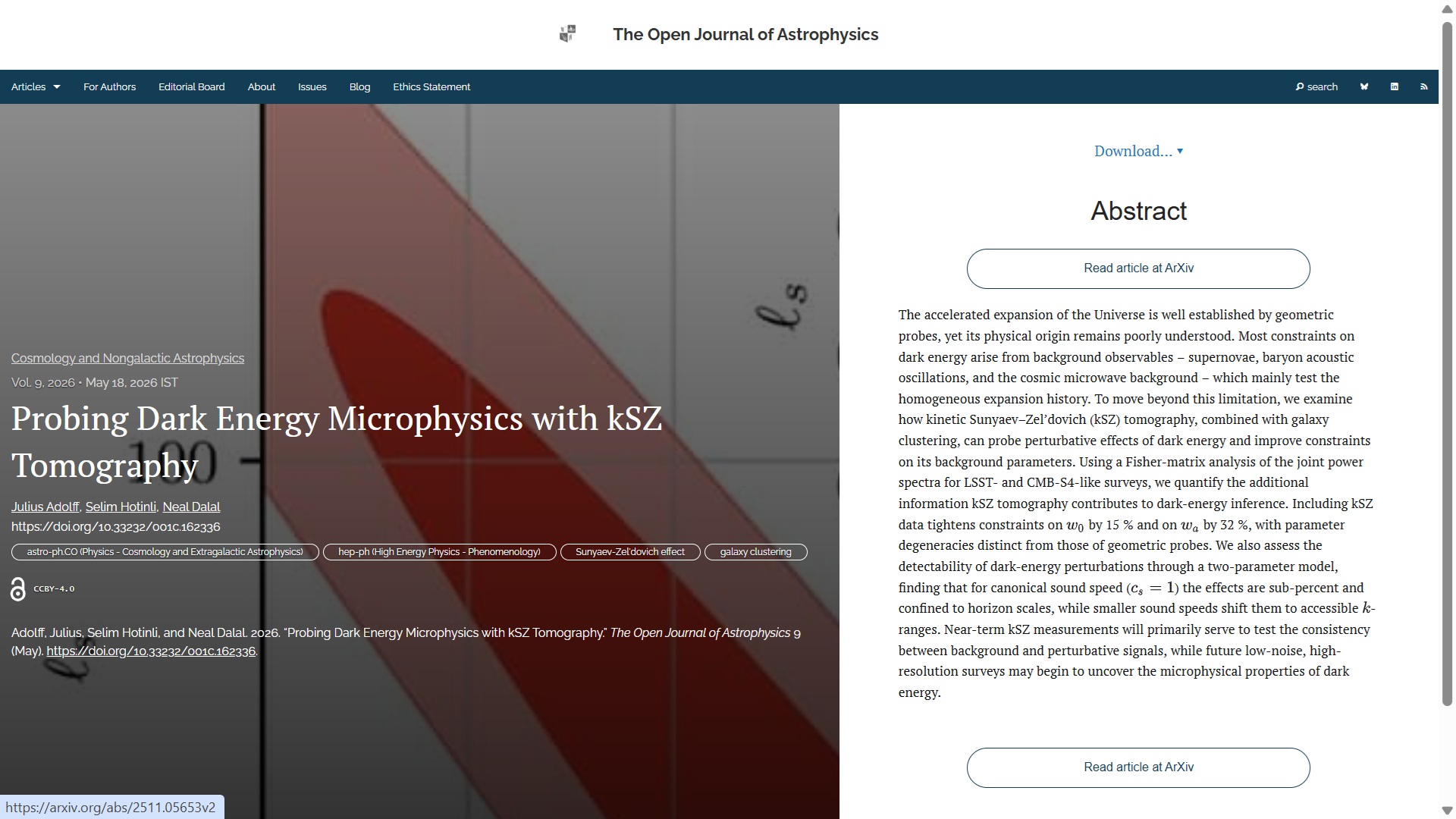
Next one up, the third paper of the week, and the third published on Monday 18th May, and in the folder Cosmology and Nongalactic Astrophysics is “Probing Dark Energy Microphysics with kSZ Tomography” by Julius Adolff, Selim Hotinli and Neal Dalal (all of the Perimeter Institute, Canada). This paper explores how kinetic Sunyaev-Zel’dovich tomography and galaxy clustering can enhance our understanding of dark energy and its effects, potentially revealing its microphysical properties in future surveys.
The overlay for this one is here:
The final, accepted version can be found on arXiv here and the Mastodon announcement is here:
New Publication at the Open Journal of Astrophysics: "Probing Dark Energy Microphysics with kSZ Tomography" by Julius Adolff, Selim Hotinli and Neal Dalal (Perimeter Institute, Canada)
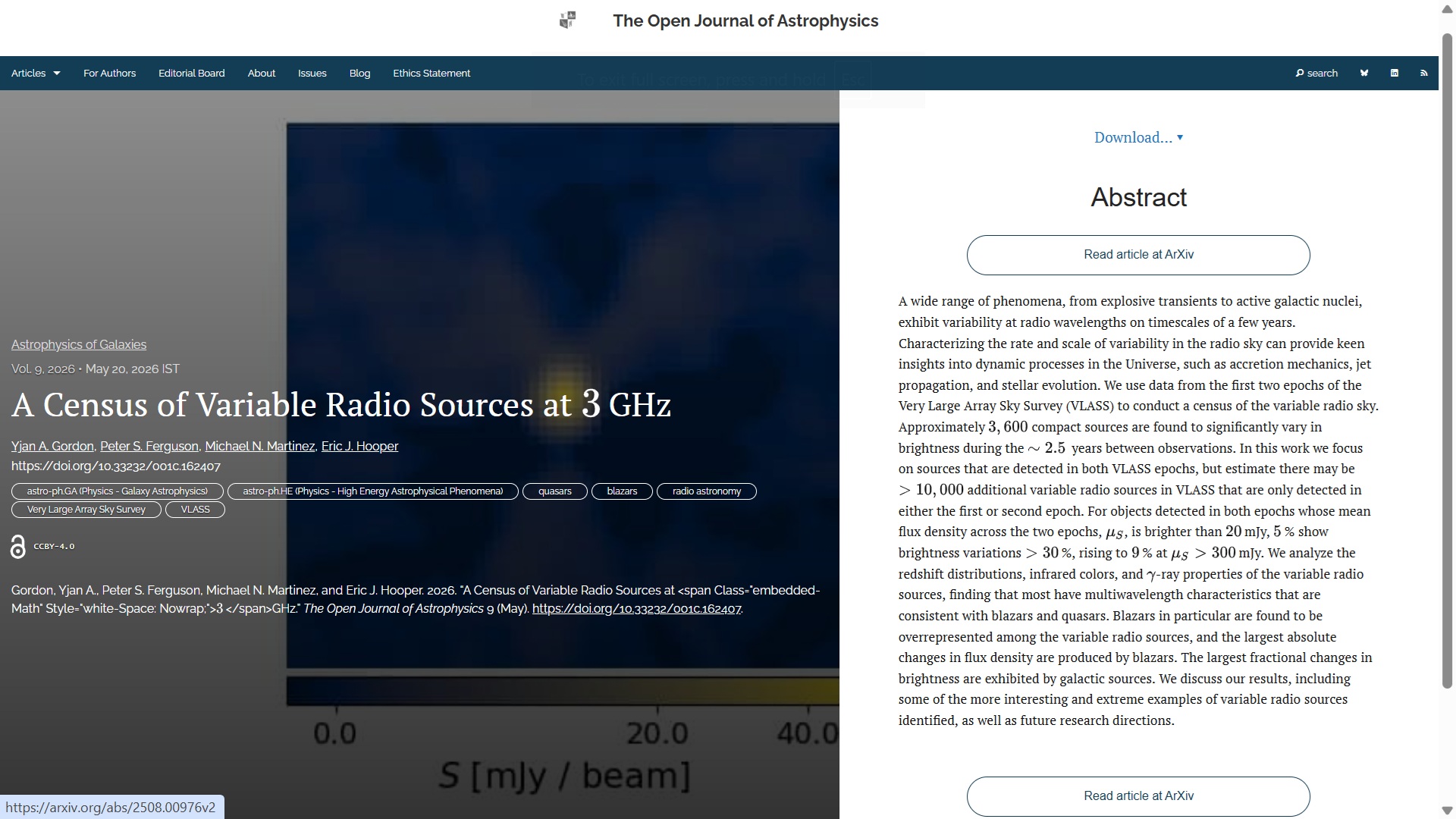
The fourth paper this week, published on Wednesday May 20th is “A Census of Variable Radio Sources at 3 GHz” by Yjan A. Gordon, Peter S. Ferguson, Michael N. Martinez and Eric J. Hooper (all of the University of Wisconsin, USA). This article, published in the folder Astrophysics of Galaxies, uses data from the Very Large Array Sky Survey to analyze variability in the radio sky, finding most changes consistent with blazars and quasars.
The overlay is here:
The officially accepted version can be found on arXiv here and here is the Mastodon announcement:
New Publication at the Open Journal of Astrophysics: "A Census of Variable Radio Sources at 3 GHz" by Yjan A. Gordon, Peter S. Ferguson, Michael N. Martinez & Eric J. Hooper (U. Wisconsin, USA)
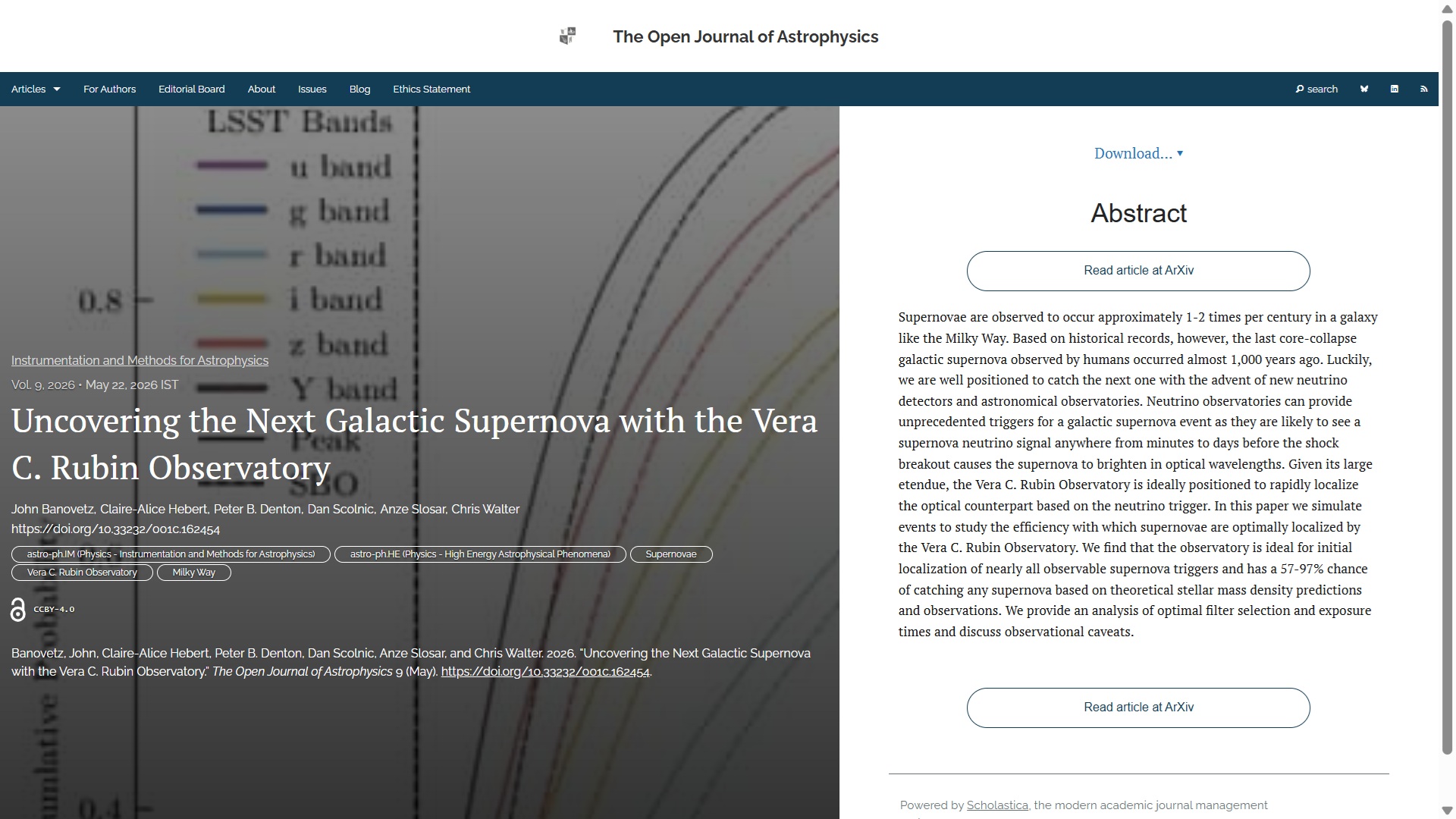
The fifth article of this week was published on Friday 22nd May in the folder Instrumentation and Methods for Astrophysics. The title is “Uncovering the Next Galactic Supernova with the Vera C. Rubin Observatory” by John Banovetz (Lawrence Berkeley Lab., USA), Claire-Alice Hebert & Peter B. Denton (Brookhaven National Lab., USA), Dan Scolnic (Duke University, USA), Anze Slosar (Brookhaven) and Chris Walter (Duke). The paper presents a study simulating how effectively the Vera C. Rubin Observatory can localize supernovae using neutrino triggers, finding a 57-97% success rate based on stellar mass density predictions.
The overlay is here:
You can find the authorized version of this paper on arXiv here and the Fediverse announcement is here:
New Publlication at the Open Journal of Astrophysics: "Uncovering the Next Galactic Supernova with the Vera C. Rubin Observatory" by John Banovetz (Lawrence Berkeley Lab., USA), Claire-Alice Hebert & Peter B. Denton (Brookhaven National Lab., USA) , Dan Scolnic (Duke U., USA) , Anze Slosar (Brookhaven), and Chris Walter (Duke)
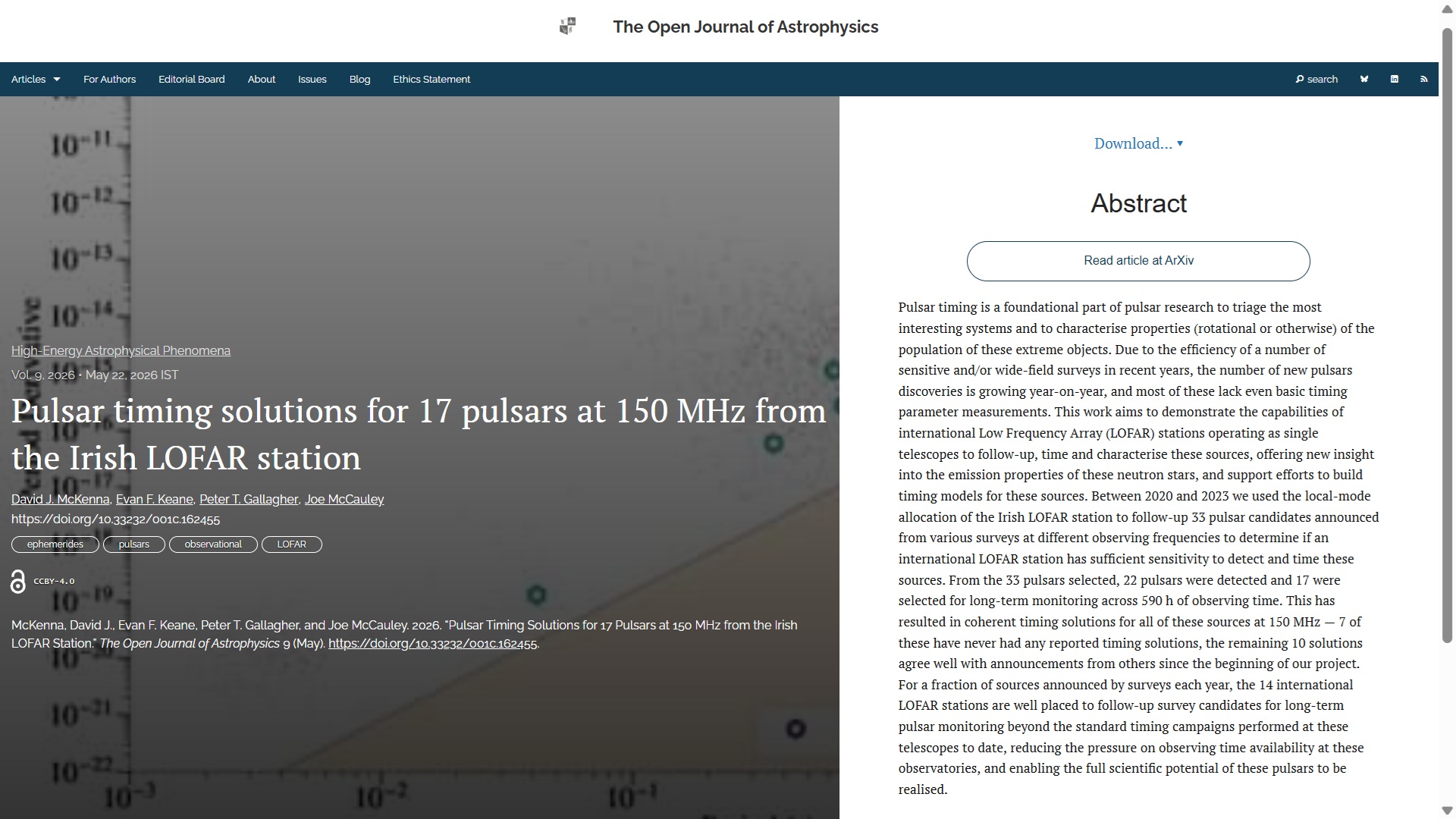
Last, but by no means least, this week we have “Pulsar timing solutions for 17 pulsars at 150 MHz from the Irish LOFAR station” by David J. McKenna (ASTRON, The Netherlands), Evan F. Keane (Trinity College Dublin, Ireland), Peter T. Gallagher (DIAS, Ireland) and Joe McCauley (Trinity). This was published on Friday 22nd May in the folder High-Energy Astrophysical Phenomena. It presents a demonstration of the use of international Low Frequency Array (LOFAR) stations in tracking and characterizing pulsars, providing new insights into these neutron stars’ emission properties.
The overlay for this one is here:
You can find the authorized version of this paper on arXiv here and the Fediverse announcement is here:
New Publication at the Open Journal of Astrophysics: "Pulsar timing solutions for 17 pulsars at 150 MHz from the Irish LOFAR station" by David J. McKenna (ASTRON, The Netherlands), Evan F. Keane (Trinity College Dublin, Ireland), Peter T. Gallagher (DIAS, Ireland) and Joe McCauley (Trinity)
It’s Saturday once again, so time for another update of activity at the Open Journal of Astrophysics. Since the last update we have published a further five papers, bringing the number in Volume 9 (2026) to 104 and the total so far published by OJAp up to 552. It took us until late July to pass 100 last year.
I will continue to include the posts made on our Mastodon account (on Fediscience) to encourage you to visit it. Mastodon is a really excellent service, and a more than adequate replacement for X/Twitter (which nobody should be using); these announcements also show the DOI for each paper.
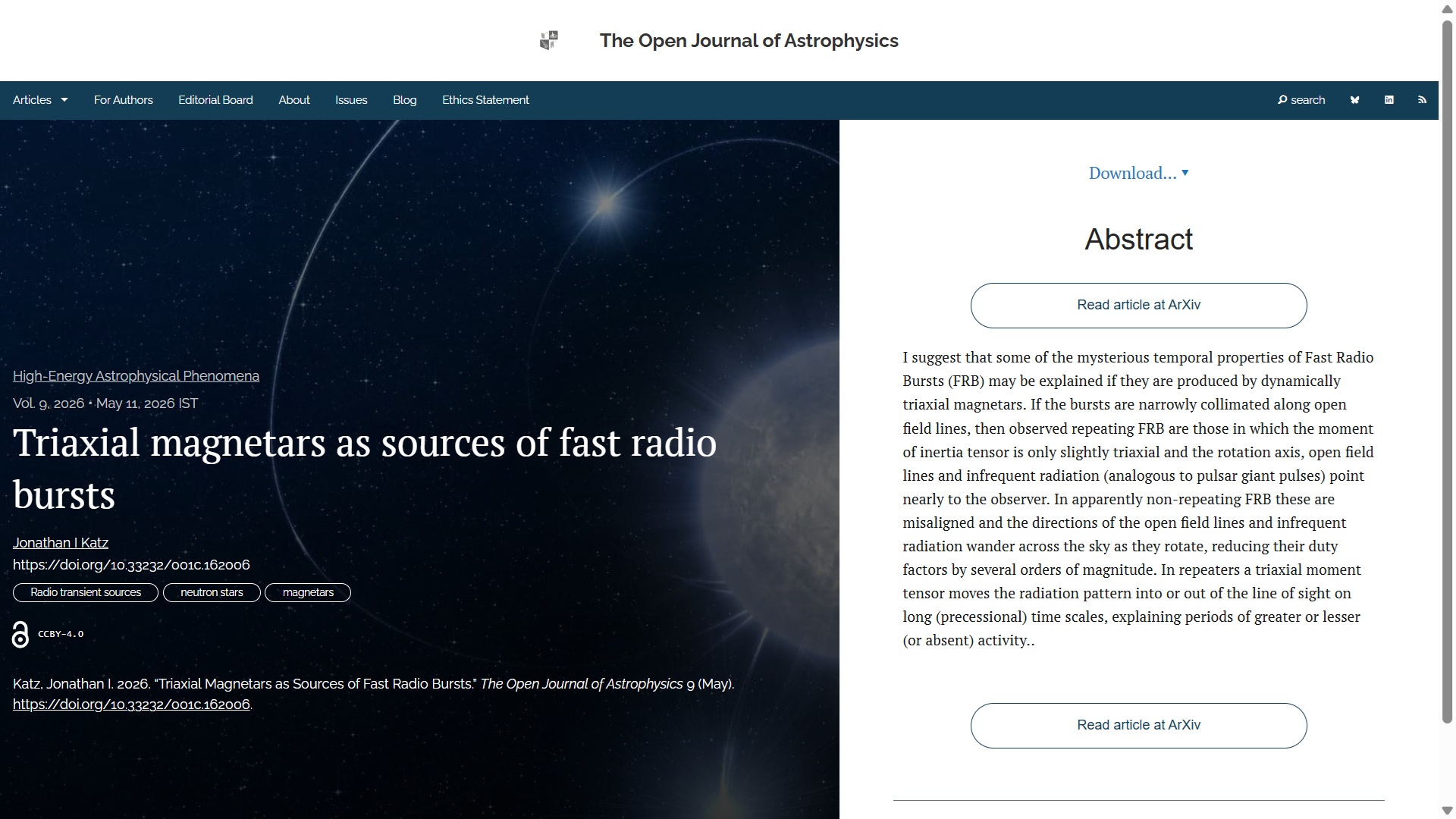
The first paper to report this week, published on Monday 11th May in the folder High-Energy Astrophysical Phenomena is “Triaxial magnetars as sources of fast radio bursts” by Jonathan I Katz (Washington University, USA). This paper suggests that the mysterious properties of Fast Radio Bursts (FRB) could be explained by triaxial magnetars, with their activity levels influenced by precessional time scales.
The overlay for this paper is here
You can find the officially accepted version on arXiv here and the announcement on Fediverse here:
New Publication at the Open Journal of Astrophysics: "Triaxial magnetars as sources of fast radio bursts" by Jonathan I Katz (Washington University, USA)
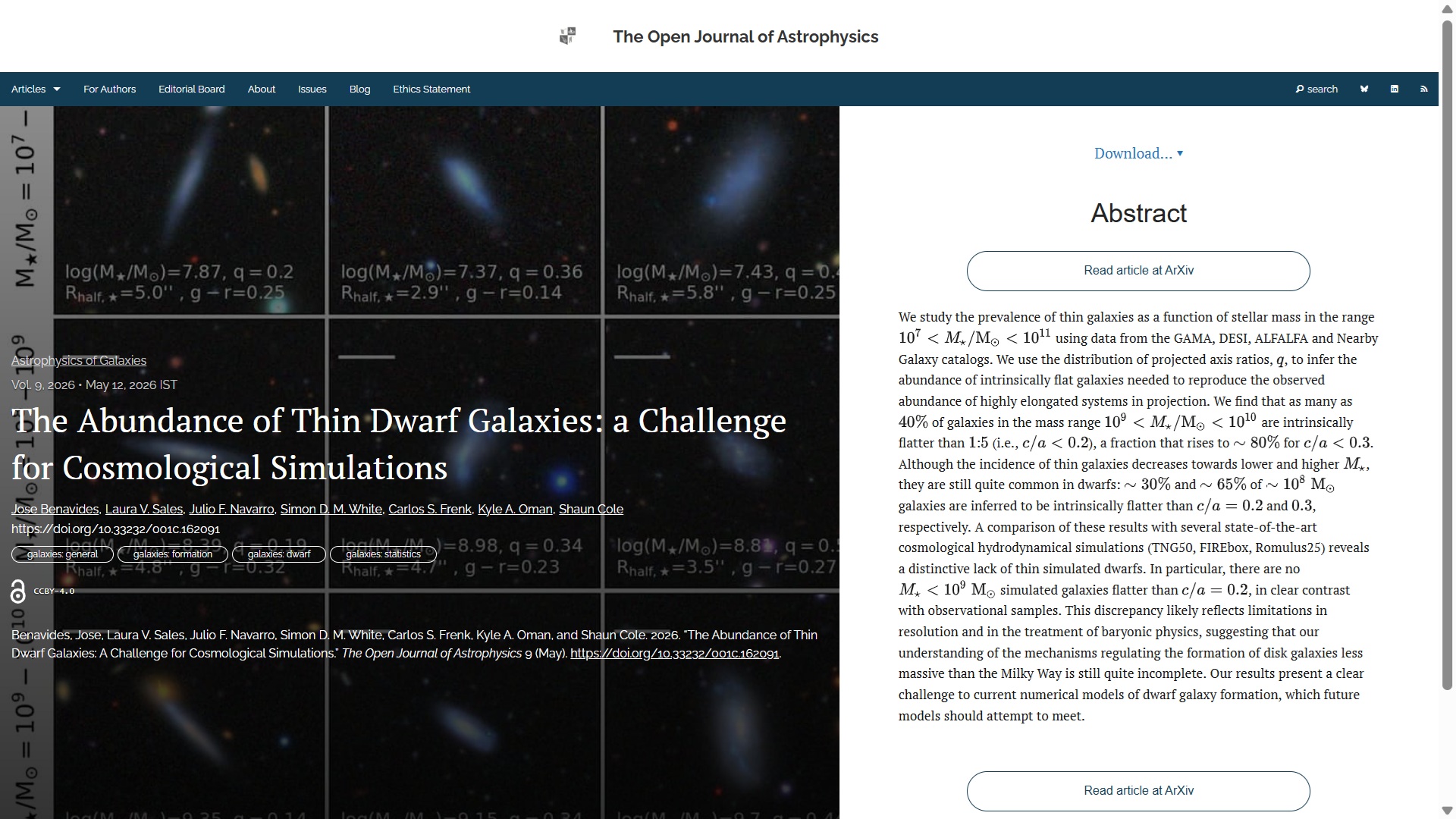
The second paper for this week, published on Tuesday 12th May in the folder Astrophysics of Galaxies, is “The Abundance of Thin Dwarf Galaxies: a Challenge for Cosmological Simulations” by Jose Benavides & Laura V. Sales (UC Riverside, USA), Julio F. Navarro (U. Victoria, Canada), Simon D. M. White (MPA Garching, Germany), and Carlos S. Frenk, Kyle A. Oman & Shaun Cole (U. Durham, UK). Depending on mass up to 40% of galaxies are intrinsically flat, a fraction that numerical models of galaxy formation struggle to reproduce suggesting the models are incomplete.
The overlay for this one is here:
The official version of the paper can be found on arXiv here and the Fediverse announcement here:
New Publication at the Open Journal of Astrophysics: "The Abundance of Thin Dwarf Galaxies: a Challenge for Cosmological Simulations" by Jose Benavides & Laura V. Sales (UC Riverside, USA), Julio F. Navarro (U. Victoria, Canada), Simon D. M. White (MPA Garching, Germany), and Carlos S. Frenk, Kyle A. Oman & Shaun Cole (U. Durham, UK)
Next one up, the third paper of the week, also published on Tuesday 12th May but in the folder Cosmology and Nongalactic Astrophysics is “Cosmological peculiar velocities in general relativity” by Chris Clarkson (Queen Mary, University of London, UK) and Roy Maartens (U. Western Cape, South Africa). This paper refutes claims that the 1+3 covariant approach to cosmological perturbation theory predicts stronger growth of galaxy peculiar velocities, arguing that standard treatments are correct and fully relativistic.
The overlay for this one is here:
The final, accepted version can be found on arXiv here and the Mastodon announcement is here:
New Publication at the Open Journal of Astrophysics: "Cosmological peculiar velocities in general relativity" by Chris Clarkson (QMUL, UK) and Roy Maartens (U. Western Cape, South Africa)
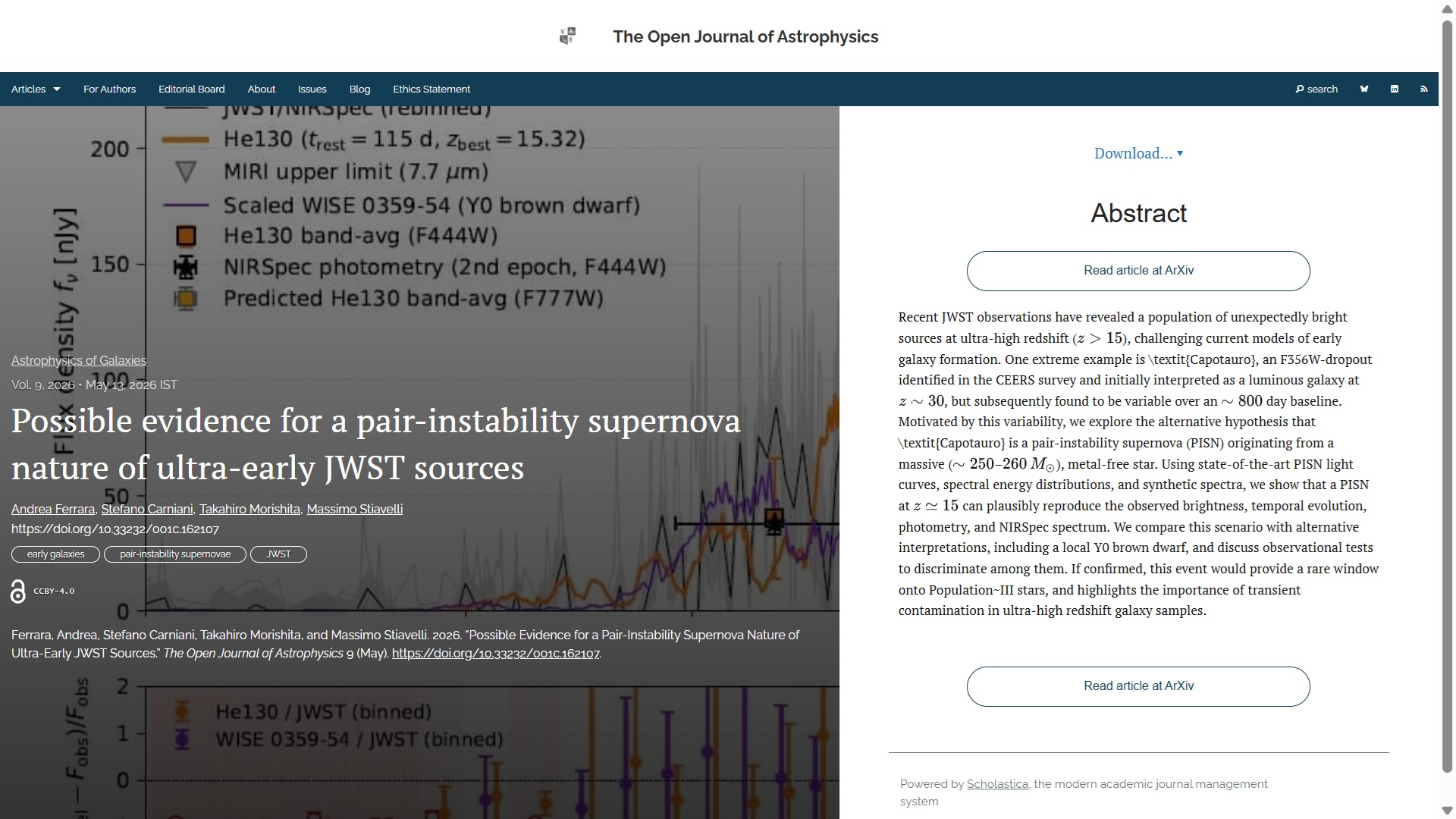
The fourth paper this week, published on Wednesday May 13th “Possible evidence for a pair-instability supernova nature of ultra-early JWST sources” by Andrea Ferrara & Stefano Carniani (Scuola Normale Superiore, Pisa, Italy), Takahiro Morishita (California Institute of Technology, USA), and Massimo Stiavelli (Space Telescope Science Institute, USA). Published in the section Astrophysics of Galaxies. This paper argues that recent observations challenge early galaxy formation models, suggesting that the bright source, Capotauro, could be a supernova from a massive, metal-free star, not a luminous galaxy as initially thought.
The overlay is here:
The officially accepted version can be found on arXiv here and here is the Mastodon announcement:
New Publication at the Open Journal of Astrophysics: "Possible evidence for a pair-instability supernova nature of ultra-early JWST sources" by Andrea Ferrara & Stefano Carniani (Scuola Normale Superiore, Pisa, Italy), Takahiro Morishita (Caltech, USA) and Massimo Stiavelli (STScI, USA)
The fifth and final article of this week was also published on Wednesday 13th May but in the folder Cosmology and Nongalactic Astrophysics. The title is “Evolving and interacting dark energy: photometric and spectroscopic synergy with DES Y3 and DESI DR2” and it is by Maria Tsedrik and Benjamin Bose (University of Edinburgh, UK). The study investigates the Dark Scattering interacting dark energy scenario, using data from various sources. Results show no evidence of dark-sector interaction and a preference for the Chevallier-Polarski-Linder parametrisation.
The overlay is here:
You can find the authorized version of this paper on arXiv here and the Fediverse announcement is here:
New Publication at the Open Journal of Astrophysics: "Evolving and interacting dark energy: photometric and spectroscopic synergy with DES Y3 and DESI DR2" by Maria Tsedrik and Benjamin Bose (University of Edinburgh, UK)
It’s Saturday once again, so time for another update of activity at the Open Journal of Astrophysics. Since the last update we have published a further five papers, bringing the number in Volume 9 (2026) to 99 and the total so far published by OJAp up to 547. We didn’t quite make it to a hundred for the year last week, but will do so with the next paper.
I will continue to include the posts made on our Mastodon account (on Fediscience) to encourage you to visit it. Mastodon is a really excellent service, and a more than adequate replacement for X/Twitter (which nobody should be using); these announcements also show the DOI for each paper.
The first paper to report this week is “Formation of Close Binaries through Massive Black Hole Perturbations and Chaotic Tides” by Howard Hao-Tse Huang and Wenbin Lu (University of California at Berkeley, USA). This one was published on Wednesday 6th May 2026 in the folder Astrophysics of Galaxies. The paper presents a model of massive black hole-binary systems, showing that repeated tidal interactions can lead to the creation of hyper-velocity stars and other nuclear transients.
The overlay for this paper is here
You can find the officially accepted version on arXiv here and the announcement on Fediverse here:
New Publication at the Open Journal of Astrophysics: "Formation of Close Binaries through Massive Black Hole Perturbations and Chaotic Tides" by Howard Hao-Tse Huang & Wenbin Lu (U. California Berkeley, USA)
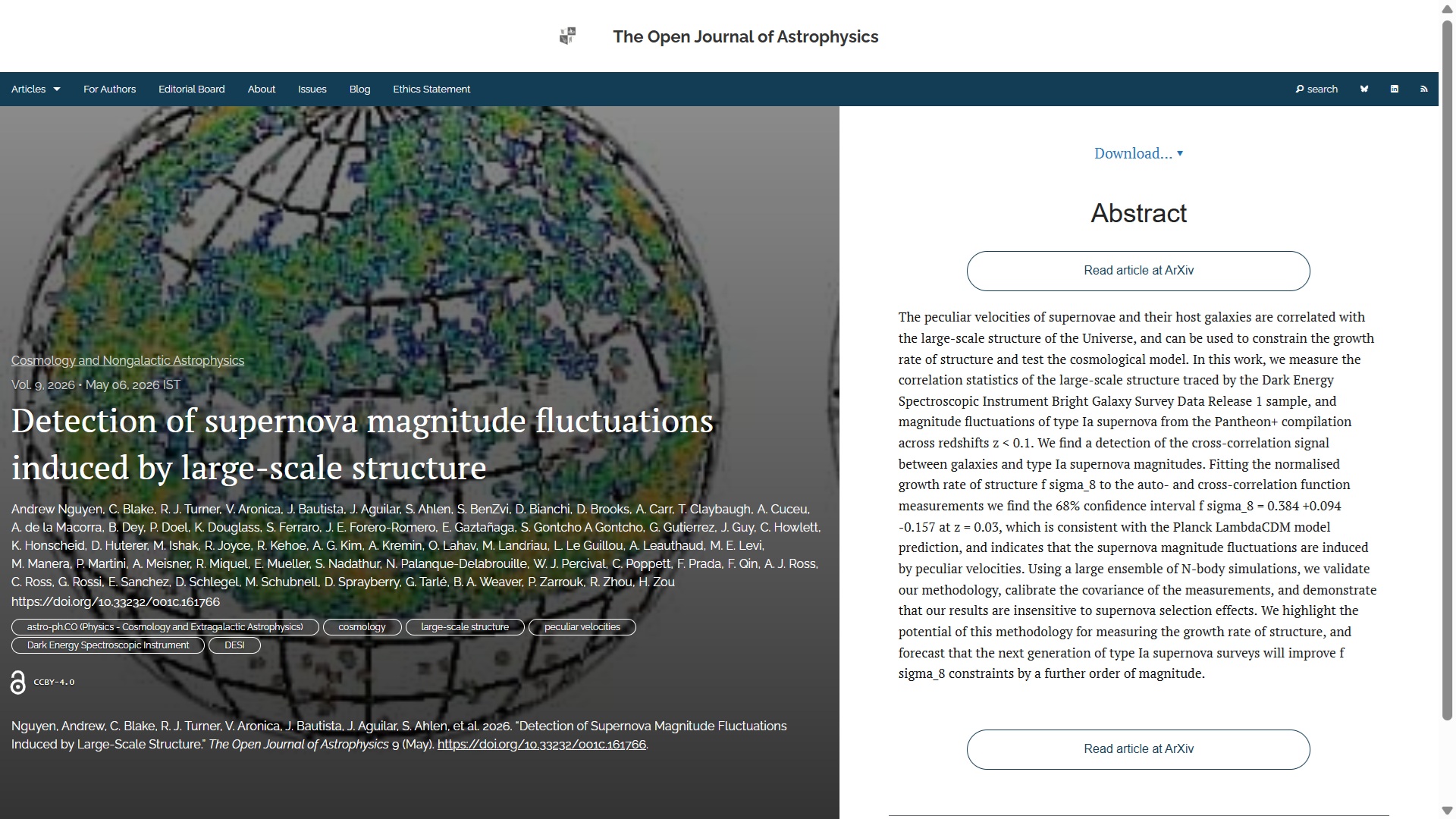
The second paper for this week, also Wednesday 6th May, but in the folder Cosmology and Nongalactic Astrophysics is “Detection of supernova magnitude fluctuations induced by large-scale structure” by Andrew Nguyen (Swinburne Institute of Technology, Australia) and 58 others based all around the world. This study uses supernovae and galaxy velocities to measure the universe’s structure growth rate, confirming the Planck LambdaCDM model prediction. The methodology is validated and shows potential for future research.
The overlay for this one is here:
The official version of the paper can be found on arXiv here and the Fediverse announcement here:
New Publication at the Open Journal of Astrophysics: "Detection of supernova magnitude fluctuations induced by large-scale structure" by Andrew Nguyen (Swinburne Institute of Technology, Australia) and 58 others based all around the world.
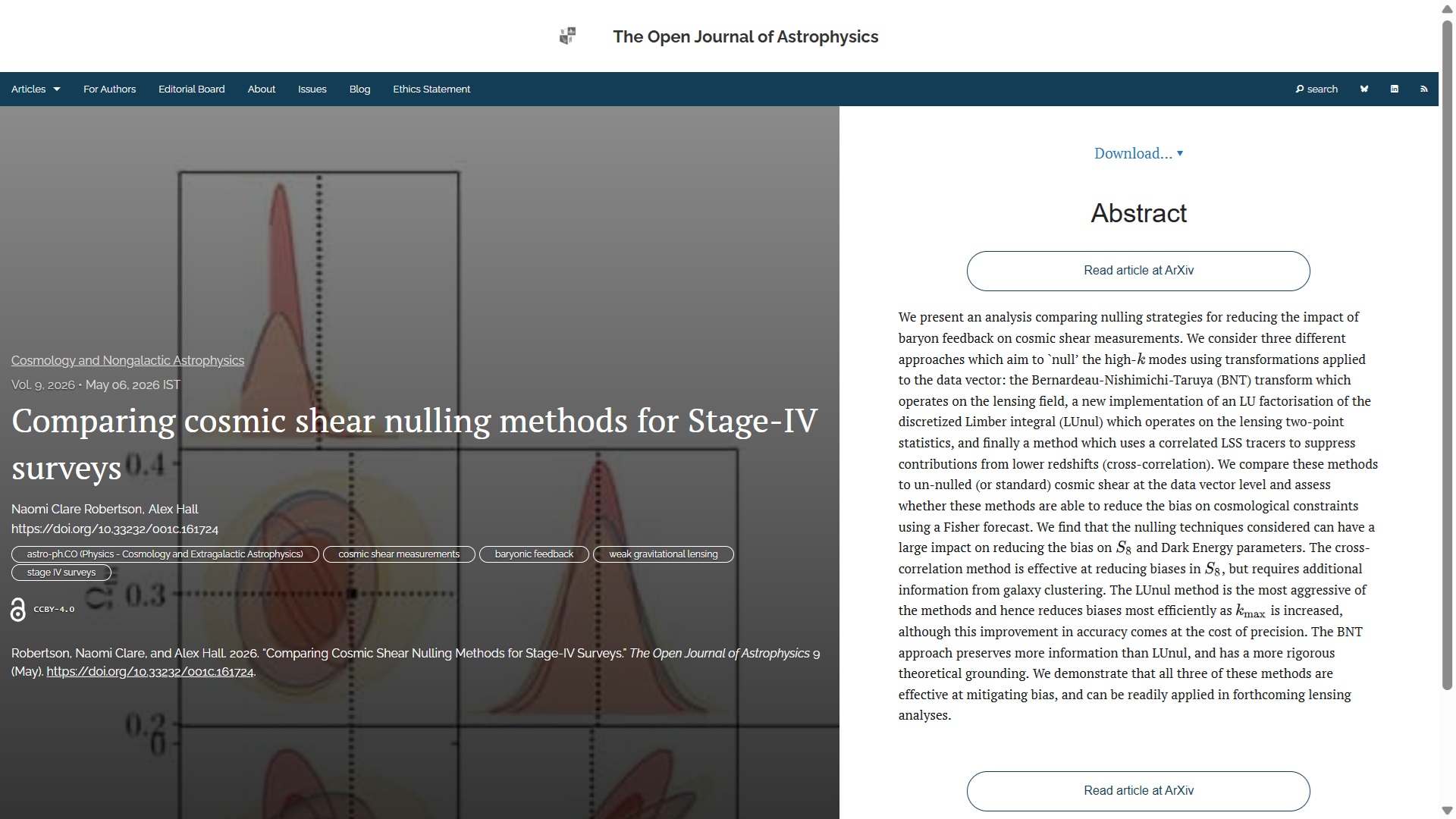
Next one up, the third paper of the week, also published on Wednesday 6th May in the folder Cosmology and Nongalactic Astrophysics is “Comparing cosmic shear nulling methods for Stage-IV surveys” by Naomi Clare Robertson and Alex Hall (University of Edinburgh, UK). This study compares three strategies for reducing baryon feedback impact on cosmic shear measurements. All methods effectively mitigate bias, with varying degrees of efficiency and information preservation.
The overlay for this one is here:
The final, accepted version can be found on arXiv here and the Mastodon announcement is here:
New Publication at the Open Journal of Astrophysics: "Comparing cosmic shear nulling methods for Stage-IV surveys" by Naomi Clare Robertson & Alex Hall (U. Edinburgh, UK)
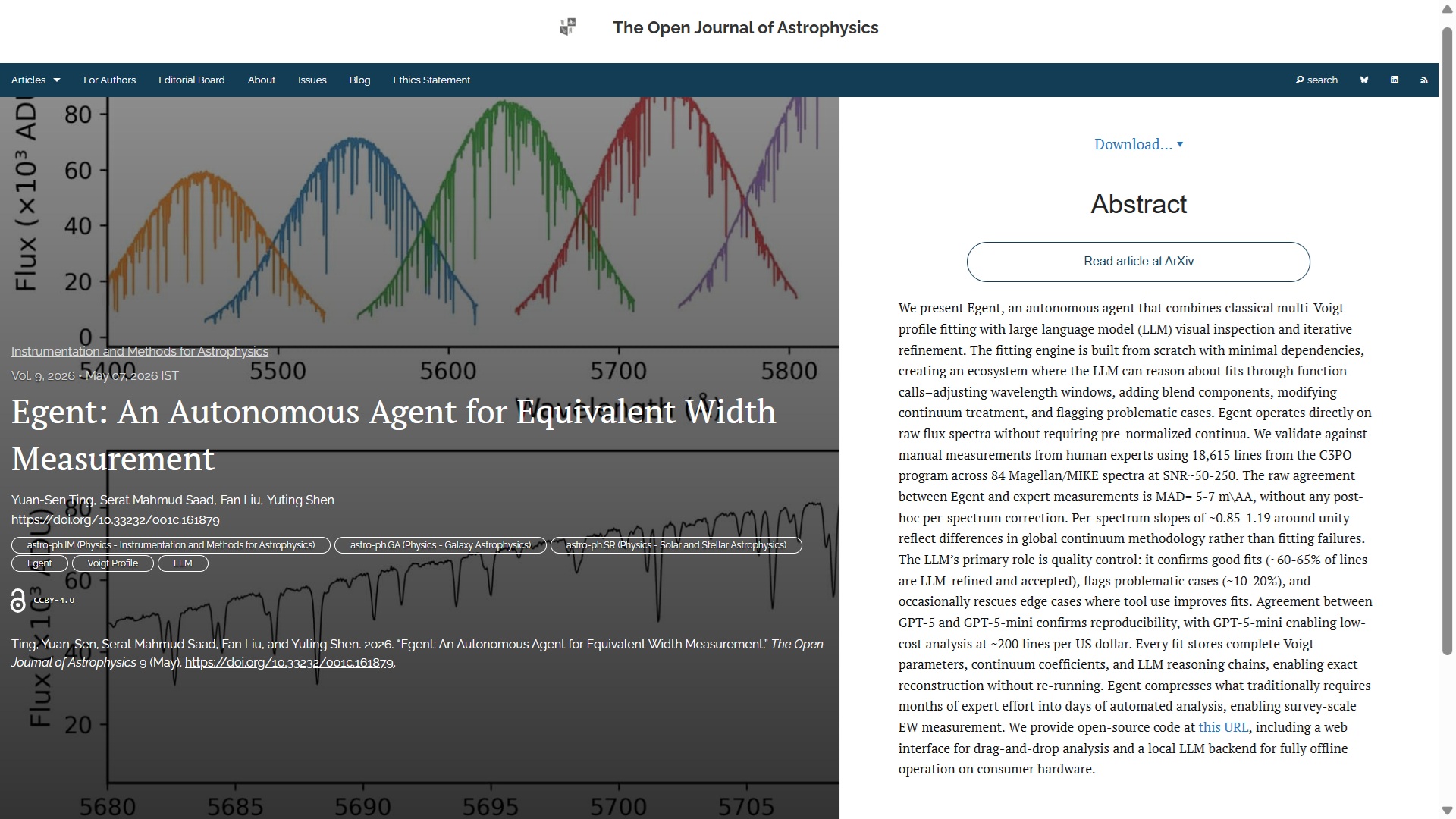
The fourth paper this week, published on Thursday May 7th, is “Egent: An Autonomous Agent for Equivalent Width Measurement” by Yuan-Sen Ting & Serat Mahmud Saad (Ohio State University, USA), Fan Liu (National Astronomical Observatories, Beijing, China), and Yuting Shen (Georgia Institute of Technology, USA). Egent is an autonomous agent that combines multi-Voigt profile fitting with large language model visual inspection for efficient, automated analysis of raw flux spectra, validated against expert measurements. This one is in the folder Instrumentation and Methods for Astrophysics. The associated software can be found here.
The overlay is here:
The officially accepted version can be found on arXiv here and here is the Mastodon announcement:
New Publication at the Open Journal of Astrophysics: "Egent: An Autonomous Agent for Equivalent Width Measurement" by Yuan-Sen Ting & Serat Mahmud Saad (Ohio State U., USA), Fan Liu (National Astronomical Observatories, China) and Yuting Shen (Georgia Institute of Technology, USA)
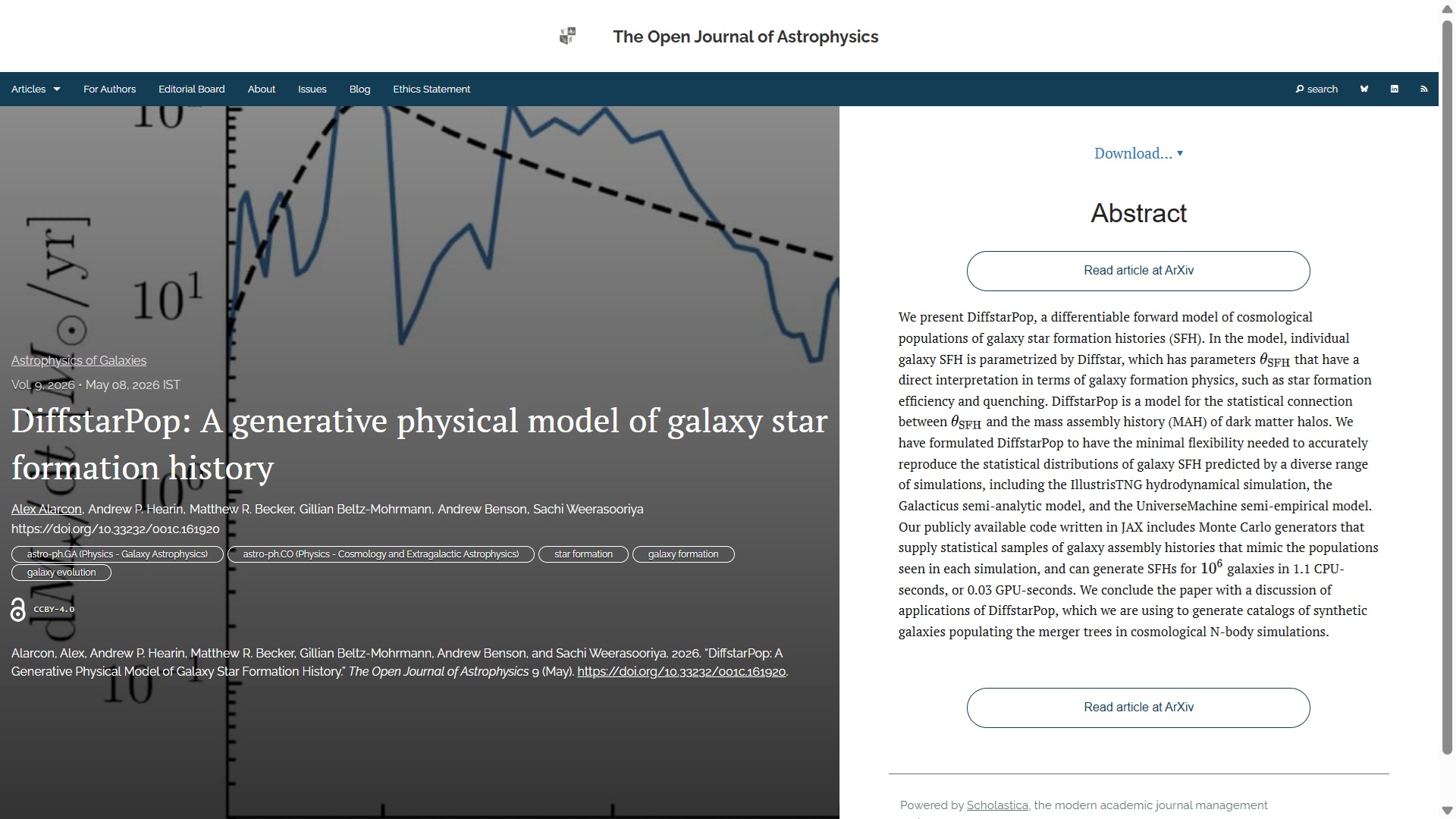
The fifth and final article of this week was published on Friday 8th May in the folder Astrophysics of Galaxies. The title is “DiffstarPop: A generative physical model of galaxy star formation history” and it is by Alex Alarcon (Institute of Space Sciences, Barcelona, Spain), Andrew P. Hearin , Matthew R. Becker & Gillian Beltz-Mohrmann (Argonne National Laborarory, USA), and Andrew Benson & Sachi Weerasooriya (Carnegie Observatories, USA). DiffstarPop is a model that accurately and rapidly reproduces statistical distributions of galaxy star formation histories (SFH), using parameters related to galaxy formation physics.
The overlay is here:
You can find the authorized version of this paper on arXiv here and the Fediverse announcement is here:
New Publication at the Open Journal of Astrophysics: "DiffstarPop: A generative physical model of galaxy star formation history" by Alex Alarcon (Institute of Space Sciences, Barcelona, Spain), Andrew P. Hearin , Matthew R. Becker & Gillian Beltz-Mohrmann (Argonne National Laborarory, USA), and Andrew Benson & Sachi Weerasooriya (Carnegie Observatories, USA)
Here we are, on schedule, with another update of activity at the Open Journal of Astrophysics. Since the last update we have published a further seven papers, bringing the number in Volume 9 (2026) to 94 and the total so far published by OJAp up to 542. I checked the corresponding update for last year (on 3rd May 2025), and we’ve had an increase from 54 to 94 in papers published (about 74%) between the first four months of 2025 and the first four months of 2026.
I will continue to include the posts made on our Mastodon account (on Fediscience) to encourage you to visit it. Mastodon is a really excellent service, and a more than adequate replacement for X/Twitter (which nobody should be using); these announcements also show the DOI for each paper.
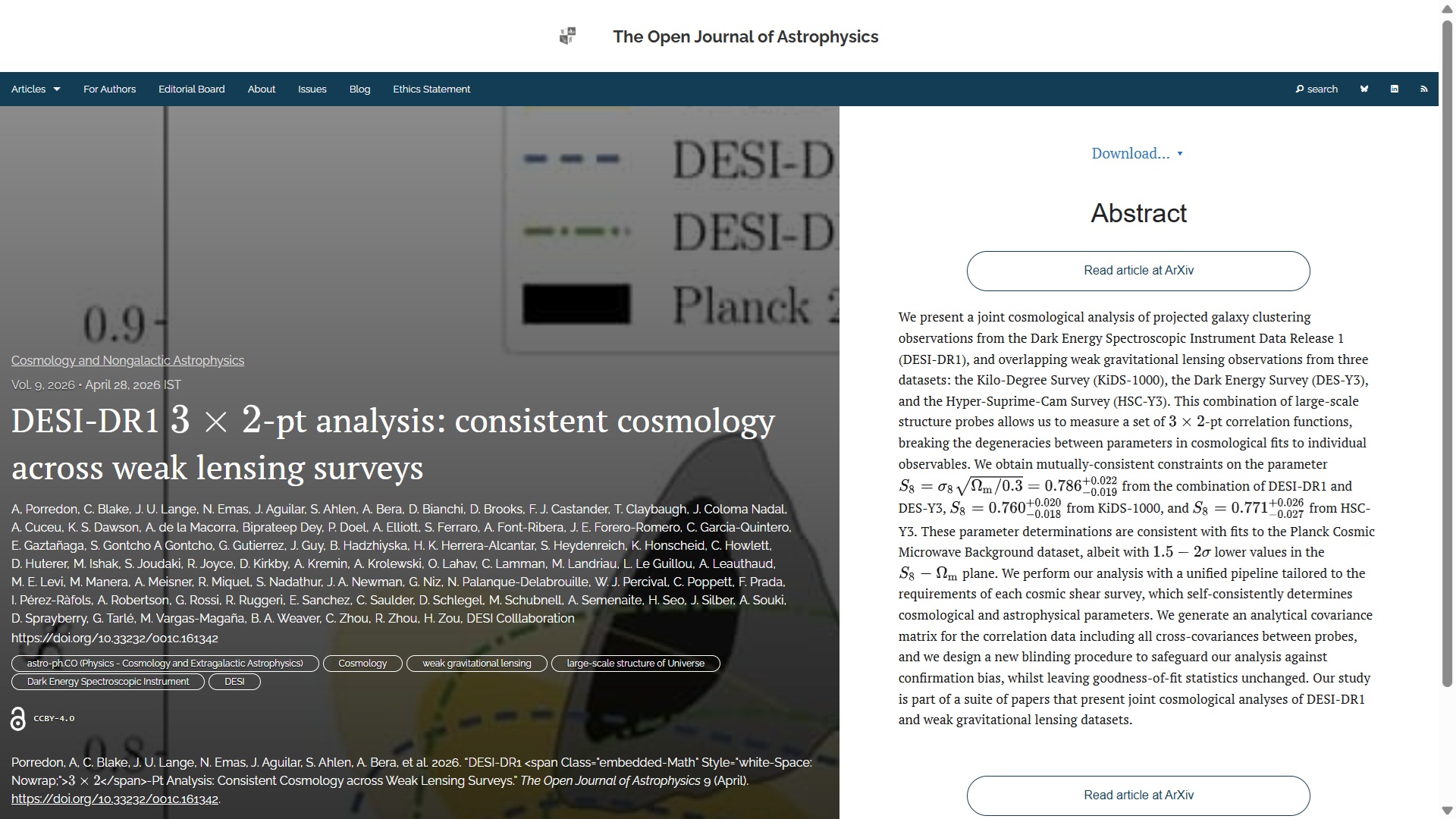
The first paper to report this week is “DESI-DR1 3 × 2-pt analysis: consistent cosmology across weak lensing surveys” by Anna Porredon (CIEMAT, Madrid, Spain) and 72 others (DESI Colllaboration). This paper was published on Tuesday 28th April in the folder Cosmology and Nongalactic Astrophysics. This paper presents a joint cosmological analysis of galaxy clustering and gravitational lensing observations, providing consistent constraints on cosmological parameters. The analysis also introduces a new blinding procedure to prevent confirmation bias. See this post for news of an important DESI milestone.
The overlay for this paper is here
You can find the officially accepted version on arXiv here and the announcement on Fediverse here:
New Publication at the Open Journal of Astrophysics: "DESI-DR1 3 × 2-pt analysis: consistent cosmology across weak lensing surveys" by Anna Porredon (CIEMAT, Madrid, Spain) and 72 others (DESI Colllaboration)
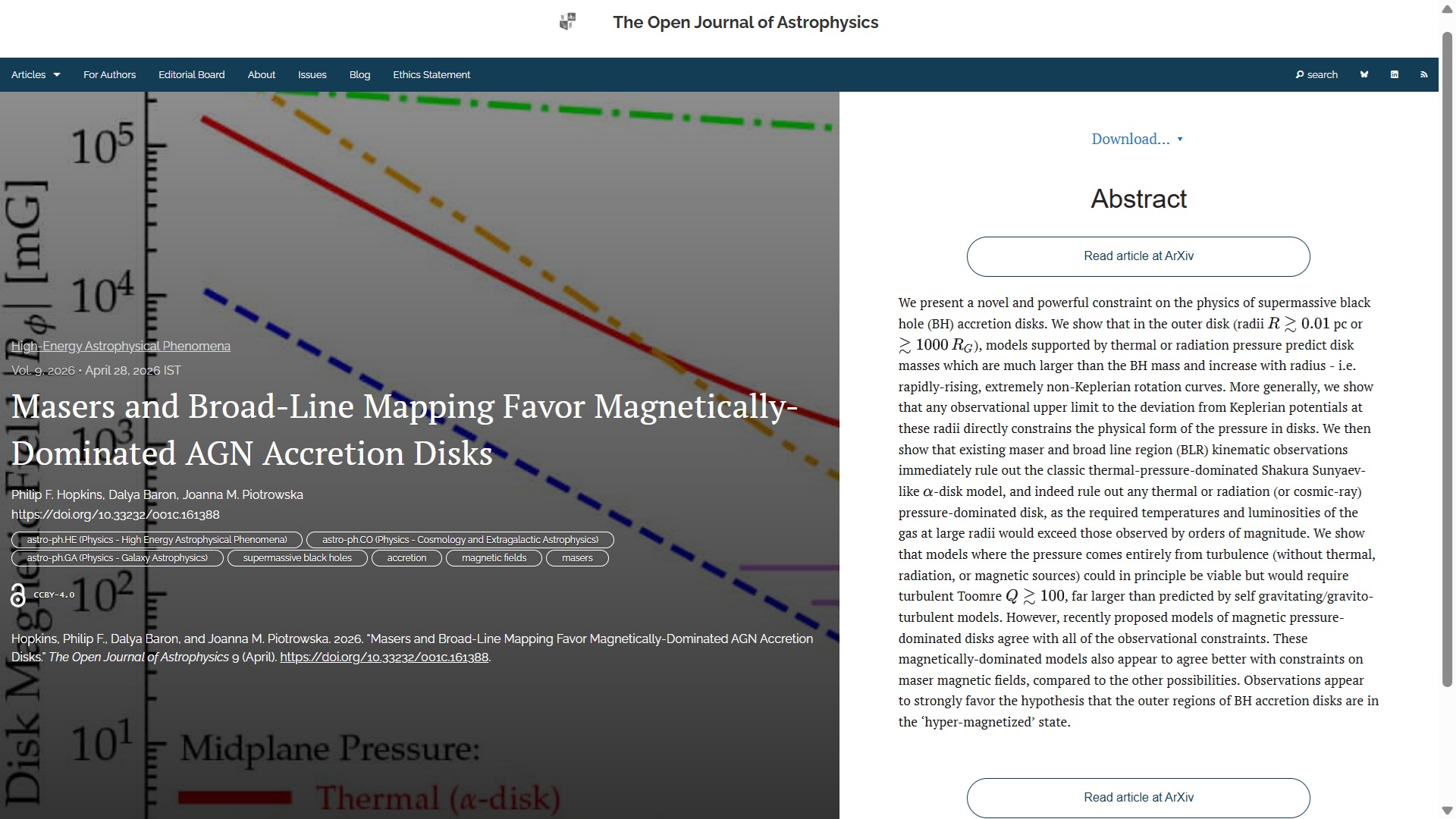
The second paper for this week, also published on Tuesday 28th April but in the folder High-Energy Astrophysical Phenomena is “Masers and Broad-Line Mapping Favor Magnetically-Dominated AGN Accretion Disks” by Philip F. Hopkins (Caltech, USA), Dalya Baron (Stanford U., USA) and Joanna M. Piotrowska (Caltech). This one presents a new constraint on supermassive black hole accretion disks physics, suggesting that outer regions are likely in a ‘hyper-magnetized’ state, as thermal or radiation pressure models appear inconsistent.
The overlay for this one is here:
The official version of the paper can be found on arXiv here and the Fediverse announcement here:
New Publication at the Open Journal of Astrophysics: "Masers and Broad-Line Mapping Favor Magnetically-Dominated AGN Accretion Disks" by Philip F. Hopkins (Caltech, USA), Dalya Baron (Stanford U., USA) and Joanna M. Piotrowska (Caltech)
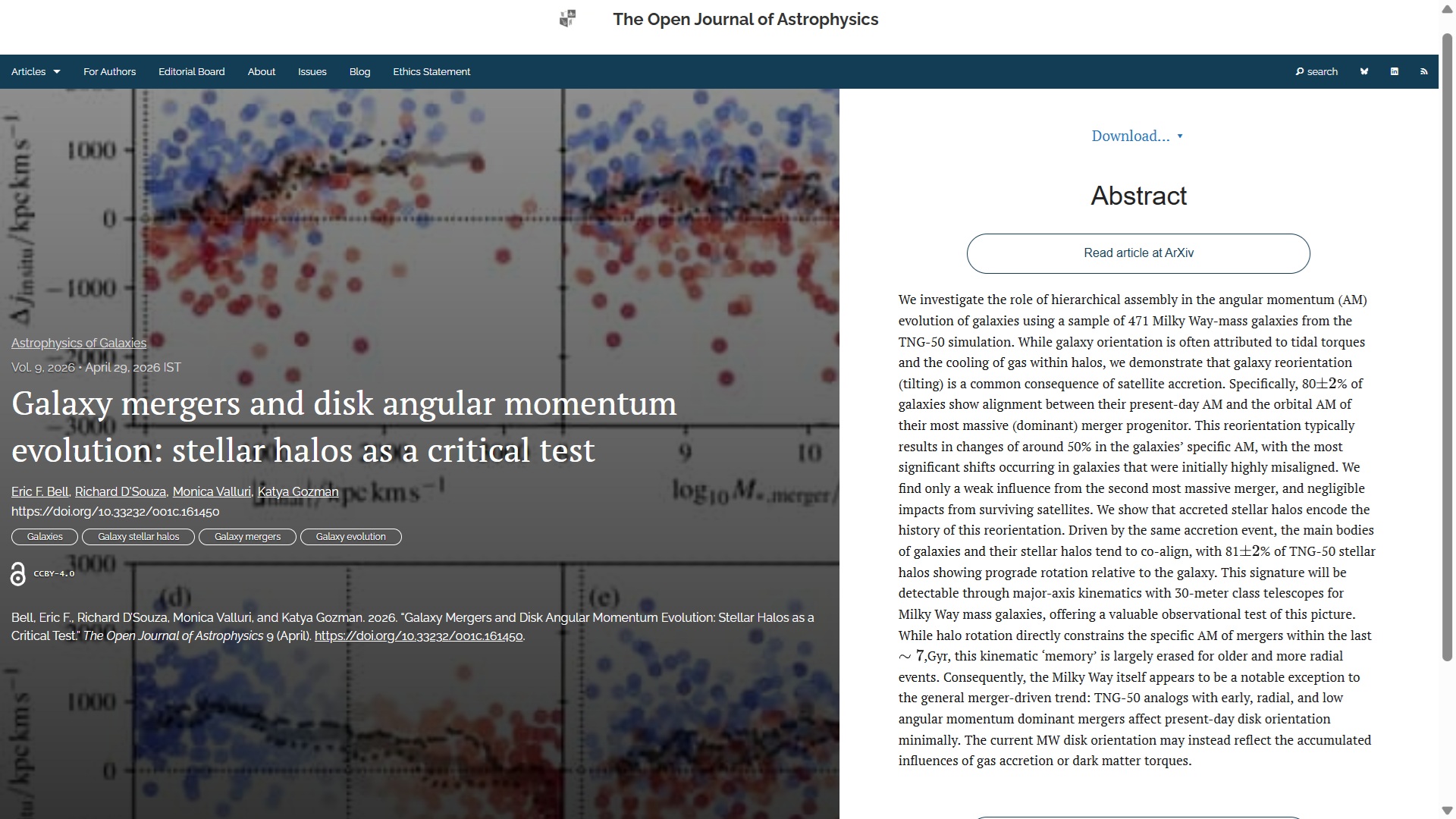
Next one up, the third paper of the week, is “Galaxy mergers and disk angular momentum evolution: stellar halos as a critical test” by Eric F. Bell (U. Michigan, Ann Arbor, USA), Richard D’Souza (Vatican Observatory), Monica Valluri & Katya Gozman (U. Michigan). This was published on Wednesday 29th April in the folder Astrophysics of Galaxies. The paper argues that satellite accretion impacts the angular momentum evolution of galaxies, often causing significant reorientation. This process is detectable in Milky Way-mass galaxies so the idea is testable observationally.
The overlay for this one is here:
The final, accepted version can be found on arXiv here and the Mastodon announcement is here:
New Publication at the Open Journal of Astrophysics: "Galaxy mergers and disk angular momentum evolution: stellar halos as a critical test" by Eric F. Bell (U. Michigan, Ann Arbor, USA), Richard D'Souza (Vatican Observatory), Monica Valluri & Katya Gozman (U. Michigan)
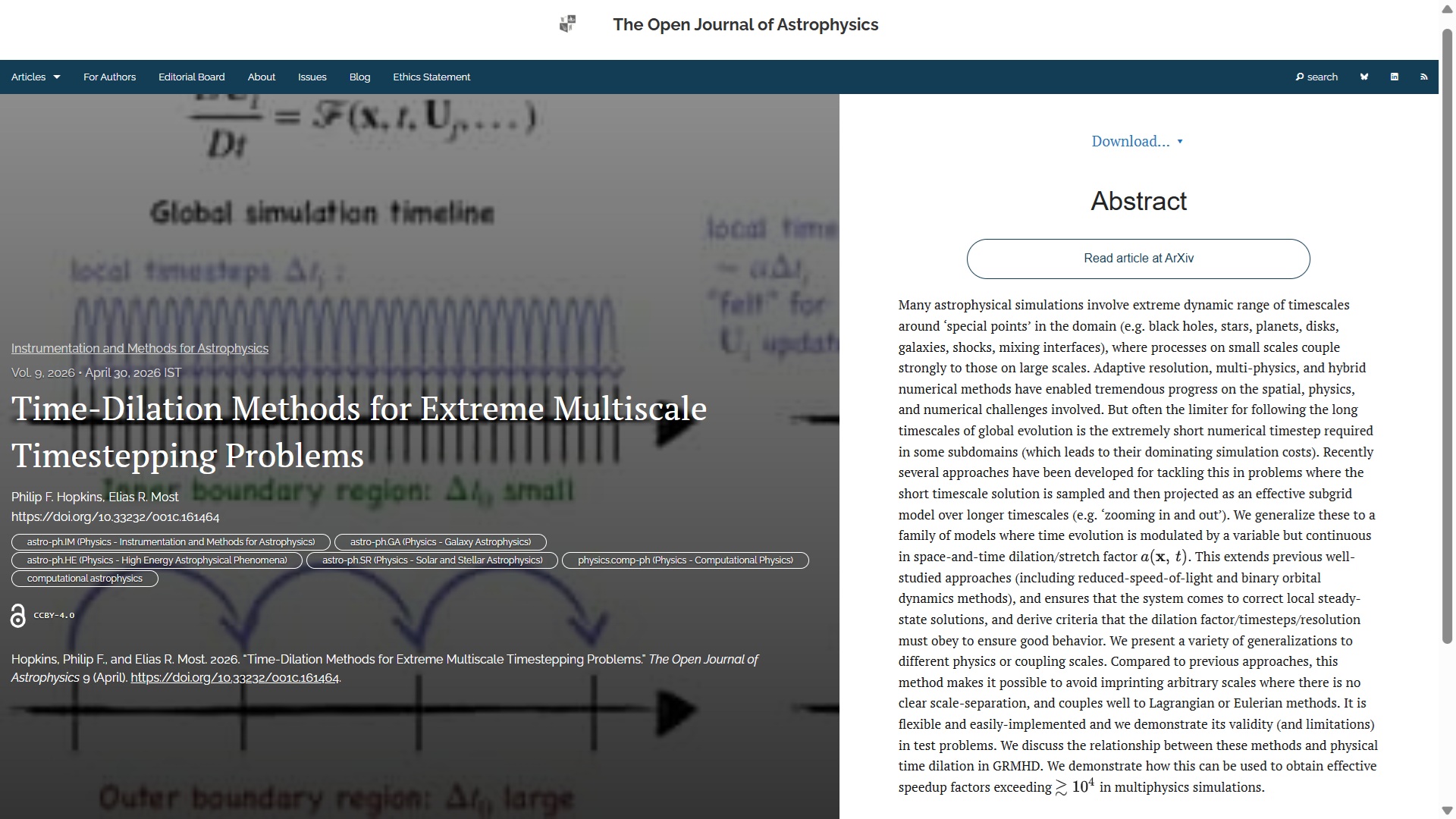
The fourth paper this week, published on Thursday April 30th, is “Time-Dilation Methods for Extreme Multiscale Timestepping Problems” by Philip F. Hopkins and Elias R. Most (Caltech, USA). This paper is in the folder Instrumentation and Methods for Astrophysics: it presents a new method for astrophysical simulations that modulates time evolution with a variable dilation/stretch factor, improving efficiency and accuracy in modeling processes across different scales.
The overlay is here:
The finally accepted version of this paper can be found here and the Mastodon announcement follows:
New Publication at the Open Journal of Astrophysics: "Time-Dilation Methods for Extreme Multiscale Timestepping Problems" by Philip F. Hopkins and Elias R. Most (Caltech, USA)
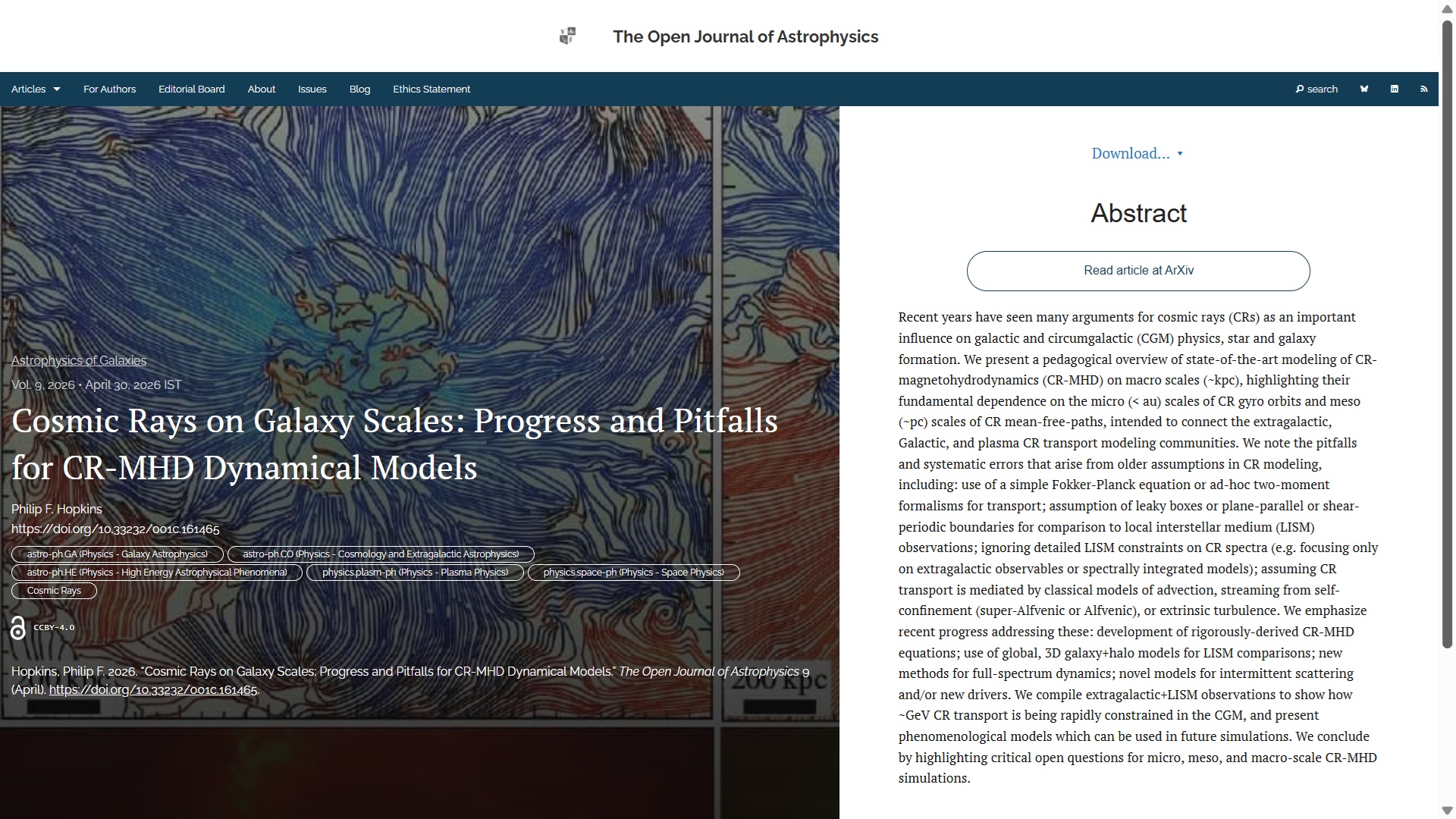
The fifth article of this week was also published on Thursday 30th April, but in the folder Astrophysics of Galaxies. The title is “Cosmic Rays on Galaxy Scales: Progress and Pitfalls for CR-MHD Dynamical Models” and the author is Philip F. Hopkins (Caltech, USA) who has three papers featured this week. The paper presents an overview of cosmic ray (CR) modeling, highlighting its influence on galactic physics and star formation. It addresses previous modeling errors and presents new methods for full-spectrum dynamics.
The overlay is here:
You can find the authorized version of this paper on arXiv here and the Fediverse announcement is here:
New Publication at the Open Journal of Astrophysics: "Cosmic Rays on Galaxy Scales: Progress and Pitfalls for CR-MHD Dynamical Models" by Philip F. Hopkins (Caltech, USA)
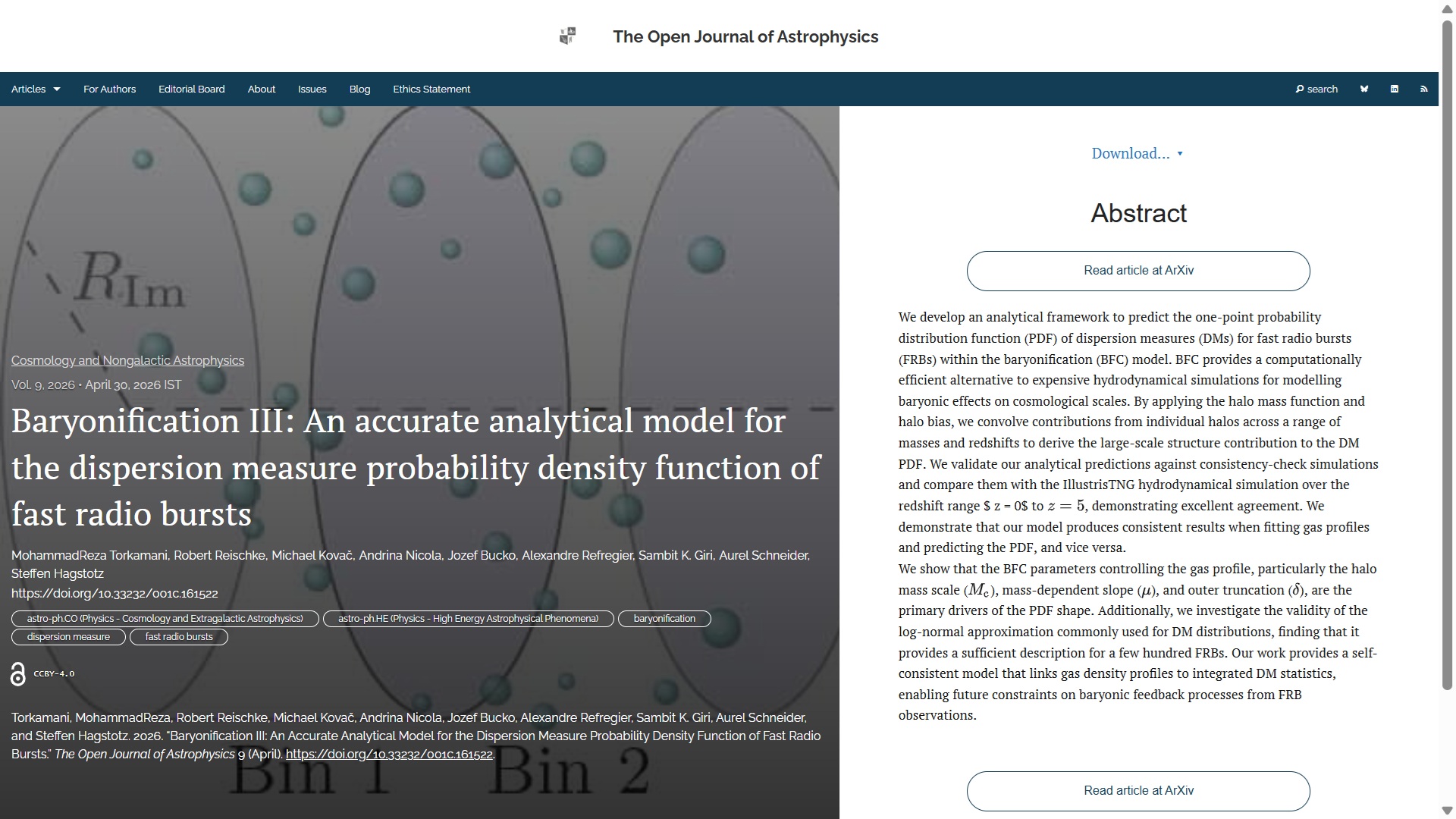
New Publication at the Open Journal of Astrophysics: "Baryonification III: An accurate analytical model for the dispersion measure probability density function of fast radio bursts" by MohammadReza Torkamani (Universität Bonn, Germany) and 8 others based in Germany, Switzerland, UK and Sweden
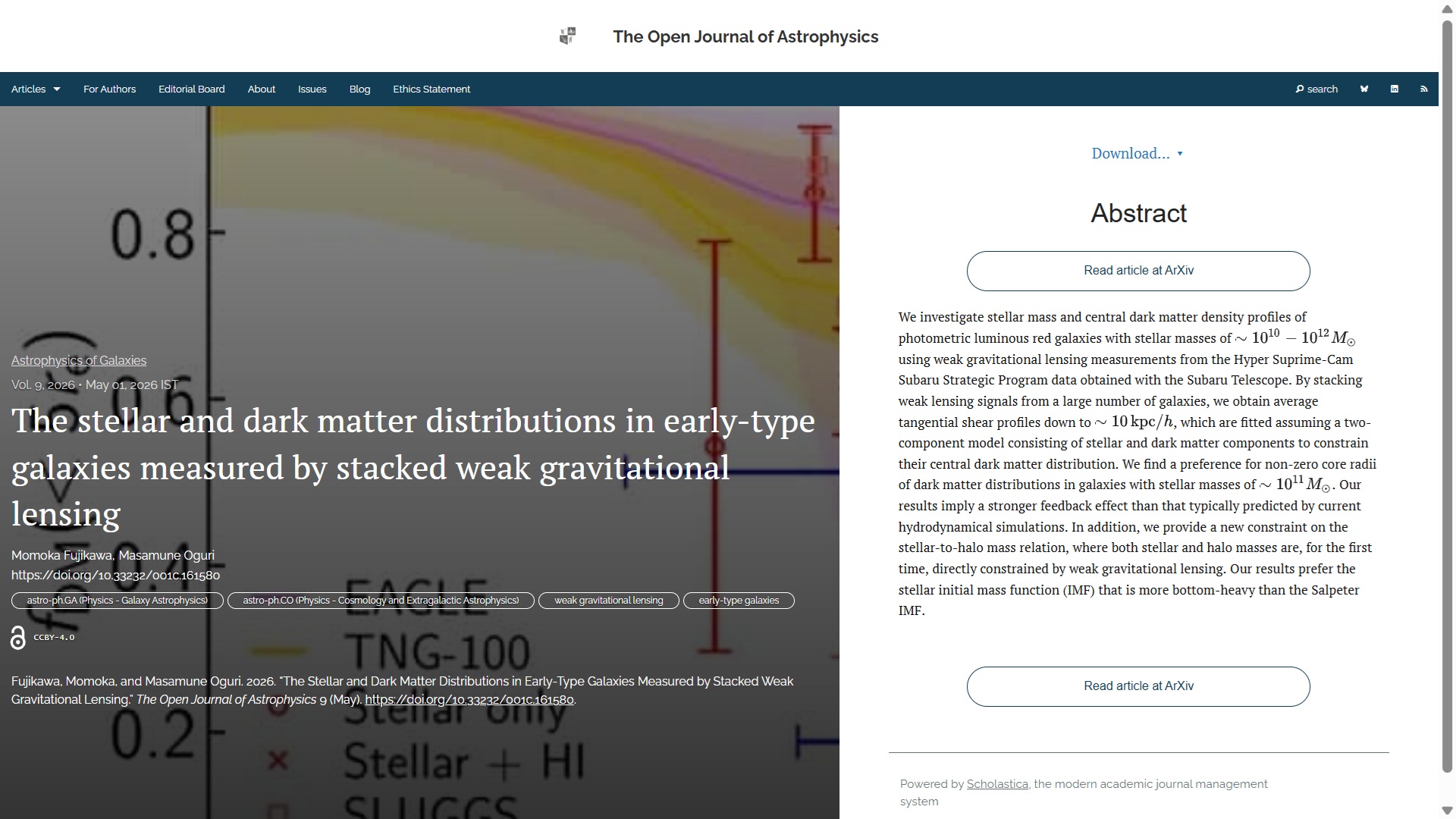
New Publication at the Open Journal of Astrophysics: "The stellar and dark matter distributions in early-type galaxies measured by stacked weak gravitational lensing" by Momoka Fujikawa & Masamune Oguri (Chiba University, Japan)
So here we are again, on a Saturday morning, with another update of activity at the Open Journal of Astrophysics. Since the last update we have published a further five papers, bringing the number in Volume 9 (2026) to 87 and the total so far published by OJAp up to 535.
I will continue to include the posts made on our Mastodon account (on Fediscience) to encourage you to visit it. Mastodon is a really excellent service, and a more than adequate replacement for X/Twitter (which nobody should be using); these announcements also show the DOI for each paper.
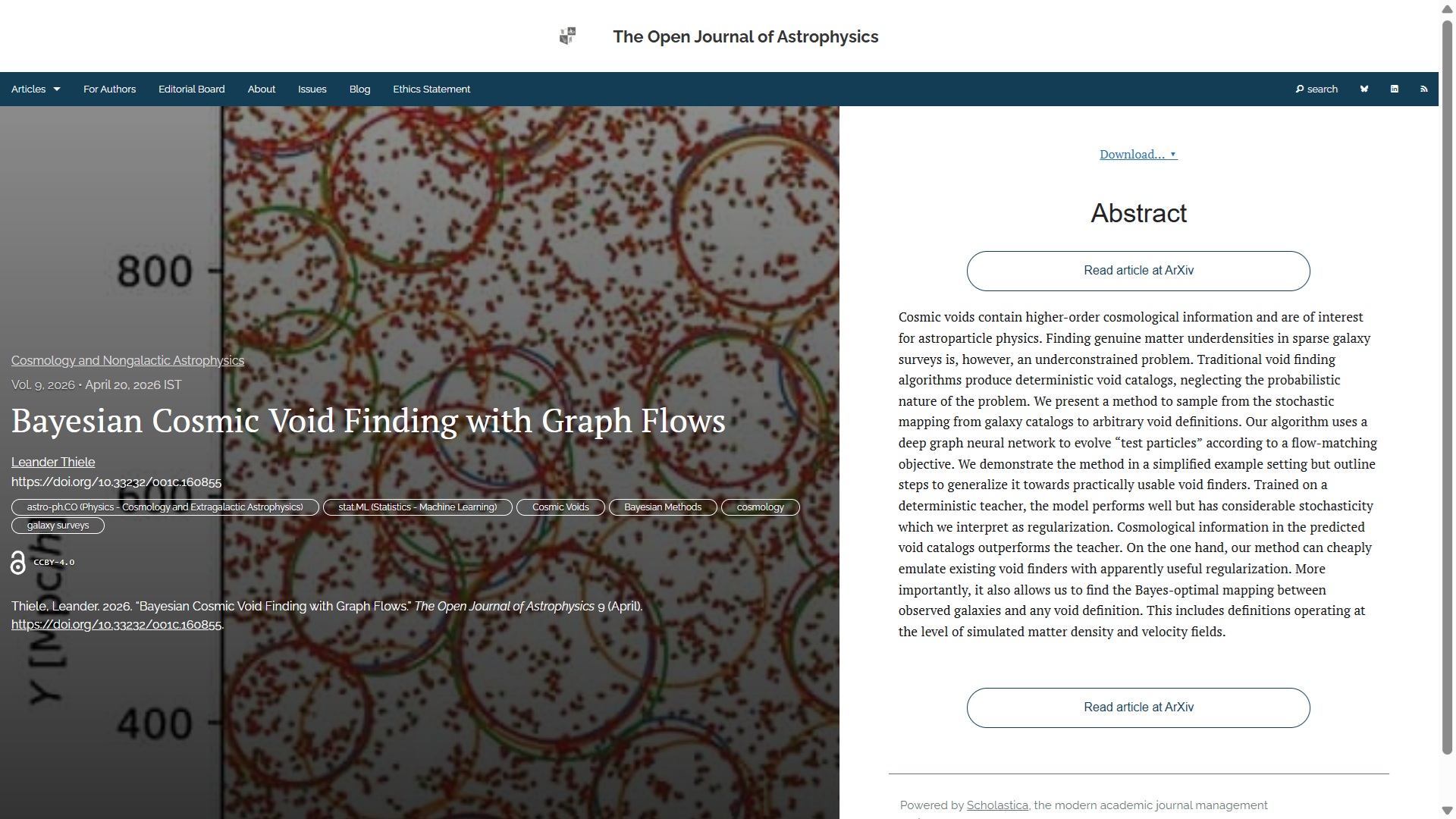
The first paper to report this week is “Bayesian Cosmic Void Finding with Graph Flows” by Leander Thiele (U. Tokyo, Japan). This was published on Monday 20th April in the folder Cosmology and Nongalactic Astrophysics. The paper presents a method using a deep graph neural network to identify cosmic voids in sparse galaxy surveys, improving upon traditional deterministic algorithms by considering the problem’s probabilistic nature. The overlay is here:
You can find the officially accepted version on arXiv here and the announcement on Fediverse here:
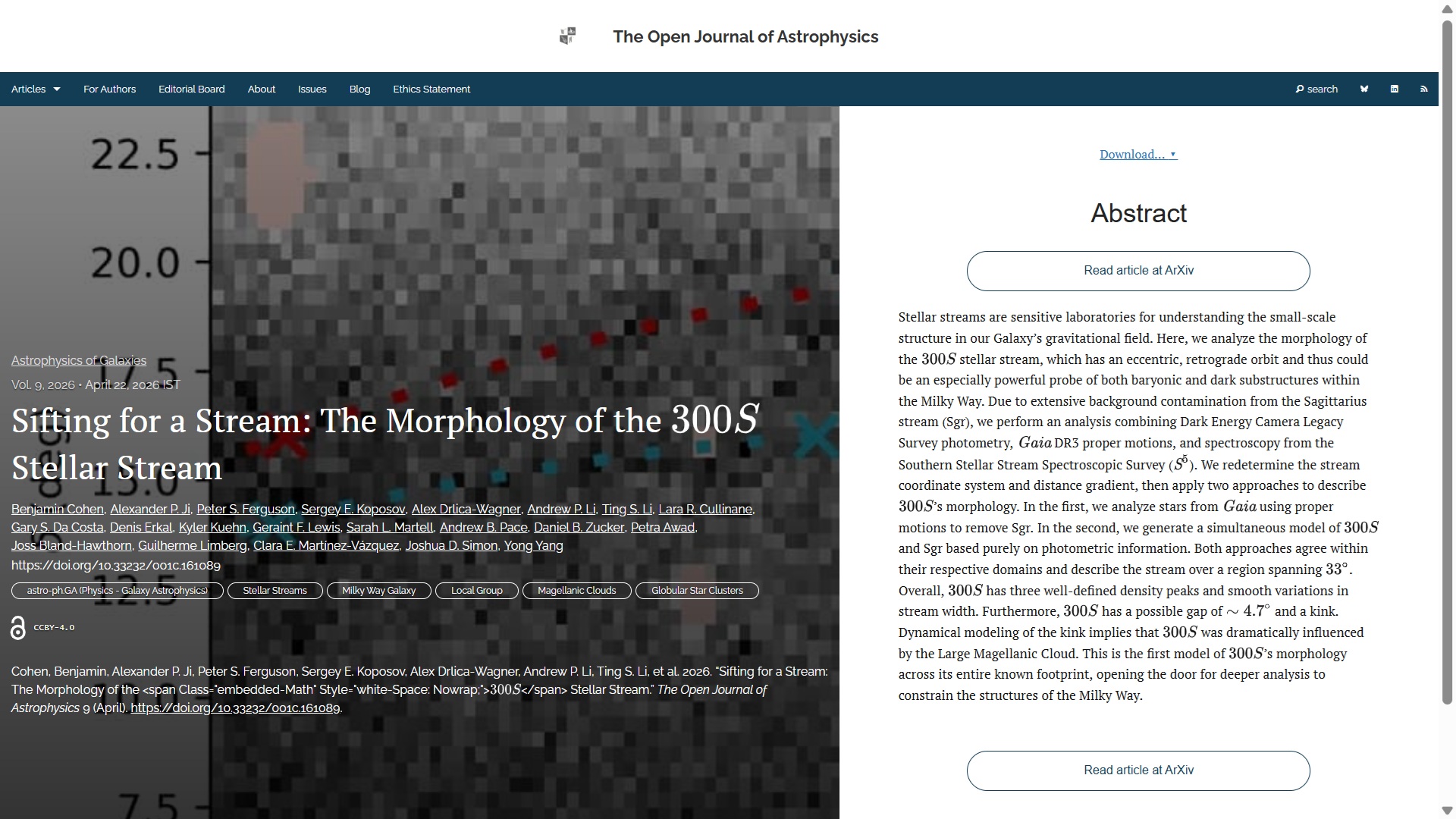
The second paper for this week, published on Wednesday 22nd April in the folder Astrophysics of Galaxies, is “Sifting for a Stream: The Morphology of the 300S Stellar Stream” by Benjamin Cohen (U. Chicago, USA) and 20 others distributed around the world. This study analyzes the morphology of the $300S$ stellar stream, revealing three density peaks, a possible gap, and a kink, suggesting significant influence from the Large Magellanic Cloud on its structure.
The overlay for this one is here:
The official version of the paper can be found on arXiv here and the Fediverse announcement here:
New Publication at the Open Journal of Astrophysics: "Sifting for a Stream: The Morphology of the 300S Stellar Stream" by Benjamin Cohen (U. Chicago, USA) and 20 others distributed around the world.
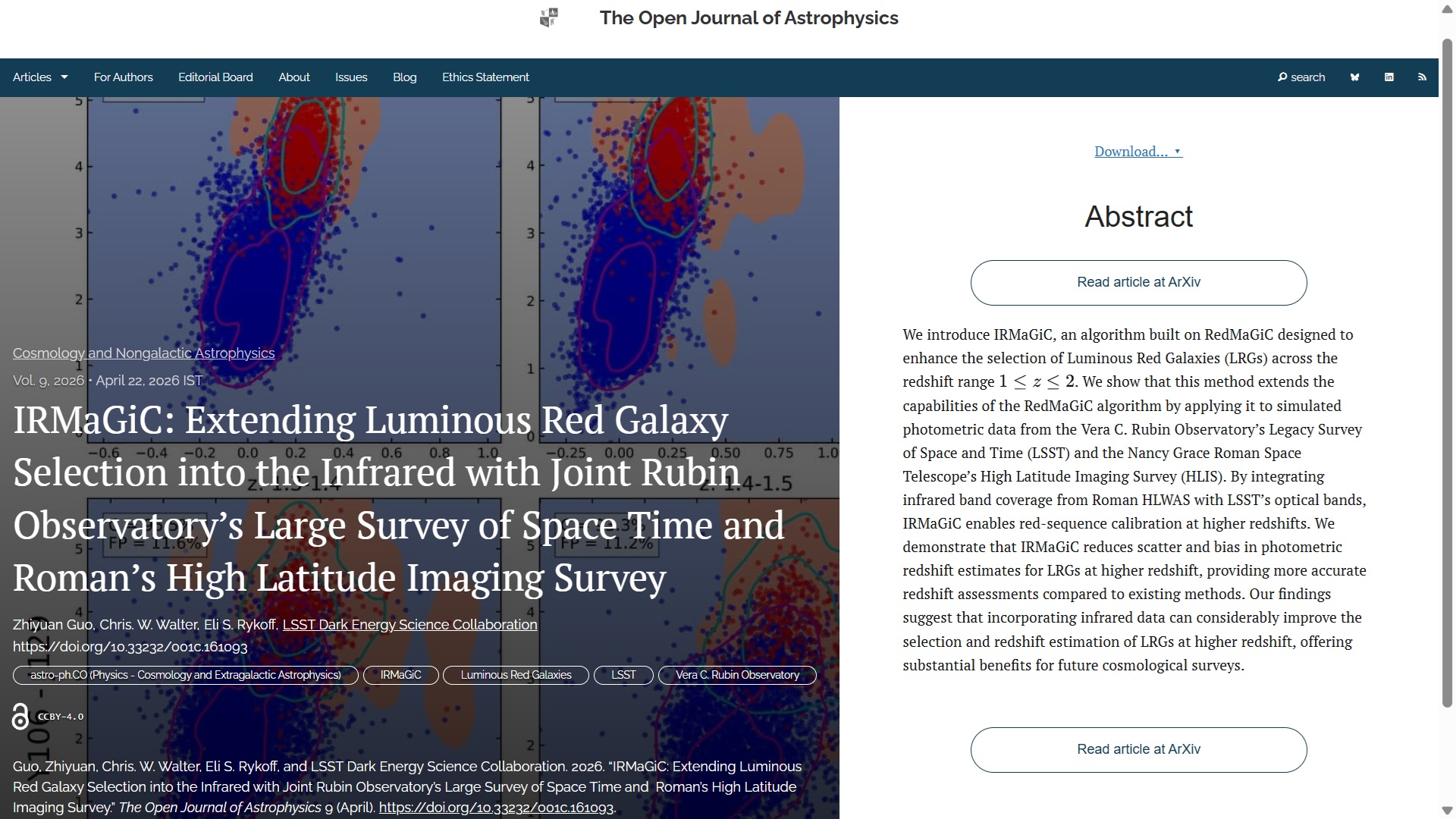
New Publication at the Open Journal of Astrophysics: "IRMaGiC: Extending Luminous Red Galaxy Selection into the Infrared with Joint Rubin Observatory’s Large Survey of Space Time and Roman’s High Latitude Imaging Survey" by Zhiyuan Guo & Chris. W. Walter (Duke U., USA) and Eli S. Rykoff (Stanford U., USA) on behalf of the LSST Dark Energy Science Collaboration
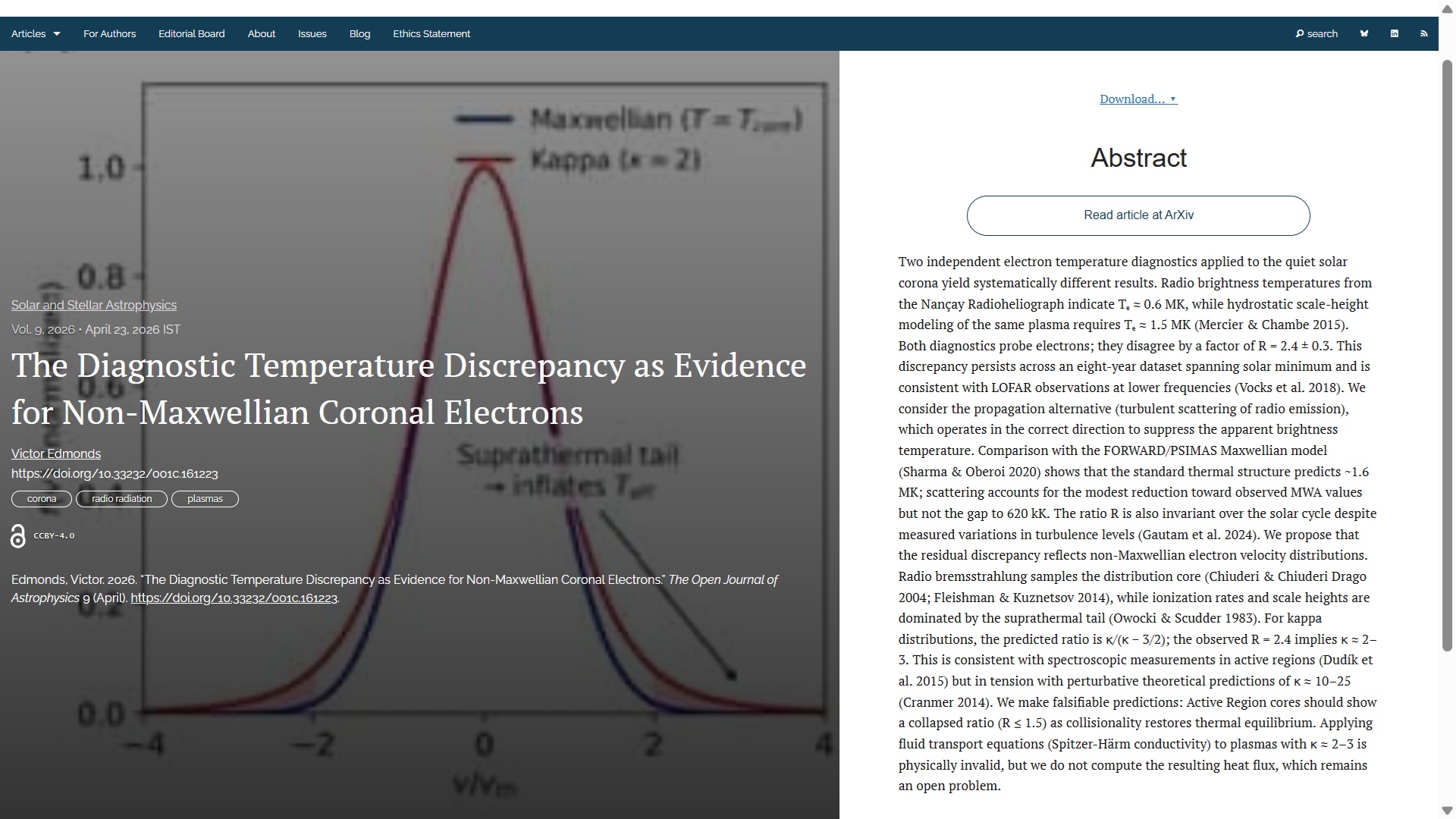
New Publication at the Open Journal of Astrophysics: "The Diagnostic Temperature Discrepancy as Evidence for Non-Maxwellian Coronal Electrons" by Victor Edmonds (Final Stop Consulting, USA)
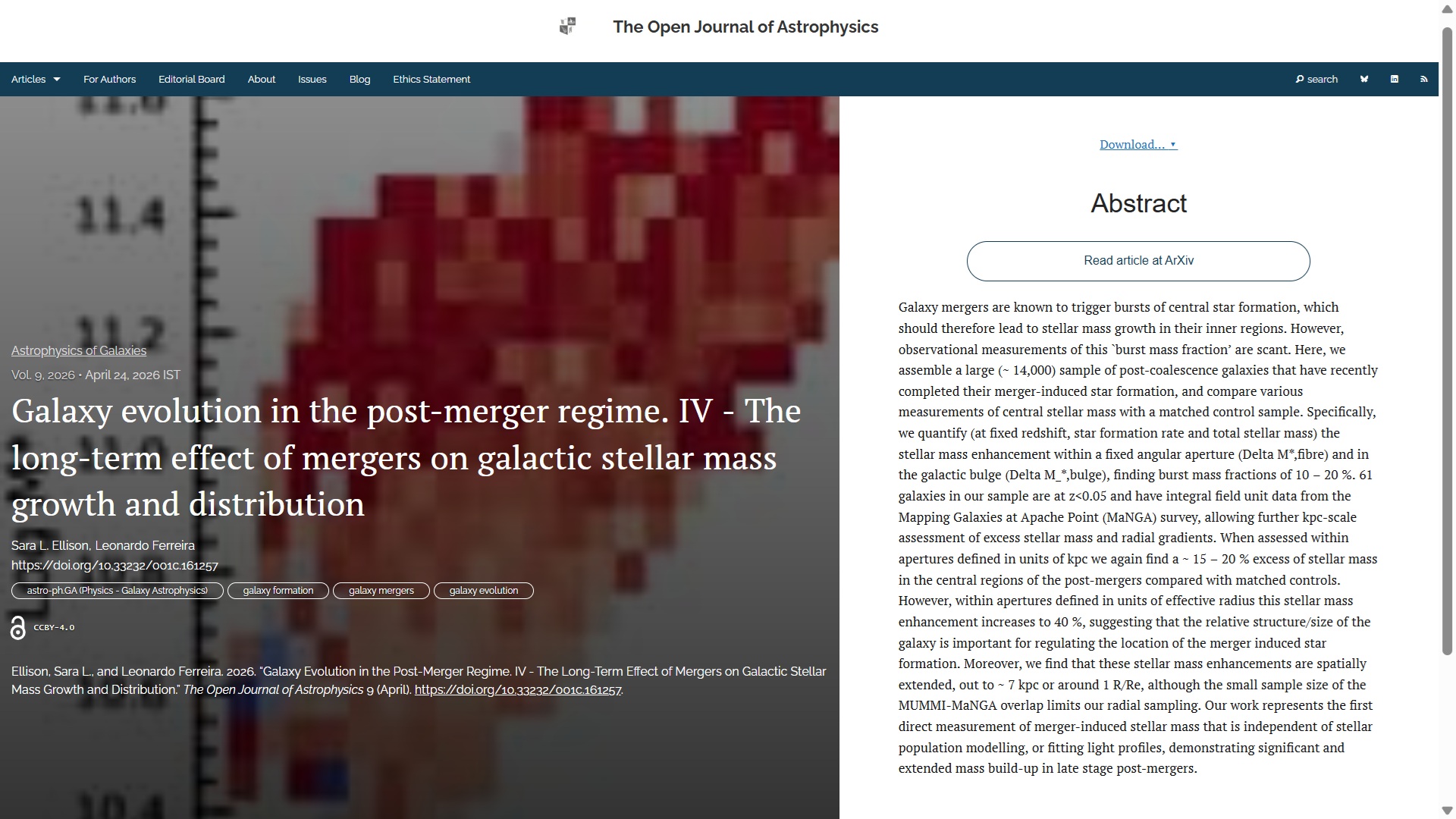
The fifth and final paper for this week was published on Friday 24th April in the folder Astrophysics of Galaxies. The title is “Galaxy evolution in the post-merger regime. IV – The long-term effect of mergers on galactic stellar mass growth and distribution” by Sara L. Ellison (U. Victoria, Canada) and Leonardo Ferreira (Universidade Federal do Rio Grande, Brazil). This study uses a large sample of post-merger galaxies to demonstrate that galaxy mergers trigger significant and extended stellar mass growth in their central regions, independent of stellar population modelling.
The overlay is here:
You can find the authorized version of this paper on arXiv here and the Fediverse announcement is here:
New Publication at the Open Journal of Astrophysics: "Galaxy evolution in the post-merger regime. IV – The long-term effect of mergers on galactic stellar mass growth and distribution" by Sara L. Ellison (U. Victoria, Canada) and Leonardo Ferreira (Universidade Federal do Rio Grande, Brazil)
New Publication at the Open Journal of Astrophysics: "Galaxy evolution in the post-merger regime. IV – The long-term effect of mergers on galactic stellar mass growth and distribution" by Sara L. Ellison (U. Victoria, Canada) and Leonardo Ferreira (Universidade Federal do Rio Grande, Brazil)
It is Saturday morning, and therefore time for yet another update of activity at the Open Journal of Astrophysics. Since the last update we have published a further six papers, bringing the number in Volume 9 (2026) to 82 and the total so far published by OJAp up to 530.
I will continue to include the posts made on our Mastodon account (on Fediscience) to encourage you to visit it. Mastodon is a really excellent service, and a more than adequate replacement for X/Twitter (which nobody should be using); these announcements also show the DOI for each paper.
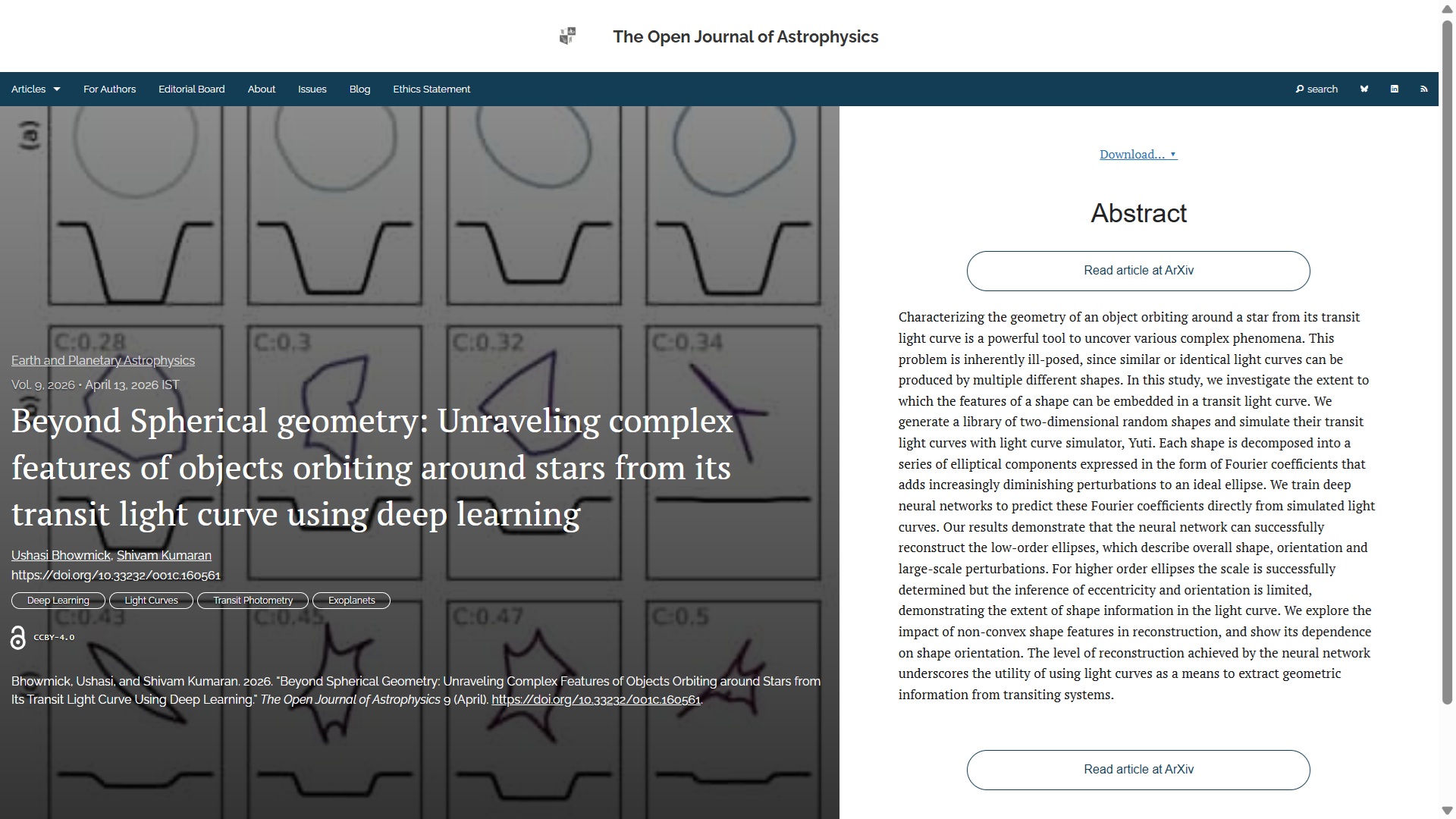
New Publication at the Open Journal of Astrophysics: "Beyond Spherical geometry: Unraveling complex features of objects orbiting around stars from its transit light curve using deep learning" by Ushasi Bhowmick & Shivam Kumaran (ISRO, Ahmedabad, India)
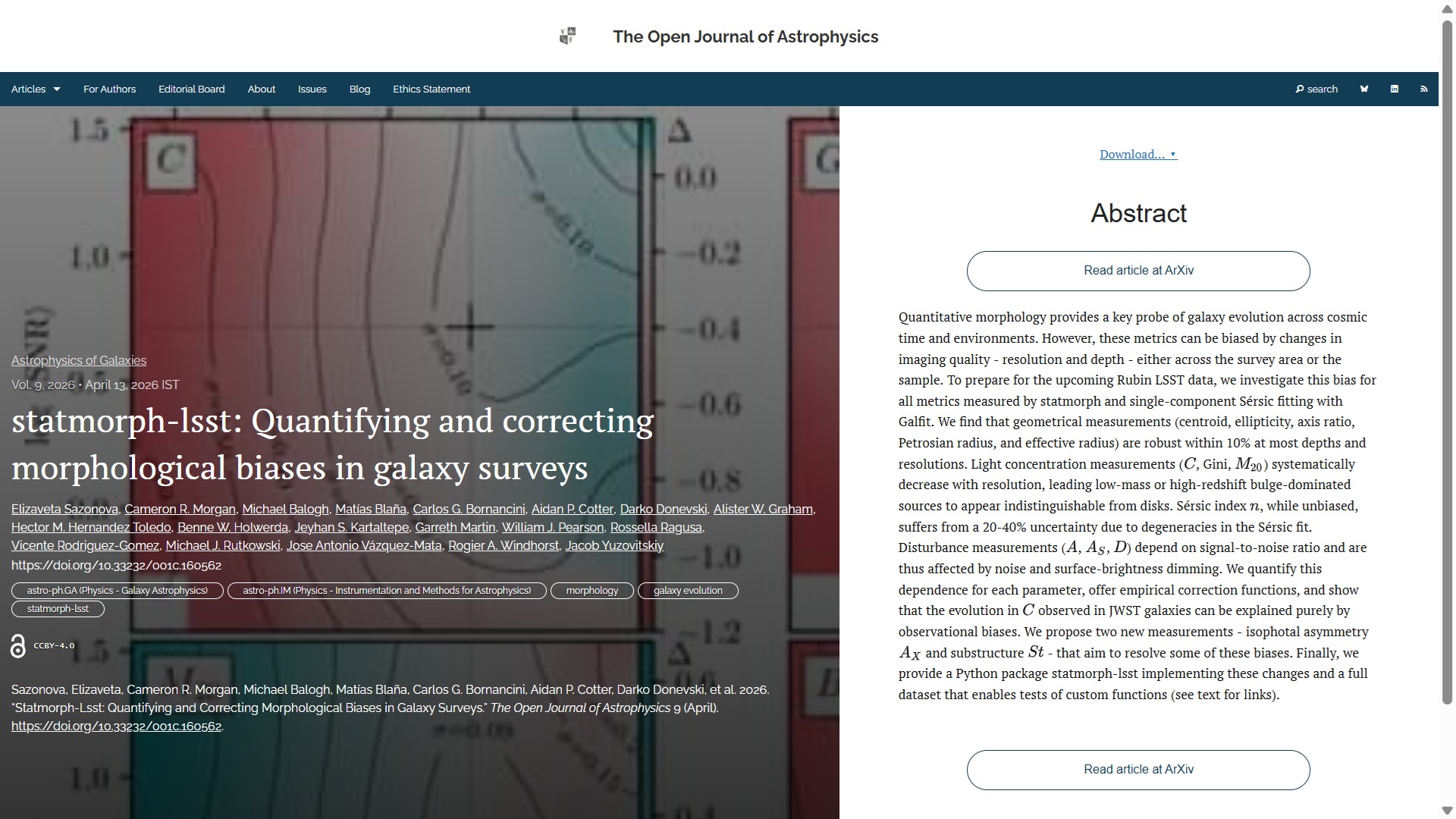
The second paper for this week, also published on Monday 13th April but in the folder Astrophysics of Galaxies, is “statmorph-lsst: Quantifying and correcting morphological biases in galaxy surveys” by Elizaveta Sazonova (U. Waterloo, Canada) and an international cast of 18 others. This paper presents an investigation of potential biases in quantitative morphology metrics used in galaxy evolution studies, proposing two new measurements to resolve biases, and provides a related Python package (statmorph-lsst), which can be found here on github.
The overlay for this one is here:
The official version of the paper can be found on arXiv here and the Fediverse announcement here:
New Publication at the Open Journal of Astrophysics: "statmorph-lsst: Quantifying and correcting morphological biases in galaxy surveys" by Elizaveta Sazonova (U. Waterloo, Canada) and an international cast of 18 others.
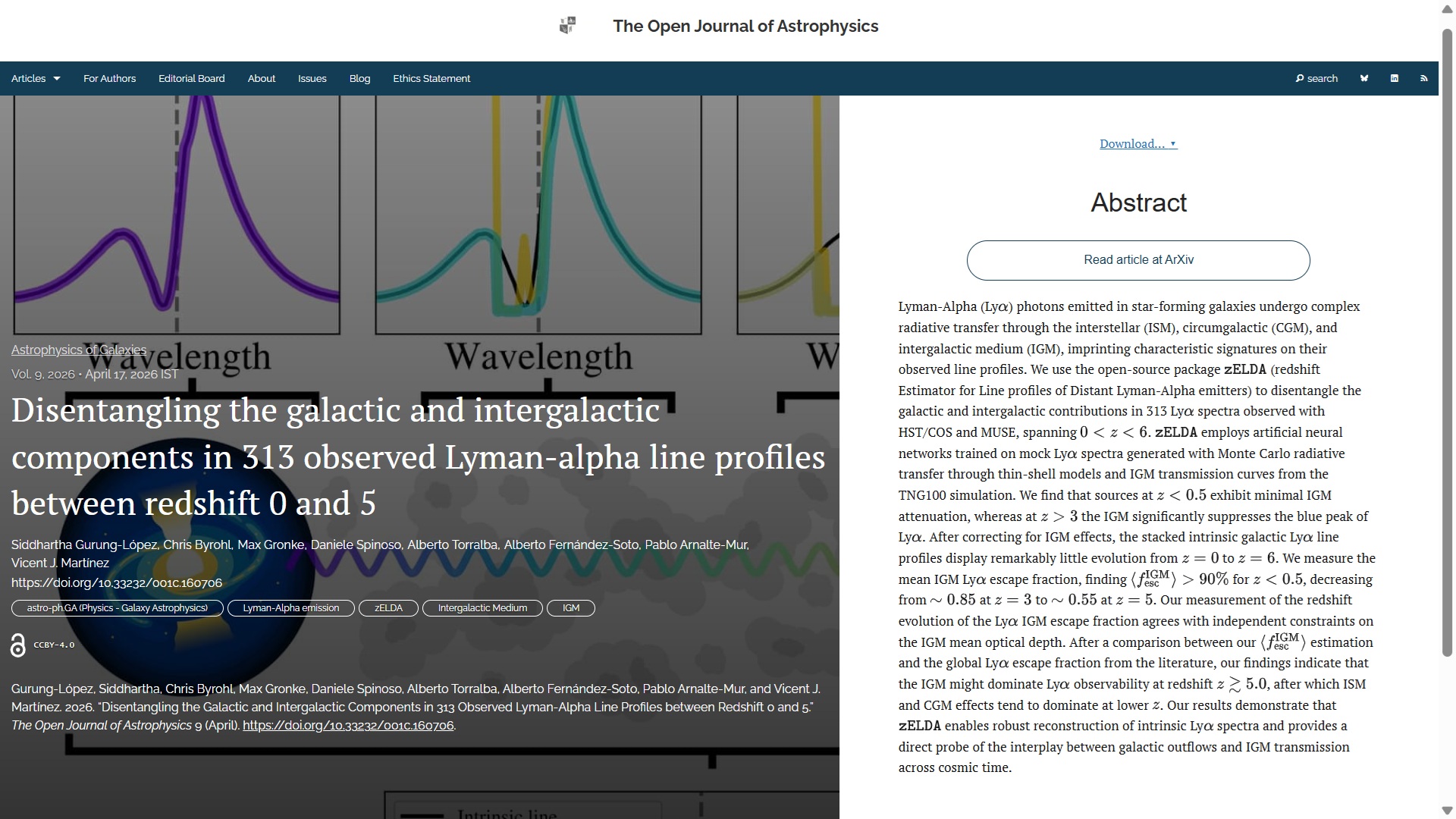
Next one up, the third paper of the week, one of four published on Friday 17th April, is “Disentangling the galactic and intergalactic components in 313 observed Lyman-alpha line profiles between redshift 0 and 5” by Siddhartha Gurung-López (Universitat de València, Spain) and 7 others based in Spain and Germany. Published in the folder Astrophysics of Galaxies, this paper uses the zELDA package to analyze Lyman-alpha photons from star-forming galaxies, revealing IGM effects dominate Lyman-alpha observability at high redshifts, while galactic outflows become more important at lower z.
The overlay for this one is here:
The final, accepted version can be found on arXiv here and the Mastodon announcement is here:
New Publication at the Open Journal of Astrophysics: "Disentangling the galactic and intergalactic components in 313 observed Lyman-alpha line profiles between redshift 0 and 5" by Siddhartha Gurung-López (Universitat de València, Spain) and 7 others based in Spain and Germany.
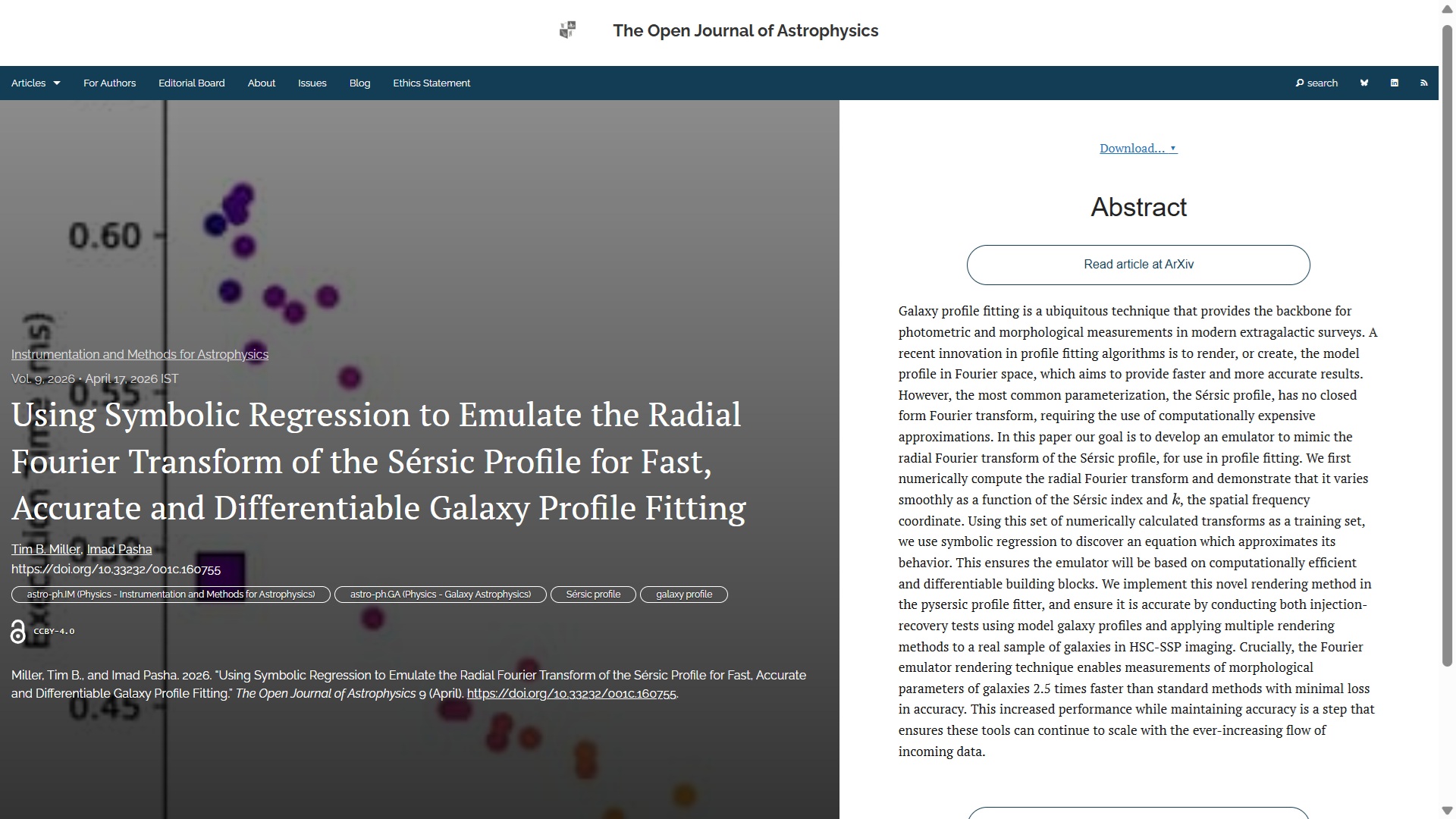
New Publication at the Open Journal of Astrophysics: "Using Symbolic Regression to Emulate the Radial Fourier Transform of the Sérsic Profile for Fast, Accurate and Differentiable Galaxy Profile Fitting" by Tim B. Miller (Northwestern University, USA) and Imad Pasha (Yale University, USA)
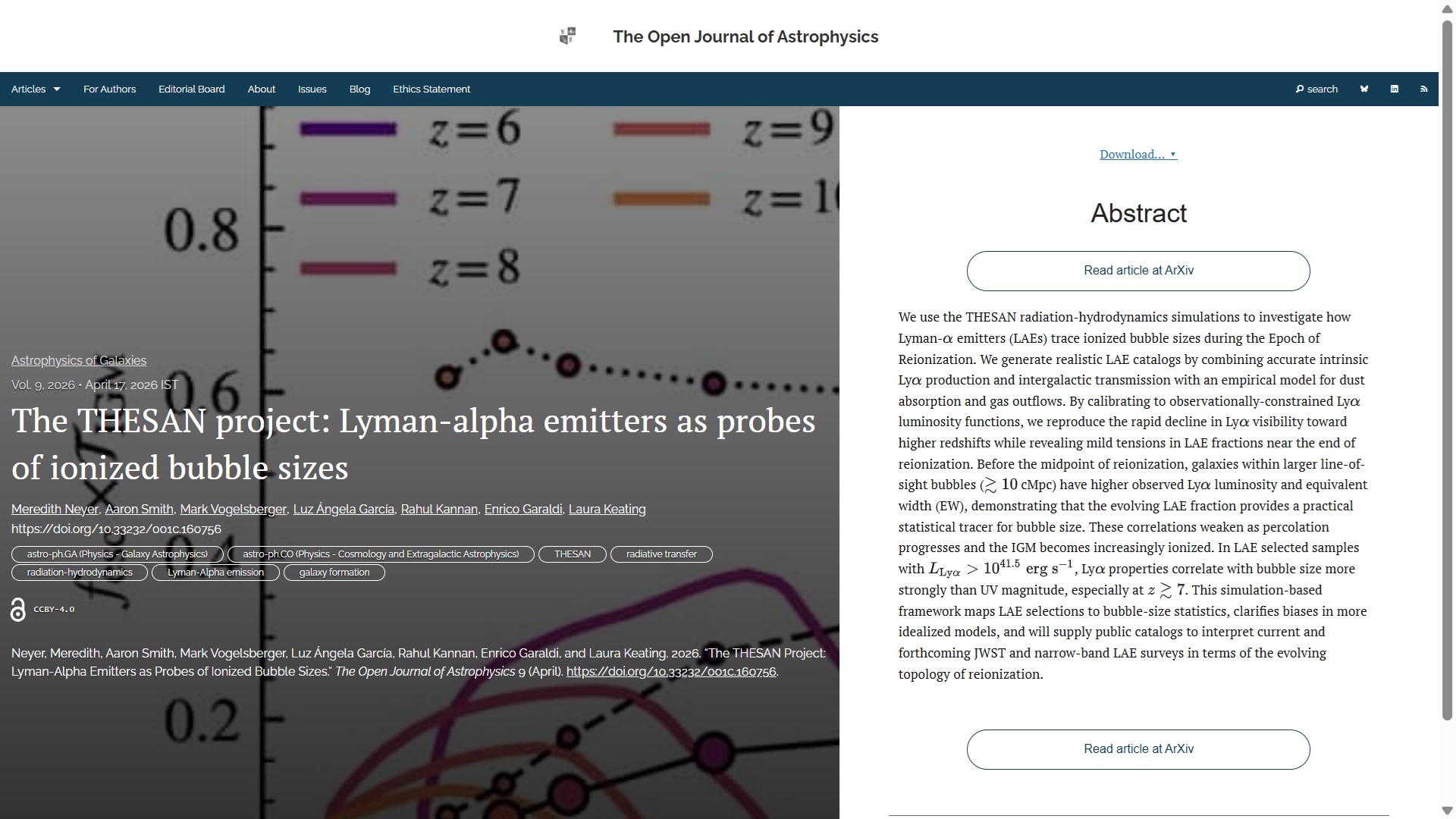
The fifth paper for this week is “The THESAN project: Lyman-alpha emitters as probes of ionized bubble sizes” by Meredith Neyer (MIT, USA) and 6 others based in the USA, Colombia, Canada, Japan and UK. The study uses THESAN simulations to explore how Lyman-alpha emitters (LAEs) trace ionized bubble sizes during the Epoch of Reionization, providing a framework for interpreting LAE surveys. This was published on Friday 17th April in the folder Astrophysics of Galaxies.
The overlay for this one is here:
You can find the authorized version of this paper on arXiv here and the Fediverse announcement is here:
New Publication at the Open Journal of Astrophysics: "The THESAN project: Lyman-alpha emitters as probes of ionized bubble sizes" by Meredith Neyer (MIT, USA) and 6 others based in the USA, Colombia, Canada, Japan and UK.
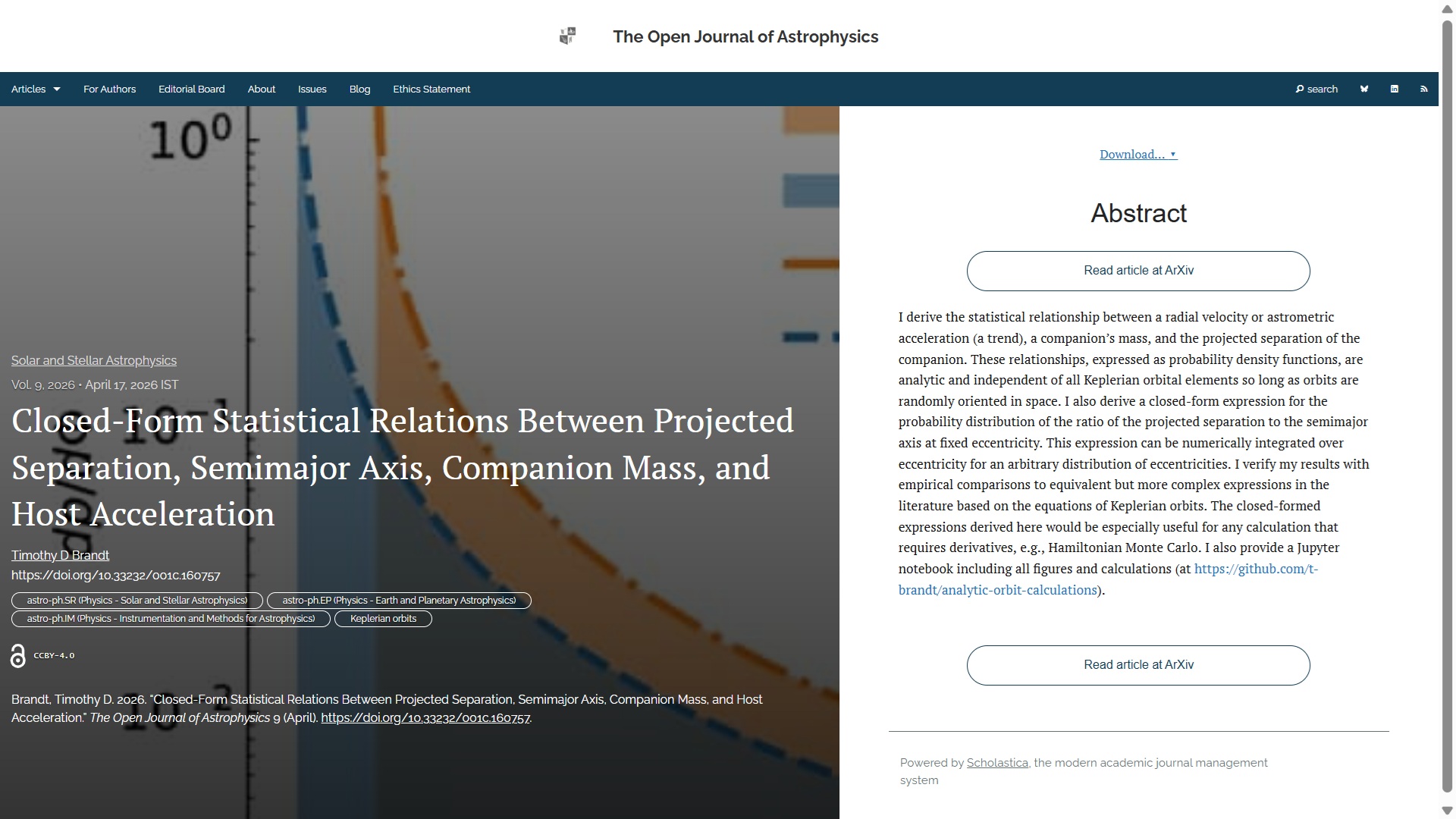
New Publication at the Open Journal of Astrophysics: "Closed-Form Statistical Relations Between Projected Separation, Semimajor Axis, Companion Mass, and Host Acceleration" by Timothy D Brandt (Space Telescope Science Institute, USA)
With permission, I have time for yet another Saturday morning update of activity at the Open Journal of Astrophysics. Since the last update we have published a further five papers, bringing the number in Volume 9 (2026) to 76 and the total so far published by OJAp up to 524.
I will continue to include the posts made on our Mastodon account (on Fediscience) to encourage you to visit it. Mastodon is a really excellent service, and a more than adequate replacement for X/Twitter (which nobody should be using); these announcements also show the DOI for each paper.
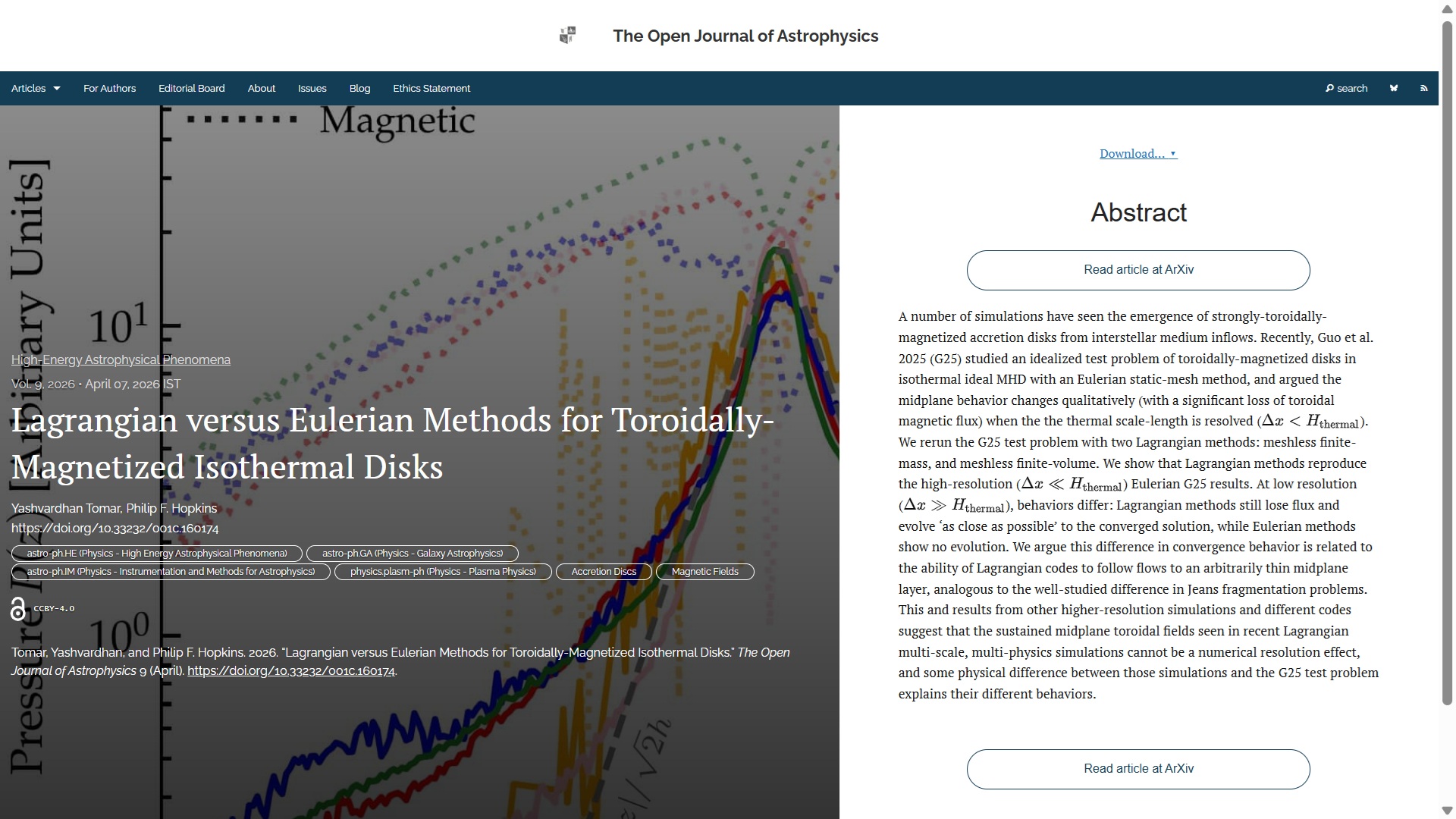
The first paper to report this week is “Lagrangian versus Eulerian Methods for Toroidally-Magnetized Isothermal Disks” by Yashvardhan Tomar and Philip F. Hopkins (California Institute of Technology, USA). This study re-evaluates previous research on toroidally-magnetized disks, using two Lagrangian methods. The results suggest that sustained midplane toroidal fields in recent simulations are not a numerical artefact. It was published on Tuesday April 7th 2026 in the folder High-Energy Astrophysical Phenomena.
The overlay is here:
You can find the officially accepted version on arXiv here and the announcement on Fediverse here:
New Publication at the Open Journal of Astrophysics: "Lagrangian versus Eulerian Methods for Toroidally-Magnetized Isothermal Disks" by Yashvardhan Tomar and Philip F. Hopkins (Caltech, USA)
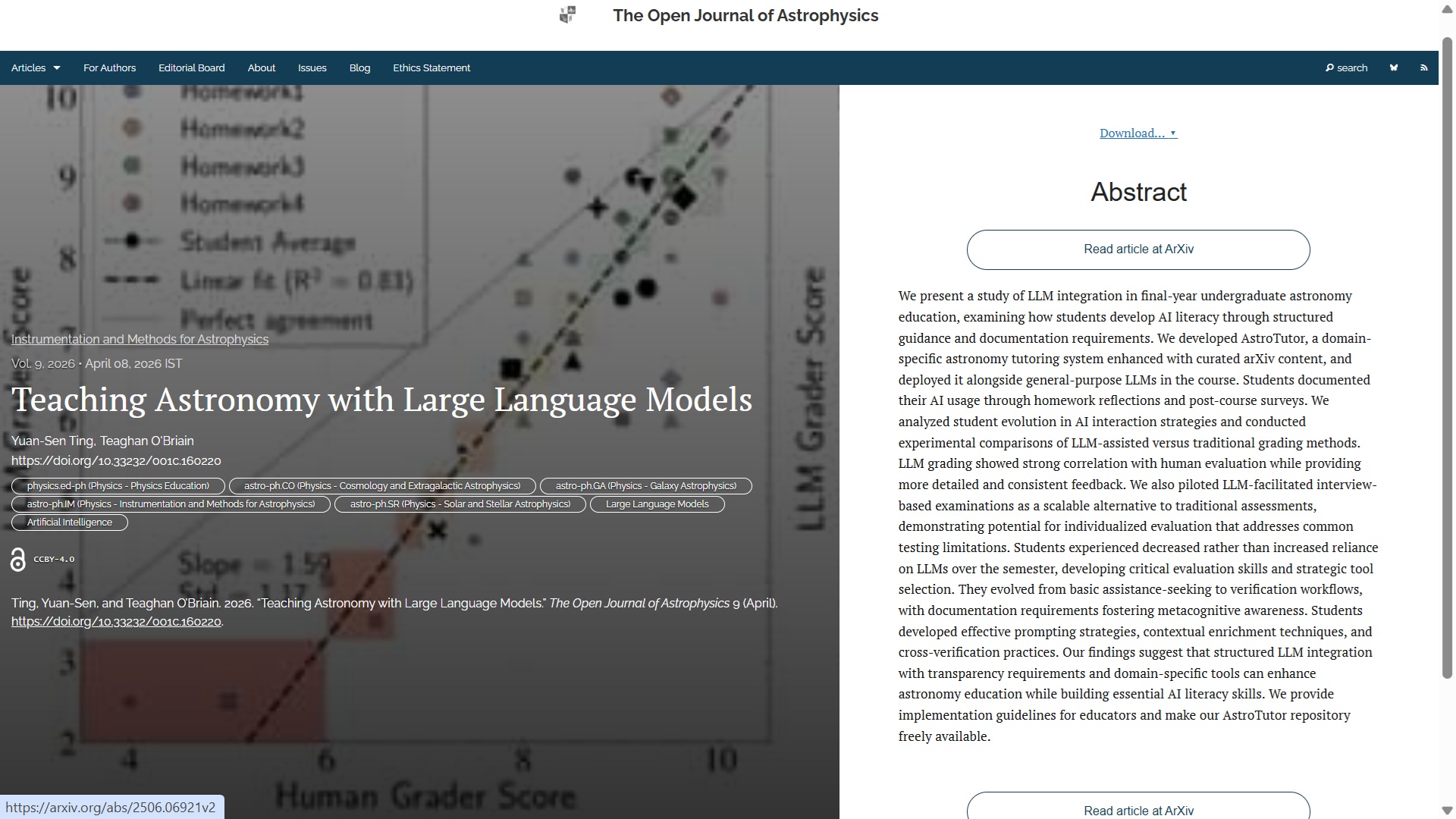
The second paper for this week, published on Wednesday 8th Apil in the folder Instrumentation and Methods for Astrophysics, is “Teaching Astronomy with Large Language Models” by Yuan-Sen Ting and Teaghan O’Briain (Ohio State University, USA). The paper introduces AstroTutor, an AI-enhanced astronomy tutoring system, to improve undergraduate astronomy education and AI literacy. It found that structured AI integration can enhance learning and critical evaluation skills. The primary classification on arXiv for this paper is physics.ed-ph but it is cross-listed on astro-ph which qualifies it for consideration.
The overlay for this one is here:
The official version of the paper can be found on arXiv here and the Fediverse announcement here:
New Publication at the Open Journal of Astrophysics: "Teaching Astronomy with Large Language Models" by Yuan-Sen Ting and Teaghan O'Briain (Ohio State University, USA)
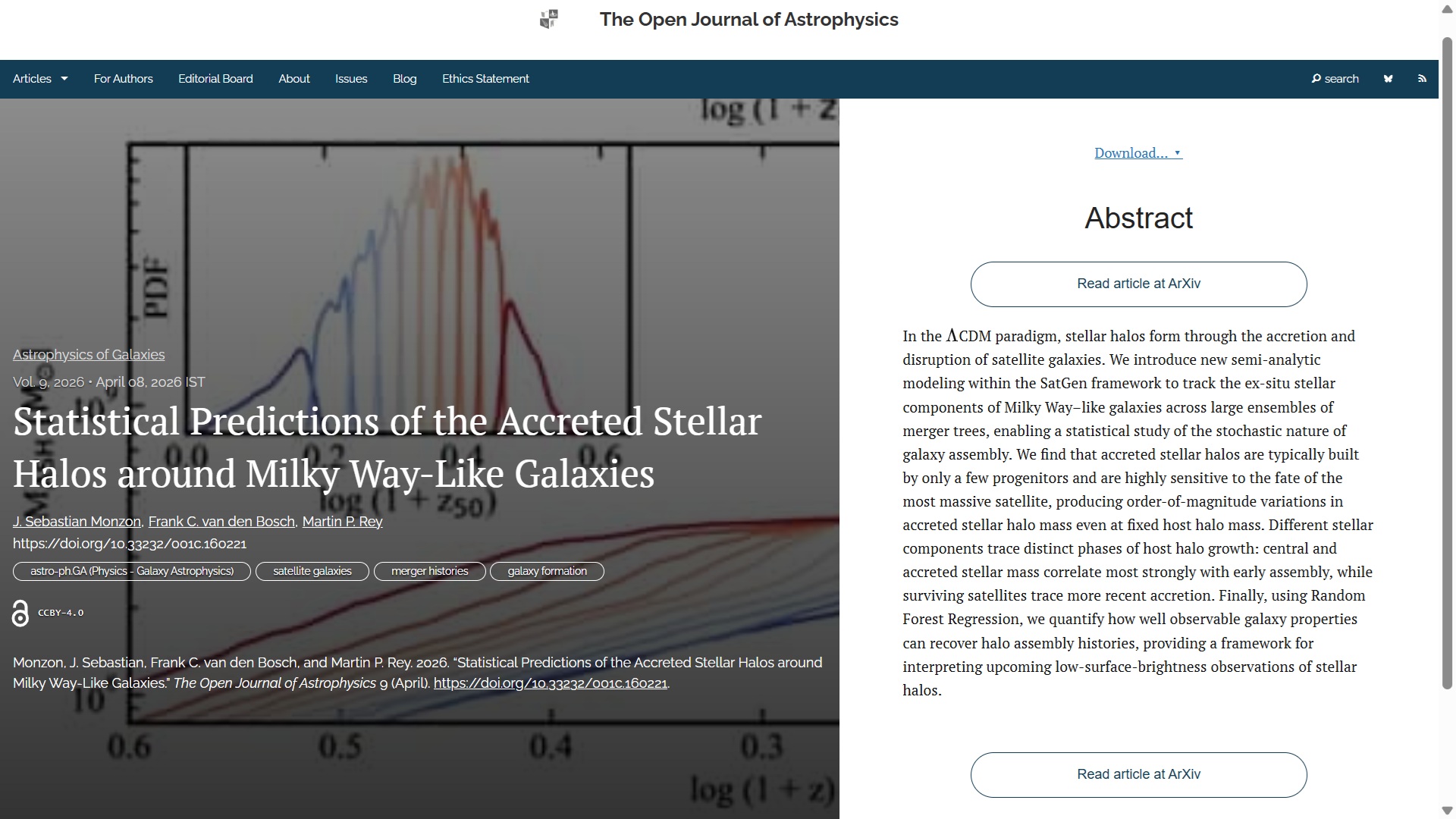
Next one up, the third paper of the week, also published on Wednesday 8th April, is “Statistical Predictions of the Accreted Stellar Halos around Milky Way-Like Galaxies” by J. Sebastian Monzon & Frank C. van den Bosch (Yale University, USA) and Martin P. Rey (University of Bath, UK). This one was published in the section Astrophysics of Galaxies; it describes new model to track formation of stellar halos in Milky Way-like galaxies, revealing their sensitivity to the fate of the largest satellite and whether accretion is early or late.
The overlay for this one is here:
The final, accepted version can be found on arXiv here and the Mastodon announcement is here:
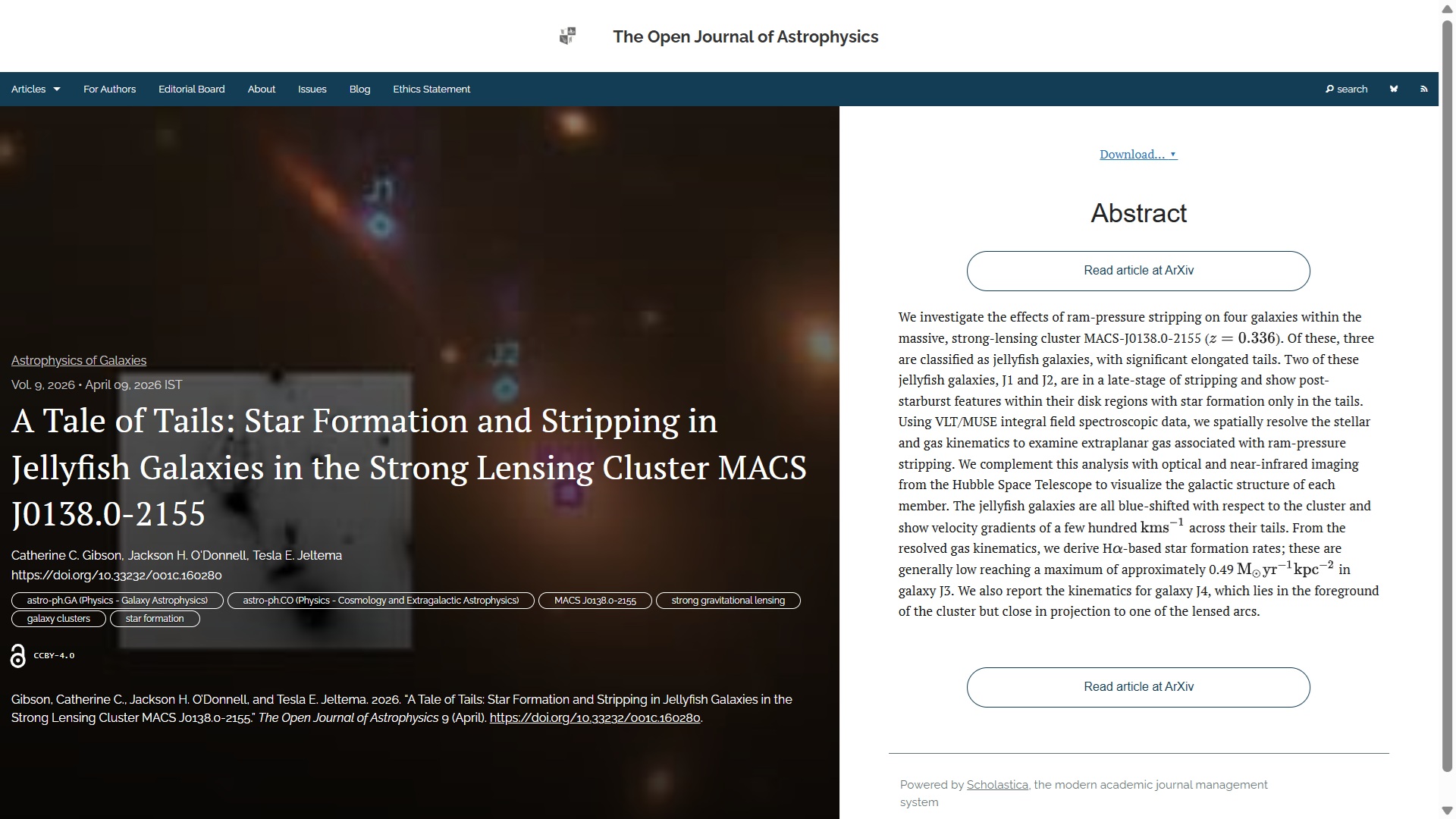
New Publication at the Open Journal of Astrophysics: "A Tale of Tails: Star Formation and Stripping in Jellyfish Galaxies in the Strong Lensing Cluster MACS J0138.0-2155" by Catherine C. Gibson, Jackson H. O'Donnell and Tesla E. Jeltema (UC Santa Cruz, USA)
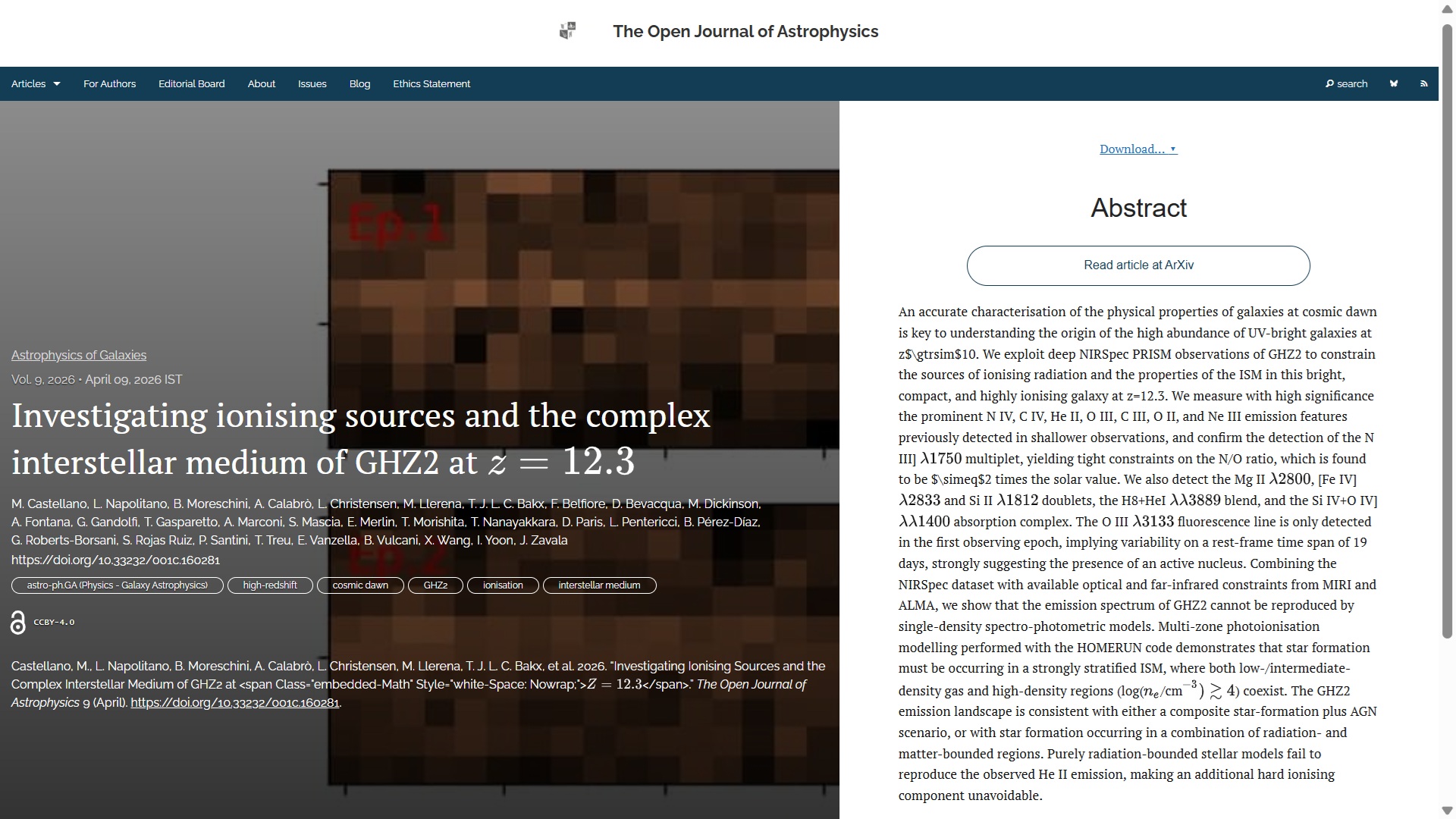
The fifth and final paper for this week is “Investigating ionising sources and the complex interstellar medium of GHZ2 at z=12.3” by M. Castellano (INAF Osservatorio Astronomico di Roma, Italy) and 29 others based all around the world. This was also published on Thursday 9th April in the folder Astrophysics of Galaxies. The paper uses deep observations of galaxy GHZ2 to explore the sources of ionising radiation and interstellar medium properties at cosmic dawn. Findings suggest a stratified environment and a hard ionising radiation component.
The overlay for this one is here:
The officially-accepted version of this one can be found on arXiv here and the Mastodon announcement is here
New Publication at the Open Journal of Astrophysics: "Investigating ionising sources and the complex interstellar medium of GHZ2 at z=12.3" by M. Castellano (INAF Osservatorio Astronomico di Roma, Italy) and 29 others based around the world.
I’m a bit late passing this news on, but a few weeks ago arXiv announced that from 1st July 2026 it will be establishing itself as an “independent nonprofit organization”. It has been hosted for many years by Cornell University. You can read here about the reasons for this and how it will work, and there is a lengthier article in Science magazine, but the quick summary is
This transition allows for faster technological development, greater organizational flexibility, expanded partnerships, and long-term financial sustainability. A platform built by scientists for scientists, the new arXiv will continue to serve researchers worldwide with the same dedication to free and open scientific discovery.
Such a move creates opportunities, but also carries risks. The sustainability of the new-look arXiv will depend on finding appropriate sources of income, for example. I wish arXiv well in this move. There’s an advertisement for the post of Chief Executive, if anyone fancies the job!
One possible future model for the Open Journal of Astrophysics is as a standalone non-profit organization of some sort, funded also by donations. Currently we are funded by the Library at Maynooth University, where I am based. Having made the decision not to charge fees of any kind, we lack any source of income other than the University. I am very grateful for that support, but we are run on a very tight budget. We keep costs to an absolute minimum, but are not free.
I have written before about what I think the future of Diamond Open Access could look like. I would like to see a range of Diamond Open Access journals offering a choice for authors and serving different sub-disciplines. Most universities nowadays have publishing operations so there could be network of federated journals, some based on arXiv and some based on other repositories and others with different models, such as SciPost. Perhaps institutions are worried about the expense but, as we have shown the actual cost, is far less than they are wasting on Article Processing Charges.
Everything is working well right now at OJAp, but it is not reasonable that the expense of running a journal that serves the global astrophysics community should fall entirely on one small University in Ireland. It won’t be sustainable in the long run, either, if we continue to grow at the present rate. Compare us with the Diamond Open Access publisher SCIPOST, which has a long list of sponsors covering its costs; we have none. My only hope at the moment of turning OJAp into an independent organization is to win the lottery!
Another thing makes me nervous. Many modern universities, which are nominally non-profit institutions, are managed by people who care far more about revenue generation than about academic scholarship and research. I worry that someone upstairs might pressurize us to introduce charges to generate income by threatening to close us down.
I know that money is very tight in astrophysics these days but if you have access to any potential sources of funding – then please consider supporting OJAp!
It may be the Easter weekend, but it’s still time for a Saturday morning update of activity at the Open Journal of Astrophysics. Since the last update we have published a further four papers, bringing the number in Volume 9 (2026) to 71 and the total so far published by OJAp up to 519. This update coimpletes the first quarter of 2026, which suggests that if we continue to publish at the same rate we’ll reach about 280 for the year.
I will continue to include the posts made on our Mastodon account (on Fediscience) to encourage you to visit it. Mastodon is a really excellent service, and a more than adequate replacement for X/Twitter (which nobody should be using); these announcements also show the DOI for each paper.
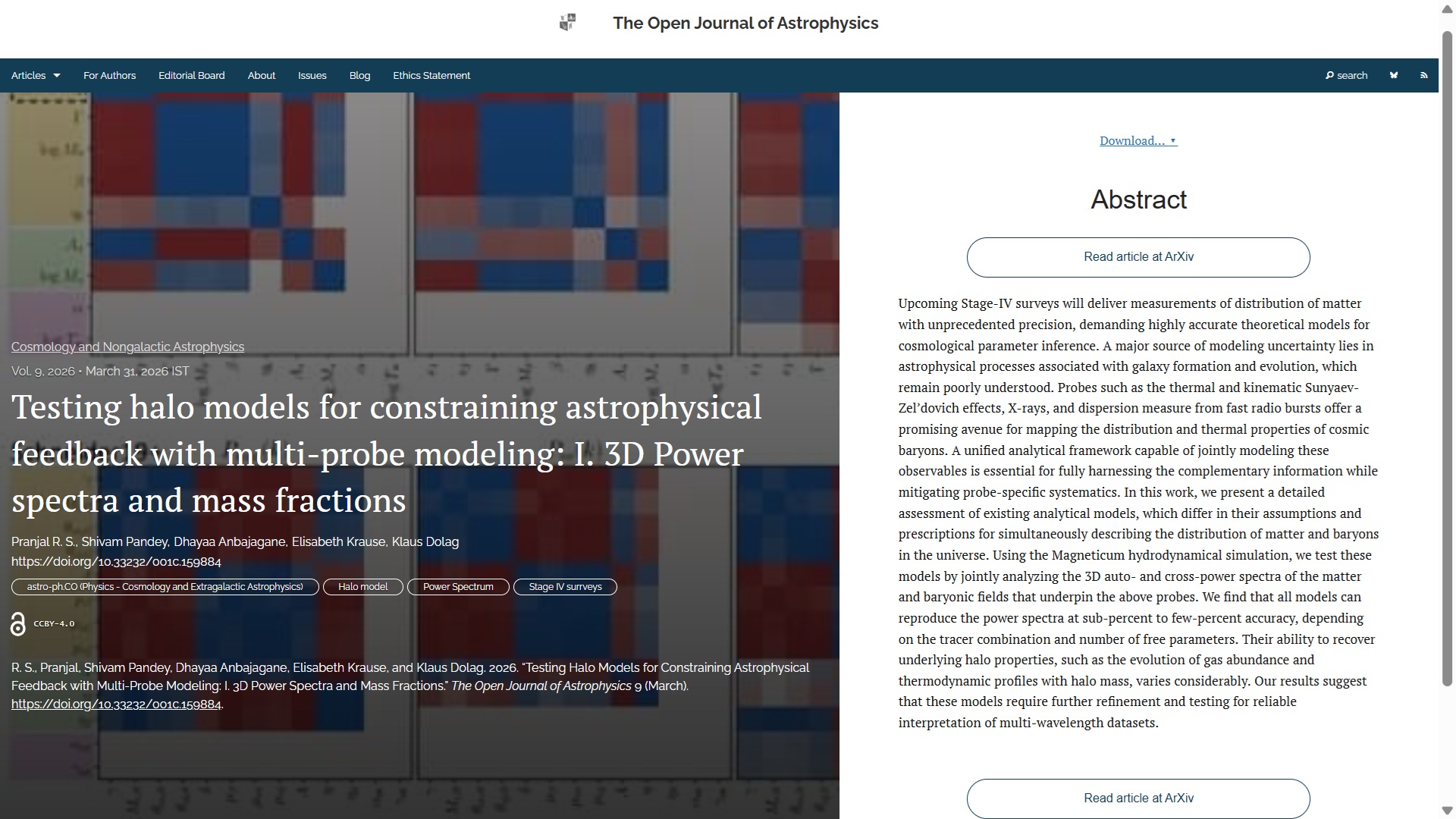
New Publication at the Open Journal of Astrophysics: "Testing halo models for constraining astrophysical feedback with multi-probe modeling: I. 3D Power spectra and mass fractions" by Pranjal R. S. (U. Arizona, USA), Shivam Pandey Johns Hopkins U., USA), Dhayaa Anbajagane (U. Chicago, USA), Elisabeth Krause (U. Arizona) and Klaus Dolag (Max Planck Institute for Astrophysics, Germany)
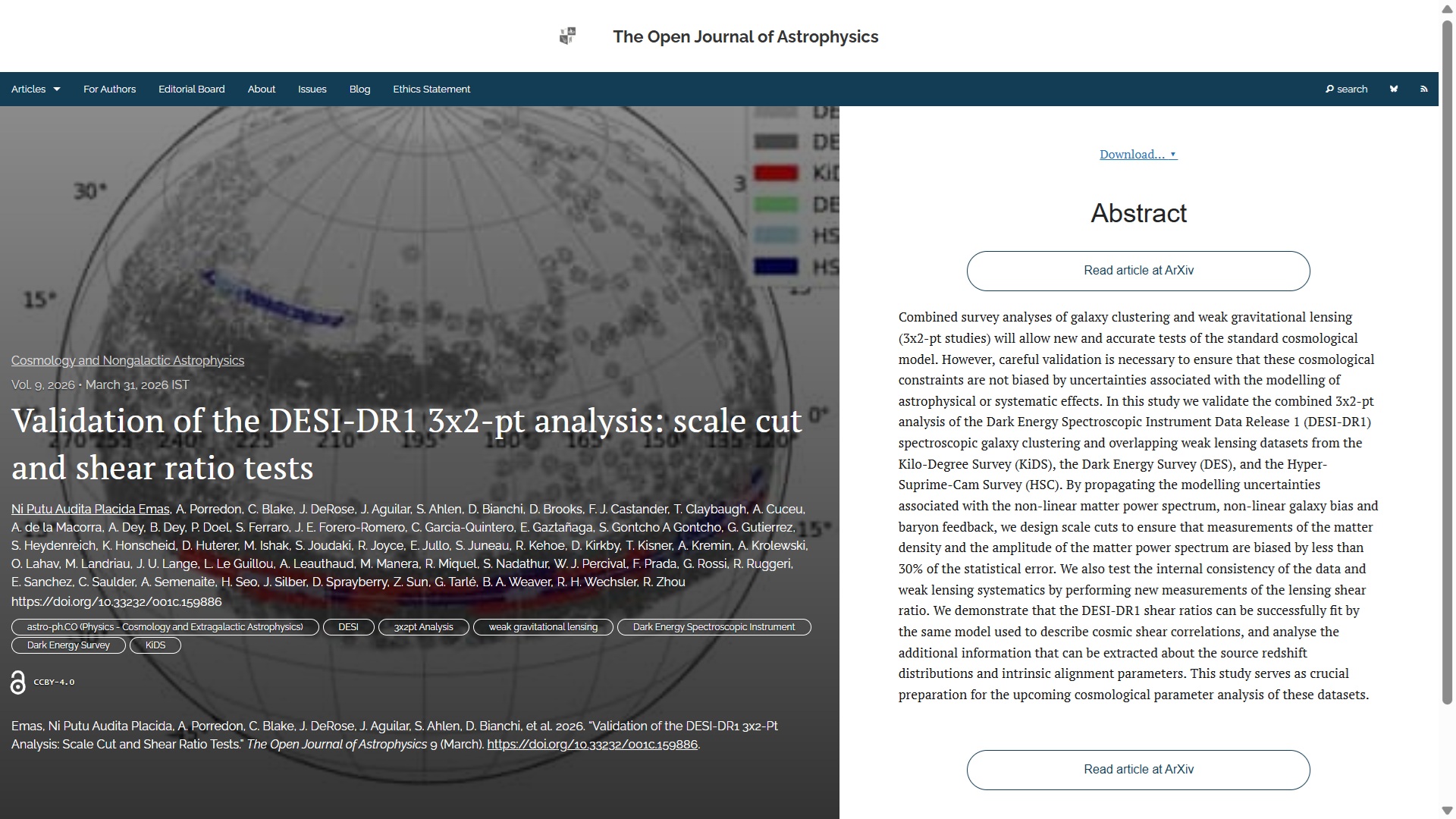
The second paper for this week, also published on Tuesday March 31st in the folder Cosmology and Nongalactic Astrophysics, is “Validation of the DESI-DR1 3×2-pt analysis: scale cut and shear ratio tests” by Ni Putu Audita Placida Emas (Swinburne University of Technology, Australia) and an international cast of 56 others. This study validates the combined analysis of galaxy clustering and weak gravitational lensing data from various surveys, ensuring accurate tests of the standard cosmological model using future Stage-IV surveys
The overlay for this one is here:
The official version of the paper can be found on arXiv here and the Fediverse announcement here:
New Publication at the Open Journal of Astrophysics: "Validation of the DESI-DR1 3×2-pt analysis: scale cut and shear ratio tests" by Ni Putu Audita Placida Emas (Swinburne University of Technology, Australia) and an international cast of 56 others.
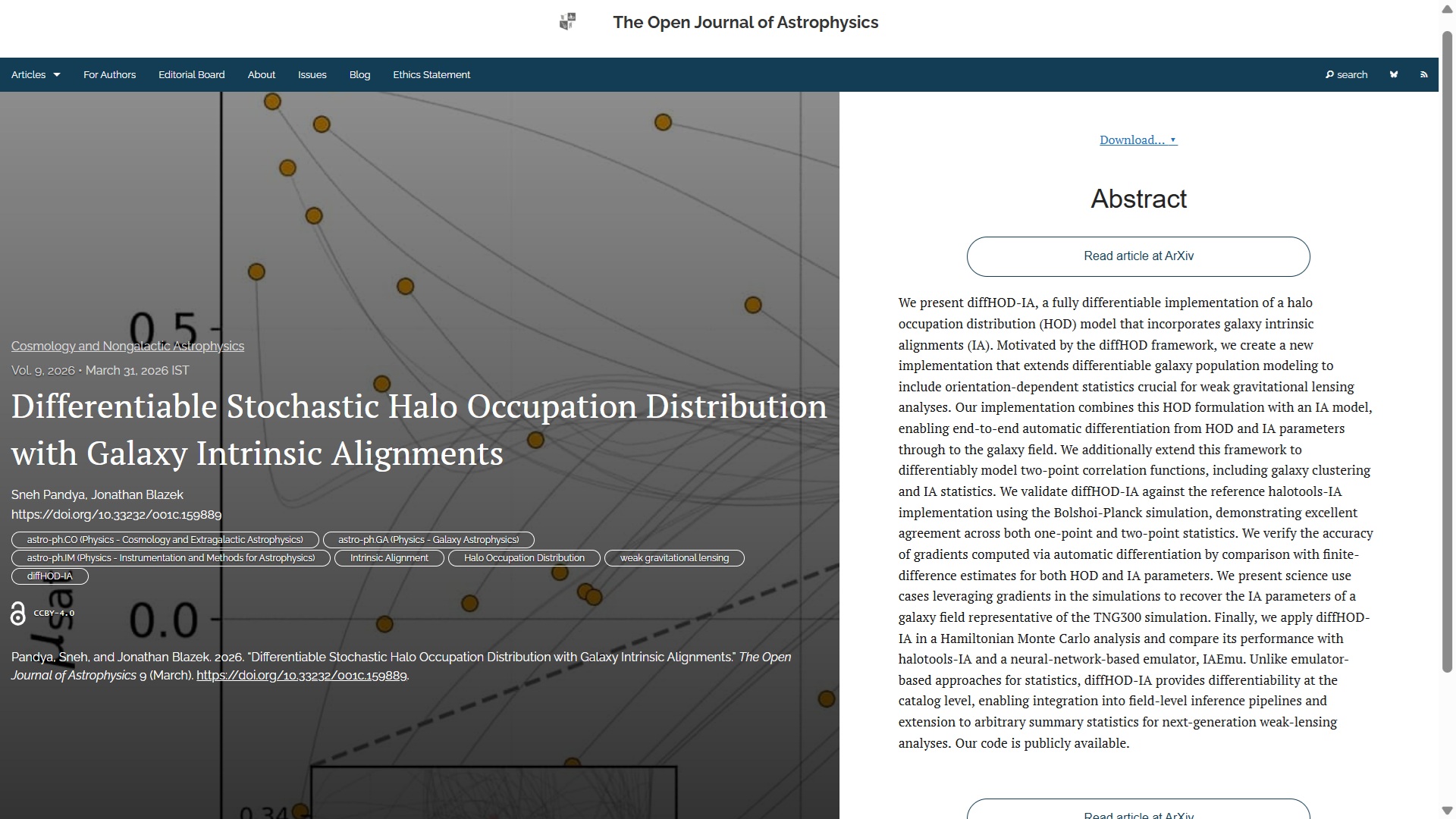
Next one up, the third paper of the week, also published on Tuesday March 31st in the folder Cosmology and Nongalactic Astrophysics, is “Differentiable Stochastic Halo Occupation Distribution with Galaxy Intrinsic Alignments” by Sneh Pandya and Jonathan Blazek (both of Northeastern University, USA). This is a paper introducing diffHOD-IA, a differentiable model for galaxy population analysis that incorporates intrinsic alignments and halo occupation distribution. It’s validated against existing models and can be used in next-generation weak-lensing analyses.
The overlay for this one is here:
The final, accepted version can be found on arXiv here and the Mastodon announcement is here:
New Publication at the Open Journal of Astrophysics: "Differentiable Stochastic Halo Occupation Distribution with Galaxy Intrinsic Alignments" by Sneh Pandya and Jonathan Blazek (Northeastern U., USA)
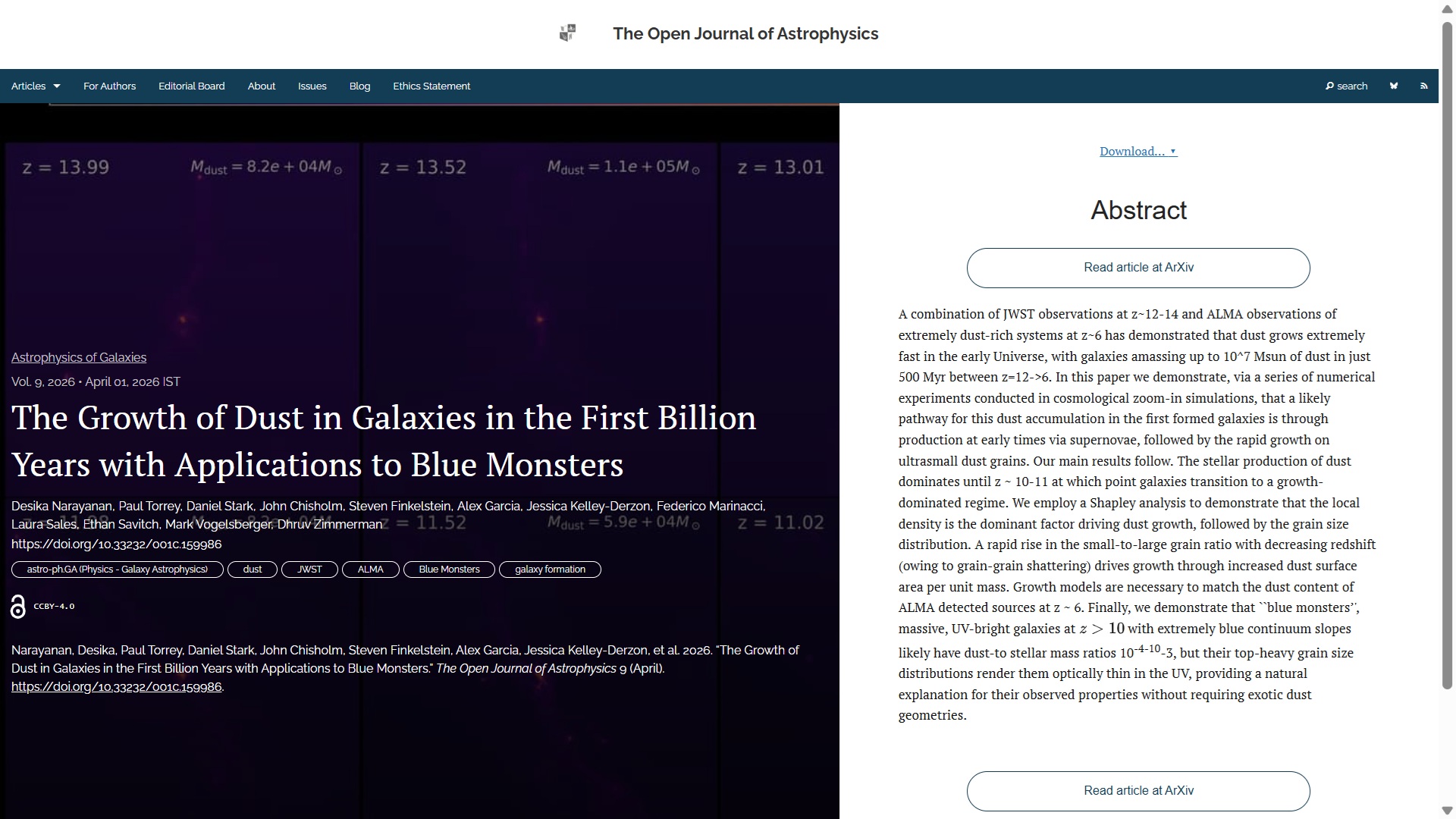
The fourth and final paper this week, published on Wednesday April 1st (but not a joke), is “The Growth of Dust in Galaxies in the First Billion Years with Applications to Blue Monsters” by Desika Narayanan (U. Florida, USA) and 11 others based in the USA and Europe. This one is in the folder Astrophysics of Galaxies; it presents a simulation-based study of dust accumulation in early galaxies via supernovae production and rapid growth on tiny dust grains, with local density and grain size being important factors.
The overlay is here:
The finally accepted version of this paper can be found here and the Mastodon announcement is here:
New Publication at the Open Journal of Astrophysics: "The Growth of Dust in Galaxies in the First Billion Years with Applications to Blue Monsters" by Desika Narayanan (U. Florida, USA) and 11 others based in the USA and Europe.
The views presented here are personal and not necessarily those of my employer (or anyone else for that matter).
Feel free to comment on any of the posts on this blog but comments may be moderated; anonymous comments and any considered by me to be vexatious and/or abusive and/or defamatory will not be accepted. I do not necessarily endorse, support, sanction, encourage, verify or agree with the opinions or statements of any information or other content in the comments on this site and do not in any way guarantee their accuracy or reliability.