Autumn Repeats Again

Posted in Education, History, Maynooth with tags , , , on August 6, 2026 by telescoper

The repeat examination period at Maynooth University has begun. In fact the first papers were sat yesterday (5th August); the period goes on for ten days or so, I will have four different papers to grade, though I’m expecting only one candidate each for three of them. My first is tomorrow (Friday 7th August).

A couple of years ago, Maynooth University produced this nice good luck message for those resitting so I’ll repeat it here:

Every year at this time I mention the difference between the system of repeats in Maynooth compared to other institutions with which I am familiar, especially in the UK. Elsewhere, students generally take resits when, because they have failed one or more examinations the previous May, they have not accumulated sufficient credits to proceed to the next year of their course. Passing the resit allows them to retrieve lost credit, but their mark is generally capped at a bare pass (usually 40%). That means the student gets the credit they need for their degree but their average (which determines whether they get 1st, 2nd or 3rd class Honours) is affected. This is the case unless a student has extenuating circumstances affecting the earlier examination, such as bad health or family emergency, in which case they take the resit as a `sit’, i.e. for the first time with an uncapped mark.

Here in Maynooth, however, the mark obtained in a repeat examination is usually not capped. Indeed, some students – though not many – elect to take the repeat examination even if they passed earlier in the summer, in order to increase their average mark.

Some people don’t like the idea of uncapped repeats because they feel that it would lead to many students playing games, i.e. deliberately not taking exams in May with the intention of spreading some of their examination  load into August. For this reason the Institute of Physics has decided to impose capped resits as part of its accreditation requirements. Some people here seem to think IOP accreditation is worth having so we’re being pushed into that requirement. I find it heavy-handed and unhelpful. I also think it imposes a dreary uniformity on physics courses in the UK. In any case, IOP accreditation is unimportant unless you want to do postgraduate study in physics in the UK (and often not even then). It doesn’t matter at all anywhere else.

If you think students have an unfair advantage if they don’t take a full diet of examinations in May, then the logical conclusion is that part-time students have an unfair advantage as do students taking micro-credentials consisting of just one or two modules. It’s the essence of the modular system that each module result should be considered on its own merit, not in relation to other modules a student may or may not have taken at the same time. One can of course argue whether the modular system is good or not, but if you have it then you should act consistently in accordance with it. You wouldn’t penalize students who have to work to support their study relative to those who don’t, would you?

And there’s no real evidence of students in Maynooth actually playing the system in the way the IOP thinks they do anyway. For one thing, the results from the repeat examination period are not confirmed until early September so that students that deploy this strategy do not know whether they are going to be able to resume their course until just a couple of weeks before term. That could cause lots of problems securing accommodation, etc, so it doesn’t seem to me to be a good ploy. Finalists adopting this strategy will not be able to graduate with the rest of their cohort and may miss several months of potential employment. I think most of our students are smart enough to realize that it’s a risky strategy.

Anyway, I’d welcome comments for or against whether resits/repeats should be capped/uncapped and on what practice is adopted in your institution.

Passports, Old and New

Posted in Biographical with tags , on August 5, 2026 by telescoper

So, three weeks to the day since I completed the online formalities, I received delivery today, by courier, of my new UK passport. Fair play to the Passport Office for their extremely efficient service. The only thing I don’t have is my previous (expired) passport which I am assured will arrive under separate cover. It being less valuable than a new one, presumably it will be sent by a cheaper and slower method.

I thought I would compare the new one (right) with my oldest old one (left; the first passport I ever had, issued in 1986, with the corner now cut off to show it is defunct):

The new one is black (or perhaps a very dark blue) but the old one is more of a navy blue. The new one is a bit smaller. The size of the old one was not consistent with international ID standards and was changed in 1992, at which point the colour was changed to burgundy red. The 1986 vintage is not a biometric passport either. The biggest difference however is that the old one is a bit battered from extensive use but this is unlikely to happen to the new one. I’ve already put it away for safe keeping. I don’t think I’ll be using it much so it will probably remain in a pristine state until it expires (or I do).

UPDATE: 07/08/2026. Just two days after the new one arrived, I got the old one (minus corner).

There Will Come Soft Rains

Posted in Literature, Poetry with tags , , , on August 4, 2026 by telescoper

In 1950 Ray Bradbury wrote a short story called There Will Come Soft Rains. The story appears in a collection called The Martian Chronicles. The title comes from poem of the same title, written in 1918 as a response to the horrors of World War 1:

There will come soft rains and the smell of the ground,
And swallows circling with their shimmering sound;
And frogs in the pools, singing at night,
And wild plum trees in tremulous white,
Robins will wear their feathery fire,
Whistling their whims on a low fence-wire;
And not one will know of the war, not one
Will care at last when it is done.
Not one would mind, neither bird nor tree,
If mankind perished utterly;
And Spring herself, when she woke at dawn,
Would scarcely know that we were gone.

by Sara Teasdale (1884-1933)

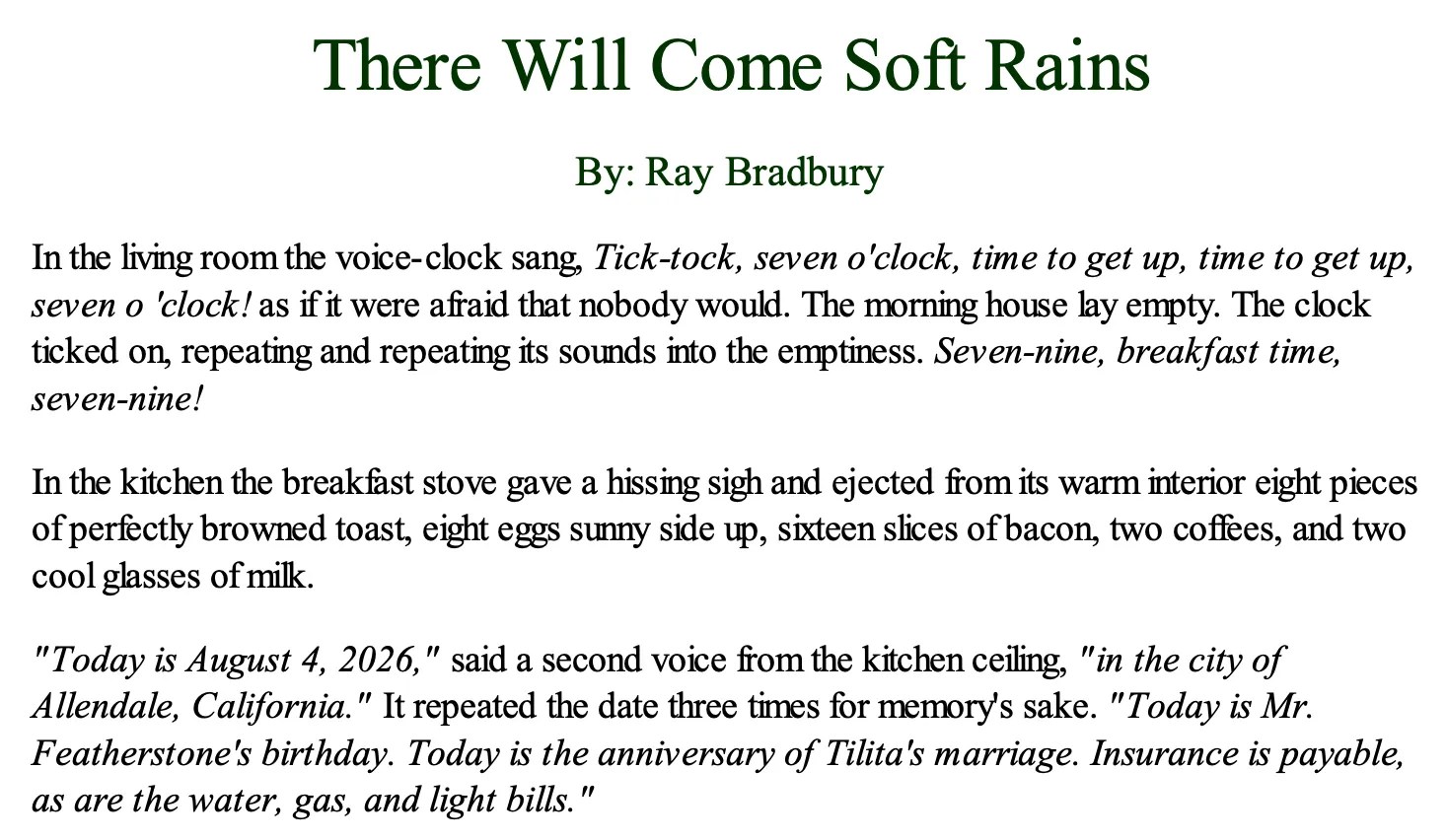
The Ray Bradbury story is set in the (then) distant future and describes, in a typically eery and unsettling way, the aftermath of a nuclear holocaust. One house, in Allendale Carlifornia, fully automated to provide for the comfort of its owners, carries on functioning after the owners are both vapourised by a nuclear blast. Beds continue to be made, meals prepared, floors cleaned, and dishes washed, by systems oblivious to the fact the owners are no more. The house recites to the ladyof the house one of her favoruite poems, There Will Come Soft Rains by Sara Teasdale. Then a fire starts by accident and the house burns to the ground.

I was reminded today that the date of the story (in the original version) is August 4, 2026. I looked for my copy of The Martian Chronicles when I got home but couldn’t find it. Here, however, are the opening few paragraphs:

The full text of the story can be found here (among a number of other places). It’s out of copyright.

Lá Saoire i mí Lúnasa

Posted in Biographical, Education, mathematics, Maynooth with tags , , , , on August 3, 2026 by telescoper

Today, Monday 3rd August 2026, being the first Monday in August, is a Bank Holiday in Ireland. This holiday was created by the Bank Holiday Act of 1871 when Ireland was under British rule. While the August Bank Holiday was subsequently moved to the end of August in England and Wales, it has remained at the start of August in Ireland. It has been a nice morning weather-wise, but in true Bank Holiday fashion we’re promised heavy rain later on, with a chance of thunderstorms.

As I mentioned on Saturday, the first day of August marks the old pagan festival of Lughnasadh, named after the God Lugh, on which is celebrated the beginning of the harvest season. This coincides with the English Lammas Day, one of many Christian festivals with pagan origins. Traditionally this is the start of the harvest season and is celebrated accordingly, with rites involving the first fruit and bread baked from flour obtained from the first corn. It is also one of the cross-quarter days, lying roughly half-way between the Summer Solstice and the Autumnal Equinox (in the Northern Hemisphere).

Two years ago at this time I was still on sabbatical. That seems like ages ago! When I resumed teaching, in September 2024, I had to teach two modules I’d never taught before: a fourth-year Mathematical physics course on Differential Equations and Complex Analysis and a second-year Engineering Mathematics course. I am doing both of these again so resumption of teaching in September won’t be as challenging, although I will be changing a few things in the light of last year’s experience. Lectures start on Monday 22nd September.

After I return to work tomorrow the next big item on the agenda is the repeat examination period, which starts on Wednesday August 5th. The first paper for which I have responsibility is on Friday 7th, but I won’t be able to get the scripts until Monday 10th so I have a bit of time to do other stuff before I start marking. I am not expecting many scripts, actually, so it shouldn’t be too onerous a task to get them done promptly.

Next week also sees the deadline for the dissertations for our MSc course. I have been supervising a student this year and will probably be asked to give comments on the final draft of his report. Then the MSc students have their presentations on Friday 14th August. They have all completed the taught component of the course so the only thing left to assess are these projects. Students will get their final results later this month, along with the resitting undergraduate students.

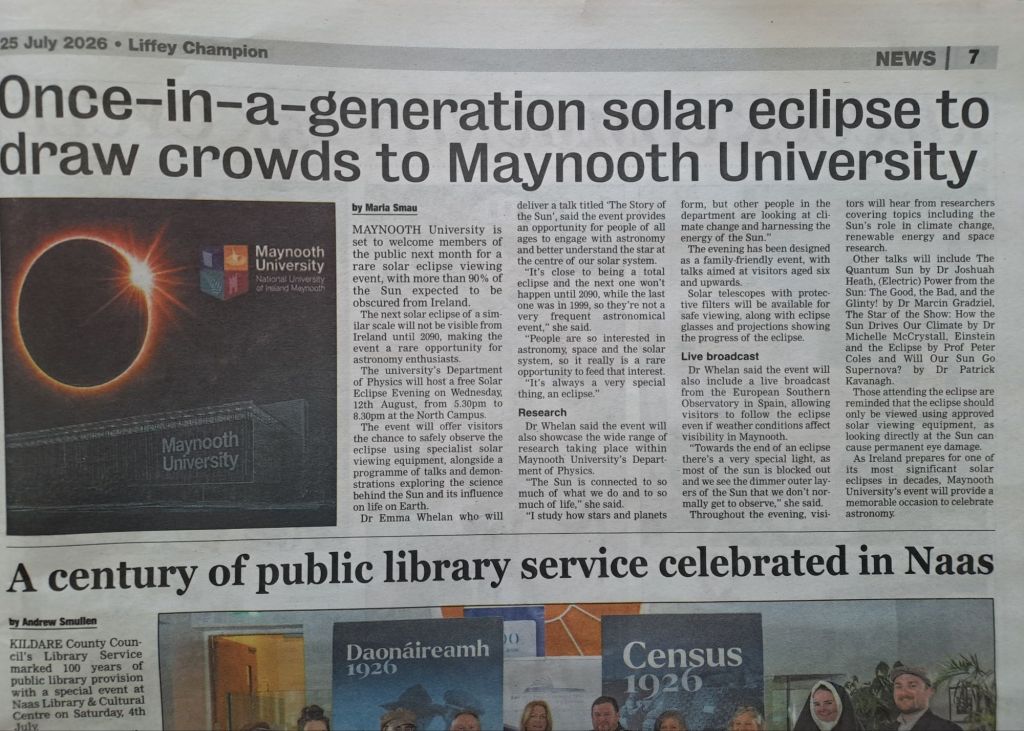
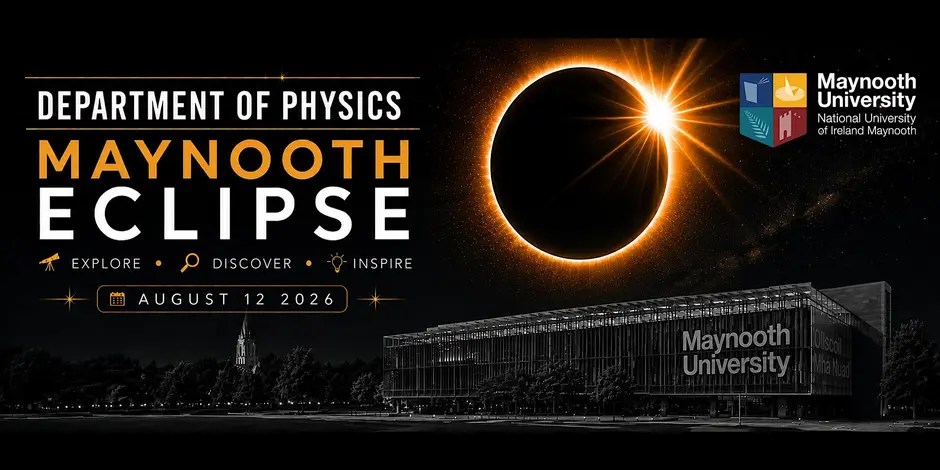
In between all this we have our Eclipse Event on August 12th. This sold out very quickly so we expect a good turnout. The event was advertised quite a bit in the local media, e.g. here and here:

The viewing of the eclipse will of course depend on the weather, but we have talks lined up indoors and a pop-up planetarium so I hope people will turn up even if the weather isn’t great. Although it is officially full, there may be a few returns, so it is worth checking on the day to see if we can fit you in.

Anyway, after the repeat examinations and project assessments are done, the marks uploaded, and the Undergraduate and Postgraduate Examination Boards have done their work, the next job will be to prepare for the new intake of students. This year’s Leaving Certificate results will be announced on Friday 21st August, at which point we’ll see how many students (if any) we have studying Physics next academic year (which, if all goes to plan, will be my penultimate…)

News from arXiv…

Posted in Open Access with tags , , , , , , on August 2, 2026 by telescoper

I saw recently an announcement that arXiv – which recently became a standalone nonprofit organization – now hosts more than three million articles. That message took me to a post on the arXiv blog from which I learnt that said blog is on WordPress which makes it possible to include embedded links from this WordPress blog, i.e.:

This in turn reminded me to answer a question that people sometimes ask about the Open Journal of Astrophysics, namely what would happen if arXiv went offline? Since OJAp is an arXiv-overlay journal this would appear to be fatal. We have been keeping duplicates of all the papers we publish, and associated metadata, in a local repository so that if arXiv went down we could reistate them fairly quickly. All we would need to do is alter the overlay to point to a different web address: there is no reason at all why the overlay idea can’t be adapted to other forms of repository.

Recently, however, arXiv decided to do a similar thing for all its articles. Here is a blog post about it:

I blogged about the first stage of this here.

Anyway, if you use arXiv at all – which will include most astrophysicists – then it would be a good idea to follow the arXiv blog as there is very important news on it, including information about alterations to the schedule of announcements.

Lughnasadh – The Start of Autumn

Posted in Biographical, Education, Maynooth with tags , , , , , on August 1, 2026 by telescoper

Today is 1st August, which is marked by the old Celtic festival of Lughnasadh, named after the God Lugh. This coincides with the English Lammas Day, one of many Christian festivals with pagan origins. The word for August in modern Irish is Lúnasa, a name derived from the old Celtic word.

Traditionally 1st August marks the start of the harvest season and is celebrated accordingly, with rites involving the first fruit and bread baked from flour obtained from the first corn. It is also one of the cross-quarter days, lying roughly half-way between the Summer Solstice and the Autumnal Equinox (in the Northern Hemisphere).

In the Northern hemisphere, from an astronomical point of view, the solar year is defined by the two solstices (summer, around June 21st and winter, around December 21st) and the equinoxes (Spring, around March 21st, and Autumn, around September 21st). These four events divide the year into four roughly equal parts of about 13 weeks each. If you divide each of these intervals in two you divide the year into eight pieces of six and a bit weeks each. The dates midway between the astronomical events mentioned above are (roughly) :

  • 1st February: Imbolc (Candlemas)
  • 1st May: Beltane (Mayday)
  • 1st August: Lughnasadh (Lammas)
  • 1st November: Samhain (All Saints Day)

The names I’ve added are taken from the Celtic/neo-Pagan (and Christian terms) for these cross-quarter days. These timings are rough because the dates of the equinoxes and solstices vary from year to year. Imbolc is often taken to be the 2nd of February (Groundhog Day) and Samhain is sometimes taken to be October 31st, Halloween. But hopefully you get the point. All four of thes days have a Bank Holiday associated with them (on the first Monday after the respective date); this Monday (3rd August) is a Bank Holiday in Ireland.

Some folk in Ireland regard August 1st as the first day of Autumn, just as 1st February is regarded as the first day of Spring and 1st May is the start of Summer. Indeed, our annual cycle of repeat examinations at Maynooth always happens in early to mid-August and these examinations are officially called the Autumn repeats. I rest my case. In my time here I have also noticed that May, June and July do tend to have significantly better weather than August, although I’m pleased to say that the weather isn’t particularly autumnal today.

Weekly Update from the Open Journal of Astrophysics 01/08/2026

Posted in OJAp Papers, Open Access, The Universe and Stuff with tags , , , , , , , , , , , , , , , , , , , , on August 1, 2026 by telescoper

It’s time once more for another Saturday update of activity at the Open Journal of Astrophysics. Since the last update we have published a further three papers, bringing the number in Volume 9 (2026) to 163 and the total so far published by OJAp up to 611.

I continue to include the posts made on our Mastodon account (on Fediscience); these announcements also show the DOI for each paper.

The first paper to report this week was published on Tuesday 28th July in the folder Cosmology and Nongalactic Astrophysics. “The Origins of the Bulk Flow” by Richard Watkins & Trajan Clark (Willamett U., USA) and Hume A Feldman (U. Kansas, USA) analyzes the origin of large-scale bulk flow using the CosmicFlows-4 catalog, finding that it is largely influenced by structures beyond 200 h-1 Mpc, challenging previous assumptions.

The overlay for this paper is here

You can find the officially accepted version on arXiv here and the announcement on Fediverse here:

Open Journal of Astrophysics

New Publication at the Open Journal of Astrophysics: "The Origins of the Bulk Flow" by Richard Watkins & Trajan Clark (Willamett U., USA) and Hume A Feldman (U. Kansas, USA).

doi.org/10.33232/001c.165870

July 28, 2026, 8:30 am 1 boosts 0 favorites

The second paper for this week, also published on Tuesday 28th July in the folder Cosmology and Nongalactic Astrophysics is: “Enhancing weak lensing redshift distribution characterization by optimizing the Dark Energy Survey Self-Organizing Map Photo-z method” by A. Campos (Carnegie Mellon U., USA) and the DES collaboration (113 authors). This study improves the Self-Organizing Map methodology for estimating redshift distribution in galaxies, notably reducing overlap between redshift bins, in preparation for the Dark Energy Survey Year 6 data.Abstractfor Enhancing weak lensing redshift distribution characterization by optimizing the Dark Energy Survey Self-Organizing Map Photo-z method.

The overlay looks like this:

The official version of the paper can be found on arXiv here and the Fediverse announcement here:

Open Journal of Astrophysics

New Publication at the Open Journal of Astrophysics: "Enhancing weak lensing redshift distribution characterization by optimizing the Dark Energy Survey Self-Organizing Map Photo-z method" by A. Campos (Carnegie Mellon U., USA) and the DES collaboration (113 authors)

doi.org/10.33232/001c.165871

July 28, 2026, 8:45 am 1 boosts 1 favorites

The third paper of the week, published on Thursday 29th July in the folder Instrumentation and Methods for Astrophysics is “The Ray Tracing Sampler: Bayesian Sampling of Neural Networks for Everyone” by Peter Behroozi of the University of Arizona (USA). This paper presents a new family of Markov Chain Monte Carlo sampling methods based on ray tracing, offering higher resilience to heating for stochastic gradients and other advantages.

The overlay for this one is here:

The final, accepted version can be found on arXiv here and the Mastodon announcement is here:

Open Journal of Astrophysics

New Publication at the Open Journal of Astrophysics: "The Ray Tracing Sampler: Bayesian Sampling of Neural Networks for Everyone" by Peter Behroozi (U. Arizona, USA)

doi.org/10.33232/001c.165932

July 29, 2026, 9:10 am 0 boosts 1 favorites

That’s all for this week. It’s been a bit slower than previous weeks no doubt because of the holiday season.

The Fallen, by Louise Brangan

Posted in History, Literature with tags , , on July 31, 2026 by telescoper

I’ve just finished reading The Fallen: The Magdalene Laundries & Ireland’s Legacy of Shame by Louise Brangan, which I bought a couple of months ago. This tells the shocking story of Ireland’s Magdalene Laundries, institutions run by a variety of religious orders designed to accommodate “fallen” women and girls. Also known as “Penitents”, the inmates of these institutions were a mixture of the poor and unwanted, orphans, disabled, those who had suffered familial abuse, and those who simply didn’t conform to Ireland’s self-image of a virtuous Roman Catholic state.

After Independence in 1922 these institutions, which had already been in existence for over a century, became a sort of dumping ground for inconvenient woman of all kinds. Once inside, the Penitents – most of whom hadn’t really done anything wrong – were stripped of what meagre possessions they had, had their hair shorn, their names were erased, and they were put to hard menial labour washing and drying clothes. They were fed and housed – after a fashion – but conditions were damp and unsanitary and they were forbidden to make friendships with their companions, or even talk to them. They were locked inside and forbidden to leave unless and until the nuns decided they could, which was often never. The Magdalene Laundries were prisons in which every inmate was serving an indefinite sentence of hard labour.

Not surprisingly, the result of this soul-destroying regime was that many of the Penitents became completely institutionalised, some living our their days in a man-made purgatory. Perhaps the most shocking thing of all is the last of these terrible places – which was on what is now Sean McDermott Street in North Dublin – didn’t close until 1996. This book was published to mark the 30th anniversary of this event.

The book is a scholarly work, woven around the oral testimonies of several women, measured in tone but with an unmistakeable undertone of righteous indignitation. It also sets the story of the Magdalene Laundries in the context of 20th Century Irish history, especially the rise of the Catholic theocracy under de Valera and it subsequent fall in the wake of major scandals, of which the Magdalene Laundries were one. As a relative newcomer to Ireland, I was unaware of the true nature of these places and found this book educational as well as deeply moving.

Some comments cut very much to the bone. Here is a paragraph concerning a woman known in the book as Carmel who had been taken to Sunday’s Well for reasons she was never told to find that many of the other women there were quite elderly and infirm:

Going to bed that first night, Carmel had thought that she had been sent to Sunday’s Well to care for the old women. Gradually, she had come to realise, like many others before her, that she had been sent to the Laundry not to look after these women but to become one of them.

Another passage that hit me hard was about the disinterment, in 1993, of 133 bodies from a mass grave when the Sisters of Our Lady of Charity decided to sell the land to a property developer. The graves of the women, who had died while incarcerated at a Magdalene Laundry, were unmarked; another 22 were found later. Shamefully, only 75 death certificates had ever been registered. It is against the law in Ireland to bury someone without registering their death so 80 crimes had been committed over the years. No action was ever taken.

In recent years there has been a redress scheme for the survivors of these institutions, but what financial compensation can possibly be adequate for a lifetime of penal servitude? The most important message of this book is that stories like this have to be told. Ireland must confront the dark side of its recent past. Silence can be the worst form of dishonesty.

Astronomy Envy

Posted in Biographical, Education, Science Politics with tags , , , on July 30, 2026 by telescoper

In 1998 the Department of Physics at the University of Nottingham was struggling in both research and undergraduate recruitment. To remedy the situation it decided to add a new group in Astronomy. The main idea was that having astronomy in its portfolio would attract more students and boost its standing in the Research Assessment Exercise (as it was then called). I was one of the people appointed to turn that decision into reality, and I’m glad to say the result was a success. Undergraduate numbers increased and in the next RAE Nottingham Physics scored a ‘5’, compared to the previous ‘4’. The Astronomy group quickly gained recognition across the UK and abroad, and another group was added, in Astroparticle Physics.

When the new Astronomy group was set up in 1999, the Department of Physics changed its name to the School of Physics & Astronomy. Despite the positive effect of this new activity, it was immediately clear that some members of staff resented it. A new letterhead was created, referring to the School of Physics & Astronomy, and one (very distinguished) senior member of the former Department always crossed off the “and Astronomy” whenever he used it. Others were surprised that the astronomers wanted to do research, when they felt that astronomy was just a bit of window-dressing for undergraduate recruitment. The astronomers were just there to do teaching, so that the “proper physicists” – mostly in semiconductor physics, nanoscience and other areas of condensed matter physics – could spend more time in their laboratories. I’m not saying that every physicist thought this – most were genuinely appreciative and supportive – but there were more than a few grumblers.

The undertone of all this is the envy that some physicists feel towards astronomy. Astronomers get invited to talk about their work to the general public and to amateur astronomy clubs, while there are no such calls for semiconductor physicists. Nobel prizes go to cosmology and astrophysics much more frequently than some would like. Above all there is the view that astronomy is all very well for bringing students in, but once at university the students must be converted to “proper physics”. Astronomers (including astrophysicists and cosmologists) should not get “notions” (as the Irish say). The short-sighted view that scientific research in universities should be aimed at short-term commercial gain amplifies this attitude, but does not entirely account for it.

These thoughts have been at the back of my mind for some time, but they came to the front again with the recent news about cuts to STFC funding. The callous attitude shown to the UK astronomy research community, implying that it should be grateful that it is not being cut by more than the disastrous level announced, indicates (to me) that there’s much more to what is going on than a mere budgetary issue. There is a deliberate plan to slap down a community that has grown too big for its boots.

The consequences for UK astronomy, and UK physics in general, are dire. Astronomy has kept many physics departments afloat for the last several decades. Without it, physics will fail in all but a handful of universities. That’s where envy takes you.

Jodrell Bank – Patric Dickinson

Posted in Poetry with tags , , , , on July 29, 2026 by telescoper
Who were they, what lonely men
Imposed upon the fact of night
The fiction of constellations
And made commensurable
The distances between
Themselves their loves and their doubt
Of government and nations;
Who made the dark stable

When the light was not? Now
We receive the blind codes
Of spaces beyond the span
Of our myths, and a long dead star
May only echo how
There are no loves nor gods
Men can invent to explain
How lonely all men are.

This poem is from a collection called “The World I See”, by Patric Dickinson, which was published in 1960. The poem was inspired by a visit to Jodrell Bank observatory. I have posted it before, but it seems apt to post it again now.