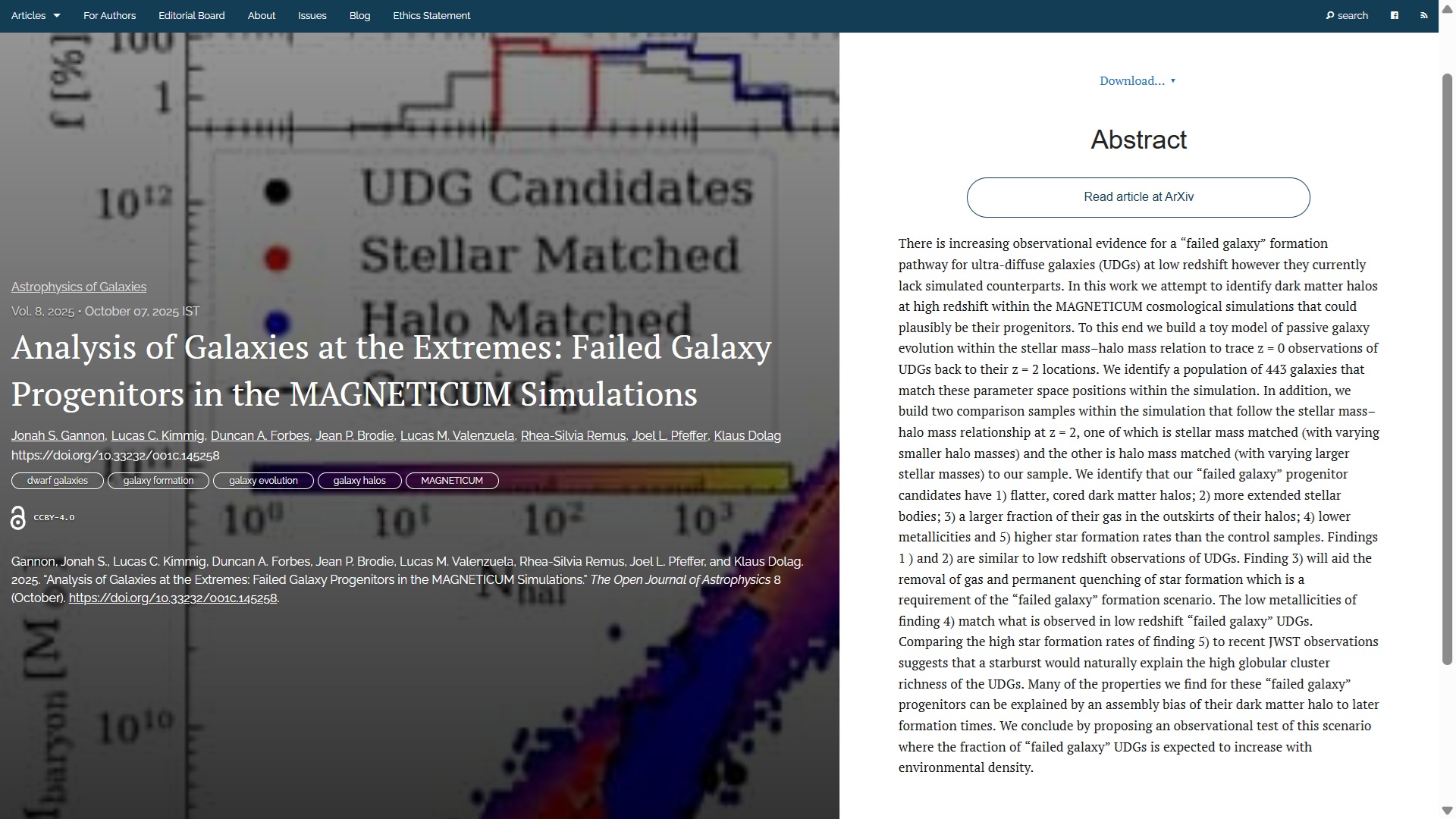
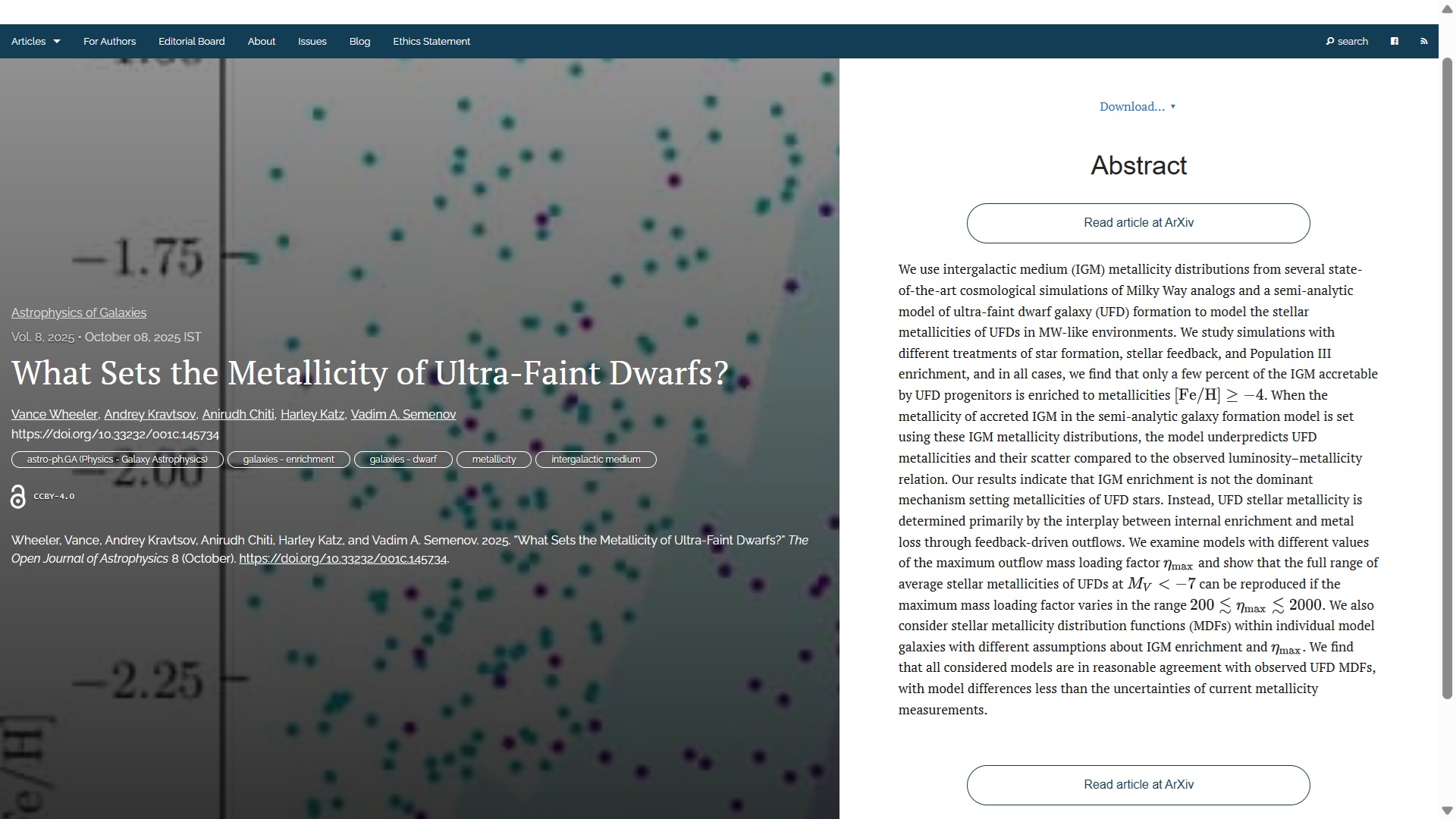
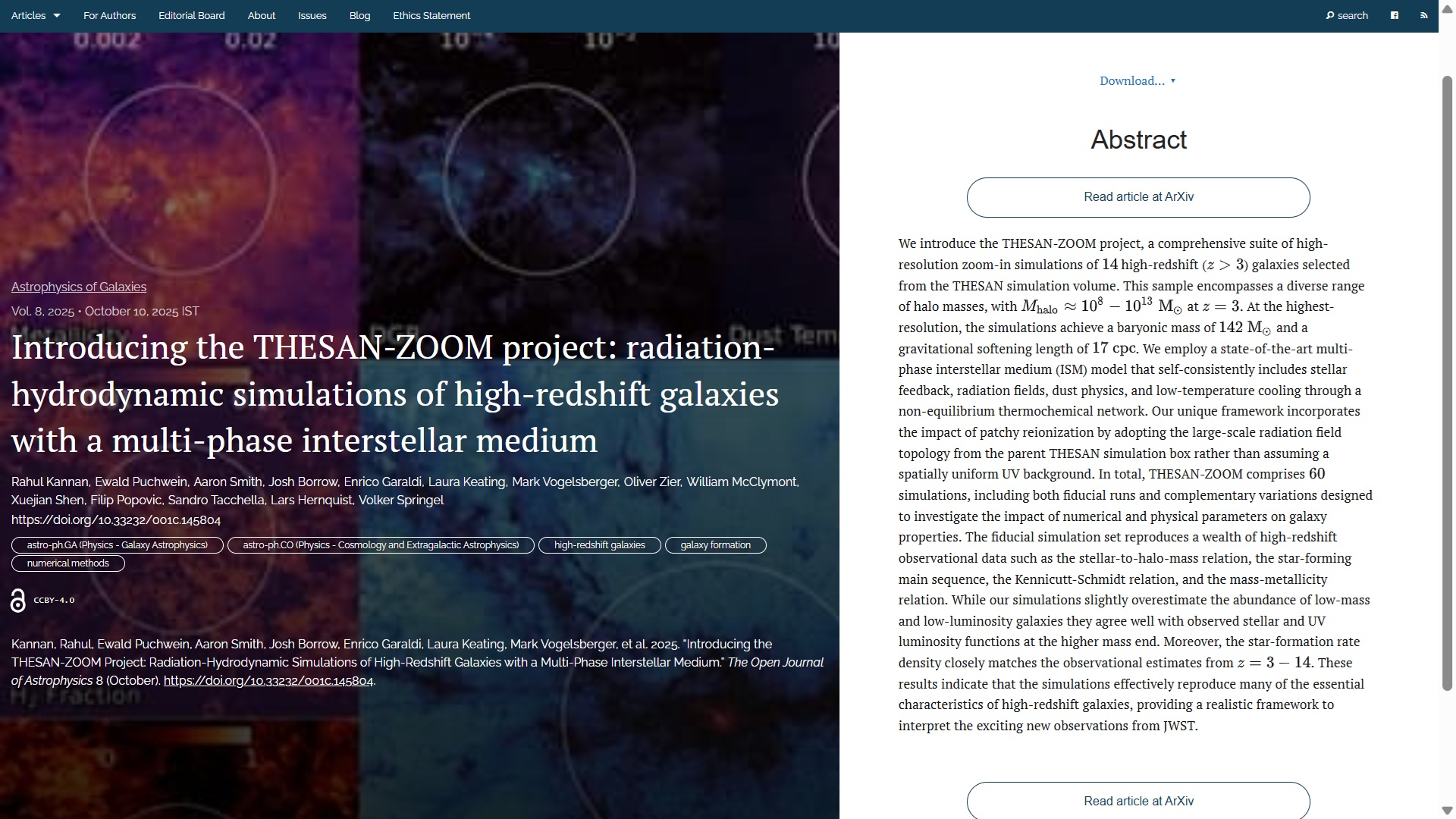
Archive for Astrophysics of Galaxies

Weekly Update from the Open Journal of Astrophysics – 02/08/2025

Posted in OJAp Papers, Open Access, The Universe and Stuff with tags , , , , , , , , , , , , , , , , , , , , , , , , , , , , on August 2, 2025 by telescoper

It’s Saturday morning again, and it’s the start of a new month, so it’s time for an update of papers published at the Open Journal of Astrophysics. Since the last update we have published five new papers, which brings the number in Volume 8 (2025) up to 110, and the total so far published by OJAp up to 345. I expect we’ll the total number we published last year (120) sometime this month. I predict that by the end of this year we will have published around 180 papers in Volume 8 and around 400 altogether.

The papers published this week, with their overlays, are as follows. You can click on the images of the overlays to make them larger should you wish to do so.

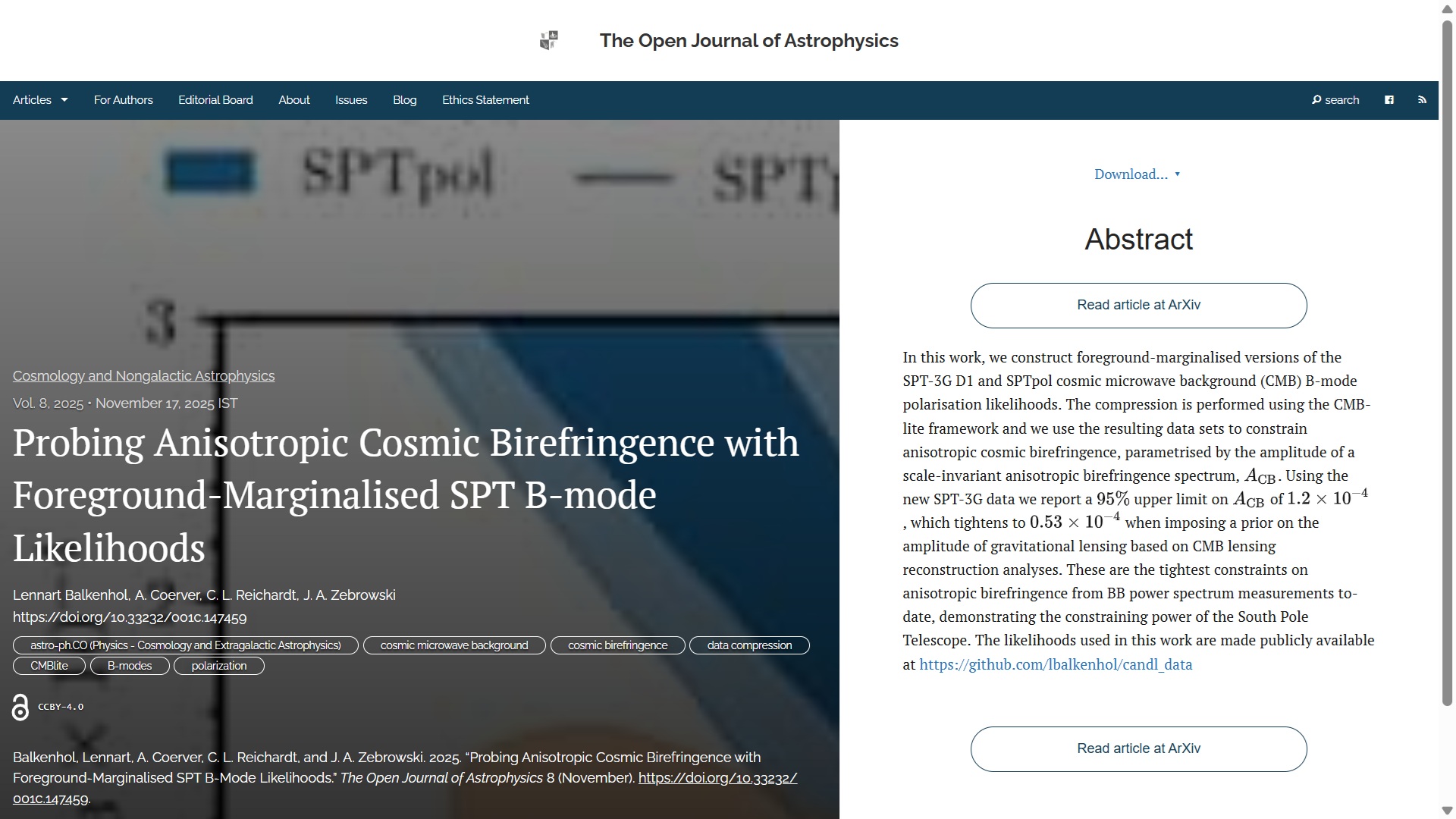
The first paper to report is “The matter with(in) CPL” by Leonardo Giani (U. Queensland, Australia), Rodrigo Von Marttens (Universidade Federal da Bahia, Brazil) and Oliver Fabio Piattella (Universita degli Studi dell’Insubria, Italy). This was published on Monday 29th July 2025 in the folder Cosmology and Nongalactic Astrophysics. This article presents a new parameterization of the standard model and its implications for the interpretation of cosmological observations.

The overlay is here:


The officially-accepted version can be found on arXiv here.

The second paper of the week, published on Tuesday 30th July in the folder Instrumentation and Methods for Astrophysics, is “An automated method for finding the most distant quasars” by Lena Lenz, Daniel Mortlock, Boris Leistedt & Rhys Barnett (Imperial College London, UK) and Paul C. Hewett (U. Cambridge, UK)”.  This paper presents an automated, reproduceable and objective high-redshift quasar selection pipeline, tested on simulations and real data from the Sloan Digital Sky Survey (SDSS) and UKIRT Infrared Deep Sky Survey (UKIDSS). The overlay is here:


You can find the officially accepted version of the paper on arXiv here.

The third paper of the week is “Early Post Asymptotic Giant Branch Instability: Does it Affect White Dwarf Hydrogen Envelope Mass?” by James MacDonald (University of Delaware, USA). This one was published on Friday 1st Auguest (i.e. yesterday) in the folder Solar and Stellar Astrophysics. It is an investigation into whether Early Post AGB Instability (EPAGBI) can affect determinations of the total abundance of hydrogen in white dwarf stars.

The overlay is here:

The final version is on arXiv here.


The fourth paper of the week, also published on Friday 1st August, is “Light Echoes of Time-resolved Flares and Application to Kepler Data” by Austin King and Benjamin C. Bromley (University of Utah, USA).  This describes a new model for circumstellar disks that incorporates echoes produced by extended, time-resolved flares. It is published in the folder Solar and Stellar Astrophysics. Here is the overlay:

You can find the officially-accepted version on arXiv here.


The fifth and final article published this week, also published on Friday 1st August,  is “Wide Binaries from Gaia DR3 : testing GR vs MOND with realistic triple modelling” by Charalambos Pittordis, Will Sutherland and Paul Shepherd (Queen Mary, University of London, UK). This presents a test for modified gravity from a sample of wide-binary stars from Gaia DR3, finding that (unmodified) Newtonian gravity provides a better fit to the data. It is in the folder Astrophysics of Galaxies.

The overlay is here:


You can find the officially-accepted version on arXiv here.

And that’s all the papers for this week. I’ll do another update next Saturday.
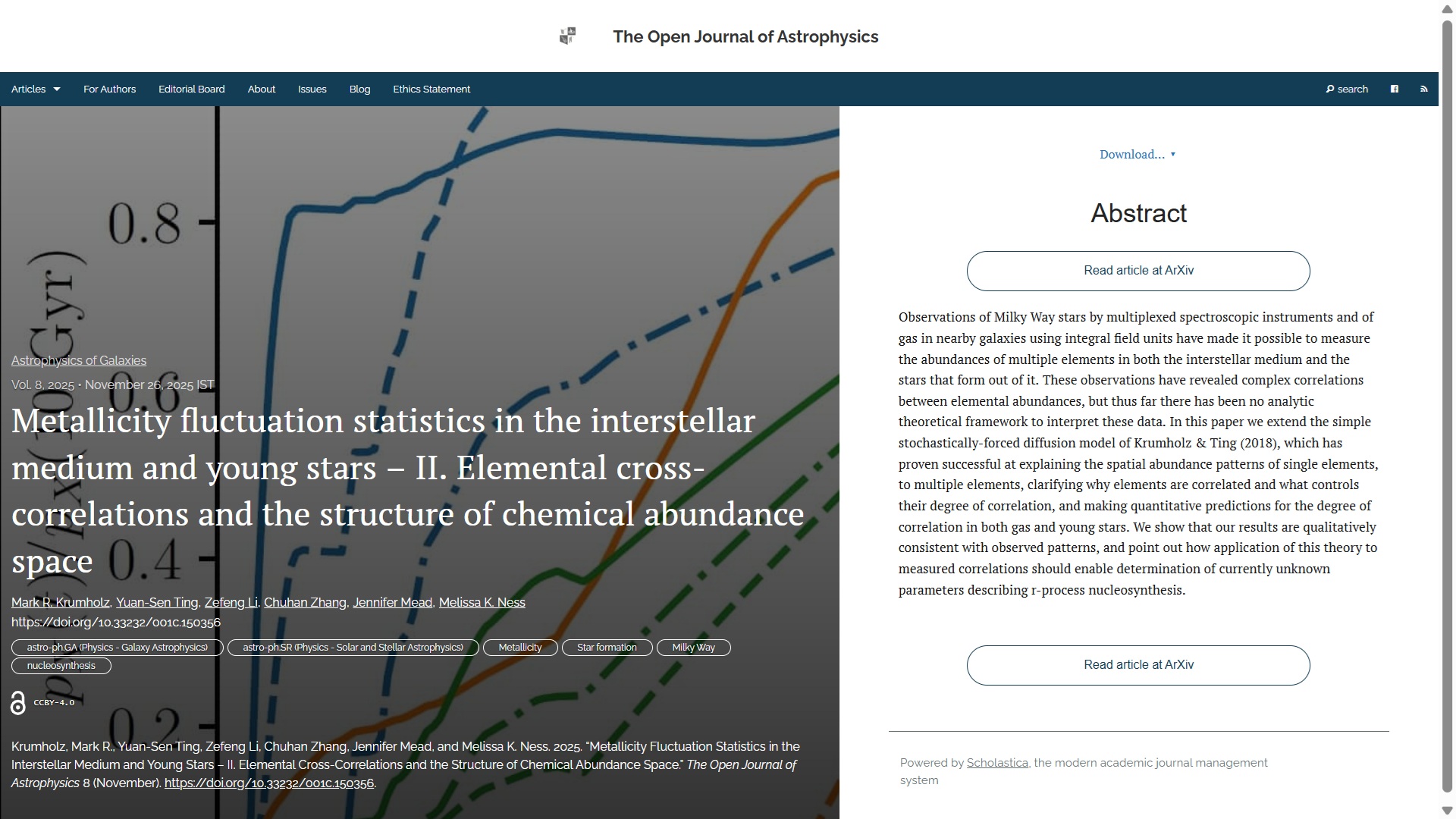
Weekly Update from the Open Journal of Astrophysics – 26/07/2025

Posted in OJAp Papers, Open Access, The Universe and Stuff with tags , , , , , , , , , , , , , , , , , , , , , on July 26, 2025 by telescoper

It’s Saturday morning again, so it’s time again for an update of papers published at the Open Journal of Astrophysics. Since the last update we have published seven new papers, which brings the number in Volume 8 (2025) up to 105, and the total so far published by OJAp up to 340. I expect we’ll pass the century for this year sometime next week. I had expected a bit of a slowdown in July, but that doesn’t seem to have happened. Anyway, with the century for the year having been achieved, the next target is 120 (the total number we published last year). At the current rate I expect us to reach that sometime in August.

The papers published this week, with their overlays, are as follows. You can click on the images of the overlays to make them larger should you wish to do so.

The first paper to report is “Non-equilibrium ionization in the multiphase circumgalactic medium – impact on quasar absorption-line analyses” by Suyash Kumar and Hsiao-Wen Chen (University of Chicago, USA). This was published on Tuesday 22nd July 2025 in the folder Astrophysics of Galaxies. It discusses time-dependent photoionization (TDP) models that self-consistently solve for the ionization state of rapidly cooling gas irradiated by the extragalactic ultraviolet background (UVB) and the application thereof to observed systems.

The overlay is here:

The officially-accepted version can be found on arXiv here.

The second paper of the week, also published on Tuesday 22nd July but in the folder Cosmology and Nongalactic Astrophysics, is “Do We Know How to Model Reionization?” by Nick Gnedin (University of Chicago, USA). This paper discusses the similarities and differences between the radiation fields produced by different numerical simulations of cosmic reionization. The overlay is here:

You can find the officially accepted version of the paper on arXiv here.

The third paper of the week is “The effects of projection on measuring the splashback feature” by Xiaoqing Sun (MIT), Stephanie O’Neil (U. Penn.), Xuejian Shen (MIT) and Mark Vogelsberger (MIT), all based in the USA. This paper describes an investigation whether projection effects could lead to any systematic bias in determining the position of the boundary between infalling and accreting matter around haloes. It was published on Wednesday 23rd July in the folder Astrophysics of Galaxies. The overlay is here:

The officially-accepted version can be found on arXiv here.

The fourth paper of the week, also published on Wednesday 22nd July in the folder Astrophysics of Galaxies, is “Host galaxy identification of LOFAR sources in the Euclid Deep Field North” by Laura Bisigello, Marika Giulietti, Isabella Prandoni, Marco Bondi, & Matteo Bonato (INAF, Bologna, Italy), Manuela Magliocchetti (INAF-IAPS Roma, Italy), Huub Rottgering (Leiden Observatory, Netherlands), Leah, K. Morabito (Durham University, UK) and Glenn, J. White (Open Universirty, UK). This presents a catalogue of optical and near-infrared counterparts to radio sources detected in the Euclid Deep Field North using observations from the LOw-Frequency ARray (LOFAR). The overlay is here:

The final, accepted version of the paper is on arXiv here.

Fifth one up is “Constraining the dispersion measure redshift relation with simulation-based inference” by Koustav Konar (Ruhr University Bochum), Robert Reischke (Universität Bonn), Steffen Hagstotz (Ludwig-Maximilians Universität München), Andrina Nicola (Bonn) and Hendrik Hildebrandt (Bochum); all authors based in Germany. This was published on Thursday 24th July in the folder Cosmology and NonGalactic Astrophysics. It discusses using simulations to develop the use of Dispersion Measures of Fast Radio Bursts as cosmological probes. The overlay is here:

You can find the officially accepted version on arXiv here.

The penultimate (sixth) article published this week is “Generating Dark Matter Subhalo Populations Using Normalizing Flows” by Jack Lonergan (University of Southern California), Andrew Benson (Carnegie Observatories) and Daniel Gilman (University of Chicago), all based in the USA. This paper describes a generative AI approach to subhalo populations, trained using the semi-analytical model Galacticus. This paper was published yesterday (i.e. on Friday 25th July) in the folder Astrophysics of Galaxies.

You can find the final version on arXiv here.

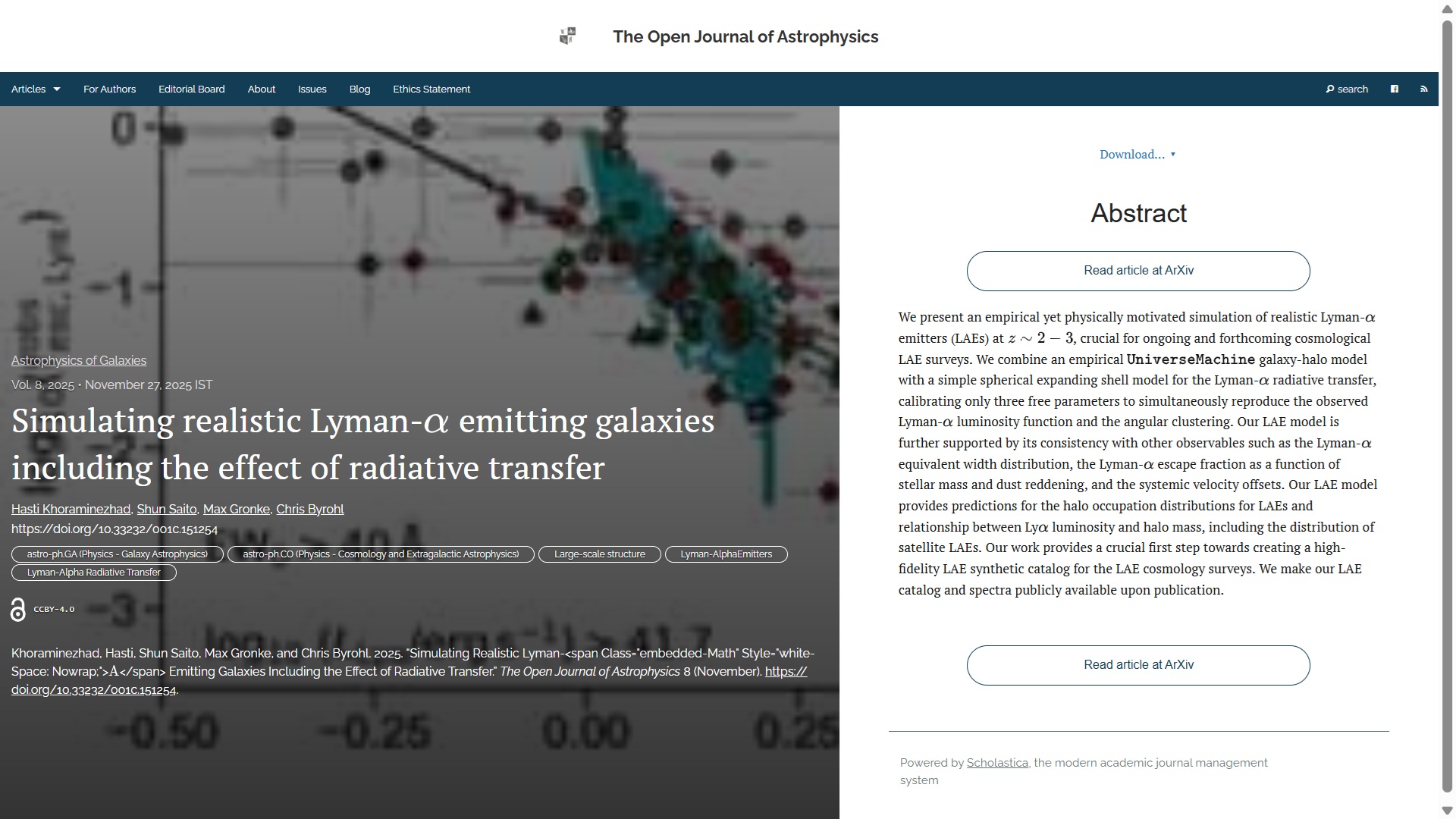
The last article published this week is “21 Balmer Jump Street: The Nebular Continuum at High Redshift and Implications for the Bright Galaxy Problem, UV Continuum Slopes, and Early Stellar Populations” by Harley Katz of the University of Chicago, and 13 others based in the USA, UK, Germany, Denmark and Austria. This discusses the implications of extreme nebular emission for the spectroscopic properties of galaxies, especially at high redshift. It was published on Friday 25th July in the folder Astrophysics of Galaxies.

The overlay is here:

You can find the officially-accepted version on arXiv here.

And that’s all the papers for this week. I’ll do another update next Saturday, when we’ll be into August.

Weekly Update from the Open Journal of Astrophysics – 12/07/2025

Posted in OJAp Papers, Open Access, The Universe and Stuff with tags , , , , , , , , , , , , , , , , , , , , , , , , , on July 12, 2025 by telescoper

It’s Saturday morning again, so it’s time again for an update of papers published at the Open Journal of Astrophysics. Since the last update we have published seven new papers, which brings the number in Volume 8 (2025) up to 92, and the total so far published by OJAp  up to 327.

This was a slightly strange week, starting with the fact that there were no new arXiv announcements on Monday 7th July because of the 4th July holiday in the USA on Friday so no papers were published that day. We were not able to publish any papers on Wednesday 9th July either because Crossref was offline for 24 hours that day while its data was migrated into the cloud. Our publishing process requires a live connection with Crossref to deposit metadata upon publication so we can’t publish while that service is down. Fortunately the update seems to have gone well and normal services resumed the following day. That partially accounts for the fact that four of this week’s papers were published on 10th July.

Anyway, The papers published this week, with their overlays, are as follows.  You can click on the images of the overlays to make them larger should you wish to do so.

The first paper to report is “The Jackknife method as a new approach to validate strong lens mass models” by Shun Nishida & Masamune Oguri (Chiba University, Japan) , Yoshinobu Fudamoto (Steward Observatory, USA) and Ayari Kitamura (Tohoku University, Japan). This article, which is in the folder marked Cosmology and NonGalactic Astrophysics,  describes and application of the Jackknife statistical resampling techique to gravitational lensing by removing lensed images and recalcualting the mass modelIt was published on Tuesday 8th July 2025. The overlay is here:


The officially-accepted version can be found on arXiv here.

The second paper is “Low redshift post-starburst galaxies host abundant HI reservoirs” by Sara Ellison (U. Victoria, Canada) and 10 others based in China, UK, Spain, USA and Canada.  This one was also published oon Tuesday 8th July but in the folder Astrophysics of Galaxies. This paper uses 21cm observations of a sample of post-starburst galaxies, to show  that they contain large reservoirs of neutral hydrogen. Here is the overlay:

You can find the final version of the manuscript on arXiv here.

Next one up, one of four published on Thursday 10th July, is “Predicting the number density of heavy seed massive black holes due to an intense Lyman-Werner field” by Hannah O’Brennan (Maynooth University, Ireland) and 7 others based in Ireland, USA and Italy. This paper presents an exploration of the scenario for black hole formation driven by Lyman-Werner photons (i.e. ultraviolet radiation in the range 11.2 to 13.6 eV). It is in the folder marked Cosmology and NonGalactic Astrophysics, and the overlay is here:


You can read the final accepted version on arXiv here.

The fourth paper this week, and the second published on 10th July, is “Chemical Abundances in the Metal-Poor Globular Cluster ESO 280-SC06: A Formerly Massive, Tidally Disrupted Globular Cluster” by Sam A. Usman (U. Chicago, USA) and 8 others based in the USA, Canada and Australia. This paper, which is in the folder Astrophysics of Galaxies, presents a detailed spectroscopic study of the chemical abundances in a Milky Way globular cluster ESO 280-SC06. The overlay is here:

The officially accepted version of the paper can be read here.

Next one up, also published on 10th July and also in the folder marked Astrophysics of Galaxies is “Predictions for the Detectability of Milky Way Satellite Galaxies and Outer-Halo Star Clusters with the Vera C. Rubin Observatory” by Kabelo Tsiane (U. Michigan) and 9 others on behalf of the LSST Dark Energy Science Collaboration.

The overlay is here:


You can find the officially-accepted version of the paper on arXiv here.

The penultimate paper for this week, and the last of the batch published on 10th July,  is “Systematically Measuring Ultra-Diffuse Galaxies. VIII. Misfits, Miscasts, and Miscreants” by Dennis Zaritsky, Richard Donnerstein, and Donghyeon J. Khim (Steward Observatory, U. Arizona, USA). This paper presents a morphological study of weird and wonderful galaxies as part of an effort to Systematically Measure Ultra-Diffuse Galaxies (the SMUDGes survey). It is in the folder marked Astrophysics of Galaxies. The overlay is here:


You can find the officially-accepted version of the paper on arXiv here.

The last article published this week is “Differential virial analysis: a new technique to determine the dynamical state of molecular clouds” by Mark R. Krumholz (ANU, Australia), Charles J. Lada (Harvard, USA) & Jan Forbrich (U. Herts, UK). This paper presents simple analytic models of supported and collapsing molecular clouds, tested using full 3D simulations and applied to observed clouds in Andromeda. It is in the folder marked Astrophysics of Galaxies and was published yesterday, i.e on Friday 11th July 2025. Here is the overlay


You can find the officially-accepted version on arXiv here.

And that’s all the papers for this week. I will, however, take this opportunity to mention that a while ago I was interviewed about the Open Journal of Astrophysics by Colin Stuart on behalf of the Foundational Questions Institute; the write-up of the interview can be found here.

Weekly Update from the Open Journal of Astrophysics: 05/07/2025

Posted in OJAp Papers, Open Access, The Universe and Stuff with tags , , , , , , , , , , , , , , , , , on July 5, 2025 by telescoper

It’s Saturday so, once again, it’s time for the weekly update of papers published at the Open Journal of Astrophysics. Since the last update we have published three new papers, which brings the number in Volume 8 (2025) up to 85, and the total so far published by OJAp  up to 320.

The three papers published this week, with their overlays, are as follows. You can click on the images of the overlays to make them larger should you wish to do so.

The first paper to report is “Stellar reddening map from DESI imaging and spectroscopy” by Rongpu Zhou (Lawrence Berkeley National Laboratory, USA) and an international case of 56 others too numerous to mention individually. This paper was published on 1st July 2025 in the folder marked Astrophysics of Galaxies. It describes maps of stellar reddening by Galactic dust inferred from observations obtained using the Dark Energy Spectroscopic Instrument, and a comparison with previous such maps. The overlay is here:

You can find the final, accepted, version on arXiv here.

Next one up is “On inertial forces (indirect terms) in problems with a central body” by Aurélien Crida (Université Côte d’Azur, France) and 17 others – again too numerous to be listed individually – based in France, Italy, Germany, Mexico and the USA. This paper discusses the indirect terms that arise the Newtonian dynamics of multi-body systems dominated by a central massive body, upon which other bodies exert a gravitational pull, when the massive body is treated as the origin of the coordinate system. This one, also published on July 1st 2025, is in the folder marked Earth and Planetary Astrophysics.

The overlay is here:

You can find the officially accepted version on arXiv here.

The last paper of this batch is “Stellar ejection velocities from the binary supernova scenario: A comparison across population synthesis codes” by Tom Wagg (U. Washington, USA), David D. Hendriks (U. Surrey, UK), Mathieu Renzo (U. Arizona, USA) and Katelyn Breivik (Carnegie Mellon U., USA). It was published on July 2nd 2025 in the folder Solar and Stellar Astrophysics and it presents comparison of the ejection velocities of stars ejected from binary systems by supernova explosions predicted in three different population synthesis codes.

The overlay is here:

You can read the final accepted version on arXiv here.

That’s all the papers for this week. I’ll post another update next weekend.

Weekly Update from the Open Journal of Astrophysics – 28/06/2025

Posted in OJAp Papers, Open Access, The Universe and Stuff with tags , , , , , , , , , , , , , , , , , , , , , , , , on June 28, 2025 by telescoper

It’s Saturday morning again so time for an update of papers published at the Open Journal of Astrophysics. Since the last update we have published eight new papers, which brings the number in Volume 8 (2025) up to 82, and the total so far published by OJAp  up to 317. With about half the year gone, we’re on target to published around 160 papers this year.

The papers published this week, with their overlays, are as follows.  You can click on the images of the overlays to make them larger should you wish to do so.

The first paper to report is “Spectroscopic and X-ray Modeling of the Strong Lensing Galaxy Cluster MACS J0138.0-2155” by Abigail Flowers (University of California at Santa Cruz; UCSZ), Jackson H. O’Donnell (UCSZ), Tesla E. Jeltema (UCSZ), Vernon Wetzell (U. Pennsylvania) & M. Grant Roberts (UCSZ). This artticle, which is in the folder marked Cosmology and NonGalactic Astrophysics, presents a study of the mass distribution and substructure of a galaxy cluster that acts as a gravitational lens for a source galaxy at z=1.95 that contains two supernovae. It was published on 23rd June 2025. The overlay is here:

The officially-accepted version can be found on arXiv here.

Illuminating the Physics of Dark Energy with the Discovery Simulations” by Gillian D. Beltz-Mohrmann (Argonne National Laboratory, USA) and 12 others based in the USA and Spain. This describes new high-resolution cosmological simulations providing a testbed for alternative cosmological probes that may offer additional constraining power beyond Baryon Accoustic Oscillations. It is filed in the folder marked Cosmology and NonGalactic Astrophysics.

The overlay is here:

You can read the final accepted version on arXiv here.

Next one up is in the folder marked Astrophysics of Galaxies. The title is “On the minimum number of radiation field parameters to specify gas cooling and heating functions” and it is by David Robinson & Camille Avestruz (U. Michigan) and Nickolay Y. Gnedin (U.Chicago) and was published on 23rd June 2025. It presents an analysis using machine learning of atomic gas cooling and heating functions computed by the spectral synthesis code Cloudy.

The overlay is here:


You can find the officially-accepted version of the paper on arXiv here.

The thirtd paper is “On the Use of WGANs for Super Resolution in Dark-Matter Simulations” by John Brennan (Maynooth), Sreedhar Balu (U. Melbourne), Yuxiang Qin (ANU), John Regan (Maynooth) and Chris Power (U. Western Australia). This one is also in the folder marked Astrophysics of Galaxies and was also published on Monday 23rd June. It is about using the Wasserstein Generative Adversarial Network (WGAN) model to increase the particle resolution of dark-matter-only simulations of galaxy formation. The overlay is here:

You can find the officially-accepted version of the paper on arXiv here.

Next we have “Cosmic Rays Masquerading as Hot CGM Gas: An Inverse-Compton Origin for Diffuse X-ray Emission in the Circumgalactic Medium” by Philip F. Hopkins (Caltech), Eliot Quataert (Princeton), Sam B. Ponnada (Caltech) and Emily Silich (Caltech), all based in the USA.  This one was published on 24th June 2025 in the folder High-Energy Astrophysical Phenomena

You can find the officially-accepted version on arXiv here.

The fifth paper this week is “Compact Binary Formation in Open Star Clusters III: Probability of Binary Black Holes Hidden Inside of Gaia Black Hole Binary” by Ataru Tanikawa (Fukui Prefectural University, Japan), Long Wang (Sun Yat-sen University, China), Michiko S. Fujii (University of Tokyo, Japan), Alessandro A. Trani (Niels Bohr Institute, Denmark), Toshinori Hayashi (Kyoto University, Japan) and Yasushi Suto (Kochi University of Technology, Japan).  This one is in the folder marked Astrophysics of Galaxies and was published on Tuesday 24th June. It presents an investigation into whether some Gaia black hole binary systems may in fact involve three black holes, including a pair too compact to be resolved astrometrically. Here is the overlay:

You can find the officially-accepted paper on arXiv here.

Next we have “Rapid identification of lensed type Ia supernovae with color-magnitude selection” by Prajakta Mane (IISER) and Anupreeta More & Surhud More (IUCAA), all based in India. This paper presents an  extension of the use of color-magnitude diagrams, used previously as a means to identify lensed supernovae, with applications to LSST-like photometric data. It is in the folder marked Astrophysics of Galaxies and was published on Thursday 26th June.

The officially-accepted version of the article can be found on arXiv here.

The penultimate article this week is: “Cosmic Reionization On Computers: Biases and Uncertainties in the Measured Mean Free Path at the End Stage of Reionization” by Huanqing Chen (U. Alberta, Canada), and Jiawen Fan & Camille Avestruz (U. Michigan, USA). This one is in the folder Cosmology and Nongalactic Astrophysics and was published on 26th June 2025.  This paper studies possible systematic effects in computer simulations of cosmic reionization especially when it results from quasar radiation.

The overlay is here:

You can find the officially-accepted version on arXiv here.

Eighth and last paper this week is “Exploring the Core-galaxy Connection” by Isabele Lais de Souza Vitório (U. Michigan) and Michael Buehlmann, Eve Kovacs, Patricia Larsen, Nicholas Frontiere & Katrin Heitmann (Argonne National Laboratory, USA).  This one is in the folder Cosmology and Nongalactic Astrophysics and was published on Friday 27th June 2025 (i.e. yesterday).

The overlay is here:


You can find the officially-accepted version on arXiv here.

And that’s all the papers for this week. I do, however, have some more news to pass on. We are delighted to welcome two new recruits to our Editorial Board,  Dr Foteini Oikonomou of the Norwegian University of Science and Technology, who specializes in the application of particle physics theories to  high-energy astrophysical phenomena, and Dr Heloise Stevance of Oxford University (UK), who specializes in the interface between Machine Learning and Astrophysics.

Weekly Update from the Open Journal of Astrophysics – 20/06/2025

Posted in OJAp Papers, Open Access, The Universe and Stuff with tags , , , , , , , , , , , , , , , on June 20, 2025 by telescoper

Yesterday (Thursday 19th June 2025) was a national holiday in the USA, which means that no new papers were announced on arXiv today (Friday 20th June). I have therefore decided to bring forwarded the usual weekly update of papers published at the Open Journal of Astrophysics by a day. Since the last update we have published three new papers, which brings the number in Volume 8 (2025) up to 74, and the total so far published by OJAp  is now up to 309.

The three papers published this week, with their overlays, are as follows. All three were published on Tuesday, June 17th 2025. You can click on the images of the overlays to make them larger should you wish to do so.

The first paper to report is “Illuminating the Physics of Dark Energy with the Discovery Simulations” by Gillian D. Beltz-Mohrmann (Argonne National Laboratory, USA) and 12 others based in the USA and Spain. This describes new high-resolution cosmological simulations providing a testbed for alternative cosmological probes that may offer additional constraining power beyond Baryon Accoustic Oscillations. It is filed in the folder marked Cosmology and NonGalactic Astrophysics.

The overlay is here:

You can read the final accepted version on arXiv here.

The second paper is in the folder marked Astrophysics of Galaxies. It is “LIGHTS. The extended point spread functions of the LIGHTS survey at the LBT” by Nafise Sedighi (Instituto de Astrofísica de Canarias, Spain) and 15 others based in Spain, USA, Iran, Italy and the UK. It describes the procedure used to construct the extended Point Spread Functions (PSFs) of the LIGHTS survey in images taken with the Large Binocular Cameras (LBCs) of the Large Binocular Telescope (LBT).

The overlay is here:


You can find the officially-accepted version of the paper on arXiv here.

Finally this week we have “Fast radio bursts as a probe of gravity on cosmological scales” by Dennis Neumann (Leiden University, Netherlands), Robert Reischke (Universität Bonn, Germany), Steffen Hagstotz (Ludwig-Maximilians Universität München, Germany) and Hendrik Hildebrandt (Ruhr University Bochum, Germany). This is about using dispersion measures derived from Fast Radio Bursts (FRBs) in combination with cosmic shear to investigate modified gravity theories, specifically Horndeski gravity. It is in the folder marked Cosmology and NonGalactic Astrophysics.

The overlay is here:

You can find the officially-accepted version on arXiv here.

That’s all the papers for this week. I’ll revert to the usual schedule for updates next week, and post the next one on Saturday 28th June.


Weekly Update from the Open Journal of Astrophysics – 14/06/2025

Posted in OJAp Papers, Open Access, The Universe and Stuff with tags , , , , , , , , , , , , on June 14, 2025 by telescoper

It’s Saturday so once again it’s time for the weekly update of papers published at the Open Journal of Astrophysics. Since the last update we have published two new papers, which brings the number in Volume 8 (2025) up to 71, and the total so far published by OJAp  is now up to 306.

The two papers published this week, with their overlays, are as follows. You can click on the images of the overlays to make them larger should you wish to do so.

The first paper to report is “Analysis of optical spectroscopy and photometry of the type I X-ray bursting system UW CrB2” by Mark Kennedy (University College Cork, Ireland) and 21 others based in Ireland, UK, USA, Finland, Netherlands and Australia. This one was published on Tuesday June 10th in the folder High-Energy Astrophysical Phenomena.  This describes optical photometry and spectroscopy of the low-mass X-ray binary UW Coronae Borealis taken over 2 years

The overlay is here:


You can read the final accepted version on arXiv here.

The second paper is “The Impact of Feedback-driven Outflows on Bar Formation” by Martin D. Weinberg (University of Massachusetts, Amherst, USA). This paper uses a generalization of the Hamiltonian Mean-Field model to of the disruption of bar formation in galaxies by stellar feedback. It was published on Friday 13th June 2025 in the folder marked Astrophysics of Galaxies.

The overlay is here:


You can find the officially-accepted version of the paper on arXiv here.

That’s all the papers for this week. I’ll post another update next weekend.


Weekly Update from the Open Journal of Astrophysics – 07/06/2025

Posted in OJAp Papers, Open Access, The Universe and Stuff with tags , , , , , , , , , , , on June 7, 2025 by telescoper

It’s Saturday so once again it’s time for the weekly update of papers published at the Open Journal of Astrophysics. Since the last update we have published two new papers, which brings the number in Volume 8 (2025) up to 69 and the total so far published by OJAp  is now up to 304.

The two papers published this week, with their overlays, are as follows. You can click on the images of the overlays to make them larger should you wish to do so.

The first paper to report is “Chemical Abundances in the Leiptr Stellar Stream: A Disrupted Ultra-faint Dwarf Galaxy?” by Kaia R. Atzberger (Ohio State University) and 13 others based in the USA, Germany, the UK, Sweden, Australia, Canada and Brazil. This one was published on 2nd June 2025 and is in the folder marked Astrophysics of Galaxies. It presents a spectroscopic study of stars in a stellar stream suggesting that the stream originated by the accretion of a dwarf galaxy by the Milky Way.

The overlay is here:


You can read the final accepted version on arXiv here.

The second paper is “Scaling Laws for Emulation of Stellar Spectra” by Tomasz Różański (Australian Nastional University) and Yuan-Sen Ting (Ohio State University, USA). This was published yesterday, i.e. on 6th June 2025, and is in the folder Instrumentation and Methods for Astrophysics. The paper discusses certain scaling models and their use to achieve optimal performance for neural network emulators in the inference of stellar parameters and element abundances from spectroscopic data.

The overlay is here:

You can find the officially-accepted version of the paper on arXiv here.

That’s the papers for this week. I’ll post another update next weekend.

As a postscript I have a small announcement about our social media. Owing to the imminent demise of Astrodon, we have moved the Mastodon profile of the Open Journal of Astrophysics to a new instance, Fediscience. You can find us here. The old profile currently redirects to the new one, but you might want to update your links as the old server will eventually go offline.

Weekly Update from the Open Journal of Astrophysics – 17/05/2025

Posted in OJAp Papers, Open Access, The Universe and Stuff with tags , , , , , , , , , , , , on May 17, 2025 by telescoper

It’s a lovely Saturday morning in May, and it’s time for the weekly  update of papers published at the Open Journal of Astrophysics. Since the last update we have published four new papers, which brings the number in Volume 8 (2025) up to 59 and the total so far published by OJAp up to 294.

In chronological order of publication, the four papers published this week, with their overlays, are as follows. You can click on the images of the overlays to make them larger should you wish to do so.

The first paper to report is: “Multi-Phase Thermal Structure & The Origin of the Broad-Line Region, Torus, and Corona in Magnetically-Dominated Accretion Disks” by Philip F. Hopkins (Caltech, USA). This was published on Monday May 12th in the folder Astrophysics of Galaxies. It presents simple accretion disk model that predicts the properties of many features including the dusty torus, broad-line region, continuum emission and coronal gas.

The overlay is here:

You can find the officially accepted version on arXiv here.

Second one up is “Sparsity covariance: a source of uncertainty when estimating correlation functions with a discrete sample of observations in the sky” by Pierre Fleury (U. Montpellier, France). This one was published on Tuesday 13th May 2025 in the folder Cosmology and NonGalactic Astrophysics.  This paper presents a discussion of the uncertainty in cosmological observables caused by discrete sampling and a method to compute the covariances resulting from this.

The overlay is here:

You can find the officially-accepted version of the paper on arXiv here.

The third paper of the week, published on Wednesday May 14th 2025,  is “Dark Matter Particle Flux in a Dynamically Self-consistent Milky Way Model” by Lucijana Stanic, Mark Eberlein, Stanislav Linchakovskyy, Christopher Magnoli, Maryna Mesiura, Luca Morf, Prasenjit Saha (University of Zurich, Switzerland) and Eugene Vasiliev (University of Surrey, UK). This one presents a study of the behaviour of dark matter in an anisotropic model for the Milky Way halo with implications for particle detection rates. It is in the folder Astrophysics of Galaxies.

Here is the overlay:

You can find the officially accepted version of this paper on arXiv here.

The last paper published this week is “Too fast to be single: Tidal evolution and photometric identification of stellar and planetary companions” by Ilay Kamai and Hagai B. Perets (Technion, Haifa, Israel). This one was published on Friday 16th May 2025 in the folder Solar and Stellar Astrophysics. It presents an analysis of the rotation of stars observed in the Kepler field to identify non-single systems with high spin rates resulting from tidal effects.

Here is the overlay:

The official published version can be found on the arXiv here.

That’s all the papers for this week. I’ll post another update next week.

Weekly Update from the Open Journal of Astrophysics – 03/05/2025

Posted in OJAp Papers, Open Access, The Universe and Stuff with tags , , , , , , , , , , , , , , , , , , , on May 3, 2025 by telescoper

Saturday morning once again, and time for another update of papers published at the Open Journal of Astrophysics. It’s been a recording-breaking week: since the last update we have published no fewer than ten papers, which brings the number in Volume 8 (2025) up to 54 and the total so far published by OJAp up to 289.

The first paper to report is “Subspace Approximations to the Focused Transport Equation of Energetic Particles, I. The Standard Form” by B. Kippenstein & A. Shalchi (U. Manitoba, Canada). This paper, which was published on Monday 28th April 2025, presents a hybrid analytical-numerical method to solve the Fokker-Planck equation for the transport of energetic particles. It is published in the folder Solar and Stellar Astrophysics.

The overlay is here:

You can find the officially accepted version on arXiv here.

Next is “The Importance of Subtleties in the Scaling of the ‘Terminal Momentum’ For Galaxy Formation Simulations” by Philip F. Hopkins (Caltech, USA). This presents a technical discussion of issues surrounding the proper modelling of supernova blast waves and their effects in numerical simulations of galaxy formation. It was published on Tuesday 29th April 2025 in the folder Astrophysics of Galaxies. The overlay is here:

The final version can be found on arXic here.

Next one up is “Local variations of the radial metallicity gradient in a simulated NIHAO-UHD Milky Way analogue and their implications for (extra-)galactic studies” by Sven Buder (ANU, Australia), Tobias Buck (U. Heidelberg, Germany), Qian-Hui Chen (ANU) and Kathryn Grasha (ANU). This one was also published on Tuesday 29th April 2025 in the folder Astrophysics of Galaxies. It describes a numerical study of the variation of chemical abundance with radial position in galaxies and the implications of this for galaxy formation. Here is the overlay:

and you can find the final accepted version on arXiv here.

The fourth paper this week is “Zooming In On The Multi-Phase Structure of Magnetically-Dominated Quasar Disks: Radiation From Torus to ISCO Across Accretion Rates” by Philip F. Hopkins (Caltech, USA) and 14 others based in the USA and Canada. This was also published on Tuesday 29th April 2025 in the folder Astrophysics of Galaxies. It presents very detailed numerical study of the structure of magnetized quasar accretion disks. The overlay is here:

You can find the official final version on arXiv here.

Next is “Tomographic halo model of the unWISE-Blue galaxies using cross-correlations with BOSS CMASS galaxies” by Alex Krolewski, Jensen Lawrence, and Will J. Percival (U. Waterloo, Canada). This one was also published on 29th April 2025, which was a busy day(!), but in the folder Cosmology and NonGalactic Astrophysics.  This paper describes using the halo model to create mock samples unWISE-Blue galaxies, applicable to other tomographic cross-correlations between photometric samples and narrowly-binned spectroscopic samples. The overlay is here:

The final version of this one can be found on the arXiv here.

Number six for this week is “StratLearn-z: Improved photo-estimation from spectroscopic data subject to selection effects” by Chiara Moretti (SISSA, Trieste, Italy), Maximilian Autenrieth (Imperial College, UK), Riccardo Serra (SISSA), Roberto Trotta (SISSA), David A. van Dyk (Imperial) and Andrei Mesinger (SNS Pisa, Italy). This was published on Thursday 1st May 2025 in the folder Cosmology and NonGalactic Astrophysics. This one is about estimating photometric redshifts using an approach that relies on splitting the source and target datasets into strata based on estimated propensity score. The overlay is here:


The official version can be found on arXiv here.

Next is “The Impact of Galaxy-halo Size Relations on Galaxy Clustering Signals” by Joshua B. Hill and Yao-Yuan Mao (U. Utah, USA). This one was also published on May 2nd 2025 and is in the folder Astrophysics of Galaxies. It discusses the challenge of identifying a specific galaxy halo property that controls galaxy sizes through constraints from galaxy clustering alone. The overlay is here:

You can find the official version of the paper on arXiv here.

The next paper is “Detection of Thermal Emission at Millimeter Wavelengths from Low-Earth Orbit Satellites” by Allen Foster (Princeton, USA) and an international cast of 90 others, which is too many to list individually. This one was also published on Thursday May 1st but is in the folder Instrumentation and Methods for Astrophysics.  The paper discusses the experimental detection of thermal emission from satellites and a discussion of the implications for astrophysical observations, especially time-domain astronomy. The overlay is here:

You can find the final version of the paper on arXiv here.

The penultimate paper of this week is “Pseudo-Cls for spin-s fields with component-wise weighting” by David Alonso (U. Oxford, UK). This one was published yesterday (Friday 2nd May 2025).  The paper presents an approach to power spectrum estimation appropriate for data with anisotropic noise properties or for which complicated masks are required.  It can be found in the folder Cosmology and NonGalactic Astrophysics. The overlay is here:


The final version of this paper is on arXiv here.

The last paper this week is “The past, present and future of observations of externally irradiated disks” by Planet formation environments collaboration: Megan Allen (U. Sheffield, UK) and 52 others. This paper was published on Friday 2nd May in the folder Solar and Stellar Astrophysics.  It presents a review of research on the effects of the ultraviolet radiation environment on protoplanetary disc evolution and planet formation. The overlay is here:

You can find the final version on arXiv here.

That’s all the papers for this week. I’ll just add that there were quite a few gremlins at Crossref this week, particularly yesterday. I usually do the publishing first thing in the morning but yesterday’s papers were held in a queue for most of the day pending registration. Usually it just takes a few minutes, but for these I had to wait several hours but we got there in the end. Although ten papers is more than we have ever published in a week, we still haven’t had a week in which we’ve published on every working day!
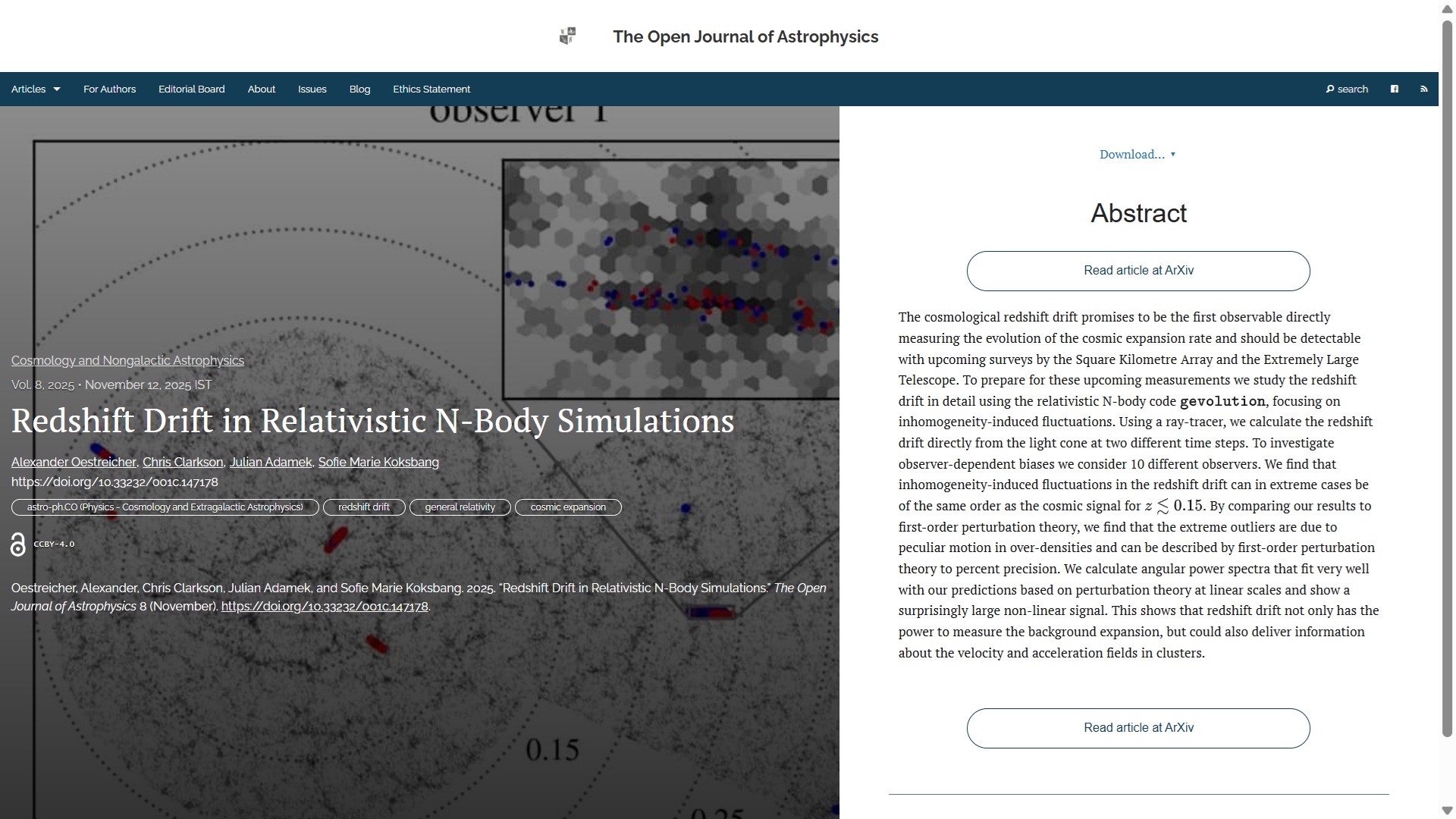
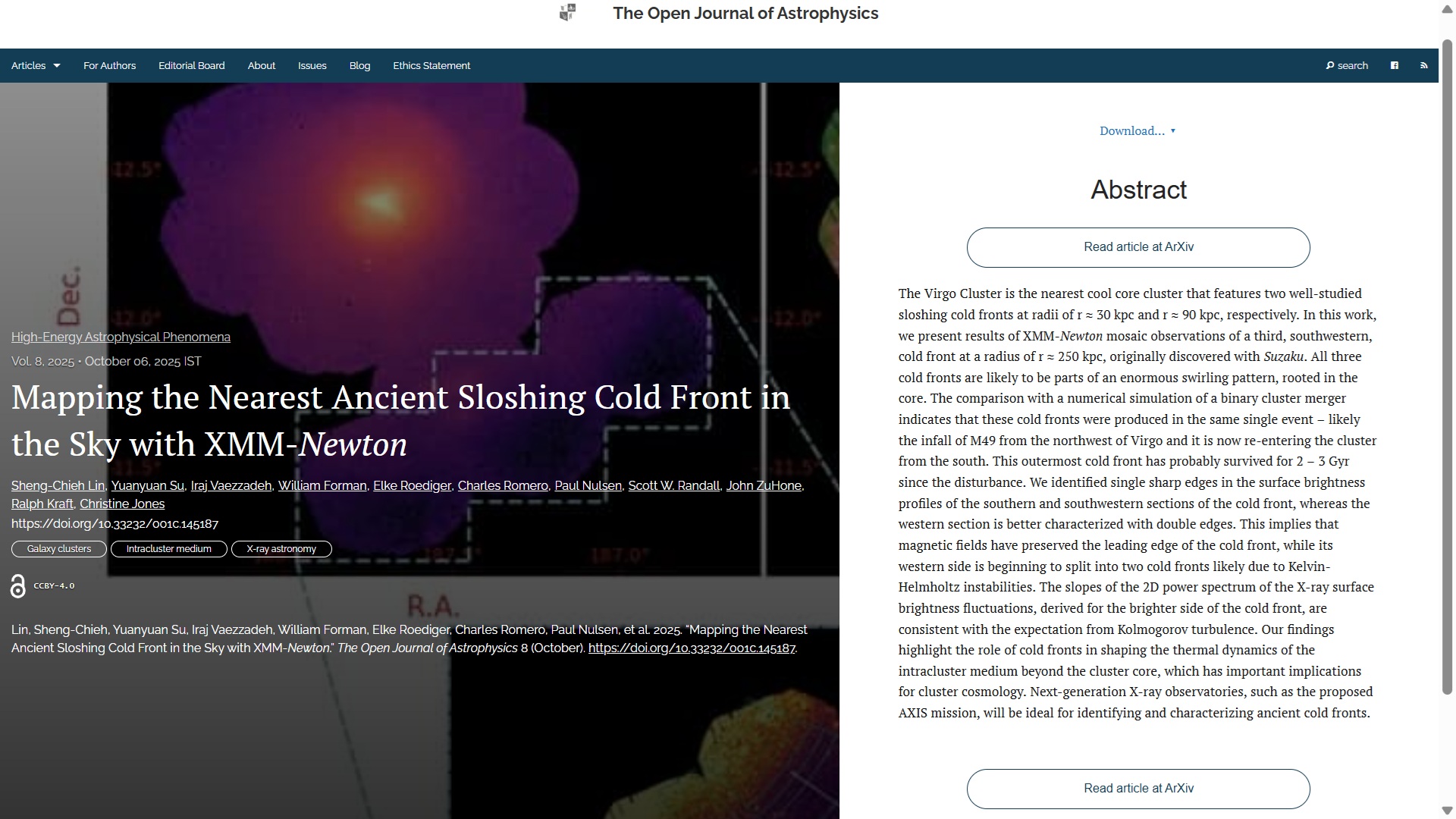
Anyway, that’s all for this week. I’ll post another update next Saturday.