Archive for JWST

Weekly Update from the Open Journal of Astrophysics – 15/11/2025

Posted in OJAp Papers, Open Access, The Universe and Stuff with tags , , , , , , , , , , , , , , , , , , , , , , , , , , , , , on November 15, 2025 by telescoper

It’s Saturday again, so it’s time for the usual update of the week’s new papers at the Open Journal of Astrophysics. It has been quite a busy week. Since the last update we have published another seven papers, which brings the number in Volume 8 (2025) up to 175, and the total so far published by OJAp up to 410.

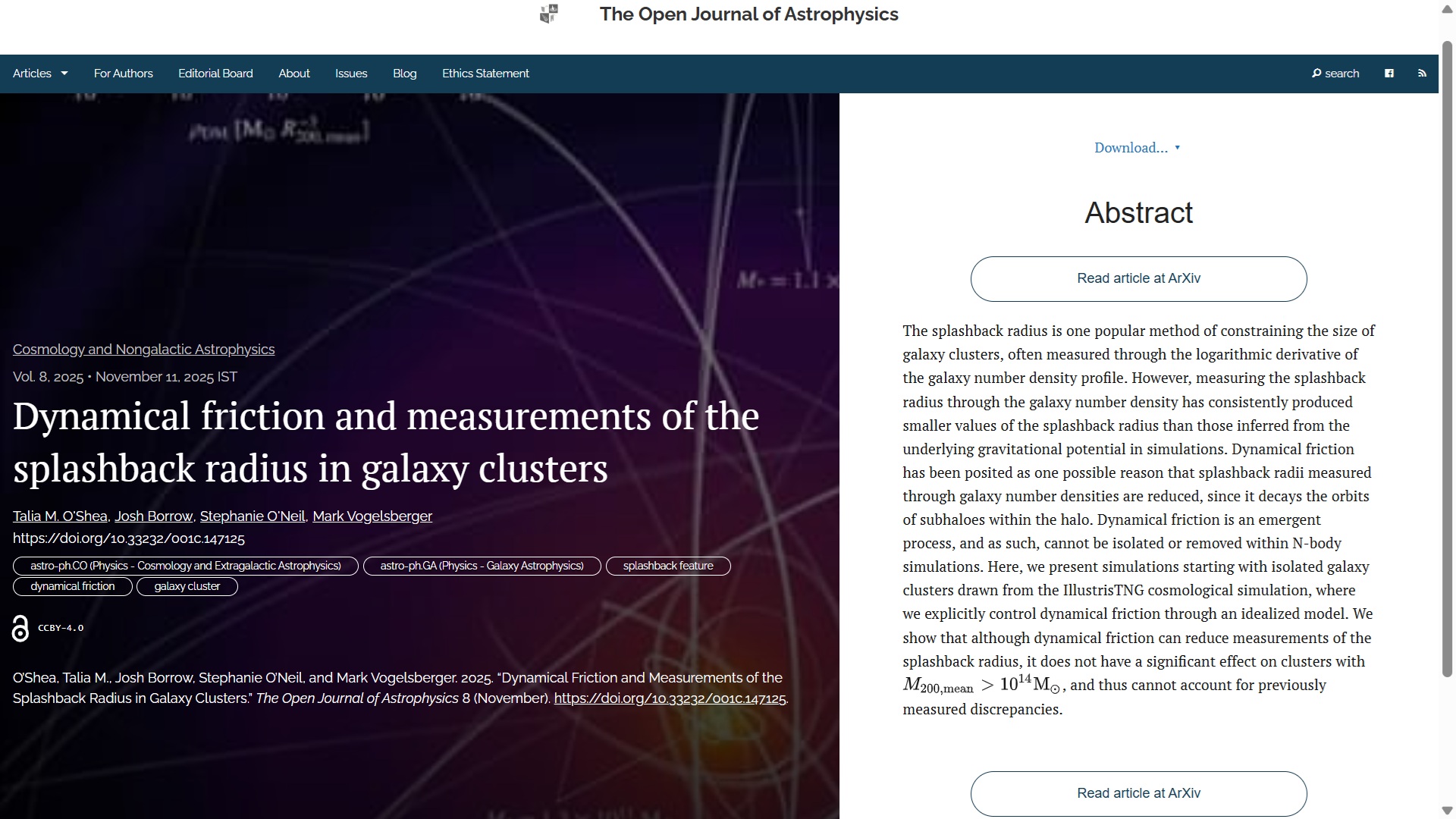
First on the menu for this week is “Dynamical friction and measurements of the splashback radius in galaxy clusters” by Talia M. O’Shea (U. Wisconsin-Madison, USA), Josh Borrow & Stephanie O’Neil (U. Pennsylvania, USA) and Mark Vogelsberger (MIT, USA). Published on Tuesday 11th November in the folder Cosmology and NonGalactic Astrophysics, this one presents a study suggesting that dynamical friction does not play a major role in reducing the radius of the splashback feature in real data compared to numerical simulations.

The overlay is here:

You can find the officially accepted version on arXiv here.

The Fediverse announcement is here:

Open Journal of Astrophysics

New Publication at the Open Journal of Astrophysics: "Dynamical friction and measurements of the splashback radius in galaxy clusters" by Talia M. O'Shea (U. Wisconsin-Madison, USA), Josh Borrow & Stephanie O'Neil (U. Pennsylvania, USA) and Mark Vogelsberger (MIT, USA)

doi.org/10.33232/001c.147125

November 11, 2025, 8:36 am 3 boosts 1 favorites


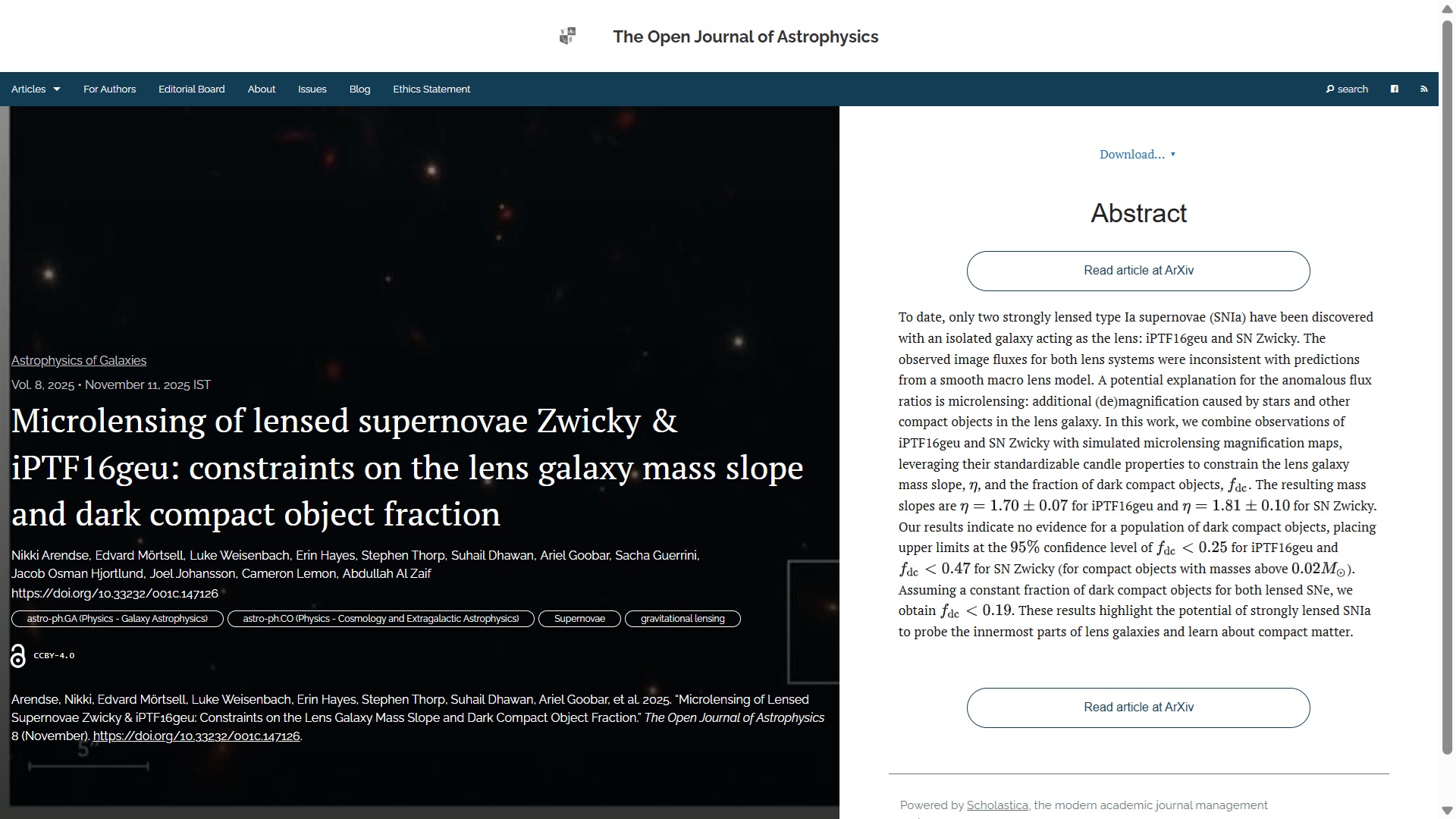
The second paper of the week is “Microlensing of lensed supernovae Zwicky & iPTF16geu: constraints on the lens galaxy mass slope and dark compact object fraction” by Nikki Arendse (Stockholm University, Sweden) and and international cast of 11 others based in Sweden, UK and France. This one was published on 11th November 2025 in the folder Astrophysics of Galaxies. It is about combining observations of two supernovae, iPTF16geu and SN Zwicky, with microlensing magnification maps to probe the properties of the lens galaxy.

The overlay is here:


You can find the official version of this one on arXiv here. The federated announcement on Mastodon is here:

Open Journal of Astrophysics

New Publication at the Open Journal of Astrophysics: "Microlensing of lensed supernovae Zwicky & iPTF16geu: constraints on the lens galaxy mass slope and dark compact object fraction" by Nikki Arendse (Stockholm University, Sweden) and 11 others based in Sweden, UK and France

doi.org/10.33232/001c.147126

November 11, 2025, 8:53 am 1 boosts 1 favorites


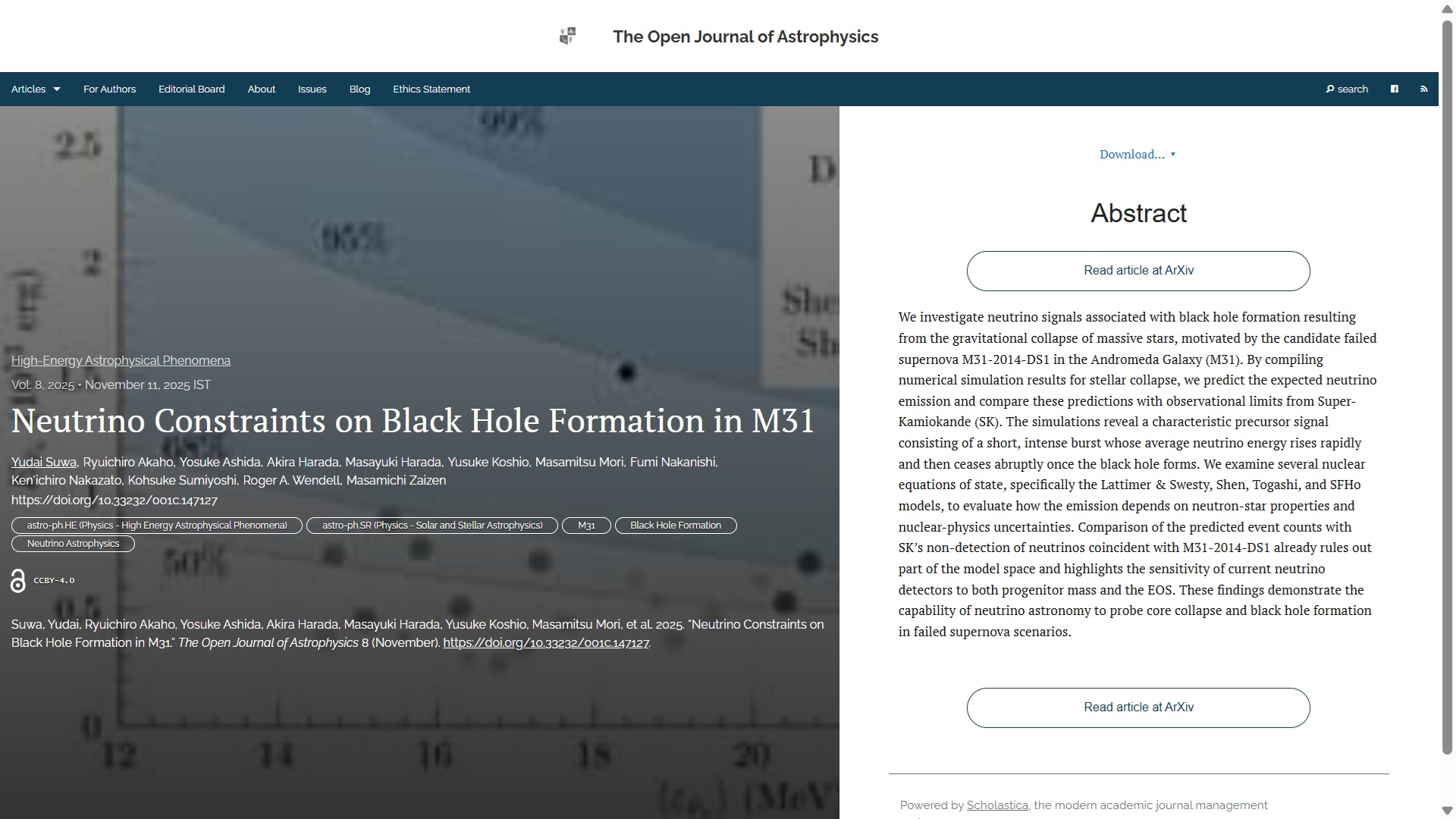
Next one up is “Neutrino Constraints on Black Hole Formation in M31” by Yudai Sawa (U. Tokyo, Japan) and 11 others all based in Japan. This was published on Tuesday 11th November in the folder High-Energy Astrophysical Phenomena. It presents a calculation of the neutrino emission expected from the collapse of massive stars and its use in constraining black hole formation using neutrino detectors.


The overlay is here:

You can find the official accepted version on arXiv here. The fediverse announcement is here:

Open Journal of Astrophysics

New Publication at the Open Journal of Astrophysics: "Neutrino Constraints on Black Hole Formation in M31" by Yudai Sawa (U. Tokyo, Japan) and 11 others all based in Japan

doi.org/10.33232/001c.147127

November 11, 2025, 9:04 am 0 boosts 1 favorites

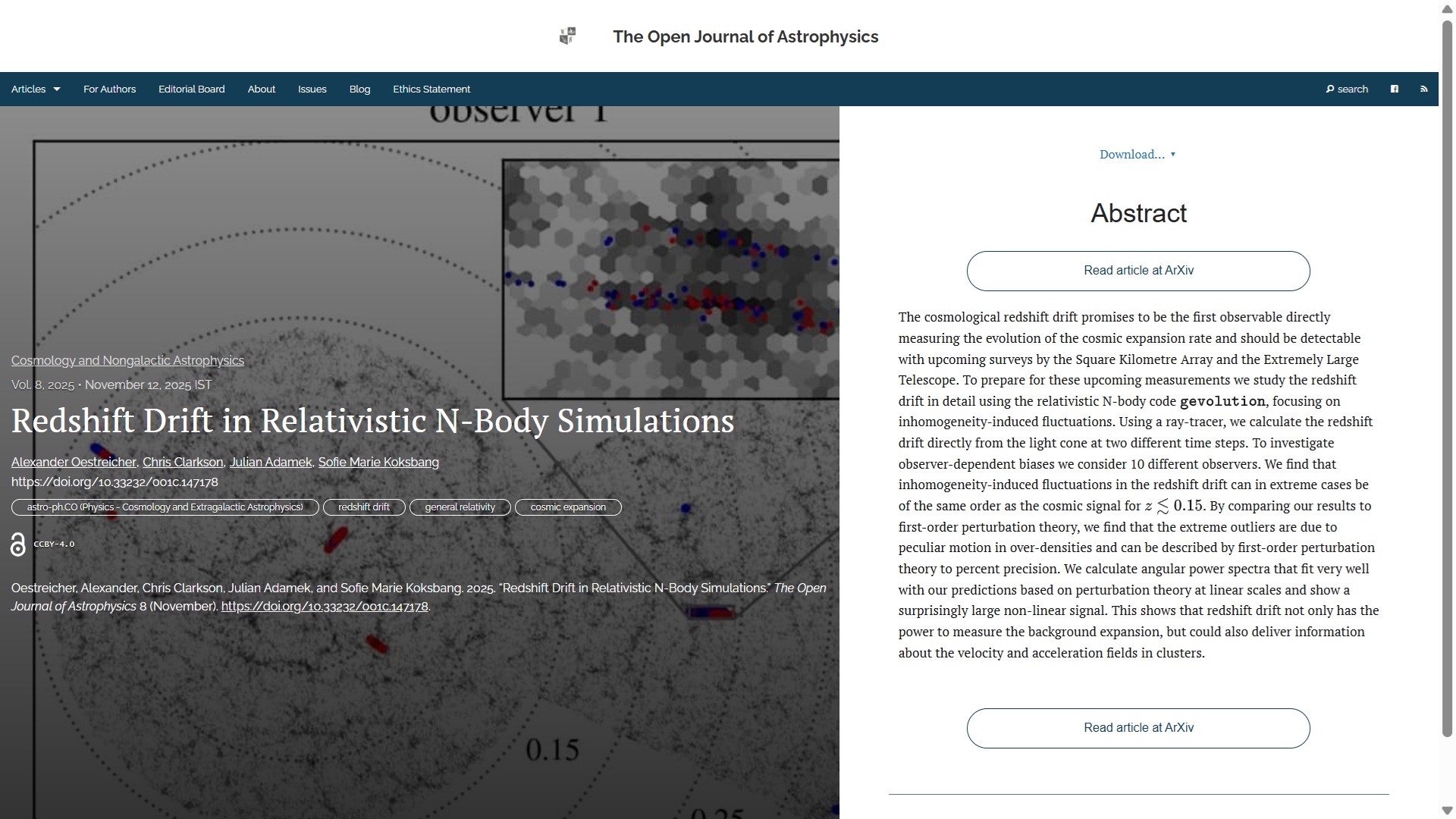
The fourth paper this week is “Redshift Drift in Relativistic N-Body Simulations” by Alexander Oestreicher (U. Southern Denmark, DK), Chris Clarkson (QMUL, UK), Julian Adamek (U. Zürich, CH) and Sofie Marie Koksbang (U. Southern Denmark, DK). This one was published on Wednesday 12th November in the folder marked Cosmology and NonGalactic Astrophysics. It presents numerical calculations of the cosmological redshift drift effect for comparison with future surveys.

The overlay is here:


You can find the official published version on arXiv here. The Fediverse announcement follows:

Open Journal of Astrophysics

New Publication at the Open Journal of Astrophysics: "Redshift Drift in Relativistic N-Body Simulations" by Alexander Oestreicher (U. Southern Denmark, DK), Chris Clarkson (QMUL, UK), Julian Adamek (U. Zürich, CH) and Sofie Marie Koksbang (U. Southern Denmark, DK)

doi.org/10.33232/001c.147178

November 12, 2025, 8:35 am 1 boosts 0 favorites


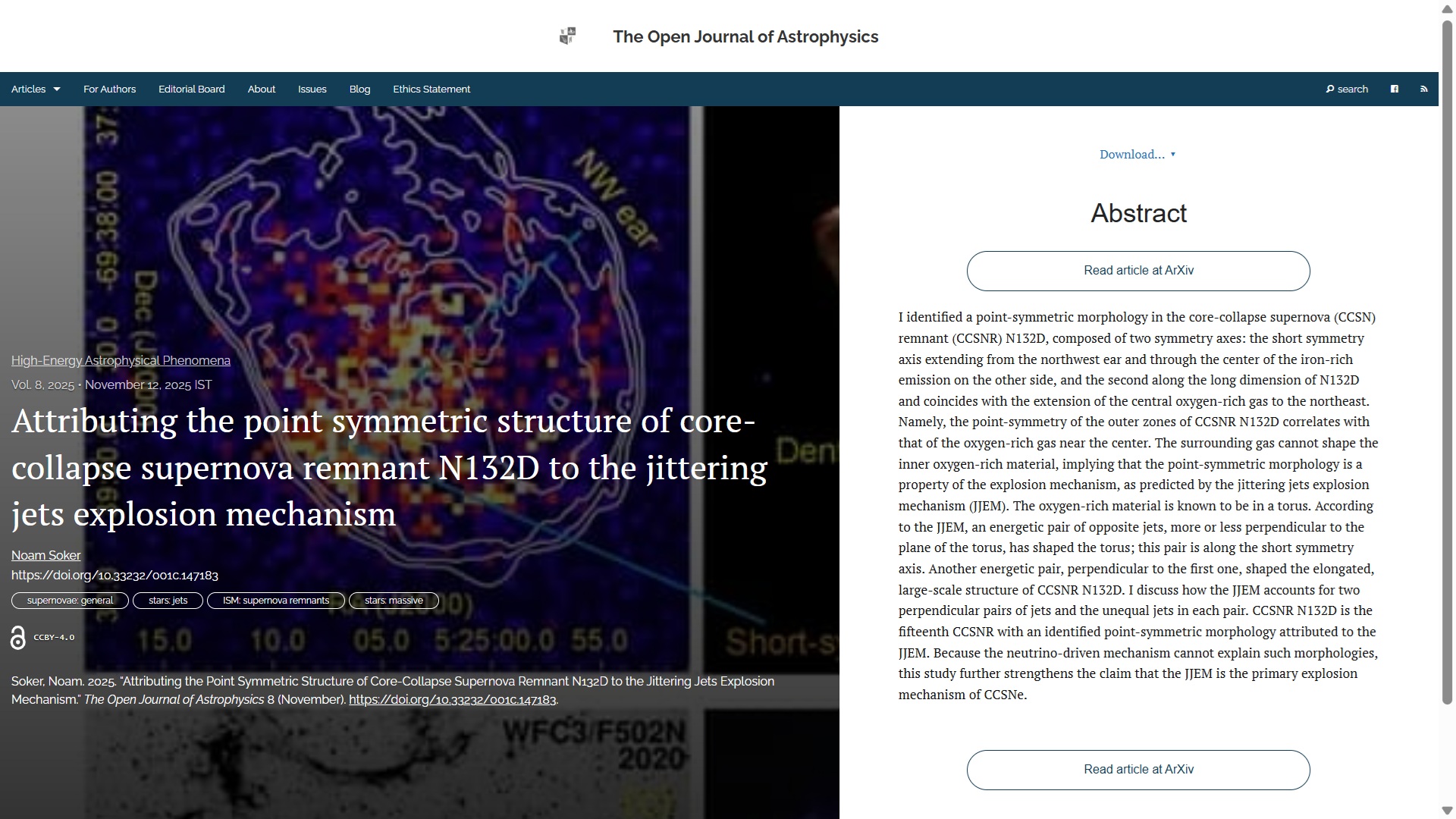
The fifth paper for this week is “Attributing the point symmetric structure of core-collapse supernova remnant N132D to the jittering jets explosion mechanism” by Noam Soker (Technion, Haifa, Israel). This one, published on Wednesday November 12th in the folder High-Energy Astrophysical Phenomena, presents a discussion of the morphology of a supernova remnant and possible explanation for it in terms of the explosion mechanism.

The overlay is here:


The officially accepted version can be found on arXiv here. The Fediverse announcement is here:

Open Journal of Astrophysics

New Publication at the Open Journal of Astrophysics: "Attributing the point symmetric structure of core-collapse supernova remnant N132D to the jittering jets explosion mechanism" by Noam Soker (Technion, Haifa, Israel)

doi.org/10.33232/001c.147183

November 12, 2025, 8:46 am 1 boosts 0 favorites

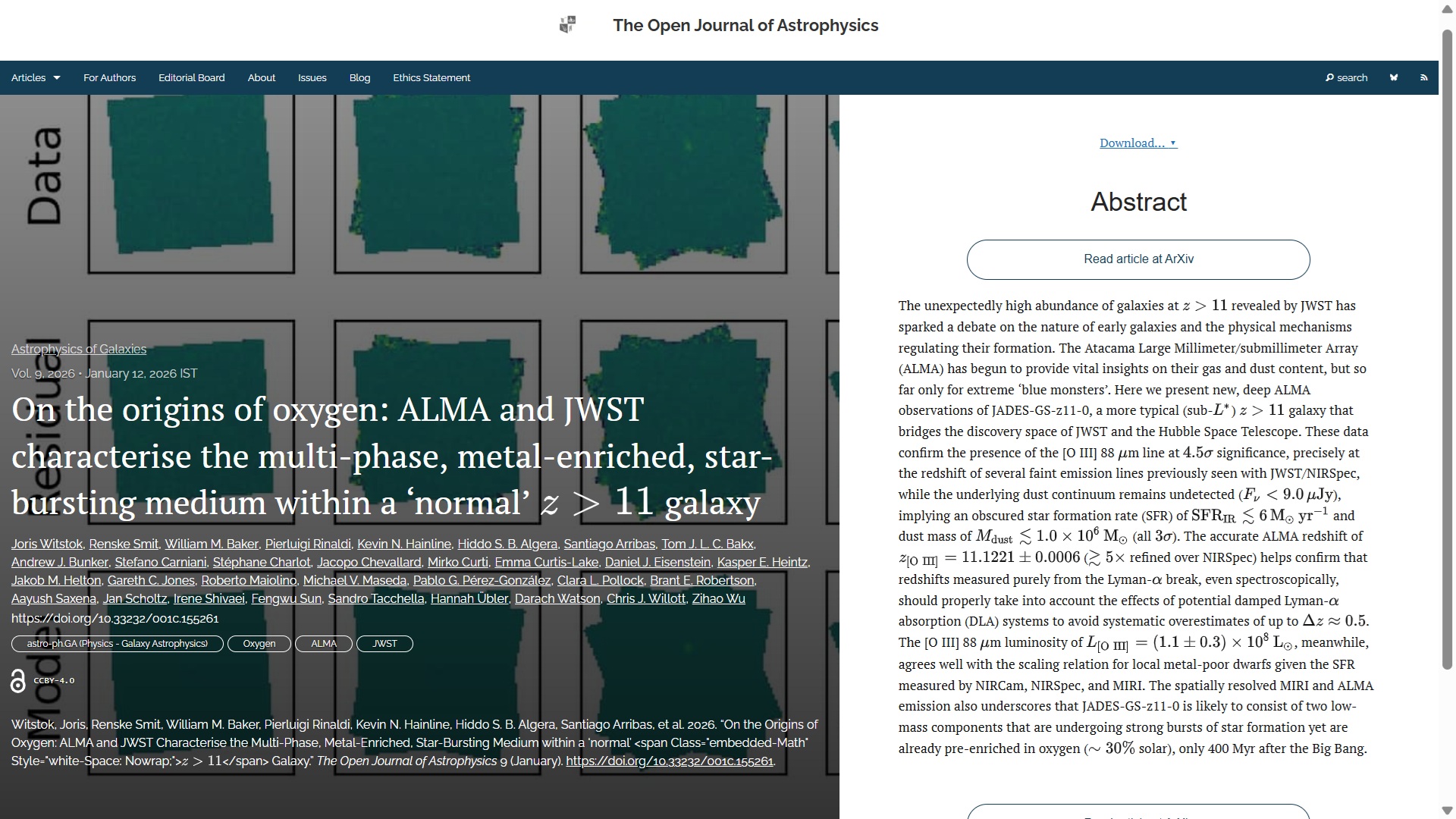
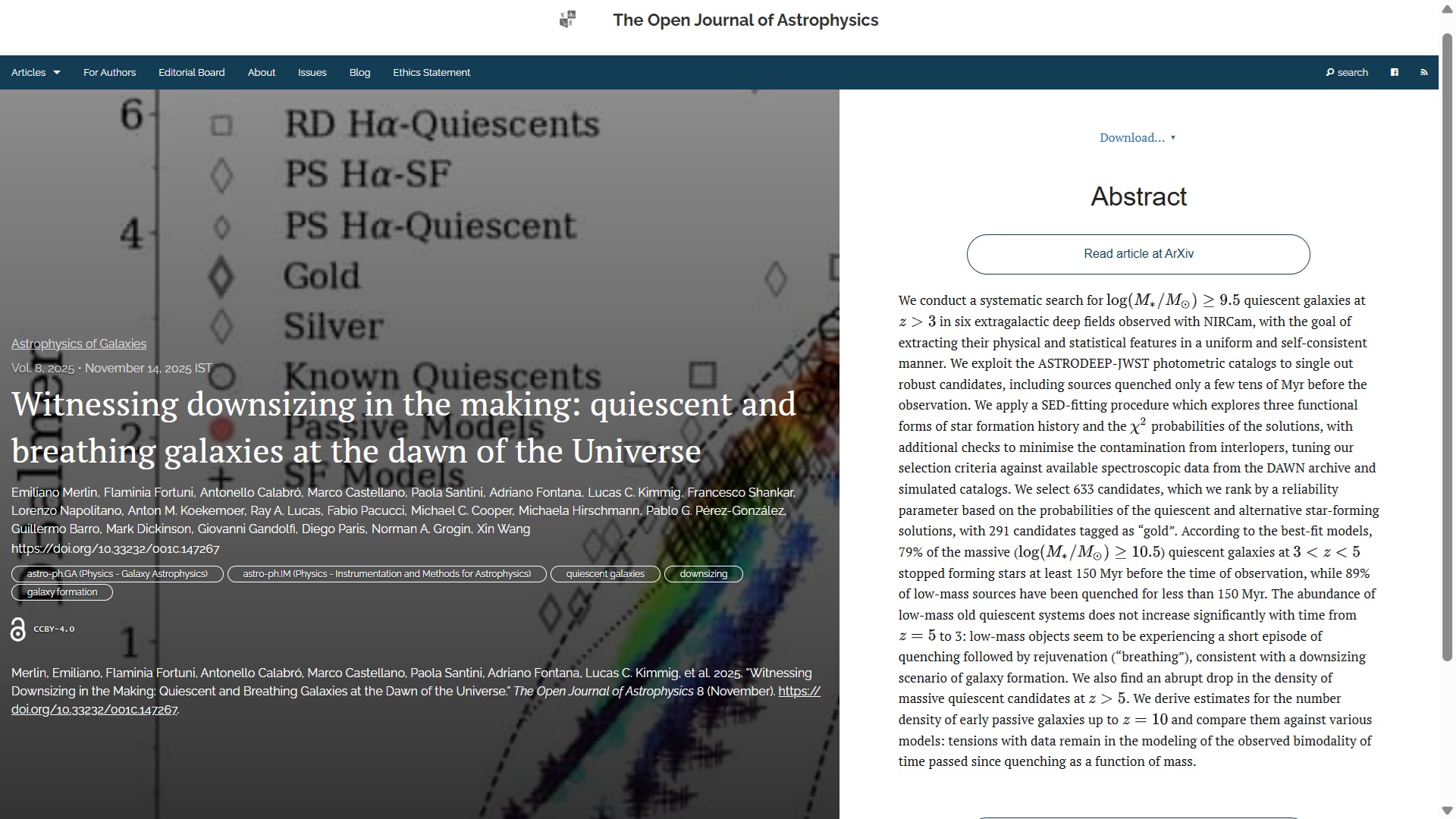
The sixth paper to report this week is “Witnessing downsizing in the making: quiescent and breathing galaxies at the dawn of the Universe” by Emiliano Merlin (Osservatorio Astronomico di Roma, Italy) and an international cast of 20 others based in Italy, Germany, UK, USA, Switzerland, Spain and China. This one was published on Friday November 14th in the folder Astrophysics of Galaxies.

You can find the officially-accepted version on arXiv here. The fediverse announcement is here:

Open Journal of Astrophysics

New Publication at the Open Journal of Astrophysics: "Witnessing downsizing in the making: quiescent and breathing galaxies at the dawn of the Universe" by Emiliano Merlin (Osservatorio Astronomico di Roma, Italy) and 20 others based in Italy, Germany, UK, USA, Switzerland, Spain and China

doi.org/10.33232/001c.147267

November 14, 2025, 8:38 am 1 boosts 1 favorites

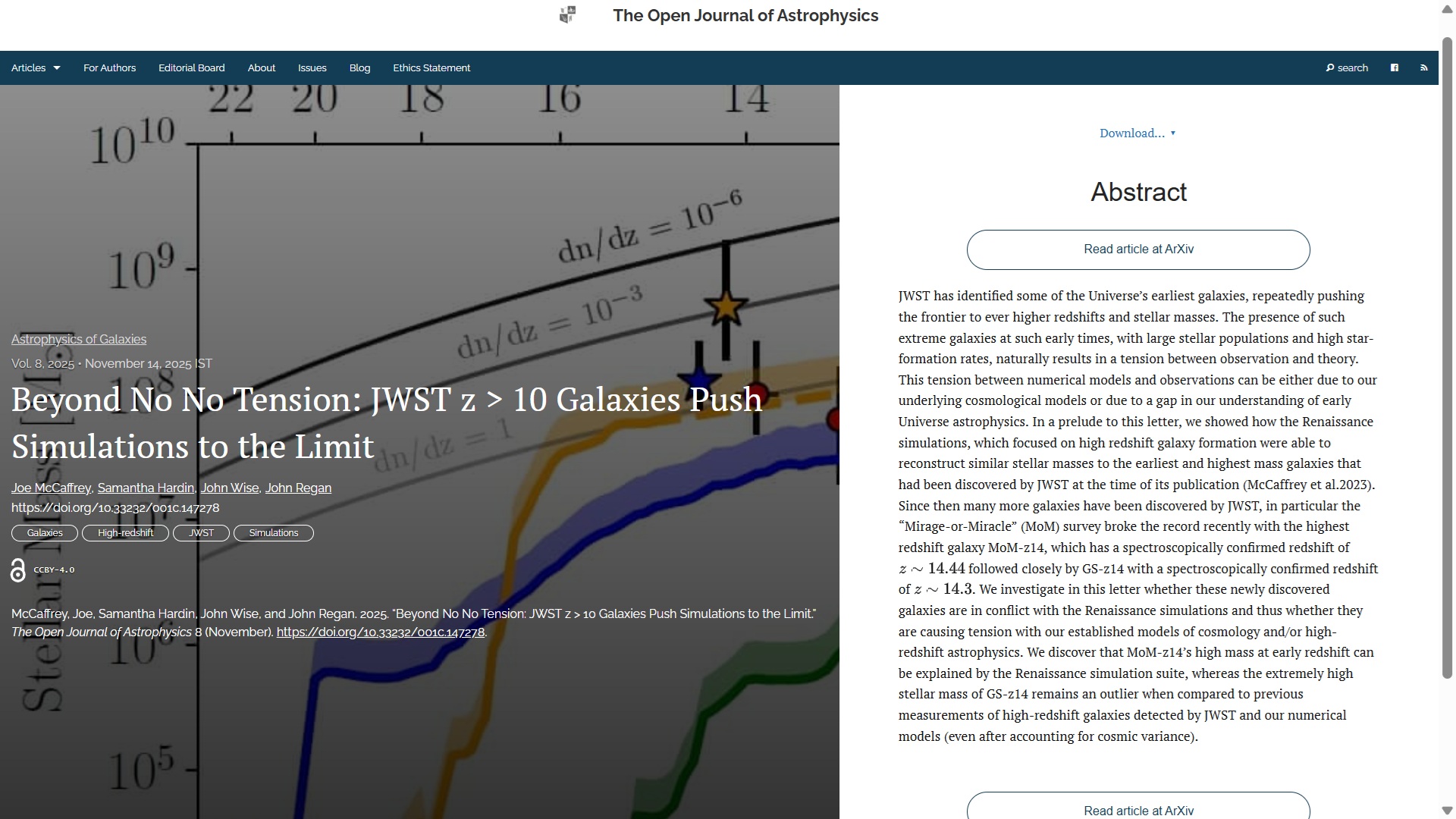
And finally (for this week) we have “Beyond No No Tension: JWST z > 10 Galaxies Push Simulations to the Limit” by Joe McCaffrey (NUI Maynooth, Ireland), Samantha Hardin & John Wise (Georgia Institute of Technology, USA) and John Regan (Maynooth). This one was also published on Friday 14th November, in the folder marked Astrophysics of Galaxies. It asks the question whether newly-discovered high redshift galaxies are consistent with simulations of galaxy formation. The overlay is here:

You can find the officially acceopted version on arXiv here. The fediverse announcement is here:

Open Journal of Astrophysics

New Publication at the Open Journal of Astrophysics: "Beyond No No Tension: JWST z > 10 Galaxies Push Simulations to the Limit" by Joe McCaffrey (NUI Maynooth, Ireland), Samantha Hardin & John Wise (Georgia Institute of Technology, USA) and John Regan (Maynooth)

doi.org/10.33232/001c.147278

November 14, 2025, 9:02 am 2 boosts 0 favorites

And that concludes the update for this week. There will be another next Saturday.

Weekly Update from the Open Journal of Astrophysics – 04/10/2025

Posted in OJAp Papers, Open Access, The Universe and Stuff with tags , , , , , , , , , , , , , , , , , , , , , , , , on October 4, 2025 by telescoper

It’s Saturday again, so it’s time for a summary of the week’s new papers at the Open Journal of Astrophysics. Since the last update we have published five more papers, which brings the number in Volume 8 (2025) up to 146, and the total so far published by OJAp up to 381. At this rate Volume 8 will contain around 190 by the end of 2025.

Anyway, here are this week’s papers, starting with three published on Monday 29th September 2025.

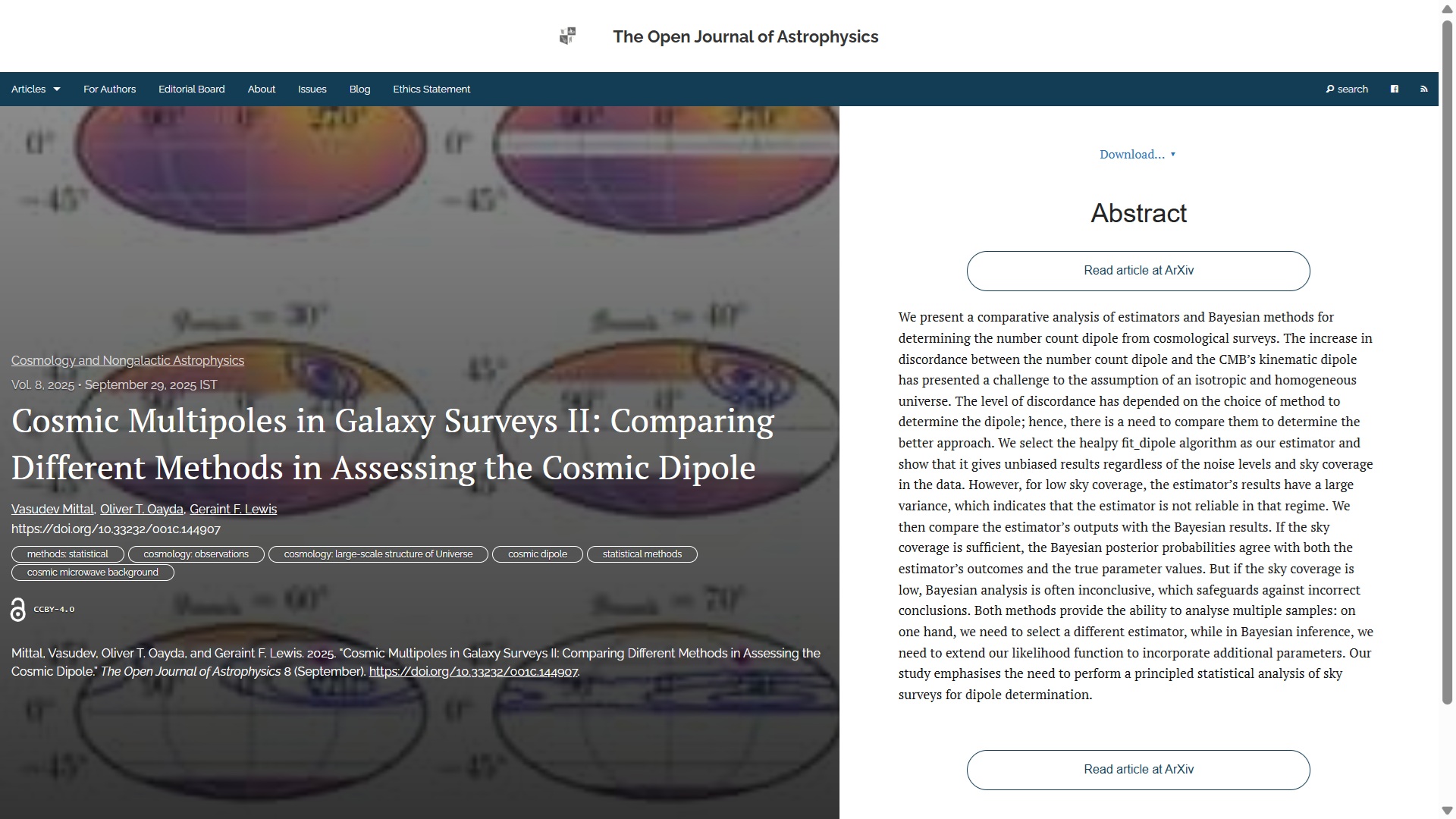
The first paper is “Cosmic Multipoles in Galaxy Surveys II: Comparing Different Methods in Assessing the Cosmic Dipole” by Vasudev Mittal, Oliver T. Oayda and Geraint F. Lewis (U. Sydney, Australia). This is in the folder Cosmology and Nongalactic Astrophysics. It presents a comparison of methods for determining the number count dipole from cosmological surveys with a discussion of the implications for the known discordance with the CMB diple.

The overlay is here:

You can make this larger by clicking on it.  The officially accepted version of this paper can be found on the arXiv here.

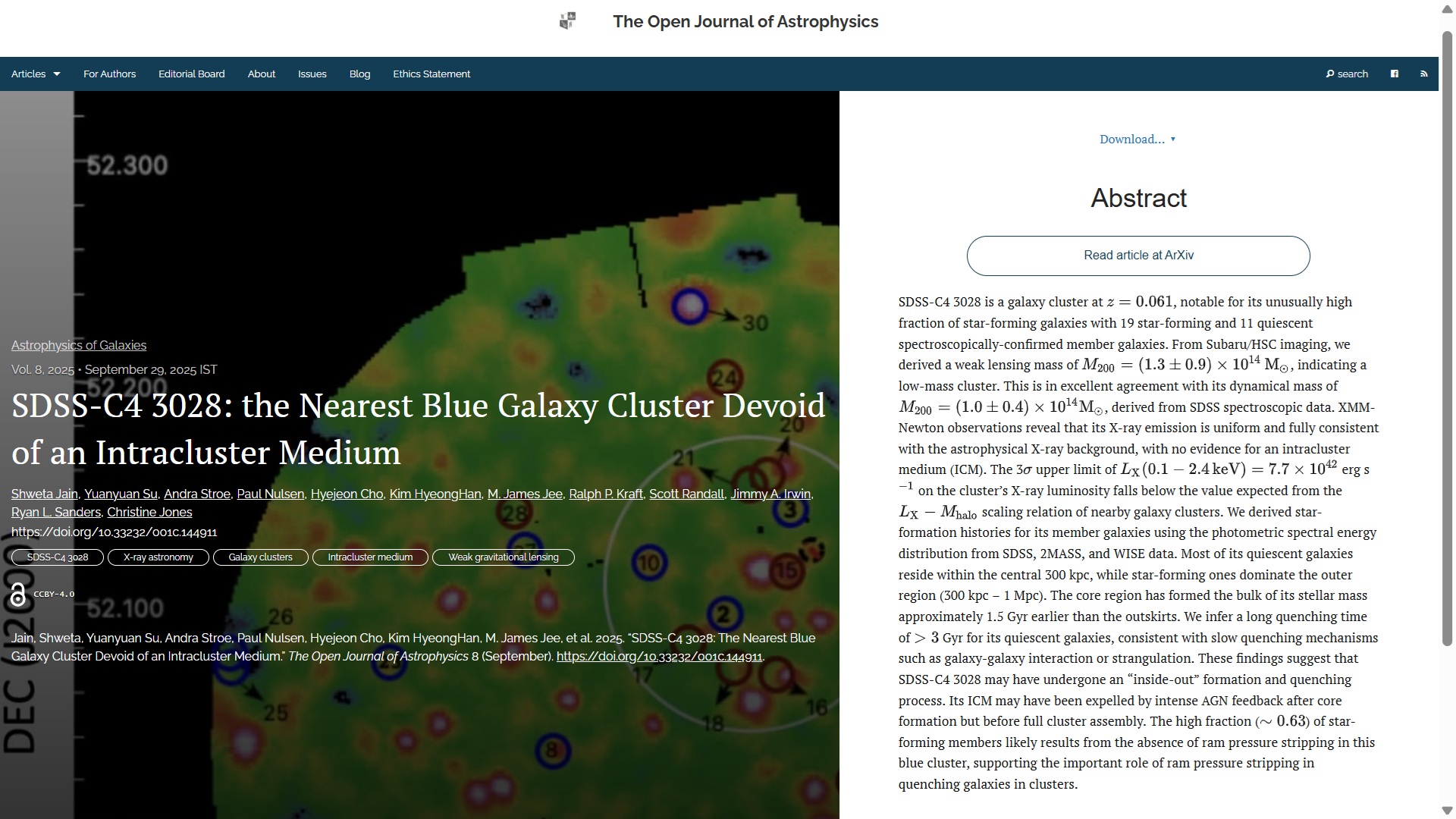
The second paper this week, also published on Monday 29th September, is “SDSS-C4 3028: the Nearest Blue Galaxy Cluster Devoid of an Intracluster Medium” by Shweta Jain (University of Kentucky, USA) and 11 others based in the USA, Australia and Korea. This describes a galaxy cluster with an unusually high fraction (about 63%) of star-forming galaxies which may be a result of ram pressure stripping; the article is in the folder Astrophysics of Galaxies.

The corresponding overlay is here:


You can find the officially accepted version on arXiv here.

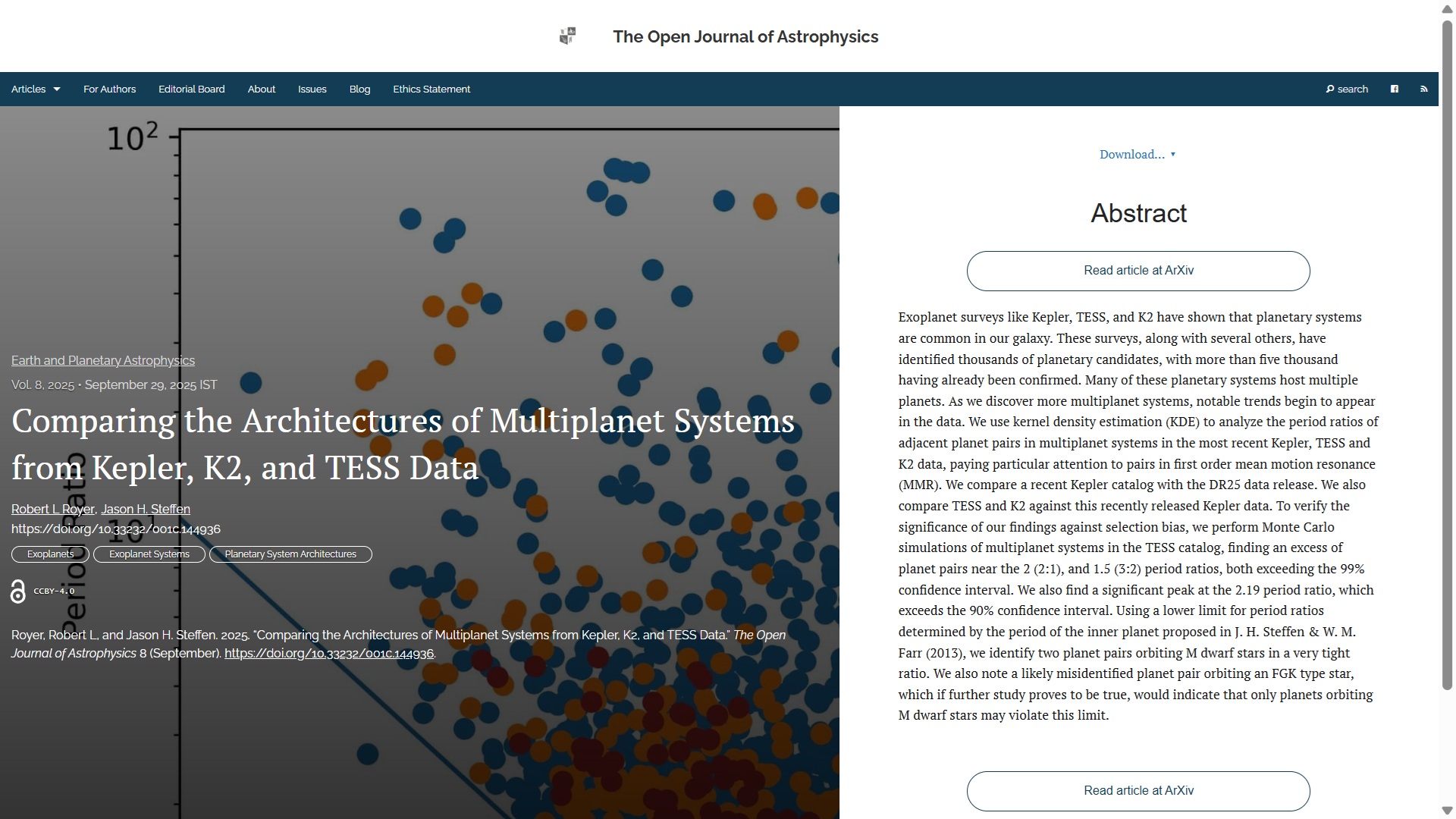
The third one this week, published on also published on Monday 29th September but in the folder Earth and Planetary Astrophysics, is “Comparing the Architectures of Multiplanet Systems from Kepler, K2, and TESS Data” by Robert L Royer and Jason H. Steffen (University of Nevada, USA).  This paper explores the trends seen in exoplanet survey data, including Kepler, TESS, and K2 including many planetary systems with multiple planets.

The overlay is here:


You can find the officially-accepted version on arXiv here.

The next one up is “Seeding Cores: A Pathway for Nuclear Star Clusters from Bound Star Clusters in the First Billion Years” by Fred Angelo Batan Garcia (Columbia University, USA), Massimo Ricotti (University of Maryland, USA) and Kazuyuki Sugimura (Hokkaido University, Japan). This paper was published on Thursday 2nd October in the folder Astrophysics of Galaxies. This is about modelling the formation of Nuclear Star Clusters using cosmological radiation-hydrodynamic simulations, with discussion of the implications for seeding supermassive black holes and the little red dots seen by JWST.

The corresponding overlay is here:

You can find the officially accepted version of this one on arXiv here.

The fifth and last one for this week, published on Friday 3rd October 2025, is “Efficient semi-analytic modelling of Pop III star formation from Cosmic Dawn to Reionization” by Sahil Hegde and Steven R. Furlanetto (University of Californi Los Angeles, USA).  This is also in the folder marked Astrophysics of Galaxies. It uses a self-consistent analytic model to trace the formation of the first stars from their birth through the first billion years of the universe’s history. complementing semi-analytic and computational methods.


You can find the officially-accepted version of this paper on arxiv here.

That concludes the report for this week. I’ll post another update next Saturday.

A Zoom in to the Butterfly Nebula

Posted in Maynooth, The Universe and Stuff, YouTube with tags , , , , , , on September 17, 2025 by telescoper

I haven’t used my Youtube channel very much recently so to avoid disappointing my subscribers, of whom there are several, I have today uploaded a video showcasing the work of colleagues in the Physics Department at Maynooth.

This zoom in from an optical Hubble Space Telescope (HST) image shows how infrared observations by the James Web Space Telescope reveal the surprising details of the structure at the heart of the Butterfly Nebula, NGC 6302

For background to this video, see here.

Galaxies and Black Holes in the First Billion Years

Posted in Biographical, The Universe and Stuff with tags , , , , , on September 1, 2025 by telescoper

Trying to catch up on recent developments in galaxy formation? I can heartily recommend an excellent review article on the subject by Richard Ellis which you can find on the arXiv here. The abstract reads:

 I present written notes from three lectures given at the 54th Saas-Fee Advanced Course of the Swiss Society of Astrophysics and Astronomy in January 2025 entitled “Galaxies and Black Holes in the First Billion Years as seen by the JWST”. I focused my lectures on progress in studies of cosmic reionisation, the properties of galaxies in the reionisation era, topics related to the redshift frontier and the search for Population III stars. The lectures were given to graduate students in astrophysics and cover both pedagogical material as well as observational results from the first two and half years of JWST science operations. The pace of discovery with JWST is, of course, rapid and so my lectures discuss long-term goals, analysis methods and their assumptions and limitations in the hope that the underlying material will retain value in the near future. In this written version, the visual material is that presented at Saas-Fee in January 2025 but I have provided updates on progress from the literature up to August 2025. The material is aimed at early career researchers and should not be considered as a scholarly review of the entire JWST literature on high redshift galaxies.

It’s quite a long article (65 pages) but nicely written and well worth reading, as it is full of information about recent advances as well as historical insights. Talking of which, there’s a picture on page 41 taken at a meeting in Durham in 1988 called The Epoch of Galaxy Formation that I attended while I was still a graduate student:

Richard Ellis himself is in the front row, left of centre with light-coloured trousers, checked shirt and hands in pockets. I’m in the picture too, but I’ll leave it up to you to find me!

A poll was held among the delegates at that meeting about various questions to do with galaxy formation. The majority opinions revealed by these votes nearly all turned out to be utterly wrong! That’s progress, I guess…

Weekly Update from the Open Journal of Astrophysics – 30/08/2025

Posted in OJAp Papers, Open Access, The Universe and Stuff with tags , , , , , , , , , , , , , , , on August 30, 2025 by telescoper

Once again it’s time for a summary of the week’s new papers at the Open Journal of Astrophysics. Since the last update we have published three new papers, which brings the number in Volume 8 (2025) up to 125, and the total so far published by OJAp up to 360.

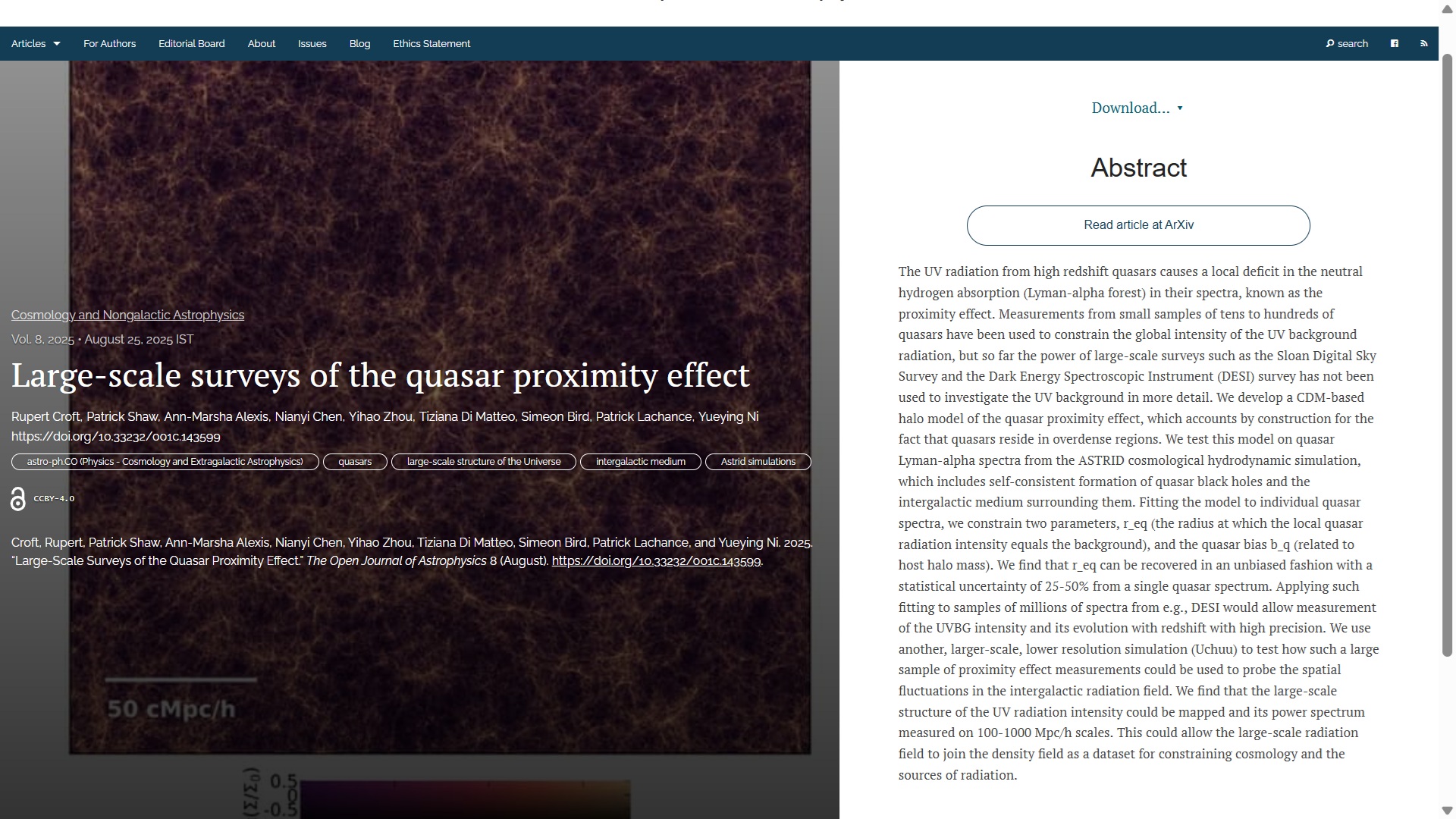
The first paper to report this week is “Large-scale surveys of the quasar proximity effect” by Rupert Croft, Patrick Shaw & Ann-Marsha Alexis (Carnegie Mellon University; CMU), Nianyi Chen (Princeton), Yihao Zhou & Tiziana Di Matteo (CMU), Simeon Bird (UC Riverside), Patrick Lachance (CMU), and Yueying Ni (Harvard). This paper was published on Monday 25th August in the folder Cosmology and NonGalactic Astrophysics. It presents a CDM-based halo model of the quasar proximity effect, tested on quasar Lyman-alpha spectra from the ASTRID cosmological simulation, including self-consistent formation of quasar black holes and the intergalactic medium.

The overlay is here:


You can make this larger by clicking on it, as you can with all the overlays below. The officially accepted version of this paper can be found on the arXiv here.

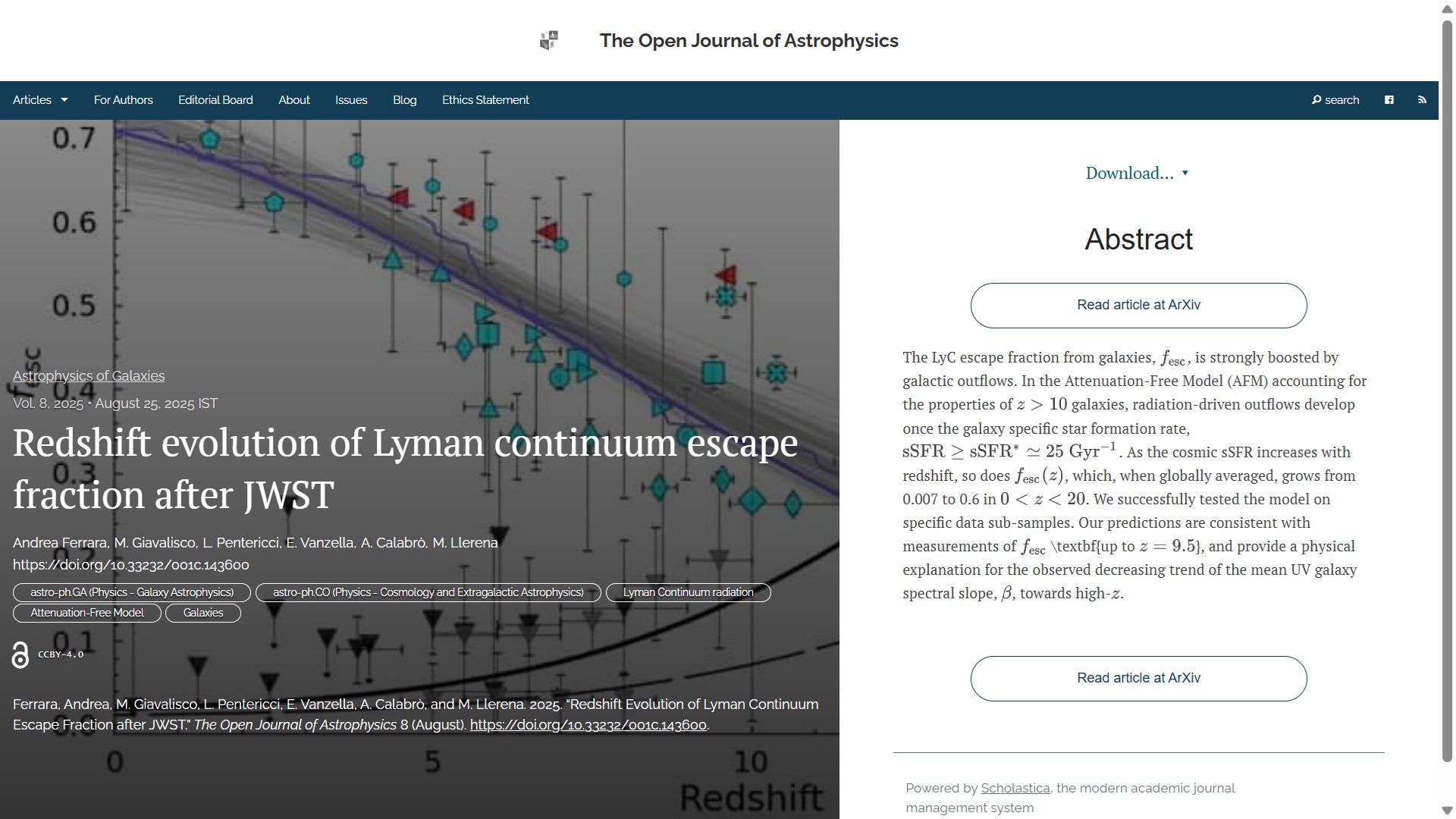
The second paper this week, also published on Monday 25th August, but in the folder Astrophysics of Galaxies, is “Redshift evolution of Lyman continuum escape fraction after JWST” by Andrea Ferrara (Pisa), M. Giavalisco (UMass Amherst), L. Pentericci (Rome), E. Vanzella (Bologna), A. Calabrò (Rome) and M. Llerena (Rome). This paper is about the Attenuation-Free Model (AFM) for galaxies, in which radiation-driven outflows develop once the galaxy specific star formation rate exceeds a certain level, which is tested on data with positive results. The overlay is here:

You can find the officially accepted version on arXiv here.

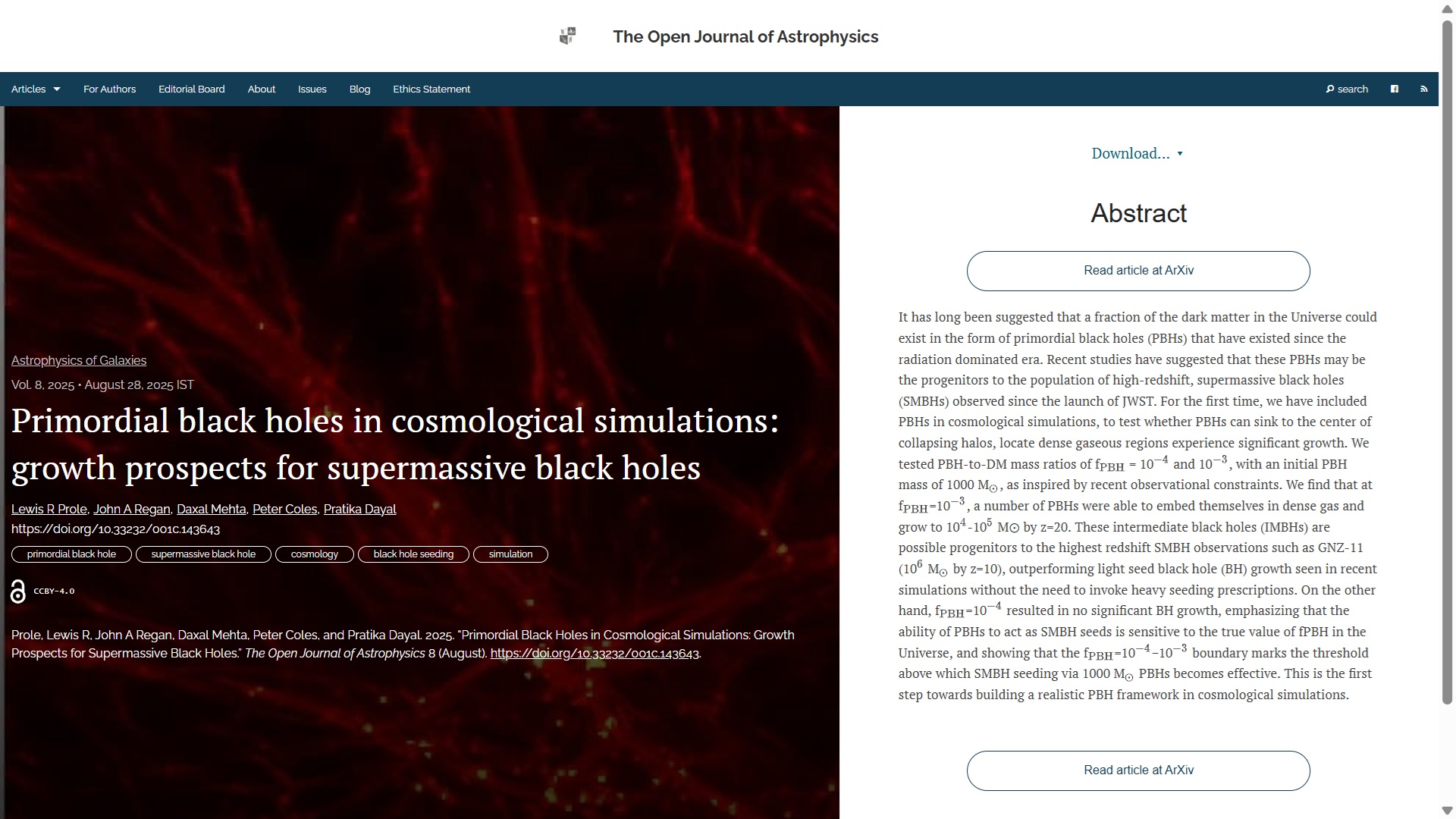
The third and final paper this week is “Primordial black holes in cosmological simulations: growth prospects for supermassive black holes” by Lewis R Prole, John A Regan, Daxal Mehta & Peter Coles (National University of Ireland, Maynooth) and Pratika Dayal (Groningen, NL). This one was published in Astrophysics of Galaxies folder on Thursday 28th August 2025. You can read more about this paper here: basically it studies the growth of primordial black holes in the early Universe using numerical simulations, with implications for the subsequent formation of massive black holes.

The overlay is here:

You can find the officially accepted version of this one on arXiv here.

And that’s all the papers for this week. It’s still a bit slow as we emerge from the summer vacations, but I expect things will start to pick up from now on.

Two New Publications at the Open Journal of Astrophysics

Posted in OJAp Papers, Open Access, The Universe and Stuff with tags , , , , , , , , on November 16, 2024 by telescoper

Once again it’s time for a Saturday morning update on activity at the  Open Journal of Astrophysics.  Since the last update we have published two more papers, taking  the count in Volume 7 (2024) up to 104 and the total published by OJAp up to 219.

The first paper of the most recent pair, published on November 13 2024,  in the folder Cosmology and NonGalactic Astrophysics, is “Stochastic Super-resolution of Cosmological Simulations with Denoising Diffusion Models” by Andreas Schanz, Florian List and Oliver Hahn (all based in the University of Vienna, Austria). It presents a  discussion of denoising diffusion in generative models for achieving super-resolution in simulations of cosmic large-scale structure.

Here is a screen grab of the overlay which includes the abstract:


You can click on the image of the overlay to make it larger should you wish to do so.  You can find the officially accepted version of this paper on the arXiv here.

The second paper to be published this week is also in the folder marked Cosmology and NonGalactic Astrophysics. It was published on November 14 and has the title “Halo mass functions at high redshift” by Hannah O’Brennan, John A. Regan, Chris Power (*), Saoirse Ward, John Brennan, and Joe McCaffrey. Five of the six authors are colleagues of mine from the National University of Ireland, Maynooth; Chris Power (marked with a *) is from the University of Western Australia.

Here is a screen grab of the overlay which includes the abstract:


You can click on the image of the overlay to make it larger should you wish to do so. You can find the officially accepted version of the paper on the arXiv here.

That concludes this week’s update. More  next week!

Newgrange and JWST

Posted in History, The Universe and Stuff with tags , , on August 18, 2024 by telescoper

Although I won’t myself be able to attend, I’m happy to be able to use the medium of this blog to advertise the above public event which is taking place in the first week of September on the back of a week-long conference to celebrate the career of Professor Tom Ray of the Dublin Institute for Advanced Studies. That in turn follows hard on the heels of the Irish National Astronomy Meeting (INAM) which takes place in Galway on 29th and 30th August.

Anyway, the public event on 3rd September is free to attend but you need to register here, where it is described thusly:

The Newgrange Passage Tomb, a prehistoric monument in County Meath, Ireland, is one of the most remarkable examples of Neolithic art and architecture, dating back to around 3200 BC. This ancient structure, with its intricate stone carvings and precise alignment with the winter solstice sunrise, reflects the sophisticated astronomical knowledge of its builders.

With starkly different technology, the James Webb Space Telescope (JWST), launched in 2021, represents the pinnacle of modern astronomical achievement. JWST is designed to peer into the farthest reaches of the universe, capturing images and data from the formation of the earliest galaxies to the atmospheres of planets outside of/beyond our solar system.

Despite being separated by millennia, both Newgrange and JWST underscore humanity’s enduring quest to understand our place in the cosmos through the study of the stars and the universe.

As part of the celebration of the career of Professor Tom Ray the Dublin Institute for Advanced Studies and the Institute of Physics are delighted to host a public event on Newgrange and JWST. This is in recognition of Tom’s long interest in archaeoastronomy and Newgrange in particular, and his involvement with the JWST through the Mid-Infrared instrument (MIRI).

The talk will be delivered by Dr. Frank Prendergast, archaeoastronomer and Emeritus Research Fellow at Technological University Dublin, and Professor Gillian Wright, European Principal Investigator of MIRI and Director of the UK Astronomy Technology Centre in Edinburgh.

Hubble Tension Reduced?

Posted in The Universe and Stuff with tags , , , , on August 14, 2024 by telescoper

Back in April I posted about a meeting at the Royal Society in London called Challenging the Standard Cosmological Model, some of which I attended virtually. In that post I mentioned that Wendy Freedman gave a talk related to the ongoing issue of the Hubble Tension, i.e. the discrepancy between different types of measurement of the Hubble Constant, usually characterized as local measurements (using stellar distance indicators) and larger-scale measurements (chiefly Planck). There are quite a few posts about this issue on this blog. Anyway, Wendy Freedman mention in her talk that her latest work on stellar distances suggested a value of 69.1 ± km s-1 Mpc-1, which reduces the tension with Planck significantly. At the time, however, there was no paper explaining how this number was derived.

Yesterday there appeared on arXiv a preprint by Freedman et al. which summarizes the recent results. The abstract is here:

We present the latest results from the Chicago Carnegie Hubble Program ( CCHP) to measure the Hubble constant using data from the James Webb Space Telescope (JWST). This program is based upon three independent methods: (1) Tip of the Red Giant Branch (TRGB) stars, (2) JAGB (J-Region Asymptotic Giant Branch) stars, and (3) Cepheids. Our program includes 10 nearby galaxies, each hosting Type Ia supernovae (SNe Ia), suitable for measuring the Hubble constant (H0). It also includes NGC  4258, which has a geometric distance, setting the zero point for all three methods. The JWST observations have significantly higher signal-to-noise and finer angular resolution than previous observations with the Hubble Space Telescope (HST). We find three independent values of H0 = 69.85 ± 1.75 (stat) ± 1.54 (sys) for the TRGB, H0 = 67.96 ± 1.85 (stat) ± 1.90 (sys)  km s-1 Mpc-1 for the JAGB, and H0 = 72.05 ± 1.86 (stat) ± 3.10 (sys) for Cepheids. Tying into SNe Ia, and combining these methods adopting a flat prior, yields our current estimate of H0 = 69.96 ± 1.05 (stat) ± 1.12 (sys)  km s-1 Mpc-1. The distances measured using the TRGB and the JAGB method agree at the 1% level, but differ from the Cepheid distances at the 2.5-4% level. The value of H0 based on these two methods with JWST data alone is H0 = 69.03 ± 1.75 (total error)  km s-1 Mpc-1. These numbers are consistent with the current standard ΛCDM model, without the need for the inclusion of additional new physics. Future JWST data will be required to increase the precision and accuracy of the local distance scale.

You can read the full paper on arXiv here. A summary of the summary is that of the three methods they use, two give lower values of the Hubble constant and one (Cepheids) gives a higher value but with larger errors. The number quoted in the Royal Society talk was presumably preliminary as it doesn’t match any of the numbers in the abstract, but the point remains.

You can see the reduction in scatter in the new JWST measurements in this Figure (old on the left and new on the right).

On the face of it, these results suggest that the Hubble tension is greatly reduced. I am sure, however, that advocates of a higher value will have been preparing their ripostes and it’s just a matter of time before they arrive on the arXiv too!

SN1987A, Past and Present

Posted in Biographical, The Universe and Stuff with tags , , , , , , on February 23, 2024 by telescoper

There’s a new paper in Science featuring observations using the MIRI and NIRSpec instruments on JWST of Supernova SN1987A in the Large Magellanic Cloud. I couldn’t resist doing a short post about this result, partly because the paper features Maynooth colleague Paddy Kavanagh, and partly because I’m old enough to remember when this supernova was detected, in 1987. In fact I was doing my PhD at the time. When I started lecturing a few years later I used to use it as an example of a Type II (core-collapse) supernova. At first I would say “you will remember SN1987A” then, as the years passed, I realized that students would have been quite young in 1987 so I changed this to “some of you will remember SN1987A”. Still later, I realized that none of my students had even been born in 1987 so I forgot about the remembering bit and just talked about SN1987A. As of 2024, nobody under the age of 37 was born in 1987. Tempus has a distinct tendency to Fugit.

In 1987 I was in Sussex and I remember Roger Tayler getting very excited about the detection of anti-neutrinos from SN1987A at the Kamioka Observatory in Japan. There weren’t many – 12 altogether – but he wanted to do a statistical analysis of the arrival times to see if there was any evidence that might indicate the neutrinos had mass. Being rather “old-school”, he did a Monte Carlo experiment involving drawing numbers written on bits of paper out of a cardboard box. After a brief chat I suggested I could do a much better job using a random-number generator on a computer so I wrote a bit of code and did the computation. The results showed no evidence for neutrino mass.

Anyway, this type of supernova should produce a neutron star or black hole sitting inside a ring-shaped remnant. The ring has been well studied, but in 37 years of observation the central object has not been detected. The results in the latest paper (by Fransson et al.) involve a spectroscopic study of the emission lines of ionized argon from the SN1987a remnant at sufficiently high spectral resolution to map the velocity structure. The results suggest that ionizing radiation from a neutron star is illuminating gas from the inner parts of the remnant.

https://doi.org/10.1126/science.adj5796

For more details, see the paper.

PHANGS for the galaxies…

Posted in The Universe and Stuff with tags , , , , , , , on January 31, 2024 by telescoper

I couldn’t resist sharing this wonderful set of images from JWST courtesy of the PHANGS* team showing exquisite details of 19 face-on spiral galaxies as seen in the infra-red:

More information about the remarkable structures seen in these images, as well as higher resolution versions of the images themselves, can be found on the European Space Agency website here.

*For those of you not in the know, PHANGS stands for Particularly Horrible Acronym Not Generated Sensibly Physics at High Angular resolution in Nearby GalaxieS.