It may be the Easter weekend, but it’s still time for a Saturday morning update of activity at the Open Journal of Astrophysics. Since the last update we have published a further four papers, bringing the number in Volume 9 (2026) to 71 and the total so far published by OJAp up to 519. This update coimpletes the first quarter of 2026, which suggests that if we continue to publish at the same rate we’ll reach about 280 for the year.
I will continue to include the posts made on our Mastodon account (on Fediscience) to encourage you to visit it. Mastodon is a really excellent service, and a more than adequate replacement for X/Twitter (which nobody should be using); these announcements also show the DOI for each paper.
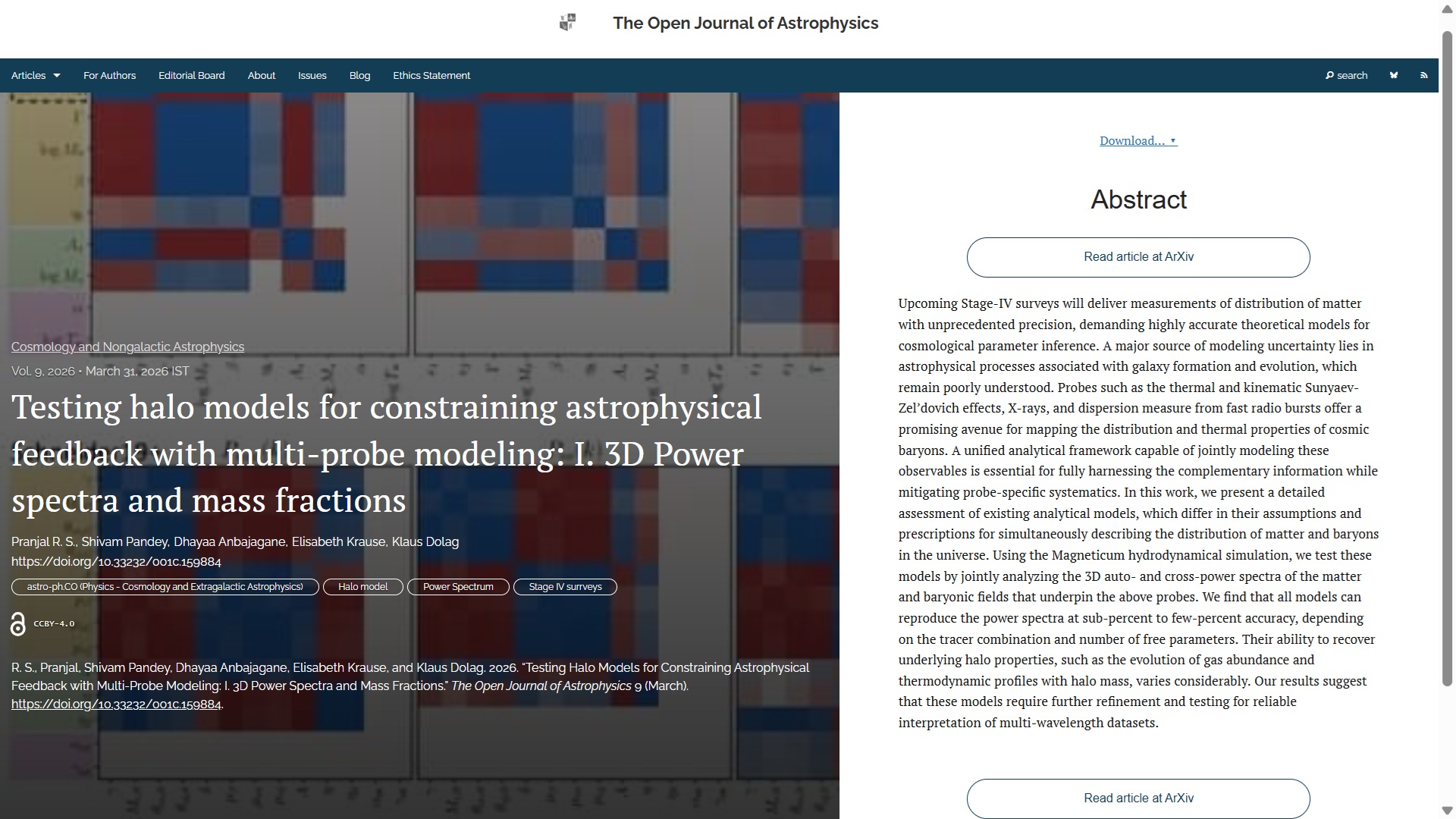
New Publication at the Open Journal of Astrophysics: "Testing halo models for constraining astrophysical feedback with multi-probe modeling: I. 3D Power spectra and mass fractions" by Pranjal R. S. (U. Arizona, USA), Shivam Pandey Johns Hopkins U., USA), Dhayaa Anbajagane (U. Chicago, USA), Elisabeth Krause (U. Arizona) and Klaus Dolag (Max Planck Institute for Astrophysics, Germany)
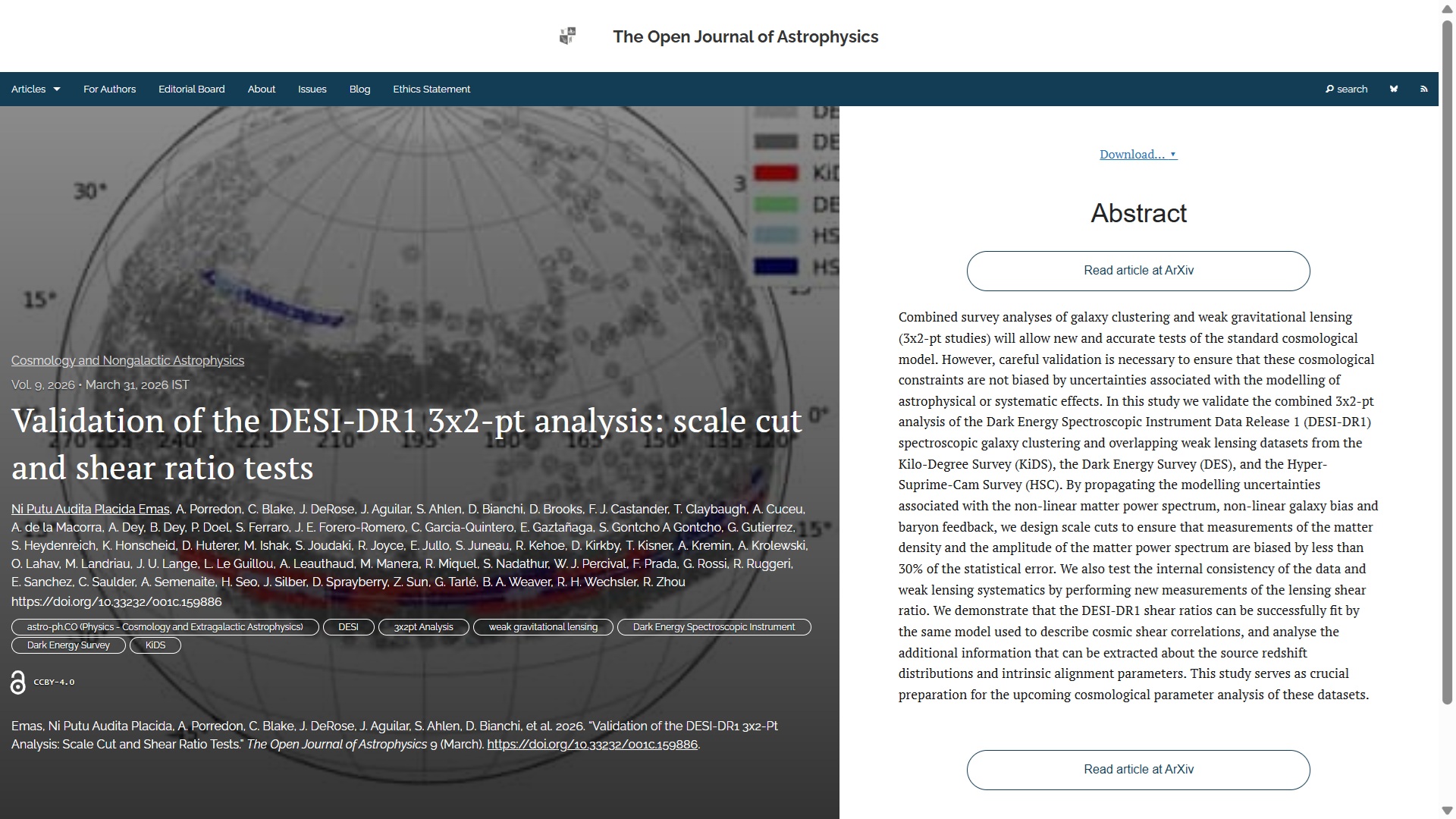
The second paper for this week, also published on Tuesday March 31st in the folder Cosmology and Nongalactic Astrophysics, is “Validation of the DESI-DR1 3×2-pt analysis: scale cut and shear ratio tests” by Ni Putu Audita Placida Emas (Swinburne University of Technology, Australia) and an international cast of 56 others. This study validates the combined analysis of galaxy clustering and weak gravitational lensing data from various surveys, ensuring accurate tests of the standard cosmological model using future Stage-IV surveys
The overlay for this one is here:
The official version of the paper can be found on arXiv here and the Fediverse announcement here:
New Publication at the Open Journal of Astrophysics: "Validation of the DESI-DR1 3×2-pt analysis: scale cut and shear ratio tests" by Ni Putu Audita Placida Emas (Swinburne University of Technology, Australia) and an international cast of 56 others.
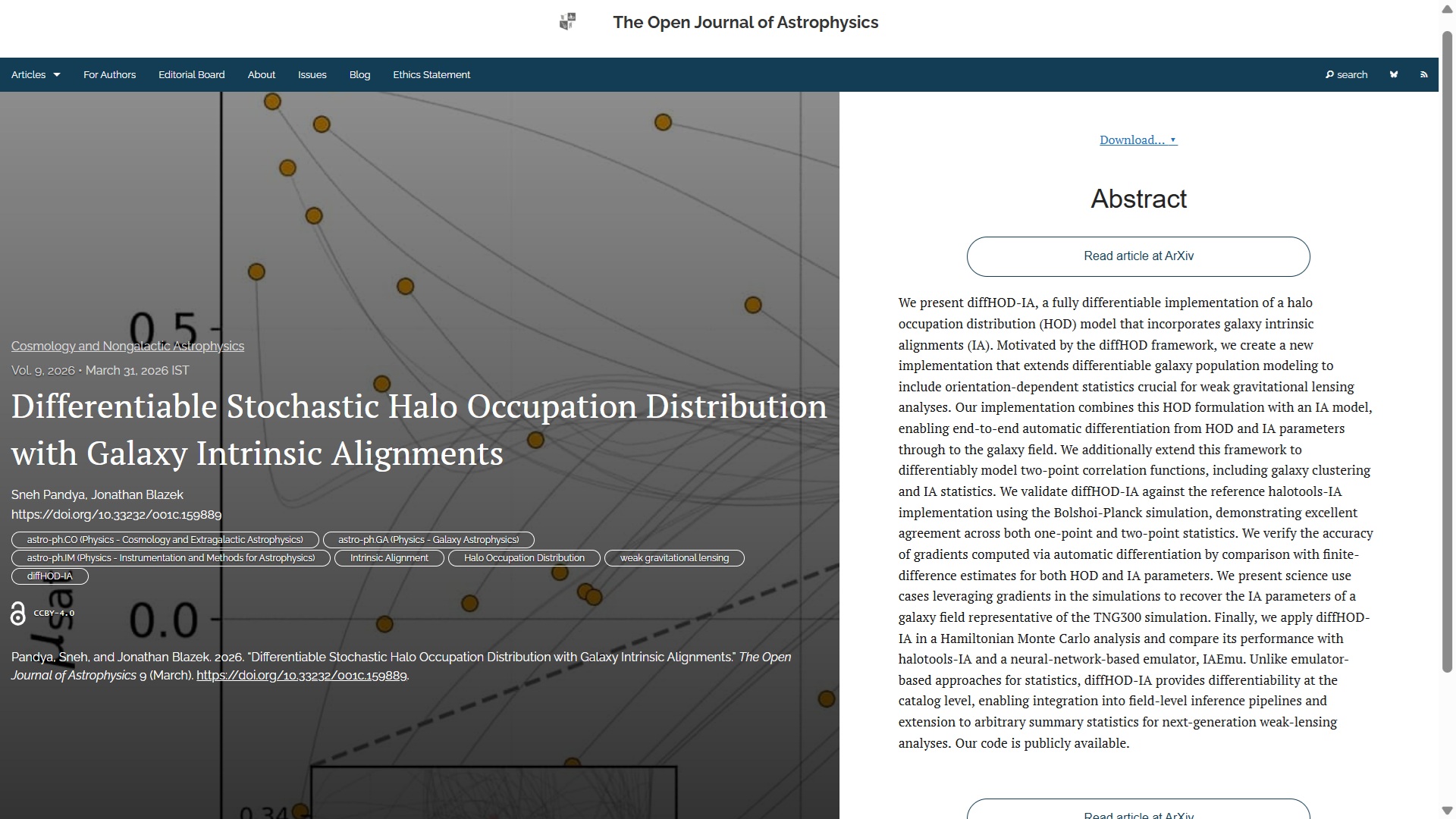
Next one up, the third paper of the week, also published on Tuesday March 31st in the folder Cosmology and Nongalactic Astrophysics, is “Differentiable Stochastic Halo Occupation Distribution with Galaxy Intrinsic Alignments” by Sneh Pandya and Jonathan Blazek (both of Northeastern University, USA). This is a paper introducing diffHOD-IA, a differentiable model for galaxy population analysis that incorporates intrinsic alignments and halo occupation distribution. It’s validated against existing models and can be used in next-generation weak-lensing analyses.
The overlay for this one is here:
The final, accepted version can be found on arXiv here and the Mastodon announcement is here:
New Publication at the Open Journal of Astrophysics: "Differentiable Stochastic Halo Occupation Distribution with Galaxy Intrinsic Alignments" by Sneh Pandya and Jonathan Blazek (Northeastern U., USA)
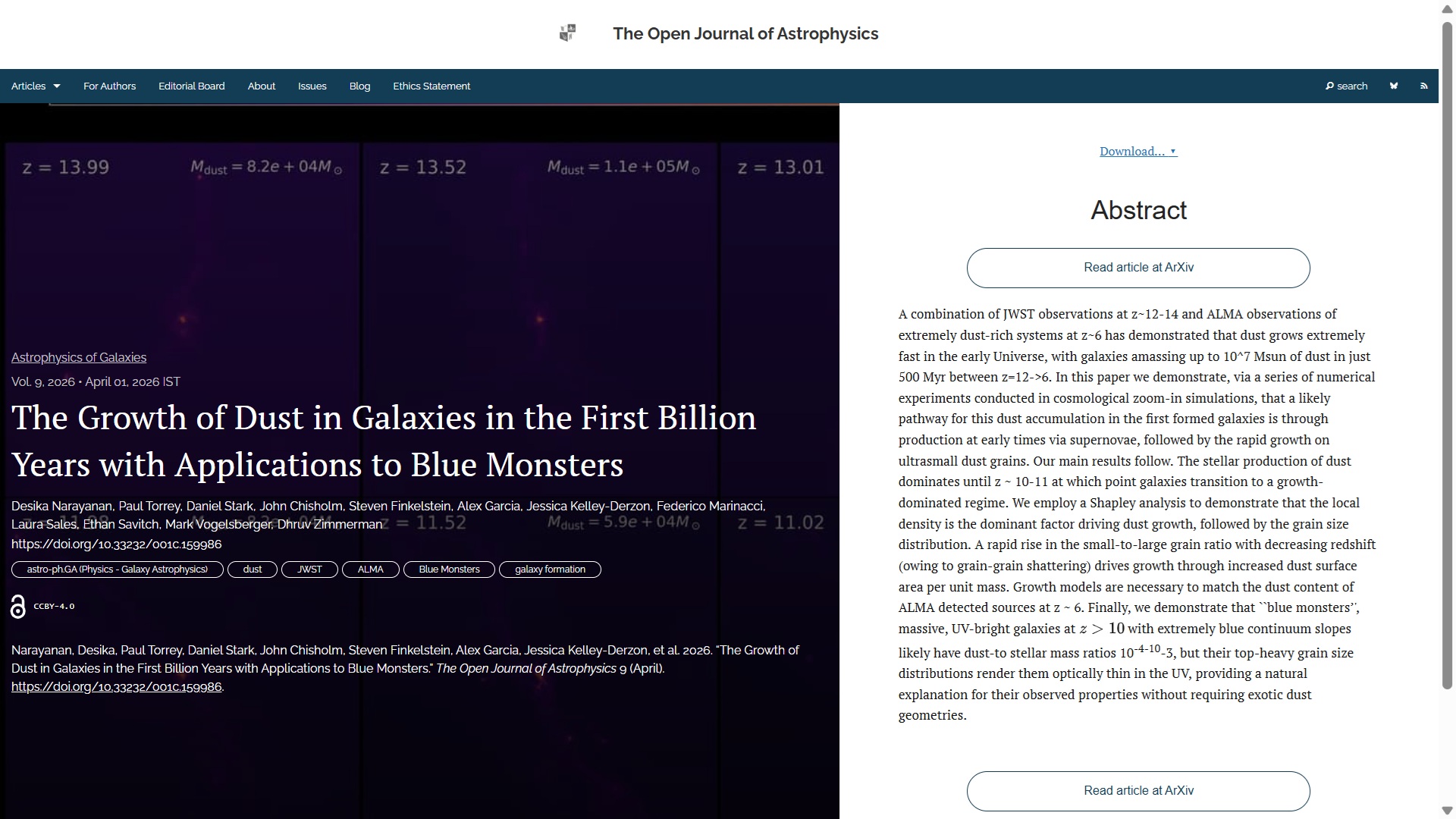
The fourth and final paper this week, published on Wednesday April 1st (but not a joke), is “The Growth of Dust in Galaxies in the First Billion Years with Applications to Blue Monsters” by Desika Narayanan (U. Florida, USA) and 11 others based in the USA and Europe. This one is in the folder Astrophysics of Galaxies; it presents a simulation-based study of dust accumulation in early galaxies via supernovae production and rapid growth on tiny dust grains, with local density and grain size being important factors.
The overlay is here:
The finally accepted version of this paper can be found here and the Mastodon announcement is here:
New Publication at the Open Journal of Astrophysics: "The Growth of Dust in Galaxies in the First Billion Years with Applications to Blue Monsters" by Desika Narayanan (U. Florida, USA) and 11 others based in the USA and Europe.
It’s Saturday once more so time for another update of activity at the Open Journal of Astrophysics. Since the last update we have published seven papers, bringing the number in Volume 9 (2026) to 11 and the total so far published by OJAp up to 459. This week has been quite busy; for only the second time in recorded history we published at least one paper each working day.
I will continue to include the announcements made on our Mastodon account (on Fediscience) to encourage you to visit it. Mastodon is a really excellent service, and a more than adequate replacement for X/Twitter which nobody should be using.
The first three papers this week were all published on Monday January 12th in the folder Astrophysics of Galaxies.
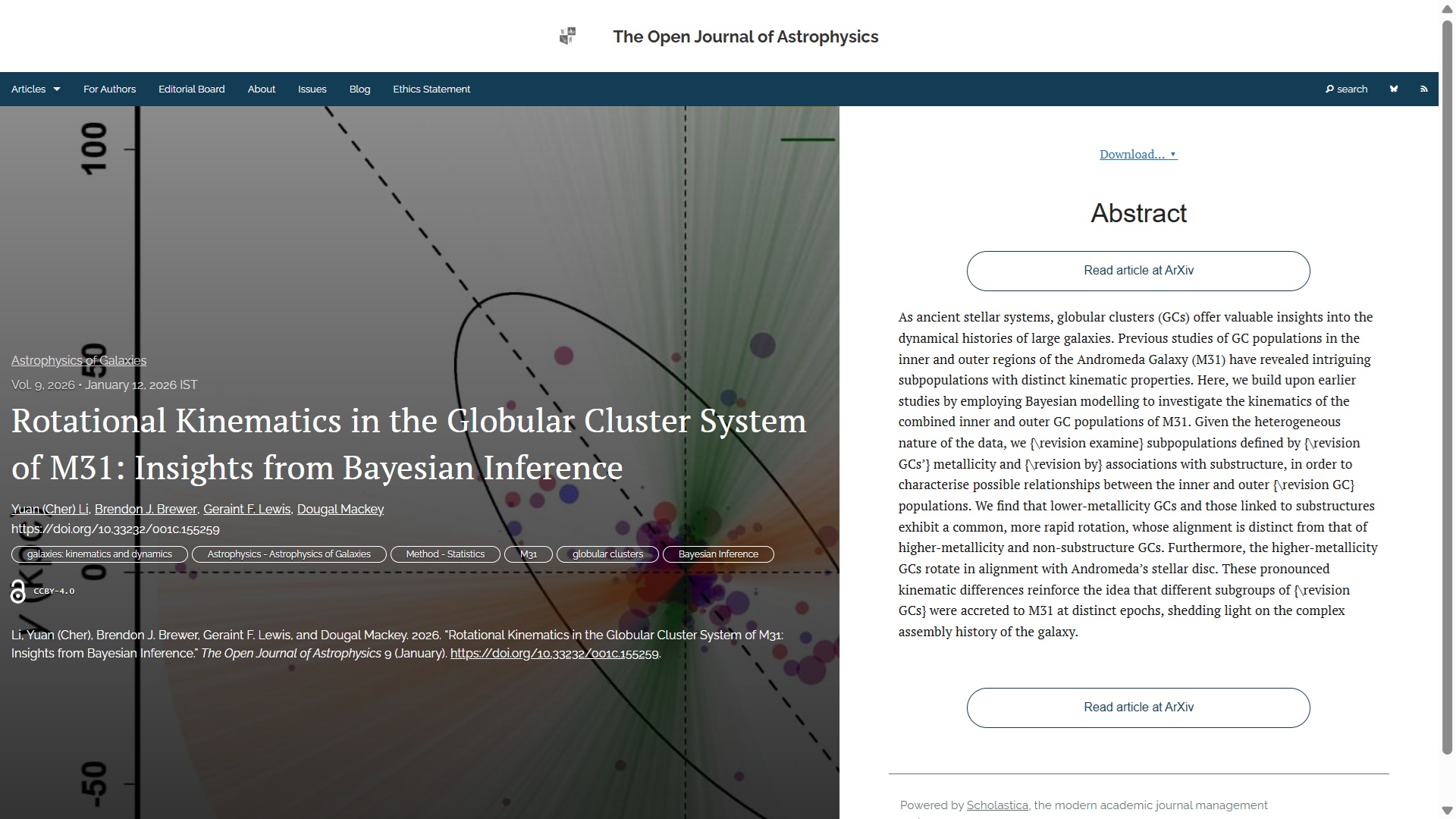
The first paper to report this week is “Rotational Kinematics in the Globular Cluster System of M31: Insights from Bayesian Inference” by Yuan (Cher) Li & Brendon J. Brewer (U. Auckland, New Zealand), Geraint F. Lewis (U. Sydney, Australia) and Dougal Mackey (independent researcher, Australia). This study uses Bayesian modelling to explore the kinematics of globular clusters in the Andromeda Galaxy, revealing distinct rotation patterns that suggest different subgroups were added at separate times.
The overlay is here:
You can find the officially accepted version on arXiv here and the announcement on Fediverse here:
New Publication at the Open Journal of Astrophysics: "Rotational Kinematics in the Globular Cluster System of M31: Insights from Bayesian Inference" by Yuan (Cher) Li & Brendon J. Brewer (U. Auckland, New Zealand), Geraint F. Lewis (U. Sydney, Australia) and Dougal Mackey
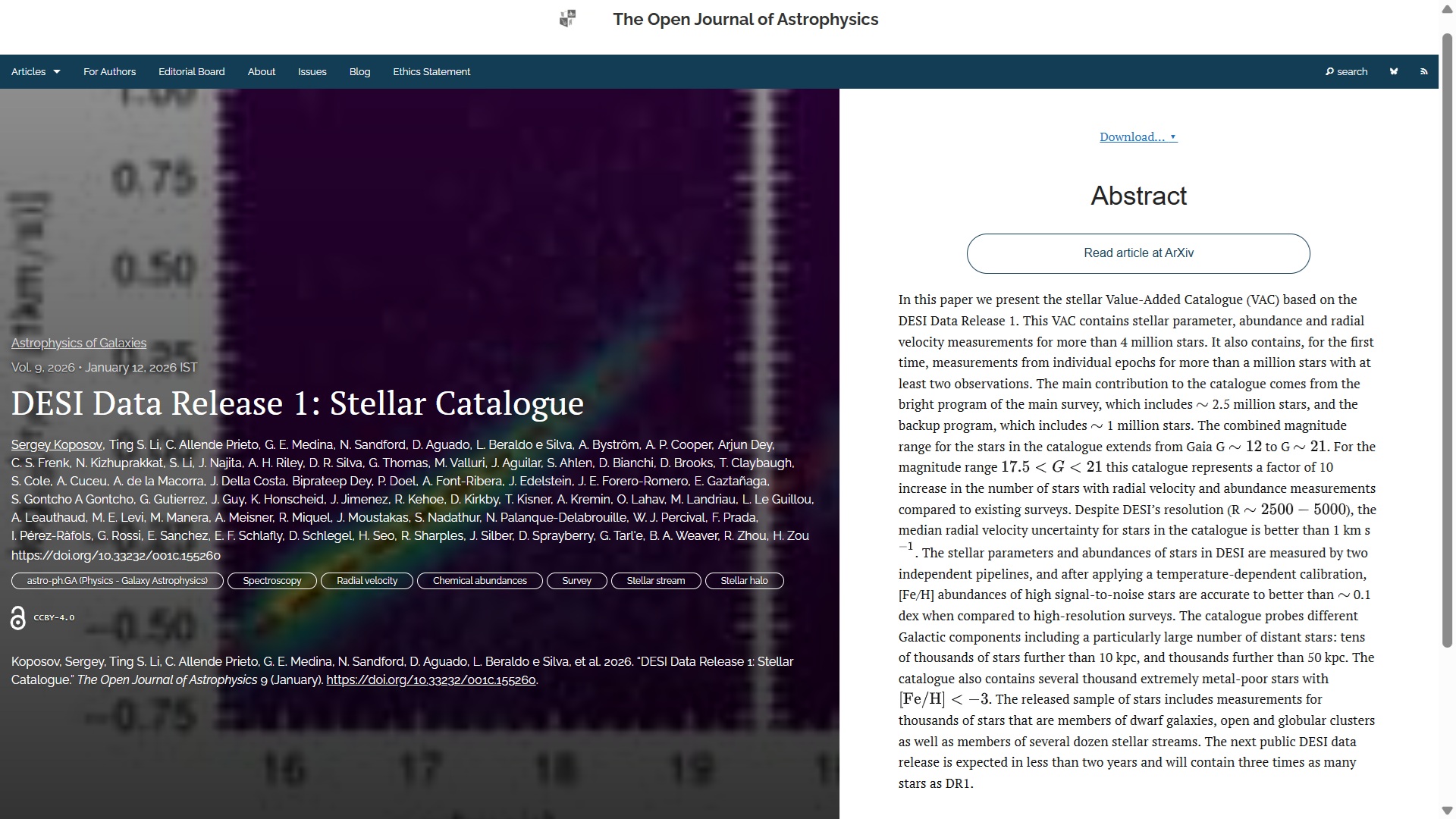
The second paper is “DESI Data Release 1: Stellar Catalogue” by Sergey Koposov (U. Edinburgh, UK) and an international cast of 67 other authors. This paper introduces and describes the stellar Value-Added Catalogue (VAC) based on DESI Data Release 1, providing measurements for over 4 million stars, including radial velocity, abundance, and stellar parameters.
The overlay for this one is here:
The official version of the paper can be found on arXiv here and the Fediverse announcement here:
New Publication at the Open Journal of Astrophysics: "DESI Data Release 1: Stellar Catalogue" by Sergey Koposov (U. Edinburgh, UK) and an international cast of 67 other authors.
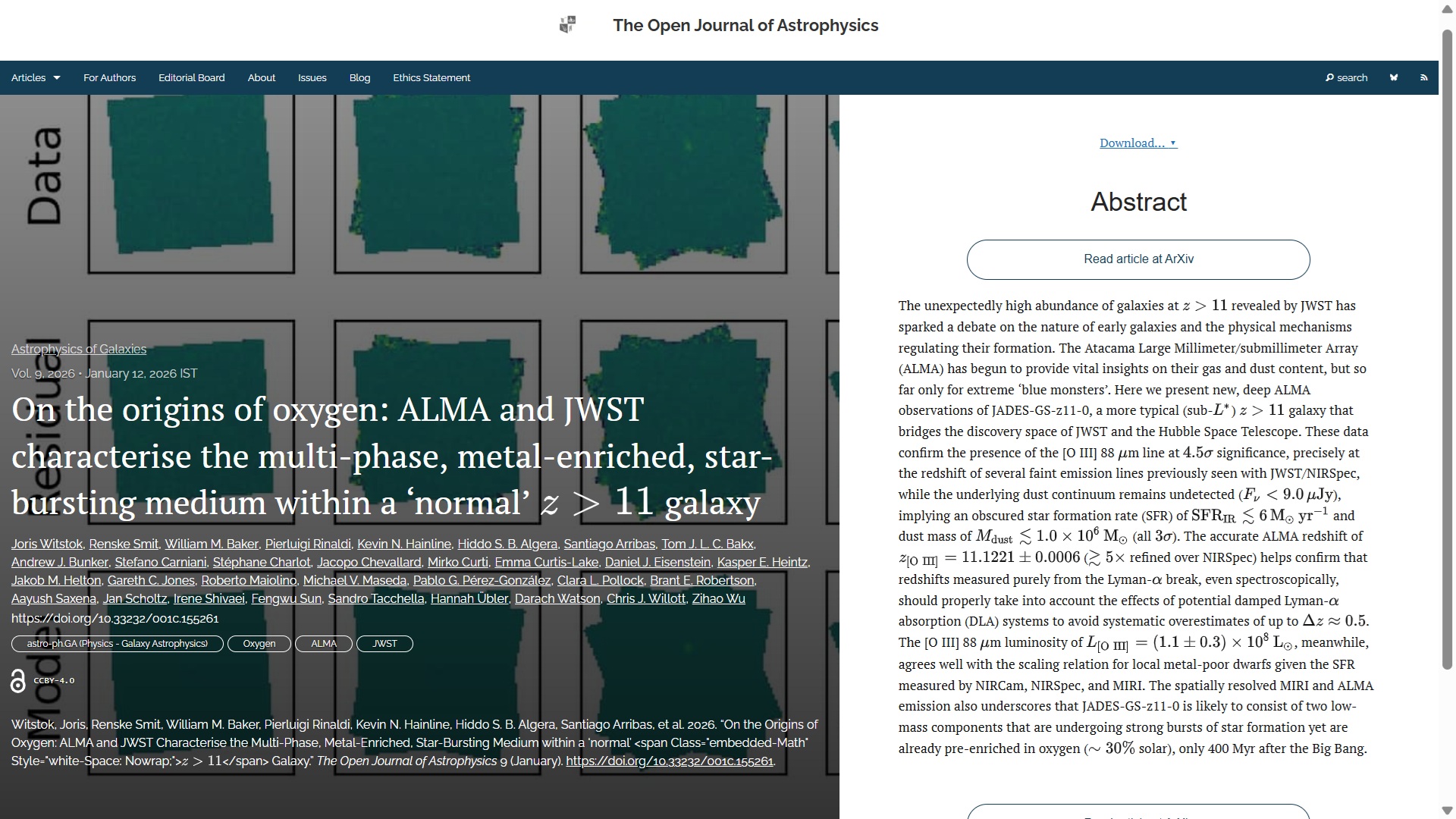
New Publication at the Open Journal of Astrophysics: "On the origins of oxygen: ALMA and JWST characterise the multi-phase, metal-enriched, star-bursting medium within a ‘normal’ z>11 galaxy" by Joris Witstok (Cosmic Dawn Centre, Copenhagen, Denmark) and 37 others dotted around the world
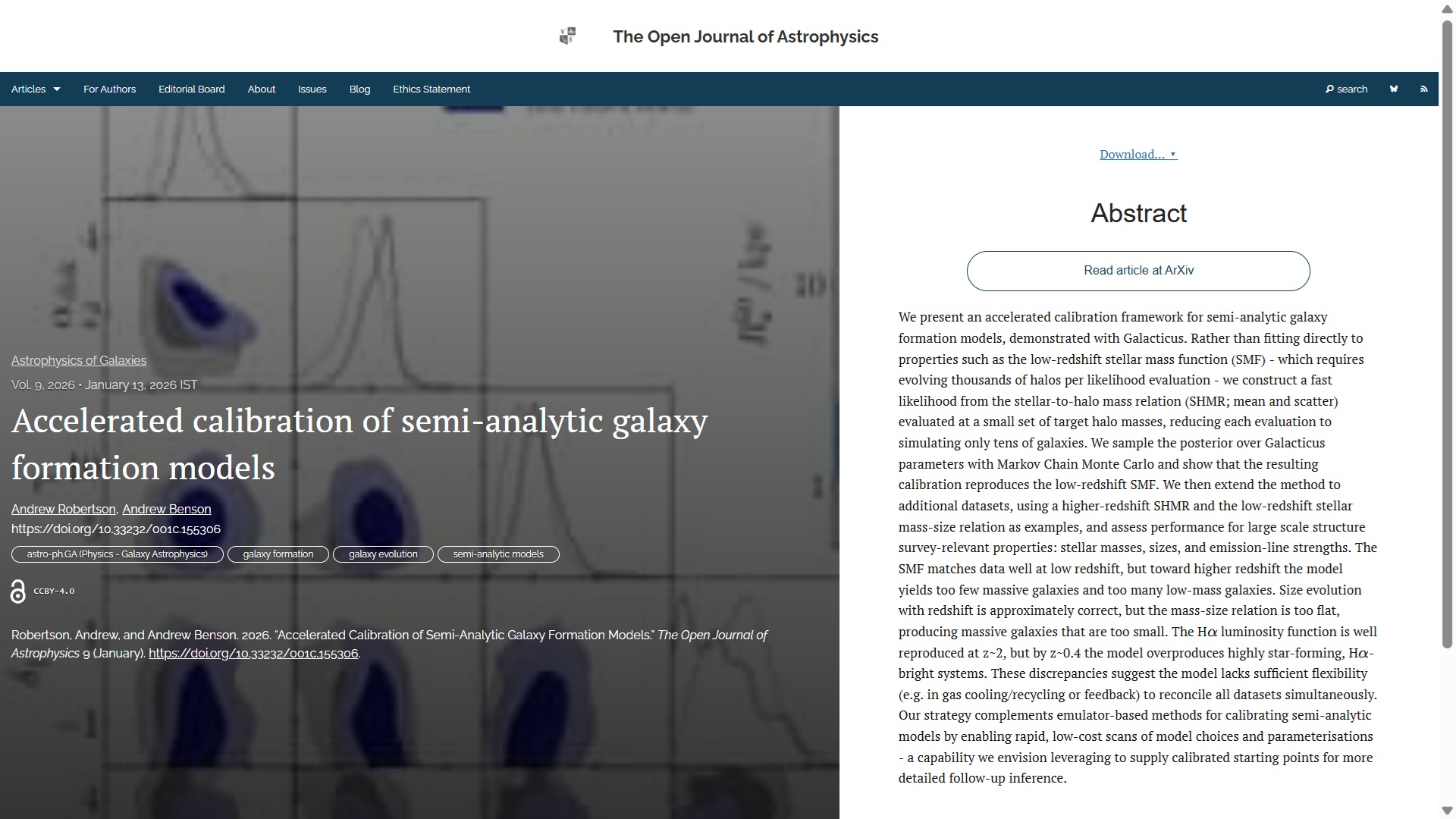
The fourth paper this week is also in the folder Astrophysics of Galaxies. but was published on Tuesday 13th January. It is entitled “Accelerated calibration of semi-analytic galaxy formation models” by Andrew Robertson and Andrew Benson (Carnegie Observatories, USA). This paper presents a faster calibration framework for galaxy formation models, using fewer simulations for each evaluation. However, the model shows discrepancies suggesting the model needs to be made more flexible.
The overlay is here:
You can find the officially accepted version on arXiv here and the Mastodon announcement here:
New Publication at the Open Journal of Astrophysics: "Accelerated calibration of semi-analytic galaxy formation models" by Andrew Robertson and Andrew Benson (Carnegie Observatories, USA)
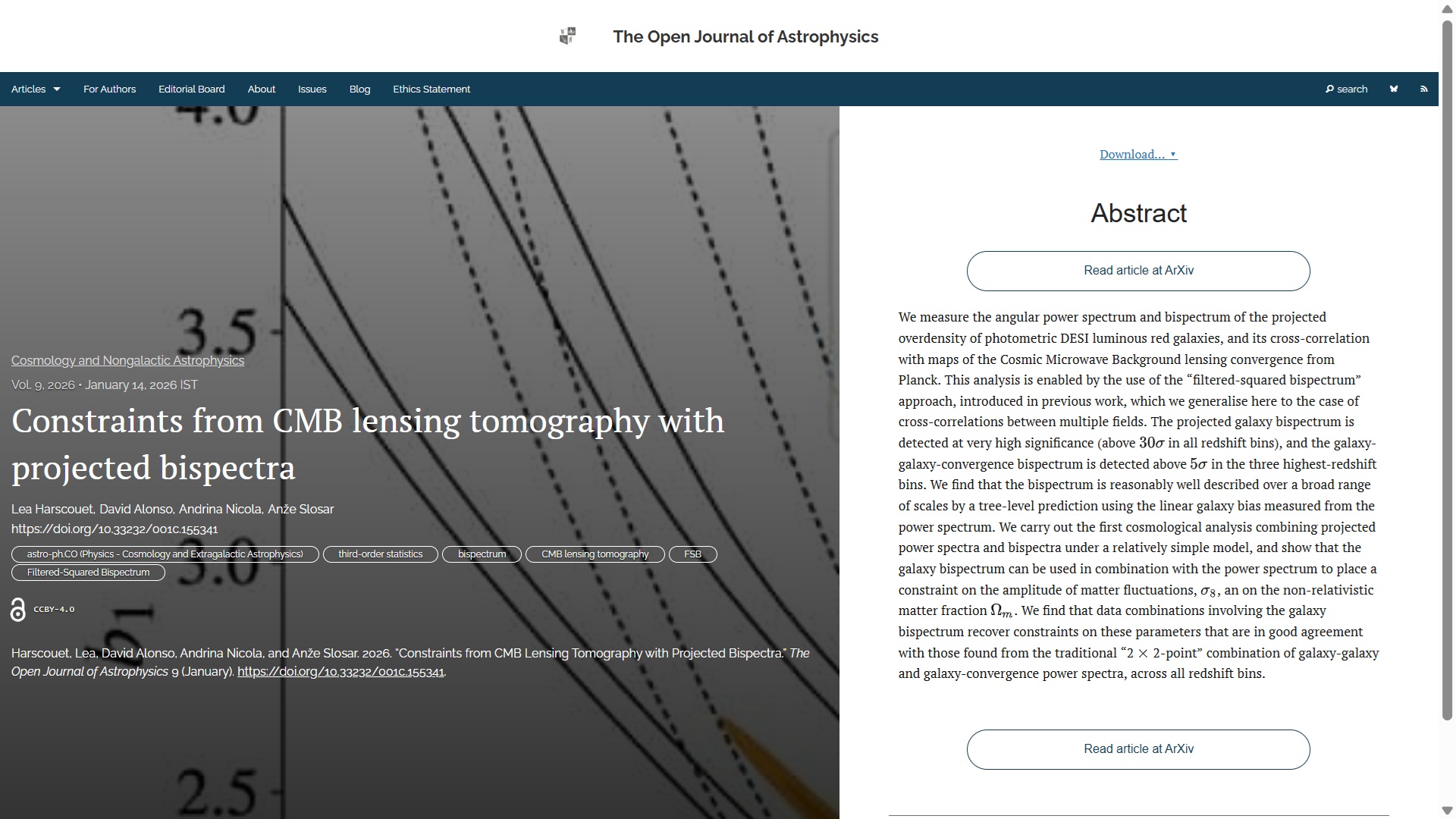
Next one up, published on Wednesday 14th January in the folder Cosmology and Nongalactic Astrophysics, is “Constraints from CMB lensing tomography with projected bispectra” by Lea Harscouet & David Alonso (U. Oxford), UK), Andrina Nicola (U. Manchester, UK) and Anže Slosar (Brookhaven National Laboratory, USA). This study presents angular power spectra and bispectra of DESI luminous red galaxies, finding that the galaxy bispectrum can constrain the amplitude of matter fluctuations and the non-relativistic matter fraction. The overlay is here:
You can find the officially accepted paper on arXiv here and the Mastodon announcement here:
New Publication at the Open Journal of Astrophysics: "Constraints from CMB lensing tomography with projected bispectra" by Lea Harscouet & David Alonso (U. Oxford, UK), Andrina Nicola (U. Manchester, UK) and Anže Slosar (Brookhaven National Laboratory, USA)
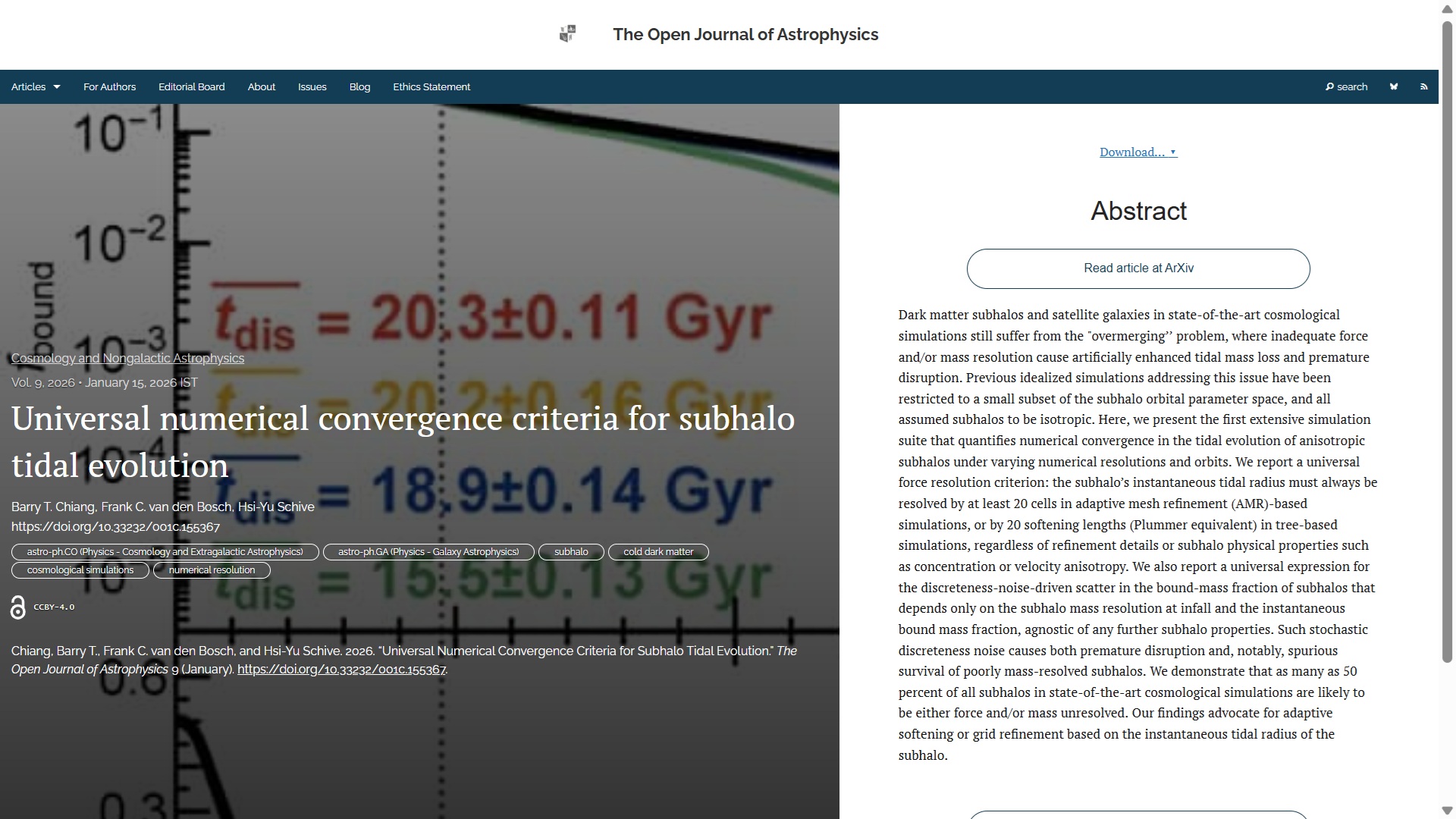
The sixth paper this week is “Universal numerical convergence criteria for subhalo tidal evolution” by Barry T. Chiang & Frank C. van den Bosch (Yale U., USA) and Hsi-Yu Schive (National Taiwan University, Taiwan). This was published on Thursday 15th January in the folder Cosmology and Nongalactic Astrophysics; it presents an analysis of a simulation suite that addresses the ‘overmerging’ problem in cosmological simulations of dark matter subhalos, showing that up to 50% of halos in state-of-the art simulations are unresolved. The overlay is here:
The final accepted version of this paper can be found on arXiv here. The Mastodon announcement follows:
New Publication at the Open Journal of Astrophysics: "Universal numerical convergence criteria for subhalo tidal evolution" by Barry T. Chiang & Frank C. van den Bosch (Yale U., USA) and Hsi-Yu Schive (National Taiwan University, Taiwan)
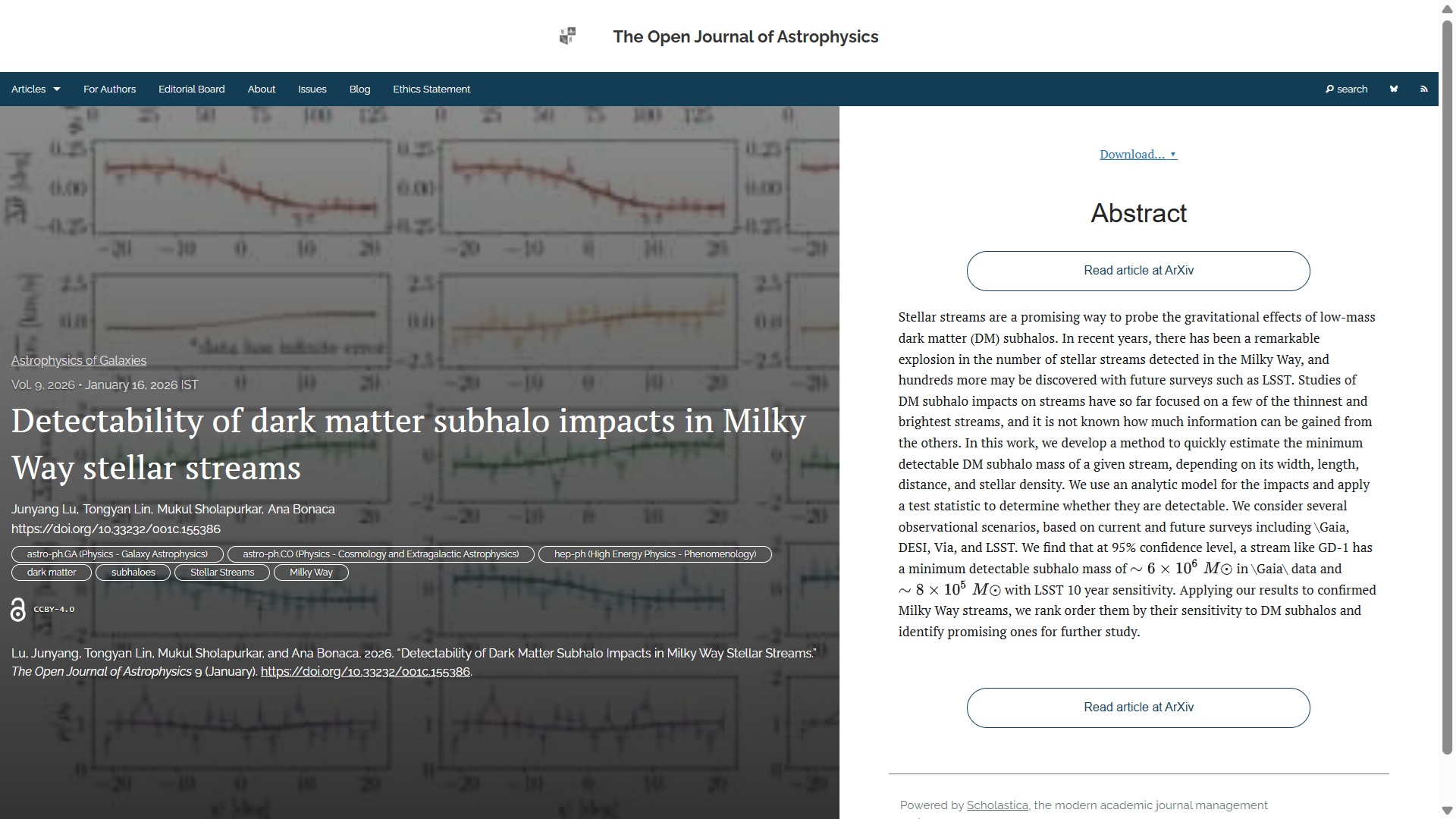
Finally for this week we have “Detectability of dark matter subhalo impacts in Milky Way stellar streams” by Junyang Lu , Tongyan Lin & Mukul Sholapurkar (UCSD, USA) and Ana Bonaca (Carnegie Observatories, USA). This was published on Friday 16th January (i.e. yesterday) in the folder Astrophysics of Galaxies. The study develops a method to estimate the minimum detectable dark matter subhalo mass in stellar streams, ranking them by sensitivity and identifying promising lines for further research.
The overlay is here:
The officially accepted version can be found on arXiv here and the Fediverse announcement here:
New Publication at the Open Journal of Astrophysics: "Detectability of dark matter subhalo impacts in Milky Way stellar streams" by Junyang Lu , Tongyan Lin & Mukul Sholapurkar (UCSD, USA) and Ana Bonaca (Carnegie Observatories, USA)
Welcome to the first proper update for 2026 from the Open Journal of Astrophysics. The New Year brings us to Volume 9. In many countries, especially in Europe, Christmas is celebrated on January 6th so this week was also affected by the holiday season. Nevertheless, since the last update we have published four papers, bringing the number in Volume 9 (2026) to 4 and the total so far published by OJAp up to 452.
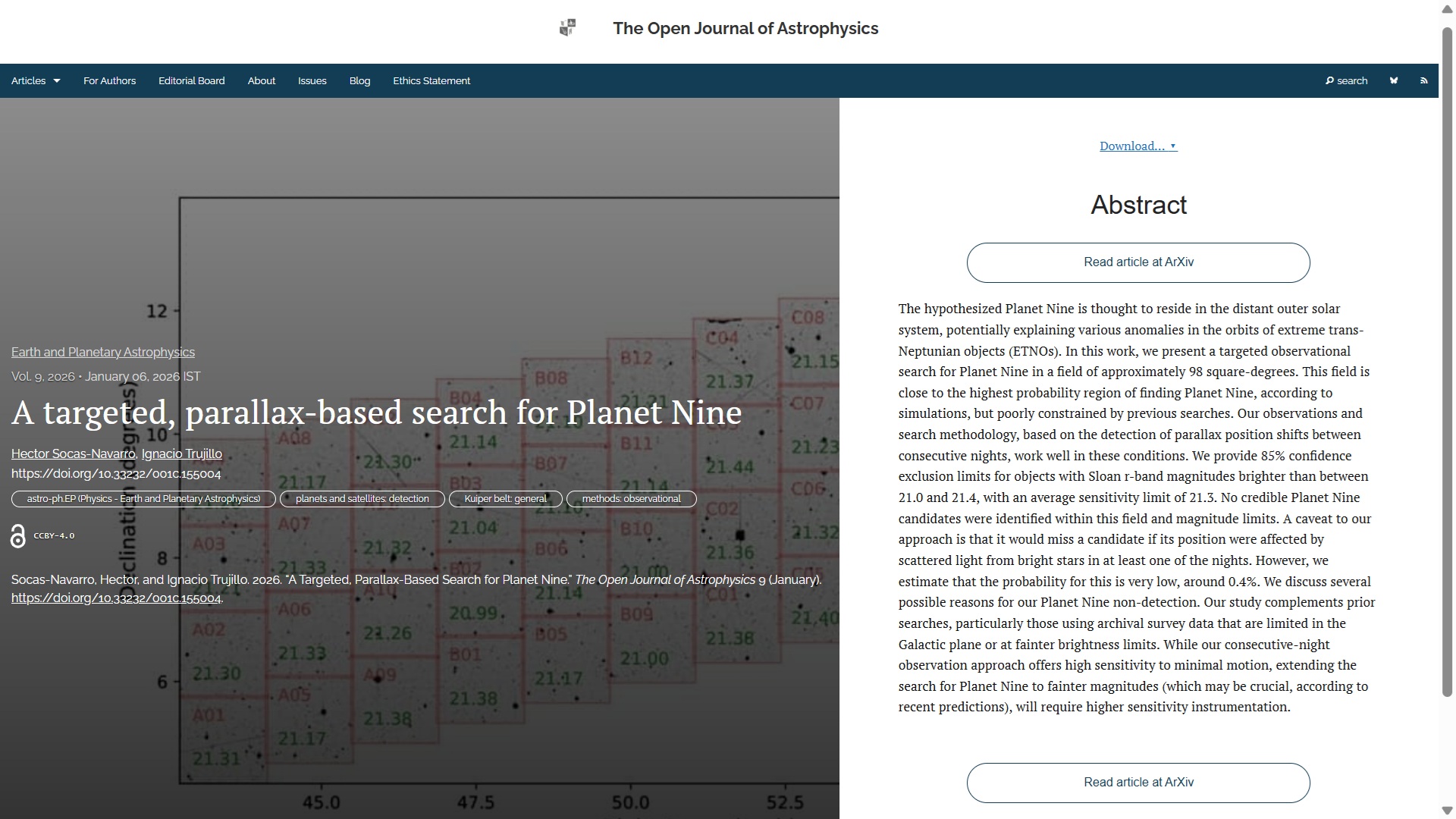
The first paper this week (and of course the first of 2026) is “A targeted, parallax-based search for Planet Nine” by Hector Socas-Navarro and Ignacio Trujillo (both of the Instituto de Astrofísica de Canaria, Spain). This article describes a targeted search for the hypothesized Planet Nine in the outer solar system, using parallax position shifts. No credible candidates were found within the observed field. It was published on Tuesday January 6th in the folder Earth and Planetary Astrophysics. The overlay is here:
You can find the officially accepted version on arXiv here and the announcement on Fediverse here:
New Publication at the Open Journal of Astrophysics: "A targeted, parallax-based search for Planet Nine" by Hector Socas-Navarro and Ignacio Trujillo (Instituto de Astrofísica de Canaria, Spain)
The second paper is “Going beyond S8: fast inference of the matter power spectrum from weak-lensing surveys” by Cyrille Doux (Université Grenoble Alpes, France) and Tanvi Karwal (U. Chicago, USA). This was published on Wednesday January 7th in the folder Cosmology and Nongalactic Astrophysics and it presents a new framework to extract the scale-dependent matter power spectrum from cosmic shear and CMB lensing measurements, revealing a consistent suppression in the matter power spectrum in galaxy-lensing. The overlay is here:
The official version of the paper can be found on arXiv here and the Fediverse announcement here:
New Publication at the Open Journal of Astrophysics: "Going beyond $S_{8}$: fast inference of the matter power spectrum from weak-lensing surveys" by Cyrille Doux (Université Grenoble Alpes, France) and Tanvi Karwal (U. Chicago, USA)
Next we have “Constraining the Stellar-to-Halo Mass Relation with Galaxy Clustering and Weak Lensing from DES Year 3 Data” which is led by G. Zacharegkas et al. (Argonne National Laboratory, USA) and has 102 other authors too numerous to list by name from many institutions around the world again too numerous to list by name. It presents a framework to analyze the relationship between a galaxy’s stellar mass and its dark matter halo mass, using data from the Dark Energy Survey. The findings align with previous results. This paper was published on Thursday January 8th in the folder Astrophysics of Galaxies. The overlay is here:
The official version can be found on arXiv here and the Fediverse announcement is here:
New Publication at the Open Journal of Astrophysics: "Constraining the Stellar-to-Halo Mass Relation with Galaxy Clustering and Weak Lensing from DES Year 3 Data" by G. Zacharegkas et al. (Argonne National Laboratory, USA) and 102 others based in numerous countries.
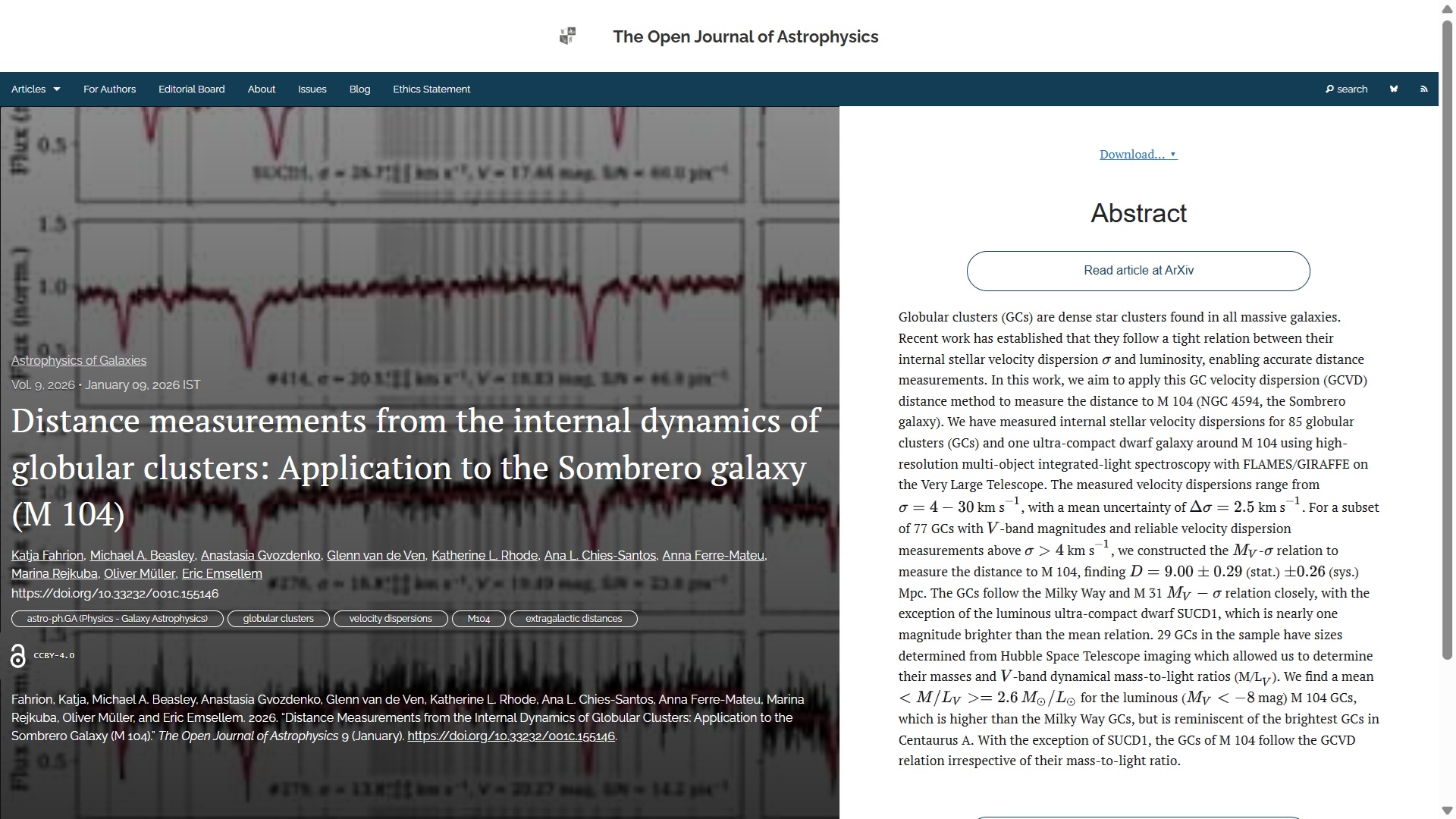
New Publication at the Open Journal of Astrophysics: "Distance measurements from the internal dynamics of globular clusters: Application to the Sombrero galaxy (M 104)" by Katja Fahrion (University of Vienna, Austria) and 9 others based in Spain, Australia, UK, USA, Brazil, Germany and Switzerland.
Christmas is coming, but it’s still time for the usual update of the week’s new papers at the Open Journal of Astrophysics. Since the last update we have published two more regular papers, described below, which brings the number in Volume 8 (2025) up to 197, as well as the 12 papers in yesterday’s Supplement, and the total published for the year up to 209, and the total so far published by OJAp up to 444.
Please note that we will be pausing publishing activity from 24th December 2025 until Monday 5th January 2026. Submissions will remain open, but no more papers will be published in Volume 8 (2025) after Christmas Eve. We will resume in the New Year with Volume 9.
The first regular paper this week is “Optimal intrinsic alignment estimators in the presence of redshift-space distortions” by Claire Lamman (Harvard-Smithsonian CfA, USA), Jonathan Blazek (Ohio State U., USA) and Daniel J. Eisenstein (Northeastern U., USA). This was published on Monday December 15th 2025 in the folder Cosmology and Nongalactic Astrophysics. The authors present estimators for quantifying intrinsic alignments in large spectroscopic surveys intended to inprove the constraints they provide for weak gravitational lensing and other cosmological applications.
The overlay is here:
You can find the officially accepted version on arXiv here and this is the announcement on Mastodon (Fediscience):
New Publication at the Open Journal of Astrophysics: "Optimal intrinsic alignment estimators in the presence of redshift-space distortions" by Claire Lamman (Harvard-Smithsonian CfA), Jonathan Blazek (Ohio State U.) and Daniel J. Eisenstein (Northeastern U.); all based in the USA
The second regular paper of the week is “What is the contribution of gravitational infall on the mass assembly of star-forming clouds? A case study in a numerical simulation of the interstellar medium” by Noé Brucy (Universite Claude Bernard Lyon 1, France), Enrique Vázquez-Semadeni (Universidad Nacional Autónoma de México, Mexico), Tine Colman (Universite Claude Bernard Lyon 1, France), Jérémy Fensch (Universite Claude Bernard Lyon 1, France) and Ralf S. Klessen (Universität Heidelberg, Germany). This was published in the folder Astrophysics of Galaxies on Friday 19th December 2025. This paper describes research using numerical simulations to quantify how much of the mass inflow into a star-forming cloud is driven by the self-gravity of the gas and the gravity from the stellar disk.
The overlay is here:
You can find the official version of this one on arXiv here. The federated announcement on Mastodon is here:
New Publication at the Open Journal of Astrophysics: "What is the contribution of gravitational infall on the mass assembly of star-forming clouds? A case study in a numerical simulation of the interstellar medium" by Noé Brucy (Universite Claude Bernard Lyon 1, France), Enrique Vázquez-Semadeni (Universidad Nacional Autónoma de México, Mexico), Tine Colman (Lyon), Jérémy Fensch (Lyon) and Ralf S. Klessen (Universität Heidelberg, Germany)
It may be a Bank Holiday weekend here in Ireland, but it’s still time for the usual Saturday update of the week’s new papers at the Open Journal of Astrophysics (although a bit later in the day than usual). Since the last update we have published another five papers, which brings the number in Volume 8 (2025) up to 161, and the total so far published by OJAp up to 396.
This week’s update is rather unusual because there are four papers in a series (or, more precisely, mathematically speaking, a sequence) all published on the same day (Wednesday October 22nd 2025), in the same folder (Cosmology and NonGalactic Astrophysics), with the same first author (Dhayaa Anbajagane of the University of Chicago), with long author lists and many co-authors in common. These papers all relate to the DECADE cosmic shear project. Instead of doing them one by one, therefore, I’ve decided to put all four overlays together and provide links to all the papers afterwards. As I’m trying to encourage people to follow our feed on the Fediverse via Mastodon (where I announce papers as they are published, including the all-important DOI), I’ll include links to each announcement there too.
New Publication at the Open Journal of Astrophysics: "The DECADE cosmic shear project I: A new weak lensing shape catalog of 107 million galaxies" by Dhayaa Anbajagane (University of Chicago, USA) et al. (54 authors)
New Publication at the Open Journal of Astrophysics: "The DECADE cosmic shear project II: photometric redshift calibration of the source galaxy sample" by Dhayaa Anbajagane (University of Chicago, USA) et al. (53 authors)
New Publication at the Open Journal of Astrophysics: "The DECADE cosmic shear project III: validation of analysis pipeline using spatially inhomogeneous data" by Dhayaa Anbajagane (University of Chicago, USA) et al. (53 authors)
New Publication at the Open Journal of Astrophysics: "The DECADE cosmic shear project IV: cosmological constraints from 107 million galaxies across 5,400 deg^2 of the sky" by Dhayaa Anbajagane (University of Chicago, USA) et al. (75 authors)
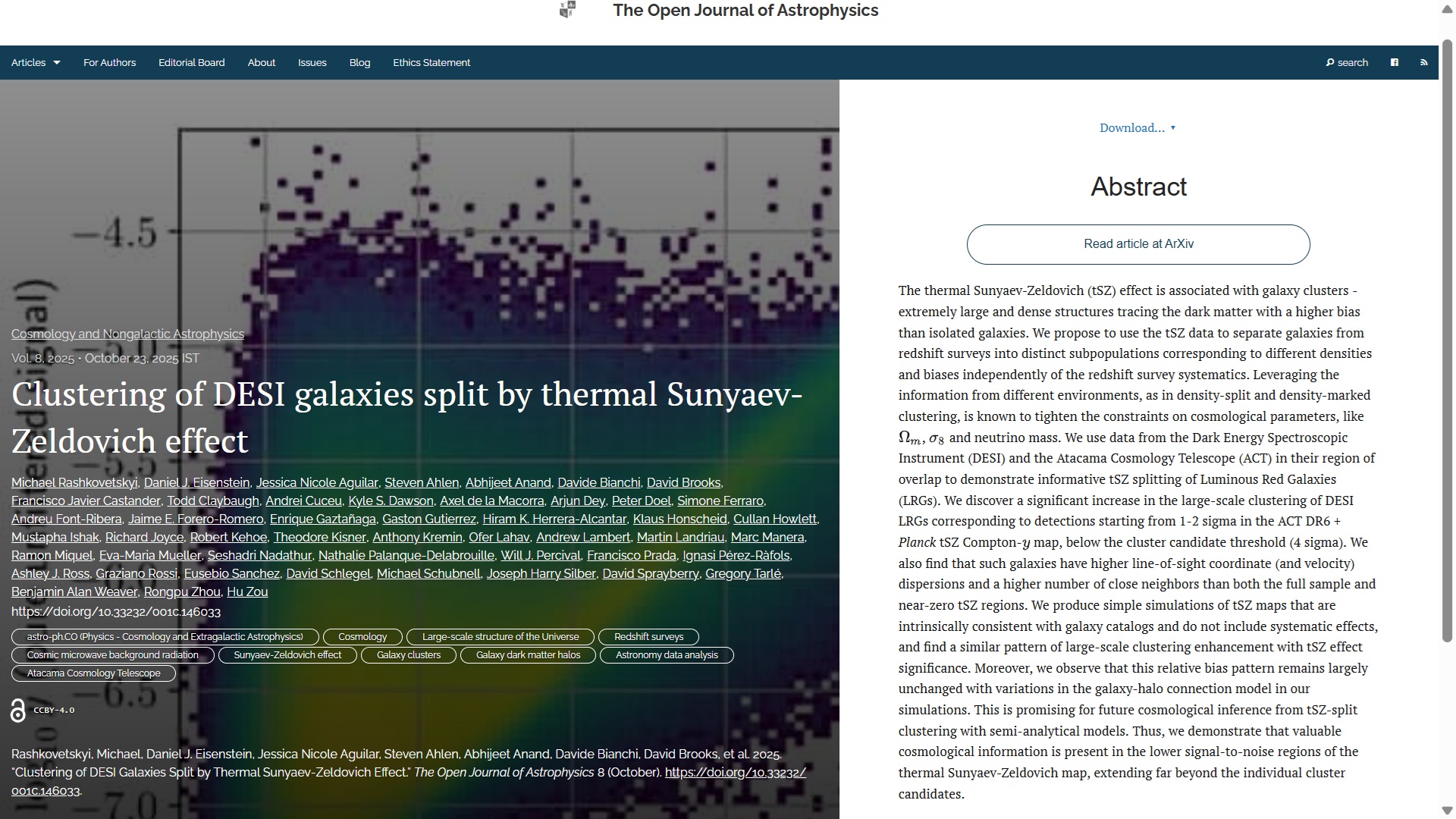
The fifth and final paper for this week is “Clustering of DESI galaxies split by thermal Sunyaev-Zeldovich effect” by Michael Rashkovetskyi of the Harvard-Smithsonian Center for Astrophysics, or CfA for short, and 48 others. This one was published on Wednesday 23rd October in the folder Cosmology and NonGalactic Astrophysics. This paper explores how the clustering properties of galaxies mapped by the Dark energy Spectroscopic Instrument (DESI) relate to the local thermal Sunyaev-Zeldovich emission mapped by the Atacama Cosmology Telescope (ACT). The overlay is here:
The officially accepted version can be found on arXiv here, and the fediverse announcement is here:
New Publication at the Open Journal of Astrophysics: "Clustering of DESI galaxies split by thermal Sunyaev-Zeldovich effect" by Michael Rashkovetskyi (Cfa Harvard-Smithsonian, USA) et al. (49 authors)
It’s Saturday again, so it’s time for a summary of the week’s new papers at the Open Journal of Astrophysics. Since the last update we have published five new papers, which brings the number in Volume 8 (2025) up to 141, and the total so far published by OJAp up to 376.
The first paper to report this week is “The Bispectrum of Intrinsic Alignments: Theory Modelling and Forecasts for Stage IV Galaxy Surveys” by Thomas Bakx (Utrecht U., NL), Alexander Eggemeier (U. Bonn, DE), Toshiki Kurita (MPA Garching, DE), Nora Elisa Chisari (Leiden U., NL) and Zvonimir Vlah (Ruđer Bošković Institute, Croatia). This paper was published on Monday 22nd September 2025 in the folder Cosmology and NonGalactic Astrophysics. It studies the bispectrum of intrinsic galaxy alignments, a possible source of systematic errors in extracting cosmological information from the analysis of weak lensing surveys.
The overlay is here:
You can make this larger by clicking on it. The officially accepted version of this paper can be found on the arXiv here.
You can find the officially accepted version on arXiv here.
The third one this week, published on Wednesday 24th September 2025 in the folder Astrophysics of Galaxies, is “Is feedback-free star formation possible?” by Andrea Ferrara, Daniele Manzoni, and Evangelia Ntormousi (all of the Scuola Normale Superiore, Pisa, Italy). This paper presents an argument that Lyman-alpha radiation pressure strongly limits star formation efficiency, even at solar metallicities, so that a feedback-free star formation phase is not possible without feedback. The overlay is here:
You can find the officially-accepted version on arXiv here.
Next we have “Microphysical Regulation of Non-Ideal MHD in Weakly-Ionized Systems: Does the Hall Effect Matter?” by Philip F. Hopkins (Caltech, USA), Jonathan Squire (U. Otago, New Zeland), Raphael Skalidis (Caltech) and Nadine H. Soliman (Caltech). This was also published on Wednesday 24th September 2025, but in the folder Earth and Planetary Astrophysics. It presents an improved treatment of non-ideal effects in magnetohydrodynamics, particularly the Hall effect, and a discussion of the implications for weakly-ionized astrophysical systems.
The corresponding overlay is here:
You can find the officially accepted version of this one on arXiv here.
It’s Saturday again, so it’s time for another summary of the week’s new papers at the Open Journal of Astrophysics. Since the last update we have published seven new papers, which brings the number in Volume 8 (2025) up to 134, and the total so far published by OJAp up to 369. We seem to be emerging for the slight late-summer hiatus we have experienced over the last few weeks.
Anyway, the first paper to report this week is “Observing the Sun with the Atacama Large Aperture Submillimeter Telescope (AtLAST): Forecasting Full-disk Observations” by Mats Kirkaune & Sven Wedemeyer (U. Oslo, Norway), Joshiwa van Marrewijk (Leiden U., Netherlands), Tony Mroczkowski (ESO, Garching, Germany) and Thomas W. Morris (Yale, USA). This paper discusses possible strategies and parameters for full-disk observations of the Sun using the proposed Atacama Large Aperture Submillimeter Telescope (AtLAST). It was published on Tuesday 9th September 2025 in the folder Solar and Stellar Astrophysics.
The overlay is here:
You can make this larger by clicking on it. The officially accepted version of this paper can be found on the arXiv here.
You can find the final accepted version on arXiv here.
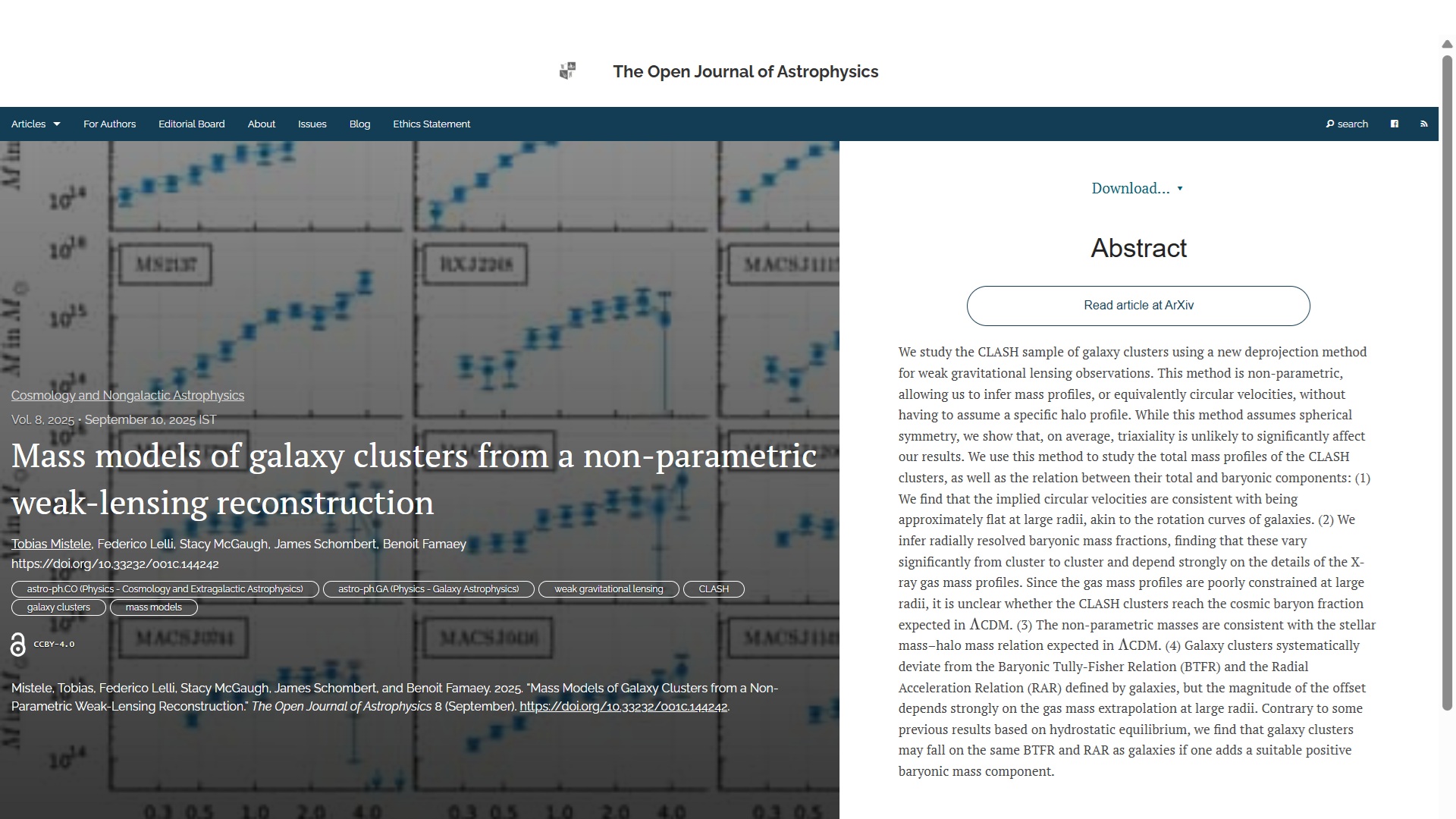
The fourth paper of this week was also published on Wednesday 10th September. It is “Mass models of galaxy clusters from a non-parametric weak-lensing reconstruction” by Tobias Mistele (Case Western Reserve U., USA), Federico Lelli (INAF, Firenze, Italy), Stacy McGaugh (Case Western), James Schombert (U. Oregon, USA) and Benoit Famaey (Université de Strasbourg, France). Published in the folder Cosmology and NonGalactic Astrophysics, it presents new, non-parametric deprojection method for weak gravitational lensing applied to a sample of galaxy clusters. The overlay is here:
You can find the officially accepted version on arXiv here.
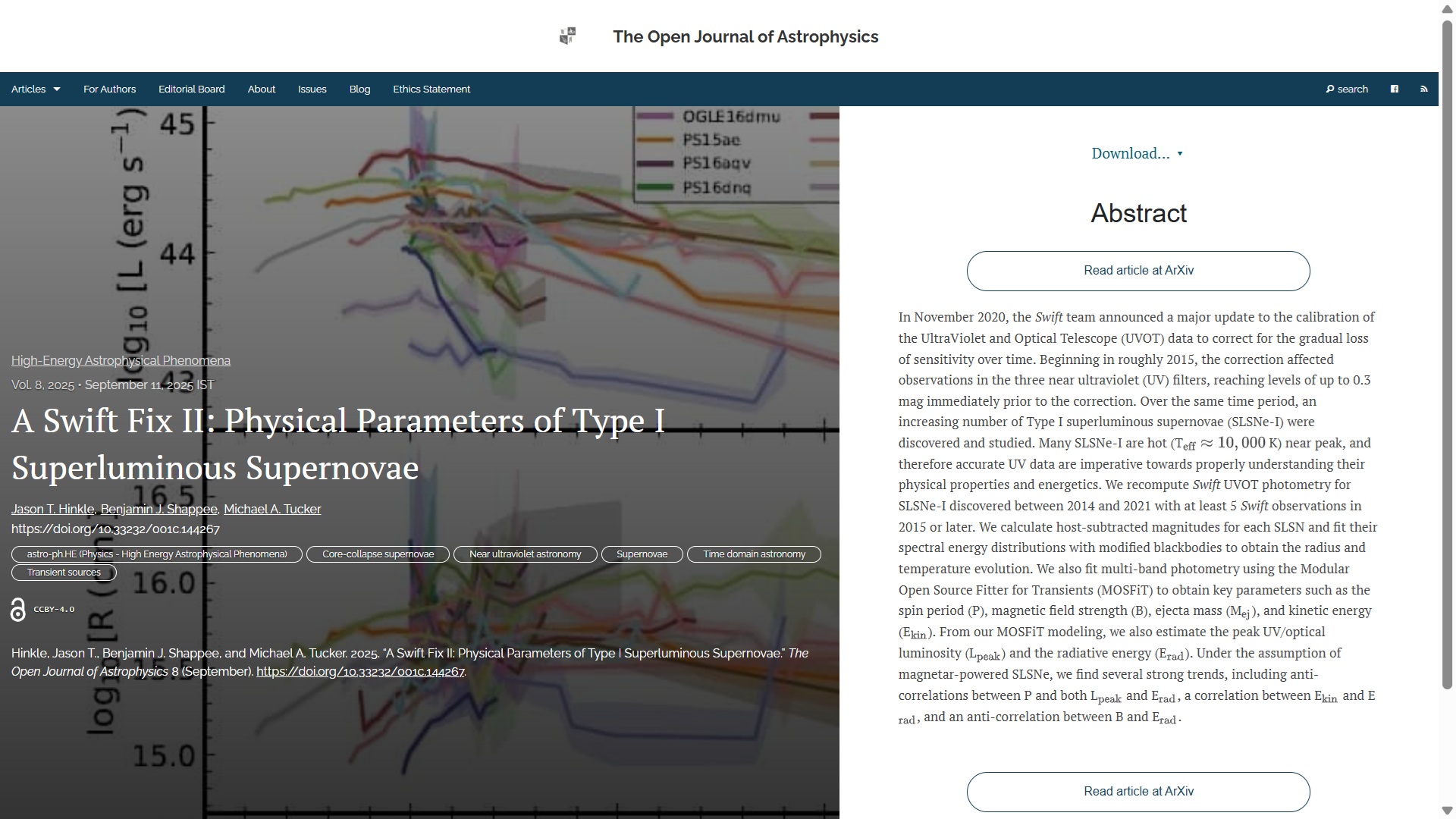
The fifth paper of the week is “A Swift Fix II: Physical Parameters of Type I Superluminous Supernovae” by Jason T. Hinkle & Benjamin J. Shappee (U. Hawaii, USA) and Michael A. Tucke (Ohio State, USA). This one was published on Thursday 11th September 2025 in the folder High-Energy Astrophysical Phenomena. The paper uses recalibrated Swift photometry to recompute peak luminosities and other properties of a sample of superluminous Type I supernovae. The overlay is here:
You can find the official accepted version on arXiv here.
Paper No. 6 for this week is “Detailed Microwave Continuum Spectra from Bright Protoplanetary Disks in Taurus” by Caleb Painter (Harvard, USA) and 11 others, too numerous to mention by name, based in the USA, Germany, Mexico and Taiwan. This one was published in the folder marked Solar and Stellar Astrophysics on September 11th 2025. It presents new observations sampling the microwave (4-360 GHz) continuum spectra from eight young stellar systems in the Taurus region. The overlay is here:
The last paper for this update is “On Soft Clustering For Correlation Estimators” by Edward Berman (Northeastern University, USA) and 13 others based in the USA, France, Denmark and Finland and Cosmos-Web:The JWST Cosmic Origins Survey. This was published on Friday 12th September 2025 in the folder Instrumentation and Methods for Astrophysics. It presents an algorithm for estimating correlations that clusters objects in a probabilistic fashion, enabling the uncertainty caused by clustering to be quantified simply through model inference. The overlay is here:
And that’s all the papers for this week. I’ve noticed a significant recent increase in the number of papers in Solar and Stellar Astrophysics, which means we’re broadening our impact across the community. Which is nice.
P.S. I found out last week that, according to NASA/ADS, papers in OJAp have now accumulated over 5000 citations.
What with all the cosmological goings-on of the past couple of weeks – see here, here and here – I quite forgot to mention another important set of results. These are from the final data release Kilo-Degree Survey known as KiDS for short and represent a final analysis of the complete dataset. For those of you not in the know, KiDs is a weak lensing shear tomography survey and its core science drivers are to map the large scale matter distribution in the Universe and constrain the equation of state of Dark Energy. The results can be found in three papers on arXiv, which you can add to your reading list:
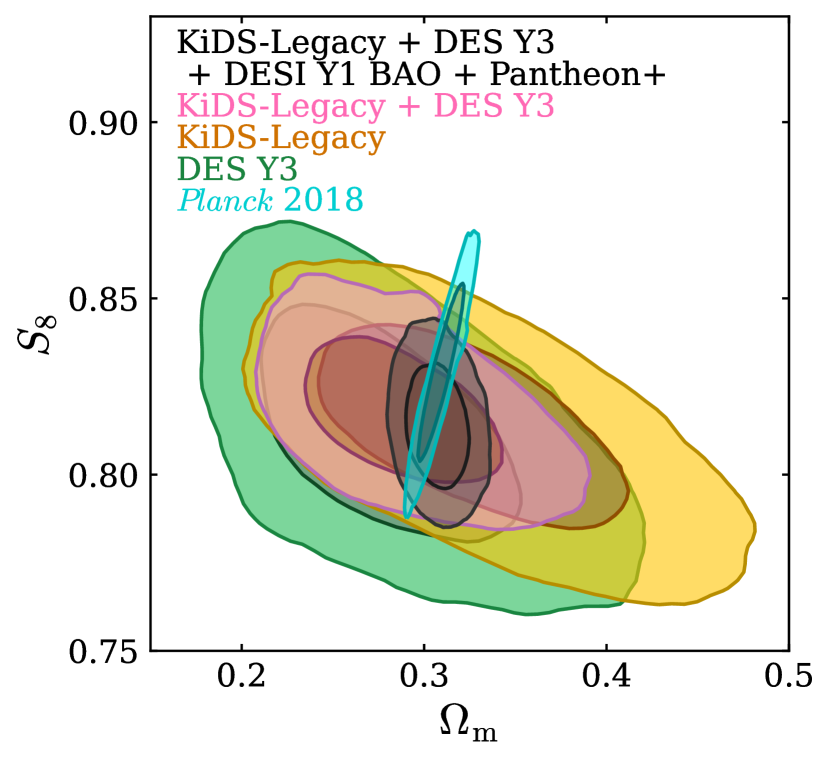
As far as I’m concerned, the main result to leap out from the cosmological analysis, which primarily constrains the clumpiness of matter in the universe, expressed by the density parameter Ωm and a fluctuation amplitude σ8 in the combined parameter “S8“, which is constrained almost independently from Ωm. The value obtained for this parameter by KiDS has previously been “in tension” with values from other experiments (notably Planck) ; see here for a discussion. The new results, however, seem consistent with the standard cosmological model. Here is a figure from the last paper in the above list that illustrates the point:
As is often the case, there’s also one of those nice Cosmology Talks videos that discusses this and other aspects of the KiDS Legacy results to which I refer you for more details!
The Ideas of March are come, so it’s time for another update of papers published at the Open Journal of Astrophysics. Since the last update we have published two papers, which brings the number in Volume 8 (2025) up to 27 and the total so far published by OJAp up to 262.
Here is the overlay, which you can click on to make larger if you wish:
You can read the officially accepted version of this paper on arXiv here.
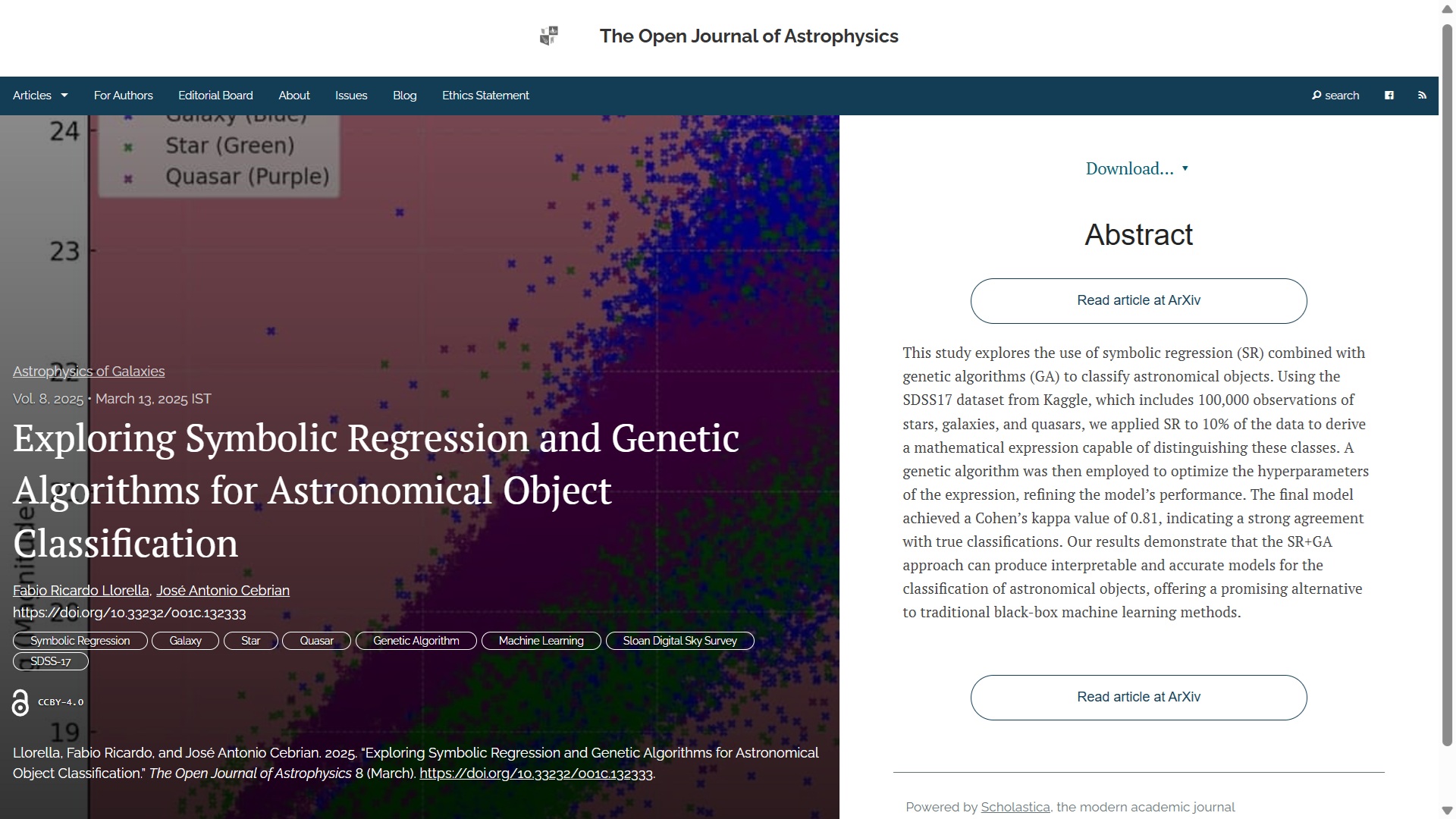
The other paper published this week is “Exploring Symbolic Regression and Genetic Algorithms for Astronomical Object Classification” by Fabio Ricardo Llorella (Universidad Internacional de la Rioja, Spain) & José Antonio Cebrian (Universidad Laboral de Córdoba, Spain), which came out on Thursday 13th March. This one is in the folder marked Astrophysics of Galaxies and it discusses the classification of astronomical objects in the Sloan Digital Sky Survey SDSS-17 dataset using a combination of Symbolic Regressiion and Genetic Algorithms.
It’s Saturday morning, so once again it’s time for an update of papers published at the Open Journal of Astrophysics. There were no papers to report last week but since the last update we have published four new papers, which brings the number in Volume 8 (2025) up to 11 and the total so far published by OJAp up to 246.
In chronological order of publication, the four papers published this week, with their overlays, are as follows. You can click on the images of the overlays to make them larger should you wish to do so.
First one up is “A halo model approach for mock catalogs of time-variable strong gravitational lenses” by Katsuya T. Abe & Masamune Oguri (Chiba U, Japan), Simon Birrer & Narayan Khadka (Stony Brook, USA), Philip J. Marshall (Stanford, USA), Cameron Lemon (Stockholm U., Sweden), Anupreeta More (IUCAA, India), and the LSST Dark Energy Science Collaboration. It was published on 27th January 2025 in the folder marked Cosmology and NonGalactic Astrophysics. The paper discusses how to generate mock catalogs of strongly lensed QSOs and Supernovae on galaxy-, group-, and cluster-scales based on a halo model that incorporates dark matter halos, galaxies, and subhalos.
You can find the officially accepted version of this paper on arXiv here.
Here is a screen grab of the overlay, which includes the abstract:You can find the officially accepted version of the paper on the arXiv here.
The third paper to announce, published on 29th January 2025 in the folder Cosmology and NonGalactic Astrophysics, is “A Heavy Seed Black Hole Mass Function at High Redshift – Prospects for LISA” by Joe McCaffrey & John Regan (Maynooth U., Ireland), Britton Smith (Edinburgh U., UK), John Wise (Georgia Institute of Technology, USA), Brian O’Shea (Michigan State U., USA) and Michael Norman (University of California, San Diego). This is a numerical study of the growth rates of massive black holes in the early Universe and implications for their detection via gravitational wave emission.
You can see the overlay here:
The accepted version of this paper can be found on the arXiv here.
The views presented here are personal and not necessarily those of my employer (or anyone else for that matter).
Feel free to comment on any of the posts on this blog but comments may be moderated; anonymous comments and any considered by me to be vexatious and/or abusive and/or defamatory will not be accepted. I do not necessarily endorse, support, sanction, encourage, verify or agree with the opinions or statements of any information or other content in the comments on this site and do not in any way guarantee their accuracy or reliability.















 In the Dark