Archive for Diamond Open Access

Weekly Update from the Open Journal of Astrophysics – 17/01/2026

Posted in OJAp Papers, Open Access, The Universe and Stuff with tags , , , , , , , , , , , , , , , , , , , , , , , , , , , , on January 17, 2026 by telescoper

It’s Saturday once more so time for another update of activity at the Open Journal of Astrophysics. Since the last update we have published seven papers, bringing the number in Volume 9 (2026) to 11 and the total so far published by OJAp up to 459. This week has been quite busy; for only the second time in recorded history we published at least one paper each working day.

I will continue to include the announcements made on our Mastodon account (on Fediscience) to encourage you to visit it. Mastodon is a really excellent service, and a more than adequate replacement for X/Twitter which nobody should be using.

The first three papers this week were all published on Monday January 12th in the folder Astrophysics of Galaxies.

The first paper to report this week is “Rotational Kinematics in the Globular Cluster System of M31: Insights from Bayesian Inference” by Yuan (Cher) Li & Brendon J. Brewer (U. Auckland, New Zealand), Geraint F. Lewis (U. Sydney, Australia) and Dougal Mackey (independent researcher, Australia). This study uses Bayesian modelling to explore the kinematics of globular clusters in the Andromeda Galaxy, revealing distinct rotation patterns that suggest different subgroups were added at separate times.

The overlay is here:

You can find the officially accepted version on arXiv here and the announcement on Fediverse here:

Open Journal of Astrophysics

New Publication at the Open Journal of Astrophysics: "Rotational Kinematics in the Globular Cluster System of M31: Insights from Bayesian Inference" by Yuan (Cher) Li & Brendon J. Brewer (U. Auckland, New Zealand), Geraint F. Lewis (U. Sydney, Australia) and Dougal Mackey

doi.org/10.33232/001c.155259

January 12, 2026, 9:55 am 1 boosts 1 favorites

The second paper is “DESI Data Release 1: Stellar Catalogue” by Sergey Koposov (U. Edinburgh, UK) and an international cast of 67 other authors. This paper introduces and describes the stellar Value-Added Catalogue (VAC) based on DESI Data Release 1, providing measurements for over 4 million stars, including radial velocity, abundance, and stellar parameters.

The overlay for this one is here:

The official version of the paper can be found on arXiv here and the Fediverse announcement here:

Open Journal of Astrophysics

New Publication at the Open Journal of Astrophysics: "DESI Data Release 1: Stellar Catalogue" by Sergey Koposov (U. Edinburgh, UK) and an international cast of 67 other authors.

doi.org/10.33232/001c.155260

January 12, 2026, 10:11 am 2 boosts 1 favorites

Next we have “On the origins of oxygen: ALMA and JWST characterise the multi-phase, metal-enriched, star-bursting medium within a ‘normal’ z>11 galaxy” by Joris Witstok (Cosmic Dawn Centre, Copenhagen, Denmark) and 37 others in locations dotted around the world. This paper presents new ALMA observations of the JADES-GS-z11-0 galaxy confirm the presence of the [O III] 88 µm line, suggesting it consists of two low-mass components undergoing star formation and enriched in metals.

The overlay is here:

The official version can be found on arXiv here and the Fediverse announcement is here:

Open Journal of Astrophysics

New Publication at the Open Journal of Astrophysics: "On the origins of oxygen: ALMA and JWST characterise the multi-phase, metal-enriched, star-bursting medium within a ‘normal’ z>11 galaxy" by Joris Witstok (Cosmic Dawn Centre, Copenhagen, Denmark) and 37 others dotted around the world

doi.org/10.33232/001c.155261

January 12, 2026, 10:30 am 1 boosts 2 favorites

The fourth paper this week is also in the folder Astrophysics of Galaxies. but was published on Tuesday 13th January. It is entitled “Accelerated calibration of semi-analytic galaxy formation models” by Andrew Robertson and Andrew Benson (Carnegie Observatories, USA). This paper presents a faster calibration framework for galaxy formation models, using fewer simulations for each evaluation. However, the model shows discrepancies suggesting the model needs to be made more flexible.

The overlay is here:

You can find the officially accepted version on arXiv here and the Mastodon announcement here:

Open Journal of Astrophysics

New Publication at the Open Journal of Astrophysics: "Accelerated calibration of semi-analytic galaxy formation models" by Andrew Robertson and Andrew Benson (Carnegie Observatories, USA)

doi.org/10.33232/001c.155306

January 13, 2026, 9:41 am 1 boosts 1 favorites

Next one up, published on Wednesday 14th January in the folder Cosmology and Nongalactic Astrophysics, is “Constraints from CMB lensing tomography with projected bispectra” by Lea Harscouet & David Alonso (U. Oxford), UK), Andrina Nicola (U. Manchester, UK) and Anže Slosar (Brookhaven National Laboratory, USA). This study presents angular power spectra and bispectra of DESI luminous red galaxies, finding that the galaxy bispectrum can constrain the amplitude of matter fluctuations and the non-relativistic matter fraction. The overlay is here:

You can find the officially accepted paper on arXiv here and the Mastodon announcement here:

Open Journal of Astrophysics

New Publication at the Open Journal of Astrophysics: "Constraints from CMB lensing tomography with projected bispectra" by Lea Harscouet & David Alonso (U. Oxford, UK), Andrina Nicola (U. Manchester, UK) and Anže Slosar (Brookhaven National Laboratory, USA)

doi.org/10.33232/001c.155341

January 14, 2026, 2:00 pm 2 boosts 0 favorites

The sixth paper this week is “Universal numerical convergence criteria for subhalo tidal evolution” by Barry T. Chiang & Frank C. van den Bosch (Yale U., USA) and Hsi-Yu Schive (National Taiwan University, Taiwan). This was published on Thursday 15th January in the folder Cosmology and Nongalactic Astrophysics; it presents an analysis of a simulation suite that addresses the ‘overmerging’ problem in cosmological simulations of dark matter subhalos, showing that up to 50% of halos in state-of-the art simulations are unresolved. The overlay is here:

The final accepted version of this paper can be found on arXiv here. The Mastodon announcement follows:

Open Journal of Astrophysics

New Publication at the Open Journal of Astrophysics: "Universal numerical convergence criteria for subhalo tidal evolution" by Barry T. Chiang & Frank C. van den Bosch (Yale U., USA) and Hsi-Yu Schive (National Taiwan University, Taiwan)

doi.org/10.33232/001c.155367

January 15, 2026, 9:11 am 1 boosts 0 favorites

Finally for this week we have “Detectability of dark matter subhalo impacts in Milky Way stellar streams” by Junyang Lu , Tongyan Lin & Mukul Sholapurkar (UCSD, USA) and Ana Bonaca (Carnegie Observatories, USA). This was published on Friday 16th January (i.e. yesterday) in the folder Astrophysics of Galaxies. The study develops a method to estimate the minimum detectable dark matter subhalo mass in stellar streams, ranking them by sensitivity and identifying promising lines for further research.

The overlay is here:

The officially accepted version can be found on arXiv here and the Fediverse announcement here:

Open Journal of Astrophysics

New Publication at the Open Journal of Astrophysics: "Detectability of dark matter subhalo impacts in Milky Way stellar streams" by Junyang Lu , Tongyan Lin & Mukul Sholapurkar (UCSD, USA) and Ana Bonaca (Carnegie Observatories, USA)

doi.org/10.33232/001c.155386

January 16, 2026, 9:32 am 0 boosts 0 favorites

That concludes the update for this week. I will do another next Saturday.

Weekly Update from the Open Journal of Astrophysics – 10/01/2026

Posted in OJAp Papers, Open Access, The Universe and Stuff with tags , , , , , , , , , , , , , , , , , , , on January 10, 2026 by telescoper

Welcome to the first proper update for 2026 from the Open Journal of Astrophysics. The New Year brings us to Volume 9. In many countries, especially in Europe, Christmas is celebrated on January 6th so this week was also affected by the holiday season. Nevertheless, since the last update we have published four papers, bringing the number in Volume 9 (2026) to 4 and the total so far published by OJAp up to 452.

The first paper this week (and of course the first of 2026) is “A targeted, parallax-based search for Planet Nine” by Hector Socas-Navarro and Ignacio Trujillo (both of the Instituto de Astrofísica de Canaria, Spain). This article describes a targeted search for the hypothesized Planet Nine in the outer solar system, using parallax position shifts. No credible candidates were found within the observed field. It was published on Tuesday January 6th in the folder Earth and Planetary Astrophysics. The overlay is here:

You can find the officially accepted version on arXiv here and the announcement on Fediverse here:

Open Journal of Astrophysics

New Publication at the Open Journal of Astrophysics: "A targeted, parallax-based search for Planet Nine" by Hector Socas-Navarro and Ignacio Trujillo (Instituto de Astrofísica de Canaria, Spain)

doi.org/10.33232/001c.155004

January 6, 2026, 7:53 am 1 boosts 2 favorites

The second paper is “Going beyond S8: fast inference of the matter power spectrum from weak-lensing surveys” by Cyrille Doux (Université Grenoble Alpes, France) and Tanvi Karwal (U. Chicago, USA). This was published on Wednesday January 7th in the folder Cosmology and Nongalactic Astrophysics and it presents a new framework to extract the scale-dependent matter power spectrum from cosmic shear and CMB lensing measurements, revealing a consistent suppression in the matter power spectrum in galaxy-lensing. The overlay is here:

The official version of the paper can be found on arXiv here and the Fediverse announcement here:

Open Journal of Astrophysics

New Publication at the Open Journal of Astrophysics: "Going beyond $S_{8}$: fast inference of the matter power spectrum from weak-lensing surveys" by Cyrille Doux (Université Grenoble Alpes, France) and Tanvi Karwal (U. Chicago, USA)

doi.org/10.33232/001c.155045

January 7, 2026, 9:30 am 1 boosts 2 favorites

Next we have “Constraining the Stellar-to-Halo Mass Relation with Galaxy Clustering and Weak Lensing from DES Year 3 Data” which is led by G. Zacharegkas et al. (Argonne National Laboratory, USA) and has 102 other authors too numerous to list by name from many institutions around the world again too numerous to list by name. It presents a framework to analyze the relationship between a galaxy’s stellar mass and its dark matter halo mass, using data from the Dark Energy Survey. The findings align with previous results. This paper was published on Thursday January 8th in the folder Astrophysics of Galaxies. The overlay is here:

The official version can be found on arXiv here and the Fediverse announcement is here:

Open Journal of Astrophysics

New Publication at the Open Journal of Astrophysics: "Constraining the Stellar-to-Halo Mass Relation with Galaxy Clustering and Weak Lensing from DES Year 3 Data" by G. Zacharegkas et al. (Argonne National Laboratory, USA) and 102 others based in numerous countries.

doi.org/10.33232/001c.155046

January 8, 2026, 10:20 am 1 boosts 1 favorites

Finally for this week we have “Distance measurements from the internal dynamics of globular clusters: Application to the Sombrero galaxy (M 104)” by Katja Fahrion (University of Vienna, Austria) and 9 others based in Spain, Australia, UK, USA, Brazil, Germany and Switzerland. This was published on Friday 9th January (yesterday) in the folder Astrophysics of Galaxies. This study uses the globular cluster velocity dispersion method to measure the distance to the Sombrero galaxy, finding it to be approximately 9.0 Mpc away. The overlay is here:

The officially accepted version can be found on arXiv here and the Fediverse announcement here:

Open Journal of Astrophysics

New Publication at the Open Journal of Astrophysics: "Distance measurements from the internal dynamics of globular clusters: Application to the Sombrero galaxy (M 104)" by Katja Fahrion (University of Vienna, Austria) and 9 others based in Spain, Australia, UK, USA, Brazil, Germany and Switzerland.

doi.org/10.33232/001c.155146

January 9, 2026, 9:30 am 1 boosts 2 favorites

That concludes the update for this week. I will do another next Saturday.

Not a Weekly Update from the Open Journal of Astrophysics – 03/01/2026

Posted in Maynooth, Open Access with tags , , , , on January 3, 2026 by telescoper

Not entirely surprisingly, we have not published any papers at the Open Journal of Astrophysics since the last update on 27th December 2025. Of course many authors have been on holiday and there were no arXiv announcements on either Tuesday 30th December or Thursday 1st January anyway. Although we had a few papers accepted before the break, none of them appeared this past week. I dare say some of them will appear next week. We will be starting Volume 9 in 2026, as soon as there is a paper to publish in it.

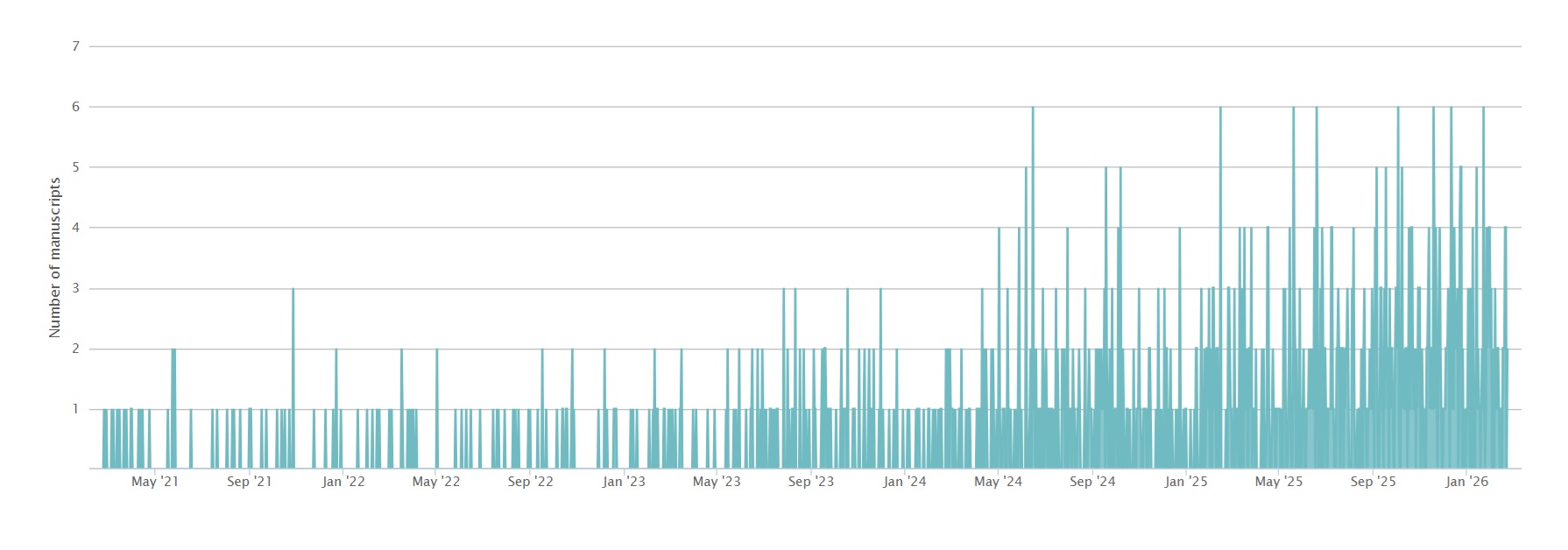
There being no papers to report, instead of doing one of the regular Saturday updates, I’d like to take the opportunity afforded by this pause to thank everyone who has supported the Open Journal of Astrophysics this year – Editors, Reviewers, Authors and the excellent Library staff at Maynooth University Library – and who have made it such a bumper year. I’d also like to repeat a call for volunteers to join the Editorial Board. In 2023 we published just 50 papers, and in 2025 the figure was 213, so we have more than quadrupled in two years. How many will we publish in 2026?

Here is a graphic showing the number of new papers submitted to the Open Journal of Astrophysics since January 2020:

As the legend explains, this is only the first submission of a paper – resubmissions of revised papers are not included. You can see the thicket is getting denser all the time!
The increasing number of articles is of course very welcome indeed, but it is increasing the load on our Editorial Board many of whom are also very busy with other things. We have expanded the Board recently, but we’re always for volunteers to join the team, in any area of astrophysics. As a reminder, here are the areas we cover, corresponding to the sections of astro-ph on the arXiv:

  • astro-ph.GA – Astrophysics of Galaxies. Phenomena pertaining to galaxies or the Milky Way. Star clusters, HII regions and planetary nebulae, the interstellar medium, atomic and molecular clouds, dust. Stellar populations. Galactic structure, formation, dynamics. Galactic nuclei, bulges, disks, halo. Active Galactic Nuclei, supermassive black holes, quasars. Gravitational lens systems. The Milky Way and its contents
  • astro-ph.CO – Cosmology and Nongalactic Astrophysics. Phenomenology of early universe, cosmic microwave background, cosmological parameters, primordial element abundances, extragalactic distance scale, large-scale structure of the universe. Groups, superclusters, voids, intergalactic medium. Particle astrophysics: dark energy, dark matter, baryogenesis, leptogenesis, inflationary models, reheating, monopoles, WIMPs, cosmic strings, primordial black holes, cosmological gravitational radiation
  • astro-ph.EP – Earth and Planetary Astrophysics. Interplanetary medium, planetary physics, planetary astrobiology, extrasolar planets, comets, asteroids, meteorites. Structure and formation of the solar system
  • astro-ph.HE – High Energy Astrophysical Phenomena. Cosmic ray production, acceleration, propagation, detection. Gamma ray astronomy and bursts, X-rays, charged particles, supernovae and other explosive phenomena, stellar remnants and accretion systems, jets, microquasars, neutron stars, pulsars, black holes
  • astro-ph.IM – Instrumentation and Methods for Astrophysics. Detector and telescope design, experiment proposals. Laboratory Astrophysics. Methods for data analysis, statistical methods. Software, database design
  • astro-ph.SR – Solar and Stellar Astrophysics. White dwarfs, brown dwarfs, cataclysmic variables. Star formation and protostellar systems, stellar astrobiology, binary and multiple systems of stars, stellar evolution and structure, coronas. Central stars of planetary nebulae. Helioseismology, solar neutrinos, production and detection of gravitational radiation from stellar systems.

We are looking for experienced scientists in any of these areas, and it would indeed be useful to have people who can cover a range of subjects (as some of our existing editors do). Since we don’t charge authors or readers we can not offer payment to Editors but it is nevertheless a way of providing a service to the community. If you’re interested, please get in touch either through the Open Journal website here, through a message on Mastodon here or BlueSky here.

Weekly Update from the Open Journal of Astrophysics – 27/12/2025

Posted in OJAp Papers, Open Access, The Universe and Stuff with tags , , , , , , , , , , , , , , , , , , , on December 27, 2025 by telescoper

I wasn’t planning to do another update this week but I thought it would be best to complete the publications for 2025  at the Open Journal of Astrophysics, so that I don’t have to do a bigger update in the new year, and I have a bit of time this morning, so here we go.

Since the last update we have published four papers which brings the number in Volume 8 (2025) up to 201. Adding the 12 papers in the Supplement, this brings the final total for the year up to 213, and the total so far published by OJAp up to 448. In 2023 we published just 50 papers, so we have more than quadrupled in two years.

The first paper this week is “Transverse Velocities in Real-Time Cosmology: Position Drift in Relativistic N-Body Simulations” by Alexander Oestreicher (University of Southern Denmark), Chris Clarkson (QMUL, UK), Julian Adamek (Universität Zürich, CH) and Sofie Marie Koksbang (U. Southern Denmark). This study uses a general relativistic N-body simulation code to explore how cosmological structures affect position drift measurements, a new method for studying cosmic structure formation and velocity fields. This was published on Tuesday 23rd December 2025 in the folder Cosmology and Nongalactic Astrophysics.

The overlay is here:


You can find the officially accepted version on arXiv here and this is the announcement on Mastodon (Fediscience):

Open Journal of Astrophysics

New Publication at the Open Journal of Astrophysics: "Transverse Velocities in Real-Time Cosmology: Position Drift in Relativistic N-Body Simulations" by Alexander Oestreicher (University of Southern Denmark), Chris Clarkson (QMUL, UK), Julian Adamek (Universität Zürich, CH) and Sofie Marie Koksbang (U. Southern Denmark)

doi.org/10.33232/001c.154744

December 23, 2025, 9:33 am 1 boosts 0 favorites


The second paper of the week is “On the statistical convergence of N-body simulations of the Solar System” by Hanno Rein, Garett Brown and Mei Kanda (U. Toronto, Canada). This study presents numerical experiments to determine the minimum timestep for long-term simulations of the Solar System, finding that timesteps up to 32 days yield physical results.  It was published on Tuesday December 23rd in the folder Earth and Planetary Astrophysics.

The overlay is here:


You can find the official version of this one on arXiv here. The federated announcement on Mastodon is here:

Open Journal of Astrophysics

New Publication at the Open Journal of Astrophysics: "On the statistical convergence of N-body simulations of the Solar System" by Hanno Rein, Garett Brown and Mei Kanda (U. Toronto, Canada)

doi.org/10.33232/001c.154745

December 23, 2025, 9:50 am 6 boosts 9 favorites

Next, published on 24th December 2025 in the folder High-Energy Astrophysical Phenomena, we have “The explosion jets of the core-collapse supernova remnant Circinus X-1” by Noam Soker and Muhammad Akashi (Technion, Haifa, Israel). This paper suggests that the rings in the Circinus X-1 supernova remnant resulted from jet-driven explosions, supporting the jittering-jets explosion mechanism theory for core collapse supernovae.

The overlay is here:

The officially accepted paper can be found on arXiv here and the announcement on Mastodon is here

Open Journal of Astrophysics

New Publication at the Open Journal of Astrophysics: "The explosion jets of the core-collapse supernova remnant Circinus X-1" by Noam Soker and Muhammad Akashi (Technion, Haifa, Israel)

doi.org/10.33232/001c.154770

December 24, 2025, 9:15 am 2 boosts 1 favorites

Finally for 2025 we have “Quantifying the Fermi paradox via passive SETI: a general framework” by Matthew Civiletti (City University of New York, USA). This was published on Wednesday 24th December in the folder Instrumentation and Methods for Astrophysics. The author uses SETI observations and the Drake Equation to calculate the probability of detecting at least one extraterrestrial signal, highlighting the model’s limitations and potential improvements. The overlay is here:

The officially accepted version can be found on arXiv here and the Mastodon announcement here:

Open Journal of Astrophysics

New Publication at the Open Journal of Astrophysics: "Quantifying the Fermi paradox via passive SETI: a general framework" by Matthew Civiletti (City University of New York, USA)

doi.org/10.33232/001c.154771

December 24, 2025, 9:27 am 1 boosts 1 favorites

And that concludes the updates for 2025. I’ll be back in a week with the first update of 2026, which will include the first paper(s) of Volume 9.

I’d like to thank everyone who has supported the Open Journal of Astrophysics this year – Editors, Reviewers, Authors and the excellent Library staff at Maynooth – and who have made it such a bumper year. In 2023 we published just 50 papers, so we have more than quadrupled in two years. How many will we publish in 2026?

Weekly Update from the Open Journal of Astrophysics – 20/12/2025

Posted in OJAp Papers, Open Access, The Universe and Stuff with tags , , , , , , , , , , , , , , , on December 20, 2025 by telescoper

Christmas is coming, but it’s still time for the usual update of the week’s new papers at the Open Journal of Astrophysics. Since the last update we have published two more regular papers, described below, which brings the number in Volume 8 (2025) up to 197, as well as the 12 papers in yesterday’s Supplement, and the total published for the year up to 209, and the total so far published by OJAp up to 444.

Please note that we will be pausing publishing activity from 24th December 2025 until Monday 5th January 2026. Submissions will remain open, but no more papers will be published in Volume 8 (2025) after Christmas Eve. We will resume in the New Year with Volume 9.

Now for this week’s update. Since I blogged about the contents of the Supplement yesterday I won’t repeat them here and will instead just include the two regular papers.

The first regular paper this week is “Optimal intrinsic alignment estimators in the presence of redshift-space distortions” by Claire Lamman (Harvard-Smithsonian CfA, USA), Jonathan Blazek (Ohio State U., USA) and Daniel J. Eisenstein (Northeastern U., USA). This was published on Monday December 15th 2025 in the folder  Cosmology and Nongalactic Astrophysics. The authors present estimators for quantifying intrinsic alignments in large spectroscopic surveys intended to inprove the constraints they provide for weak gravitational lensing and other cosmological applications.

The overlay is here:

You can find the officially accepted version on arXiv here and this is the announcement on Mastodon (Fediscience):

Open Journal of Astrophysics

New Publication at the Open Journal of Astrophysics: "Optimal intrinsic alignment estimators in the presence of redshift-space distortions" by Claire Lamman (Harvard-Smithsonian CfA), Jonathan Blazek (Ohio State U.) and Daniel J. Eisenstein (Northeastern U.); all based in the USA

doi.org/10.33232/001c.154373

December 15, 2025, 8:57 am 1 boosts 0 favorites

The second regular paper of the week is “What is the contribution of gravitational infall on the mass assembly of star-forming clouds? A case study in a numerical simulation of the interstellar medium” by Noé Brucy (Universite Claude Bernard Lyon 1, France), Enrique Vázquez-Semadeni (Universidad Nacional Autónoma de México, Mexico), Tine Colman (Universite Claude Bernard Lyon 1, France), Jérémy Fensch (Universite Claude Bernard Lyon 1, France) and Ralf S. Klessen (Universität Heidelberg, Germany). This was published in the folder Astrophysics of Galaxies on Friday 19th December 2025. This paper describes research using numerical simulations to quantify how much of the mass inflow into a star-forming cloud is driven by the self-gravity of the gas and the gravity from the stellar disk.

The overlay is here:

You can find the official version of this one on arXiv here. The federated announcement on Mastodon is here:

Open Journal of Astrophysics

New Publication at the Open Journal of Astrophysics: "What is the contribution of gravitational infall on the mass assembly of star-forming clouds? A case study in a numerical simulation of the interstellar medium" by Noé Brucy (Universite Claude Bernard Lyon 1, France), Enrique Vázquez-Semadeni (Universidad Nacional Autónoma de México, Mexico), Tine Colman (Lyon), Jérémy Fensch (Lyon) and Ralf S. Klessen (Universität Heidelberg, Germany)

doi.org/10.33232/001c.154637

December 19, 2025, 8:30 am 0 boosts 0 favorites

And that concludes the update for this week, which will be the last Saturday update for 2025.

Weekly Update from the Open Journal of Astrophysics – 13/12/2025

Posted in OJAp Papers, Open Access, The Universe and Stuff with tags , , , , , , , , , , , , , , , , , , , , , , , , , , on December 13, 2025 by telescoper

It’s time once again for the usual Saturday morning update of the week’s new papers at the Open Journal of Astrophysics. Since the last update we have published a further five papers, which brings the number in Volume 8 (2025) up to 195, and the total so far published by OJAp up to 430.

The first paper this week is “Cosmic Rays Masquerading as Cool Cores: An Inverse-Compton Origin for Cool Core Cluster Emission” by Philip F. Hopkins (Caltech), Eliot Quataert (Princeton), Emily M. Silich, Jack Sayers, Sam B. Ponnada and Isabel S. Sands (Caltech).  This was published on Tuesday 9th December 2025 in the folder marked High-Energy Astrophysical Phenomena. It presents an argument  that cosmic-ray inverse-compton emission could contribute significantly to the X-ray surface brightness (SB) in cool-corre clusters, implying that gas densities may have been overestimated therein.

The overlay is here:

You can find the officially accepted version on arXiv here and the Fediverse announcement is here:

Open Journal of Astrophysics

New Publication at the Open Journal of Astrophysics: "Cosmic Rays Masquerading as Cool Cores: An Inverse-Compton Origin for Cool Core Cluster Emission" by

Philip F. Hopkins (Caltech), Eliot Quataert (Princeton), Emily M. Silich, Jack Sayers, Sam B. Ponnada and Isabel S. Sands (Caltech)

doi.org/10.33232/001c.154053

December 9, 2025, 7:22 am 1 boosts 0 favorites

The second paper of the week is “Detecting False Positives With Derived Planetary Parameters: Experimenting with the KEPLER Dataset” by Ayan Bin Rafaih (Aitchison College, Lahore, Pakistan) and Zachary Murray (Université Côte d’Azur, France). This one was published on 9th December 2025 in the folder Earth and Planetary Astrophysics. It is an investigation into the performance of a range of machine-learning algorithms on the KEPLER dataset, using precision-recall trade-off and accuracy metrics.

The overlay is here:

You can find the official version of this one on arXiv here. The federated announcement on Mastodon is here:

Open Journal of Astrophysics

New Publication at the Open Journal of Astrophysics: "Detecting False Positives With Derived Planetary Parameters: Experimenting with the KEPLER Dataset" by Ayan Bin Rafaih (Aitchison College, Lahore, Pakistan) and Zachary Murray (Université Côte d’Azur, France)

doi.org/10.33232/001c.154054

December 9, 2025, 7:34 am 1 boosts 0 favorites

Next one up is “The role of peculiar velocity uncertainties in standard siren cosmology” by Chris Blake and Ryan J. Turner (Swinburne, Australia). This paper discusses the impact of peculiar velocities on the error in H0 determinations from local distance indicators with observed redshifts, incorporating the effect of bulk flows. It was published on Tuesday 9th December in the folder Cosmology and Nongalactic Astrophysics.

The overlay is here:

You can find the official accepted version on arXiv here. The fediverse announcement is here:

Open Journal of Astrophysics

New Publication at the Open Journal of Astrophysics: "The role of peculiar velocity uncertainties in standard siren cosmology" by Chris Blake and Ryan J. Turner (Swinburne, Australia)

doi.org/10.33232/001c.154055

December 9, 2025, 7:47 am 1 boosts 0 favorites

The fourth article of the week is “Transient QPOs of Fermi-LAT blazars with Linearly Multiplicative Oscillations” by P. Penil (Clemson University, USA) and 7 others based in the USA, Italy and Germany. This was published on Thursday 10th December in the folder High-Energy Astrophysical Phenomena. This paper presents an investigation of patterns of quasi-periodic oscillations in observed blazar systems characterized by periodic multiplicative amplitudes including both the periodicities and long-term variations.  The overlay is here:

You can find the official published version on arXiv here. The Fediverse announcement follows:

Open Journal of Astrophysics

New Publication at the Open Journal of Astrophysics: "Transient QPOs of Fermi-LAT blazars with Linearly Multiplicative Oscillations" by P. Penil (Clemson University, USA) and 7 others based in the USA, Italy and Germany

doi.org/10.33232/001c.154123

December 10, 2025, 12:22 pm 0 boosts 1 favorites

The last paper for this week is “Tidally Delayed Spin-Down of Very Low Mass Stars” by Ketevan Kotorashvili and Eric G. Blackman (U. Rochester, USA). This was published on Friday 12th December (yesterday) in the folder Solar and Stellar Astrophysics. It discusses the effect of tides from sub-stellar companions on rotational evolution of very low-mass stars, suggesting that these may explain the dearth of field, late-type M dwarfs with intermediate rotation periods.

The overlay is here:


You can find the officially-accepted version on arXiv here, and the Mastodon announcement is here:

Open Journal of Astrophysics

New Publication at the Open Journal of Astrophysics: "Tidally Delayed Spin-Down of Very Low Mass Stars" by Ketevan Kotorashvili and Eric G. Blackman (U. Rochester, USA)

doi.org/10.33232/001c.154268

December 12, 2025, 10:31 am 1 boosts 0 favorites


And that concludes the update for this week. I will do another of these regular announcements next Saturday, which will be the last such update for 2025. Will we make it past 200 for the year? Tune in next week to find out!
Like a Million Pounds…

Posted in Biographical, Open Access with tags , , , , , , , on December 4, 2025 by telescoper

I’ve come down with some sort of lurgy and had to cancel a tutorial that was due to take place today, which I am sorry about. I did, however, manage to rise from my sick bed earlier this morning to publish a paper at the Open Journal of Astrophysics. When I checked the publishing dashboard I saw that this one is paper No. 425. This is a significant figure if you reckon by the cost of an Article Processing Charge (APC) at Monthly Notices of the Royal Astronomical Society. The current APC is £2356 per paper. If you multiply this by 425 the result is just over a million pounds (£1,001,300 to be exact). The Open Journal of Astrophysics, being a Diamond Open Access journal, is totally free for authors.

I mentioned a couple of weeks ago, that this is a small fraction of the money being wasted by the astronomical community worldwide on publication charges but if even a small operation like ours can save a million pounds, just think of what could happen if we all published this way! For one thing, there would certainly be more money available for actual research. That doesn’t only go for astronomy, of course: almost every scientific discipline is being ripped off by publishers who have hijacked the Open Access movement to generate income from APCs.

I’ll repeat the quotation I posted yesterday about a scandal relating to corporate publishing giant Elsevier

The scandal exposes the windfall profits of scientific publishers, who in recent years have amassed billions of dollars in earnings from public funds earmarked for science.

It’s a shocking idea, I know, but what if we spent public funds on what they are supposed to be spent on rather than handing millions to greedy publishers?

Weekly Update from the Open Journal of Astrophysics – 29/11/2025

Posted in OJAp Papers, Open Access, The Universe and Stuff with tags , , , , , , , , , , , , , , , , , , , , on November 29, 2025 by telescoper

It’s Saturday again, so it’s time for the usual update of the week’s new papers at the Open Journal of Astrophysics. Publishing this week was interrupted by the Thanksgiving holiday in the United States, which meant there were no arXiv announcements yesterday. Nevertheless, since the last update we have published another four papers, which brings the number in Volume 8 (2025) up to 184, and the total so far published by OJAp up to 419.

The first paper this week is “A theoretical prediction for the dipole in nearby distances using cosmography” by Hayley J. Macpherson (U. Chicago, USA) and Asta Heinesen (Niels Bohr Institute, Denmark). This was published on Monday 24th November 2025 in the folder Cosmology and Nongalactic Astrophysics. It presents a method to predict the dipole in luminosity distances that arises due to nearby inhomogeneities to leading-order correction to the standard isotropic distance-redshift law. Incidentally, I wrote about a talk by one of the authors here.

The overlay is here:


You can find the officially accepted version on arXiv here and the Fediverse announcement is here:

Open Journal of Astrophysics

New Publication at the Open Journal of Astrophysics: "A theoretical prediction for the dipole in nearby distances using cosmography" by Hayley J Macpherson (U. Chicago, USA) and Asta Heinesen (Niels Bohr Institute, Denmark)

doi.org/10.33232/001c.150319

November 24, 2025, 8:25 am 2 boosts 1 favorites


The second paper of the week is “A Targeted Gamma-Ray Search of Five Prominent Galaxy Merger Systems with 17 years of Fermi-LAT Data” by Siddhant Manna and Shantanu Desai (IIT Hyderabad Kandi, India). This one was published on Tuesday November 25th 2025 in the folder marked High-Energy Astrophysical Phenomena. It describes a search for gamma-ray emission in Fermi-LAT data from five merging galaxy systems with marginal detections for two of them

The overlay is here:


You can find the official version of this one on arXiv here. The federated announcement on Mastodon is here:


Next one up is “Metallicity fluctuation statistics in the interstellar medium and young stars – II. Elemental cross-correlations and the structure of chemical abundance space” by Mark R. Krumholz (ANU, Australia), Yuan-Sen Ting (Ohio State U., USA), Zefeng Li (Durham U., UK), Chuhan Zhang (ANU), Jennifer Mead (Columbia U., USA) and Melissa K. Ness (ANU). This was published in the folder Astrophysics of Galaxies on Wednesday November 26th. It presents an extended stochastically-forced diffusion model for the chemical evolution of galaxies, making quantitative predictions for the degree of correlation in abundance patterns in both gas and young stars.

The overlay is here:


You can find the official accepted version on arXiv here. The fediverse announcement is here:

Open Journal of Astrophysics

New Publication at the Open Journal of Astrophysics: "Metallicity fluctuation statistics in the interstellar medium and young stars – II. Elemental cross-correlations and the structure of chemical abundance space" by Mark R. Krumholz (ANU, Australia), Yuan-Sen Ting (Ohio State U., USA), Zefeng Li (Durham U., UK), Chuhan Zhang (ANU), Jennifer Mead (Columbia U., USA) and Melissa K. Ness (ANU)

doi.org/10.33232/001c.150356

November 26, 2025, 8:34 am 1 boosts 1 favorites

The fourth and final paper of the week is “Simulating realistic Lyman-alpha emitting galaxies including the effect of radiative transfer” by Hasti Khoraminezhad & Shun Saito (Missouri Institute of Science & Technology, USA), Max Gronke (U. Heidelberg, Germany) and Chris Byrohl (MPA Garching, Germany). An empirical model for Lyman-alpha emitters (LAEs) which provides predictions for the halo occupation distributions and relationship between luminosity and halo mass, including the distribution of satellite LAEs. It was published on Thursday November 27th 2025 in the folder Astrophysics of Galaxies.

The overlay is here:

You can find the official published version on arXiv here. The Fediverse announcement follows:

Open Journal of Astrophysics

New Publication at the Open Journal of Astrophysics: "Simulating realistic Lyman-alpha emitting galaxies including the effect of radiative transfer" by Hasti Khoraminezhad & Shun Saito (Missouri Institute of Science & Technology, USA), Max Gronke (U. Heidelberg, Germany) and Chris Byrohl (MPA Garching, Germany)

doi.org/10.33232/001c.151254

November 27, 2025, 9:20 am 1 boosts 1 favorites

And that concludes the update for this week. I will do another next Saturday.

Money and Open Access

Posted in Open Access with tags , , , , , , , on November 24, 2025 by telescoper

I was thinking when I did Saturday’s update of the week’s new papers at the Open Journal of Astrophysics that I should convey some idea of the amount of money being saved by using Diamond Open Access.

So far this year we have published 181 articles in the Open Journal of Astrophysics. That’s a very small fraction – a few percent – of the output of the established journals in the area, Astrophysical Journal, Astronomy & Astrophysics and Monthly Notices of the Royal Astronomical Society, MNRAS.

I will take MNRAS as an example for comparison. Last time I looked, the Article Processing Charge (APC) (i.e. publication fee) for a paper submitted there is £2356. Our 181 papers published this year would have cost their authors £426,436 had they had to pay the MNRAS APC. Some – especially in the UK – do not pay directly, but have an equivalent amount taken from their institution(s) via Read-and-Publish agreements. The charge therefore does not come directly from the authors’ funds but from their institution, but that is just splitting hairs. The point about OJAp is that neither authors nor their institutions have to pay.

For comparison, a year’s stipend for a PhD student outside London at UKRI rates is £20,780. That means that the total amount saved by publishing in OJAp rather than MNRAS (£426,436) would be more than the cost of 20 PhD students. It might even be enough (just) to pay your Vice-Chancellor’s salary…

You might well think that is a trivial amount of money compared to the total circulating in science funding, but the real point is that it represents only a tiny fraction of the money being siphoned off from astrophysics research into other activities. Taking all the APCs paid (or page charges or other words that mean “publication fee”) to all the journals, the total figure is probably at least 50 times the £426,436 obtained above. That would be a figure in excess of £20 million. That is not a trivial amount of money. Even for a Vice-Chancellor.

Wouldn’t you and your institution rather keep your grant funds to spend on research than hand it over – directly or indirectly – to publishers? I know I would!

Weekly Update from the Open Journal of Astrophysics – 22/11/2025

Posted in OJAp Papers, Open Access, The Universe and Stuff with tags , , , , , , , , , , , , , , , , , , , , , on November 22, 2025 by telescoper

It’s Saturday again, so it’s time for the usual update of the week’s new papers at the Open Journal of Astrophysics. Since the last update we have published another five papers, which brings the number in Volume 8 (2025) up to 180, and the total so far published by OJAp up to 415.

The first paper to report this week is “Probing Anisotropic Cosmic Birefringence with Foreground-Marginalised SPT B-mode Likelihoods” by Lennart Balkenhol (Sorbonne Université, France), A. Coerver (UC Berkeley, USA), C. L. Reichardt (U. Melbourne, Australia) and J. A. Zebrowski (U. Chicago, USA). This paper was published on Monday November 17th in the folder Cosmology and Nongalactic Astrophysics. It presents a way of using data from the Souh Pole Telescope (SPT) in the CMB-lite framework to constrain the level of cosmic birefringence.  The overlay is here:

You can find the officially accepted version on arXiv here and the The Fediverse announcement is here:

Open Journal of Astrophysics

New Publication at the Open Journal of Astrophysics: "Probing Anisotropic Cosmic Birefringence with Foreground-Marginalised SPT B-mode Likelihoods" by Lennart Balkenhol (Sorbonne Université, France), A. Coerver (UC Berkeley, USA), C. L. Reichardt (U. Melbourne, Australia) and J. A. Zebrowski (U. Chicago, USA)

doi.org/10.33232/001c.147459

November 17, 2025, 8:43 am 1 boosts 0 favorites

The second paper of the week is “Radio Observations of a Candidate Redback Millisecond Pulsar: 1FGL J0523.5-2529” by Owen. A. Johnson & E. F. Keane (Trinity College Dublin, Ireland), D. J. McKenna (ASTRON, NL), H. Qiu (SKAO, UK), S. J. Swihart (Insitute for Defense Analyses, USA), J. Strader (Michigan State U., USA) and M. McLaughlin (West Virginia U., USA). This one was published on Tuesday November 18th 2025 in the folder marked High-Energy Astrophysical Phenomena and it describes a search for radio emission from a candidate “redback pulsar” J0523.5-2529 resulting in upper limits but no detection.

The overlay is here:

You can find the official version of this one on arXiv here. The federated announcement on Mastodon is here:

Open Journal of Astrophysics

New Publication at the Open Journal of Astrophysics: "Radio Observations of a Candidate Redback Millisecond Pulsar: 1FGL J0523.5-2529" by Owen. A. Johnson & E. F. Keane (Trinity College Dublin, Ireland), D. J. McKenna (ASTRON, NL), H. Qiu (SKAO, UK), S. J. Swihart (Insitute for Defense Analyses, USA), J. Strader (Michigan State U., USA) and M. McLaughlin (West Virginia U., USA)

doi.org/10.33232/001c.147516

November 18, 2025, 8:42 am 1 boosts 0 favorites

Next one up is “The role of turbulence in setting the phase of the ISM and implications for the star formation rate” by Tine Colman (Université Paris-Saclay, France) and 13 others based in France, Germany, Italy and the UK. This was published in the folder Astrophysics of Galaxies on Tuesday November 18th. It descrtibes using a suite of stratified box simulations to explore the link between star formation, turbulence and the thermal state of the multi-phase interstellar medium (ISM).

The overlay is here:

You can find the official accepted version on arXiv here. The fediverse announcement is here:

Open Journal of Astrophysics

New Publication at the Open Journal of Astrophysics: "The role of turbulence in setting the phase of the ISM and implications for the star formation rate" by Tine Colman (Université Paris-Saclay, France) and 13 others based in France, Germany, Italy and the UK.

doi.org/10.33232/001c.147517

November 19, 2025, 8:19 am 0 boosts 0 favorites

The fourth paper of the week is “A Bimodal Metallicity Distribution Function in the Ultra-Faint Dwarf Galaxy Reticulum II” by Alice M. Luna (U. Chicago, USA) and 8 others based in the USA, Korea and Canada. This was published on Wednesday November 19th in the folder Astrophysics of Galaxies. It decribes low-resolution Magellan/IMACS spectroscopy of 167 stars in the ultra-faint galaxy Reticulum II, revealing a clearly bimodal distribution.

The overlay is here:

You can find the official published version on arXiv here. The Fediverse announcement follows:

Open Journal of Astrophysics

New Publication at the Open Journal of Astrophysics: "A Bimodal Metallicity Distribution Function in the Ultra-Faint Dwarf Galaxy Reticulum II" by Alice M. Luna (U. Chicago, USA) and 8 others based in the USA, Korea and Canada.

doi.org/10.33232/001c.147696

November 19, 2025, 8:37 am 0 boosts 0 favorites

The fifth and final paper for this week is “Cool Gas in the Circumgalactic Medium of Massive Post Starburst Galaxies” by Zoe Harvey, Sahyadri Krishna, Vivienne Wild & Rita Tojeiro (U. St Andrews, UK) and Paul Hewett (U. Cambridge, UK). This was published on Thursday November 20th in the folder Astrophysics of Galaxies.

The overlay is here:

The officially accepted version can be found on arXiv here. The Fediverse announcement is here:

Open Journal of Astrophysics

New Publication at the Open Journal of Astrophysics: "Cool Gas in the Circumgalactic Medium of Massive Post Starburst Galaxies" by Zoe Harvey, Sahyadri Krishna, Vivienne Wild & Rita Tojeiro (U. St Andrews, UK) and Paul Hewett (U. Cambridge, UK)

doi.org/10.33232/001c.147836

November 20, 2025, 9:02 am 1 boosts 0 favorites

And that concludes the update for this week. I will do another next Saturday.