Archive for Open Journal of Astrophysics

New Publication at the Open Journal of Astrophysics

Posted in OJAp Papers, Open Access, The Universe and Stuff with tags , , , , , on August 17, 2024 by telescoper

It’s Saturday morning and time for the usual weekly update of publications at the Open Journal of Astrophysics. This will be a short post because there is only one paper to report this week, being  the 68th paper in Volume 7 (2024)  and the 183rd  altogether. It was published on Thursday August 15th 2024.

The title of the latest paper is is “Spatial segregation of massive clusters in a simulation of colliding dwarf galaxies” and it  is in the folder marked Astrophysics of Galaxies. The authors are Bruce Elmegreen (IBM, NY, USA) and Natalia Lahen (MPA Garching, Germany);  the paper presents a numerical study of the properties and spatial distribution of star clusters resulting from a collision between dwarf galaxies.

Here is the overlay of the paper containing the abstract:


You can click on the image of the overlay to make it larger should you wish to do so. You can also find the officially accepted version of the paper on the arXiv here.

Four New Publications at the Open Journal of Astrophysics

Posted in OJAp Papers, Open Access, The Universe and Stuff with tags , , , , , , , , , , , , , , , , , , on July 27, 2024 by telescoper

It’s Saturday morning, so once again it’s time for an update of activity at the Open Journal of Astrophysics. This week we have published another batch of four papers, the same number as last week, which takes the count in Volume 7 (2024) up to 64 and the total published altogether by OJAp up to 179.

Before announcing the week’s papers I’ll add three other updates you might find interesting:

  1.  When I looked at NASA/ADS this morning to help construct this post I saw that papers published in OJAp have now garnered over 2500 citations between them;
  2. We had a good response to our recent call for new members of the Editorial Board and have added four new members here;
  3. Last week we received a significant (unsolicited) cash donation from a higher education institution based in Europe to help with our work in Diamond Open Access. If any other organizations or individuals would like to do similar then please contact me!

Now, in chronological order, the four papers published this week, with their overlays, are as follows. You can click on the images of the overlays to make them larger should you wish to do so.

First one up is: “Widespread disruption of resonant chains during protoplanetary disk dispersal by Bradley M S Hansen (UCLA), Tze-Yeung Yu (UCLA) and Yasuhiro Hasegawa (JPL), all based in California, USA.  The paper presents a discussion of the effect of a dispersing protoplanetary disk on the evolution of low-mass planets around a Solar mass star.  It was published on 21st July 2024 and is in the folder marked Earth and Planetary Astrophysics.

Here is a screen grab of the overlay, which includes the abstract:


You can find the officially accepted version of the paper on the arXiv here.

The second paper to announce is “Using A One-Class SVM To Optimize Transit Detection” by Jakob Roche of the University of South Florida, also in the USA (but not in California). This articles discusses the advantages of One-Class Support Vector Machines (SVMs) over Convolutional Neural Networks (CNN) in the context of exoplanet detection. Its in the folder called Instrumentation and Methods for Astrophysics and was published on 25th July 2024.

You can see the overlay here:


The accepted version of this paper can be found on the arXiv here.

The next paper, also published on 25th July 2024, is in the folder marked High-Energy Astrophysical Phenomena. Its primary classification on arXiv is General Relativity and Quantum Cosmology (gr-qc), but it is cross-listed on astro-ph so we considered it for publication and had it refereed, with favourable results. It is entitled “What no one has seen before: gravitational waveforms from warp drive collapse” and is by Katy Clough (QMUL, UK), Tim Dietrich (Potsdam, Germany) and Sebastian Khan (Cardiff, UK).  Looking at the title of this paper you might be tempted to dismiss it on the grounds that warp drives are the stuff of science fiction (which they are), but this paper is really a rigorous technical study of the dynamical evolution and stability of spacetimes that violate the null energy condition, inspired by the idea of a warp drive.

Here is the overlay:


You can find the full text for this one on the arXiv here.

Last, published on 26th July 2024, we have a paper with the title “A study of gamma-ray emission from OJ 287 using Fermi-LAT from 2015-2023” by Vibhavasu Pasumarti and Shantanu Desai of the Indian Institute of Technology, Hyderabad, India. It is an investigation of the properties of gamma-ray emission from OJ287 (a BL Lac object) using the Fermi Large Area Telescope (LAT).  This one is also in the folder marked High-Energy Astrophysical Phenomena; here is the overlay

You can find the officially accepted version of this paper on the arXiv here.

That’s all for this week. Stay tuned for another update next week.

Call for Editors at the Open Journal of Astrophysics

Posted in Open Access with tags , , , , , , , , , , , , , on July 7, 2024 by telescoper

Just over halfway into 2024 the number of papers submitted to the Open Journal of Astrophysics continues to rise, as demonstrated by this nice graphic which shows the submission stats for the last five years:

The increasing number of articles is of course very welcome indeed, but it is increasing the load on our Editorial Board and that includes me! We’re therefore looking for volunteers to join the team, in any area of astrophysics. As a reminder, here are the areas we cover, corresponding to the sections of astro-ph on the arXiv:

  1. astro-ph.GA – Astrophysics of Galaxies. Phenomena pertaining to galaxies or the Milky Way. Star clusters, HII regions and planetary nebulae, the interstellar medium, atomic and molecular clouds, dust. Stellar populations. Galactic structure, formation, dynamics. Galactic nuclei, bulges, disks, halo. Active Galactic Nuclei, supermassive black holes, quasars. Gravitational lens systems. The Milky Way and its contents
  2. astro-ph.CO – Cosmology and Nongalactic Astrophysics. Phenomenology of early universe, cosmic microwave background, cosmological parameters, primordial element abundances, extragalactic distance scale, large-scale structure of the universe. Groups, superclusters, voids, intergalactic medium. Particle astrophysics: dark energy, dark matter, baryogenesis, leptogenesis, inflationary models, reheating, monopoles, WIMPs, cosmic strings, primordial black holes, cosmological gravitational radiation
  3. astro-ph.EP – Earth and Planetary Astrophysics. Interplanetary medium, planetary physics, planetary astrobiology, extrasolar planets, comets, asteroids, meteorites. Structure and formation of the solar system
  4. astro-ph.HE – High Energy Astrophysical Phenomena. Cosmic ray production, acceleration, propagation, detection. Gamma ray astronomy and bursts, X-rays, charged particles, supernovae and other explosive phenomena, stellar remnants and accretion systems, jets, microquasars, neutron stars, pulsars, black holes
  5. astro-ph.IM – Instrumentation and Methods for Astrophysics. Detector and telescope design, experiment proposals. Laboratory Astrophysics. Methods for data analysis, statistical methods. Software, database design
  6. astro-ph.SR – Solar and Stellar Astrophysics. White dwarfs, brown dwarfs, cataclysmic variables. Star formation and protostellar systems, stellar astrobiology, binary and multiple systems of stars, stellar evolution and structure, coronas. Central stars of planetary nebulae. Helioseismology, solar neutrinos, production and detection of gravitational radiation from stellar systems.

We are looking for experienced scientists in any of these areas, and it would indeed be useful to have people who can cover a range of subjects (as some of our existing editors do), but there are two specific topics that have seen a big increase recently: (a) galaxy formation simulations (especially involving hydrodynamics) covered by astro-ph.CO; and (b) galactic dynamics, covered by astro-ph.GA. The latter increase is driven Gaia data, an immensely rich source for discovery science.

Since we don’t charge authors or readers we can not offer payment to Editors but it is nevertheless a way of providing a service to the community.

Please get in touch either through the Open Journal website here, or through a message Mastodon here, BlueSky here, or Facebook here. You could even send a message through this form:

← Back

Thank you for your response. ✨

Seriously, Scopus?

Posted in Open Access with tags , , , on June 10, 2024 by telescoper

Five months ago I wrote a blog post mentioning that the Open Journal of Astrophysics (OJAp) had been accepted for listing in Scopus. A couple of months later, I posted an update explaining that the process of was taking much longer than the 4 to 6 weeks I was told it would. Well, I can now report that, a full five months after acceptance, we have finally made it onto the Scopus database.

Great! I hear you say. Well, no actually. Despite taking an excessive length of time to index the Open Journal of Astrophysics, the Scopus crew have messed up the bibliometric data relating to it in a most ridiculous fashion.

Here is the entry:

I draw your attention first to the column marked Documents 2020-23 under which you will see the number 67. In fact we published 99 articles between 2020 and 2023, not 67. This is easily established here. The number 67 relates to the period 2022-23 only. Accidentally or deliberately, Scopus has omitted a third of our papers from its database.

But the error doesn’t end there. Papers published in OJAp between 2020 and 2023 have actually been cited 959 times, not 137. If you restrict the count to papers published in 2022-23 there are 526 citations. It’s no wonder that OJAp has such a low CiteScore, and consequently appears so far down the rankings, when the citation information is so woefully inaccurate.

Incidentally, CiteScores are marketed by Scopus as “metrics you can verify and trust”. Oh no you can’t.

When I first saw this travesty I thought very hard about asking to have OJAp removed from Scopus altogether, but on reflection I decided to contact them with the actual numbers and a request that they issue a correction as soon as possible. Given that it took 5 months to get this far, however, I’m not optimistic for a speedy response.

While I’m waiting for that I suggest you consider whether these egregious errors are simply incompetent or whether they are deliberate acts of sabotage by a front organization for the commercial publishing industry? And another question: how much else in the Scopus database is as badly wrong as the OJAp entry?

Another Day, Another Predator…

Posted in Open Access with tags , , , on May 9, 2024 by telescoper

It’s been a while since I reported on a couple of encounters with predatory publishers so I thought I’d do another post in the same vein. Just this morning I received an email:

The email is in Polish, followed by the above translation into English. Out of curiosity I had a look at the website for UK Zhende Publishing. Imagine my lack of surprise when I found out it was down! The company is however registered at Companies House. Mr Zihan Li – who is resident in China -owns 75% of the business.

The Open Journal of Astrophysics is not for sale under any circumstances, not that I own it anyway. I did toy with the idea of selling them some other journal I don’t own, but I’m too busy to play such games. I did, however, find the time to reply giving my “thoughts/comments” as requested, though it would be inappropriate to repeat them here.

The last time I received such an approach ( a few months ago) the suggested price was $70,000. I see it has now gone up to $100,000. I don’t know how Mr Zihan arrived at a valuation of $100K but it got me thinking. We have so far published 149 articles at OJAp. Taking the APC for MNRAS of £2500 (approximately $3000) as typical then we have saved the community about $447,000 in unnecessary publication charges.

Two New Publications at the Open Journal of Astrophysics

Posted in OJAp Papers, The Universe and Stuff with tags , , , , , , on May 4, 2024 by telescoper

It’s Saturday morning in Barcelona, and time to post another update relating to the  Open Journal of Astrophysics.  Since the last update we have published two more papers, taking  the count in Volume 7 (2024) up to 32 and the total published by OJAp up to 147. There’s every chance we will reach 150 next week.

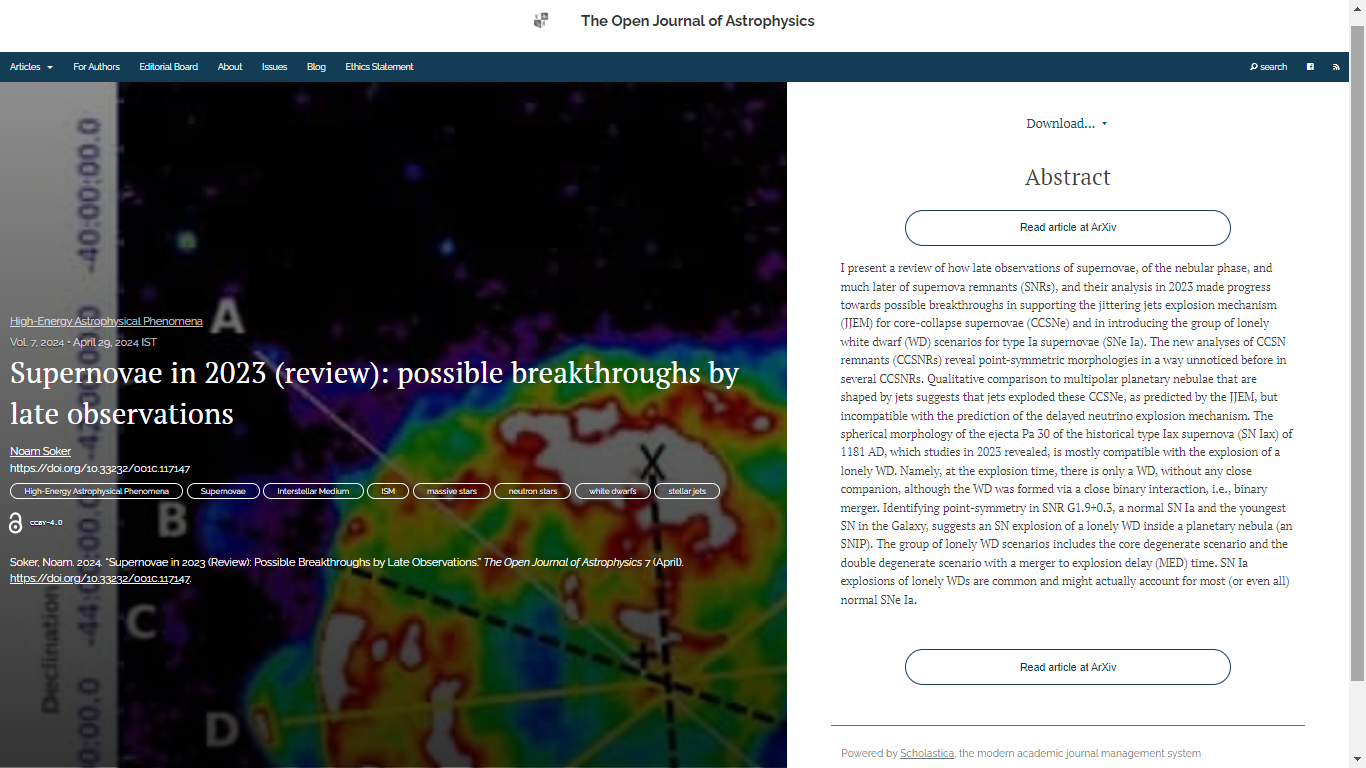
The first paper of the most recent pair – published on  Monday 29th April- is “Supernovae in 2023 (review): possible breakthroughs by late observations” by Noam Soker of Technion in Haifa, Israel. It presents  a discussion of observations of the aftermath of supernovae explosions, such as supernova remnants, and how these may shed light on the explosion mechanism. This one is in the folder marked High-Energy Astrophysical Phenomena.

Here is a screen grab of the overlay which includes the abstract:


You can click on the image of the overlay to make it larger should you wish to do so. You can find the officially accepted version of the paper on the arXiv here.

The second paper was published on Thursday 2nd May and has the title “ΛCDM is alive and well” The authors are: Alain Blanchard (Université de Toulouse, France), Jean-Yves Héloret (Université de Toulouse, France), Stéphane Ilíc (Université Paris-Saclay, France), Brahim Lamine (Université de Toulouse, France) and Isaac Tutusaus (Université de Genève, Switzerland). This one, which is in the folder marked Cosmology and NonGalactic Astrophysics, presents a review of  review of the alleged tensions between observations and the standard cosmological model.

I did a post recently relating to a Royal Society Meeting on this topic. The first version of this paper appeared on arXiv about two years ago but the final version is extensively modified.

Here is a screen grab of the overlay which includes the abstract:


You can click on the image of the overlay to make it larger should you wish to do so. You can find the officially accepted version of the paper on the arXiv here.

And that concludes this week’s update. More next week!

Five New Publications at the Open Journal of Astrophysics

Posted in OJAp Papers, Open Access, The Universe and Stuff with tags , , , , , , , , , on April 6, 2024 by telescoper

As promised a couple of days ago, I am taking the opportunity today to announce the batch of papers at the Open Journal of Astrophysics that were paused slightly while we updated our system. This batch includes five papers, which I now present to you here. These five take the count in Volume 7 (2024) up to 25 and the total published by OJAp up to 140. We’re publishing roughly two papers a week these days so we expect publish about 100 this year.

In chronological order, the five papers, with their overlays, are as follows. You can click on the images of the overlays to make them larger should you wish to do so.

This paper, by Yingtian Chen and Oleg Gnedin of the University of Michigan, is the 21st paper to be published in Volume 7 and the 136th altogether. It is a study of kinematic, chemical and age data of globular clusters from Gaia yielding clues to how the Milky Way Galaxy assembled. Here’s a screenshot of the overlay which includes the abstract. Note the new-style DOI at the bottom left.

You can read the article on arXiv directly here. This paper has a publication date of 20th March 2024, and is in the folder marked Astrophysics of Galaxies.

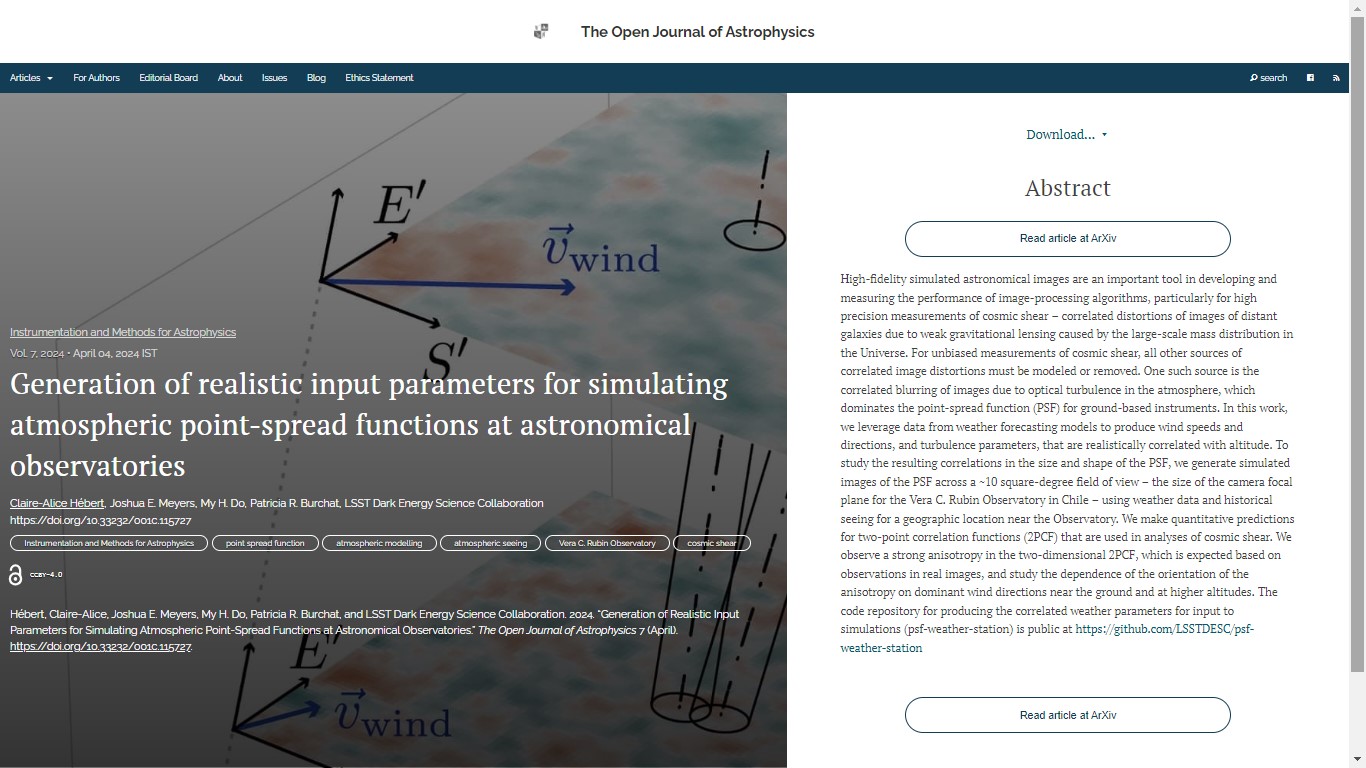
The second paper is “Generation of realistic input parameters for simulating atmospheric point-spread functions at astronomical observatories” by Claire-Alice Hébert (Stanford), Joshua E. Meyers (Stanford), My H. Do (Cal. State U, Pomona), Patricia R. Burchat (Stanford) and the LSST Dark Energy Science Collaboration. It explores the use of atmospheric modelling to generate realistic estimates of the point-spread function for observational work, especially for the Vera C. Rubin Observatory. This one is in the folder marked Instrumentation and Methods for Astrophysics and was published on 4th April 2024. Here is a screen grab of the overlay which includes the abstract:


You can find the officially accepted version of the paper on the arXiv here.

The third paper to announce is “Cosmic Dragons: A Two-Component Mixture Model of COSMOS Galaxies” by William K. Black and August E. Evrard of the University of Michigan (Ann Arbor, USA). This paper was also published on 4th April 2024,  is in the folder Astrophysics of Galaxies and you can see the overlay here:


The accepted version of this paper can be found on the arXiv here.

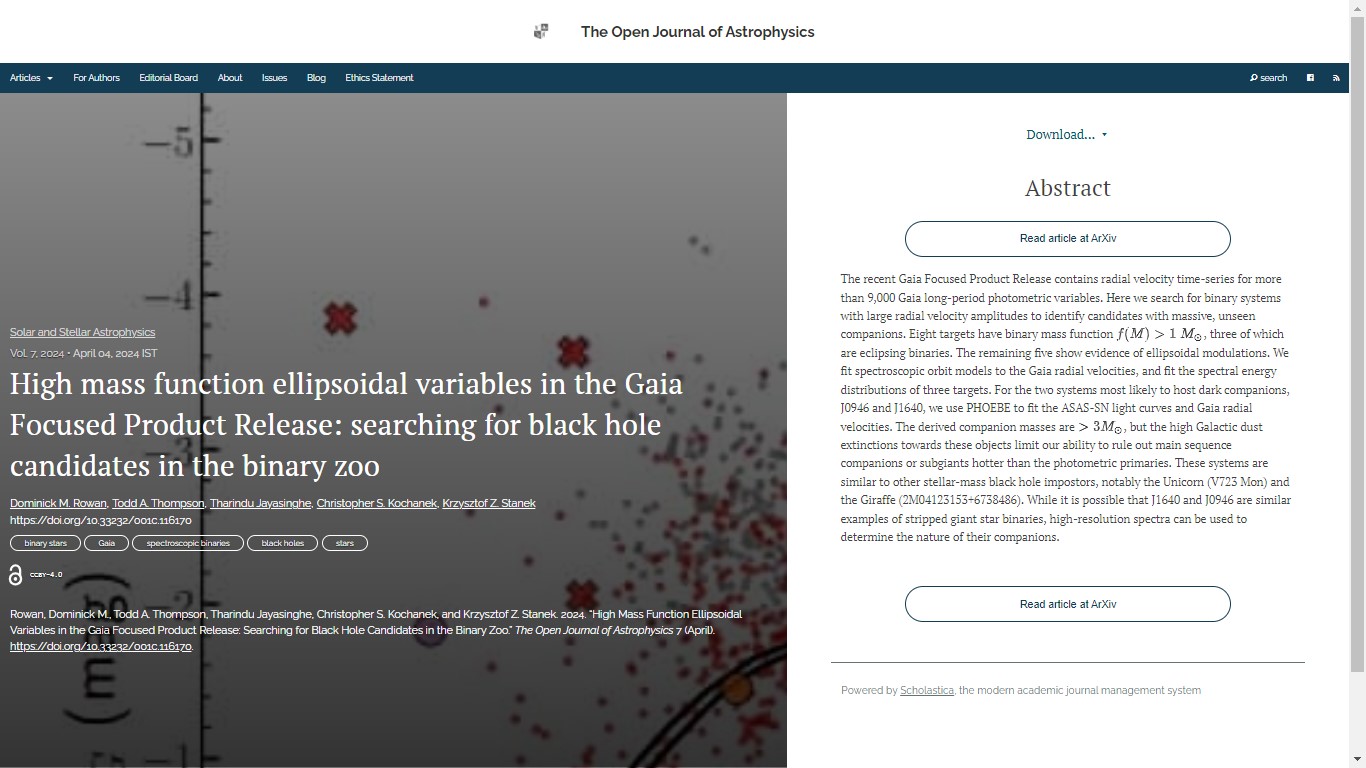
The next paper is “High mass function ellipsoidal variables in the Gaia Focused Product Release: searching for black hole candidates in the binary zoo” by Dominick M. Rowan, Todd A. Thompson,
Tharindu Jayasinghe, Christopher S. Kochanek and Krzysztof Z. Stanek of Ohio State University (USA). This paper, in the Solar and Stellar Astrophysics collection, describes a search for massive unseen stellar companions variable star systems found in Gaia data. This one was also published on 4th April 2024.

Here is the overlay:


You can find the full text for this one on the arXiv here.

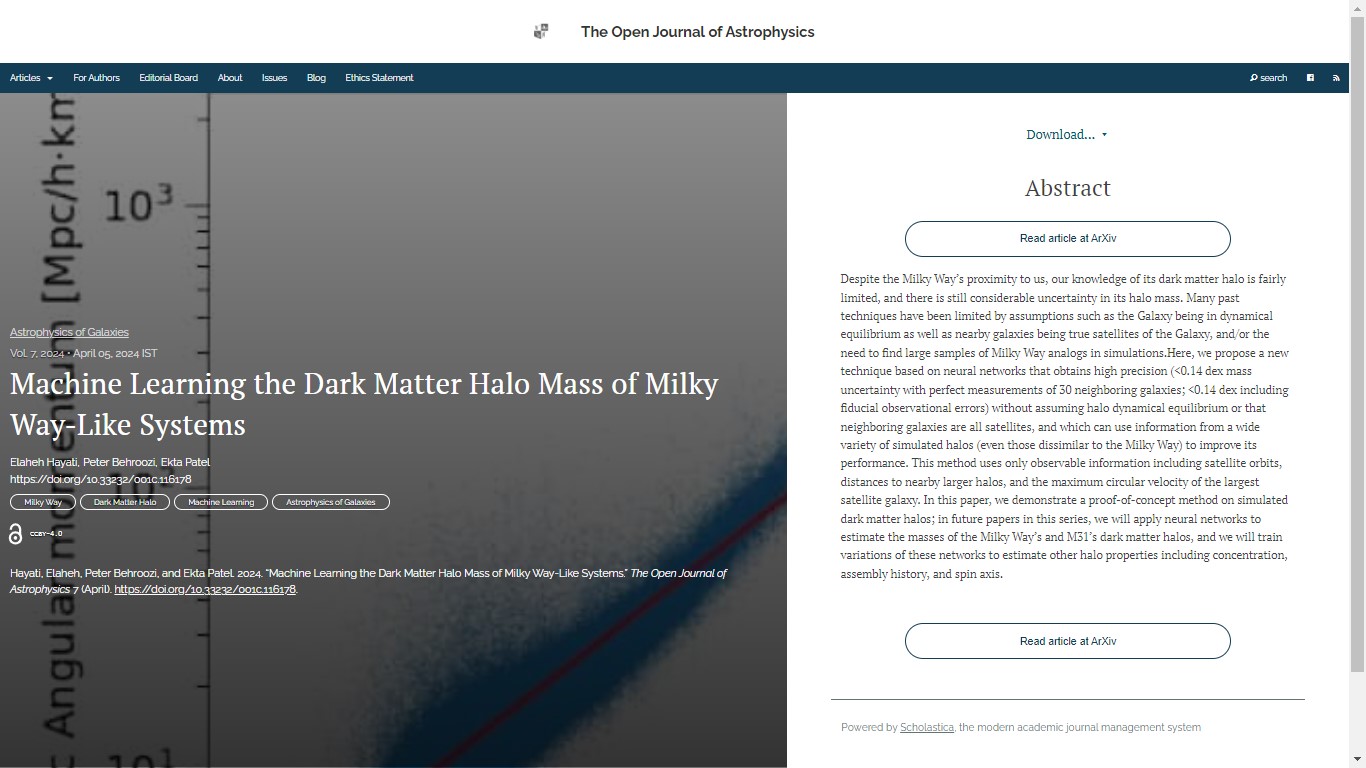
Last in this batch, but by no means least, published yesterday (5th April 2024), we have a paper “Machine Learning the Dark Matter Halo Mass of Milky Way-Like Systems” by Elaheh Hayati & Peter Behroozi (University of Arizona, USA) and Ekta Patel (University of Utah, USA).  The primary classification for this one is once again Astrophysics of Galaxies and it presents a method for estimating the mass of a galaxy halo using neural networks that does not assume, for example,  dynamical equilibrium:


You can click on the image of the overlay to make it larger should you wish to do so. You can find the officially accepted version of the paper on the arXiv here.

As you can see this is quite a diverse collection of papers. Given the increase in submissions in the area of galactic astrophysics we are very happy to welcome another expert in that area to our Editorial Board, in the form of Professor Walter Dehnen of the University of Heidelberg.

Open Journal of Astrophysics Update

Posted in OJAp Papers, Open Access with tags , , , , , on April 4, 2024 by telescoper

I’ve just noticed that my post earlier in the week about changes to the publication system at the Open Journal of Astrophysics is dated April 1st. I can assure you it wasn’t meant as a joke! Anyway, the integration with Crossref is now complete and I’ve started clearing the backlog of papers waiting to be published. I would say normal service has been resumed, but the idea is to make the process faster and more reliable than before so it’s hopefully a return but to better-than-normal service.

I want first of all to thank the people at Maynooth University Library, Crossref, and Scholastica for helping us figure out the issue and solve it. We would no doubt have got there faster were it not for the intervention of the Easter break, but in any case it has only required a pause of publication for a couple of weeks.

I’ll resume the regular weekly updates at the weekend. However, one paper got snarled up when we ran into a problem. Although published on 20th March, it was never properly registered with Crossref. The only way I could think of to sort out the issue with this one was to start it again, which I did this morning, and it is now published though I kept the publication date as 20th March.

This paper, by Yingtian Chen and Oleg Gnedin of the University of Michigan, is the 21st paper to be published in Volume 7 and the 136th altogether. It is a study of kinematic, chemical and age data of globular clusters from Gaia yielding clues to how the Milky Way Galaxy assembled. You can read the article on arXiv directly here.

You will note the new format of DOI on the overlay. Nothing else has changed that’s visible to the reader.

Changes at the Open Journal of Astrophysics

Posted in Maynooth, Open Access with tags , , , , , , , on April 1, 2024 by telescoper

Regular readers of this blog – both of them – will have noticed that I haven’t posted any new publications from the Open Journal of Astrophysics for a couple of weeks. The reason for this is that we are switching to a new system of publishing that automatically integrates the Scholastica platform with Crossref, the system that (among many other things) keeps track of citations to published articles.

Up to now, I have had to prepare manually an XML file containing the metadata for each paper for upload, then send it to a colleague to register with Crossref. There are two problems with this. One is that transcribing the information from each overlay is prone to errors (made by me), especially if there is a long author list. The other problem is that it is rather slow and inefficient, which wasn’t such a problem when we were only publishing a few papers, but now that we are handling much more it is taking up too much time.

The obvious solution is to cut out the middle man (i.e. me) and register everything with Crossref directly from our platform. That will ensure that what goes to Crossref will be exactly the same as on our website and it will go there much faster. Another advantage is that if there is an error on the platform, such as a spelling mistake in an author name, correcting it there will automatically update the metadata on Crossref. You have no idea how much time and frustration this will save. Up to now we have to raise a ticket with Crossref for their staff to make the change, which can take a while to complete.

Scholastica offers a way to do this integration, but it doesn’t work with our existing Digital Object Identifiers (DOIs), which have the format 10.21105/astro.1234.56789, because it doesn’t allow us to include the “astro” which we need it to do because we share the prefix (10.21105) with another journal, the Journal of Open Source Software and we need to keep the two separate; they use 10.21105/joss at the start of their DOIs. After much to-ing and fro-ing we were unable to persuade Scholastica to change their policy, so to use their integration we have been forced to change prefix. Fortunately, Maynooth University (which runs Maynooth Academic Publishing, the official publisher of OJAp) is registered to mint its own DOIs so we can switch to a new prefix (10.33232) and avoid potential problems with the old one.

This change seems straightforward but it requires Crossref to switch the “ownership” of the journal and give us permission to add new papers with the same journal title “The Open Journal of Astrophysics” from what is effect a new publisher. This is a straightforward process, but has been a bit slower than expected because of the Easter break. I expect it to be completed in a week or so, at the latest.

It is important to stress that this change only affects the DOIs and registration of new papers. Existing papers are not affected at all: they continue with the old DOIs. The DOI is meant to be a persistent identifier so this is as it should be. The name of our website domain (astro.theoj.org) remains unchanged too. In other words, nothing visible to authors will change except for the format of the DOIs and the fact we go from acceptance to publication even faster.

If al this seems rather boring, that’s because it is. But please bear with us while we complete this change. It’s definitely going to be worth it in the long run, for me if nobody else!

Three New Publications at the Open Journal of Astrophysics

Posted in OJAp Papers, The Universe and Stuff with tags , , , , , , , , , , , , , , , , on March 19, 2024 by telescoper

Now that I’m safely back in Barcelona it’s a time for a roundup of the latest business at the  Open Journal of Astrophysics. The latest batch of publications consists of three papers, taking the count in Volume 7 (2024) up to 20 and the total published by OJAp up to 135.

This time the papers are all related, have many authors in common, and have the same first author, Philip F. Hopkins of Caltech. In fact the second and third papers in this batch were accepted well before the first one, but it seemed to make much more sense to publish them together so I held those two back a bit and published all three on 14th March.

The three papers published, with their overlays, are as follows. You can click on the images of the overlays to make them larger should you wish to do so. You can read these publications directly on arXiv if you wish; you will find them here, here and here.

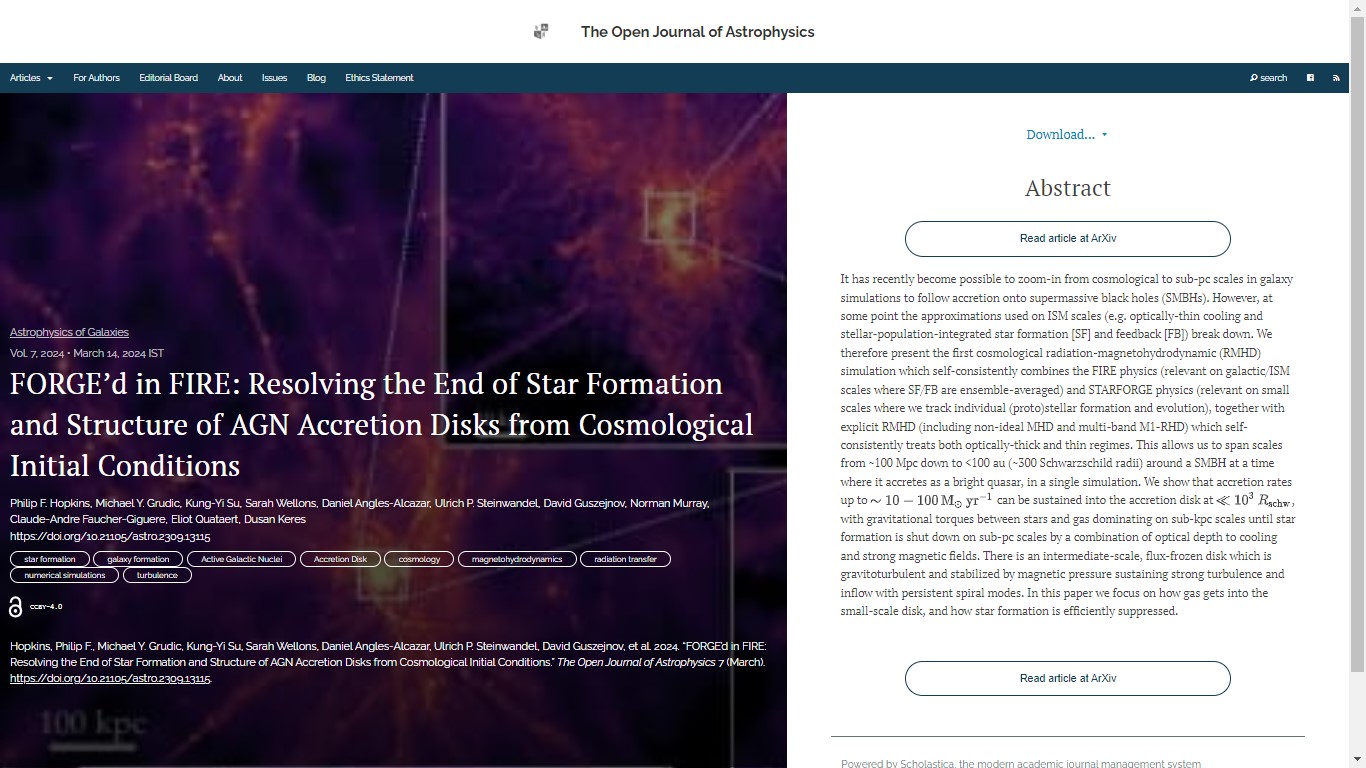
First one up is “FORGE’d in FIRE: Resolving the End of Star Formation and Structure of AGN Accretion Disks from Cosmological Initial Conditions” in which, using a full cosmological simulation, incorporating radiation and magnetohydrodynamics, the authors study the formation and structure of AGN accretion disks and their impact on star formation. This one is in the folder marked Astrophysics of Galaxies.

The authors (ten from the USA and one from Canada) are Philip F. Hopkins (Caltech), Michael Y. Grudic (Carnegie Observatories), Kung-Yi Su (Harvard), Sarah Wellons (Wesleyan University), Daniel Angles-Alcazar (University of Connecticut & Flatiron Institute), Ulrich P. Steinwandel (Flatiron Institute), David Guszejnov (University of Texas at Austin), Norman Murray (CITA, Toronto, Canada), Claude-Andre Faucher-Giguere (Northwestern University), Eliot Quataert (Princeton), and Dusan Keres (University of California, San Diego or UCSD for short).

Here is a screen grab of the overlay, which includes the abstract:


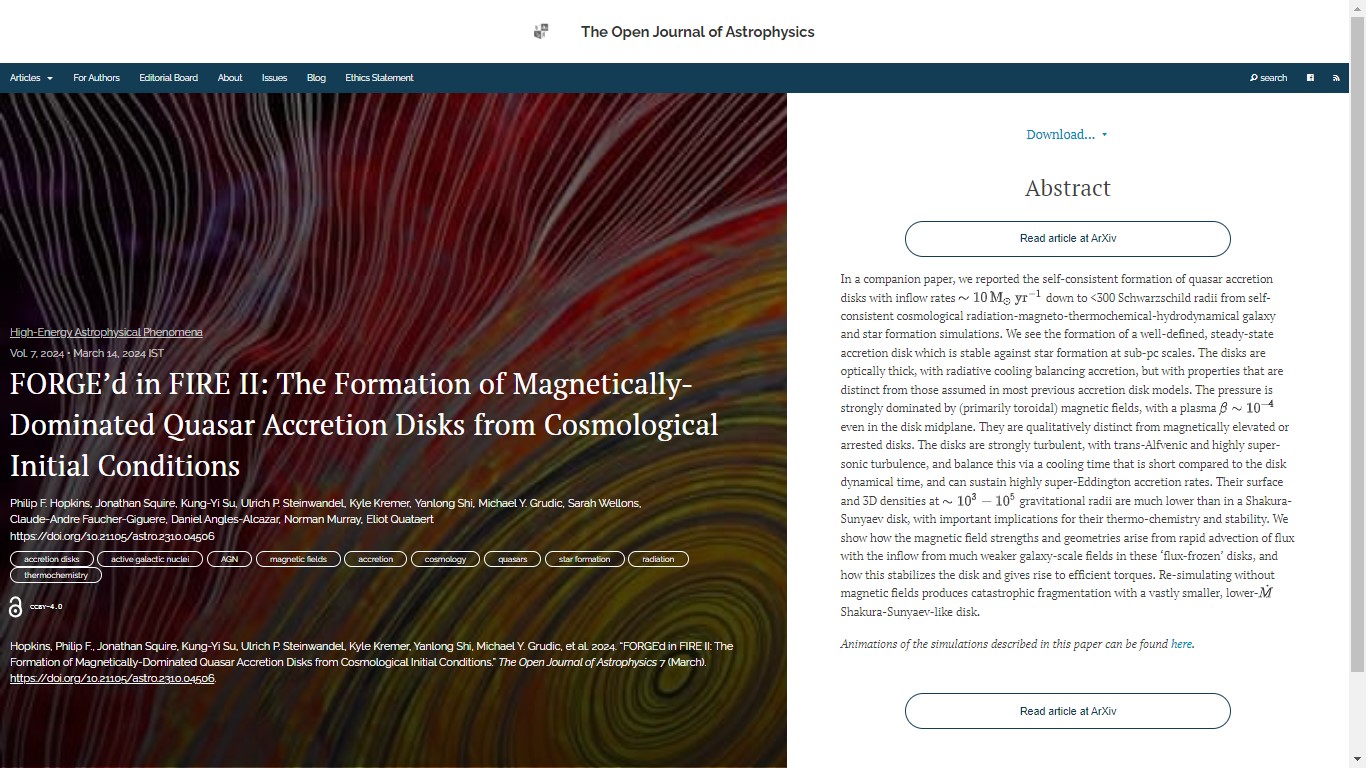
The second paper to announce is “FORGE’d in FIRE II: The Formation of Magnetically-Dominated Quasar Accretion Disks from Cosmological Initial Conditions” which is a study of the formation and properties of highly magnetized accretion disks using numerical simulations that include the effects of radiation, magnetic fields, thermochemistry, and star formation.

This one is in the folder High-Energy Astrophysical Phenomena. The authors (ten based in the USA, one fin Canada, and one in New Zealand) are Philip F. Hopkins, Jonathan Squire (University of Dunedin, New Zealand), Kung-Yi Su (Harvard), Ulrich P. Steinwandel (Flatiron Institute), Kyle Kremer (Caltech), Yanlong Shi (Caltech), Michael Y. Grudic (Carnegie Observatories), Sarah Wellons (Wesleyan University), Claude-Andre Faucher-Giguere (Northwestern University), Daniel Angles-Alcazar (University of Connecticut & Flatiron Institute), Norman Murray (CITA, Toronto), and Eliot Quataert (Princeton).
 

The last paper of this batch, also in the folder High-Energy Astrophysical Phenomena, is  entitled “An Analytic Model For Magnetically-Dominated Accretion Disks” and is closely related to the previous one; this particular paper presents an analytic similarity model for accretion disks that agrees remarkably well with the simulations in the previous one. Animations of the simulations referred to in both papers can be found here.

Here is the overlay:
The authors of this one are Philip F. Hopkins, Jonathan Squire, Eliot Quataert, Norman Murray, Kung-Yi Su, Ulrich P. Steinwandel, Kyle Kremer, Claude-Andre Faucher-Giguere, and Sarah Wellons. You can find all their affiliations above.
That’s all for now. More news in a week or so!